Visualização de leitura

ANZ Organizations Are in the Ransomware Crosshairs— What the Dark Web Is Telling Us
ANZ ransomware threats

The conversation around ANZ ransomware threats has shifted noticeably over the past year. What once looked like sporadic, high-profile incidents has evolved into a sustained and structured campaign against organizations across Australia and New Zealand. Signals emerging from underground forums and marketplaces reveal a sobering reality: ransomware is no longer just a technical problem; it is an economic strategy driven by efficiency, specialization, and scale. 

At the center of this shift is ransomware dark web intelligence, which paints a clear picture of attacker intent. Threat actors are not simply increasing volume; they are refining their focus. The ANZ region, with its high-value economy and deeply digitized infrastructure, has become a preferred hunting ground. 

Why High-Value Economies Attract ANZ Ransomware Threats 

Australia’s economic profile plays directly into the hands of ransomware operators. A strong GDP, combined with a relatively small population, creates a high-return environment. Attackers don’t need to cast a wide net; each successful breach can yield significant payouts. 

By mid-2025, 71 ransomware incidents had been publicly claimed in Australia, compared to nine in New Zealand. On the surface, those figures may seem moderate. However, when adjusted for population, the rate of ransomware attacks in Australia and New Zealand stands out globally. Even larger economies have not experienced the same intensity relative to their size. 

This imbalance reflects a fundamental principle driving ANZ organizations cybersecurity risks: attackers prioritize value over volume. In practical terms, fewer victims can still mean higher profits. 

A Fragmented Threat Landscape with No Single Dominant Actor 

Unlike regions where one ransomware group dominates headlines, the dark web ANZ cyber threats ecosystem is notably fragmented. Multiple groups, including Qilin, Akira, INC, Lynx, and Dragonforce, operate concurrently, each claiming a similar share of attacks. 

This decentralization complicates defense strategies. Organizations are not facing a predictable adversary with a consistent playbook. Instead, they must prepare for a rotating cast of threat actors, each bringing different techniques, timelines, and negotiation tactics. 

From a ransomware dark web intelligence perspective, this fragmentation signals a competitive market. Threat actors are actively testing sectors, probing defenses, and adapting quickly based on what works. 

Industries Under Sustained Pressure 

The distribution of ANZ ransomware threats is far from uniform. Certain sectors continue to absorb the majority of attacks due to the nature of their operations. 

Healthcare and professional services sit at the top of the list. In healthcare, the urgency of patient care creates a near-zero tolerance for downtime, increasing the likelihood of ransom payments. Professional services firms, on the other hand, hold large volumes of sensitive client data, making them lucrative targets. 

However, the scope is broader than these two sectors alone. Aviation software providers, pharmaceutical companies, engineering firms, and even steel manufacturers have all been affected. This pattern reinforces a key insight: ransomware attacks in Australia and New Zealand are opportunistic but calculated, targeting environments where disruption carries tangible consequences. 

Notable Incidents Reveal Tactical Evolution 

Several incidents in 2025 highlight how attackers are evolving their methods. 

The Akira group compromised an Australian industrial technology provider, exfiltrating approximately 10GB of sensitive data, including financial records and employee identification documents. This case highlights the growing overlap between ransomware and critical infrastructure risk. 

In another breach, a political organization suffered exposure to communications, identity records, and financial data, highlighting that ANZ organizations' cybersecurity risks extend beyond the private sector. 

Meanwhile, Dragonforce leaked over 100GB of data from an engineering firm, including technical drawings and internal reports. The long-term implications of such intellectual property theft often exceed immediate financial damage. 

These cases share a common thread: encryption is no longer the sole objective. Data exfiltration and double extortion have become standard practices. 

The Rise of Initial Access Brokers 

One of the most important developments in shaping dark web ANZ cyber threats is the growth of the initial access market. In 2025 alone, 92 instances of compromised access sales were observed across Australia and New Zealand. 

Retail organizations accounted for roughly 34% of these cases, followed by BFSI and professional services. The implications are significant. Attackers no longer need to breach networks themselves; they can simply purchase access. 

This shift has redefined how ANZ ransomware threats materialize. The most complex phase of an attack—initial intrusion—is now outsourced, accelerating timelines and increasing overall attack volume. 

It also introduces indirect risk. Organizations may be compromised through vendors, partners, or shared platforms, expanding the attack surface beyond traditional boundaries. 

Ransomware-as-a-Service and the Scaling Problem 

The emergence of affiliate-driven models, particularly groups like INC Ransom, has further amplified ransomware attacks in Australia and New Zealand. Operating under a Ransomware-as-a-Service structure, these groups separate responsibilities: affiliates handle intrusions, while core operators manage ransom negotiations. 

This model enables rapid scaling. Multiple attacks can be executed simultaneously, each leveraging shared infrastructure and tooling. 

INC Ransom’s activity across healthcare and professional services highlights how effective this approach has become. Their operations often involve credential compromise, privilege escalation, lateral movement, and eventual deployment of ransomware—frequently paired with data exfiltration. 

From a ransomware dark web intelligence standpoint, this reflects a mature ecosystem where roles are specialized, and efficiency is maximized. 

A Regional Problem with Cross-Border Impact 

Although Australia is the primary target, the broader region is not immune. A ransomware attack on Tonga’s Ministry of Health disrupted national healthcare services, while a major breach in New Zealand’s healthcare sector involved both data theft and system encryption. 

These incidents reinforce the interconnected nature of ANZ organizations' cybersecurity risks. Threat actors operate without regard for national boundaries, shifting focus wherever defenses appear weakest. 

Common Entry Points and Techniques 

Despite the evolving ecosystem, many attack methods remain consistent. Spear-phishing campaigns, exploitation of unpatched systems, and the use of stolen credentials continue to dominate. 

Once inside, attackers often rely on legitimate tools—file compression utilities, remote management software, and standard data transfer mechanisms—to blend into normal operations. This “living off the land” approach makes detection significantly more difficult. 

From Defense to Resilience 

The steady rise of ANZ ransomware threats signals a need for strategic change. Perimeter-based defenses are no longer sufficient in an environment where access can be purchased, and attacks can be outsourced. 

As access is bought and attacks are outsourced, organizations must shift toward stronger identity controls, continuous monitoring, rapid patching, and tighter third-party risk management. 

Cybersecurity is no longer just about prevention—it’s about resilience. Attacks are inevitable, but their impact doesn’t have to be. Cyble helps organizations stay ahead with AI-powered threat intelligence, dark web monitoring, and predictive defense through its AI-native platform, Cyble Blaze. 

Stay ahead of ransomware threats—book a free demo and build a more resilient security posture.

The post ANZ Organizations Are in the Ransomware Crosshairs— What the Dark Web Is Telling Us appeared first on Cyble.
SOHO router compromise leads to DNS hijacking and adversary-in-the-middle attacks

Executive summary

Forest Blizzard, a threat actor linked to the Russian military, has been compromising insecure home and small-office internet equipment like routers, then modifying their settings in ways that turn them into part of the actor’s malicious infrastructure. The threat actor then hides behind this legitimate but compromised infrastructure to spy on additional targets or conduct follow-on attacks. Microsoft Threat Intelligence is sharing information on this campaign to increase awareness of the risks associated with insecure home and small-office internet routing devices and give users and organizations tools to mitigate, detect, and hunt for these threats where they might be impacted. 


Since at least August 2025, the Russian military intelligence actor Forest Blizzard, and its sub-group tracked as Storm-2754, has conducted a large-scale exploitation of vulnerable small office/home office (SOHO) devices to hijack Domain Name System (DNS) requests and facilitate the collection of network traffic. For nation-state actors like Forest Blizzard, DNS hijacking enables persistent, passive visibility and reconnaissance at scale.

By compromising edge devices that are upstream of larger targets, threat actors can take advantage of less closely monitored or managed assets to pivot into enterprise environments. Microsoft Threat Intelligence has identified over 200 organizations and 5,000 consumer devices impacted by Forest Blizzard’s malicious DNS infrastructure; telemetry did not indicate compromise of Microsoft-owned assets or services.

Forest Blizzard, which primarily collects intelligence in support of Russian government foreign policy initiatives, has also leveraged its DNS hijacking activity to support post-compromise adversary-in-the-middle (AiTM) attacks on Transport Layer Security (TLS) connections against Microsoft Outlook on the web domains. This activity enables the interception of cloud-hosted content, impacting numerous sectors including government, information technology (IT), telecommunications, and energy—all usual targets for this actor.

While the number of organizations specifically targeted for TLS AiTM is only a subset of the networks with vulnerable SOHO devices, Microsoft Threat Intelligence assesses that the threat actor’s broad access could enable larger-scale AiTM attacks, which might include active traffic interception. Targeting SOHO devices is not a new tactic, technique, or procedure (TTP) for Russian military intelligence actors, but this is the first time Microsoft has observed Forest Blizzard using DNS hijacking at scale to support AiTM of TLS connections after exploiting edge devices.

In this blog, we share our analysis of the TTPs used by Forest Blizzard in this campaign to illustrate how threat actors leverage this attack surface. We’re also outlining mitigation and protection recommendations to reduce exposure from compromised SOHO devices, as well as Microsoft Defender detection and hunting guidance to help defenders identify and investigate related malicious activity. It’s important for organizations to account for unmanaged SOHO devices—particularly those used by remote and hybrid employees—since compromised home and small‑office network infrastructure can expose cloud access and sensitive data even when enterprise environments and cloud services themselves remain secure.

DNS hijacking attack chain: From compromised devices to AiTM and other follow-on activity

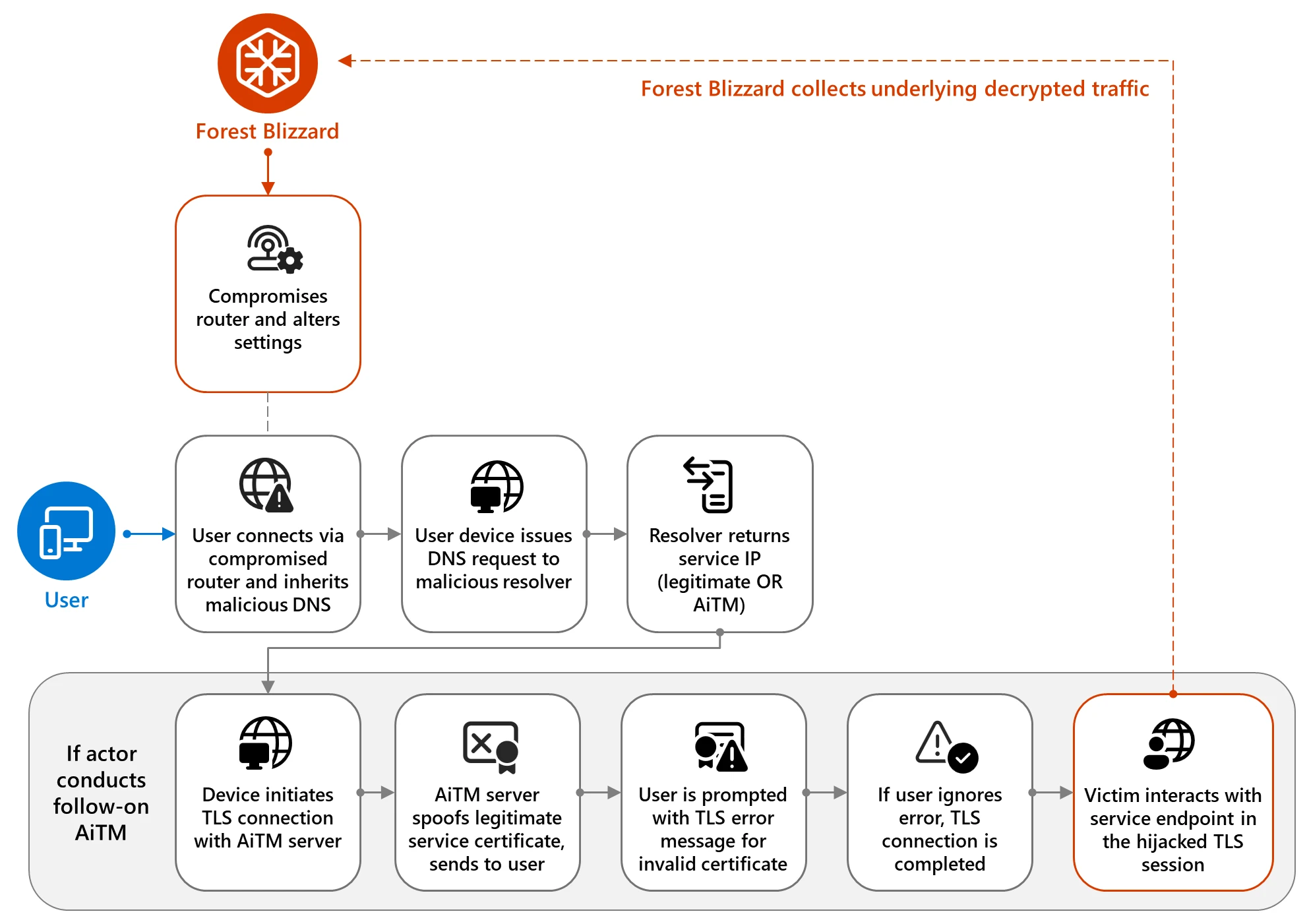
The following sections provide details on Forest Blizzard’s end-to-end attack chain for this campaign, from initial access on vulnerable SOHO routers to actor-controlled DNS resolution and AiTM activity.

Figure 1. DNS hijacking through router compromise

Edge router compromise

Forest Blizzard gained access to SOHO devices then altered their default network configurations to use actor-controlled DNS resolvers. This malicious re-configuration resulted in thousands of devices sending their DNS requests to actor-controlled servers.

Typically, endpoint devices obtain network configuration settings from edge devices through Dynamic Host Configuration Protocol (DHCP). Exploiting SOHO devices requires minimal investment while providing wide visibility on compromised devices, allowing the actor to collect DNS traffic and passively observe DNS requests, which could facilitate follow-on collection activity as described in the next section.

DNS hijacking

Forest Blizzard is almost certainly using the dnsmasq utility to perform DNS resolution and provide responses while listening on port 53 for DNS queries. The dnsmasq utility is a legitimate tool that provides lightweight network services widely used in home routers or smaller networks. Among its services are DNS forwarding and caching and a DHCP server, which collectively enable upstream DNS query forwarding and IP address assignment on a local network.

Adversary-in-the-middle attacks

Microsoft Threat Intelligence has observed AiTM attacks related to the initial access campaign. Although they target different endpoints, both are Transport Layer Security (TLS) AiTM attacks, allowing the threat actor to collect data being transmitted.

In most cases, the DNS requests appear to have been transparently proxied by the actor’s infrastructure, resulting in connections to the legitimate service endpoints without interruption. However, in a limited number of compromises, the threat actor spoofed DNS responses for specifically targeted domains to force impacted endpoints to connect to infrastructure controlled by the threat actor.

The actor-controlled malicious infrastructure would then present an invalid TLS certificate to the victim, spoofing the legitimate Microsoft service. If the compromised user ignored warnings about the invalid TLS certificate, the threat actor could then actively intercept the underlying plaintext traffic—potentially including emails and other customer content— within the TLS connection. Since Forest Blizzard does not always conduct AiTM activity after achieving initial access through DNS hijacking, the actor is likely using it selectively against targets of intelligence priority post-compromise:

  • AiTM attack against Microsoft 365 domains: Microsoft observed Forest Blizzard conducting follow-on AiTM operations against a subset of domains associated with Microsoft Outlook on the web.
  • AiTM attack against specific government servers: Microsoft identified separate AiTM activity targeting non-Microsoft hosted servers in at least three government organizations in Africa, during which Forest Blizzard intercepted DNS requests and conducted follow-on collection.

Possible post-compromise activities

Forest Blizzard’s DNS hijacking and AiTM activity allows the actor to conduct DNS collection on sensitive organizations worldwide and is consistent with the actor’s longstanding remit to collect espionage against priority intelligence targets. Although we have only observed Forest Blizzard utilizing their DNS hijacking campaign for information collection, an attacker could use an AiTM position for additional outcomes, such as malware deployment or denial of service.

Mitigation and protection guidance

Microsoft recommends the following mitigation steps to protect against this Forest Blizzard activity:

Protection against DNS hijacking

Protection against AiTM and credential theft

  • Centralize your organization’s identity management into a single platform. If your organization is a hybrid environment, integrate your on-premises directories with your cloud directories. If your organization is using a third-party for identity management, ensure this data is being logged in a SIEM or connected to Microsoft Entra to fully monitor for malicious identity access from a centralized location.
    • The added benefits to centralizing all identity data is to facilitate implementation of Single Sign On (SSO) and provide users with a more seamless authentication process, as well as configure Microsoft Entra’s machine learning models to operate on all identity data, thus learning the difference between legitimate access and malicious access quicker and easier.
    • It is recommended to synchronize all user accounts except administrative and high privileged ones when doing this to maintain a boundary between the on-premises environment and the cloud environment, in case of a breach. 
  • Strictly enforce multifactor authentication (MFA) and apply Conditional Access policies, particularly for privileged and high‑risk accounts, to reduce the impact of credential compromise. Use passwordless solutions like passkeys in addition to implementing MFA.
  • Implement continuous access evaluation and implement a sign-in risk policy to automate response to risky sign-ins. A sign-in risk represents the probability that a given authentication request isn’t authorized by the identity owner. A sign-in risk-based policy can be implemented by adding a sign-in risk condition to Conditional Access policies that evaluates the risk level of a specific user or group. Based on the risk level (high/medium/low), a policy can be configured to block access or force multi-factor authentication. We recommend requiring multi-factor authentication on Medium or above risky sign-ins. 
  • Follow best practices for recovering from systemic identity compromises outlined by Microsoft Incident Response.

Microsoft Defender detection and hunting guidance

Microsoft Defender customers can refer to the following list of applicable detections. Microsoft Defender coordinates detection, prevention, investigation, and response across endpoints, identities, email, apps to provide integrated protection against attacks like the threat discussed in this blog.

Microsoft Defender for Endpoint

The following alerts might indicate threat activity associated with this threat. These alerts, however, can be triggered by unrelated threat activity and are not monitored in the status cards provided with this report. Microsoft tracks the specific component of Forest Blizzard associated with this activity as Storm-2754.

  • Forest Blizzard Actor activity detected
  • Storm-2754 activity

Entra ID Protection

The following Microsoft Entra ID Protection risk detection informs Entra ID user risk events and can indicate associated threat activity, including unusual user activity consistent with known Forest Blizzard attack patterns identified by Microsoft Threat Intelligence research: 

Hunting

Because initial compromise and DNS modification occur at the router-level, the following hunting recommendations focus on detecting post-compromise behavior.

Modifications to DNS settings

In identified activity, Forest Blizzard’s compromise of an infected SOHO device resulted in the update of the default DNS setting on connected Windows machines.

  • Identifying unusual modifications to DNS settings can be an identifier for malicious DNS hijacking activity.
  • Resetting the DNS settings and addressing vulnerable SOHO devices can resolve this activity, though these actions will not remediate an attacker who has managed to steal user credentials in follow-on AiTM activity.

Post-compromise activity

Forest Blizzard’s post-compromise AiTM activity could enable the actor to operate in the environment as a valid user. Establishing a baseline of normal user activity is important to be able to identify and investigate potentially anomalous actions. For Entra environments, Microsoft Entra ID Protection provides two important reports for daily activity monitoring:

  • Risky sign-in reports surfaces attempted and successful user access activities where the legitimate owner might not have performed the sign-in.
  • Risky user reports surfaces user accounts that might have been compromised, such as a leaked credential that was detected or the user signing in from an unexpected location in the absence of planned travel.

Defenders can surface highly suspicious or successful risky sign-ins using the following advanced hunting query in the Microsoft Defender XDR portal:

AADSignInEventsBeta 
| where RiskLevelAggregated == 100 and (ErrorCode == 0 or ErrorCode == 50140) 
| project Timestamp, Application, LogonType, AccountDisplayName, UserAgent, IPAddress 

After stealing credentials, Forest Blizzard could potentially carry out a range of activity against targets as a legitimate user. For Microsoft 365 environments, the ActionType “Search” or “MailItemsAccessed” in the CloudAppEvents table in the Defender XDR portal can provide some information on user search activities, including the Microsoft Defender for Cloud Apps connector that surfaces activity unusual for that user.

CloudAppEvents
| where AccountObjectId == " " // limit results to specific suspicious user accounts by adding the user here
| where ActionType has_any ("Search", "MailItemsAccessed")

Threat intelligence reports

Microsoft Defender XDR customers can use the following threat analytics reports in the Defender portal (requires license for at least one Defender XDR product) to get the most up-to-date information about the threat actor, malicious activity, and techniques discussed in this blog. These reports provide the intelligence, protection information, and recommended actions to prevent, mitigate, or respond to associated threats found in customer environments:

Microsoft Security Copilot

Microsoft Security Copilot is embedded in Microsoft Defender and provides security teams with AI-powered capabilities to summarize incidents, analyze files and scripts, summarize identities, use guided responses, and generate device summaries, hunting queries, and incident reports.

Customers can also deploy AI agents, including the following Microsoft Security Copilot agents, to perform security tasks efficiently:

Security Copilot is also available as a standalone experience where customers can perform specific security-related tasks, such as incident investigation, user analysis, and vulnerability impact assessment. In addition, Security Copilot offers developer scenarios that allow customers to build, test, publish, and integrate AI agents and plugins to meet unique security needs.

Learn more

For the latest security research from the Microsoft Threat Intelligence community, check out the Microsoft Threat Intelligence Blog.

To get notified about new publications and to join discussions on social media, follow us on LinkedIn, X (formerly Twitter), and Bluesky.

To hear stories and insights from the Microsoft Threat Intelligence community about the ever-evolving threat landscape, listen to the Microsoft Threat Intelligence podcast.

The post SOHO router compromise leads to DNS hijacking and adversary-in-the-middle attacks appeared first on Microsoft Security Blog.

China’s APT41 and the Expanding Enterprise Attack Surface: What Security Teams Must Prepare For

China APT41 cyber attacks

The modern enterprise attack surface is no longer confined to corporate networks and endpoints; it now stretches across cloud workloads, supply chains, remote devices, and even operational technology environments.

Within this fragmented landscape, the activities of the APT41 threat group stand out as a signal of how hackers and adversaries are adapting. Known for blending state-sponsored espionage with financially motivated operations, APT41 represents a dual-purpose threat model that security teams can no longer afford to treat as an edge case.

Understanding APT41’s Hybrid Threat Model

Unlike many threat actors that operate with a singular objective, China APT41 cyber-attacks are notable for their breadth of intent. Active since 2012, the group has consistently targeted industries ranging from healthcare and telecommunications to gaming, logistics, and finance. This diversity is not accidental; it reflects a deliberate strategy to exploit both high-value intelligence targets and monetization opportunities. 

Operating under aliases such as Wicked Panda, Brass Typhoon, and BARIUM, the APT41 threat group has demonstrated a level of operational maturity that blends long-term persistence with opportunistic intrusion.  

Their campaigns often involve supply chain compromises, credential harvesting, and stealthy lateral movement, techniques that align closely with the realities of today’s sprawling enterprise environments. 

Maritime Sector: A Case Study in Expanding Risk

One of the more telling examples of this evolution is the maritime industry. Responsible for roughly 90% of global trade, it has become a focal point for cyber operations. Recent threat intelligence findings have documented over a hundred cyber incidents targeting shipping and logistics organizations, with multiple advanced persistent threat groups involved. 

Within this context, China APT41 cyber attacks have impacted shipping entities across Europe and Asia, including targets in the UK, Italy, Spain, Turkey, Taiwan, and Thailand. What makes these attacks particularly concerning is not just their frequency, but their depth.  

Malware frameworks such as DUSTTRAP have been deployed to evade forensic analysis, while tools like ShadowPad and VELVETSHELL enable persistent access and data exfiltration. The maritime sector also highlights a new issue in enterprise attack surface security: the convergence of IT and operational technology. Cargo systems, navigation tools, and logistics platforms are interconnected, creating new entry points that traditional security models often overlook. 

The Scale and Sophistication of Tooling

The operational toolkit associated with APT41 is extensive, spanning more than 90 identified malware families and utilities. These range from widely available tools like Cobalt Strike and Mimikatz to custom-built backdoors, loaders, and rootkits. This combination allows the group to remain flexible, often blending into legitimate administrative activity while maintaining persistence within compromised networks. 

Credential theft tools such as Impacket and pwdump are frequently used to escalate privileges, while reconnaissance frameworks like PowerSploit and PlugX help map internal environments. In parallel, custom implants like KEYPLUG and MoonBounce demonstrate a high degree of technical sophistication, particularly in evading detection. 

Legal Actions and Global Reach

The global footprint of the APT41 threat group has not gone unnoticed. In 2019 and 2020, U.S. authorities unsealed indictments against several individuals allegedly linked to the group, including Zhang Haoran, Tan Dailin, Qian Chuan, Fu Qiang, and Jiang Lizhi. The charges ranged from unauthorized access and identity theft to money laundering and racketeering. 

These cases revealed the scale of APT41’s operations, including attacks on hundreds of organizations worldwide. Victims spanned continents and sectors, with telecommunications providers, social media platforms, and government entities among those impacted. Notably, the group has also been linked to ransomware deployment, further blurring the line between espionage and cybercrime. 

Preparing for What Comes Next

The APT41 threat group stands out for its adaptability, shifting between espionage and financially driven operations while exploiting gaps across the modern enterprise. Defending against APT41 and broader China APT41 cyber attacks requires more than point solutions; it demands strong enterprise attack surface security and continuous attack surface management to understand and reduce exposure across interconnected systems. 

Platforms like Cyble help organizations stay ahead with real-time threat intelligence and AI-driven security. Explore Cyble or schedule a demo to strengthen defenses against evolving threats like APT41. 

References:

The post China’s APT41 and the Expanding Enterprise Attack Surface: What Security Teams Must Prepare For appeared first on Cyble.

India’s Evolving Cyber Threat Landscape: State-Sponsored Attacks, Hacktivism, and What’s Next in 2026

India Cyber Threat Landscape 2026

The India cyber threat landscape 2026 is no longer defined by isolated incidents or opportunistic attacks. It has become a dynamic, constantly shifting battleground shaped by geopolitical tensions, rapid digitization, and highly advanced hackers. What once looked like sporadic cybercrime has matured into a layered ecosystem of state-sponsored cyber attacks, organized ransomware groups, and a growing wave of Hacktivism in India. 

Recent threat intelligence observations reveal a new pattern: attackers are not only becoming more capable, but also more strategic. They are targeting supply chains, exploiting systemic weaknesses, and adapting their methods faster than most organizations can respond. As a result, understanding India cybersecurity trends in 2026 requires looking beyond raw numbers and examining how intent, capability, and opportunity are converging. 

A Surge in Attacks: The Numbers Tell Only Part of the Story 

India’s exposure to cyber risk has expanded dramatically. In the first half of 2024 alone, the country experienced 593 cyberattacks, including 388 data breaches, 107 data leaks, and 39 ransomware incidents. These figures highlight not just frequency, but diversity in attack types. 

By October 2025, the threat environment had intensified further. Cybersecurity teams faced a sharp escalation marked by: 

  • Record-breaking supply chain compromises  

  • Ransomware activity is reaching one of its highest peaks of the year  

  • Attackers are deploying more refined and targeted techniques across sectors  

The Rise of State-Sponsored Operations 

One of the most defining aspects of the Indian cyber threat landscape in 2026 is the growing footprint of state-backed threat actors. These groups operate with long-term objectives, often aligned with geopolitical interests rather than immediate financial gain. 

Unlike conventional cybercriminals, state-sponsored cyber attacks in India tend to: 

  • Focus on espionage and intelligence gathering. 

  • Target government networks, defense infrastructure, and strategic industries. 

  • Use advanced persistent threat (APT) techniques to maintain long-term access. 

What makes these actors particularly dangerous is their patience. They are not looking for quick wins; they are embedding themselves within systems, studying operational patterns, and waiting for the right moment to act. This shift has forced Indian organizations to rethink cybersecurity not just as an IT concern, but as a matter of national and economic security. 

Hacktivism in India: Ideology Meets Cyber Capability 

Parallel to state-backed threats, Hacktivism in India has gained noticeable momentum. Unlike financially motivated attackers, hacktivist groups are driven by political, ideological, or social causes. 

In recent years, these actors have: 

  • Defaced government and corporate websites  

  • Leaked sensitive data to make political statements  

  • Coordinated attacks around major national or international events  

What’s changing in 2026 is the level of coordination and technical maturity. Hacktivist groups are no longer limited to basic disruptions; they are leveraging tools and tactics once associated with more advanced threat actors. This convergence is blurring the lines between activism and cyber warfare. 

Supply Chain and Sector-Specific Vulnerabilities 

A notable trend shaping India's cybersecurity trends in 2026 is the rise of supply chain attacks. Instead of targeting a single organization directly, attackers compromise with a trusted vendor or service provider to gain access to multiple downstream systems. 

This approach has proven particularly effective in sectors undergoing rapid digital transformation, such as healthcare. India’s healthcare industry, for instance, has embraced digitization at scale, improving efficiency and accessibility. However, this expanded digital footprint has also introduced new vulnerabilities. 

Threat actors targeting this sector are: 

  • Exploiting interconnected systems and third-party dependencies  

  • Using ransomware to disrupt critical services  

  • Leveraging stolen health data for financial and strategic gain  

The Expanding Role of Threat Intelligence 

In response to the growing complexity of cyber attacks in India 2026, organizations are turning to threat intelligence as a core defense mechanism. This goes beyond basic monitoring and involves a multi-layered approach: 

  • Tactical intelligence for real-time threat detection  

  • Operational intelligence to understand attacker behavior  

  • Strategic intelligence to anticipate future risks  

  • Technical intelligence to analyze vulnerabilities and exploits  

What Lies Ahead: Preparing for the Next Phase 

Looking forward, the India cyber threat landscape 2026 will likely be shaped by three key forces: 

  1. Automation and AI in Attacks and Defense: Attackers are beginning to use automation to scale their operations, while defenders are deploying AI to detect anomalies faster. This creates a technological arms race with no clear endpoint.  

  1. Blurring of Threat Actor Categories: The distinctions between cybercriminals, hacktivists, and state-sponsored groups are becoming less defined. Collaboration and shared tools are making attribution more difficult.  

  1. Increased Focus on Operational Technology (OT): As industries digitize their operational environments, attacks will target systems that control physical processes, raising the stakes significantly.  

Conclusion 

The India cyber threat landscape 2026 has made cybersecurity a strategic priority, not just an IT function. With rising state sponsored cyber attacks India and coordinated Hacktivism in India, organizations must shift to intelligence-driven, proactive defense to keep up with cyber attacks in India 2026.  

Cyble addresses this need with AI-native threat intelligence and real-time response capabilities that help teams stay ahead of evolving risks. To see how this approach works in practice, book a Personalized Demo today! 

The post India’s Evolving Cyber Threat Landscape: State-Sponsored Attacks, Hacktivism, and What’s Next in 2026 appeared first on Cyble.

Ransomware Attacks Have Surged 30% Since Q4 2025

ransomware groups in Q4 2025

Ransomware groups claimed more than 2,000 attacks in the last three months of 2025 – and they’re starting 2026 at the same elevated pace. 

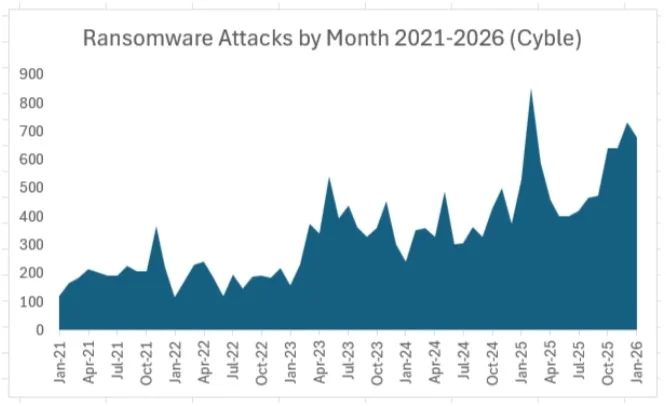
Cyble recorded 2,018 claimed attacks by ransomware groups in the fourth quarter of 2025, an average of just under 673 a month. The threat groups maintained that pace in January 2026, claiming 679 ransomware victims. 

By comparison, in the first nine months of 2025, ransomware groups averaged 512 claimed victims a month, so the trend in the last four months has been more than 30% above the previous nine-month period. The chart below shows ransomware attacks by month since 2021. 

ransomware attacks by year 2021-2026

Qilin Leads All Ransomware Groups as CL0P Returns 

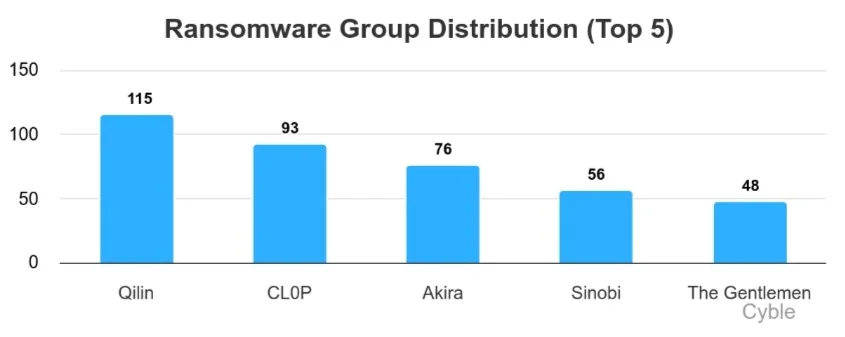
Qilin once again led all ransomware groups, with 115 claimed attacks in January. A resurgent CL0P has claimed scores of victims in the last two weeks, yet as of this writing had provided no technical details on the group’s latest campaign. Akira once again remained among the leaders with 76 claimed victims, while newcomers Sinobi and The Gentlemen rounded out the top five (chart below). 

ransomware groups distribution

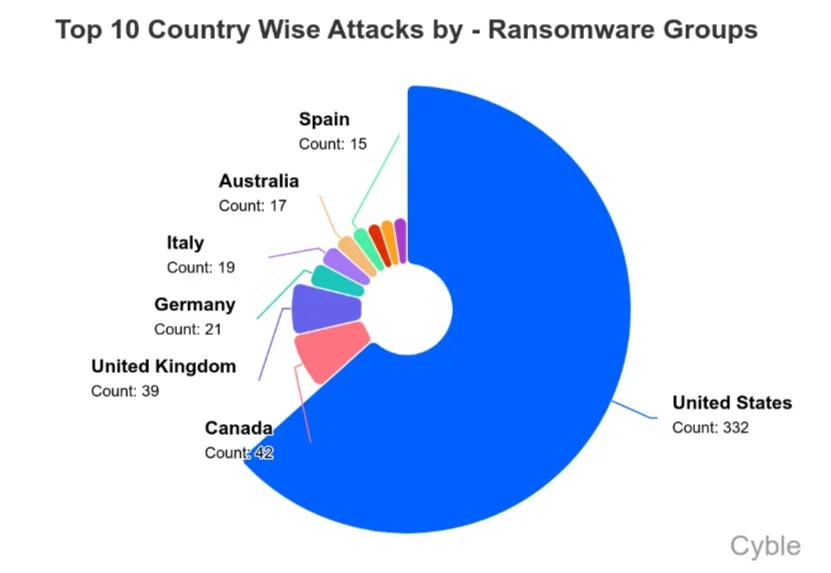
The U.S. once again was the most attacked country by a significant margin, accounting for just under half of all ransomware attacks in January (chart below). The UK and Australia experienced higher-than-usual attack volumes; CL0P’s recent campaign was a factor in both of those increases. 

ransomware groups country wise attacks

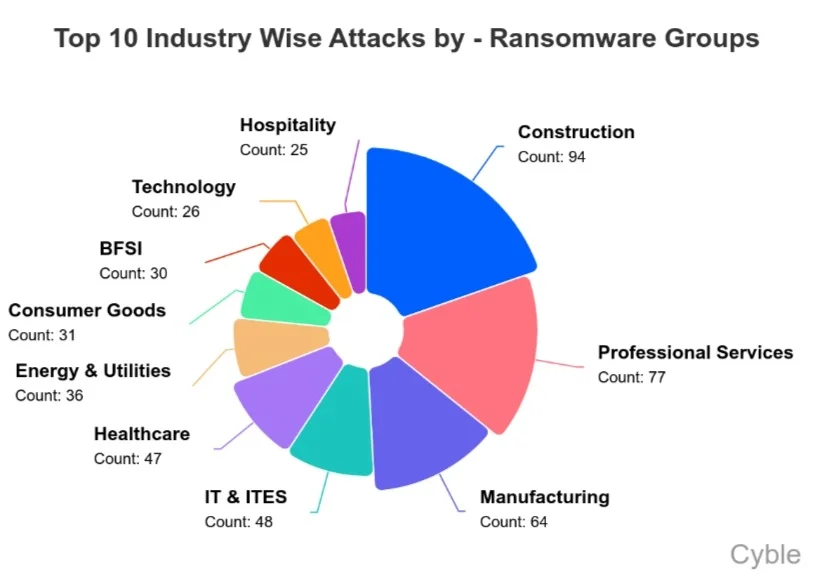
Construction, professional services, and manufacturing continue to lead the sectors hit by ransomware attacks, likely due to opportunistic threat actors targeting vulnerable environments (chart below). The IT industry also remains a frequent target of ransomware groups, likely due to the rich target the sector represents and the potential to pivot into downstream customer environments.

industry wise attacks by ransomware groups

Recent Ransomware Attacks 

Here are some of the most significant ransomware attacks that occurred in January, several of which had supply chain implications. Additional details will be provided in Cyble’s forthcoming January 2026 Threat Landscape Report, which will be published in the Research Reports section. 

As CL0P tends to claim victims in clusters, such as its exploitation of Oracle E-Business Suite flaws that helped drive supply chain attacks to records in October, new campaigns by the group are noteworthy. Among the claimed victims in the latest campaign have been 11 Australia-based companies spanning a broad range of sectors such as IT and IT services, banking and financial services (BFSI), construction, hospitality, professional services, and healthcare.  

Other claimed victims have included a U.S.-based IT services and staffing company, a global hotel company, a major media firm, a UK payment processing company, and a Canada-based mining company engaged in platinum group metals production. 

The Everest ransomware group claimed responsibility for breaching a major U.S. manufacturer of telecommunications networking equipment and claimed to have exfiltrated 11 GB of data. Everest claims the data includes PDF documents containing sensitive engineering materials, such as electrical schematics, block diagrams, and service subsystem documentation.  

Additional directories reportedly contain .brd files, which are printed circuit board (PCB) layout files detailing information critical to hardware manufacturing and replication. The group also shared multiple samples showing internal directories, engineering blueprints, and 3D design-related materials. 

The Qilin ransomware group claimed responsibility for breaching a U.S.-based airport authority responsible for managing commercial aviation operations and related services. The group shared 16 data samples as proof-of-compromise. The materials suggest access to financial documents, telehealth-related reports, internal email correspondence, scanned identification documents, non-disclosure agreements (NDAs), and other confidential agreements, suggesting exposure of sensitive administrative and operational information. 

The Sinobi ransomware group claimed a breach of an India-based IT services company providing digital transformation, cloud, ERP, and managed services. The threat group alleges the theft of more than 150 GB of data, including contracts, financial records, and customer data. Samples shared by the attackers indicate access to internal infrastructure, including Microsoft Hyper-V servers, multiple virtual machines, backups, and storage volumes. 

The Rhysida ransomware group claimed responsibility for breaching a U.S. company providing life sciences and biotechnology instrumentation and solutions. According to the threat group, the allegedly stolen data has already been sold, though no information was provided regarding the buyer or the price at which the dataset was advertised.  

The victim was listed as directly sold rather than placed under a traditional negotiation or countdown model. Despite this, samples remain accessible and indicate exposure of email correspondence, engineering blueprints, project documentation, and non-disclosure agreements (NDAs), suggesting compromise of both technical and corporate information. 

The RansomHouse extortion group claimed responsibility for breaching a China-based electronics manufacturing company providing precision components and assembly services for global technology and automotive manufacturers. As evidence, RansomHouse published documentation indicating access to extensive proprietary engineering and production-related data. The shared materials reference confidential 3D CAD models (STEP/PRT), 2D CAD drawings (DWG/DXF), engineering documentation, printed circuit board (PCB) design data, Gerber files, electrical and layout architecture data, and manufacturing drawings. Notably, the group claims the compromised archives contain data associated with multiple major technology and automotive companies. 

INC Ransom claimed responsibility for breaching a Hong Kong–based manufacturer supplying precision components to the global electronics and automotive industries. According to the group, approximately 200 GB of data was allegedly exfiltrated. The claimed dataset reportedly includes client-related information associated with more than a dozen major global brands, plus confidential contracts and project documentation for at least three major IT companies. 

The Qilin ransomware group claimed responsibility for breaching a Taiwan-based company operating in the semiconductor and electronics manufacturing sector. According to the group, approximately 275 GB of data was allegedly exfiltrated. Based on the file tree information shared by Qilin, the dataset reportedly consists of 19,822 directories and 177,551 files, suggesting broad access to internal systems. 

The Nitrogen ransomware group leaked more than 71 GB of data allegedly stolen from a U.S. company providing engineered components and systems for the automotive industry. According to the threat group, the exposed data includes sensitive corporate and technical information such as CAD drawings, accounts payable and receivable records, invoices, and balance sheet documentation. To substantiate its claims, Nitrogen published selected project blueprints and shared a file tree indicating the alleged theft of approximately 116,180 files, suggesting broad access to internal engineering and financial systems. 

The Anubis ransomware group claimed responsibility for breaching an Italian government authority responsible for the management, regulation, and development of regional maritime port operations. According to the group, the compromised data includes incident and safety reports, logistics and operational data, port infrastructure layouts, audit results, internal reports, and business correspondence. 

New Ransomware Groups 

Among new ransomware groups that have emerged recently, Green Blood has launched an onion-based data leak site. While the group has not yet publicly named specific victims, it claims that affected organizations are located in India, Senegal, and Colombia. The group provides TOX ID and email-based communication channels for victim contact. Notably, malware samples associated with Green Blood have been observed in the wild. The ransomware encrypts files using the “.tgbg” extension and drops a ransom note titled “!!!READ_ME_TO_RECOVER_FILES!!!.txt” 

A new ransomware-as-a-service (RaaS) operation named DataKeeper has surfaced, promoting an updated affiliate model referred to as CrystalPartnership RaaS. The group claims this approach improves trust by splitting ransom payments directly between the operator’s and affiliate’s Bitcoin addresses at the time of payment, removing reliance on centralized payout handling. DataKeeper is advertised as a Windows-focused ransomware toolkit. The operation claims to use a hybrid encryption scheme combining symmetric file encryption with RSA-4096 key protection, unique per-build identifiers, and TOR-based payment links. Encryption and decryption workflows are tied to a victim-specific ID, with decryption requiring delivery of a key file following payment.  

The group emphasizes operational features such as in-memory execution, multithreaded encryption, optional shadow copy removal, network share targeting, and evading security controls. 

The threat actor (TA) MonoLock announced a new RaaS operation on the RAMP cybercrime forum (the forum has since been seized by the FBI). MonoLock’s core design is based on Beacon Object Files (BoF), enabling full in-memory execution, reduced payload exposure, and centralized control from a single post-exploitation command-and-control (C2) instance without dropping files.  

While BoF usage is common in Windows environments, MonoLock introduced a custom Linux ELF-based BoF loader, derived from the TrustedSec ELFLoader, adding chained execution, command packing, encryption, and in-memory deployment. The group promotes a “Zero Panel” extortion model, explicitly rejecting leak sites and Tor-based negotiation panels.  

MonoLock claims that avoiding public extortion infrastructure reduces law enforcement exposure and leverages silence as negotiation pressure, minimizing reputational damage for victims. Affiliates are recruited under a 20% revenue share with a USD $500 registration fee, alongside a limited referral program running from January 11 to March 31. 

Conclusion 

The persistently high level of ransomware attacks – and the emergence of new ransomware groups eager to compete on features and price – highlight the urgent need for security teams to adopt a defense-in-depth cyber strategy. Cybersecurity best practices that can help build resilience against attacks include: 

  • Protecting web-facing assets. 

  • Segmenting networks and critical assets. 

  • Hardening endpoints and infrastructure. 

  • Strong access controls, allowing no more access than is required, with frequent verification. 

  • A strong source of user identity and authentication, including multi-factor authentication and biometrics, as well as machine authentication with device compliance and health checks. 

  • Encryption of data at rest and in transit. 

  • Ransomware-resistant backups that are immutable, air-gapped, and isolated as much as possible. 

  • Honeypots that lure attackers to fake assets for early breach detection. 

  • Proper configuration of APIs and cloud service connections. 

  • Monitoring for unusual and anomalous activity with SIEM, Active Directory monitoring, endpoint security, and data loss prevention (DLP) tools. 

  • Routinely assessing and confirming controls through audits, vulnerability scanning, and penetration tests. 

Cyble’s comprehensive attack surface management solutions can help by scanning network and cloud assets for exposures and prioritizing fixes, in addition to monitoring for leaked credentials and other early warning signs of major cyberattacks. 

Additionally, Cyble’s third-party risk intelligence can help organizations carefully vet partners and suppliers, providing an early warning of potential risks. 

The post Ransomware Attacks Have Surged 30% Since Q4 2025 appeared first on Cyble.

Initial Access Sales Accelerated Across Australia and New Zealand in 2025

Initial Access Australia and New Zealand Region

The cyber threat environment in Australia and New Zealand experienced a new escalation throughout 2025, driven by a surge in initial access sales, ransomware operations, and high-impact data breaches. According to our Threat Landscape Report Australia and New Zealand 2025, threat activity observed between January and November 2025 reveals a complex and commercialized underground ecosystem, where compromised network access is actively bought, sold, and exploited across multiple sectors. 

The threat landscape report identifies a persistent focus on data-rich industries, with threat actors disproportionately targeting Retail, Banking, Financial Services, and Insurance (BFSI), Professional Services, and Healthcare organizations. These sectors continue to attract attackers due to the volume of sensitive personally identifiable information (PII), financial data, and downstream access opportunities they offer. 

Growth of Initial Access Sales in 2025 

A central finding of the report is the continued growth of the initial access market. Cyble Research and Intelligence Labs (CRIL) documented 92 instances of compromised access sales affecting organizations in Australia and New Zealand during 2025. Retail organizations were the most heavily targeted, accounting for 31 incidents, or approximately 34% of all observed activity. This figure is more than three times higher than that of the next most targeted sector. 

The BFSI sector recorded nine compromised access listings, followed by Professional Services with seven incidents. Combined, these three sectors accounted for more than half of all initial access listings observed in the region during the reporting period. 

This concentration reflects a strategic approach by initial access brokers. Retail and BFSI organizations routinely handle large volumes of customer data and payment information, making them valuable targets for monetization or follow-on ransomware attacks. Professional Services firms, meanwhile, often provide access to client environments, creating opportunities for supply chain exploitation. 

A Fragmented but Active Access Brokerage Market 

Analysis of the compromised access marketplace reveals a highly fragmented ecosystem rather than one dominated by a small number of major actors. The threat actor known as “cosmodrome” emerged as the most prolific seller of compromised access during the period, followed closely by an actor operating under the alias “shopify.” 

Despite their activity, these actors did not control the market. The top seven most active sellers were collectively responsible for only about 26% of the observed access listings. The remaining activity originated from dozens of individual threat actors who posted listings once or twice, suggesting a low barrier to entry and a marketplace populated by both specialized brokers and opportunistic participants. 

This structure indicates that initial access sales have become an accessible revenue stream for a wide range of threat actors, reinforcing the resilience and scalability of the underground economy. 

High-Impact Incidents Highlight Broader Risks 

Several notable incidents documented in the threat landscape report illustrate how initial access is translated into real-world impact. 

In June 2025, the threat group Scattered Spider was suspected of orchestrating a cyberattack against a major Australian airline. Attackers reportedly gained unauthorized access to a customer service portal, resulting in a data breach that exposed records belonging to nearly six million customers. The compromised data included names, email addresses, phone numbers, dates of birth, and frequent flyer numbers. 

The airline confirmed that more sensitive information, such as credit card details, financial records, and passport data, was not affected because it was not stored in the breached system. Investigators believe the incident may be part of a broader campaign targeting the aviation sector. 

In March, threat actor “Stari4ok” advertised the sale of unauthorized access to a large Australian retail chain on the Russian-language cybercrime forum Exploit. The actor claimed the access involved a hosting server containing approximately 250 GB of data, including a 30 GB SQL database with a user table of around 71,000 records. Based on the claimed annual revenue of USD 2.6 billion and the described industry, the victim appears to be a major retailer, although this has not been independently confirmed. The access was listed for auction with a starting price of USD 1,500. 

Another listing emerged in May when the threat actor “w_tchdogs” offered unauthorized access to a portal belonging to an Australian telecommunications provider on the English-language forum Darkforums. The actor claimed the access provided entry to domain administration tools and critical network information. The listing price was USD 750. 

Data Breaches and Hacktivist Activity 

Not all incidents were tied directly to access sales. In mid-April, unidentified threat actors gained unauthorized access to the IT systems of a prominent accounting firm operating across Australia and New Zealand. The organization publicly confirmed the breach, stating that some data may have been compromised and that an investigation was ongoing. While business operations continued, the firm warned clients of potential phishing attempts and obtained court injunctions in both countries to prevent the dissemination of affected data. As of the time of reporting, no threat group had claimed responsibility. 

Hacktivist activity also remained visible. In January 2025, the group RipperSec claimed to have accessed an optical-fiber network monitoring device belonging to an Australian cable and media services provider. The device was reportedly no longer supported by its vendor. As proof, the group released images suggesting internal defacement and possible data manipulation. 

Want a deeper insight into these threats? Check out Cyble’s Australia and New Zealand Threat Landscape Report 2025 or schedule a demo to see check out how Cyble can protect your organization against these threats. 

The post Initial Access Sales Accelerated Across Australia and New Zealand in 2025 appeared first on Cyble.

❌