
Visualização de leitura

IR Trends Q1 2026: Phishing reemerges as top initial access vector, as attacks targeting public administration persist

  • Phishing reemerged as the most observed means of gaining initial access, accounting for over a third of the engagements where initial access could be determined. Phishing has not been the top vector for initial access since Q2 2025.
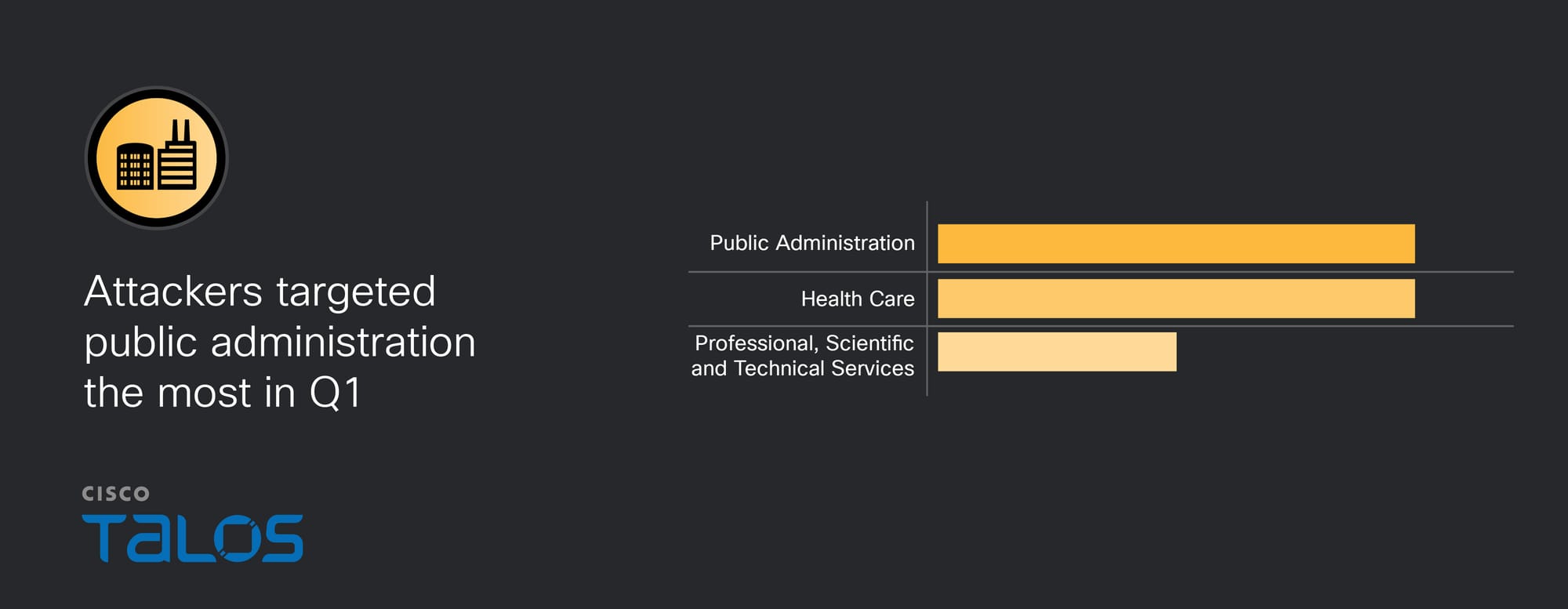
  • Public administration and health care tied as the most targeted industry verticals, each accounting for 24 percent of all engagements. This is the third consecutive quarter where public administration has been the most targeted industry vertical.  
  • Pre-ransomware incidents made up just 18 percent of engagements this quarter, and we did not observe any ransomware deployment due to early and swift mitigation from Cisco Talos Incident Response (Talos IR). This is a slight increase from last quarter but overall very low compared to Q1 and Q2 2025, when we observed ransomware in 50 percent of engagements.
IR Trends Q1 2026: Phishing reemerges as top initial access vector, as attacks targeting public administration persist

Watch this video to see Talos experts break down the trends and offer guidance for defenders.

AI tool leveraged in phishing campaign 

Talos IR responded to a campaign that leveraged phishing, the most common means of initial access this quarter, to compromise the most targeted industry vertical this quarter: public administration. Notably, the actors leveraged the Softr AI-based web application development service, marking the first time we have documented the use of a specific AI tool by an adversary in a phishing campaign. Softr was used to generate a credential harvesting page targeting users’ Microsoft Exchange and Outlook Web Access (OWA) accounts. 

State-sponsored and criminal actors have been observed abusing large language models (LLMs) to aid in the development of phishing lures, malicious scripts, and other tasks. DDoS-as-a-service actors have adopted AI algorithms for defense evasion and attack orchestration. While this is the first time we have documented the use of a specific AI tool in a Talos IR incident, we have moderate confidence that malicious actors have used Softr’s AI-powered web application creation platform since at May 2023, based on Cisco Umbrella data and other telemetry, and have done so with increasing frequency to date.    

This incident demonstrates how AI tools can lower the barrier to entry for less sophisticated actors and/or accelerate the speed of phishing and credential-harvesting campaigns. Using a form template and the “vibe coding” feature, a phishing page like the one used in this attack could be quickly created with a few AI prompts and no code. Phishing pages built with Softr can direct data to a disposable external data store, such as Google Sheets, and send alerts for new captures via email — all without code.    

Crimson Collective seen for the first time   

Talos IR experienced its first case involving Crimson Collective, a cyber extortion group that appeared in September 2025. This attack highlighted the use of valid accounts for initial access, the second most commonly observed means of initial access this quarter. This attack also notably involved targeting exploit weaknesses, the second-most observed security weakness, accounting for 25 percent of all engagements. We attribute this activity to Crimson Collective based on IPs associated with the group that were used to scan the victim's ASA firewalls, as well as an overlap of observed tactics and techniques with publicly reported Crimson Collective attacks. 

The incident began when a GitHub Personal Access Token (PAT) was inadvertently published on a public-facing website, exposing the organization to adversaries for several months. Upon obtaining access, the adversary used TruffleHog, an open-source tool commonly utilized by security professionals, to scan thousands of victim GitHub repositories for additional secrets and sensitive information. This approach allows attackers to perform reconnaissance without triggering suspicion, as they are leveraging standard, legitimate tools. The attacker’s discovery of client secrets through TruffleHog enabled further access to the victim’s Azure cloud storage, where they used Microsoft Graph API calls to authenticate, explore, and exfiltrate data. The abuse of legitimate cloud APIs demonstrates a growing trend where threat actors use native platform functionality to blend into normal user activity, making detection more challenging. 

In addition to exfiltrating data, the adversary attempted to inject malicious code into multiple GitHub repositories. This code was designed to harvest any new secrets committed in the future, sending them to adversary-controlled infrastructure. Though these attempts were largely thwarted by the expiration of targeted secrets and effective security controls, the tactic reflects an emerging trend of supply chain and development environment attacks.  

Ransomware trends 

Ransomware experiences slight increase, remains low overall  

Pre-ransomware incidents made up just 18 percent of engagements this quarter, and we did not observe any ransomware encryption due to early and swift mitigation from Talos IR. This is a slight increase from last quarter, when ransomware and pre-ransomware collectively comprised 13 percent of engagements, but overall very low compared to Q1 and Q2 2025, when we observed ransomware in 50 percent of engagements. Attribution is challenging in pre-ransomware events because there are no encryptors or ransom notes, but we assess that Rhysida ransomware and MoneyMessage ransomware accounted for two of the engagements. 

While we did not observe many active and prolific ransomware-as-a-service (RaaS) operations, like Qilin or Akira, this likely does not indicate these major players are decreasing operations, as their data leak sites remain consistently active.    

Rhysida ransomware actors use uncommon backdoor, Meowbackconn  

Talos IR responded to a ransomware incident where the adversary attempted to deploy Rhysida ransomware. While the attack was mitigated in the pre-ransomware stage, we attribute this activity with moderate confidence to Rhysidabased on observed infrastructure that is associated with Rhysida activity and the use of Gootloader, which is commonly leveraged in Rhysida attacks during initial access. Notably, the actors deployed proxy-related DLLs (e.g., “meow_eu.dll”), which we assess were likely related to MeowBackConn, an uncommon backdoor that is closely associated with Gootloader, based on public reporting. 

This attack represents several trends that we observed throughout Talos IR engagements in Q1 2026. The environmental weaknesses that enabled this intrusion — exposed WinRM management ports, over-privileged service accounts, and critical logging gaps — directly echo this quarter’s most prominent security weaknesses, including vulnerable or exposed infrastructure, accounting for 25 percent of engagements. Furthermore, the adversary’s use of Remote Desktop Protocol (RDP) for lateral movement is consistent with RDP being the top technique for lateral movement for the previous two quarters (Q3 and Q4 2025).

Targeting
IR Trends Q1 2026: Phishing reemerges as top initial access vector, as attacks targeting public administration persist

Public administration and health care were tied as the most targeted industry verticals. Notably, Q3 2025 marked the first time public administration emerged as the most targeted sector in Talos IR engagements, and it has retained that position since. Organizations within the public administration sector are attractive targets as they are often underfunded and use legacy equipment. These entities may have access to sensitive data as well as a low downtime tolerance, making them attractive to financially motivated and espionage-focused threat groups.

Initial access
IR Trends Q1 2026: Phishing reemerges as top initial access vector, as attacks targeting public administration persist

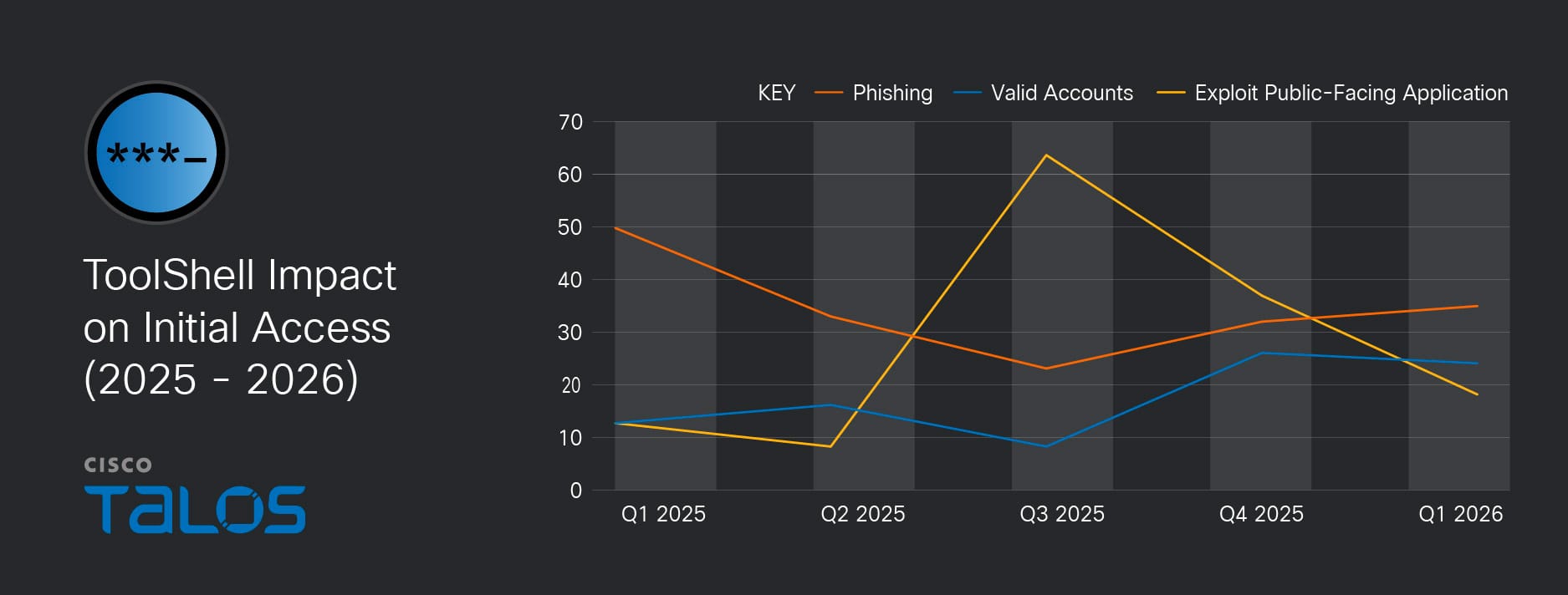
Phishing reemerged as the most observed means of gaining initial access, accounting for over a third of the engagements where initial access could be determined. Phishing was the top initial access vector in the first half of 2025, at which point it was surpassed by exploitation of public-facing applications, likely due to the widespread exploitation of vulnerabilities in on-premises Microsoft SharePoint servers, collectively referred to as ToolShell. Since then, we have observeda steady decrease in the exploitation of public-facing applications as an initial access vector from a high of 62 percent to only 18 percent in Q1 2026. Similarly, in this quarter, valid accounts returned to its pre-ToolShell baseline as the second most observed means of gaining initial access, comprising 24 percent of Talos IR engagements. We assess the decline in ToolShell exploitation is likely due to the widespread availability of emergency patches and enhanced security detections, highlighting the importance of timely patching.

Recommendations for addressing top security weaknesses
IR Trends Q1 2026: Phishing reemerges as top initial access vector, as attacks targeting public administration persist

Implement properly configured MFA and other access control solutions  

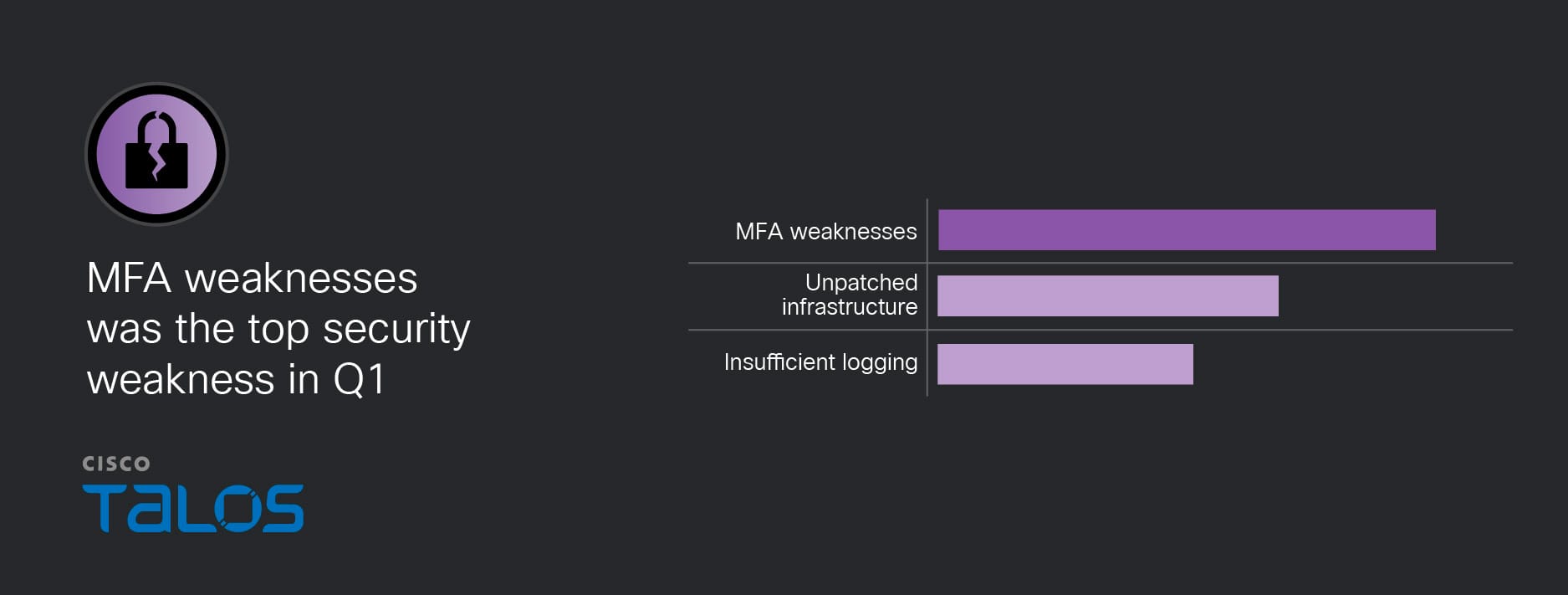
35 percent of engagements this quarter involved multi-factor authentication (MFA) weaknesses, an increase from last quarter. This includes incidents where threat actors bypassed MFA and where MFA was either missing or only partially enabled, particularly on remote access services. Adversaries were able to bypass MFA by registering new devices to previously compromised accounts, and in one instance, by configuring Outlook clients to connect directly to Exchange servers, circumventing MFA requirements. Addressing these weaknesses, especially by restricting self-service MFA enrollment and enforcing strong, centralized authentication policies, is essential to reducing risk and strengthening organizational resilience. 

Conduct robust patch management   

Vulnerable or exposed infrastructure was another top security weakness accounting for 25 percent of all engagements, a slight decrease from last quarter. This included exploiting a vulnerability (CVE-2025-20393) in the Spam Quarantine feature of Cisco AsyncOS Software for Cisco Secure Email Gateway and Cisco Secure Email and Web Manager, as well as a vulnerability (CVE-2023-20198) in the web UI feature in Cisco IOS XE Software. Talos also observed exposed management ports (such as WinRM open to the internet), which enabled rapid attacker movement and reconnaissance.  

Configure centralized logging capabilities across the environment   

Finally, 18 percent of engagements this quarter involved organizations with insufficient logging capabilities, which hindered investigative efforts. Understanding the full context and chain of events performed by an adversary on a targeted host is vital not only for remediation but also for enhancing defenses and addressing any system vulnerabilities for the future. To address this issue, Talos IR recommends organizations implement a security information and event management (SIEM) solution for centralized logging. In the event an adversary deletes or modifies logs on the host, the SIEM will contain the original logs to support a forensics investigation. Additionally, Talos IR offers a Log Architecture Assessment service, which provides a focused review of an organization’s logs and overall log strategy to identify gaps and offer recommendations that give a complete view of the security environment and strengthen incident response readiness 

MITRE ATT&CK appendix 

The tables below represent the MITRE ATT&CK techniques observed in this quarter’s IR engagements and includes relevant examples and the number of times seen. Given that some techniques can fall under multiple tactics, we grouped them under the most relevant tactic based on the way they were leveraged. Please note that this is not an exhaustive list. 

Key findings from the MITRE ATT&CK framework include: 

  • Phishing was the top method of initial access, replacing exploitation of public-facing applications which was dominant in the prior two quarters. 
  • Web-based C2 was the most common C2 pattern. Application Layer Protocol over web protocols was observed most often, indicating adversaries frequently blended C2 into normal-looking traffic. 
  • Lateral movement primarily relied on common remote administration channels. SMB/Windows Admin Shares was the top lateral movement technique, with WMI and RDP also heavily used, suggesting attackers repeatedly leveragedstandard enterprise remote management paths once inside. RDP was the top technique for lateral movement in the prior two quarters.  
  • Defense evasion frequently focused on weakening visibility and endpoint protections. Impair defenses by disabling/modifying tools appeared multiple times, alongside log/trace reduction behaviors (e.g., clear command history and file deletion), indicating a recurring emphasis on reducing detection and forensic evidence.

Tactic 

Technique 

Example 

Estimated times observed  

Reconnaissance 

T1589.002: Gather Victim Identity Information: Email Addresses 

The adversary enumeratedinternal processes and identifiedvendor emails to facilitate their fraudulent ordering scheme. 

1 


T1595: Active Scanning 


The adversary scanned public-facing websites to understand the target environment. 

2 


T1593: Search Open Websites/Domains 

The adversary scanned the web to obtain Github PATs. 

1 

Initial access 

T1566: Phishing 

The adversary used malicious emails and social engineering to compromise user accounts and facilitate fraudulent purchase orders. 

5 


T1189: Drive-by compromise 

The adversary registered several domains that masquerade as being related to VMware, and manipulated the SEO to show them at the top when searching for keywords such as VMware 

3 


T1078: Valid Accounts 

The adversary successfully gained access to the environment by using compromised user credentials  

4 


T1190: Exploit public-facing applications 

Two internet facing Linux servers running Apache and an LMS application were targeted. 

3 

Execution 

T1204.002: User Execution: Malicious File 

The victim downloaded a malicious installer on their personal host, connected the host to their company’s network, transferred the malware to their primary domain controller, then executed the malware.  

3 


T1204.001: User Execution: Malicious link  

The victim clicked on a link that led to a fake DocuSign document hosted on adobe[.]com 

5 


T1059.001: Command and Scripting Interpreter: PowerShell  

The adversary used PowerShell commands and scripts for execution. 

4 


T1059.006: Command and Scripting Interpreter: Python 

The adversary used automated Python scripts to interact with the environment. 

1 


T1059.005: Command and Scripting Interpreter: MSHTA 

The adversary attempted to use mshta.exe to retrieve and execute a remote malicious payload from an external URL. 

1 

Persistence 

T1556.006: ModifyAuthentication Process: Multi-Factor Authentication 

The adversary registered their own malicious MFA devices to maintain access to compromised accounts. 

2 


T1219: Remote Access Software 

The adversary installed and used AnyDesk for unauthorized remote access. 

1 


T1053.005: Scheduled Task/Job: Scheduled Task 

The adversary configured tasks to run on a schedule or at system startup. 

1 


T1505: Server Software Component 

The adversary installed malware on breached devices to facilitateremote command execution via HTTP. 

1 

Privilege escalation 

T1068: Exploitation for Privilege Escalation 

The adversary escalated to SYSTEM level privileges, which may have provided access to cached credentials in memory or registry hive. 

1 


T1548: Abuse Elevation Control Mechanism 

The adversary used ExecutionPolicy Bypass in PowerShell and attempted to add users to the local Administrators group. 

1 


T1078 Valid Accounts 

The adversary bypassed standard access controls by using compromised accounts with existing high-level privileges. 

1 

Defense evasion 

T1070.003: Indicator Removal on Host: Clear Command History 

The adversary used the terminal emulator "ConEmu" to run commands, intentionally avoiding log generation. 

2 


T1070.001: Indicator Removal: Clear Windows Event Logs 

The adversary deleted logs on compromised devices to limit forensic findings. 

1 


T1556: ModifyAuthentication Process 

The adversary set up an Outlook client Outlook client to connect to the Exchange Server and was able to send messages via that path which bypasses the requirement for MFA via Duo. 

1 


T1562.001: Impair Defenses: Disable or Modify Tools 

The adversary was able to uninstall EDR agents from hosts and attempted to delete Windows Defender policies. 

4 

Credential access 


T1003.002: OS Credential Dumping: Security Account Manager 

The adversary saved SAM and SYSTEM registry hives to extract local account hashes.  

2 


T1003.003: OS Credential Dumping: NTDS  

The adversary dumped the ntds.dit file from Domain Controllers to obtain domain-wide credential hashes. 

1 


T1003.005: Cached Domain Credentials  

The adversary gained NT hashes for multiple domain accounts from cached logon information. 

1 


T1557: Adversary-in-the-Middle 

The adversary  used an AiTMproxy to capture credentials and session tokens. 

1 

Discovery 

T1087.003: Account Discovery: Email Account 

The adversary used Graph API calls to verify long lists of email addresses and retrieve associated user GUIDs. 

1 


T1580: Cloud Infrastructure Discovery  

The adversary performed enumeration of the environment, including gathering OneDrive metadata (drive IDs and child item counts) and user roles. 

1 


T1069.002: Permission Groups Discovery: Domain Groups  

The adversary used commands like net group "domain admins" /domain to find high-privilege accounts. 


1 


T1526: Cloud Service Discovery   

The adversary ran the legitimate cybersecurity tool TruffleHog to discover repositories containingclient secrets and personal information. 

1 

Lateral movement 

T1021.002: Remote Services: SMB/Windows Admin Shares 

The adversary used PsExec(communicated over SMB) to move laterally from the compromised domain controller to other servers. 

4 


T1047: Windows Management Instrumentation  

The adversary used PowerShell scripts to leverage WMI (Get-WmiObject) to query remote computers. 

3 


T1021.001: Remote Services: Remote Desktop Protocol 

The adversary used RDP connections between hosts. 

3 

Collection 

T1530: Data from Cloud Storage Object  

The analysis of M365 Audit Logs showed multiple FileAccessedand FileDownloaded events for documents stored in SharePoint and OneDrive. 

1 


T1040 Network Sniffing 

The adversary executed monitor capture commands on specific interfaces to intercept and capture network traffic. 

1 

Command and control 

T1071.001: Application Layer Protocol: Web Protocols 

The adversary used MeshAgentto communicate with the C2 server over WebSockets. 

5 


T1102: Web Service  

The adversary leveraged a Telegram URL to issue instructions and download links.  

1 


T1572: Protocol Tunneling 

The adversary used a second-stage script to create an HTTPS tunnel directly to the C2 system. 

1 


T1201: Traffic Signaling 

The adversary communicated with external infrastructure using regular beaconing or other signaling patterns to maintain C2 or check in with their C2 server. 

1 

Exfiltration 

T1567.002: Exfiltration Over Web Service 

The adversary accessed and exfiltrated internal data, specifically SharePoint files, via web-based channels. 

1 


T1041: Exfiltration Over C2 Channel 

The adversary exfiltrated approximately 2,500 client secrets and personal information. 

2 

Impact 

T1657: Financial Theft 

The adversary used company resources to place orders totaling hundreds of thousands of US dollars for various products which were successfully delivered. 

1 


T1486 Data Encrypted for Impact 

The adversary encrypted victim data. 

1 


T1531 Account Access Removal 

The adversary disabled admin accounts and deleted service accounts in the Active Directory (AD) and Azure 

1 

Software 

Rhysida  

A RaaS, known for posing as a cybersecurity team that “helps” its victims identify security weaknesses in their networks. 

Pre-ransomware engagement 


SocGholish 

A JavaScript-based loader malware that has been used since at least 2017, primarily for initial access.  

1 


Money Message 

A ransomware that emerged in March 2023, and is capable of targeting Windows and Linux systems (including VMware ESXiservers). 

Pre-ransomware engagement 

IR Trends Q4 2025: Exploitation remains dominant, phishing campaign targets Native American tribal organizations

IR Trends Q4 2025: Exploitation remains dominant, phishing campaign targets Native American tribal organizations

Threat actors predominately exploited public-facing applications for the second quarter in a row, with this tactic appearing in nearly 40 percent of Cisco Talos Incident Response (Talos IR) engagements — a notable decrease from over 60 percent last quarter, when engagements involving ToolShell surged. This quarter included exploitation of Oracle E-Business Suite (EBS) and React2Shell, as well as the deployment of malware implants previously associated with advanced persistent threat (APT) groups.  

Phishing was the second-most common tactic for initial access, and this quarter included a campaign specifically targeting Native American tribal organizations for credential harvesting. Once the adversaries compromised a legitimate account, they leverage it to send out further internal phishes and gain more credentials.  

Ransomware incidents made up only approximately 13 percent of engagements this quarter, a decrease from 20 percent last quarter and a steep drop from nearly 50 percent in Q1 and Q2. Talos IR did not respond to any previously unseen ransomware variants. Qilin continues to be a dominant player in these engagements, a continuation from the previous few quarters.   

Watch this video discussion on the biggest trends from this quarter's report

Continued exploitation campaigns show the importance of timely patching  

As mentioned above, threat actors exploited public-facing applications for initial access in nearly 40 percent of engagements this quarter. While there was no dominant exploitation campaign as there was last quarter with ToolShell, Talos IR did observe activity targeting Oracle EBS (CVE-2025-61882) as well as React Server Components, Next.js, and related frameworks (CVE-2025-55182 aka React2Shell). In both cases, exploitation activity occurred around the time the vulnerability became public, demonstrating actors’ speed in capitalizing on these opportunities as well as the inherent risks of internet-facing enterprise applications and default deployments embedded in widely used frameworks.    

Talos IR responded to an organization that had an internet-facing server vulnerable to CVE-2025-61882. Exploitation began very shortly after the vulnerability was made public and was likely related to a large-scale campaign aiming to extort executives. After exploiting the vulnerability, the threat actors deployed multi-stage web shells related to the SAGE* infection chain.   

In another incident, we observed a threat actor successfully exploit the React2Shell vulnerability to compromise the victim organization, gain shell access to the web server, and download and install XMRig Monero cryptomining malware. Cryptocurrency mining is one of the many types of operations we expect to see as threat actors race to quickly capitalize on unpatched systems. Public reporting on React2Shell exploitation also revealed targeting by state-sponsored groups, ransomware affiliates, and more, highlighting the diverse array of threat actors who look to leverage new exploits and the importance of timely patching and other mitigations, such as robust segmentation.   

Exploitation activity this quarter also involved implants previously tied to APT groups. In one incident, Talos IR observed activity consistent with the BadCandy implant targeting Cisco IOS XE. The threat actors leveraged this implant to create an unauthorized account, though the activity appeared to be automated with no interactive access or additional malicious activity observed outside the router.   

In an incident in which exploitation of the organization’s Cisco Secure Management Appliance (SMA) was suspected, the adversaries deployed AquaShell, a lightweight Python backdoor capable of receiving encoded commands through unauthenticated HTTP POST requests and executing them in the system shell, a backdoor which Talos has connected to UAT-9686. Similar to the incident described above, there was no follow-on activity observed. In both incidents, Talos IR commended the customers for their quick responses, which likely helped mitigate any further damage.

Phishing campaigns target Native American tribal organizations for potential credential harvesting operation   

Phishing was the second-most common means of initial access this quarter, and Talos IR responded to a phishing campaign that appeared to target Native American tribal organizations.   

In one incident affecting a tribal organization, Talos IR observed adversaries use compromised email accounts, alongside a legitimate but compromised web domain, to distribute lures themed around sexual harassment training. Although initial waves were unsuccessful, once the adversaries compromised an account, they used it to propagate further phishing internally and externally. In the latter phases of this campaign, the adversary leveraged a web shell directory hosted on a legitimate third-party domain to distribute phishing content and facilitate broader targeting. We suspect that the attacker gained a foothold within the victim environment due to lack of multi-factor authentication (MFA), and while no lateral movement beyond email account abuse could be confirmed, the exposure of additional accounts within the victim's environment and external recipients indicates the potential for a wider impact.   

In a second related incident affecting another tribal organization, Talos IR observed the victim receive a wave of external phishing emails, with one user targeted with numerous Outlook Web Access (OWA) login attempts, resulting in subsequent MFA prompts, one of which was approved. Afterwards, the compromised user’s account was used to issue a flood of follow-on phishing emails. After the customer removed the compromised account, the campaign continued, leveraging an external email address that was spoofed to resemble the disabled account.   

Beyond similar victimology, there were overlaps in the indicators of compromise for these incidents, suggesting they may have originated from the same campaign. Both incidents also highlight a trend observed last quarter of compromised accounts being used to distribute further phishing attacks. Talos IR urges tribal organizations to be especially vigilant of this threat, scrutinizing all emails and MFA pushes.

Ransomware trends 

Ransomware and pre-ransomware incidents made up just 13 percent of engagements this quarter, a decline from 20 percent last quarter, and a sharp drop from 50 percent in Q1 and Q2. Qilin ransomware, which we responded to for the first time in Q2, remains dominant and was observed in the majority of ransomware incidents, confirming our predictions in Q2 and Q3 that the group would continue to hold a heavy presence. We also responded to DragonForce ransomware, a variant we had not observed in Talos IR engagements for over a year.

Talos IR responded to a ransomware incident in which the adversary deployed multiple remote monitoring and management (RMM) tools across the attack chain. After leveraging valid accounts for initial access, they relied on ScreenConnect for persistence, SoftPerfect Network Scanner for reconnaissance, and rclone to exfiltrate data. This is a trend we have observed in other threat activity as well, such as a social engineering campaign this quarter in which the threat actors used multiple RMM tools for initial access and persistence. Relying on multiple tools can better facilitate the attack in case one is detected or blocked by security controls. In addition, because these tools may be legitimately used in an environment, they may be harder for defenders to detect in the first place.

Targeting

IR Trends Q4 2025: Exploitation remains dominant, phishing campaign targets Native American tribal organizations

Consistent with last quarter, public administration was the most-targeted industry vertical. This is noteworthy as last quarter was the first time since we began publishing these reports that public administration held this position. Organizations within the public administration sector are attractive targets as they are often underfunded and use legacy equipment. These entities may have access to sensitive data as well as a low downtime tolerance, making them attractive to financially motivated and espionage-focused threat groups. We observed exploitation and phishing campaigns targeting these organizations, with one successful phishing campaign leveraging a compromised account to send out follow-on internal and external phishes, making them appear more legitimate.

Initial access

IR Trends Q4 2025: Exploitation remains dominant, phishing campaign targets Native American tribal organizations

Also consistent with last quarter, the most observed means of gaining initial access was exploitation of public-facing applications, accounting for over a third of the engagements where initial access could be determined. As mentioned, this is a sharp drop from 62 percent last quarter in which widespread ToolShell exploitation occurred. Other observed means of initial access included phishing, which increased from 23 percent last quarter to 32 percent, as well as valid accounts and brute forcing.

Recommendations for addressing top security weaknesses

IR Trends Q4 2025: Exploitation remains dominant, phishing campaign targets Native American tribal organizations

Conduct robust patch management  

35 percent of engagements this quarter involved vulnerable or exposed infrastructure, aligning with the percentage of engagements in which Talos IR observed exploitation of publicly facing applications. This included exploitation of the React2Shell vulnerability, Oracle EBS, as well as exposed Cisco products such as Cisco IOS XE WebUI. These latter incidents underscore the importance of limiting the exposure of vulnerable and high-value servers. Though some of these vulnerabilities were older, once again highlighting the fact that adversaries can find success with years-old exploits, others were targeted right around disclosure, showing the importance of timely patching. Relatedly, there were several incidents in which exposed GitHub secrets were leveraged to access and exfiltrate sensitive data.

Implement detections to identify MFA abuse and strong MFA policies  

MFA issues, including misconfigured MFA, lack of MFA, and MFA bypass, were another top security weakness this quarter, aligning with phishing being the second-most prominent initial access technique. This included issues such as a lack of MFA as well as MFA fatigue. Talos IR recommends configuring systems to monitor and alert on the following for effective MFA deployment: abuse of bypass codes, registration of new devices, creation of accounts designed to bypass or be exempt from MFA, and removal of accounts from MFA.

Configure centralized logging capabilities across the environment  

Insufficient logging capabilities once again hindered investigative efforts by Talos IR. Understanding the full context and chain of events performed by an adversary on a targeted host is vital not only for remediation but also for enhancing defenses and addressing any system vulnerabilities for the future. Talos IR recommends that organizations implement a Security Information and Event Management (SIEM) solution for centralized logging. In the event an adversary deletes or modifies logs on the host, the SIEM will contain the original logs to support forensic investigation.

Timely response is paramount  

Finally, several incidents this quarter revealed the value of quick responses, such as several exploitation attacks against Cisco products in which timely cooperation with Talos IR helped prevent follow-on attacks. This quarter, we also responded to a ransomware incident in which an organization delayed engaging with Talos IR, and thus were unable to prevent encryption or exfiltration of sensitive data. For more information on how timely response can dramatically improve outcomes, please see the this blog.

Top-observed MITRE ATT&CK techniques  

The table below represents the MITRE ATT&CK techniques observed in this quarter’s Talos IR engagements. Given that some techniques can fall under multiple tactics, we grouped them under the most relevant tactic in which they were leveraged. Please note this is not an exhaustive list.  

Key findings from the MITRE ATT&CK framework include:  

  • Adversaries leveraged a wider variety of techniques for credential access this quarter compared to last quarter, including discovery of remote systems, domain trust relationships, and valid accounts.   
  • This was the second quarter in a row where exploitation of public-facing applications was the top initial access technique.   
  • Use of Remote Desktop Protocol (RDP) was the top technique for lateral movement for the second quarter in a row.
TacticTechniqueExample 
Reconnaissance  T1597 Search Open Websites/Domains   Adversaries may search freely available websites and/or domains for information about victims that can be used during targeting. 
T1018 Remote System Discovery  Adversaries may attempt to get a listing of other systems by IP address, hostname, or other logical identifier on a network. 
T1482 Domain Trust Discovery  Adversaries may attempt to gather information on domain trust relationships that may be used to identify lateral movement opportunities in Windows multi-domain/forest environments. 
T1087 Account Discovery   Adversaries may attempt to get a listing of valid accounts, usernames, or email addresses on a system or within a compromised environment. 
Initial Access  T1190 Exploit Public-Facing Application  Adversaries may exploit a vulnerability to gain access to a target system. 
T1598 Phishing for Information  Adversaries may send phishing messages to elicit sensitive information that can be used during targeting. 
T0859: Valid Accounts  Adversaries may steal and abuse the credentials of a specific user or service account using credential access techniques. 
T1110 Brute Force   Adversaries may use brute force techniques to gain access to accounts when passwords are unknown or when password hashes are obtained. 
Execution T1059 Command and Scripting Interpreter  Adversaries may abuse command and script interpreters to execute commands, scripts, or binaries. 
T1204.001 User Execution: Malicious Link  An adversary may rely upon a user clicking a malicious link in order togain execution. Users may be subjected to social engineering to get them to click on a link that will lead to code execution.  
T1204.002 User Execution: Malicious File  An adversary may rely upon a user opening a malicious file in order to gain execution. 
T1078 Valid Accounts   Adversaries may obtain and abuse credentials of existing accounts to access systems within the network and execute their payload. 
T1047 Windows Management Instrumentation   Adversaries may abuse Windows Management Instrumentation (WMI) to execute malicious commands and payloads. 
T1505.003 Server-side Web Shell   Adversaries may backdoor web servers with web shells to establish persistent access to systems. 
Persistence  T1136 Create Account   Adversaries may create an account to maintain access to victim systems. 
T1219 Remote Access Tools  An adversary may use legitimate remote access tools to establish an interactive command and control channel within a network. 
T1059 Command and Scripting Interpreter  Adversaries may abuse command and script interpreters to execute commands, scripts, or binaries. 
T1053 Scheduled Task/Job   Adversaries may abuse task scheduling functionality to facilitate initial or recurring execution of malicious code. 
T1078 Valid Accounts  The adversary may compromise a valid account to move through the network to additional systems. 
Defense Evasion  T1562 Impair Defenses  Adversaries may maliciously modifycomponents of a victim environment in order to hinder or disable defensive mechanisms.  
T1070 Indicator Removal   Adversaries may delete or modify artifacts generated within systems to remove evidence of their presence or hinder defenses. 
T1218 System Binary Proxy Execution   Adversaries may bypass process and/or signature-based defenses by proxying execution of malicious content with signed, or otherwise trusted, binaries. 
T1564.008 Hide Artifacts: Email Hiding Rules  Adversaries may use email rules to hide inbound or outbound emails in a compromised user's mailbox. 
T1112 Modify Registry   The Registry may be modified in order to hide configuration information or malicious payloads.  
Credential Access  T1558.003 Steal or Forge Kerberos Tickets   Adversaries may attempt to subvert Kerberos authentication by stealing or forging Kerberos tickets to enable pass the ticket. 
T1003 OS Credential Dumping   Adversaries may attempt to dump credentials to obtain account login and credential material, normally in the form of a hash or a clear text password. 
T1111 Multi-Factor Authentication Interception   Adversaries may target MFA mechanisms, (i.e., smart cards, token generators, etc.) to gain access to credentials that can be used to access systems, services, and network resources. 
T1552.001 Unsecured Credentials  Adversaries may search compromised systems to find and obtain insecurely stored credentials. 
T1110 Brute Force  Adversaries may use brute force techniques to gain access to accounts when passwords are unknown or when password hashes are obtained. 
Discovery  T1087 Account Discovery   Adversaries may attempt to get a listing of valid accounts, usernames, or email addresses on a system or within a compromised environment. 
T1082 System Information Discovery  An adversary may attempt to get detailed information about the operating system and hardware, including version, patches, hotfixes, service packs, and architecture. 
T1083 File and Directory Discovery   Adversaries may enumerate files and directories or may search in specific locations of a host or network share for certain information within a file system. 
T1016 System Network Configuration Discovery  Adversaries may look for details about the network configuration and settings, such as IP and/or MAC addresses, of systems they access or through information discovery of remote systems. 
T1046 Network Service Discovery   Adversaries may attempt to get a listing of services running on remote hosts and local network infrastructure devices, including those that may be vulnerable to remote software exploitation. 
Lateral Movement  T1021.001 Remote Services: Remote Desktop Protocol  Adversaries may use Valid Accounts to log into a computer using RDP. The adversary may then perform actions as the logged-on user.  
T1021.002 Remote Services: SMB/Windows Admin Shares  Adversaries may use Valid Accounts to interact with a remote network share using Server Message Block (SMB). The adversary may then perform actions as the logged-on user.  
Command and Control  T1071 Application Layer Protocol   Adversaries may communicate using OSI application layer protocols to avoid detection/network filtering by blending in with existing traffic. 
T1008 Fallback Channels   Adversaries may use fallback or alternate communication channels if the primary channel is compromised or inaccessible in order to maintain reliable command and control and to avoid data transfer thresholds.  
T1105 Ingress Tool Transfer  Adversaries may transfer tools or other files from an external system into a compromised environment. 
T1090 Proxy   Adversaries may use a connection proxy to direct network traffic between systems or act as an intermediary for network communications to a command and control server to avoid direct connections to their infrastructure. 
Exfiltration  T1041 Exfiltration Over C2 Channel  Adversaries may steal data by exfiltrating it over an existing command and control channel. 
T1567 Exfiltration Over Web Service   Adversaries may use an existing, legitimate external Web service to exfiltrate data rather than their primary command and control channel. 
Impact  T1486 Data Encrypted for Impact  Adversaries may use ransomware to encrypt data on a target system.  
T1485 Data Destruction   Adversaries may destroy data and files on specific systems or in large numbers on a network to interrupt availability to systems, services, and network resources. 
T1489 Service Stop  Adversaries may stop or disable services on a system to render those services unavailable to legitimate users. 
Software  S1242 Qilin  A Ransomware-as-a-Service (RaaS) that has been active since at least 2022 with versions written in Golang and Rust that are capable of targeting Windows or VMWare ESXi devices. 
S0591 ConnectWise  A legitimate remote administration tool that has been used since at least 2016 by threat actors. 
S1040 Rclone  A command line program for syncing files with cloud storage services such as Dropbox, Google Drive, Amazon S3, and MEGA.  
S0029 PsExec   Free Microsoft tool that can remotely execute programs on a target system. 
❌