A newly identified dark web platform, Darkhub, is advertising a wide range of hacking-for-hire services, including account compromise, surveillance, and financial manipulation. The service, accessible via the Tor network, presents itself as a centralized hub for offensive cyber capabilities targeting both individuals and organizations. Many similar services historically function as advance-fee scams rather than delivering […]
Unit 42 uncovers high-risk AI browser extensions. Disguised as productivity tools, they steal data, intercept prompts, and exfiltrate passwords. Protect your browser.
Modern browser extensions and ad blockers are legally collecting and reselling user data, including streaming habits and B2B sales intelligence, under the guise of "analytics." This unregulated "legal spyware" creates massive security gaps as employees unwittingly leak corporate URLs, SaaS dashboards, and research activity to third-party databases. With the rise of AI-native browsers and personal device syncing, security leaders must evolve beyond simple permission checks to implement rigorous extension governance and privacy policy reviews to prevent targeted attacks and corporate data leakage.
Osservatorio Nessuno uncovered Morpheus spyware spreading via fake Android apps to steal data, highlighting rising covert surveillance tools.
The non-partisan, non-religious, nonprofit organization Osservatorio Nessuno exposed a new spyware called Morpheus, distributed through fake Android apps posing as updates. Once installed, it can steal extensive data from the infected devices. The report shows strong demand from law enforcement and intelligence agencies, fueling a growing market of spyware vendors, many operating quietly outside public scrutiny.
Attackers used a typical low-cost spyware tactic: disrupt a service and trick the victim into installing a fake app to restore it. In this case, targets received an SMS linking to a site impersonating an ISP. The first stage, a dropper app, installs a hidden second-stage payload embedded within it. It checks if the payload is already present, then silently deploys it with minimal user awareness.
The second stage disguises itself as legitimate system components, using fake icons and names to appear trustworthy. It forces users to grant dangerous permissions, including Accessibility access, which allows it to read screens, interact with apps, and capture sensitive data.
“After granting Accessibility permissions, the spyware starts a Permission Workflow that creates an overlay with a fake update process and a fake reboot screen. In background, the workflow performs all the steps to grant all the needed permissions. This includes enabling Developer Options, turning on Wireless Debugging, and locally pairing to the ADB daemon.” reads the report published by the Osservatorio Nessuno. “Conveniently, during the fake update the app disables the touchscreen by setting FLAG_NOT_TOUCHABLE on the whole full-screen overlay, leaving the user partially unable to respond to the infection.”
The malware also gains persistence by restarting after reboot and can request device admin privileges, making removal difficult. Overall, it enables long-term, covert surveillance of the infected device.
The spyware abuses overlay windows and Accessibility features to take control of the device and bypass protections. Using the powerful SYSTEM_ALERT_WINDOW permission, it displays fake screens, such as updates or reboots, while secretly granting itself permissions in the background, even disabling touch input to limit user control. It can trick victims into approving actions like linking a WhatsApp account by showing a fake biometric prompt.
It also enables Wireless Debugging and connects to ADB to gain elevated privileges, silently granting itself sensitive permissions, disabling security protections like camera/mic indicators and Play Protect, and turning off antivirus tools.
“In the third phase the spyware disables a number of known Antivirus software, including Google’s own SafetyCore, Bitdefender, Sophos, Avast, AVG, Malwarebytes, along with a handful of smaller “cleaner/antivirus” apps popular on low end devices.” continues the report. “None of these requires root, and persists across reboots since the Android security model treats user’s installed anti-malware software like ordinary apps.”
Finally, it adjusts system settings across different Android versions to ensure persistence, avoid detection, and maintain full access to the device.
The analysis of the source code suggests an Italian origin for the spyware, based on language clues and references like “aprafoco” and “Gomorra.” The malware supports multiple languages and Android devices, showing broader targeting. Its infrastructure uses encrypted configs, Italian-hosted servers, and domains linked to small ISPs and obscure entities with generic details.
The researchers found ties between hosting providers, fake or opaque companies, and shared contacts. The phishing domain is registered to a small Italian firm with minimal activity and links to other questionable businesses. Overlapping financial and corporate connections suggest a network of related entities potentially supporting the spyware operation while masking its true ownership.
Osservatorio Nessuno concluded that the spyware is linked to IPS Intelligence, an Italian firm active for over 30 years in lawful interception technologies used by governments to monitor communications through telecom and internet providers.
“While IPS Intelligence is a well‑known commercial surveillance provider, this is, to our knowledge, the first report linking them to the distribution and operation of spyware.” concludes the report. “Morpheus is extremely invasive: it can record audio and video, silently pair a WhatsApp device, erase evidence, and deliberately weaken the security of the infected phone, among other malicious capabilities.”
The researchers did not provide details on how they isolated or identified the sample, so the exact collection and analysis process remains undisclosed.
O DarkSword e o Coruna são novas ferramentas utilizadas em ataques invisíveis a dispositivos iOS. Esses ataques não exigem interação do usuário e já estão sendo usados em larga escala por agentes mal-intencionados. Antes do surgimento dessas ameaças, a maioria dos usuários do iPhone não precisava se preocupar com a segurança de dados. Poucos grupos realmente se preocupavam com isso, como políticos, ativistas, diplomatas, executivos de negócios de alto nível e pessoas que lidam com dados extremamente confidenciais, já que eles poderiam vir a ser alvos de agências de inteligência estrangeiras. Já discutimos spywares avançados usados contra esses grupos anteriormente, e observamos como era raro encontrá-los.
No entanto, o DarkSword e o Coruna, descobertos por pesquisadores no início deste ano, são revolucionários. Esses malwares estão sendo usados em infecções em massa de usuários comuns. Nesta postagem, explicamos por que essa mudança ocorreu, os riscos dessas ferramentas e como se proteger.
O que sabemos sobre o DarkSword e como ele pode infectar o seu iPhone
Em meados de março de 2026, três equipes de pesquisa diferentes coordenaram a divulgação das suas descobertas sobre um novo spyware chamado de DarkSword. Essa ferramenta é capaz de invadir silenciosamente dispositivos com o iOS 18, sem que o usuário perceba que algo está errado.
Agora que isso já foi esclarecido, vamos voltar a falar sobre o DarkSword. A pesquisa mostra que esse malware infecta as vítimas quando elas visitam sites perfeitamente legítimos que contêm códigos maliciosos. O spyware se instala sem qualquer interação do usuário: basta acessar uma página comprometida. Isso é conhecido como técnica de infecção zero clique. Os pesquisadores relatam que milhares de dispositivos já foram infectados desta forma.
Para comprometer um dispositivo, o DarkSword usa uma cadeia de exploits com seis vulnerabilidades para evitar o sandbox, aumentar privilégios e executar código. Assim que o dispositivo é infectado, o malware consegue coletar dados, incluindo:
Senhas
Fotos
Conversas e dados do iMessage, WhatsApp e Telegram
Histórico do navegador
Informações dos aplicativos Calendário, Notas e Saúde da Apple
Além disso, o DarkSword coleta dados de carteiras de criptomoedas, atuando como malware de dupla finalidade para espionagem e roubo de criptoativos.
A única boa notícia é que o spyware não sobrevive a uma reinicialização. O DarkSword é um malware sem arquivo, o que significa que ele vive na RAM do dispositivo e nunca se incorpora ao sistema de arquivos.
Coruna: direcionado às versões mais antigas do iOS
Apenas duas semanas antes da descoberta do DarkSword se tornar pública, os pesquisadores revelaram outra ameaça que tinha o iOS como alvo, chamada de Coruna. Esse malware consegue comprometer dispositivos que executam softwares mais antigos, especificamente as versões 13 a 17.2.1 do iOS. O método utilizado pelo Coruna é exatamente igual ao do DarkSword: as vítimas visitam um site legítimo injetado com código malicioso que, em seguida, infecta o dispositivo delas com o malware. Todo o processo é completamente invisível e não requer interação do usuário.
Uma análise detalhada do código do Coruna revelou que ele explora 23 vulnerabilidades distintas do iOS, várias delas localizadas no WebKit da Apple. Vale lembrar que, de um modo geral (fora da UE), todos os navegadores iOS precisam usar o mecanismo WebKit. Isso significa que essas vulnerabilidades não afetam apenas os usuários do Safari, mas também qualquer pessoa que use outros navegadores no iPhone.
A versão mais recente do Coruna, assim como o DarkSword, inclui modificações projetadas para drenar carteiras de criptomoedas. Ele também coleta fotos e, em alguns casos, informações de e-mails. Ao que tudo indica, roubar criptomoedas parece ser o principal motivo da implementação generalizada do Coruna.
Quem criou o Coruna e o DarkSword, e como eles foram disseminados?
A análise do código de ambas as ferramentas sugere que o Coruna e o DarkSword provavelmente foram desenvolvidos por grupos diferentes. No entanto, ambos são softwares criados por empresas patrocinadas pelo governo, possivelmente dos EUA. Isso se reflete na alta qualidade do código: não são kits montados com partes aleatórias, mas exploits projetados de forma uniforme. Em algum momento, essas ferramentas vazaram e foram parar nas mãos de gangues de cibercriminosos.
Uma teoria sugere que um funcionário da empresa que desenvolveu o Coruna vendeu o malware para hackers. Desde então, ele tem sido usado para drenar carteiras de criptomoedas de usuários na China. Alguns especialistas estimam que pelo menos 42 mil dispositivos foram infectados somente neste país.
Quanto ao DarkSword, os cibercriminosos já o usaram para infectar dispositivos de usuários na Arábia Saudita, Turquia e Malásia. O problema se agrava pelo fato de que os invasores que implementaram o DarkSword deixaram o código-fonte completo nos sites infectados, facilitando a detecção dele por outros grupos criminosos.
O código também inclui comentários detalhados explicado exatamente o que faz cada componente, reforçando a hipótese de que ele surgiu no Ocidente. Essas instruções detalhadas tornam mais fácil para outros hackers adaptarem a ferramenta para interesses próprios.
Como se proteger do Coruna e do DarkSword
Dois malwares poderosos que permitem a infecção em massa de iPhones sem exigir qualquer interação do usuário caíram nas mãos de um grupo essencialmente ilimitado de cibercriminosos. Para ser infectado pelo Coruna ou pelo DarkSword, basta que você visite o site errado na hora errada. Portanto, este é um daqueles casos em que todos os usuários precisam levar a sério a segurança do iOS, não apenas aqueles que pertencem a grupos de alto risco.
A melhor coisa a fazer para se proteger do Coruna e do DarkSword é atualizar assim que possível os dispositivos para a versão mais recente do iOS ou do iPadOS 26. Se isso não for possível (por exemplo, se o dispositivo for mais antigo e não compatível com o iOS 26), ainda assim é recomendado baixar a versão mais recente disponível. Especificamente, procure as versões 15.8.7, 16.7.15 ou 18.7.7. A Apple aplicou correções em vários sistemas operacionais mais antigos, o que é raro.
Para proteger os dispositivos Apple contra malwares semelhantes que provavelmente aparecerão no futuro, recomendamos fazer o seguinte:
Instale as atualizações em todos os dispositivos da Apple o quanto antes. A empresa lança regularmente versões do SO que corrigem vulnerabilidades conhecidas. Não as ignore.
Ative a opção Otimização de segurança em segundo plano. Esse recurso permite que o dispositivo receba correções de segurança críticas além das atualizações completas do iOS, reduzindo o risco de exploração de vulnerabilidades pelos hackers. Para ativá-lo, vá para Configurações → Privacidade e segurança → Otimização de segurança em segundo plano e ative a opção Instalar automaticamente.
Considere usar o Modo de bloqueio. Essa é uma configuração de segurança reforçada que, apesar de limitar alguns recursos do dispositivo, bloqueia ou restringe ataques de forma significativa. Para ativá-lo, vá para Configurações → Privacidade e segurança → Modo de bloqueio → Ativar o Modo de bloqueio.
Reinicie o dispositivo uma vez por dia (ou mais). Isso interrompe a atuação de malwares sem arquivo, pois essas ameaças não são incorporadas ao sistema e desaparecem após a reinicialização.
Use o armazenamento criptografado para dados confidenciais. Mantenha chaves de carteiras de criptomoedas, fotos de documentos e dados confidenciais em um local seguro. Kaspersky Password Manager é uma ótima opção para isso, pois gerencia suas senhas, tokens de autenticação de dois fatores e chaves de acesso em todos os dispositivos, mantendo notas, fotos e documentos sincronizados e criptografados.
A ideia de que os dispositivos da Apple são à prova de balas é um mito. Eles são vulneráveis a ataques de zero clique, cavalos de Troia e técnicas de infecção ClickFix. Além disso, aplicativos maliciosos já foram encontrados na App Store mais de uma vez. Leia mais aqui:
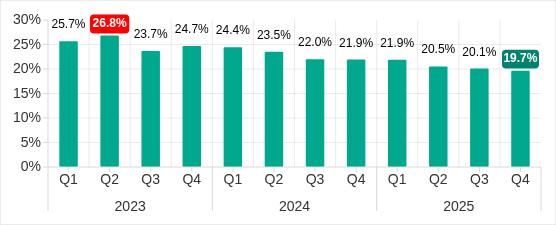
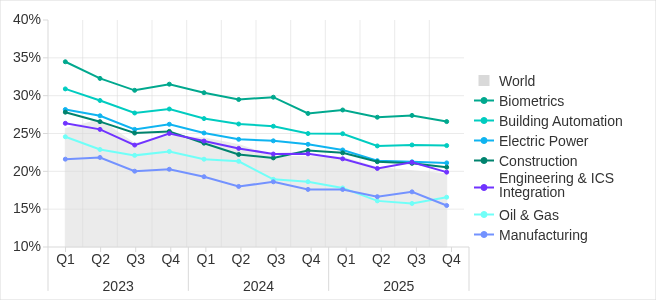
The percentage of ICS computers on which malicious objects were blocked has been decreasing since the beginning of 2024. In Q4 2025, it was 19.7%. Over the past three years, the percentage has decreased by 1.36 times, and by 1.25 times since Q4 2023.
Percentage of ICS computers on which malicious objects were blocked, Q1 2023–Q4 2025
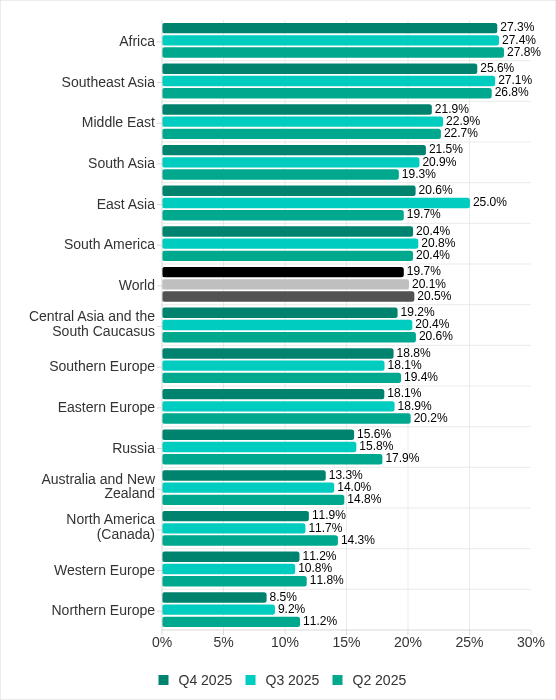
Regionally, in Q4 2025, the percentage of ICS computers on which malicious objects were blocked ranged from 8.5% in Northern Europe to 27.3% in Africa.
Regions ranked by percentage of ICS computers on which malicious objects were blocked
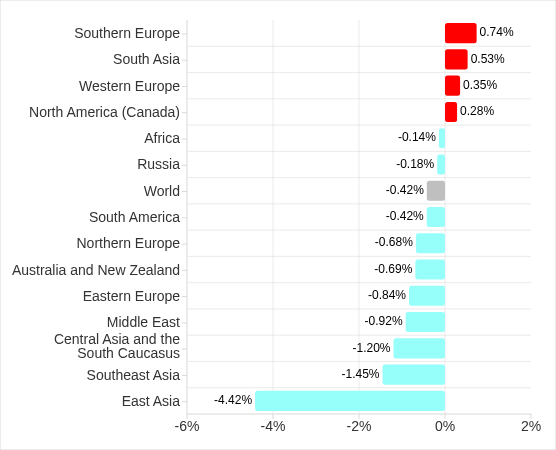
Four regions saw an increase in the percentage of ICS computers on which malicious objects were blocked. The most notable increases occurred in Southern Europe and South Asia. In Q3 2025, East Asia experienced a sharp increase triggered by the local spread of malicious scripts, but the figure has since returned to normal.
Changes in percentage of ICS computers on which malicious objects were blocked, Q4 2025
Feature of the quarter: worms in email
In Q4 2025, the percentage of ICS computers on which wormsinemailattachments were blocked increasedinallregions of the world.
Many of the blocked threats were related to the worm Backdoor.MSIL.XWorm. This malware is designed to persist on the system and then remotely control it.
Interestingly, this threat was not detected on ICS computers in the previous quarter, yet it appeared in all regions in Q4 2025.
A study found that the active spread of Backdoor.MSIL.XWorm via phishing emails was likely linked to the use by hackers of another malware obfuscation technique that was actively used during massive phishing campaigns in Q4 2025. These campaigns have been known since 2024 as “Curriculum-vitae-catalina”.
The attackers distributed phishing emails to HR managers, recruiters, and employees responsible for hiring. The messages were disguised as responses from job applicants with subjects such as “Resume” or “Attached Resume” and contained a malicious executable file under the guise of a curriculum vitae. Typically, the file was named Curriculum Vitae-Catalina.exe. When executed, it infected the system.
In Q4 2025, the threat spread across regions in two waves — one in October and another in November. Russia, Western Europe, South America, and North America (Canada) were attacked in October. A spike in Backdoor.MSIL.XWorm blocking was observed in other regions in November. The attack subsided in all regions in December.
The highest percentage of ICS computers on which Backdoor.MSIL.XWorm was blocked was observed in regions where threats from email clients had been historically blocked at high rates on ICS computers: Southern Europe, South America, and the Middle East.
At the same time, in Africa, where USB storage media are still actively used, the threat was also detected when removable devices were connected to ICS computers.
Selected industries
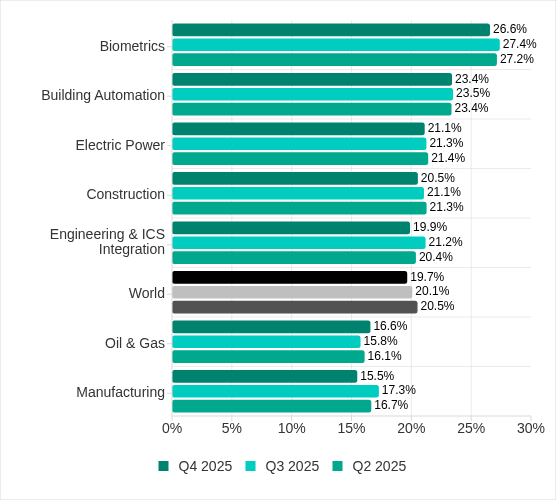
The biometrics sector has historically led the rankings of industries and OT infrastructures surveyed in this report in terms of the percentage of ICS computers on which malicious objects were blocked.
These systems are characterized by accessibility to and from the internet, as well as minimal cybersecurity controls by the consumer organization.
Rankings of industries and OT infrastructure by percentage of ICS computers on which malicious objects were blocked
In Q4 2025, the percentage of ICS computers on which malicious objects were blocked increased only in one sector: oil and gas. The corresponding figures increased in two regions: Russia, and Central Asia and the South Caucasus.
However, if we look at a broader time span, there is a downward trend in all the surveyed industries.
Percentage of ICS computers on which malicious objects were blocked in selected industries
Diversity of detected malicious objects
In Q4 2025, Kaspersky protection solutions blocked malware from 10,142 different malware families of various categories on industrial automation systems.
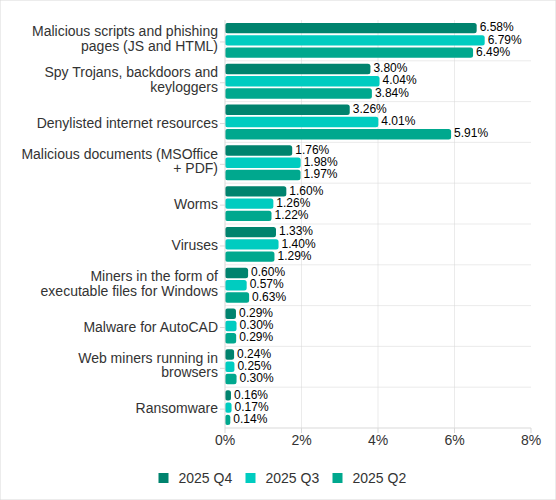
Percentage of ICS computers on which the activity of malicious objects from various categories was blocked
In Q4 2025, there was an increase in the percentage of ICS computers on which worms, and miners in the form of executable files for Windows were blocked. These were the only categories that exhibited an increase.
Main threat sources
Depending on the threat detection and blocking scenario, it is not always possible to reliably identify the source. The circumstantial evidence for a specific source can be the blocked threat’s type (category).
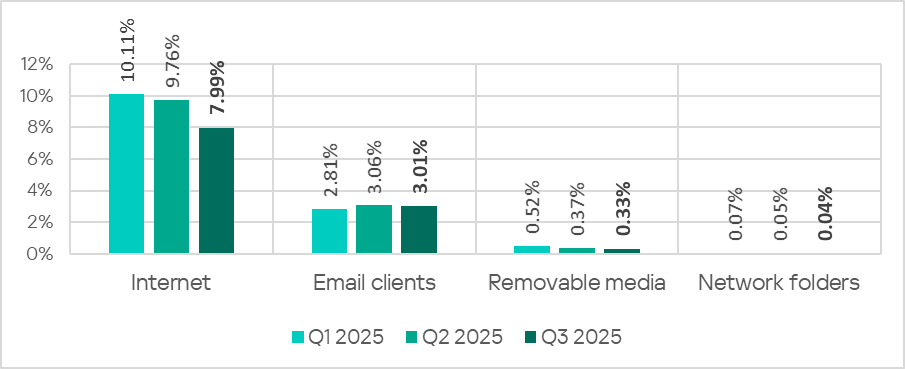
The internet (visiting malicious or compromised internet resources; malicious content distributed via messengers; cloud data storage and processing services and CDNs), email clients (phishing emails), and removable storage devices remain the primary sources of threats to computers in an organization’s technology infrastructure.
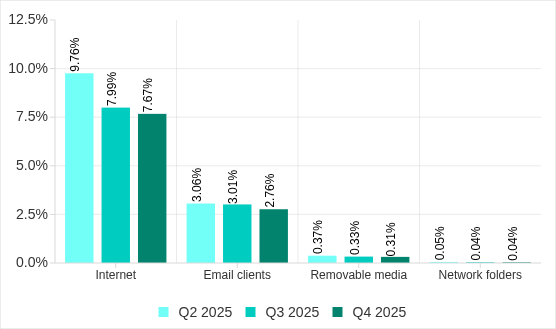
In Q4 2025, the percentage of ICS computers on which malicious objects from various sources were blocked decreased. All sources except email clients saw their lowest levels in three years.
Percentage of ICS computers on which malicious objects from various sources were blocked
The same computer can be attacked by several categories of malware from the same source during a quarter. That computer is counted when calculating the percentage of attacked computers for each threat category, but is only counted once for the threat source (we count unique attacked computers). In addition, it is not always possible to accurately determine the initial infection attempt. Therefore, the total percentage of ICS computers on which various categories of threats from a certain source were blocked can exceed the percentage of computers affected by the source itself.
In Q4 2025, the percentage of ICS computers on which threats from the internet were blocked decreased to 7.67% and reached its lowest level since the beginning of 2023. The main categories of internet threats are malicious scripts and phishing pages, and denylisted internet resources. The percentage ranged from 3.96% in Northern Europe to 11.33% in South Asia.
The main categories of threats from email clients blocked on ICS computers were malicious scripts and phishing pages, spyware, and malicious documents. Most of the spyware detected in phishing emails was delivered as a password archive or a multi-layered script embedded in office document files. The percentage of ICS computers on which threats from email clients were blocked ranged from 0.64% in Northern Europe to 6.34% in Southern Europe.
The main categories of threats that were blocked when removable media was connected to ICS computers were worms, viruses, and spyware. The percentage of ICS computers on which threats from removable media were blocked ranged from 0.05% in Australia and New Zealand to 1.41% in Africa.
The main categories of threats that spread through network folders in Q4 2025 were viruses, AutoCAD malware, worms, and spyware. The percentage of ICS computers on which threats from network folders were blocked ranged from 0.01% in Northern Europe to 0.18% in East Asia.
Threat categories
Typical attacks blocked within an OT network are multi-step sequences of malicious activities, where each subsequent step of the attackers is aimed at increasing privileges and/or gaining access to other systems by exploiting the security problems of industrial enterprises, including OT infrastructures.
Malicious objects used for initial infection
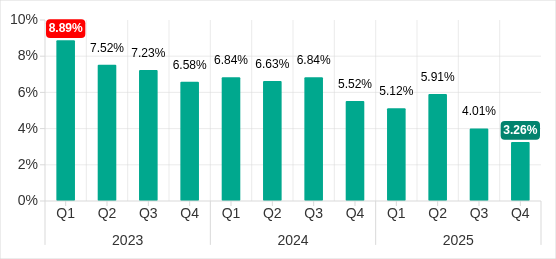
In Q4 2025, the percentage of ICS computers on which denylisted internet resources were blocked decreased to 3.26%. This is the lowest quarterly figure since the beginning of 2022, and it has decreased by 1.8 times since Q2 2025.
Percentage of ICS computers on which denylisted internet resources were blocked, Q1 2023–Q4 2025
Regionally, the percentage of ICS computers on which denylisted internet resources were blocked ranged from 1.74% in Northern Europe to 3.93% in Southeast Asia, which displaced Africa from first place. Russia rounded out the top three regions for this indicator.
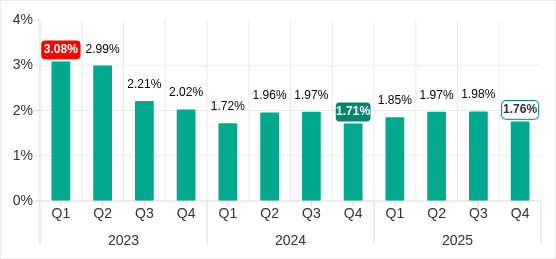
The percentage of ICS computers on which malicious documents were blocked increased for three consecutive quarters. However, in Q4 2025 it decreased by 0.22 pp to 1.76%.
Percentage of ICS computers on which malicious documents were blocked, Q1 2023–Q4 2025
Regionally, the percentage ranged from 0.46% in Northern Europe to 3.82% in Southern Europe. In Q4 2025, the indicator increased in Eastern Europe, Russia, and Western Europe.
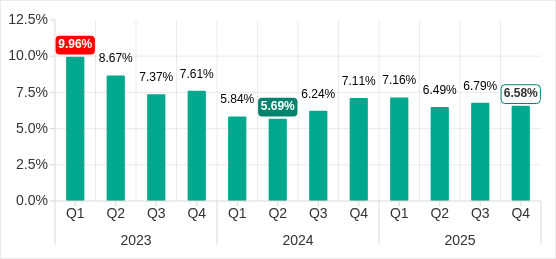
The percentage of ICS computers on which malicious scripts and phishing pages were blocked decreased to 6.58%. Despite the decline, this category led the rankings of threat categories in terms of the percentage of ICS computers on which they were blocked.
Percentage of ICS computers on which malicious scripts and phishing pages were blocked, Q1 2023–Q4 2025
Regionally, the percentage ranged from 2.52% in Northern Europe to 10.50% in South Asia. The indicator increased in South Asia, South America, Southern Europe, and Africa. South Asia saw the most notable increase, at 3.47 pp.
Next-stage malware
Malicious objects used to initially infect computers deliver next-stage malware — spyware, ransomware, and miners — to victims’ computers. As a rule, the higher the percentage of ICS computers on which the initial infection malware is blocked, the higher the percentage for next-stage malware.
In Q4 2025, the percentage of ICS computers on which spyware, ransomware and web miners were blocked decreased. The rates were:
Spyware: 3.80% (down 0.24 pp). For the second quarter in a row, spyware took second place in the rankings of threat categories in terms of the percentage of ICS computers on which it was blocked.
Ransomware: 0.16% (down 0.01 pp).
Web miners: 0.24% (down 0.01 pp), this is the lowest level observed thus far in the period under review.
The percentage of ICS computers on which miners in the form of executable files for Windows were blocked increased to 0.60% (up 0.03 pp).
Self-propagating malware
Self-propagating malware (worms and viruses) is a category unto itself. Worms and virus-infected files were originally used for initial infection, but as botnet functionality evolved, they took on next-stage characteristics.
To spread across ICS networks, viruses and worms rely on removable media and network folders and are distributed in the form of infected files, such as archives with backups, office documents, pirated games and hacked applications. In rarer and more dangerous cases, web pages with network equipment settings, as well as files stored in internal document management systems, product lifecycle management (PLM) systems, resource management (ERP) systems and other web services are infected.
In Q4 2025, the percentage of ICS computers on which worms were blocked increased by 1.6 times to 1.60%. As mentioned above, this increase is related to a global phishing attack that spread the Backdoor.MSIL.XWorm backdoor worm across all regions of the world. The percentage increased in all regions. The biggest increase (up by 2.16 times) was in Southern Europe. The malware was primary distributed through email clients, and Southern Europe led the way in terms of the percentage of ICS computers on which threats from email clients were blocked.
The percentage of ICS computers on which viruses were blocked decreased to 1.33%.
AutoCAD malware
This category of malware can spread in a variety of ways, so it does not belong to a specific group.
After an increase in the previous quarter, the percentage of ICS computers on which AutoCAD malware was blocked decreased to 0.29% in Q4 2025.
WhatsApp blocked a fake app by Italian firm SIO/Asigint that targeted 200 users with spyware, urging them to reinstall the official app.
WhatsApp has recently uncovered a malicious fake version of its app that targeted roughly 200 users, most of whom are in Italy. The platform confirmed that the unofficial client contained spyware and was developed by Italian firm Asigint, a subsidiary of SIO Spa, a company known for providing surveillance tools to law enforcement and government agencies.
“Our security team identified around 200 users, mostly in Italy, who we believe may have downloaded this unofficial and harmful client. We logged them out and alerted them to the privacy and security risks,” WhatsApp stated. “We believe this was a social engineering attempt targeting a limited number of users with the goal of inducing them to install harmful software impersonating WhatsApp, likely to gain access to their devices. Today, WhatsApp has taken action against Asigint, an Italian spyware company controlled by Sio Spa that created a fake version of WhatsApp. We believe the individuals behind this malicious client used social engineering techniques to trick people into downloading an unofficial and harmful app disguised as WhatsApp,” the Meta Group company said in a statement, adding that it intends to “send a formal legal notice to this spyware company to cease all harmful activity.”
The affected users were promptly logged out and notified of the potential risks to their privacy and security. WhatsApp advised them to remove the fake app and reinstall the official version, emphasizing that the incident did not involve a vulnerability in WhatsApp itself; the end-to-end encryption of legitimate apps remains intact.
According to WhatsApp, the attackers relied on social engineering techniques, tricking users into installing the counterfeit app, which was not available on official digital stores like the Apple App Store or Google Play. The approach suggests a highly targeted campaign, likely part of a broader investigation, rather than a mass-distribution attack.
“It is important to clarify that this was not a vulnerability in WhatsApp; end-to-end encryption continues to protect the communications of people using the official WhatsApp apps,” the Meta Group platform stated, as reported by the Italian press agency ANSA. “We believe the individuals behind this malicious client used social engineering techniques to convince people to download an unofficial and harmful app, passing it off as WhatsApp, likely to gain access to their devices. We intend to send a formal legal notice to this spyware company to cease any harmful activity.”
SIO, through Asigint, has a long history in the development of government-grade spyware. In a 2025 TechCrunch report, SIO was linked to Spyrtacus, a series of malicious Android apps that disguised themselves as WhatsApp and other popular applications. Spyrtacus allowed attackers to extract sensitive data from devices, including messages, contact lists, and call logs, as well as monitor users through microphones and cameras.
A WhatsApp spokesperson explained that the company plans to issue a formal legal demand to Asigint, requesting that the company cease all malicious activities. The platform stressed that holding spyware developers accountable under law is a crucial part of protecting users from targeted attacks. WhatsApp has previously achieved a precedent-setting outcome by holding a commercial spyware firm responsible under U.S. law for attempting to spy on users’ mobile devices.
The incident highlights a broader trend in digital surveillance: using fake apps as a tool for spying. Cybersecurity experts note that such tactics are common in operations targeting individuals for intelligence or law enforcement purposes.
“The fake WhatsApp campaign demonstrates the sophistication of modern social engineering techniques, where attackers exploit users’ trust in popular software to gain access to sensitive devices,” I told ANSA.
SIO describes itself as a team of software developers and architects leveraging advanced technologies to redefine human-computer interaction. According to its website, the company collaborates closely with law enforcement, government organizations, and intelligence agencies, boasting more than 30 years of experience in the sector. The fake WhatsApp case underlines how firms that operate in the intelligence space can inadvertently, or deliberately, target private users in ways that raise ethical and legal questions.
While the full scope of the attack remains unclear, the proactive response by WhatsApp underscores the importance of vigilance. Users are strongly encouraged to only download official applications and remain alert to suspicious links or prompts, especially when dealing with messaging or banking apps.
This case also demonstrates the evolving challenges of digital security in Italy and globally, where spyware developers increasingly use counterfeit applications to bypass traditional defenses and exploit user trust. Even though most affected individuals were Italian, the lessons extend to anyone using widely trusted apps. Awareness and timely updates are essential defenses against such targeted threats.
In conclusion, the WhatsApp-Asigint incident is a reminder of the ongoing arms race between privacy-focused platforms and surveillance-focused actors. While end-to-end encryption protects users of legitimate apps, attackers will continue to explore indirect methods, such as fake apps, to circumvent safeguards. Vigilance, legal accountability, and prompt user education remain the most effective tools for mitigating these sophisticated threats.
In March 2026, we discovered an active campaign promoting previously unknown malware in private Telegram chats. The Trojan was offered as a MaaS (malware‑as‑a‑service) with three subscription tiers. It caught our attention because of its extensive arsenal of capabilities. On the panel provided to third‑party actors, in addition to the standard features of RAT‑like malware, a stealer, keylogger, clipper, and spyware are also available. Most surprisingly, it also includes prankware capabilities: a large set of features designed to trick, annoy, and troll the user. Such a combination of capabilities makes it a rather unique Trojan in its category.
Kaspersky’s products detect this threat as Backdoor.Win64.CrystalX.*, Trojan.Win64.Agent.*, Trojan.Win32.Agentb.gen.
Technical details
Background
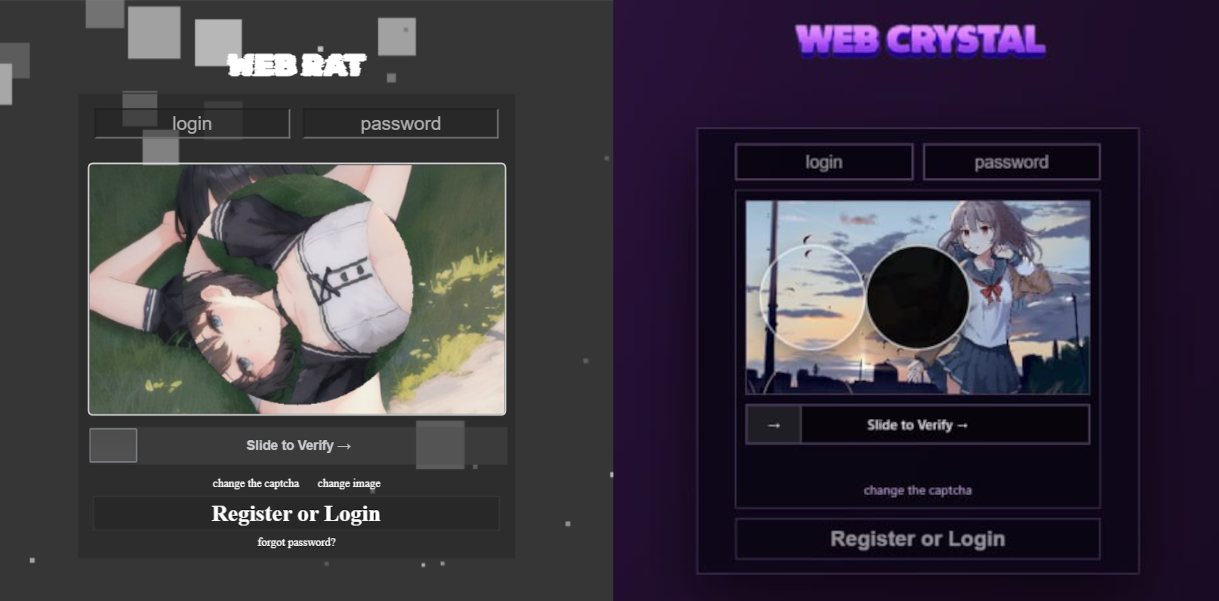
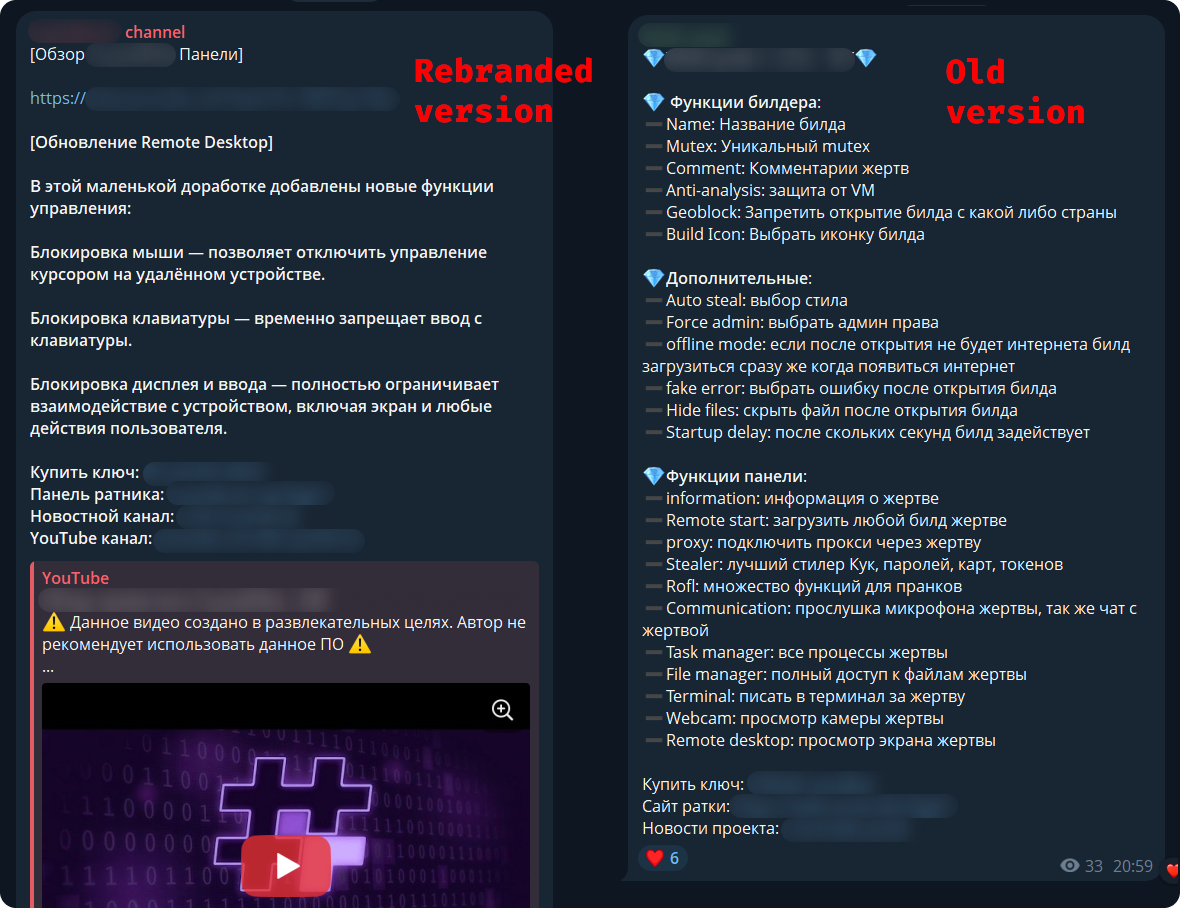
The new malware was first mentioned in January 2026 in a private Telegram chat for developers of RAT malware. The author actively promoted their creation, called Webcrystal RAT, by attaching screenshots of the web panel. Many users observed that the panel layout was identical to that of the previously known WebRAT (also called Salat Stealer), leading them to label this malware as a copy. Additional similarities included the fact that the RAT was written in Go, and the messages from the bot selling access keys to the control panel closely matched those of the WebRAT bots.
After some time, this malware was rebranded and received a new name, CrystalX RAT. Its promotion moved to a corresponding new channel, which is quite busy and features marketing tricks, such as access key draws and polls. Moreover, it expanded beyond Telegram: a special YouTube channel was created, aimed at marketing promotion and already containing a video review of the capabilities of this malware.
The builder and anti-debug features
By default, the malware control panel provides third parties with an auto‑builder featuring a wide range of configurations, such as selective geoblocking by country, anti‑analysis functions, an executable icon, and others. Each implant is compressed using zlib and then encrypted with ChaCha20 and a hard‑coded 32‑byte key with a 12‑byte nonce. The malware has basic anti‑debugging functionality combined with additional optional capabilities:
MITM Check: checking if a proxy is enabled by reading the registry value HKCU\Software\Microsoft\Windows\CurrentVersion\Internet Settings, blacklisting names of certain processes (Fiddler, Burp Suite, mitmproxy, etc.), and verifying the presence of installed certificates for the corresponding programs
VM detect: checking running processes, presence of guest tools, and hardware characteristics
Anti-attach loop: an infinite loop checking the debug flag, debug port, hardware breakpoints, and program execution timings
Stealth patches: patches for functions such as AmsiScanBuffer, EtwEventWrite, MiniDumpWriteDump
Stealer capabilities
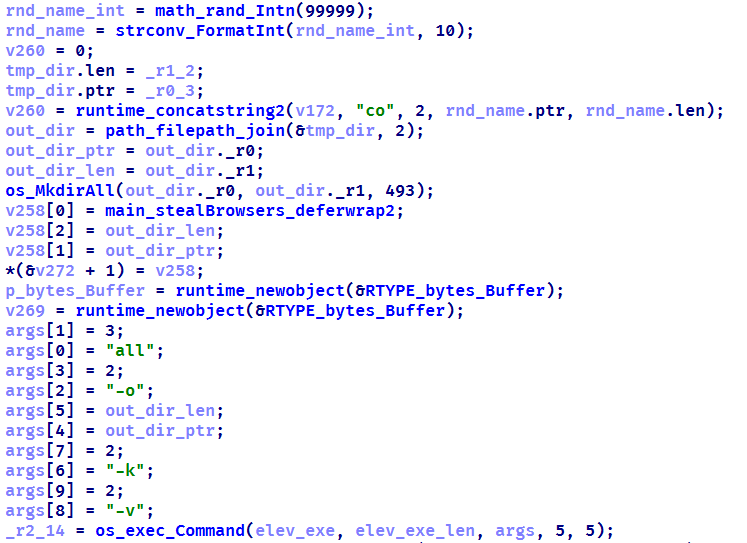
When launched, the malware establishes a connection to its C2 using a hard‑coded URL over the WebSocket protocol. It performs an initial collection of system information, after which all data is sent in JSON format as plain text. Then the malware executes the stealer function, doing so either once or at predefined intervals depending on the build options. The stealer extracts the victim’s credentials for Steam, Discord, and Telegram from the system. It also gathers data from Chromium‑based browsers using the popular ChromeElevator utility. To do this, it decodes and decompresses the utility using base64 and gunzip and saves it to %TEMP%\svc[rndInt].exe, then creates a directory %TEMP%\co[rndInt], where the collected data is stored, and finally runs ChromeElevator with all available options.
The collected data is exfiltrated to the C2. For Yandex and Opera browsers, the stealer has a separate proprietary implementation with base decryption directly on the victim’s system. Notably, the builds created at the time the article was written lack the stealer functionality. OSINT results show that the author intentionally removed it with the aim to update the stealer arsenal before enabling it again.
Keylogger & clipper
Another option of the RAT is the keylogger. All user input is instantly transmitted via WebSocket to the C2, where it is assembled into a coherent text suitable for analysis. Additionally, the malware allows the attacker to read and modify the victim’s clipboard by issuing appropriate commands from the control panel. Moreover, it can inject a malicious clipper into the Chrome or Edge browser. This happens according to the following algorithm:
The special malware command clipper:set:[ADDR1,...] with the attackers’ crypto‑wallets addresses passed as arguments launches the clipper injection thread.
A %LOCALAPPDATA%\Microsoft\Edge\ExtSvc directory is created (regardless whether Edge or Chrome is the target of the injection), in which a malicious extension is stored, consisting of a manifest and a single JS script named content.js.
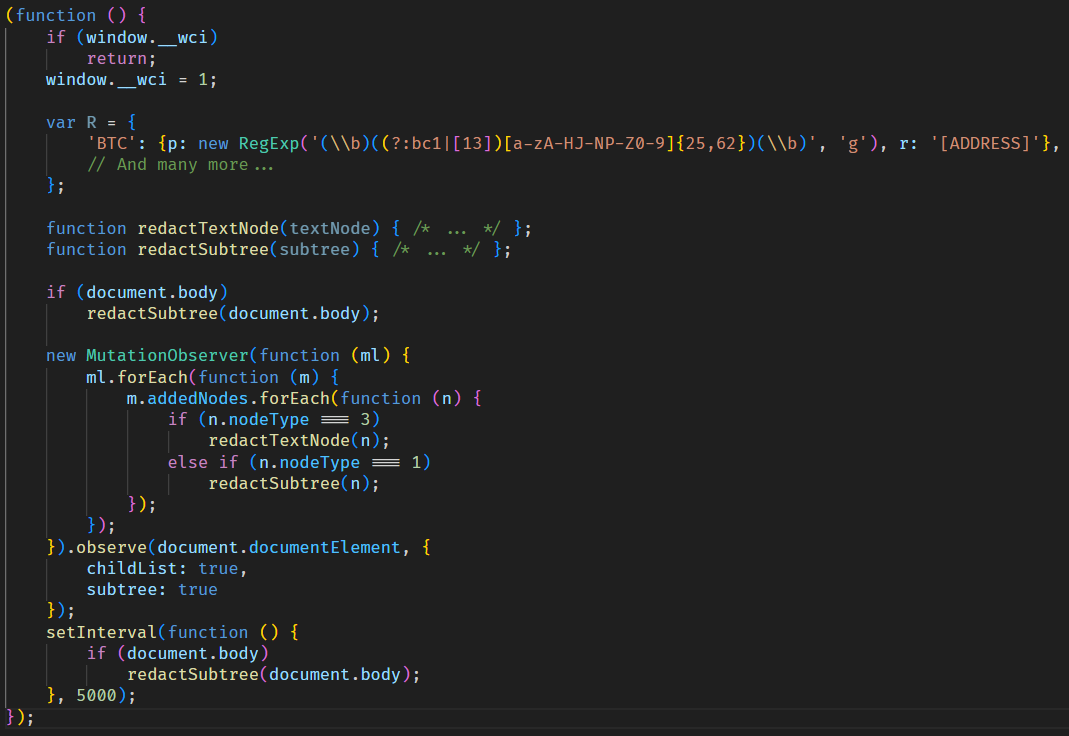
The content.js script is dynamically generated, containing regular expressions for crypto wallet addresses (such as Bitcoin, Litecoin, Monero, Avalanche, Doge, and others) and substitution values.
The generated script is activated via the Chrome DevTools (CDP) protocol using the command Page.addScriptToEvaluateOnNewDocument.
The final script looks as follows:
Remote access
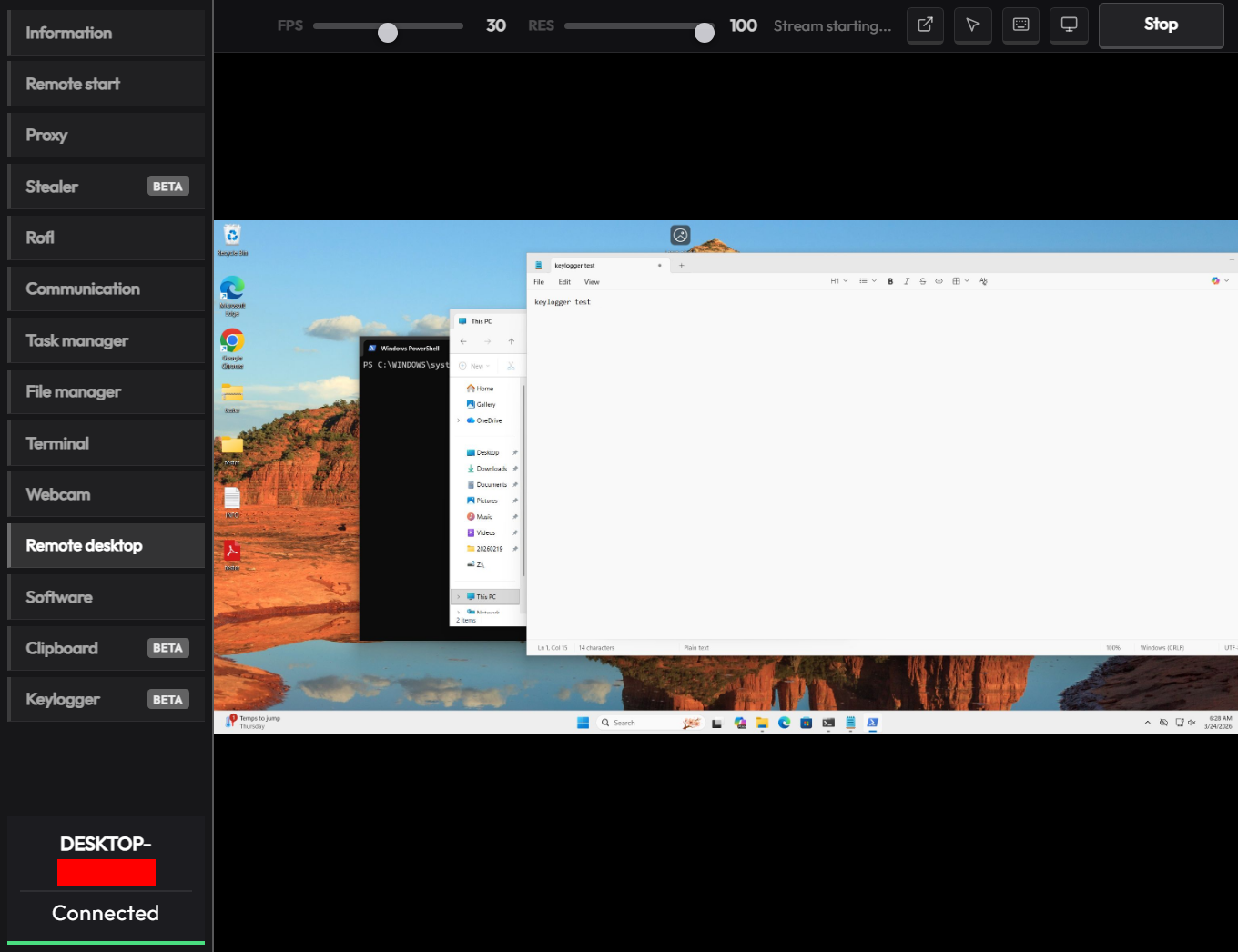
The malware has a large set of commands for remote access to the victim’s system. The attacker can upload arbitrary files, execute any commands using cmd.exe, and also browse the file system, including all available drives. Moreover, the RAT includes its own VNC that allows the attacker to view the victim’s screen and control it remotely. Since both the attacker and the victim use the same session, the panel provides a number of buttons to block user input so that the attacker can perform necessary actions unhindered. The malware can also capture the audio stream from the microphone and the video stream from the camera in the background.
Prank commands
The finishing touch is a separate section of the panel named “Rofl” with commands whose functions consist of various pranks on the victim.
Setting a background: downloading an image from a specified URL and using it as the desktop background.
Display orientation: rotating the screen 90°, 180°, or 270°.
System shutdown: the panel has two different buttons “Voltage Drop” and “BSoD”, but malware analysis shows that both commands perform a regular shutdown using the appropriate utility.
Remapping mouse buttons: swapping left click with right click and the other way round.
Peripherals disruption: disconnecting the monitor and blocking the input from the mouse and keyboard.
Notifications: displaying a window with a custom title and message.
Cursor shake: a special command starts a loop in which the cursor position changes chaotically at short intervals.
Disabling components: hiding all file icons on the desktop, disabling the taskbar, task manager, and cmd.exe.
Moreover, the attacker can send a message to the victim, after which a dialog window will open in the system, allowing a bidirectional chat.
Conclusions
The sheer variety of available RATs has perpetuated demand, as actors prioritize flexibility of existing malware and its infrastructure. Thus, CrystalX RAT represents a highly functional MaaS platform that is not limited to espionage capabilities – spyware, keylogging and remote control – but includes unique stealer and prankware features. At the moment, the vector of the initial infection is not precisely known, but it affects dozens of victims. Although to date, we have only seen infection attempts in Russia, the MaaS itself has no regional restrictions meaning it may attack anywhere around the globe. Moreover, our telemetry has recorded new implant versions, which indicates that this malware is still being actively developed and maintained. Combined with the growing PR campaign for CrystalX RAT, it can be concluded that the number of victims can increase significantly in the near future.
Amnesty reports Angolan journalist’s iPhone was infected by Intellexa’s Predator spyware via a WhatsApp link in May 2024.
Amnesty International reports that in May 2024, Intellexa’s Predator spyware infected the iPhone of Teixeira Cândido, an Angolan journalist and press freedom advocate, after he opened a malicious link sent via WhatsApp. This incident highlights how attackers actively target journalists for surveillance.
Predator is a powerful mobile spyware by Intellexa, sold to governments for surveillance. Investigations over five years documented abuses worldwide, despite Intellexa rebranding and shifting its corporate structure. The Angola case marks the first confirmed Predator attack there, showing the spyware remained active through 2025. Amnesty International and partners exposed Intellexa’s operations, but the responsible customers remain unknown.
Since 2022, Angolan journalist Teixeira Cândido faced multiple attacks and break-ins, raising suspicions of surveillance. From April to June 2024, an attacker posing as students sent him WhatsApp messages to gain his trust, eventually sending malicious links. On 4 May 2024, he clicked one link, infecting his iPhone with Intellexa’s Predator spyware. Once installed, the spyware gave attackers full access to his device, including messages, calls, emails, location, camera, microphone, passwords, and other sensitive data, illustrating a targeted and highly invasive surveillance operation.
“Through forensic analysis of the links and associated domain names, Amnesty International’s Security Lab determined with high confidence that all the links sent to Teixeira Cândido to this WhatsApp number were attempts to infect his phone with the Predator spyware. All infection domains matched a network fingerprint used to track Intellexa infection servers.” reads the report published by Amnesty International. “On 4 May 2024, one day after the first Predator infection link was received (Figure 4), Teixeira Cândido appears to have opened the infection link received, which would have resulted in the successful infection of the journalist’s phone with the Predator spyware.
On 4 May 2024, Amnesty International confirmed Predator spyware ran on Teixeira Cândido’s iPhone, executing from the directory /private/var/containers/Bundle/ under the name “iconservicesagent” to impersonate a system process.
His device ran the outdated iOS 16.2, potentially exposing it to known exploits, though Intellexa could also use zero-day vulnerabilities. The spyware remained active less than a day, but attackers sent 11 further malicious WhatsApp links through mid-June 2024. Forensic traces, network activity, and infection domains confirm this attack as Predator.
Amnesty International’s research shows Intellexa’s Predator spyware has targeted Angola since at least early 2023, with the attack on journalist Teixeira Cândido representing just part of broader activity. Predator communicates with spyware servers via domain names, many in Portuguese, revealing a regional focus. Technical analysis linked the domains used against Cândido to Predator, with earlier Angola-linked domains dating back to March 2023. Predator grants total access to devices, making independent audits nearly impossible.
Amnesty considers such spyware fundamentally incompatible with human rights. The Angola attack violates journalists’ rights to privacy and free expression, chilling civil society in a context of growing authoritarianism under President João Lourenço. Amnesty’s inquiries to Intellexa about its role and access to customer systems remain unanswered, raising concerns over the company’s legal and ethical responsibility in these abuses.
“While it remains unclear if Intellexa could access the specific Angolan deployment in 2024, the finding from Intellexa Leaks that the company had potential visibility into active surveillance operations of their customers, including seeing technical information about the targets, raises new legal questions about Intellexa’s role in relation to the spyware and the company’s potential legal or criminal responsibility for unlawful surveillance operations carried out using their products.” concludes the report. “This new case of spyware use against a journalist in Angola makes clear – yet again – that the unchecked sale and use of surveillance technologies continue to facilitate human rights abuses at a global scale. “
ZeroDayRAT is a commercial mobile spyware that grants full remote access to Android and iOS devices for spying and data theft.
ZeroDayRAT is a newly discovered commercial mobile spyware toolkit that gives attackers full control over Android and iOS devices. It supports live camera access, keylogging, and theft of banking and crypto data.
First spotted in February 2026 and analyzed by iVerify, it is sold on Telegram and rivals tools usually built by nation-states. Attackers host their own servers and generate malicious apps to infect victims.
The seller runs sales, support, and update channels and gives buyers an easy-to-use control panel. From it, attackers can fully control Android and iOS devices, watch users in real time, and steal money. ZeroDayRAT works on a wide range of phones and needs no technical skills. Attackers usually infect victims through smishing texts, phishing emails, fake apps, or malicious links shared on messaging platforms.
After infecting a mobile device, ZeroDayRAT shows operators a detailed overview of the device. The panel displays the phone model, operating system, battery level, country, SIM and carrier details, app usage, recent activity, and SMS previews on one screen. This already lets attackers profile the victim’s habits, contacts, and daily activity.
From there, operators can track real-time and historical GPS locations on a map, monitor notifications from all apps, and see alerts, messages, and missed calls without opening any app.
A dedicated accounts section lists every service linked to the device.
“One of the more problematic panels is the accounts tab. Every account registered on the device is enumerated: Google, WhatsApp, Instagram, Facebook, Telegram, Amazon, Flipkart, PhonePe, Paytm, Spotify, and more, each with its associated username or email.” reads the report published by iVerify. “This is basically everything an attacker needs to attempt account takeover or launch targeted social engineering.”
ZeroDayRAT also enables live surveillance, not just data collection. From one panel, operators can stream the phone’s camera, record the screen, and listen through the microphone in real time, while tracking the device’s location.
“The surveillance tab crosses into real-time physical access: live camera streaming (front or back), screen recording, and a microphone feed.” continues the report. “Combined with GPS tracking, an operator can watch, listen to, and locate a target simultaneously.”
A built-in keylogger records every action with precise timestamps, including keystrokes, gestures, app launches, and unlocks. A live screen preview lets attackers watch what the victim is doing as it happens.
ZeroDayRAT also supports direct financial theft. Its crypto stealer component scans the device for wallet apps, records wallet IDs and balances, and hijacks clipboard data to replace copied wallet addresses with the attacker’s own. A separate banking module targets mobile banking apps, UPI services, and payment platforms like Apple Pay and PayPal, using overlays to steal login details. From one control panel, operators can attack both crypto assets and traditional financial accounts.
“Taken together, this is a complete mobile compromise toolkit, the kind that used to require nation-state investment or bespoke exploit development, now sold on Telegram.” concludes the report. “A single buyer gets full access to a target’s location, messages, finances, camera, microphone, and keystrokes from a browser tab. Cross-platform support and active development make it a growing threat to both individuals and organizations.”
The Irish government is planning to bolster its police’s ability to intercept communications, including encrypted messages, and provide a legal basis for spyware use.
The founder of a spyware company that encouraged customers to secretly monitor their romantic partners has pleaded guilty to federal charges - marking one of the few successful US prosecutions of a stalkerware operator.
Read more in my article on the Hot for Security blog.
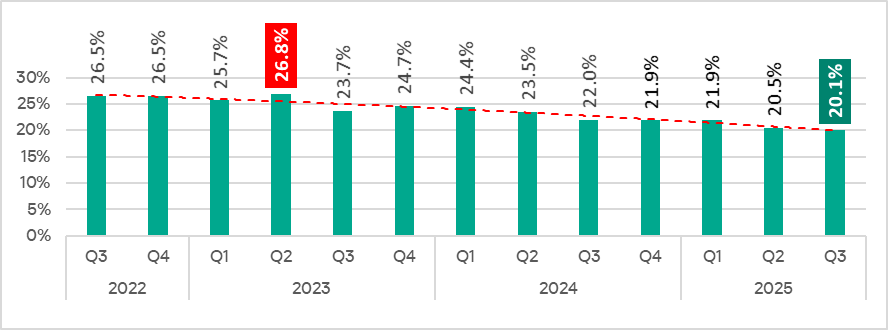
In Q3 2025, the percentage of ICS computers on which malicious objects were blocked decreased from the previous quarter by 0.4 pp to 20.1%. This is the lowest level for the observed period.
Percentage of ICS computers on which malicious objects were blocked, Q3 2022–Q3 2025
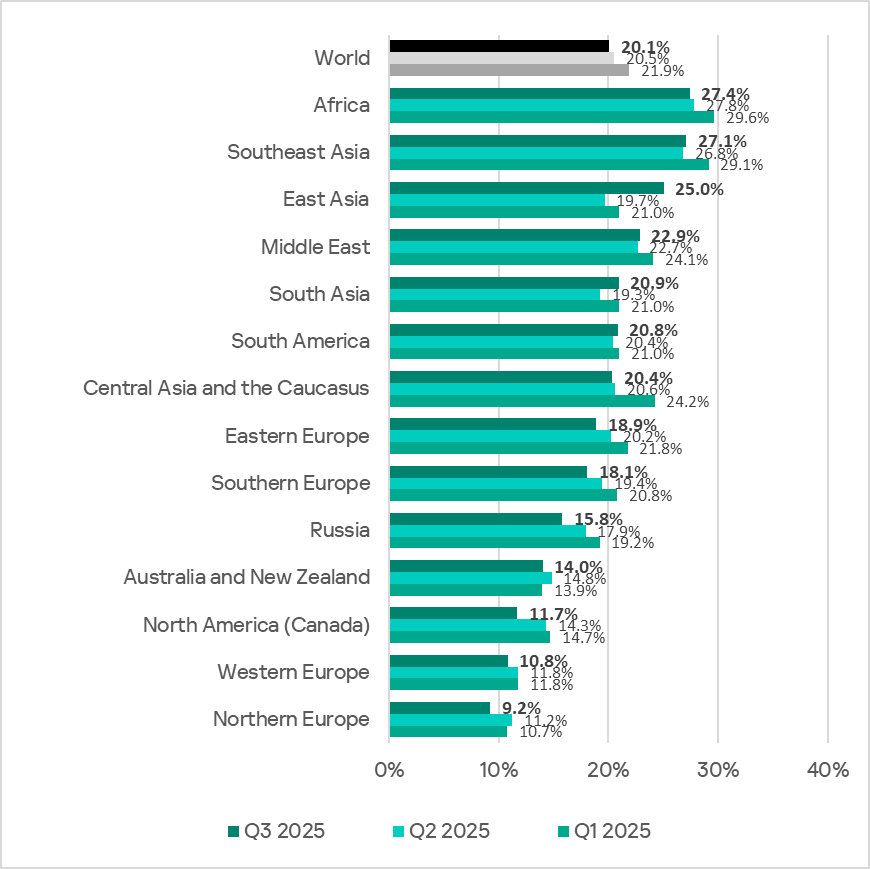
Regionally, the percentage of ICS computers on which malicious objects were blocked ranged from 9.2% in Northern Europe to 27.4% in Africa.
Regions ranked by percentage of ICS computers on which malicious objects were blocked
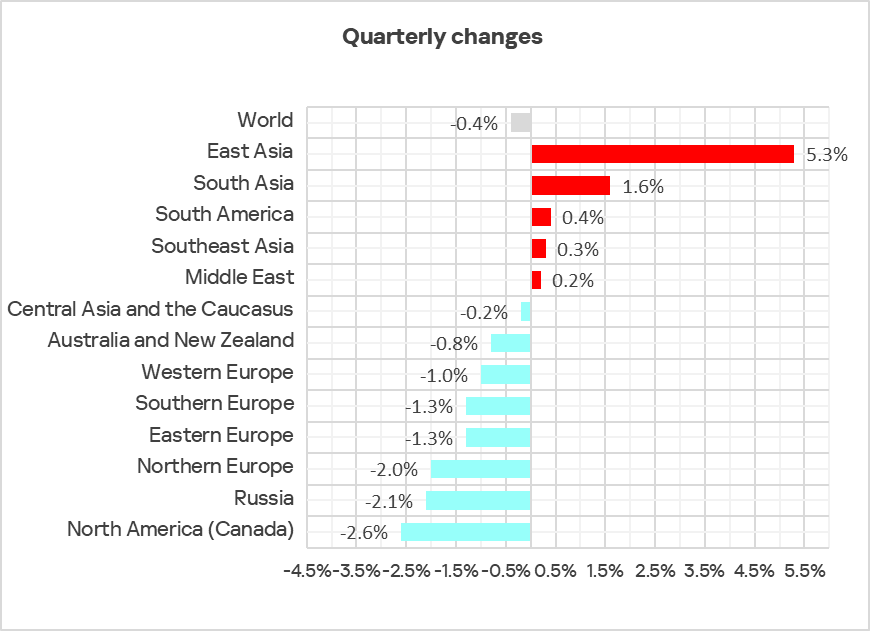
In Q3 2025, the percentage increased in five regions. The most notable increase occurred in East Asia, triggered by the local spread of malicious scripts in the OT infrastructure of engineering organizations and ICS integrators.
Changes in the percentage of ICS computers on which malicious objects were blocked, Q3 2025
Selected industries
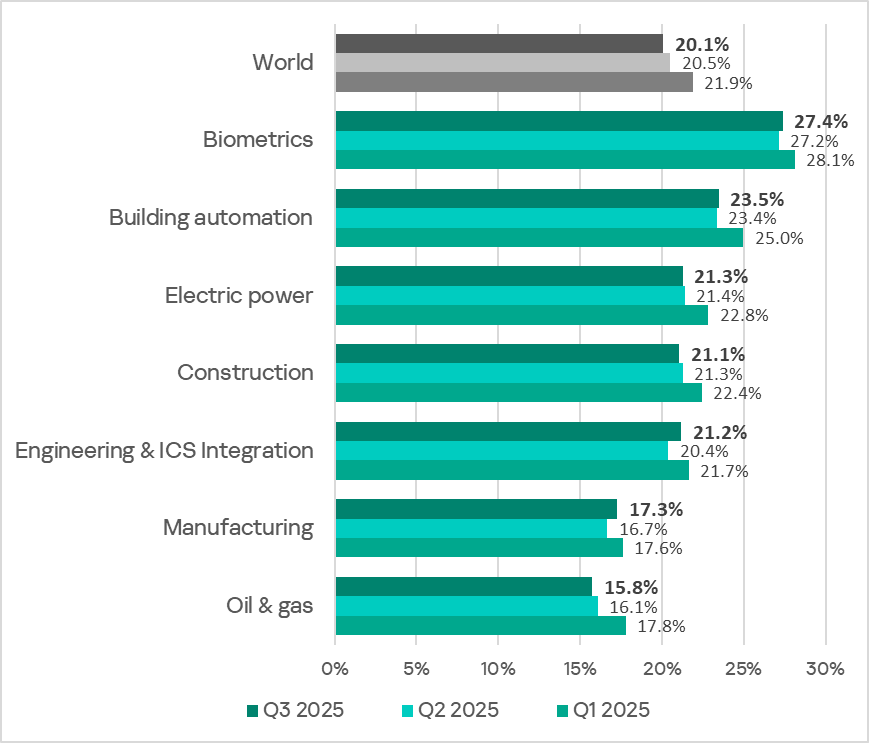
The biometrics sector traditionally led the rankings of the industries and OT infrastructures surveyed in this report in terms of the percentage of ICS computers on which malicious objects were blocked.
Rankings of industries and OT infrastructures by percentage of ICS computers on which malicious objects were blocked
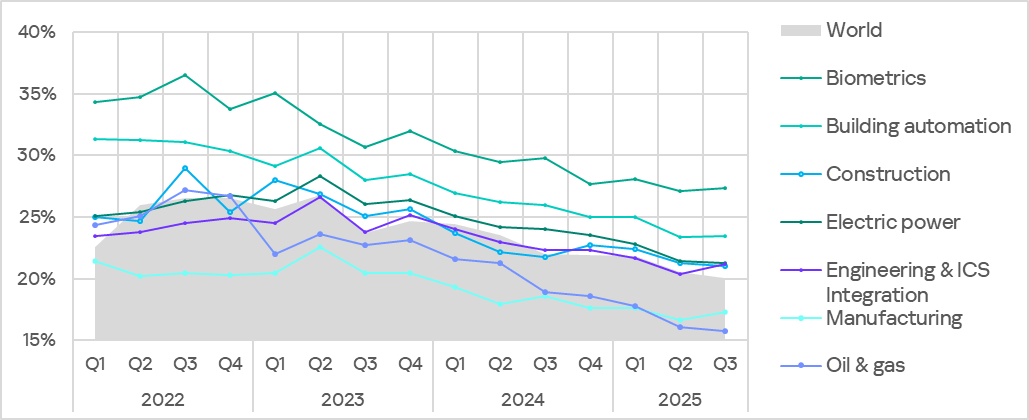
In Q3 2025, the percentage of ICS computers on which malicious objects were blocked increased in four of the seven surveyed industries. The most notable increases were in engineering and ICS integrators, and manufacturing.
Percentage of ICS computers on which malicious objects were blocked in selected industries
Diversity of detected malicious objects
In Q3 2025, Kaspersky protection solutions blocked malware from 11,356 different malware families of various categories on industrial automation systems.
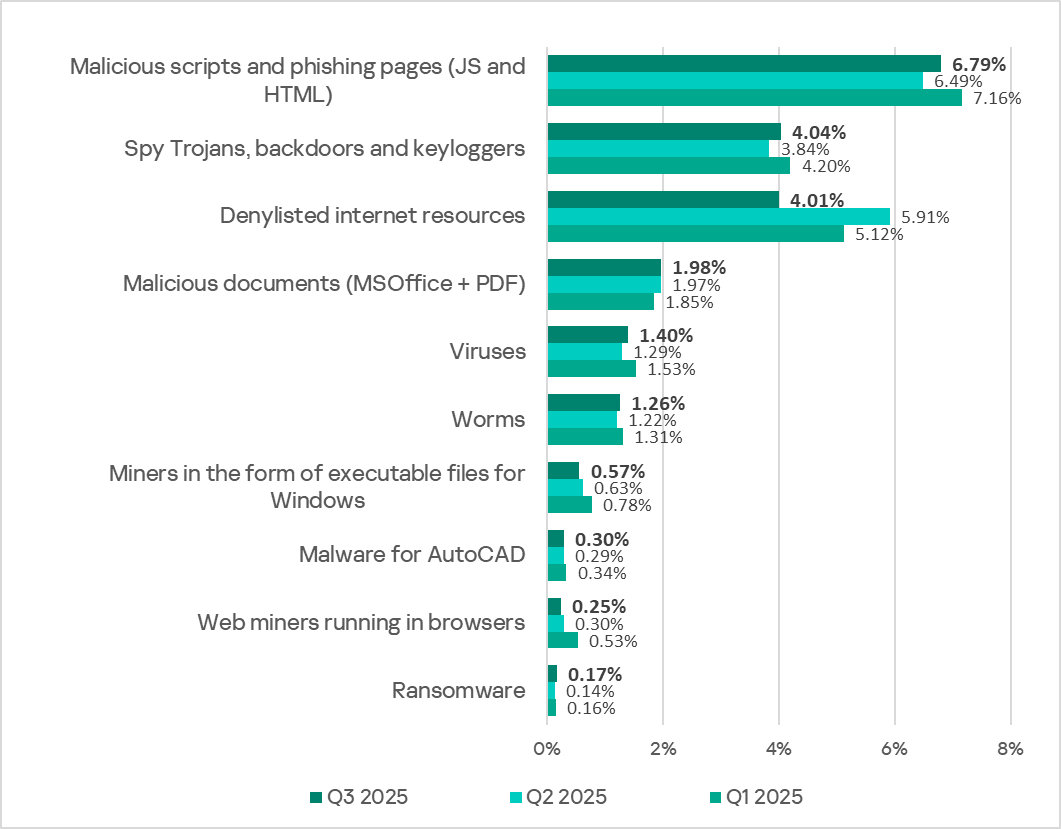
Percentage of ICS computers on which the activity of malicious objects of various categories was blocked
In Q3 2025, there was a decrease in the percentage of ICS computers on which denylisted internet resources and miners of both categories were blocked. These were the only categories that exhibited a decrease.
Main threat sources
Depending on the threat detection and blocking scenario, it is not always possible to reliably identify the source. The circumstantial evidence for a specific source can be the blocked threat’s type (category).
The internet (visiting malicious or compromised internet resources; malicious content distributed via messengers; cloud data storage and processing services and CDNs), email clients (phishing emails), and removable storage devices remain the primary sources of threats to computers in an organization’s technology infrastructure.
In Q3 2025, the percentage of ICS computers on which malicious objects from various sources were blocked decreased.
Percentage of ICS computers on which malicious objects from various sources were blocked
The same computer can be attacked by several categories of malware from the same source during a quarter. That computer is counted when calculating the percentage of attacked computers for each threat category, but is only counted once for the threat source (we count unique attacked computers). In addition, it is not always possible to accurately determine the initial infection attempt. Therefore, the total percentage of ICS computers on which various categories of threats from a certain source were blocked can exceed the percentage of threats from the source itself.
The main categories of threats from the internet blocked on ICS computers in Q3 2025 were malicious scripts and phishing pages, and denylisted internet resources. The percentage ranged from 4.57% in Northern Europe to 10.31% in Africa.
The main categories of threats from email clients blocked on ICS computers were malicious scripts and phishing pages, spyware, and malicious documents. Most of the spyware detected in phishing emails was delivered as a password-protected archive or a multi-layered script embedded in an office document. The percentage of ICS computers on which threats from email clients were blocked ranged from 0.78% in Russia to 6.85% in Southern Europe.
The main categories of threats that were blocked when removable media was connected to ICS computers were worms, viruses, and spyware. The percentage of ICS computers on which threats from this source were blocked ranged from 0.05% in Australia and New Zealand to 1.43% in Africa.
The main categories of threats that spread through network folders were viruses, AutoCAD malware, worms, and spyware. The percentages of ICS computers where threats from this source were blocked ranged from 0.006% in Northern Europe to 0.20% in East Asia.
Threat categories
Typical attacks blocked within an OT network are multi-step sequences of malicious activities, where each subsequent step of the attackers is aimed at increasing privileges and/or gaining access to other systems by exploiting the security problems of industrial enterprises, including technological infrastructures.
Malicious objects used for initial infection
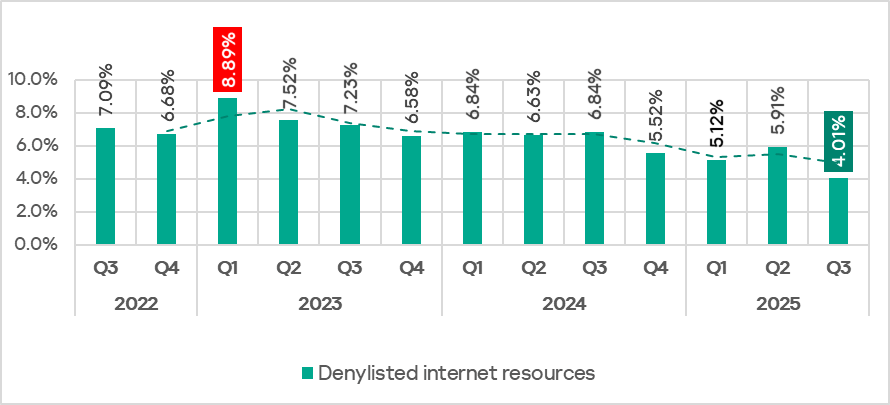
In Q3 2025, the percentage of ICS computers on which denylisted internet resources were blocked decreased to 4.01%. This is the lowest quarterly figure since the beginning of 2022.
Percentage of ICS computers on which denylisted internet resources were blocked, Q3 2022–Q3 2025
Regionally, the percentage of ICS computers on which denylisted internet resources were blocked ranged from 2.35% in Australia and New Zealand to 4.96% in Africa. Southeast Asia and South Asia were also among the top three regions for this indicator.
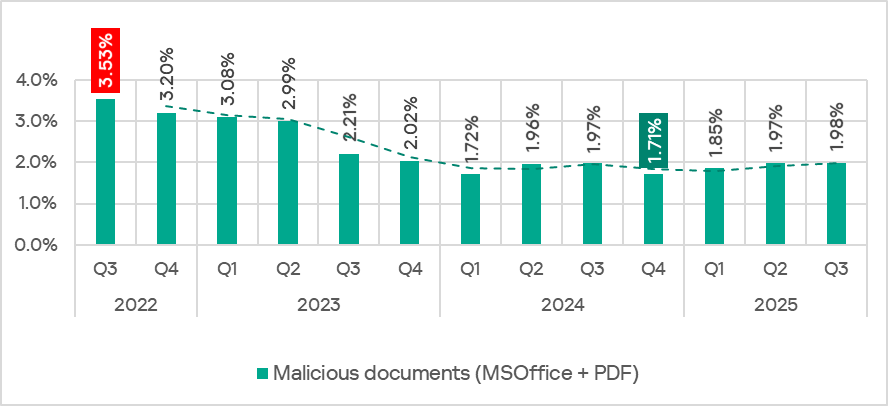
The percentage of ICS computers on which malicious documents were blocked has grown for three consecutive quarters, following a decline at the end of 2024. In Q3 2025, it reached 1,98%.
Percentage of ICS computers on which malicious documents were blocked, Q3 2022–Q3 2025
The indicator increased in four regions: South America, East Asia, Southeast Asia, and Australia and New Zealand. South America saw the largest increase as a result of a large-scale phishing campaign in which attackers used new exploits for an old vulnerability (CVE-2017-11882) in Microsoft Office Equation Editor to deliver various spyware to victims’ computers. It is noteworthy that the attackers in this phishing campaign used localized Spanish-language emails disguised as business correspondence.
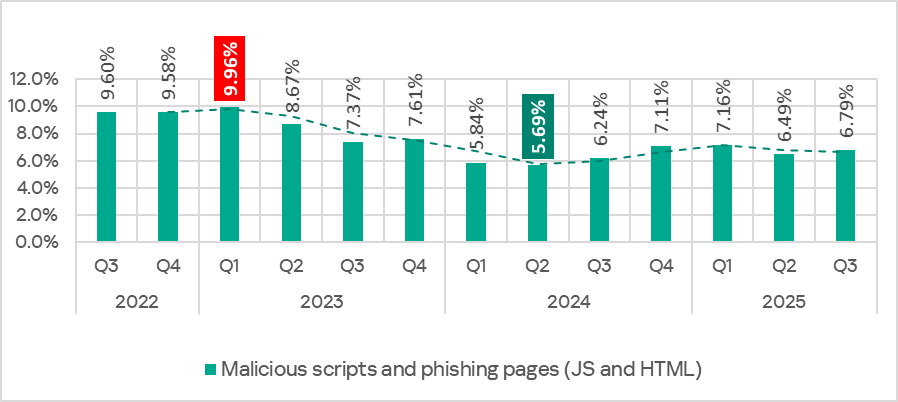
In Q3 2025, the percentage of ICS computers on which malicious scripts and phishing pages were blocked increased to 6.79%. This category led the rankings of threat categories in terms of the percentage of ICS computers on which they were blocked.
Percentage of ICS computers on which malicious scripts and phishing pages were blocked, Q3 2022–Q3 2025
Regionally, the percentage of ICS computers on which malicious scripts and phishing pages were blocked ranged from 2.57% in Northern Europe to 9.41% in Africa. The top three regions for this indicator were Africa, East Asia, and South America. The indicator increased the most in East Asia (by a dramatic 5.23 pp) as a result of the local spread of malicious spyware scripts loaded into the memory of popular torrent clients including MediaGet.
Next-stage malware
Malicious objects used to initially infect computers deliver next-stage malware — spyware, ransomware, and miners — to victims’ computers. As a rule, the higher the percentage of ICS computers on which the initial infection malware is blocked, the higher the percentage for next-stage malware.
In Q3 2025, the percentage of ICS computers on which spyware and ransomware were blocked increased. The rates were:
spyware: 4.04% (up 0.20 pp);
ransomware: 0.17% (up 0.03 pp).
The percentage of ICS computers on which miners of both categories were blocked decreased. The rates were:
miners in the form of executable files for Windows: 0.57% (down 0.06 pp), it’s the lowest level since Q3 2022;
web miners: 0.25% (down 0.05 pp). This is the lowest level since Q3 2022.
Self-propagating malware
Self-propagating malware (worms and viruses) is a category unto itself. Worms and virus-infected files were originally used for initial infection, but as botnet functionality evolved, they took on next-stage characteristics.
To spread across ICS networks, viruses and worms rely on removable media and network folders in the form of infected files, such as archives with backups, office documents, pirated games and hacked applications. In rarer and more dangerous cases, web pages with network equipment settings, as well as files stored in internal document management systems, product lifecycle management (PLM) systems, resource management (ERP) systems and other web services are infected.
In Q3 2025, the percentage of ICS computers on which worms and viruses were blocked increased to 1.26% (by 0.04 pp) and 1.40% (by 0.11 pp), respectively.
AutoCAD malware
This category of malware can spread in a variety of ways, so it does not belong to a specific group.
In Q3 2025, the percentage of ICS computers on which AutoCAD malware was blocked slightly increased to 0.30% (by 0.01 pp).
A 49-year-old man has received a five-and-a-half year jail sentence after admitting to creating detailed video tutorials that showed members of a criminal gang how to infect Android phones with spyware and drain their bank accounts.
Read more in my article on the Hot for Security blog.

 Entrar