Visualização de leitura

Instagram’s to End Encrypted Chats for Direct Messages

Meta has announced that Instagram will officially discontinue its optional end-to-end encrypted direct message feature on May 8, 2026.

The feature was initially rolled out for testing in 2021 to provide users with a secure communication channel accessible only by the sender and recipient.

Meta cites very low adoption rates among its user base as the primary reason for sunsetting this privacy feature.

Once the May 8 deadline passes, all direct messages on the platform will revert to standard Transport Layer Security.

Transport Encryption Versus Privacy

The transition away from end-to-end encryption marks a significant shift in how user data is handled on Instagram.

With end-to-end encryption, cryptographic keys are stored exclusively on user devices, preventing intercepted messages from being read by anyone.

By reverting to standard transport encryption, data remains secure while traveling across the network, but is decrypted once it reaches Meta’s servers.

This architectural change allows Meta to perform several new actions on your private messages.

  • Automated scanning for safety violations and malicious links.
  • Integration of private chat data into machine learning and AI training models.
  • Fulfillment of legal requests or law enforcement subpoenas using plaintext data.
  • Routine moderation using server-side keyword tracking and behavioral analysis.

Furthermore, cybersecurity experts note that removing end-to-end encryption increases the risk of data exposure in the event of a server-side data breach.

Users who previously relied on the encrypted chat feature must take immediate action to preserve their communication history.

Meta is actively sending notifications urging affected users to export their encrypted chat data before the infrastructure changes take effect.

After the cutoff date, previously encrypted threads will become fully accessible to Meta’s automated moderation algorithms.

You have four days left to enjoy encrypted chats on Instagram.

Once May 8th rolls around, your chats will be visible to Meta. pic.twitter.com/k1JftFSLbe

— Malwarebytes (@Malwarebytes) May 4, 2026

To safeguard their data, users should navigate to their account security settings and request a secure download of their personal information.

Failing to export this data before the deadline means those private conversations will seamlessly be added to the platform’s scannable database.

Community Backlash and Alternatives

The cybersecurity community and privacy advocates have strongly criticized this sudden policy change.

Threat intelligence experts emphasize that removing built-in security features contradicts the growing global demand for robust digital privacy.

Social media discussions, including alerts from security firms like Malwarebytes, highlight public frustration over corporate data harvesting.

In response to the changes, security researchers continue to recommend migrating sensitive conversations to dedicated secure platforms.

Meta actively encourages users seeking privacy to transition to WhatsApp. However, many privacy-conscious individuals are shifting to independent messengers like Signal.

The post Instagram’s to End Encrypted Chats for Direct Messages appeared first on Cyber Security News.

U.S. Consumers Lost $2.1 Billion in Social Media Scams in 2025, FTC Says

An FTC report says that Americans last year lost $2.1 billion in social media scams, such as shopping and investment schemes. Social media site have become the place where most of these scams start, and more than half of that money was stolen in scams began on Facebook, WhatsApp, and Instagram.

The post U.S. Consumers Lost $2.1 Billion in Social Media Scams in 2025, FTC Says appeared first on Security Boulevard.

TikTok Says No to End-to-End Encryption: Here’s Why That’s a Big Deal

In a move that bucks the entire industry trend, TikTok has confirmed it will not implement end-to-end encryption (E2EE) for direct messages on its platform — arguing that E2EE would make users less safe. We break down what’s really going on: the child safety argument, the privacy counterargument, the geopolitical questions surrounding ByteDance, and what […]

The post TikTok Says No to End-to-End Encryption: Here’s Why That’s a Big Deal appeared first on Shared Security Podcast.

The post TikTok Says No to End-to-End Encryption: Here’s Why That’s a Big Deal appeared first on Security Boulevard.

💾

Child exploitation, grooming, and social media addiction claims put Meta on trial

Meta is facing two trials over child safety allegations in California and New Mexico. The lawsuits are landmark cases, marking the first time that any such accusations have reached a jury. Although over 40 state attorneys general have filed suits about child safety issues with social media, none had gone to trial until now.

The New Mexico case, filed by Attorney General Raúl Torrez in December 2023, centers on child sexual exploitation. Torrez’s team built their evidence by posing as children online and documenting what happened next, in the form of sexual solicitations. The team brought the suit under New Mexico’s Unfair Trade Practices Act, a consumer protection statute that prosecutors argue sidesteps Section 230 protections.

The most damaging material in the trial, which is expected to run seven weeks, may be Meta’s own paperwork. Newly unsealed internal documents revealed that a company safety researcher had warned about the sheer scale of the problem, claiming that around half a million cases of child exploitation are happening daily. Torrez did not mince words about what he believes the platform has become, calling it an online marketplace for human trafficking. From the complaint:

“Meta’s platforms Facebook and Instagram are a breeding ground for predators who target children for human trafficking, the distribution of sexual images, grooming, and solicitation.”

The complaint’s emphasis on weak age verification touches on a broader issue regulators around the world are now grappling with: how platforms verify the age of their youngest users—and how easily those systems can be bypassed.

In our own research into children’s social media accounts, we found that creating underage profiles can be surprisingly straightforward. In some cases, minimal checks or self-declared birthdates were enough to access full accounts. We also identified loopholes that could allow children to encounter content they shouldn’t or make it easier for adults with bad intentions to find them.

The social media and VR giant has pushed back hard, calling the state’s investigation ethically compromised and accusing prosecutors of cherry-picking data. Defence attorney Kevin Huff argued that the company disclosed its risks rather than concealing them.

Yesterday, Stanford psychiatrist Dr. Anna Lembke told the court she believes Meta’s design features are addictive and that the company has been using the term “Problematic Internet Use” internally to avoid acknowledging addiction.

Meanwhile in Los Angeles, a separate bellwether case against Meta and Google opened on Monday. A 20-year-old woman identified only as KGM is at the center of the case. She alleges that YouTube and Instagram hooked her from childhood. She testified that she was watching YouTube at six, on Instagram by nine, and suffered from worsening depression and body dysmorphia. Her case, which TikTok and Snap settled before trial, is the first of more than 2,400 personal injury filings consolidated in the proceeding. Plaintiffs’ attorney Mark Lanier called it a case about:

“two of the richest corporations in history, who have engineered addiction in children’s brains.”

A litany of allegations

None of this appeared from nowhere. In 2021, whistleblower Frances Haugen leaked internal Facebook documents showing the company knew its platforms damaged teenage mental health. In 2023, Meta whistleblower Arturo Béjar testified before the Senate that the company ignored sexual endangerment of children.

Unredacted documents unsealed in the New Mexico case in early 2024 suggested something uglier still: that the company had actively marketed messaging platforms to children while suppressing safety features that weren’t considered profitable. Internal employees sounded alarms for years but executives reportedly chose growth, according to New Mexico AG Raúl Torrez. Last September, whistleblowers said that the company had ignored child sexual abuse in virtual reality environments.

Outside the courtroom, governments around the world are moving faster than the US Congress. Australia banned under 16s from social media in December 2025, becoming the first country to do so. France’s National Assembly followed, approving a ban on social media for under 15s in January by 130 votes to 21. Spain announced its own under 16 ban this month. By last count, at least 15 European governments were considering similar measures. Whether any of these bans will actually work is uncertain, particularly as young users openly discuss ways to bypass controls.

The United States, by contrast, has passed exactly one major federal child online safety law: the Children’s Online Privacy Protection Act (COPPA), in 1998. The Kids Online Safety Act (KOSA), introduced in 2022, passed the Senate 91-3 in mid-2024 then stalled in the House. It was reintroduced last May and has yet to reach a floor vote. States have tried to fill the gap, with 18 proposed similar legislation in 2025, but only one of those was enacted (in Nebraska). A comprehensive federal framework remains nowhere in sight.

On its most recent earnings call, Meta acknowledged it could face material financial losses this year. The pressure is no longer theoretical. The juries in Santa Fe and Los Angeles will now weigh whether the company’s design choices and safety measures crossed legal lines.

If you want to understand how social media platforms can expose children to harmful content—and what parents can realistically do about it—check out our research project on social media safety.


We don’t just report on threats – we help protect your social media

Cybersecurity risks should never spread beyond a headline. Protect your social media accounts by using Malwarebytes Identity Theft Protection.

Meta confirms it’s working on premium subscription for its apps

Meta plans to test exclusive features that will be incorporated in paid versions of Facebook, Instagram, and WhatsApp. It confirmed these plans to TechCrunch.

But these plans are not to be confused with the ad-free subscription options that Meta introduced for Facebook and Instagram in the EU, the European Economic Area, and Switzerland in late 2023 and framed as a way to comply with General Data Protection Regulation (GDPR) and Digital Markets Act requirements.

From November 2023, users in those regions could either keep using the services for free with personalized ads or pay a monthly fee for an ad‑free experience. European rules require Meta to get users’ consent in order to show them targeted ads, so this was an obvious attempt to recoup advertising revenue when users declined to give that consent.

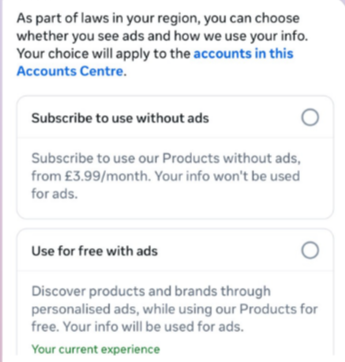
This year, users in the UK were given the same choice: use Meta’s products for free or subscribe to use them without ads. But only grudgingly, judging by the tone in the offer… “As part of laws in your region, you have a choice.”

As part of laws in your region, you have a choice
The ad-free option that has been rolling out coincides with the announcement of Meta’s premium subscriptions.

That ad-free option, however, is not what Meta is talking about now.

The newly announced plans are not about ads, and they are also separate from Meta Verified, which starts at around $15 a month and focuses on creators and businesses, offering a verification badge, better support, and anti‑impersonation protection.

Instead, these new subscriptions are likely to focus on additional features—more control over how users share and connect, and possibly tools such as expanded AI capabilities, unlimited audience lists, seeing who you follow that doesn’t follow you back, or viewing stories without the poster knowing it was you.

These examples are unconfirmed. All we know for sure is that Meta plans to test new paid features to see which ones users are willing to pay for and how much they can charge.

Meta has said these features will focus on productivity, creativity, and expanded AI.

My opinion

Unfortunately, this feels like another refusal to listen.

Most of us aren’t asking for more AI in our feeds. We’re asking for a basic sense of control: control over who sees us, what’s tracked about us, and how our data is used to feed an algorithm designed to keep us scrolling.

Users shouldn’t have to choose between being mined for behavioral data or paying a monthly fee just to be left alone. The message baked into “pay or be profiled” is that privacy is now a luxury good, not a default right. But while regulators keep saying the model is unlawful, the experience on the ground still nudges people toward the path of least resistance: accept the tracking and move on.

Even then, this level of choice is only available to users in Europe.

Why not offer the same option to users in the US? Or will it take stronger US privacy regulation to make that happen?


We don’t just report on threats – we help protect your social media

Cybersecurity risks should never spread beyond a headline. Protect your social media accounts by using Malwarebytes Identity Theft Protection.

Smashing Security podcast #451: I hacked the government, and your headphones are next

In episode 451 of "Smashing Security," we meet the cybercriminal who hacked the US Supreme Court, Veterans Affairs, and more - and then helpfully posted screenshots (and even someone’s blood type) on an account called "I hacked the government." Plus we discuss how researchers uncovered a creepy flaw that lets attackers hijack wireless headphones, listen in on calls, inject audio, and even turn your earbuds into a stalking device - all without you noticing. All this, and much more, in this episode of the "Smashing Security" podcast with Graham Cluley, and special guest Ray [REDACTED]

Smashing Security podcast #450: From Instagram panic to Grok gone wild

Confusion reigns after claims that data linked to 17.5 million Instagram accounts is up for sale - sparked by a vague post, contradictory statements, and a flood of password reset emails nobody asked for. And we dig into Grok, Elon Musk’s AI chatbot, after it started generating sexualised images of women and children - raising uncomfortable questions about guardrails, accountability, and why playing the censorship card doesn’t make the problem go away. All this, and much more, in episode 450 of the "Smashing Security" podcast with Graham Cluley, and special guest Monica Verma.

Received an Instagram password reset email? Here’s what you need to know

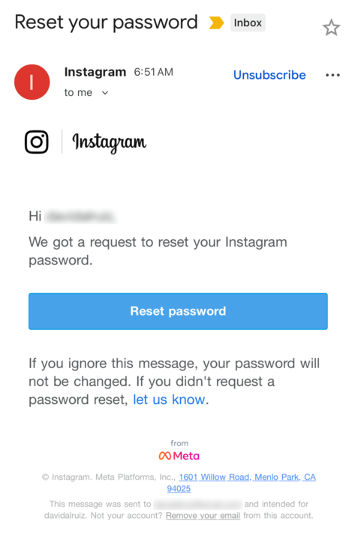
Last week, many Instagram users began receiving unsolicited emails from the platform that warned about a password reset request.

The message said:

“Hi {username},
We got a request to reset your Instagram password.
If you ignore this message, your password will not be changed. If you didn’t request a password reset, let us know.”

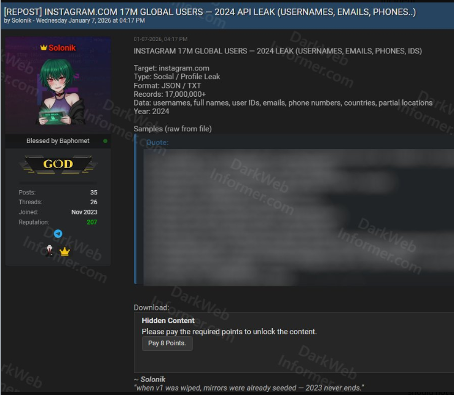
Around the same time that users began receiving these emails, a cybercriminal using the handle “Solonik” offered data that alleged contains information about 17 million Instagram users for sale on a Dark Web forum.

These 17 million or so records include:

  • Usernames
  • Full names
  • User IDs
  • Email addresses
  • Phone numbers
  • Countries
  • Partial locations

Please note that there are no passwords listed in the data.

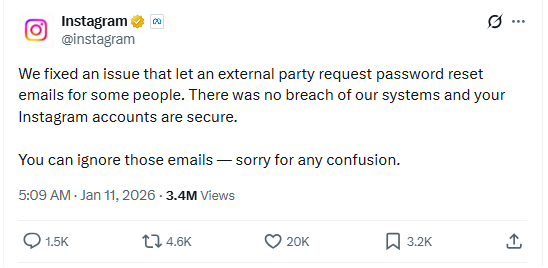
Despite the timing of the two events, Instagram denied this weekend that these events are related. On the platform X, the company stated they fixed an issue that allowed an external party to request password reset emails for “some people.”

So, what’s happening?

Regarding the data found on the dark web last week, Shahak Shalev, global head of scam and AI research at Malwarebytes, shared that “there are some indications that the Instagram data dump includes data from other, older, alleged Instagram breaches, and is a sort of compilation.” As Shalev’s team investigates the data, he also said that the earliest password reset requests reported by users came days before the data was first posted on the dark web, which might mean that “the data may have been circulating in more private groups before being made public.”

However, another possibility, Shalev said, is that “another vulnerability/data leak was happening as some bad actor tried spraying for [Instagram] accounts. Instagram’s announcement seems to reference that spraying. Besides the suspicious timing, there’s no clear connection between the two at this time.”

But, importantly, scammers will not care whether these incidents are related or not. They will try to take advantage of the situation by sending out fake emails.

“We felt it was important to alert people about the data availability so that everyone could reset their passwords, directly from the app, and be on alert for other phishing communications,” Shalev said.

If and when we find out more, we’ll keep you posted, so stay tuned.

How to stay safe

If you have enabled 2FA on your Instagram account, we think it is indeed safe to ignore the emails, as proposed by Meta.

Should you want to err on the safe side and decide to change your password, make sure to do so in the app and not click any links in the email, to avoid the risk that you have received a fake email. Or you might end up providing scammers with your password.

Another thing to keep in mind is that these are Meta-data. Which means some users may have reused or linked them to their Facebook or WhatsApp accounts. So, as a precaution, you can check recent logins and active sessions on Instagram, WhatsApp, and Facebook, and log out from any devices or locations you do not recognize.

If you want to find out whether your data was included in an Instagram data breach, or any other for that matter, try our free Digital Footprint scan.

Norton alerta sobre golpe de caridade circulando no Brasil

Uma nova investigação conduzida por especialistas da Norton, marca de segurança cibernética da Gen™ (NASDAQ: GEN), revela uma onda de golpes envolvendo doações que afetam centenas de pessoas no Brasil. Por meio das redes sociais, cibercriminosos estão disseminando sites falsos de doações com base em histórias reais retiradas de plataformas legítimas, com o objetivo de enganar as pessoas que apoiam ações de caridade e redirecionar fundos para contas fraudulentas.

Norton alerta sobre golpe de caridade circulando no Brasil

Ao contrário de muitos outros ataques cibernéticos, este golpe não visa especificamente roubar dados pessoais ou bancários, mas sim desviar diretamente fundos destinados a causas humanitárias. Os golpistas usam perfis falsos ou contas comprometidas em plataformas como Facebook, Threads e Instagram para se infiltrar em comunidades locais. Primeiramente, eles republicam o conteúdo de outros usuários para ganhar credibilidade e, em seguida, compartilham links para sites falsos que imitam plataformas legítimas de arrecadação de fundos, como Vakinha.

Norton alerta sobre golpe de caridade circulando no Brasil

Esses sites fraudulentos replicam descrições, imagens e até vídeos reais, exibindo comentários falsos de supostos doadores, além de efeitos visuais que simulam doações em tempo real. Assim que a vítima acessa o site e decide doar, ela é direcionada para uma página de pagamento com um código QR ou PIX. Após a conclusão do pagamento, uma mensagem de agradecimento é exibida, confirmando falsamente que a doação foi recebida pela causa pretendida.

Norton alerta sobre golpe de caridade circulando no Brasil

É provável que muitas vítimas nunca percebam que enviaram dinheiro para golpistas. Ao mesmo tempo, as verdadeiras vítimas — aquelas que realmente precisam de apoio — nunca recebem os fundos.

“Esses tipos de campanhas são particularmente sofisticadas, porque imitam postagens e sites de doações reais, aproveitando a empatia e a disposição das pessoas em ajudar. Ao replicar o conteúdo legítimo e se espalhar por plataformas comuns, como as redes sociais, eles conseguem evitar suspeitas e receber transferências diretas sem precisar roubar informações pessoais”, diz Jakub Vávra, Analista de Operações de Ameaças na Gen.

A Norton detectou e bloqueou centenas de tentativas desse golpe no Brasil na última semana. A empresa continua monitorando ativamente essas campanhas, para proteger as pessoas na América Latina e em outras regiões.

Norton alerta sobre golpe de caridade circulando no Brasil

Para se proteger contra esse tipo de ameaça, os especialistas da Norton recomendam:

  • Fazer doações apenas por meio de plataformas ou sites confiáveis, verificando tanto as causas quanto quem está por trás delas.
  • Conferir os endereços dos sites antes de clicar ou transferir dinheiro. Certifique-se de que a URL esteja correta e que o site é seguro (https).
  • Pesquisar a causa. Uma rápida busca na internet pelo nome da campanha ou da pessoa envolvida pode ajudar a confirmar a legitimidade.
  • Não ceder à pressão. Os golpistas costumam criar uma sensação de urgência emocional, para impedir que a pessoa pense criticamente.

Se você se deparar com uma campanha de doação suspeita, não faça nenhuma transferência de dinheiro. Em vez disso, verifique a legitimidade do site e use apenas plataformas confiáveis que validam tanto a causa quanto aqueles que estão envolvidos.  

Sobre a Norton 

Norton é líder em segurança cibernética e faz parte da Gen™ (NASDAQ: GEN), uma empresa global dedicada a promover a liberdade digital, com uma família de marcas nas quais os consumidores confiam. A Norton protege milhões de pessoas e seus familiares com proteção premiada para seus dispositivos, privacidade online e identidade digital. Os produtos e serviços da Norton são certificados por organizações de testes independentes, como AV-TEST, AV Comparatives e SE Labs. A Norton é membro fundador do Anti-Stalkerware Coalition. Para mais informações, visite: https://br.norton.com/.

Affiliates Flock to ‘Soulless’ Scam Gambling Machine

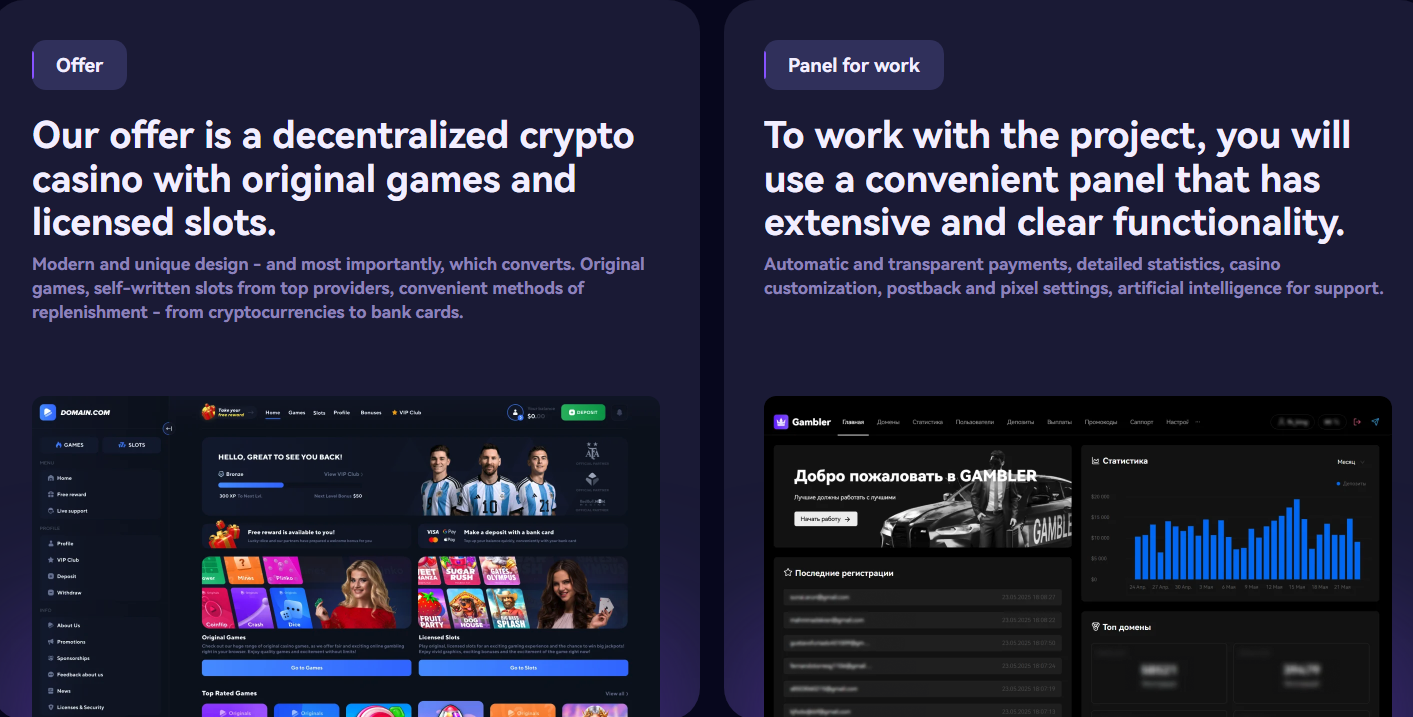
Last month, KrebsOnSecurity tracked the sudden emergence of hundreds of polished online gaming and wagering websites that lure people with free credits and eventually abscond with any cryptocurrency funds deposited by players. We’ve since learned that these scam gambling sites have proliferated thanks to a new Russian affiliate program called “Gambler Panel” that bills itself as a “soulless project that is made for profit.”

A machine-translated version of Gambler Panel’s affiliate website.

The scam begins with deceptive ads posted on social media that claim the wagering sites are working in partnership with popular athletes or social media personalities. The ads invariably state that by using a supplied “promo code,” interested players can claim a $2,500 credit on the advertised gaming website.

The gaming sites ask visitors to create a free account to claim their $2,500 credit, which they can use to play any number of extremely polished video games that ask users to bet on each action. However, when users try to cash out any “winnings” the gaming site will reject the request and prompt the user to make a “verification deposit” of cryptocurrency — typically around $100 — before any money can be distributed.

Those who deposit cryptocurrency funds are soon pressed into more wagering and making additional deposits. And — shocker alert — all players eventually lose everything they’ve invested in the platform.

The number of scam gambling or “scambling” sites has skyrocketed in the past month, and now we know why: The sites all pull their gaming content and detailed strategies for fleecing players straight from the playbook created by Gambler Panel, a Russian-language affiliate program that promises affiliates up to 70 percent of the profits.

Gambler Panel’s website gambler-panel[.]com links to a helpful wiki that explains the scam from cradle to grave, offering affiliates advice on how best to entice visitors, keep them gambling, and extract maximum profits from each victim.

“We have a completely self-written from scratch FAKE CASINO engine that has no competitors,” Gambler Panel’s wiki enthuses. “Carefully thought-out casino design in every pixel, a lot of audits, surveys of real people and test traffic floods were conducted, which allowed us to create something that has no doubts about the legitimacy and trustworthiness even for an inveterate gambling addict with many years of experience.”

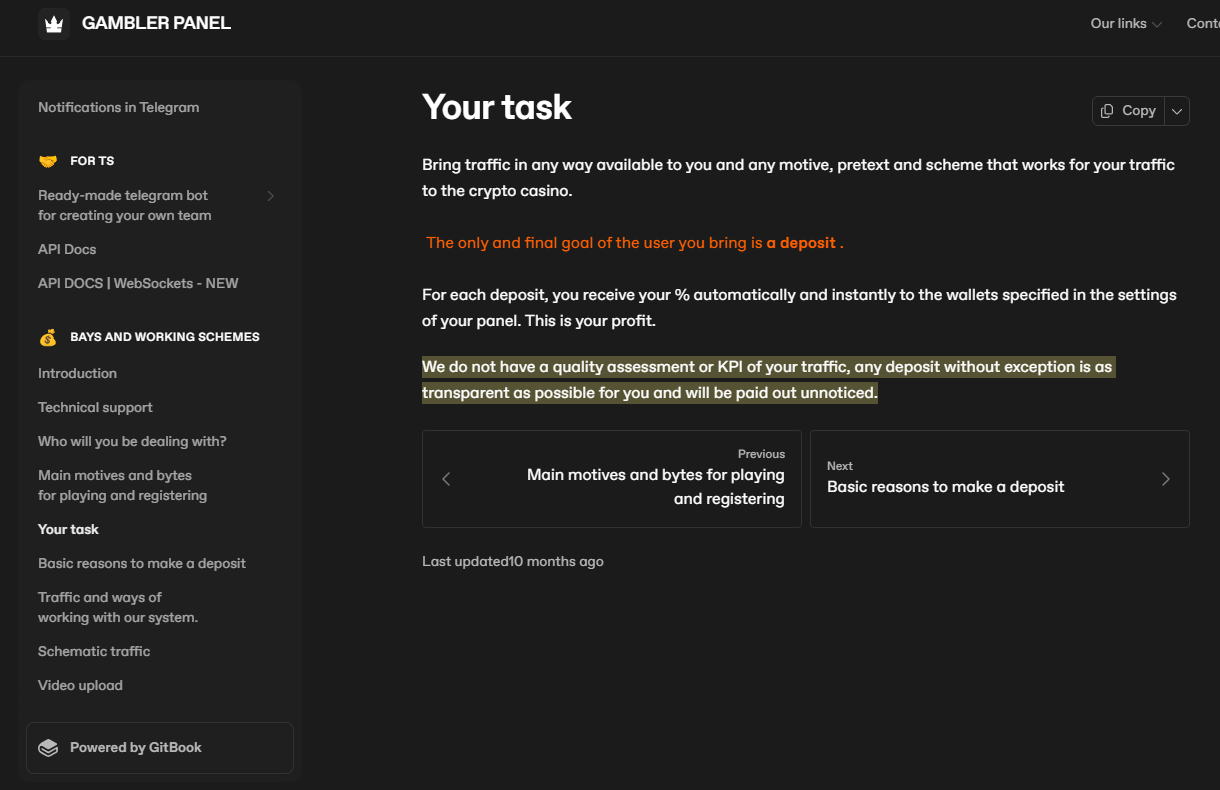
Gambler Panel explains that the one and only goal of affiliates is to drive traffic to these scambling sites by any and all means possible.

A machine-translated portion of Gambler Panel’s singular instruction for affiliates: Drive traffic to these scambling sites by any means available.

“Unlike white gambling affiliates, we accept absolutely any type of traffic, regardless of origin, the only limitation is the CIS countries,” the wiki continued, referring to a common prohibition against scamming people in Russia and former Soviet republics in the Commonwealth of Independent States.

The program’s website claims it has more than 20,000 affiliates, who earn a minimum of $10 for each verification deposit. Interested new affiliates must first get approval from the group’s Telegram channel, which currently has around 2,500 active users.

The Gambler Panel channel is replete with images of affiliate panels showing the daily revenue of top affiliates, scantily-clad young women promoting the Gambler logo, and fast cars that top affiliates claimed they bought with their earnings.

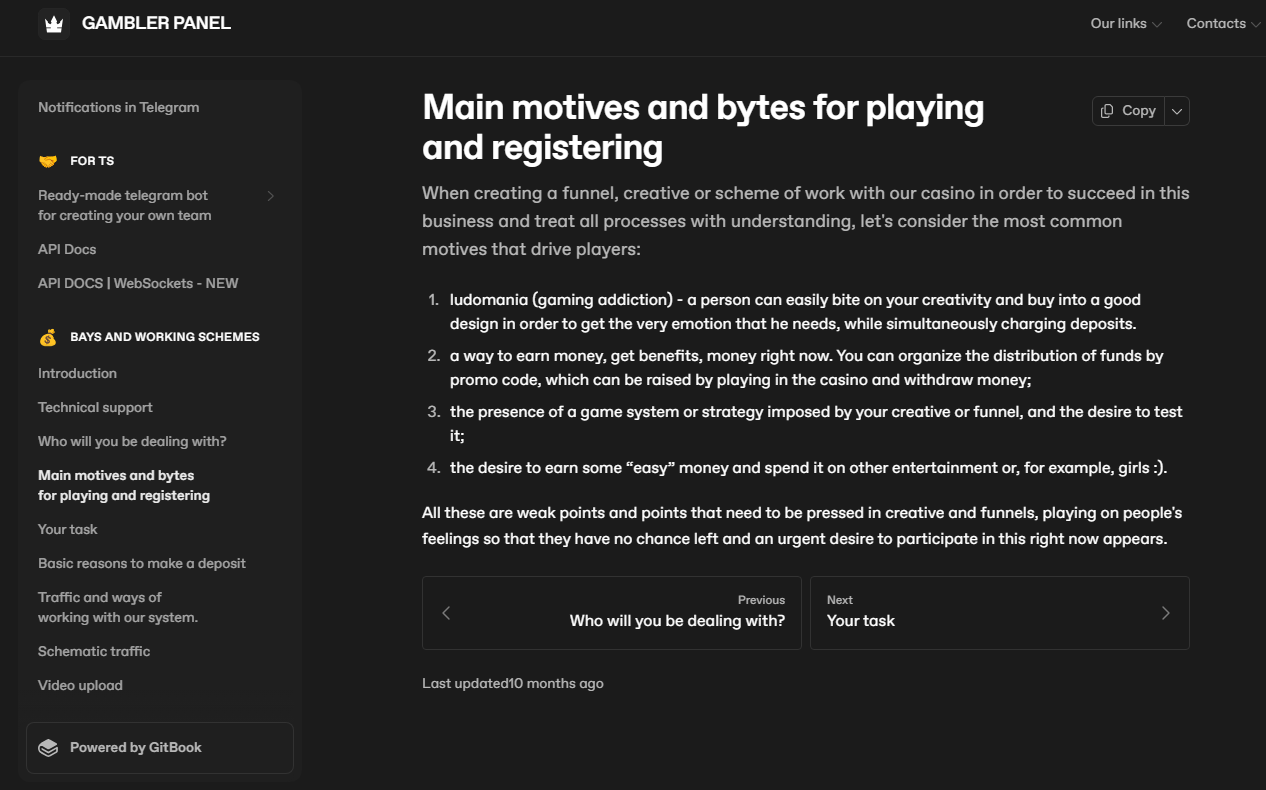
A machine-translated version of the wiki for the affiliate program Gambler Panel.

The apparent popularity of this scambling niche is a consequence of the program’s ease of use and detailed instructions for successfully reproducing virtually every facet of the scam. Indeed, much of the tutorial focuses on advice and ready-made templates to help even novice affiliates drive traffic via social media websites, particularly on Instagram and TikTok.

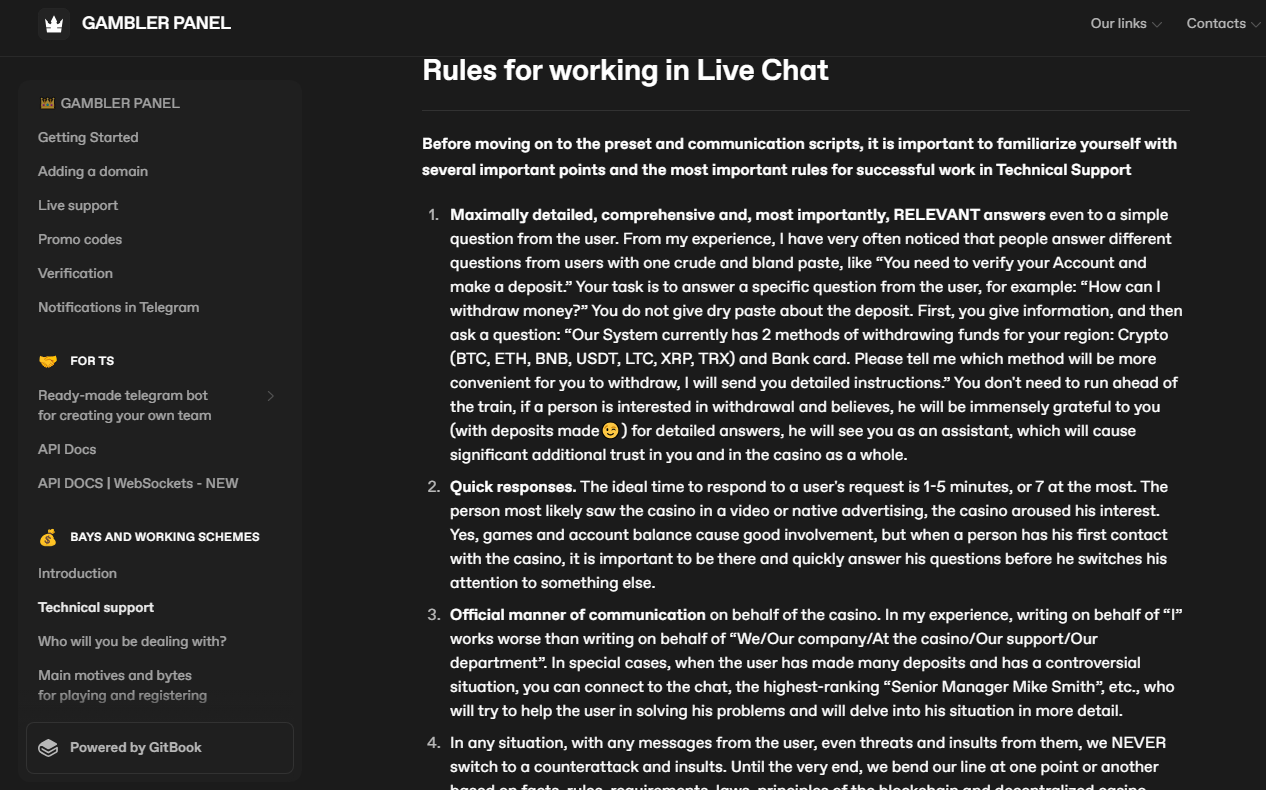
Gambler Panel also walks affiliates through a range of possible responses to questions from users who are trying to withdraw funds from the platform. This section, titled “Rules for working in Live chat,” urges scammers to respond quickly to user requests (1-7 minutes), and includes numerous strategies for keeping the conversation professional and the user on the platform as long as possible.

A machine-translated version of the Gambler Panel’s instructions on managing chat support conversations with users.

The connection between Gambler Panel and the explosion in the number of scambling websites was made by a 17-year-old developer who operates multiple Discord servers that have been flooded lately with misleading ads for these sites.

The researcher, who asked to be identified only by the nickname “Thereallo,” said Gambler Panel has built a scalable business product for other criminals.

“The wiki is kinda like a ‘how to scam 101’ for criminals written with the clarity you would expect from a legitimate company,” Thereallo said. “It’s clean, has step by step guides, and treats their scam platform like a real product. You could swap out the content, and it could be any documentation for startups.”

“They’ve minimized their own risk — spreading the links on Discord / Facebook / YT Shorts, etc. — and outsourced it to a hungry affiliate network, just like a franchise,” Thereallo wrote in response to questions.

“A centralized platform that can serve over 1,200 domains with a shared user base, IP tracking, and a custom API is not at all a trivial thing to build,” Thereallo said. “It’s a scalable system designed to be a resilient foundation for thousands of disposable scam sites.”

The security firm Silent Push has compiled a list of the latest domains associated with the Gambler Panel, available here (.csv).

What to do if you can’t get into your Facebook or Instagram account

How to prove your identity after your account gets hacked and how to improve security for the future

Your Facebook or Instagram account can be your link to friends, a profile for your work or a key to other services, so losing access can be very worrying. Here’s what to do if the worst happens.

If you have access to the phone number or email account associated with your Facebook or Instagram account, try to reset your password by clicking on the “Forgot password?” link on the main Facebook or Instagram login screen. Follow the instructions in the email or text message you receive.

If you no longer have access to the email account linked to your Facebook account, use a device with which you have previously logged into Facebook and go to facebook.com/login/identify. Enter any email address or phone number you might have associated with your account, or find your username which is the string of characters after Facebook.com/ on your page. Click on “No longer have access to these?”, “Forgotten account?” or “Recover” and follow the instructions to prove your identity and reset your password.

If your account was hacked, visit facebook.com/hacked or instagram.com/hacked/ on a device you have previously used to log in and follow the instructions. Visit the help with a hacked account page for Facebook or Instagram.

Change the password to something strong, long and unique, such as a combination of random words or a memorable lyric or quote. Avoid simple or guessable combinations. Use a password manager to help you remember it and other important details.

Turn on two-step verification in the “password and security” section of the Accounts Centre. Use an authentication app or security key for this, not SMS codes. Save your recovery codes somewhere safe in case you lose access to your two-step authentication method.

Turn on “unrecognised login” alerts in the “password and security” section of the Accounts Centre, which will alert you to any suspicious login activity.

Remove any suspicious “friends” from your account – these could be fake accounts or scammers.

If you are eligible, turn on “advanced protection for Facebook” in the “password and security” section of the Accounts Centre.

Continue reading...

© Photograph: bigtunaonline/Alamy

© Photograph: bigtunaonline/Alamy

❌