Framework OSINT avançado do TikTok para encontrar contas por e-mail ou telefone e extrair biografias, datas de criação e dados completos do perfil 🕵🏽♂️
🚀 Funcionalidades
🔎 Reconhecimento Profundo: Busca de e-mail e número de telefone.
📊 Extração de Metadados Avançados: Recupera datas de criação, biografias, métricas completas e avatares em alta resolução.
⚡ Verificação rápida baseada em API: Impulsionada por fontes de dados externas de alta velocidade.
📄 Geração de relatórios em JSON e TXT: Salva automaticamente todos os resultados estruturados localmente.
🎨 Interface CLI colorida: Saída de terminal limpa, estética e profissional.
🔐 Gerenciamento seguro de chaves de API: Credenciais estritamente gerenciadas via .env.
📂 Processamento em lote: Analise listas de alvos por meio de um arquivo TXT.
💡 Configuração automática da API: integração interativa na primeira execução.
A new AITM phishing campaign targets TikTok Business accounts to hijack them for malvertising, continuing tactics seen in earlier Google-themed scams.
Push Security researchers uncovered a new wave of AITM phishing pages targeting TikTok for Business accounts, aiming to hijack them for malvertising. The campaign includes TikTok and Google-themed fake pages, showing links to previous operations. Once compromised, accounts are used to run malicious ads, steal credentials, spread malware, and conduct ad fraud, diverting company advertising budgets for profit.
Attackers used newly registered domains created within seconds and hosted behind Cloudflare. The pages follow a common naming pattern and redirect victims from legitimate services before loading fake TikTok for Business or Google “Schedule a call” pages.
Users are asked to fill in basic details, then shown a malicious login page powered by an AITM phishing kit. The campaign uses bot protection to evade detection and likely spreads via targeted emails, similar to past operations.
“When the link is first clicked, the page is silently redirected from a legitimate Google Storage site before loading the page.” reads the report published by Push Security. “A Cloudflare Turnstile check is used to prevent security bots from analyzing the page, before loading either a TikTok or Google themed page. Progressing through the forms ultimately serves up an AITM phishing page.”
By combining trusted branding, redirects, and layered deception, attackers increase success rates and harvest credentials for further abuse, including account takeover and fraud.
While phishing campaigns usually mimic platforms like Google or Microsoft, targeting TikTok is becoming more common.
The platform has long been used to spread malicious links and social engineering content, including videos that trick users into installing infostealers like Vidar or StealC. It is also widely abused for crypto scams and direct attacks via messages. Gaining access to TikTok business accounts is especially valuable, as they can be used for malvertising and fraud.
Many users log in via Google, meaning a single compromise can expose both TikTok and Google accounts, enabling broader abuse such as ad fraud, data theft, and access to other connected services.
The report also includes Indicators of Compromise (IoCs) for this campaign.
“Short-lived IoCs are of limited value when tackling modern phishing attacks due to the rate at which attackers are able to quickly spin up and rotate the sites used in the attack chain, often dynamically serving different URLs to site visitors.” concludes the report.
In a move that bucks the entire industry trend, TikTok has confirmed it will not implement end-to-end encryption (E2EE) for direct messages on its platform — arguing that E2EE would make users less safe. We break down what’s really going on: the child safety argument, the privacy counterargument, the geopolitical questions surrounding ByteDance, and what […]
TikTok has shifted to a majority-American entity, TikTok USDS Joint Venture, LLC, to comply with U.S. national security requirements and avoid a ban. This week we discuss why a recent privacy policy update went viral—especially language about sensitive data like immigration status and precise location—and argue much of it reflects longstanding practices and required California […]
A funny thing happened on TikTok last month, and it has brought allegations of censorship, manipulation, and control.
It was the week of January 22, and after a long legal battle, TikTok had finally—for the first time in its company history—moved its ownership to new, American stewards. But with the American restructuring, TikTok users immediately reported that something had changed: videos would sometimes fail to record any views, and even direct messages would fail to send. But, according to user complaints, the flaws weren’t random. Instead, they befell users who spoke openly about topics that have become political lightning rods in the US, including Immigration and Customs Enforcement and the actions of sex offender Jeffrey Epstein.
To some aggrieved users, the flaws looked like censorship. But, according to TikTok, the error messages and missing video count tallies were part of a larger power outage.
“Since yesterday we’ve been working to restore our services following a power outage at a US data center impacting TikTok and other apps we operate,” TikTok wrote on the social media platform X (formerly Twitter). “We’re working with our data center partner to stabilize our service. We’re sorry for this disruption and hope to resolve it soon.”
While TikTok has reportedly more than 200 million users in the US alone, it’s far from a universal app. But the changes made to TikTok hint at a bigger sea change in social media and the internet today, in which online spaces are increasingly being altered, shut down, or even controlled—if not through government plot then certainly through corporate influence.
Oddly, the ownership change of TikTok was supposed to solve many of these problems.
Since TikTok’s 2017 founding in China, American lawmakers and government officials claimed that American users were vulnerable to Chinese surveillance. All the data that Americans hand over when using TikTok—their names and email addresses, but also their viewing habits, interests, behaviors, political inclinations, and approximate locations—all of that, the argument went, should not belong in the hands of a foreign power.
“The possibility that the Chinese government could use [TikTok] to control data collection on millions of users or control the recommendation algorithm, which could be used for influence operations.”
But the rocky start to the new American TikTok has only drawn renewed scrutiny: Have the past concerns about foreign manipulation now become current concerns about domestic manipulation?
Today on the Lock and Code podcast with host David Ruiz, we speak with Zach Hinkle, senior social media manager for Malwarebytes, and MinJi Pae, social media content creator for Malwarebytes, about what they personally experienced during TikTok’s transition to American owners, why the changes matter for the delivery of news and information, and how the internet appears to be shrinking from its earlier promises.
As Hinkle said on the podcast:
“ The idea of the internet being a private, free space that was ingrained in its creation, and every platform since then sort of carried that spirit with it… those spaces are disappearing.”
In 2026, could any five words be more chilling than “We’re changing our privacy terms?”
The timing could not have been worse for TikTok US when it sent millions of US users a mandatory privacy pop-up on January 22. The message forced users to accept updated terms if they wanted to keep using the app. Buried in that update was language about collecting “citizenship or immigration status.”
Specifically, TikTok said:
“Information You Provide may include sensitive personal information, as defined under applicable state privacy laws, such as information from users under the relevant age threshold, information you disclose in survey responses or in your user content about your racial or ethnic origin, national origin, religious beliefs, mental or physical health diagnosis, sexual life or sexual orientation, status as transgender or nonbinary, citizenship or immigration status, or financial information.”
The internet reacted badly. TikTok users took to social media, with some suggesting that TikTok was building a database of immigration status, and others pledging to delete their accounts. It didn’t help that TikTok’s US operation became a US-owned company on the same day, with Senator Ed Markey (D-Mass.) criticizing what he sees as a lack of transparency around the deal.
A legal requirement
In this case, things are may be less sinister than you’d think. The language is not new—it first appeared around August 2024. And TikTok is not asking users to provide their immigration status directly.
Instead, the disclosure covers sensitive information that users might voluntarily share in videos, surveys, or interactions with AI features.
The change appears to be driven largely by California’s AB-947, signed in October 2023. The law added immigration status to the state’s definition of sensitive personal information, placing it under stricter protections. Companies are required to disclose how they process sensitive personal information, even if they do not actively seek it out.
Other social media companies, including Meta, do not explicitly mention immigration status in their privacy policies. According to TechCrunch, that difference likely reflects how specific their disclosure language is—not a meaningful difference in what data is actually collected.
One meaningful change in TikTok’s updated policy does concern location tracking. Previous versions stated that TikTok did not collect GPS data from US users. The new policy says it may collect precise location data, depending on user settings. Users can reportedly opt out of this tracking.
Read the whole board, not just one square
So, does this mean TikTok—or any social media company—deserves our trust? That’s a harder question.
There are still red flags. In April, TikTok quietly removed a commitment to notify users before sharing data with law enforcement. According to Forbes, the company has also declined to say whether it shares, or would share, user data with agencies such as the Department of Homeland Security (DHS) or Immigration and Customs Enforcement (ICE).
That uncertainty is the real issue. Social media companies are notorious for collecting vast amounts of user data, and for being vague about how it may be used later. Outrage over a particularly explicit disclosure is understandable, but the privacy problem runs much deeper than a single policy update from one company.
People have reason to worry unless platforms explicitly commit to not collecting or inferring sensitive data—and explicitly commit to not sharing it with government agencies. And even then, skepticism is healthy. These companies have a long history of changing policies quietly when it suits them.
We don’t just report on data privacy—we help you remove your personal information
Cybersecurity risks should never spread beyond a headline. With Malwarebytes Personal Data Remover, you can scan to find out which sites are exposing your personal information, and then delete that sensitive data from the internet.
TikTok may have found a way to stay online in the US. The company announced late last week that it has set up a joint venture backed largely by US investors. TikTok announced TikTok USDS Joint Venture LLC on Friday in a deal valued at about $14 billion, allowing it to continue operating in the country.
This is the culmination of a long-running fight between TikTok and US authorities. In 2019, the Committee on Foreign Investment in the United States (CFIUS) flagged ByteDance’s 2017 acquisition of Musical.ly as a national security risk, on the basis that state links between the app’s Chinese owner would make put US users’ data at risk.
In his first term, President Trump issued an executive order demanding that ByteDance sell the business or face a ban. That was order was blocked by courts, and President Biden later replaced it with a broader review process in 2021.
In April 2024, Congress passed the Protecting Americans from Foreign Adversary Controlled Applications Act (PAFACA), which Biden signed into law. That set a January 19, 2025 deadline for ByteDance to divest its business or face a nationwide ban. With no deal finalized, TikTok voluntarily went dark for about 12 hours on January 18, 2025. Trump later issued executive orders extending the deadline, culminating in a September 2025 agreement that led to the joint venture.
Three managing investors each hold 15% of the new business: database giant Oracle (which previously vied to acquire TikTok when ByteDance was first told to divest), technology-focused investment group Silver Lake, and the United Arab Emirates-backed AI (Artificial Intelligence) investment company MGX.
Other investors include the family office of tech entrepreneur Michael Dell, as well as Vastmere Strategic Investments, Alpha Wave Partners, Revolution, Merritt Way, and Via Nova.
Original owner ByteDance retains 19.9% of the business, and according to an internal memo released before the deal was officially announced, 30% of the company will be owned by affiliates of existing ByteDance investors. That’s in spite of the fact that PAFACA mandated a complete severance of TikTok in the US from its Chinese ownership.
A focus on security
The company is eager to promote data security for its users. With that in mind, Oracle takes the role of “trusted security partner” for data protection and compliance auditing under the deal.
Oracle is also expected to store US user data in its cloud environment. The program will reportedly align with security frameworks including the National Institute of Standards and Technology (NIST) Cybersecurity Framework. Other TikTok-owned apps such as CapCut and Lemon8 will also fall under the joint venture’s security umbrella.
Canada’s TikTok tension
It’s been a busy month for ByteDance, with other developments north of the border. Last week, Canada’s Federal Court overturned a November 2024 governmental order to shut down TikTok’s Canadian business on national security grounds. The decision gives Industry Minister Mélanie Joly time to review the case.
Why this matters
TikTok’s new US joint venture lowers the risk of direct foreign access to American user data, but it doesn’t erase all of the concerns that put the app in regulators’ crosshairs in the first place. ByteDance still retains an economic stake, the recommendation algorithm remains largely opaque, and oversight depends on audits and enforcement rather than hard technical separation.
In other words, this deal reduces exposure, but it doesn’t make TikTok a risk-free platform. For users, that means the same common-sense rules still apply: be thoughtful about what you share and remember that regulatory approval isn’t the same as total data safety.
We don’t just report on data privacy—we help you remove your personal information
Cybersecurity risks should never spread beyond a headline. With Malwarebytes Personal Data Remover, you can scan to find out which sites are exposing your personal information, and then delete that sensitive data from the internet.
Loyal readers and other privacy-conscious people will be familiar with the expression, “If it’s too good to be true, it’s probably false.”
Getting paid handsomely to scroll social media definitely falls into that category. It sounds like an easy side hustle, which usually means there’s a catch.
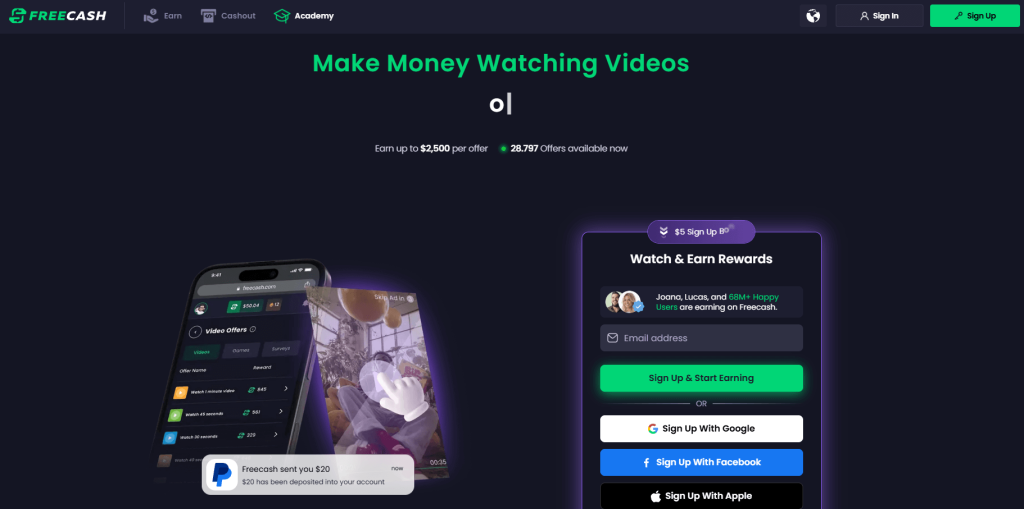
In January 2026, an app called Freecash shot up to the number two spot on Apple’s free iOS chart in the US, helped along by TikTok ads that look a lot like job offers from TikTok itself. The ads promised up to $35 an hour to watch your “For You” page. According to reporting, the ads didn’t promote Freecash by name. Instead, they showed a young woman expressing excitement about seemingly being “hired by TikTok” to watch videos for money.
The landing pages featured TikTok and Freecash logos and invited users to “get paid to scroll” and “cash out instantly,” implying a simple exchange of time for money.
Those claims were misleading enough that TikTok said the ads violated its rules on financial misrepresentation and removed some of them.
Once you install the app, the promised TikTok paycheck vanishes. Instead, Freecash routes you to a rotating roster of mobile games—titles like Monopoly Go and Disney Solitaire—and offers cash rewards for completing time‑limited in‑game challenges. Payouts range from a single cent for a few minutes of daily play up to triple‑digit amounts if you reach high levels within a fixed period.
The whole setup is designed not to reward scrolling, as it claims, but to funnel you into games where you are likely to spend money or watch paid advertisements.
Freecash’s parent company, Berlin‑based Almedia, openly describes the platform as a way to match mobile game developers with users who are likely to install and spend. The company’s CEO has spoken publicly about using past spending data to steer users toward the genres where they’re most “valuable” to advertisers.
Our concern, beyond the bait-and-switch, is the privacy issue. Freecash’s privacy policy allows the automatic collection of highly sensitive information, including data about race, religion, sex life, sexual orientation, health, and biometrics. Each additional mobile game you install to chase rewards adds its own privacy policy, tracking, and telemetry. Together, they greatly increase how much behavioral data these companies can harvest about a user.
Experts warn that data brokers already trade lists of people likely to be more susceptible to scams or compulsive online behavior—profiles that apps like this can help refine.
We’ve previously reported on data brokers that used games and apps to build massive databases, only to later suffer breaches exposing all that data.
When asked about the ads, Freecash said the most misleading TikTok promotions were created by third-party affiliates, not by the company itself. Which is quite possible because Freecash does offer an affiliate payout program to people who promote the app online. But they made promises to review and tighten partner monitoring.
For experienced users, the pattern should feel familiar: eye‑catching promises of easy money, a bait‑and‑switch into something that takes more time and effort than advertised, and a business model that suddenly makes sense when you realize your attention and data are the real products.
If you’re curious how intrusive schemes like this can be, consider using a separate email address created specifically for testing. Avoid sharing real personal details. Many users report that once they sign up, marketing emails quickly pile up.
Some of these schemes also appeal to people who are younger or under financial pressure, offering tiny payouts while generating far more value for advertisers and app developers.
So, what can you do?
Gather information about the company you’re about to give your data. Talk to friends and relatives about your plans. Shared common sense often helps make the right decisions.
Create a separate account if you want to test a service. Use a dedicated email address and avoid sharing real personal details.
Limit information you provide online to what makes sense for the purpose. Does a game publisher need your Social Security Number? I don’t think so.
Be cautious about app installs that are framed as required to make the money initially promised, and review permissions carefully.
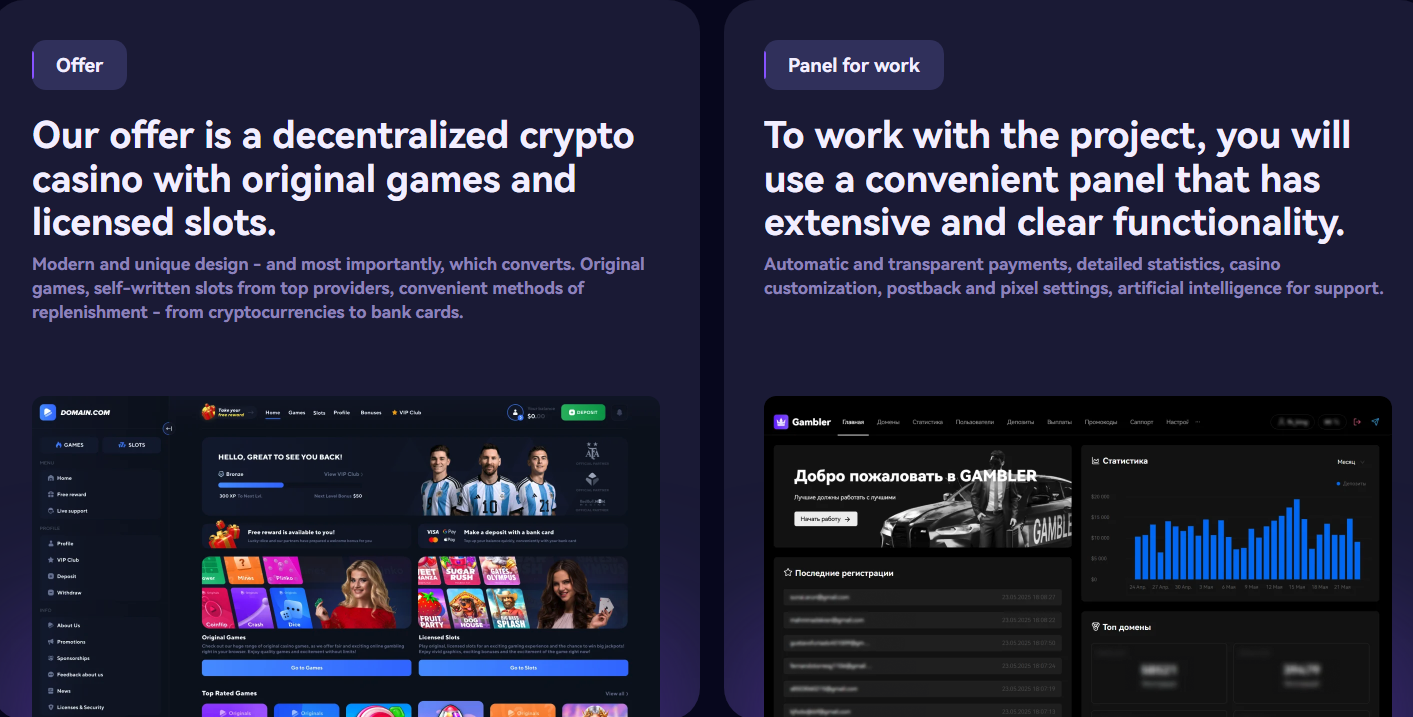
Last month, KrebsOnSecurity tracked the sudden emergence of hundreds of polished online gaming and wagering websites that lure people with free credits and eventually abscond with any cryptocurrency funds deposited by players. We’ve since learned that these scam gambling sites have proliferated thanks to a new Russian affiliate program called “Gambler Panel” that bills itself as a “soulless project that is made for profit.”
A machine-translated version of Gambler Panel’s affiliate website.
The scam begins with deceptive ads posted on social media that claim the wagering sites are working in partnership with popular athletes or social media personalities. The ads invariably state that by using a supplied “promo code,” interested players can claim a $2,500 credit on the advertised gaming website.
The gaming sites ask visitors to create a free account to claim their $2,500 credit, which they can use to play any number of extremely polished video games that ask users to bet on each action. However, when users try to cash out any “winnings” the gaming site will reject the request and prompt the user to make a “verification deposit” of cryptocurrency — typically around $100 — before any money can be distributed.
Those who deposit cryptocurrency funds are soon pressed into more wagering and making additional deposits. And — shocker alert — all players eventually lose everything they’ve invested in the platform.
The number of scam gambling or “scambling” sites has skyrocketed in the past month, and now we know why: The sites all pull their gaming content and detailed strategies for fleecing players straight from the playbook created by Gambler Panel, a Russian-language affiliate program that promises affiliates up to 70 percent of the profits.
Gambler Panel’s website gambler-panel[.]com links to a helpful wiki that explains the scam from cradle to grave, offering affiliates advice on how best to entice visitors, keep them gambling, and extract maximum profits from each victim.
“We have a completely self-written from scratch FAKE CASINO engine that has no competitors,” Gambler Panel’s wiki enthuses. “Carefully thought-out casino design in every pixel, a lot of audits, surveys of real people and test traffic floods were conducted, which allowed us to create something that has no doubts about the legitimacy and trustworthiness even for an inveterate gambling addict with many years of experience.”
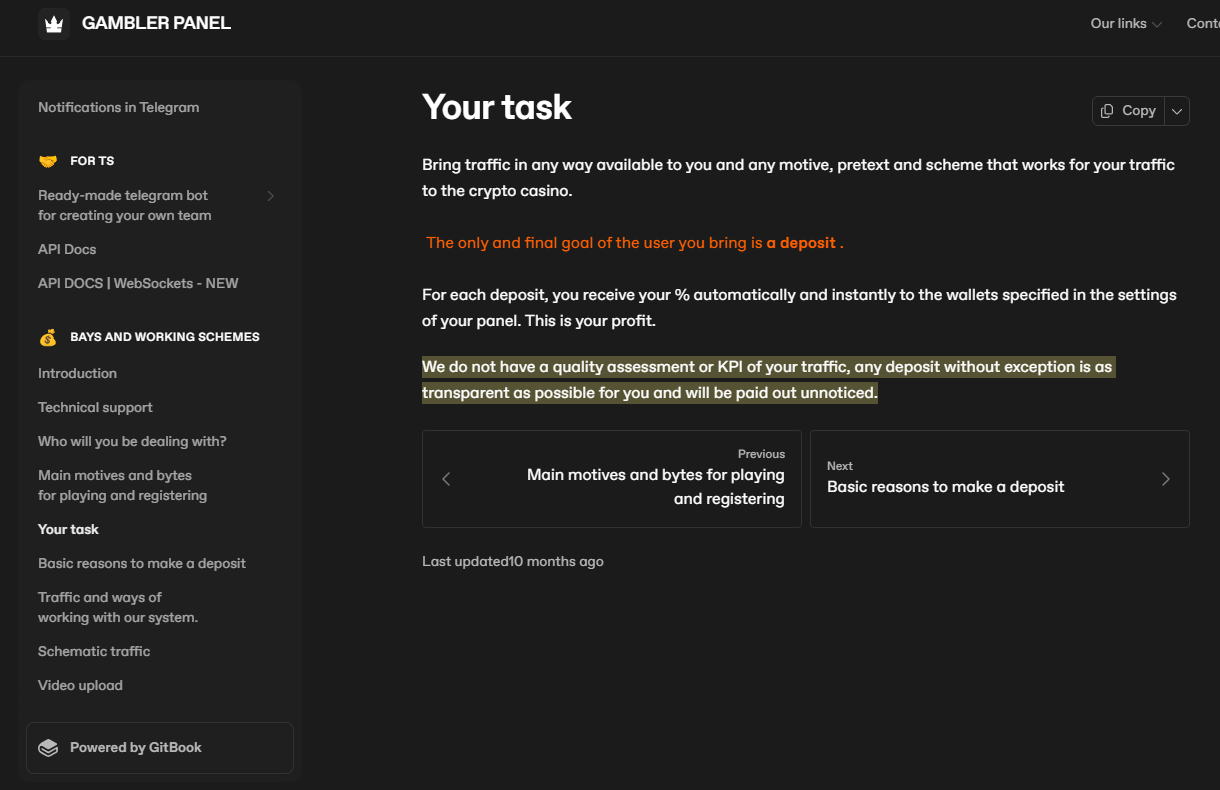
Gambler Panel explains that the one and only goal of affiliates is to drive traffic to these scambling sites by any and all means possible.
A machine-translated portion of Gambler Panel’s singular instruction for affiliates: Drive traffic to these scambling sites by any means available.
“Unlike white gambling affiliates, we accept absolutely any type of traffic, regardless of origin, the only limitation is the CIS countries,” the wiki continued, referring to a common prohibition against scamming people in Russia and former Soviet republics in the Commonwealth of Independent States.
The program’s website claims it has more than 20,000 affiliates, who earn a minimum of $10 for each verification deposit. Interested new affiliates must first get approval from the group’s Telegram channel, which currently has around 2,500 active users.
The Gambler Panel channel is replete with images of affiliate panels showing the daily revenue of top affiliates, scantily-clad young women promoting the Gambler logo, and fast cars that top affiliates claimed they bought with their earnings.
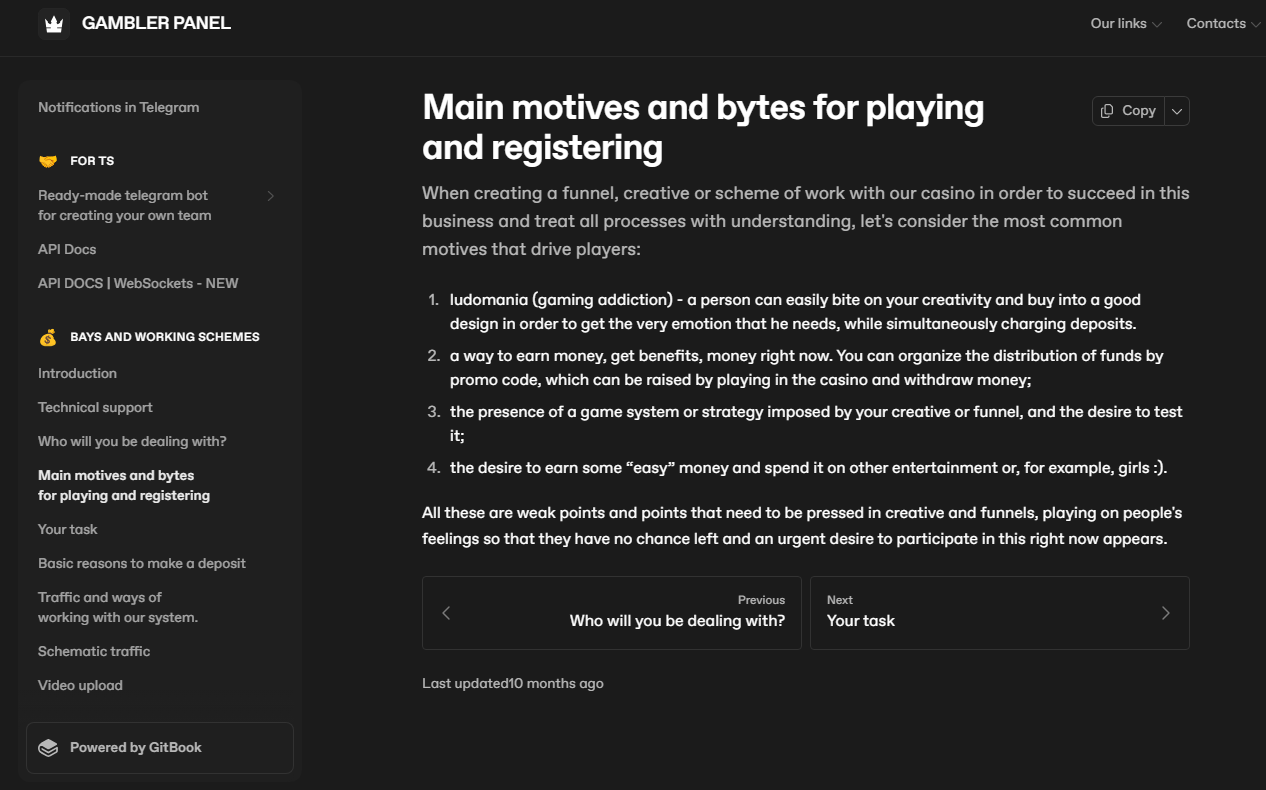
A machine-translated version of the wiki for the affiliate program Gambler Panel.
The apparent popularity of this scambling niche is a consequence of the program’s ease of use and detailed instructions for successfully reproducing virtually every facet of the scam. Indeed, much of the tutorial focuses on advice and ready-made templates to help even novice affiliates drive traffic via social media websites, particularly on Instagram and TikTok.
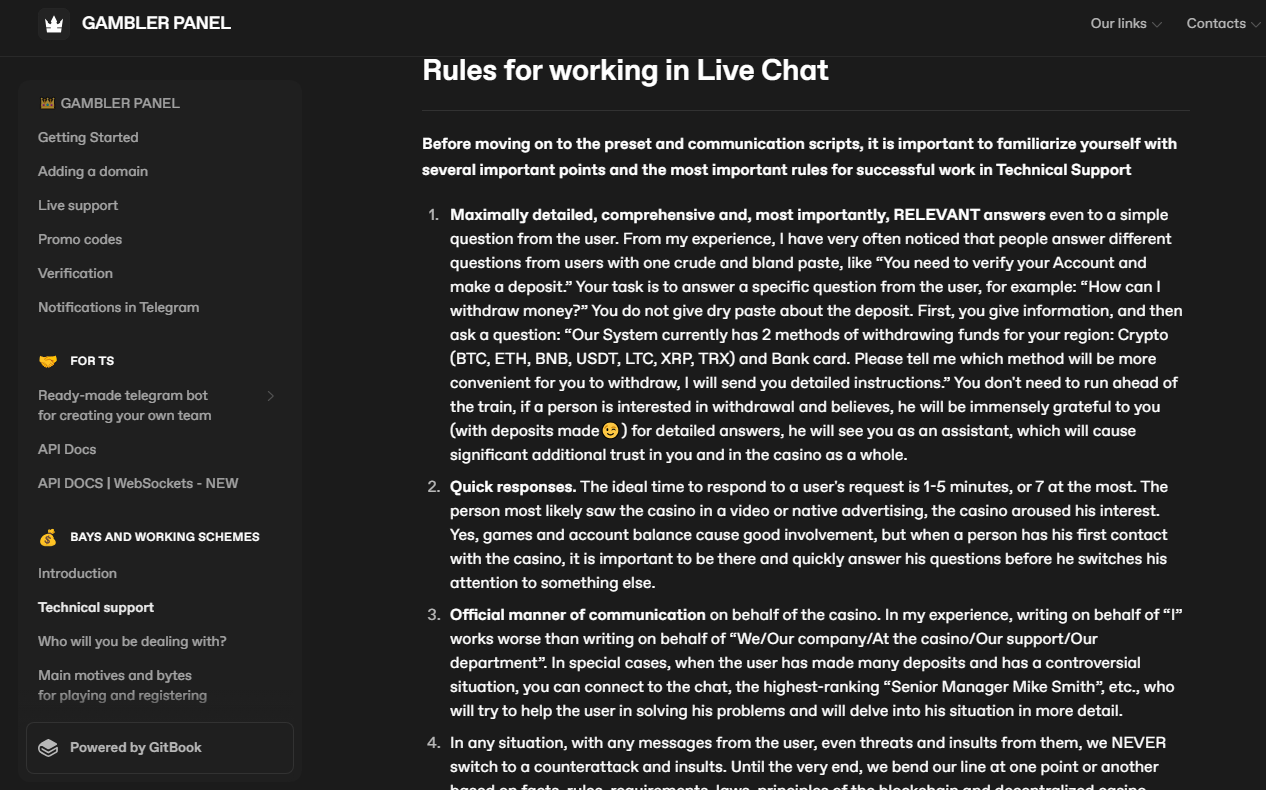
Gambler Panel also walks affiliates through a range of possible responses to questions from users who are trying to withdraw funds from the platform. This section, titled “Rules for working in Live chat,” urges scammers to respond quickly to user requests (1-7 minutes), and includes numerous strategies for keeping the conversation professional and the user on the platform as long as possible.
A machine-translated version of the Gambler Panel’s instructions on managing chat support conversations with users.
The connection between Gambler Panel and the explosion in the number of scambling websites was made by a 17-year-old developer who operates multiple Discord servers that have been flooded lately with misleading ads for these sites.
The researcher, who asked to be identified only by the nickname “Thereallo,” said Gambler Panel has built a scalable business product for other criminals.
“The wiki is kinda like a ‘how to scam 101’ for criminals written with the clarity you would expect from a legitimate company,” Thereallo said. “It’s clean, has step by step guides, and treats their scam platform like a real product. You could swap out the content, and it could be any documentation for startups.”
“They’ve minimized their own risk — spreading the links on Discord / Facebook / YT Shorts, etc. — and outsourced it to a hungry affiliate network, just like a franchise,” Thereallo wrote in response to questions.
“A centralized platform that can serve over 1,200 domains with a shared user base, IP tracking, and a custom API is not at all a trivial thing to build,” Thereallo said. “It’s a scalable system designed to be a resilient foundation for thousands of disposable scam sites.”
The security firm Silent Push has compiled a list of the latest domains associated with the Gambler Panel, available here (.csv).

 Entrar