Visualização de leitura

‘Scattered Spider’ Member ‘Tylerb’ Pleads Guilty

A 24-year-old British national and senior member of the cybercrime group “Scattered Spider” has pleaded guilty to wire fraud conspiracy and aggravated identity theft. Tyler Robert Buchanan admitted his role in a series of text-message phishing attacks in the summer of 2022 that allowed the group to hack into at least a dozen major technology companies and steal tens of millions of dollars worth of cryptocurrency from investors.

Buchanan’s hacker handle “Tylerb” once graced a leaderboard in the English-language criminal hacking scene that tracked the most accomplished cyber thieves. Now in U.S. custody and awaiting sentencing, the Dundee, Scotland native is facing the possibility of more than 20 years in prison.

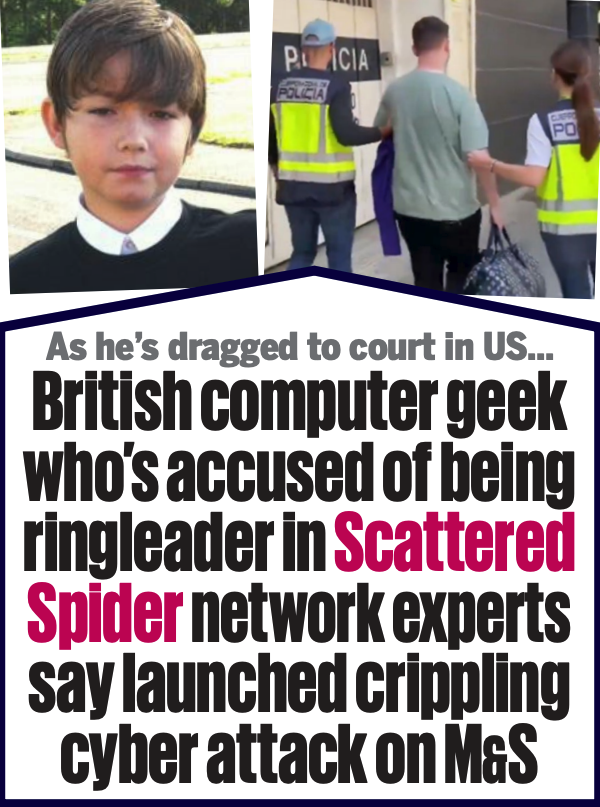
A screenshot of two photos of Buchanan that appeared in a Daily Mail story dated May 3, 2025.

Two photos published in a Daily Mail story dated May 3, 2025 show Buchanan as a child (left) and as an adult being detained by airport authorities in Spain. “M&S” in this screenshot refers to Marks & Spencer, a major U.K. retail chain that suffered a ransomware attack last year at the hands of Scattered Spider.

Scattered Spider is the name given to a prolific English-speaking cybercrime group known for using social engineering tactics to break into companies and steal data for ransom, often impersonating employees or contractors to deceive IT help desks into granting access.

As part of his guilty plea, Buchanan admitted conspiring with other Scattered Spider members to launch tens of thousands of SMS-based phishing attacks in 2022 that led to intrusions at a number of technology companies, including Twilio, LastPass, DoorDash, and Mailchimp.

The group then used data stolen in those breaches to carry out SIM-swapping attacks that siphoned funds from individual cryptocurrency investors. In an unauthorized SIM-swap, crooks transfer the target’s phone number to a device they control and intercept any text messages or phone calls to the victim’s device — such as one-time passcodes for authentication and password reset links sent via SMS. The U.S. Justice Department said Buchanan admitted to stealing at least $8 million in virtual currency from individual victims throughout the United States.

FBI investigators tied Buchanan to the 2022 SMS phishing attacks after discovering the same username and email address was used to register numerous phishing domains seen in the campaign. The domain registrar NameCheap found that less than a month before the phishing spree, the account that registered those domains logged in from an Internet address in the U.K. FBI investigators said the Scottish police told them the address was leased to Buchanan throughout 2022.

As first reported by KrebsOnSecurity, Buchanan fled the United Kingdom in February 2023, after a rival cybercrime gang hired thugs to invade his home, assault his mother, and threaten to burn him with a blowtorch unless he gave up the keys to his cryptocurrency wallet. That same year, U.K. investigators found a device at Buchanan’s Scotland residence that included data stolen from SMS phishing victims and seed phrases from cryptocurrency theft victims.

Buchanan was arrested by Spanish authorities in June 2024 while trying to board a flight to Italy. He was extradited to the United States and has remained in U.S. federal custody since April 2025.

Buchanan is the second known Scattered Spider member to plead guilty. Noah Michael Urban, 21, of Palm Coast, Fla., was sentenced to 10 years in federal prison last year and ordered to pay $13 million in restitution. Three other alleged co-conspirators — Ahmed Hossam Eldin Elbadawy, 24, a.k.a. “AD,” of College Station, Texas; Evans Onyeaka Osiebo, 21, of Dallas, Texas; and Joel Martin Evans, 26, a.k.a. “joeleoli,” of Jacksonville, North Carolina – still face criminal charges.

Two other alleged Scattered Spider members will soon be tried in the United Kingdom. Owen Flowers, 18, and Thalha Jubair, 20, are facing charges related to the hacking and extortion of several large U.K. retailers, the London transit system, and healthcare providers in the United States. Both have pleaded not guilty, and their trial is slated to begin in June.

Investigators say the Scattered Spider suspects are part of a sprawling cybercriminal community online known as “The Com,” wherein hackers from different cliques boast publicly on Telegram and Discord about high-profile cyber thefts that almost invariably begin with social engineering — tricking people over the phone, email or SMS into giving away credentials that allow remote access to corporate internal networks.

One of the more popular SIM-swapping channels on Telegram has long maintained a leaderboard of the most rapacious SIM-swappers, indexed by their supposed conquests in stealing cryptocurrency. That leaderboard previously listed Buchanan’s hacker alias Tylerb at #65 (out of 100 hackers), with Urban’s moniker “Sosa” coming in at #24.

Buchanan’s sentencing hearing is scheduled for August 21, 2026. According to the Justice Department, he faces a statutory maximum sentence of 22 years in federal prison. However, any sentence the judge hands down in this case may be significantly tempered by a number of mitigating factors in the U.S. Sentencing Guidelines, including the defendant’s age, criminal history, time already served in U.S. custody, and the degree to which they cooperated with federal authorities.

Banning Routers Won’t Secure the Internet

Washington’s push to ban foreign-made Wi-Fi routers may sound tough on cybersecurity, but like earlier bans on foreign drones and telecom gear it risks becoming security theater that ignores the real problem: Millions of unpatched devices already sitting on American networks.

The post Banning Routers Won’t Secure the Internet appeared first on Security Boulevard.

Blocking children from social media is a badly executed good idea

While we can probably all agree that there is more than enough proof that social media is bad for the mental health of our children, the methods we are trying to block or ban them seem to do more harm than good.

Across the world, lawmakers are tripping over each other to be seen “doing something” about kids and social media. Europe is slowly turning into a patchwork of age limits, curfews, and partial bans, with each country testing its own flavor of restriction while platforms try to update their systems just fast enough to stay compliant. Australia has gone even further with a nationwide ban for children under 16 that regulators now struggle to enforce at scale. The political message seems to be: social media is dangerous, and the state will step in where parents supposedly fail.

On paper, that sounds decisive. In practice, it is messy, easy to bypass, and it risks shifting the problem rather than solving it. Most of these measures depend on age‑verification systems that were never designed to handle this kind of pressure. Research looking at sign‑up flows for major platforms shows what every teenager already knows: it is not hard to lie about your date of birth, borrow an older friend’s details, or hop to a service that is just outside the current regulatory crosshairs. The result is a lot of political noise, a lot of extra friction for everyone, and only a marginal effect on the very group these rules are aimed at.

Worse, by treating all social media use by minors as equally harmful, bans erase important nuances. There is a world of difference between doom‑scrolling through algorithmically-boosted gore reels at 2 AM and using a group chat to do homework, laugh at memes, or stay in touch with cousins abroad. Studies and expert reviews echo this. Social media can contribute to anxiety, depression, and poor sleep, but it can also provides support, connection, and a sense of belonging, especially for teens who feel isolated offline. A blunt ban cuts off both the toxic and the helpful parts in one sweep, which is not necessarily an improvement.

The tools we build to make bans enforceable come with their own side‑effects. Age‑verification schemes based on IDs, biometric analysis, or third‑party brokers may reduce some underage sign‑ups, but they also normalize handing over sensitive data just to speak or listen online. Legal and technical analysts warn that these systems introduce new privacy risks, expand surveillance, and can disproportionately impact vulnerable communities who rely on pseudonyms and anonymity for their safety. For children, the lesson the takeaway is that if they want to participate, they must accept invasive checks they barely understand or learn how to bypass them.

Which children easily do.

When you close one door without addressing the underlying behavior, kids will find another, as they have done throughout history. From chat rooms to instant messaging to early social networks, every attempt to lock children out has produced a mix of circumvention and secrecy. That secrecy is a problem in itself, because it pushes online life into hidden accounts, borrowed devices, or unregulated platforms where adults have even less visibility into what is going on. The more online activity that moves into that grey area of illegality, the harder it becomes to have honest conversations about the risks.

That, ultimately, is the core weakness of “ban first, ask questions later” policies. They are optimized for sending a strong signal to voters, not for building resilient habits in families. Politicians and platforms both have roles to play to make the online environment safer. Platforms can use a better design, safer defaults, more transparency, and proper enforcement against clear abuse. But none of that will replace what actually makes a difference for a child: an adult who understands the risks well enough to talk about them, set reasonable boundaries, and is trusted enough that the child will come to them when something goes wrong. No child suddenly matures enough on their 13th or even 16th birthday to be able to fight off the pitfalls of extremely fine-tuned algorithms.

We should be honest about this. No regulator, filter, or age‑gate will ever know your child as well as you do. No law will be able to adjust itself on the fly when a teenager suddenly starts using a new app in a worrying way. Governments can and should tackle the worst excesses, and hold companies responsible so they stop pretending that maximized engagement is compatible with child safety. But in the end, the real responsibility for keeping children safe online cannot be outsourced to apps or regulation. In the end, it lies, unavoidably, with the people—daily, compassionately—in their lives.


We don’t just report on threats – we help protect your social media

Cybersecurity risks should never spread beyond a headline. Protect your social media accounts by using Malwarebytes Identity Theft Protection.

A week in security (March 23 – March 29)

New FCC router ban could leave home networks less secure

On Monday, the Federal Communications Commission (FCC) updated its list of insecure equipment, outlining its reasons for adding all consumer-grade routers made outside the US.

Effectively, this would stop foreign-made routers from being imported unless their manufacturers obtain an exemption, due to what the FCC called an “unacceptable risk to the national security of the United States or the safety and security of United States persons.”

We applaud decisions that make people more secure, but this one raises some serious questions.

Almost all routers

Virtually all consumer-grade routers are produced outside of the US, including those marketed by American companies. This doesn’t pose an immediate problem, because the ban would only apply to future imports. Products already in use or currently on sale could still be used.

But with no US-manufactured routers readily available, people may hold on to older, less secure devices for longer than they normally would due to a  lack of alternatives. That means routers that have reached end-of-life (EOL) might remain in use without updates or support.

The real danger

Although it makes sense to scrutinize untrusted routers in government and critical infrastructure environments, I don’t think banning SOHO (small office/home office) routers is likely to have a big impact on national security.

At first glance, you might think this kind of move is aimed at taking down some major botnets which thrived on internet-connected devices like cameras, routers, and video recorders. And the National Security Determination does mention these botnets.

But in most cases, the reason these routers can be used in botnets isn’t because they were made abroad, but because they are shipped with default credentials and unclear directions on how to change them.

Untrusted routers could lead to espionage and denial of service at critical times, especially where countries of origin have laws prescribing mandatory backdoors (like China). In those cases, it makes sense to avoid those routers in organizations that are “critical for maintaining functional communications, critical infrastructure, and emergency services.”

But many routers are manufactured in countries that have no such laws, and where there is little to gain from state-level espionage targeting US consumers.

Alternative safety measures

Before buying a new router, check with your Internet Service Provider (ISP) which models work with their services. Many ISPs publish lists of approved modems, and sometimes gateway devices, but they usually allow customers to use their own standalone router as long as it connects via Ethernet and supports the WAN type (DHCP, PPPoE, VLAN tags, etc.).

In practice, the best router for national security isn’t the one with a “Made in USA” label, but the one that gets patched as soon as a vulnerability is disclosed.

If you can afford it and haven’t already, upgrade to Wi-Fi 7 to help future-proof your setup while current models are still in stores.

You should also:

  • Change your router’s default credentials to something less easy to guess.
  • Check the vendor’s website for updates and confirm the EOL date.

For technically confident users, replacing vendor firmware with open-source alternatives like OpenWrt or DD-WRT can extend a router’s secure lifespan. But this comes with risks, including voiding warranties or potentially bricking your device. You should only do this, or have it done, if you’re comfortable troubleshooting.


We don’t just report on privacy—we offer you the option to use it.

Privacy risks should never spread beyond a headline. Keep your online privacy yours by using Malwarebytes Privacy VPN.

The FCC Just Blocked Every New Foreign-Made Router from the U.S. Market

Foreign-Made Router, FCC Ban, FCC

The router sitting in your home — the one connecting every phone, laptop, and smart device on your network to the internet — is almost certainly made overseas. As of March 23, no new model of that device can receive U.S. market authorization unless it clears a security review by the Department of War or the Department of Homeland Security first.

The Federal Communications Commission updated its Covered List to include all routers produced in a foreign country, following a National Security Determination received on March 20 from a White House-convened Executive Branch interagency body.

The determination concluded that foreign-produced routers introduce a supply chain vulnerability that could disrupt the U.S. economy, critical infrastructure, and national defense, and pose a severe cybersecurity risk that could be leveraged to immediately and severely disrupt U.S. critical infrastructure and directly harm U.S. persons.

The FCC's Covered List — established under the Secure and Trusted Communications Networks Act — carries real enforcement teeth. Equipment on the Covered List is prohibited from receiving FCC equipment authorization, and most electronic devices require FCC equipment authorization prior to importation, marketing, or sale in the U.S. Covered equipment is banned from receiving new equipment authorizations, preventing new devices from entering the U.S. market.

The national security determination cited three Chinese state-sponsored cyber campaigns by name. Routers produced abroad were directly implicated in the Volt, Flax, and Salt Typhoon cyberattacks, which targeted critical American communications, energy, transportation, and water infrastructure.

Salt Typhoon penetrated multiple U.S. telecommunications carriers and persisted inside their networks for months; Volt Typhoon pre-positioned itself inside U.S. critical infrastructure for potential future disruption; and Flax Typhoon operated a 260,000-device botnet largely built from compromised consumer routers.

Unlike prior Covered List entries that targeted specific entities such as Huawei and ZTE, this update applies categorically based on place of production, not manufacturer identity. That distinction matters enormously for the industry.

Virtually all routers are made outside the United States, including those produced by U.S.-based companies like TP-Link, which manufactures its products in Vietnam. It appears that the entire router industry will be impacted by the FCC's announcement concerning new devices not previously authorized by the FCC. Netgear, Amazon Eero, Google Nest WiFi, Asus, Linksys, and D-Link all manufacture in Asia. The one apparent exception is the newer Starlink Wi-Fi router, which the company says is manufactured in Texas.

The action does not strand existing users. Consumers can continue using any router they have already purchased, and retailers can continue selling previously authorized models already in their supply chains. Firmware updates for covered devices remain permitted at least through March 1, 2027.

The disruption falls entirely on new product cycles — which in a fast-moving consumer networking market means the freeze begins almost immediately.

A rule that bans new foreign router models while leaving millions of existing foreign-made devices completely untouched does not make U.S. networks measurably more secure today. Security researchers have noted that the Volt Typhoon attacks cited by the FCC as justification, primarily targeted Cisco and Netgear hardware — U.S.-designed products — pointing to software patching failures rather than manufacturing origin as the operational vulnerability.

A Conditional Approval pathway exists for manufacturers willing to pursue it. The Conditional Approval pathway requires companies to commit to establishing or expanding U.S. manufacturing for the products they want to bring to market. That is a significant industrial policy commitment on top of any security review, and one that smaller router vendors may find prohibitive.

The December 2025 drone ban used an identical framework — and as of publication, it had cleared exactly four non-Chinese drone systems while leaving major Chinese manufacturers fully blocked.

Also read: FCC Set to Reverse Course on Telecom Cybersecurity Mandate

The Privacy Problem With Meta’s Ray-Ban Smart Glasses

This episode discusses Meta Ray-Ban Smart Glasses, which blend a camera, microphone, AI features, and social media integration into sunglasses that look like normal fashion eyewear, raising major privacy concerns. It highlights reports that footage captured by the glasses may be reviewed by human contractors to help train Meta’s AI systems, and notes critics’ concerns […]

The post The Privacy Problem With Meta’s Ray-Ban Smart Glasses appeared first on Shared Security Podcast.

The post The Privacy Problem With Meta’s Ray-Ban Smart Glasses appeared first on Security Boulevard.

💾

Does the UK really want to ban VPNs? And can it be done?

The idea of a “Great British Firewall” makes for a catchy headline, but it would be riddled with holes and cause huge problems.

The Guardian reports that the GCHQ (Government Communications Headquarters), a UK intelligence, security, and cyber agency, is exploring the idea of a British firewall offering protection against malicious hackers. It falls within its remit, but one of the measures reportedly discussed—banning VPN software—raises practical and technical questions.

Here’s what you actually need to know, and why you shouldn’t panic about your VPN just yet.

  • There are no current plans on the statute books to ban VPNs for everyone. Ministers and regulators explicitly acknowledge VPNs as lawful services with legitimate uses.
  • The current political focus is on “online safety”, especially kids accessing porn and harmful content, and how VPNs can undermine the Online Safety Act’s age‑assurance and filtering regime.
  • The latest move is an online‑safety consultation that explicitly mentions “options to age-restrict or limit children’s VPN use where it undermines safety protections”, not an outright nationwide ban.

So what may happen is tighter controls around minors, and perhaps pressure on app stores and platforms, rather than a blanket prohibition for adults.

Options

Technically speaking, these are some of the measures available to address VPNs bypassing geo-blocking and local legislation.

  • App‑store and download pressure: Require Apple/Google to hide or age‑gate VPN apps for UK accounts, or block listing of some consumer VPNs. This raises friction for non‑technical users but is trivial to route around (sideloading where possible, non‑UK stores, manual configs).
  • Commercial provider lists: Buy accounts at popular VPNs, enumerate exit IP ranges, and require ISPs or certain sites (e.g. porn sites) to block those IPs. This can catch a large chunk of mainstream VPN traffic but is high‑maintenance and easy to evade with IP rotation, residential proxies, self‑hosted VPNs, and lesser‑known services.
  • Targeted site‑level blocking of VPNs: Require certain categories of sites (e.g. adult sites) to reject traffic that appears to come from VPN IPs, an idea already floated by some experts as more likely than an outright technology ban. That still leaves VPNs usable for everything else, including general browsing and work.
  • Age‑based device/network controls: Mandate school networks, child‑oriented devices, or parental control routers to block known VPN endpoints and app traffic, as media regulator Ofcom and others have suggested may be possible at the home‑router level. Again, this targets minors rather than adults and is only as strong as the weakest network they connect to (a friend’s Wi‑Fi, mobile hotspot, etc.).

All of these are “making it harder” tactics rather than a hard technical kill switch.

Why a watertight VPN ban is essentially impossible

To comprehensively block VPNs, the government would need to require internet providers to inspect traffic, restrict apps from app stores, and attempt to cut off access to thousands of VPN servers worldwide. That would be a massive, expensive, and deeply complicated undertaking—and it still wouldn’t work.

Problem 1: VPNs are basically invisible

Modern VPNs are designed to look very similar to normal web browsing. When you load a website over HTTPS (the padlock in your browser) and when you connect to a VPN, the traffic flowing through your internet connection looks almost identical. Reliably telling them apart is a bit like trying to spot which cars on a motorway are taxis versus private vehicles based solely on their tire tread patterns at motorway speed, for every car, in real time. You’d end up accidentally blocking huge amounts of perfectly ordinary internet traffic in the attempt.

Problem 2: Too many legitimate users depend on VPNs

VPNs aren’t just for privacy-conscious consumers. They’re how millions of people securely connect to their workplace from home. The NHS (the UK’s National Health Service) uses them for remote access. Journalists use them to protect sources. Researchers use them to access academic resources. Any serious enforcement effort would have to grapple with the risk of collateral damage to businesses and public services.

Problem 3: The ban would be trivially easy to bypass

Even if the government successfully blocked every major commercial VPN app and service, technically skilled users could simply rent a cheap server anywhere in the world and set up their own private tunnel in under ten minutes. There are also tools designed to evade exactly this kind of blocking, disguising encrypted traffic as ordinary web activity.

We know this because Russia has been trying to block VPNs for years, using the full weight of state enforcement behind it. But VPN usage in Russia has surged, not declined. Blocked services pop up under new names and addresses and new tools emerge overnight. This track record suggests that long-term, comprehensive suppression is difficult, even with aggressive powers of enforcement.

What does this actually mean for UK citizens?

The government can probably make consumer VPN use slightly more inconvenient, removing apps from UK app stores, for instance, or creating legal grey areas for certain uses. But a genuine, technical ban on VPN software and encrypted connections is not realistically achievable without causing serious collateral damage to the UK’s digital economy and the millions of people who depend on this technology for entirely legitimate reasons.

Don’t ditch your VPN. The Great Firewall of Great Britain isn’t coming. And if it tried, it would have more holes than a fishing net.

Hat tip to Stefan Dasic and the Malwarebytes VPN team for their invaluable input.


We don’t just report on privacy—we offer you the option to use it.

Privacy risks should never spread beyond a headline. Keep your online privacy yours by using Malwarebytes Privacy VPN.

Developer creates app to detect nearby smart glasses

An independent developer, moved after reading about the abuse of smart glasses to film people without their consent, decided to create an app to detect nearby smart glasses.

Smart glasses are wearable devices built into ordinary-looking eyewear that add functions like audio, cameras, sensors, and sometimes a small display. They can let you listen to music, take calls, capture photos or video from your point of view, or see simple information overlaid in your field of vision, depending on the model. To do this, they pack components such as microphones, touch controls, motion sensors, and sometimes a camera and tiny projector into the frame and arms of the glasses.

Nearby Glasses is an Android hobbyist app that continuously scans for Bluetooth Low Energy “advertising frames”—a type of data—to recognize devices from manufacturers linked to smart glasses, specifically Meta, Luxottica (Meta Ray-Bans), and Snap.

When it sees a matching Bluetooth signature, it sends a notification like “Smart Glasses are probably nearby,” though the developer explicitly warns about false positives, for example from Meta Quest VR headsets. Users install it from Google Play or GitHub, enable foreground scanning, start the scan, and then decide how to respond if an alert appears.

Because stalkers and harassers misuse smart glasses to target people, the developer built the app in deliberate defiance to modern surveillance after reading reports about people using Meta’s Ray-Ban smart glasses to secretly film others in massage parlors and during immigration raids.

In speaking with the outlet 404 Media about the project, developer Yves Jeanrenaud said: “I consider it to be a tiny part of resistance against surveillance tech.”

This kind of app matters most in contexts where covert recording or automated identification has real consequences:

  • For people in vulnerable or stigmatized workplaces (e.g., massage parlors, clinics, shelters) where non-consensual filming can lead to harassment, doxxing, or professional harm.​
  • During law-enforcement or immigration actions, protests, or political gatherings, where smart glasses could be used for evidentiary recording, intimidation, or bulk identification.​
  • In any setting where bystanders reasonably expect not to be recorded or profiled, either because of a sense of privacy or because of the law (public transport, bathrooms, gyms, support groups).

In these scenarios it makes sense to want an extra signal that someone nearby may be using surveillance-capable wearables.

As observed by the reporters at 404 Media, this app is an imperfect, tech-based mitigation to a social and legal problem: it can misfire, it can’t tell you who is being recorded, and it risks giving a false sense of safety. The developer frames it not as a solution but as a small, user-controlled countermeasure in an environment where surveillance devices are becoming more invisible and more AI-augmented.


We don’t just report on privacy—we offer you the option to use it.

Privacy risks should never spread beyond a headline. Keep your online privacy yours by using Malwarebytes Privacy VPN.

Smashing Security podcast #455: Face off: Meta’s Glasses and America’s internet kill switch

Could America turn off Europe's internet? That’s one of the questions that Graham and special guest James Ball will be exploring as they discuss tech sovereignty. Could Gmail, cloud services, and critical infrastructure really become geopolitical leverage? And is anyone actually building a Plan B? Plus we explore if Meta is quietly plotting to turn its smart glasses into face-recognising surveillance specs? With reports of internal memos suggesting they plan to launch controversial features while everyone’s distracted by political chaos, we ask: is this innovation really wanted by the public... or something far creepier? All of this, and much more, in episode 455 of the award-winning "Smashing Security" podcast with cybersecurity veteran Graham Cluley, joined this week by journalist and author James Ball.

Surveillance at sea: Cruise firm bans smart glasses to curb covert recording

If you're planning a cruise for your holidays, and cannot bear the idea of being parted from your Ray-Ban Meta smart glasses, you may want to avoid sailing with MSC Cruises. The cruise line has updated its list of prohibited items, specifically banning smart glasses and similar wearable devices from public areas. Read more in my article on the Hot for Security blog.

Feds Tie ‘Scattered Spider’ Duo to $115M in Ransoms

U.S. prosecutors last week levied criminal hacking charges against 19-year-old U.K. national Thalha Jubair for allegedly being a core member of Scattered Spider, a prolific cybercrime group blamed for extorting at least $115 million in ransom payments from victims. The charges came as Jubair and an alleged co-conspirator appeared in a London court to face accusations of hacking into and extorting several large U.K. retailers, the London transit system, and healthcare providers in the United States.

At a court hearing last week, U.K. prosecutors laid out a litany of charges against Jubair and 18-year-old Owen Flowers, accusing the teens of involvement in an August 2024 cyberattack that crippled Transport for London, the entity responsible for the public transport network in the Greater London area.

A court artist sketch of Owen Flowers (left) and Thalha Jubair appearing at Westminster Magistrates’ Court last week. Credit: Elizabeth Cook, PA Wire.

On July 10, 2025, KrebsOnSecurity reported that Flowers and Jubair had been arrested in the United Kingdom in connection with recent Scattered Spider ransom attacks against the retailers Marks & Spencer and Harrods, and the British food retailer Co-op Group.

That story cited sources close to the investigation saying Flowers was the Scattered Spider member who anonymously gave interviews to the media in the days after the group’s September 2023 ransomware attacks disrupted operations at Las Vegas casinos operated by MGM Resorts and Caesars Entertainment.

The story also noted that Jubair’s alleged handles on cybercrime-focused Telegram channels had far lengthier rap sheets involving some of the more consequential and headline-grabbing data breaches over the past four years. What follows is an account of cybercrime activities that prosecutors have attributed to Jubair’s alleged hacker handles, as told by those accounts in posts to public Telegram channels that are closely monitored by multiple cyber intelligence firms.

EARLY DAYS (2021-2022)

Jubair is alleged to have been a core member of the LAPSUS$ cybercrime group that broke into dozens of technology companies beginning in late 2021, stealing source code and other internal data from tech giants including MicrosoftNvidiaOktaRockstar GamesSamsungT-Mobile, and Uber.

That is, according to the former leader of the now-defunct LAPSUS$. In April 2022, KrebsOnSecurity published internal chat records taken from a server that LAPSUS$ used, and those chats indicate Jubair was working with the group using the nicknames Amtrak and Asyntax. In the middle of the gang’s cybercrime spree, Asyntax told the LAPSUS$ leader not to share T-Mobile’s logo in images sent to the group because he’d been previously busted for SIM-swapping and his parents would suspect he was back at it again.

The leader of LAPSUS$ responded by gleefully posting Asyntax’s real name, phone number, and other hacker handles into a public chat room on Telegram:
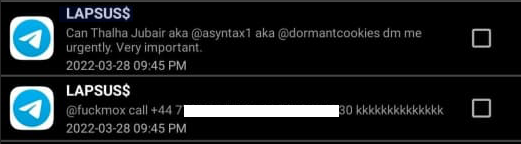
In March 2022, the leader of the LAPSUS$ data extortion group exposed Thalha Jubair’s name and hacker handles in a public chat room on Telegram.

That story about the leaked LAPSUS$ chats also connected Amtrak/Asyntax to several previous hacker identities, including “Everlynn,” who in April 2021 began offering a cybercriminal service that sold fraudulent “emergency data requests” targeting the major social media and email providers.

In these so-called “fake EDR” schemes, the hackers compromise email accounts tied to police departments and government agencies, and then send unauthorized demands for subscriber data (e.g. username, IP/email address), while claiming the information being requested can’t wait for a court order because it relates to an urgent matter of life and death.
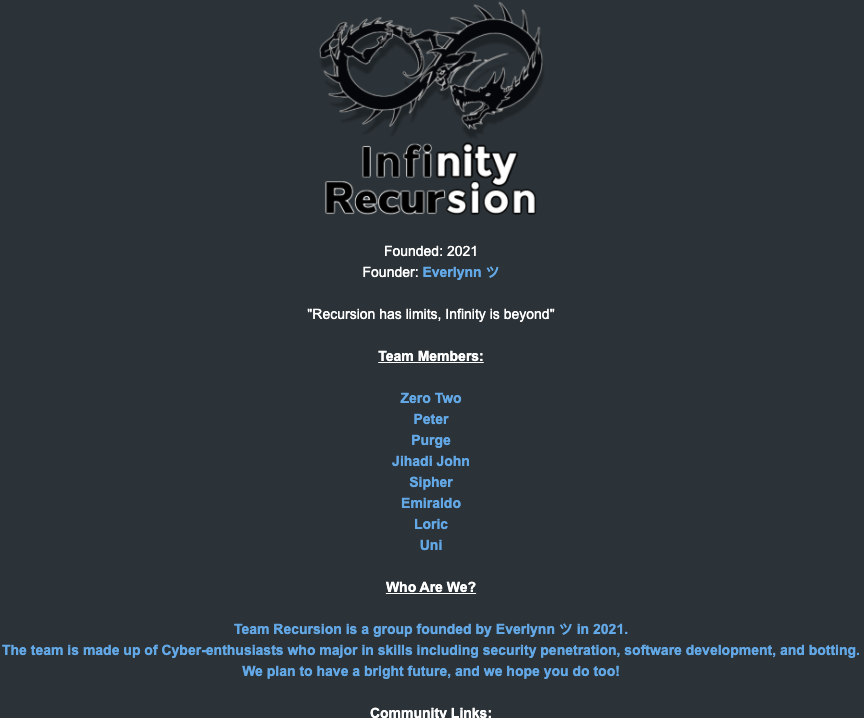
The roster of the now-defunct “Infinity Recursion” hacking team, which sold fake EDRs between 2021 and 2022. The founder “Everlynn” has been tied to Jubair. The member listed as “Peter” became the leader of LAPSUS$ who would later post Jubair’s name, phone number and hacker handles into LAPSUS$’s chat channel.

EARTHTOSTAR

Prosecutors in New Jersey last week alleged Jubair was part of a threat group variously known as Scattered Spider, 0ktapus, and UNC3944, and that he used the nicknames EarthtoStar, Brad, Austin, and Austistic.

Beginning in 2022, EarthtoStar co-ran a bustling Telegram channel called Star Chat, which was home to a prolific SIM-swapping group that relentlessly used voice- and SMS-based phishing attacks to steal credentials from employees at the major wireless providers in the U.S. and U.K.
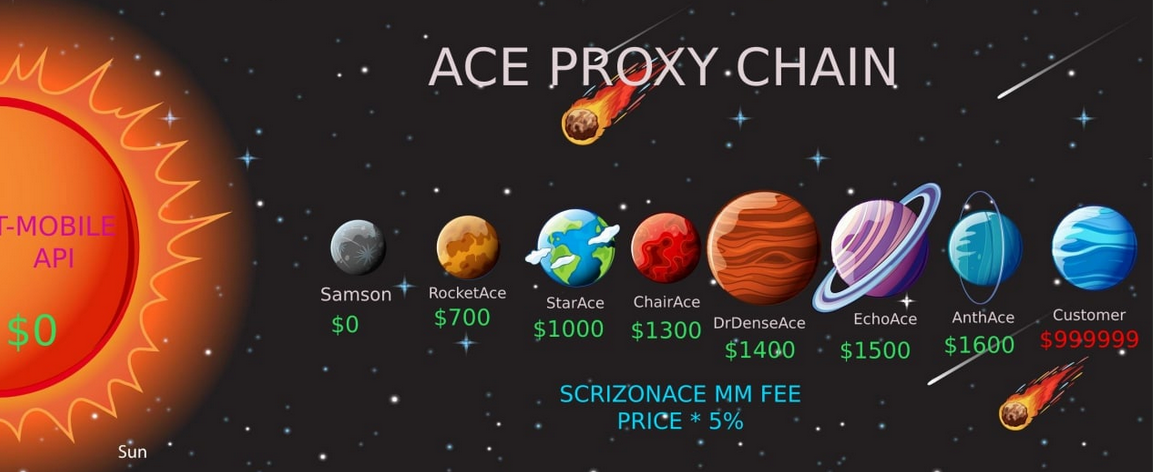
Jubair allegedly used the handle “Earth2Star,” a core member of a prolific SIM-swapping group operating in 2022. This ad produced by the group lists various prices for SIM swaps.

The group would then use that access to sell a SIM-swapping service that could redirect a target’s phone number to a device the attackers controlled, allowing them to intercept the victim’s phone calls and text messages (including one-time codes). Members of Star Chat targeted multiple wireless carriers with SIM-swapping attacks, but they focused mainly on phishing T-Mobile employees.

In February 2023, KrebsOnSecurity scrutinized more than seven months of these SIM-swapping solicitations on Star Chat, which almost daily peppered the public channel with “Tmo up!” and “Tmo down!” notices indicating periods wherein the group claimed to have active access to T-Mobile’s network.
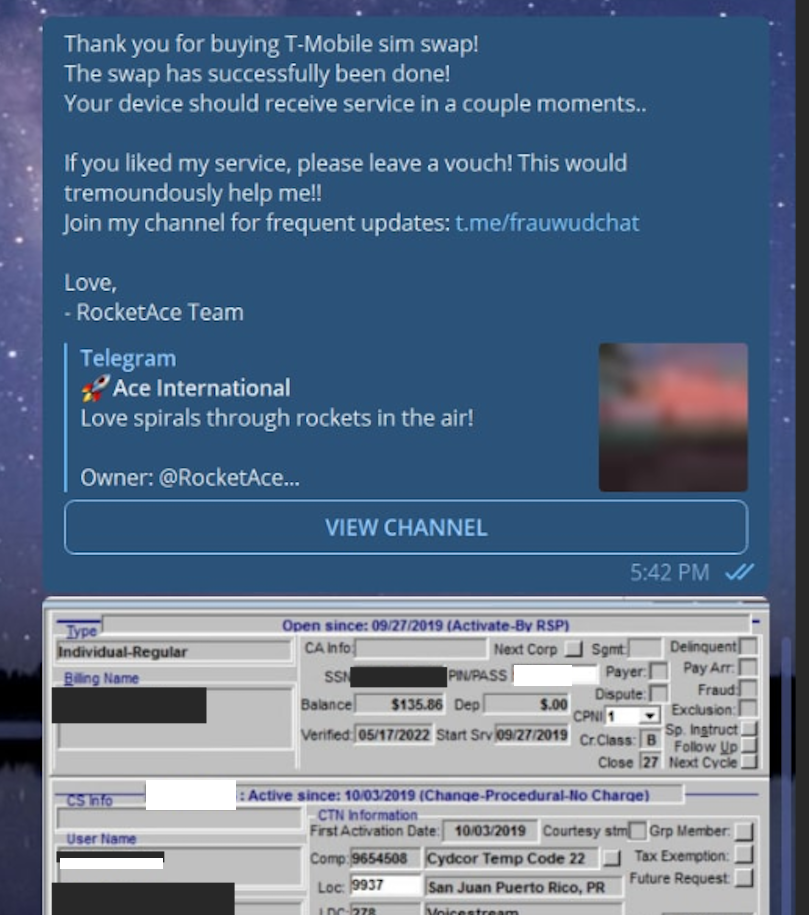
A redacted receipt from Star Chat’s SIM-swapping service targeting a T-Mobile customer after the group gained access to internal T-Mobile employee tools.

The data showed that Star Chat — along with two other SIM-swapping groups operating at the same time — collectively broke into T-Mobile over a hundred times in the last seven months of 2022. However, Star Chat was by far the most prolific of the three, responsible for at least 70 of those incidents.
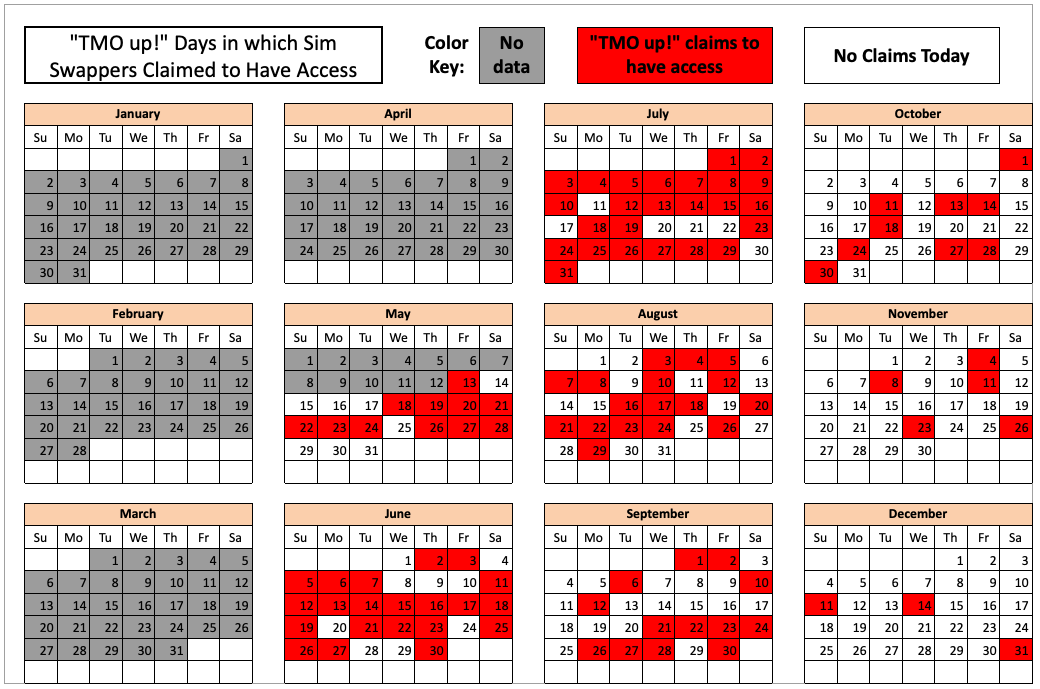
The 104 days in the latter half of 2022 in which different known SIM-swapping groups claimed access to T-Mobile employee tools. Star Chat was responsible for a majority of these incidents. Image: krebsonsecurity.com.

A review of EarthtoStar’s messages on Star Chat as indexed by the threat intelligence firm Flashpoint shows this person also sold “AT&T email resets” and AT&T call forwarding services for up to $1,200 per line. EarthtoStar explained the purpose of this service in post on Telegram:

“Ok people are confused, so you know when u login to chase and it says ‘2fa required’ or whatever the fuck, well it gives you two options, SMS or Call. If you press call, and I forward the line to you then who do you think will get said call?”

New Jersey prosecutors allege Jubair also was involved in a mass SMS phishing campaign during the summer of 2022 that stole single sign-on credentials from employees at hundreds of companies. The text messages asked users to click a link and log in at a phishing page that mimicked their employer’s Okta authentication page, saying recipients needed to review pending changes to their upcoming work schedules.

The phishing websites used a Telegram instant message bot to forward any submitted credentials in real-time, allowing the attackers to use the phished username, password and one-time code to log in as that employee at the real employer website.

That weeks-long SMS phishing campaign led to intrusions and data thefts at more than 130 organizations, including LastPass, DoorDash, Mailchimp, Plex and Signal.
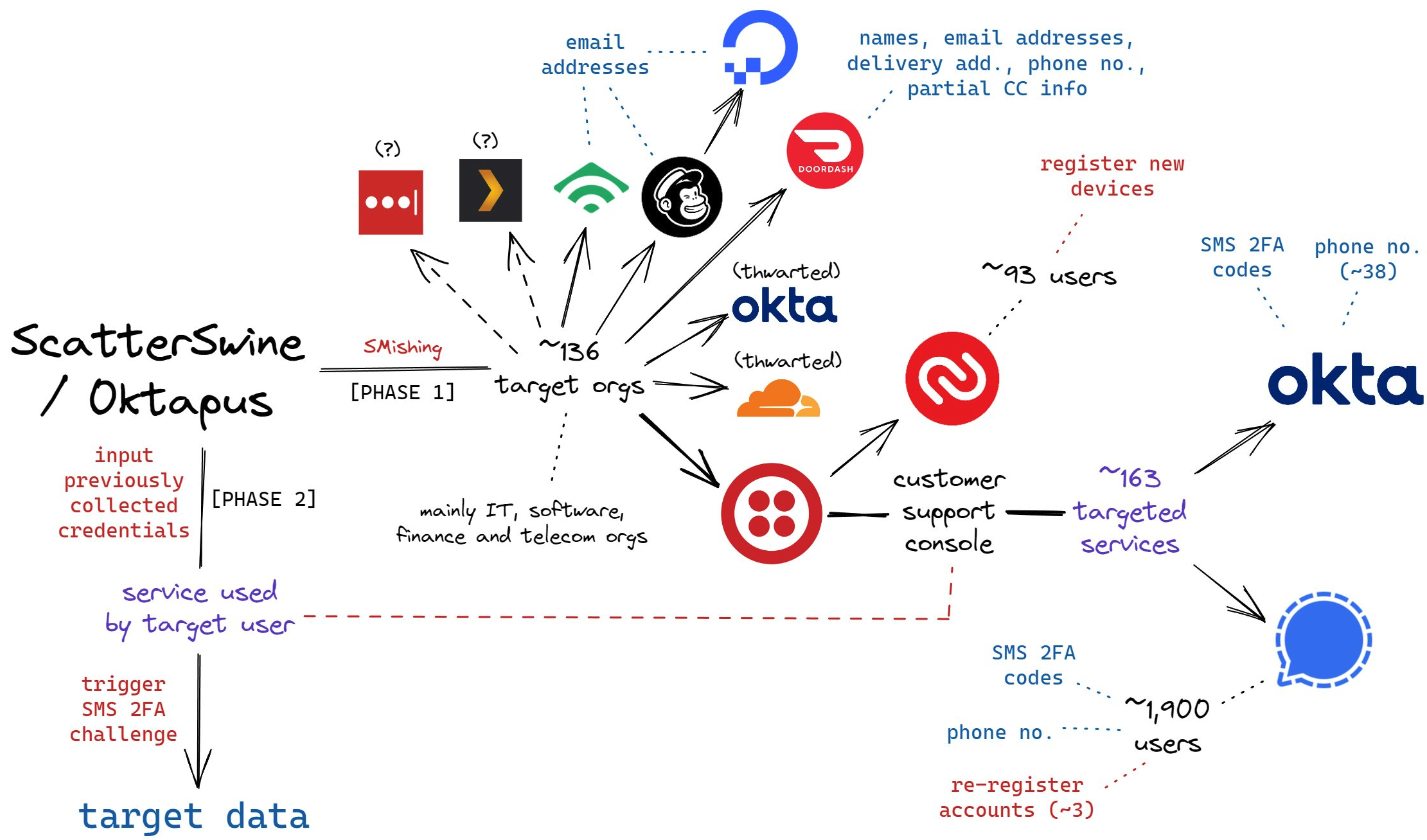
A visual depiction of the attacks by the SMS phishing group known as 0ktapus, ScatterSwine, and Scattered Spider. Image: Amitai Cohen twitter.com/amitaico.

DA, COMRADE

EarthtoStar’s group Star Chat specialized in phishing their way into business process outsourcing (BPO) companies that provide customer support for a range of multinational companies, including a number of the world’s largest telecommunications providers. In May 2022, EarthtoStar posted to the Telegram channel “Frauwudchat”:

“Hi, I am looking for partners in order to exfiltrate data from large telecommunications companies/call centers/alike, I have major experience in this field, [including] a massive call center which houses 200,000+ employees where I have dumped all user credentials and gained access to the [domain controller] + obtained global administrator I also have experience with REST API’s and programming. I have extensive experience with VPN, Citrix, cisco anyconnect, social engineering + privilege escalation. If you have any Citrix/Cisco VPN or any other useful things please message me and lets work.”

At around the same time in the Summer of 2022, at least two different accounts tied to Star Chat — “RocketAce” and “Lopiu” — introduced the group’s services to denizens of the Russian-language cybercrime forum Exploit, including:

-SIM-swapping services targeting Verizon and T-Mobile customers;
-Dynamic phishing pages targeting customers of single sign-on providers like Okta;
-Malware development services;
-The sale of extended validation (EV) code signing certificates.
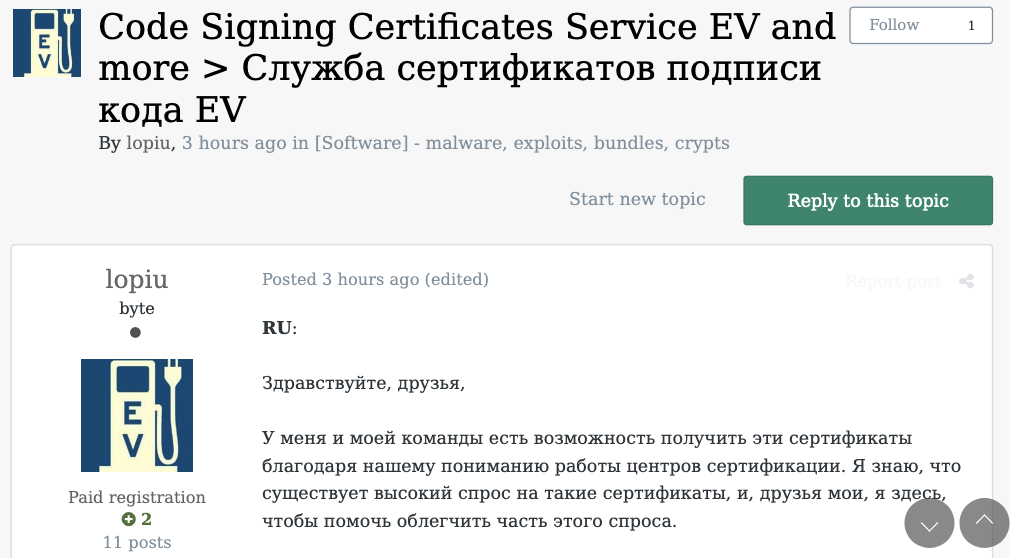
The user “Lopiu” on the Russian cybercrime forum Exploit advertised many of the same unique services offered by EarthtoStar and other Star Chat members. Image source: ke-la.com.

These two accounts on Exploit created multiple sales threads in which they claimed administrative access to U.S. telecommunications providers and asked other Exploit members for help in monetizing that access. In June 2022, RocketAce, which appears to have been just one of EarthtoStar’s many aliases, posted to Exploit:

Hello. I have access to a telecommunications company’s citrix and vpn. I would like someone to help me break out of the system and potentially attack the domain controller so all logins can be extracted we can discuss payment and things leave your telegram in the comments or private message me ! Looking for someone with knowledge in citrix/privilege escalation

On Nov. 15, 2022, EarthtoStar posted to their Star Sanctuary Telegram channel that they were hiring malware developers with a minimum of three years of experience and the ability to develop rootkits, backdoors and malware loaders.

“Optional: Endorsed by advanced APT Groups (e.g. Conti, Ryuk),” the ad concluded, referencing two of Russia’s most rapacious and destructive ransomware affiliate operations. “Part of a nation-state / ex-3l (3 letter-agency).”

2023-PRESENT DAY

The Telegram and Discord chat channels wherein Flowers and Jubair allegedly planned and executed their extortion attacks are part of a loose-knit network known as the Com, an English-speaking cybercrime community consisting mostly of individuals living in the United States, the United Kingdom, Canada and Australia.

Many of these Com chat servers have hundreds to thousands of members each, and some of the more interesting solicitations on these communities are job offers for in-person assignments and tasks that can be found if one searches for posts titled, “If you live near,” or “IRL job” — short for “in real life” job.

These “violence-as-a-service” solicitations typically involve “brickings,” where someone is hired to toss a brick through the window at a specified address. Other IRL jobs for hire include tire-stabbings, molotov cocktail hurlings, drive-by shootings, and even home invasions. The people targeted by these services are typically other criminals within the community, but it’s not unusual to see Com members asking others for help in harassing or intimidating security researchers and even the very law enforcement officers who are investigating their alleged crimes.

It remains unclear what precipitated this incident or what followed directly after, but on January 13, 2023, a Star Sanctuary account used by EarthtoStar solicited the home invasion of a sitting U.S. federal prosecutor from New York. That post included a photo of the prosecutor taken from the Justice Department’s website, along with the message:

“Need irl niggas, in home hostage shit no fucking pussies no skinny glock holding 100 pound niggas either”

Throughout late 2022 and early 2023, EarthtoStar’s alias “Brad” (a.k.a. “Brad_banned”) frequently advertised Star Chat’s malware development services, including custom malicious software designed to hide the attacker’s presence on a victim machine:

We can develop KERNEL malware which will achieve persistence for a long time,
bypass firewalls and have reverse shell access.

This shit is literally like STAGE 4 CANCER FOR COMPUTERS!!!

Kernel meaning the highest level of authority on a machine.
This can range to simple shells to Bootkits.

Bypass all major EDR’s (SentinelOne, CrowdStrike, etc)
Patch EDR’s scanning functionality so it’s rendered useless!

Once implanted, extremely difficult to remove (basically impossible to even find)
Development Experience of several years and in multiple APT Groups.

Be one step ahead of the game. Prices start from $5,000+. Message @brad_banned to get a quote

In September 2023 , both MGM Resorts and Caesars Entertainment suffered ransomware attacks at the hands of a Russian ransomware affiliate program known as ALPHV and BlackCat. Caesars reportedly paid a $15 million ransom in that incident.

Within hours of MGM publicly acknowledging the 2023 breach, members of Scattered Spider were claiming credit and telling reporters they’d broken in by social engineering a third-party IT vendor. At a hearing in London last week, U.K. prosecutors told the court Jubair was found in possession of more than $50 million in ill-gotten cryptocurrency, including funds that were linked to the Las Vegas casino hacks.

The Star Chat channel was finally banned by Telegram on March 9, 2025. But U.S. prosecutors say Jubair and fellow Scattered Spider members continued their hacking, phishing and extortion activities up until September 2025.

In April 2025, the Com was buzzing about the publication of “The Com Cast,” a lengthy screed detailing Jubair’s alleged cybercriminal activities and nicknames over the years. This account included photos and voice recordings allegedly of Jubair, and asserted that in his early days on the Com Jubair used the nicknames Clark and Miku (these are both aliases used by Everlynn in connection with their fake EDR services).

Thalha Jubair (right), without his large-rimmed glasses, in an undated photo posted in The Com Cast.

More recently, the anonymous Com Cast author(s) claimed, Jubair had used the nickname “Operator,” which corresponds to a Com member who ran an automated Telegram-based doxing service that pulled consumer records from hacked data broker accounts. That public outing came after Operator allegedly seized control over the Doxbin, a long-running and highly toxic community that is used to “dox” or post deeply personal information on people.

“Operator/Clark/Miku: A key member of the ransomware group Scattered Spider, which consists of a diverse mix of individuals involved in SIM swapping and phishing,” the Com Cast account stated. “The group is an amalgamation of several key organizations, including Infinity Recursion (owned by Operator), True Alcorians (owned by earth2star), and Lapsus, which have come together to form a single collective.”

The New Jersey complaint (PDF) alleges Jubair and other Scattered Spider members committed computer fraud, wire fraud, and money laundering in relation to at least 120 computer network intrusions involving 47 U.S. entities between May 2022 and September 2025. The complaint alleges the group’s victims paid at least $115 million in ransom payments.

U.S. authorities say they traced some of those payments to Scattered Spider to an Internet server controlled by Jubair. The complaint states that a cryptocurrency wallet discovered on that server was used to purchase several gift cards, one of which was used at a food delivery company to send food to his apartment. Another gift card purchased with cryptocurrency from the same server was allegedly used to fund online gaming accounts under Jubair’s name. U.S. prosecutors said that when they seized that server they also seized $36 million in cryptocurrency.

The complaint also charges Jubair with involvement in a hacking incident in January 2025 against the U.S. courts system that targeted a U.S. magistrate judge overseeing a related Scattered Spider investigation. That other investigation appears to have been the prosecution of Noah Michael Urban, a 20-year-old Florida man charged in November 2024 by prosecutors in Los Angeles as one of five alleged Scattered Spider members.

Urban pleaded guilty in April 2025 to wire fraud and conspiracy charges, and in August he was sentenced to 10 years in federal prison. Speaking with KrebsOnSecurity from jail after his sentencing, Urban asserted that the judge gave him more time than prosecutors requested because he was mad that Scattered Spider hacked his email account.

Noah “Kingbob” Urban, posting to Twitter/X around the time of his sentencing on Aug. 20.

court transcript (PDF) from a status hearing in February 2025 shows Urban was telling the truth about the hacking incident that happened while he was in federal custody. The judge told attorneys for both sides that a co-defendant in the California case was trying to find out about Mr. Urban’s activity in the Florida case, and that the hacker accessed the account by impersonating a judge over the phone and requesting a password reset.

Allison Nixon is chief research officer at the New York based security firm Unit 221B, and easily one of the world’s leading experts on Com-based cybercrime activity. Nixon said the core problem with legally prosecuting well-known cybercriminals from the Com has traditionally been that the top offenders tend to be under the age of 18, and thus difficult to charge under federal hacking statutes.

In the United States, prosecutors typically wait until an underage cybercrime suspect becomes an adult to charge them. But until that day comes, she said, Com actors often feel emboldened to continue committing — and very often bragging about — serious cybercrime offenses.

“Here we have a special category of Com offenders that effectively enjoy legal immunity,” Nixon told KrebsOnSecurity. “Most get recruited to Com groups when they are older, but of those that join very young, such as 12 or 13, they seem to be the most dangerous because at that age they have no grounding in reality and so much longevity before they exit their legal immunity.”

Nixon said U.K. authorities face the same challenge when they briefly detain and search the homes of underage Com suspects: Namely, the teen suspects simply go right back to their respective cliques in the Com and start robbing and hurting people again the minute they’re released.

Indeed, the U.K. court heard from prosecutors last week that both Scattered Spider suspects were detained and/or searched by local law enforcement on multiple occasions, only to return to the Com less than 24 hours after being released each time.

“What we see is these young Com members become vectors for perpetrators to commit enormously harmful acts and even child abuse,” Nixon said. “The members of this special category of people who enjoy legal immunity are meeting up with foreign nationals and conducting these sometimes heinous acts at their behest.”

Nixon said many of these individuals have few friends in real life because they spend virtually all of their waking hours on Com channels, and so their entire sense of identity, community and self-worth gets wrapped up in their involvement with these online gangs. She said if the law was such that prosecutors could treat these people commensurate with the amount of harm they cause society, that would probably clear up a lot of this problem.

“If law enforcement was allowed to keep them in jail, they would quit reoffending,” she said.

The Times of London reports that Flowers is facing three charges under the Computer Misuse Act: two of conspiracy to commit an unauthorized act in relation to a computer causing/creating risk of serious damage to human welfare/national security and one of attempting to commit the same act. Maximum sentences for these offenses can range from 14 years to life in prison, depending on the impact of the crime.

Jubair is reportedly facing two charges in the U.K.: One of conspiracy to commit an unauthorized act in relation to a computer causing/creating risk of serious damage to human welfare/national security and one of failing to comply with a section 49 notice to disclose the key to protected information.

In the United States, Jubair is charged with computer fraud conspiracy, two counts of computer fraud, wire fraud conspiracy, two counts of wire fraud, and money laundering conspiracy. If extradited to the U.S., tried and convicted on all charges, he faces a maximum penalty of 95 years in prison.

In July 2025, the United Kingdom barred victims of hacking from paying ransoms to cybercriminal groups unless approved by officials. U.K. organizations that are considered part of critical infrastructure reportedly will face a complete ban, as will the entire public sector. U.K. victims of a hack are now required to notify officials to better inform policymakers on the scale of Britain’s ransomware problem.

For further reading (bless you), check out Bloomberg’s poignant story last week based on a year’s worth of jailhouse interviews with convicted Scattered Spider member Noah Urban.

SIM-Swapper, Scattered Spider Hacker Gets 10 Years

A 20-year-old Florida man at the center of a prolific cybercrime group known as “Scattered Spider” was sentenced to 10 years in federal prison today, and ordered to pay roughly $13 million in restitution to victims.

Noah Michael Urban of Palm Coast, Fla. pleaded guilty in April 2025 to charges of wire fraud and conspiracy. Florida prosecutors alleged Urban conspired with others to steal at least $800,000 from five victims via SIM-swapping attacks that diverted their mobile phone calls and text messages to devices controlled by Urban and his co-conspirators.

A booking photo of Noah Michael Urban released by the Volusia County Sheriff.

Although prosecutors had asked for Urban to serve eight years, Jacksonville news outlet News4Jax.com reports the federal judge in the case today opted to sentence Urban to 120 months in federal prison, ordering him to pay $13 million in restitution and undergo three years of supervised release after his sentence is completed.

In November 2024 Urban was charged by federal prosecutors in Los Angeles as one of five members of Scattered Spider (a.k.a. “Oktapus,” “Scatter Swine” and “UNC3944”), which specialized in SMS and voice phishing attacks that tricked employees at victim companies into entering their credentials and one-time passcodes at phishing websites. Urban pleaded guilty to one count of conspiracy to commit wire fraud in the California case, and the $13 million in restitution is intended to cover victims from both cases.

The targeted SMS scams spanned several months during the summer of 2022, asking employees to click a link and log in at a website that mimicked their employer’s Okta authentication page. Some SMS phishing messages told employees their VPN credentials were expiring and needed to be changed; other missives advised employees about changes to their upcoming work schedule.

That phishing spree netted Urban and others access to more than 130 companies, including Twilio, LastPass, DoorDash, MailChimp, and Plex. The government says the group used that access to steal proprietary company data and customer information, and that members also phished people to steal millions of dollars worth of cryptocurrency.

For many years, Urban’s online hacker aliases “King Bob” and “Sosa” were fixtures of the Com, a mostly Telegram and Discord-based community of English-speaking cybercriminals wherein hackers boast loudly about high-profile exploits and hacks that almost invariably begin with social engineering. King Bob constantly bragged on the Com about stealing unreleased rap music recordings from popular artists, presumably through SIM-swapping attacks. Many of those purloined tracks or “grails” he later sold or gave away on forums.

Noah “King Bob” Urban, posting to Twitter/X around the time of his sentencing today.

Sosa also was active in a particularly destructive group of accomplished criminal SIM-swappers known as “Star Fraud.” Cyberscoop’s AJ Vicens reported in 2023 that individuals within Star Fraud were likely involved in the high-profile Caesars Entertainment and MGM Resorts extortion attacks that same year.

The Star Fraud SIM-swapping group gained the ability to temporarily move targeted mobile numbers to devices they controlled by constantly phishing employees of the major mobile providers. In February 2023, KrebsOnSecurity published data taken from the Telegram channels for Star Fraud and two other SIM-swapping groups showing these crooks focused on SIM-swapping T-Mobile customers, and that they collectively claimed internal access to T-Mobile on 100 separate occasions over a 7-month period in 2022.

Reached via one of his King Bob accounts on Twitter/X, Urban called the sentence unjust, and said the judge in his case discounted his age as a factor.

“The judge purposefully ignored my age as a factor because of the fact another Scattered Spider member hacked him personally during the course of my case,” Urban said in reply to questions, noting that he was sending the messages from a Florida county jail. “He should have been removed as a judge much earlier on. But staying in county jail is torture.”

A court transcript (PDF) from a status hearing in February 2025 shows Urban was telling the truth about the hacking incident that happened while he was in federal custody. It involved an intrusion into a magistrate judge’s email account, where a copy of Urban’s sealed indictment was stolen. The judge told attorneys for both sides that a co-defendant in the California case was trying to find out about Mr. Urban’s activity in the Florida case.

“What it ultimately turned into a was a big faux pas,” Judge Harvey E. Schlesinger said. “The Court’s password…business is handled by an outside contractor. And somebody called the outside contractor representing Judge Toomey saying, ‘I need a password change.’ And they gave out the password change. That’s how whoever was making the phone call got into the court.”

❌