
 Entrar
Visualização de leitura

Fake macOS Troubleshooting Sites Used to Steal iCloud Data in ClickFix Scam
From Windows to macOS: ClickFix attacks shift tactics with ChatGPT-based lures
ClickFix campaigns are evolving, with attackers increasingly targeting macOS users and deploying more advanced infostealers, according to Sophos researchers.
ClickFix is a growing social engineering technique that tricks users into manually executing malicious commands, bypassing traditional protections. Once mainly targeting Windows, it is now increasingly affecting macOS, with recent campaigns deploying infostealers like AMOS and MacSync. Researchers note the evolving tactics, likely driven by both defensive measures and broader tech trends.
Sophos researchers analyzed three ClickFix campaigns targeting macOS users with the MacSync infostealer.
In November 2025, attackers relied on relatively “classic” ClickFix techniques. Victims searching for ChatGPT-related tools were lured via malicious Google-sponsored links leading to fake OpenAI/ChatGPT pages. These pages instructed users to copy and execute obfuscated Terminal commands, which ultimately downloaded and ran the MacSync infostealer. The approach was straightforward but effective, relying heavily on user trust and deception.

“Note the terminal command above, which when deobfuscated, downloads and executes a Bash script from a threat actor-controlled site:” reads the report published by Sophos. “The script requests the user’s password, then fetches and runs a malicious MachO binary (the MacSync infostealer) with user-level permissions”
By December 2025, the campaigns became notably more advanced in their delivery and evasion tactics. Instead of redirecting users directly to fake download sites, attackers leveraged legitimate ChatGPT shared conversations to build credibility. These pages then led to GitHub-themed fake interfaces that mimicked legitimate installation workflows, encouraging users to run malicious commands. This technique helped bypass macOS protections like Gatekeeper and XProtect.
“The ChatGPT conversations appeared to be helpful guides like ‘how to clean up your Mac’ or install tools, but redirected victims to malicious GitHub-themed landing pages, which in turn used fake GitHub-themed installation interfaces to trick users into running malicious terminal commands (the ClickFix portion of the attack chain).” continues the report. “This can have the effect of bypassing macOS security controls like Gatekeeper and XProtect.”

By February 2026, the operation had evolved into a far more advanced and stealthy threat. While still relying on user interaction at the initial stage, the payload delivery shifted to a multi-stage, loader-as-a-service model. Instead of simple binaries, the malware used obfuscated shell scripts, API key-protected command-and-control infrastructure, and dynamic AppleScript payloads executed in memory. These enhancements significantly improved evasion against static and behavioral detection.
The latest MacSync variant performs extensive data harvesting, targeting browser data, credentials, files, SSH keys, cloud configurations, and cryptocurrency wallets. It also includes advanced capabilities such as chunked data exfiltration, persistence mechanisms, and anti-analysis techniques. Notably, it can tamper with Ledger wallet applications by injecting malicious code to steal seed phrases, enabling attackers to directly compromise cryptocurrency assets.
Overall, these campaigns highlight a shift from relatively simple social engineering attacks to highly modular, stealthy, and data-focused operations, reflecting both adaptation to defensive measures and increasing attacker sophistication.
“These three campaigns demonstrate a variety of tactics, and some changes to the traditional ClickFix model. While all three campaigns leveraged the use of GenAI-related lures in some way, a shift from malicious sites impersonating known legitimate companies to shared ChatGPT conversations represents an interesting shift in social engineering.” concludes the report. “Here, the threat actor leveraged two things which may have worked in their favor: hosting malicious content on a trusted domain (something the first campaign also utilized), and exploiting the relative novelty of ChatGPT conversations.”
Follow me on Twitter: @securityaffairs and Facebook and Mastodon
(SecurityAffairs – hacking, ClickFix)
Google ads funnel Mac users to poisoned AI chats that spread the AMOS infostealer
Researchers have found evidence that AI conversations were inserted in Google search results to mislead macOS users into installing the Atomic macOS Stealer (AMOS). Both Grok and ChatGPT were found to have been abused in these attacks.
Forensic investigation of an AMOS alert showed the infection chain started when the user ran a Google search for “clear disk space on macOS.” Following that trail, the researchers found not one, but two poisoned AI conversations with instructions. Their testing showed that similar searches produced the same type of results, indicating this was a deliberate attempt to infect Mac users.
The search results led to AI conversations which provided clearly laid out instructions to run a command in the macOS Terminal. That command would end with the machine being infected with the AMOS malware.
If that sounds familiar, you may have read our post about sponsored search results that led to fake macOS software on GitHub. In that campaign, sponsored ads and SEO-poisoned search results pointed users to GitHub pages impersonating legitimate macOS software, where attackers provided step-by-step instructions that ultimately installed the AMOS infostealer.
As the researchers pointed out:
“Once the victim executed the command, a multi-stage infection chain began. The base64-encoded string in the Terminal command decoded to a URL hosting a malicious bash script, the first stage of an AMOS deployment designed to harvest credentials, escalate privileges, and establish persistence without ever triggering a security warning.”
This is dangerous for the user on many levels. Because there is no prompt or review, the user does not get a chance to see or assess what the downloaded script will do before it runs. It bypasses security because of the use of the command line, it can bypass normal file download protections and execute anything the attacker wants.
Other researchers have found a campaign that combines elements of both attacks: the shared AI conversation and fake software install instructions. They found user guides for installing OpenAI’s new Atlas browser for macOS through shared ChatGPT conversations, which in reality led to AMOS infections.
So how does this work?
Most major chat interfaces (including Grok on X) also let users delete conversations or selectively share screenshots. That makes it easy for criminals to present only the polished, “helpful” part of a conversation and hide how they arrived there.
The cybercriminals used prompt engineering to get ChatGPT to generate a step‑by‑step “installation/cleanup” guide that, in reality, installs malware. ChatGPT’s sharing feature creates a public link to a conversation that lives in the owner’s account. Attackers can curate their conversations to create a short, clean conversation which they can share.
Then the criminals either pay for a sponsored search result pointing to the shared conversation or they use SEO techniques to get their posts high in the search results. Sponsored search results can be customized to look a lot like legitimate results. You’ll need to check who the advertiser is to find out it’s not real.
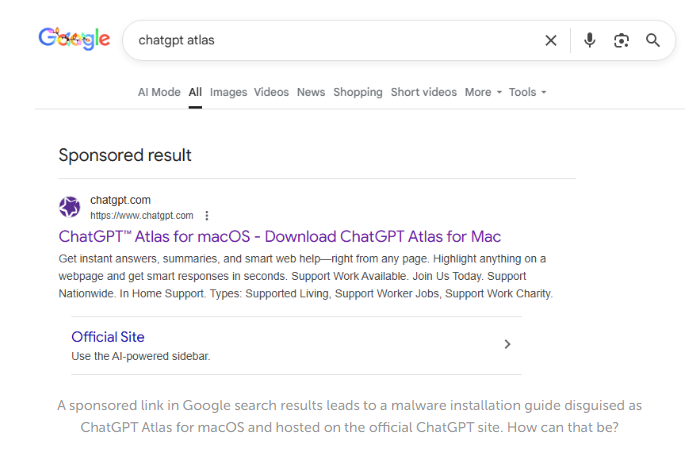
From there, it’s a waiting game for the criminals. They rely on victims to find these AI conversations through search and then faithfully follow the step-by-step instructions.
How to stay safe
These attacks are clever and use legitimate platforms to reach their targets. But there are some precautions you can take.
- First and foremost, and I can’t say this often enough: Don’t click on sponsored search results. We have seen so many cases where sponsored results lead to malware, that we recommend skipping them or make sure you never see them. At best they cost the company you looked for money and at worst you fall prey to imposters.
- If you’re thinking about following a sponsored advertisement, check the advertiser first. Is it the company you’d expect to pay for that ad? Click the three‑dot menu next to the ad, then choose options like “About this ad” or “About this advertiser” to view the verified advertiser name and location.
- Use real-time anti-malware protection, preferably one that includes a web protection component.
- Never run copy-pasted commands from random pages or forums, even if they’re hosted on seemingly legitimate domains, and especially not commands that look like
curl … | bashor similar combinations.
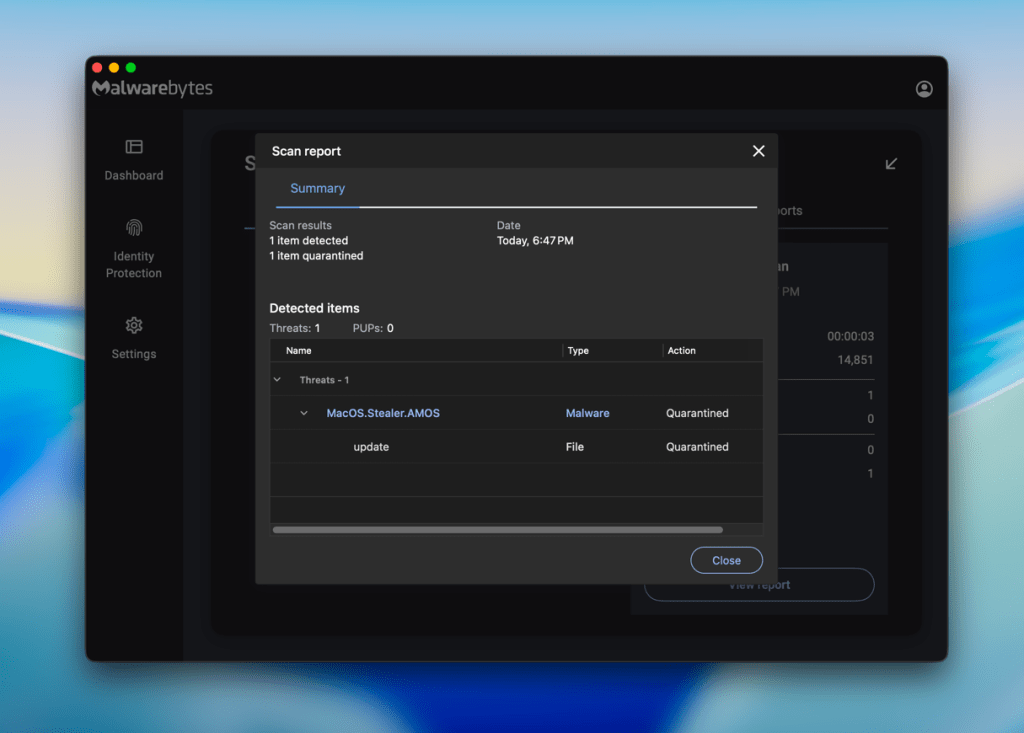
If you’ve scanned your Mac and found the AMOS information stealer:
- Remove any suspicious login items, LaunchAgents, or LaunchDaemons from the Library folders to ensure the malware does not persist after reboot.
- If any signs of persistent backdoor or unusual activity remain, strongly consider a full clean reinstall of macOS to ensure all malware components are eradicated. Only restore files from known clean backups. Do not reuse backups or Time Machine images that may be tainted by the infostealer.
- After reinstalling, check for additional rogue browser extensions, cryptowallet apps, and system modifications.
- Change all the passwords that were stored on the affected system and enable multi-factor authentication (MFA) for your important accounts.
If all this sounds too difficult for you to do yourself, ask someone or a company you trust to help you—our support team is happy to assist you if you have any concerns.
We don’t just report on threats—we remove them
Cybersecurity risks should never spread beyond a headline. Keep threats off your devices by downloading Malwarebytes today.
