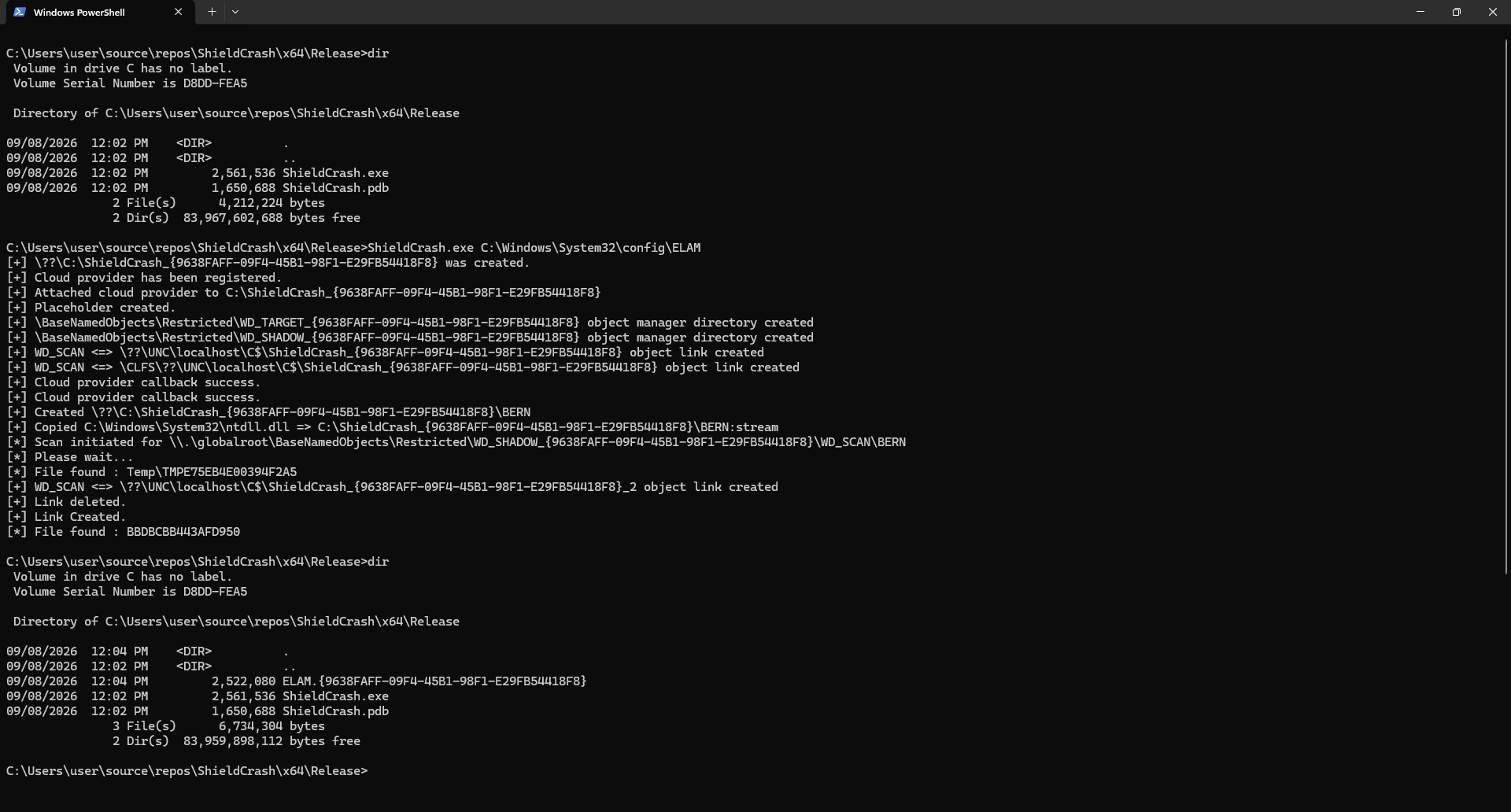
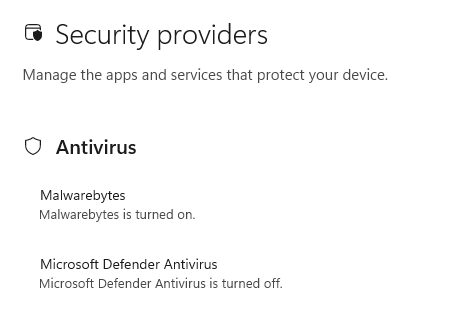
The researcher Chaotic Eclipse released ShieldCrash, a PoC exploit for a Microsoft Defender Zero-Day vulnerability.
Security researcher Chaotic Eclipse, also known as INFINITE NIGHTMARE, MSNightmare and Nightmare-Eclipse, released a new zero-day exploit targeting Microsoft Defender. The researcher named the exploit ShieldCrash, it triggers an arbitrary file read as SYSTEM.
The researcher claims that Microsoft has not fully fixed the ShieldBreak vulnerability (CVE-2026-69414). According to the researcher, Microsoft closed several ways to exploit the flaw but missed a specific condition that still allows the same attack.
The researcher published a proof of concept (PoC) that can read arbitrary files with SYSTEM privileges, the highest level of access on Windows. He says all supported Windows versions remain vulnerable, even after the September 2026 security updates.
“Microsoft has failed to properly patch ShieldBreak CVE-2026-69414, under specific conditions it is still possible to trigger the exact same problem that was caused by ShieldBreak. While Microsoft fixed several things to prevent re-exploiting the issue, they missed a spot where ShieldBreak can still be exploited.” Chaotic Eclipse wrote. “This PoC demonstrates an arbitrary file read as SYSTEM with September 2026, all supported windows versions are affected.”
The researcher described the PoC as a basic version for now. They may later develop it into a full SYSTEM-level exploit, but for now they published only enough code to show that Microsoft’s patch does not completely block ShieldBreak.
Microsoft recently updated the Malware Protection Engine to fix CVE-2026-69414. Version 1.1.26080.3 includes the fix, which requires no user action and does not affect systems with Microsoft Defender disabled. Microsoft recommends keeping malware definitions and the engine updated automatically.
“Microsoft is aware of an elevation of privilege in the Microsoft Malware Protection Engine in Microsoft Defender publicly referred to as “ShieldBreak ” reads Microsoft’s advisory. “In response to a constantly changing threat landscape, Microsoft frequently updates malware definitions and the Microsoft Malware Protection Engine. In order to be effective in helping protect against new and prevalent threats, antimalware software must be kept up to date with these updates in a timely manner. For enterprise deployments as well as end users, the default configuration in Microsoft antimalware software helps ensure that malware definitions and the Microsoft Malware Protection Engine are kept up to date automatically. Product documentation also recommends that products are configured for automatic updating.”
Last week, Chaotic Eclipse released a new zero-day exploit targeting Nvidia. The researcher named the exploit GreenSection, it triggers a Memory Corruption flaw.
Recently, Chaotic Eclipse released exploits targeting other anti-malware and defense solutions. Chaotic Eclipse released a zero-day exploit targeting Kaspersky Endpoint Security he named HardBreacher, which triggers a privilege escalation flaw. The researcher pointed out that the PoC is unstable and may require repeated attempts, but when successful, it creates a DLL in System32 with full user permissions. The researcher also claims taking control of Kaspersky’s UI process can disrupt the antivirus and interfere with file-access controls, potentially leaving the system in an unstable state.
Nightmare Eclipse says the Kaspersky Endpoint Security zero-day allows privilege escalation on a fully patched Windows 11 25H2 system running Kaspersky Endpoint v14.0.0.504.
The researcher also released a zero-day exploit targeting GenDigital Avast Antivirus, named PrettyPrague. The exploit triggers a privilege escalation flaw.
The researcher claims to have found another zero-day in an antimalware product, this time targeting Avast Antivirus. The PoC exploits a flaw in Avast Sandbox to dump the Windows SAM database and gain a SYSTEM-level shell. It reportedly works even on fully patched Avast Antivirus and Windows 11 25H2. The researcher also suspects the flaw may affect other Gen Digital products, including AVG and Norton.
Finally, Chaotic Eclipse released a new zero-day exploit targeting Crowdstrike Falcon cybersecurity platform. The researcher named the exploit FalconFlank, it triggers a privilege escalation flaw.
According to the researcher, FalconFlank abuses Falcon’s “Microsoft Office file malicious macro removal” feature. The function is part of Falcon’s remediation capabilities and operates with high privileges. The researcher claims that this behavior can be abused to escalate privileges from a low-privileged local user to a more powerful context.
Chaotic Eclipse, also known as Nightmare Eclipse, is a researcher known for publicly releasing PoC exploits for zero-day vulnerabilities, often after criticizing vendors’ handling of vulnerability reports. His releases have mainly targeted Microsoft products, including Windows and Microsoft Defender, with some later exploited in the wild. Among the most notable are the Undefend and RedSun Defender zero-days.
His work has fueled debate over responsible disclosure and the risks of publishing working exploits.
Follow me on Twitter: @securityaffairs and Facebook and Mastodon
Pierluigi Paganini
(SecurityAffairs – hacking, ShieldCrash)

 Entrar