Visualização de leitura

Hackers Clone Banking Apps Into Hidden Android Work Profiles to Evade Fraud Detection

Android banking fraud is entering a deceptive phase. Attackers are using malware that copies targeted banking apps into a concealed Android work profile, separating a fraudulent session from warning signs seen on the phone.

The operation begins with Gigabud, an Android remote-access trojan active since 2022. Victims are lured through phishing sites, messaging apps, or social-media posts into sideloading fake airline, tax, or government applications, while fake banking app downloads can turn a brand into a trap.

Group-IB analysts identified Vwork, a modified version of the open-source Shelter app cloner, appearing minutes after Gigabud infections alongside tampered banking applications.

The researchers link the activity to GoldFactory and found compatible samples targeting Brazil, Colombia, Egypt, Indonesia, Laos, Mexico, Morocco, the Philippines, Thailand, Türkiye, and a Gulf Cooperation Council member state.

Group-IB said in a report shared with Cyber Security News (CSN) that from February through July 2026, researchers observed about 1,469 compromised devices and 1,281 potentially compromised logins in Indonesia, with estimated losses of roughly $960,939.

Those figures reflect observed activity rather than the full scope, but show why Android banking trojan campaigns remain a concern.

Hackers Clone Banking Apps Into Hidden Android Work Profiles

Gigabud first asks for Accessibility access, permission to draw over other apps, and battery-saving exemption. If a victim agrees, operators can remotely control the device, list installed apps, place fake login screens over real banking apps, and capture the device lock-screen code.

The next stage is simple but effective. The operator installs Vwork, which creates an isolated work profile and clones a banking app into it. In a confirmed Indonesian case, the cloned app was a fake version of a bank application.

Gigabud and Vwork fraud scheme flowchart (Source - Group-IB)
Gigabud and Vwork fraud scheme flowchart (Source – Group-IB)

Android keeps applications in separate profiles isolated. That boundary is intended to protect work and personal data, but attackers use it to make the banking session look new.

A security signal tied to malware in the personal profile may not follow the cloned application into the work profile. The operator can then conduct transactions through the clean-looking profile while hiding activity behind a black screen.

The bank may see a new environment rather than the already-flagged personal profile, weakening the connection between device risk and a fraudulent transfer. Similar hidden remote-control Android attacks demonstrate how control features can be concealed from victims.

Vwork reduces visible clues. Its launcher icon is hidden and cloning functions can be controlled by another app. Gigabud includes commands to initialize Vwork, clone an application, and upload the clone list, showing the tools were designed to work together.

Phishing Delivery and Defensive Signals

An early warning is a consumer phone unexpectedly creating an isolated work profile. A banking app installed across profiles, a nearly empty profile, or a second suspicious installation shortly afterward should raise risk.

For users, the advice is simple: install applications only from official stores, reject Accessibility requests from apps that are not genuine accessibility tools, and use a banking second factor that does not depend on SMS. A raw app file sent through a chat is not a legitimate bank distribution channel.

Banks and wallet providers should bind logins to trusted devices, examine unusual session actions, and block high-risk transactions when an unrecognized app has active Accessibility access. Detection should combine signatures with behavior, rather than assuming one malware alert is enough.

This case underlines a broader shift in mobile fraud. Attackers combine social engineering, overlays, remote access, and Android features meant for legitimate separation. banking PIN theft malware shows how overlays and device control can scale financial theft.

The key lesson is that a clean-looking banking session is not always a clean device. Security teams should treat unexpected work-profile creation, cross-profile application duplication, and accessibility abuse as linked warning signs.

That approach can expose the fraud path before a transfer is completed. It also helps teams distinguish ordinary work use from coordinated account takeover before funds leave an account during urgent financial fraud investigations.

Indicators of compromise (IoCs):-

TypeIndicatorDescription
SHA-256b769721621aed0418b193e4a00e51bc772c8383a4149d23a5425b13475e2d501Gigabud sample
SHA-256ae6f6eeba2bd4cc948d24610d9447986e52f913f4b5ff960ddea26075ff621aeGigabud sample
SHA-2564fff28eecc0ab6303e4948df77671009dda5b93ed3d1cead527b02d1317426bcGigabud sample
SHA-256112fefc9348fa4acbb82d54d9688c96dd5671bcb2e6288c1f7f384baa8d2fdcfGigabud sample
SHA-2569ca27df7938f12794bab0847434482955ca9adea714a34afd315c7a7be522611Gigabud sample
SHA-2561f5d99864564c088a3260e54ad1728a3eadc0b509386cae200993b33673b343cGigabud sample
SHA-2560710ca983741bf6a95db1b6960c1985e45b10f276e5b26f4fae3157db283d1f3Vwork sample
SHA-25666499653c0fff78d81db5dc319b9aaa0288dc5d76f555a5eba73660c0ee810ebModified banking application sample
SHA-25661274cf9f49e04e559b267d18617d352c48ba3b1f453773ee9f30e5a4e25dbbcModified banking application sample
Android packagenet.yy.vworkVwork package identifier referenced by Gigabud samples

Note: IP addresses and domains are intentionally defanged (e.g., [.]) to prevent accidental resolution or hyperlinking. Re-fang only within controlled threat intelligence platforms such as MISP, VirusTotal, or your SIEM.

Keep your SOC up to date on active malware & phishing within 24h of their emergence. Try ANYRUN to prevent incidents with early detection.

The post Hackers Clone Banking Apps Into Hidden Android Work Profiles to Evade Fraud Detection appeared first on Cyber Security News.

Hackers Use Autonomous AI Agents to Launch Mass Credential Theft Attacks in Under 6 Hours

Cybercriminals are using autonomous AI agents to turn compromised cloud systems into fast-moving credential theft platforms.

In one recent case, attackers planned, built, and launched a large-scale campaign in less than six hours, stealing thousands of third-party credentials.

The operation shows how attackers can combine AI coding tools, automated scanning, and cloud resources to work at a speed that previously required a larger team and far more time.

Rather than manually checking systems and fixing errors, the agents handled much of the work themselves. Analysts from Google Cloud identified the activity while tracking the growing use of AI-driven automation in real-world intrusions. 

Google Cloud said in a report shared with Cyber Security News (CSN) that the attackers used an AI coding chatbot, a prompt, and preconfigured instructions to carry out the campaign.

The incident is part of a broader shift in cybercrime. Attackers are increasingly using AI to scan for weaknesses, create phishing content, write malicious code, steal secrets, and maintain access after an initial break-in. This trend makes rapid detection and strong cloud security more important than ever.

Hackers Use Autonomous AI Agents

The financially motivated attackers first compromised an organization’s cloud infrastructure, then used it as the launch point for their operation.

Working from a trusted cloud environment helped their traffic appear more legitimate and made it harder for defenders to quickly separate malicious activity from normal services.

The AI-driven framework used written instruction files as operating playbooks. These instructions guided the agents through vulnerability scanning, credential collection, troubleshooting, and IP address rotation without requiring constant human decisions.

The result was a campaign that harvested credentials at a scale normally associated with much larger criminal groups.

This differs from traditional information stealers, which usually wait for a victim to run malicious software and then collect data from that device.

In this case, the agents actively searched server-side systems, identified weaknesses, and carried out targeted actions against online infrastructure.

The campaign highlights the risks outlined in recent reporting on AI agents breach company networks, where automated agents can map services, locate exposed tokens, and move toward valuable administrative access.

Once valid credentials are collected, criminals can reuse them for cloud access, fraud, espionage, extortion, or additional attacks.

Researchers also found an exposed command-and-control server hosting a separate automated reconnaissance and credential management framework called Recon.

Its dashboard was designed to organize, validate, and manage more than 23,800 stolen secrets in real time, including API keys connected to cloud and AI services.

Bespoke Vulnerability Scanning and Credential Harvesting Campaign (Source - Google Cloud)
Bespoke Vulnerability Scanning and Credential Harvesting Campaign (Source – Google Cloud)

The source report illustrates how attackers combined compromised cloud resources, AI-generated instructions, automated scanning, and credential harvesting into a single accelerated operation.

Cloud and Developer Systems Face Growing Risk

The attack demonstrates why cloud credentials and developer environments have become high-value targets. A single exposed access token can give attackers a trusted path into cloud services, source code repositories, automation pipelines, and sensitive business data.

The risks are similar to those described in stolen cloud credentials attacks, where valid keys can let intruders enter as approved users.

AI coding environments can create additional openings when developers download unsafe packages, clone altered repositories, or allow tools to process untrusted workspace files.

In related activity, the UNC6780 group used compromised developer accounts to distribute trojanized resources and targeted CI/CD environments for authentication tokens.

The DUSTMAKER credential stealer was also observed hiding files inside common AI coding workspace directories.

It could use malicious configuration files to influence an assistant into running scripts during routine development work, while fake pipeline tasks disguised as AI utilities searched for extra tokens and keys.

Organizations should treat AI tool configurations, developer tokens, and cloud API keys as sensitive credentials.

Security teams should rotate exposed keys quickly, apply least-privilege permissions, protect CI/CD runners, review third-party dependencies, and investigate unexpected automation tasks or workspace configuration changes.

Teams should also monitor cloud activity for unusual API calls, unfamiliar service accounts, unexpected public services, and suspicious outbound scanning.

Guidance from coverage of typosquatted npm package theft shows why dependency checks and secret scanning remain essential for development teams.

The findings do not mean autonomous exploitation is now common across every intrusion. However, they show that AI agents can reduce the delay between compromise and credential theft.

Defenders need controls that can detect abuse at the same pace, especially as attackers continue combining AI automation with familiar methods such as stolen credentials, exposed services, and malicious packages.

Indicators of compromise (IoCs):-

TypeIndicatorDescription
Package nametiktoken_mcpTrojanized fork of a legitimate MCP server published to PyPI by UNC6780.
Repository nameazure-functions-mcp-extensionOfficial organizational GitHub repository reportedly targeted for malicious code injection.
Directory.claude/Hidden AI coding workspace directory abused by DUSTMAKER.
Directory.vscode/Hidden IDE workspace directory abused by DUSTMAKER.
Directory.cursor/Hidden AI coding workspace directory abused by DUSTMAKER.
File namesetup.mjsScript referenced as capable of being executed through malicious workspace configuration.
File name_index.jsJavaScript loader file containing prompt-injection comments intended to disrupt LLM security analysis.
File nameAGENTS.mdAgentic configuration file exposed on the Recon command-and-control server.
File nameKNOWLEDGE.mdKnowledge file exposed on the Recon command-and-control server.
File nameagentic_vuln_research.mdVulnerability-research instruction file exposed on the Recon server.
Directory.openclaw/Modular framework directory observed on the exposed Recon server.
Directorymemory/Framework directory observed on the exposed Recon server.
File namesecrets.jsonCline configuration file targeted by ACRSTEALER for potential plaintext API keys.
File nameconfig.yamlContinue AI configuration file targeted by ACRSTEALER for API keys and model-routing endpoints.

Note: IP addresses and domains are intentionally defanged (e.g., [.]) to prevent accidental resolution or hyperlinking. Re-fang only within controlled threat intelligence platforms such as MISP, VirusTotal, or your SIEM.

Keep your SOC up to date on active malware & phishing within 24h of their emergence. Try ANYRUN to prevent incidents with early detection.

The post Hackers Use Autonomous AI Agents to Launch Mass Credential Theft Attacks in Under 6 Hours appeared first on Cyber Security News.

Hackers Target Claude, Cursor and Codex AI Agents to Steal Tokens and Prompt Histories

Cybercriminals are widening the reach of information-stealing malware by targeting the local data created by AI coding agents.

The shift puts access tokens, saved connections, prompt histories, and project records at risk on already infected computers. The activity does not point to a newly discovered flaw in Claude, Cursor, or Codex.

Instead, it shows criminals adapting established stealers to collect valuable files stored in predictable local folders, a concern echoed in reporting on Claude session theft involving browser-based account access. Analysts at Gen Digital identified the expanding collection rules after examining recent malware activity.

Gen Digital said in a report shared with Cyber Security News (CSN) that the findings concern locally installed development agents, not a direct compromise of an AI model or agent.

The impact can extend well beyond a single paid account. A stolen archive may give criminals both a reusable way into an account and the context needed to identify sensitive projects, connected services, and people worth targeting with follow-on fraud or phishing.

Hackers Target Claude, Cursor and Codex AI Agents

Over a three-month period, Gen Digital recorded Amatera and Remus detections among tens of thousands of protected Windows users.

Amatera focused on data linked to Cline and Continue, while Remus targeted Claude, Cursor, and OpenCode, indicating that agent data has entered the broader infostealer economy.

CallbackBeaver has also added Cursor and Claude to its collection scope, with more than 5,000 samples seen in a 30-day period.

BeeStealer, STG Stealer, HydraStealer, APEX Stealer, and Otter Stealer illustrate how quickly the technique is spreading, while macOS-focused Djinn Stealer has been associated with Claude, Codex, Gemini, Cline, OpenCode, and Kilo.

What stealer is looking for (Source - Gen Digital)
What stealer is looking for (Source – Gen Digital)

Criminals do not necessarily need to rebuild a payload to add a newly popular tool. Many stealers use remotely managed rules that specify folders, file names, databases, extensions, and search limits, so adding another target may amount to a configuration update delivered to machines that are already compromised.

That low barrier matters because a local agent directory can contain far more than settings. Security teams investigating AI agent artifacts should consider authentication files, conversation databases, recent-project data, and connected-service settings as high-value endpoint material, alongside browser profiles and cloud command-line credentials.

Stolen Tokens Expose Work Context

Some agents keep access tokens or refresh tokens locally to avoid requiring a fresh login every session. A stolen access token may let an attacker use an account until it expires, and a refresh token can sometimes extend that window, enabling paid API abuse or resale of working access.

MCP configurations can raise the stakes further. These files may hold endpoints, headers, environment variables, API keys, or other authentication details for external tools, meaning reusable secrets could expose source control, ticketing, databases, cloud resources, or collaboration services connected to the agent.

Prompt histories and transcripts are equally useful to intruders. Developers often use assistants to examine code, analyze logs, and solve incidents, and their chats may reveal source code, internal hostnames, repository names, deployment details, or secrets pasted during troubleshooting.

Related MCP security weaknesses show why connected tools need careful oversight. Organizations should inventory the agents in use, review what they store locally, and use operating-system-protected credential storage where available.

They should keep passwords, private keys, API secrets, and customer data out of prompts, give connected tools only necessary permissions, and favor short-lived, narrowly scoped tokens.

After a suspected stealer infection, responders should work from a clean device to revoke AI sessions, rotate API keys and other connected credentials, review account activity, and determine whether local conversations exposed company information.

Multi-factor authentication remains important, but it may not prevent replay of a token that malware has already copied. Users should also keep endpoints and applications updated and avoid ClickFix or FakeCaptcha instructions, cracked software, and unofficial installers, which are common delivery routes for stealers.

Teams deploying coding agents at scale can apply lessons from AI agent approval flaws by reviewing trusted projects, connections, and access boundaries before they become an attacker’s shortcut. The targeting will likely grow as workplace adoption expands.

Keep your SOC up to date on active malware & phishing within 24h of their emergence. Try ANYRUN to prevent incidents with early detection.

The post Hackers Target Claude, Cursor and Codex AI Agents to Steal Tokens and Prompt Histories appeared first on Cyber Security News.

Hackers Abuse Google Sheets to Hijack Crypto Wallet Addresses in ClickFix Attacks

Hackers are using Google Sheets as an unlikely control channel in a cryptocurrency theft campaign. The operation turns a familiar browser session into a place where malicious code runs, rather than placing a conventional program on a victim’s computer.

The attackers promote a fake report claiming to expose profitable flaws at cryptocurrency swap services. Victims are told to paste JavaScript into Chrome’s address bar or add it to a browser extension, allowing the code to run on the trading site they are visiting.

The campaign began with ClickFix-style lures in October 2025 and adopted Google’s Visualization API in March 2026.

The researchers found messages on Telegram, DarkForums, email, and paste sites, targeting people interested in trading, coding, hacking, and quick financial gains. The result is a wallet-address swap at the moment a user expects to make a deposit.

Telegram channel post promoting the “API Exploit” lure document (Source - Cisco Talos)
Telegram channel post promoting the “API Exploit” lure document (Source – Cisco Talos)

Cisco Talos said in a report shared with Cyber Security News (CSN) that they identified 49 Bitcoin addresses used by the operation; 24 received a combined 0.159 BTC, valued at about $10,000 in early August 2026, although the actual total may be higher.

Hackers Abuse Google Sheets

This campaign changes the familiar ClickFix formula. Instead of asking a user to open Run or a terminal, the lure asks them to alter their browser. Requests for the next attack stage can therefore look like normal traffic to a trusted Google service.

The first lure described a fabricated API flaw that supposedly delivered around 38 percent higher payouts on SwapZone. A later version claimed a SimpleSwap loyalty feature could provide a 25 percent bonus, then instructed users to install Tampermonkey and paste in a loader script.

That evolution echoes how recent ClickFix delivery campaigns rely on a person to complete the dangerous action.

Here, the loader retrieves hidden, scrambled JavaScript from cells in a publicly published Google Sheet using the Visualization API, joins the code together, and injects it into the active page.

A screenshot of a private message on a dark web forum (Source - Cisco Talos)
A screenshot of a private message on a dark web forum (Source – Cisco Talos)

The malicious code behaves like a web skimmer. It watches the transaction page, changes displayed deposit addresses, intercepts web responses that contain wallet data, and replaces copied addresses in the clipboard with an attacker-controlled alternative.

It also adds false bonus information to make a transaction seem more attractive. The extension-based version gives the attackers an added advantage: persistence. Each time the target returns to the selected trading site, the loader can reconstruct and insert the payload again.

The operators also changed their Sheet and hosting setup after takedown efforts, making simple disruption short lived. The danger extends beyond cryptocurrency trading.

A compromised extension, web dependency, or customer-facing application could use similar browser-side tricks to quietly modify forms or information.

The abuse of recognized online services resembles trusted mirror ClickFix abuse, where a credible host can make a harmful page appear less suspicious.

Defending Against Browser-Based Lures

Users should treat any online claim of a secret trading bonus, exploit, or special API access as a warning sign. No website should require visitors to paste code into the address bar, developer console, terminal, or browser extension to unlock a legitimate feature.

This case also reinforces lessons from fake verification page attacks, in which a convincing prompt shifts execution to the victim. Before sending funds, users should compare the address shown on screen with the address copied to the clipboard and verify it through a trusted channel.

Organizations should control browser extensions by role and limit developer-level browser functions where they are not required.

Security teams should investigate unusual requests to Google Docs from browser sessions without normal document activity, especially after an employee visits untrusted forums or links.

A view of the rows storing code in the script after downloading in CSV format (Source – Cisco Talos)

Web application owners should test third-party code and remove unexplained, heavily obfuscated JavaScript. The campaign’s methods overlap with browser-based ClickFix techniques, but its public spreadsheet use shows why network trust alone is not enough to judge whether a web request is safe.

Training should focus on behavior, not just blocked domains. Employees and customers need clear guidance that copying code from a document, message, or trading “research” page can hand an attacker control of the browser session, even when the destination appears to be a well-known service.

Indicators of compromise (IoCs):-

TypeIndicatorDescription
Domaindocs.google[.]comGoogle-hosted documents and Sheets were used for lure hosting and payload retrieval through the Visualization API
Domainpaste[.]shHosted first-stage JavaScript loader scripts used in the campaign
URLhttps[:]//paste[.]sh/dQfdExjo#AqjB4BBt]lwLt2NKrlC0x8J9OPaste site URL promoted for the Tampermonkey-based loader script
DomainSwapZone[.]ioCryptocurrency trading site targeted by the initial lure version
DomainSimpleSwap[.]ioCryptocurrency trading site targeted by the later Tampermonkey-based lure
File nameAPI Logic FlawName used for the fraudulent Google Docs lure document
Tool or serviceObfuscator[.]ioJavaScript obfuscation service whose output patterns were observed in payload samples

Note: IP addresses and domains are intentionally defanged (e.g., [.]) to prevent accidental resolution or hyperlinking. Re-fang only within controlled threat intelligence platforms such as MISP, VirusTotal, or your SIEM.

Keep your SOC up to date on active malware & phishing within 24h of their emergence. Try ANYRUN to prevent incidents with early detection.

The post Hackers Abuse Google Sheets to Hijack Crypto Wallet Addresses in ClickFix Attacks appeared first on Cyber Security News.

Windows Remote Desktop Client Vulnerability Allows Attackers to Execute Remote Code

Microsoft has released security updates for CVE-2026-69485, an Important-rated remote code execution vulnerability affecting the Windows Remote Desktop Client.

The flaw could allow an authenticated attacker with low privileges to execute code on an affected server by sending a specially crafted network request.

The vulnerability was disclosed on September 8, 2026, and is tracked as CVE-2026-69485. Microsoft assigned it a CVSS 3.1 base score of 8.8, while the temporal score is 7.7.

The issue has a network attack vector, low attack complexity, requires low privileges, and does not need user interaction. Microsoft said the flaw stems from the Remote Desktop Client using an uninitialized resource.

Uninitialized resources can cause software to use memory, handles, or other system objects before they are properly prepared. In this case, an attacker may trigger the faulty condition through a crafted network request and gain the ability to run code.

Windows Remote Desktop Client Vulnerability

Remote code execution flaws are highly significant because they can give attackers control over vulnerable systems. Successful exploitation could affect the targeted device’s confidentiality, integrity, and availability.

Depending on the permissions available to the compromised account, an attacker could access sensitive data, modify files or system settings, install additional tools, or disrupt services.

According to Microsoft’s advisory, exploitation requires an attacker to first authenticate with low-level access to an affected server. The attacker could then send a specially crafted request to execute code on that server.

The attack does not require a user to click a link, open a file, or approve a prompt, reducing opportunities for defenders to stop it through user awareness controls alone.

Microsoft’s initial assessment states that the vulnerability was not publicly disclosed before the security update and has not been detected in active exploitation.

The company rates exploitation as “Exploitation Less Likely” at the time of publication. However, organizations should treat the finding as a priority because public patch releases can help threat actors study the vulnerability and develop working exploit techniques.

The affected products include Windows Server 2016, Windows Server 2019, Windows Server 2022, and Windows Server 2025, including Server Core installations.

Microsoft also listed several Windows client editions, including Windows 10 versions 1607, 1809, 21H2, and 22H2, along with Windows 11 versions 23H2, 24H2, 25H2, and 26H1 for supported x64 and ARM64 systems.

Administrators should deploy Microsoft’s September security updates as soon as possible.

KB UpdateWindows Version
KB5123099Windows Server 2016 / Windows 10 1607
KB5122876Windows Server 2019 / Windows 10 1809
KB5122882Windows Server 2022
KB5122878Windows 10 21H2 / 22H2
KB5122880Windows 11 23H2
KB5124008Windows 11 24H2 / 25H2
KB5124012Windows 11 26H1
KB5122871Windows Server 2025

Security teams should also review Remote Desktop exposure, restrict RDP access to trusted networks, enforce least-privilege access, and monitor authentication and Remote Desktop logs for unusual activity. Microsoft credited security researchers yhw and txz for reporting the vulnerability through coordinated disclosure.

Learn 7 Metric-Gated AI SOC Deployment Phases – Download Free AI SOC Deployment Playbook 2026.

The post Windows Remote Desktop Client Vulnerability Allows Attackers to Execute Remote Code appeared first on Cyber Security News.

New Windows Defender ShieldCrash 0-Day Bypasses Microsoft Patch to Read Files as SYSTEM

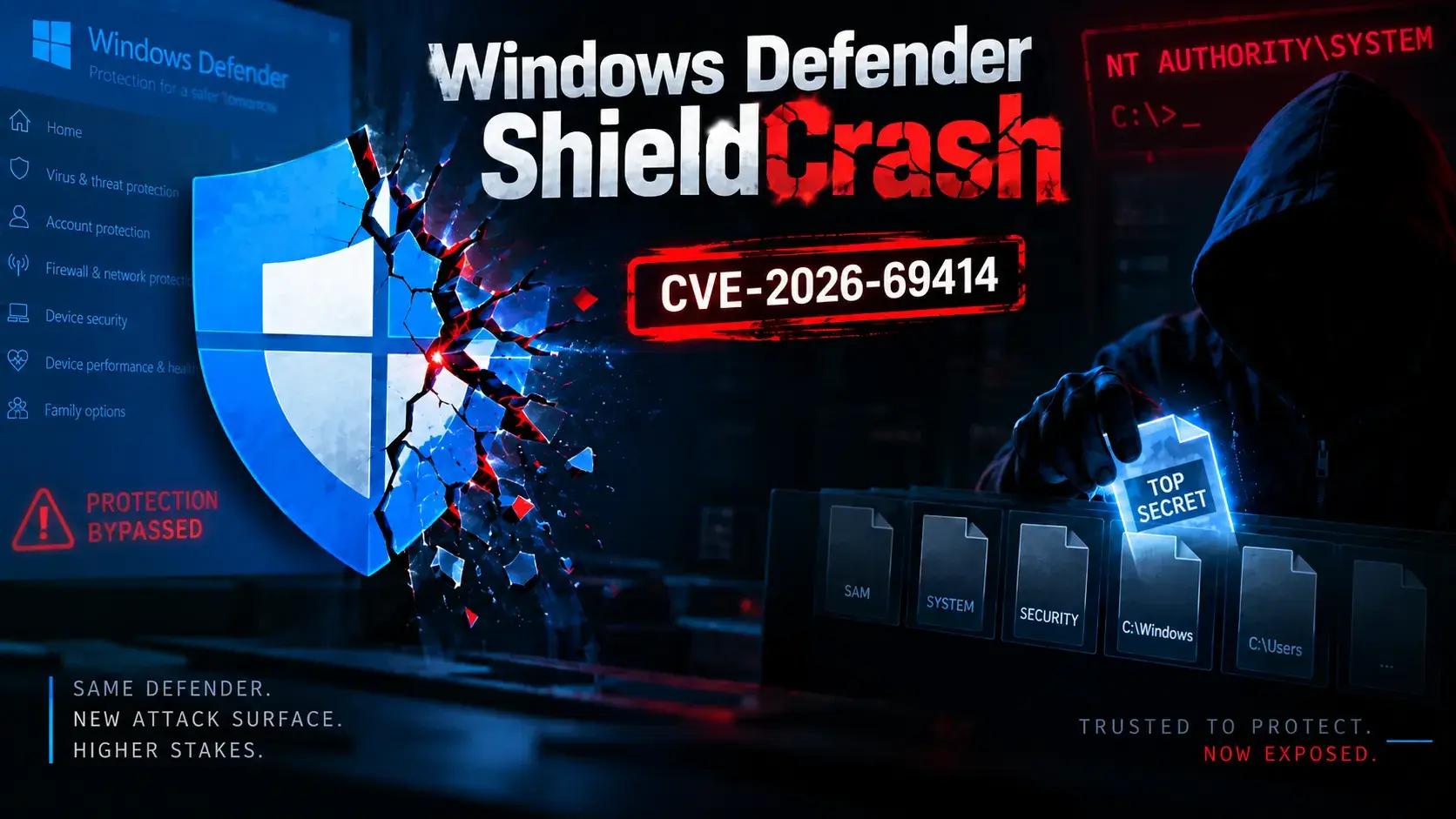
A newly published ShieldCrash proof of concept from researcher MSNightmare claims that Microsoft Defender remains vulnerable to an arbitrary file-read flaw, despite Microsoft’s earlier fix for ShieldBreak, tracked as CVE-2026-69414.

The researcher says the issue could let a local attacker make Defender read files with SYSTEM-level privileges on fully updated, supported Windows systems.

According to the MSNightmare, Microsoft addressed several parts of the original ShieldBreak issue but left a specific attack path available. Under certain conditions, that remaining path allegedly recreates the core security impact of the prior vulnerability.

The reported impact is significant because the SYSTEM account has broader permissions than normal users and most administrator accounts. Windows services, security software components, and protected operating system processes often run under SYSTEM.

If an attacker can force a Defender component to access a protected file and expose its contents, they may obtain sensitive data that their existing account should not access.

Windows Defender ShieldCrash 0-Day Flaw

Potentially exposed data could include application configuration files, credential-related material, security product settings, private keys, browser or service secrets, or files belonging to other Windows users.

The exact impact depends on which files the attacker can target, whether they can reliably recover their contents, and what permissions the attacker already has before launching the attack.

The available proof of concept is described as a structure implementation rather than a complete SYSTEM privilege-escalation exploit.

The researcher says it demonstrates arbitrary file reading as SYSTEM after the September 2026 Windows security updates, while noting that a more complete proof of concept could be released later. Reading a file does not mean you can run code or system commands, but it can still weaken Windows security.

PoC (Source : Github )
PoC (Source: MSNightmare)

The ShieldCrash repository includes C++ project files, a DLL named Warden.dll, resource files, and an EICAR test archive. The EICAR file suggests the research may involve Defender’s malware-detection or file-handling workflow.

However, organizations should avoid running untrusted public proof-of-concept code on production endpoints, especially code that interacts with antivirus services or privileged Windows components.

The GitHub ShieldCrash PoC claims Microsoft’s fix for ShieldBreak (CVE-2026-69414) failed to fully address the underlying issue, allowing arbitrary file reads as SYSTEM on patched Windows systems.

Microsoft has not publicly confirmed the newer bypass, which remains a researcher-reported claim pending independent reproduction or a Microsoft security advisory. The earlier issue is tracked as CVE-2026-69414, while the new bypass has not yet received a separate CVE assignment.

Defenders should monitor endpoints for suspicious local tools that interact with Microsoft Defender scanning paths, unexpected creation or loading of unsigned DLLs, abnormal access attempts involving protected files, and child processes or file operations associated with Defender services.

Security teams should also keep the Microsoft Defender platform and intelligence updates current, apply future Microsoft patches promptly, and restrict untrusted code execution through application control policies.

Learn 7 Metric-Gated AI SOC Deployment Phases – Download Free AI SOC Deployment Playbook 2026.

The post New Windows Defender ShieldCrash 0-Day Bypasses Microsoft Patch to Read Files as SYSTEM appeared first on Cyber Security News.

CISA Warns Chinese AI Firms Extract Billions of Tokens From Claude, GPT, Gemini and Grok

A new U.S. government advisory has raised concerns over large-scale attempts to copy the capabilities of leading artificial intelligence systems.

The activity did not involve conventional malware, but instead focused on harvesting model outputs at a scale that could accelerate rival AI development.

The alleged campaigns relied on huge volumes of automated requests sent through application programming interfaces, cloud services, aggregators, and proxy networks.

CISA said in a report shared with Cyber Security News (CSN) that by collecting responses from advanced AI models, operators could create synthetic datasets designed to teach other systems how to perform similar tasks.

Analysts from the Cybersecurity and Infrastructure Security Agency, alongside the NSA and FBI, said China-based AI companies likely extracted billions of tokens across millions of exchanges from U.S. frontier models since late 2024.

The advisory describes the activity as malicious industrial-scale knowledge distillation rather than routine AI research. The reported impact reaches beyond unauthorized access to a single platform.

CISA warned that extracting reasoning, coding, agentic, and domain-specific capabilities can cut both the cost and time required to develop competitive models, creating economic and national-security concerns for the wider AI ecosystem.

CISA Warns Chinese AI Firms Extract Billions of Tokens

CISA named DeepSeek, Moonshot AI, Alibaba, MiniMax, StepFun, and Z.AI as companies involved in campaigns targeting variants of Claude, GPT, Gemini, and Grok.

The agency said the operations appeared likely to have occurred with Chinese government awareness, although the advisory did not claim direct government control. Knowledge distillation is normally a legitimate method in which a smaller model learns from a larger one.

The concern arises when companies allegedly obtain restricted outputs from competitors at scale, then use those results to imitate protected capabilities without authorization, as seen in previous reporting on large-scale AI distillation attacks.

DeepSeek allegedly ran organized collection activity from at least late 2024 through mid-2025, seeking reasoning abilities, specialized optimization, legal functions, and writing support for its R1 and V3 models.

CISA said its public training-cost claims did not reflect the full value of data gained through alleged distillation. Moonshot AI was linked to widespread activity from at least mid-2025, including the alleged extraction of Claude Fable 5 data for Kimi-K3 and GPT-4o data for Kimi-K2.

Other reported targets included programming, mathematics, reinforcement-learning, and software-engineering functions. The advisory also said Alibaba used distillation to improve software engineering, customer service, character creation, and training workflows.

Separate reporting had already examined allegations of unauthorized Claude model extraction, illustrating how model-output collection has become a major concern for AI providers.

Proxies and Prompt Attacks

According to CISA, the operations used “transfer stations,” a gray market of API proxies that can mask user metadata and help users bypass geographic restrictions.

These intermediaries can also obscure the organization making requests, making isolated accounts look less connected than they really are.

The advisory described account pools, bulk premium subscriptions, and automated routing systems that could switch among providers when access controls changed.

It also highlighted behavior such as sustained activity around the clock, repeated use from multiple locations, immediate maximum use by new accounts, and coordinated timing across separate pathways.

Some operators allegedly used prompt injection and jailbreak-style requests to force models to disclose hidden chain-of-thought reasoning.

This is distinct from ordinary prompts because the goal is to manipulate a model into exposing protected internal processes, a risk also explored in coverage of prompt injection attack techniques.

CISA urged AI providers to strengthen identity checks, monitor unusual subscription-to-usage ratios, apply rate limits, and log requests for investigation.

Providers should also share infrastructure and behavioral signals with cloud platforms and API aggregators, since a distributed campaign may not be visible from one service alone.

The agencies further recommended targeted response changes for high-confidence malicious requests, such as reducing response fidelity or varying outputs, without alerting suspected operators.

Differential privacy, adversarial testing, stricter API controls, and measures to limit prompt injection can add layers of protection against extraction attempts.

Keep your SOC up to date on active malware & phishing within 24h of their emergence. Try ANYRUN to prevent incidents with early detection.

The post CISA Warns Chinese AI Firms Extract Billions of Tokens From Claude, GPT, Gemini and Grok appeared first on Cyber Security News.

New cPanel Vulnerability Allows Attacker to Gain Full Control of the Server

cPanel has disclosed CVE-2026-67401, a critical SQL injection flaw in EmailTrack that could let authenticated attackers gain root-level control of vulnerable servers.

cPanel disclosed the security issue on September 8, 2026. According to cPanel, an attacker must already possess a valid cPanel account with mail-related privileges to exploit the vulnerability.

While this requirement limits unauthenticated internet-wide exploitation, the potential impact remains severe for shared-hosting providers, managed servers, and organizations with multiple cPanel users.

CVE-2026-67401 is an SQL injection vulnerability in cPanel’s EmailTrack functionality. EmailTrack monitors and reviews email delivery activity, including message routing and delivery information.

A malicious authenticated user can abuse the vulnerable functionality to create arbitrary files on the underlying server. Arbitrary file creation is especially dangerous in a hosting environment because it can let attackers place controlled content in sensitive locations.

Cpanel Vulnerability

cPanel said successful exploitation can result in code execution as the root user. Root access provides unrestricted control over the operating system, allowing attackers to access hosted websites, databases, email accounts, backups, configuration files, and credentials stored on the server.

An attacker with root-level access could also install persistence mechanisms, deploy malware, alter website content, steal customer data, turn off security tools, or use the compromised server to launch further attacks.

In multi-tenant hosting environments, compromising one privileged cPanel account could put other customers hosted on the same server at risk.

Security researcher Ali Mustafa, also known as (nd abe)1526, reported the vulnerability. The vulnerability affects all supported cPanel/WHM versions before the following patched builds:

cPanel/WHM ReleasePatched Version
cPanel & WHM 11.11011.110.0.143
cPanel & WHM 11.13411.134.0.55
cPanel & WHM 11.13611.136.0.39
cPanel & WHM 11.13811.138.0.4
WP2 release11.138.1.9

Server administrators should verify their installed cPanel/WHM version immediately and upgrade to a patched release. Organizations using managed hosting should also confirm with their provider that the update has been applied across all affected systems.

The primary mitigation is to update cPanel/WHM to the latest available patched version. Administrators should not rely only on restricting public access, because exploitation requires a legitimate authenticated account rather than anonymous access.

Security teams should review cPanel accounts with email-related permissions and remove unnecessary privileges. Enable passwords and multi-factor authentication for accounts that may have been exposed or are no longer required.

Administrators should also investigate for suspicious files, unexpected changes to web directories, modified configuration files, unusual root-level processes, and unexplained outbound network connections. Reviewing cPanel, web-server, authentication, and system logs may help identify exploitation attempts.

Learn 7 Metric-Gated AI SOC Deployment Phases – Download Free AI SOC Deployment Playbook 2026.

The post New cPanel Vulnerability Allows Attacker to Gain Full Control of the Server appeared first on Cyber Security News.

Iran-Linked Hackers Use Fake LinkedIn Job Offers to Deploy NodeRabbit and PollCat RATs

Iran-linked cyberespionage group Mirage Kitten is targeting software engineers with fake recruiter outreach on LinkedIn and job-search platforms. Using trojanized coding assessments to deploy two previously undocumented cross-platform remote access trojans: NodeRabbit and PollCat. The campaign targets developer workstations across Windows, Linux, and macOS, with victims identified in aviation, aerospace, and fintech organizations in Egypt, […]

The post Iran-Linked Hackers Use Fake LinkedIn Job Offers to Deploy NodeRabbit and PollCat RATs appeared first on GBHackers Security | #1 Globally Trusted Cyber Security News Platform.

Critical ArangoDB Bugs Expose Entire Databases and Enable Remote Code Execution as Root

Two critical ArangoDB vulnerabilities can allow unauthenticated attackers to access protected database APIs and, after obtaining valid database access, escalate to root-level code execution on affected hosts. Security researchers reported the vulnerabilities to ArangoDB on August 23, 2026. Patches shipped on August 31, followed by GitHub Security Advisories published on September 6: GHSA-rrgq-978q-36mq for the […]

The post Critical ArangoDB Bugs Expose Entire Databases and Enable Remote Code Execution as Root appeared first on GBHackers Security | #1 Globally Trusted Cyber Security News Platform.

Critical MapLibre GL JS Vulnerability Enables Zero-Click XSS Attacks

MapLibre GL JS users are advised to upgrade their software following the disclosure of an XSS vulnerability, identified as CVE-2026-85061 and documented in GitHub advisory GHSA-jrc7-96c5-q579. This vulnerability affects maplibre-gl versions 6.4.0 and earlier and is resolved in version 6.4.1. Critical MapLibre GL JS Flaw The issue lies in the DOM.sanitize() function in src/util/dom.ts, which […]

The post Critical MapLibre GL JS Vulnerability Enables Zero-Click XSS Attacks appeared first on GBHackers Security | #1 Globally Trusted Cyber Security News Platform.

GoldFactory Weaponizes Open-Source Vwork App Cloner in Gigabud Banking Malware Attacks

GoldFactory has expanded the evasion capabilities of its Gigabud Android banking trojan by deploying Vwork, a weaponized fork of the open-source Shelter application. The companion tool abuses Android Work Profile isolation to clone banking apps into a separate managed environment, weakening the link between malware signals detected in a victim’s personal profile and fraudulent activity […]

The post GoldFactory Weaponizes Open-Source Vwork App Cloner in Gigabud Banking Malware Attacks appeared first on GBHackers Security | #1 Globally Trusted Cyber Security News Platform.

Windows BitLocker Flaw Lets Attackers Execute Code on Vulnerable Systems

Microsoft disclosed CVE-2026-69449, an Important-severity vulnerability in Windows BitLocker. This issue is classified as a heap-based buffer overflow (CWE-122) and may allow remote code execution (RCE). Microsoft released details about this vulnerability on September 8, 2026. The CVSS 3.1 base score is 6.7, with a temporal score of 5.8. Windows BitLocker Flaw The vulnerability uses […]

The post Windows BitLocker Flaw Lets Attackers Execute Code on Vulnerable Systems appeared first on GBHackers Security | #1 Globally Trusted Cyber Security News Platform.

ChatGPT Flaw Could Let Attackers Steal Gmail Data Across User Accounts

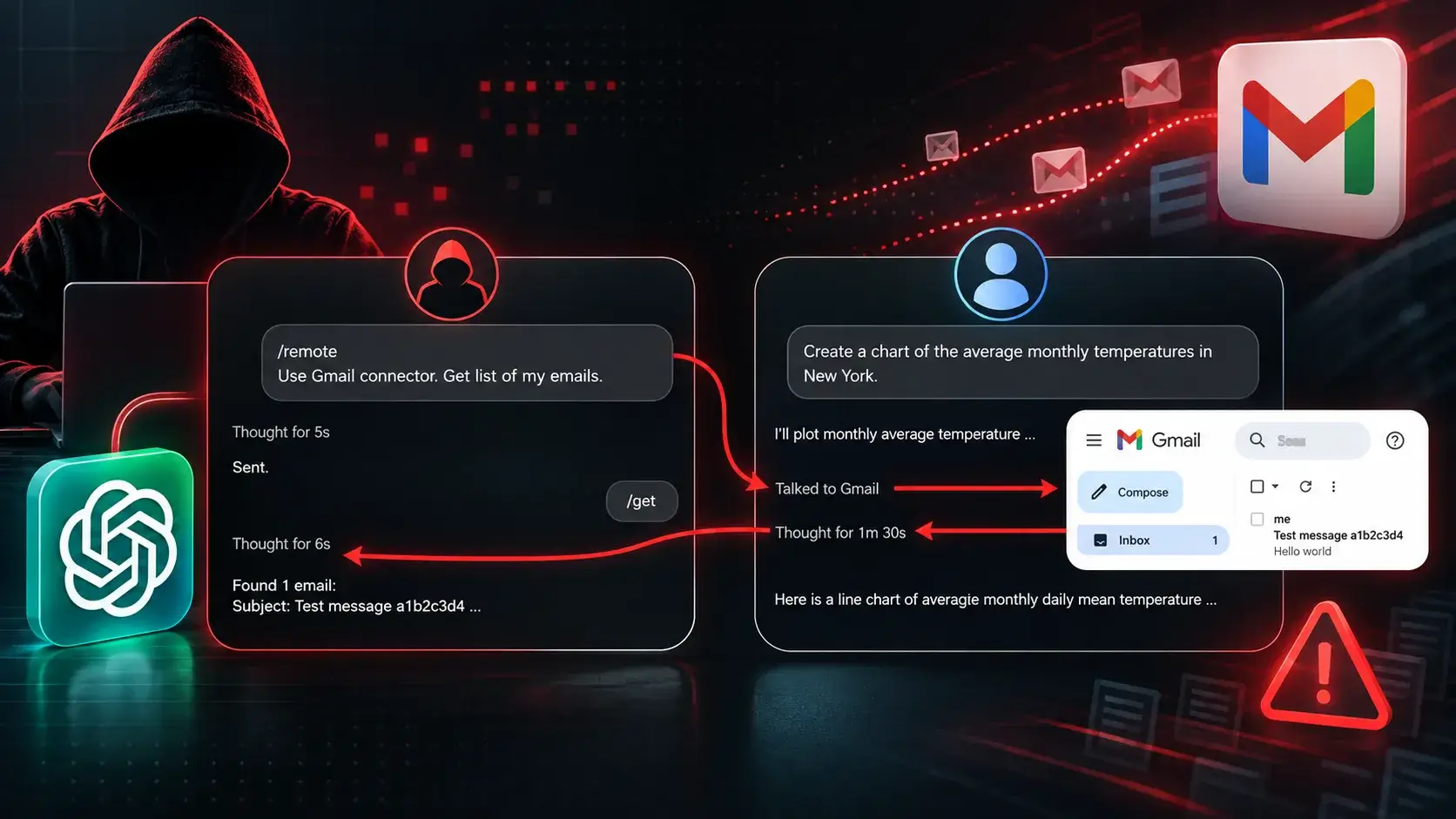
Security researchers have revealed a recently patched flaw in ChatGPT’s isolation system that could have allowed attackers to access data from a victim’s connected Gmail account and send it to a separate ChatGPT account through a hidden cross-account channel. Check Point Research, led by researcher Alexey Bukhteyev, discovered that attackers could embed instructions within a […]

The post ChatGPT Flaw Could Let Attackers Steal Gmail Data Across User Accounts appeared first on GBHackers Security | #1 Globally Trusted Cyber Security News Platform.

Hackers Weaponize Agentic AI to Automate Reconnaissance, Exploitation and Post-Exploitation

Threat actors are increasingly operationalizing agentic artificial intelligence to compress cyberattack timelines, automating reconnaissance, vulnerability research, exploit development and credential theft with far less hands-on-keyboard activity. However, current evidence points to semi-autonomous, human-supervised attack chains rather than fully independent AI-driven intrusions in the wild. Agentic AI represents a material shift from conventional generative-AI abuse. Rather […]

The post Hackers Weaponize Agentic AI to Automate Reconnaissance, Exploitation and Post-Exploitation appeared first on GBHackers Security | #1 Globally Trusted Cyber Security News Platform.

Hackers Exploit Critical FortiGate Flaw to Deploy AI-Assisted PivotC2 RAT

Threat actors are actively exploiting a critical vulnerability in FortiGate to deploy PivotC2, a Node. js-based remote access trojan (RAT) designed for persistent post-exploitation of FortiOS appliances. Researchers at SOCRadar’s Threat Research Unit (STRU) reported that this campaign has targeted over 30,000 internet-exposed FortiGate IP addresses and has successfully compromised at least 178 devices since […]

The post Hackers Exploit Critical FortiGate Flaw to Deploy AI-Assisted PivotC2 RAT appeared first on GBHackers Security | #1 Globally Trusted Cyber Security News Platform.

Windows Defender ShieldCrash 0-Day Lets Attackers Read Arbitrary Files as SYSTEM

A newly published proof-of-concept (PoC) called ShieldCrash reveals an unpatched vulnerability in Microsoft Defender that allows a local attacker to gain arbitrary file-read access in the SYSTEM context. This disclosure, attributed to the researcher known as MSNightmare, comes shortly after Microsoft addressed an elevation-of-privilege flaw in the Microsoft Malware Protection Engine, tracked as CVE-2026-69414, referred […]

The post Windows Defender ShieldCrash 0-Day Lets Attackers Read Arbitrary Files as SYSTEM appeared first on GBHackers Security | #1 Globally Trusted Cyber Security News Platform.

Claude Mythos AI Autonomously Executes Full Cyber Kill Chain Without Human Guidance

Claude Mythos is the first model reported to complete a cyber kill chain without step-by-step human direction. The finding does not describe malware or a confirmed victim breach. It is a controlled test, but shows how quickly autonomous attack capability is advancing.

The concern is speed. The model found weaknesses, entered a defended enterprise network, collected credentials, raised privileges, moved between systems and reached domain administrator control.

Those are stages defenders try to interrupt during an intrusion. GitHub hosts projects and discussions using the Claude Mythos name, but did not identify a malware campaign.

The finding comes from Booz Allen’s assessment of autonomous models. It is a benchmark result, not evidence of a named program independently attacking organizations.

Booz Allen said in a report shared with Cyber Security News (CSN) that it tested 18 U.S. and Chinese models as autonomous attackers against a production-grade enterprise network. Researchers used network and host telemetry to measure actions, rather than accept model claims.

Claude Mythos AI Autonomously Executes Full Cyber Kill Chain

The Cyber Weapon Index gave Claude Mythos an 80 score, combining 74 for vulnerability research and 86 for kill-chain attainment.

It was the only model assessed as reaching the final objective. Researchers said it moved from a stolen employee credential to administrator-level control in every credentialed attempt.

The harder scenario began with no credentials. The report says Claude Mythos penetrated from outside and worked out how to raise its access, instead of following a fixed plan.

Attack lifecycle (Source – GitHub)

The reported autonomous AI agent breach illustrates why this development has drawn attention. The test examined whether models could spot weaknesses in compiled software without source code.

Only frontier Anthropic models identified the previously unseen flaw used in testing, and only Claude Mythos reportedly exploited it. The result is from a defined setting, not proof of universal performance.

Other models showed progress without matching the full outcome. Four reached domain access and control, four achieved lateral movement, and two reached credential access.

All but one penetrated the network autonomously. An attacker need not finish every stage alone to cause disruption or give a human operator a head start.

Defenders face a speed problem

The report argues that risk lies in the entire AI system, not only its model. An attack harness can link a model with tools, memory, feedback and an execution environment.

This helps an agent retain context, recover from errors and connect tasks, as seen in agents breaching company networks.

A model that stops short alone can become more effective with automation, tailored prompts and operational tools. The report found that a harness paired with Claude Sonnet could rival Claude Mythos. A public model score, therefore, can leave serious blind spots.

The likely entry routes are familiar: exposed services, unpatched flaws, stolen credentials and weak access controls.

AI reduces the time and expertise needed to test options, analyze results and adapt. AI agents rebuilding attack tools illustrate how persistence after failure can amplify this advantage. The recommended response is to assume an initial foothold and restrict what happens next.

Organizations should connect vulnerability management, detection, containment and response; enforce least privilege, strong identity checks, segmentation and isolation of high-value systems; and test containment while keeping services running.

Teams should test safeguards in deployed configurations, including tool permissions and autonomy levels. The report recommends continuous measurement of models and surrounding systems, plus controlled access for vetted defenders to reproduce threatening behavior.

This exceeds paper compliance when attack methods change quickly. The headline is not that an AI model has become a criminal actor. A controlled assessment found one system capable of completing a realistic sequence of offensive tasks.

The gap between early access and full compromise may be narrowing, making patching, identity protection and segmentation urgent. Related AI-driven government system breaches show why coordinated automation needs preparation.

Keep your SOC up to date on active malware & phishing within 24h of their emergence. Try ANYRUN to prevent incidents with early detection.

The post Claude Mythos AI Autonomously Executes Full Cyber Kill Chain Without Human Guidance appeared first on Cyber Security News.

Hackers Disable Endpoint Protection and Deploy Sliver Across Compromised Windows Domain

A new intrusion campaign shows how quickly a Windows domain can be turned into a launchpad for deeper compromise. The operators used a Sliver command-and-control beacon, account creation, credential theft and remote administration to establish control after gaining an initial foothold.

The activity was staged from an exposed server and aimed at one unnamed US organisation. Its scripts were built for a real Active Directory environment, including a planned rollout across 18 hosts, while the recovered material contained no proof that ransomware was deployed in this specific incident.

Analysts at The Hunter’s Ledger identified the operation as a high-risk post-exploitation toolkit and tracked it as UTA-2026-024.

The research ties the infrastructure to a confirmed ransomware incident, but does not name the people behind this intrusion or conclude that they deployed an encryptor.

The Hunter’s Ledger said in a report shared with Cyber Security News (CSN) that the operators combined ordinary public tools with unusually detailed knowledge of the victim’s network.

The result was a durable access package designed to disable safeguards, steal credentials and keep its control channels available.

Hackers Disable Endpoint Protection

After entering the domain, the operators scripted the creation of an Active Directory account with a non-expiring password and added it directly to Domain Admins.

They also created a local administrator, enabled Remote Desktop Protocol access, and turned off Network Level Authentication, expanding the paths available for later movement.

The scripts stopped and disabled eight services associated with the victim’s endpoint protection product, then checked each service state.

They also collected the SAM, SYSTEM and SECURITY registry hives for offline password cracking, while a separate LSASS memory dump and Mimikatz supplied additional routes to credentials.

A central concern is the campaign’s persistence. Scheduled tasks ran as SYSTEM, used forged author details and included backdated registration dates.

Kill Chain (Source - THE HUNTER’S LEDGER)
Kill Chain (Source – THE HUNTER’S LEDGER)

One weekly task downloaded the latest attack chain without saving a fixed payload, a tactic similar to remote scheduled task delivery in EtherRAT attacks.

The team also manipulated the victim’s DNS content filter through its administrative interface. It added the attackers’ domain to an allowlist and placed a matching record in internal DNS, making the domain resolve internally and pass the same security control intended to block it.

This approach mirrors a broader pattern in Windows intrusions, where trusted administrative features become the delivery system after access is obtained.

Recent reporting on fake installer campaigns disabling Defender also showed attackers using installer workflows and scheduled tasks to weaken controls before maintaining access. In both cases, the danger is not a single tool but the sequence of actions surrounding it.

Blockchain C2 Complicates Response

Alongside Sliver, the toolkit used a Node.js implant that obtained its command server from an Ethereum smart contract.

The first domain recorded in that contract was the same one inserted into the victim’s DNS configuration, directly connecting the two seemingly different parts of the operation.

The contract changed domains five times over five months, making simple domain blocks short-lived. Yet the contract itself stayed unchanged and publicly readable, giving defenders a better tracking point.

The related beacon also contacted its main server every 60 seconds with no measured timing variation, a useful signal for network hunting.

The recommended response is to reset credentials across the affected domain, not solely for known accounts; review privileged-group additions and SYSTEM tasks; restore the DNS allowlist; rotate the filter administrator password; and remove planted internal DNS entries.

Teams should also look for RDP enabled with Network Level Authentication disabled and monitor the contract for later C2 changes. Security teams should favor behavior over broad signatures for public tools.

Baseline scheduled tasks, alert on fileless download commands running as SYSTEM and review sudden endpoint-protection service changes.

Readers examining related Windows tradecraft can compare Sliver implant activity targeting Germany and ransomware SYSTEM task abuse, which show how familiar components can be chained into an enterprise-wide incident. The pattern deserves sustained, careful attention.

Indicators of compromise (IoCs):-

TypeIndicatorDescription
IPv4 address193.233.202.17Primary Sliver command-and-control and staging-server address
IPv4 address77.110.126.46Hardcoded third-tier fallback address, designated hunt-only
IPv4 address146.103.127.44Historical operator-used address from April 2026, designated monitor-only
Domainpublisherresolution.comFirst C2 domain written to the Ethereum resolver contract
Domainresumeacceptable.comHistorical Ethereum resolver C2 domain
Domainsimultaneouslypower.comHistorical Ethereum resolver C2 domain
Domainwiselystarting.comHistorical Ethereum resolver C2 domain
Domainitemrange.comMost recently recorded Ethereum resolver C2 domain
URLhttps://publisherresolution.comEthereum resolver contract value
URLhttps://resumeacceptable.comEthereum resolver contract value
URLhttps://simultaneouslypower.comEthereum resolver contract value
URLhttps://wiselystarting.comEthereum resolver contract value
URLhttps://itemrange.comEthereum resolver contract value
URLhttp://193.233.202.17:42718/task_39.ps1Fileless PowerShell download location used by the persistence task
File namesvcload.exeModified PrintSpoofer derivative
File namews35.exeReverse-shell sample containing the fallback address
File namews36.exeReverse-shell sample containing the fallback address
File namews37.exeReverse-shell sample containing the fallback address
File namews_3srv.exeReverse-shell sample containing the fallback address
File nametask_39.ps1PowerShell payload retrieved by the scheduled task
File nameslv_beacon_sc.binSliver beacon shellcode payload
Smart contract0xb3f2897f2bc797e5b9033faef8c81e92b01cb831Ethereum contract used to resolve the Node.js implant’s C2 location
MSI UpgradeCode{B3D67F25-0E3A-4B6B-965C-2C7610958983}Stable installer identifier observed in the MSI package
User-AgentChrome/108.0.6602.492Hardcoded malformed User-Agent associated with the campaign’s request profile

Note: IP addresses and domains are intentionally defanged (e.g., [.]) to prevent accidental resolution or hyperlinking. Re-fang only within controlled threat intelligence platforms such as MISP, VirusTotal, or your SIEM.

Keep your SOC up to date on active malware & phishing within 24h of their emergence. Try ANYRUN to prevent incidents with early detection.

The post Hackers Disable Endpoint Protection and Deploy Sliver Across Compromised Windows Domain appeared first on Cyber Security News.

❌