❌

Visualização de leitura

Attackers Exploit Third-Party Provider to Raid French Bank Crédit Mutuel Arkéa

French Bank Crédit Mutuel Arkéa says hackers exploited a service provider to steal up to $133 million using the bank’s own account.

French cooperative bank Crédit Mutuel Arkéa was hit by a cyberattack that let attackers make fraudulent transactions of up to $133 million, forcing it to suspend certain systems. Crédit Mutuel Arkéa is a major French cooperative banking and insurance group headquartered in Brest, Brittany, France.

The bank says the attacker used its own account to send transactions to other banking organizations, and that customer assets weren’t affected.

“French lender Credit Mutuel Arkea said on Thursday hackers had stolen around €100 million ($112.61 million) in a cyber heist and it was working to try to recover the money, in a rare case of cybercriminals successfully stealing from a mainstream bank.” Reuters states.

Blockchain researcher ZachXBT first warned of a large unauthorized withdrawal from multiple centralized exchange accounts a day earlier. He said the attacker may have stolen up to 118 million euros ($133 million) and withdrawn it as the USDC and USDT stablecoins.

“Over the past 24 hours the illicit actor has been aggressively swapping USDC for ETH, transferring to instant exchanges (WellWallet, Kyrrex, etc), converting to XMR via Wagyu, and bridging across multiple chains.” ZachXBT wrote.

“While the illicit actor remains unidentified, I can say with a high degree of confidence it is NOT Lazarus Group based on multiple laundering indicators.”

The attacker remains unidentified, but ZachXBT believes it is highly unlikely to be Lazarus Group, based on money-laundering patterns.

According to BleepingComputer, the expert pointed out that the lack of public disclosure allowed attackers to launder $30 million by November 3, potentially preventing EU authorities from freezing the funds. The Paris prosecutor’s cybercrime unit opened an investigation after receiving a complaint from Crédit Mutuel Arkéa, with France’s cybercrime police leading the probe.

Arkéa disclosed the incident on November 4, saying it was contained, customer assets were unaffected and some transfers had been delayed. Attackers reportedly accessed the bank through a service provider’s platform, not Fortuneo, and used Arkéa’s own account to move funds through other banks and convert them into cryptocurrency. The bank also warned customers about increased phishing risks.

“Crédit Mutuel Arkéa announces that it has been the target of an attack that enabled the execution of fraudulent transactions.” reads the notice published by the bank. “Upon detecting this attack, and in accordance with standard procedures, the Group contacted the relevant regulatory and supervisory authorities to inform them of the situation.” “This incident is now closed and fully under control. Operations are gradually resuming this morning, following thorough verification by the Group and its subsidiaries and the implementation of enhanced security measures.”


Crédit Mutuel Arkéa says customer assets were unaffected, although some transfers were delayed. The bank maintains its financial stability, warns of possible phishing attempts and urges customers not to share sensitive information. Its teams are assessing the incident and strengthening security measures, with further updates expected.

Arkéa did not confirm ZachXBT’s reported figure but acknowledged significant losses and said some funds were blocked. The bank ruled out internal human error, described the incident as a sophisticated attack and is working with law enforcement to identify the attackers and establish how the breach occurred.

When the FAQ asked whether 118 million euros had been stolen, Arkéa wouldn’t give a number: We do not confirm this information and can only validate the order of magnitude.

Follow me on Twitter: @securityaffairs and Facebook and Mastodon

Pierluigi Paganini

(SecurityAffairs – hacking, Crédit Mutuel Arkéa)

Inside ARTEX: AI Hacking Tools, Exposed Servers and South Korean Bank Breaches

Hunt.io traced ARTEX servers and AI-powered hacking tools used in breaches affecting seven South Korean financial institutions.

Between late September and early October 2026, seven South Korean financial institutions had data breached through internet-facing systems. About 66,000 to 67,000 people and around 2,200 corporations were affected, and personal, employment, income and loan data was exposed. Hunt.io dug into the infrastructure behind the campaign, and its findings add a lot to what CrowdStrike and Genians already published.

CrowdStrike reported on October 7 and Genians Security Center on October 12, and both pointed to ARTEX, an open-source autonomous penetration testing framework developed in China and licensed under AGPL-3.0. CrowdStrike assessed with moderate confidence that a single Chinese-speaking individual motivated by money ran it, and not an established threat group. DeepSeek v4.1 Flash was the main model, with GLM 5.3 and Grok 4.6 as backups, reached partly through a reseller domain, xcai[.]pro.

The public indicators were a server at 38.244.50[.]120, which hosted the ARTEX console, plus a Hong Kong address and nine proxies. Genians said the ARTEX GitHub repository and Docker image were removed on October 11, though forks and mirrors remain.

“CrowdStrike assessed with moderate confidence that the operator was a single Chinese-speaking individual motivated by financial gain rather than an established threat group.” reads the report published by Hunt.io. “The infrastructure reportedly accessed these services in part through the reseller domain xcai[.]pro. Both reports described a two-server configuration, consisting of a Hong Kong-based IP address used as primary infrastructure and 38.244.50[.]120, which hosted the ARTEX console.”

Hunt.io notified the relevant national CERT before publishing, and says the report holds no personal records or credentials.

The company’s own scanning showed 38.244.50[.]120 sits on Cogent’s network in Los Angeles, with 15 open ports. The ARTEX login page, with a Chinese title meaning “autonomous penetration testing console”, appears on ports 443 and 8090. Other services include a Gemini2API admin console and a Tinyproxy server.

Searching its AttackCapture platform for that address, Hunt.io found another open directory at 23.248.226[.]250, a jump server in Hong Kong on AS138415. It held 42 files in 2 subdirectories, 105 MB in all, and the platform had logged warnings on September 5, September 26 and October 5. A file in it names 38.244.50[.]120 as the jump host, and its own comment tells the operator never to paste the credentials into a session. It sat in an open directory.

Three scripts back up the link. They keep reverse SSH tunnels alive, run a local relay, and copy files to the jump host, one tunnel is named grok2api, and the credentials file also holds keys for Zhipu AI’s GLM models, an OpenAI-compatible relay and a proxy service. That explains how several language models ran in one campaign.

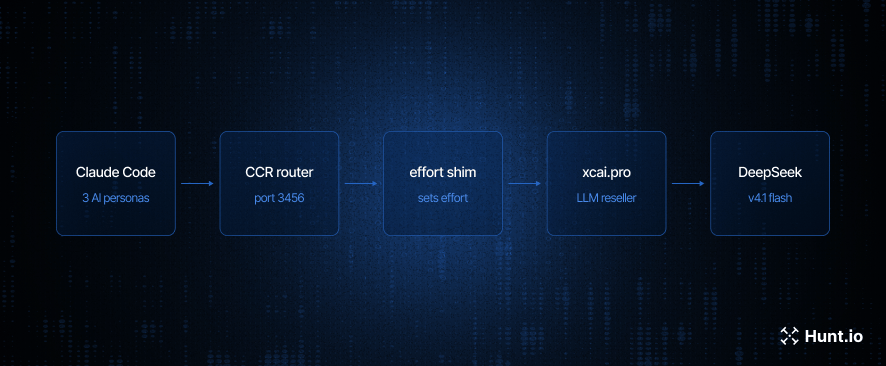
The AI setup is the most striking part. A state file shows the harness is Claude Code itself, version 2.1.221, started 510 times since August 4, but it isn’t talking to Anthropic. A small proxy, ds-models-shim.py, fixes a compatibility problem by faking a model list and sending requests to DeepSeek, and another, xcai-effort-shim.py, adds a reasoning setting because the DeepSeek backend otherwise skips its reasoning step. The route runs from Claude Code through Claude Code Router, an open-source project, to xcai and then to DeepSeek.

“A small local proxy, ds-models-shim.py, addresses a compatibility issue: the official /v1/models endpoint returns a 404 response when queried against a non-Anthropic backend, preventing Claude Code from discovering the available models. The shim intercepts that specific request and returns a locally defined model list containing deepseek-v4-pro and deepseek-flash. All other requests are forwarded to api.deepseek.com/anthropic.” states the report.

The same file counts 19 custom skills, reusable instruction sets for the agent, with 147 recorded uses. They cover code audit, reconnaissance, web injection, WAF bypass testing, authentication testing, Telegram Mini Apps, APK download and decompiling, cloud phone control and payment logic testing. Next to the payment skill sat three self-registered test accounts with tokens for a cash-in deposit API, dated September 12, and a comment calls them an authorized, self-built test. The setup fits testing for insecure direct object reference flaws, a technique CrowdStrike and Genians described against Korean loan and inquiry services.

The directory also held supporting tools. A script queried FOFA, a Chinese asset search engine like Shodan, through a third-party API, and a comment says the primary membership had expired and a backup key was in use. Proxy scripts enumerated a rotating proxy service at 154.201.79[.]246:443, where 79 unique exit IPs showed up among the first 100 identities tested.

A separate directory at 23.248.226[.]250:8001 held a small staged setup for JNDI and LDAP exploitation, retrieved on October 5 at 03:42 UTC. It confirms command execution through a DNS callback, and one script lets web and LDAP traffic share a single port. Hunt.io’s analysis describes the tooling without publishing steps to reproduce it.

Other recovered files include tools aimed at a cryptocurrency exchange’s admin session and withdrawals, Linux privilege escalation exploits, iOS probe source code and Android kernel and firmware utilities. Hunt.io says their connection to the Korean breaches isn’t confirmed.

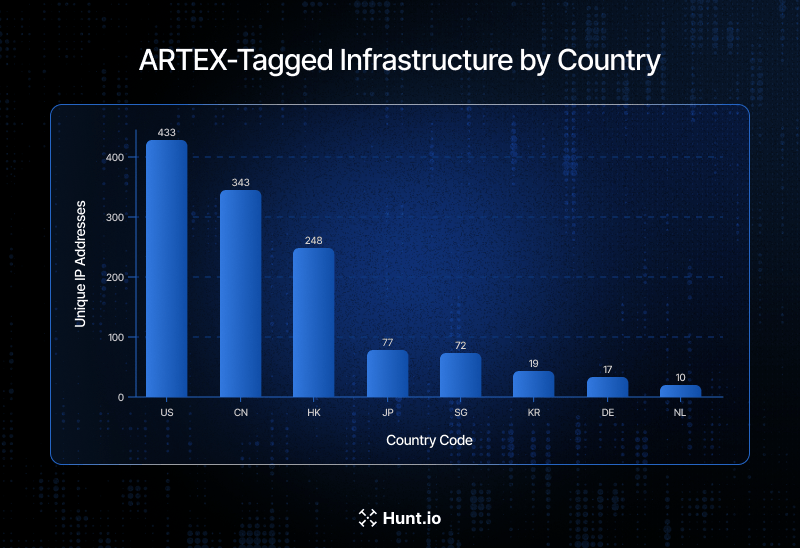
Hunt.io then showed how to hunt ARTEX servers. Searching for an ARTEX certificate issuer returned 19 IP addresses, and searching its malware classification returned 1,303 addresses across 30 countries, led by the United States, China and Hong Kong. Those figures show where addresses are registered, not where the operator sits.

“The result returned 19 distinct IP addresses, including 38.244.50[.]120. This method is precise but limited to hosts that expose a matching certificate. Systems using a different certificate will not appear in these results.” continues the report.

Matching the console’s page title returned about 1,300 IPs, and a looser search found 21 title strings, 19 of them likely ARTEX consoles, in English, Chinese, Korean, Japanese, Russian, Portuguese and Vietnamese.

A malware-name search in AttackCapture gave 280 results with open directories. One at 130.94.31[.]86:18888 in Seoul held two small scripts, and another at 156.251.11[.]39 held an SMB reconnaissance toolkit whose test script writes a file named artex_probe_11876.txt.

More hosts held exploitation kits for DedeCMS and FangCMS, a CAPTCHA bypass suite, a RuoYi and Spring administrative console exploit and CAPTCHA-based login automation. Together they show the framework attracting many operators.

For defenders, the advice is plain. Remove public access and put administration behind VPNs or allowlists, and reset SSH passwords and rotate API keys, proxy credentials and tokens that exposed files may have revealed. Patch internet-facing services, watch for unexpected LDAP and JNDI activity, DNS callbacks and remote script downloads, and store secrets in a managed vault with least-privilege permissions. Also restrict access to model gateways, watch their requests, and enforce compliance rules on managed phones. Hunt.io’s lesson is that an investigation shouldn’t stop at the first list of indicators, because

The company also published indicators of compromise in its analysis.

“The findings highlight risks associated with exposed administrative services, reusable credentials, remote access tunnels, proxy infrastructure, and exploitation tooling.” concludes the report.

Follow me on Twitter: @securityaffairs and Facebook and Mastodon

Pierluigi Paganini

(SecurityAffairs – hacking, ARTEX)

Hot fridges, a fake nuclear alert and a $6bn heist: are we in the foothills of a hacking epidemic?

As AI exposes flaws in IT systems and geopolitics plays out on the cyber frontline, some experts say the events of recent weeks could soon be a common occurrence

Alex Pearce was doing the morning rounds at his fruit and vegetable wholesale business in London on Monday last week when he noticed something odd.

The defrost light on refrigeration unit 2 was on, and the panel reading was 150C. Unit 4 was the same.

Continue reading...

© Composite: Guardian Design/Getty Images

© Composite: Guardian Design/Getty Images

© Composite: Guardian Design/Getty Images

UNM Health Shuts Clinics and Diverts Patients During Security Incident

A cybersecurity incident forced UNM Health to divert ambulances, cancel appointments, and pause care while it contained the threat.

On Monday, October 26, the University of New Mexico Health System (UNM Health) faced the kind of security incident that healthcare leaders dread: one serious enough to change how patients could receive emergency care.

A major hospital network in New Mexico worked urgently on Monday to fix a cybersecurity problem. The issue forced it to send ambulances to other hospitals and left the state without a hospital emergency department able to treat the most serious injuries.

UNM Health operates New Mexico’s only Level 1 trauma center. These centers treat the most serious and complex injuries. Even a temporary closure can put extra pressure on other hospitals.

UNM Health runs New Mexico’s only Level 1 trauma center. That matters because a Level 1 center handles the most complex injuries, and losing even temporary access to it puts pressure on every nearby hospital.

The organization told patients not to come to its main Albuquerque hospital and canceled appointments across more than 30 clinics.

“The University of New Mexico Health System is experiencing a cybersecurity issue at this time. UNM Health officials are actively working to resolve this issue. Currently, all ambulance traffic is being diverted to other hospitals and all appointments at all clinics today have been cancelled. UNM Health patients should not show up to UNM Health facilities on October 26. Emergencies should be handled by 911 and non-emergencies should be delayed until further notice.” reads the update published by the organization on October 26, 2026. “The cybersecurity threat is affecting the entire University of New Mexico Health Sciences Center. “

UNM said its IT security teams identified the threat around 11 a.m. and began containment work. They later said the event affected some end-user devices but did not reach core systems or servers.

Leadership activated an Emergency Operations Center, brought in outside support, and notified state and federal law enforcement. That is the right sequence: isolate first, investigate second, communicate continuously.

From 12:30 to 2:30 p.m., UN Health temporarily stopped accepting new patients while teams protected the network. “System outages also required the suspension of outpatient surgeries and appointments for the remainder of the day.”

This was not an abstract IT problem. Patients arrived for care and were told to reschedule. Staff had to explain, repeatedly, why a hospital visit could not proceed as planned.

UNM also canceled classes at its Health Sciences Center and sent nonessential employees home. Medical, nursing, pharmacy, and population health students lost a day of instruction because the institution had to protect its network.

Other providers stepped in. Presbyterian Healthcare Services and Lovelace Health System coordinated with UNM and took additional patients, which is exactly what a functioning regional healthcare system should do.

UNM Health began restoring its systems on Monday afternoon. By the following day, hospitals, ambulance services and clinics were back to normal.

The incident is still under criminal investigation. Employees reported messages claiming that patient, student and staff data had been stolen, but UNM has not confirmed this. The hospital also warned people to watch out for phishing and fraud attempts by attackers exploiting the incident.

Follow me on Twitter: @securityaffairs and Facebook and Mastodon

Pierluigi Paganini

(SecurityAffairs – hacking, UNM Health)

October 2026 Cyber Attacks Statistics Infographic

Thirty-one days, 438 incidents, one attack every 100 minutes. This infographic distills October 2026 into a single scroll. Cyber Crime was the loudest motive, while nearly half of all attacks left their motivation unknown. Malware led the arsenal, exploited public-facing applications opened the most doors, and Information & Communication took the brunt of targeting.

October 2026 Cyber Attacks Statistics

October 2026 closed with 438 recorded cyber incidents. Cyber Crime drove 44.1% of them, while nearly half of all motivations remained undetermined. Malware led the named attack techniques at 15.7%, ahead of Vulnerability Exploitation and Account Takeover. Exploiting public-facing applications was again the top initial access vector, and Information & Communication was the most targeted sector. The report breaks down motivations, attack vectors, initial access, sectors and geography.

U.S. Charges Canadian Man in Alleged Hack of University Supercomputers

A Canadian man was extradited to the U.S. to face charges over hacking universities and hijacking their computers to mine cryptocurrency.

A Canadian man, Ryan James Roach (35), has been extradicted to the United States to face charges tied to a hacking operation that targeted universities and other schools. Roach was extradited on October 28 and now faces federal charges alongside Mathiew James Stubbings, 41, of Ontario.

The indictment alleges that, from June 2016 to December 2019, the two men hacked computers, stole login details, and used victims’ machines to mine cryptocurrency for themselves.

“They used virtual private servers in multiple countries, which were registered under false names. These servers transmitted malware and mining software to victim computers and stored stolen login credentials.” DoJ states. “Victims of the scheme included educational institutions in New York, Tennessee, North Carolina, and Massachusetts. Some of the computers damaged by the defendants were located at an institution of higher learning in the Western District of New York.”

The targets were not random home PCs. Prosecutors say the pair went after U.S. schools with supercomputers, including institutions in New York, Tennessee, North Carolina and Massachusetts. Some affected computers belonged to a higher-education institution in western New York.

“To carry out the scheme, Roach and Stubbings surreptitiously accessed victim computers without authorization, deployed malware to gain control, stole victim login credentials, exfiltrated the data to servers that they controlled, and forcing victim computers to use their processing power to mine cryptocurrency for the financial benefit of the defendants.” DoJ continues.

That is a lot of effort to turn someone else’s research hardware into a personal crypto rig.

The alleged method was also more involved than a single phishing email. The indictment says they looked for weaknesses in victims’ networks, used servers and compromised machines from one victim to hide their tracks, and then moved through the network once inside. The duo used sophisticated techniques and tools to conduct reconnaissance and expand their access within the network.

The charges include conspiracy to obtain information from and damage protected computers, obtaining information from a protected computer, and intentional damage to a protected computer. Each carries up to 10 years in prison and a $250,000 fine. Prosecutors also allege the pair damaged at least 10 protected computers in one year and caused at least $5,000 in losses.

Roach appeared before U.S. Magistrate Judge Mark W. Pedersen and is being held pending a detention hearing. Extradition proceedings for Stubbings continue in Canada. The FBI, the Justice Department’s Computer Crime and Intellectual Property Section, and the Office of International Affairs worked on the case.

For security teams, the useful part is not the alleged crypto-mining. It is the reminder that universities remain attractive targets because they hold powerful computing resources, broad networks, and plenty of people with access. Patch quickly, watch for unusual processing load, and treat credential theft as a serious incident rather than a nuisance.

“The fact that a defendant has been charged with a crime is merely an accusation and the defendant is presumed innocent until and unless proven guilty.” DoJ concludes.

Follow me on Twitter: @securityaffairs and Facebook and Mastodon

Pierluigi Paganini

(SecurityAffairs – hacking, University Supercomputers)

The more you know, the less you know.

This week, hosts of N2K CyberWire ⁠⁠⁠⁠⁠⁠⁠⁠⁠⁠⁠⁠⁠⁠⁠⁠⁠⁠⁠⁠⁠⁠⁠⁠⁠⁠⁠⁠⁠⁠⁠Maria Varmazis⁠⁠⁠⁠⁠⁠⁠⁠⁠⁠⁠⁠⁠⁠⁠⁠⁠⁠⁠⁠⁠⁠⁠⁠⁠⁠⁠⁠⁠⁠⁠⁠⁠⁠⁠⁠⁠⁠⁠⁠⁠⁠⁠⁠⁠⁠⁠⁠⁠⁠⁠⁠⁠⁠⁠⁠⁠⁠⁠⁠ and⁠⁠⁠⁠⁠⁠⁠⁠⁠⁠⁠⁠⁠⁠⁠⁠⁠⁠⁠⁠⁠⁠⁠⁠⁠⁠⁠⁠⁠⁠⁠⁠⁠⁠⁠⁠⁠⁠⁠⁠⁠⁠⁠⁠⁠⁠⁠⁠⁠⁠⁠⁠⁠⁠⁠⁠⁠⁠⁠⁠⁠⁠⁠⁠⁠⁠⁠⁠⁠⁠⁠⁠⁠⁠⁠⁠⁠⁠⁠⁠⁠⁠⁠⁠⁠⁠⁠⁠⁠⁠⁠⁠⁠⁠⁠⁠⁠⁠⁠⁠⁠⁠⁠⁠⁠⁠⁠⁠⁠ ⁠⁠⁠⁠⁠⁠⁠⁠⁠⁠⁠⁠⁠⁠⁠⁠⁠⁠⁠⁠⁠⁠⁠⁠⁠⁠⁠⁠⁠⁠⁠⁠⁠⁠⁠⁠⁠⁠⁠⁠⁠⁠⁠⁠⁠⁠⁠⁠⁠⁠⁠⁠Dave Bittner⁠⁠⁠⁠⁠⁠⁠⁠⁠⁠⁠⁠⁠⁠⁠⁠⁠⁠⁠⁠⁠⁠⁠⁠⁠⁠⁠⁠⁠⁠⁠⁠⁠⁠⁠⁠⁠⁠⁠⁠⁠⁠⁠⁠⁠⁠⁠⁠⁠⁠⁠⁠ alongside ⁠⁠⁠⁠⁠⁠⁠⁠⁠⁠⁠⁠⁠⁠⁠⁠⁠⁠⁠⁠⁠⁠⁠⁠⁠⁠⁠⁠⁠⁠⁠⁠⁠⁠⁠⁠⁠⁠⁠⁠⁠⁠⁠⁠⁠⁠⁠⁠⁠⁠⁠⁠⁠⁠Joe Carrigan⁠⁠⁠⁠⁠⁠⁠⁠⁠⁠⁠⁠⁠⁠⁠⁠⁠⁠⁠⁠⁠⁠⁠⁠⁠⁠⁠⁠⁠⁠⁠⁠⁠⁠⁠⁠⁠⁠⁠⁠⁠⁠⁠⁠⁠⁠⁠⁠⁠⁠⁠⁠⁠⁠⁠⁠⁠ are discussing the latest in social engineering scams, phishing schemes, and criminal exploits that are making headlines. We start with some follow up from Adina, who shares a few more examples of things that become more complicated the more you learn about them, including statistics and the real-world effects of changes to complex systems. Dave adds quantum physics to the list. Maria covers new research from Akamai showing that online scam detections doubled in the past year, overtaking phishing for the first time in the company's data. Dave explores the case of a Brazilian man who traveled nearly 2,000 kilometers to meet a woman he fell in love with online, only to discover she was an AI-generated personality. Joe examines a phishing email disguised as a Calendly notification that claims to provide access to an official Social Security statement and potentially delivers malware. Our Catch of the Day features two suspicious emails, including an unsolicited donation offer supposedly from a billionaire.

CVE-2026-58868: Critical Android Bug Could Let Attackers Run Remote Code

Critical Android flaw CVE-2026-58868 could allow remote code execution without user interaction on devices running Android 14 through 17.

Google has fixed CVE-2026-58868, a critical Android vulnerability affecting versions 14 through 17. The flaw is a critical Android vulnerability caused by a heap buffer overflow in the onOutputReceived function of FrameDecoder.cpp. The flaw can trigger an out-of-bounds write, potentially allowing a remote attacker to execute arbitrary code on a vulnerable device. Exploitation requires neither user interaction nor additional execution privileges, making it a potential zero-click attack.

“cve-2026-58868 In onOutputReceived of FrameDecoder.cpp, there is a possible out-of-bounds write due to a heap buffer overflow.” reads the advisory. “This could lead to remote code execution with no additional execution privileges needed. User interaction is not needed for exploitation.”

Devices receive the fix through security patch level 2026-11-01 or later, depending on manufacturers and carriers. Google is not aware of active exploitation of the flaws in its November 2026 bulletin.

Google’s November 2026 Android security bulletin addresses 216 vulnerabilities, including 23 rated Critical. Two of these flaws, CVE-2026-58876 and CVE-2026-58936, affect the System component and could allow remote code execution without user interaction.

The bulletin also lists five other Critical flaws in the System component. Three could lead to privilege escalation, while two could cause denial-of-service conditions. Another Critical vulnerability affects the Framework component and could also allow remote code execution.

Six Critical vulnerabilities affect the Android kernel. Two involve Bluetooth code, three affect the protected Kernel-based Virtual Machine (pKVM), and one is in the Human Interface Device (HID) component. The most severe kernel flaw could allow a remote attacker to gain elevated privileges without user interaction.

The November 5 patch level also addresses Critical vulnerabilities in MediaTek modem code and a closed-source Qualcomm component. Google’s bulletin lists eight Critical MediaTek modem flaws, while MediaTek’s own November security bulletin details six of them: CVE-2026-20499 and CVE-2026-20545 through CVE-2026-20549.

MediaTek describes these six vulnerabilities as out-of-bounds write flaws caused by missing bounds checks, integer overflow or improper input validation. The company says it is not aware of any active exploitation in the wild.

The Qualcomm issue is tracked as CVE-2026-25285 and affects a closed-source component. Google does not provide further technical details in its bulletin.

One of the critical issues fixed by Google is CVE-2026-58882 (aka SMS of Death), which could allow attackers to remotely disable a phone by sending a specially crafted SMS message. The flaw affects decodeWapPdu, a function responsible for processing WAP Push messages, a type of content delivered through the SMS infrastructure.

The vulnerability is particularly concerning because exploitation reportedly requires no user interaction. An attacker only needs the victim’s phone number to send a malicious message. The message doesn’t appear in the SMS inbox, so the victim may have no indication of what caused the problem.

The issue also raises concerns about the reliability of mobile communications during an attack. According to a technical analysis published on October 29 by security researcher Mark B, a malformed WAP Push message can crash com.android.phone, the Android system component responsible for handling telephony functions. The crash can terminate ongoing calls, including emergency calls.

Tests on several Android phone models reportedly reproduced the crash consistently. The phone can also become stuck in a crash loop because Android retries processing the malicious message whenever the device starts. As a result, the device may continue crashing until the offending message is removed.

There is an important distinction, however. Google’s security bulletin and the CVE record identify the vulnerable decodeWapPdu function, but neither explicitly confirms that CVE-2026-58882 is the same issue described in the researcher’s SMS of Death report. The technical overlap is worth investigating, but the two reports shouldn’t be treated as definitively describing the same vulnerability without further confirmation.

Follow me on Twitter: @securityaffairs and Facebook and Mastodon

Pierluigi Paganini

(SecurityAffairs – hacking, CVE-2026-58868)

❌