❌

Visualização de leitura

The open compute revolution: Why the C-suite is redefining the modern data center

For years, the enterprise data center operated under a predictable, if restrictive, playbook. Siloed, proprietary hardware stacks dictated infrastructure life cycles, leaving CIOs locked into vendor ecosystems. Every hardware refresh meant navigating premium pricing, constrained supply chains, and artificial limitations on interoperability.

Today, that playbook is being rewritten. As AI, massive data analytics, and intense computational demands reshape corporate strategies, C-level executives are turning to Open Compute infrastructure. Originally pioneered by hyperscalers to manage massive scale efficiently, open hardware design has graduated to the enterprise. By decoupling software from proprietary hardware and embracing collaborative, community-driven standards, open compute is no longer just a technical preference—it is a strategic business imperative.

For the C-suite, transitioning to an open infrastructure model solves three critical pain points: accelerating technological agility, optimizing total cost of ownership (TCO), and meeting aggressive corporate sustainability targets.

Here are the three primary reasons why open compute infrastructure has become vital for IT strategy, and how leaders like HPE and AMD are making it more accessible for the enterprise.

1. Shattering vendor lock-in to accelerate enterprise agility

In a rapidly shifting market, operational agility is a primary competitive advantage. Traditional, proprietary data center architectures restrict a company’s ability to pivot. If a specific vendor faces supply chain disruptions or falls behind in processing power, the enterprise suffers.

Open Compute infrastructure dismantles these artificial barriers. By adhering to open-source hardware specifications, enterprises gain the freedom to mix, match, and upgrade components without replacing their entire infrastructure. This modularity means that hardware can keep pace with software innovations.

This is where the collaboration between hardware pioneers becomes essential. HPE has championed this shift by bringing enterprise-grade reliability, support, and life cycle management to open, flexible architectures. Rather than forcing companies into closed systems, HPE delivers the scaling benefits of open design backed by global service-level agreements (SLAs). For the C-suite, this means the flexibility of an open ecosystem without the operational risk of managing unverified white-box hardware.

2. Optimizing total cost of ownership (TCO) at scale

Inflationary pressures and flat IT budgets mean CFOs are scrutinizing capital expenditures (CapEx) and operating expenses (OpEx) more closely than ever. Closed, proprietary systems carry a premium—not just in the initial purchase price, but in specialized maintenance, proprietary cables, and restricted upgrade paths.

Open Compute infrastructure fundamentally alters data center economics in three distinct ways:

  • Component standardization: Standardized form factors reduce the cost of spare parts and simplify physical deployment.
  • Streamlined maintenance: Stripping away cosmetic bezels and redundant, proprietary management tools allows IT teams to service systems faster.
  • Extended life cycles: Instead of replacing an entire server chassis, executives can upgrade individual components, such as upgrading processors while retaining the existing racks and power distribution units.

Powering these cost-effective, high-density environments requires a new standard in silicon efficiency. AMD has been central to this economic shift. By delivering high-core-density processors like AMD EPYC™, they allow enterprises to consolidate their physical footprint. Fewer sockets mean lower software licensing fees and reduced hardware costs, directly translating to optimized TCO that keeps financial officers satisfied.

3. Driving meaningful progress toward sustainability goals

Data centers are among the world’s most energy-intensive facilities, making them a primary target for corporate environmental, social, and governance (ESG) metrics. For CEOs and chief sustainability officers, reducing carbon footprints is no longer an afterthought—it is a board-level mandate. Some traditional servers include inefficient power supplies and restrictive airflow designs that can drive up cooling costs.

Open Compute architectures tackle energy consumption from the ground up. By utilizing centralized, highly efficient rack-level power distribution and optimizing physical layouts for improved airflow, open designs can reduce Power Usage Effectiveness (PUE) ratios.

When you pair open-rack efficiency with energy-efficient silicon, the sustainability gains multiply. AMD’s continuous focus on performance-per-watt efficiency enables data centers to handle exponentially more compute volume without a corresponding spike in energy consumption. This combination allows enterprise leaders to scale their compute capabilities to handle more intense workloads while visibly driving down operational emissions and meeting corporate sustainability milestones.

The C-suite verdict: Future-proofing the enterprise

Open Compute infrastructure is no longer an experimental architecture reserved solely for hyperscale tech giants. Through enterprise-ready offerings from trusted partners like HPE and cutting-edge silicon from AMD, open infrastructure has become a practical, scalable option for mainstream corporations.

For C-level executives, the decision to migrate toward open standards represents a fundamental commitment to the future. It provides the financial relief required by the CFO, the sustainability metrics demanded by the CEO, and the technological agility needed by the CIO to lead the enterprise into the future.

Three quick tips for C-level executives getting started with Open Compute

  • Audit current refresh cycles: Identify proprietary hardware due for replacement over the next 18 months and map out Open-Compute alternatives to benchmark TCO improvements.
  • Prioritize workload density over raw hardware volume: Partner with architecture leaders like HPE and AMD to design high-core-density configurations that slash operational footprint and licensing overhead.
  • Align infrastructure updates with sustainability reporting timelines: Measure the energy-efficiency gains of moving to centralized power and highly efficient processors to demonstrate tangible carbon reductions to shareholders.

Shape the future of infrastructure: Join the Open Compute community

True innovation doesn’t happen in isolation. The power of Open Compute lies in its global community of engineering experts, visionary developers, and enterprise leaders who collaborate to solve the industry’s toughest data center challenges. By actively participating in the Open Compute Project (OCP), your organization can help define next-generation specifications, preview upcoming silicon and server road maps, and share deployment best practices alongside industry pioneers like HPE and AMD.

Don’t just adapt to the future—help build it. Visit the official Open Compute Project website today to explore active project groups, attend upcoming regional summits, and discover how your enterprise can contribute to a more efficient, collaborative, and sustainable technological landscape.

*************

HPE and AMD are partnering to deliver the next generation of AI and supercomputing infrastructure. Combining HPE’s deep expertise in large-scale system design with AMD EPYC™ processors and AMD Instinct™ accelerators, the two companies help customers build platforms capable of supporting the most demanding AI, modeling, simulation, and analytics workloads. Whether accelerating scientific research, enabling digital engineering, or training advanced AI models, HPE and AMD focus on what matters most: faster insights, greater efficiency, and the flexibility to scale. Together, they provide the technology foundation organizations need to solve complex problems, drive discovery, and create lasting business and societal impact.

The AI boom is putting construction at the centre of the digital economy

For the past two years, the conversation around AI has focused on which industries it will disrupt. But AI’s rapid growth is also creating a major infrastructure challenge. As investment pours into data centres and supporting infrastructure, the AI boom is becoming central to delivering the next wave of the digital economy, reshaping construction in unexpected ways.

Earlier this year, NVIDIA CEO Jensen Huang called AI the “largest infrastructure buildout in human history.” For Australia, that presents a significant opportunity. Global tech companies are investing heavily in the infrastructure needed to support AI growth, and Australia is increasingly viewed as the place to do it because of our land availability, stable institutions and long-term renewable energy potential.

Commonwealth Bank has described Australia as the world’s third-largest destination for AI investment, behind the United States and China, with the country’s data centres pipeline estimated to reach A$150 billion by 2030.

The interesting part isn’t just the scale and opportunity AI presents. It’s that construction has reached its own inflection point, with the data and AI boom creating a rare opportunity to modernise how the industry plans, designs and delivers projects.

Construction is becoming more data-driven

Construction will always be grounded in the physical work of building.

But increasingly, data is shaping how projects are planned, coordinated and delivered.

Long before construction starts onsite, projects are developed in highly detailed digital environments. On the most advanced projects, buildings are now designed, coordinated and resolved virtually before anyone steps foot on site. Architectural, structural and services information is combined into a single living digital model where thousands of potential clashes can be identified and addressed up front, providing greater certainty of programme, cost and delivery.

This shift has made digital pre-construction one of the industry’s most valuable investment areas, reducing rework, improving productivity and minimising disruption for surrounding communities.

Unlike many other industries, construction generates large volumes of real-world data that general AI models can’t scrape from the internet. Laser scans and site cameras capture a detailed picture of how physical assets are designed and assembled, and companies that use that data effectively can build faster and with better certainty.

That data has historically been fragmented and underutilised.

AI is creating the opportunity to connect that information and turn it into better decisions, creating a significant competitive advantage.

The workforce shift no one expected

One of the more important opportunities created by AI is the chance to rethink how technical and trade-based careers evolve.

Construction and technology have typically followed separate talent pathways. Today, those worlds are increasingly converging as digital tools, data and advanced manufacturing become further embedded across the industry.

The workforce is beginning to evolve as modern construction becomes more digital. Tradespeople are increasingly working from digital models on tablets, assembling components prebuilt in factories and engaging with advanced manufacturing processes that would have been unfamiliar a decade ago.

At the same time, construction companies are recruiting machine learning engineers, AI product managers and advanced manufacturing specialists alongside traditional project teams.

The result is an industry with the potential to look very different from the stereotypes that still shape how it is often perceived.

AI still needs builders

Technology companies receive much of the attention when it comes to AI. But AI growth cannot exist within a vacuum.

Behind every model, agent and application sits an ecosystem of physical infrastructure that must be financed, designed, powered and built. As AI investment accelerates, the industries responsible for delivering that infrastructure will become increasingly important to the success of the digital economy.

There’s an irony in that.

The technology many people believe will transform the future relies on an industry still often viewed as traditional. For construction, that creates a rare opportunity: to use the data and AI boom not only to deliver the next wave of infrastructure, but to accelerate the industry’s own transformation.

AI does well in digital settings with clear rules. The physical world is messier and harder to predict. Ultimately, AI still relies on people to make decisions and safely build what it runs on. There’s something reassuring in that, and a little ironic. For all the talk about machines, it’s still people who set the pace.

The same AI question emits more carbon dioxide in Texas than in Sweden

The Swedish AI company Berget AI, together with researchers from the Stockholm Environment Institute (SEI) and the organizations WattTime and Klimatkollen, has developed a new method for calculating how much carbon dioxide different AI requests generate.

The aim is to make the AI ​​industry’s climate impact more transparent and give companies the opportunity to compare different suppliers.

According to the method, for example, a typical request to the AI ​​model Kimi K3 results in around 0.4 grams of carbon dioxide emissions in Sweden, 1.6 grams in Ireland, 2.5 grams in Germany, and 3.2 grams in Texas. Despite identical hardware.

Berget AI has published the method as open source, meaning other companies can freely use it. A web-based calculator also makes it possible to compare emissions between different AI models and geographical regions.

The CIO’s new recovery problem: Knowing what ‘good’ looks like

For years, disaster recovery was built around a relatively simple question: How quickly can we get the business back online?

That question still matters. But for today’s CIO, it is no longer enough.

Enterprise technology environments have become too dynamic to define recovery simply as restoring applications, reconnecting infrastructure and resuming operations. Applications span on-premises infrastructure, cloud environments and SaaS platforms. Identities and permissions are constantly changing. Employees introduce new tools and automation into workflows, sometimes without IT knowing about them. AI is accelerating that pace of change even further.

As a CIO, I see this complexity firsthand. My organization is navigating its own transformation while modernizing the technology that supports the business. One challenge I believe CIOs increasingly share is what I call “complexity sprawl,” the accumulation of technologies, applications, identities, integrations and processes that makes it increasingly difficult to understand what exists, how everything connects and, most importantly, what normal actually looks like.

That creates a different recovery problem. When something goes wrong, how do you know what you are actually trying to recover to?

Restoring a system does not necessarily mean restoring a trustworthy system. A compromised identity may still have inappropriate access. A configuration may have been changed. An attacker may have created another way back into the environment. A dependency may have shifted since the recovery plan was last tested. Getting everything running again is only part of the job. CIOs also need confidence that what they are bringing back is something the organization can trust.

Know what ‘good’ looks like before something goes wrong

That confidence starts with visibility long before an incident occurs.

Most large organizations do not operate within one neat technology environment. They have infrastructure accumulated over years, systems introduced through acquisitions, cloud services adopted by different business units, SaaS applications and legacy platforms that remain critical to day-to-day operations.

That complexity is not inherently bad. Much of it exists because the business evolved, and the technology evolved with it. The problem comes when an organization loses the ability to understand the environment as a whole.

I have seen how difficult it becomes to maintain a single source of truth as environments grow more fragmented. As a CIO, I do not want my team trying to reconstruct that environment for the first time while we are already managing an incident. We need that understanding before the pressure is on. What systems are critical? What depends on what? Who and what have access? What changed recently? If we cannot answer those questions while the environment is healthy, we are going to have a much harder time answering them during recovery.

That is why I view inventory and dependency mapping as recovery capabilities, not simply documentation exercises. CIOs need a continuously updated understanding of critical systems, applications, identities and dependencies. The goal is not to eliminate complexity. It is to make that complexity visible enough that we can distinguish the environment we intended to build from the environment that actually exists.

Recovery is a decision-making challenge

The challenge becomes even greater when you consider how much legitimate change occurs inside an enterprise every day. Employees change roles. Applications are updated. Permissions evolve. Automation executes actions across systems. AI tools and agents are introducing new workflows and interactions at an even faster pace.

Shadow IT is not new. CIOs have dealt with it for years. What has changed is the speed at which employees can now introduce technology into the business. Someone can adopt an AI tool or build an automated workflow without going through the traditional processes that might have given IT visibility into it.

I am navigating that reality in my own organization. I want people experimenting. I want teams finding better ways to work. The CIO cannot become the person who simply says no every time the business wants to try something new. But giving people room to innovate also requires maintaining enough visibility and governance to understand what is operating within the environment, what data it touches and what risk it introduces.

That matters enormously during recovery. When thousands of legitimate changes coexist alongside potentially malicious ones, you cannot assume the answer is simply to roll everything backward. You need to understand what changed, when it changed and whether that change belongs in the recovered environment.

This is where recovery becomes as much a decision-making challenge as a technical one.

One thing you learn quickly as a CIO is that some of the hardest decisions during an incident are not purely technical. Technology teams can tell you whether something can be restored. The harder questions are whether it should be restored, which systems need to come back first, what dependencies have to be in place and when the organization has enough confidence to safely resume operations.

Establish decision rights before the pressure is on

Those decisions cross cybersecurity, identity, infrastructure, cloud, data, applications and business operations. Restoring one system may depend on another. Reinstating an identity or permission may introduce risk elsewhere. Returning an application to production may have downstream implications for customers or business operations.

The CIO should not be making every one of those decisions personally. Our responsibility is to make sure the organization has established the priorities, ownership and decision rights necessary to make them quickly when the pressure is on.

That means asking difficult questions in advance. What does a trusted state look like for our most critical environments? Which systems and identities need to be restored first? What dependencies have to exist for them to operate safely? Who has the authority to determine whether an environment is trustworthy enough to return to production?

An active incident is the wrong time to answer those questions for the first time.

Test the organization, not just the backup

It is also why I put so much value on testing. I have spent enough time managing large technology environments to know that what is written in a recovery plan and what exists in the environment can diverge surprisingly quickly. Technology changes. People change roles. Applications are replaced. New dependencies emerge. A process that worked six months ago may rely on assumptions that are no longer true.

A meaningful recovery exercise therefore has to test more than whether a backup can technically be restored. It should test whether the organization can identify the right recovery point, understand its dependencies, make decisions under pressure and determine whether the restored environment can actually be trusted.

I also view testing as an organizational exercise. Do people understand their roles? Are escalation paths clear? Does the organization have the expertise necessary to make decisions quickly? Are critical dependencies documented, or does that knowledge reside primarily with a handful of employees?

The skills question is becoming increasingly important. One of the challenges I think about constantly is how quickly technology is changing relative to our ability to keep people current. That is difficult under normal circumstances. During a recovery event, a gap in expertise can quickly become an operational gap.

You can have the right technology and the right process on paper, but if the expertise required to execute that process sits with one or two people, you still have a resilience problem.

Testing exposes those weaknesses when the stakes are lower. It creates operational muscle memory and gives teams experience making the kinds of decisions they may eventually have to make under much greater pressure. In that sense, recovery is not a document sitting on a shelf. It is an organizational capability that has to be continually exercised.

Redefining what successful recovery looks like

I do not expect enterprise environments to become less complex. AI agents, automation and machine identities will introduce even more activity into environments that many CIOs are already working hard to understand. Businesses will continue adopting new technologies, modernizing legacy systems and connecting environments that were never originally designed to work together.

The CIO’s job is not to eliminate that complexity. It is to make sure we maintain enough visibility and control to manage it.

For recovery, that means understanding what exists and how it connects before an incident happens. It means knowing what is changing and whether those changes are legitimate. It means establishing ownership and decision rights before teams are operating under pressure. And it means testing whether the organization can actually execute the plan it has put on paper.

Speed will always matter. Every CIO wants to restore operations as quickly as possible when something goes wrong. But speed without confidence is not resilience.

Ultimately, the most important recovery question may no longer be, “How quickly can we get back?”

It may be, “How do we know what we’re getting back to?”

CIOs who can answer that question before an incident occurs will be in a much stronger position when something inevitably goes wrong.

AI datacenter capex will far exceed forecast revenue through 2030

Investors are pouring more into AI data center infrastructure than they can hope to recoup by 2030, according to Gartner.

“Enterprise and consumer AI revenue will be insufficient to support profitable returns on all planned AI capital expenditures during this period,” said Gartner Senior Director Analyst Will Sommer.

AI data center owners would need to generate $8.5 trillion in revenue through 2030 to cover announced capital spending, financing costs and expected investment returns, he said. “However, total enterprise and consumer AI revenue that can be attributed to AI data centers during this period is forecast to reach no more than $3.6 trillion.”

Gartner joins a growing chorus warning that major AI players may be over-committing themselves. Bain and Co. recently made a similar forecast, estimating that annual spending on AI infrastructure could reach $1.5 trillion by 2031 and that the AI services market would need to top $6 trillion annually to pay for it.

This is particularly bad news for neocloud providers, said Gartner. While the hyperscalers are large enough to absorb the financial pressures, the research company suggests that the cost pressure will force more than 80% of neocloud providers to cease independent operations.​

The Bain and Gartner surveys don’t cover quite the same ground, but their conclusions are very similar: a lot of AI infrastructure investment is never going to make a return, and companies need to prepare themselves for some degree of financial loss.

This article first appeared on Network World.

IT leaders still on the hunt for VMware alternatives

Nearly three years after Broadcom purchased VMware, IT leaders still aren’t convinced they will stick with the leading virtualization technology provider over the long term.

Ninety percent of current VMware customer CIOs are considering alternatives to VMware due to higher licensing costs since the Broadcom acquisition, according to a recent survey, with over half saying that Broadcom’s decision to end perpetual license support is a major reason they are evaluating other options.

The survey, commissioned by third-party support vendor Rimini Street, also finds 60% of VMware customers considering multiple-hypervisor strategies, to create more flexible virtualization environments.

Since taking over VMware in late 2023, Broadcom has revamped its pricing models, often leading to cost increases of 50% to 200%. In some cases, customers have reported quotes that would result in price hikes of 1,500%.

Keith Costello, Rimini Street’s EVP and COO, says his company has heard widespread dissatisfaction about the price increases, including the transition from perpetual licenses to a subscription model, as well as the push to adopt VMware Cloud Foundation, an integrated software platform for deploying and managing private and hybrid cloud environments.

“What I’m hearing is that they’re not dissatisfied with the product at all,” he says. “VMware’s customers love their product, but the terms under which VMware is providing alternatives, in terms of migration for their customers, doesn’t work with their timelines, doesn’t work with their economics.”

A VMware spokesman declined to respond to the survey results.

The long road to cost recovery when switching vendors

Widespread dissatisfaction doesn’t necessarily mean IT leaders will abandon VMware, adds Joe Locandro, Rimini Street’s CIO. Alternatives have emerged, but VMware has long been a market leader for virtualization, he notes, and switching to new vendors can be expensive, even considering VMware’s price hikes.

The cost of switching to a new vendor can take three to five years to recover, even when users factor in the price increases, and many CIOs don’t consider the costs of retraining staff in new products and the lost opportunity costs created by a long-term transition to a new vendor with major upfront costs, Locandro says.

“You don’t want to jump from one frying pan to another,” he says. “At the end of the day switching is not a competitive advantage; it’s a bit of the infrastructure and plumbing, and there’s the opportunity cost of investment to other AI initiatives and other things that require capital and expenditure.”

Still, many CIOs want more vendor flexibility and control over their virtualization spending, Costello says.

“One thing clients don’t like, and it’s not unique to VMware software and virtualization capabilities, is that they don’t like being forced into a corner to make a choice,” he adds. “CIOs feel a lack of control over their estate, when, all of a sudden, the price for this big technology that they’ve been relying on for 15 years goes up 3x.”

The survey also finds about two-thirds of IT leaders are considering third-party support for end-of-support versions of VMware’s vSphere virtualization product, a service Rimini Street specializes in.

Rethinking VMware as the default — before renewal removes leverage

While Rimini Street has a huge interest in VMware customers exploring alternatives such as third-party support, other observers of the virtualization market also see broad dissatisfaction with the price increases.

Many CIOs and CFOs have been reevaluating VMware in the wake of Broadcom’s licensing changes, says Thomas Cloud, founder of Vertex CIO Advisory and 48 Technologies and director of IT for an MSP.

But leaving VMware immediately is rarely the right approach, he adds.

“The right answer is to understand which workloads still justify the platform, quantify the real cost of staying, understand the cost and risk of moving, and make the decision before the renewal deadline removes your leverage,” he says. “A VMware renewal should be treated like any other material technology dependency: Understand it before the deadline, quantify the alternatives, and don’t let the renewal date make the decision for you.”

A good approach is to separate the workloads that justify staying on VMware from workloads that can move to other providers, Cloud says. “The biggest mistake I see is treating it as an all-or-nothing migration question,” he adds.

Third-party VMware support can also be a useful bridge, he says. “It can give the company time to avoid making a rushed infrastructure decision simply because a renewal date is approaching,” he explains. “But it should be part of an intentional transition or support strategy, not just a way to postpone the same decision indefinitely.”

In addition to advising clients on potential migrations, Cloud’s organizations are reevaluating their use of VMware as well, he says.

“We’re not looking at it as, ‘VMware is now bad; therefore everything has to move,’” he adds. “We’re looking at where VMware still makes operational and economic sense versus where other platforms such as Hyper-V or Azure may be a better fit going forward. The Broadcom changes have definitely made us more willing to challenge the assumption that VMware should automatically remain the default.”

A defector’s tale

Over at the Swiss National Supercomputing Center, engineers and IT leaders began exploring alternatives to VMware in 2021, before the Broadcom acquisition. The center’s transition to SUSE Virtualization was driven more by technical needs, but the price changes at VMware have reinforced the center’s decision, says Maria Grazia Giuffreda, associate director at the center.

The center is also a big supporter of open-source software, and that philosophy drove the organization to seek alternatives, she adds. The center is opposed to paying for software licenses, she notes.

“Cost always has an impact, because you want to reduce your cost wherever possible,” she says. “You sometimes start looking at alternative solutions for reducing the amount of money that you invest, and licenses are an eternal discussion.”

The new solution has reduced the time the center manages infrastructure by 70%, says Dino Conciatore, a systems engineer at the center.

“When we saw the licensing change, we thought, ‘Oh, we’re so lucky, we never liked closed products,’” he adds.

IT leaders seeking options should check out Networkworld’s “5 alternatives to VMware vSphere virtualization platform” and its deeper look at how enterprises are reevaluating their virtualization strategies.

The great AI pricing reset is coming. Are you ready?

Per-token pricing has become the default commercial language of generative AI, and practically every budget conversation now happens in those terms (tokens consumed, tokens generated, cost per million tokens, etc., etc.).

The problem is that this model treats every AI interaction as a discrete transaction, separate from the infrastructure required to process it. Yes, tokens are a billing unit, but the work they represent also has a physical footprint in memory and storage, and as agentic AI drives context windows into the hundreds of thousands of tokens, that footprint has outgrown the GPU.

So why does this matter? Well, according to recent analysis published in Harvard Business Review (HBR), corporate AI is about to experience a massive “cost shock”, as vendors move away from unmetered or bundled AI features and begin passing on the cost of the infrastructure required to deliver them.

As HBR points out, organizations are currently being paid, in effect, to adopt AI, with major software vendors quietly absorbing the steep costs of GPUs, inference and tokens on their customers’ behalf. That subsidy is not built to last.

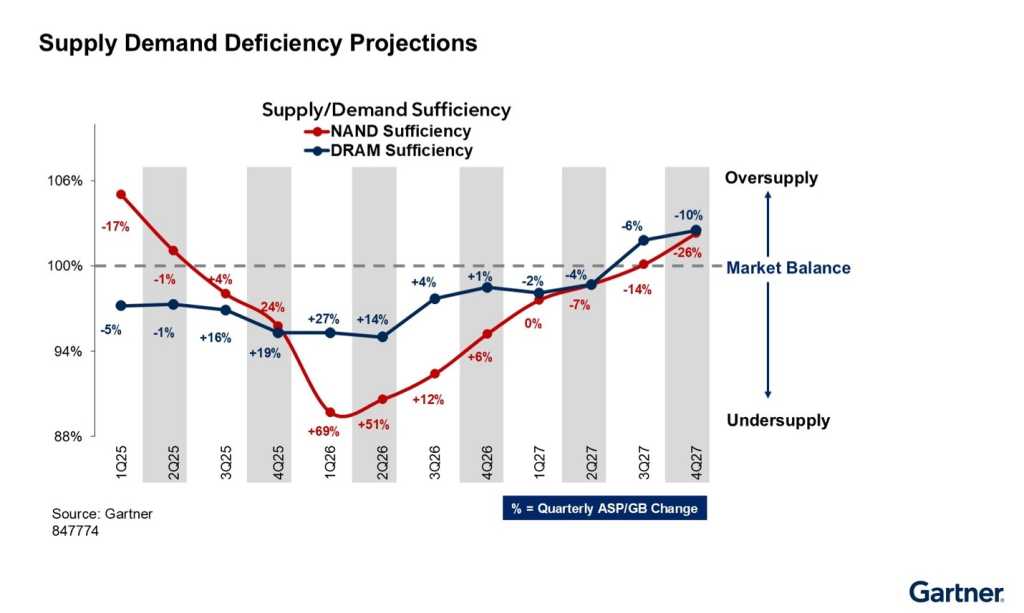
Take memory and storage costs, for example. DRAM prices have risen sharply as manufacturers focus on High Bandwidth Memory (HBM) production for AI accelerators, tightening supply for conventional server memory. Meanwhile, demand for AI is exerting sustained pressure on the availability and pricing of high-capacity SSDs.

This is totally unsustainable, and there was always going to come a point at which vendors could no longer continue covering these costs themselves and would need to pass more of them on to customers. That point is now rapidly approaching.

The scale of the shift is hard to overstate. Google was processing 9.7 trillion tokens a month in 2024; by mid-2025 that had risen to 480 trillion, and at this year’s I/O, Sundar Pichai put the figure at 3.2 quadrillion tokens a month. Goldman Sachs projects industry-wide token consumption will multiply another 24 times by 2030. Whatever an organization budgeted for inference last year, the volume assumption behind it is already out of date, and a growing share of that volume is input, not output: agentic workflows that plan, call tools and re-read context on every step are pushing input tokens, not generated ones, to the top of the cost stack.

Your AI budget has a serious NAND problem

The clearest sign of where this is heading came at CES 2026, when Nvidia unveiled what it first called its Inference Context Memory Storage Platform, built around its coming BlueField-4 DPU, and has since formalized as the NVIDIA CMX context memory storage platform. CMX standardizes the offload of the model’s working memory, the KV cache, onto NVMe SSDs, extending GPU memory into a shared, pod-level context tier and making it persistent across inference runs. Nvidia says the approach can deliver up to five times greater power efficiency and up to five times higher tokens-per-second throughput, and it already has more than a dozen storage partners lined up to support it, including Dell, IBM, NetApp, VAST and WEKA.

That is a significant validation point: several storage vendors were already extending GPU memory onto flash before ICMSP existed. Nvidia standardizing the approach across its ecosystem confirms this is now an architectural direction for the industry, not a niche workaround. But it also means the economics of inference are no longer determined solely by GPU pricing; they are now directly exposed to storage media pricing.

That exposure matters because flash pricing is anything but stable. According to VDURA’s own Flash Volatility Index, 30TB TLC SSD pricing rose 472% between Q2 2025 and Q1 2026, and the price multiple between high-capacity QLC flash and hard drives widened from roughly 4.9x to more than 22x over the same period, while HDD pricing moved about 35%. If cost-per-token now depends on flash-resident context tiers, then token costs inherit flash volatility, and organizations running all-flash inference infrastructure are carrying unhedged exposure to the NAND market on every query.

Instead, flash should be reserved for hot context data where its performance genuinely affects inference. This is because not all types of data generated or retained by AI workloads have the same latency requirements. For instance, data retained for future use, such as checkpoints, does not necessarily need flash performance. The hyperscalers worked this out long before the current price cycle: Google, Meta and Microsoft do not run all-flash storage; they run mixed fleets, with just enough flash to saturate compute and intelligent tiering draining everything else to high-density disk. A mixed-fleet architecture separates performance capacity from bulk capacity, giving organizations a structural hedge against volatile flash prices.

Tread carefully

If they aren’t doing so already, infrastructure leaders should model token-cost sensitivity to media pricing before committing capital. Do not forget that agentic workloads can disproportionately increase token consumption on the input and context sides. As a result, cost models must account for how much context requires high-performance flash capacity and how much can be stored on lower-cost tiers. Teams should regularly test how projected AI costs change as CMX-style architectures push more context onto NVMe, and as SSD pricing rises further while context requirements grow.

That all being said, HBR’s concluding analysis is extremely apposite: as long as executives are being asked to redesign their organizations around a technology with unpredictable pricing, they should tread carefully.

AMD’s plan to boost production could ease AI supply chain concerns

As the demand for AI infrastructure continues to outstrip available capacity, AMD is planning a substantial increase in CPU and GPU supply in 2027. During her recent visit to Taiwan, AMD CEO Lisa Su confirmed that the company is working to expand supply across its ecosystem and is now planning capacity three to five years ahead.

Su told reporters that AMD has increased its supply and capacity in 2026 and is going to substantially increase supply in 2027, as per Reuters.

Su was in Taiwan on October 5-6 with the aim of ramping up AMD’s supply for CPU and GPU production to meet growing AI demand. Su had reportedly held meetings with Foxconn and was also scheduled to meet TSMC as part of discussions with local partners. Following her meetings in Taiwan, Su is now visiting South Korea, where she held meetings with Samsung Electronics’ Device Solutions (DS) to broaden the partnership, among other companies.

For CIOs, this ramp-up could eventually improve access to AI compute and add another option to Nvidia’s dominant infrastructure, but it is unlikely to end supply constraints overnight.

AMD’s supply ramp depends on its partners

AMD may have the demand and product roadmap, but scaling supply will depend on how much capacity these manufacturing and memory partners can deliver.

“AMD designs the chips, but relies on TSMC for advanced chip manufacturing and packaging, and SK Hynix and Samsung for HBM memory. Its 2027 supply increase therefore depends heavily on these partners adding capacity on time. Any delays in new wafer, packaging or HBM capacity could constrain AMD’s GPU ramp,” said Pareekh Jain, CEO at EIIRTrend & Pareekh Consulting.

Even though AMD has committed to a substantial supply increase in 2027, the execution is dependent on multiple factors.

First being the yield and efficiency of HBM4. “As AMD transitions its next-generation architecture to HBM4, it becomes dependent on highly complex architectural changes. HBM4 shifts to a logic base die, requiring deep collaboration with memory giants like SK Hynix and Samsung Electronics. If these memory makers experience poor bit efficiency or yield issues on early HBM4 runs, AMD’s shippable volume will be instantly capped, regardless of how much raw silicon it prints,” said Danish Faruqui, CEO at Fab Economics.

Secondly, there is a severe Chip-on-Wafer-on-Substrate (CoWoS) allocation squeeze as hyperscalers and Tier-1 cloud providers are locking down packaging capacity years in advance.

Faruqui noted that because Nvidia absorbs the lion’s share of TSMC’s packaging allocation for its Blackwell platforms, AMD’s ability to substantially increase its 2027 volumes therefore depends entirely on how many packaging slots it can successfully wrestle away from competitors.

Lastly, while AMD is exploring broader ecosystem investments (such as expanding its multi-billion-dollar presence in Taiwan), it remains 100% tied to TSMC as its primary foundry for advanced nodes, added Faruqui. Efforts to diversify, such as evaluating potential packaging or wafer capacity from US-based fabs (like TSMC’s Texas initiatives), will not yield meaningful volume relief by 2027, leaving its ramp entirely vulnerable to supply chain shocks or capacity rationing in Taiwan, added Faruqui.

AI compute crunch may persist through 2027

The AI compute supply crunch is expected to remain acute till the first half of 2027, say experts. This is because the shortage extends beyond GPUs to high-bandwidth memory, advanced packaging, data-centre space and reliable power, and demand from AI training and inference workloads continues to outpace the substantial new capacity being added.

“Enterprises can expect moderate relief in 2027 as new chip packaging and data-centre capacity comes online, although meaningful improvement is unlikely before the second half of the year. The outlook is therefore one of easing constraints rather than full normalisation, and premium pricing is likely to persist until supply expands across the entire infrastructure stack,” said Devroop Dhar, co-founder and MD at Primus Partners.

Dhar added that most incremental capacity will initially be absorbed by hyperscalers such as AWS, Microsoft, Google and Meta, along with leading AI labs, given their long-term procurement commitments and scale advantages. However, enterprises will benefit largely indirectly, through broader availability of cloud-based AI services and improved access to GPU resources via public-cloud and managed-service providers.

More supply may not mean cheaper AI compute

With demand for GPUs, CPUs and HBM already outpacing supply, additional capacity should eventually ease some pressure on AI infrastructure costs. But the new capacity will be arriving in a market where AI demand continues to grow rapidly.

“Lead times for premium enterprise data center GPUs range from 36 to 52 weeks in 2026, extending deliveries into 2027, driving GPU prices up by 25-35% above the manufacturer’s suggested retail price, and cloud service providers’ share increased premium GPU instance pricing (like EC2 Capacity Blocks) by roughly 15-25% already,” added Faruqui.

While total global AI compute stock, including AMD’s hardware, is projected to scale up through 2027, enterprises can realistically expect only marginal price reduction, and that too in stages.

Dhar noted that in the near term, the most significant effect will be greater negotiating leverage, as a credible alternative supplier gives enterprises and cloud providers more flexibility. Selective discounts may first appear on AMD-based cloud instances and older-generation GPUs.

Prices for frontier compute capacity could begin to moderate in the second half of 2027, once initial large-scale deployments are completed and more supply becomes available to the broader market. A more substantial price correction may therefore not emerge before 2028. He added that, amongst the various products, the MI350P and MI355X may be AMD’s trump cards in this market and can give it an advantage in optimizing AI compute requirements and spend.

Compute will become more accessible to corporate buyers over the course of 2027, but will require deliberate planning and secured commitments. As AI compute is becoming strategic infrastructure that needs multiyear planning, Jain cautioned that CIOs should estimate AI demand under different growth scenarios, reserve capacity for critical workloads, use the cloud for unexpected demand, and avoid depending completely on one GPU supplier. The key measure should be cost per successful AI workload, not simply GPU price.

The article originally appeared on NetworkWorld.

$6T in annual AI revenue needed to pay off data center investments

Hyperscalers are rushing to build more data centers to run AI  workloads — but will the AI industry ever generate enough revenue to pay for that infrastructure?

Researchers at Bain and Company have looked into this and concluded that productivity gains from existing AI services are not enough to justify the money being pumped in: AI companies and the hyperscalers that power them will need to create brand new markets for their services.

Bain said the “arms race” among hyperscalers is accelerating to the extent that their capital expenditures could reach $780 billion in 2026, a fivefold increase in three years. And, it estimates, annual spending on AI infrastructure could reach $1.5 trillion by 2031.

Making the assumption that hyperscalers’ capital expenditure amounts to about 25% of revenue, they would need the AI market to be worth $6 trillion annually.

But, said Bain, the current consumer and enterprise AI markets together could be worth up to $1.8 trillion by 2031, leaving a whopping $4.2 trillion still to find from new markets.

Bain highlighted four potential areas: the use of AI in search; the development of more autonomous vehicles, including drones; physical AI, including digital twins and robotics; and new product development, for example, breakthroughs in pharmaceuticals.

This article first appeared on Network World.

Memory squeeze set to tighten through 2028, Micron says

The global memory shortage that has driven up the cost of servers, storage and PCs through 2026 will get worse in 2027 and 2028, according to memory maker Micron Technology.

“We expect memory and storage supply-demand conditions to be much tighter in calendar 2027 and 2028 than they were in 2026,” CEO Sanjay Mehrotra said in prepared remarks for the company’s fiscal fourth-quarter earnings call.

Even with new cleanroom space planned across the industry, “We do not have line of sight to when supply and demand will return to balance,” he said. Earlier industry forecasts had expected the two to return to balance in 2028.

Mehrotra added that new plants would not bring quick relief. “Production from new DRAM and NAND fabrication facilities takes time to ramp and gradually becomes more meaningful starting a few quarters after initial output,” he said.

Neil Shah, vice president of research at Counterpoint Research, said the outlook means CIOs “will have to be prudent about which equipment to upgrade and which to stretch to maintain cost efficiencies.”

Higher prices, less memory

On the same call, CFO Mark Murphy said Micron’s “inventory levels and supply remain extremely tight.” Its DRAM prices rose by a percentage in the high teens in the fiscal fourth quarter, while NAND prices climbed about 30%, he said.

Taiwan-based market research firm TrendForce expects prices across the industry to keep rising. In a Sept. 30 report, it forecast that conventional DRAM contract prices will increase another 10% to 15% in the fourth quarter from the third. It expects NAND flash prices to climb 15% to 20%. The firm said increases are slowing but the market remains undersupplied.

IDC expects PC buyers to pay more as well. The research firm forecast in June that average PC selling prices will rise 17% in 2026.

TrendForce has also tracked a shift toward less memory per server. Cloud providers and OEMs have moved some servers from 96GB and 128GB memory modules to 32GB and 64GB modules since the first half of 2026, the firm said in a July report. Analysts had warned in January of higher prices and lower memory specifications for enterprise PCs.

Supply committed years ahead

Micron has already committed more than 75% of its 2027 output, and most of its customer discussions now concern 2028, Mehrotra told analysts on the call.

Much of that supply is locked into multiyear, take-or-pay contracts that Micron calls strategic customer agreements (SCAs). “Any new discussions on SCAs where pricing is involved are negotiated with higher pricing based on prevailing market conditions and outlook,” Mehrotra said.

Some cloud providers have signed similar long-term agreements with memory makers, TrendForce said in its July report. That has left buyers without such deals as the main source of server DRAM price increases, it said.

Shah said enterprises should lock in pricing too. “Companies should secure multiyear pricing for the computing capacity they know they will need,” he said. Moving workloads to the cloud will not avoid rising hardware and energy costs “because providers will pass them on,” he added.

Which refreshes to delay

When it comes to replacing existing equipment, Shah said, the right call depends on the workload. “For general back-office PCs and routine file servers, stretching lifecycles from three years to five is harmless,” he said. “But for core infrastructure and engineering seats, delaying refreshes can backfire.” Aging equipment can drag on productivity, lose software support and fail more often, he added.

Shah also cautioned against turning to older memory to save money. Memory makers have been converting production lines to high-bandwidth memory and DDR5, so DDR4 is no longer cheap or plentiful, he said. “If you buy legacy platforms today to shave 10% off upfront server costs, you’re buying into systems which won’t have serviceable parts two years from now.”

He recommended starting with the hardware already in place. “Enterprises often waste 30% to 50% of memory by provisioning for peaks that rarely occur,” he said. Right-sizing virtual machines, quantizing AI models and batching workloads more efficiently can cut memory use significantly, according to Shah.

Before buying more hardware, he said, “CIOs should think about optimizing on the silicon already in place.”

What hardware vendors say

Hardware vendors had no helpful advice to offer budget-constrained buyers.

Lenovo did not answer questions directly but pointed to remarks executives made on its Aug. 13 earnings call.

Chairman and CEO Yuanqing Yang said then that he expects memory demand to keep rising and supply to remain constrained at least through the end of 2027. He said Lenovo can respond quickly to rising component costs: “When the material costs rise, we can adjust the pricing at the front end in a timely manner.”

Luca Rossi, president of Lenovo’s Intelligent Devices Group, said he expects the PC market to shrink about 15% in units in the six months to March, with business demand holding up better than consumer demand.

On the server side, Ashley Gorakhpurwalla, president of Lenovo’s Infrastructure Solutions Group, said a “strong server refresh cycle is underway.”

Dell, HPE, HP, Cisco and Supermicro did not respond to requests for comment by publication time.

Three Million Affected in Pentagon Personnel Agency Data Breach

Pentagon personnel agency breach exposed data of 3 million people after attackers accessed a file-sharing server for about nine months.

The U.S. Defense Manpower Data Center (DMDC), which maintains personnel records for the Department of Defense, is notifying people that their personal information was exposed in a data breach. According to the agency, unauthorized users accessed one of its file-sharing servers for roughly nine months.

The breach affects 2.76 million living people and 294,000 deceased individuals, according to a Department of War official. DMDC held at least 60 million records in fiscal year 2024, covering military and civilian personnel, contractors, family members, retirees and veterans.

“The Pentagon has confirmed that the breach affects 2.76 million “living individuals,” a category that potentially includes current and former defense personnel or their dependents, and 294,000 “deceased individuals,” a Defense Department official told CNN on Monday, three days after this story was published.” CNN states.

The Defense Manpower Data Center (DMDC) has notified individuals that a security vulnerability exposed personal information stored on one of its file-sharing systems.

The vulnerability was discovered on July 16, 2026, and the US office quickly patched the system and restored it. An investigation found that a small number of unauthorized users had accessed files between October 2025 and the discovery date. The files contained unencrypted personal information.

“On July 16, 2026, a security vulnerability in a DMDC file sharing system was discovered, which allowed unauthorized users to access files. DMDC immediately updated the file sharing system to patch the vulnerability and the system was restored.” reads a data breach notification letter sent to impacted individuals. “Analysis identified that between October 2025 and the date of discovery, a small number of unauthorized users accessed files on a server containing unencrypted PII. The types of PII involved vary by individual; however, in your case, they include social security number (SSN) and at least one additional identifier such as name, date of birth, contact information, sex, race, and military personnel information (such as occupational specialty).”

US Defense Manpower Data Center (DMDC)
US Defense Manpower Data Center (DMDC) notice of data breach (Source Reddit)

The data exposed varies by person, but in this case included Social Security numbers (SSNs) and at least one other identifier, such as name, date of birth, contact details, sex, race or military personnel information, including occupational specialty.

After discovering the vulnerability, the Defense Manpower Data Center (DMDC) launched its privacy and cybersecurity incident response process in line with U.S. government policies and guidelines. The agency says it is assessing the affected system and taking steps to improve its security.

DMDC is also offering 12 months of free credit monitoring through IDX, a company specializing in data breach and recovery services. Individuals affected by the breach are encouraged to contact IDX with any questions and enroll in the service. Enrollment is available through the dedicated IDX website using the enrollment code provided in the notification. The deadline to enroll is August 19, 2027. The credit monitoring is intended to help affected individuals identify potential misuse of their personal information following the breach.

At this time, no known cybercrime group claimed responsibilty for the attack.

DMDC says it launched privacy and cybersecurity incident response actions after finding the vulnerability.

Follow me on Twitter: @securityaffairs and Facebook and Mastodon

Pierluigi Paganini

(SecurityAffairs – hacking, US Defense Manpower Data Center)

The GPU revolution: Redefining the architecture of innovation

For decades, the metric for success in the C-suite of research institutions and enterprise data centers was simple: raw CPU clock speed. In the supercomputing landscape, solving the world’s most complex problems—weather forecasting, aerodynamic modeling, or seismic analysis—means stringing together thousands of traditional processors.

However, we have entered a new era. The CPU-only approach has hit a thermal and scaling wall. Today, some of the most powerful supercomputers on Earth share a common DNA: they are GPU-accelerated. The shift is not from CPUs to GPUs in isolation. It is from CPU-centric clusters to accelerated systems where CPUs coordinate control-plane work, GPUs deliver massive parallel throughput, and high-speed networking, storage, and software keep the entire system at peak output.

As HPE and NVIDIA continue to push the boundaries of what is possible, the integration of GPUs into the heart of the data center has done more than just speed up calculations. It has fundamentally changed the architecture of discovery, moving supercomputing from a niche academic pursuit into the engine room of innovation and discovery.

From graphics to greatness: The architectural shift

To understand why GPUs have become more standard for HPC, we have to look at the shift from serial to parallel processing. 

Traditional CPUs are designed for latency-sensitive tasks. They are like a few highly skilled craftsmen who can do almost anything, one step at a time. This is perfect for running an operating system or complex business logic. GPUs, conversely, are throughput-oriented. They are designed like a factory floor with thousands of simpler workers all doing the same task simultaneously.

NVIDIA GPUs accelerate HPC and AI because the hardware, CUDA software ecosystem, Tensor Cores, high-bandwidth memory, and interconnects are designed to process vast numbers of parallel operations efficiently.

In the world of supercomputing, many problems—like simulating the vibration of atoms or the flow of air over a wing—are inherently parallel. By offloading these massive mathematical workloads to NVIDIA GPUs, HPE Cray supercomputers can process data at scales that were unthinkable a decade ago.

This architectural shift has enabled the transition from petascale (one quadrillion calculations per second) to exascale (one quintillion). It isn’t just a 1,000x increase in speed; it is a leap in resolution. Scientists can now simulate systems at the molecular level with the same ease they once simulated them at the macro level.

The convergence of AI and HPC

The most significant change GPUs have brought to supercomputing is the blurring of the line between traditional simulation and artificial intelligence.

In the past, HPC was used to simulate the world based on known laws of physics. AI predicts outcomes based on patterns in data. Today, thanks to the massive parallel processing power of NVIDIA’s Tensor Core GPUs, these two fields have merged in AI-augmented simulation.

Instead of running a full-physics simulation that might take weeks, researchers use GPUs to train an AI model on previous simulation data. The AI can then surrogate parts of the simulation, providing results in hours instead of days.

NVIDIA is pioneering AI-augmented simulation to merge physical laws with generative AI. By training ultra-fast “surrogate” models on high-fidelity simulation data, NVIDIA’s stack slashes engineering/design iterations from weeks to hours. This technology spans multiple industries, powering virtual factories, autonomous vehicles, humanoid robots, and global climate models.

For CIOs, AI-HPC convergence means one governed, accelerated platform can support simulation, synthetic data generation, model training, fine-tuning, inference, and feedback loops. Supercomputers are not just great calculators. They are versatile business assets.

Case study: Real-time fraud detection in financial services

Global financial institutions process billions of transactions daily, each requiring a security check in milliseconds. Traditional CPU-based rule engines often struggle with the sophisticated, evolving patterns of modern cybercrime.

  • The problem: High false-positive rates in fraud detection not only frustrate customers but also lead to significant operational costs. Banks need to analyze massive datasets in real-time without introducing latency to the transaction.
  • The GPU impact: Using HPE ProLiant servers optimized for NVIDIA Tensor Core GPUs, financial firms can run complex deep learning models at the edge of their network.
  • Outcome: By offloading these high-throughput inference tasks to GPUs, banks have achieved up to a 225% better cost performance compared to traditional infrastructures. This allows them to identify fraudulent patterns instantly, reducing losses while maintaining a seamless user experience.

Expanding access to high-performance computing

Perhaps the most exciting change is that supercomputing is no longer restricted to national laboratories. With HPE and NVIDIA, the technologies developed for world-leading systems are now readily available in the enterprise. What was once a custom-built system is now available as a modular, liquid-cooled rack that fits into a standard data center.

This allows enterprises to deploy GPU-accelerated clusters for specific projects—like drug discovery or financial risk modeling—on their own premises. By integrating these systems directly into their existing data center architecture, organizations gain the ability to process massive datasets with the same speed and efficiency as national research centers.

The path forward: The sovereign AI era

As we look toward the future, the role of GPUs in supercomputing will only grow as nations and corporations pursue sovereign AI. The ability to own and process your data on your own accelerated infrastructure is becoming a matter of competitive advantage and national security.

GPUs haven’t just changed how we compute; they have changed what we can imagine. Whether it’s simulating the effects of climate change or discovering the next life-saving vaccine, HPE and NVIDIA are collaborating with the HPC community to accelerate solving the world’s most complex problems.

For today’s CIO, the message is clear: The future of the data center is GPU-accelerated. The question is no longer whether to adopt GPU-driven supercomputing, but how quickly you can harness its power to out-innovate the competition. Find out more at  hpe.com/supercomputing and hpe.com/ai.

***********

As AI becomes increasingly central to economic competitiveness, scientific advancement, and national priorities, organizations require infrastructure that balances performance with security and sovereign control. Together, HPE and NVIDIA co-engineer rack-scale AI systems that integrate AI computing, high-performance networking, and supercomputing expertise to support large-scale AI workloads. This provides enterprises, governments, and research institutions with a trusted foundation for sovereign AI initiatives while maintaining control over critical data, models, and operations.

The amount of e-waste caused by AI is underestimated: we can’t only include the servers

When enterprise IT calculates the likely environmental and ROI impact from replacing data center systems, it fails to account for much of it, and also tends to discard hardware far too quickly, according to a report from the Basel Action Network (BAN). 

BAN is an NGO that polices the application of the 1989 United Nations Basel Convention, which restricts the trade of hazardous waste between more developed countries and less developed countries.

“Previous quantitative AI e-waste estimates have underestimated the coming volumes, as they focused overwhelmingly on servers and accelerators, which represent just 13% of a data center’s electromechanical infrastructure. This study identifies five equipment categories including networking, power distribution, storage/backup, and cooling, which total approximately 70,000 metric tonnes per GW of capacity,” the report said. “The previously uncounted 87%, the vast majority of which is also defined as e-waste, has never appeared in any AI e-waste projection of which we are aware.”

Even though AI data center (DC) expansion, both in terms of the number of DCs globally as well as the capabilities of each one, is soaring, and is projected to continue to do so for years, the report argues that most enterprise calculations are flawed.

“The data center industry’s ‘cattle not pets’ operational doctrine and rapid GPU generational turnover are already compressing AI equipment lifespans to 2.5 – 5 years, shorter than the normal lifespan of servers and related equipment would require, meaning the same infrastructure becomes waste far sooner than conventional replacement cycles would predict,” the report pointed out. “By 2030, this study’s estimate of AI-driven electronic equipment being retired is roughly 40 – 60 times higher than the most widely cited academic projection, primarily because prior work counted only servers and GPUs.”

The report projects a total global e-waste generation of 196 – 211 million metric tonnes (Mt) per year by 2050, more than tripling the roughly 67 Mt the world is producing today. And, it said, “Of the projected 2050 totals, 31Mt – 46Mt per year is attributable to AI waste alone.”

This is not a new discussion. The impact of DC e-waste has been acknowledged by enterprises for years, but few strong conclusions have been reached about what to do about it. 

Questions about the math

Analysts and consultants generally found the report’s overall conclusions valid, although some pushed back on the precise mathematical projections, wondering if the environmental advocacy group inflated its projections.

Frank Dickson, principal analyst at Dickson Research, said some of the report’s more eye-catching stats are the most suspicious.

“The headline number, 40 to 60 times prior estimates, is going to get all the attention. It is the least defensible part of this report,” he said, noting that some of the stats were quite rigorously calculated, which is what raises questions about other claims in the report. 

Dickson said the report built its 70 thousand metric tonnes (kt) per GW number from a 100-megawatt reference facility whose infrastructure was broken into five categories: cooling at 35%, power distribution at 34%, backup power at 15%, servers and accelerators at 13%, and networking at 3%, “and BAN then cross-checked it against the World Economic Forum’s mineral-intensity figures and Microsoft’s own disclosed copper consumption at one Chicago facility. That’s a reasonably rigorous way to build a per-gigawatt hardware mass estimate and I don’t have a strong basis to dispute the 62kt/GW to 77kt/GW range it lands on.”

Equipment lifespans under debate

But, Dickson said, “where it gets shakier is the trip from hardware mass to future waste tonnage. It leans on assumptions doing a lot of work: an 8.8% compound annual growth rate in data center capacity sustained for 26 straight years, and a 2.5-year retirement cycle for accelerators specifically. That last one is problematic because it’s now a live industry debate.”

Every major hyperscaler extended its own accounting useful life assumptions for servers between 2022 and 2025, Dickson said, with Microsoft increasing those assumptions from 4 to 6 years, Alphabet from 4.5 to 6, Meta to 5.5 and Oracle from 5 to 6.

Those vendors’ numbers were based “on the argument that a chip’s working life doesn’t end when it leaves a frontier training cluster. It cascades down to inference and then lower-intensity batch work for years afterward,” Dickson said. “BAN’s own report acknowledges this research exists and calls it untested for AI accelerators specifically, then keeps the 2.5 year figure anyway. It is the report’s weakest link. The honest read is that BAN’s near-term, 2030-era numbers are probably overstated.”

Dickson added, however: “AI-driven power density is compressing replacement cycles for cooling and power-distribution gear faster than most capital planning models have caught up to.”

Independent technology consultant Steven Eric Fisher also questions some of the math assumptions underlying the report’s conclusions. 

“Equipment being retired from a particular installation is not necessarily the same thing as equipment becoming waste,” Fisher said. “The report assigns accelerators, servers, and racks a 2.5 year lifespan and connects that partly to NVIDIA’s architectural release cadence. I don’t think product generation cadence can be used as a proxy for useful equipment life.”

He pointed out that, though NVIDIA introduced the V100 in 2017, Google Cloud still lists V100 instances today, and the A100 was introduced in 2020 and remains an actively offered AWS platform in 2026. “That does not mean every hyperscaler operates hardware that long, but it demonstrates that a newer generation entering the market does not automatically make the previous generation economically useless,” he said.

Fisher also questioned how the report calculated hardware purchases. 

“The report estimates that servers, accelerators and racks constitute only 13% of facility mass, while power distribution and cooling together account for roughly 69%. But the eight year power distribution lifespan is explicitly a BAN estimate, even though the report itself states that traditional power infrastructure can last 15 to 20 years,” Fisher said. “The five year cooling lifespan is also a BAN estimate. Once those assumptions are multiplied across hundreds of gigawatts of projected capacity, relatively small modeling choices can produce extremely large waste totals.”

CIOs need to rethink DC cost measurement

Nidhi Luthra, executive advisor at Acceligence, said the takeaway from the report for CIOs is that they need to rethink how they are measuring the entirety of DC costs. 

“I think the most important thing about this report is not whether every long range tonnage estimate proves exact. It is that IT may be measuring the wrong thing,” Luthra said. “The approximately 70,000 tonnes per gigawatt estimate is directionally plausible based on the methodology they lay out. But the 2050 projections are much more assumption-sensitive, especially around long term data center growth rates and infrastructure refresh cycles. The report is transparent about that.”

But, she added, “the bigger executive issue is that AI may create economic obsolescence faster than physical obsolescence. Equipment can still work perfectly well and yet become commercially unattractive because the next generation requires different power density, cooling, networking, or rack architecture. That is where CIOs should focus.”

Darin Stahl, distinguished analyst at Info-Tech Research Group, agreed.

“IT leaders buying AI infrastructure should treat lifecycle and end-of-life impacts as an architectural and procurement requirement, tracking and reporting not only compute equipment, but also supporting systems, batteries, refrigerants, suppression agents, reuse potential, and responsible recovery or disposal,” he said.

Luthra said that the fix for this problem is certainly not slowing AI investments, but should be “putting a lifecycle model next to the capacity model. CIOs should be asking what happens to equipment at refresh, what can be redeployed into lower-tier workloads, what residual value remains, whether systems are modular enough to upgrade selectively, and what vendors are committing to around take-back, reuse and recovery.”

Stahl added, “If AI infrastructure could drive waste on the scale that BAN projects, any government oversight frameworks being discussed should consider requiring lifecycle transparency for large AI and data-center developments, including equipment lifespans, material turnover, reuse, batteries, refrigerants, and fire suppression agents, so that any oversight reflects the full AI infrastructure footprint rather than electricity or water consumption alone.”

That means, Luthra said, that a change in CIO thinking is needed. “AI has largely been discussed as a software, compute and energy story,” she said. “It is increasingly becoming a materials and lifecycle management story as well. The precise numbers will evolve. The strategic issue is already here.”

Broadcom hampers VMware migration by blocking downloads of key SDK

Broadcom is raising the stakes when it comes to preventing its VMware customers from moving to another platform. The company has stopped users from downloading its Virtual Disk Development Kit (VDDK).

While this may not look like significant news VDDK is, in fact, a vital part of tools used to migrate away from VMware. For example, it is used by Microsoft Azure Migrate, Red Hat’s Migration Toolkit, Nutanix Move, and VMware-to-KVM migration products — in other words, many of the applications that will assist disgruntled customers from navigating away from VMware. The kit is still available to larger Broadcom software partners, but can no longer be downloaded by anyone for free.

Broadcom made the move, reported by the VirtualizationHowTo website, with little warning, no deprecation announcement, no alternative link, nor any explanation. The original download link for VDDK now leads to a 404 page, as do many of the support pages for it.

Redditors complained about the missing pages, with one sharing links to copies of VDDK hosted by the Internet Archive. Those files have since been removed from the archive, and the download page has also been excluded from the Wayback Machine, the Internet Archive’s index of past web pages. Such exclusions can occur at the site owner’s request, or if the uploads are found to breach the Internet Archive’s policies.

Since purchasing VMware, Broadcom has been making things more difficult for users, with higher prices, unfavorable support terms and unnecessary product bundling. It has boosted its financial returns on the product but customers are seeing fewer benefits.

Making it harder to obtain the tools necessary to walk away from VMware may not be sufficient to stem the tide.

This article first appeared on Network World.

From tokens to terabytes: Building reactive generative media pipelines

For the first three years of the generative AI wave, the output of a model was a string. You called an API, you got tokens back, you rendered them in a chat window or wrote them to a row in Postgres. The economics of that pipeline were dominated by inference cost. Storage was a rounding error.

That era is over. The output of a modern generative pipeline is an asset: a 4K video clip, a stem-separated audio track, a 50-megapixel product render, a 3D mesh with PBR textures. Generative AI has gone from text-centric to asset-centric, and the architectural center of gravity has moved with it. The teams building durable advantages in generative media right now are the ones treating their storage layer as a pipeline component rather than a destination.

This is a good problem. It is the problem you get when your pipeline works.

Asset-centric changes the shape of the system

Text pipelines are stateless in practice. A prompt goes in, a response comes out and the interesting state lives in a database. You can rebuild almost any artifact by re-running the call.

Media pipelines are not like that. Every stage produces a large, opaque binary that the next stage consumes. A single finished deliverable might traverse a dozen of them: prompt expansion, base generation, upscale, frame interpolation, color pass, audio generation, mix, mux, transcode to delivery formats, thumbnail extraction. Each stage writes an intermediate. Each intermediate is expensive enough to regenerate that you keep it.

The result is a system where the objects are the state. Your object store stops being a place you put things when you are finished and becomes the substrate the pipeline runs on.

Adoption is past experimentation, and the volume is in production

Advertising has the clearest numbers. IAB’s 2026 Digital Video Ad Spend and Strategy Report finds that nearly two in three digital video buyers now use generative AI for creative, up from half in 2025. A third of their ad assets are expected to involve generative AI this year, up from a quarter in 2025, with buyers projecting 43 percent by 2027. That is happening inside a U.S. digital video ad market IAB projects will pass $80 billion in 2026, growing 11 percent year over year, nearly 20 percent faster than the total ad market.

The interesting detail for architects is what the creative is used for. IAB’s prior-year data showed buyers reaching for generative AI specifically to produce audience-specific versions of an ad, visual style variations and contextually adapted cuts. That is not one asset per campaign. That is a matrix.

Games are the instructive counterexample. GDC’s 2026 State of the Game Industry puts generative AI use at 36 percent of industry professionals and 30 percent at game studios specifically, but the usage breakdown is dominated by language models rather than media generation: research and brainstorming at 81 percent, code assistance and routine writing at 47 percent each, prototyping at 35 percent. The most-used tools are ChatGPT, Gemini and Copilot. Sentiment is sharply negative, with 52 percent saying generative AI is having a negative impact on the industry, rising to 64 percent among visual and technical artists. Asset-centric pipelines have not landed in games the way they have in advertising, and the constraint is as much workforce and provenance as it is tooling.

Elsewhere, the pattern holds even where the survey data is thinner: e-commerce teams generating on-model imagery per SKU per segment, localization pipelines producing dubbed and lip-synced variants per market, previsualization work that used to require an art department.

What the adopting categories have in common is that none of them produce one asset per request. They produce a set. The pipeline is judged on how many viable options it surfaces, which means a better pipeline is, definitionally, a pipeline that writes more bytes.

Reactive architecture, because the model layer will not hold still

The model landscape resets on a cadence measured in weeks. A new video model ships with better temporal coherence. A new audio model handles multilingual prosody properly. A new image model finally gets text rendering right. If your pipeline requires an engineering sprint to adopt a new model, you are structurally behind teams whose pipelines do not.

Reactive architecture is the answer, and it means two specific things.

  1. Model-agnostic stages. Each stage of the pipeline should express a contract in terms of inputs and outputs, not in terms of a vendor. A generation stage takes a prompt and conditioning assets and produces a video at a declared resolution and duration. Which model backs it is configuration. Swapping providers should be a config change and an eval run, not a refactor.
  2. Event-driven orchestration. Polling-based orchestration couples your stages to a scheduler and makes each new stage a change to the control plane. Event-driven orchestration inverts it: a stage completes, it writes its output, the write itself is the signal that the next stage should start. Adding a stage means subscribing to an event, not modifying a DAG definition that six other teams depend on.

This is where storage stops being passive. Object storage that emits events on write lets your bucket act as the message bus for the pipeline. B2 Event Notifications send a signed HTTP POST to a webhook endpoint when objects are created, updated or deleted, with rules scoped per bucket and filterable by prefix. That prefix filter is the part that matters architecturally: if your bucket is organized by stage, a rule on stage/upscale/ is a subscription to “upscale finished” without any code knowing what upscale is. Custom headers on the notification carry auth tokens or context to the target, so the endpoint can be a queue, a serverless function or a workflow platform rather than a service you had to build.

A completed upscale triggers the color pass. A completed mux triggers the transcode fan-out. A completed transcode triggers the CDN warm and the catalog write. The storage layer sequences the work, which removes an entire class of orchestration glue from your codebase and removes polling latency along with it.

Quality improvements arrive as file size increases

Every generation of media models improves along axes that all cost bytes. Resolution goes up. Frame rate goes up. Duration limits extend. Bit depth and color fidelity improve. Audio moves from mono to multi-channel. Compression artifacts that were acceptable at 720p are not acceptable at 4K, so teams move to higher bitrates and, for anything entering a post pipeline, to intermediate codecs.

The arithmetic is worth doing explicitly. A 10-second clip in a delivery-grade H.264 4K encode at 50 Mbps is roughly 60 MB. The same ten seconds as a ProRes 422 HQ intermediate, which Apple targets at 884 Mbps for 3840×2160 at 30p, is 1.1 GB. That is roughly 18 times the size, and intermediates are exactly what you keep between stages. Now assume your pipeline generates eight candidates per brief because your creative director wants options, and each candidate produces four intermediates before final. That is one brief consuming tens of gigabytes.

Nobody plans for that in a proof of concept. Everybody encounters it in month four of production.

The iteration multiplier

Here is the part that surprises teams: robustness and storage growth are the same curve.

A fragile pipeline produces one output per request because that is all it can manage. A robust pipeline produces candidates, keeps the rejects for training and eval, versions every asset so a creative decision can be reverted, retains intermediates so a late note does not require regenerating from the prompt, and derives proxies, thumbnails and per-platform cuts from every approved master.

Each of those is the correct engineering decision. Together they mean that improving your pipeline increases your storage footprint superlinearly relative to your output volume. If your unit economics assume storage scales with delivered assets, they are wrong. Storage scales with attempts multiplied by stages multiplied by versions multiplied by derivatives.

This is why storage strategy has to be a design input rather than a line item you discover on an invoice. The two things that turn it from a manageable cost into a structural problem are egress pricing and the absence of a lifecycle policy. Egress hurts most in the exact architecture described above because a multi-stage pipeline repeatedly reads its own intermediates, and a distribution layer constantly reads masters. When every read carries a metered charge, the pipeline design that produces the best creative output is also the one that produces the worst bill, and teams start making architectural compromises to protect margin. Lifecycle policy hurts by omission: if you never decide what an intermediate is worth after 30 days, you pay to keep all of them forever.

What to put in place now

If generative media is core to what you are building, four decisions determine whether your storage layer accelerates you or constrains you:

  1. Choose a storage economic model that does not penalize reads. Understand your egress terms before your architecture depends on them. A pipeline that reads its own outputs at every stage is a read-heavy workload, and pricing that assumes write-once, read-rarely does not fit it. Model the ratio you actually expect: egress as a multiple of stored volume, not as an absolute. That ratio is the number to design against.
  2. Make writes trigger work. Use object-level event notifications as the pipeline’s signaling mechanism. This buys you loose coupling, lower latency between stages and the ability to add a stage without touching the orchestrator.
  3. Attach metadata at write time. Model version, prompt hash, parent asset, generation parameters, approval state. Metadata written at generation time is nearly free. Reconstructing provenance across a million objects later is not; provenance is what makes your rejected candidates usable as eval data and a training signal.
  4. Define lifecycle policy per artifact class. Masters, approved derivatives, intermediates and rejects have different retention values. Encode that as policy on day one rather than as a cleanup project in year two.

Which points at the useful way to think about the storage layer: in a pipeline where everything else churns, it is the constant. Models turn over every few weeks. Stages get swapped, added and reordered around them. Output volume compounds with every quality improvement. The one layer absorbing all of that without being redesigned is the one holding the assets, so it is worth choosing based on the characteristics that stay true while the rest moves. That is what we built B2 for. Always hot, so no stage waits on a rehydration to read what the last one wrote. No retention minimum or file size floor, so intermediates that were always disposable cost what they used. Egress scales to what you store rather than metered per read, so a pipeline that reads its own output is not penalized for being good at its job. The architecture above it should change every quarter. The storage underneath it should not have to.

The opportunity

The teams that will win in generative media are not the ones with privileged access to a model. Model access is converging toward commodities. The advantage is in the pipeline: how fast you can adopt a better model, how many candidates you can afford to generate, how much history you retain to evaluate and fine-tune against, and how cheaply you can move all of it.

Every one of those is a storage architecture question. Treat the storage layer as an active participant in the workflow and it becomes the thing that lets you iterate faster than your competition. Treat it as a bucket you dump finished files into, and it becomes the ceiling on how good your pipeline is allowed to get.

The assets are the product now. Architect accordingly.

IT infrastructure shortages are real and lasting. Here’s how to cope

Lead times of nine to 12 or even 18 months. Costs rising by 35%, 45%, even 50% to 200%. More than halfway through 2026, the market for IT infrastructure that’s crucial for enterprise projects, including those involving artificial intelligence, is strapped.

Memory is at the root of the shortages. Memory prices “have risen by 50% to 200%, resulting in PC prices increasing by 35% to 45% and some server prices rising over 125%,” according to Jon Forest, VP analyst at Gartner. Network switches also need memory, albeit in lesser amounts than servers, so they are not immune, with prices and lead times likewise rising dramatically.

Industry experts agree that most of the issues stem from hyperscalers gobbling up memory capacity, which trickles down to servers, storage systems, and networking devices. But while the source of the problem may be new, supply chain disruptions are far from unprecedented.

As a result, industry insiders are not short on advice on how best to deal with the situation, with tips including making better use of what you have, considering options beyond your usual scope, and lots of planning with your vendors and internal finance teams.

State of the problem

Just how bad is the current supply chain problem? “It’s pretty bad,” says Matt Kimball, vice president and principal analyst with Moor Insights & Strategy. Companies accustomed to 30- to 45-day lead times for various infrastructure are now looking at 6, 12, or even 18 months.

“It’s real, and I’m hearing it from companies of all sizes, from the 1000-server to the 10,000-server shops,” Kimball says.

“Memory costs are expected to rise sharply well into 2027 and will reach up to 25% of network hardware expenses by the end of 2027,” according to an email Gartner’s Forest sent to Network World. The figure below shows the timeline Gartner expects for memory prices, and Forest notes that the same timing applies across networking, storage, and compute infrastructure. 

Gartner NAND DRAM stats

Gartner

“Enterprise network equipment pricing is projected to increase by over 20% in 2026. This upward trend is anticipated to continue with a further rise of 3% to 5% entering 2027, with no signs of price reduction until the end of 2027.”

But “reduction” will likely look more like “stabilization.”

“That’s something a lot of people don’t like to talk about. But let’s say prices went up 40%, they may come down five,” says Phillip Privett, senior vice president of vendor management with the global distributor and value-added reseller TD SYNNEX. “They’re not going to come down 40%.”

Perhaps worse, compared with past disruptions caused by issues such as fires in chip fabrication factories or the Covid pandemic, Kimball says this one is “durable” because its cause—the AI wave—is more long-lasting and just getting started.

“This AI inference wave we’re hitting is just beginning. It’s going to be longer and bigger than the training wave,” he says. “It’s impacting everything, from AI infrastructure to the traditional stuff that’s standing up your virtualization and cloud infrastructure.”

No vendors seem to be immune, not even the likes of Cisco, which makes its own Cisco Silicon One chips. Or, at least, it designs the chips; they’re actually manufactured by the Taiwan Semiconductor Manufacturing Company (TSMC), the same company that makes many of the other chips that are in such demand. And that’s only one component of many that comprise a switch.

On the other hand, the margins Cisco gets from enterprise sales are far greater than those from hyperscalers because Cisco sells mainly just hardware to hyperscalers, whereas enterprise sales generally include software and services as well. So, Cisco has incentive to keep enterprise customers happy and maintain the 66% margins it reported in Q3, its latest quarter.

Still, Cisco must deal with the same shortages as other vendors.

“I wouldn’t say any company is faring better than others,” says Neil Anderson, vice president and CTO for cloud, infrastructure, and AI solutions at World Wide Technology (WWT). “There may be nuances that some suppliers are employing to balance it to some extent, but I fail to recognize a supplier that’s not having almost the same issue.”

Cloud storage vendor Backblaze is one company that’s facing equipment cost and availability issues. “There are different types of shortages occurring in multiple places, all driven by unusual market demands, really by just a handful of very large buyers,” says James Rowell, senior vice president of operations with Backblaze.

Backblaze is constantly forecasting and monitoring demand triggers, Rowell says. That involves close alignment with the sales team to forecast client needs, as well as paying attention to historical trendlines to predict upcoming demand from new deals and growth with existing clients. But the company also looks for “unnatural market-related triggers” that would cause a spike in utilization.

With hyperscalers buying up vast amounts of capacity, “This is definitely an unnatural phase,” Rowell says. “For about for the last 12 months, I would say there’s been somewhere between a 15% and 30% uptick in costs,” especially in terms of servers and compute disks.

On the positive side, at least for Backblaze, the company is also seeing an uptick in business from an interesting source: AI companies. “We reported in the last earnings period a 70% increase in AI companies using our platform,” says Patrick Thomas, vice president of marketing at Backblaze. “That’s massive.”

On top of that, the company is seeing an uptick in deals from enterprises that can’t get the storage capacity they need or want on-prem. “There’s a general market nervousness where we’ve got potential deals coming our way because those organizations are concerned about being able to do it themselves,” Rowell says.

While some expect new chip fabrication plants currently under construction will ease memory supply constraints, Privett doesn’t buy it. “I don’t see it getting better anytime soon,” he says. “Building a new fab is a two-year process.”

Advice: Start with the basics

Enterprises, then, must play the cards they’re dealt. For Moore Insights’ Kimball, who did stints as an IT exec with the states of Florida and Oregon, that starts with making the most of what you have.

Such a strategy is “shockingly not implemented much” across the companies he sees. “A simple capacity planning exercise can free up a lot of resources.” That includes virtualized servers running at just 20% to 30% utilization as well as extending the life of existing servers. While 15 or 20 years ago it was common to refresh every four years or so, companies can often get six or seven years out of today’s servers.

While such strategies won’t solve your AI compute challenges, they can certainly help support your ongoing operations and free up budget for AI and other modernization projects, he says.

“Sweat your assets,” agrees Privett of TD SYNNEX. “Work them as much as you can, add only what you need, get extensions on your licensing, renewals on your services agreements and things like that. Just sweat it out a little longer.”

If you have budget to spend but can’t get the hardware you’re after, buy something else, says WWT’s Anderson. “Look at things that are not tied to those components, like software projects or SaaS licensing,” he says.

Get friendly with finance teams

Numerous experts recommend regular meetings with your CFO or finance teams to keep them apprised of what you’re up against so the company can plan accordingly.

Gartner’s Forest advises using rolling 12- to 24‑month forecasts and engaging early with suppliers to identify constrained components and SKUs. Committing to quarterly or monthly buys can help you avoid long-term agreements that extend past the rapid increases we’re seeing in 2026, he says.

Also engage with the financing arm of your equipment vendors, some of which are offering financing incentives, Privett says. Compute vendors in particular are offering subsidized financing, deferred payments, and low-cost financing for the first year or so. “Those are huge opportunities to take advantage of,” he says.

By engaging with finance teams, IT groups can conduct budget allocation exercises and try to come up with ways to make the financials work. The last thing you want to do is surprise them with additional budget requests out of the blue.

Kimball recalls his days with the state of Florida, when all budget requests were examined by a technical review working group—which was designed to be hostile.

“I can’t imagine going to them and saying, ‘Oh, did I say that was a million dollars? It’s actually $2 million. I need you to write me a bigger check,’” he says. “I would walk into one of the swamps in Tallahassee and get eaten by the alligators instead of doing that.”

Work with your vendors and VARs

As you put plans together, lean on your vendors for help, including channel partners such as value-added resellers (VAR) and national resellers. “Work with them to map things out and understand what your workloads will look like,” Kimball says.

That’s what Backblaze’s Rowell regularly does with his suppliers. He lays out his forecast for the year, with commitments on what Backblaze will definitely buy, as well as scenarios that account for rapid growth, say, 2x. “And they’ll come back with, ‘Well, okay, no problem,’ or maybe they say we need to put in an allocation right away, or we won’t be able to get what we may need,” he says.

Similarly, he sits down with his CFO regularly to map out predictive models that factor in inflation, price hikes, and the like. The idea is to plan out multiple scenarios, so you don’t get blindsided.

“If you don’t do that, you’ll get caught with your pants down, on the upside-down end of spectrum,” he said – meaning not having the capacity to take advantage of market opportunities.

Acquiring the capacity you need to meet project demand may also mean being flexible in terms of your equipment choices. If you’re a Dell shop but can’t get Dell servers, maybe you go with Lenovo, Kimball says.

“You’ve got to figure out how to use all this silicon and infrastructure in a heterogenous way to serve your needs,” he says. That’s especially true when it comes to AI infrastructure. “If you think you’re going to go with 100% Nvidia for everything from RAG [retrieval augmented generation] to inferencing at the edge, you’re kind of crazy, not because of cost but because of availability.”

Look at alternatives, including AMD and cloud solutions, while staying mindful of how it all plays together. You may not be able to get Nvidia GPUs, but AWS, Azure, and Oracle Cloud have them, Kimball notes.

Be strategic, perhaps by using cloud offerings to handle certain tuning or inference workloads, then bringing them back in-house when appropriate. “Have a better understanding of what absolutely has to be on prem and what can be in the cloud,” he says.

That’s good advice, says Backblaze’s Thomas. When it comes to AI, think about performance tiers and the range of use cases you have. They don’t all need top-tier performance.

“People get wrapped around axle of needing the top end. There’s a lot of flexibility in the edges, innovation in different hardware and software,” Thomas says.

Gartner likewise advises companies to increase configuration flexibility and expand sourcing paths. That may include buying from secondary markets and lease-return programs to preserve continuity with existing infrastructure until the shortages pass, Forest says.

Get started somewhere

Even if you can’t acquire or have to wait for the infrastructure you need, don’t let that keep you from getting started with AI or other modernization projects.

Options include public cloud and neocloud providers, Anderson says. WWT also provides capacity in its own lab so customers can get started with proof-of-concept projects. “Don’t just throw your hands up. We can help you find access to capacity,” Anderson says. “Production-scale AI may be delayed, but don’t let that derail your strategy.”

Colocation providers may likewise be an option, especially if enterprises are struggling to acquire high-end networking equipment. Networking is a key value proposition for colocation providers, in that they have built-in connections to various cloud providers and other ecosystem players.

Equinix, for example, has 280 data centers in 77 metropolitan areas, says Phil Read, senior director, colocation product management for the company. If you have the compute infrastructure, Equinix can help you with the high-end connectivity required both intra- data center and at edge facilities.

It also has partnerships with the likes of Cisco and Nvidia for “ready-to-go AI connectivity,” Read says. That means Equinix offers the right infrastructure to meet the requirements of high-end compute solutions in terms of power density and cooling. Such power densities are significant, requiring 120k VA per rack and up. “There’s plenty of talk about a megawatt rack,” he says.

Power is a significant issue in this entire discussion, Privett says. Older installed computing infrastructure likely consumes far more power than newer systems, which is an argument for upgrading as soon as possible.

“If you modernize today, you could substantially reduce the number of servers needed to support the same applications at a much lower power consumption rate,” Privett says. He advises sitting down with folks from the OT side of the house to make sure power is available for whatever you want to do. In many areas, power is at a premium.

If your plans include installing GPU environments in your own data center, WWT advises you not to delay. “We’re telling customers, you need to talk with us and get that designed, get that ordered, because it will take quite a bit of time until it actually ships and we’re able to install it,” Anderson says.

Moor Insights’ Kimball agrees. “You have to order these parts today if you want to see them hitting your dock, your warehouse, or your office 12 months from now.”

Dell’s $95B AI backlog shows the infrastructure crunch is far from over

Dell Technologies is acknowledging that infrastructure and storage supply still can’t keep up with agentic AI’s insatiable appetite for resources.

The company this week reported a “record” AI backlog, with $95 billion in orders waiting to be filled. This dovetails with quarterly earnings reflecting a more than 50% year-over-year increase in AI demand.

On an earnings call, Dell COO Jeff Clarke acknowledged that supply constraints start with servers and storage, and span the stack to “just about every product going through a leading node.”

“We are doing everything we can to get more supply,” he said. “In today’s environment, that’s a very difficult task.”

A glimpse of infrastructure demands ahead

Dell reported that, in its financial quarter ending July 31, its revenue was $47 billion, reflecting 58% year-over-year growth. Moreover, revenue in its Dell Infrastructure Solutions Group (ISG) increased 89% to a record $31.8 billion.

Much of this growth is in servers, notably traditional central processing unit (CPU)-based servers that are increasingly supporting agentic AI workloads. Demand is “exceptionally strong” in this area, with earnings up 122% year-over-year.

Perhaps most tellingly when it comes to the ongoing demand, the company booked nearly $61 billion in AI server orders in the three months ending July 31; all told, over the last 12 months, it has inked more than $130 billion in AI server orders.

Clarke reported that Dell converted $131.7 billion of demand into orders over the last year, and that demand is broadening across enterprise customers, neoclouds, and sovereign cloud providers. To illustrate his point, he noted that the number of customers using Dell AI Factory, the company’s platform built to support AI workflows, has surpassed 6,500, and of those, 3,300 signed on in the last three quarters. Clarke pointed out that, by contrast, it took the company two years to sign on the first 3,200 after debuting Dell AI Factory in May 2024.

“Agentic demand is reshaping the data center,” Clarke said. Inference is “pure demand in our industry.” In fact, Dell anticipates that 3,600 quadrillion tokens will be in use by 2030, representing an 87x increase from today. Further, over that same period, training demand is predicted to grow to 850 zettaflops, a 5x jump.

“Enterprise agentic AI is expected to be the single largest workload by 2028,” Clarke said, and by 2030 will account for 75% of all data center demand.

Enterprises clamor for traditional servers

Dell is seeing a growing trend of customers requiring “meaningful CPU compute capacity” to support AI and agentic workflows. As evidence of this demand, in just its last two financial quarters, it has generated nearly as much revenue from traditional servers and networking as it has in any prior full year in company history.

Most of this growth comes from existing customers accelerating their investments in traditional IT environments to refresh, modernize, and bolster performance, efficiency, and resiliency. Dell anticipates “significant and durable” refreshes ahead, and heightened security and resiliency requirements are also increasing demand.

“AI requires modern, disaggregated architectures that keep data accessible and in motion across compute, storage, and networking,” Clarke noted. It is much more than assembling and delivering components; AI deployments require significant engineering, design, and deployment expertise. Some customer engagements, in fact, require upwards of 50 unique designs as enterprises optimize for workload performance, power, cooling and the data center environment, he claimed.

Enterprises want new servers with more cores, more dynamic random-access memory (DRAM), and more storage. However, the constraints remain the same: “DRAM, DRAM, DRAM, followed by NAND, NAND, NAND [flash memory],” Clarke said. There are “spotty” CPU and disk drive shortages, and constraints all the way down the supply chain, from microcontrollers to drives to transistors.

Large enterprises and multinational corporations across the globe “would prefer to have products now if we had the supply,” he said. “We are supply constrained in the sense of what we can build in any given quarter.”

This has led Dell to plan accordingly and optimize configurations with what “bits and bytes” they do have coming in to maximize outputs, with a focus on “getting it out the door,” Clarke said. There are associated lead times that the company is working through, but they’ve been able to “realize greater shipments.”

“We’ll continue to focus on trying to get more supply, and take the supply we have and optimize the output,” he said.

Reflecting increased need for storage as enterprises prep, manage, and protect huge volumes of data, Dell has also seen strong growth across its PowerFlex, PowerStore, PowerProtect, and PowerVault products.

“Demand remains broad based; enterprises continue to modernize their storage environments as data growth increases the importance of keeping data available and secure,” Clarke said.

How customers respond to shortages

Clarke acknowledged that modernization is driving higher core counts, more DRAM, and more storage. Those configurations “cost more than they did last quarter, and the quarter before, and the quarter before.”

Customers are adjusting to these price increases, he noted, deferring purchases because they are unable to sufficiently flex existing budget dollars. In other cases, enterprises are placing orders further in advance to ensure they have access to constrained supplies. “Large, sophisticated customers are acting, first and foremost,” Clarke said. Some are collaboratively planning with Dell to gain a view of their needs further into the future.

“That is a new phenomenon,” he said. “We are working through this demand environment that’s well ahead of supply, helping customers manage.”

This article originally appeared on Network World.

Why every country wants a data center — and most will lose

Every decade or so, a new form of infrastructure becomes the thing that separates economies that compound from economies that stagnate. In the 20th century, it was ports, highways and power grids. Right now, it’s compute. And governments around the world are scrambling to get a piece of it — offering land, tax breaks and power guarantees to a small group of American and Chinese technology companies — without fully understanding what they’re trading away or what they’re actually competing for.

I’ve spent my career designing and building these facilities. Here’s what I see.

What a country is really signing up for

When a government announces it’s attracting a hyperscale data center, the press release usually mentions jobs, digital transformation and becoming a regional tech hub. What it rarely mentions is what the country is giving up and what it will need to sustain the facility for the next 20 years.

A large data center — say, 100 megawatts — needs roughly the same power as a small city. It needs that power reliably, 24 hours a day, with redundancy built in so that a grid fluctuation doesn’t take down critical systems. It needs water, often millions of gallons per month, for cooling. It needs fiber connectivity with multiple diverse routes. It needs a construction workforce that understands raised floor systems, precision cooling, high-voltage electrical distribution and fire suppression. And it needs all of this before a single server is installed.

Most developing countries don’t have this. Not yet. And the gap between “we want a data center” and “we can sustain one” is exactly where deals fall apart, projects stall or facilities get built and then underperform.

The countries pulling away

The United States has roughly 4,000 data center facilities, more than any other country by a wide margin. That number is growing faster than most of the rest of the world combined. The reasons are structural: deregulated power markets in key states, established fiber networks, deep capital markets, a legal system investors trust and decades of operational knowledge in the industry.

China is building at comparable speed but inside a closed system. Its facilities serve Chinese companies under strict data localization rules. For global capital allocators, China is largely a separate game.

The EU is growing but constrained by its own regulations. GDPR and data sovereignty laws mean European data often must stay in Europe, which is creating demand — but also creating friction. Energy costs, permitting timelines and land constraints in Western Europe are pushing investment toward Nordic countries (cheap hydropower, natural cooling) and Central and Eastern Europe (lower costs, EU membership).

Singapore, Australia and Japan are the established APAC anchors. They have the rule of law, the connectivity and the enterprise demand. But Singapore banned new data center construction outright from 2019 to 2022 over resource concerns, and even its 2025 reopening came with strict sustainability quotas that leave hundreds of megawatts of demand unmet. The pressure is redistributing. 

Where developing countries actually stand

India is the clearest breakout story. It has real enterprise demand, a growing hyperscaler presence and government policy actively supporting data center investment — including a 20-year tax holiday for foreign cloud operators announced in the 2026 budget. The challenges are grid reliability and water scarcity in key metro areas — solvable problems, but they require serious infrastructure investment alongside the facilities themselves.

Southeast Asia — Indonesia, Malaysia, Thailand, Vietnam — is attracting genuine capital. Malaysia in particular has moved fast, drawing more than $24 billion in approved data center investment and positioning Johor (just across the border from Singapore) as an overflow market. The risk is that these countries are capturing construction investment and some jobs, but the operational expertise and long-term value is still flowing out.

Sub-Saharan Africa and Latin America are earlier. There is demand — mobile internet penetration is driving real data needs — but the power infrastructure in most markets isn’t ready for hyperscale. What’s viable today is edge computing: smaller, distributed facilities closer to users that don’t require the same power density. This is where early investors are looking.

What developing countries are getting wrong in negotiations

When a government announces it has attracted a hyperscale data center, the story is always the same: jobs, digital transformation, becoming a regional tech hub. What’s missing from that story is the question of who controls what.

A data center is not an economic anchor the way a factory is. A factory transfers skills, builds supplier ecosystems and creates middle-class employment at scale. A data center run by a foreign hyperscaler employs a small local facilities team, sends all operational decision-making offshore and keeps every dollar of the value it generates inside its own balance sheet. The host country gets the electricity bill and the water consumption. The technology company gets the asset.

What countries are actually competing for is not a building. It’s the right to be inside the infrastructure layer that runs the global economy for the next 30 years. That requires a completely different negotiation — one about data rights, local engineering capacity, grid co-investment and long-term operational control. Almost nobody is having that negotiation. They’re haggling over tax rates instead.

The governments that are negotiating well understand this. They’re demanding local data processing requirements, commitments to train and hire local engineers, co-investment in grid upgrades and technology transfer agreements. They’re treating compute infrastructure the way Gulf states treated oil infrastructure in the 1970s — the leverage point is during the negotiation, not after.

The governments that are not doing this will look back in 20 years and realize they subsidized someone else’s infrastructure empire.

What this means if you’re allocating capital

The investment thesis in this space is not “find the next Singapore.” That window has closed. The actual opportunity is in the infrastructure gaps.

Power is the binding constraint everywhere. Companies that can solve reliable, cheap, clean power for data centers — whether through grid modernization, on-site generation or small modular nuclear reactors — are sitting on the scarcest input in the industry. This is where I’d be looking.

Second-tier markets are real. The “big four” US markets — Northern Virginia, Silicon Valley, Dallas, Chicago — are land-constrained, power-constrained and increasingly expensive. Capital is moving to the Midwest, the Southwest and internationally to markets with available power and land. The facilities being built in these markets today are the critical infrastructure of the next decade.

The countries that get the policy right — stable regulation, reliable power, fair contract enforcement — will attract disproportionate capital. The ones that don’t will keep making announcements and watching projects stall.

In the 19th century, the countries that owned the ports controlled trade. In the 20th century, the countries that controlled oil set the terms for industrial growth. Compute is next. The physical layer of AI infrastructure — the land, the power, the cooling, the fiber — is being locked up right now, mostly by a handful of private companies operating across borders with very little accountability to the countries hosting them.

For capital allocators, the opportunity is real and the window is open but not indefinitely. Power solutions, second-tier markets and policy-stable emerging economies are where the uncaptured value sits.

For governments, the window to negotiate from a position of strength is also now — before the facilities are built and the leverage is gone. Once the servers are in the ground, the terms are set.

The countries and investors who understand this in 2025 will look very smart in 2040. The ones who are still thinking about data centers as a real estate play will not.

❌