❌

Visualização de leitura

CISA Warns of GitLab Integer Overflow Vulnerability Exploited in Attacks

The Cybersecurity and Infrastructure Security Agency has warned that attackers are exploiting CVE-2026-97229. This GitLab vulnerability could allow code execution without logging in.

CISA added the flaw to its Known Exploited Vulnerabilities catalog on October 29, 2026, confirming evidence of active exploitation and raising the urgency for organizations running affected GitLab servers.

The vulnerability affects GitLab Community Edition and Enterprise Edition. It involves an integer overflow or wraparound caused by insufficient checks on regular expressions inside CI/CD configurations. A specially crafted expression could allow an unauthenticated attacker to execute arbitrary code on the GitLab server.

Cybersecuritynews.com previously covered the technical details in its report on the GitLab code execution vulnerability. Regular expressions are text patterns used to match or filter data. In this case, the dangerous input reaches GitLab’s regular expression compiler through a CI/CD configuration.

These configurations define automated development tasks. Processing a malicious pattern could affect the server itself, not just cause a pipeline task to fail.

GitLab Integer Overflow Vulnerability Exploited

An integer overflow occurs when a calculation produces a number outside the range a program can store. The resulting value can become unexpectedly small or negative. MITRE’s CWE-190 description explains that these errors can cause crashes, memory corruption, or unauthorized code execution, depending on how the software uses the value.

GitLab assigned the flaw a maximum CVSS score of 10.0. Earlier reporting identified affected versions as 19.2 before 19.2.8, 19.3 before 19.3.4, and 19.4 before 19.4.2. Those branches received fixes on October 12. Administrators should review their installed release and follow the current vendor update guidance.

The supplied catalog entry lists November 1, 2026, as the remediation deadline and marks forensic triage as required under BOD 26-04. It lists ransomware use as unknown. That status does not establish a ransomware link, and CISA’s public alert does not identify attackers, victims, or the scale of exploitation.

CISA’s October 29 alert explains that BOD 26-04 requires federal civilian agencies to prioritize high-risk vulnerabilities on exposed assets.

The directive also requires, where applicable, checks for signs that attackers compromised a system before updates were applied. CISA encourages other organizations to adopt similar risk-based patching practices.

Administrators must also avoid confusing this issue with CVE-2026-110264, a separate GitLab regular expression vulnerability disclosed later in October.

Cybersecuritynews.com’s coverage of that separate GitLab server vulnerability explains that installing the earlier CVE-2026-97229 update does not fix the newer issue.

Reviewing both advisories helps teams choose an update that addresses both vulnerabilities rather than leaving another code execution path open on their GitLab servers.

Give your SOC the alert context to stops incidents quickly. Integrate Threat Intel from 16K SOCs.

The post CISA Warns of GitLab Integer Overflow Vulnerability Exploited in Attacks appeared first on Cyber Security News.

The Weak Link Identified by AI: October 2026, When the Outer Contact Point Collapsed

Security Blind Spots Identified by AI The large-scale data breaches disclosed in quick succession in South Korea and Japan in October 2026 mostly originated not from internal core systems, but from peripheral entry points such as externally exposed web services, app backend APIs, and outsourced SaaS (services provided by third-party vendors via the cloud, such […]

GitLab Patches Max-Severity Vulnerability CVE-2026-97229

GitLab fixed a critical vulnerability with a maximum CVSS score of 10.0 that could let unauthenticated attackers run code on its servers.

GitLab has addressed a critical security flaw, tracked as CVE-2026-97229 (CVSS score of 10.0), that could let attackers run code on its servers without logging in.

The flaw affects Community Edition (CE) and Enterprise Edition (EE), it is an integer overflow bug caused by weak validation of regular expressions in CI/CD configurations. The issue affects GitLab versions 19.2 before 19.2.8, 19.3 before 19.3.5, and 19.4 before 19.4.2. Users should upgrade to a patched version to protect their systems. GitLab advisory

“GitLab has remediated an issue that, under certain conditions, could have allowed an unauthenticated user to execute arbitrary code on the GitLab server via a specially crafted regular expression in a CI/CD configuration, due to insufficient regular expression validation.” reads the advisory.

The researchers joaxcar reported this vulnerability through the company’s HackerOne bug bounty program.

The company also addressed these flaws:

  • CVE-2026-92883 (CVSS score: 8.7) – A security flaw where an attacker can trick another user’s web browser into running malicious JavaScript code through a specially designed repository.
  • CVE-2026-16301 (CVSS score: 8.5) – An authorization flaw that lets a user with a Developer role bypass security permissions and run automated testing/deployment (CI/CD) pipelines on protected code branches.
  • CVE-2026-14814 (CVSS score: 8.2) – A pattern-matching flaw that allows an attacker to manipulate cached files, causing target users’ automated pipelines to run malicious code and potentially leak sensitive environment variables.

In early October, GitLab released patches for a critical vulnerability in its AI Gateway, tracked as CVE-2026-90970 (CVSS score of 9.9), that could allow an authenticated user with access to the Duo Agent Platform to execute arbitrary commands on the gateway.

GitLab disclosed the flaw on October 2 and fixed it with the release of AI Gateway versions 19.2.4, 19.3.2 and 19.4.1.

The issue affects the way the AI Gateway handles custom flow prompt templates. According to GitLab, a user with Duo Agent Platform access could use a specially crafted flow configuration to escape the prompt template sandbox and execute commands on the AI Gateway host.

“GitLab has remediated an issue in the GitLab AI Gateway that, under certain conditions, could have allowed an authenticated user with Duo Agent Platform access to escape the prompt template sandbox via a specially crafted flow configuration, leading to arbitrary command execution on the AI Gateway.” reads the advisory.

The key point is that the attack does not require an unauthenticated connection. GitLab’s advisory does not provide further details about the exact conditions required to exploit the flaw or the permissions needed beyond that access.

GitLab credited the HackerOne researcher invisiblemeerkat with responsibly reporting the vulnerability.

Follow me on Twitter: @securityaffairs and Facebook and Mastodon

Pierluigi Paganini

(SecurityAffairs – hacking, CVE-2026-97229)

CVE-2026-90970: Critical GitLab AI Gateway Flaw Fixed

GitLab fixes critical AI Gateway flaw that could let authenticated Duo users escape a prompt sandbox and execute commands on self-hosted gateways.

GitLab has released patches for a critical vulnerability in its AI Gateway, tracked as CVE-2026-90970 (CVSS score of 9.9), that could allow an authenticated user with access to the Duo Agent Platform to execute arbitrary commands on the gateway.

GitLab disclosed the flaw on October 2 and fixed it with the release of AI Gateway versions 19.2.4, 19.3.2 and 19.4.1.

The issue affects the way the AI Gateway handles custom flow prompt templates. According to GitLab, a user with Duo Agent Platform access could use a specially crafted flow configuration to escape the prompt template sandbox and execute commands on the AI Gateway host.

“GitLab has remediated an issue in the GitLab AI Gateway that, under certain conditions, could have allowed an authenticated user with Duo Agent Platform access to escape the prompt template sandbox via a specially crafted flow configuration, leading to arbitrary command execution on the AI Gateway.” reads the advisory.

The important point is that the attack does not require an unauthenticated connection. GitLab’s advisory does not provide further details about the exact conditions required to exploit the flaw or the permissions needed beyond that access.

GitLab credited the HackerOne researcher invisiblemeerkat with responsibly reporting the vulnerability.

The GitLab AI Gateway is basically the middle layer between GitLab Duo and the AI models. GitLab Duo provides AI features such as code suggestions, chat, code explanation and agentic workflows. The AI Gateway receives the requests from GitLab, prepares the prompts and communicates with the underlying LLMs.

GitLab operates its own cloud-based gateway, but organizations can also deploy an AI Gateway inside their own infrastructure.

GitLab says the security fix has already been deployed to its own hosted AI Gateways. Customers using GitLab.com, GitLab Dedicated, or a GitLab Self-Managed instance connected to a GitLab-hosted gateway therefore do not need to take action.

The customers that need to patch are those running a GitLab Self-Hosted AI Gateway. GitLab has already contacted those customers directly and strongly recommends updating affected installations immediately.

Self-hosting the gateway is designed for organizations that want to keep AI requests and responses inside their own environment. In a fully self-hosted configuration, GitLab, the AI Gateway and the selected AI models can all operate within the organization’s infrastructure.

Below are the affected AI Gateway releases:

Affected versionFixed version
18.1.6 through 19.2.319.2.4
19.3.0 through 19.3.119.3.2
19.4.019.4.1

The AI Gateway sits between GitLab’s AI features and the underlying models. In a self-hosted deployment, it processes requests between the GitLab instance and the organization’s AI infrastructure.

The service also has access to sensitive authentication material. GitLab’s installation documentation says that self-hosted deployments require signing and validation keys for JSON Web Tokens. These keys are passed to the gateway as environment variables.

For that reason, command execution on the gateway could provide an attacker with a foothold inside infrastructure that handles AI requests and authentication. The exact impacts would depend on how the gateway is deployed and what access it has to the rest of the organization’s environment.

GitLab’s October 2 advisory does not say that CVE-2026-90970 has been exploited in the wild. It also does not publish a proof of concept or technical exploitation steps.

That leaves several important questions unanswered, including the precise flow configuration needed to escape the template sandbox and the exact conditions under which the resulting command execution can be reached.

Follow me on Twitter: @securityaffairs and Facebook and Mastodon

Pierluigi Paganini

(SecurityAffairs – hacking, newsletter)

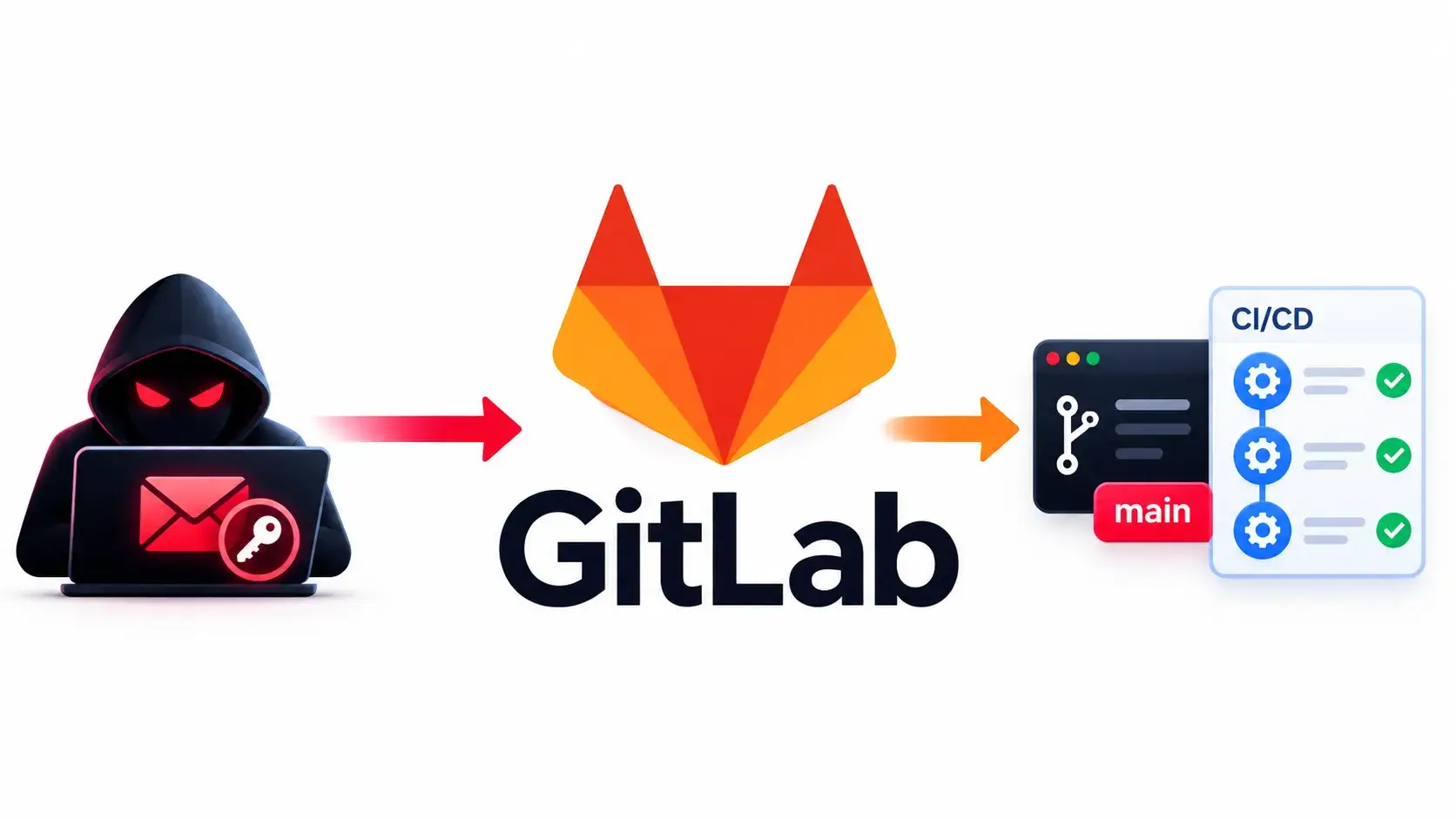
GitLab Email Token Lets Attackers Push Code to Main and Execute CI/CD Jobs

A long-lived GitLab incoming email token embedded in project email addresses for the “Email work item” feature can be exploited to push attacker-controlled code, create merge requests, and trigger CI/CD pipelines using the permissions of the token owner. This issue can also bypass GitLab’s IP restrictions, as incoming email is explicitly excluded from those controls. […]

The post GitLab Email Token Lets Attackers Push Code to Main and Execute CI/CD Jobs appeared first on GBHackers Security | #1 Globally Trusted Cyber Security News Platform.

U.S. CISA adds GitLab, JFrog Artifactory, and ConnectWise ScreenConnect flaws to its Known Exploited Vulnerabilities catalog

U.S. Cybersecurity and Infrastructure Security Agency (CISA) adds GitLab, JFrog Artifactory, and ConnectWise ScreenConnect flaws to its Known Exploited Vulnerabilities catalog.

The U.S. Cybersecurity and Infrastructure Security Agency (CISA) added [1, 2] the following vulnerabilities to its Known Exploited Vulnerabilities (KEV) catalog:

  • CVE-2026-42016 (CVSS score of 8.1) JFrog Artifactory Incorrect Authorization Vulnerability 
  • CVE-2026-42018 (CVSS score of 7.5) JFrog Artifactory Improper Authentication Vulnerability 
  • CVE-2026-84869 (CVSS score of 9.9) ConnectWise ScreenConnect Improper Privilege Management and Missing Authorization Vulnerability
  • CVE-2026-85706 (CVSS score of 10.0) GitLab Community Edition and Enterprise Edition Path Traversal Vulnerability

Two of the above vulnerabilities affect JFrog Artifactory. CVE-2026-42016 can allow attackers to bypass authorization checks and escalate privileges, while CVE-2026-42018 can expose an internal anonymous-user token to unauthenticated attackers. An attacker can chain the flaws to achieve administrative control.

Attackers have already been seen combining the two Artifactory vulnerabilities with another critical flaw tracked as CVE-2026-82329. The attacks, observed between August 15 and September 8, involved taking control of self-hosted servers, creating persistent administrator accounts, deploying malicious plugins and installing backdoors.

The vulnerability CVE-2026-84869 affects the ScreenConnect client. Under certain conditions, attackers can transfer and execute files through an active remote session without authorization or confirmation from the host. Huntress researchers linked the flaw to several incidents in which malicious VBScript payloads were delivered to newly connected systems. ConnectWise recommends updating to ScreenConnect 26.6.5.

The most recent flaw added to the KeV catalog is CVE-2026-85706, a path traversal vulnerability in its repository commits API.

CVE-2026-85706 affects GitLab’s repository commits API and can let attackers access files they should not see. A crafted request may expose SSH keys, database credentials, deploy tokens, CI/CD variables, and other sensitive configuration data.

By September 11, active probing and exploitation attempts were already underway. watchTowr researchers are already seeing in-the-wild probes targeting CVE-2026-85706.

“watchTowr Intel is already observing in-the-wild probes for the latest critical GitLab Path Traversal vulnerability, CVE-2026-85706, which allows attackers to read arbitrary files in a single HTTP request.” the company wrote on LinkedIn.

“Organizations with public-facing self-hosted GitLab instances should patch as soon as possible or remove public access.

Defenders should also hunt through log files for HTTP POST requests to “/api/v4/projects/{id}/repository/commits/” URIs containing “file.path” parameters to identify potential exploitation attempts.”

Given how quickly attackers exploit similar GitLab flaws, organizations should patch immediately or remove public access. Defenders should also check logs for suspicious POST requests to GitLab’s repository commit API containing file.path parameters, which may indicate exploitation attempts.

All Community Edition and Enterprise Edition versions from 18.7 before 19.1.8, 19.2 before 19.2.6, and 19.3 before 19.3.2 are affected. GitLab assigned the vulnerability a CVSS score of 10.0. The same update cycle also patches CVE-2026-87719, an insecure deserialization flaw that could expose advanced search configuration and credentials, providing an additional reason to upgrade rather than look for narrower workarounds.

The detection query is useful because a file.path parameter in a POST request to the commits API can signal an exploitation attempt.

According to Binding Operational Directive (BOD) 22-01: Reducing the Significant Risk of Known Exploited Vulnerabilities, FCEB agencies have to address the identified vulnerabilities by the due date to protect their networks against attacks exploiting the flaws in the catalog.

Experts also recommend that private organizations review the Catalog and address the vulnerabilities in their infrastructure.

CISA orders federal agencies to fix the GitLab and ConnectWise flaws by September 14, 2026, while the remaining JFrog Artifactory issues must be addressed by September 25, 2026.

Follow me on Twitter: @securityaffairs and Facebook and Mastodon

Pierluigi Paganini

(SecurityAffairs – hacking, CISA)

GitLab CVE-2026-85706: One HTTP Request, No Authentication, Full File Read – Exploited Within 24 Hours

CVE-2026-85706, a CVSS 10.0 GitLab path traversal, was under active exploitation within 24 hours of disclosure.

GitLab disclosed CVE-2026-85706 (CVSS score of 10.0) on September 10, 2026, a path traversal vulnerability in its repository commits API.

CVE-2026-85706 affects GitLab’s repository commits API and can let attackers access files they should not see. A crafted request may expose SSH keys, database credentials, deploy tokens, CI/CD variables, and other sensitive configuration data.

By September 11, active probing and exploitation attempts were already underway. CISA has since added the flaw to its Known Exploited Vulnerabilities catalog.

watchTowr researchers are already seeing in-the-wild probes targeting CVE-2026-85706.

“watchTowr Intel is already observing in-the-wild probes for the latest critical GitLab Path Traversal vulnerability, CVE-2026-85706, which allows attackers to read arbitrary files in a single HTTP request.” the company wrote on LinkedIn.

“Organizations with public-facing self-hosted GitLab instances should patch as soon as possible or remove public access.

Defenders should also hunt through log files for HTTP POST requests to “/api/v4/projects/{id}/repository/commits/” URIs containing “file.path” parameters to identify potential exploitation attempts.”

Given how quickly attackers exploit similar GitLab flaws, organizations should patch immediately or remove public access. Defenders should also check logs for suspicious POST requests to GitLab’s repository commit API containing file.path parameters, which may indicate exploitation attempts.

All Community Edition and Enterprise Edition versions from 18.7 before 19.1.8, 19.2 before 19.2.6, and 19.3 before 19.3.2 are affected. GitLab assigned the vulnerability a CVSS score of 10.0. The same update cycle also patches CVE-2026-87719, an insecure deserialization flaw that could expose advanced search configuration and credentials, providing an additional reason to upgrade rather than look for narrower workarounds.

The detection query is useful because a file.path parameter in a POST request to the commits API can signal an exploitation attempt.

After patching, organizations should also rotate any credentials that exposed files may have contained, including tokens, SSH keys, CI/CD variables, and cloud keys. First check for signs of compromise so defenders can identify which credentials need rotation and expand the response if they find evidence of successful exploitation.

GitLab has seen similar path traversal flaws exploited quickly. CVE-2023-2825, which also allowed arbitrary file reads, faced active attacks just days after disclosure. CVE-2026-85706 followed the same pattern, with attackers starting probes even faster than expected.

Organizations should treat the flaw as an urgent threat, not wait for widespread exploitation to begin.

Follow me on Twitter: @securityaffairs and Facebook and Mastodon

Pierluigi Paganini

(SecurityAffairs – hacking, CVE-2026-85706)

❌