Visualização de leitura

Poster Boy: Sanctioned Kinahan Cartel Lieutenant Found Playing Padel in Dubai

This article is the result of a collaboration with The Sunday Times. You can find their corresponding piece here.

Every Friday evening, the brochure says, players can compete to win cash prizes in one of the world’s fastest-growing racquet sports. The padel club in Dubai’s west is the picture of modern wellness culture: climate-controlled courts, a private sauna and ice bath, and one-on-one coaching. The promotional image shows a bearded man in mid-swing, eyes locked on the ball. He wears matching activewear and a golden tan. The poster boy for padel is a talented player who once finished runner-up at an international tournament. He has also spent the past decade living in the shadows.

Left: Ian Dixon has been sanctioned by the US Treasury as part of its action against the Kinahan cartel. Right: Dixon, who appears to live a carefree lifestyle in Dubai, at a racquet sports event post-sanctions. Source: US Treasury, sanddune_padel_dxb / Instagram, asiapacificpadeltour / Instagram

Support Bellingcat

Your donations directly contribute to our ability to publish groundbreaking investigations and uncover wrongdoing around the world.

Ian Thomas Dixon is a key figure in the Kinahan cartel, the Irish organised crime group that authorities say has evolved into a US$1.5 billion transnational network involved in drug trafficking, money laundering and arms smuggling. Investigators have connected the cartel to Iran’s intelligence services and the Lebanon-based militant group Hezbollah. Its feuds with rival gangs have been linked to at least 18 murders across four countries.

Dixon, 36, along with the Kinahan Organised Crime Group’s senior leadership – Christy Kinahan, 69, and his sons Daniel, 49, and Christopher Jr, 45 – was sanctioned by the US government in 2022. Authorities allege the Irishman acted as a trusted lieutenant to Daniel Kinahan, who is said to manage the cartel’s vast drug trafficking operation by helping move bulk cash across Europe, arranging payments and keeping tabs on money owed by a narco-trafficker.

Wanted posters for Irish drugs smugglers Daniel, Christy and Christopher Kinahan Jr, released after the cartel leaders were sanctioned along with four key associates in 2022. Source: US Department of the Treasury

Bellingcat and The Sunday Times can today reveal how Dixon’s racquet sport hobby has left behind a digital trail that led to the most recent footage of him since those sanctions were imposed – the first time he has been pictured publicly in almost a decade. This investigation also uncovers the alias Dixon has used in Dubai and exposes the first open source links to an underworld associate who was recently extradited from the Gulf state and jailed in Scotland.

It comes as cartel leader Daniel Kinahan awaits extradition to Ireland after his arrest in Dubai on foot of a warrant issued by Irish authorities. The arrest, in April, followed an extensive policing and diplomatic effort from international law enforcement.

Bellingcat recently published images of ex-UFC fighter Mounir Lazzez with Daniel and Christy Kinahan at a 2025 MMA event in Dubai. Our investigation also linked Lazzez to multimillion-dollar transactions for crude oil tankers that were later sanctioned by the US. Source: WeCaptureYou, C4ADS Horizons

In March, investigations by Bellingcat and The Sunday Times exposed the first photographs of Daniel Kinahan and his father in years and also revealed that the cartel’s “friend”, former UFC fighter Mounir Lazzez, was connected to US sanctions against Iran.

The latest findings give an unprecedented glimpse into the recent activity of a key cartel associate who, until now, has largely flown under the radar.

Family Ties

When cartel founder Christy Kinahan moved to Spain after his release from an Irish prison in 2001, it wasn’t long before his new home became a hub for the gang. His sons, Daniel and Christopher Jr, soon followed him to the Costa del Sol – as did their younger cousin, Dublin native Ian Dixon.

From the late 2000s onward, Dixon worked for businesses linked to the crime family in the south of Spain. One of these was The Auld Dubliner, a pub in Estepona that reportedly served as a base of operations for the cartel. In 2010, the pub was raided and temporarily closed by authorities as part of Operation Shovel, a years-long multi-national police investigation into the cartel’s drugs and arms-trafficking activities.

Left: Dixon pictured in 2011 behind the bar at The Auld Dubliner in Estepona. Right: Exterior of the pub in 2012 (image highlighted by Bellingcat). Source: Facebook, Google Street View

Dixon would also work as a trainer at MGM Marbella, the boxing gym co-founded by Daniel Kinahan that would go on to represent some of the biggest pro boxers in the world. The company, which was renamed MTK Global, shut down after the US sanctions on the Kinahans were imposed in April 2022.

Top left: Ian Dixon at MGM Marbella in 2013. Top right: Dixon running a pads training session at the gym in January 2015. Bottom: Dixon pictured with Daniel Kinahan and others in Spain in 2013. Source: X, MGM Marbella / YouTube

In 2016, Dixon was arrested by Spanish police investigating the murder of Irish criminal Gary Hutch. The previous year, Hutch had been gunned down while out for a morning jog in a gated community on the Costa del Sol.

Dixon was released without charge, and another Kinahan cartel associate was later sentenced to 22 years for his role in the murder. The killing sparked a feud between the Kinahans and the rival Irish Hutch gang  that resulted in at least 18 deaths. 

Dixon and other key Kinahan members fled to Dubai in the wake of the deadly feud.

CCTV footage of Gary Hutch being pursued by a gunman in southern Spain, moments before Hutch was cornered and shot dead in September 2015. Source: BBC, The Irish Sun

Ian Dixon has no known convictions. But his alleged role in the Kinahan Organised Crime Group was laid bare when the US sanctioned him. Authorities said Dixon managed finances and moved bulk currency for Daniel Kinahan and also kept tabs on the debt owed by a narco-trafficker. 

The sanctions notice also said Dixon controlled Hoopoe Sports LLC, a Dubai firm that listed a number of pro boxers among its clients and reportedly received more than $4 million for bouts involving former heavyweight champion Tyson Fury. Boxing promoter Bob Arum told Yahoo Sports the money was for consulting fees owed to Daniel Kinahan.

Screenshot from a 2022 archive of US-sanctioned Hoopoe Sports’ website, showing pro boxers Jamie Conlan, Billy Joe Saunders, Hughie Fury and Michael Conlan among its clients list. Dixon’s company email address is visible on the footer. Source: arejaywoof / X, archive.org

Dixon lived in an exclusive gated community in Dubai, according to the 2022 sanctions notice. Online listings show that properties like his Spanish-inspired villa are worth up to $2.7 million.

Passion for Padel

Padel is an increasingly popular racquet sport from Mexico best described as a combination of tennis and squash. According to the sport’s governing body, it has more than 17.5 million weekly players across 150 countries and the UAE, where Dixon lives, has the second-highest number of padel courts in Asia. It was on these courts in late 2024 that Dixon played in the master final of the Asia Pacific Padel Tour (APPT).

A pre-match group photo was captured on the APPT male amateur final live stream. The photo, posted to Facebook, shows Dixon was part of the lineup. Source: APPT / YouTube, Facebook, US Treasury

APPT rankings show Dixon registered for the tournament under the name “Ian Thomas”. Like his cartel leader relative Christy Kinahan, who used his first and middle names as an alias on his Google review profile, Dixon had dropped his surname.

Finding a Fugitive – How we Located Dixon

Bellingcat found the padel club promotion showing Ian Dixon after running images of the cartel associate through a publicly available facial recognition search engine. Among the results was a link to a graphic designer’s online portfolio, which included the advertisement for the padel competition. The original photo had been posted on the sports club’s Instagram page in late 2023, with the caption: “Elevating fun, one swing at a time!” Dixon was not named.

Left: The padel tournament ad discovered via a PimEyes search for Ian Dixon. Right: The original picture and caption from the sports club’s Instagram page, posted in October 2023. Source: sanddune_padel_dxb / Instagram

We searched for additional open source evidence and located online profiles for a 36-year-old Irish padel player named “Ian Thomas” who had taken part in a number of matches in Dubai in recent years. One profile shows he played 16 ranked matches between September 2024 and April 2026 – the most recent being the week after Daniel Kinahan’s arrest. But the accounts did not include profile pictures.

Left: Screenshots from an online profile for 36-year-old Irishman “Ian Thomas” & Christy Kinahan’s Google review profile under the name “Christopher Vincent”. Right: Dixon pictured at a padel centre in an Instagram post from August 2024. Source: Rankedin.com, Google Maps, Instagram

Bellingcat searched for footage showing the padel events and venues listed on the profiles. It returned multiple social media posts and live-streams clearly showing Ian Dixon at the same events where “Ian Thomas” was registered as playing. Dixon can also be heard speaking with a Dublin accent and at one point is seen with a close relative of Daniel Kinahan.

Dixon and his doubles partner played four games over the December 13-15 weekend, eventually placing second after losing in the final. The Irish cartel associate is captured on film after the match receiving a silver medal and commemorative racquet.

Clip showing “Ian Thomas” in the final position in the APPT Dubai 2024 male amateur rankings, followed by Dixon on court during the match and receiving a racquet after his silver-medal placement. Source: asiapacificpadeltour.com, asiapacificpadeltour / Instagram

The Asia Pacific Padel Tour was held a month after senior Kinahan cartel figure Sean McGovern was arrested in Dubai on foot of an Interpol red notice. McGovern was extradited to Ireland last year and earlier this month jailed for 24 years for directing the activities of a criminal organisation in relation to murder and attempted murder. 

The tournament was live-streamed to YouTube via webcams set up on two courts. Dixon was captured throughout the three-day event, both playing on the court and mingling with others in the background. The hour-long male amateur final, which Dixon lost, is viewable in its entirety.

Clips from the tournament on December 15 showing Dixon before, during and after the amateur male final. Source: APPT / YouTube

Dixon also posed for photos during the tournament, but it appears he did have some reticence about appearing on social media. In two images from a different padel event hosted at the same venue a few months later, Dixon’s face had been covered. However, a third photo was not edited, confirming that it was Ian Dixon.

Top: Dixon posed for a photo before beginning the APPT amateur male final. Bottom: Dixon’s face was covered with a grey oval and an emoji in two social media posts from a different event. One of the pictures was not censored in another post. Source: APPT / Facebook, isdpadel / Instagram, ISD Dubai Sports City / LinkedIn

Kingpin in the Crowd

Among the people Dixon was seen with at padel events in Dubai was Stephen Jamieson, a Scottish criminal who was recently jailed for his role in a multimillion-dollar drug trafficking operation.

Dixon (left) and Jamieson (right) seen arriving and meeting on a live stream of a Dubai racquet sport event in December 2024. Jamieson was arrested by authorities in the Gulf state the following July. Source: Police Scotland, The Scottish Sun, asiapacificpadeltour / Instagram, APPT / YouTube

Dixon greeted Jamieson with a fist pump during the Dubai APPT tournament in December 2024 on the day the Irishman played in the amateur final.

Left: Jamieson watching padel games on days one and three of the APPT in 2024, when Dixon was also in attendance. Right: Police mugshot of Jamieson. Source: asiapacificpadeltour / Instagram, Police Scotland

Dixon was also pictured with Jamieson at a family day padel event just weeks before the Scottish criminal’s arrest. (Bellingcat is not publishing details of that event to protect the identity of family members.)

Clips from day three of the tournament showing Dixon meeting Jamieson. Both men arrived and left separately at different times. Source:  APPT / YouTube, BBC, The Scottish Sun

Jamieson, who has multiple convictions, was extradited from Dubai last year and is serving a six-year prison sentence in Scotland on organised crime and drug charges. The case against him was built around intercepted messages he had sent via the defunct encrypted communication network EncroChat – a network the Kinahans have also usedto direct drug shipments.

The Sunday Times reports today on the Kinahan cartel’s deeply entrenched links to organised crime in the UK, where it is known to control much of the illicit drug market. It said the footage showing that Dixon and Jamieson know each other could indicate an underworld connection, since cartel cadres do not associate with rival operations.

Dixon is among the remaining cartel figures at large in Dubai, along with Christy Kinahan, Christopher Jr and gang lieutenant Bernard Clancy. Source: US Treasury

Three of the seven alleged key Kinahan cartel figures have been arrested since the US sanctions were imposed. Johnny Morrissey, arrested in Spain in 2022, was later bailed and subject to a travel ban. Sean McGovern was jailed earlier this month and Daniel Kinahan awaits extradition to Ireland after his recent arrest in Dubai. Garda Commissioner Justin Kelly, of Ireland’s police force, recently said the investigation into the Kinahan cartel was ongoing and that authorities were continuing to focus on the other members of the gang.

Ian Dixon did not respond to questions from Bellingcat.


Connor Plunkett, Peter Barth, Beau Donelly and John Mooney contributed to this article. 

Bellingcat is a non-profit and the ability to carry out our work is dependent on the kind support of individual donors. If you would like to support our work, you can do so here. You can also subscribe to our Patreon channel here. Subscribe to our Newsletter and follow us on Bluesky here, Instagram here, Reddit here and YouTube here.

Support Bellingcat

Your donations directly contribute to our ability to publish groundbreaking investigations and uncover wrongdoing around the world.

The post Poster Boy: Sanctioned Kinahan Cartel Lieutenant Found Playing Padel in Dubai appeared first on bellingcat.
Heading Off: New Technique Helps Track Grain Smuggling Expansion to Libya

On February 15, 2026, the bulk carrier, Grumant (IMO: 9385879) was pictured at the occupied Ukrainian Port of Feodosia on the Crimean peninsula. Satellite imagery suggests it had already been there for several days.  It appeared to stock up on grain before departing on a two-month-long journey eventually docking at the Port of Benghazi in Libya on April 18.

While there have been previous reports of grain shipments from occupied Ukraine arriving in Libya, this is only the second time a Russian ship has been observed delivering what the Ukrainian government describes as “stolen” grain to the country. The previous case involved the Damas Wave which travelled in January of last year to the port of Misrata which is under the control of the UN-recognised Government of National Unity (GNU). In addition to satellite imagery, Bellingcat deployed a new technique that analysed Grumant’s heading data which was contained in AIS information provided by Lloyd’s List Intelligence, to help confirm Grumant’s presence in Feodosia. 

Bellingcat has been tracking smuggled Ukrainian grain shipments as they find new markets, five of the ships we previously identified have since been sanctioned by the EU while another was sanctioned by the US Department of Treasury.

MapLibre | Protomaps© OpenStreetMap contributors

Bosphorus Strait

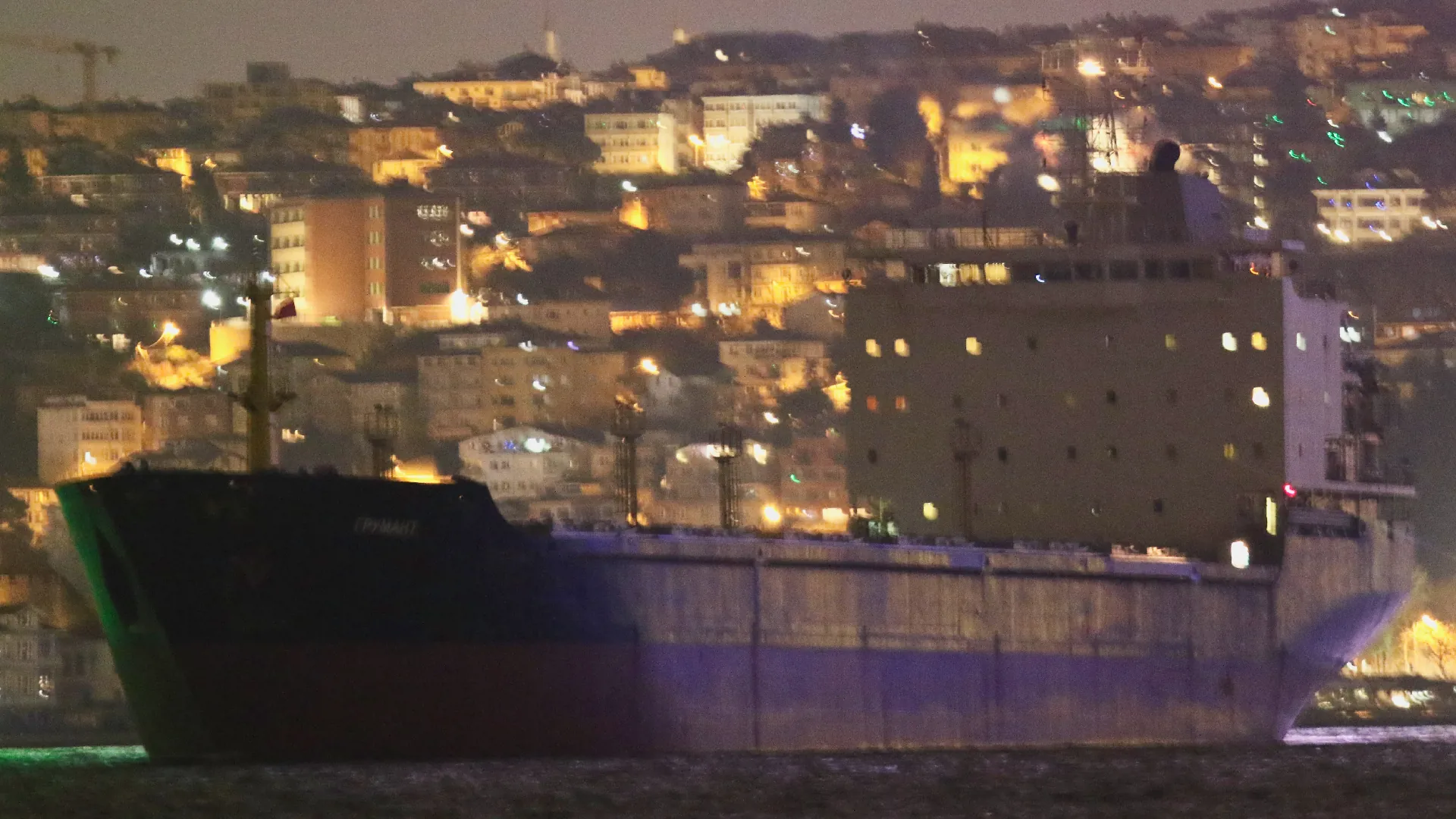
Grumant transits the Bosphorus Strait in the middle of the night.

Credit: Yörük Işık.

Black Sea

Grumant enters a region of the Black Sea known for GNSS interference, meaning that Grumant’s publicly reported Automated Identification System (AIS) position is unreliable.

Port of Feodosia

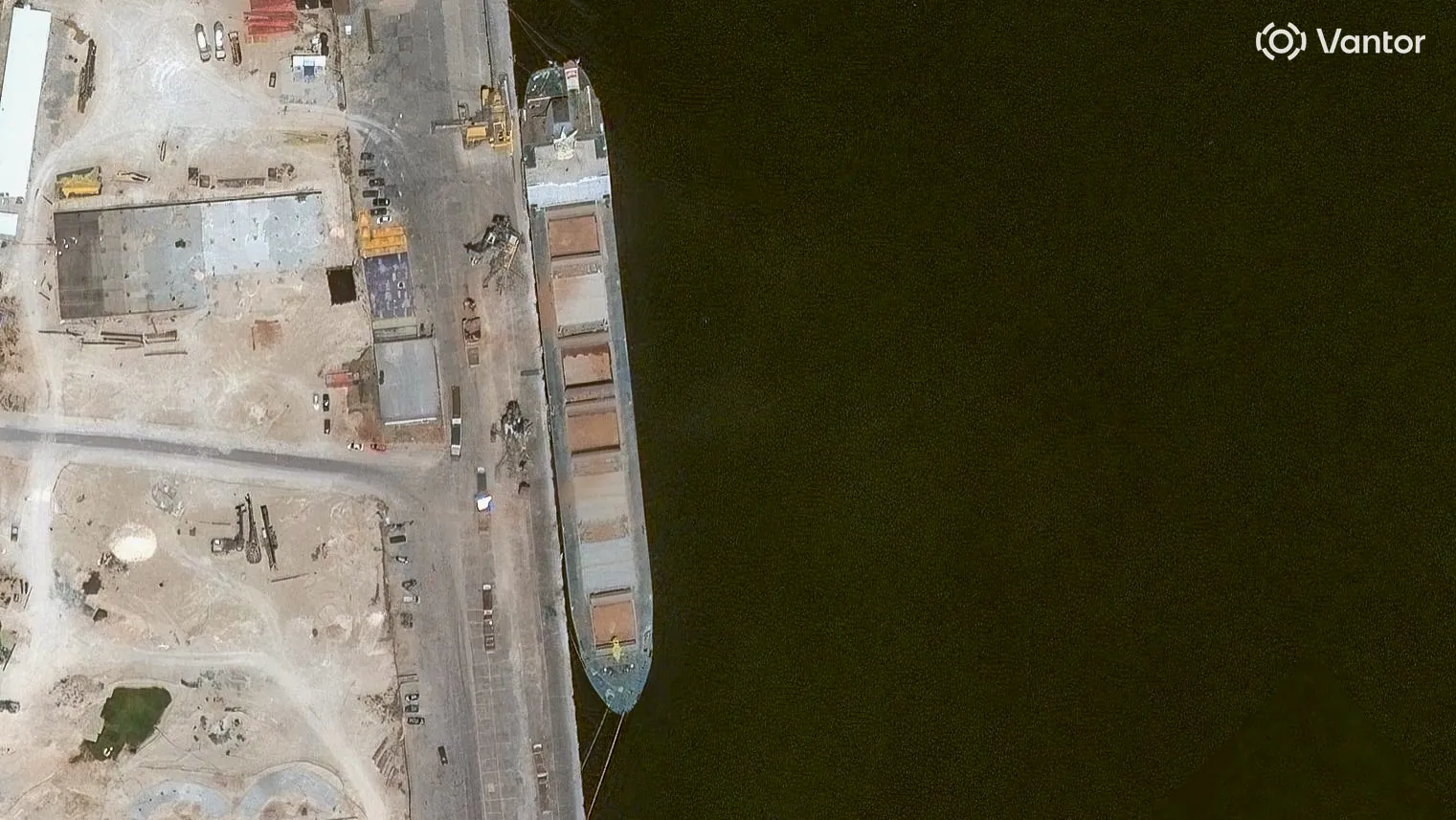
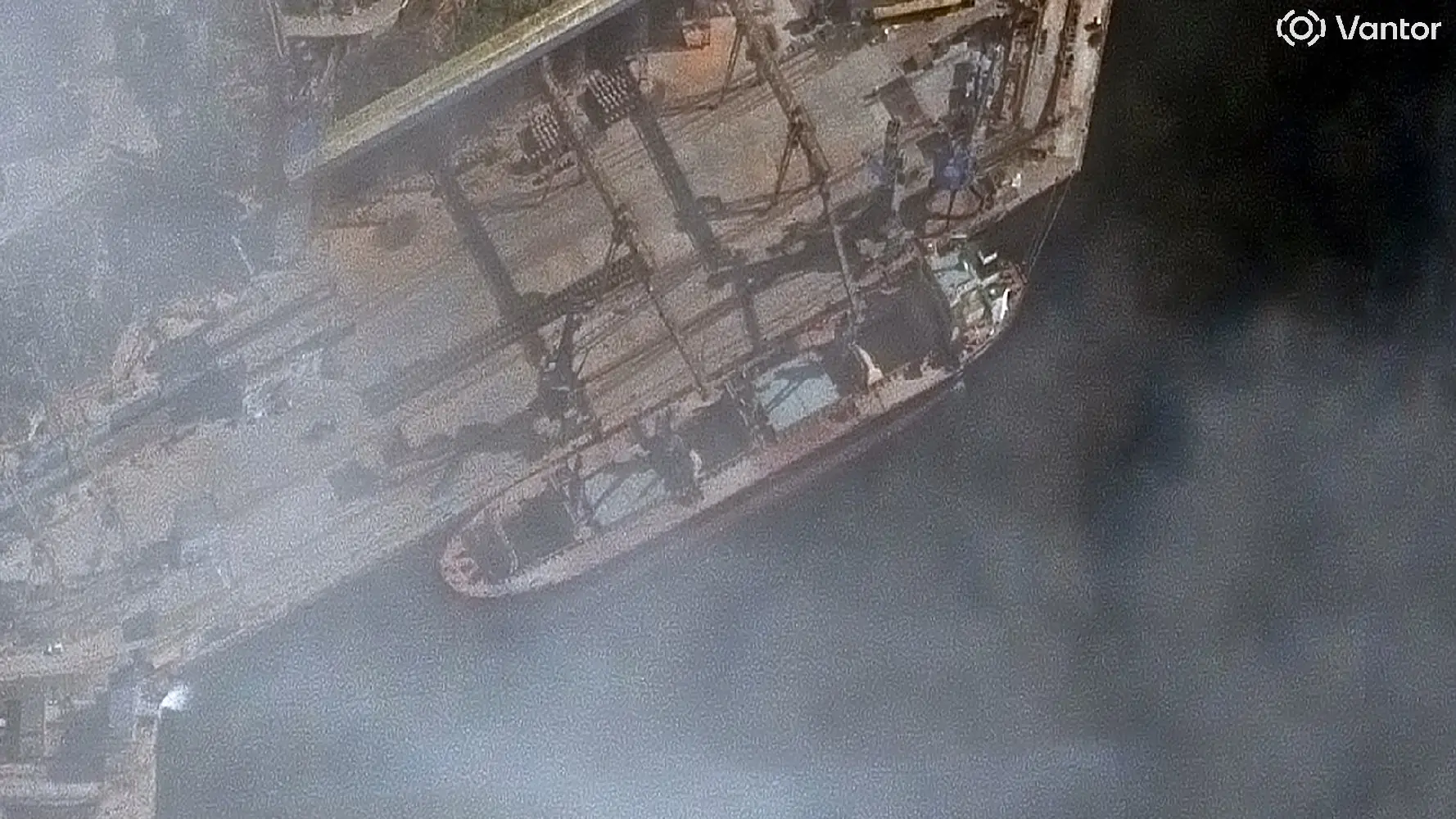
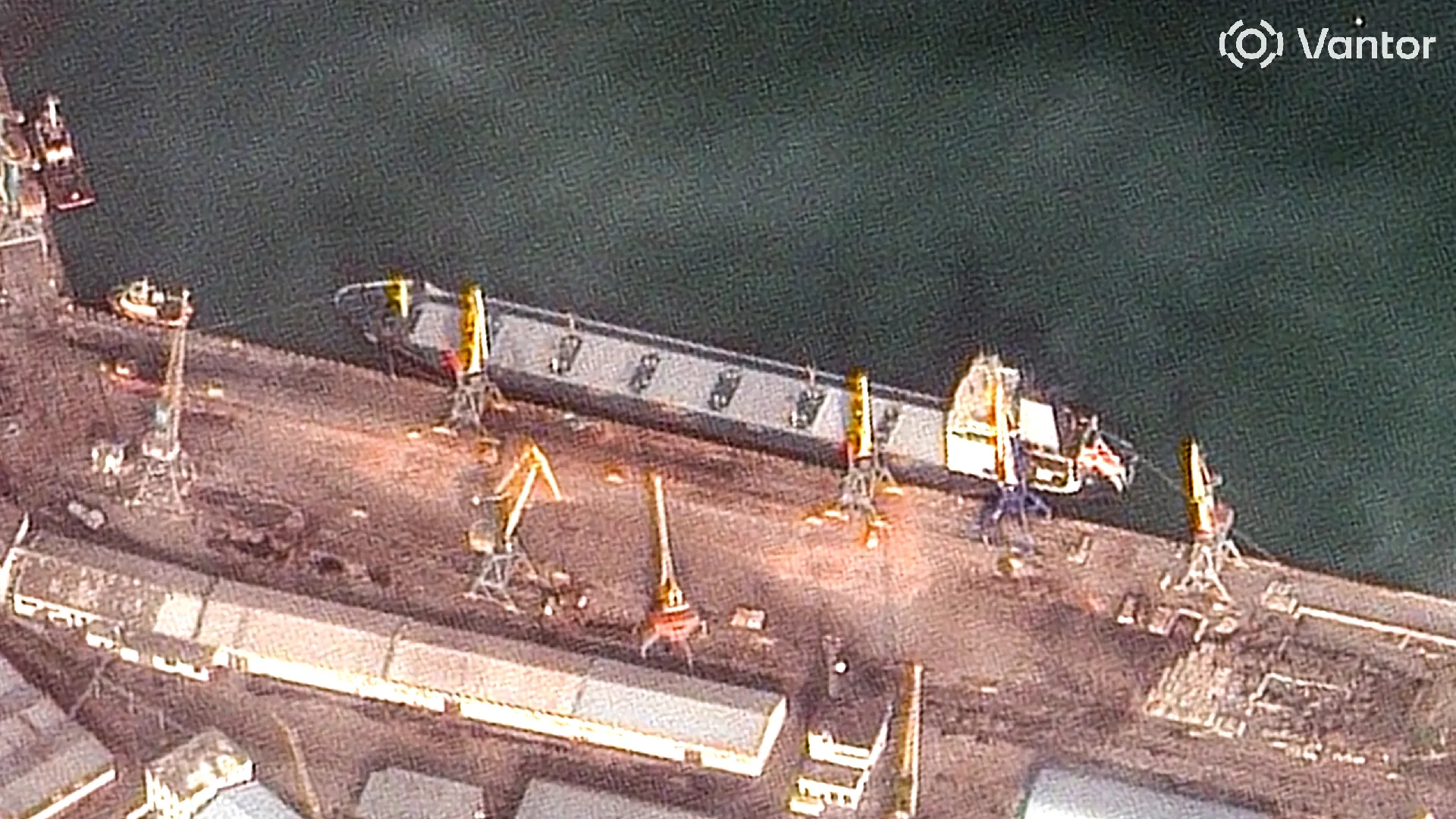
On February 15, a high resolution satellite image confirms the ship is docked at the port of Feodosia at berth No. 1 that is used for bulk and metal cargo. Matching features visible include Grumant’s grey decking, its seven hatches and bright yellow front mast. What appears to be leftover grain can be seen under the two port crates, immediately next to the ship.

Credit: Satellite image ©2026 Vantor.

Black Sea

Grumant exits the area of signal interference, meaning that its reported position on ship tracking services is now reliable again. Its AIS messages indicate it is travelling towards the Bosphorus.

Bosphorus Strait

Grumant transits the Bosphorus Strait towards the Sea of Marmara. Judging by the draft, with no visible red paint on its hull, the ship appears to be fully laden.

Credit: Yörük Işık.

Izmir Anchorage

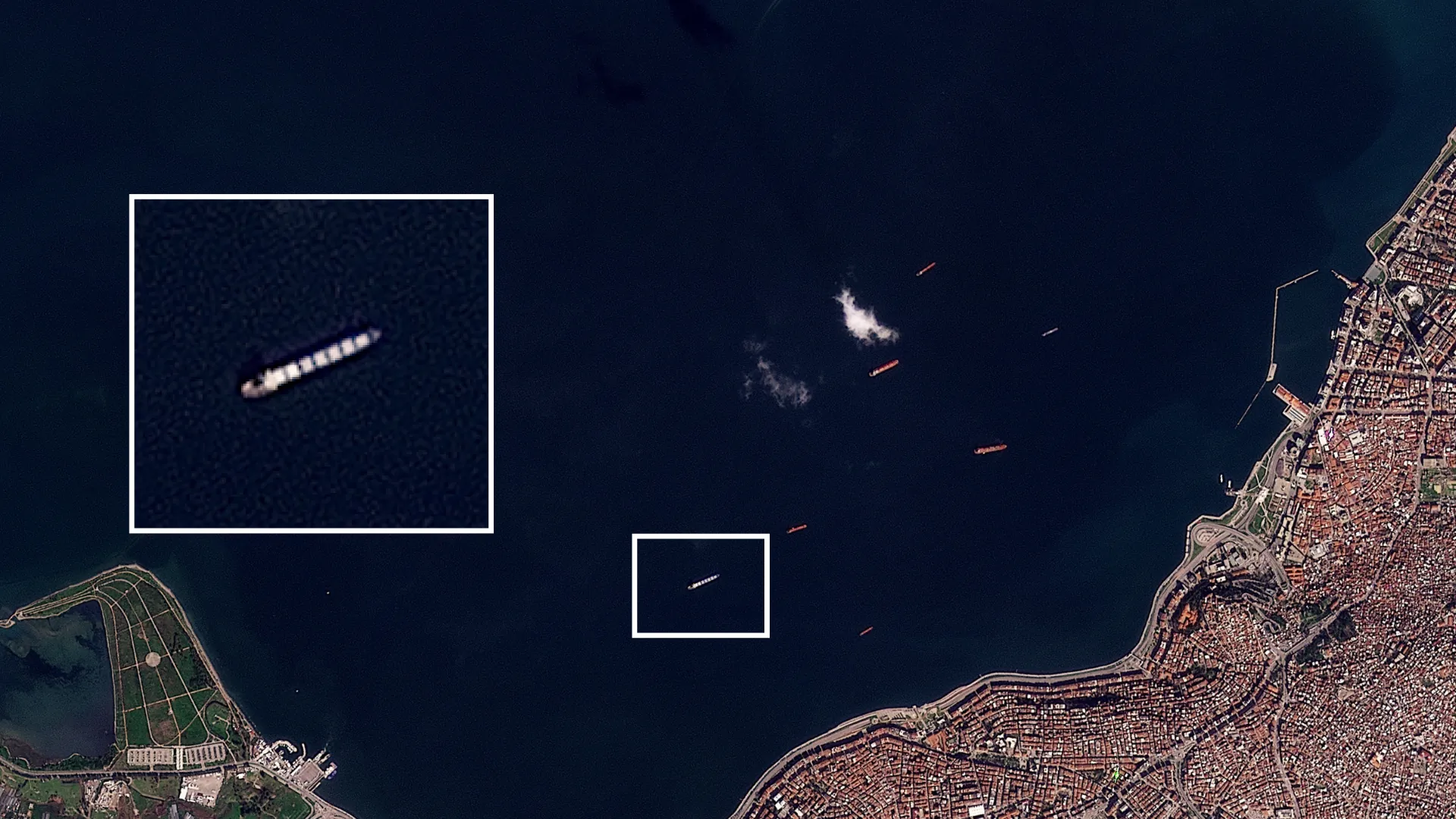
Grumant arrives in Izmir, Turkey on February 23 and anchors off the coast until March 13.

Over the course of three weeks, Grumant never enters the Port of Izmir. It is not known if it was denied entry. Bellingcat asked the port operators but did not receive a response before publication.

Credit: Planet Labs PBC.

Aliağa

Grumant then loiters off the coast of Aliağa, about 50 km from Izmir. It stays here until March 16, never entering the port. It again is not known if it was denied entry. Bellingcat asked the port operators but did not receive a response before publication.

Near Benghazi

Grumant arrives in Libyan waters and stays off the coast of Benghazi until April 1.

Libyan Waters

Grumant briefly leaves the coast of Benghazi, but returns a few days later.

Benghazi

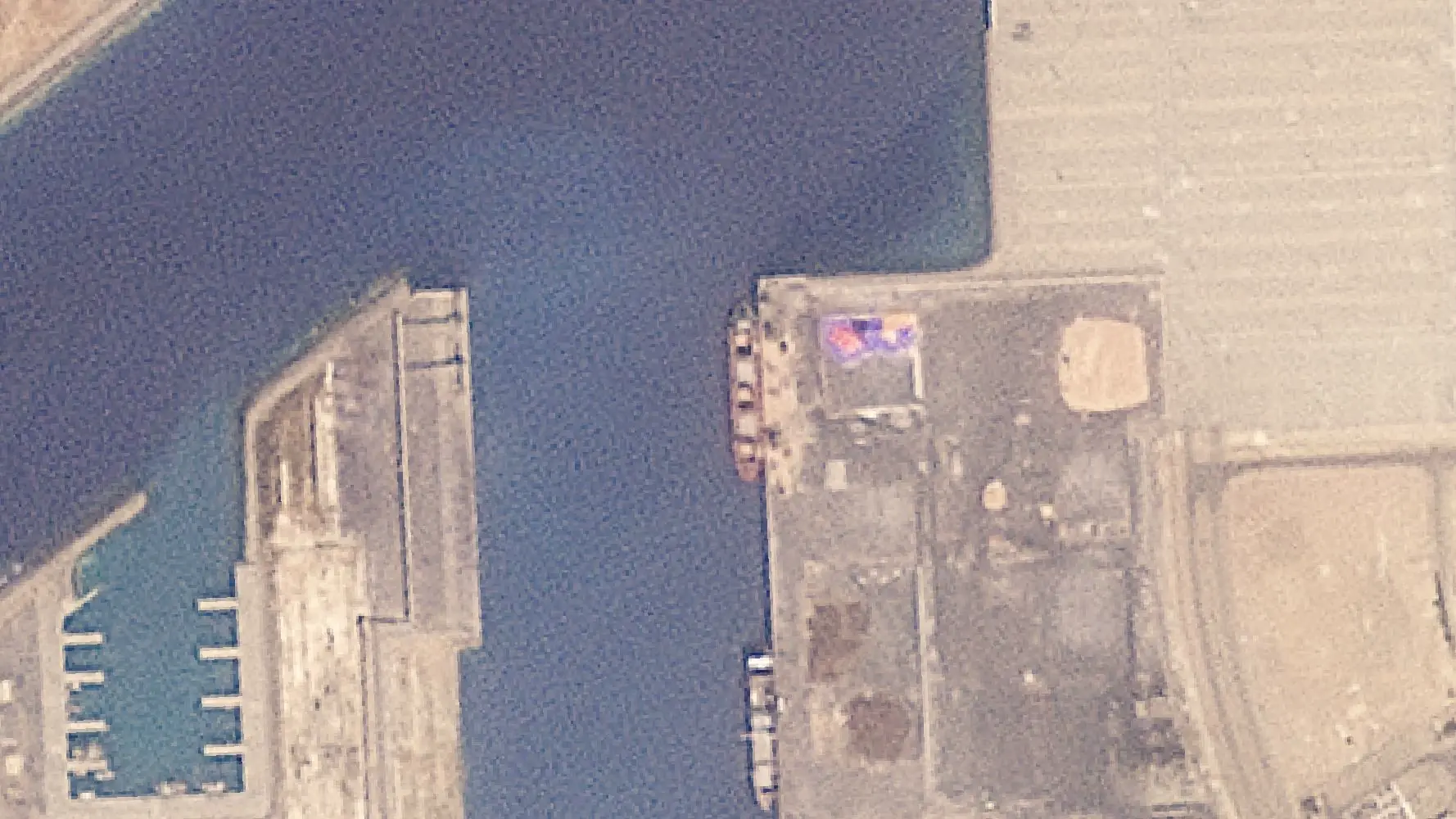
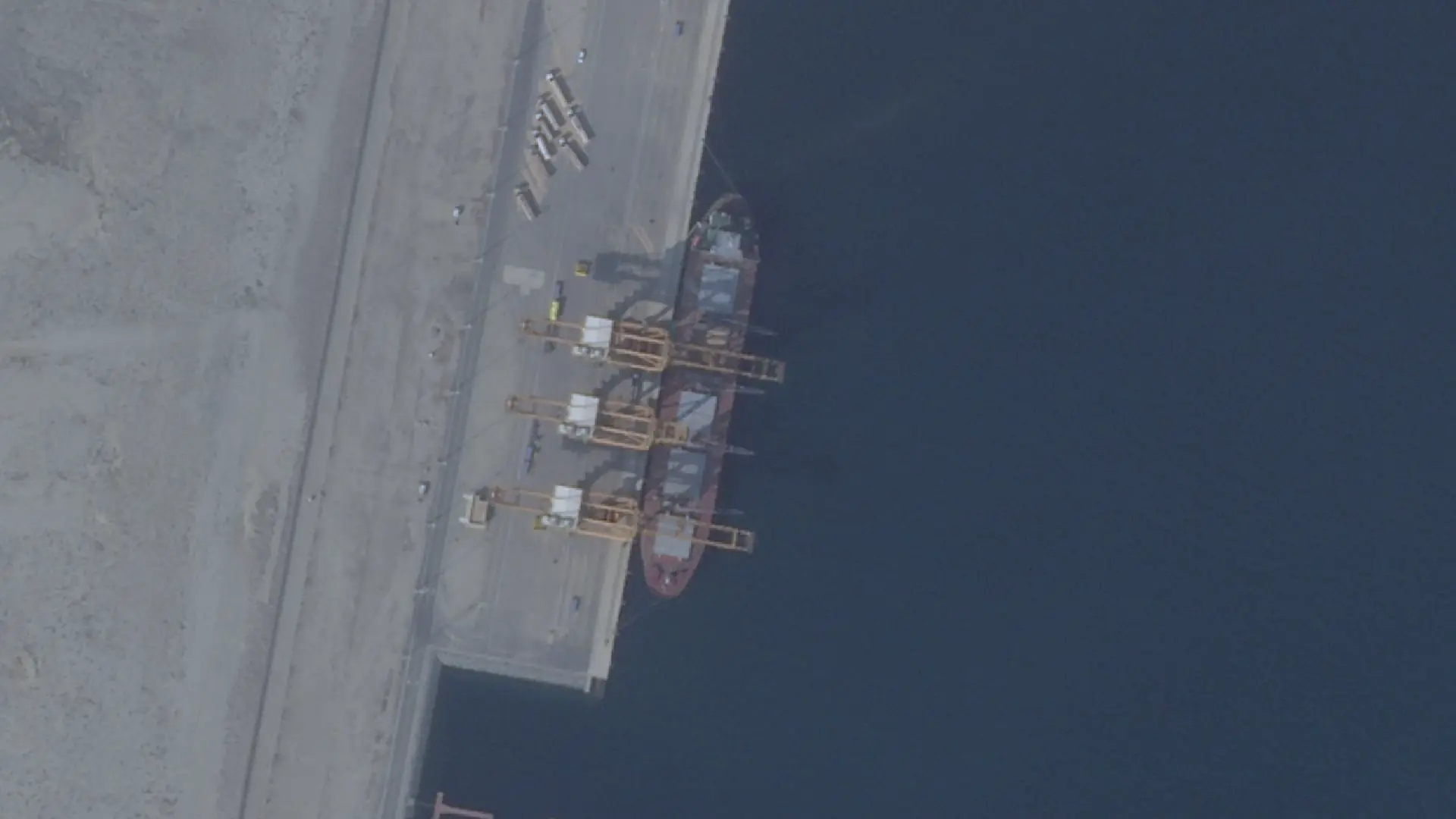
Grumant leaves the anchorage on April 18 and docks at the port of Benghazi where it unloads the grain. The ship was captured in a Vantor satellite image on April 20.

It leaves port on April 23, and heads back towards the Bosphorus.

Credit: Satellite image ©2026 Vantor.

Bosphorus Strait

After spending a few days off the coast of Tuzla, Grumant transits the Bosphorus towards the Black Sea.

Credit: Yörük Işık.

Lloyd’s List Intelligence has previously reported on the expansion of Russia’s grain smuggling operations, beyond the occupied port of Sevastopol to include Feodosia port

According to the Ukrainian activism, journalism and hacker group, Kiborg News, Grumant used deceptive shipping practices to deliver grain to Latakia, Syria in 2024. The report included several of Grumant’s shipping manifests, which showed it had repeatedly exported grain from Occupied Crimea to Syria. 

Heading Data Helps Locate Grumant

It is standard maritime practice that ships broadcast Automatic Identification System (AIS) messages which include a ship’s position, heading, and draught (among other information).

Because of longstanding Global Navigation Satellite System (GNSS) interference in parts of the Black Sea, the position data transmitted by an affected ship’s AIS system is often unreliable.

Between February 7 and February 19, 2026, data from Lloyd’s List Intelligence shows the Grumant transmitted 29 AIS messages, with unreliable positions in the vicinity of Feodosia. We know these positions are unreliable as they are erratic and some of them report the ship as being positioned on land.

Unreliable AIS positions – Grumant’s reported positions between February 7-19, 2026, via Lloyd’s List Seasearcher.

However, according to the IMO, the heading data transmitted by a ship’s AIS system must come from an onboard compass. A compass is unaffected by GNSS interference, meaning it is a more reliable source of information in these conditions.

Over the same dates, all 29 AIS messages reported the ship’s heading as 267 degrees or 268 degrees. The Port of Feodosia has a heading of 267.5 degrees. The close agreement between the ship’s heading and port heading strongly suggests that Grumant was moored at the port between February 7 and February 19, 2026.

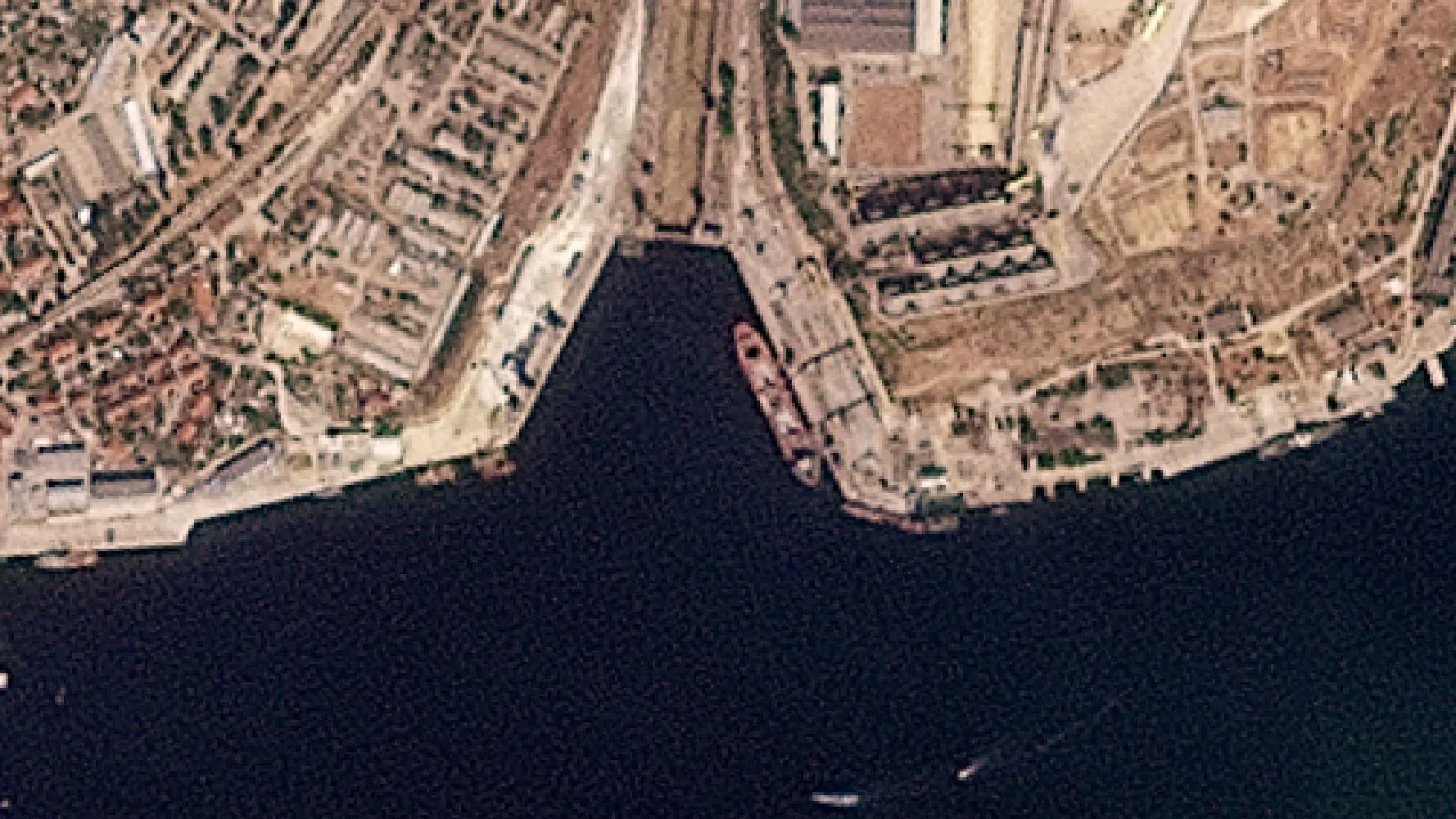
We conducted an extra check of the heading data by reviewing satellite imagery available of berth 1 at Feodosia Port, which suggests that the same vessel was present on several days between February 6 and February 18. Imagery on Feb. 6 shows the port was empty in the morning and occupied in the afternoon. Grumant exited the area of GNSS interference on February 21, and berth 1 at the port was captured on satellite image on February 22 and appeared empty. The low resolution satellite imagery is only used as an additional check to see if a vessel is at the berth.

Timeline of open source observations related to Grumant’s presence (tick) or absence (cross) at Feodosia port. Empty entries indicate a lack of available data.
Sentinel-1 timelapse of Feodosia Port, Copernicus Sentinel data 2026. Annotations by Bellingcat.
PlanetScope timelapse of Feodosia Port, Planet Labs PBC. Annotations by Bellingcat.

Bellingcat checked all vessels transmitting AIS in the vicinity of Feodosia Port and found that Grumant was the only one that consistently transmitted a heading matching the Port of Feodosia over the period of interest.

We shared our research with Charlie Brown, a former US Naval Officer and Senior Advisor at United Against Nuclear Iran where he focuses on maritime sanctions enforcement and the tracking of illicit shipping. Brown told Bellingcat that while satellite imagery of vessels remained key for identification, when looking for reliable data in a spoofing environment it made sense to look at the various elements of AIS data to try and find some accurate information, despite GNSS spoofing.

“It’s quite standard for the independent gyro compass to be providing the heading […] I think the majority would not [be subject to spoofing] so it’s a good methodology to parse out the particular data and then make some inferences from that.”

“It’s neat to think of what can be derived from data that would otherwise be dirty or wrong. So there’s still some elements of use in there.”

He added that in theory there are probably some compasses that are subject to spoofing as well. 

He told Bellingcat that it was fair to say the heading data of the Grumant supported identification, but stressed the need to cross-reference with other data sources. 

While in this instance it has been possible to use AIS data to help verify the location of Grumant, it is relatively unusual to have access to this information. 

Ships that call to the occupied territories frequently disable their AIS transponders to do so.

This activity, known as “dark port calls”, is a common tactic for those engaging in illicit or sanctioned trades. 

Grumant does not transmit AIS messages from February 8 to 11, but this is the longest gap in data (see diagram above), with intermittent messages coming through after that point.

It is unclear why Grumant continued to transmit AIS during the period it was loading in Feodosia. 

A review of Lloyd’s List Intelligence data from January 2025 shows that on a previous voyage to the Black Sea the Grumant operated “dark” for 59 days.  

Visual Identification

On February 15, 2026, high resolution imagery showed Grumant docked in the Port of Feodosia. We compared it with other recent images of Grumant to confirm the match. 

The ship in the satellite image has a grey-coloured deck, which is uncommon enough for it to stand out. Many bulk carriers have cranes (including the ships we previously covered such as Krasnodar, Zafar and Zaid), Grumant does not have any. It also has seven hatches (openings for the grain) and a bright yellow front mast that matches the mast of Grumant (see the image of it transiting the Bosphorus). We can match the Grumant in the Feodosia image, not only to pictures of the Grumant shot from the ground, but also to the satellite image from Benghazi.

The length and breadth of the ship also matches that of the Grumant; 180 metres by 22.90 metres. 

Above: Image of the Grumant transiting the Bosphorus. (In yellow: the mast, red: the seven hatches, green: four vent masts, two on either side). Credit: Yörük Işık. Middle: Satellite image of the Grumant in Feodosia on February 15, 2026. (Matching elements are denoted in the same way as the image above). Bottom: Grumant captured at Benghazi port on April 20. Credit: Satellite image ©2026 Vantor. Annotations by Bellingcat.

Libya’s Relationship with Russia and Ukraine 

Libya has complicated internal dynamics with essentially two administrations in charge of different parts of the country – the Government of National Unity (GNU) in the west and the Libyan National Army (LNA) in the east.

In recent years, Russia has backed the LNA’s General Khalifa Haftar, based out of Benghazi, in the east of the country. But Jalel Harchaoui, a political scientist specialising in Libya with the Royal United Services Institute (RUSI), stressed that the two sides of this conflict, the LNA and the UN-recognised GNU, are not currently fighting. Instead they are in a flawed, multi-year truce.

Therefore, the east-west divide isn’t as clear-cut as during the civil war. While all shipments going to Benghazi and Tobruk are overseen by the LNA, not all shipments going to the city of Misrata (which is run by the GNU) are meant for the GNU-dominated part of the country. 

Harchaoui told Bellingcat: “the Tripoli government is in some regards pro-Ukraine, but if there’s business that can be done with Russia through the very opaque port of Misrata and all the right people get paid, the business is going to take place.”

That observation is potentially significant given at least one previously tracked vessel that went from occupied Ukraine to Libya docked in Misrata.

This was not the case of the Grumant, however, which arrived in an LNA-controlled part of the country. It is not known from open sources alone if the authorities in Libya or at the port in Benghazi knew the grain carried by Grumant had come from occupied Ukraine.

Bellingcat contacted the Benghazi-based LNA government and representatives of the Tripoli-based GNU government via the Libyan Embassy in The Netherlands. We also contacted the Port of Benghazi, Port of Imzir in Turkey as well as the Ukrainian and Russian authorities. Representatives of the LNA did not respond to requests for comment before publication, nor did the Port of Benghazi or Port of Izmir. The Libyan Embassy in The Netherlands replied to Bellingcat after publication, stating that Benghazi and eastern Libya are not under the authority or administrative control of the Government of National Unity and therefore they are not currently in a position to comment on Bellingcat’s findings.

Ukraine Continues to Pursue the “Shadow Grain Fleet”

“The port of Feodosia, located in the temporarily occupied Autonomous Republic of Crimea, is not under Ukrainian control, and any commercial activity conducted there is illegal,” the Ministry for Development of Communities and Territories of Ukraine and the Ministry of Foreign Affairs of Ukraine told Bellingcat in a joint response. 

They told us the loading of grain exported from the temporarily occupied territories is an illegal act and Russia was using ports as logistics centers to export stolen Ukrainian agricultural products.

“The expansion of such routes to third countries, in particular to North Africa, demonstrates Russia’s ongoing efforts to circumvent international sanctions and monetize resources stolen from the occupied Ukrainian territories.” 

The Ukrainian Ministry of Foreign Affairs sent information about Grumant’s (IMO: 9385879) “illegal activities” to the diplomatic missions in Great Britain, the Republic of Turkey and the Republic of Tunisia over the course of March to May this year, the ministries told Bellingcat. 

Ukraine is continuing to pursue legal action against Russia’s “shadow grain fleet” they told us. For instance, earlier this month a Swedish court approved the transfer of the Russian “shadow grain fleet” vessel CAFFA to Ukraine for investigation after it was arrested in Swedish waters. 

This case has set a new precedent, going beyond sanction and fines previously handed out to such vessels, and allowing for the detention and confiscation of a shadow fleet vessel in European jurisdictions, the ministries said.

According to Russian court documents Grumant’s previous owner Murmansk Shipping Company was dissolved and “Decision/Reshenie” LLC were listed as the International Safety Manager and operator of Grumant. Decision/Reshenie were also listed as the operator of Grumant in another court document, from an unrelated case. 

Bellingcat attempted to contact Decision/Reshenie to ask about Grumant’s grain shipment from Feodisia Port to Benghazi Port, but they had not responded at time of publication.


Youri van der Weide, Galen Reich, Yörük Işık and Bridget Diakun contributed to this report.

Cover image: Planet Lab image shows Grumant anchored off Izmir, Turkey on February 27. Credit: Planet Labs PBC.

Bellingcat is a non-profit and the ability to carry out our work is dependent on the kind support of individual donors. If you would like to support our work, you can do so here. You can also subscribe to our Patreon channel here. Subscribe to our Newsletter and follow us on Bluesky here, Instagram here, Reddit here and YouTube here.


The post Heading Off: New Technique Helps Track Grain Smuggling Expansion to Libya appeared first on bellingcat.

Tracing Digital Links Between Viory and Ruptly

“In the age of misinformation, the line between fact and fiction is blurrier than ever.”

“For those of us working in video news, verification isn’t a nice-to-have. It’s a necessity. It is how we protect the stories we help shape and how we earn and maintain trust in an increasingly chaotic information ecosystem,” Abu Dhabi-registered video news agency Viory posted on LinkedIn on April 9, 2026, offering training to help newsrooms and journalists sort fact from fiction. 

The self-described “video news agency of the Global South” has delivered journalism training to multiple national press agencies across Africa, Asia and the Middle East.

However, when it comes to Viory itself, the line between fact and fiction is very blurry indeed. 

Bellingcat has found multiple links between the digital infrastructure of Viory and Ruptly news agency, a branch of sanctioned Russian propaganda outlet Russia Today, including shared IP addresses, a Viory-linked site using a digital security certificate registered to Ruptly, and Ruptly sending site performance data to Viory. While there have been previous reports on suspected links between the two outlets, our investigation adds new evidence about Viory’s ties to Ruptly media. 

When contacted for comment, both Viory and Ruptly denied any connection with each other.

Composite Image created by Bellingcat.

‘Video News Agency of the Global South’

Viory’s main offering is raw video footage of news events provided via subscription. According to Viory, its clients include “major international news outlets, local media organisations, and independent creatives in more than 170 countries”.

If its own figures are to be believed, Viory was strikingly well established at its launch in November 2023, by which time it claimed to have a “pre-assembled team of over 150 full-time staff, and an established network of over 3,000 video journalists across the world”.

The name “Viory” is a trade name. The company’s legal name is Darpo Vision FZ LLC, according to its website, which also states that it is registered in Abu Dhabi. In August 2024, Darpo Vision FZ LLC filed for a trademark in the US for the name Viory, which was approved in December of 2025

As of May 2026, Bellingcat found press releases and news reports referencing at least 30 agreements between Viory and partners in more than 22 countries, as well as cooperation agreements with government agencies, training agreements with universities and regional journalism bodies. 

This includes:

Viory also sponsored a glitzy event for its inaugural Global South Video News Awards in December 2025 at Abu Dhabi’s first-ever BRIDGE Summit.

Ruptly Revisited

Ruptly is a video news agency formerly based in Berlin and ultimately controlled by Russia Today (RT), which is owned by Russian state media company ANO TV-Novosti. ANO TV-Novosti has been on the EU sanctions list since December 2022 for spreading “pro-Kremlin propaganda and disinformation” and supporting Russia’s war against Ukraine. 

RT launched Ruptly, which operated in Berlin via a German-registered subsidiary in 2013, with the goal of “becom[ing] the go-to alternative resource in a highly concentrated market of professional news video footage, and to deliver coverage of stories that other agencies miss.”

Sanctions imposed on RT following Russia’s 2022 invasion of Ukraine choked off Ruptly’s source of funds in Germany, leading the German company to begin insolvency proceedings in October 2024. Ruptly continues to operate from Moscow as of 2026.

As with Viory, Ruptly’s main offering is providing raw news footage to subscribers around the world. It relies on a large network of international freelancers and stringers. In 2016 RT claimed that Ruptly had “surpassed” newswire services AFP and Reuters on YouTube, and was serving more than 600 media organisations in 45 countries.

Felix Huesmann of the German outlet RedaktionsNetzwerk Deutschland (RND), was the first to outline links between Ruptly and Viory while covering the insolvency proceedings of Ruptly. He found that Darpo Vision’s original details on the Abu Dhabi Creative Media Authority’s site included an email address d.toktosunova@gmail.com. It has not been confirmed who this email address belongs to; however, the username matches the first name initial and surname of Dinara Toktosunova, the managing director of Ruptly. When asked about this email address by Huesmann  in 2024, Ruptly “explained that Toktosunova is focused on securing the future of the Ruptly team [in Moscow] and is not working anywhere else as a managing director.”The activist group, OSINT For Ukraine, also outlined links between Ruptly and Viory, including the movement of multiple key staff between the two organisations and strong similarities between the two organisations’ platforms and content.

Darpo Vision’s Security Certificate

The legal entity behind Viory, Darpo Vision, was set up in one of Abu Dhabi’s free zones – special economic areas that have business-friendly incentives such as tax exemptions and that allow 100 percent foreign ownership. The free zones also offer what some describe as high levels of “corporate privacy,”  which others assert has created a haven for shell companies and opaque corporate structures.

Darpo Vision initially had its own web domain, darpo.vision. The site has since been removed. Whois records show that the domain was registered by Darpo Vision FZ LLC in December 2022 to a PO Box in Abu Dhabi, using a Russian domain name registrar and a Moscow phone number. 

Initially, Darpo.vision had its own Secure Sockets Layer (SSL) certificate – a digital certificate that authenticates a website’s identity, allowing it to secure and encrypt data. However, VirusTotal data shows that as of at least June 2024, darpo.vision was using a wildcard SSL certificate registered to ruptly.video. A Wildcard SSL certificate is a single certificate with a wildcard character (*) in the domain name field. This allows the certificate to secure a single domain and multiple subdomains. You can see historical SSL certificates for darpo.vision.


James Wilson, a software and networking engineer with 20 years of experience and currently Enterprise Technology editor at Risky Business Media, told Bellingcat that to prevent unauthorised use or forgery of SSL certificates, a private key is needed to create and use a wildcard certificate across multiple domains. 

“The fact that darpo.vision was using a wildcard SSL certificate for ruptly.video indicates that whoever was running darpo.vision also had access to the private key for ruptly.video’s SSL certificate. Normally, only the people operating Ruptly’s web hosting infrastructure would be likely to have access to that,” Wilson explained. 

When asked by Bellingcat about whether there were alternative possible explanations, Wilson suggested that it was theoretically possible that someone may have hacked Ruptly and stolen their private SSL key. 

“However, using that wildcard SSL certificate on a domain that didn’t match the wildcard in the certificate defies explanation as the browser would alert the user to the certificate error,” he added.

Shared IP Addresses

Bellingcat also identified multiple shared IP addresses which appeared to be concurrently in use by both Ruptly and Viory between May 2025 and May 2026. 

From 2025 onwards, the Russian IP address 158.160.132.25 has been used concurrently by viory.video, ruptly.video, ruptly.agency and ruptly.tv, according to VirusTotal. Similarly, since the beginning of 2026, IP address 84.252.135.88 has been used concurrently by viory.video, viory.team, ruptly.video, ruptly.agency and ruptly.tv, according to VirusTotal. 

VirusTotal data shows that from 2025 onwards, IP address 158.160.166.22 has been used by ruptly.video and viory.video while from 2026 onwards, IP address 158.160.226.68 has been used by viory.video and ruptly.tv. The VirusTotal data appears to show these IP addresses being used exclusively by Ruptly and Viory as of 2025 and 2026. However, VirusTotal does not necessarily capture all domains which resolve to an IP, and other domains may also have resolved to these IP addresses, which were not observed by VirusTotal’s passive DNS replication service. It is also important to note that in some cases, unrelated domains use the same IP addresses.

Ruptly Sends Site Performance Data to Viory

Viory’s and Ruptly’s site infrastructure was also linked through data sent via Sentry, an internal error tracking and performance monitoring platform. 

An API scan of Ruptly’s main client login page, ruptly.agency, on March 26, 2026, shows that the page was sending data to a subdomain of viory.team. This domain appears to be used by Viory primarily for backend purposes, based on subdomains which appear to refer to common developer and site management tools such as Traefik and ArgoCD, in addition to Sentry.io. Notably, two subdomains also appear to refer to Ruptly. 

The purpose of one domain sending data to another domain’s Sentry project is generally to consolidate all of the relevant performance and error data in one place for in-house developers to monitor. 

The ruptly.agency page’s request to viory.team also includes an authentication key for Viory’s Sentry project. Ruptly.agency is not the only Ruptly domain sending Sentry data to viory.team. As of May 9, 2026 the login page for ruptly.video’s own Sentry project, sentry.ops.ruptly.video, automatically redirects to sentry.ops.ruptly.video/auth/login/viory/. Ruptly Video’s Sentry login page also features “Viory” as the title.

The ruptly.video Sentry login page is also sending data to the viory.team Sentry project, the ruptly.agency homepage and using a favicon hosted on viory.team.

A third Ruptly domain, ruptly.tv, also sends performance data to viory.team’s Sentry project via cms.dev.ruptly.tv. 

James Wilson noted that in each case, the Ruptly domains sending data to Viory appeared to be using a different Sentry key.

“If you look at each of these snippets sending telemetry data [from the Ruptly domains], the specific Sentry keys for sentry.ops.viory.team are different for each. I presume that someone with access to Viory’s Sentry keys has generated and included fresh Sentry keys in each of these instances in order to differentiate between the telemetry from this site versus others using the same Sentry instance,” Wilson said. 

“This cuts against the idea that this is, for example, a case of someone just lazily copy-pasting code on Ruptly’s domains. It suggests that each of these snippets was likely to have been deliberately included. The alternative explanation of changing these API keys to some arbitrary value seems much less plausible given the lack of diligence in ensuring other aspects of the content didn’t cross-reference the domains.”

‘Ruptly’ Page Title on Viory Test Page

Finally, Bellingcat found a page at frontend.dev.viory.video/en that appears likely to be a developer test page for the front page of Viory’s main domain viory.video.

Notably, however, the page title reads “Stream trending news | Ruptly.” The page description included in the source code also refers to Ruptly:  

“Follow breaking world news in real-time and stream the latest developments in politics, sports, finance, science, tech, and more from one of the top online news sites. Download and share international news today with award-winning news agency Ruptl” [sic].

Screenshot of frontend.dev.viory.video/en page, captured May 10th 2026. Archived source.

Wilson said that the use of the Ruply page title and text on the Viory test page “looks like a case of lazy copy and pasting”.

“That could potentially be done by someone outside of Ruptly, although it would be strange.”

While this particular piece lies on the lower end of the spectrum of proof, Wilson said that together with the other stronger pieces of evidence, including multiple Ruptly domains appearing to send data to Viory using different API keys, and Ruptly’s wildcard SSL certificate on Darpo Vision’s site, the weight of evidence for a connection between Ruptly and Viory adds up.

“None of the pieces of evidence are watertight on their own, but when you add them together it’s difficult to think of other plausible explanations for all of them being true at the same time,” he added.

“None of the pieces of evidence are watertight on their own, but when you add them together it’s difficult to think of other plausible explanations for all of them being true at the same time,”

-James Wilson

Bellingcat also found that Ruptly appears to have connections to a company in Hong Kong. Company records from July 2022 indicate that this company was originally named Ruptly Limited, but in September of that year, the company’s name was changed to Lotus Production Limited. 

The Hong Kong company remains registered as active and filed annual reports in September 2025.

Russian Slant in the ‘Global South’ 

Anna Hiller, a Bangkok-based Consultant Research Analyst for the Institute for Strategic Dialogue told Bellingcat that the resources provided by Viory can be an attractive pool of source material for smaller media outlets, governments and academic institutions with small budgets.

She told Bellingcat that Viory’s editorial choices are clear when looking at the site’s videos.

“When accessing Viory, the prominence of pro-Russian and pro-China content is immediately noticeable, including numerous articles focused on Vladimir Putin, Russia-China cooperation, and broader China-related narratives.”  

Bellingcat contacted Viory, Darpo Vision and Lotus Production Limited to ask about the connections we found between the Viory website and Ruptly and between Lotus Production Limited and Ruptly. 

Viory said that it had no connection with Ruptly. “Viory has no connection with Ruptly; any suggestion otherwise based on ordinary use of similar digital platforms, tools or cloud providers is poorly founded and inaccurate; Viory is a UAE-based, privately held, self-funded and 100% privately owned organisation, and receives no funding, direction or instructions from any state media,” the company said in an email response. 

Ruptly also said it was not connected to Viory. It declined to respond to Bellingcat’s questions, including about specific findings such as Ruptly’s domains sending technical performance and error data to Viory, calling these questions “irrelevant”.


Bellingcat is a non-profit and the ability to carry out our work is dependent on the kind support of individual donors. If you would like to support our work, you can do so here. You can also subscribe to our Newsletter and follow us on Bluesky here, Instagram here, Reddit here and YouTube here.

The post Tracing Digital Links Between Viory and Ruptly appeared first on bellingcat.

Satellite Imagery Shows Ongoing Demolitions Across Southern Lebanon

The fragile ceasefire agreed between Israel and Hezbollah last month is holding. 

But satellite imagery shows that at least 46 of 54 towns and villages within the Israel Defense Forces (IDF) “Yellow Line” in southern Lebanon have been heavily damaged or, in some cases, entirely flattened

Much of the destruction and demolition has taken place in recent weeks.

Bellingcat’s satellite imagery analysis examined towns and villages identified on OpenStreetMap, a community-driven map database. Medium resolution PlanetScope satellite imagery covering each of the locations was provided by Planet Labs, a US company that recently restricted some of its imagery in the Middle East.

Bellingcat is sharing the annotated PlanetScope imagery for the dates of March 2 and May 8, 2026, showing the scale of damage that has occurred during roughly the first two months of the US-Israeli war against Iran.

The towns and villages detailed in the map are colour coded. Red shows locations  that have suffered varying degrees of damage or destruction, while yellow shows locations that were damaged prior to the US-Israeli war with Iran. White shows locations that have not been significantly damaged at time of publication.

Scroll and zoom to see damage throughout southern Lebanon in each of the date tabs. The first image is from March 2, 2026, shortly after the US and Israel attacked Iran. The second image is from May 8, 2026, more than two months after the start of the war and amid a fragile ceasefire between Israel and Hezbollah. PlanetScope imagery via Planet Labs PBC.

Israel’s Defence Minister, Israel Katz, is reported to have stated that “all homes in Lebanese villages near the border will be destroyed — in accordance with the Rafah and Beit Hanoun model in Gaza”. The aim, Katz said, is to “remove, once and for all, the threats near the border”. Israel has adopted similar methods of flattening buildings and homes close to Israel’s border in Gaza.

The large-scale destruction in southern Lebanon has been reported by multiple outlets including the BBC, CNN, SkyNews and The New York Times. These reports have shared images from several towns and villages, but Bellingcat is publishing satellite imagery for the entirety of southern Lebanon. The changes between the two dates show the scale and pace of destruction.

Take our survey

Help shape the future of our collective.

Within the Yellow Line  — the area occupied by the IDF since a ceasefire was agreed between Hezbollah and Israel on April 16 —  some towns were reported already destroyed or heavily damaged during the 2024 Israeli invasion of southern Lebanon. Some — like the coastal border town of Naqoura or the southeastern border town of Kfar Kila — have now been largely demolished. This is visible in both the medium-resolution PlanetScope imagery, and in high-resolution imagery obtained from Airbus by the BBC.   

Everything south of Lebanon’s Litani and Zahrani Rivers has been under evacuation orders issued by the IDF since early March, with regular updates warning residents to leave ahead of airstrikes. 

Much of the destruction within the “Yellow Line” appears to be from either controlled demolitions using explosives or construction vehicles. The IDF has shared numerous videos showing large-scale demolitions conducted in the towns and villages in southern Lebanon, while videos shared elsewhere on social media show the aftermath — large parts of towns like Beit Lif or Kheim reduced to rubble. 

One particularly large explosion took place in the small village of Qantara, where the IDF says it found two large tunnel systems built by Hezbollah. 

The tunnels were detonated with 450 tonnes of explosives, leaving large parts of the village obliterated. Another video released by the IDF showed some of the few remaining buildings in the nearby village of Aadashit being demolished with explosives. The IDF claimed the buildings were “Hezbollah infrastructure”.

Before and after imagery from Planet Labs shows the villages of Qantara and Aadshit in southern Lebanon on March 2 and April 30, 2026. The April imagery shows the aftermath of two large demolitions conducted by the IDF. Large parts of both villages have also been demolished. The UNP 7-1 label details the position of a UN peacekeepers facility.

Bellingcat contacted the IDF for comment on the details in this story but did not receive a response before publication. 

A full size version of the map can be found here.


Bellingcat is a non-profit and the ability to carry out our work is dependent on the kind support of individual donors. If you would like to support our work, you can do so here. You can also subscribe to our Newsletter and follow us on Bluesky here, Instagram here, Reddit here and YouTube here.

The post Satellite Imagery Shows Ongoing Demolitions Across Southern Lebanon appeared first on bellingcat.

“Make Iran Ungovernable” – Tracking Efforts To Destroy Iran’s Police Infrastructure

Bellingcat has identified at least 80 police stations or infrastructure related to law enforcement agencies and the Basij paramilitary group that has been damaged or destroyed in the first three weeks of the United States and Israel’s war against Iran. Experts told Bellingcat that both countries aim to degrade the Iranian regime’s “repressive capacity”.

Combined, the US and Israel have conducted thousands of strikes during the course of the 2026 war in Iran. Targets range from Islamic Revolutionary Guard Corps (IRGC) sites, Navy vessels to Iranian weapons manufacturers.

In early March, a Bellingcat analysis using satellite imagery and available photos and videos identified police stations as another apparent target, with at least 15 damaged or destroyed in the capital, Tehran.

We also identified multiple strikes against police infrastructure in the country’s north and west; these areas were targeted by the Israel Defence Forces according to a map released by the IDF on March 31.

“We are providing the brave people of Iran with the conditions to take their destiny into their own hands,” declared the Israeli Ministry of Foreign Affairs official X account, along with a photo of a destroyed police station.

اینجا کلانتری ۱۲۱ سلیمانیه در خیابان نبرد تهران بود.

ما شرایطی را برای مردم شجاع ایران فراهم می‌کنیم تا سرنوشت خود را در دست بگیرند. pic.twitter.com/VSm6YVvIwZ

— اسرائیل به فارسی (@IsraelPersian) March 5, 2026

In all, the majority of strikes Bellingcat analysed focused on police stations (30 incidents) and command centers or headquarters (29 incidents). Locations also include sites related to Basij, a plainclothes paramilitary organisation (9) affiliated with the IRGC that were “involved in the deadly crackdown” of protests in January 2026, others are associated with special forces (3) and traffic (2) or diplomatic (2) police compounds.

Related articles by Bellingcat

Satellite Imagery Reveals Strikes on Iranian Police Stations
Investigations

Satellite Imagery Reveals Strikes on Iranian Police Stations

Due to commercial satellite companies limiting access to imagery over Iran and neighbouring countries we relied on Sentinel-2 imagery data to help verify the incidents, as well as videos and photos, some of which were also verified by independent geolocators and contributors to the Geoconfirmed volunteer community and confirmed by Bellingcat researchers. 

Location data was partly determined using open source mapping data either from Wikimapia, OpenStreetMap or Google Maps. When video footage or photos were available for incidents reportedly targeting police stations, the location was verified with geolocation and satellite imagery analysis using either Planet Labs medium resolution PlanetScope data (restricted to imagery collected by March 9) or low resolution Sentinel-2 data.

Some locations were discovered utilising location data taken from OpenStreetMap using Overpass Turbo and comparing that with available Sentinel-2 data throughout Iran.

Map showing geolocated incidents in Iran. Click the markers to view the coordinates, sources, and verification notes. Map: Bellingcat/Miguel Ramalho

A Problem of Scale

Israel has released multiple videos showing the targeting of bases and checkpoints belonging to the Basij. In mid-March, the IDF announced the killing of the paramilitary group’s commander, Gholamreza Soleimani. 

Targeting the Basij is part of Israel’s and the US’ agenda “to degrade the regime’s repressive capacity,” Ali Vaez, the director of International Crisis Group Iran Project, told Bellingcat. Police stations are “not involved in repression in the way that crowd control police or Basij centers are”, so targeting them “appears more aimed at preventing the Islamic Republic from being able to maintain control internally,” he said.

Support Bellingcat

Your donations directly contribute to our ability to publish groundbreaking investigations and uncover wrongdoing around the world.

Vaez told Bellingcat that, when considered alongside the broader range of targets, including industrial factories, the widespread targeting of police stations is part of a strategy “to make Iran ungovernable for the existing regime or whatever comes after”. 

Vaez was skeptical about the short term effects: “It’s a problem of scale. Iran is such a large country, even if you are able to completely destroy, not just degrade, the capacity of the regime in policing, oppressing, etc – it really requires not just maybe weeks but maybe months if not years.”

The Risk of Civilian Casualties

As of April 7, the Iranian Human Rights Activists News Agency estimates there’ve been more than 1,700 civilian fatalities during the war. 

Several police stations are situated in densely populated urban areas such as Tehran. Stations are used by civilians for various reasons including renewing driving licences, so if these buildings are targeted “during working hours and not in the middle of the night then risk is higher for these people,” Vaez said.

Map showing geolocated incidents in Tehran. Click the markers to view the coordinates, sources, and verification notes. Map: Bellingcat/Miguel Ramalho

A recent joint Airwars, Center for Civilians in Conflict and Human Rights Activists in Iran report detailing the first month of civilian casualties included a section on the worsening situation for detainees in Iranian prisons — including police stations that have been targeted. 

“I was detained in the holding cell of [Police Station 148] for ten days, along with four other activists. Now it looks like nothing is left of that station but ruins. I can’t even recognize where the detention area was. I keep wondering what happened to the people who were being held there during the attack. – Activist, told HRA upon seeing photos of the police station after recent US/Israeli airstrikes.”

Footage shared and geolocated by the BBC’s Shayan Sardarizadeh showed Police Station 148 damaged after an apparent strike in mid-March.

The main building of Tehran’s 148 police station and its courtyard, located on Enghelab Street, has been severely damaged in air strikes conducted on Friday.

The adjacent Hamoon Theatre also sustained some damage.

Video: @Vahid

Location: 35.700812, 51.402163@GeoConfirmed pic.twitter.com/9sdOtHd2XN

— Shayan Sardarizadeh (@Shayan86) March 14, 2026

One destroyed police station identified by Bellingcat in the city of Mahabad in northwestern Iran led to apparent damage to an Iranian Red Crescent Society building located next door. According to Iran’s Tasnim News agency (an IRGC-affiliated media outlet sanctioned by the EU, the US and Canada), one Red Crescent employee was injured in the attack.

The police station adjacent to the Red Crescent building isn’t identified on any mapping services, though there are reports “Police Station 11” was targeted the same day.

Annotated Google Earth image showing the location of a destroyed police station and partially destroyed Red Crescent building in Mahabad, West Azerbaijan Province, Iran. A video shared on Telegram by mamlekate on March 6 shows the view of the destruction from the ground. Buildings behind the destroyed police station match with those seen in the Google Earth imagery.

Israel has also targeted checkpoints operated by Basij members.

Bellingcat examined two cases showing Israeli strikes on checkpoints while civilians were passing. In one video, a strike hits a checkpoint as five motorbikes and a vehicle go by.

View of a Basij checkpoint in Tehran targeted by the IDF. Immediately before the explosion is visible in the video, there are five motorbikes and a car next to the checkpoint. Source: YouTube/IDF

In another IDF video, a yellow bus is immediately adjacent to the checkpoint when it is hit. It is unclear how many people were on the bus at the time of the strike or if anyone was injured.

View of a Basij checkpoint in Tehran targeted by the IDF. Immediately before the explosion, there is a yellow bus visible next to the targeted checkpoint. Source: IDF

According to the Open Source Munitions Portal (OSMP), Israeli drones commonly employ the Mikholit bomb. A variant of this bomb has 890 grams of explosives, an amount that creates hazardous fragmentation up to 104 meters away. 

“I have been watching the reporting on these Basij strikes and the use of the Mikholit in particular in open urban areas. It is IDF standard—using precision munitions and even sometimes “low collateral” munitions but in a reckless manner that still puts the civilian population at risk,” Wes J. Bryant, a defence and national security analyst formerly with the Pentagon’s Civilian Protection Center of Excellence told Bellingcat.

Questions Over Legality

International Humanitarian Law defines civilians as “persons who are not members of the armed forces”. Police officers fall under that definition, according to Adil Haque, Professor of Law at Rutgers University and Executive Editor at Just Security.  “As a rule, police are civilians and may not be attacked unless they take a direct part in hostilities,” Haque told Bellingcat. National security analyst Bryant agreed, adding that targeting police “does not stand up to legal scrutiny”.

Subscribe to the Bellingcat newsletter

Subscribe to our newsletter for first access to our published content and events that our staff and contributors are involved with, including interviews and training workshops.

In an email to Bellingcat, the IDF noted “that the police form part of Iran’s internal security apparatus, which also forms part of Iran’s armed forces, under Iran’s own domestic legislation. In every strike, the IDF takes feasible precautions in order to mitigate incidental harm to civilians and civilian objects to the extent possible under the circumstances.”

Police are indeed “part of the country’s armed forces. By that logic, anything with a flag on it is a legitimate target,” Ali Vaez, the director of International Crisis Group Iran Project, said.

Although Basij is a paramilitary group, any strikes against it would require precautions to minimise harm to civilians, Haque told Bellingcat. “Since the hostilities almost entirely involve aerial bombardment, the concrete and direct military advantage anticipated from strikes on Basij members who qualify as combatants is extremely low, so significant harm to nearby civilians would be disproportionate and illegal,” he said.

When asked about potential civilian casualties in the checkpoint strikes, the IDF told Bellingcat that since the Basij are subordinate to the IRGC and are therefore part of the armed forces, they are regarded as lawful military targets. Regarding the checkpoint strikes specifically, they stated “precision munitions and surveillance means were used in the strikes, as part of the precautions taken under the circumstances to mitigate expected incidental harm”.

Bellingcat reached out to US Central Command (CENTCOM) to ask if the US had any role in the police station strikes identified but received no official comment at the time of publication. 

The data collected so far for these sites can be found here.


Miguel Ramalho and Felix Matteo Lommerse contributed to this report.

Bellingcat is a non-profit and the ability to carry out our work is dependent on the kind support of individual donors. If you would like to support our work, you can do so here. You can also subscribe to our Patreon channel here. Subscribe to our Newsletter and follow us on Bluesky here, Instagram here, Reddit here and YouTube here.

The post “Make Iran Ungovernable” – Tracking Efforts To Destroy Iran’s Police Infrastructure appeared first on bellingcat.

Iran Crisis Highlights Rising Gulf Cybersecurity Risks to Critical Infrastructure

Gulf cybersecurity

The Persian Gulf is a strategically sensitive region due to energy reserves, maritime trade routes, and ongoing geopolitical rivalries. The recent escalation involving Iran and regional adversaries has reinforced instability in the region and highlighted the growing relevance of Gulf cybersecurity, alongside traditional security concerns.   The expansion of missile systems, drones, and cyber capabilities has increased the likelihood that conflicts could affect both physical infrastructure and digital systems, strengthening the importance of cybersecurity in Middle East frameworks. 

Iran Crisis and Cybersecurity in Gulf Infrastructure Risks 

The Iran crisis has shown that Gulf states are directly exposed to regional conflicts. Critical infrastructure such as ports, energy facilities, desalination plants, and financial hubs has become vulnerable to disruption.   This has increased the role of cybersecurity in Gulf planning as states focus on protecting both operational technology and digital systems that support essential services. For the UAE, this exposure has reinforced the need to secure economic and strategic assets against both kinetic and cyber threats. As a result, cybersecurity in the Middle East is integrated into national security strategies. 

RSCT Perspective and Cybersecurity in Middle East Interdependence 

Regional Security Complex Theory (RSCT), developed by Barry Buzan and Ole Wæver, explains that security threats in the Gulf are interlinked, meaning instability in one state affects others. The Iran crisis reflects this dynamic, where missile strikes, drone operations, and cyber activity can rapidly influence regional stability.  Within this structure, Gulf cybersecurity is also interdependent. A cyberattack on energy or financial infrastructure in one Gulf state can affect supply chains, markets, and maritime operations across the region. This makes cybersecurity in the Middle East a shared regional issue rather than a purely national concern. 

UAE Military Modernization and Cybersecurity in Gulf Defense Posture 

The UAE has expanded its defense capabilities, strengthened strategic partnerships, and engaged in regional security initiatives. It has also adopted a defensive posture relying on systems such as THAAD and Patriot to intercept and neutralize incoming missile threats.  Alongside missile defense, cybersecurity in Gulf resilience has become part of national defense priorities. The increasing use of drones, cyber operations, and long-range missiles has required integration of cyber defense with conventional military systems. This reflects broader cybersecurity in the Middle East adaptation to hybrid warfare. 

Economic Security, Strait of Hormuz, and Gulf Cybersecurity Exposure 

The Iran crisis has reinforced the link between economic and national security in the Gulf. The Strait of Hormuz remains a critical chokepoint for global energy transport, and disruptions have direct effects on trade and supply chains.  Cities such as Dubai and Abu Dhabi function as major global economic hubs. Any disruption to ports, energy systems, or financial infrastructure, whether physical or cyber, can have international consequences. This has increased focus on Gulf cybersecurity to protect economic continuity and system resilience.  Gulf Cooperation Council (GCC) states have discussed deeper security integration, including coordinated air defense systems, intelligence sharing, and maritime security cooperation. These initiatives aim to reduce reliance on external security guarantees while improving regional response capacity. At the same time, states are diversifying partnerships beyond traditional allies. Cooperation with countries such as Pakistan, as well as European and Asian partners, reflects strategic hedging. This diversification extends to cybersecurity in the Middle East, where states seek broader cooperation on digital threats and intelligence exchange.

The War You’re Not Allowed to See: How the UAE Rewrites the Story of Iranian Strikes

Bellingcat has identified several high-profile incidents where authorities in the United Arab Emirates have downplayed damage, mischaracterised interceptions and in some instances not acknowledged successful Iranian drone strikes on the country.

A review of official statements shows that the public account does not always align with what can be observed through open sources. This comes as the UAE faces sustained aerial attacks on civilian and economic infrastructure, challenging its image as a secure global hub for business and tourism. Hours after the United States and Israel launched coordinated attacks on Iran on Feb. 28, the Islamic Republic responded by launching an attack against US-allies in the region including the UAE. 

In the wake of the attacks, the UAE’s attorney general warned that publication of images or videos of strikes was illegal. People were also encouraged to report anyone sharing photos or videos of the strikes to authorities. 

The country’s attorney general has ordered the arrest of 35 people and said they would face an expedited trial for “publishing video clips on social media platforms containing misleading, fabricated content and content that harmed defence measures and glorified acts of military aggression against UAE.” Separately police in Abu Dhabi reported they had arrested just over 100 people on suspicion of filming incidents related to Iran’s attacks on the UAE and sharing misleading information online.

Bellingcat contacted the Dubai Media Office, the Fujairah Media Office as well as the UAE’s Ministry of Defence to understand how statements are put out and how distinctions are made between successful drone strikes and damage caused by debris. We did not receive a response by the time of publication.

“Spreading Rumours is a Crime”

During the first days of the conflict several videos were posted on social media, primarily on X, TikTok and Telegram showing footage of Iranian attacks and interceptions across the UAE. 

Around the same time the Dubai Media Office, the X account of the Government of Dubai’s press office, warned followers that legal action would be taken against those sharing “unverified material”.

 The X account of the Dubai Media Office has more than 2.3 million followers making it one of the largest state-run accounts in the country. 

“The public and media are urged to rely solely on official sources for accurate information and refrain from sharing unverified material,” the account posted.

Dubai Police issued similar warnings on social media, stating that sharing content that contradicts official announcements could lead to imprisonment of at least two years and fines of no less than 200,000 dirhams (approximately $55,000).

An image shared by Dubai Police on March 3, 2026. Source: X/DubaiPoliceHQ

Despite authorities urging the public to rely on official sources only, Bellingcat found that some of the videos posted online as well as satellite imagery from the region contradicts a number of official accounts of high-profile attacks. For this piece we have only included links to videos that have already been widely published in mainstream news outlets, posted by professional journalists, or have been widely viewed on social media.

Successful Interceptions?

On March 3, a video filmed from a vessel appears to show a drone striking the port of Fujairah, one of the UAE’s most strategically important energy hubs. The port handles roughly 1.7 million barrels of oil per day and is among the world’s largest.

The drone appears to approach its target intact, with no visible sign of interception, Sam Lair, a researcher at James Martin Center for Nonproliferation Studies, told Bellingcat. 

Moments after it descends behind storage tanks, an explosion is heard and a large plume of smoke rises from the site.

On the same day, the Fujairah Media Office stated that a fire resulted from debris following a successful interception, adding that the fire had been brought under control. Satellite images captured on March 4 and 5 show thick black smoke rising from the site. NASA FIRMS data also detected fires on March 3, March 4 and March 5. By March 7, satellite imagery shows at least three storage tanks fully destroyed (25.184565, 56.345481).

Satellite imagery of Fujiarah oil port from March 7, 2026, provided by Planet Labs PBC.

Detained in Dubai, a group that provides legal advice to people detained in the UAE, said that a Vietnamese national who filmed the strike on Fujairah port had been detained by authorities after posting the footage online. 

Authorities made a similar report on March 1, stating that a fire at one of the berths of Jebel Ali Port was caused by debris from an aerial interception. Satellite imagery from the same day shows fires at two separate locations – approximately 3 km apart – within the port. One appears to be a central facility associated with fuel handling operations, connected via pipelines to surrounding storage tanks (25.00704, 55.07499). The other is a large structure (24.97953, 55.05204) in the military area of the port, which is one of the US Navy’s busiest ports in the Middle East. The New York Times previously identified an Iranian strike as the cause of the fire at the site. 

Satellite imagery of Jebel Ali Port from March 1, 2026, Planet Labs PBC, inset imagery Google Earth. 

Burj Al Arab: A “Limited” Fire

Damage at Dubai’s Burj Al Arab Hotel was attributed by the Dubai Media Office to “shrapnel” from an intercepted drone and described as a “limited” fire. However, footage shows the fire extended to approximately 30 metres in height, covering approximately eight floors of the building, suggesting a far more significant incident than officially described.  

Lair told Bellingcat that the damage appeared more consistent with a direct impact. He added that if the damage had resulted from an interception it would have occurred irresponsibly close to the building.

Fairmont The Palm: Omission of Cause

On Feb. 28, the Fairmont hotel in Dubai’s Palm Jumeirah area was struck by a drone, as shown in footage verified by Bellingcat.

However the Dubai Media office did not confirm a strike took place, instead they stated  only that an “incident occurred in a building in the Palm Jumeirah area,” and urged the public not to share footage.

One video of the fire was shared by a Dubai-based Bloomberg journalist. In the replies to the journalist’s post, multiple users tagged the Dubai Police, a pattern seen across posts documenting the strikes, in an apparent effort to flag violations of the cyber-crime laws to authorities.  

The aftermath of the strike was also captured by a content-creator who has since left the UAE. 

Radha Stirling, founder of Detained in Dubai, told Bellingcat at least five people have been confirmed by the British embassy to have been charged and detained under the UAE’s cybercrime law in connection with documenting this strike. According to Stirling, authorities have sought access to individuals’ phones following incidents to determine whether they filmed or shared footage.

“Even just taking a photo is illegal, it’s illegal to share content that the government deems negative, even in a private message,” Stirling said.

Dubai International Airport: An Unacknowledged Strike

On March 7, the Dubai Media Office announced the temporary suspension of operations at Dubai International Airport, stating only that a situation was being handled under safety protocols. 

Footage that emerged online around the same time, and was verified by Bellingcat, shows a drone strike next to an airport terminal building (25.24165, 55.37498).

Stirling told Bellingcat that she has been in contact with a cabin crew member who was detained after sending an image to colleagues of Dubai airport after an explosion. 

Warda Complex: A Direct Hit

On March 1, a drone struck a residential apartment on the 19th floor of the Warda complex in Dubai (25.004320, 55.293164). Two videos filmed from different angles show the drone hitting the building directly, with no visible sign of interception. In one clip, filmed inside the apartment, a British resident says: “We’ve just been hit by a drone… I didn’t even finish my cup of tea.”

Geolocation diagram with screengrab of drone before impact. Satellite imagery provided by Google Earth. 

The footage shows relatively limited damage and no explosion, indicating the drone did not detonate. However, the incident appears to show a direct hit by an Iranian drone.

In contrast, statements published the same day by the Dubai Media Office describe air defence activity and attribute sounds heard across the emirate to successful interception operations. Bellingcat was unable to find any acknowledgement of a direct hit in UAE media.

These cases point to a gap between official accounts and observable evidence, raising questions about how incidents are being presented to the public.

Influencers and Narrative Control

At the same time, pro-government messaging has proliferated online. A number of near-identical videos posted by influencers promoting the UAE’s safety and leadership appeared, often using the format: “You live in Dubai, aren’t you scared?” followed by images of UAE leaders and the response: “No, because I know who protects us.” 

Screengrab of TikTok post, Source: makshaeva_aa

Analysis by the BBC found that some of these videos were uploaded within seconds of each other, suggesting coordinated activity.

Stirling told Bellingcat that influencers in the UAE, who require licences to operate, are often paid to promote official narratives. “They are seen as an asset,” she said, describing them as “almost an extension of the government.”

As of April 1, UAE media reported that a total of 12 people had been killed and 190 injured by strikes since the beginning of the war.  

“People are dying. It’s not as safe as the government is reporting. It’s not as safe as influencers are reporting. It’s like a dream narrative that you wish was true.” Stirling said.

Bellingcat also identified a number of incidents in which authorities reported deaths or injuries caused by “debris” following “successful interceptions”. In these cases, however, we were unable to identify supporting photo, video, or other independently verifiable evidence to corroborate the official account.

Notably, fewer videos of such incidents appear to have emerged online in recent weeks, likely as public awareness of detentions under the cyber-criminality law has increased.

Jonathan Dagher, head of the Middle East desk at Reporters Without Borders told Bellingcat that the UAE government was using the Iran war to further restrict independent reporting in the country. 

“When the conflict began, the government stepped up this repression, explicitly prohibiting the public (including journalists) from publishing photos or information related to the strikes, and encouraging the public to report on such incidents.”  

He added that legitimate concerns about national security should not infringe on the public’s right to information. 

“Broad and loosely worded bans on covering events, in the name of security, violate this right and expose journalists to arrest and violence.”

Bellingcat contacted the Dubai Media Office, the Fujairah Media Office as well as the UAE’s Ministry of Defence to understand how statements are put out and how distinctions are made between successful drone strikes and damage caused by debris. We did not receive a response by the time of publication.

Lana Nusseibeh, a representative of the UAE’s Foreign Ministry previously told the BBC: 

“In order for everyone to feel safe it’s important at this time that the information is credible and the sources are reliable. That is the basis of the legislation that has come into play in this State, which is obviously a tense time.” 

She added that her advice for residents, citizens, tourists and journalists in the UAE was to: “Follow the guidelines. The guidelines are there for your safety and for your protection.” 


Merel Zoet contributed to this report.

Bellingcat is a non-profit and the ability to carry out our work is dependent on the kind support of individual donors. If you would like to support our work, you can do so here. You can also subscribe to our Patreon channel here. Subscribe to our Newsletter and follow us on Bluesky here, Instagram here, Reddit here and YouTube here.

The post The War You’re Not Allowed to See: How the UAE Rewrites the Story of Iranian Strikes appeared first on bellingcat.

Two Waves of Bombing: New Videos Reveal Further Details About Iran School Strike

Bellingcat has geolocated and verified two new videos showing the deadly strikes that hit an Iranian Revolutionary Guard Corps (IRGC) compound as well as an adjacent school in the city of Minab in late February.

The new videos were released by Iran’s Ministry of Foreign Affairs and show multiple missiles hitting the complex. 

One of the new videos shows the area around the school being struck while the other shows a nearby IRGC clinic and two buildings within the IRGC facility being hit by Tomahawk missiles. 

Support Bellingcat

Your donations directly contribute to our ability to publish groundbreaking investigations and uncover wrongdoing around the world.

Visual and solar analysis of the videos appears to show there was a time gap between when each was filmed, suggesting that there were at least two waves of strikes carried out in the area. 

Applying the same solar analysis techniques to social media footage that showed the school after it had been hit indicates the school was impacted during the first wave of strikes.

Previous investigations by Bellingcat and other news organisations showed a US Tomahawk missile struck the IRGC facility on Feb. 28. 

The US is the only party to the conflict to possess Tomahawk missiles.

Media reports, including from the New York Times and Reuters, have since detailed that a preliminary investigation by the US military concluded it was likely a US strike that hit the Shajarah Tayyebeh elementary school.

According to Iranian media, at least 175 people were killed in the attack, including children.

Analysing New Minab Videos

The first video (video one) is filmed from just over 2.5 kilometres (1.5 miles) away from the IRGC base and shows at least 10 missiles impacting the area over a period of 50 seconds.

The first explosion is visible five seconds into the video. The area around where the school was located is struck at 14 seconds. This is the fourth explosion visible in the footage.

Another structure that was damaged in the strikes is situated approximately 100 metres away from the school in the same general area. It was therefore not possible to determine which exact structure was hit from this footage alone.

Screenshot of Video one showing 10 missiles striking the area. The fourth impact hits the area round the school (white box), seconds after the first three explosions. Annotation by Bellingcat. Source: Tasnim News.

The second new video (video two) was filmed approximately two kilometres southeast of the school, and is of a higher quality than video one. This video shows three Tomahawk missiles in the moments before impact.

Screenshots from Video two showing each Tomahawk missile before impact. Annotations added by Bellingcat. Source: Iran Ministry of Foreign Affairs.

Video two includes annotations and pauses when each Tomahawk appears on screen. 

A frame-by-frame analysis also shows what appear to be two minor visual glitches where some frames are transposed and annotations were added, highlighting when missiles can be seen.

The second impact seen in video two is the same as seen in footage released by Iranian media in early March, and previously reported on by Bellingcat and others, only from a different perspective.

Video two also only shows the southern part of the base, with its northern section not visible. The school is located on the northern edge of the base and is therefore not visible in video two.

Left: Tomahawk missile strike in footage previously published showing Tomahawk strike in Minab. Right: The same strike visible in Video two. Sources: Mehr News and Tasnim News.

Bellingcat asked the Iranian Ministry of Foreign Affairs why only part of the strike, as seen in video one, was released and if there was a longer version that may show further impacts. We did not receive a response before publication.

Bellingcat also asked the US Department of Defense whether it had any further information on the strike since its reported preliminary findings. It referred us to CENTCOM, which said: “We have nothing for you on this. The investigation is still ongoing.”

Geolocating the Videos

Bellingcat was able to geolocate and verify video one by tracing sightlines on satellite imagery to determine the camera’s location and identify objects such as buildings, trees and a water tower within the IRGC facility. 

According to this analysis, video one was most likely filmed from an electric substation southeast of the school.

Left: Screengrab from video one. The dashed vertical lines represent the intersection of planes of constant angle with the image plane. These planes connect the center of the camera and enable the selected elements to be geolocated. Right: annotated satellite imagery showing the corresponding perspective lines and the geolocated elements. The analysis allowed us to identify, geolocate buildings and locate the explosion points. Annotated by Bellingcat. Source: Tasnim News. Satellite Image: Google Earth/Airbus

Once all key elements were identified and geolocated, we analysed each explosion that can be seen in the footage. 

Fourteen seconds into video one, the fourth impact appears to hit the area immediately around the school, which was approximately 200 meters behind a water tower. 

While the school was walled off and outside the IRGC facility, the water tower and another building (situated between the school and the water tower) are located within it.

Due to the relatively small distance between the school and the other IRGC building (roughly 100m), it was not possible to determine what structure was hit at the moment of the strike visible in video one.

More information, such as obtaining the entire strike video sequence, would be needed to fully determine which structure was hit in this footage. However, social media footage captured at the scene does suggest that the school was hit around this time.

Left: Line of sight passing by the yellow building intersects the point of forth explosion from behind the IRGC water tower. Center: Direction of line of sight intersects school and passes close to a nearby IRGC building. Both buildings were damaged in the attack. Right: Satellite image showing both the school and IRGC building. More details would be needed to determine which of both buildings were hit in this video. Satellite image: Google Earth/Airbus

For video two, we stitched together a rough panorama of what could be seen in the footage. 

This made it possible to match up multiple buildings visible southeast of the IRGC base and school, while also building rough sightlines to show which part of the base was being filmed.

Annotated geolocation with Google Earth imagery showing key visual elements visible in the stitched panoramic from the end of Video two and their corresponding locations in satellite imagery. Source: Tasnim News. Satellite Image: Google Earth/Airbus/Maxar.

Bellingcat was able to narrow down the areas hit by the three missiles seen in video two by comparing it with the point of view of a short video released in early March, showing a Tomahawk hitting the complex, as well as with what could be seen in video one. Post-strike satellite imagery also helped confirm the buildings that were hit in the footage. 

We were thus able to determine that video two shows an IRGC clinic and two buildings within the IRGC compound being hit.

Left: Planet SkySat imagery of the IRGC Base, and the adjacent school and health clinic, collected March 04, 2026 after the strikes. Annotated by Bellingcat. Right: Screenshots of the three explosions in video two. Sources: Planet and Iran Ministry of Foreign Affairs

Time of the Strikes

The Iranian Ministry of Foreign Affairs has claimed that two waves of strikes occurred

Initial analysis did suggest that video one and two appeared to be filmed at different times as the strikes visible in each clip cannot be synced up. 

Solar data also gives clues as to the time each was taken, suggesting that there was a time gap of at least an hour between the strikes seen in the two videos.

According to the New York Times, the strikes were first reported on social media just after 11:30 am.

Solar data, derived by the direction of shadows visible in video one and simulated via the SunCalc platform, appears to indicate it was filmed between 10:30 and 11:30am.

Left: Screengrab from video one showing an object on a roof casting a shadow consistent with a time between 10:30-11:30 a.m on February 28 2026. Right: Solar data simulation center on the object. Source: Tasnim News, SunCalc.org

Analysing the shadows seen in the earlier March video using the same method, appears to show that it was filmed between 13:30 and 14:30. 

This would seem to indicate that video two and the earlier March video were likely filmed after video one.

Left: Screengrab from earlier March video showing rebars casting a shadow parallel to the building construction and consistent with a time between 13:30-14:30 on February 28 2026. Top Right: Solar data simulation center on the object. Bottom Right; Satellite image showing the shadow direction along the building line. Source: The Washington PostSunCalc.org. Satellite Image: Google Earth Pro/Airbus

Solar data from a video posted to Telegram showing the smouldering school, and damage to the nearby IRGC building about 100m away, shows that it was recorded around the time of the first video.

Left: Screengrabs from a video released the day of the strikes, showing the destroyed school (blue), and damaged roof of the IRGC building about 100m away (red box). Inset: Planet SkySat imagery showing this building (red) and the school (blue). Right: The shadow cast by the bystander is consistent with a time between 11:00-12:00 on February 28 2026. Right: Solar data simulation centred on where the bystander was standing.. Sources: Mehr News, Planet, and SunCalc.

This, therefore, appears to confirm that the school was impacted before the wave of attacks seen in video two.

Iranian media previously released images of munition remnants they claim they recovered from the school. 

Bellingcat was not able to verify where the remnants were originally found, but was able to identify them as Tomahawk missile remnants. The New York Times also confirmed this identification by matching the contract number on a remnant to a contract for the Tomahawk missile.


Bellingcat’s Carlos Gonzales, Jake Godin and Trevor Ball contributed research to this article.

Bellingcat is a non-profit and the ability to carry out our work is dependent on the kind support of individual donors. If you would like to support our work, you can do so here. You can also subscribe to our Patreon channel here. Subscribe to our Newsletter and follow us on Bluesky here, Instagram here, Reddit here and YouTube here.

The post Two Waves of Bombing: New Videos Reveal Further Details About Iran School Strike appeared first on bellingcat.

Evidence Points to US Scattering Mines over Iranian Village

The US appears to have deployed the Gator Scatterable Mine system over Kafari, a village near Shiraz, in southern Iran overnight. Several people were killed according to Iranian media

Three experts told Bellingcat the munitions appeared to be air-delivered US-made Gator anti-tank mines. 

The US is the only participant in the Iran war known to possess Gator Scatterable Mines. 

Bellingcat asked the US Department of Defense whether it had dropped the mines overnight, but did not receive a response at time of publication.

Satellite Imagery showing the village where the mines were found in relation to an Iranian “missile city”. Source: Logan Williams / Bellingcat. Aerial imagery © 2026  Airbus, CNES / Airbus, Landsat / Copernicus, Maxar Technologies via Google Earth. Inset map © 2026 Mapcreator, OpenStreetMap.

Dr NR Jenzen-Jones, Director of Armament Research Services, told Bellingcat that the images appeared to show US-made anti-tank landmines. 

“These images show what appear to be American BLU-91/B scatterable anti-tank landmines. 

“The BLU-91/B is dispensed from the CBU-78/B or CBU-89/B air-delivered cargo bombs (cluster munitions). 

“The presence of square ‘aeroballistic adaptors’ indicates that the mines seen here were delivered by air. Similar mines can be dispensed from the vehicle- or helicopter-based Volcano system.”

Gator “SCATMINE” system. BLU-91/B pictured on the bottom left, BLU-92/B pictured on the bottom right. Source: Department of the Army

Amael Kotlarski, Weapons Team leader at Janes, also identified the mines as BLU-91/B ‘Gator’ anti-tank mines. Kotlarski told Bellingcat “the BLU-91/B is dispensed from either the US Air Force’s CBU-89/B (72 BLU-91/B and 22 BLU-92/B) or the US Navy’s CBU-78/B (45 BLU-91/B and 15 BLU-92/B).”

He elaborated that the BLU/92B is an anti-personnel mine, similar in appearance to a BLU/91B, though not identical.

“No BLU-92/B is observable in the photographic evidence presented so far. This could be that they have not been found, or that the dispensers were loaded solely with AT mines to help reduce the risk to civilians.”

BLU-91/B anti-tank mine posted by Iranian Media. Source: IRIB News.

Gator Scatterable Mines System

The Gator system is an air-delivered dispenser system or cargo bomb that distributes mines over an area. These dispensers contain a mixture of either 94 or 60 BLU-92/B anti-personnel and BLU-91/B anti-vehicle mines depending on which dispenser is used. These dispensers release the mines over an area of approximately 200 by 650 metres.  In the images reviewed by Bellingcat, it is not clear which dispenser was used, or how many dispensers were deployed.

Reference images of the BLU-92/B and BLU-91/B. These mines may or may not have the box-shaped “aeroballistic adaptor” attached to the circular mine when found. Source: Naval Explosive Ordnance
Technology Division via Bulletpicker.

Andro Mathewson, an independent open source analyst, who formerly worked at landmine-clearing NGO The HALO Trust, told Bellingcat the images showed BLU-91/B mines.

BLU-91/B mine found with an aeroballistic adaptor. Source: Tasnim News.

Some of the images of the mines posted by Iranian media show an aeroballistic adaptor. The aeroballistic adaptor is only present on the BLU-91/B and BLU-92/B, not on other mines within the US Family of Scatterable Mines (FASCAM), indicating that these were deployed from a Gator system aircraft dispenser.

BLU-91/B mine with a partially broken aeroballistic adaptor. Source: Tasnim News.

BLU-91/B and BLU-92/B Mines and Self-Destruct Features

Both BLU-91/B and BLU-92/B mines are activated two minutes after being deployed; however, a very small number can fail to properly arm and explode. These mines also have self-destruct features with a variable delay which means they may randomly explode hours or days after they are dispensed. They may also explode if disturbed. These features make them particularly dangerous.

The self-destruct can be set for 4 hours, 48 hours, or 15 days, but the mines may self-destruct before then.

So far, only visual evidence of magnetically influenced BLU-91/B anti-tank mines has been posted online, but these mines are usually deployed alongside the anti-personnel BLU-92/B. The BLU-92/B also deploys tripwires.

In addition to the self-destruct features, the BLU-92/B anti-personnel mines have an anti-handling device (AHD) that is intended to make the mine explode when disturbed. While BLU-91/B anti-tank mines do not have an anti-handling device (AHD), they “may detonate when moved, because the mine may sense a significant change from its original orientation.”

Amael Kotlarski of Janes told Bellingcat that “The mine will go off if subjected to significant movement.” This could explain local reports that a man was killed when he picked one up near his car. 

Characteristics of BLU-92/B and BLU-91/B scatterable mines. Source: Department of the Army.

Uniquely US Weapons

The US is the only participant in the war known to possess these mines. They were developed after the US stopped supplying arms to Iran. A review of Stockholm International Peace Research Institute’s (SIPRI) Arms Transfer Database, and US Major Arms Sales does not show any transfers of these mines to Israel.

Dr Jenzen-Jones also told Bellingcat that “Scatterable anti-tank landmines may have been employed to deny vehicles access to or from so-called ‘missile cities’. This could both prevent TELs [missile launch vehicles] from leaving, and limit efforts to re-establish access to facilities (for example, by preventing excavators from operating at collapsed entrances).”

Bellingcat geolocated some of the mines to the village of Kafari, Iran (coordinates 29.50544059, 52.48745447 and 29.50964897, 52.48920842). This video shows at least three mines approximately two kilometres away from the entrance to what is reported to be Shiraz South Missile Base, an Iranian “missile city.” 

Two of the mines visible in the video geolocated by Bellingcat. The mine on the right has an aeroballistic adaptor, while the one on the left does not. Source: Reason2Resist with Dimitri Lascaris.

Bellingcat asked the US Department of Defense to confirm whether they dropped mines in this area, how many were deployed, and what the intended target was. They did not respond at time of publication.

Bellingcat was unable to determine how many more mines were scattered over the village. Some mines may not yet have been found due to where they landed. 


Bellingcat’s Carlos Gonzales and Logan Williams as well as Felix Matteo Lommerse contributed research to this article.

The post Evidence Points to US Scattering Mines over Iranian Village appeared first on bellingcat.

AI Used to Promote Non-Existent Evacuation Flights From the Middle East

The Netherlands’ largest newspaper, De Telegraaf, recently published an interview with a woman claiming to organise her own evacuation flights from Dubai, selling seats at €1,600 (US$ 1850) each. Four days later, her photo was removed from the article, though the interview remained.

Bellingcat has found that the original image not only includes artefacts commonly associated with generative AI, but that the flights referenced in the article do not appear to exist.

Subscribe to the Bellingcat newsletter

Subscribe to our newsletter for first access to our published content and events that our staff and contributors are involved with, including interviews and training workshops.

The story came at a time when thousands of Dutch people were reportedly seeking urgent ways to leave the region following Iranian missile and drone strikes across the Gulf in retaliation for US-Israeli strikes.

Published on De Telegraaf’s website on March 5, the headline reads: “Dutch people in the Middle East feel abandoned by the government: We just rented a plane ourselves.”

The Dutch minister of foreign affairs was confronted with this headline during a television interview, in which he described ongoing efforts by the Dutch government to repatriate citizens to the Netherlands.

The article features interviews with several Dutch people struggling to leave Dubai and Abu Dhabi, including Tamara Harema. Under the subheading “Dutch people hire their own plane”, Harema says she was “rebooked five times by Emirates” and that the official repatriation flights organised by the Dutch government were not ‘taking off’.

As part of a group, she says, they are organising buses and have hired an Airbus A321 to fly home. Harema is quoted as saying: “The first plane is already full, so we’re organising a second flight. Stranded travellers can contact us.”

However, several discrepancies in Harema’s photo, published in the original article, suggest it was AI-generated. No trace of a person matching Harema’s face or profile could be found, and flight-tracking data suggests no such plane took off.

The Photo

In the image below, the world’s tallest structure, Burj Khalifa, can be seen through the window overlooking the Dubai skyline. Each side of the tower is unique, with platforms that protrude at different heights and in different directions. It also contains several mechanical floors, which appear as dark bands in the photo.

Photo description as published by De Telegraaf reads: “Tamara Harema and a group organise their own flights to the Netherlands, for which they have rented an Airbus A321. “Otherwise, nothing would get off the ground.” © Own photo” Source: Published in De Telegraaf, March 5.

By cross-checking the height of the visible platforms together with the location of the mechanical floors, it’s possible to determine that Harema’s hotel room faces north-west, towards the Burj Khalifa’s south-east-facing facade.

Comparing Harema’s photo (bottom left) to all three sides of Burj Khalifa’s base suggests she is looking at the Southeast facade. Source: Harema’s image / Google Street View.

Several discrepancies are visible when comparing Harema’s photo with other images of the building, including an upper mechanical floor appearing higher than in other images and the absence of the water feature at the base of the building.

Harema’s image (left), compared to a screenshot of a video of the building from 2020 (right), suggests a discrepancy between the upper mechanical floors. The water feature is also absent. Source: Harema’s image / Youtube.

To establish whether Harema’s photo could have been taken several years earlier, Google Street View imagery was analysed from 2013 onwards. No match could be found when comparing the arrangement of buildings at the base of the Burj Khalifa.

In Harema’s photo, the arrangement of buildings at the base of the tower does not match historic Google Street View images. Source Harema’s image/ Google Street View.

Several other irregularities, as shown below, including the hotel room furniture and details of Harema’s clothing and jewellery, also suggest it may have been AI-generated.

(Left) a distorted lamp stand; (top right) blurring on the “V” of her T-shirt; (bottom right) an earring that appears to merge into her face – all discrepancies commonly associated with generative AI.


Fully Booked Airbus A321

Regarding whether the plane existed, Harema says in her interview that buses have already been arranged to collect passengers from two locations in Dubai on Saturday, March 7, after which a 232-seater Airbus A321 will depart from Muscat, Oman, for the Netherlands.

The article notes the cost is €1,600 (US$ 1850) per person, without detours. “Although we read that a Dutch repatriation flight costs €600, just try getting on such a flight,” says Harema.

According to Flightradar24, multiple A321s departed Muscat on March 7 and 8, but none bound for the Netherlands. The only aircraft that did arrive in Amsterdam from Muscat were either government-organised repatriation flights or scheduled Oman Air services, none of which were Airbus A321s.

Two Airbus A321s were recorded on the ground at Muscat Airport on March 7. One, belonging to Gulf Air, later departed for Rome via Riyadh March 8. The other, operated by SalamAir, had been flying routes between Oman and Bangladesh until March 3, but has since remained in Muscat.

Support Bellingcat

Your donations directly contribute to our ability to publish groundbreaking investigations and uncover wrongdoing around the world.

After contacting De Telegraaf, an explanation for the photo’s removal was added at the bottom of the article, stating that the photo did “likely not meet our journalistic guidelines.”

The newspaper’s deputy editor-in-chief, Joost de Haas, added:

“Regarding the quoted Tamara Harema, the editors contacted her after Mr. Chizki Loonstein—a long-standing source for one of our reporters—informed us about attempts to charter a plane. Mr Loonstein informed us that Ms Harema stayed in Dubai and could tell us more about it. This led to messages from which several quotes from Harema were extracted, as reproduced in the relevant passage of the article.”

A search for Loonstein led to a six-month-old report from another Dutch newspaper, NRC, which claimed that Loonstein, a lawyer, emigrated to Dubai after his legal company went bankrupt, leaving his clients, victims of fraud, worse off.

Contacted for comment, Loonstein confirmed that he knew Harema and had shared her contact details in “an app group” in relation to a flight from Muscat to Amsterdam. After this contact, Bellingcat sent him the photo of Harema to confirm her identity and asked him to share Harema’s contact details. In response, Loonstein refused to provide further comment. 


Merel Zoet and Claire Press contributed to this report.

Bellingcat is a non-profit and the ability to carry out our work is dependent on the kind support of individual donors. If you would like to support our work, you can do so here. You can also subscribe to our Patreon channel here. Subscribe to our Newsletter and follow us on Bluesky here, Instagram here, Reddit here and YouTube here.

The post AI Used to Promote Non-Existent Evacuation Flights From the Middle East appeared first on bellingcat.

Tracing Tomahawks: US Missiles Bound for Iran Spotted Over Iraq

To stay up to date on our latest investigations, join Bellingcat’s WhatsApp channel here.

Bellingcat has geolocated footage of multiple Tomahawk cruise missiles travelling through Iraqi airspace towards Iran, either in violation of its airspace or with Iraq’s consent.

Bellingcat identified at least 20 individual cruise missiles and geolocated them over Iraqi Kurdistan including alongside Mount Piramagrun, in the Zagros Mountain range, and approximately 50 km southeast of the city of Kirkuk.

Modern Tomahawks can travel up to 1600 km, and are used for precision strikes. At the start of the war, the US had a carrier strike group in the Mediterranean and the Arabian Sea, as well as some independently deployed destroyers.

The US is the only participant in the war known to possess Tomahawks, which can be launched by ships or submarines. US President Donald Trump said at a press conference on Monday that Iran “also has some Tomahawks”. Official ​​government reports on Iran’s military balance don’t support this claim.

Considering the distance of US vessels to the geolocated missiles, the missiles seen in the videos were most likely fired from the Mediterranean Sea, Sam Lair, a research associate at the James Martin Center for Nonproliferation Studies, told Bellingcat.

Red Sea launches would be pushing the maximum range, and US Navy ships were not known to have been in the Persian Gulf at the start of the war, Lair said.

Brian Finucane, a senior adviser with the US Program at the International Crisis Group, told Bellingcat that without the consent of Iraq and Syria, the intrusion of Tomahawk missiles into their airspace “would violate its sovereignty and international law”. 

We asked the US State Department and Department of Defense as well as the foreign ministries of Iraq and Syria, if ​​the US had an agreement with Iraq or Syria to utilise their airspace for cruise missiles targeting a third country. The Department of Defense told Bellingcat they “had nothing to provide” while neither the Iraqi nor Syrian ministry had responded at the time of publication.

On Tuesday, Iraqi Prime Minister Mohammed Shia al-Sudani spoke with US Secretary of State Marco Rubio and stressed that Iraqi airspace and territory should not be used for any military action targeting neighbouring countries, the prime minister’s media office said.

Bellingcat geolocated at least eight videos showing Tomahawk missiles over Iraq. The videos show at least 20 individual Tomahawk missiles, based on the longest uninterrupted video we reviewed.

The below graphic shows all Tomahawk missiles Bellingcat has geolocated, which includes additional missiles identified outside of Iraq.

Click the arrows in the map below to view the verified missile sightings, including the original footage and geolocation analysis.

Interactive map showing the approximate locations of US carrier groups in the region at the start of the war, with a 1600 km range, in relation to Tomahawks geolocated by Bellingcat. We included a possible Red Sea launch point for visualisation, reference and comparison purposes only. The white arrows indicate the location of Tomahawk sightings. Their respective directions of travel are shown by default. All coordinates and directions shown are approximate. Source: Logan Williams/Bellingcat.

These missiles don’t always make it to their intended target. In addition to footage of the airborne missiles, Bellingcat also identified remnants of a Tomahawk missile that had crashed outside Kafr Zita in northwest Syria.

Unexploded WDU-36/B warhead of a Tomahawk missile, outside Kafr Zita, Syria. Source: Qalaat Al Mudiq.

Missiles Fired From the Sea

On the first day of the war, Feb 28, the US Central Command (CENTCOM) published footage of Tomahawk missiles being fired from the sea. Later on March 1, CENTCOM released additional video of the USS Thomas Hudner (DDG-116) firing a Tomahawk missile, while operating in the Eastern Mediterranean Sea

According to a Center for Strategic and International Studies (CSIS) analysis, more than 160 Tomahawk missiles may have been used in the first 100 hours of the war, and “they would have been used to destroy Iranian air defenses and other counter-air capabilities and create permissive conditions for follow-on attacks”.

Arleigh Burke-class guided-missile destroyer USS Thomas Hudner (DDG 116) fires Tomahawk land attack missiles in support of Operation Epic Fury, Mar. 1, 2026. (U.S. Navy video)

Tomahawk Flights Through Iraqi Airspace

The footage analysed by Bellingcat showing cruise missiles travelling over land is consistent with the typical flight profile of Tomahawks, which cruise at low altitude along pre-programmed routes toward distant targets. 

Support Bellingcat

Your donations directly contribute to our ability to publish groundbreaking investigations and uncover wrongdoing around the world.

According to the US Navy, “Tomahawk cruise missiles are designed to fly at extremely low altitudes at high subsonic speeds, and are piloted over an evasive route by several mission tailored guidance systems.”

This explains why they are sometimes filmed by civilians during transit. Similar sightings have previously been recorded during US conflicts in the Middle East. 

Bellingcat analysed terrain features and solar data in the footage and confirmed the location and approximate direction of travel of the Tomahawk missiles. We found that they followed the terrain closely, and appeared to follow two different valleys near the Iraq-Iran border.

The Zagros mountain range stretches across much of Iran as well as northern Iraq. The mountains of this valley would provide details for the Tomahawks’ terrain matching guidance, and hide them from Iranian radar detection.

Click the arrows in the map below to view the verified missile sightings, including the original footage and geolocation analysis.

Interactive map showing the locations of Tomahawk sightings. The missiles were travelling through Iraqi airspace towards Iran in valleys near the Iraq-Iran border, and near Kirkuk. The respective directions of travel are shown (white arrows). All coordinates and directions shown are approximate. Source: Logan Williams/Bellingcat.

Other Geolocated Footage 

In a video filmed in Tehran and posted on the first day of the war, six Tomahawk missiles can be seen flying over the Qurkhane Bus Terminal in Tehran, as an anti-aircraft gun on a nearby building fires at them. Other gunfire can be heard in the distance.

A Tomahawk flying over the area near Qurkhane Bus Terminal in Tehran, as an anti-aircraft gun on a nearby roof fires at it. Source: Vahid Online.

Bellingcat previously geolocated a Tomahawk strike in Manib, Iran, near a school where 175 people, including children, were reported to have been killed.

A final video analysed by Bellingcat, posted on March 3, shows 13 Tomahawk missiles flying past a commercial ship in the direction of Iran, the M/V MAERSK BOSTON, while it was off the coast of Oman, according to solar, visual and Marine Traffic data.

A Tomahawk flying past the MV MAERSK BOSTON off the coast of Oman. Source: Warren Wright Olanda.

New Tomahawk Variants

Since the beginning of the war, two new variants of Tomahawk missiles have been observed.

Typical Tomahawk configuration, with wings slightly angled towards the rear. Left: View of the bottom of a Tomahawk as it dives towards its target during a test. Right: View of the top of a Tomahawk as it dives during a test. Sources: Commonwealth of Australia, Department of Defence.

One Tomahawk variant seen publicly for the first time, distinguished by its visible black body, believed to be a stealth coating. Other missiles appear to have wings angled forwards, a modification designed to make them harder to detect by radar, according to an analysis by The War Zone.

Tomahawk missile with forward swept wings. Source: Channel8.

Clobbering

Sam Lair, a research associate at the James Martin Center for Nonproliferation Studies, told Bellingcat that Tomahawks have GPS guidance and use terrain matching to determine their location. When there is an error in guidance, some missiles can “clobber” and hit the ground.

The US stopped firing Tomahawk missiles over Saudi Arabia during the 2003 Iraq War after some crashed in the country while attempting to strike targets. About ten Tomahawk missiles crashed during that war, with some landing in Iran and Turkey as well.


Bellingcat’s Logan Williams and Felix Matteo Lommerse contributed research to this article. Livio Spani, Anisa Shabir, Afton Briones, Mathis Noizet, and Nicole Kiess from Bellingcat’s Volunteer Community also contributed to this piece.

Bellingcat is a non-profit and the ability to carry out our work is dependent on the kind support of individual donors. If you would like to support our work, you can do so here. You can also subscribe to our Patreon channel here. Subscribe to our Newsletter and follow us on Bluesky here, Instagram here, Reddit here and YouTube here.

The post Tracing Tomahawks: US Missiles Bound for Iran Spotted Over Iraq appeared first on bellingcat.

Video Shows US Tomahawk Missile Strike Next to Girls’ School in Iran

New video footage shows a US Tomahawk missile hitting an Islamic Revolutionary Guard Corps (IRGC) facility in Minab, Iran, on Feb 28, showing for the first time that the US struck the area.

The footage, released by Mehr News and geolocated by Bellingcat, also shows smoke already rising from the vicinity of the girls’ school where 175 people were reportedly killed, including children.

New video footage shows a US Tomahawk missile hitting an IRGC facility in Minab, Iran, on Feb 28, showing for the first time that the US struck the area. The footage also shows smoke already rising from the vicinity of the girls’ school, where 175 people were reportedly killed. pic.twitter.com/4jBXrNcRJO

— Trevor Ball (@Easybakeovensz) March 8, 2026

The footage would appear to contradict US President Donald Trump’s claim that it was an Iranian missile that hit the school.

Left: Image showing a Tomahawk missile from the airstrike in Minab. Right: A Tomahawk missile flying over Tehran earlier in the conflict.

The US is the only participant in the war that is known to have Tomahawk missiles. Israel is not known to have Tomahawk missiles.

The red cone superimposed over this image shows the estimated area of impact of the missile visible in the footage. The graphic also shows the position of a clinic, the school and other damaged buildings.

Geolocation by Bellingcat showing the strike’s estimated area of impact.

Planet Labs satellite imagery shows that only two structures within this red cone were damaged, including a clinic.

The other structure appears to be an earth-covered magazine or bunker.

Imagery showing two damaged structures. Source: PlanetLabs.

Giancarlo Fiorella and Merel Zoet contributed research to this piece.

Bellingcat is a non-profit and the ability to carry out our work is dependent on the kind support of individual donors. If you would like to support our work, you can do so here. You can also subscribe to our Patreon channel here. Subscribe to our Newsletter and follow us on Bluesky here, Instagram here, Reddit here and YouTube here.

The post Video Shows US Tomahawk Missile Strike Next to Girls’ School in Iran appeared first on bellingcat.

The Incendiary Bomb Never Seen in Israel Before

The Israeli Air Force (IAF) has dropped 5,000 bombs on Iran since the United States and Israel launched an attack last week, according to a statement by the IAF on March 4.

Bellingcat has monitored weapons used in the first few days of the war, and strikes across the region, including those that caused civilian harm. Some weapons, such as the US Precision Strike Missile, have seen their first use in combat. A variant of the Tomahawk missile, previously unknown to the public, was also used.

On March 3, the IAF posted three images in three separate posts showing a bomb not publicly seen in Israeli service before. The Israel Air Force released these photos accompanied with claims they were of jets participating in the strikes on Iran. Experts told Bellingcat that this bomb appears to have an incendiary component, and may be one intended to destroy chemical or biological warfare agents.

Photo of an Israeli Air Force jet purportedly participating in strikes, equipped with two of these bombs (far left and far right). Source: Israeli Air Force.

The images appear to show 2,000-pound-class air-delivered bombs fitted with Joint Direct Attack Munition (JDAM) guidance kit with a red band around the nose. Red is commonly used to denote an incendiary, while yellow indicates high explosive effect.

Image of a bomb with the body of a MK 84 2,000-pound-bomb, but with a red band near the nose, and a US JDAM guidance kit. The image is cropped by Bellingcat to focus on the bomb. Source: Israeli Air Force.

We identified key details about the munition and shared the images with two weapons experts.

Apparent Similarities to the MK 84

Dr N.R. Jenzen-Jones, the director of Armament Research Services (ARES), a weapons intelligence consulting company, told Bellingcat these images show a 2,000-pound-class air-delivered bomb fitted with a Joint Direct Attack Munition (JDAM) guidance kit.

Frederic Gras, an Explosive Remnants of War (ERW) expert, also told Bellingcat that the bomb could be of the US MK 80 series, or an Israeli copy, and has a JDAM guidance kit.

Left: 2,000-pound bomb with red band and US JDAM guidance kit posted by the IAF. Right: Standard MK 84 2,000-pound bombs with US JDAM guidance kits. Sources: IAF and SrA Karalyn Degraffenreed/DVIDS.

The US JDAM bomb guidance kit is designed for use with bombs that use the MK 80 series bomb bodies, and the closely related BLU-109 “bunker buster” body. 

The Open Source Munitions Portal added the munition to their website on March 3, describing it as “visually similar to a MK 84 general purpose aerial bomb”, while noting that “the marking scheme is distinctly different”. The War Zone also reported on these distinct markings, and possible munitions it could be.

Open Source Munitions Portal’s (OSMP) entry on the bomb, with an analyst note. The OSMP is jointly run by Airwars and ARES, and entries undergo a review by at least two experts. Source: Open Source Munitions Portal.

“The combination of yellow and red bands probably indicates both a high explosive and incendiary payload, which would be consistent with a 2,000-pound-class bomb of MK 84 form factor known as the BLU-119/B Crash Prompt Agent Defeat (CrashPAD),” Dr Jenzen-Jones told Bellingcat.

Frederic Gras, an Explosive Remnants of War (ERW) expert said that the US and Israel both use red markings to indicate an incendiary payload, or effect. The bomb could be a full incendiary payload, with the yellow band indicating a bursting charge, or it could be a bomb primarily with a high explosive component, and a secondary incendiary effect, Gras added.

Red Bands on Israeli Weapons

It’s not the first time the Israeli Air Forces has published weapon images with red bands marking the warhead or payload section of a munition. Shortly after the start of the Gaza War in 2023, the IAF posted a photo which included an Apache attack helicopter with a Hellfire missile with a red band. The IAF deleted the post and replaced it with a similar photo of an Apache without this missile.

Israeli Air Force AH-64 Apache with Hellfire missiles, including one with a red band. Source: Israeli Air Force.

This fueled speculation online that this could be an incendiary or the thermobaric variant of the Hellfire missile, the AGM-114N. It has been approved by the US for sale to Israel.

M825A1 155mm white phosphorus artillery projectiles, munitions designed to create smoke, used by Israel also have a red band and a yellow band around the nose. 

Israeli munitions which are not incendiary have also been spotted with light red bands over the fuel tanks for munitions with jet engines, such as the Delilah cruise missile.

Israeli Delilah Cruise Missile. Source: KGyST, Wikimedia.

Designed To Target Chemical or Biological Weapon Stockpiles

The markings are consistent with the US-produced CrashPAD, but “given the possible CBW [chemical and biological warfare] threats Israel has long faced from Iran, it is entirely plausible that an Israeli analogue was developed,” Dr Jenzen-Jones told Bellingcat.

The CrashPAD contains white phosphorus and high explosives, and is designed to destroy biological and chemical warfare agents according to US government documents.

Components of a BLU-119/B (CrashPAD). Source: US Department of Defense.

Dr Jenzen-Jones told Bellingcat that the CrashPAD is the only publicly known weapon of this type utilising a MK 84 bomb body although there are several programs producing similar munitions. A penetrating variant is known as the Shredder but it uses a modified BLU-109 bomb body, which is visually different from the MK 84 bomb body visible in the IAF photos.

BLU-109 2,000-pound “bunker buster” bombs equipped with JDAM guidance kits. Source: OSMP.

CrashPAD has been in the US inventory for nearly two decades. “Chemical Agent Defeat weapons, such as Crashpad, are not illegal”, and they must undergo a legal review to ensure compliance with US domestic and international law, Michael Meier, former Senior Advisor to the Army Judge Advocate General for Law of War and current Adjunct Professor at Georgetown University Law Center, told Bellingcat.

“The express purpose for the reservation is that these weapons, such as Crashpad, are the only weapons that can effectively destroy certain targets such as biological weapons facilities, for which high heat would be required to eliminate bio-toxins,” Meier said.

Dr Arthur van Coller, Professor of International Humanitarian Law at the STADIO Higher Education, told Bellingcat that “if the CrashPAD is used as designed, i.e. to target chemical or biological weapon stockpiles sufficiently removed from civilian populations, then its use is consistent with IHL [International Humanitarian Law] and treaty law, even under CCW [Certain Conventional Weapons], Protocol III.”

Dr Arthur van Coller also said that the “United States and Israel are State Parties to the CCW itself,” but only the US is also a party to Protocol III on incendiary weapons, albeit with reservations, which means that Israel “is not legally bound by Protocol III’s restrictions on incendiary weapons (including those applying to CrashPAD) under treaty law”. Iran is not a party to the CCW at all.

The US is a major supplier of weapons to Israel, and has sent thousands of MK 80 series and BLU-109 bombs to the country. Israel also produces some MK 80 series bombs.

Israel and US Responses

The US Defense Security Cooperation Agency, which publishes details of some major arms sales, does not mention any transfers of the CrashPAD. Bellingcat asked the Department of State if the CrashPAD or weapons with similar capabilities were transferred to Israel. Bellingcat also asked the Department of State if they assessed that Iran had a chemical weapons program. A State Department Spokesperson told Bellingcat that “The Trump administration backs Israel’s right to self-defense” and referred Bellingcat to the IDF for questions about procurement and munitions used.

The US Department of Defense did not respond to requests for comment by the time of publication. 

Bellingcat asked the IDF what the bomb was, if it was supplied by the US, if it contained white phosphorus, thermobaric or fuel air explosives, and if the IDF assessed that Iran had a chemical weapons program. The IDF told Bellingcat that it “will not be able to provide details regarding the types of munitions it uses. With that said the IDF uses only legal weapons and ammunition.”


Bellingcat’s Carlos Gonzales contributed research to this article. Livio Spaini from Bellingcat’s Volunteer Community also contributed to this piece.

Bellingcat is a non-profit and the ability to carry out our work is dependent on the kind support of individual donors. If you would like to support our work, you can do so here. You can also subscribe to our Patreon channel here. Subscribe to our Newsletter and follow us on Bluesky here, Instagram here, Reddit here and YouTube here.

The post The Incendiary Bomb Never Seen in Israel Before appeared first on bellingcat.

Satellite Imagery Reveals Strikes on Iranian Police Stations

US President Donald Trump said on January 2 that the US was “locked and loaded and ready to go”. Trump was talking aloud about intervening in Iran if it continued a violent crackdown on demonstrators who had taken to the streets over spiralling inflation and ongoing repression

Thousands of Iranian’s were reported to have been killed by state security forces in just under a month. According to Amnesty International, the Islamic Revolutionary Guard Corps (IRGC), the Basij plainclothes militia, police forces and other plain-clothed agents carried out the deadliest violence against protesters in decades.

On Saturday, February 28, the United States and Israel launched a large-scale attack against Iran, killing Supreme Leader Ayatollah Ali Khamenei and targeting military infrastructure throughout the country. President Trump initially told Iranians they should seize control of the government but on Tuesday this week said: “If you’re going to go out and protest, don’t do it yet. It’s very dangerous out there. A lot of bombs are being dropped.” Almost 800 Iranians have been killed in US and Israeli strikes so far, according to the Iranian Red Crescent. 

While the US has released a list of military targets, including IRGC headquarters and missile systems, Bellingcat has reviewed strikes against another type of target inside the Islamic Republic — police stations.

Experts told the New York Times that strikes against these facilities may be part of an effort to motivate Iranians to challenge the regime, although satellite analysis alone doesn’t allow us to tell if it is the US, Israel or both nations who have targeted police stations.

Mapping Targeted Police Stations

Using medium-resolution PlanetScope satellite imagery from Planet Labs, Bellingcat has been able to locate at least 15 local police stations or similar buildings that were struck between March 1 and March 3. Videos and photos shared on social media also show the aftermath of some of these strikes.

Comparing the March 1 PlanetScope satellite imagery with imagery taken on March 3, it’s possible to make out visible signs of building destruction throughout Tehran. Some of these sites have already been widely-reported on, including the strike on Supreme Leader Ali Khamenei’s compound and official residence.

But Bellingcat reviewed damage to a number of smaller buildings throughout Tehran and cross-referenced the locations with data on Google Maps, Open Street Maps and Wikimapia where we found that several were listed as police stations. The majority of sites we identified are in dense urban areas. 

Video shared by Iranian state broadcaster Tasnim News showed the aftermath of a strike on what it describes as a “diplomatic police station” near Ferdowsi Square — one of downtown Tehran’s main intersections. Another video taken at the same location shows at least two people on the ground with a large amount of damage to nearby buildings. Geolocation of the videos puts them at 35.7032, 51.4189, adjacent to a school and office buildings. 

An annotated image from Google Earth showing where a police station was destroyed in an airstrike. Video from Iran’s Tasnim News shows buildings that match those in the satellite imagery.

Another video, geolocated by a volunteer with Geoconfirmed — a volunteer geolocation collective — shows a heavily damaged police station near Tehran’s Grand Bazaar. PlanetScope imagery from March 3 shows heavy damage to the area around the police station.

Photos and video from the Golestan Palace, a UNESCO World Heritage Site that sits adjacent to the police office, shows that it also sustained damage.

Iran’s Police and Law Enforcement

Iran’s security apparatus includes a network of police, plain clothes officers, civilian militia battalions known as Basij and the Islamic Revolutionary Guard Corps. During recent protests security forces were seen shooting protestors on the streets, and many of those killed showed signs of being shot in the head.

Iran has experienced several waves of anti-regime protests over the past 15 years, all of which have been put down by the authorities who have not shied away from using extreme violence to contain them.

Although the Financial Times reported speaking to a Tehran resident that said one of the police stations we identified, in the Gisha neighborhood, had hosted a branch of Iran’s morality police, it is thus far unclear from the satellite data whether any of the police stations had any particular role during the recent protests.


Trevor Ball, Logan Williams and Felix Matteo Lommerse contributed reporting to this piece for Bellingcat. Anisa Shabir and Stéphanie Ladel contributed from Bellingcat’s Volunteer Community.

Bellingcat is a non-profit and the ability to carry out our work is dependent on the kind support of individual donors. If you would like to support our work, you can do so here. You can also subscribe to our Patreon channel here. Subscribe to our Newsletter and follow us on Bluesky here, Instagram here, Reddit here and YouTube here.

The post Satellite Imagery Reveals Strikes on Iranian Police Stations appeared first on bellingcat.

“Bombs will fall Everywhere”: The American, Israeli and Iranian Weapons Being Deployed in Middle East

The United States and Israel launched an attack on Iran on Saturday morning, killing Supreme Leader Ayatollah Ali Khamenei as well as several senior regime figures and striking multiple sites across the country. Iran retaliated by firing at targets across the region, including Israel, Bahrain, Qatar, the UAE and other Gulf states. The conflict is ongoing despite no declaration of war by the US Congress. US President Donald Trump initially called for regime change in Iran but has since delivered a mixed message about the aims of “Operation Epic Fury”.

Israel has said it dropped more than 2,000 bombs in the first 30 hours of the war. While the US claims to have struck over 1,000 targets in the first 24 hours, with President Trump stating that “bombs will fall everywhere”. In response, Iran is reported to have launched at least 390 missiles and 830 drones in the first two days.
Bellingcat has been monitoring strikes across the region, including those that caused civilian harm, and identified a wide variety of weapons have been used so far, including missiles and drones.

US-Made Weapons and Tomahawks Launched

The US reported that some of the first weapons they launched were Tomahawk missiles. Footage from the US McFaul also showed Tomahawks being launched.

There is also reporting that a new variant of the Tomahawk was used in these strikes.

Imagery of many other different munitions used by the US, Israel and Iran have appeared on social media. 

This article covers some of the munitions Bellingcat has seen imagery of as the war enters its fourth day.

Many of the weapons used so far have also been deployed in other recent US conflicts, including the 12-day Israel-Iran war, and US strikes in Yemen and Venezuela

The US is the major supplier of arms to allies in the region, including for Israel, Kuwait, Qatar, UAE, and Jordan.

On Sunday, the US Department Of Defence (DOD) published photos showing weapons being prepared for loading on aircrafts, including the MK-80 series of bombs like MK-82 500-pound bombs, and BLU-109 2,000-pound ‘bunker busters’ equipped with Joint Direct Attack Munition (JDAM) bomb guidance kits.

Left:  Feb. 27. 500-pound bombs equipped with JDAM guidance kits. Right: Feb. 28. 2,000-pound BLU-109 ‘bunker busters’ equipped with JDAM guidance kits. Sources: US Navy/DVIDS and US NAVY/DVIDS.
Left: Feb. 27. 500-pound bombs equipped with JDAM guidance kits. Right: Feb. 28. 2,000-pound BLU-109 ‘bunker busters’ equipped with JDAM guidance kits. Sources: US Navy/DVIDS and US NAVY/DVIDS.

The DOD has also released several photos showing the C variants of the AGM-154 Joint Standoff Weapon (JSOW). As documented by the Open Source Munitions Portal, this weapon has been used recently by the US in Yemen and Venezuela.

Feb. 27. AGM-154C JSOW bombs being loaded onto aircraft. Source: US Navy/DVIDS

The DOD also released a slideshow showing images from the first 24 hours of the war, including an image showing the first combat use of the Precision Strike Missile. The DOD further released a list of some equipment used, including the THAAD ballistic missile defense system.

Image of a Precision Strike Missile being fired in the first 24 hours of the war. Source: US CENTCOM.

Many of the weapons deployed by the US have also been used by Israel. This includes the MK-80 series of bombs, BLU-109 bombs and Joint Direct Attack Munition (JDAM) bomb guidance kits.

A Feb. 28. image shows an IAF F-15 equipped with a BLU-109 bomb with a JDAM guidance kit. Source: Israeli Air Force.

Israel also produces some of its own munitions, which they released video or photos of since the start of the conflict, including MK-83 1,000-pound bombs equipped with Israeli SPICE-1000 bomb guidance kits.

A Mar. 1. screenshot showing IAF personnel loading a MK-83 1,000 pound bomb equipped with a SPICE-1000 bomb guidance kit. Source: IAF.

Israel also produces RAMPAGE missiles, visible in the image below. 

A Feb. 28. image showing an IAF F-16 with a RAMPAGE missile. Source: IAF.

On Sunday, the DOD said they had used the Low-cost Unmanned Combat Attack System (LUCAS) one-way attack drones in strikes. The LUCAS drone is a US copy of the Iranian Shahed one-way attack drone.

Several LUCAS drones. Source: US CENTCOM.

A video of a crashed LUCAS drone has subsequently appeared online, reportedly in Iraq. 

While Bellingcat could not geolocate this video, then men seen in the footage can be heard speaking Arabic while US CENTCOM has said that this is the first time they have used this drone in combat.

Local Iraqi residents are taking the newly deployed, nearly intact American LUCAS drone for themselves. pic.twitter.com/fbx411iAYU

— Special Kherson Cat 🐈🇺🇦 (@bayraktar_1love) March 2, 2026

A video shows a LUCAS drone that allegedly crashed in Iraq.

Iranian Attacks

Iran has retaliated by firing one-way attack drones, including Shahed variants, and missiles at Israel, and US-bases in various countries across the region, including UAE, Qatar, Kuwait, Jordan and Iraq. 

Iranian Shahed drones have hit civilian buildings in the Gulf, as well as US military bases.

Palm Jumeirah in Dubai was attacked by Shahed kamikaze drones.

[image or embed]

🦋Special Kherson Cat🐈🇺🇦 (@specialkhersoncat.bsky.social) 28 February 2026 at 15:37

A Shahed drone crashes into a hotel in Dubai on Feb. 28.

In Bahrain, a Shahed was seen crashing into a residential building on Feb. 28.

Virtually a first person view of the Iranian drone hitting the high-rise building in Manamah, Bahrain.

[image or embed]

— (((Tendar))) (@tendar.bsky.social) 28 February 2026 at 18:57

A Feb. 28. video shows a Shahed drone hitting a residential tower in Bahrain.

Many missiles have a booster, a rocket motor that detaches from the missile after it is expended. These boosters fall to the ground under the flight path of the missile. 

Bellingcat verified that Iranian missile boosters have fallen in nearby countries caught in the crossfire, including Qatar and Jordan (see below post geolocated to Al-Hashmi St. in Irbid, Jordan), while some Israeli boosters have reportedly fallen in Iraq.

اهلنا في اربد الله يحميكم pic.twitter.com/LvHWgicE4F

— فواز الذياب (@FawazElziyab) February 28, 2026

A Feb. 28. post shows an Iranian ballistic missile booster that fell on Al-Hashmi St. in Irbid, Jordan.

Iranian Missiles Intercepted

The US and Israel, as well as several Gulf countries, have fired missiles, intended to destroy Iranian missiles or drones in the air before they reach their targets. Many Iranian weapons have been intercepted, but others have successfully hit, including in a strike on a US command post in Kuwait, killing six US troops.  

Most ballistic missile interceptors are “hit-to-kill” where they are designed to destroy missiles by the impact. These interceptors have their own components that fall to the ground, as well as the debris from interceptions.

Remnants of Patriot Interceptor missiles, which are operated by the US and several Gulf countries, have been seen, and countries including the UAE have reported they have intercepted missiles. The UAE has claimed that 165 missiles and 541 drones were fired at the country, most were intercepted.  

Feb. 28. Two photos showing the same remnants of a US-made Patriot Air Defense System PAC-3 CRI interceptor missile published by the UAE MOD. The UAE operates the Patriot system. Source: UAE Ministry of Defense.

A Sea of Unverified Images and Misidentification of Munitions

Many close-up images of munition debris have been posted on social media over recent days which are difficult to geolocate. While we have not been able to verify the location of these munitions, we used reverse image search tools to verify they had not been posted online prior to the current conflict. The munition remnants are also consistent with those used by the US, Israel and Iran. But as we cannot geolocate or chronolocate them yet, we cannot fully verify them. Many of these images have been posted with false claims about the object and who fired it.

Despite Bellingcat being unable to fully verify them, we are including a selection of them with accurate identifications, due to the likelihood that more images of these same objects will continue to appear online as the war continues.

One example of incorrectly identified munitions, is the below picture of an aircraft’s external fuel tank, or drop tank that was posted on Telegram on March 1 alongside the claim that it is an Israeli missile.

A Mar. 1. image shows a drop tank from an Israeli jet reportedly found in Anbar, Iraq. Source: NAYA.

Drop tanks are used on jets to extend the range and are jettisoned after use, resulting in these tanks falling to the ground. These tanks have been mistaken for missile parts in previous conflicts.

Despite Iran’s prevalent use of missiles, not all missile boosters are Iranian. On February 28 missile boosters from Israeli air-launched ballistic missiles were reportedly found just east of Tikrit, Iraq. The below image shows the booster from Israel’s Blue Sparrow series, and can be matched to images previously identified and posted on the likes of the Open Source Munitions Portal.

A short while ago, a missile landed near Duraji village in the Dauda area of the Khurmatu district.#Isreal #Iran pic.twitter.com/qzZLNUgekD

— Sarwan Wllatzheri (@SarwanBarzani_) February 28, 2026

A Feb. 28. post shows an Israeli Blue Sparrow series missile booster, reportedly found in Duraji, Iraq.

Additionally, unexploded WDU-36/B warheads from Tomahawk missiles were reportedly found –, one in Kirkuk, Iraq and one found near Jablah, Syria. Tomahawk warheads and other remnants are frequently misidentified, often as drones.

Left: Feb. 28. Unexploded Tomahawk warhead reportedly found in Kirkuk, Iraq. Right: Mar. 2. Unexploded Tomahawk warhead reportedly found near Jablah, Syria. Sources: NAYA and Qalaat Al Mudiq.

These titanium cased warheads comprise a small part of the much larger Tomahawk missile, and have been found intact in numerous countries when the warhead has failed to explode, as seen in images shared on the Open Source Munitions Portal. 

Unexploded Tomahawk warheads from strikes in other conflicts have also been identified by the Open Source Munitions Portal .

Remnants of an Israeli Arrow 2 interceptor missile were posted online, falsely identified as an Iranian missile, and were allegedly found in eastern Syria.  These images could again be matched to those found from previous conflicts on the Open Source Munitions Portal.

An Iranian missile fell in Al-Shoula area, south of DeirEzzor eastern Syria!. pic.twitter.com/TsWVuda2nf

— Omar Abu Layla (@OALD24) March 1, 2026

A Israeli Arrow 2 interceptor missile falsely identified as as an Iranian missile in a post on X.

An Ancient US Munition Used by Iran

One photo of a remnant reportedly found in Ahvaz, Iran, included a false claim that it was a US ATACMS missile. Bellingcat was able to confirm the image does not match ATACMS construction by comparing it to imagery of that munition. We have as yet been unable to confirm if it was indeed located in Ahvaz, Iran – although we were able to identify the munition.

U.S. ATACMS tactical ballistic missile remains found in Ahvaz, Iran.@Osinttechnical pic.twitter.com/plytSUI4w6

— Open Source Intel (@Osint613) March 1, 2026

An actuator section of a MIM-23 HAWK missile, falsely identified by the post above as an ATACMS missile.

The markings on the remnant include an  “FSN” or federal stock number, that can be looked up to identify the item. The FSN was replaced by the national stock number (NSN) in 1974, meaning this missile was produced prior to 1974.

The markings on a actuator section of a MIM-23 HAWK missile.

Bellingcat looked up the  FSN/NSN (1410002343266) which corresponds with the US manufactured MIM-23B HAWK, an air defence missile. 

A US DOD document with the specific FSN, found by open-source researcher Alpha_q_OSINT. Source: US Defense Ammunition Center.

There are many other US, Israeli and Iranian munitions that may have been used in the current conflict, but images have not yet appeared on social media.

With fresh strikes carried out overnight/ early Tuesday and President Trump saying that “likely more” US troops will die, the conflict continues to escalate and shows no sign of ceasing in the days ahead. And despite the death of Ayatollah Ali Khamenei the Iranian regime has vowed revenge and continued strikes against Israel, the US and their Gulf allies.


Bellingcat’s Carlos Gonzales, Jake Godin and Felix Matteo Lommerse contributed research to this article. Anisa Shabir from Bellingcat’s Volunteer Community also contributed to this piece.

Bellingcat is a non-profit and the ability to carry out our work is dependent on the kind support of individual donors. If you would like to support our work, you can do so here. You can also subscribe to our Patreon channel here. Subscribe to our Newsletter and follow us on Bluesky here, Instagram here, Reddit here and YouTube here.

The post “Bombs will fall Everywhere”: The American, Israeli and Iranian Weapons Being Deployed in Middle East appeared first on bellingcat.

Shipwrecks, Sham Papers and False Flags: Tracking the Company Behind It All

A shipwreck in India, an ammunition seizure in Senegal, and a raid on an oil tanker in Malaysia – all three incidents involve ageing vessels, operating with false papers and one recurring figure: Captain Suniel Kumar Sharma.

For over a decade, Sharma has been condemned by the governments of Dominica, Guyana, Samoa, the Federated States of Micronesia and Eswatini, as well as the UN International Maritime Organisation (IMO), for issuing fraudulent paperwork to vessels, including false flag certificates.

In a recent interview with the Financial Times, Sharma said his most prominent flag registry, the International Maritime Safety Agency of Guyana (IMSAG), was no longer operational. However, a Bellingcat investigation has found certificates issued by IMSAG as recently as December 2025. In the same interview, Sharma denied setting up any more registries. Yet Bellingcat has found evidence of a newly launched website linked to Sharma offering flag registration in Nicaragua.

In June 2020, a typhoon off the Indian coast forced the 38-year-old oil tanker, MT Basra Star (IMO 8515817), to run aground. Despite an insurance inspector’s report recommending her immediate demolition, the vessel remained for five years, rusting away on the beach, until she was finally scrapped in January this year.

The Basra Star became a local tourist attraction during the five years it lay rusting on the beach. Instagram post, December 2025.

The insurance report states Basra Star was sailing under a Samoan flag and its classification society (the company that certifies the vessel as seaworthy) was Ascent Navals.   

Two years before MT Basra Star ran aground, the Samoan government and the IMO issued a warning about a fraudulent company called Ascent Navals, and its director, Captain Suniel Kumar Sharma, for appearing to operate on behalf of Samoa, but without official authorisation.

Screenshot of part of the IMO circular warning, dated 6 June 2018.

By sailing under a false flag (Samoa False) and a fraudulent classification society (Ascent Navals), when the worst-case scenario did occur, no jurisdiction (flag state) was legally responsible for the marooned ship.

Bellingcat contacted the vessel’s owners, Shat Al Arab Marine Supply LLC, the insurance surveyors, Uday Bhogate & Associates, and Ascent Navals and its director, Suniel Kumar Sharma. None responded to requests for comment.

Nearly two years after Basra Star was shipwrecked, another ageing vessel, Eolika (IMO 8214968), was found operating under a false flag while laden with illicit cargo. At the port of Dakar, Senegalese customs officers boarded the 39-year-old cargo ship and discovered three concealed containers of ammunition, reportedly worth US$5.2 million. Eolika was flying a false Guyana flag. 

Local TV media, Jambaar report from Dakar Port, published on YouTube, January 19, 2022.

In an open letter, the IMO, together with the Guyana authorities, denounced the flag under which Eolika was sailing as false. They warned of a fraudulent company, the International Maritime Safety Agency of Guyana (IMSAG), for flagging vessels without authorisation from any flag state. Guyana’s police force said it would investigate “this rogue enterprise led by Captain Suniel Kumar”, together with Interpol.  

There is no suggestion that Sharma or IMSAG took part in the transport of illicit goods. The IMO warning was issued in response to IMSAG supplying false paperwork, which then enables vessels to operate without oversight. Flying a false flag for a registry that doesn’t exist voids any insurance, risks crew safety and threatens environmental harm, as seen with the Basra Star.  

Support Bellingcat

Your donations directly contribute to our ability to publish groundbreaking investigations and uncover wrongdoing around the world.

But it’s not just Sharma’s companies supplying false papers. Last year, maritime experts at Windward identified 285 international tankers falsely flagged by 18 different fraudulent registries. The majority were sanctioned vessels, which typically seek out false flags to evade restrictions. However, according to Lloyd’s List Intelligence, it was Guyana’s fraudulent registry which became the first port of call for sanctioned tankers looking to hop flags.

Seized off the coast of Malaysia earlier this year, the sanctioned tanker Nora (IMO 9237539) switched to a false Guyana flag issued by IMSAG on February 1, 2025. Nora and a second sanctioned tanker, Rcelebra (IMO 9286073), were caught by the Malaysian Maritime Enforcement Agency (MMEA) engaged in an unauthorised ship-to-ship transfer.

Nora (left) and Rcelebra (right) moored together during an unauthorised ship-to-ship transfer off Penang. Source: MMEA/Facebook

Both captains and 53 members of the crew were detained. The cargo of crude oil was valued at more than RM512 million (US$130 million), according to the MMEA. 

53 crew members were arrested, according to MMEA. Source: MMEA/Facebook

However, within days, both tankers were released. Fined the maximum penalty of RM300,000 (US$76,000) for an unauthorised ship-to-ship transfer, the MMEA acted to enforce Malaysia’s environmental and maritime safety laws, but not International and UN sanctions. Asked if this was within its remit, the MMEA did not respond to our request. 

There is no indication that Sharma or IMSAG knowingly issued flags to criminal actors. But by providing false paperwork, the IMO warn that fraudulent flag registries are enabling high-risk vessels to continue operating. 

The promise of investment and the signing of an MoU

Crucial to understanding how IMSAG has continued to operate as a fraudulent registry for so long is that it was once legitimate. 

Back in 2021, Guyanan media described how IMSAG was making investments of US$35 million, creating hundreds of jobs, and constructing a state-of-the-art training facility – all presented as a way to grow Guyana’s maritime industry. 

Sharma (centre) and his wife (centre-right) pose with Guyanese officials after announcing a US$35M investment in Guyana’s maritime industry, March 2021. Source: Ministry of Public Works/Facebook.

Sharma also signed a Memorandum of Understanding (MoU) with Guyana’s Maritime Ministry. But less than six months later, Guyana quietly terminated all arrangements with Sharma and his companies.

Screenshot of Guyana’s official notice terminating all relations with Sharma. Source: MARAD.

Whilst the MoU was in effect, IMSAG had served as Guyana’s official international ship registry. The domain imsag.org was used to register and flag vessels on its behalf. But after the MoU was terminated, instead of shutting the company down, IMSAG continued to operate without Guyana’s authorisation. A redacted version of the MoU is still live and being promoted on IMSAG’s website. 

Screenshot from imsag.org, January, 2026. The yellow box added by Bellingcat highlights the continued promotion of the MoU, which Guyana terminated in 2021.

In a recent interview with the Financial Times, Sharma confirmed he had set up a ship registry in Guyana, but said it had been “discontinued” after the authorities withdrew consent. He also said the domain imsag.org was “not operational just informative”.

Bellingcat recently downloaded 230 vessel certificates for 87 ships from imsag.org, including the sanctioned tanker recently seized by the Malaysian authorities, Nora

Nora is still broadcasting the call sign ‘8RKK9’ as shown in this certificate issued by IMSAG.

Counter to Sharma’s claims that IMSAG was no longer operational, all 230 certificates found by Bellingcat were issued well after the MoU was terminated in March 2021, including some as recently as December 2025. Of the 87 certified vessels 63 were oil tankers, with an average age of 24 years. Diana 1 (IMO 9212229), for example – a 26-year-old oil tanker last seen in Libya – was issued a certificate by IMSAG on June 26 2025. 

Screenshot of a certificate issued by IMSAG for Diana 1.

According to Equasis data, Diana 1 hopped to a false Guyana flag on July 1 2025. 

Screenshot of Equasis data for Diana 1 showing flag as Guyana False.

Neither Sharma nor IMSAG responded to our request for comment regarding our findings that IMSAG had continued issuing certificates as recently as December 2025, despite Guyana having terminated the MoU and withdrawn its authorisation.

For a full list of the 87 vessels, including certificates and details of our methods, click below to expand:

See full certificate list and methodology

The table below lists all 87 vessels and 230 certificates that Bellingcat found records for on imsag.org. Hover over each certificate for details, or click to see an archived screenshot. Each vessel’s flag history has been pulled from the maritime database Equasis to compare when the vessels switched to the Guyana flag and when they were issued a certificate from IMSAG.

Methods:

The IMSAG website allowed users to search using either a “Certificate Number” or an “Official Number.” The search returned information about a vessel, including the dates on which certificates were issued.  While these certificate numbers were not publicly disclosed, Bellingcat found a seafarer certificate via a Google search for “site:imsag.org filetype:pdf”, which locates PDFs hosted on IMSAG’s website. By changing the URL to look for ship certificates instead, imsag.org returned a vessel certificate for the oil tanker, Tranquilus.

Bellingcat then tested sequential variations of certificate and official numbers, returning 230 certificates issued by IMSAG. As not all certificate numbers were sequential, this index represents only a partial view of IMSAG’s recent activity.

Expanding Operations in Nicaragua

In Sharma’s interview with the Financial Times, he denied he was setting up any more registries and said he had left the maritime sector entirely. Yet Bellingcat has found evidence of a new registry with links to Sharma that appears to be offering flag registration in Nicaragua. 

In July 2025, the domain niataregister.com was launched, promoting the Nicaragua International Aquatica Transportation Administration (NIATA).

Screenshot www.niataregister.com 10 Feb, 2026.

The website is active. Bellingcat found a certificate issued as recently as February 2 for the sanctioned tanker and member of the shadow fleet, Al Jafzia (IMO 9171498, sanctioned under the name Chil 1).

According to maritime tracking data, on February 6, while sailing under a false Aruba flag, the Al Jafzia was detained by the Indian Coast Guard for an illicit ship-to-ship transfer of Iranian oil. On February 11, the vessel began broadcasting under a Nicaraguan flag, listing its home port as Corinto, Nicaragua’s largest port. The MMSI number can be seen in the certificate below.  

Screenshot of a vessel certificate issued for Al Jafzia, February, 2026.

Despite multiple requests, the Nicaraguan authorities did not respond to our questions as to whether they had heard of NIATA or had any official partnership with the company. 

According to the IMO’s GISIS database, Nicaragua has not approved any organisation to issue flags on its behalf. The IMO also confirmed directly to Bellingcat that Nicaragua had provided no further information beyond what was visible in GISIS at the time of publication.

Screenshot of IMO GISIS database, January 2026.

Bellingcat downloaded all publicly available forms from NIATA’s website. Analysing document metadata revealed the creator of the documents as ‘Oceaniek Technologies’.

Screenshots: (left) form downloaded from the NIATA website, December 2025; (right) form metadata showing author as Oceaniek Technologies.

Navigating to the Oceaniek Technologies homepage (shown below), under the headline ‘Our Products’ 11 companies were promoted in a looping carousel up until August of last year. It now features only five, spanning a wide range of industries, including a cricket league, a hospital and streaming services.

Top – Oceanik Technologies homepage. Bottom – four of the 11 companies promoted up until August of last year.  Shown left to right: IMSAG, a cricket league, streaming services, and a hospital. Screenshots captured August, 2025.

The managing director of Oceanik Technologies, according to his own LinkedIn, is Suniel Sharma. Sharma has also been photographed by local Indian media, cited as the “MD of Oceanik Technologies”.

Screenshot of Sharma’s LinkedIn profile from December 19 2025.

Also among the 11 companies promoted up until August of last year were the Nautilus Times and Nautilus Register.

Screenshots taken August, 2025.

Promoting vessel classification services, Nautilus Register, appears as an entity of interest in OpenSanctions due to its ties with several sanctioned vessels, including members of the shadow fleet. Sharma’s own LinkedIn lists him as the Director General of the Nautilus Register. 

Screenshot of Sharma’s LinkedIn profile, dated 19 Dec.

Bellingcat confirmed nautilusregister.net is still active, issuing classification certificates as recently as January 2026 (shown below). The IMO told Bellingcat that Nautilus Register is not listed as a recognised organisation in their database, GISIS.

Certificate issued January 13 2026, via nautilusregister.net. Metadata contained within the PDF listed Sharma as the author.

A search for the second company, Nautilus Times, led to a website offering dozens of training courses, from cadetship to firefighting, as well as competency training.

Competency training is a requirement for all seafarers. Crew members may attend a course in any jurisdiction, but it’s then up to the flag state (the country in which the vessel is registered) as to whether that training is recognised.

According to the Nautilus Times website, a crew member can enrol in any one of six jurisdictions, as shown below, including Guyana and Nicaragua.

Screenshot of the Nautilus Times website offering competency training fees for six jurisdictions, highlighted by a yellow box. Annotations by Bellingcat.

After contacting all six jurisdictions, the official Maritime Administration Department (MARAD) of Guyana confirmed that Nautilus Times was not authorised to issue certificates to seafarers on their behalf. They reiterated that they had no relationship with Nautilus Times or Sharma. St Maarten has previously said that it does not have an international flag registry and therefore does not issue competency certificates. No other jurisdictions replied to our request. 

Bellingcat contacted both the Nautilus Times and Sharma to ask why the site was advertising courses on behalf of Guyana and St Maarten without their authorisation. Neither replied to our request for comment.

Finally, two more companies embedded in the carousel on Oceaniek Technologies’ homepage,  but deleted after August 2025, were the MSTA Registry and Aruba Maritime.

Screenshots of two of the 11 companies promoted in a carousel embedded on Oceanik Technologies’ homepage. Captured August 2025.

Subscribe to the Bellingcat newsletter

Subscribe to our newsletter for first access to our published content and events that our staff and contributors are involved with, including interviews and training workshops.

The MSTA Registry was cited in a warning issued by St Maarten and the IMO in May 2025 for issuing false flags to vessels under the guise of St. Maarten. Aruba Maritime was sanctioned by the European Union in October 2025 for fraudulently issuing oil tankers with false Aruba flags. 

Neither Oceaniek Technologies nor Sharma responded to our request for comment regarding the nature of these companies’ connection to Oceaniek Technologies. 

As sanction enforcements continue to expand, so too will the number of vessels seeking illegitimate paperwork from fraudulent registries such as IMSAG. Despite criminal charges being filed, warnings being issued, and investigations being published, Sharma’s operation continues – now seemingly having expanded into Nicaragua and with the apparent formation of a larger network, Oceaniek Technologies. 


Merel Zoet and Claire Press contributed to this report.

Bellingcat is a non-profit and the ability to carry out our work depends on the kind support of individual donors. If you would like to support our work, you can do so here. You can also subscribe to our Patreon channel here. Subscribe to our Newsletter and follow us on Bluesky here and Mastodon here.

The post Shipwrecks, Sham Papers and False Flags: Tracking the Company Behind It All appeared first on bellingcat.

Made in the USA: How American-Built Weapons Have Wrought Destruction in Gaza

To stay up to date on our latest investigations, join Bellingcat’s WhatsApp channel here

On the night of Jan. 7 this year, three 250-pound bombs smashed into an apartment block in the Al Tuffah neighbourhood of northern Gaza. Footage of the aftermath shows walls collapsed, rubble piled up and blackened household items scattered across the scene.

Although a ceasefire has been in effect since October, and a Board of Peace led by US President Donald Trump has been announced to begin phase two of that process, Israel has continued to conduct strikes within Gaza

The IDF claimed they targeted a senior Hamas operative in response to a violation of the ceasefire agreement in the Jan. 7 attack. 

Two people were reported to have been killed.

While the strike was an Israeli operation, among the debris were munition remnants of at least three US-made GBU-39 Small Diameter Bombs, including one that failed to explode.

Remnants of the tail actuations sections of three GBU-39 bombs. Sources: Abdel Qader Sabbah/Dropsite News, Staff Sgt. Jordan Martin/DVIDS, Staff Sgt. Jordan Martin/DVIDS.

American-made munitions like these have played a significant role in Israel’s operations in Gaza. 

The US has provided billions of dollars worth of military aid to Israel over the years, and has enacted legislation providing at least US$16.3 billion in direct military aid since the most recent war began. In the first few months of the Trump Administration nearly $12 billion in major weapon sales to Israel were approved with deliveries scheduled to take years to complete.

However, human rights groups like Amnesty International and Human Rights Watch have said that US-made weapons have been used in Gaza in ways that have likely violated international law. Multiple international media reports have also identified individual instances of civilian harm likely caused by US weaponry deployed by Israel in Gaza.

A 2024 State Department report, completed during the administration of former President Joe Biden, even stated that due to Israel’s “significant reliance on US-made defence articles it is reasonable to assess” that they have been used in “instances inconsistent with its IHL [International Humanitarian Law] obligations or with established best practices for mitigating civilian harm” — although Israel says it operates within international law and seeks to mitigate civilian harm while aiming to dismantle Hamas’ military capabilities. 

Support Bellingcat

Your donations directly contribute to our ability to publish groundbreaking investigations and uncover wrongdoing around the world.

Yet the full extent of civilian harm in Gaza caused by the use of US-produced weapons remains unclear. 

Foreign media are not allowed into Gaza and the documentation of events there has relied heavily on social media footage and the work of local journalists, many of whom have been killed in Israeli air or ground strikes while carrying out their work.

Collating Incidents

Bellingcat has collated scores of incidents like the Jan. 7 strike in Al Tuffah where US-produced munitions have been found in the aftermath of Israeli strikes.

This analysis utilises publicly available media footage and identifies at least 79 specific cases, many of which caused death and damage to civilian infrastructure such as schools, homes and healthcare infrastructure.

While revealing, it is important to note that the data comes with some significant caveats and limitations that must be acknowledged before exploring it.

Gaza has been pummelled since the Hamas attacks of Oct. 7, 2023, when more than 1,200 Israelis were killed and hundreds more kidnapped. 

In response, Israel is reported to have deployed 30,000 munitions into Gaza in the first seven weeks of the conflict alone. The Israeli Airforce has also bombed over 100 different targets in Gaza in a single day multiple times.

This dataset – which details cases where US-made munition remnants have been found and evidence of their use published in media or posted to social media – therefore only captures a small fraction of the overall incidents over more than two years of war.

Furthermore, Israel and the US both produce some of the same munitions, such as the MK-80 series of bombs. The US supply of this series, especially the 2,000-pound MK-84 of which over 14,000 have reportedly been delivered since Oct. 7 2023, have been central to calls for the suspension of US arms transfers to Israel due to their destructive potential. 

But because Israel also makes these bombs domestically the country of origin cannot be definitively identified without specific remnants that show either the lot number, indicating the manufacturer, or other identifying information.

Etched information on an unexploded MK-84 2000-pound bomb that was dropped by the Israeli Air Force on Sanaa Airport, Yemen and failed to explode. The lot number indicates that this bomb body was manufactured by General Dynamics Tactical Systems, a US based company, in 2017. Source: YEMAC

As a result a decision was made to try and track the use of three specific munitions that are made solely in the US and which Israel does not domestically produce. This, again, significantly reduced the number of incidents analysed. 

These munitions were Hellfire missiles, GBU-39 Small Diameter Bombs and Joint Direct Attack Munition (JDAM) bomb guidance kits. While this analysis does not track MK-80 series bombs, the JDAM kit is one of several guidance kits that can attach to bombs like the MK-84 but which is only produced by the US. 

The full dataset can be found here. The munition identifications were reviewed by Frederic Gras, an independent Explosive Remnants of War (ERW) Expert and Consultant.

Residents near the rubble of the Al Roya 2 tower which was hit in an Israeli attack in September 2024. Anadolu via Reuters Connect.

Despite all of the above caveats and limitations, the analysis recorded 79 geolocated incidents where remnants of these three models of US-made munitions were either found in the aftermath of a strike or were captured in visual imagery in the moments before impact.

Beyond the 79 cases analysed and included in the dataset, other US-made munitions were identified in a further 26 cases, although it was not possible to geolocate the remnants or strikes prior to publication. It may be possible to geolocate the outstanding incidents in time. Bellingcat is, therefore, including these incidents in the dataset but notes further work is required for them. 

Many of the geolocations in the dataset were initially posted publicly by independent geolocators, or volunteers from the GeoConfirmed community, including Anno Nemo, Abu Location, fdov, Chris Osieck, Zvi Adler and Will Cobb. These geolocations were independently checked and verified by Bellingcat.

Subscribe to the Bellingcat newsletter

Subscribe to our newsletter for first access to our published content and events that our staff and contributors are involved with, including interviews and training workshops.

For the 79 incidents it was possible to geolocate, Bellingcat sought to compile reports of civilian harm. Yet given the lack of access afforded to international observers it was not possible to independently verify each of these reports of casualties or fatalities.

The reports, many of which cite health authorities in Gaza, detailed that at least 744 people were killed in these 79 strikes, including at least 78 women and 175 children. When reports offered a range for the number killed, or number of women and children killed, Bellingcat used the lower end of the estimate. 

Israel rarely provides estimates for civilian casualties from their strikes. It has also claimed that the Gaza Ministry of Health has exaggerated death tolls after specific strikes. Analysing previous public reporting of each incident in the dataset, Bellingcat found that the IDF had claimed at least 69 people that were reported killed in these attacks were militants belonging to Hamas or other factions. In one strike, where at least 33 people were reported killed, the IDF claimed to have targeted “dozens” of Hamas members, releasing the names of 17 people they said were part of Hamas. 

Bellingcat asked the IDF if they could provide a total for the number of people killed in the attacks listed in the dataset or for any specific strikes but they did not provide a figure. A spokesperson for the IDF provided information for eight strikes within the dataset that it said sought to hit “terrorist targets”. Bellingcat has noted this response beside each incident in the dataset.

The spokesperson added that Israel “strikes military targets and objectives in accordance with international law and takes all feasible measures to mitigate harm to civilians and civilian structures as much as possible.”

The Gaza Ministry of Health has reported that over 70,000 Palestinians have been killed in the conflict. While Israel has long disputed those casualty figures, Israeli media recently cited anonymous Israeli Defence Force (IDF) sources who said they believed them to be largely accurate. Israel has claimed to have killed about 25,000 militants in Gaza. 

Attacks on Schools

Attacks on schools, mosques, shelters and residences are all included in the dataset. In total, 28 strikes on schools using US made munitions were identified. GBU-39 bomb remnants were found at the site of 20 of these strikes. Most of these took place before the ceasefire of January 2025.

For example, the Khadija school in Deir Al Balah was targeted in three rounds of airstrikes on July 27, 2024 that used both GBU-39 bombs and MK-80 series bombs equipped with JDAM kits. Satellite imagery before and after the strike showed significant damage to the facility.

Planet Imagery from before and after the July 27 2024 airstrikes on Khadija School Complex. The destruction of several buildings is visible. (Credit: Planet Labs PBC).

Video from the ground provided more detail, showing that the first round of airstrikes targeted five different areas of the school complex.

The unexploded bomb body of a GBU-39 was found inside the school, while the fuzewell from a GBU-39 bomb that exploded was photographed near the destroyed gate structure.

Graphic showing the areas targeted in the initial strike. Source: Airbus via Google Earth; WAFA; Telegram/Hamza, Telegram/Hamza and Telegram/Hamza.

An evacuation notice was then reportedly issued, and two buildings on the eastern side of the complex were targeted with larger bombs, leveling the buildings there. An additional evacuation notice was reportedly issued before a third strike. 

A video of the third strike shows at least six people, including a child, visible within approximately 55 meters of where a bomb equipped with a US-made JDAM kit hit one of the already collapsed buildings on the eastern side of the complex.

MK-80 series bomb shortly before impact in the third round of strikes at Khadija School. The buildings visible on the left in the previous graphic are both seen here already leveled. Source: Hamza via Telegram/Abu Ali Express

These three strikes killed at least 30 people, including 15 children and eight women, according to reports collated by Airwars. At least 100 were injured, according to the same reports. Most people were reportedly harmed in the initial strikes, according to the UN Office of the High Commissioner for Human Rights.

MK-80 series bomb with JDAM before impacting Safad School and JDAM reference photos. Sources: Abdullah Majdalawi, US Air Force, Militarnyi.

The United Nations reported at the end of February 2025 that 403 of 564 school buildings in Gaza had been “directly hit” in some manner, either by airstrikes or by other munitions. School buildings are often used as shelters. However, Israel has claimed in some instances that they were being used as Hamas command centres.

After the war resumed in March 2025, recorded strikes on schools generally appeared to use Israeli-made munitions. Only two strikes on schools since then were found to have used US made munitions – a May 2025 attack on the Fahmy Al Jarjawi school with at least three US-made GBU-39 bombs that killed 36 people, according to hospitals in Gaza, and a July 2025 strike on Cairo Basic School where five people were reported killed and where remnants of a Hellfire missile was found.

Part of a Hellfire missile rocket motor recovered after the strike at Cairo Basic School that reportedly killed five. Ali Jadallah / Anadolu via Reuters Connect.

While the dataset shows no other attacks on schools using US munitions after this period, it is important to note that there may have been other instances where US-made munitions were used in such circumstances but which were not recorded.

Strikes on Healthcare Facilities

Two strikes using US-made munitions to directly target medical facilities were identified in this analysis. A Hellfire missile was used in a June 2024 strike on a health clinic in Gaza City that killed Hani al-Jafarawi, the director of ambulance and emergency services in Gaza. However, the IDF claimed the strike had killed “the terrorist Muhammad Salah, who was responsible for projects and development in Hamas’ Weapons Manufacturing Headquarters”.

The Gaza Civil Defence Headquarters in Al Daraj, Gaza City, was also targeted with a US-made GBU-39 bomb in September 2024. The bomb penetrated multiple floors but failed to explode, causing injuries but no deaths.

Five instances of US-made munitions being used for strikes near medical facilities were also identified. Four of these strikes used Hellfire missiles to target tents within approximately 150 meters of the Al Aqsa Martyr’s Hospital Main Complex in Deir Al Balah.

Remnants of a Hellfire missile, including the control section, found after a November 2025 strike outside AlAqsa Martyr’s Hospital complex that reportedly killed three and wounded 26 others. Sources: Seraj TV, Lance Cpl. Paul Peterson/DVIDS, Captain Frank Spatt/DVIDS.

The fifth strike used a US JDAM likely attached to a MK-82 500-pound bomb to target the Al Aqsa Mosque across the street from the hospital, approximately 50 meters away from the main hospital complex. This strike killed 26 people, according to the Gaza Ministry of Health

A US Marine Corps manual on Close Air Support states that a MK-82 bomb delivered within 425 meters is considered “danger close”, with a bomb delivered within 250 meters being 100 times more dangerous than the minimum “danger close” standard.

Evacuation Strike Notices

Twenty-six strikes were identified where US munitions were used to target buildings including homes, schools and mosques after an evacuation notice was issued by the IDF. In 23 of these strikes there was no reported harm. However, there was significant harm recorded in others even with evacuation notices. 

Evacuation notices are notifications that provide advance warning of strikes and can be made on social media or sent to people’s phones. These notices often provide journalists on the ground time to set up cameras to record the incoming strikes. Such videos are occasionally of high enough quality to identify the bomb guidance kit attached as JDAMs kit as they fall, as can be seen in the video below.

لحظة قصف مسجد الألباني في مدينة خانيونس بصاروخين من طيران الحربي .
The moment the Al-Albani Mosque in Khan Younis
was bombed with two missiles by warplanes.

🎥 : Abdallah Alattar / Anadoluimages
1 أغسطس 2025 pic.twitter.com/U3Tad0veA6

— عبدالله العطار abdallah alattar (@abdallahatar) August 1, 2025

By Sept. 17, 2025 Israel said it had destroyed 25 high-rise buildings in preparation for their assault on Gaza City. Bellingcat was able to identify that at least seven high-rise buildings in Gaza City, including Al Soussi Tower, Al Roya Tower, and Al Roya 2 Tower, were issued evacuation notices then destroyed using MK-80 series bombs with JDAM kits.

MK-80 series bombs with JDAM kits shortly before impact. Both strikes resulted in the total collapse of the towers. Source: Anadolu Agency via Reuters.

The Aybaki Mosque, built in the 13th century, was also hit with MK-80 series bombs with JDAM kit, which the IDF told Bellingcat was a strike targeting the “deputy commander of heavy machine guns unit in Hamas, Khaled Nabil Saleh Shabat”. The IDF has claimed that these tall buildings host Hamas infrastructure, including observation posts and prepared attack positions.

The public warnings posted by the IDF for buildings targeted in Gaza City in September 2025 alerted residents of specific blocks, as well as those in the target building and adjacent tents to leave and head south towards the IDF declared humanitarian zone.

Prior to strikes in Lebanon where the IDF issued evacuation notices, maps were publicly posted requesting civilians evacuate at least 500 meters away. However, a review of public posts by the IDF for evacuation notices in Gaza from September 2025 found no notices that provide a specific evacuation distance.

Bellingcat asked the IDF if the content of evacuation notices sent to people’s phones differ in content from those publicly posted and why evacuation notices in Gaza appeared to not provide a recommended evacuation distance like those issued by the IDF in Lebanon. The IDF told Bellingcat that they issue “clear and detailed advance warnings through multiple channels, including communications published by the IDF Arabic Spokesperson and enables the civilian population to evacuate before strike.”

The distance people are told to evacuate prior to strikes is important as fragments from bombs, or the buildings being targeted, can still kill or injure people hundreds of meters away.

In one strike where an evacuation notice was given before the strike, a four-year-old girl, Razan Hamdiye, was reported killed. One person was also reported killed in the strike on the AlRoya tower.

After the airstrike targeting the Harmony Tower, a graphic video captured by the Anadolu Agency showed a group of people about 120 meters away had been either killed or injured by the strike, despite the evacuation notice.

US-made munitions have also been used in other IDF strikes, including one which reportedly killed the leader of Hamas’ Military Wing, Mohammed Deif. At least 90 people were reported killed in this attack and US-made JDAM remnants recovered. US munitions were also used in the September 2025 strike that reportedly killed Hamas Spokesman, “Abu Obayda” and at least six other people, where remnants of US-made GBU-39 bombs were found.

American-made munitions were also used alongside other unidentified munitions in the June 2024 IDF hostage rescue operation in Nuseirat, where 274 people were reportedly killed. These 274 deaths are not included in the 744 people reported killed in the incidents contained within the dataset due to the inability to identify the other weapons used in at least 13 strikes that occurred during the operation.

Bellingcat reached out to the IDF, the US Department of State, and the US Department of Defense before publishing this story. Bellingcat also asked the primary contractors for these munitions, Boeing and Lockheed Martin, about whether they track how their products are used in Gaza.

Boeing, which manufactures the GBU-39 bomb and JDAM bomb guidance kit did not respond. Neither did Lockheed Martin, which makes the AGM-114 “Hellfire” missile.

The Department of Defense declined to comment.

A spokesperson for the US Department of State said “The US Government is not able to make such determinations” when asked how many civilian deaths could be attributed to the use of US-made weapons in Gaza. 

Bellingcat asked if the State Department held a different assessment than the NSM-20 which was introduced under President Biden and determined that it was reasonable to assess that US-made weapons were used by Israel in instances “inconsistent with its IHL obligations or with established best practices for mitigating civilian harm”. The spokesperson said “NSM-20 is no longer US policy.”

The State Department referred other questions about the use of the munitions highlighted in this article to the Israeli Defence Forces, who told Bellingcat that they do not detail the munitions they employ and that Hamas exploits “civilian infrastructure for terrorist purposes”.


Jake Godin and Carlos Gonzales contributed to this report.

Afton Briones, a member of Bellingcat’s Volunteer Community, contributed research to this piece.

Bellingcat is a non-profit and the ability to carry out our work is dependent on the kind support of individual donors. If you would like to support our work, you can do so here. You can also subscribe to our Patreon channel here. Subscribe to our Newsletter and follow us on Bluesky here and Mastodon here.

The post Made in the USA: How American-Built Weapons Have Wrought Destruction in Gaza appeared first on bellingcat.

Investigating the Impact of US-Israeli Strikes on Iran’s Nuclear Programme 

In the early hours of June 13, Israeli missiles slammed into apartment buildings across the Iranian capital, Tehran. 

By morning, it became apparent that nine men Israel said were closely associated with the country’s nuclear programme were dead. 

Videos posted to social media showed buildings in flames and rescue workers sifting through rubble as they looked for survivors.

Dozens of civilians who lived in the same apartment blocks as those targeted also died in the strikes. In one instance, a 14-storey residential tower completely collapsed.

But this was just the start, the opening shots of what Israel dubbed Operation Rising Lion – a 12-day operation targeting Iranian scientists, nuclear sites, security figures and military capabilities.

While Iran sought to fight back, launching missiles and drones at Israel, the damage and death toll inflicted by Israel was far greater.

On day 10 of the operation, the United States joined with Israel, carrying out strikes on nuclear sites at Fordow, Natanz and Isfahan.

Bellingcat worked with FRONTLINE (PBS), The Washington Post and Evident Media to piece together the events of the 12-day war to try and understand the true impact of the strikes on Iran’s nuclear programme. Iran maintains the programme is peaceful but Israel has long suspected that it is designed to develop nuclear weapons.

FRONTLINE filmmakers were given access to Iran, where they visited the sites of some of the strikes and spoke to neighbours and relatives of those who were killed as well as high-ranking Iranian officials.

The Washington Post also spoke to senior intelligence and military sources involved in Operation Rising Lion, and the filmmakers visited Vienna to speak with the International Atomic Energy Agency (IAEA), the organisation that has been responsible for monitoring Iran’s nuclear programme.

Bellingcat, alongside The Washington Post, analysed open source information such as satellite imagery, social media footage, local media coverage, death notices and cemetery records to understand how the attacks on Iranian scientists unfolded as well as analyse the civilian cost of the conflict.

US viewers can watch the full film below.

Full reporting reporting from The Washington Post on this topic can be found here and seen on FRONTLINE’s YouTube channel, at pbs.org/frontline, on PBS stations and in the PBS App.


Trevor Ball, Carlos Gonzales, Sebastian Vandermeersch and Eoghan Macguire reported for Bellingcat. Sebastian Walker and Adam Desiderio reported for PBS Frontline. Nilo Tabrizy and Jarrett Ley reported for The Washington Post.

Bellingcat is a non-profit and the ability to carry out our work is dependent on the kind support of individual donors. If you would like to support our work, you can do so here. You can also subscribe to our Patreon channel here. Subscribe to our Newsletter and follow us on Twitter here and Mastodon here.

The post Investigating the Impact of US-Israeli Strikes on Iran’s Nuclear Programme  appeared first on bellingcat.

Russia’s Smuggled Grain Finds New Market in Saudi Arabia

A joint investigation by Bellingcat and Lloyd’s List has identified Saudi Arabia as the newest country to import grain directly from a Western-sanctioned port in occupied Crimea, as Russia attempts to secure recognition of the Ukrainian territory via a US-led peace plan.

Satellite imagery and Automated Identification System (AIS) data from Lloyd’s List Intelligence shows the bulk carrier Krasnodar (IMO: 9296781) sailed from Avlita Grain Terminal in Sevastopol to Saudi Arabia on two occasions between September and November 2025. Bellingcat confirmed Krasnodar’s journeys ended at Saudi Arabia’s King Abdullah Port in September and the Port of Jazan in November.

These journeys show that Saudi Arabia has joined buyers in Iran, Syria, Egypt, Turkey, Venezuela and Houthi-controlled territories in Yemen who are willing to accept what the Ukrainian government describes as “stolen” grain. 

MapLibre | Protomaps© OpenStreetMap contributors

Black Sea

Krasnodar goes dark – an AIS gap lasting more than two weeks begins on August 22.

Occupied Crimea: Port of Sevastopol

Imagery shows Krasnodar docked at Berth 21 of the Avlita grain terminal at the Port of Sevastopol on August 27.

Credit: Planet Labs PBC

Black Sea

Krasnodar turns its AIS back on in the Black Sea, as required to transit the Bosphorus on September 6.

Bosphorus Strait

Krasnodar transits the Bosphorus. Judging by the draft, with no visible red paint on its hull, the ship appears to be fully laden.

Credit: Yörük Işık

Saudi Arabia: King Abdullah Port

Imagery (as well as AIS data) shows Krasnodar docked at the King Abdullah Port. A pile of what appears to be grain is visible to the right of the image on September 18.

Credit: Planet Labs PBC

Bosphorus Strait

Returning via the Suez Canal, Krasnodar transits through the Bosphorus on September 28 with its red paint fully visible, indicating it is not heavily laden.

Credit: Yörük Işık

Black Sea

Krasnodar goes dark – an AIS gap lasting more than one week begins on October 6.

Occupied Crimea: Port of Sevastopol

Satellite imagery shows Krasnodar docked, with its hatches open, at Berth 21 of the Avlita grain terminal on October 8.

Satellite image ©2025 Vantor

Black Sea

Krasnodar turns its AIS back on in the Kerch strait. After a few days loitering in the Kerch strait, it transits through the Bosphorus.

Bosphorus Strait

With no red paint visible and the Plimsoll line near maximum draft, the vessel appears to be fully laden when it transits the Bosphorus on October 26.

Credit: Yörük Işık

Saudi Arabia: Jazan City

AIS data shows Krasnodar docked at Jazan City for Primary and Downstream Industries for seven days. Planet imagery captured it on November 6.

Credit: Planet Labs PBC

After leaving Jazan, Krasnodar returned to the Black Sea via the Bosphorus on November 23.

It stopped transmitting AIS for a third time on November 24 for nine days and has been intermittently transmitting data since.

Krasnodar was again captured in satellite imagery docked at the Avlita terminal in Sevastopol on November 26. 

Krasnodar captured in satellite imagery docked at the Avlita terminal in Sevastopol on November 26. Credit: Planet Labs PBC

Petrokhleb-Kuban Denies Visiting Avlita Terminal

Documents accessed on Russia’s federal registry indicate the vessel is leased by Russian firm Petrokhleb-Kuban, a major player in Russian and international grain markets. 

Petrokhleb Kuban told Bellingcat it “categorically denies any allegations of involvement in the theft of grain from Ukrainian regions”.

It added that Petrokhleb-Kuban does not export grain from the Avlita terminal to any country.

“Petrokhleb-Kuban does not operate at the port of Avlita and does not ship grain from there. All grain shipped by Petrokhleb-Kuban is produced by Russian farmers,” a spokesperson said. 

“The vessel Krasnodar follows all widely accepted safety protocols and does not disable its AIS while on passage. The AIS signal in the Black Sea is being jammed by the military due to the ongoing conflict between Russia and Ukraine.”

The spokesperson also said the vessel Krasnodar was loading barley at the port of Kavkaz, “as confirmed by bills of lading and port clearance.”

AIS interference is rampant in the Black Sea, however, instances of jamming typically do not last more than a couple of days. Further, third-party disruptions impact all vessels in one area indiscriminately. 

Bellingcat reviewed the AIS traces of vessels sailing near Krasnodar. In both voyages, Krasnodar was the only vessel in that area that stopped transmitting AIS data for that period of time.  

Bellingcat also checked available Planet Labs PBC and Sentinel-2 satellite imagery covering the grain terminal in Port Kavkaz during the two periods of August and October where Krasnodar has absent or unreliable AIS coverage and found no vessels matching the length of the Krasnodar.

Bellingcat identified Krasnodar in Avlita terminal on three occasions, by cross referencing satellite images of Krasnodar and recent images and video of the ship. Krasnodar was last detected at Avlita terminal in satellite imagery on November 26, again with its AIS switched off.  Krasnodar’s chimney is navy blue in colour, except for a white band on the left, right, and front side of the chimney. The ship’s other features – five grey hatches, four grey cranes, a red deck, a green floor on the bridge, all visually match known images of the ship.

Finally, the ship’s measurements (a total length of 183 metre according to Russia’s shipping registry) matches what we see in satellite images.

Visual Comparison: Images of Krasnodar at Avlita Terminal and other recent images of Krasnodar

The Krasnodar has a dark blue (midnight navy blue) chimney with a white band that runs around the sides and the front of the chimney, leaving the back completely blue.

A close up of the Krasnodar photographed in the Bosphorus on October 26, 2025. Credit: Yörük Işık.

The life boats are immediately to the left and right of the bridge. The boats can also be seen in satellite imagery from Saudi Arabia. The image below shows Krasnodar in Jazan.

Krasnodar seen in Satellite Image at the Port of Jazan, Saudi Arabia on November 6, 2025. Credit: Planet Labs PBC.

Satellite imagery also clearly shows the colour of deck (dull red), the floor colour of the bridge (green), the colour of the hatches and the cranes (grey). All of that, as well as the chimney (navy blue with white) can be matched with satellite imagery from Sevastopol that show Krasnodar docked at the Avlita grain terminal.

Left: Krasnodar seen in Satellite Image at the Port of Jazan, Saudi Arabia on November 6, 2025. Right: Krasnodar seen in Satellite Image docked at Avlita grain terminal in the Port of Sevastopol on October 8, 2025. Credits: Planet Labs PBC and 2025 Vantor.

Five grey hatches and a red deck. The image on the left is from Jazan (November 6). The image on the right is from Sevastopol (October 8).

A close up of the above images. Credits: Planet Labs PBC and 2025 Vantor.

If we zoom in on the bridge, we can also see that the shape and the colour (grey) of the top of the bridge are also a visual match. 

The chimney is not very clearly visible in the image from Jazan but it is clear that the chimney is dark in colour. The image from Sevastopol shows a dark blue chimney with a white band, which was also visible in images and video of Krasnodar.

Left: Krasnodar seen in Satellite Image docked at Avlita grain terminal in the Port of Sevastopol on October 8, 2025. Right: A close up of the Krasnodar taken in the Bosphorus on October 26, 2025. Credits: 2025 Vantor and Yörük Işık. Annotations by Bellingcat.

We see red on the hull, below the water line, in the Sevastopol satellite image. You can also see it in the image from when the ship transited the Bosphorus. The rest of the hull is dark.

Left: Krasnodar seen in Satellite Image docked at Avlita grain terminal in the Port of Sevastopol on October 8, 2025. Right: Krasnodar photographed in the Bosphorus on October 26, 2025. Credits: 2025 Vantor and Yörük Işık.

There are no live or historic sanctions on Krasnodar, according to Lloyd’s List Intelligence data.

Saudi Arabia Joins List of Importers of Russia’s Smuggled Grain


Krasnodar’s voyages from Sevastopol to Saudi Arabia demonstrate that Russia is continuing to expand its grain exports from occupied Crimea to new markets as it negotiates to end the war in Ukraine.

Crimea’s occupied ports have become important assets for Moscow, having evolved into key logistics hubs for dark grain exports over the course of the war.

Prior to the full-scale invasion of Ukraine in 2022, the ports in occupied Crimea were used for the small-scale export of grain and scrap metal, mostly to Syria and Turkey.

The occupation of additional territory in Donetsk and Zaporizhia enabled Russia to establish a new supply route, resulting in more grain being shipped south to Crimea for export to international markets.

The Port of Sevastopol and the Avlita grain terminal remain under European, UK and US sanctions. While no UN sanctions specifically target the port, a majority of UN member states have passed resolutions condemning Russia’s invasion of Ukraine and its occupation of Crimea since 2024. 

Ukraine has repeatedly tried to dissuade countries from purchasing shipments loaded with what it describes as “stolen” grain from occupied regions.

In 2023, Iran received its first grain shipments from Sevastopol. In 2024, it was joined by Venezuela, Libya, Egypt and the Houthis, which control territory in Yemen. Last month, Bellingcat revealed that the bulk carrier Irtysh (IMO: 9664976) delivered grain from the Crimean port of Sevastopol to the Houthi-controlled port of Saleef in Yemen despite Western Sanctions. 

Bellingcat and other news outlets have identified a total of eight countries that have imported grain directly from occupied Crimea.

While Saudi Arabia is the latest direct importer from Sevastopol, it is unclear if authorities are aware of the origin of the cargo. 

The grain shipments follow a similar pattern to Russia’s shadow fleet, which moves sanctioned oil barrels. In both cases steps are taken to disguise the origin of the cargo and port of loading.

Most ships calling to Crimea disable their AIS transponders, which is considered a deceptive shipping practice, and fraudulent documents are issued. 

Alona Shkrum, First Deputy Minister for Development of Communities and Territories of Ukraine, told Bellingcat that Ukraine was closely monitoring Russian exports from occupied territories. She said Ukraine had discussed the issue with Saudi Arabia on the sidelines of recent talks at the International Maritime Organisation Assembly.

She told Bellingcat that Ukraine had “received assurances that Saudi authorities are actively counteracting the risks posed by shadow fleet operations and other violations of international maritime law.” 

She added that Ukraine would continue to work with partners to identify and sanction vessels involved in the illegal export of grain from occupied territories. 

Bellingcat contacted both the Saudi Arabian Ministry of Foreign Affairs and the Russian Ministry of Foreign Affairs; neither responded to requests for comment. 

US-Russia Peace Plan and Ownership of Ukraine’s Ports


The US-Russia 28-point peace proposal includes the recognition of Crimea, Luhansk and Donetsk as “de facto” Russian. Ownership of Crimea and the occupied territories bordering the Sea of Azov is critical for securing shipping routes to and from Russia, and these ports play a vital role in supporting economic growth in the region. 

However, the impact of ceding control of this region and the port of Sevastopol to Russia is not mentioned in either the original US draft plan or subsequent amended versions.

Ian Ralby, chief executive of the maritime and resource security consultancy I.R. Consilium said while it was a high priority for Ukraine to ensure access to the grain market through the Black Sea is preserved, Russia is continuing to try to expand its global access to ports. 

“We see that there is a resurgence in Russia’s efforts on port access.”

“As the prospect of potential peace begins to loom, even though it seems to be much farther off than many would want, there is likely to be a renewed focus on the key strategic assets that matter for the future, and the ports have to be foremost among them.” 


Bridget Diakun, Yörük Işık, Youri van der Weide, Peter Barth and Galen Reich contributed to this report.

Cover image: Planet Lab image shows Krasnodar docked at Jazan City, Saudi Arabia on November 6. Credit: Planet Labs PBC.

Bellingcat is a non-profit and the ability to carry out our work is dependent on the kind support of individual donors. If you would like to support our work, you can do so here. You can also subscribe to our Patreon channel here. Subscribe to our Newsletter and follow us on Twitter here and Mastodon here.

The post Russia’s Smuggled Grain Finds New Market in Saudi Arabia appeared first on bellingcat.

❌