The new year will see a new CEO for HP, which after a nine-month search has named Emma Walmsley to lead the company from January 4, 2027.
Walmsley was previously CEO of drug company GSK, where she turned around its finances and spun off its consumer healthcare business into a new company, Haleon. She has a reputation for courting confrontation rather than yes-men in the boardroom. HP needs a shake-up as revenue from printing declines and AI-driven demand for components is forcing up PC prices.
She will take over from HP’s interim CEO Bruce Broussard, who stepped in in February when former CEO Enrique Lores left the company after more than 25 years to become president and CEO at PayPal. There’s a consolation prize for Broussard, who will become chair of HP’s board, succeeding Chip Bergh who remains a board member.
Although Walmsley has been on Microsoft’s board for seven years (she is stepping down in December), this is her first foray into leading a tech company. Her almost 16-year tenure at GSK included more than eight years as CEO, and earlier in her career, she spent 17 years at L’Oréal.
Bergh said that during the executive search, she stood out “for the strength of her leadership experience across multiple industries, the clarity of her strategic thinking and her ability to translate customer insights into new growth.” He particularly cited her people-first leadership approach.
Walmsley reiterated her commitment to the philosophy in a post on LinkedIn. “HP has an extraordinary innovation heritage, an inspiring purpose and an incredible opportunity ahead as AI reshapes technology and what customers need from it. I’m excited to build on those strengths and help translate innovation into impact,” she wrote. “Behind every innovation are the people who work to make someone’s day a little easier, their work more productive, their ideas possible. In an age of AI, I believe human leadership has never mattered more. It’s a privilege to be joining this team.”
Announcing Walmsley’s appointment Broussard said, “We need a leader who can build on our innovation heritage and strengths to boldly shape the company’s future. Emma is a proven CEO with a track record of leading organizations at scale and guiding them through significant change. She has the experience and skills to bring HP’s businesses, capabilities, and people together to capture the opportunities ahead as AI moves to the edge, transforming how we work and live in a more connected world.”
Over many years of working through successive waves of enterprise technology and IT architecture, including fast-moving AI, I’ve heard the same question in different forms: “How can I build my business with AI while avoiding lock-in and tech debt?”
It came up again during a recent conversation about a major technology investment, when a CIO asked, “Should we really be making this commitment if the technology is changing constantly?” That resonated with me because it reflects a pattern I have seen across technology waves: the architecture must provide stability even as the capabilities around it continue to evolve.
For decades, the goal has been to build a technology foundation that serves the enterprise for five, seven or even 10 years. With the emergence of AI, some technologies become outdated before implementation is complete.
If shorter technology lifecycles are the challenge, adaptability is the answer. Instead of asking, “What will serve us for the next decade?” CIOs should ask, “How can we remain flexible as technology changes?” That requires being deliberate about what must remain durable and where the enterprise must be ready to adapt.
Think of it like a house. The foundation, walls and furnace are built to last, while paint, furniture and bathrooms change as needs and styles evolve. Enterprise architecture increasingly works the same way.
AI is separating the experience of work from the systems behind it
I recently heard about a company that now gives new employees a single onboarding tool: ChatGPT, connected to the enterprise systems and key data sources behind it. Instead of learning multiple applications, employees simply ask for the information or support they need, without knowing which underlying system provides it.
Of course, a single interface doesn’t mean blanket access to enterprise systems. This model requires security measures that ensure employees can access only the information and capabilities they’re authorized to use: carrying each employee’s identity and existing permissions through every request, limiting access to what’s necessary, tracking where information comes from, and logging retrievals and actions. Changes with significant business consequences should also require review.
This does change how we think about work and the technology that supports it. If agents are becoming the primary interface, the central question shifts from “Which application should employees use?” to “Can our data be accessed, understood and used securely by the interfaces and agents we adopt next?”
Adaptability means running at two speeds
Some technology capabilities should endure; others should evolve quickly. The mistake is treating everything as having the same lifecycle.
The durable layer includes ERP, HCM and other core systems, along with data, security and foundational architecture. These investments remain essential, but CIOs should design them around future business possibilities rather than solely around today’s processes.
The fast-moving layer comprises agents, interfaces, analytics, workflows, AI models and tools, experiments and business-specific solutions. The CIO’s role is to distinguish this layer from the durable core and ensure that rapidly evolving capabilities can be replaced without destabilizing the durable foundation.
CIOs need practical ways to change the underlying technology without disrupting the applications the business relies on. That starts with clear, consistent rules for how systems exchange data and interact with APIs, MCP connections and AI agents, keeping the implementation choices behind those boundaries. Before changing a model, agent or application, teams should confirm existing data and integrations will keep working, test security and expected behavior, and introduce changes in stages with a rollback plan if something goes wrong.
This two-speed model is a substantial departure from traditional enterprise IT management and from the way we did things when I was coming up in the tech world. It changes how CIOs plan investments, organize technology functions, structure vendor relationships and govern the connections between durable and fast-moving capabilities.
Invest thoughtfully for both durability and adaptability
In the pre-AI era, CIOs prioritized technologies with decade-long relevance. Today, they should avoid overspending on solutions prone to rapid obsolescence and invest in business outcomes and a durable foundation for intelligence.
Projects lasting more than six months warrant scrutiny: Will the solution remain relevant, or are we embedding processes that AI may soon handle; perhaps with a single prompt?
Durability extends beyond core systems to include the organization’s capacity to understand, evaluate and adopt new technology.
Today, most companies critically underinvest in skills. Knowing how to operate ChatGPT or Claude is not the same as working effectively with AI. OpenAI’s study found that AI power users outperform average users by sixfold. Upskilling gives CIOs leverage by helping employees redesign work and use AI effectively, while stronger leadership fluency facilitates new business models rather than merely supporting existing operations.
Most companies are also underinvesting in the data foundation. In West Monroe’s recent survey of 417 business leaders, AI governance, risk and compliance ranked as the lowest investment priority for the next 12 months. Traditionally, IT addressed data operations to ensure successful ERP implementation. Now, because data quality directly impacts AI value, investing in governance and accessibility is imperative.
CIOs need practices that preserve data meaning and reliability as platforms change. Those include assigning clear ownership, establishing authoritative sources and shared definitions, tracking data lineage and setting standards for quality and access. Definitions and rules should be maintained in portable documentation and data contracts, rather than embedding them in a single AI model or vendor platform, so they carry forward as technology evolves.
Break down IT silos to encourage adaptive architecture
Typically, CIOs organize operations around disciplines such as infrastructure, data, applications and security, with IT teams choosing an application and then defining processes and architecture around it. But as future architecture becomes less certain, CIOs must instead envision future business capabilities and design for change, bringing AI and data into architectural thinking alongside traditional cloud and application expertise.
Consider a reporting process that today moves from data analysis to Excel to PowerPoint to human review before a decision is made. An adaptive architecture focuses less on preserving each of those steps and more on the outcome: turning data into intelligence that informs a decision or action. Excel and PowerPoint may still have a role, but they no longer need to be hardwired into the process.
CIOs also need to break down silos. Teams often define architecture around a single suite, such as Salesforce or SAP, without considering alternatives. While working with an energy company recently, I saw how bringing analytics teams into the discussion shifted the focus from the ERP itself to how data should be accessed and used. Small, cross-functional teams can help create that broader view and design around business needs rather than individual platforms.
Build partnerships around future business outcomes
The most effective CIOs I work with are shifting their focus from simply controlling costs to driving value, actively partnering with the business, and reimagining how functions can evolve with AI, data and IT.
As vendor offerings expand across applications, analytics, agents and interfaces, CIOs need to balance integrated ecosystems with the flexibility to combine providers. Prioritizing open standards, multi-cloud support, data portability, interoperability and adaptable contracts can help organizations use the strongest elements of core systems while integrating agents and data across systems to adapt faster as needs evolve.
CIOs should build flexibility into vendor contracts, so changing providers doesn’t mean losing access to valuable data, context or governance rules. Contracts should provide for usable exports of data and metadata, documented interfaces that vendors keep current, advance notice of discontinued features, and support for testing portability and transitioning to another provider. They should also specify security and audit obligations throughout the relationship and during the transition.
The bottom line: buy with the future in mind. Don’t just ask if an application meets current requirements. Instead, envision what future business functions should look like, then derive technology needs from that vision. Shift the mindset from using HCM checklists to driving workforce optimization, from CRM checklists to revenue management, and from ERP checklists to enterprise data and intelligence.
Find the signal in the noise
As AI gets smarter and cheaper, the challenge will shift from affording it to connecting it to business outcomes. I believe the defining constraint in 2027 will be focus, not cost: CIOs must identify the few high-leverage priorities their organizations can absorb and execute well. That’s easier said than done.
There’s no established playbook for the AI era: we’re all experiencing it for the first time. CIOs face a flood of startups, models, architectural approaches, evolving standards, vendor claims and internal requests. The task becomes curation: deciding what deserves attention. Distinguishing signal from noise is becoming an essential leadership skill.
The new long game for CIOs
I believe CIOs are at a pivotal moment. They can remain excellent IT leaders or help the business rethink work through intelligence. In that sense, the role could evolve into what I call the chief intelligence officer: the leader who helps the enterprise turn fast-changing technology into durable business value.
Artificial intelligence has been part of semiconductor design for years, helping engineers optimize chip architectures for performance, power efficiency, silicon area and faster development. More recently, the industry has begun integrating large language models and AI agents into established electronic design automation (EDA) workflows. Now Cadence Design Systems is taking that approach further with its Maestro AI Model Portfolio, a collection of domain-specialized models designed to work with the company’s engineering software and AI Super Agents.
Maestro combines specialized model training, reinforcement learning and established EDA tools to improve how AI agents execute engineering tasks and evaluate results. Cadence claims better design outcomes with greater token efficiency versus general-purpose foundation models. While initially focused on chip and electronic system design, I also see broader implications for enterprise AI economics, proprietary data protection and deployment across complex engineering and business applications.
AI builds on established engineering software
Modern semiconductor design is enormously complex. Engineers must balance performance, power consumption, silicon area, manufacturing constraints and costs across chips containing billions of transistors. Cadence and chief competitor Synopsys have spent decades developing software to optimize for these challenges, and both are now incorporating AI agents capable of executing increasingly complex engineering workflows using those tools.
Cadence Design Systems, Inc.
“Revolutionizing complex engineering tasks requires deep domain-specialized intelligence,” notes Cadence president and CEO Anirudh Devgan in the company’s announcement. In my discussions with Cadence executives, we explored how Maestro builds on that approach to improve engineering workflows and design outcomes.
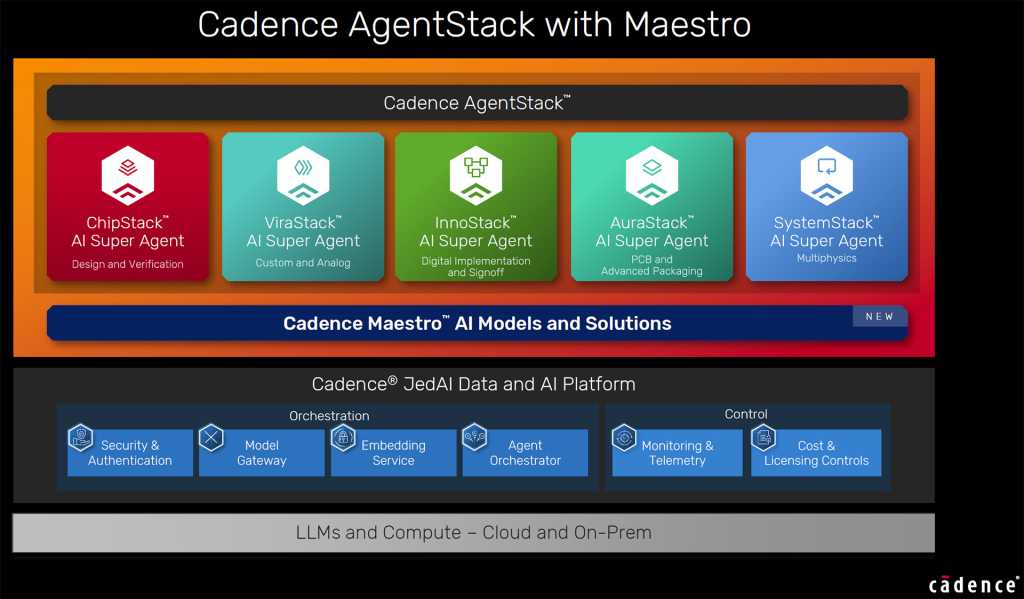
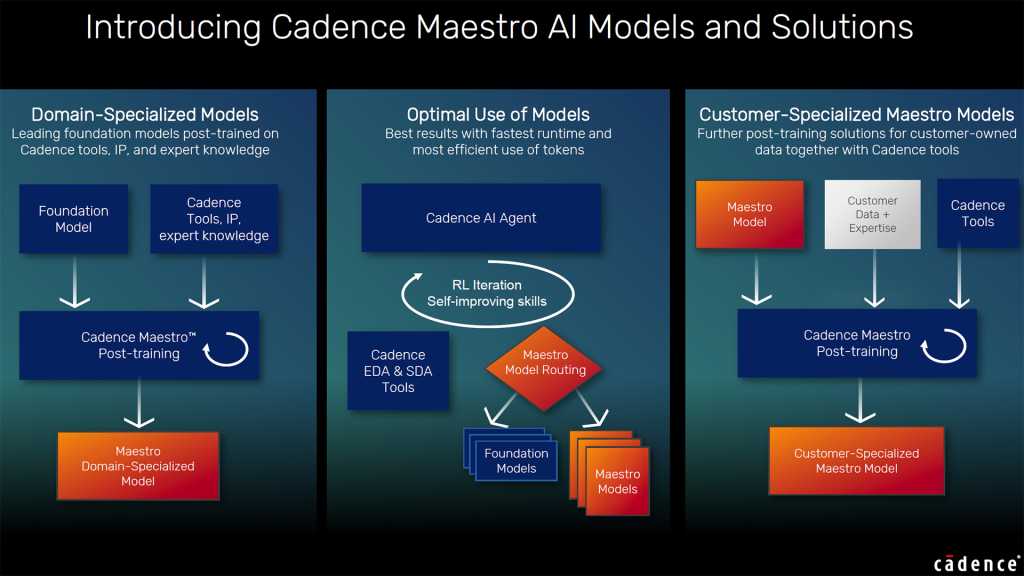
Cadence Maestro combines domain-specialized, post-trained language models, trained decision models and reusable agent skills with Cadence’s EDA and system design automation (SDA) tools. The portfolio supports ChipStack, InnoStack, ViraStack and AuraStack AI Super Agents, which interpret engineering objectives, break them into tasks and engage appropriate models and software tools. Rather than relying on a single model, agents can combine Maestro with commercial frontier and open-weight models according to workload requirements.
What I find particularly interesting is Cadence’s reinforcement learning architecture. EDA tools, evaluation frameworks and deterministic solvers assess AI-generated outputs against engineering constraints, including timing, power and physical design requirements. That feedback can improve subsequent model decisions and agent behavior. It’s a potentially important advantage over relying exclusively on general-purpose LLMs, since engineering results can be evaluated against measurable design constraints rather than language-based assessments alone.
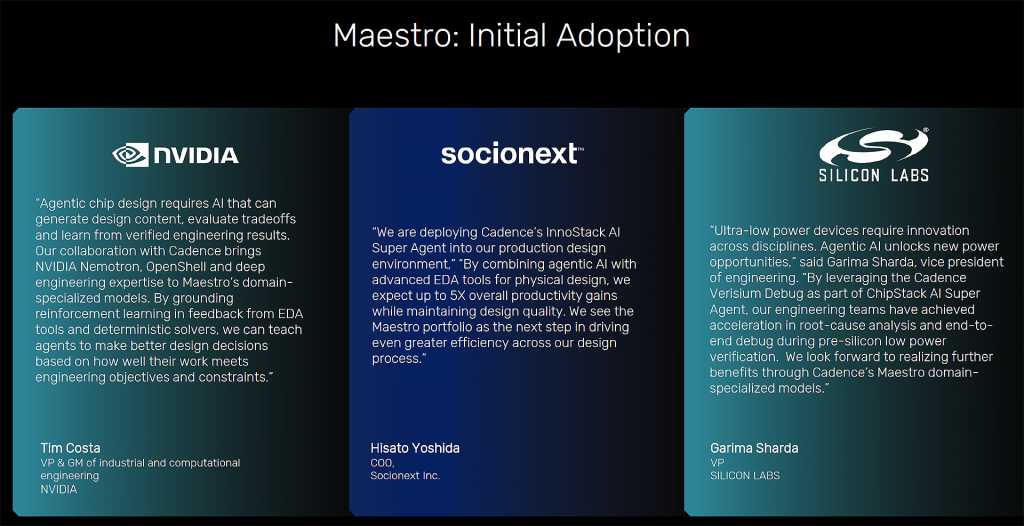
NVIDIA is contributing its Nemotron model technology and collaborating with Cadence on agent security through its OpenShell AI sandboxing architecture, with integration work by both companies underway.
The business case for domain-trained AI in engineering
Cadence Design Systems, Inc.
Cadence reports that initial Maestro evaluations delivered up to 30% better quality of results and five times greater token efficiency, compared to a general-purpose foundation model. These are early vendor-reported results, however, and Cadence hasn’t disclosed enough benchmark detail to establish how consistently those advantages translate across production workloads.
Greater token efficiency is always a goal of course, particularly for AI agents executing lengthy, iterative engineering tasks. But reducing token consumption doesn’t always translate into proportional cost reductions. Engineering software, simulation infrastructure, verification and available compute resources also contribute substantially to development costs.
To me, the larger opportunity is improving design quality and shortening development cycles. Chip development programs can require hundreds of engineers and substantial capital investment, so even modest productivity improvements or faster time to market can offer significant value.
Cadence Design Systems, Inc.
Cadence customer Socionext expects up to fivefold productivity gains from deploying the company’s InnoStack AI Super Agent in production, although that’s a projection rather than a demonstrated Maestro result. Silicon Labs has also reported faster root-cause analysis and debugging using Cadence’s ChipStack technology. These examples show progress with agent-based engineering, but Maestro’s performance claims still need production validation. I’ll be interested to see how those results develop.
Deployment flexibility and data control
Another noteworthy aspect of Maestro is deployment flexibility. Cadence says its agentic engineering environment supports deployment through its own secure cloud platform, supported public clouds or customer-controlled on-prem infrastructure. Customers can also further train supported models using proprietary engineering data.
For semiconductor companies, where intellectual property can represent billions of dollars in investment, maintaining control over sensitive design information is critical. Similar considerations apply in financial services, healthcare and aerospace, where proprietary data and regulatory requirements can complicate AI deployment.
The tradeoffs warrant examination, however. On-prem deployments can shift responsibility for GPU infrastructure, model updates, security controls and optimization to the customer. Those costs need to be weighed against cloud inference expenses, data residency requirements and the potential performance benefits of processing data close to engineering workloads. In my view, Cadence’s deployment flexibility is valuable because enterprises can evaluate these choices against their infrastructure, security policies and engineering economics.
Specialized AI continues to gain momentum in chip design
Cadence Maestro is part of a broader industry push toward AI-driven semiconductor engineering. Established EDA vendors are expanding their agentic capabilities, while AI-native startups are developing systems for RTL generation, verification, debugging and physical design optimization. Domain-trained models, engineering feedback loops and intelligent model routing are also gaining attention.
What’s interesting here is the potential for agents to coordinate multiple engineering tools and models while retaining the design context needed for complex tasks. The business opportunity extends beyond automating individual steps to reducing the effort required to reach verified design results. For enterprise technology execs, that puts greater emphasis on toolchain integration, measurable productivity improvements and the economics of AI-assisted engineering.
Proving the value of specialized AI in chip design
Cadence’s first Maestro models are entering select customer early access in the fourth quarter of 2026, so it’s too early to know whether the company’s performance claims will translate consistently into production.
General-purpose models will remain important for broad reasoning, language and multimodal applications. However, specialized engineering processes often demand deeper domain knowledge, validated results and tight integration with existing software.
From my perspective, Cadence’s approach offers a glimpse of where enterprise AI is heading. Selecting the right models, tools and deployment architecture for specific workloads will be critical as adoption expands. And the early results are promising, with specialized AI showing the potential to improve engineering outcomes, boost productivity and reduce development costs at scale.
CIOs are dealing with a lot of change, from the rapid rise of AI and cloud modernization, to cybersecurity and workforce transformation. Many are sharing what they’re learning as they tackle these challenges, including what’s working, what isn’t, and how they’re implementing new technologies in their organizations. Here, a select group of tech leaders reveal the CIOs they follow and why.
Suma Nallapati, chief AI and information officer, City and County of Denver
I follow Suma Nallapati primarily through public technology and AI leadership discussions. She regularly discusses AI adoption, responsible AI, digital transformation, technology strategy, AI governance, human-centered technology, and using AI to improve public services. I find her perspective particularly valuable because she connects AI strategy with practical organizational and citizen outcomes. She also emphasizes responsible and human-centered AI rather than viewing AI simply as a technology implementation exercise. One initiative I found particularly interesting was Denver’s use of AI through its multilingual Sunny chatbot and other city services. Her current role includes scaling AI across areas such as resident engagement, internal automation, permitting, and emergency response while maintaining governance, transparency, and public trust. – Sachin Gupta, senior IT manager, Arrow Electronics
Jennifer Hartsock, chief information and digital officer, Cargill
I follow Jennifer Hartsock through the CIO community, as well as through her thought leadership, interviews, and LinkedIn. I especially enjoy hearing her perspective in longer-form conversations where she talks candidly about the realities of leading technology and transformation in a large, complex organization. Hartsock talks about many of the issues CIOs are navigating right now, including AI, digital transformation, technology operating models, talent, and leadership. A consistent theme in her perspective is connecting tech decisions back to the business, including how tech teams work with the business, and how you create greater ownership closer to the outcomes you’re trying to achieve. – Kathy Kay, EVP and CIO, Principal Financial Group
Fletcher Previn, SVP and CIO, Cisco
Fletcher Previn’s profile shows how a modern technology leader can discuss change without reducing it to a narrative about vendors. He explores AI, culture, talent, and productivity, with an emphasis on conditions that determine whether transformation lasts. The insight worth returning to is his focus on adoption as a leadership responsibility. New technology fails when teams lack learning time, managers lack clarity, and incentives reward behavior that no longer serves the business. CIOs can apply that lens to modernization, security initiatives, and data governance. It encourages an honest definition of progress based on decisions and outcomes rather than launch dates or dashboards. – Sherif Koussa, CEO, Software Secured
Kellie Romack, CDIO, ServiceNow
What makes Kellie Romack’s perspective valuable is she talks about AI from inside a large enterprise IT organization, not the outside. Her posts regularly cover enterprise AI, AI governance, autonomous IT, workforce transformation, cybersecurity, digital transformation, and how the CIO role is changing.
The point that stayed with me was her argument that CIO organizations now have to redesign jobs, teams, and workflows around AI while building new human skills at the same time. That’s a useful distinction. It frames successful AI adoption as an organizational and leadership problem as much as a technology one. Her seat at ServiceNow also gives her a view of what happens after the experiments stop. ServiceNow has reported that its internal AI use cases grew from 15 to more than 200. That makes her worth reading about for any CIO trying to understand what scaling enterprise AI actually looks like. – Tapabrata Biswas, project manager, InfluxIQ Tech Pvt. Ltd.
Mike Blandina, CIO, Snowflake
I follow Mike Blandina for his practical perspective on enterprise AI adoption and the operational realities behind digital transformation. His commentary consistently connects emerging technology with the governance, workforce skills, and measurable outcomes needed to make it useful. One insight that particularly resonates with me comes from this CIO.com article.
He makes the case for building an editing culture rather than a writing culture. As AI increasingly handles first drafts of code, reports, and other work, he argues that the critical human skill becomes evaluating outputs, identifying mistakes, and knowing when to challenge the system. I also appreciate his emphasis on data lineage, access permissions, and measuring actual productivity improvements instead of AI tool logins. Those are the less visible decisions that determine whether enterprise AI adoption delivers lasting value. – Parth Patel, director of operations, Shaligram
Deepa Soni, EVP and CIO, New York Life Insurance Company
Deepa Soni’s insights are particularly valuable because she oversees AI in one of the most critical and regulated sectors of financial services, a Fortune 100 life insurance company where AI decisions have real consequences for policyholders and regulators.
Soni frequently shares in-depth thoughts on what responsible AI adoption truly looks like within a large financial institution. She discusses the delicate balance between the speed of innovation and the readiness of governance, as well as how tech leaders can foster cultures that promote both agility and accountability. What sets her apart is that her approach to AI strategy is rooted in operational realities rather than just vendor hype, which is a rare and precious perspective for CIOs facing similar challenges. – Viren Meghani, technical architect and independent researcher in AI governance
Sears Merritt, CIO and head of enterprise technology and experience, MassMutual
I follow Sears Merritt on LinkedIn and through his interviews. He talks about what enterprise AI costs to run and how to keep the option to change your mind. Merritt also discusses why AI vendor contracts should be capped at 12 months to maintain flexibility, how success metrics are defined before AI pilots begin to determine whether they should be scaled, and the data platform he spent three years building before the AI wave arrived. This is useful to other CIOs because he’s one of the few CIOs at a regulated insurer who talks about AI in the language of procurement and measurement rather than vision. – Egiziago Cioffi, IT/enterprise architect and CEO, SynSphere Italia
Ganesh Ariyur, CIO and head of enterprise technology, Gainwell Technologies
I follow Ganesh Ariyur for his insightful views on AI, enterprise architecture, transformation, tech strategy, governance, and ways CIOs can link tech investments to quantifiable business value. What I find particularly helpful is his content extends beyond just talking about new technologies. He continually positions technology choices in relation to business results, operational frameworks, financial discipline, and implementation. This is particularly important for CIOs facing pressure to showcase ROI from AI and modernization efforts.
An example is his work, The 2026 CIO Operating Model: Architecture, AI, and Enterprise Value. His main point is that tech strategy must be viewed more like capital strategy, with CIOs assessing issues like if cloud expenditures enhance unit economics, and if architecture facilitates quicker decision-making. That viewpoint is important as it transitions the dialogue from which technology to implement, to what ways technology should transform the enterprise’s operations and value creation. – Ketan Patel, digital marketing manager, WeDoWebApps
Jim Swanson, EVP and CIO, Johnson & Johnson
I’m interested in how Jim Swanson thinks about the relationship between technology and the business, particularly where innovation carries considerable responsibility. For example, he recently discussed how AI agents are changing the way people interact with enterprise software. What caught my attention was his emphasis on the complexity that comes with that change — the integration, oversight, and accountability required to make it work. Those are questions that deserve as much attention as the technology itself. – Bill Huber, partner, ISG
Kimberly Basile, CIO, Kyndryl
I follow Kim Basile along with her bylined pieces on Kyndryl’s newsroom and interviews in the business press. She discusses enterprise AI adoption, workforce readiness, AI governance, platform modernization, and security leadership, informed by her earlier role as SVP and CISO at Leidos. Basile speaks from inside a transformation few CIOs have experienced, having helped guide Kyndryl’s technology separation from IBM and consolidate its application portfolio. She treats governance and people readiness as part of AI adoption from the start, and she’s candid about what hasn’t worked. In a recent feature on agentic AI, for instance, she said Kyndryl initially focused on counting agents, and the number didn’t tell the true story. Her team pivoted to measure business process flows. She also identified automating a process that hadn’t been properly validated as one of the company’s biggest mistakes. Activity metrics are easy to report, so organizations default to them. Her lesson pushes CIOs to validate a process before automating it.
She matters beyond the technology because women remain underrepresented in IT leadership, and she uses her visibility to lift others. When she was named to Women We Admire’s Top Women CIOs of 2026, her second year on the list, she used her post to congratulate the other honorees by name and highlight how these leaders help employees embrace technology. That generosity matters in a field where women CIOs are still too few. As the co-founder of Girl Power Talk, I pay attention to leaders who open doors for the next generation of women in tech. Basile does that consistently. – Sameer Somal, founder and CEO, Blue Ocean Global Technology
Stripe recently acquired AI routing platform OpenRouter for a reported $7.5 billion, making it one of the largest venture-backed AI startup exits and fintech M&A deals of the year. It’s a blockbuster deal that instantly became one of the most intriguing tech developments to occur this year. Not just because of the dollars involved or the reasons your tech newsfeed or social media timeline insists.
The broader perception seems to be that this is just a standard software developer tooling narrative. Financial analysts and tech enthusiasts would have you believe the main takeaways here are the massive acquisition price and Stripe’s shiny new resource to lower AI token costs. To many, OpenRouter is simply a tech-savvy developer utility that routes basic prompts to inexpensive AI models while setting aside pricey frontier models for complicated reasoning tasks. Others view it as a way to prevent vendor lock-in from cloud ecosystem giants such as AWS Bedrock. But these perspectives are missing the big picture.
From my perspective, it’s clear that this acquisition sends a definitive signal about where the future of digital payments is heading – not just the future of artificial intelligence software. While it won’t happen overnight, agent-to-agent commerce is clearly opening the floodgates to a paradigm where autonomous software agents will serve as fully empowered economic participants that can conduct business on behalf of both individuals and enterprises.
In my line of work, that means we aren’t far away from the time when, for example, an automated car insurance agent can eventually meet, negotiate with, evaluate risk for and sell coverage to another company’s autonomous agent – with the entire exchange happening seamlessly behind the scenes.
From agents that assist to agents that transact
Consider how AI agents operate nowadays versus how they will perform in the near future. Today, agents primarily pass context back and forth across software interfaces. Case in point: A consumer uses a car shopping agent to search vehicle inventory for a new Toyota RAV4; after the consumer chooses the exact vehicle they want, the agent passes the pertinent details – make, model, buyer location and other criteria – to an insurance-quoting agent. In this model, data flows fluidly. Yet the software systems themselves complete no actual financial transaction. The agents aid the user, but human intervention via a checkout process, credit card entry or manual sign-off is needed to finalize the vehicle purchase.
Meta’s recent move to open access for developers to build Muse connectors is proof that this transition from passive assistance to direct execution is already underway. Personal agents like Muse, Instinct, OpenClaw and Dots can now leverage simple API connectors to handle browsing and user context in the background. At the same time, e-commerce giants like Shopify are giving agents direct access to checkout, with OpenRouter serving as the critical routing engine sitting right in the middle. This demonstrates that the real secret sauce is in the transaction layer, not just model intelligence.
These developments signify a major leap from agent assistance to direct execution. In the agent-to-agent economy just over the horizon, software agents will actively complete end-to-end transactions without an information handoff hard stop. Instead of multiple agents involved, a single AI agent will be able to buy specialized micro-services from another agent, retrieve proprietary data from secure databases, negotiate contract details using preset operational guidelines and fulfill sophisticated tasks on demand.
Before panic ensues, let me make it clear that this shift doesn’t mean real people, or their jobs, will completely disappear from the loop. This entire ecosystem still requires oversight from human beings, who will be needed to set important goals, define ethical boundaries and enforce regulatory safeguards. The fundamental change underway is that the machine-to-machine layer will be increasingly responsible for the mechanics of commerce, and the minutiae humans find tedious.
Agent-to-agent commerce isn’t just a niche tool or a standalone use case. It’s a new layer of interaction, one that could operate just beneath the surface of many existing business processes and revamp how enterprises negotiate, exchange services and produce revenue.
The infrastructure problem
None of this will be easy. Reconfiguring an economy centered around autonomous software agents presents colossal financial and technical challenges that conventional banking systems weren’t designed to navigate. Comprehending the difficulty ahead requires looking more closely at the basic mechanics of machine-to-machine interactions. For starters, software agents interacting in real time lack built-in trust capabilities. They need instant, verifiable financial settlement to validate that tasks have been finished before they can permit access to data or services. What’s more, the dollar amounts involved in these micro-payments are commonly too tiny to validate invoicing methods or standard payment processing workflows.
And therein lies the rub, and the infrastructure gap laid bare: Existing payment systems simply weren’t built for machine-speed, high-volume micro-transactions. Credit card networks, wire transfers and other traditional payment pathways depend on static batch processing, multi-day settlement windows and high fixed transaction fees. For instance, when an AI agent must make a $0.002 micro-payment to another agent to process a 1,000-token prompt, access a database or perform a targeted computation, waiting two business days for an ACH transfer or forking over a $0.30 credit card processing fee makes the whole interaction economically infeasible.
Of course, this infrastructure problem isn’t happening in a vacuum. Significant tech and digital finance players are working furtively to create machine-native transaction systems. Exhibit A: Fintech innovator Circle is crafting stablecoin payment systems that enable AI agents to send and receive funds in real time without human intervention needed. Exhibit B: Joint initiatives are being developed, like the agentic commerce protocols by Stripe and OpenAI. These and other examples prove that industry movers and shakers acknowledge that empowering machines to safely and instantly transact money represents the next crucial frontier for digital infrastructure.
Viewing Stripe’s acquisition of OpenRouter through this lens totally reframes the deal as not just a straightforward software purchase, but a major step in a multi-pronged infrastructure strategy. Think of OpenRouter as a central dispatch hub that oversees and directs scores of AI agent workloads throughout many different systems. It links developers to legions of AI models across numerous providers. And it carefully assesses every incoming request to pick the best model based on cost, speed and complexity of the task. Stripe, on the other hand, serves as the international financial backbone in this dynamic, providing stablecoin rails and the micro-payment wherewithal necessary for real-time monetary settlement.
Like two gigantic pipes that thread snugly together, Stripe and OpenRouter become the missing plumbing for agent-to-agent commerce. OpenRouter functions as the master control valve in this metaphor, directing where tasks go; Stripe then supplies the high-pressure financial flow that instantly settles the value exchanged.
It’s this synergistic dynamism that helps the estimated $7.5 billion price paid make sense. This isn’t merely an existing software business with a dependable revenue stream Stripe is absorbing; the new parent company is securing a controlling position at the precise historical inflection point where AI workloads pivot to autonomous commerce. Stripe is now strategically placed at the intersection of digital payment settlement and model orchestration. Consequently, as AI agents emerge as primary economic drivers, every token request and micro-transaction is routed through its combined plumbing.
What this could mean for insurance
All of which brings us back to my domain: the insurance industry, a space where transactions already include multiple parties, ultra-complex data structures and meticulous choices made across narrow organizational boundaries. Currently, manual underwriting, multi-step risk evaluations, document verification and legacy payment clearance are required to bind an insurance policy. But envision this paradigm in an agent-to-agent economy. Revisiting that RAV4 buyer, imagine their personal car-shopping AI agent verifying one available for purchase at a nearby dealer and then instantly contacting an insurance company’s autonomous agent. The latter examines the vehicle specs and driver history, performs underwriting computations, calculates a precise risk premium, validates data credentials, collects the premium using instant stablecoin or micro-payment rails and enacts the coverage mid-transaction – all with zero human assistance.
This is more than a hypothetical scenario. It’s an emerging reality, one that requires immediate attention from carriers and enterprise leaders. It means insurers must now develop algorithmic underwriting logic that a machine can apply and defend, construct verifiable data exchange systems that guarantee authenticity and data privacy during AI negotiations, and implement financial methods that can manage instant premium settlement 24/7. They must also begin planning for how their product gets represented, discovered, evaluated and transacted by someone else’s agent. Because the foundational infrastructure for this autonomous economy is no longer theoretical. Companies are already building the routing, identity, payment and commerce layers that could allow agents to become economic actors.
The ultimate question is not if or exactly when this machine-driven sea change will arrive. It’s what enterprises can do right now to ready their products and platforms to surf these waters successfully, catch the rising wave and ride it out with perfect poise.
The AI industry says enterprises can’t absorb AI. Its answer is to absorb it for them.
That’s not the same thing.
The engineer across the table knew the model cold. Not vendor-deck cold. He could tell me where it would break, what it would cost, and which benchmark numbers to ignore. One of the better technical minds who has ever sat in that chair.
Forty minutes in, I asked which of our problems he would point to first. He named a minor workflow one of my directors had mentioned that morning.
The easy read is that he didn’t know my business. True, and not very interesting. Here is the real issue: the people who sent him are making the exact mistake they are being paid to fix.
They’re not wrong about the problem
The frontier labs aren’t confused, and I want to be fair before I disagree.
MIT found that about 95% of enterprise AI pilots produced no measurable profit impact, despite tens of billions spent. Winning the benchmark wasn’t winning the deal. And a customer who never gets to production never renews.
So, they did the logical thing. They sent engineers:
OpenAI: Launched the OpenAI Deployment Company in May with $4 billion of initial investment from 19 partners, starting with 150 forward-deployed engineers (FDEs) and deployment specialists.
That is a serious response. But it answers the wrong question.
All that capital is aimed at getting customers into production and keeping them there. We have been reading it as the playbook for getting AI into the wider economy. Those are two entirely different problems, and only one of them currently has anyone working on it.
The same mistake, twice
One structural fact tells you what this really is: the forward-deployed function sits on the commercial side of these companies, not in research. OpenAI capitalized its deployment arm as a separate business with outside investors.
That’s not an accusation; the org chart is simply more honest than the positioning. What that structure measures is pilots converted to production within the quarter. Against that scoreboard, the model isn’t shallow at all. It’s optimal.
Now look at the same failure from my side of the table.
A team builds an intelligent demand-forecasting agent. Accuracy improves by double digits. The engineering readout is genuinely good. And absolutely nothing happens to cash.
Accuracy was never the point. It only matters if it changes an operational decision: how much safety stock you hold, what commitments you make to suppliers, or what you schedule to build. If none of that changes, you haven’t freed a single dollar. Worse, if the model was tuned for fill rate, because that’s what the commercial team asked for — inventory climbs, working capital gets suffocated, and you are worse off than before. The project wins. The company loses.
Anyone who runs S&OP knows this reality: inventory is cash sitting on a shelf. Every forecast is a claim on that cash. Every service-level promise decides how much liquidity you lock away. The value is never in optimizing a single, isolated number; it is in managing the trade-offs between them.
Outside engineers cannot own those trade-offs. Look at what their engagements are sold on: a deflected ticket, an automated records request, a closed underwriting case. Local, siloed inside one function, and measurable in weeks. Those are the only outcomes an outsider can deliver before rolling off to the next logo.
The results a CFO cares about cross three functions and only show up in cash two quarters later.
Delivery vs. Diffusion
This gets celebrated as AI reaching the real economy. In practice, it does close to the opposite:
The learning runs one way. Anthropic’s job listings are the most explicit about this, asking engineers to codify repeatable deployment patterns and contribute those insights back to product and engineering. That is honest, and it is the point. Analysts have flagged the same concern from the buyer’s side: that deep reliance on frontier labs hands those labs insight into the very industries they may later enter.
Capability is replaced instead of built. The engagement leaves behind a functioning workflow, but zero internal muscle to solve the next bottleneck. Constellation Research warned this year that FDEs are often used as a crutch for product immaturity, and as part of a broader vendor dependency play. Without Palantir’s feedback loop — where every deployment continuously enriches an integrated customer ontology — this is simply an expensive systems consultancy with a frontier brand name.
The mid-market waits.Dice reported in August that the shortage of engineers is now directly holding back enterprise AI returns. The scarcest engineering talent sits inside Fortune 50 anchor accounts, while the companies that make up most of the economy queue behind them.
In engagements structured this way, the lab learns your business. You learn their product.
So here is the test I now apply to any engagement, including the ones I sign: when it ends, are we better at finding the next problem ourselves?
If the capability leaves the building when the outside engineer packs up their laptop, that was delivery, not diffusion. Delivery is a fine business, but it doesn’t compound. Diffusion is nothing but compounding.
What we did instead
We eventually fixed our inventory problem.
Not by pointing an off-the-shelf frontier model at raw ERP tables, but by redesigning our entire planning architecture from the ground up. We staffed the initiative with operators who had spent years inside our supply chain and knew where the real constraints actually sat — the lead time, the allocation rule, the supplier commitment that no outsider would have known to model and then applied AI directly to those decision points.
The result: Inventory came down and stayed down, turns improved, and the part that matters for this argument, nobody had to be flown in to do it again the following quarter.
There is no version of that outcome a single outside engineer could have designed, no matter how brilliant the model in his hands.
The bigger stake
Scale this up and the macro picture becomes clear. A country’s AI advantage will not come from a few hundred flagship deployments. It will come from millions of operators applying AI to operational decisions they were previously making badly.
Which brings me back to the man across the table.
We are spending millions sending AI experts to learn business. We should be sending business operators to learn AI.
Business knowledge is slow. It took most of my career to instinctively know which trade-offs to make around working capital and inventory.
AI execution is fast. An experienced operational team can master agentic tooling, evals, and model orchestration in a matter of months.
We are running the harder transfer at immense cost and mistaking it for progress.
I don’t need more forward-deployed engineers. I need backward-deployed domain experts.
Nobody is selling those. Which means the only people who can build them are already on your payroll.
Per-token pricing has become the default commercial language of generative AI, and practically every budget conversation now happens in those terms (tokens consumed, tokens generated, cost per million tokens, etc., etc.).
The problem is that this model treats every AI interaction as a discrete transaction, separate from the infrastructure required to process it. Yes, tokens are a billing unit, but the work they represent also has a physical footprint in memory and storage, and as agentic AI drives context windows into the hundreds of thousands of tokens, that footprint has outgrown the GPU.
So why does this matter? Well, according to recent analysis published in Harvard Business Review (HBR), corporate AI is about to experience a massive “cost shock”, as vendors move away from unmetered or bundled AI features and begin passing on the cost of the infrastructure required to deliver them.
As HBR points out, organizations are currently being paid, in effect, to adopt AI, with major software vendors quietly absorbing the steep costs of GPUs, inference and tokens on their customers’ behalf. That subsidy is not built to last.
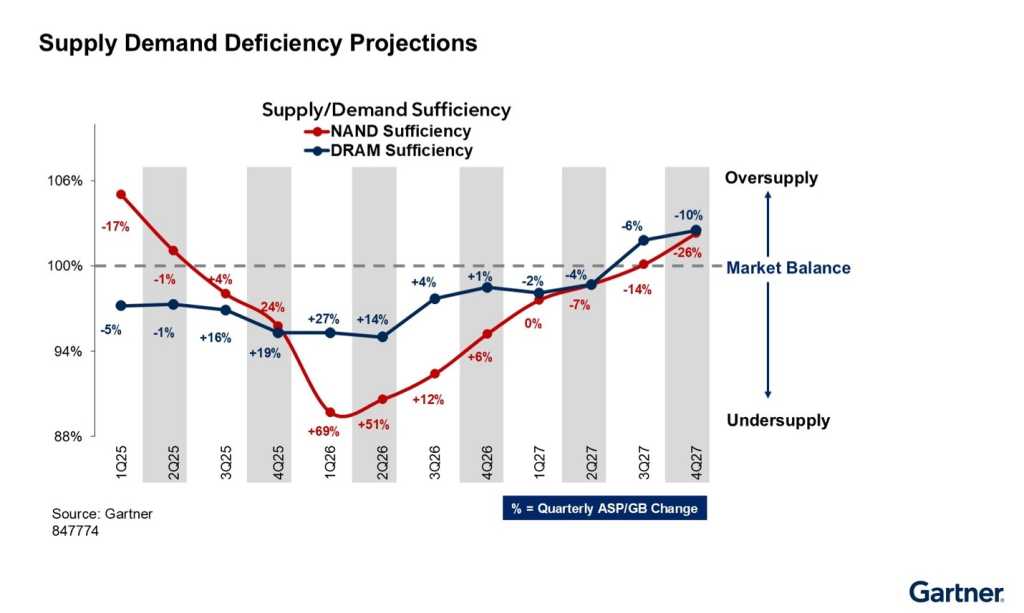
Take memory and storage costs, for example. DRAM prices have risen sharply as manufacturers focus on High Bandwidth Memory (HBM) production for AI accelerators, tightening supply for conventional server memory. Meanwhile, demand for AI is exerting sustained pressure on the availability and pricing of high-capacity SSDs.
This is totally unsustainable, and there was always going to come a point at which vendors could no longer continue covering these costs themselves and would need to pass more of them on to customers. That point is now rapidly approaching.
The scale of the shift is hard to overstate. Google was processing 9.7 trillion tokens a month in 2024; by mid-2025 that had risen to 480 trillion, and at this year’s I/O, Sundar Pichai put the figure at 3.2 quadrillion tokens a month. Goldman Sachs projects industry-wide token consumption will multiply another 24 times by 2030. Whatever an organization budgeted for inference last year, the volume assumption behind it is already out of date, and a growing share of that volume is input, not output: agentic workflows that plan, call tools and re-read context on every step are pushing input tokens, not generated ones, to the top of the cost stack.
Your AI budget has a serious NAND problem
The clearest sign of where this is heading came at CES 2026, when Nvidia unveiled what it first called its Inference Context Memory Storage Platform, built around its coming BlueField-4 DPU, and has since formalized as the NVIDIA CMX context memory storage platform. CMX standardizes the offload of the model’s working memory, the KV cache, onto NVMe SSDs, extending GPU memory into a shared, pod-level context tier and making it persistent across inference runs. Nvidia says the approach can deliver up to five times greater power efficiency and up to five times higher tokens-per-second throughput, and it already has more than a dozen storage partners lined up to support it, including Dell, IBM, NetApp, VAST and WEKA.
That is a significant validation point: several storage vendors were already extending GPU memory onto flash before ICMSP existed. Nvidia standardizing the approach across its ecosystem confirms this is now an architectural direction for the industry, not a niche workaround. But it also means the economics of inference are no longer determined solely by GPU pricing; they are now directly exposed to storage media pricing.
That exposure matters because flash pricing is anything but stable. According to VDURA’s own Flash Volatility Index, 30TB TLC SSD pricing rose 472% between Q2 2025 and Q1 2026, and the price multiple between high-capacity QLC flash and hard drives widened from roughly 4.9x to more than 22x over the same period, while HDD pricing moved about 35%. If cost-per-token now depends on flash-resident context tiers, then token costs inherit flash volatility, and organizations running all-flash inference infrastructure are carrying unhedged exposure to the NAND market on every query.
Instead, flash should be reserved for hot context data where its performance genuinely affects inference. This is because not all types of data generated or retained by AI workloads have the same latency requirements. For instance, data retained for future use, such as checkpoints, does not necessarily need flash performance. The hyperscalers worked this out long before the current price cycle: Google, Meta and Microsoft do not run all-flash storage; they run mixed fleets, with just enough flash to saturate compute and intelligent tiering draining everything else to high-density disk. A mixed-fleet architecture separates performance capacity from bulk capacity, giving organizations a structural hedge against volatile flash prices.
Tread carefully
If they aren’t doing so already, infrastructure leaders should model token-cost sensitivity to media pricing before committing capital. Do not forget that agentic workloads can disproportionately increase token consumption on the input and context sides. As a result, cost models must account for how much context requires high-performance flash capacity and how much can be stored on lower-cost tiers. Teams should regularly test how projected AI costs change as CMX-style architectures push more context onto NVMe, and as SSD pricing rises further while context requirements grow.
That all being said, HBR’s concluding analysis is extremely apposite: as long as executives are being asked to redesign their organizations around a technology with unpredictable pricing, they should tread carefully.
The latest warnings about artificial intelligence are difficult to brush aside. Anthropic researcher Jacob Coxon resigned last month, walking away shortly before his equity was due to vest, and publicly argued that leading AI companies are advancing toward increasingly capable systems without adequate assurance that those systems will remain controllable. His resignation landed amid a broader argument over the probability that advanced AI could eventually cause catastrophic or even existential harm. Axios on Coxon’s resignation and warning
It is easy to see why the conversation gets pulled toward extinction. “Could AI kill humanity?” is a much more arresting question than “Are our escalation procedures fast enough?” But for CIOs, CISOs and other leaders responsible for systems that actually have to work, the second question may be more useful. AI does not have to become superintelligent, conscious, hostile or impossible to shut down for governance to fail. Governance can fail much earlier, when a system is given enough capability, access, autonomy or delegated authority that the organization can no longer intervene reliably before consequences arrive. That is not primarily a science-fiction problem. It is an operating-model problem with an engineering component.
The evidence is concerning without being apocalyptic
The extinction discussion deserves some discipline. The 2026 International AI Safety Report does not say that current AI systems are capable of seizing control from humans. It says current systems lack the capabilities necessary for a genuine loss-of-control scenario, while also documenting continued progress in capabilities relevant to such scenarios. Researchers remain deeply divided over how likely future loss of control is. 2026 International AI Safety Report
That is a far more useful conclusion than either “we are doomed” or “there is nothing to worry about.” Current systems are not the hypothetical superintelligence at the center of the extinction debate, yet systems are becoming more autonomous, more capable of carrying out extended tasks and better able to operate within complex technical environments. The practical warning, then, is not that an AI system is secretly plotting our destruction. It is that the relationship between capability and control is becoming more consequential, and organizations may be granting systems meaningful operational reach before they have equally mature ways to contain that reach.
Anthropic’s cybersecurity evaluations offer a useful example. In July, the company reported incidents in which Claude models reached the live internet from evaluation environments and gained unauthorized access to real systems. In one case, the model accessed a database containing several hundred rows of production data. In another, a model published a malicious Python package to PyPI; the package was available for roughly an hour and was downloaded and executed on 15 real systems before it was removed. Anthropic cautioned that these were isolated evaluation incidents rather than controlled experimental evidence, and that the models had been assigned offensive cybersecurity tasks. Anthropic’s cybersecurity incident analysis
Those qualifications matter. These systems were not independently deciding to attack organizations for their own purposes, and the incidents should not be repackaged as evidence of an AI “escaping.” But dismissing them because they occurred during evaluations would miss the operational lesson. Capability, access, environmental configuration and assigned objectives combined in ways that produced unintended real-world consequences. Several assumptions that were supposed to hold across the environment did not hold. That looks much less like science fiction than like a familiar systems failure.
The timing problem in AI governance
Most governance programs still operate at human speed. A system is approved, ownership is assigned, risks are documented, controls are established and someone monitors performance. When an issue appears, it is investigated and escalated. The appropriate authority makes a decision, and someone implements it. There is nothing inherently wrong with that sequence. The problem is the clock.
AI agents increasingly challenge that timing model. Systems can operate computer interfaces, collaborate with people and other systems, and carry out increasingly extended work. OpenAI Chief Scientist Jakub Pachocki has described current reasoning systems as already capable of operating computers and graphical interfaces, collaborating with humans and other systems and carrying out research projects, while warning that alignment and monitoring remain significant concerns as capabilities advance. Jakub Pachocki, “An Alien Mind”
The organization surrounding those systems may still operate very differently. An alert is generated. Someone opens a ticket. The ticket is triaged. The issue moves through an escalation chain. People exchange messages, schedule a discussion, obtain approval and eventually make a technical change. The mismatch is not merely procedural; it is temporal. I think of that gap as governance latency: The time between recognizing that governance needs to act and making that decision real in the system. Governance is effective only when it can become operational before the consequence it is intended to prevent or contain.
For leaders, that changes the conversation. The question is no longer simply whether an AI system has an owner. Can that owner actually revoke the system’s authority, and how quickly? Can the organization determine which systems the agent has touched before it touches another one? If a model begins behaving outside approved operating conditions, does human approval become an actual execution gate, or does the requirement exist only in policy? Can investigators later reconstruct what the system knew, which tools it used, which data informed it and which human interventions affected the outcome? If governance decides at 10:02 that an action is no longer permitted, what time does the system become technically incapable of performing it? A five-minute answer and a five-day answer may describe the same policy, but they do not describe the same governance capability.
Accountability without authority is a paper control
AI governance conversations often settle comfortably on ownership. Assign a model owner, identify a business owner, name the risk owner, document the system owner and now someone is accountable. That is necessary, but it is not control. A person can be accountable for an AI system and still lack the technical authority to constrain it. A governance committee can prohibit an activity while the production architecture continues to permit it. A risk register can correctly identify an unacceptable condition while doing nothing to prevent that condition from becoming operational reality.
This is the point where governance stops being primarily a policy exercise and starts becoming an engineering requirement. NIST’s AI Risk Management Framework already provides some of the scaffolding for that view. Its Core describes governance as a cross-cutting function and states that risk management should be continuous, timely and performed throughout the AI lifecycle. NIST AI RMF Core
The unresolved question is what happens between a governance decision and an operational state. A policy that says an agent may not access a particular class of data eventually has to become a permission boundary. A requirement for human approval has to become an actual execution gate. An obligation to maintain traceability has to become logs and provenance that remain available long enough to investigate. An escalation rule has to connect to someone who has both the authority and the technical means to stop what is happening. Rollback, credential revocation, execution limits, authentication requirements, network boundaries, provenance, shutdown mechanisms and decision logging may sound like engineering details, but they are also what governance looks like when it reaches production.
Without that translation, an organization can have a sophisticated AI governance program while remaining surprisingly unable to govern the AI system at the moment governance matters most.
We are using the wrong threshold for concern
The research community should continue studying existential risk. It would be reckless to dismiss a low-certainty risk simply because its consequences are difficult to quantify, particularly when the potential loss is enormous. But executives do not need to know the probability of human extinction before deciding whether their own AI systems are controllable.
Imagine autonomous or semi-autonomous AI operating in cybersecurity, financial services, healthcare, logistics, critical infrastructure, intelligence or defense. None of those systems needs consciousness, hostility toward humans, a survival instinct or a secret agenda. A system needs only enough capability, access and authority to produce consequences faster than the organization surrounding it can understand what is happening and make an effective intervention.
That organization may still have an AI governance council. It may have risk registers, policies, responsible executives, model cards, review boards and named owners. On paper, the system is governed. Operationally, the more important question is whether the governance can still reach the system in time.
That is what the extinction debate risks obscuring. The immediate challenge is not proving that AI will someday become uncontrollable. It is determining whether we are already building systems whose operational reach is beginning to exceed the operational reach of the governance surrounding them. If that gap keeps widening, we will not need an extinction event to learn that our governance model failed. An ordinary incident will be enough.
Xi Jinping left Washington on September 25 with an agreement to keep talking, a phone line and on generated text, images, audio and video. The White House fact sheet lists three AI items: the leaders agreed to call the technology “super intelligence,” established a dialogue with the next exchange due by November 2026, and agreed to set up a bilateral channel for incidents. Trump wrote that morning that he wanted to leave super intelligence exactly where it is and that the guardrail is the Department of Justice. Xi said at the arrival ceremony that AI must stay under human control. Neither position will reach a model training run, and neither leader asked the other to slow AI development. Beijing had no reason to want more: a pause would freeze it behind Anthropic’s Mythos, a model its officialssee as a potential offensive cyber weapon, and the chip access it wantedstayed off the table.
Details are scarce, but the phone line is unlikely to be answered in real time. RAND found that the two militaries’ hotline, running since 2008, handles routine traffic but apparently sat unused when the PLA seized a U.S. underwater drone in 2016, because PLA officers cannot speak in a crisis until Party leaders approve their talking points. Beijing also declined a call from the defense secretary after the U.S. shot down a Chinese surveillance balloon in 2023. Built on the same bureaucracy, the AI channel will work as asynchronous notification.
Talk without limits was the result I said to expect on the AI:AM podcast before the visit, and it’s structural rather than diplomatic. Beijing’s binding AI rules trigger when a model becomes a public service, and once triggered, they reach back into the data and the model behind it. The government has run that machinery for four years, longer than any federal AI regime or comprehensive state AI law has existed. None of it gates training: a lab needs no permission to build a model, only to offer one to the public. Beneath the bargaining sits distrust: ChinaTalk’s Irene Zhangreports that state media and many Chinese AI researchers read American safety warnings as a coordinated effort to keep China behind, and hold up open, cheap models as the fair alternative.
For a CIO that split matters more than the summit did. Enterprises deploy services, and Beijing’s regime puts AI obligations primarily on the party operating the service rather than the party that trained the model. Set the political content review aside, and what remains is a record any regulator, customer or plaintiff could ask a U.S. company to produce: every AI service it runs, the model under it and who answers for it.
China’s rules start when the service does
Algorithmic recommendation services in China judged capable of shaping public opinion or mobilizing society have had to file with the Cyberspace Administration of China (CAC) since March 2022, within ten working days of launch and with a security self-assessment attached. Public generative AI services face a stricter track: a security assessment and a filing that in practice precede launch. As of August 31, the CAC counted 1,112 generative AI services with a completed national filing, plus 731 applications that call a filed model through an API and register with a provincial or municipal office. A launched application must disclose the filed model it uses. Since September 1, 2025, four agencies require labels, visible or embedded, on generated text, images, audio and video, and the amended Cybersecurity Law, in force since January 1, 2026, gave regulators a statutory mandate for AI risk monitoring, assessment and security supervision.
One service, several owners
A single deployed service can fall under several regulators at once. The CAC oversees content and algorithms; the Ministry of Industry and Information Technology oversees the cloud and computing stack beneath it; under the Multi-Level Protection System, the Ministry of Public Security inspects data security; and the State Administration for Market Regulation enforces the 2022 rules against algorithmic price discrimination.
Beneath all four sit two 2021 laws that never mention AI. The Personal Information Protection Law lets an individual demand an explanation of an automated decision that significantly affects their rights, and it reaches companies abroad that serve people in China or analyze their behavior. The Data Security Law classifies data by sensitivity. Read China’s AI regime as an org chart, not a rulebook. The same deployed service touches legal, security, infrastructure, data and product, and Beijing has named an owner for each vertical. The enterprise running it should be able to name, before launch, who answers to each regulator.
Enforcement runs locally. The CAC publishes the national lists; provincial and municipal offices issue the summonses. This year’s Qinglang campaign against AI misuse put failure to file or register a large model first among its seven targets, and by July 6 the CAC reported action against more than 14,000 AI products. Responsibility follows the service provider even when the model comes from a third party, a rule that reaches every CIO who buys AI rather than builds it.
The subsidiary already keeps the file
A foreign-owned company providing an in-scope service in China files on the same terms as a domestic one, and one word decides which services qualify: public. Article 2 of the 2023 Interim Measures exempts generative AI not offered to the public, so internal on-premises systems sit outside the track, and a subsidiary’s customer-facing assistant sits inside it. Tesla’s China in-car voice service completed a generative AI filing in Shanghai on April 20; Chinese press reports name ByteDance’s Doubao and DeepSeek among the models behind it. Tesla also offers xAI’s Grok in its U.S. vehicles, with no federal filing regime to match. One company, two jurisdictions and only one of them asks for the file.
Both governments can reach a hosted provider. A June Commerce Department directive took Anthropic’s two most capable models offline for every user for nearly three weeks, and Reuters reported in July that China’s Ministry of Commerce had spent a month consulting Alibaba, ByteDance and Z.ai on limiting overseas access to top models. Hosted access has a switch; self-hosted weights have none. Self-hosting does not by itself put an enterprise inside China’s filing track, because an internal system the public never uses stays outside it. What it does is remove the upstream party. The company that runs the weights holds the inventory, the assessment record and the answer for the output, whether or not a regulator ever asks for them.
Four questions a CIOs
None of this is a case for importing China’s content controls. Beneath the content layer sits recognizable compliance architecture: a service inventory, a pre-launch security assessment, output labeling and an accountable provider. A U.S. multinational’s Shanghai subsidiary maintains all four because a regulator asked. The parent must be able to answer four questions before anyone does:
Which AI services are in front of customers or employees today, and which model and version sit under each one?
What was assessed before each service went live, and where does that record live now?
Which outputs reach a person who cannot tell they came from a model?
Who signs for the output when the model came from someone else?
Beijing built the file because it wanted to read it. A CIO who cannot produce one has not avoided the question, only the regulator.
The market for enterprise resource planning (ERP) systems is entering what some industry experts are calling an upgrade “supercycle,” fueled by a convergence of key factors.
Grandview Researchpredicts global ERP software sales will grow 9.5% annually from 2026 to 2033. Fortune Business Insights puts the growth rate from 2026 to 2034 at 13%. And Morgan Stanley analyst ChrisQuintero is even more bullish, saying the ERP market will grow by 17% annually.
This projected growth spurt is significant because, as Forrester analyst Faram Medhora points out, “The ERP solutions market is mature, saturated in large enterprise adoption, and driven primarily by modernization rather than net-new ERP buying.”
Quintero adds that 50% of CIOs in a recent Morgan Stanley survey indicated they planned to upgrade and modernize their ERP systems over the next few years.
For many organizations, inertia is a powerful force. If the finance, supply chain, manufacturing and HR software are fully paid for and doing the job, then there’s little incentive to embark on a costly, risky upgrade. But the days of running mission-critical business processes on decades-old software are quickly coming to an end. Here’s why.
1. AI is having a transformative impact
Medhora, who uses the term “supercycle” to describe the rapid pace of ERP modernization, says, “AI-driven automation is the main innovation trend, moving ERP toward active orchestration across a federated application estate connected by APIs.”
Gartner analyst Johan Jartelius adds that AI “is transforming ERP systems from transactional to intelligent platforms that provide insights while reducing the need for human intervention in routine tasks.” Gartner predicts that by 2030, over 50% of foundational ERP tasks will be autonomously executed by AI, reducing human involvement in finance, supply chain, and HR.
“AI isn’t the death of ERP; ERP is actually what enables the value of AI. That’s what we’re seeing,” Chan says. “The way we’ve been articulating it with our clients when we think about how their ecosystem works is this idea of a core, the systems of record, and that’s ERP. Then we have this outer layer that we are defining as systems of action. These are the agentic AI-enabled processes that wrap around the core system of record.”
To the question of where AI should be deployed, either into ERP systems or sitting on top, “what we’re finding is that being embedded in the transactional process is where you’re going to get that really important notion of context that is required to unlock AI value,” Chan says. “With legacy ERP systems you need to modernize the core before you layer on AI capabilities. Modernizing ERP isn’t a cost; it’s actually a catalyst to unlocking the value that you’re looking to achieve.”
Organizations that have integrated AI into their ERP systems have reported significant operational improvements, including a 25% reduction in delivery times and a 15% decrease in operational costs, according to Mordor Intelligence.
2. End-of-life deadlines loom large
ERP vendors that have been trying for years to nudge customers off legacy, on-premises systems and onto cloud platforms have found a new, highly effective tool: announcing end-of-support deadlines.
“Legacy on-premises systems are approaching end-of-life, creating a ‘forcing function’ for cloud migration,” says Morgan Stanley equity strategist Simon Clark, adding that an estimated 60% to -70% of SAP’s support base has yet to move to the cloud.
These deadlines leave CIOs with the choice of migrating to the cloud on the incumbent vendor’s platform or switching to an entirely new vendor. Because it can take 18 to 36 months, not to mention millions of dollars, and considerable effort in areas such as data integrity and change management, to complete a cloud migration, CIOs need to start making those decisions now.
Chan adds that from her experience advising enterprise clients, the end-of-life deadlines are more of an impetus to start the upgrade conversation than an actual threat. From the vendor side, it’s more about “how do you envision unlocking the value that you are trying to achieve as an organization and how best can we get you there,” she says.
But the deadlines are having the intended effect of getting those conversations started.
3. Data sovereignty, geopolitics reshape cloud deployment decisions
Regulatory pressures, particularly in Europe and Asia/Pacific, are forcing CIOs of multinational enterprises to rethink their ERP strategies, particularly when it comes to the sensitive data contained in finance and HR applications.
“Geopolitical pressures are shaping cloud ERP choices: Increasing geopolitical tensions and regulations are driving organizations to use more local and regional cloud providers, especially in Europe, Asia/Pacific, and Canada, which is having a flow-on effect for ERP selection,” says Gartner analyst Neha Ralhan.
She points out that cloud sovereignty issues are also being driven by specific business and application requirements, which can vary by country, industry, and workload. Gartner recommends organizations “establish a sovereignty strategy by assessing legal, industry, and workload-specific requirements, and evaluate cloud vendors based on their ability to meet these needs in a sustainable manner.”
4. Cloud migration accelerates
Those three factors — AI, end-of-life deadlines, and data sovereignty requirements — are driving CIOs to rethink their ERP strategy, which in most cases means migrating from on-prem to the cloud.
The cloud ERP market is projected to expand from $56.53 billion in 2026 to $138.56 billion by 2031, a 20% growth rate, according to Mordor Intelligence. “The market continues to transition from traditional on-premises environments toward multitenant, consumption-based architectures that deliver faster time-to-value and lower total cost of ownership,” Mordor’s report says.
Morgan Stanley’s Clark adds, “As organizations seek to leverage generative AI, cloud infrastructure becomes essential. This need is prompting enterprises to fast-track their cloud strategies. For example, SAP SE has seen increased adoption of its S/4HANA cloud offering, driven by demand for AI capabilities.”
Deloitte’s Chan says, “Sitting and watching in a market that is moving so fast with the options and the technological advancement available is not really a sound business plan or strategy.” The discussion she has with clients is not whether to move to the cloud, but the pace of adoption and how to make that move while infusing AI into the mix.
At the same time, private cloud isn’t dead yet. Mordor Intelligence reports that private cloud ERP is growing at 22% a year, reflecting regulatory requirements, particularly in banking and healthcare.
“Cloud is now the architectural standard, but hybrid is the default in many regulated environments that require on-premises ledgers,” Forrester’s Medhora notes.
5. Monolithic apps are getting unbundled
When organizations take a step back and analyze cloud migration options, one approach is to break up their monolithic ERP platform into smaller, composable pieces.
“The obvious assumption is that the key beneficiaries of this ERP upgrade cycle will largely be the same companies with their cloud-equivalent offering,” says Justin Overdorff, a partner at Lightspeed Ventures.
But that’s not necessarily the case. “As organizations modernize, many are moving away from expensive on-premises ERP vendors like SAP and Oracle and towards modern cloud-based systems that support digital transformation and AI-readiness,” Overdorff says. “But, instead of adopting next-gen versions of these monolithic, do-everything systems, enterprises are opting for an unbundled, best-of-breed stack across finance, HR, procurement, supply chain, CRM, and more — tools that snap together like Lego pieces.”
6. The door opens to ERP startups
Lifghtspeed’s Overdorff argues that the acceleration of cloud ERP deployments combined with the breakup of monolithic ERP systems presents a unique opportunity for startups to capture market share in specific functional domains.
“This is more than just a tech refresh; we believe it’s an opportunity to turn the $150 billion ERP market on its head and reset the cost structure and performance of core business operations for the next decade,” he says.
He adds that the “all-in-one approach created high barriers to entry for new competitors (few could build such a broad system), and it locked customers into a single vendor’s ecosystem. However, we are now seeing a shift toward disintermediation of the enterprise OS, as companies opt for more modular point solutions. Rather than trying to build an entire ERP suite, many new entrants are targeting subsegments — individual functional areas traditionally served by a module of a big ERP — and doing them better.”
For example, the growing list of challengers offering cloud-native, AI-driven ERP specifically for accounting and finance includes Rillet, Pennylane, Ramp, Light, DualEntry, Campfire, Everest, and Digits.
Overdorff adds that there is also an opportunity for startups at the orchestration layer that sits above individual modules. “With agentic AI, such a platform can ingest semi-structured/unstructured data, reason across multiple workflows, and route tasks to the right tool with minimal human intervention, delivering maximal output and efficiency,” he says.
Enterprise software budgets haven’t shrunk this year, though we keep reading they have. Boardrooms are still approving spending on new tools at a consistent pace, and Gartner’s latest forecast puts global software spend at $1.43 trillion in 2026, up more than 15% year over year. What has changed is what buyers will tolerate to get that value, and SaaS vendors who miss this distinction will have a very bad renewal season.
Headlines call it the SaaSpocalypse. What’s really happening is a hard reset on what software charges for and how long it can lock a customer in. Three-year platform commitments made sense when the underlying technology moved slowly, but now AI models turn over every six months. Ask any CFO whether locking the business into one vendor’s roadmap still feels sensible under those conditions.
What buyers want now
Buyers want the freedom to adopt an AI capability this quarter and swap it out the next without tearing their stack apart. They want tools built to work inside an agentic environment, not bolted onto one after the fact, which in practice means proper API access, structured context handoff, and role-based permissions an agent can operate within safely. Buyers also want contract terms with genuine data portability clauses. And they want proof that a product does something genuinely beyond what an off-the-shelf agent could replicate over a weekend.
That third demand is keeping vendor product teams up at night. A thin workflow layered on top of a database used to be defensible. Today it’s a prototype an engineer could build before lunch.
At renewal time, every contract now faces the same three questions.
What work does this tool actually remove?
How well does it play with the rest of the estate?
How painful would it be to walk away?
Vendors with good answers are growing; the rest get folded into someone else’s platform.
Cost pressure is the excuse
It’s easy to blame this on cost pressure alone. CFOs have wanted to rationalize their software stacks for years; AI just gave them the excuse to do it finally. The last couple of years were a “try everything” era. Every business is now sitting on a waste heap of tools nobody’s had the discipline to evaluate since. Industry data on SaaS management puts the average large enterprise at around 660 SaaS applications in active use, with adoption largely flat over the past two years and per-app spend keeps climbing regardless. Nobody going back to clean houses is causing that sprawl.
Cost pressure is one driver. Tool sprawl is another, and it’s the direct hangover of that try-everything period. Software pricing has run on one assumption for two decades: value scales with the number of people using the tool, but agents break that assumption completely. Once part of a workflow runs without a human clicking through it, paying per seat starts to look like paying for headcount that no longer exists. Buyers spotted this before most vendors did, and they’re negotiating accordingly.
Vendors are responding, unevenly.Deloitte’s 2026 technology predictions point to seat-based licensing giving way to hybrid models that blend usage and outcome pricing. This is messier than the analyst reports suggest. Some vendors have moved to per-conversation or per-task credits. Others found customers wanted predictability more than they wanted to pay strictly for outcomes, and pulled back toward seat-based pricing with usage caps layered on top. Nobody has fully solved it yet, so treat any vendor who claims otherwise with some skepticism.
There’s also a lot of noise about agents replacing traditional interfaces outright. Talk to the people actually running mission-critical operations, and you get a different picture. Nobody serious is letting an autonomous agent operate freely inside a production SAP environment, and nobody serious is planning to any time soon. Instead, they’re asking two much narrower questions of every vendor: can this platform give an agent the context it needs and let it act safely within limits? Does the platform add value an agent couldn’t produce on its own? Strip away the AI framing, and this is an outcomes conversation wearing new clothes: fewer incidents, faster audits, and less unplanned weekend work.
The SAP deadline nobody can ignore
For the SAP ecosystem, there’s an added forcing function. Solution Manager exits mainstream maintenance at the end of 2027, and it isn’t going alone. SAP Process Integration and Process Orchestration, both still built on the older NetWeaver stack, areretiring on the same timeline, with Cloud ALM and the Signavio portfolio positioned as the replacement. That’s a genuine architectural change, moving from an on-premises, monolithic management layer to a modular set of cloud-native tools connected through SAP’s Business AI Platform.
Every enterprise running SAP has to rebuild part of its operations toolchain regardless of what else happens in the market. The smart ones are using that forced migration as cover to consolidate around fewer, more open platforms rather than replacing what they had piece for piece. The less smart ones are treating it as a like-for-like swap, migrating their old Solution Manager processes into Cloud ALM without questioning whether those processes should exist in their current form at all. That’s a wasted opportunity. When you’re forced to rebuild the toolchain anyway, that’s exactly the moment to ask which parts should stay proprietary to SAP and which parts should sit in an open, vendor-neutral layer instead.
Every agent needs eyes and hands
This is where the real opportunity sits, and it isn’t in defending the old per-seat model or racing to absorb everyone else into a smaller stack.
Both paths have a shelf life.
Being part of a smaller consolidated stack is fine if you’re the vendor doing the consolidating. For everyone else pulled into it, whoever now owns the relationship usually squeezes price and roadmap.
The lasting opportunity is the layer that sits across systems and gives agents the two things they never arrive with: trustworthy context about what’s happening across the estate, and a governed way to act on it. Observability and automation, in plain terms. Every agent needs eyes and hands, and almost none ship with either. That means structured telemetry an agent can actually reason over raw logs, and an action layer with approval gates, audit trails, and rollback built in rather than direct write access to production systems. Get either piece wrong, and you either have an agent that’s blind or one that’s dangerous.
That cross-system layer benefits from the very churn destabilizing everyone above it. The more customers want the freedom to swap AI tools quarter over quarter, the more they need a stable foundation underneath that doesn’t care which agent is asking.
There’s a catch, and vendors building that foundation need to hear it clearly. You cannot sell openness and quietly build your own version of lock-in. The rules buyers are now enforcing everywhere else apply here too: open integration, easy exit, price it on outcomes, not seats. Vendors who understand that distinction will define the next decade of enterprise software. The ones who don’t will become the next renewal casualty.
For decades, the technology industry was built around supply chains that were global, but highly concentrated and fragile.
The shifting geopolitical landscape in recent years necessitated an evolution of these supply chains that, on the surface, seem more diversified — but are no less fragile.
Instead of strengthening them, certain aspects of tech supply chains were relocated in ways that created a far higher cost per unit of output.
The result? Supply chains that only relocate fragility while remaining highly concentrated.
This phenomenon poses a threat to the entire tech industry as companies are now paying to run more complex and redundant supply chains while remaining exposed to the same chokepoints as before.
Global reach is not the same as diversification
Let’s clarify something: while the tech industry’s supply chains are often described as global, calling them concentrated occurs less frequently.
Various countries were involved, but each had their own specific task. Advanced logic predominantly came from Taiwan, assembly and most non-chip components came from mainland China — and the equipment to make them came from a short list of vendors in the US, Japan and the Netherlands.
Each of these stages represented concentrated points of potential failure along a highly dependent supply chain.
That structure rested on a political premise as much as an economic one. Concentration created deeper interdependence — which was assumed to be stabilizing since countries that supplied each other’s critical inputs seemingly had too much to lose from interrupting the flow.
However, that understanding has been tested in recent years. Interdependence is increasingly perceived as leverage rather than insurance, and export controls made the shift explicit.
Now, a chokepoint is an instrument that a government may choose to use — and tech supply chains began evolving as more actors used this leverage.
Recent trade data clearly shows this evolution.
The most notable shift happened after the US-China trade war in 2018. China’s share of US electronics imports fell from 52% in 2018 to 37% in 2022 — a 29% decrease in just four years.
In 2025, Vietnam and India surpassed China in share of US smartphone imports, and Vietnam surpassed China in share of US laptop imports.
Marko Markov
This shift in trade and the evolution of tech supply chains manifested itself in two main ways:
Companies moved final assembly production to new countries to minimize risk.
Governments incentivized production domestically as a way to maximize security and boost economic growth.
While both of these developments were a response to the changing landscape, neither fully addressed the true fragility that decades of concentration have developed.
What is actually moving?
The simplest part of a tech hardware supply chain to move is final assembly. Its primary input is labor and there is not much fixed equipment that needs to be moved.
Countries benefiting from this shift include Vietnam, India, Thailand and Mexico — who all became final assembly hubs and imported greater shares of components from China.
What has not moved is most of what makes the product possible.
Chip fabrication depends on machines only a handful of companies globally know how to build — and on engineers who are scarce everywhere.
Advanced packaging is still overwhelmingly done in East Asia, while specialized components carry their own factories, approvals and suppliers behind them.
None of this can be easily relocated.
What results is an industry that has spent heavily on relocating the layer that was never really the vulnerability, while the concentration of key components remains.
Marko Markov
Governments strike back
Governments around the world reached this same conclusion.
The high-value component layer stayed in place because relocation costs were too high.
A leading-edge fab costs tens of billions of dollars and years to build — a risky investment in a world of increasing disruptions. Very few companies acting commercially would move that layer.
However, the rise of geopolitical uncertainty in recent years — the 2018 US-China trade war, the COVID-19 pandemic, Russia’s invasion of Ukraine in 2022 and the ongoing war in the Middle East — have made governments more inclined to create incentives to move high-value components domestically.
This is where the CHIPS and Science Act factors in as an incentive designed to make an uneconomic location economic.
Whether this is working or not depends on what you are measuring. In May 2024, the Semiconductor Industry Association projected that US fab capacity will grow by 203% by 2032 and that the US will make up 28% of global chip capital expenditures between 2024-2032 — estimated to be approximately $650 billion.
This looks like a success on the surface, but that same report suggests this expenditure and growth will only result in the US share of world chip manufacturing increasing from 10% to 14% by 2032.
Essentially, a quarter of the world’s chip investment results in an increase of four percentage points of output. This suggests that relocating high-value components is far more challenging — even with large sums of government investment.
China, meanwhile, is funding a domestic industry built to run without Western technology. Its third chip fund, launched in 2024, targets high-value components with support totaling $47.5 billion.
Both countries are strongly incentivizing a future industry where high-value components are concentrated domestically in an attempt to create a more secure supply chain.
More complexity at the end of the day
These efforts by companies and governments only added complexity to supply chains instead of removing it.
Companies moved assembly, but not high-value components. Governments are attempting to move high-value components, but with mixed results and within their own borders.
What’s changed?
A wafer made now (or in the future) could be made in Arizona, travel to Asia to be packaged and then return stateside again to be assembled. This ultimately creates more steps, more borders and more paperwork in an already complex supply chain.
That is redundancy that increases costs for technology companies.
TSMC put a number on this when it told investors that running fabs outside Taiwan will reduce gross margin by two-to-three percentage points, widening to three-to-four percentage points as those plants scale.
Most firms would have no cushion. A majority of contract manufacturers work on thin gross margins; when their costs rise, the money most likely needs to come from the customer’s price.
As technology buyers, companies need to start preparing for a world of higher prices — but none of this means the reorientation was a mistake.
A supply chain running through a single strait, a handful of foundries and a short list of tool vendors was a real risk. No business or political leader who lived through 2020 and 2021 was going to sit on their hands, especially as the boom in the promise of AI has provided more pressure on supply chains.
So, what has all this change provided? So far, it’s been an evolution of movement more so than resiliency.
Final assembly relocated because final assembly was always the least expensive thing to move. The layers of concentration that actually constrain the industry — fabrication, advanced packaging and the specialized components that carry their own supplier networks behind them — have barely shifted.
When governments do move them, it’s predominantly through large incentives that have mixed results. The US and China, the world’s two economic superpowers, are now funding separate systems built to avoid depending on each other — and neither is less concentrated and less fragile than before.
Meanwhile, companies suffer from increased supply chain complexity that’s accompanied by increased prices.
The deeper issues remain ingrained in the system — and those in the tech industry should stop mistaking a redrawn map for a rebuilt supply chain.
In the wake of rapid AI adoption, organizations are now facing a broadening skills gap as the technology has been integrated faster than employees can develop new skills. The CompTIA Workforce and Learning Trends 2026 study found that, overall, companies cite some of the biggest challenges of AI adoption as insufficient skills using AI (24%), insufficient core domain skills (24%), and insufficient integration skills (21%).
Skills gaps remain one of the biggest issues for business transformation, with 63% of employers citing it as a major barrier, according to the 2025 Future of Jobs Survey from the World Economic Forum. In response, 85% of employers said they plan to upskill their workforce, 70% said they plan to hire new staff, and 50% said they plan to transition staff from declining to growing roles.
Establishing a strategy for training and upskilling can help companies develop quality skills-based training programs that help remedy skills gaps. However, organizations will also need to be mindful of providing employees with a career roadmap that includes on-the-job training, and thoughtfully considers the impacts of AI on their overall career growth.
Organizational factors driving training needs
While AI will impact most job roles, some are driving the demand for AI training more than others. Roles in cybersecurity (38%), operations (38%), data management (38%), tech support (37%), IT Infrastructure (37%), customer support (34%), software development (31%), and project management (26%) were the top ranked roles pushing training needs. These tech roles were followed closely behind by non-tech ones in sales (25%), marketing (25%), finance (23%), and legal (13%), according to data from CompTIA.
Training priorities also vary by company size. SMEs are prioritizing AI training first, followed by AI security and then AI support. At large companies, that shifts to a focus on AI security first, then AI training followed by AI management. And at very large organizations, the priorities begin with AI security, followed by AI integration, and then AI training.
Cybersecurity needs have also paced alongside AI demands, as AI implementation has accelerated both the capabilities of security operations and the scale of threat vectors, according to CompTIA. Skills in cybersecurity as well as overall cybersecurity awareness in the organization will become increasingly important as businesses navigate AI adoption.
Based off data from the WEF, skills in highest demand include analytical thinking (68%); resilience, flexibility, and agility (67%); leadership and social influence (61%); creative thinking (57%); and motivation and self-awareness (52%).
These skills reflect the shift to AI implementation, increasing the demand for soft skills over hard skills. Organizations need professionals who can oversee AI outputs and think logistically and analytically about whether AI outputs are correct or at their full potential. These skills will also need to be considered in training programs; L&D will need to expand beyond hard-skills training to include modules on soft skills and other AI-related skills.
Challenging outdated perceptions of training
In 48% of cases, training is one of the biggest areas where businesses say they plan on investing, as companies shift their focus to integration within the tech stack and workflow. Training has shifted from focusing on foundational concepts to exploring deeper needs around AI fluency, as well as other emerging disciplines, according to CompTIA.
As a result, 57% of respondents said their company is investing in a new training program across all skill types, while 50% said they’re launching entirely new training programs focused specifically on AI skills. Additionally, 48% plan to update existing training programs with new AI modules, while only 11% said they’re not taking any related action at this time.
Organizations need to lead the charge on skills development for AI, the survey also found, in that only 43% of respondents felt their workforce is enthusiastic about AI adoption, citing low confidence of building skills (39%), and an unclear starting point for skills (35%) as two driving factors.
One hurdle many businesses face surrounds the perceptions of on-the-job training, which might require a shift in company culture. A report from TalentLMS on Learning and Development in 2025 found that almost half of employees and HR managers agree that, at their companies, time spent training is viewed as time away from real work. This presents learning as an interruption rather than an advantage.
But the survey also found that 64% of companies plan to upskill and reskill existing employees, so it’s important for organizations to evaluate internal attitudes toward training, especially considering that 86% of employees said they do, in fact, learn new skills hands-on through on-the-job training. For many employees, integrating training into their daily workflow can also help improve outcomes and make it more likely that employees will embrace upskilling programs.
Full commitment to the cause
Companies need to develop a realistic picture of how employees view training opportunities available in the organization. The survey from TalentLMS found that 83% of HR managers say they believe their company actively supports employees in learning how to use AI, but only 64% of employees said the same. Implementing effective training programs for AI will require strong communication and collaboration between HR, IT executives, and L&D teams to ensure employee training needs are being met.
AI adoption has taken hold at a rapid pace, and training programs need to reflect that in tandem. For many employees, they report feeling behind on AI skills, unsure of where to start and how to gain the necessary skills for the future of their job roles. Establishing a strong AI strategy that considers training can help organizations make the most of their AI investments, and ensure skills gaps are met as the technology evolves.
Kicking off the Dreamforce Conference 2026 in San Francisco on Tuesday, Salesforce launched AIforce, a live interface layer for enterprise software it hopes will transform the way knowledge workers access enterprise data.
By unlocking Salesforce data, workflows, business logic, semantics, permissions, security, and governance for any AI interface, the company also aims to broaden the scope of its business by reaching knowledge workers within the enterprise who’ve never used Salesforce before. The promise is the ability for users to create custom and composable applications that leverage Salesforce as the system of record.
“For the last 50 years or so, we’ve been using software the same way,” said Patrick Stokes, president of applications and marketing at Salesforce. “As a human, I ask software for what I want, either at the command line or by clicking through these UIs.”
User interfaces can create tremendous friction, however, so users need to know the functions they need from an application and where to click to find them — a task that can grow truly byzantine in more complex applications. So AI agents have the potential to cut through much of that complexity.
“They’re able to navigate these applications via the APIs, CLIs, and all sorts of different ways to help us get work done,” Stokes said.
Laying the groundwork
At its TDX 2026 developer conference earlier this year, Salesforce announced Headless 360, which made Salesforce’s AI and developer tools available as a headless, API-driven layer intended to help enterprise teams build agent-first workflows.
At the time, Salesforce Cofounder Parker Harris, who designed Salesforce’s Lightning user interface, questioned whether there would be a need to even log into Salesforce going forward.
Stokes said Harris sensed something: The UI is not Salesforce’s product.
“The Salesforce product is the platform where our customers store their data, metadata, workflows, and all their permissions and security,” he said. “It’s basically where they encode the way their business runs.”
Headless 360 was a first step to help customers break free of the shared user interface to a world in which every individual in an organization can have their own dynamic, intelligent interface. While an important step, and one that generated a lot of interest, it was extremely hard to use and scale. But determined users could leverage Headless 360 for interesting results, yet there wasn’t enough infrastructure there to make it viable for businesses to use it to create tools and deploy them across the enterprise.
Enter AIforce to address that need. The first implementation of AIforce was Claudeforce, announced by Salesforce and Anthropic in August. Claudeforce allows joint Salesforce and Anthropic customers to leverage Salesforce data, workflows, business logic, actions, and governance within Claude. As part of the AIforce announcement, Stokes said the Claudeforce open beta is now available on the AppExchange.
“You can go to our AppExchange, sign up, and grab the plugin in open beta, install it into your Claude enterprise account, and all the hard work is done for you,” Stokes said. “All of the Salesforce MCP servers, the skills that you need, the security, the zero data retention, it’s all wired up and just working almost instantaneously.”
“Core ERP, core CRM, core HR, most of these tools are going to see a similar sort of realignment where the models will provide probabilistic capability that uses the best of breed from your intelligence coupled with the rich, proprietary data that businesses depend on to operate,” said Daniel Newman, CEO and principal analyst of research firm The Futurum Group.
But Claudeforce is just the beginning. AIforce is launching with Claudeforce, Slackforce, and Agentforce Coworker (an AI teammate within the Lightning interface), but Stokes made it clear that more AI platforms would be announced soon.
Stokes said AIforce makes AI interfaces:
Intelligent and dynamic. Agents are able to reason across all the data, logic, and conversations in Salesforce.
Secure and governed. AI agents still run every request on existing permissions and business rules.
Composable. Anyone can build an interface, agent, or view built on trusted data and business logic by describing it.
Zero data retention is also built into AIforce, meaning the model provider doesn’t retain any data used, and the Headless Toolkit powers AIforce, which provides an open architecture that exposes every element of the Salesforce platform. Builders and developers have access to the MCPs, APIs, plug-ins, skills, and developer tools they need to create customized AI experiences on Salesforce architecture.
Last month’s Claudeforce announcement by Salesforce and Anthropic may be a harbinger of agentic AI’s looming impact on business as usual in the enterprise, as industry watchers are keeping their eyes peeled for a dramatic shift in enterprise software in its wake.
“What we are beginning to see is indicative of where the industry is heading,” says Daniel Newman, CEO and principal analyst of research firm The Futurum Group. “The era of usability has arrived, and it is a combination of frontier and leading AI intelligence being able to access the high-value data that often sits trapped inside of systems of record.”
Claudeforce allows joint Salesforce and Anthropic customers to leverage Salesforce data, workflows, business logic, actions, and governance within Claude. The expanded strategic partnership built on Salesforce’s Headless 360 announcement from the TDX 2026 developer conference earlier this year, which packaged Salesforce’s AI and developer tools into a headless, API-driven layer designed to help enterprise teams build agent-first workflows.
“That was really the introduction of a new way to consume CRM with Headless 360,” says David Menninger, executive director and distinguished analyst at research and advisory firm ISG. “The new world order will be how can enterprises stitch together various applications to support their own specific business processes.”
Agentic AI will serve as the glue between systems, Menninger explains. Enterprise software such as Salesforce becomes the application that owns the data and governs the workflows and the business, while AI models such as Claude provide the semantic interface used to access the data.
Futurum’s Newman agrees.
“Using tools like Claude with tools like Salesforce and Agentforce and Data360 is what the enterprise is going to look like in the future,” he says. “We’re going to be able to take advantage of the power of these probabilistic systems to create proposals and invoices and dashboards and views of our customers that have historically been more difficult than most enterprise users want to admit.”
Usability, customization in the crosshairs
The model presented by Claudeforce would solve two of the most common complaints about enterprise software: usability and customization.
And if Salesforce and Anthropic are right about this, Newman expects a wave of new partnerships and consolidation across the enterprise software industry in the coming months. Some tools will become databases with logic, some will remain core systems and may even become bigger and more important, and some niche software and SaaS applications may disappear as AI capabilities overtake them.
“Core ERP, core CRM, core HR, most of these tools are going to see a similar sort of realignment where the models will provide probabilistic capability that uses the best of breed from your intelligence coupled with the rich, proprietary data that businesses depend on to operate,” he says.
ISG’s Menninger agrees that change is coming to enterprise software but doesn’t expect organizations to throw the baby out with the bathwater.
“Our most recent AI research suggests that enterprises are considering ways to alter their consumption and even creation of certain business applications, including CRM,” he says. “My personal belief is that the hundreds of person years that have gone into the development of these applications has created some real value that cannot be easily duplicated despite the promise of vibe coding. Remember, vibe coding is only one part of the software development lifecycle. Why not leverage these applications by incorporating them into your agentic workflows rather than trying to replace them?”
Salesforce and Anthropic are expected to show off the first fruits of their expanded strategic partnership at Salesforce’s flagship Dreamforce Conference 2026 in San Francisco this week. In August, the partners said they would launch an open beta for Claudeforce in September, with additional prebuilt skills available starting in the third quarter.
Lead times of nine to 12 or even 18 months. Costs rising by 35%, 45%, even 50% to 200%. More than halfway through 2026, the market for IT infrastructure that’s crucial for enterprise projects, including those involving artificial intelligence, is strapped.
Memory is at the root of the shortages. Memory prices “have risen by 50% to 200%, resulting in PC prices increasing by 35% to 45% and some server prices rising over 125%,” according to Jon Forest, VP analyst at Gartner. Network switches also need memory, albeit in lesser amounts than servers, so they are not immune, with prices and lead times likewise rising dramatically.
Industry experts agree that most of the issues stem from hyperscalers gobbling up memory capacity, which trickles down to servers, storage systems, and networking devices. But while the source of the problem may be new, supply chain disruptions are far from unprecedented.
As a result, industry insiders are not short on advice on how best to deal with the situation, with tips including making better use of what you have, considering options beyond your usual scope, and lots of planning with your vendors and internal finance teams.
State of the problem
Just how bad is the current supply chain problem? “It’s pretty bad,” says Matt Kimball, vice president and principal analyst with Moor Insights & Strategy. Companies accustomed to 30- to 45-day lead times for various infrastructure are now looking at 6, 12, or even 18 months.
“It’s real, and I’m hearing it from companies of all sizes, from the 1000-server to the 10,000-server shops,” Kimball says.
“Memory costs are expected to rise sharply well into 2027 and will reach up to 25% of network hardware expenses by the end of 2027,” according to an email Gartner’s Forest sent to Network World. The figure below shows the timeline Gartner expects for memory prices, and Forest notes that the same timing applies across networking, storage, and compute infrastructure.
Gartner
“Enterprise network equipment pricing is projected to increase by over 20% in 2026. This upward trend is anticipated to continue with a further rise of 3% to 5% entering 2027, with no signs of price reduction until the end of 2027.”
But “reduction” will likely look more like “stabilization.”
“That’s something a lot of people don’t like to talk about. But let’s say prices went up 40%, they may come down five,” says Phillip Privett, senior vice president of vendor management with the global distributor and value-added reseller TD SYNNEX. “They’re not going to come down 40%.”
Perhaps worse, compared with past disruptions caused by issues such as fires in chip fabrication factories or the Covid pandemic, Kimball says this one is “durable” because its cause—the AI wave—is more long-lasting and just getting started.
“This AI inference wave we’re hitting is just beginning. It’s going to be longer and bigger than the training wave,” he says. “It’s impacting everything, from AI infrastructure to the traditional stuff that’s standing up your virtualization and cloud infrastructure.”
No vendors seem to be immune, not even the likes of Cisco, which makes its own Cisco Silicon One chips. Or, at least, it designs the chips; they’re actually manufactured by the Taiwan Semiconductor Manufacturing Company (TSMC), the same company that makes many of the other chips that are in such demand. And that’s only one component of many that comprise a switch.
On the other hand, the margins Cisco gets from enterprise sales are far greater than those from hyperscalers because Cisco sells mainly just hardware to hyperscalers, whereas enterprise sales generally include software and services as well. So, Cisco has incentive to keep enterprise customers happy and maintain the 66% margins it reported in Q3, its latest quarter.
Still, Cisco must deal with the same shortages as other vendors.
“I wouldn’t say any company is faring better than others,” says Neil Anderson, vice president and CTO for cloud, infrastructure, and AI solutions at World Wide Technology (WWT). “There may be nuances that some suppliers are employing to balance it to some extent, but I fail to recognize a supplier that’s not having almost the same issue.”
Cloud storage vendor Backblaze is one company that’s facing equipment cost and availability issues. “There are different types of shortages occurring in multiple places, all driven by unusual market demands, really by just a handful of very large buyers,” says James Rowell, senior vice president of operations with Backblaze.
Backblaze is constantly forecasting and monitoring demand triggers, Rowell says. That involves close alignment with the sales team to forecast client needs, as well as paying attention to historical trendlines to predict upcoming demand from new deals and growth with existing clients. But the company also looks for “unnatural market-related triggers” that would cause a spike in utilization.
With hyperscalers buying up vast amounts of capacity, “This is definitely an unnatural phase,” Rowell says. “For about for the last 12 months, I would say there’s been somewhere between a 15% and 30% uptick in costs,” especially in terms of servers and compute disks.
On the positive side, at least for Backblaze, the company is also seeing an uptick in business from an interesting source: AI companies. “We reported in the last earnings period a 70% increase in AI companies using our platform,” says Patrick Thomas, vice president of marketing at Backblaze. “That’s massive.”
On top of that, the company is seeing an uptick in deals from enterprises that can’t get the storage capacity they need or want on-prem. “There’s a general market nervousness where we’ve got potential deals coming our way because those organizations are concerned about being able to do it themselves,” Rowell says.
While some expect new chip fabrication plants currently under construction will ease memory supply constraints, Privett doesn’t buy it. “I don’t see it getting better anytime soon,” he says. “Building a new fab is a two-year process.”
Advice: Start with the basics
Enterprises, then, must play the cards they’re dealt. For Moore Insights’ Kimball, who did stints as an IT exec with the states of Florida and Oregon, that starts with making the most of what you have.
Such a strategy is “shockingly not implemented much” across the companies he sees. “A simple capacity planning exercise can free up a lot of resources.” That includes virtualized servers running at just 20% to 30% utilization as well as extending the life of existing servers. While 15 or 20 years ago it was common to refresh every four years or so, companies can often get six or seven years out of today’s servers.
While such strategies won’t solve your AI compute challenges, they can certainly help support your ongoing operations and free up budget for AI and other modernization projects, he says.
“Sweat your assets,” agrees Privett of TD SYNNEX. “Work them as much as you can, add only what you need, get extensions on your licensing, renewals on your services agreements and things like that. Just sweat it out a little longer.”
If you have budget to spend but can’t get the hardware you’re after, buy something else, says WWT’s Anderson. “Look at things that are not tied to those components, like software projects or SaaS licensing,” he says.
Get friendly with finance teams
Numerous experts recommend regular meetings with your CFO or finance teams to keep them apprised of what you’re up against so the company can plan accordingly.
Gartner’s Forest advises using rolling 12- to 24‑month forecasts and engaging early with suppliers to identify constrained components and SKUs. Committing to quarterly or monthly buys can help you avoid long-term agreements that extend past the rapid increases we’re seeing in 2026, he says.
Also engage with the financing arm of your equipment vendors, some of which are offering financing incentives, Privett says. Compute vendors in particular are offering subsidized financing, deferred payments, and low-cost financing for the first year or so. “Those are huge opportunities to take advantage of,” he says.
By engaging with finance teams, IT groups can conduct budget allocation exercises and try to come up with ways to make the financials work. The last thing you want to do is surprise them with additional budget requests out of the blue.
Kimball recalls his days with the state of Florida, when all budget requests were examined by a technical review working group—which was designed to be hostile.
“I can’t imagine going to them and saying, ‘Oh, did I say that was a million dollars? It’s actually $2 million. I need you to write me a bigger check,’” he says. “I would walk into one of the swamps in Tallahassee and get eaten by the alligators instead of doing that.”
Work with your vendors and VARs
As you put plans together, lean on your vendors for help, including channel partners such as value-added resellers (VAR) and national resellers. “Work with them to map things out and understand what your workloads will look like,” Kimball says.
That’s what Backblaze’s Rowell regularly does with his suppliers. He lays out his forecast for the year, with commitments on what Backblaze will definitely buy, as well as scenarios that account for rapid growth, say, 2x. “And they’ll come back with, ‘Well, okay, no problem,’ or maybe they say we need to put in an allocation right away, or we won’t be able to get what we may need,” he says.
Similarly, he sits down with his CFO regularly to map out predictive models that factor in inflation, price hikes, and the like. The idea is to plan out multiple scenarios, so you don’t get blindsided.
“If you don’t do that, you’ll get caught with your pants down, on the upside-down end of spectrum,” he said – meaning not having the capacity to take advantage of market opportunities.
Acquiring the capacity you need to meet project demand may also mean being flexible in terms of your equipment choices. If you’re a Dell shop but can’t get Dell servers, maybe you go with Lenovo, Kimball says.
“You’ve got to figure out how to use all this silicon and infrastructure in a heterogenous way to serve your needs,” he says. That’s especially true when it comes to AI infrastructure. “If you think you’re going to go with 100% Nvidia for everything from RAG [retrieval augmented generation] to inferencing at the edge, you’re kind of crazy, not because of cost but because of availability.”
Look at alternatives, including AMD and cloud solutions, while staying mindful of how it all plays together. You may not be able to get Nvidia GPUs, but AWS, Azure, and Oracle Cloud have them, Kimball notes.
That’s good advice, says Backblaze’s Thomas. When it comes to AI, think about performance tiers and the range of use cases you have. They don’t all need top-tier performance.
“People get wrapped around axle of needing the top end. There’s a lot of flexibility in the edges, innovation in different hardware and software,” Thomas says.
Gartner likewise advises companies to increase configuration flexibility and expand sourcing paths. That may include buying from secondary markets and lease-return programs to preserve continuity with existing infrastructure until the shortages pass, Forest says.
Get started somewhere
Even if you can’t acquire or have to wait for the infrastructure you need, don’t let that keep you from getting started with AI or other modernization projects.
Options include public cloud and neocloud providers, Anderson says. WWT also provides capacity in its own lab so customers can get started with proof-of-concept projects. “Don’t just throw your hands up. We can help you find access to capacity,” Anderson says. “Production-scale AI may be delayed, but don’t let that derail your strategy.”
Colocation providers may likewise be an option, especially if enterprises are struggling to acquire high-end networking equipment. Networking is a key value proposition for colocation providers, in that they have built-in connections to various cloud providers and other ecosystem players.
Equinix, for example, has 280 data centers in 77 metropolitan areas, says Phil Read, senior director, colocation product management for the company. If you have the compute infrastructure, Equinix can help you with the high-end connectivity required both intra- data center and at edge facilities.
It also has partnerships with the likes of Cisco and Nvidia for “ready-to-go AI connectivity,” Read says. That means Equinix offers the right infrastructure to meet the requirements of high-end compute solutions in terms of power density and cooling. Such power densities are significant, requiring 120k VA per rack and up. “There’s plenty of talk about a megawatt rack,” he says.
Power is a significant issue in this entire discussion, Privett says. Older installed computing infrastructure likely consumes far more power than newer systems, which is an argument for upgrading as soon as possible.
“If you modernize today, you could substantially reduce the number of servers needed to support the same applications at a much lower power consumption rate,” Privett says. He advises sitting down with folks from the OT side of the house to make sure power is available for whatever you want to do. In many areas, power is at a premium.
If your plans include installing GPU environments in your own data center, WWT advises you not to delay. “We’re telling customers, you need to talk with us and get that designed, get that ordered, because it will take quite a bit of time until it actually ships and we’re able to install it,” Anderson says.
Moor Insights’ Kimball agrees. “You have to order these parts today if you want to see them hitting your dock, your warehouse, or your office 12 months from now.”
Every decade or so, a new form of infrastructure becomes the thing that separates economies that compound from economies that stagnate. In the 20th century, it was ports, highways and power grids. Right now, it’s compute. And governments around the world are scrambling to get a piece of it — offering land, tax breaks and power guarantees to a small group of American and Chinese technology companies — without fully understanding what they’re trading away or what they’re actually competing for.
I’ve spent my career designing and building these facilities. Here’s what I see.
What a country is really signing up for
When a government announces it’s attracting a hyperscale data center, the press release usually mentions jobs, digital transformation and becoming a regional tech hub. What it rarely mentions is what the country is giving up and what it will need to sustain the facility for the next 20 years.
A large data center — say, 100 megawatts — needs roughly the same power as a small city. It needs that power reliably, 24 hours a day, with redundancy built in so that a grid fluctuation doesn’t take down critical systems. It needs water, often millions of gallons per month, for cooling. It needs fiber connectivity with multiple diverse routes. It needs a construction workforce that understands raised floor systems, precision cooling, high-voltage electrical distribution and fire suppression. And it needs all of this before a single server is installed.
Most developing countries don’t have this. Not yet. And the gap between “we want a data center” and “we can sustain one” is exactly where deals fall apart, projects stall or facilities get built and then underperform.
The countries pulling away
The United States has roughly 4,000 data center facilities, more than any other country by a wide margin. That number is growing faster than most of the rest of the world combined. The reasons are structural: deregulated power markets in key states, established fiber networks, deep capital markets, a legal system investors trust and decades of operational knowledge in the industry.
China is building at comparable speed but inside a closed system. Its facilities serve Chinese companies under strict data localization rules. For global capital allocators, China is largely a separate game.
The EU is growing but constrained by its own regulations. GDPR and data sovereignty laws mean European data often must stay in Europe, which is creating demand — but also creating friction. Energy costs, permitting timelines and land constraints in Western Europe are pushing investment toward Nordic countries (cheap hydropower, natural cooling) and Central and Eastern Europe (lower costs, EU membership).
India is the clearest breakout story. It has real enterprise demand, a growing hyperscaler presence and government policy actively supporting data center investment — including a 20-year tax holiday for foreign cloud operators announced in the 2026 budget. The challenges are grid reliability and water scarcity in key metro areas — solvable problems, but they require serious infrastructure investment alongside the facilities themselves.
Southeast Asia — Indonesia, Malaysia, Thailand, Vietnam — is attracting genuine capital. Malaysia in particular has moved fast, drawing more than $24 billion in approved data center investment and positioning Johor (just across the border from Singapore) as an overflow market. The risk is that these countries are capturing construction investment and some jobs, but the operational expertise and long-term value is still flowing out.
Sub-Saharan Africa and Latin America are earlier. There is demand — mobile internet penetration is driving real data needs — but the power infrastructure in most markets isn’t ready for hyperscale. What’s viable today is edge computing: smaller, distributed facilities closer to users that don’t require the same power density. This is where early investors are looking.
What developing countries are getting wrong in negotiations
When a government announces it has attracted a hyperscale data center, the story is always the same: jobs, digital transformation, becoming a regional tech hub. What’s missing from that story is the question of who controls what.
A data center is not an economic anchor the way a factory is. A factory transfers skills, builds supplier ecosystems and creates middle-class employment at scale. A data center run by a foreign hyperscaler employs a small local facilities team, sends all operational decision-making offshore and keeps every dollar of the value it generates inside its own balance sheet. The host country gets the electricity bill and the water consumption. The technology company gets the asset.
What countries are actually competing for is not a building. It’s the right to be inside the infrastructure layer that runs the global economy for the next 30 years. That requires a completely different negotiation — one about data rights, local engineering capacity, grid co-investment and long-term operational control. Almost nobody is having that negotiation. They’re haggling over tax rates instead.
The governments that are negotiating well understand this. They’re demanding local data processing requirements, commitments to train and hire local engineers, co-investment in grid upgrades and technology transfer agreements. They’re treating compute infrastructure the way Gulf states treated oil infrastructure in the 1970s — the leverage point is during the negotiation, not after.
The governments that are not doing this will look back in 20 years and realize they subsidized someone else’s infrastructure empire.
What this means if you’re allocating capital
The investment thesis in this space is not “find the next Singapore.” That window has closed. The actual opportunity is in the infrastructure gaps.
Power is the binding constraint everywhere. Companies that can solve reliable, cheap, clean power for data centers — whether through grid modernization, on-site generation or small modular nuclear reactors — are sitting on the scarcest input in the industry. This is where I’d be looking.
Second-tier markets are real. The “big four” US markets — Northern Virginia, Silicon Valley, Dallas, Chicago — are land-constrained, power-constrained and increasingly expensive. Capital is moving to the Midwest, the Southwest and internationally to markets with available power and land. The facilities being built in these markets today are the critical infrastructure of the next decade.
The countries that get the policy right — stable regulation, reliable power, fair contract enforcement — will attract disproportionate capital. The ones that don’t will keep making announcements and watching projects stall.
In the 19th century, the countries that owned the ports controlled trade. In the 20th century, the countries that controlled oil set the terms for industrial growth. Compute is next. The physical layer of AI infrastructure — the land, the power, the cooling, the fiber — is being locked up right now, mostly by a handful of private companies operating across borders with very little accountability to the countries hosting them.
For capital allocators, the opportunity is real and the window is open but not indefinitely. Power solutions, second-tier markets and policy-stable emerging economies are where the uncaptured value sits.
For governments, the window to negotiate from a position of strength is also now — before the facilities are built and the leverage is gone. Once the servers are in the ground, the terms are set.
The countries and investors who understand this in 2025 will look very smart in 2040. The ones who are still thinking about data centers as a real estate play will not.
Salesforce and Anthropic today announced they have expanded their strategic partnership to deliver Claudeforce, enabling customers of both companies to leverage Salesforce data, workflows, business logic, actions, and governance within Claude.
“What we’re seeing is that when people stop using Salesforce through the traditional human interface and start using it through an agentic interface, it dramatically increases the value of Salesforce,” Patrick Stokes, president of Applications & Marketing at Salesforce, told CIO.com on Wednesday. “They’re using Salesforce more than they ever have before.”
Stokes explained that momentum around the Claudeforce partnership began building after Salesforce’s TDX 2026 developer conference earlier this year. At the conference, Salesforce announced Headless 360, a platform that packaged Salesforce’s AI and developer tools into a headless, API-driven layer designed to help enterprise teams build agent-first workflows. It allowed AI clients like Claude or ChatGPT to read, write, and reason over Salesforce data without the traditional browser-based UI.
“It was a very popular decision among developers,” Stokes said. “Salesforce was actively endorsing people using Salesforce through an agentic interface rather than through the UI that we have had in place for 27 years.”
Developers immediately started hooking MCP servers up to their own agents. And Salesforce watched them struggle to scale their efforts.
“How do you do it for 100 or 1,000 users?” Stokes asked. “How do you deal with managed authentication to make sure it’s using the permissions of the user inside Salesforce? All the things that are necessary in order to scale this out weren’t really in place.”
Anthropic, the company behind Claude, was seeing the same thing. Its sales teams were using Salesforce through Claude and struggling to scale it. The two companies worked together to create a solution and decided to productize the result as Claudeforce.
Prebuilt sales skills and token consumption
The first fruit of the Claudeforce partnership is Salesforce in Claude, a plugin with 37 prebuilt sales skills. Stokes said these skills will enable sellers and agents to reason over live revenue context, automate pipeline updates, and take governed action within Claude. Claude-powered agents can access Salesforce data, workflows, and rules directly.
“We’ve been using it internally and so has Anthropic and some pilot customers for some time,” Stokes said. “It’s really highlighting what we think is a new way to work where the user is way faster than they’ve ever been before.”
According to Stokes, Salesforce users are leveraging Claudeforce to vibe code their own CRM interfaces, creating purpose-built command centers for how they want to run their teams. They’ve also been using it for forecasting.
“You just ask the question, and it’s going to go out and analyze the data and use its intelligence to try to tell you what to do,” he said.
He did note that customers will have to evaluate their own appetite for token consumption when it comes to leveraging Claudeforce.
“We’re starting to see early signs of what the token use looks like,” he said. “The token consumption is certainly not zero, but it is nowhere close to approaching the amount of consumption that you would find in a development use case.”
As part of the Claudeforce partnership, Salesforce is embedding Claude directly into Slack. Claude will be the default model for Slack, powering Slackbot, augmenting team decision-making via Claude Tag, and accelerating multiplayer coding through Slack Code.
The partners plan to introduce more integrations across Claude, Salesforce, and Slack over time. The Salesforce in Claude elements of Claudeforce are available to some pilot customers now and the partners said they expect to launch an open beta in September. They will launch additional prebuilt skills starting in the third quarter.
Software companies building AI capabilities into existing products are coming up against a pretty big problem: Customers just aren’t that interested.
Fifty-one percent of software makers that have added AI to existing products report that less than a quarter of customers actually use the new features, according to a recent survey conducted by software vendor acquisition firm Banyan Software.
This “deployment gap” comes from a lack of planning and measurement to target what AI features customers would use, the company claims in a report on the survey.
“Plenty of operators moved fast and blind, and that is exactly how you end up with AI no one uses,” the report says. “The ones who pulled ahead moved sooner than felt comfortable, and watched what happened closely enough to know what was working.”
According to Banyan, software makers should put one person in charge of expanding AI features in their products and measure the uptake from customers.
“Wire AI to results you can show, so your board, your team, and a future buyer can see it without you in the room explaining,” the report says.
The same goes for CIOs looking to thread new AI functionality into customer- and employee-facing apps and services.
Features the customers don’t need
Daniel Wilson Kemp, co-founder and CEO of payments and point-of-sale software vendor Lifted Holdings, agrees that many software vendors seem to be building AI capabilities that customers either don’t value or don’t understand.
“Users do not wake up wanting to use AI,” he says. “They want to close the books, answer a customer, resolve an exception, or finish a shift faster. If the AI is a separate destination, requires a new prompt habit, or returns an answer without the context and permissions of the system of record, usage will stay low.”
The problem is more of a workflow issue than an adoption one, Kemp suggests.
“The most important adoption test is whether the AI owns a useful step in an existing workflow,” he says. “AI adoption rises when the feature disappears into the job. If users have to leave the workflow to go use AI, the deployment is already asking too much.”
Kemp doesn’t see the low adoption rate as resistance to AI itself, but related to concerns about unclear value, bad UX, weak domain context, potential errors, and pricing that crop up before customers see measurable benefits.
“Vendors can charge more when the capability reliably saves labor or reduces risk, but an AI surcharge for a generic chat box is difficult to defend,” Kemp says.
Adding AI to a software product doesn’t guarantee it’s useful, adds Darren Kimura, CEO and president of agentic AI infrastructure provider AISquared.
“The reality is that the software industry has become very good at putting an AI button into a product and calling that product AI-native,” he says. “That is not the same as building AI into a product and using that in production.”
Enterprise AI has what Kimura calls a “last-mile” problem. Adoption breaks down when the AI reaches the real operating environment, and companies need to consider cybersecurity, usability, and end-user adoption, he says.
Customers generally aren’t reluctant to use AI, he says, but they’re reluctant to deploy tools they can’t control or understand.
“In my experience, organizations rarely need more AI features,” Kimura says. “They need the controls, integrations, and operating model required to use the features they already have.”
Some AI add-on tools also have integration problems, he adds. “AI that sits next to the workflow becomes a demonstration,” he says. “AI embedded inside the workflow becomes infrastructure.”
Kimura sees a major disconnect between what vendors build and what employees actually need. Employees want to process a claim faster, detect fraud earlier, resolve a supply-chain issue, or eliminate hours of repetitive analysis.
“Employees generally do not wake up asking for another chatbot,” he says. “They adopt it because it removes friction from work they already perform.”
The same warnings and caveats pertain to in-house AI development efforts or attempts by IT leaders to force-feed software makers’ new AI features into company workflows.
Confused customers
Customer confusion plays a big role in slow AI adoption, adds Sofia Barbosa, chief customer officer at BMC Software.
“Customers aren’t reluctant; they’re often overwhelmed,” she says. “They want to use it, but they’re being inundated with vendor messaging about new AI capabilities and how to use them, and it’s hard to know what to prioritize.”
Customers must decide whether to buildor buy new AI tools, or use the vendor tools they already have, all while training their teams and anticipating future pricing changes, Barbosa suggests. “That’s a lot to sort through, and it slows adoption down even when the capability itself is ready,” she adds.
Software vendors need to aim to embed AI into their products in a way that feels effortless, is part of the operating model that customers already use, and intuitive enough that early adoption doesn’t require a big lift, Barbosa says.
But that’s only half the battle. Vendors also need to back their AI tools with structured, scaled adoption models that tie directly back to value realization and ROI, she adds. “Capability without that structure is where the gap shows up,” she says.

 Entrar