❌

Visualização de leitura

IT threat evolution in Q2 2026. Mobile statistics

IT threat evolution in Q2 2026. Mobile statistics
IT threat evolution in Q2 2026. Non-mobile statistics

The mobile section of the quarterly cyberthreat report includes statistics on malware, adware, and potentially unwanted software for Android, as well as descriptions of the most notable threats for Android and iOS discovered during the reporting period. These statistics are based on detection alerts from Kaspersky products, collected from users who consented to provide statistical data to Kaspersky Security Network.

The quarter in figures

According to Kaspersky Security Network, in Q2 2026:

  • More than 1.99 million attacks on mobile devices utilizing malware, adware, or unwanted mobile software were blocked.
  • The Trojan-Banker category was the most prevalent mobile malware threat with a 30.77% share of total detected applications.
  • More than 304,000 malicious installation packages were discovered, including:
    • 93,574 packages were related to mobile banking Trojans;
    • 570 packages were related to mobile ransomware Trojans.

Quarterly highlights

Attacks on mobile devices involving malware, adware, or unwanted software continued their downward trend, falling to 1,996,823 in Q2 from 2,676,328 the previous quarter.

Attacks on users of Kaspersky mobile solutions, Q4 2024 — Q2 2026 (download)

We noted a downward trend in attacks driven by specific strains of pre-installed Trojans — a shift likely tied to the rollout of patched vendor firmware.

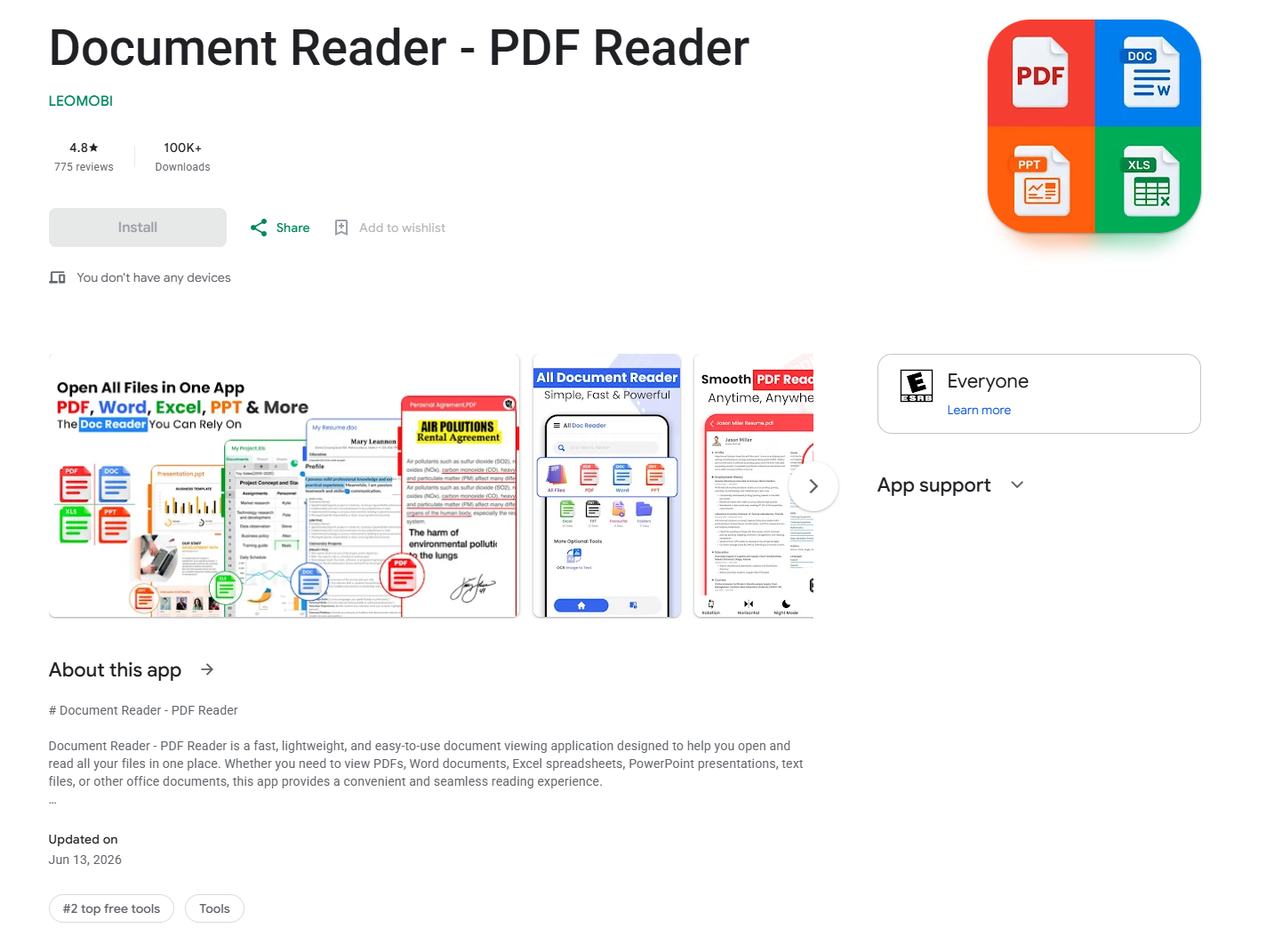
In Q2, our telemetry uncovered multiple malicious loaders hosted directly on Google Play. As highlighted in a prior report (link in Russian), one such instance involved a PDF reader app trojanized to drop the Anatsa banking malware. Upon execution, the app presented users with a fake request to install an update, which served as a front to stage the banking Trojan on the victim’s device.
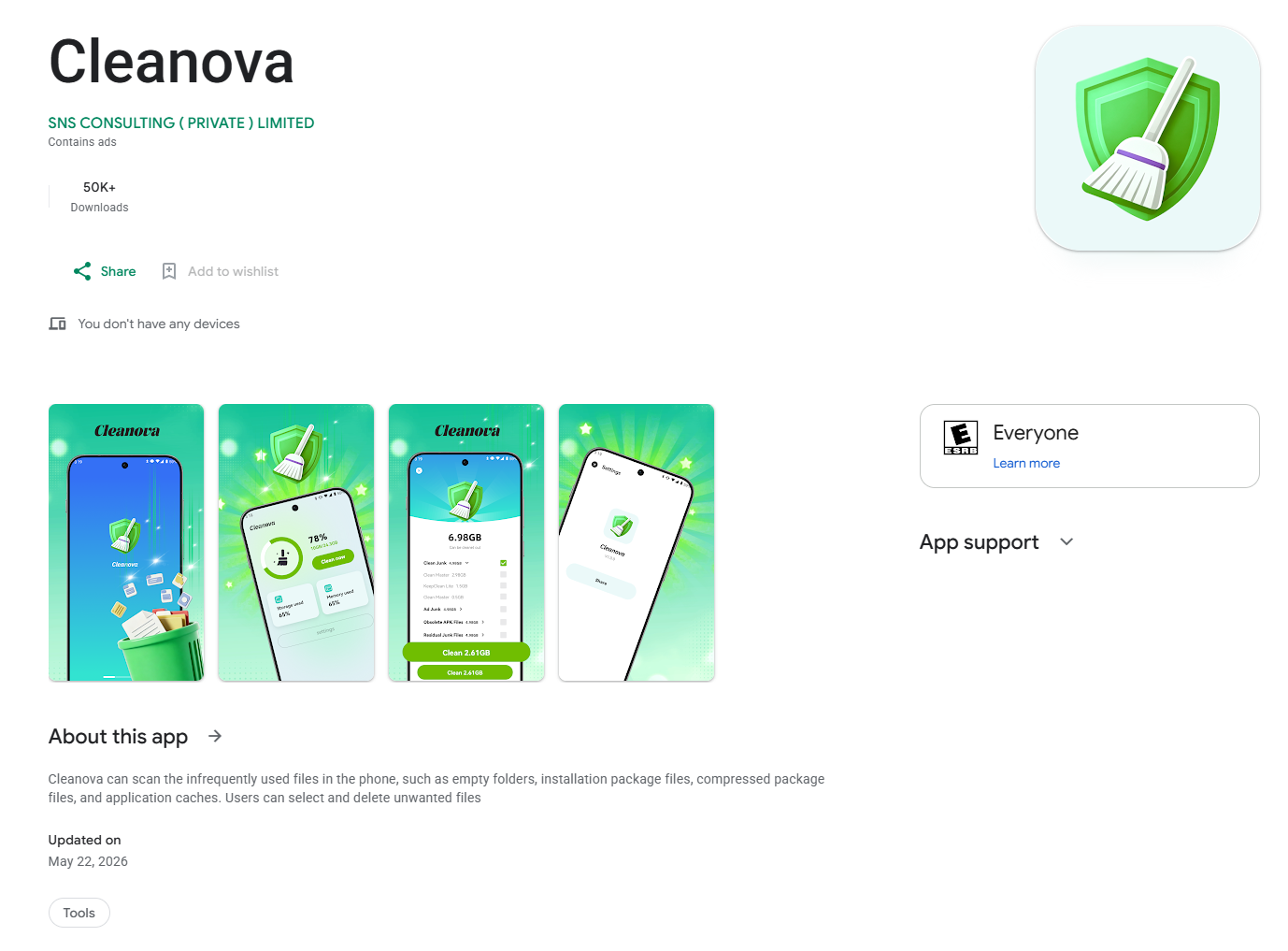
Another notable case involves a loader we detected in the Cleanova app alongside several others. The malware sent requests to a command-and-control server containing telemetry gathered from various SDKs that track the installation source. A malicious payload was returned only for certain sources. This is a fairly interesting method for bypassing app store review processes while ensuring precise victim targeting. If an analytics SDK indicates that an arbitrary installation originated from a source outside the threat actors’ scope, the malicious logic remains dormant. This effectively hides the malware from app store scanners.
Mobile threat statistics

In Q2, the number of Android malware samples totaled 304,128. It remained steady compared to the previous reporting period.

Detected malicious and potentially unwanted installation packages, Q2 2025 — Q2 2026 (download)

The detected installation packages were distributed by type as follows:

Detected mobile apps by type, Q1 — Q2 2026* (download)

* Data for the previous quarter may differ slightly from previously published data due to certain verdicts being retrospectively revised.

While the number of newly discovered banking Trojan variants fell precipitously, they continued to dominate the threat landscape as they did in Q1. Notably, the share of Creduz malware family among identified banking samples has grown significantly despite low activity in victim telemetry. This discrepancy suggests the threat actors are actively iterating on the malware — likely testing new features or bypasses — by generating a high volume of builds before staging a broader campaign.

Share* of users attacked by the given type of malicious or potentially unwanted apps out of all targeted users of Kaspersky mobile products, Q1 — Q2 2026 (download)

* The total may exceed 100% if the same users experienced multiple attack types.

Within the adware category, the sharpest declines were observed in the HiddenAd and MobiDash families. Meanwhile, the proportion of users targeted by Trojan-Dropper malware increased, primarily driven by surges in banking droppers such as Trojan-Dropper.AndroidOS.Banker and Trojan-Dropper.AndroidOS.Mamont. The corresponding drop in the Trojan-Banker category is partially explained by a shift in tactics: several banking Trojans which are now being packed were subsequently reclassified as droppers.

TOP 20 most frequently detected types of mobile malware

Note that the malware rankings below exclude riskware or potentially unwanted software, such as RiskTool or adware.

Verdict %* Q1 2026 %* Q2 2026 Difference in p.p. Change in ranking
Backdoor.AndroidOS.Triada.ag 7.09 9.35 +2.25 0
DangerousObject.Multi.Generic. 5.84 5.65 -0.19 0
DangerousObject.AndroidOS.GenericML. 5.51 5.25 -0.26 0
Trojan.AndroidOS.Boogr.gsh 2.15 3.33 +1.18 +9
Backdoor.AndroidOS.Triada.z 3.08 3.23 +0.15 +3
Trojan-Banker.AndroidOS.Mamont.hl 1.10 2.48 +1.38 +22
Trojan.AndroidOS.Fakemoney.v 3.44 2.31 -1.13 -2
Trojan-Spy.AndroidOS.Btmob.e 0.00 2.27 +2.27
Trojan.AndroidOS.Triada.fe 2.98 2.18 -0.81 0
Trojan-Dropper.AndroidOS.Banker.dd 0.01 2.16 +2.15
Trojan.AndroidOS.Triada.hf 2.23 1.93 -0.29 +1
Backdoor.AndroidOS.Triada.ad 1.40 1.93 +0.53 +8
Backdoor.AndroidOS.Keenadu.a 2.73 1.88 -0.85 -3
Backdoor.AndroidOS.Triada.ab 1.72 1.79 +0.07 +2
Trojan-Banker.AndroidOS.Mamont.iv 1.03 1.63 +0.60 +16
Trojan.AndroidOS.Generic. 1.32 1.47 +0.15 +7
Backdoor.AndroidOS.Triada.ae 1.76 1.44 -0.31 -2
Trojan.AndroidOS.Fakemoney.ej 0.00 1.43 +1.43
Trojan.AndroidOS.Triada.ii 2.07 1.41 -0.66 -5
Trojan-Spy.AndroidOS.Agent.asa 0.02 1.38 +1.36

* Unique users who encountered this malware as a percentage of all attacked users of Kaspersky mobile solutions.

The distribution of top malware families in Q2 largely mirrors the rankings from the previous reporting period. Newer variants of the Mamont banking Trojan climbed the leaderboards, displacing older iterations. This shift points to ongoing, active development of new variants by the threat actors behind the malware.

Mobile banking Trojans

In Q2, the total volume of Trojan-Banker applications dropped sharply compared to the previous quarter, totaling 93,574 installation packages.

Number of installation packages for mobile banking Trojans detected by Kaspersky, Q2 2025 — Q2 2026 (download)

Against the backdrop of this trend, the distribution shifted heavily toward Creduz Trojans. However, as noted earlier, this shift was not reflected in real-world attack metrics: virtually the entire leaderboard by proportion of targeted users continues to be dominated by diverse Mamont variants.

TOP 10 mobile bankers

Verdict %* Q1 2026 %* Q2 2026 Difference in p.p. Change in ranking
Trojan-Banker.AndroidOS.Mamont.hl 3.27 11.13 +7.86 +6
Trojan-Banker.AndroidOS.Mamont.iv 3.08 7.33 +4.25 +6
Trojan-Banker.AndroidOS.Mamont.mv 0.00 5.12 +5.12
Trojan-Banker.AndroidOS.Agent.ws 3.78 4.99 +1.22 +2
Trojan-Banker.AndroidOS.Mamont.mg 0.35 4.71 +4.36 +62
Trojan-Banker.AndroidOS.Faketoken.pac 2.56 4.10 +1.54 +6
Trojan-Banker.AndroidOS.Mamont.jo 15.75 3.73 -12.02 -6
Trojan-Banker.AndroidOS.Mamont.mc 0.83 3.51 +2.67 +26
Trojan-Banker.AndroidOS.Mamont.lf 0.00 2.79 +2.79
Trojan-Banker.AndroidOS.Agent.eq 0.89 2.58 +1.69 +23

* Unique users who encountered this malware as a percentage of all users of Kaspersky mobile security solutions who encountered banking threats.


TV boxes maliciosas: descubra como uma “SuperBox” barata transforma sua casa em um nó proxy para cibercriminosos | Blog oficial da Kaspersky

Netflix, Apple TV+, Disney+, Hulu, Amazon Prime, YouTube Premium… Hoje em dia, as famílias que seguem a lei costumam pagar, em média, de cinco a dez assinaturas apenas para assistir ao conteúdo que desejam, com gastos mensais facilmente ultrapassando a casa dos cem dólares. Não é surpresa, portanto, que as redes sociais e os marketplaces on-line estejam registrando um aumento na demanda por “caixas mágicas”. Surgidas no final de 2025, essas TV boxes Android prometem desbloquear milhares de canais e oferecer acesso gratuito a serviços de streaming mediante um único pagamento.

Os anúncios desses dispositivos estão inundando o TikTok e o Instagram: influenciadores sorridentes tiram os SuperBoxes da caixa, conectam-nos à TV e navegam por inúmeros canais. Parece a solução perfeita contra o alto preço das assinaturas, certo? Mas, na prática, essa é uma das formas mais fáceis de permitir a entrada de uma botnet na sua rede doméstica.

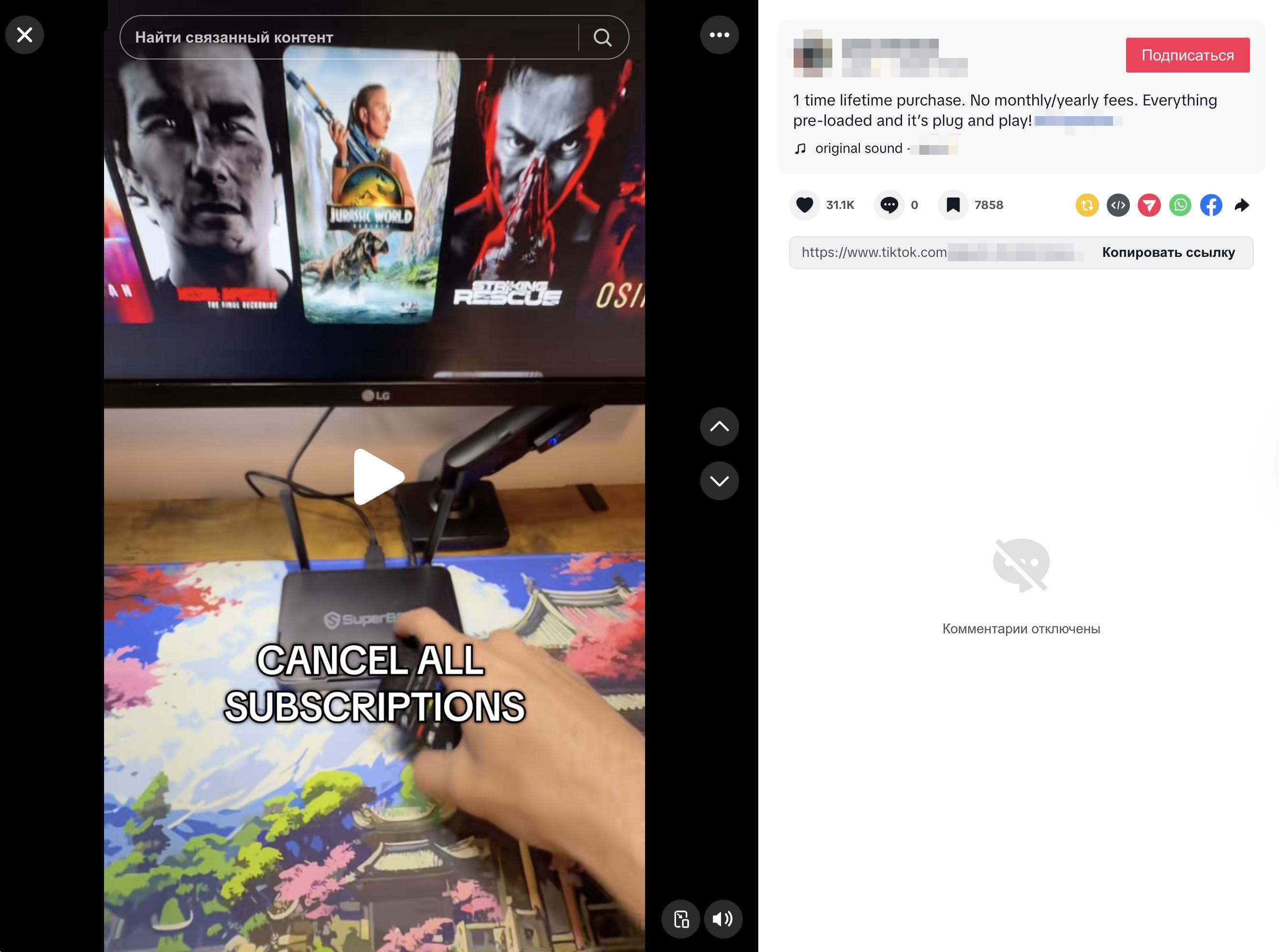
Captura de tela de um vídeo do TikTok mostrando um SuperBox em ação

Um vídeo promocional no TikTok explicando como é ótimo quando tudo é grátis simplesmente cancelar todas as suas assinaturas

O que há de errado com essas TV boxes baratas?

Já surgiram vários relatos sobre TV boxes maliciosas, mas agora sua divulgação atingiu uma escala realmente alarmante.

No final de 2025, analistas examinaram vários modelos do SuperBox, um dispositivo popular disponível nas principais lojas de varejo e marketplaces on-line. As descobertas foram muito preocupantes: logo após serem ligados, os dispositivos começaram a enviar solicitações aos servidores do aplicativo de mensagens chinês Tencent QQ e ao serviço de proxy Grass, efetivamente disponibilizando a largura de banda da Internet do usuário para terceiros.

Dentro do firmware, os pesquisadores descobriram aplicativos completamente incomuns em um reprodutor de mídia: um scanner de rede, um analisador de tráfego e ferramentas de sequestro de DNS. Com isso, o dispositivo não apenas transmite conteúdo pirata, mas também vasculha a rede local em busca de outros alvos (incluindo interfaces industriais SCADA) e fica pronto para participar de ataques DDoS. Também foi descoberto que os SuperBoxes contêm pastas com o nome revelador “secondstage”, um forte indício de malware em vários estágios.

Mais recentemente, em abril de 2026, o podcast Darknet Diaries publicou uma entrevista com um pesquisador de segurança conhecido pelo pseudônimo D3ada55, que compartilhou diversos detalhes preocupantes sobre essas caixas, incluindo o fato de que elas ainda eram vendidas livremente em plataformas como Amazon, Walmart e Best Buy.

A evolução da infecção: do BADBOX ao Keenadu

O caso do SuperBox está longe de ser a única ocorrência em que os dispositivos Android foram transformados em nós de botnet ou vendidos com infecções de fábrica. Aqui estão os casos mais recentes:

  • BADBOX 2.0. Em julho de 2025, a Google processou os operadores de uma botnet que comprometeu mais de 10 milhões de dispositivos Android, principalmente TV boxes, tablets e projetores baratos que não tinham certificação do Google Play Protect. Conforme informamos anteriormente, o BADBOX 2.0 tem como alvo TV boxes e opera tanto como uma rede proxy quanto como uma plataforma de fraude publicitária.
  • Kimwolf. Em dezembro de 2025, a equipe do QiAnXin XLab descobriu uma botnet DDoS que havia sequestrado cerca de 1,8 milhão de dispositivos Android. O hardware infectado incluía modelos genéricos de fabricantes pouco conhecidos que usavam nomes chamativos como TV BOX, SuperBox, XBOX, SmartTV e outros. O alcance da infecção foi enorme, com dispositivos comprometidos distribuídos para o mundo todo. Os países mais atingidos foram o Brasil, Índia, Estados Unidos, Argentina, África do Sul, Filipinas e México.
  • Keenadu. Nossos especialistas descobriram esse malware à espreita no firmware de dispositivos novos em novembro de 2025, mas ele só chamou atenção depois de publicarmos um estudo sobre ele em fevereiro de 2026. O Keenadu se disfarça de componente legítimo do sistema, até mesmo entrando em aplicativos de desbloqueio facial e potencialmente concedendo aos invasores acesso a dados biométricos, informações bancárias e mensagens pessoais.

Todas essas histórias compartilham a mesma origem: o cavalo de Troia Triada, documentado pela primeira vez pelos nossos pesquisadores em 2016 e apelidado na época de “um dos cavalos de Troia móveis mais avançados”. Ao longo da última década, ele evoluiu de um malware comum para um backdoor modular integrado diretamente ao firmware durante a fabricação.

Como o esquema de infecção funciona

Os fabricantes de TV boxes baratas cortam gastos em tudo: certificação do Google Play Protect, auditorias de firmware e atualizações de segurança. Muitos desses dispositivos são executados no Android Open Source Project sem nenhuma garantia de segurança. Em algum lugar ao longo da cadeia de suprimentos, seja na fábrica, por meio de um intermediário ou em uma distribuidora, um backdoor é injetado na imagem do firmware. Nossos especialistas suspeitam que o próprio fabricante pode nem estar ciente do comprometimento.

A escala da infecção transforma milhões de caixas idênticas na base perfeita para uma botnet: cada dispositivo comprometido representa um endereço IP exclusivo que pode ser alugado para terceiros. Operadores de botnet, como o Kimwolf, lucram com isso não apenas por meio de ataques DDoS distribuídos, mas também revendendo a largura de banda de smart TVs e TV boxes infectadas.

O que isso significa para você

Uma TV box infectada fica na sala de estar, conectada ao Wi-Fi doméstico. Isso significa que ela pode detectar smartphones com aplicativos bancários, unidades de armazenamento conectadas à rede (NAS) com arquivos da família, câmeras IP, fechaduras inteligentes, computadores de trabalho e qualquer outro dispositivo conectado à sua rede Wi-Fi.

Com esse tipo de vetor de acesso inicial dentro da sua rede doméstica, um invasor pode interceptar tráfego não criptografado, falsificar solicitações de DNS, verificar portas e procurar vulnerabilidades em dispositivos vizinhos. Além disso, seu endereço IP pode ser usado para atividades fraudulentas. Como resultado, na melhor das hipóteses, seu IP acabará entrando em listas de bloqueio, e serviços legítimos começarão a barrar seu acesso por atividade suspeita; na pior, autoridades podem bater à sua porta.

Como identificar um gadget potencialmente perigoso

Você deve ficar alerta se um dispositivo:

  • For vendido sob uma marca sem nome ou genérica, como T95, X96Q, MX10, TV BOX, SuperBox ou similares
  • Promete acesso vitalício gratuito a serviços premium pagos mediante um único pagamento
  • Exige que você desative o Google Play Protect ou instale APKs de terceiros durante a configuração inicial
  • Não tem uma certificação do Play Protect
  • É promovido por meio de campanhas agressivas de spam nas redes sociais

Como evitar hospedar um nó de botnet

  • Compre TV boxes certificadas com Google Play Protect ou adquira dispositivos diretamente de operadoras de telecomunicações e provedores de Internet confiáveis.
  • Isole todos os dispositivos domésticos inteligentes. Configure uma rede Wi-Fi separada no roteador da sua casa para TV boxes, câmeras, alto-falantes inteligentes, aspiradores robóticos e dispositivos semelhantes, mantendo smartphones, unidades NAS e computadores na rede principal. Isso evita que o malware se espalhe para seus dispositivos mais importantes.
  • Atualize o firmware com frequência em todos os dispositivos, e não se esqueça do roteador, pois ele também representa um elo vulnerável na cadeia.
  • Remova todos os aplicativos da TV box Android que não foram instalados por você, especialmente lojas de aplicativos alternativas, “impulsionadores” de Wi-Fi e “limpadores de sistema”.
  • Monitore o tráfego da sua rede. Roteadores modernos e o Kaspersky Premium conseguem exibir os destinos de conexão de cada dispositivo. Conexões frequentes entre um reprodutor de mídia e servidores na China representam um forte sinal de alerta de segurança.
  • Instale o Kaspersky Premium em todos os seus dispositivos, pois ele protege contra cavalos de Troia e bloqueia páginas de phishing usadas para distribuir arquivos APK infectados.
  • Não desative o Google Play Protect e evite instalar APKs de fontes duvidosas, pois esse é o principal vetor de infecção usado para burlar a loja oficial de aplicativos.
  • Em caso de dúvida, devolva a TV box. Não vale a pena arriscar sua biometria, dados bancários ou a reputação do seu endereço IP por causa de um dispositivo de streaming barato.

Quer saber como proteger seus dispositivos domésticos inteligentes? Leia mais nas nossas postagens relacionadas:

A sua TV, seu smartphone e seus alto-falantes inteligentes estão espionando você?

Seu roteador está trabalhando secretamente para inteligências estrangeiras?

Casa não tão inteligente

Lar, smart lar

Como proteger sua casa smart

IT threat evolution in Q1 2026. Mobile statistics

IT threat evolution in Q1 2026. Mobile statistics
IT threat evolution in Q1 2026. Non-mobile statistics

In the third quarter of 2025, we updated the methodology for calculating statistical indicators based on the Kaspersky Security Network. These changes affected all sections of the report except for the statistics on installation packages, which remained unchanged.

To illustrate the differences between the reporting periods, we have also recalculated data for the previous quarters. Consequently, these figures may significantly differ from the previously published ones. However, subsequent reports will employ this new methodology, enabling precise comparisons with the data presented in this post.

The Kaspersky Security Network (KSN) is a global network for analyzing anonymized threat information, voluntarily shared by users of Kaspersky solutions. The statistics in this report are based on KSN data unless explicitly stated otherwise.

The quarter in numbers

According to Kaspersky Security Network, in Q1 2026:

  • More than 2.67 million attacks utilizing malware, adware, or unwanted mobile software were prevented.
  • The Trojan-Banker category was the prevalent mobile malware threat with a 52.96% share of total detected applications.
  • More than 306,000 malicious installation packages were discovered, including:
    • 162,275 packages related to mobile banking Trojans;
    • 439 packages related to mobile ransomware Trojans.

Quarterly highlights

The number of malware, adware, or unwanted software attacks on mobile devices decreased to 2,676,328 in Q1, down from 3,239,244 in the previous quarter.

Attacks on users of Kaspersky mobile solutions, Q3 2024 — Q1 2026 (download)

The overall drop in attack volume stems primarily from a reduction in adware and RiskTool detections. Nonetheless, this trend does not equate to a lower risk for mobile users. As shown later in this report, the number of unique users targeted by these threats remained relatively stable.

In Q1, Synthient researchers identified a link between the notorious Kimwolf botnet and the IPIDEA proxy network. This network was later taken down in cooperation with GTIG.

In early 2026, we discovered several apps on Google Play and the App Store that contained a new version of the SparkCat crypto stealer.

The Trojan code, meticulously concealed, was embedded into the infected Android apps. The obfuscated malicious Rust library was decrypted using a Dalvik-like virtual machine custom-built by the attackers. The iOS version of the malware also underwent several changes; specifically, the attackers began leveraging Apple’s proprietary Vision framework for optical character recognition (OCR).

Mobile threat statistics

The number of Android malware samples saw a slight increase compared to Q4 2025, reaching a total of 306,070.

Detected malicious and potentially unwanted installation packages, Q1 2025 — Q1 2026 (download)

The detected installation packages were distributed by type as follows:

Detected mobile apps by type, Q4 2025* — Q1 2026 (download)

* Data for the previous quarter may differ slightly from previously published figures due to certain verdicts being retrospectively revised.

Threat actors once again ramped up the production of new banking Trojans; as a result, this category overtook all others in volume, accounting for more than half of all installation packages.

Share* of users attacked by the given type of malicious or potentially unwanted app out of all targeted users of Kaspersky mobile products, Q4 2025 — Q1 2026 (download)

* The total percentage may exceed 100% if the same users encountered multiple attack types.

Following the surge in banking Trojan installation packages, the number of associated attacks also rose, causing Trojan-Banker apps to climb one spot in terms of their share of targeted users. Mamont variants emerged as the most prevalent banking Trojans, accounting for 73.5% of detections, with the rest of the users encountering Faketoken, Rewardsteal, Creduz, and other families.

Yet banking Trojans were still outpaced by adware and RiskTool-type unwanted apps when measured by the total number of affected users. Despite a decrease in their share of installation packages, these two app types retained their positions as the top two threats by attack volume. The most common adware detections involved HiddenAd (44.9%) and MobiDash (38.1%), while most frequently seen RiskTool apps were Revpn (67%) and SpyLoan (20.5%).

TOP 20 most frequently detected types of mobile malware

Note that the malware rankings below exclude riskware or potentially unwanted software, such as RiskTool or adware.

Verdict %* Q4 2025 %* Q1 2026 Difference in p.p. Change in ranking
Backdoor.AndroidOS.Triada.ag 2.62 7.09 +4.48 +10
DangerousObject.Multi.Generic. 6.75 5.84 -0.92 -1
DangerousObject.AndroidOS.GenericML. 3.52 5.51 +1.99 +6
Trojan-Banker.AndroidOS.Mamont.jo 0.00 5.28 +5.28
Trojan.AndroidOS.Fakemoney.v 5.40 3.44 -1.96 -1
Trojan-Downloader.AndroidOS.Keenadu.l 0.00 3.35 +3.35
Trojan-Banker.AndroidOS.Mamont.jx 0.00 3.09 +3.09
Backdoor.AndroidOS.Triada.z 4.87 3.08 -1.79 -2
Trojan.AndroidOS.Triada.fe 5.01 2.98 -2.02 -4
Backdoor.AndroidOS.Keenadu.a 2.07 2.73 +0.66 +6
Trojan-Banker.AndroidOS.Mamont.jg 0.34 2.37 +2.03
Trojan.AndroidOS.Triada.hf 2.15 2.23 +0.07 +3
Trojan.AndroidOS.Boogr.gsh 2.35 2.15 -0.20 0
Trojan.AndroidOS.Triada.ii 5.68 2.07 -3.60 -11
Backdoor.AndroidOS.Triada.ae 1.91 1.76 -0.16 +3
Backdoor.AndroidOS.Triada.ab 1.79 1.72 -0.08 +3
Trojan.AndroidOS.Triada.gn 2.38 1.58 -0.80 -5
Trojan-Banker.AndroidOS.Mamont.gg 1.56 1.50 -0.06 +2
Trojan.AndroidOS.Triada.ga 1.48 1.50 +0.01 +4
Backdoor.AndroidOS.Triada.ad 0.53 1.40 +0.87 +44

* Unique users who encountered this malware as a percentage of all attacked users of Kaspersky mobile solutions.

The pre-installed Triada.ag backdoor rose to the top spot; it is similar to the older Triada.z version we documented previously. Because the same variant was pre-installed across a wide range of devices, the total number of affected users is aggregated. Consequently, Triada outpaced even Mamont, as users encountered a variety of Mamont variants, causing the share of that banking Trojan to spread across multiple rows. Other pre-installed Triada variants (Triada.z, Triada.ae, Triada.ab, and Triada.ad) also made the rankings. Furthermore, we observed increasing activity from the Keenadu.a backdoor, while diverse variants of the embedded Triada Trojan remained in the rankings.

Mobile banking Trojans

Q1 2026 saw a characteristic rise in mobile banking Trojan activity, with the number of packages totaling 162,275, a 50% increase compared to the prior quarter.

Number of installation packages for mobile banking Trojans detected by Kaspersky, Q1 2025 — Q1 2026 (download)

We saw a similar growth in the previous quarter, with banking Trojan volumes rising by 50% during that period as well. Various Mamont variants accounted for the absolute majority of packages and represented nearly every entry in the rankings of most frequent banking Trojans by affected user count.

TOP 10 mobile bankers

Verdict %* Q4 2025 %* Q1 2026 Difference in p.p. Change in ranking
Trojan-Banker.AndroidOS.Mamont.jo 0.00 15.75 +15.75
Trojan-Banker.AndroidOS.Mamont.jx 0.00 9.22 +9.22
Trojan-Banker.AndroidOS.Mamont.jg 1.47 7.08 +5.61 +24
Trojan-Banker.AndroidOS.Mamont.gg 6.79 4.48 -2.32 -3
Trojan-Banker.AndroidOS.Mamont.ks 0.00 3.98 +3.98
Trojan-Banker.AndroidOS.Agent.ws 6.03 3.78 -2.25 -2
Trojan-Banker.AndroidOS.Mamont.hl 4.30 3.27 -1.03 +1
Trojan-Banker.AndroidOS.Mamont.iv 6.00 3.08 -2.92 -3
Trojan-Banker.AndroidOS.Mamont.jb 3.93 3.07 -0.86 +1
Trojan-Banker.AndroidOS.Mamont.jv 0.00 2.79 +2.79

* Unique users who encountered this malware as a percentage of all users of Kaspersky mobile security solutions who encountered banking threats.

❌