 Entrar
Britain Gains Access to Ukraine’s ‘Goldmine’ of Battlefield AI Data


A researcher discovered an exposed directory containing the tools of an attacker who compromised more than 14,000 Dahua cameras between June 17 and July 22, 2026, mainly in Ukraine and Russia. Hunt.io reconstructed the operation, named Operation CameraSwarm, from the leaked files and telemetry.
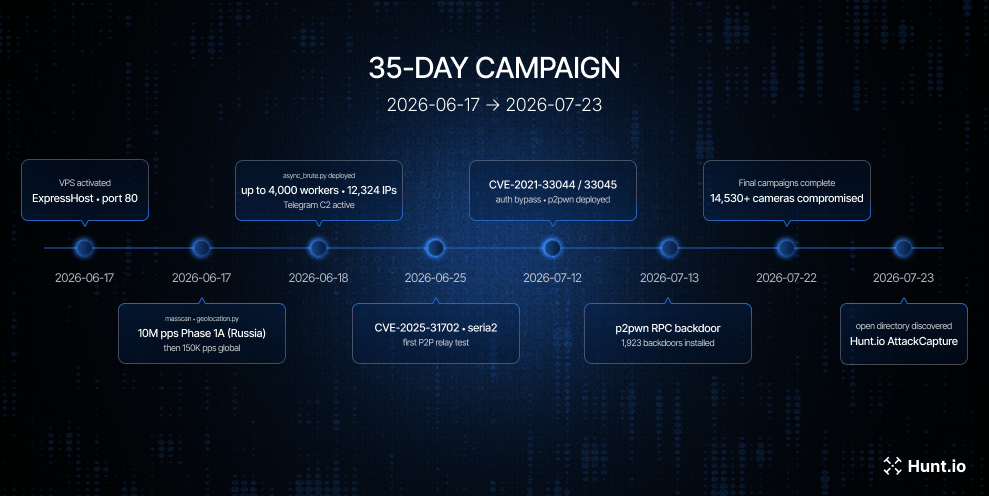
The find started with a mistake. On 23 July, Hunt.io’s AttackCapture system crawled a server at 154.86[.]119.60 and pulled down 2,616 files across 234 subdirectories, 407 MB in total, from an HTTP directory the operator had left wide open. That single slip handed researchers the operator’s scanning engine, exploit chains, exfiltration bot, and a Windows stealer staged on the same box.
“This is the second Dahua-related camera compromise operation we’ve traced back to an exposed operator directory in as many weeks. Where last week’s investigation centered on a Russian-speaking operator running a purpose-built platform against 58 cameras, this one is a different scale entirely.” reads the report published by Hunt.io.
The brute-force engine alone reached over 12,300 unique addresses. A separate authentication-bypass chain, built around two 2021 Dahua vulnerabilities, planted a persistent backdoor account on 1,923 cameras, an account stored independently of the admin password that survives both a password change and, on most firmware, a factory reset. A third path skipped IP addresses entirely and reached 283 cameras purely by serial number, through Dahua’s own cloud relay.
That third path is the part worth sitting with. Most of those cameras were exposed online without authentication.
Dahua’s cloud relay lets any app reach a camera sitting behind NAT using nothing but its serial number, and authentication to that relay runs on credentials baked identically into every Dahua client ever shipped. The operator’s own code logs the result of probing this channel at scale: 89.4 percent of live serials returned an open, no-authentication channel. Nine out of ten cameras, reachable by anyone who could guess or harvest a serial number.
“The device never authenticates the connecting party. It authenticates the session, via a token the cloud issued before the device was contacted. Obtaining that token requires only the fixed SDK credentials shared by every legitimate Dahua application.” continues the report. “The only real barrier to reaching any camera through this path is knowing its serial number, precisely what the operator’s harvesting pipeline exists to produce at scale.”
Getting from the tunnel session to full admin access still requires valid credentials or an authentication bypass. However, the attacker’s own logs suggest that most exposed cameras did not need this final step.
There are also two important details about the reported CVEs. The tool links its persistent backdoor technique to CVE-2024-39943, but that CVE actually refers to a different command-injection flaw in Rejetto’s HTTP File Server. The technique is valid, but the CVE reference is wrong. Likewise, the relay abuse is not CVE-2025-31702, which Dahua describes as a narrower authenticated privilege-escalation flaw. Incorrect CVE references can send defenders looking for the wrong fix.
Hunt.io also found something that had nothing to do with cameras: a UPX-packed Windows binary, tagged as SalatStealer, staged on the same server alongside a PowerShell script that disables Windows Defender five different ways, including a Group Policy key built to survive reboots and Defender updates. The researchers treat it as a separate, unrelated capability riding along on shared infrastructure, not part of the camera campaign proper.
What stands out across the whole toolkit is that none of it was built from scratch. The brute-force engine, the bypass chain, the relay tooling, the recovery-code generator: each traces to a different public repository, credited (sometimes accurately) to at least six other developers. The operator assembled, patched, and rewrote, layering Russian comments over Spanish code in one component recovered in three separate stages of the same rewrite.
“The same toolkit also recovers stored device passwords outright, through a routine that derives its decryption key entirely from values the attacker already holds, device class prefix and serial number, so no device secret is needed. A residual Spanish comment in that code confirms it came from the same upstream source as the original brute-forcer.” states the report.a
The offline recovery-code generator is arguably the most consequential piece precisely because it doesn’t need a compromised device at all. Given a live serial number, it derives a code entirely offline that unlocks Dahua’s cloud-level account-recovery flow, no current credentials required. Removing a backdoor account doesn’t touch this. Only Dahua changing how the code is derived would.
For anyone running Dahua gear, or the OEM-rebranded lines built on the same backend (Amcrest, Lorex, Annke, Swann, among others), the practical checklist is short: check for a p2pwn account and remove it, disable P2P on any device where it isn’t actually needed, confirm firmware is patched against the 2021 bypass pair, and rotate every credential that camera ever held, since the exfiltration bot grabbed those too. None of that fixes the recovery-code problem. That one sits with the vendor.
Follow me on Twitter: @securityaffairs and Facebook and Mastodon
(SecurityAffairs – hacking, newsletter)

CERT-UA published a new advisory attributing a phishing campaign to UAC-0099, a Russia-aligned threat actor active since at least mid-2022 and previously known for exploiting WinRAR vulnerabilities and using phishing emails to deliver malware families including LONEPAGE, MATCHBOIL, and DRAGSTARE.

The latest campaign, observed earlier this summer, uses a trojanized Notepad++ plugin as the infection mechanism. It’s a meaningful change in delivery method for a group that’s been refining its toolset steadily for three years.
The attack starts with a phishing email carrying an image attachment. Clicking it opens a URL hidden behind a link shortener, which redirects to a file-sharing service such as EasySend[.]co where a ZIP archive waits. Inside the ZIP is a VBScript file disguised as a PDF document.
Running the VBScript triggers two things simultaneously. A legitimate decoy PDF downloads and opens in front of the victim to hold their attention, while in the background the script fetches a second archive called Evernote.zip. That archive contains a full working copy of Notepad++ version 8.8.3, a malicious DLL plugin named NppExport.dll, a password-protected RAR archive called updater.rar, and a legitimate WinRAR executable.
“The mentioned archive contains a VBS script with a double extension, the name of which may intentionally contain a significant number of spaces before the final .vbs extension , for example “Zavodskyi rayon.pdf .vbs”. In turn, when launched, the script will download a decoy file (for example “Zavodskyi rayon.pdf”) and the “Evernote.zip” archive.” reads the advisory. “The archive contains a full set of Notepad++ program components version 8.8.3, as well as the “/plugins/NppExport/” directory, which contains a third-party plugin library “NppExport.dll”, a password-protected archive “updater.rar” and the WinRAR executable file “winrar.exe”.”
The VBScript extracts everything and launches Notepad++, which loads NppExport.dll as it starts up. The victim sees a text editor open normally and has no reason to suspect anything happened.
The malicious DLL, codenamed LUNCHPOKE by CERT-UA, uses the bundled WinRAR binary to unpack the password-protected archive. That archive contains two files: RemoteLibUpdater.exe and InitTest.dll. LUNCHPOKE copies them to a specific directory and creates a scheduled task that runs RemoteLibUpdater.exe every three minutes. The three-minute interval is aggressive and keeps the implant active even after unexpected process termination.
“The file “NppExport.dll” is classified as a LUNCHPOKE utility , the main purpose of which is to create the directory ” %PUBLIC%\Libraries\fFthY3-Ytrevc3w-ab3\ “, extract the contents of the archive “updater.rar” to it using a password (in particular, the files “RemoteLibUpdater.exe” and “InitTest.dll”), copy the standard utility “schtasks.exe” to the file ” %PUBLIC%\Wallpapers\Background.exe ” and create a scheduled task with the name ” \W1n3r-U09oTy-Ap5\Updates ” to run the file ” %PUBLIC%\Libraries\fFthY3-Ytrevc3w-ab3\RemoteLibUpdater.exe ” with the arguments “setup nodisplay” every three minutes (the name of the directory ” fFthY3-Ytrevc3w-ab3 ” changes).” states CERT-UA.
RemoteLibUpdater.exe is BURNYBEAR, a loader whose job is to execute InitTest.dll. That DLL is a modified version of MATCHBOIL, a C#-based loader capable of fetching and running additional payloads, now designated MATCHBOIL.V2. The update indicates active development on the toolchain rather than a static deployment.
BURNYBEAR includes an unusual built-in sabotage behavior.
“The executable file “RemoteLibUpdater.exe” is classified as a BURNYBEAR utility , the functionality of which is designed to load the DLL file “InitTest.dll”. However, if “RemoteLibUpdater.exe” is launched incorrectly, namely without specifying arguments, BURNYBEAR instead activates logic designed to exhaust computer resources (RAM and CPU).” states the report.
That behavior serves a dual purpose: it makes behavioral analysis harder by producing unexpected output if someone runs the binary without the correct arguments, and it provides a rough sandbox detection mechanism since automated analysis environments often execute binaries without arguments.
This campaign arrives alongside a separate U.S. government advisory documenting Laundry Bear, another Russia-linked actor, running a phishing campaign against Zimbra mail servers belonging to Western government and commercial organizations since at least July 2025. That campaign uses a “half-click” exploit abusing CVE-2025-66376 to deliver malicious JavaScript called ZimReaper, which can harvest email communications without requiring the victim to click anything beyond opening a malicious email in a vulnerable webmail client. The U.S. government’s assessment of Laundry Bear’s intent is unambiguous:
CERT-UA recommends updating WinRAR, 7-Zip, and Notepad++ to their latest versions to close known vulnerabilities that groups like UAC-0099 use to facilitate follow-on stages once they’ve established a foothold.
The campaign’s use of a bundled legitimate WinRAR executable rather than relying on one already installed is notable: it means the attack chain doesn’t depend on the victim having a vulnerable version present, which makes the update recommendation more relevant as a general hygiene measure than as a specific remediation for this particular campaign. Organizations receiving unexpected emails with image attachments that open URLs through link shorteners should treat those as high-risk regardless of what the displayed content looks like.
Follow me on Twitter: @securityaffairs and Facebook and Mastodon
(SecurityAffairs – hacking, Notepad++)
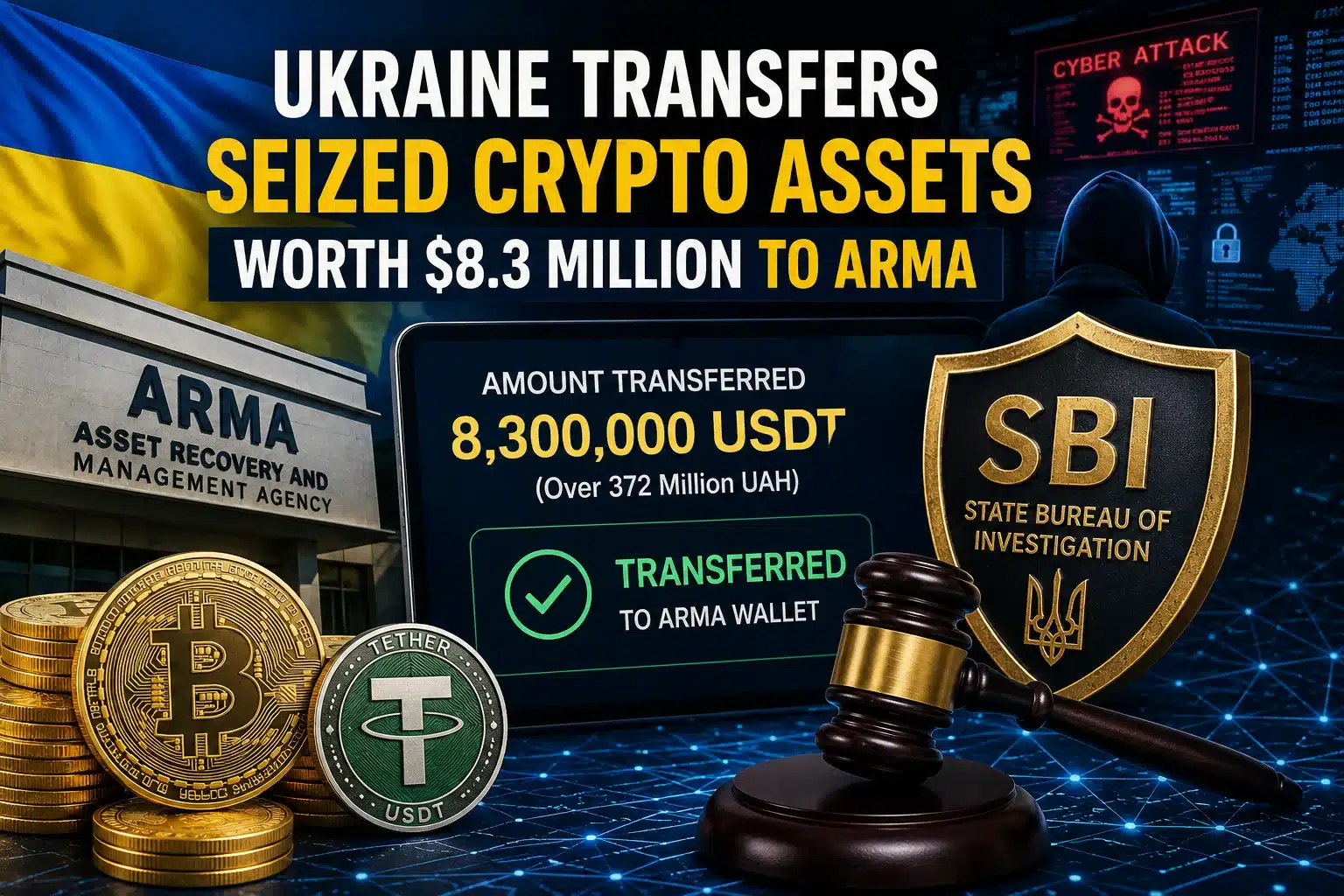
Ukraine has transferred Seized Crypto Assets worth more than 8.3 million USDT to the country's Asset Recovery and Management Agency (ARMA), marking the first time virtual assets have been placed under the agency's management following a court decision. The transfer follows an investigation led by the State Bureau of Investigation into an international hacking group accused of carrying out cyberattacks, extortion, and money laundering across Europe and the United States.
According to Ukrainian authorities, the transferred cryptocurrency is valued at more than 372 million hryvnias and represents a milestone in the country's efforts to manage digital assets linked to criminal investigations.
The State Bureau of Investigation said the transfer was completed as part of an ongoing criminal investigation conducted in cooperation with the DVB of the National Police and U.S. law enforcement agencies.
Investigators determined that the virtual assets were stored in crypto wallets controlled by a member of the organized hacking group. Following a court order, more than 8.3 million USDT was transferred to ARMA's official crypto wallet.
Authorities said this is the first practical case in Ukraine where seized digital assets have been transferred to ARMA for management, demonstrating the country's ability to handle new categories of assets within the legal system.
According to investigators, members of the international hacking group carried out large-scale cyberattacks against individuals and companies in Europe and the United States.
The investigation alleges the group stole confidential information, demanded ransom payments, and laundered criminal proceeds in Ukraine through the purchase of residential properties, vehicles, and other high-value assets.
Authorities estimate that the criminal group's activities caused losses exceeding $100 million.
As part of the pre-trial investigation, four members of the group, including its alleged organizer, were detained and placed in custody.
The investigation resulted in the cryptocurrency seizure and the confiscation of additional assets with a combined value exceeding $11.1 million.
According to the State Bureau of Investigation, the seized property includes residential buildings, apartments, vehicles, approximately $1 million in cash, and digital assets equivalent to more than $8.3 million.
The Office of the Prosecutor General is providing procedural oversight for the criminal proceedings.
The State Bureau of Investigation said that after converting the cryptocurrency into fiat currency, authorities plan to purchase military bonds.
According to the agency, the initiative is intended to support Ukraine's economy during martial law while ensuring that assets obtained through criminal activity are redirected for state purposes.
Officials described countering transnational cybercrime and ensuring effective mechanisms for the seizure and management of criminal assets as key priorities.
ARMA said receiving the cryptocurrency marks an important step in the evolution of Ukraine's asset management system.
The agency stated that the successful transfer reflects coordinated efforts between the State Bureau of Investigation and the Office of the Prosecutor General, enabling the execution of the court's decision and preserving the value of the seized assets.
ARMA added that it is continuing to develop mechanisms for managing all categories of seized property, including real estate, corporate rights, and virtual assets, to ensure their preservation in the interests of the state and society.
The agency said the case demonstrates that as cybercriminals increasingly use digital technologies to conceal illicit proceeds, authorities must also strengthen their ability to manage and preserve cryptocurrency and other digital assets seized during criminal investigations.
The Security Service of Ukraine (SSU), working jointly with the FBI, has formally exposed a sustained Russian intelligence campaign targeting the messaging accounts of government officials, military personnel, politicians, and activists across Ukraine, Europe, and the United States.
The operation is ongoing. The goal isn’t disruption; it’s intelligence collection.
“Cyber experts of the Security Service of Ukraine together with the Federal Bureau of Investigation exposed Russian special services in systematic cyberattacks on messengers of officials, military personnel, politicians and activists from Ukraine, Europe and the USA.” read the alert by SSU.
“The purpose of these ‘hacks’ is to gain access to sensitive information of a military, political and economic nature that was exchanged between users, as well as to steal their personal data.”
The attack method is low-tech by design. Operators send SMS messages impersonating platform support bots, asking targets to hand over account credentials, confirmation codes, PINs, or account recovery keys. The SBU notes that these messages tend to arrive in the morning hours, when targets are physically and emotionally less guarded. Timing is a social engineering choice, not an accident.
The scope is broader than most people assume.
“The SBU emphasizes that Russian special services and hackers associated with them attack not only organizations, officials or public figures, but also personal accounts of Ukrainians.” continues the alert.
This isn’t a targeted elite program. It’s a mass collection operation with a tiered approach: high-value targets get more sophisticated techniques, ordinary citizens get the SMS impersonation play. The SBU didn’t attribute the campaign to a specific group by name, but prior reporting from Google, the FBI, and CISA ties similar activity to clusters tracked as UNC5792 and UNC4221, both linked to FSB operations, as well as Star Blizzard.
The FBI’s June 26 advisory added a new technique to what the March warning described. Russian operators have evolved from chasing one-time verification codes to specifically targeting Signal Backup Recovery Keys, which unlock an account’s entire message history and remain valid even if the user creates a new account with the same phone number afterward. This is a meaningful escalation: a stolen verification code expires, a stolen Recovery Key doesn’t.
QR codes are another active vector the SBU specifically calls out. Scanning a QR code received from an unknown bot or user can silently link the attacker’s device to the victim’s account, a technique Google’s Threat Intelligence Group documented against Signal’s linked-devices feature in early 2025.
“Russian hackers use a variety of tools and methods for such cyberattacks. For example, to extract passwords to an account, the enemy most often uses SMS messages on behalf of ‘support teams.'” states SSU.
The variety matters: blocking one delivery mechanism doesn’t stop the campaign, because the operators rotate techniques and targeting lists continuously.
The SBU’s practical guidance covers the basics that still fail most users in practice. Check active sessions in your messenger regularly and end anything you don’t recognize. Enable two-factor authentication with a complex alphanumeric PIN, not a four-digit code. Never provide confirmation codes, PINs, passwords, or recovery keys to anyone, regardless of how legitimate the request appears. Don’t scan QR codes from unknown sources. Don’t follow suspicious links even from accounts you know, because that account may already be compromised. Anyone who receives a suspicious message in a messenger can report it to the SBU’s Cybersecurity Situation Center at incident@dis.gov.ua.
Last week, the FBI and CISA updated their March 2026 warning about Russian intelligence phishing campaigns, and the new advisory adds a detail that wasn’t in the original: the operators have shifted their primary objective from stealing verification codes to stealing Signal Backup Recovery Keys.
Follow me on Twitter: @securityaffairs and Facebook and Mastodon
(SecurityAffairs – hacking, Ukraine)
Between February 2022 and September 2025, Bellingcat staff and volunteers collected, geolocated, and shared more than 2,500 incidents of civilian harm following Russia’s full-scale invasion of Ukraine.
As part of this effort, Bellingcat tested a new machine learning model intended to rank Telegram social media posts on their likelihood of containing incidents of civilian harm.
This novel methodology dramatically reduced the search and selection time required, freeing researchers to focus on verifying incidents of civilian harm – not just searching for them.
This piece documents our methodology, ethical considerations and lessons learned in the hope that others researching similar topics can benefit from our work.
Open source research into civilian harm is still a relatively new field and it presents many challenges – one of the biggest is organising and sorting through the huge volume of user generated content being produced to find what is relevant.
Machine learning, a form of artificial intelligence that uses algorithms to identify patterns from large amounts of data and make predictions, can make this task more efficient.
With ongoing conflicts involving large amounts of civilian harm occurring in Sudan, and much of the Middle East, this guide aims to offer those covering these conflicts an example of how machine learning can be used to help find and sort incidents. You can also access the Code Notebook for our model here.
We defined “civilian harm” not just as civilian deaths or injuries resulting from armed conflict, but also the broader and delayed effects on civilians from mental trauma, loss of livelihood, displacement, destruction of infrastructure and more. This definition was informed by the Protection of Civilians book on civilian harm.
Each Telegram post containing civilian harm which had already been manually verified by researchers was used to build an initial dataset of confirmed cases of civilian harm, which data scientists call positive instances. We collected a total of 5,848 unique URLs for these Telegram posts. For our manual collection we reviewed posts on relevant Telegram channels, working through oldest to newest posts each day. Assuming that a given post made it to our geolocated incidents list, it meant the researcher who flagged it also looked at the posts that appeared before and after it on Telegram and did not flag those ones, so we selected the 10 posts surrounding the verified civilian harm post as our additional dataset of posts that did not contain civilian harm. After excluding any deleted or duplicate posts, we ended up with 48,545 non-civilian harm posts, our negative instances.

Your donations directly contribute to our ability to publish groundbreaking investigations and uncover wrongdoing around the world.
The choice to overrepresent negative instances aims at better reflecting the real world and increasing data available for model training.
We enriched each URL with metadata from the Telegram API, such as the time of publication, reactions or textual content. As some of these posts had been deleted, we completed the missing data points with previously preserved versions from our Auto Archiver database, only available for the positive instances.
Training a machine learning model requires numerical data, as these models compute a prediction score based on mathematical operations.
We built these by converting raw data from our initial dataset, such as keywords signalling potential civilian harm, into numerical scores (or “features”) that the model could interpret, with the aim of increasing the model’s ability to identify patterns. This process, known as feature engineering, can significantly improve model results because it allows data scientists to suggest explicit context knowledge.
A full list of features we used to train the model can be found in the code notebook accompanying this piece. Many features were directly inspired by researchers’ input from their experiences manually screening cases of civilian harm by sorting through a set number of Telegram channels and inspecting each post individually.

Several of the features used were directly built from the metadata contained in each Telegram post including media_type, day_of_week; or binary ones: forwarded, edited and reply_to.
Other features included engagement information: views, forwards, total_reactions, and even individual features for most used emojis including the reaction_crying_face to count  emoji.
To embed the experience from the manual collection process, researchers put together a list of keywords both in Ukrainian and Russian that, to them, signalled posts likely to show civilian harm. For instance, “Шахед” and “КАБ” translated to “Shahed” and “Guided aerial bomb” respectively. We created a numerical feature to count their frequency.
In addition, we included several generic English-language keywords which meaningfully signalled potential civilian harm, such as “injured”, “school affected” and “hospital affected” that were only used for generating semantic similarity scores.
A semantic similarity score is a calculation used to determine the proximity in meaning between different words and phrases. To get the semantic similarity between the post text and each of our keywords, we represented each in a list of numbers via a Sentence Transformer model, which converts words into numerical representations called vectors that a computer can understand.
We then calculated the level of similarity between each vector using cosine similarity, one of the most popular methods for measuring similarity between two pieces of text.

Due to how embeddings work, this calculation results in a figure on a scale from -1 (no semantic proximity) to 1 (same meaning). For example, the words “hurt” and “injured” would have a high similarity score, while “residential” and “injured” would have a negative score as the words are not semantically similar.
Finally, to enable the model to identify the relevance of each post to civilian harm in Ukraine, we used a multilingual text transformer from the BERT family of language models to represent the entire post’s text as a vector of 768 numerical values. This model can efficiently represent text from many languages in a way that captures meaning: the same sentence in different languages will generate similar embeddings, and trained machine learning models can detect patterns in the embeddings.
It is important to note that for this initial prototype of a civilian harm detection model, we did not include any features derived from media content such as photos and videos, although that would be a logical next step in attempting to improve model performance.
With 54,393 rows of 893 numerical features each, we selected four machine learning algorithms to train our predictive models.
We chose Logistic Regression as a baseline algorithm due to its simplicity. We also selected three other “best in class” models, Random Forest, XGBoost, and LightGBM. These choices centred on the interpretability of the models and their ability to work on tabular data of this size. For example, we avoided neural networks due to a lack of interpretability and because those models work best with a larger dataset.
To genuinely assess the performance of the trained models, we split our dataset into three parts:
We used a stratified split to divide the dataset instead of a random split. This method ensured the proportion of positive instances (i.e. confirmed cases of civilian harm) remained consistent across all three sets at about 11 percent.

To measure the performance of machine learning models, we ran them through the test set and measured the number of correct and incorrect predictions. Models output a likelihood between 0 and 1 that each Telegram post contains civilian harm, and we tried to find a cut-off threshold that leads to a good balance between flagging almost every post (0.1) or flagging very few (0.9).
There are two main types of evaluation metrics to gauge a model’s prediction power. Recall asserts what fraction of positive instances (i.e. known civilian harm posts) were correctly flagged as such. Precision measures the fraction of posts flagged as civilian harm that are indeed civilian harm posts.

During the training phase, we tuned the models to maximise average precision (PR-AUC), a metric that summarises precision across all recall levels. While this method also accounts for precision, it prioritises recall, which is preferable for this use case as it steers model selection to reduce the number of civilian harm posts that are skipped.
The following table sorts models from best to worst PR-AUC against a baseline of a coin-flip predictor. ROC-AUC and F1 are two other evaluation metrics included as sanity checks. Simply put, ROC-AUC measures the probability of ranking two instances, one negative and one positive, correctly; F1 balances precision and recall equally and its best cut-off threshold value.

From these results, we selected XGBoost as our final model as it had the best scores when compared across all metrics.

Because these models are interpretable, we can understand which features are the most useful when predicting whether a post includes civilian harm. The above table shows the top 10 features that most strongly signal the XGBoost model to make a decision:
These results generally tally with what you might expect when selecting Telegram posts for instances of civilian harm, including that posts that generate a lot of emotional engagement and posts using keywords about civilian harm were among those most likely to contain content related to this topic. Not all models had the same top features as XGBoost. In fact, for the Random Forest model the most important feature was the number of crying face emojis present in a post, a soft pattern highlighted by researchers when this methodology was first imagined.

Retroactively, we decided to run a sample of the same test dataset through different large language models (LLMs) to gauge their ability to make these same predictions.
We aimed to include an LLM-generated score as an extra feature for our trained models, which would be captured as relevant if it correlated with the correct predictions.
To start, we selected two local models, the 1B and 4B variants of Gemma 3 from Google DeepMind, and two cloud-hosted models, Gemini 2.5 flash and Gemini 3.5 flash. With this selection, we hoped to compare results across a wide range of models’ expected performance.
We generated a 400-row stratified sample (preserving the same proportion of real civilian harm instances) from the test dataset used for the custom models. For each of the four LLM models, we ran two tests: one where only the Telegram post message was sent, and another including both the message and the engineered features (excluding the text embeddings, as the model had direct access to the text). In the prompt for each model, we asked for a score between 0 and 1. We then evaluated the results as we did for the custom models.

The above table shows that LLMs can indeed extract value from the engineered features. All four LLMs surpassed the baseline Logistic Regression model in our tests, yet none of them performed better than the other custom-trained models, and XGBoost remained the one with the highest PR-AUC.
Still, Gemini 2.5 Flash performed better than its newer version 3.5 and even achieved a slightly higher best F1 score than any other model. While this is a good result, for the flagging of civilian harm posts, the PR-AUC remains the crucial metric, as it captures the model’s ability to identify infrequent instances of civilian harm while minimising false positives.
Introducing an instrument of automated decision-making into a process of detecting civilian harm brings inherent ethical questions. These include automation bias, or how humans tend to blindly place faith in machine-generated recommendations; algorithmic bias, or how the results of these models echo the same patterns present in the training data, including under- or over-representation of types of civilian harm.
The decision to test an automated methodology for this particular project came from the fact that there were limited resources for both steps in the process – the detection of potential civilian harm and its actual verification. Historically, we built an enormous backlog of unverified incidents because a lot of time had to be spent on monitoring the most recent events so that potential evidence would be captured and preserved as soon as possible.
The automation of this process also reduced the exposure of researchers to a significant amount of unpleasant and distressing visual and text content, reducing the burden of exposure to traumatic content.
For this project, we tried to ameliorate the ethical challenges with a number of strategies including randomly flagging posts not captured by any model, monitoring which features models relied on to make decisions, and by doing historical comparisons of patterns in data.
Additionally, as stated above, for this initial prototype of a civilian harm detection model we did not include any features derived from the media content itself. In the future, it would be a logical next step in attempting to improve the model performance, to include the media from the posts – but using AI to review actual media comes with additional ethical challenges such as model bias.
Because of the opaque ownership of many LLM companies and their generative nature, the use of LLMs for an extra feature presented additional ethical challenges including privacy and safety concerns considering the sensitive nature of the data. Our model did not rely on LLMs, though we retroactively ran a sample through it.
After selecting this model, we created a user interface where researchers could view a list of Telegram posts sorted from most to least likely to contain indications of civilian harm. The user interface was designed for quick triage and integration, where a positive confirmation from researchers would instantly send the post to the Auto Archiver (Bellingcat’s tool for preserving digital content) and then transfer it to ATLOS (our internal collaborative verification platform). Bellingcat staff and volunteers could then manually verify incidents. Researcher input was constantly stored so that this data could be used to improve the model in the future.
Preliminary feedback indicated that the AI model was useful. Not only were we able to reduce time and harm from scouring through dozens of war reporting Telegram channels, researchers also reported that the stream of new posts being added to the verification backlog were capturing real and diverse cases of civilian harm.
We recognise this model has much room for improvement and is a work in progress. Even though it can illicit diverse civilian harm posts, further tests and improvements (such as improved feature engineering and continuous evaluation) are needed before it can confidently be deployed.
Despite the focus on civilian harm and Telegram (highly popular in Ukraine and Russia), this pipeline is generic and can be adapted to other conflict monitoring tasks. How easily this can be done does depend on how open the social media platform is and whether it is possible to scrape posts from it. Apart from that, it is easy to incorporate new features and data, and cheap to automatically retrain, test and deploy models as the system receives more human input.
Looking forward, sorting through overwhelming amounts of data in a conflict will continue to be challenging. Hopefully, this methodology can help newsrooms, conflict monitoring organisations, and others find the balance between ethical considerations and resources in order to carry out open source investigations on civilian harm and human rights violations.
Editor’s note: This article was updated on July 3, 2026, to include a line outlining that the model described is a work in progress.
Bellingcat is a non-profit and the ability to carry out our work is dependent on the kind support of individual donors. If you would like to support our work, you can do so here. You can also subscribe to our Patreon channel here. Subscribe to our Newsletter and follow us on Bluesky here, Instagram here, Reddit here and YouTube here.
Your donations directly contribute to our ability to publish groundbreaking investigations and uncover wrongdoing around the world.
The post How to Use AI to Help Find Civilian Harm appeared first on bellingcat.
On February 15, 2026, the bulk carrier, Grumant (IMO: 9385879) was pictured at the occupied Ukrainian Port of Feodosia on the Crimean peninsula. Satellite imagery suggests it had already been there for several days. It appeared to stock up on grain before departing on a two-month-long journey eventually docking at the Port of Benghazi in Libya on April 18.
While there have been previous reports of grain shipments from occupied Ukraine arriving in Libya, this is only the second time a Russian ship has been observed delivering what the Ukrainian government describes as “stolen” grain to the country. The previous case involved the Damas Wave which travelled in January of last year to the port of Misrata which is under the control of the UN-recognised Government of National Unity (GNU). In addition to satellite imagery, Bellingcat deployed a new technique that analysed Grumant’s heading data which was contained in AIS information provided by Lloyd’s List Intelligence, to help confirm Grumant’s presence in Feodosia.
Bellingcat has been tracking smuggled Ukrainian grain shipments as they find new markets, five of the ships we previously identified have since been sanctioned by the EU while another was sanctioned by the US Department of Treasury.
Grumant transits the Bosphorus Strait in the middle of the night.

Credit: Yörük Işık.
Grumant enters a region of the Black Sea known for GNSS interference, meaning that Grumant’s publicly reported Automated Identification System (AIS) position is unreliable.
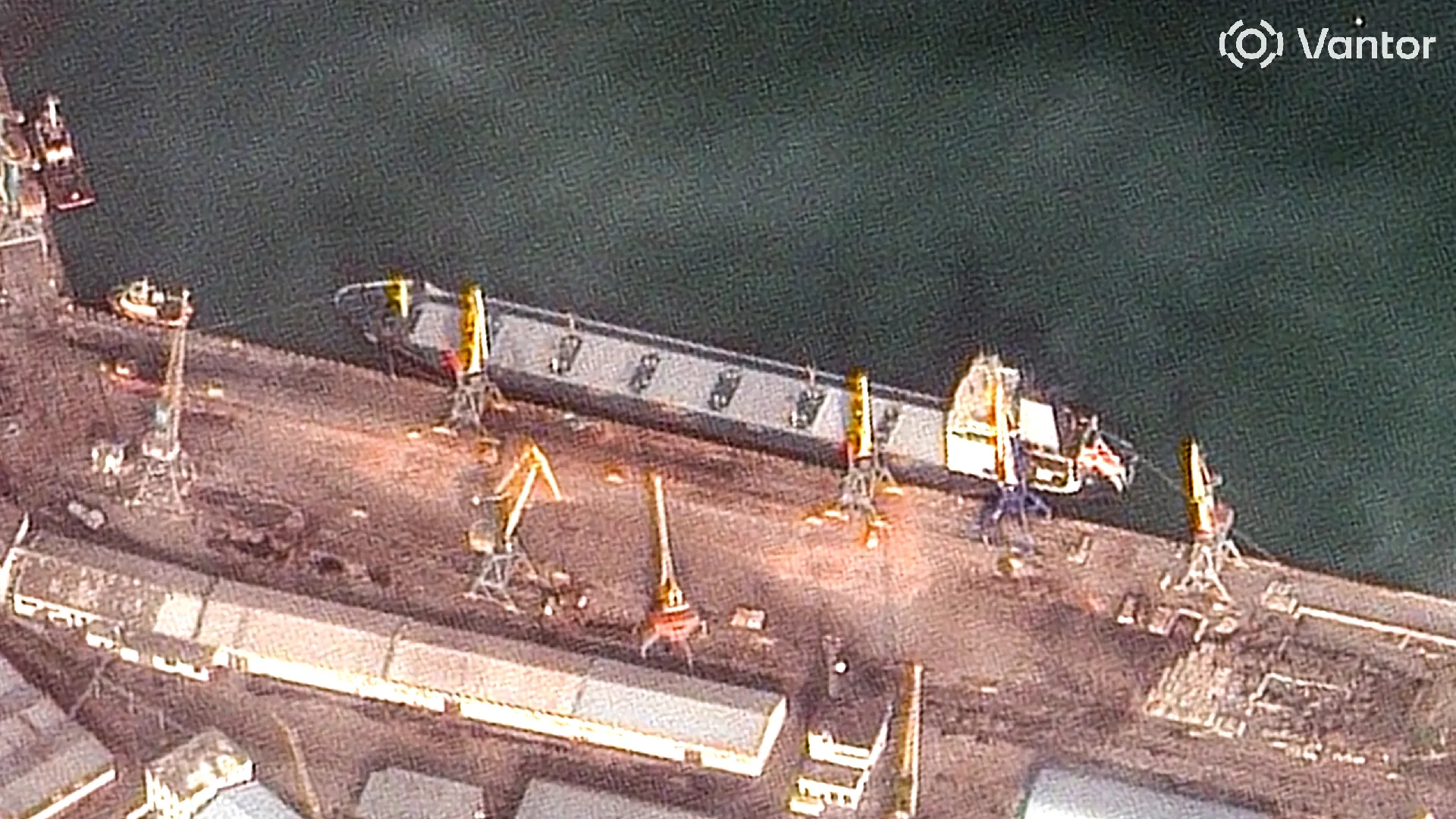
On February 15, a high resolution satellite image confirms the ship is docked at the port of Feodosia at berth No. 1 that is used for bulk and metal cargo. Matching features visible include Grumant’s grey decking, its seven hatches and bright yellow front mast. What appears to be leftover grain can be seen under the two port crates, immediately next to the ship.
Credit: Satellite image ©2026 Vantor.
Grumant exits the area of signal interference, meaning that its reported position on ship tracking services is now reliable again. Its AIS messages indicate it is travelling towards the Bosphorus.
Grumant transits the Bosphorus Strait towards the Sea of Marmara. Judging by the draft, with no visible red paint on its hull, the ship appears to be fully laden.

Credit: Yörük Işık.
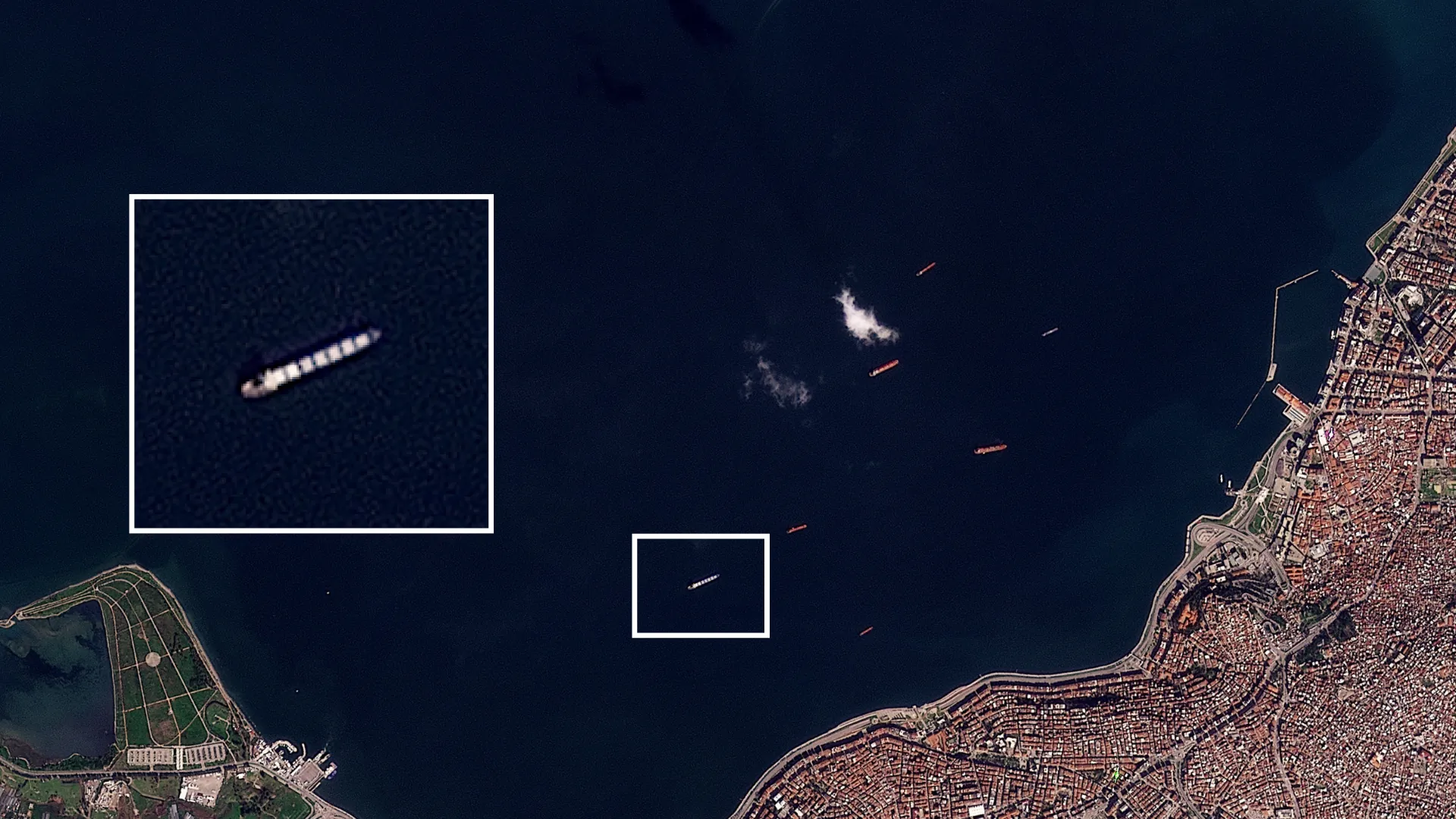
Grumant arrives in Izmir, Turkey on February 23 and anchors off the coast until March 13.
Over the course of three weeks, Grumant never enters the Port of Izmir. It is not known if it was denied entry. Bellingcat asked the port operators but did not receive a response before publication.
Credit: Planet Labs PBC.
Grumant then loiters off the coast of Aliağa, about 50 km from Izmir. It stays here until March 16, never entering the port. It again is not known if it was denied entry. Bellingcat asked the port operators but did not receive a response before publication.
Grumant arrives in Libyan waters and stays off the coast of Benghazi until April 1.
Grumant briefly leaves the coast of Benghazi, but returns a few days later.
Grumant leaves the anchorage on April 18 and docks at the port of Benghazi where it unloads the grain. The ship was captured in a Vantor satellite image on April 20.
It leaves port on April 23, and heads back towards the Bosphorus.

Credit: Satellite image ©2026 Vantor.
After spending a few days off the coast of Tuzla, Grumant transits the Bosphorus towards the Black Sea.

Credit: Yörük Işık.
Lloyd’s List Intelligence has previously reported on the expansion of Russia’s grain smuggling operations, beyond the occupied port of Sevastopol to include Feodosia port.
According to the Ukrainian activism, journalism and hacker group, Kiborg News, Grumant used deceptive shipping practices to deliver grain to Latakia, Syria in 2024. The report included several of Grumant’s shipping manifests, which showed it had repeatedly exported grain from Occupied Crimea to Syria.
It is standard maritime practice that ships broadcast Automatic Identification System (AIS) messages which include a ship’s position, heading, and draught (among other information).
Because of longstanding Global Navigation Satellite System (GNSS) interference in parts of the Black Sea, the position data transmitted by an affected ship’s AIS system is often unreliable.
Between February 7 and February 19, 2026, data from Lloyd’s List Intelligence shows the Grumant transmitted 29 AIS messages, with unreliable positions in the vicinity of Feodosia. We know these positions are unreliable as they are erratic and some of them report the ship as being positioned on land.

However, according to the IMO, the heading data transmitted by a ship’s AIS system must come from an onboard compass. A compass is unaffected by GNSS interference, meaning it is a more reliable source of information in these conditions.
Over the same dates, all 29 AIS messages reported the ship’s heading as 267 degrees or 268 degrees. The Port of Feodosia has a heading of 267.5 degrees. The close agreement between the ship’s heading and port heading strongly suggests that Grumant was moored at the port between February 7 and February 19, 2026.
We conducted an extra check of the heading data by reviewing satellite imagery available of berth 1 at Feodosia Port, which suggests that the same vessel was present on several days between February 6 and February 18. Imagery on Feb. 6 shows the port was empty in the morning and occupied in the afternoon. Grumant exited the area of GNSS interference on February 21, and berth 1 at the port was captured on satellite image on February 22 and appeared empty. The low resolution satellite imagery is only used as an additional check to see if a vessel is at the berth.


Bellingcat checked all vessels transmitting AIS in the vicinity of Feodosia Port and found that Grumant was the only one that consistently transmitted a heading matching the Port of Feodosia over the period of interest.
We shared our research with Charlie Brown, a former US Naval Officer and Senior Advisor at United Against Nuclear Iran where he focuses on maritime sanctions enforcement and the tracking of illicit shipping. Brown told Bellingcat that while satellite imagery of vessels remained key for identification, when looking for reliable data in a spoofing environment it made sense to look at the various elements of AIS data to try and find some accurate information, despite GNSS spoofing.
“It’s quite standard for the independent gyro compass to be providing the heading […] I think the majority would not [be subject to spoofing] so it’s a good methodology to parse out the particular data and then make some inferences from that.”
“It’s neat to think of what can be derived from data that would otherwise be dirty or wrong. So there’s still some elements of use in there.”
He added that in theory there are probably some compasses that are subject to spoofing as well.
He told Bellingcat that it was fair to say the heading data of the Grumant supported identification, but stressed the need to cross-reference with other data sources.
While in this instance it has been possible to use AIS data to help verify the location of Grumant, it is relatively unusual to have access to this information.
Ships that call to the occupied territories frequently disable their AIS transponders to do so.
This activity, known as “dark port calls”, is a common tactic for those engaging in illicit or sanctioned trades.
Grumant does not transmit AIS messages from February 8 to 11, but this is the longest gap in data (see diagram above), with intermittent messages coming through after that point.
It is unclear why Grumant continued to transmit AIS during the period it was loading in Feodosia.
A review of Lloyd’s List Intelligence data from January 2025 shows that on a previous voyage to the Black Sea the Grumant operated “dark” for 59 days.
On February 15, 2026, high resolution imagery showed Grumant docked in the Port of Feodosia. We compared it with other recent images of Grumant to confirm the match.
The ship in the satellite image has a grey-coloured deck, which is uncommon enough for it to stand out. Many bulk carriers have cranes (including the ships we previously covered such as Krasnodar, Zafar and Zaid), Grumant does not have any. It also has seven hatches (openings for the grain) and a bright yellow front mast that matches the mast of Grumant (see the image of it transiting the Bosphorus). We can match the Grumant in the Feodosia image, not only to pictures of the Grumant shot from the ground, but also to the satellite image from Benghazi.
The length and breadth of the ship also matches that of the Grumant; 180 metres by 22.90 metres.


Libya has complicated internal dynamics with essentially two administrations in charge of different parts of the country – the Government of National Unity (GNU) in the west and the Libyan National Army (LNA) in the east.
In recent years, Russia has backed the LNA’s General Khalifa Haftar, based out of Benghazi, in the east of the country. But Jalel Harchaoui, a political scientist specialising in Libya with the Royal United Services Institute (RUSI), stressed that the two sides of this conflict, the LNA and the UN-recognised GNU, are not currently fighting. Instead they are in a flawed, multi-year truce.
Therefore, the east-west divide isn’t as clear-cut as during the civil war. While all shipments going to Benghazi and Tobruk are overseen by the LNA, not all shipments going to the city of Misrata (which is run by the GNU) are meant for the GNU-dominated part of the country.
Harchaoui told Bellingcat: “the Tripoli government is in some regards pro-Ukraine, but if there’s business that can be done with Russia through the very opaque port of Misrata and all the right people get paid, the business is going to take place.”
That observation is potentially significant given at least one previously tracked vessel that went from occupied Ukraine to Libya docked in Misrata.
This was not the case of the Grumant, however, which arrived in an LNA-controlled part of the country. It is not known from open sources alone if the authorities in Libya or at the port in Benghazi knew the grain carried by Grumant had come from occupied Ukraine.
Bellingcat contacted the Benghazi-based LNA government and representatives of the Tripoli-based GNU government via the Libyan Embassy in The Netherlands. We also contacted the Port of Benghazi, Port of Imzir in Turkey as well as the Ukrainian and Russian authorities. Representatives of the LNA did not respond to requests for comment before publication, nor did the Port of Benghazi or Port of Izmir. The Libyan Embassy in The Netherlands replied to Bellingcat after publication, stating that Benghazi and eastern Libya are not under the authority or administrative control of the Government of National Unity and therefore they are not currently in a position to comment on Bellingcat’s findings.
“The port of Feodosia, located in the temporarily occupied Autonomous Republic of Crimea, is not under Ukrainian control, and any commercial activity conducted there is illegal,” the Ministry for Development of Communities and Territories of Ukraine and the Ministry of Foreign Affairs of Ukraine told Bellingcat in a joint response.
They told us the loading of grain exported from the temporarily occupied territories is an illegal act and Russia was using ports as logistics centers to export stolen Ukrainian agricultural products.
“The expansion of such routes to third countries, in particular to North Africa, demonstrates Russia’s ongoing efforts to circumvent international sanctions and monetize resources stolen from the occupied Ukrainian territories.”
The Ukrainian Ministry of Foreign Affairs sent information about Grumant’s (IMO: 9385879) “illegal activities” to the diplomatic missions in Great Britain, the Republic of Turkey and the Republic of Tunisia over the course of March to May this year, the ministries told Bellingcat.
Ukraine is continuing to pursue legal action against Russia’s “shadow grain fleet” they told us. For instance, earlier this month a Swedish court approved the transfer of the Russian “shadow grain fleet” vessel CAFFA to Ukraine for investigation after it was arrested in Swedish waters.
This case has set a new precedent, going beyond sanction and fines previously handed out to such vessels, and allowing for the detention and confiscation of a shadow fleet vessel in European jurisdictions, the ministries said.
According to Russian court documents Grumant’s previous owner Murmansk Shipping Company was dissolved and “Decision/Reshenie” LLC were listed as the International Safety Manager and operator of Grumant. Decision/Reshenie were also listed as the operator of Grumant in another court document, from an unrelated case.
Bellingcat attempted to contact Decision/Reshenie to ask about Grumant’s grain shipment from Feodisia Port to Benghazi Port, but they had not responded at time of publication.
Youri van der Weide, Galen Reich, Yörük Işık and Bridget Diakun contributed to this report.
Cover image: Planet Lab image shows Grumant anchored off Izmir, Turkey on February 27. Credit: Planet Labs PBC.
Bellingcat is a non-profit and the ability to carry out our work is dependent on the kind support of individual donors. If you would like to support our work, you can do so here. You can also subscribe to our Patreon channel here. Subscribe to our Newsletter and follow us on Bluesky here, Instagram here, Reddit here and YouTube here.
The post Heading Off: New Technique Helps Track Grain Smuggling Expansion to Libya appeared first on bellingcat.
Authorities in the Netherlands have arrested the co-owners of two related Internet hosting companies for operating IT infrastructure used by Russia to carry out cyberattacks, influence operations and disinformation campaigns inside the European Union. The two men were the focus of a 2025 KrebsOnSecurity story about how their hosting companies had assumed control over the technical infrastructure of Stark Industries Solutions, an Internet service provider sanctioned last year by the EU as a frequent staging ground for cyber mischief from Russia’s intelligence agencies.

An investigator with the Tax Intelligence and Investigation Service (FIOD), the Dutch financial crimes agency, during the raid. Image: FIOD.
The Dutch daily news outlet de Volkskrant reports that the Dutch financial crime agency FIOD on May 18 arrested a 57-year-old from Amsterdam and a 39-year-old from The Hague, charging them with violating sanctions law by directly or indirectly making economic resources available to EU-sanctioned entities.
The Dutch investigation focuses on Stark Industries, a sprawling hosting provider that materialized just two weeks before Russia invaded Ukraine. As detailed in this May 2024 deep-dive, Stark quickly became the source of massive distributed denial-of-service (DDoS) attacks against European targets, and emerged as a top supplier of proxy and anonymity services that showed up time and again in cyberattacks linked to Russia-backed hacking groups.
That report identified two Moldovan brothers — Ivan and Yuri Neculiti and their company PQHosting — who were providing one of Stark’s two main conduits to the larger Internet. In May 2025, the EU sanctioned PQHosting and the Neculiti brothers for aiding Russia’s hybrid warfare efforts. But as KrebsOnSecurity observed in September 2025, those sanctions failed to target Stark’s remaining connection to the Internet — an Internet service provider based in the Netherlands called MIRhosting.
MIRhosting is operated by Andrey Nesterenko, a 39-year-old Russian native who runs the business out of the Netherlands. News that PQHosting and the Neculiti brothers were about to be sanctioned by the EU leaked in the media nearly two weeks before the sanctions were announced last year. During that time, the Stark network assets were transferred from PQHosting to a new entity called the[.]hosting, under the control of the Dutch entity WorkTitans BV.
And as our September 2025 report showed, WorkTitans was controlled by Nesterenko and a 57-year-old from Amsterdam named Youssef Zinad. On top of that, WorkTitans was getting connectivity to the larger Internet solely through MIRhosting, where Zinad had worked previously.
On May 18, Dutch financial crime investigators arrested Nesterenko and Zinad, and searched three businesses in Enschede and Almere and two data centers in Dronten and Schiphol-Rijk. A statement from the Dutch authorities said they also seized laptops, telephones and more than 800 servers.
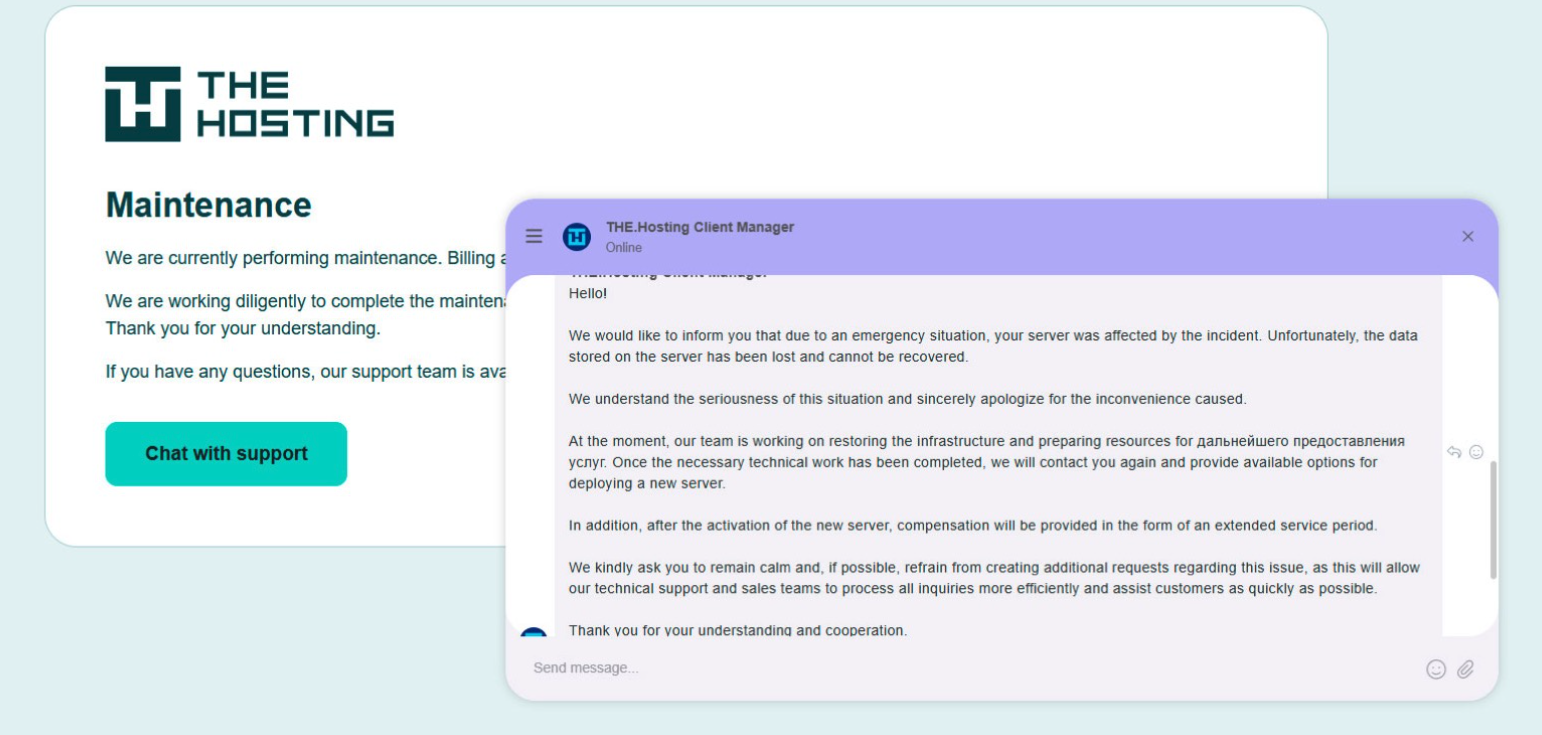
A message to the-hosting customers immediately after 800 of its servers were seized by Dutch authorities. The message says that unfortunately data stored on the server has been lost and cannot be recovered.
De Volkskrant said it reviewed data showing WorkTitans and MIRhosting were the most-used networks in pro-Russian attacks on Danish government bodies between November 13 and 19, 2025, the week of Denmark’s municipal elections.
The publication wrote that prior to Nesterenko’s arrest, the MIRhosting founder denied that he knew his servers had been misused by pro-Russian cybercriminals. “He said he had ended all services with the Neculiti brothers when the EU sanctions came into force in May 2025,” and the he “reserved all rights to take action against ‘harmful and incorrect publications,” de Volkskrant wrote.
MIRhosting released a statement saying it has initiated an internal investigation into the alleged facts concerning the elections in Denmark, and that it has temporarily paused services to WorkTitans as a precautionary measure while the matter is being reviewed further.
“Based on our preliminary findings, there are no indications that the services over which we exercise control were actually used to influence the Danish elections,” the statement reads. “No anomalies or spikes were observed in our network traffic during the period mentioned in the publication; had large-scale DDoS attacks occurred, such activity would have been evident. Furthermore, prior to the media publication, we had not received any complaints, abuse reports, or official requests regarding suspicious activities or misuse of our network. Meanwhile, our regular operational activities continue, and our service to our other clients remains fully intact.”
Born in Nizhny Novgorod, Russia, Mr. Nesterenko grew up as a piano prodigy who performed publicly at a young age. In 2004, Nesterenko founded MIRhosting’s parent Innovation IT Solutions Corp., which has the notable distinction of being the company responsible for hosting stopgeorgia[.]ru, a hacktivist website for organizing cyberattacks against Georgia that appeared at the same time Russian forces invaded the former Soviet nation in 2008. That conflict was thought to be the first war ever fought in which a notable cyberattack and an actual military engagement happened simultaneously.
Responding to questions shared via email, Nesterenko said MIRhosting does not support cybercrime, sanctions evasion, or illegal activity, and that the allegations and arrest by Dutch authorities have been extremely harmful to him and his company.
“The transition to the.hosting was not intended to evade sanctions,” Nesterenko wrote. “The hardware and customer portfolio had already been transferred to WorkTitans before the sanctions appeared. Closing or damaging a legitimate Dutch infrastructure company will not stop cybercrime, but it will harm many people who have done nothing wrong.”
Far less is public about the 57-year-old Zinad, who reportedly has been keeping a low profile since our story last year. De Volkskrant reported that Zinad blocked access to his LinkedIn account, had gone months without responding to emails, WhatsApp messages and phone calls, and told a colleague that illness was forcing him to lead a somewhat more reclusive life.
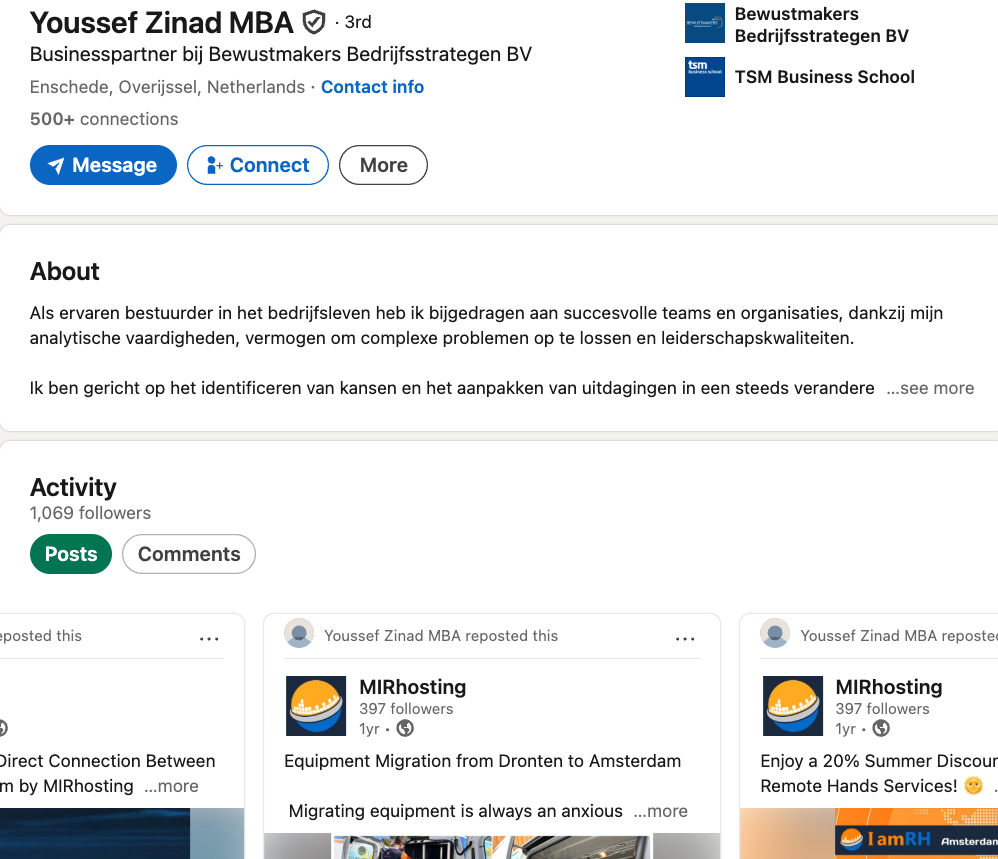
Mr. Zinad’s now-defunct LinkedIn profile. It was full of posts for MIRhosting’s services.
Mr. Nesterenko claims Zinad was never an employee of MIRhosting.
“He helped me and MIRhosting with certain business tasks under a normal business-to-business arrangement between companies,” Nesterenko explained.
However, in previous emails to KrebsOnSecurity, Nesterenko carbon copied Mr. Zinad (who had a @mirhosting.com email), explaining that he was part of the company’s legal team. Also, the Dutch website stagemarkt[.]nl lists Youssef Zinad as an official contact for MIRhosting’s offices in Almere.
Mr. Zinad has never responded to requests for comment. Nor did de Volkskrant have any luck tracking him down. The publication said it repeatedly asked Mr. Zinad (referred to here as simply “Z”), but he reportedly avoided every form of contact.
“‘I am unavailable but will respond to your message as soon as possible,’ reads an automated reply on WhatsApp on 2 October 2025,” de Volkskrant reported. “It is the only response de Volkskrant would receive in months. He did not pick up his phone and did not call back. When an acquaintance asked him via LinkedIn to contact the reporter, he blocked access to his LinkedIn page. At an address in Almere where Z.’s personal limited company is registered, no one was present in April. The corner house’s blinds were drawn, and a pile of rubbish bags lay outside next to a container, as if someone had recently left. A neighbour said he knew the man but did not know where he was staying. Z. was later arrested at a residence in Amsterdam.”

 Image Source: Cyber Police Department, National Police of Ukraine[/caption]

Ukrainian cyber defenders reported a newly intensified cyber campaign that is targeting Ukraine’s healthcare system and local government agencies, with attackers deploying increasingly sophisticated malware and social engineering tactics.
In a fresh advisory, the CERT-UA said the activity—linked to a threat cluster tracked as UAC-0247—spiked between March and April 2026, with clinical hospitals, emergency services, and municipal bodies bearing the brunt of the attacks.
The campaign begins with phishing emails disguised as offers of humanitarian assistance—a tactic designed to exploit trust during wartime conditions. Victims are urged to click on links that appear legitimate, sometimes backed by convincingly crafted fake websites or compromised third-party resources.
Behind the scenes, however, the links trigger a multi-stage infection chain that ultimately gives attackers remote control over the victim’s system.
Once clicked, victims download an archive containing a malicious shortcut file. This file activates a built-in Windows tool to execute remote code, initiating a sequence that includes decoy documents to avoid suspicion.
The attack escalates quickly. Malicious executables are deployed via scheduled tasks, injecting code into legitimate system processes such as RuntimeBroker.exe to evade detection.
Recent campaigns show an evolution in sophistication, with attackers introducing multi-stage loaders and custom executable formats. Payloads are often encrypted and compressed, making analysis and detection more difficult.
At later stages, attackers deploy reverse shell tools—including variants resembling “RAVENSHELL”—to establish encrypted communication with command-and-control servers and execute remote commands.
To maintain long-term access, attackers install a custom backdoor known as AGINGFLY, a C#-based malware designed for full remote system control. The tool enables:
Unlike conventional malware, AGINGFLY dynamically retrieves and compiles its command logic from remote servers, making it more adaptable and harder to detect.
Complementing this is a PowerShell-based tool dubbed SILENTLOOP, which helps maintain persistence and retrieves command server addresses—sometimes even pulling them from Telegram channels.
Once inside a network, attackers move quickly to expand access. CERT-UA observed tools like CHROMELEVATOR being used to extract browser credentials, while ZAPIXDESK targets WhatsApp data.
The attackers also conduct internal reconnaissance using both custom scripts and publicly available tools such as RUSTSCAN. For stealthy movement across networks, tunneling tools like LIGOLO-NG and CHISEL are deployed.
In at least one case, attackers went further—embedding the XMRIG cryptocurrency miner inside a modified version of the legitimate WireGuard application, highlighting a secondary motive of financial gain.
The campaign isn’t limited to civilian infrastructure. CERT-UA noted an incident in March where individuals connected to Ukraine’s defense sector were targeted via the Signal platform.
Attackers distributed a trojanized version of software used by FPV drone operators, packaged as a seemingly legitimate update. In reality, the download triggered a DLL side-loading attack that installed the AGINGFLY backdoor.
CERT-UA recommends reducing exposure by restricting the execution of high-risk file types such as LNK, HTA, and JavaScript files. The agency also urges organizations to limit the use of native Windows tools like mshta.exe and PowerShell where possible, as these are frequently abused in attacks.
In the tiny town of Krasnopillia in rural Ukraine, the stillness of the night is shattered by the whine of a Russian drone. Seconds later, a community hospital bursts into flames. Sparks and debris rain down across the skeletons of trees as the fire sends plumes of smoke into the pitch-black sky.
Dozens of people are evacuated, according to local media reports – but as rescuers respond, in what appears to be a double-tap strike, Russian forces hit a shelter where more than 20 patients are huddled, including some with limited mobility.
The strike in March 2025 comes just hours after a larger regional hospital in the northeastern Sumy governorate is targeted, decimating the primary health facilities serving the small town of Krasnopillia, whose prewar population was around 7,700. Healthcare services for the town “practically ceased” in the wake of the strikes, Olena Pryima, a local school director, told Bellingcat in a phone interview.
“[The Russians] destroy the infrastructure so that people do not have the opportunity to live and exist normally. You cannot consult a doctor, nothing,” she said. “And now these people who remain, God forbid, the ambulance will not go there, just because the security situation does not allow it.”
Your donations directly contribute to our ability to publish groundbreaking investigations and uncover wrongdoing around the world.
Her own school was among the many buildings destroyed in Russian strikes, and she says it has been impossible to rebuild amid the ongoing war. “We try to heat some accommodations, in spite of everything … especially since this winter is very difficult,” Pryima said. “But we are not talking about rebuilding at all now. We have hope; we are collecting some documents [such as testimonies and damage assessments], since this will end someday – and then we can rebuild something.”
For the past four years, Bellingcat has been documenting and verifying incidents such as these, chronicling the extensive damage to civilian life and infrastructure after the onset of Russia’s full invasion which began in February 2022.
In over 2,500 cases of civilian harm that we have verified – the vast majority of which occurred on Ukrainian territory, although dozens also took place in Russia – more than 1,100 residential structures were hit. Hundreds of other civilian sites such as schools, playgrounds, fire stations, hospitals, churches, cultural centres, museums, businesses and farms have been impacted too.
Our data – which includes cases that Bellingcat researchers were able to definitively geolocate using open source evidence, and does not reflect the full extent of civilian harm across Ukraine – pinpoints more than 300 attacks on schools or childcare facilities, 170 hits on healthcare or humanitarian sites, and four dozen incidents targeting food and related infrastructure.
While many attacks were clustered around four main cities – Kharkiv, Donetsk, Kherson and Kyiv – we documented strikes across all areas of the country. Of the weapons that could be identified through available open source information, cluster munitions were used in more than 100 cases.
Cluster munitions, which are banned in more than 100 countries (but not Russia or Ukraine), have killed more than 1,200 people since the war began, with Ukraine recording the highest number of annual casualties worldwide from these weapons in 2024 for the third consecutive year, according to the Landmine and Cluster Munition Monitor.
Bellingcat and members of its volunteer community logged all verified incidents of civilian harm on an interactive TimeMap over a four-year period spanning February 2022 to December 2025. The map is no longer being updated, but it remains online as an archive (and can be seen below).
An interactive map detailing incidents of civilian harm between February 2022 and December 2025.
Since Russia’s invasion four years ago, the civilian toll in Ukraine has been stark, with around 15,000 killed – including more than 750 children – and 40,600 injured, according to a January 2026 report by the Office of the United Nations High Commissioner for Human Rights.
An analysis last year by Armed Conflict Location and Event Data (ACLED) found that Russia followed “a persistent pattern of targeting of populated areas … often indiscriminate, other times more deliberate”.
New apartment complexes are listed for sale on Russian websites. Meanwhile, Ukrainians are struggling to reclaim their homes.
ACLED’s data for the period of February 2022 to late January 2026 highlights thousands of residential strikes across Ukraine, along with more than 750 attacks on healthcare facilities, 1,200 on educational sites, and 2,400 on energy infrastructure. A February 2025 World Bank report says it will take more than US$500bn to rebuild Ukraine.
These numbers tell only part of the story. While much global media attention has focused on the politics of the Russia-Ukraine war, or highlighted strikes on large urban centres, civilians in remote rural villages have suffered outsized impacts from the destruction of schools, hospitals and cultural institutions – the key threads tying their communities together.
In Verkhna Syrovatka, a small village in Sumy of around 3,800 people, images from the scene of shelling in May 2025 revealed a massive hole in the community’s blue-roofed cultural house. Inside the facility, which once served as a place for rehearsals, children’s classes and folk ensembles, photographs and trophies could be seen amid piles of splintered wood and cracked concrete.
The village’s only school was also impacted, with many of its windows blown out, forcing classes to move online. This devastation reflects a countrywide trend, as UNICEF reports that Ukrainian children are falling behind in core subjects such as reading, maths and science.
Incidents of civilian harm recorder by Bellingcat in Verkhna Syrovatka. Readers can click or tap the dots to learn more about each incident.
Further south, the village of Opytne in the Donetsk region is gradually being erased, amid a series of Russian attacks dating back more than a decade to the 2014 occupation of the Crimean Peninsula.
The village has changed hands repeatedly in recent years. In December 2022, drone footage revealed large-scale destruction of its residential area, including a medical office, music school and church. According to media reports, perhaps only half a dozen residents remain out of more than 1,000 who lived in the village a decade ago.


Image left shows the village of Opytne in 2021, before Russia’s full invasion (Credit: Airbus/Google Earth Pro). Image right shows the village of Opytne in 2024 (Credit: Maxar/Google Earth Pro).
A couple of months later, in February 2023 in Dvorichna, a rural settlement in the Kharkiv region, Russian forces launched another double-tap strike: as first responders searched for survivors from an earlier attack on the village council building, several emergency vehicles were hit.
Located just south of the Russian border, Dvorichna has been occupied on and off since 2022. As a result, the village, whose population was roughly 3,500 four years ago, is estimated to house only 80 residents today.
Across Ukraine, the catalogue of horrors is endless. In Pravdyne, a small village in the Kherson region, the prewar population of more than 1,000 people was reported to have dwindled to fewer than 200 by late 2022. Corpses showing signs of torture have been exhumed from garden beds; in one case, residents reportedly buried the bodies of Ukrainian soldiers under slabs of slate to prevent dogs from reaching them.
Incidents of civilian harm recorder by Bellingcat in Pravdyne. Readers can click or tap the dots to learn more about each incident.
In Sumy Oblast, Russian drone and missile attacks have forced residents to flee homes they inhabited for half a century. In the village of Hroza in northeastern Ukraine, one-fifth of the population died in a single attack while attending the funeral of a soldier, according to local officials.
What may never be calculated are the impacts this brutal conflict will have on future generations.
Incidents of civilian harm recorder by Bellingcat in Hroza. Readers can click or tap the dots to learn more about each incident.
Back in Krasnopillia, the local school director, Pryima says residents have tried hard to stay in what she calls “the zone of resilience”, but it has been a struggle.
“It’s very scary to fall asleep, because you don’t know if you’ll wake up in the morning,” she said, noting that residents live in constant fear of the drones that fly overhead, keenly aware that a bomb may drop at any moment.
For Ukrainian children, the effects have been especially dire.
“Those children, before the full-scale invasion, were carefree, cheerful – what children should be,” Pryima said. “Those children are no longer there.”
Bellingcat is a non-profit and the ability to carry out our work is dependent on the kind support of individual donors. If you would like to support our work, you can do so here. You can also subscribe to our Patreon channel here. Subscribe to our Newsletter and follow us on Bluesky here, Instagram here, Reddit here and YouTube here.
The post How Russia’s War Has Devastated Civilian Life in Ukraine appeared first on bellingcat.
Russian state has tolerated parallel probiv market for its convenience but now Ukrainian spies are exploiting it
Russia is scrambling to rein in the country’s sprawling illicit market for leaked personal data, a shadowy ecosystem long exploited by investigative journalists, police and criminal groups.
For more than a decade, Russia’s so-called probiv market – a term derived from the verb “to pierce” or “to punch into a search bar” – has operated as a parallel information economy built on a network of corrupt officials, traffic police, bank employees and low-level security staff willing to sell access to restricted government or corporate databases.
Continue reading...
© Photograph: Alexander Zemlianichenko/AP
© Photograph: Alexander Zemlianichenko/AP
© Photograph: Alexander Zemlianichenko/AP
Last month, in the dead of a cold Autumn night, residents in the Ukrainian town of Balakliia were woken by the sound of two massive explosions.
Social media footage showed apartments ablaze, balconies obliterated and a deep crater smouldering in a parking lot.
Three people were killed and 13 injured in the November 17 attack, Ukraine’s State Emergency Services (SES) said. Four of those injured were children, the SES added. A kindergarten, situated just over a hundred metres from one of the impact sites, was also reported to have suffered damage.
Since the beginning of the full-scale invasion of Ukraine, schools, educational facilities and spaces used by children have repeatedly been damaged in strikes or closed because of them.
According to the United Nation’s agency for children, UNICEF, many schools remain closed or continue to be disrupted by air raid alarms. Almost one million children have also been forced to study online, UNICEF states.
Balakliia lies in Kharkiv Oblast in the north east of Ukraine. Another Russian strike carried out there earlier in November caused damage near the town’s main square. Located just over 100 metres away was a high school and not far from that a local theatre school. While neither of those facilities appeared to be directly damaged, many other educational institutions have not been so lucky.
A Ukrainian government website (saveschools.in.ua) has been tracking the number of kindergartens, high schools, colleges and universities that have been damaged and destroyed across the country.
At time of publication 3,676 educational facilities have been damaged nationwide and 394 destroyed, according to saveschools.in.ua.
These trends are reflected in social media data collected by Bellingcat.
Since the start of Russia’s full-scale invasion, Bellingcat has been gathering and verifying social media footage showing incidents of civilian harm.
More than 2,500 incidents have been identified during this period, including attacks on hospitals, power stations, residential buildings and cultural sites. The full dataset is public and can be found here. But this is likely just a fraction of the damage caused across Ukraine as the data only captures incidents recorded and published on social media channels that have been verified.
Amongst this dataset are more than 200 cases of educational facilities that have been damaged or destroyed.
In September this year, for example, social media footage captured the moment a Russian drone hit an administrative building at Kharkiv’s National University of Pharmacy.
As far back as July 2022, a school for the visually impaired in eastern Kharkiv was hit by Russian rockets, leaving windows smashed and classrooms burned out.
Just a few months before that, footage posted online appeared to show the remains of a missile that hit a school in the town of Merefa, situated around 30 kilometres to the southeast of Kharkiv.
More educational facilities have been damaged or destroyed in Kharkiv Oblast than in any other territory currently held by Ukraine, according to Bellingcat’s dataset and saveschools.in.ua statistics.
In Kharkiv city and its surrounding areas, Bellingcat found and archived footage of at least 26 schools, kindergartens, colleges or universities that have been damaged and destroyed since Russia’s full-scale invasion. A further 36 strikes that impacted areas around educational facilities in Kharkiv but did not directly hit them were also verified and archived by Bellingcat.

Sustained attacks on educational facilities as well as widespread disruption to studies caused by the war are having a lasting impact on Ukraine’s young people, children’s rights groups say.
A report from Save the Children earlier this year detailed how attacks on educational facilities had doubled in Ukraine over the course of 2024. The same report found that parents were scared to send their children to school and that many children were being forced to resort to online learning at home.
A 2024 report from UNICEF has found Ukrainian children are falling behind children in other countries across all/multiple subjects including reading, maths and science.
In Balakliia, journalists from Agence France-Presse (AFP) bureaus in Paris and Kharkiv spoke to teenage student Bohdan Levchykov who said he studies at home and seldom leaves the house. Levchykov also spoke about the impact of losing his father in the early months of the war.
About an hour’s drive to the northwest, in the town of Khorocheve, a psychologist with the non-profit Voices of Children , Maryna Dudbyk, told AFP that the ongoing war means that everyone is living under stress.
“This has a huge impact on children’s emotional state,” she said.
“We diagnose a lot of fear and anxiety among children. Adolescents suffer from self-harm, suicidal thoughts, and the loss of loved ones.”
Other facilities, beyond schools, regularly enjoyed by children have also been impacted by the war, compounding the challenges young people face.
Bellingcat’s dataset found 28 incidents where swimming pools, parks, football pitches, bowling alleys or museums had been impacted in and around Kharkiv. A further 16 incidents were recorded in areas surrounding such facilities. The below interactive shows (in red) incidents where educational or recreational facilities used by young people have been impacted by Russian strikes in and around Kharkiv. The other markers in the map (in purple) detail additional civilian harm incidents Bellingcat has been able to verify. A wider dataset of showing incidents that have impacted areas surrounding educational and recreational facilities can be found here.
One video from March this year showed young men playing football scrambling for cover as a drone can be heard overhead before an explosion can be seen.
Although Ukraine’s policymakers are facing many challenges as Russia’s invasion of Ukraine approaches its fifth year, the mental health of the country’s youth is on their minds.
Oksana Zbitnieva, head of the Interministerial Coordination Center for Mental Health told AFP that “130,000 frontline health professionals—nurses, pediatricians, family doctors—have received certified training as part of a WHO mental health program.”
Meanwhile, more than 300 “resilience centres” welcome children and parents across the country, with three hundred more expected to be built next year, according to Ukrainian Social Affairs Minister Denys Uliutine.
New concepts are also being tested and tried.

In Kharkiv, underground schools – located beneath the streets of the city – are being set up to help bring children back into the classroom.
City authorities told AFP there would be 10 underground schools operational by the end of 2025.
At a school visited by AFP, a rotating system allows it to continue offering children in-person education, even if only for a limited time, each week. The school enables every child to attend half a day of their class in-person each week. When the child returns home they continue their education via remote classes, while another student comes into school for their half day spot. This allows the school to accommodate 1,400 children, including on weekends.
Yet recent events in Kharkiv highlight that normal life is far from returning, despite recent peace efforts.
At the end of October, a kindergarten in the west of the city was struck by a Russian drone.
Footage from the scene showed panicked parents and disoriented children being carried from away by emergency workers as smoke billowed from the kindergarten.
Despite the scale of the destruction visible in social media footage, only one person (an adult male) was reported to have died during this strike.
For many youngsters in Ukraine, there may be no reclaiming the childhood that war has taken from them.
But Bohdan Levchykov in Balakliia believes there are still things to look forward to.
He told AFP about the friends he had made online – including one named Lana who lives more than 400km away in the city of Dnipro- and his hopes of meeting them in real life one day.
“I’ve talked about it with my mother,” he told AFP.
“Maybe our parents can arrange something for us to meet,” he said hopefully.
Eoghan Macguire, Youri van der Weide and Logan Williams contributed to this report for Bellingcat as did Stéphanie Ladel and Olivia Gresham from Bellingcat’s Volunteer Community.
Boris Bachorz reported and conducted interviews for AFP with the help of Natalia Yermak.
A version of this story can be found on the website of the Central European Digital Media Observatory (CEDMO) website.
Bellingcat is a non-profit and the ability to carry out our work is dependent on the kind support of individual donors. If you would like to support our work, you can do so here. You can also subscribe to our Patreon channel here. Subscribe to our Newsletter and follow us on Twitter here and Mastodon here.
The post How Russia’s Invasion is Impacting Ukraine’s Youth appeared first on bellingcat.
