❌

Visualização de leitura

Black October: This week’s cybersecurity crises mean infrastructure inventory just became a board-level priority

“Are we exposed?” CIOs and CTOs heard that question all last week. On Tuesday, PHP shipped emergency fixes for two pre-authentication remote code execution flaws that date back to 2004. By Wednesday, Palo Alto Networks said every supported version of PAN-OS and Panorama was vulnerable and no fix was available. Cisco was reviewing 18 products and 13 cloud services, and Fortinet was reviewing eleven. NSA, NCSC and CERT-EU told operators to take unpatched systems offline, and Cloudflare’s CEO watched exploit attempts jump from thousands to millions within hours. People are calling it Black October.

An AI model found most of these bugs. The lesson for boards, though, isn’t about AI. Patching is no longer the bottleneck. Knowing where to patch is.

“Please go to your boards and ask for help right now. Not for AI, for the basics.” (Jason Clinton, Deputy CISO, Anthropic, Oct. 22.) Marc Benioff replied: “Jason is 100% right. Code red.”

Answering “are we affected?” should take minutes. That takes one real-time, authoritative record of every device, version, site, owner and exposure, plus automation that patches from that record and confirms the fix. Organizations without that record are still searching while attackers move. With vulnerability volume climbing this fast, the gap will only grow.

The number of vulnerabilities has more than doubled in the last year – and it is just getting started

From January 1 to October 13, 79,680 CVEs were published, 2.15 times the same period in 2025. Microsoft alone published 1,408 on October 13. That’s more than it disclosed in all of 2025, and its fourth record month in a row.

AI is behind the surge. Between April and July, Anthropic’s Project Glasswing partners verified more than 129,000 vulnerabilities, over 33,000 of them critical or high, and Anthropic estimates the real total is at least five times higher. Google’s threat intelligence group says monthly disclosures doubled from January to August, and that AI-found bugs are twice as likely to be remote code execution. OpenAI, whose model found the PHP flaws, expects such findings to “increase sharply in the coming months.”

Exploitation is speeding up just as fast. Mandiant’s mean time-to-exploit for 2025 was negative seven days, and Microsoft puts median discovery-to-weaponization under 24 hours. Amazon CISO CJ Moses saw PHP2Shell probing four days before a patch existed. His warning: the disclosure date isn’t the earliest date of exploitation. Reuters reported that one operator used AI agents to breach more than 100 companies for about $5,000 in tokens. That works out to roughly $50 a breach.

Attackers can’t be allowed to have a better asset inventory than you do

Enterprises simply aren’t keeping up:

The patch itself is rarely the obstacle. The obstacle is systems nobody knew about. As Armis’s threat intelligence lead put it this week, “the most common gap is not knowing an instance exists.” PHP is built into firewall consoles, NAS admin panels, printers, cameras and switches that never advertise it. Action1’s field CTO said it more bluntly: “The inventory is a guide, not a shield.” Most enterprises don’t even have the guide.

Two incidents this month show the stakes. On October 16, Palo Alto’s Unit 42 disclosed that attackers who compromised FortiManager instances got an inventory of more than 500 downstream FortiGate firewalls, including serial numbers and public IPs, and used it to gain root on those firewalls. In the Reuters case, when the target application had no flaw, the agents moved to adjacent infrastructure and found an exposed control panel nobody was watching.

AI now finds the bug, writes the exploit and maps your estate faster than your team can. The defender’s one lasting advantage is knowing the estate better than the attacker: every device, version, exposure and owner. That knowledge has to drive action in hours, not quarters.

Network and infrastructure is the front line

The hardest systems to see are the ones getting hit hardest. Google reports that edge and security appliances accounted for 14 percent of exploited vulnerabilities this year, and two-thirds of those were high or critical. Mandiant notes these devices usually lack standard EDR telemetry. In October, actively exploited flaws hit Ivanti Connect Secure, Cisco Secure Email Gateway, Palo Alto PAN-OS, Fortinet FortiMail and FortiOS, SonicWall SMA and Citrix NetScaler. Then PHP2Shell exposed the management plane of nearly every major network vendor at once.

You can’t put an agent on a router or scan what isn’t routable. That’s true across the campus, the branch and edge, the AI data center and the OT floor. The control that works there is an accurate, current record of what’s deployed, what it runs, where it sits, who owns it and whether it’s reachable from the internet, plus automation that acts on that record.

This is a board question now

Every board should ask its infrastructure leaders five questions this month:

  1. Do we have a single, continuously updated inventory of every network device, server and appliance we operate — with software version, location, owner and internet exposure?
  2. When the next PHP2Shell lands, how long does it take us to answer “which of our systems are affected”? Minutes, or weeks?
  3. Is that inventory discovered from the live network, or is it a spreadsheet someone updates when they remember?
  4. Can our automation patch directly from that inventory, or does every advisory start with a manual hunt?
  5. After we patch, do we verify the fix took and the estate hasn’t drifted?

If the answers are no, weeks, spreadsheet, manual and no, the problem isn’t patching. It’s a gap in the fundamentals, and no patch-management budget will close it.

What to do this quarter, not next year

Treat this as a loop that runs continuously, not a project with an end date:

  • Discover. Find everything on the network automatically, all the time. Unknown devices are the attacker’s favorite devices.
  • Record. Put it in one system of record: the intended state of your infrastructure, not a scan export. Version, role, site, owner, exposure.
  • Prioritize. Join that record against KEV and vendor advisories. Internet-reachable plus critical plus exploited goes first. The rest is a queue, not a panic.
  • Patch from the record. Drive automation off the inventory so a new advisory becomes a targeted job, not a scavenger hunt.
  • Verify and repeat. Confirm the live state matches the intended state, catch drift, and go again. Forever.

Automation helps teams keep pace, but without an authoritative inventory, it just misses things faster.

Attackers now discover at machine speed, while remediation still moves at the speed of someone opening a spreadsheet. Until that changes, attackers will know your infrastructure better than you do. Fix that first, and fix it this quarter.

The Week in Vulnerabilities: Toptech, Lantronix, Langflow, and CISA Malcolm Flaws

Weekly Vulnerability Report Cyble October

This Cyble Research & Intelligence Labs (CRIL) weekly vulnerability report covers two views of risk: what attackers tried against Cyble's global honeypot sensors, and what the Cybersecurity and Infrastructure Security Agency (CISA) disclosed for industrial control systems (ICS).

The Cyble Global Sensor Intelligence (CGSI) network observed exploitation attempts against about 20 known vulnerabilities. They range from newly disclosed flaws in WordPress, Apache Solr, and Langflow to years-old bugs in GPON home routers and embedded TCP/IP stacks. 

On the industrial side, CISA issued 14 ICS advisories covering 54 vulnerabilities. Of these, 13 were rated critical, 18 high, 18 medium, and five low. 

Affected vendors include Toptech Systems, Lantronix, VIVOTEK, MikroTik, Armatura, Monta, Anjvision, and, unusually, CISA itself.

Cyble sensors also recorded active malware campaigns, phishing emails, and brute-force attacks against internet-exposed services.

Real-World Attacks Observed by Cyble Sensors 

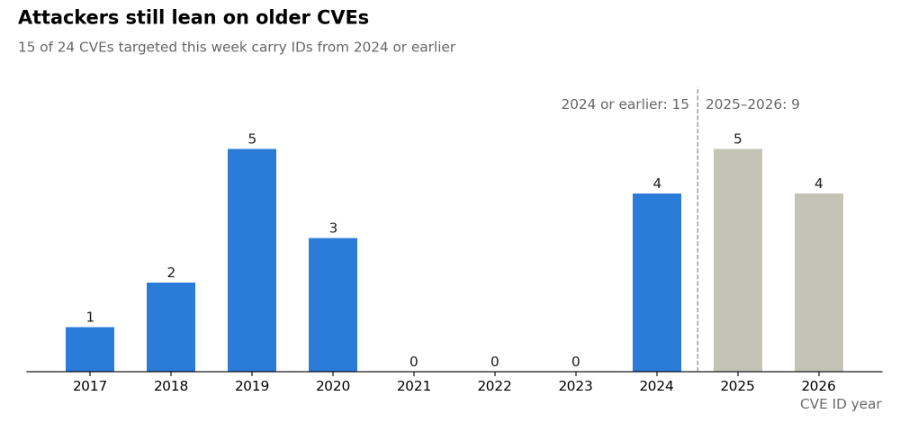
Attackers moved quickly against newly disclosed flaws in web platforms and AI tooling, while older IoT and embedded-device bugs continued to draw steady traffic. 

Source: Cyble sensor intelligence. The 24 CVEs named in this post, counted by CVE ID year 

CVE-2026-63030 — WordPress REST API 

CVE-2026-63030 is a route-confusion flaw in a WordPress REST API batch endpoint. It affects WordPress 6.9.x before 6.9.5 and 7.0.x before 7.0.2. 

Attackers can chain it with CVE-2026-60137 to achieve SQL injection and potentially remote code execution (RCE). 

CVE-2026-44825 — Apache Solr 

CVE-2026-44825 is a hardcoded credential in the Basic Authentication setup tool of Apache Solr 9.4.0 through 9.10.1 and 10.0.0. 

Remote attackers can use it to access a Solr cluster with administrative privileges. 

CVE-2026-9198 — Langflow 

CVE-2026-9198 affects IBM Langflow OSS 1.0.0 through 1.10.0. Unauthenticated attackers can chain two API endpoints to obtain superuser tokens and execute arbitrary code. 

Sensors also caught attempts against an older Langflow code injection flaw, CVE-2025-3248. Repeated targeting of the same AI workflow platform signals sustained attacker interest. 

CVE-2025-68613 — n8n 

CVE-2025-68613 is a critical RCE flaw in the n8n workflow automation platform. Expressions supplied by authenticated users can run in an insufficiently isolated context, enabling full system compromise. 

Fixes are available in versions 1.120.4, 1.121.1, and 1.122.0. 

CVE-2026-4020 — Gravity SMTP 

CVE-2026-4020 affects the Gravity SMTP WordPress plugin, versions 2.1.4 and earlier. An exposed REST API endpoint lets unauthenticated users pull system reports containing server details, database metadata, and configured API keys or tokens. 

CVE-2024-6587 — LiteLLM 

CVE-2024-6587 is a server-side request forgery (SSRF) flaw in LiteLLM. Exploitation can expose OpenAI API keys. 

Older Flaws Still in Rotation 

Cyble sensors also logged exploitation attempts against: 

  • CVE-2025-58360, an XML external entity (XXE) flaw in GeoServer's GetMap operation 

  • CVE-2024-7591, an OS command injection flaw in Progress LoadMaster 

  • CVE-2024-25600, a code injection flaw in Bricks Builder 1.9.6 and earlier 

  • CVE-2025-2010, an unauthenticated SQL injection flaw in the JobWP WordPress plugin 

  • CVE-2025-46565, a file access control bypass in the Vite development server 

  • Command injection flaws in QNAP QTS firmware 

  • Scanning for the Cisco Adaptive Security Appliance (ASA) WebVPN login page 

A Mirai variant is also targeting Dasan GPON home routers by chaining CVE-2018-10561 and CVE-2018-10562. Together, the two flaws let an unauthenticated remote attacker run commands on the device. 

Most-Attempted CVEs 

CVE-2020-11899, an IPv6 out-of-bounds read in the Treck TCP/IP stack, drew far more exploitation attempts than any other CVE this week. The rest of the top five, in order: 

  1. A group of four Wind River VxWorks TCP buffer overflows: CVE-2019-12255, CVE-2019-12260, CVE-2019-12261, and CVE-2019-12263 

  1. CVE-2020-11900, an IPv4 tunneling double-free in the Treck TCP/IP stack 

  1. CVE-2019-0708, a critical unauthenticated RCE in Microsoft Remote Desktop Services 

  1. CVE-2020-11910, an ICMPv4 out-of-bounds read in the Treck TCP/IP stack 

Most of these flaws sit in networking code embedded in IoT and industrial devices, which often go unpatched for years. 

Malware Families Observed 

Files collected from Cyble sensors were linked to several malware families: 

  • CoinMiner: Linux cryptominers that hijack CPU and GPU resources 

  • WannaCry: Ransomware that spreads through the EternalBlue exploit, targeting CVE-2017-0147 

  • Mirai: A botnet that turns IoT devices and Linux servers into remotely controlled bots 

  • IRCBot: Linux malware that uses IRC connections as a backdoor 

CRIL also observed Hajime, Gafgyt, and Wacatac activity. 

MacSync Infostealer Targets Crypto Users 

CRIL is also tracking a new version of MacSync, a macOS infostealer sold as malware-as-a-service. Kaspersky's Securelist reported that the latest campaign targets cryptocurrency users and developers. 

According to Securelist, attackers distribute MacSync through malicious disk images posing as a fake crypto wallet app. In one case, they abused a public iCloud calendar event to deliver commands. 

The malware steals browser data, saved credentials, crypto wallet data, Keychain files, and SSH, AWS, Kubernetes, and Git configurations. It also installs a backdoor disguised as Finder that persists through a LaunchAgent, shell profile changes, and Git hooks. 

Security teams should watch macOS endpoints for unexpected disk-image apps, removal of quarantine attributes, and new LaunchAgents. 

Phishing and Advance-Fee Scams 

Phishing emails captured by Cyble sensors relied on emotional appeals and promises of money. Common lures this week: 

Subject line  Scam type 
Re: DONATION FOR less-privileged  Charity or donation scam 
GOD BLESS YOU....  Emotional appeal, advance-fee scam 
Re. Compensation funds for your past effort  Compensation fund scam 
MY PROPOSAL  Business proposal, advance-fee scam 
Investment Inquiry, Funding for Your Project  Investment or project funding scam 
Dear Sir/Madam  Advance-fee scam 

Many of these emails use look-alike domains or impersonate known organizations to appear credible. 

Brute-Force Attacks 

Brute-force traffic focused on remote access and database ports, including VNC (5900), RDP (3389), SSH (22), Telnet (23), HTTP (80), Microsoft SQL Server (1433), and PPTP (1723). 

Targets included Elasticsearch, Hadoop, Oracle, GitLab, MySQL, and PostgreSQL. Attackers leaned on default and weak credentials such as "sa," "root," "password," and "123456." 

The largest share of attack traffic, 39%, came from sources with a known bad reputation. 

Critical ICS Vulnerabilities 

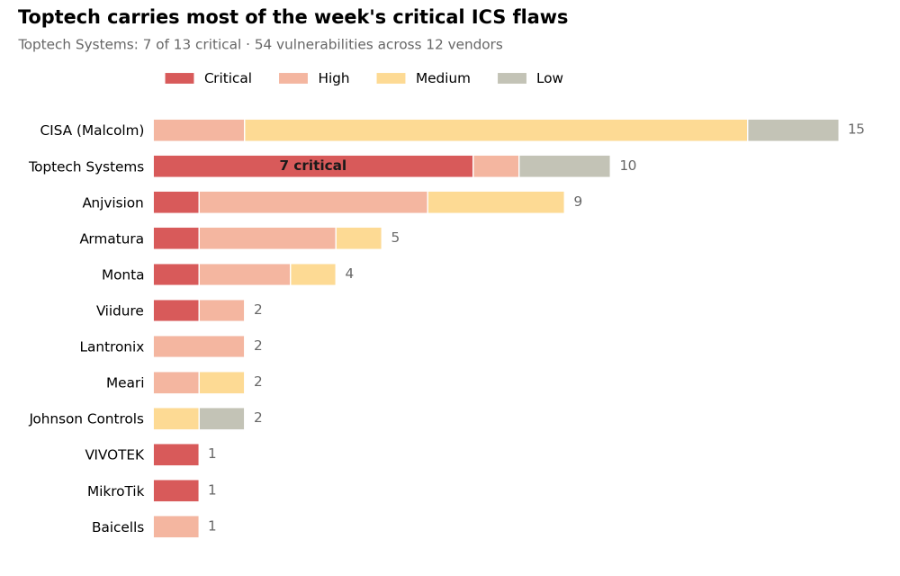
CISA's 14 ICS advisories covered 54 vulnerabilities, two-thirds of them rated high or medium. Toptech Systems and CISA itself disclosed the most flaws this week. 

Source: CISA ICS advisories analyzed by CRIL, Sept. 29–Oct. 5, 2026 · 54 vulnerabilities by vendor and severity 

Toptech Systems TMS7 and TopHAT (Critical) 

Toptech Systems' TMS7 and TopHAT version 7.6.3 carried more critical-rated ICS vulnerabilities than any other product this week. They include multiple SQL injection flaws (such as CVE-2026-72510 and CVE-2026-63713), an unrestricted file upload flaw (CVE-2026-70356), and files exposed to external parties (CVE-2026-71379). 

TMS7 is a terminal management system that controls liquid fuel and chemical distribution in the Energy, Chemical, and Transportation Systems sectors. In a product that governs fuel terminal operations, these flaws could enable interference with physical processes, not just data theft. Toptech has published security update information. 

CVE-2026-91191 and CVE-2026-84409 — Lantronix G520 Series (High) 

Two flaws affect Lantronix G520 Series cellular gateways running 2.6.0.4R6_stable. CVE-2026-91191 is an improper cryptographic signature verification flaw, and CVE-2026-84409 is a cross-site scripting (XSS) flaw. 

The signature flaw could let attackers bypass firmware integrity checks and push unauthorized firmware to remote field devices. Combined with the XSS bug, it creates a realistic multistage attack path against devices that may be hard to inspect physically. Lantronix has published remediation details. 

CVE-2026-84411 — MikroTik RouterOS (Critical) 

CVE-2026-84411 is a critical integer underflow vulnerability in MikroTik RouterOS versions before 7.24. Updated versions are available from MikroTik's download page. 

CVE-2026-22755 — VIVOTEK Cameras (Critical) 

CVE-2026-22755 is a critical command injection flaw affecting 37 VIVOTEK camera models across its V, C, S, Dome, Bullet, and Panoramic series. VIVOTEK has posted an update package. 

CVE-2026-95102 — Monta (Critical) 

CVE-2026-95102 is a missing-authentication flaw for a critical function in all versions of monta.app. Three other Monta flaws involve excessive authentication attempts, session expiration, and credential protection. The advisory data referenced no vendor fix. 

Anjvision, Viidure, and Armatura One 

Anjvision's YSSD-RTMP-H5 firmware has nine vulnerabilities, led by CVE-2026-100291, a critical insecure default setting. Others include OS command injection, hardcoded credentials, and improper signature verification. 

The Viidure Dashcam Android app, version 3.3.1.260403 and earlier, contains hardcoded credentials (CVE-2026-96587, critical). Armatura One is affected by CVE-2023-46604, a critical deserialization flaw, plus hardcoded key and credential issues. 

No vendor fixes were referenced for these products, so compensating controls such as network isolation are the main option for now. 

CISA Malcolm (15 Vulnerabilities) 

In an unusual disclosure, CISA reported 15 vulnerabilities in Malcolm, its own open-source network traffic analysis and threat-hunting platform. The flaws affect versions before 26.06.0. 

They span authentication bypass, missing authorization, default credentials, OS command injection, path traversal, and SSRF. Most are rated medium, and two are rated high. Users should update through the Malcolm releases page. 

The remaining advisories covered Baicells Technologies, Meari, and Johnson Controls products. 

Impacted Critical Infrastructure Sectors 

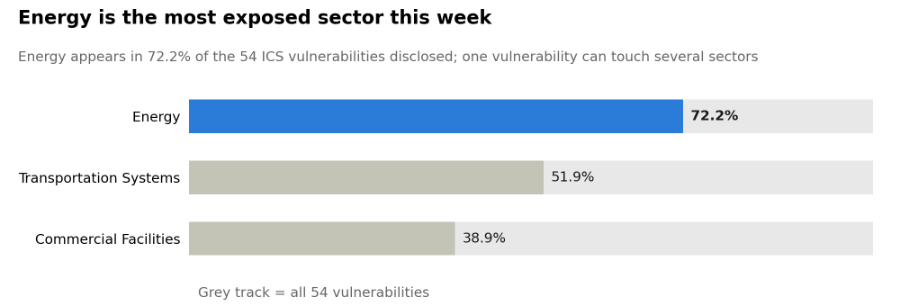
Energy was the most exposed sector this week, followed by Transportation Systems and Commercial Facilities. 

Source: CISA ICS advisories analyzed by CRIL, Sept. 29–Oct. 5, 2026 · share of 54 vulnerabilities touching each sector 

The largest single combination, Energy, Information Technology, and Water and Wastewater, accounted for 27.8% of vulnerabilities. Energy, Chemical, and Transportation Systems made up another 18.5%, driven largely by the Toptech disclosures. 

These disclosures cut across traditional infrastructure boundaries rather than clustering in one domain. A single flaw in a shared product can create risk for fuel, water, and transportation operators at once. 

Conclusion 

This weekly vulnerability report highlights several trends: 

  • Fast exploitation of newly disclosed flaws in WordPress, Apache Solr, and AI workflow tools such as Langflow and n8n 

  • Persistent attacks on years-old embedded-device and router vulnerabilities 

  • Critical ICS flaws in fuel distribution, cellular gateway, and camera products 

  • Several ICS products with no vendor fix referenced, leaving compensating controls as the main defense 

  • Ongoing phishing and brute-force activity that relies on weak and default credentials 

With 13 critical ICS vulnerabilities and active exploitation attempts against both new and legacy flaws, organizations face risk across enterprise IT and operational technology (OT) environments. 

Key Recommendations From This Weekly Vulnerability Report 

  • Patch internet-exposed web platforms, plugins, and AI workflow tools first, starting with the flaws under active exploitation above 

  • Replace default usernames and passwords, and enforce strong, unique credentials on servers and devices 

  • Restrict or block exposed remote access and database ports, including VNC, RDP, SSH, Telnet, and SQL Server 

  • Segment IT and OT networks with firewalls and demilitarized zones (DMZs) to limit lateral movement 

  • Apply compensating controls, such as network isolation, for ICS products without available fixes 

  • Verify firmware integrity on remote field devices and cellular gateways 

  • Monitor macOS endpoints for unexpected disk-image apps and new LaunchAgents 

  • Track CISA advisories and the Known Exploited Vulnerabilities (KEV) catalog, and prioritize by exploitability and operational impact 

  • Conduct regular vulnerability assessments and penetration testing 

Cyble's attack surface management and vulnerability intelligence solutions help organizations identify exposed assets, prioritize remediation, and detect early signs of compromise. Combined with real-time sensor intelligence, they help security teams stay ahead of threats across enterprise and critical infrastructure environments. To see these capabilities in action, schedule a demo with Cyble. 

Disclaimer: The data and content written in this blog is based on certain sensor and open web information available. Analysts and researchers are advised to confirm once again from original sources. 

The post The Week in Vulnerabilities: Toptech, Lantronix, Langflow, and CISA Malcolm Flaws appeared first on Cyble.

Cyber resilience is a very human decision problem, not just a technology one

Organizations today are not short of data, particularly in the domain of cyber. What many lack is a timely, trusted assessment that can help leaders act with greater confidence.

When a cyber incident begins, the technical questions surface first. What happened? Which systems are affected? Is the activity contained? But the questions that often shape the outcome are rarely technical alone. Who is behind the activity? What are they trying to achieve? Is this an isolated event or part of a broader campaign? Which customers, suppliers, assets or services are exposed? Is there a sanction, legal, regulatory or reputational dimension? And what is a proportionate immediate response while the facts are still incomplete?

This is why cyber is, in a meaningful sense, as much a human decision-making problem as a technological one. The OECD argues that digital security risk should be integrated into broader decision-making, rather than treated only as a technical issue. Tools can detect signals, spot patterns, correlate events and flag anomalies, but it takes people to decide what those signals mean, when to escalate, which trade-offs matter and what action the organization should take. In Moody’s recent whitepaper on supporting decision dominance through financial, corporate and trade intelligence, we make the case that the decisive moments in a cyber incident belong not only to systems, but to judgement.

That matters for CIOs and other technology decision-makers, because theirs is one of the most demanding decision environments in the enterprise. Reporting lines and structures vary by organization, but common themes tend to recur: technical complexity, compressed timelines, uncertain attribution and fragmented responsibility. Security teams may see indicators before they understand intent. Legal teams may need to assess obligations before the full scope of an incident is known. Communications teams often must prepare for scrutiny while operations are still working through containment. Business leaders may first need to decide when a decision must be made, then whether to pause a service, isolate a supplier, notify a regulator, issue a public statement or accept some temporary disruption to prevent greater harm.

The result can be a gap between signal and action, at a time when many organizations are experiencing a growing volume of cyber signals and alerts. Organizations commonly track mean time to detect and respond. But a less visible but equally consequential metric is decision latency: the time it takes to move from a technical signal to a shared understanding of what matters, and a decision about what to do. An organization can identify a threat quickly and still act too slowly if it cannot interpret the signal, convene the relevant stakeholders or agree on a proportionate response. The challenge is not simply speed — decisions made quickly but poorly can amplify harm. It is reducing decision latency without sacrificing judgement. This urgency is not theoretical and shouldn’t simply be admired. In her 2026 GCHQ Annual Lecture at Bletchley Park, Director Anne Keast-Butler described “a moment of consequence” shaped by the radical uncertainty. Her wider point is key for CIOs and their peers across the board: cyber security is a critical priority, and resilience depends on the ability to act with urgency, judgement and trusted partnerships.

From signal to context

Technical signals tend to become more useful when connected to wider context. A malicious domain, an unusual login, a compromised account or malware signature may tell a security team that something is happening. On its own, that signal rarely tells an executive what the organization should do next. Context reframes the question from “what does this indicator mean?” to “what decision should we make?”

That context can take several forms. Payment flows may provide additional context regarding the financial networks associated with an event or risk scenario. Ownership structures can help identify relationships between suppliers, counterparties or entities that may merit further review. Sanctions exposure may change the legal and compliance implications of a response. Adverse media may provide indicators of potential reputational or integrity concerns. Corporate linkages may reveal that what looks like a narrow technical event is in fact connected to a wider network of actors, assets or interests.

None of this removes uncertainty altogether, and no decision-maker should wait for perfect information before acting. What broader context does is improve the conditions under which judgement is exercised. Two incidents may look similar at the technical level but demand different leadership responses. One may be opportunistic criminal activity with limited broader consequence. Another may involve connections to a sanctioned entity, an organized crime network, a critical supplier or a state-linked ecosystem. The signal may look similar, but the appropriate response is not.

A cross-discipline exercise

This distinction matters because cyber response is often not contained within the security function, especially in a learning organization. A serious incident typically draws in teams from across multiple disciplines, such as security, IT, legal, risk, compliance, finance, procurement, communications and business operations. It may also involve external parties such as law enforcement, intelligence agencies, regulators, financial institutions, infrastructure operators and key suppliers. The CIO will not own every lever in this environment, and organizational structure will influence how close to the centre of the systems they sit, dependencies and information flows that affect the organization’s ability to respond effectively. Is the CIO supported or supporting during an incident? What leeway is afforded the CIO to act when required?

A common challenge in cyber response is not the absence of technical capability, but the absence, or fragility, of a shared decision model. Teams will have data, dashboards and incident playbooks in place, but still lack clarity on who decides, what information is needed, which trade-offs are acceptable and how quickly business context can be brought to bear. Ensuring a common operating picture — one that gives the leadership team a shared understanding of the same facts — tends to be a differentiator between organizations that respond coherently and those that do not.

For CIOs and CEOs, this is an organizational design problem as much as a technology one. Experience suggests that a cyber strategy that stands alone may be less effective than one integrated into the organization’s broader strategy from the outset. Cyber maturity should not be judged only by the number of controls deployed, alerts processed or systems monitored, but also by the quality of the decisions an organization can make under pressure. Using scenarios to test decision making can help refine organizational design, highlight blockers that may emerge at critical times, and improve leaders’ understanding of the potential consequences of poor decision making. That wider coordination challenge is reflected in CISA’s incident response guidance, which treats serious cyber incidents as events requiring coordination across multiple stakeholders.

Where integrated intelligence adds value

This is where integrated intelligence has a role to play. Its value lies less in the sheer volume of information it provides — most organizations already have more data than they can absorb — and more in its ability to help prioritize, separating signal from noise. It can help distinguish activity that is technically interesting from activity that may be strategically material. Used well, it can help identify enabling networks associated with an attack, inform disruption options and help focus scarce defensive resources on the assets, relationships and dependencies most likely to matter.

The aim is not to know everything. It is to develop sufficient understanding of the most relevant factors early enough to support timely actions while meaningful response options remain available.

CIOs can make this practical by asking five questions:

  1. Which cyber decisions must be made in the first moments, the first hour, first day and first week of a serious incident?
  2. Who is authorized to make them, what is their availability 24/7 and who deputizes in their absence?
  3. Can technical indicators be linked quickly to business impact, financial exposure, legal risk, supplier dependency and external context?
  4. Can security teams escalate without creating unnecessary alarm?
  5. Can the CEO and board be briefed in decision-ready language, with recommendations rather than technical detail alone?

These questions move the conversation from reporting to leadership, and they reflect the human reality of cyber defence. Employees, analysts, managers and executives are asked to make repeated judgement calls under uncertainty, often with too much noise and too little time. Attackers are often well placed to exploit that reality; resilient organizations tend to design around it

Beyond visibility

Cybersecurity has spent years improving visibility, and that work remains essential. But visibility alone does not create resilience. The next challenge is decision quality.

For CIOs, the strategic shift is that cyber signals become most valuable when connected to real-world consequences: financial, operational, legal, reputational and geopolitical. In a fast-moving incident, the critical question is rarely whether the organization has more data. It is whether leaders can understand what matters, decide what to do and act while meaningful response options remain available.

The organizations that are often most effective in this environment are not necessarily those with the most dashboards. They are often those that have worked to reduce decision latency without sacrificing judgement, often through rehearsal, scenario testing and learning from gaps identified during those exercises. In an environment shaped by ambiguity, compressed timelines and interconnected risk, the ability to make better decisions faster may become one of the defining measures of not just cyber resilience, but of leadership itself.

Apple Fixes 194 Security Flaws Across iPhone, Mac and Other Devices

Apple’s latest iPhone, iPad and Mac updates patch 194 unique security flaws involving root access, kernel code execution and protected data.

The post Apple Fixes 194 Security Flaws Across iPhone, Mac and Other Devices appeared first on TechRepublic.

❌