Visualização de leitura

Multiple Zscaler Client Connector Flaws Enable Remote Code Execution

Zscaler has addressed several vulnerabilities in its Client Connector endpoint application that could allow an unauthenticated, unprivileged attacker to execute arbitrary code within the product’s context. This vulnerability, tracked as CVE-2026-59568, is rated as Critical, with a CVSS v3.1 score of 9.1. The attack vector is network-accessible and requires no privileges or user interaction. Multiple […]

The post Multiple Zscaler Client Connector Flaws Enable Remote Code Execution appeared first on GBHackers Security | #1 Globally Trusted Cyber Security News Platform.

CISA Warns SonicWall SMA1000 Flaws Are Exploited in Ransomware Attacks

The U.S. Cybersecurity and Infrastructure Security Agency (CISA) has added a critical vulnerability in SonicWall SMA1000 to its Known Exploited Vulnerabilities catalog, noting that the flaw has been used in ransomware campaigns. This vulnerability, tracked as CVE-2026-15409, is a server-side request forgery (SSRF) issue found in the Workplace interface of SonicWall SMA1000 appliances. It has […]

The post CISA Warns SonicWall SMA1000 Flaws Are Exploited in Ransomware Attacks appeared first on GBHackers Security | #1 Globally Trusted Cyber Security News Platform.

UK’s state investments agency hit by data breach

Security lapse leaves sensitive information and contact details of 51 government officials exposed for 40 hours

The public body in charge of the UK’s state investments has been pushed to improve its internal security after a data breach left “high-level management information” publicly accessible for nearly two days.

UK Government Investments (UKGI), the agency that manages the taxpayers’ interest in a swathe of companies including Channel 4 and the Post Office, said the security failure also left more than 50 government officials’ personal details exposed for nearly 40 hours.

Continue reading...

© Photograph: Marina Demidiuk/Alamy

© Photograph: Marina Demidiuk/Alamy

© Photograph: Marina Demidiuk/Alamy

Hackers steal sensitive data from UK Department for Education and police

Details of parents and staff, including email addresses and phone numbers, are among data taken by cybercriminals

The Department for Education and a police database have been targeted by a cyber-attack, exposing more than 740,000 pieces of data.

Details of government officials, senior school leaders, university staff, police officers and members of the public have been taken by hackers.

Continue reading...

© Photograph: Dave Hunt/AAP

© Photograph: Dave Hunt/AAP

© Photograph: Dave Hunt/AAP

Personal and banking details among customer data stolen in Origin Energy hack

Hackers access Australian customers’ names, addresses, dates of birth, phone numbers and some bank account details, company says

Origin Energy customers’ addresses, phone numbers and partial bank account data have been accessed in a hack, the company has confirmed.

The firm has 4.8m customer accounts in Australia, providing electricity, fossil gas, LPG and internet services to homes and businesses.

Continue reading...

© Photograph: Jason Reed/Reuters

© Photograph: Jason Reed/Reuters

© Photograph: Jason Reed/Reuters

‘Keys to the kingdom’: hackers who gained access to heart of London transport network jailed

Thalha Jubair, 20, and Owen Flowers, 19, sentenced to five and a half years each for cyber-attack that cost Transport for London £39m

The data of millions of commuters was stolen, Londoners were left out of pocket and 27,000 Transport for London staff were forced to reset their passwords.

Over four days in 2024 a pair of teenage hackers had London’s transport network at their mercy. Thalha Jubair and Owen Flowers had burrowed into the heart of Transport for London’s IT systems and held the “keys to the kingdom”.

Continue reading...

© Photograph: William Barton/Alamy

© Photograph: William Barton/Alamy

© Photograph: William Barton/Alamy

Australian patients’ medical records could be sold on dark web after clinics’ data breach

‘Malicious actor’ obtains sensitive data including Medicare numbers, treatment details and pathology results in cyber-attack on Partnered Health

Australians’ medical records and patient information could be sold on the hidden market, an expert has warned, after a cyber-attack at one of the nation’s biggest healthcare providers.

Partnered Health revealed 21 clinics across several cities including Sydney, Melbourne and Canberra were affected when a “malicious actor” accessed its data on 23 June.

Continue reading...

© Photograph: Dominic Lipinski/PA

© Photograph: Dominic Lipinski/PA

© Photograph: Dominic Lipinski/PA

Cybersecurity and the Gap Between Skill and Ability

Last week, national security agencies from the Five Eyes—that’s the rich, English-language-speaking countries club—jointly released a statement warning of the increasing cyber risks of AI models: in particular, their ability to autonomously hack into systems and networks. The statement was more measured than some of the breathless headlines about it, and the advice they gave is pretty much the standard advice everyone gives—albeit with newfound urgency.

Internet risks are nothing new, and cyberattacks—both large and small—have been a significant issue since long before the current crop of generative AI models.

What’s been changing over the decades, and what AI is changing even faster, is the gap between skill and ability. For most of human history, the two terms were synonymous—but computers have decoupled them. As the gap between the two expands, humans empowered with these AI tools can do more: more writing, more research, more analysis and also more damage than ever before. These models can, with little detailed direction, autonomously hack into networks, steal data, deploy ransomware and destroy systems. And to the extent there is a solution, it’s going to involve harnessing AI for the defense.

In 1998, seven people from the hacker group L0pht testified before Congress. They told a mostly clueless Senate committee that they could take down the internet in 30 minutes. That was partly real and partly bravado, but it illustrates an important point: hacking into systems, stealing data and causing damage all required skill.

Contrast the L0pht hackers with hackers derided as “script kiddies.” They didn’t understand computers, or security. Instead, they used hacker tools written by others. Their actions required minimal skill and even less knowledge. But once those hacking tools became widespread, the number of potential attackers increased.

That number has continued to increase, as quality and availability of prewritten attack tools has grown. And it is growing dramatically with AI. Today’s AI systems—not just the frontier models, but most of them—are capable of carrying out cyberattacks automatically. They all do better in the hands of skilled attackers, but increasingly they are able to act autonomously with only minimal prompting.

The thing about people with ability but no skill is that they are often outsiders, not part of any professional community, and not bound by any rules or norms. This phenomenon is much more general than in cybersecurity. Any doctor can tell you how to untraceably poison someone, and many virus researchers know how to create a bioweapon. Any bridge engineer can tell you how to place explosives to blow a bridge up. The reason that murderous doctors and terrorist engineers are so rare is that the lengthy process of acquiring those skills also instills a moral and ethical code. If every random person has access to good poisoning advice, that puts us all in danger.

Modern AI systems are, in effect, a universal adviser to help people do harmful things. And while the current AI megacorporations are trying to build guardrails to prevent people from asking questions whose answers will enable the questioner to do harm, that’s not going to work in the long term. Smaller, cheaper, open-source models, including models that can run on people’s computers, and especially groups of models that run in concert with each other, are just as good as the frontier models from companies like OpenAI and Anthropic. And they continue to get better. These models will be passed around from person to person, like script kiddie hacker tools, and they won’t have any such guardrails.

Instructing AI models to spy on people and report any malicious prompts to the authorities fails for similar reasons. The megacorporations can do that, but the locally run open source models won’t. This could buy us a few months at best.

A third possibility is to somehow make the models themselves unable to hack into computers, create bioweapons or do anything else that might harm people or society. That won’t work, for the same reason we can’t teach doctors how to treat poisonings without also teaching them how to poison. It’s the same knowledge. It’s the same with construction and demolition. And it’s the same with cybersecurity. We want these AI models to be able to review computer code, find vulnerabilities and automatically fix them. The benefit to our collective security will be enormous. Unfortunately, the same knowledge can be used for attacks.

Where this leaves us is in a world of increased volatility. Super-powered humans with AI assistants will be able to do both wonderful and horrible things.

This brings us back to the Five Eyes statement. Everything they recommend is something security professionals have been recommending for years, if not decades. They are things talked about at that congressional hearing back in 1998, titled “Weak computer security in government: Is the public at risk?” Even the Five Eyes admitted that their security advice is not new, only more urgent.

What’s new is how fast things are changing: “The rapid pace of frontier AI development means cyber risk assumptions can become outdated in months, not years. We must act before and be prepared to adapt and withstand evolving threats.” The Five Eyes point to AI technology—not necessarily chatbots, but AI more generally—being used to strengthen every aspect of defense, to “detect vulnerabilities earlier, improve software quality, monitor unusual behavior, and respond faster to incidents—reducing both the cost and impact of incidents.”

Excellent advice from the Five Eyes security agencies. We need to do this with every risk that AI heightens, not just cybersecurity.

This essay was originally published in The Guardian.

AI models capable of devastating attacks on governments and business months away, rare Five Eyes statement warns

Signal agencies in Australia, the US, the UK, New Zealand and Canada sound alarm after Trump blocks foreign nationals from Anthropic’s Fable AI model

Powerful AI models capable of devastating new cyber attacks on governments and businesses are mere months away, intelligence agencies for the Five Eyes have warned in a rare joint statement, urging leaders to “act now”.

The surprising public intervention by signals agencies for Australia, the US, the UK, New Zealand and Canada comes after the Trump administration earlier this month decided to block “foreign nationals” from using a much-hyped AI model built by tech company Anthropic, called Fable.

Continue reading...

© Photograph: Andre M Chang/ZUMA Press Wire/Shutterstock

© Photograph: Andre M Chang/ZUMA Press Wire/Shutterstock

© Photograph: Andre M Chang/ZUMA Press Wire/Shutterstock

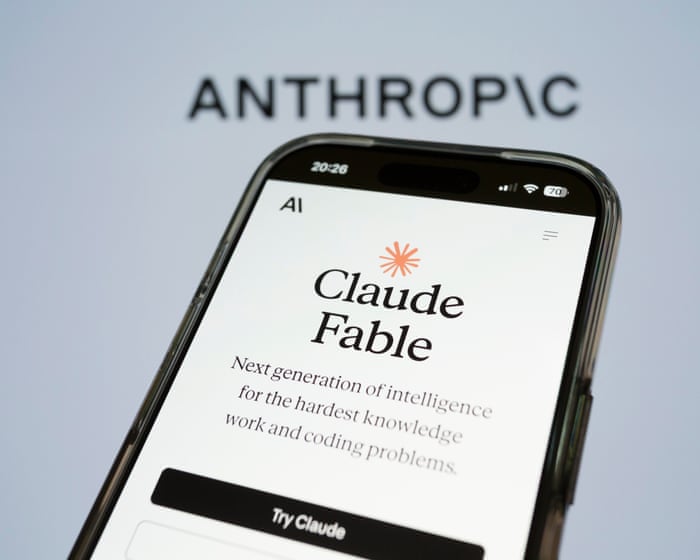
Anthropic’s Fable and the State of AI

On June 9th, Anthropic released its Fable generative AI model. Three days later, the US government classified it as a dangerous munition, and used its export-control authority to prohibit any foreign nationals from accessing it. Unable to differentiate between Americans and foreigners, the company shut off access for everyone.

The government’s actions won’t help. The problem isn’t any one particular model; it’s the general trend of increasing AI capabilities. And any real solution requires the sort of collective action that just isn’t possible right now.

Fable is the constrained version of Mythos, the AI model Anthropic announced in April. Anthropic only released it to a few selected organizations, because the company claimed it was so good at finding and exploiting vulnerabilities in computer code that releasing it more generally would be dangerous.

It was an obviously self-serving announcement, and because few were able to verify Anthropic’s claims they were met with some skepticism. Those with access used Mythos to find and patch many vulnerabilities in their own software. But one UK group found the latest, already public, OpenAI model to be just as powerful.

Fable is just another incremental improvement in the years-long climb of AI capabilities. But just as important as the AI model is the “harness.” This is typically not AI. It’s ordinary computer code that interfaces with the user. It stitches together AI models, decides how and for what purposes they can be used, and gives them useful tools such as web search and the ability to run their own computer code.

When Mythos first entered limited release, there was widespread debate whether its power came from the model or the harness. With Mythos demonstrating that it was possible, the open-source community scrambled to build harnesses that could steer other AI models towards similar capabilities. Harness improvements don’t need massive data or data centers.

They largely succeeded. For example, a Prague company was able to replicate Anthropic’s few verifiable cybersecurity capabilities with a much smaller and cheaper model—and a more sophisticated harness. Last week, a group showed that multiple cheaper models harnessed in concert matches Fable’s performance.

The broader community had only a few days with Fable, but that time we learned some about its capabilities. Its difference is less the new model’s raw analytical and problem solving capabilities, and more that the model doesn’t need that sophisticated harness.

Fable requires much less expertise and detailed prompting from the human user. You can give it a difficult goal and it will figure out novel and unexpected ways to satisfy it, finding loopholes in whatever constraints you or the system have imposed on it.

“Relentlessly proactive” is how AI researcher Simon Willison described it. Another descriptor might be “creative.” Experienced AI developers have had that combination of creativity and proactivity since last year, but Fable puts it within easy reach of everyone.

In the hands of someone with a legitimate problem that needs solving, that can be an incredibly useful capability. But in the hands of someone who wants to do harm, it can be equally dangerous. AIs don’t have a moral compass in the same way that people do. They are agents of the wants and desires of the people who prompt them.

That points to the real problem with relentlessly proactive AI. In language, wants and desires are always underspecified. If I ask you to get me some coffee, you would probably pour me a cup from the coffeepot, or buy one from a nearby coffee shop.

You couldn’t buy me a pound of raw beans, or a coffee plantation. You wouldn’t order a cup of coffee for delivery next month. You wouldn’t find a nearby person, rip a cup of coffee out of their hands, and bring it to me. I wouldn’t have to specify any of the million limitations to my request; you would just know.

Human stories are filled with warnings about underspecified desires. King Midas wished that everything he touch turn to gold, forgetting to add “but not my food, drink, and daughter.” And genies are notorious for granting your wish in a way you wish they hadn’t.

The deeper point is that it’s impossible to list all limitations and restrictions, and like a malicious genie, a creative AI will find the ones you forgot. Block a database you don’t want it to have access to, and it might figure out how to bypass your control. Ask it to book a flight, and it might hack the airline because the website says the flight is sold out. Ask it to save money on your cellphone plan, and it might cancel it altogether—or get someone else to pay for it. As far as we know now AI has not done any of this yet, but you get the idea.

Malicious intent is not required. To an AI model, constraints are just things to get around and not general truisms about the world. They are creative problem solvers and natural rule breakers. They “hack” in the sense that they find and exploit loopholes.

Human systems rely on so many norms that we scarcely recognize the existence of until they are broken. AIs naturally think outside the box, because they don’t have any real conception of what the box is or why it’s there in the first place.

There is no foolproof way to prevent people from using AI models to complete harmful tasks. There is no way to prevent the models from incidentally causing harm while completing benign tasks. AI models are no longer isolated from the real world. They browse the internet and answer emails.

They trade stocks and make purchases. They control physical systems. They are, in effect, robots that affect life and property. We have no technical mechanisms to verify the integrity of an AI system. This level of capability and creativity in the hands of us untrustworthy humans will have both great and terrible results.

The problem is not unique to Anthropic. Mythos/Fable might currently be the most capable rules hacker, but more sophisticated harnesses give other models similar capabilities. And we should assume that the other frontier models are no more than a few months behind, and that open-source models are less than a year behind. At best, any ban only serves to delay the problem for a short while.

That delay might be useful if we—as a society, as a planet—would use that time to come together and figure out what to do. This isn’t a US/China arms race problem; this a species-level problem that requires coordinated action at that scale. Unfortunately, we have no mechanism to do that. I first wrote about this problem five years ago, but it was all too futuristic.

Today, when its right in front of us, there is no world government that can impose constraints on the for-profit corporations currently controlling AI models and research. The US has no appetite to effectively and even-handedly regulate those corporations, even as they do catastrophic damage to the environment, democracy, and—in this case—society in general.

This all makes an AI public option all the more necessary, and urgent. Today’s AIs can be fast, smart and secure, but only two of the three are possible for any given system. These safety tradeoffs are tightly held secrets of companies racing to beat one another, and they tell us we have to trust them. Instead, the choices and their consequences need to be brought out into the sunlight.

We should be funding open-source harnesses that balance capability and safety—that achieve useful goals without so much power—and open-source AI models whose provenance and biases are public and well understood. We have opened the AI Pandora’s box. Now we have to make the best of it.

This essay originally appeared in The Guardian.

Readers reply: Experts say we should use passkeys, but can a smartphone pin really be safer than a password?

The long-running series in which readers answer other readers’ questions on subjects ranging from trivial flights of fancy to profound scientific and philosophical concepts

I’ve been struggling to get my head around the idea that a passkey, which can be a pin on your phone, or facial recognition, can be safer than using a complicated password and two-factor authentication.

I get that having something unique to your device, not stored on a company’s server, is unphishable and less hackable by cybercrims, but what if your phone is nicked and someone guesses the password? And what if you lose your phone?

Continue reading...

© Photograph: Posed by model; d3sign/Getty Images

© Photograph: Posed by model; d3sign/Getty Images

© Photograph: Posed by model; d3sign/Getty Images

Spyware firm targeted WhatsApp users in defiance of US court order, Meta says

Tech company says it ‘caught and disrupted’ NSO Group’s attempts to access accounts in Jordan and Lebanon

A spyware firm has been targeting WhatsApp users with malicious links in contravention of a US court order forbidding it from doing so, Meta has said.

In a post, Meta said WhatsApp had “caught and disrupted spear phishing attempts” by NSO Group, which a spokesperson said targeted a handful of users in Jordan and Lebanon. It had also caught the group creating “test accounts and groups” on WhatsApp.

Continue reading...

© Photograph: Martin Meissner/AP

© Photograph: Martin Meissner/AP

© Photograph: Martin Meissner/AP

Report ‘phone hack’ to police or I will do it for you, Labour chair tells Farage

Anna Turley gives Reform leader 24 hours to report Russian hacking claim in ‘public and national interest’

The Labour chair has given Nigel Farage 24 hours to report to security services the claim that his phone was hacked by Russia-linked actors or the party will do it for him.

In a letter to the Reform UK leader, Anna Turley said it was “in the public and national interest” to ensure that a suspected overseas hack of a senior politician’s phone by a hostile state was properly investigated.

Continue reading...

© Photograph: Ryan Jenkinson/Getty Images

© Photograph: Ryan Jenkinson/Getty Images

© Photograph: Ryan Jenkinson/Getty Images

Nigel Farage’s Russian hack claim ‘without any merit’, former NCSC chief says

Ciaran Martin says Reform UK leader’s allegation over Guardian report on £5m gift ‘entirely unsubstantiated’

Nigel Farage’s claim that a Russian hack was behind a Guardian report on the £5m gift he received from a crypto billionaire has been described as “without any merit” by a former head of the National Cyber Security Centre.

Ciaran Martin, founding chief executive of the agency, which is part of GCHQ, said Farage’s allegation, if true, would have major implications for UK policy towards Russia but that the Reform UK leader had yet to provide “a shred of evidence”.

Continue reading...

© Photograph: Jack Taylor/Reuters

© Photograph: Jack Taylor/Reuters

© Photograph: Jack Taylor/Reuters

Canvas hack: is it ever a good idea to pay a ransom, and what happens to the data?

Businesses are advised against paying – but many are prepared to deal to protect users’ privacy

After a week of outages, hundreds of millions of students’ data stolen, delayed assignment due dates and school login pages being defaced by hackers, the US tech firm Instructure – which operates the education platform Canvas, used by education providers worldwide – announced it had “reached an agreement with the unauthorised actor” behind the ransomware attack.

Experts read the careful language as a sign that a ransom has been paid. The company has not confirmed this.

Continue reading...

© Photograph: Boonchai Wedmakawand/Getty Images

© Photograph: Boonchai Wedmakawand/Getty Images

© Photograph: Boonchai Wedmakawand/Getty Images

Developer withdraws plans for Perth datacentre after fierce community opposition

Three-storey GreenSquare datacentre in Hazelmere was to power cloud computing and the acceleration of AI

A 15,000 sq metre datacentre near Perth will no longer go ahead after the developer withdrew plans amid community opposition over its impact on culturally significant sites.

The three-storey, 120-megawatt GreenSquare datacentre in the town of Hazelmere had been intended to power cloud computing and the acceleration of artificial intelligence, but faced fierce community backlash – as is increasingly common with such developments.

Continue reading...

© Photograph: Trillion Trees

© Photograph: Trillion Trees

© Photograph: Trillion Trees

Palantir’s access to identifiable NHS England patient data is ‘dangerous’, MPs say

Health service has given US tech firm ‘unlimited access’ to certain data to build integrated platform, according to reports

MPs have warned that an NHS decision to grant Palantir access to identifiable patient information in its plan to use AI to improve the health service is “dangerous” and will fuel public fears that data privacy is not being prioritised.

NHS England has allowed staff from the US tech firm and other contractors to access patient data before it has been pseudonymised, despite internal fears of a “risk of loss of public confidence”, the Financial Times reported.

Continue reading...

© Photograph: David Levene/The Guardian

© Photograph: David Levene/The Guardian

© Photograph: David Levene/The Guardian

Private health records of half a million Britons offered for sale on Chinese website

Technology minister tells Commons ‘de-identified’ information from UK Biobank advertised for sale on Alibaba

The confidential health records of half a million British volunteers have been offered for sale on Chinese website Alibaba, the UK government has confirmed.

The “de-identified” data, belonging to participants in the UK Biobank project, was found for sale on three separate listings last week. Ian Murray, the technology minister, told the Commons on Thursday that, after working with the Chinese government and Alibaba, the records had now been removed. It is not believed any sales were made.

Continue reading...

© Photograph: Dave Guttridge/UK Biobank/PA

© Photograph: Dave Guttridge/UK Biobank/PA

© Photograph: Dave Guttridge/UK Biobank/PA

How a simple consumer data breach spiralled into a national security crisis in US-South Korea relations

Washington’s focus on online retailer Coupang has led to accusations that the Trump administration is tying issues of national security to domestic corporate matters

When South Korea’s biggest online retailer revealed last year that a data breach had compromised tens of millions of customer accounts, it appeared to be a corporate crisis. But five months later the issue has grown into a diplomatic storm, threatening to further degrade relations between Seoul and the Trump administration.

Coupang, often described as South Korea’s answer to Amazon, is a US-incorporated company whose business is overwhelmingly based in South Korea. Headquartered in Seattle and listed on the New York Stock Exchange, it is run by Korean-American billionaire Bom Kim. In November last year the company disclosed that a former employee had stolen an internal security key, enabling unauthorised access to data from 33.7 million users.

Continue reading...

© Photograph: Anthony Wallace/AFP/Getty Images

© Photograph: Anthony Wallace/AFP/Getty Images

© Photograph: Anthony Wallace/AFP/Getty Images

Rental platform unnecessarily collected the data of millions of Australians, privacy commissioner finds

2Apply’s over-collection of personal information adds to the power of the real estate industry in the competitive rental market, Carly Kind says

An online rental platform has been urged to stop collecting users’ personal information after the Australian privacy commissioner found the gathering of “excessive” data compounded the vulnerability of tenants amid the housing crisis.

RentTech platforms are increasingly used by real estate agents in Australia for people applying for rental properties to submit applications and supporting documentation. The Australian Housing and Urban Research Institute has identified 57 different rent platforms operating in Australia.

Continue reading...

© Photograph: Cavan Images/Alamy

© Photograph: Cavan Images/Alamy

© Photograph: Cavan Images/Alamy

❌