❌

Visualização de leitura

Apple Bans Nudify Apps in Strict App Store Overhaul

Apple bans nudify apps and nonconsensual deepfakes under strict new App Store guidelines requiring developers to proactively block illicit content.

Related Posts:

The post Apple Bans Nudify Apps in Strict App Store Overhaul appeared first on Daily CyberSecurity.

Ofcom Investigates Pornhub Parent Aylo Over Age Checks

Pornhub age checks

Ofcom has opened an investigation into Aylo, the service provider of Pornhub, over its Pornhub age checks, examining whether the platform has met its legal obligations to prevent children from accessing pornographic content under the UK Online Safety Act.

The investigation focuses on a new age assurance process introduced by Pornhub in May 2026 for some users. The process relies on signals from Apple indicating that UK users attempting to access Pornhub may have completed Apple’s own age checks.

Under the Online Safety Act, responsibility for ensuring that age assurance is highly effective rests with the service provider, regardless of where in the process an age check takes place.

Ofcom Questions Pornhub’s Age Assurance Process

Ofcom said it is concerned that Aylo may not have carried out sufficient due diligence and testing before introducing the new process. The regulator is examining whether the system is sufficiently effective in preventing children from encountering pornography.

The investigation will assess whether Aylo complied with two key requirements under the Online Safety Act: using highly effective age assurance to prevent children from seeing pornography and completing a suitable and sufficient assessment of children’s access to the service.

Ofcom will also examine how Aylo implemented the process and whether the necessary due diligence was completed before deployment. The investigation will not determine how Apple operates its own age checks.

George Lusty, Ofcom’s Director of Enforcement, said online age checks are an important protection against children encountering inappropriate or harmful material and that technology companies are expected to ensure such systems are highly effective before deployment.

Ofcom Sets Out Investigation Process for Pornhub Age Checks

Ofcom said its investigation will begin with gathering and analysing evidence to determine whether a breach has occurred. If the regulator finds evidence of a compliance failure, it can issue a provisional decision to the company.

[caption id="attachment_114372" align="aligncenter" width="600"]Pornhub age checks Image Source: Ofcom[/caption]

Aylo would then have an opportunity to respond to Ofcom’s findings before a final decision is made.

If Ofcom determines that a company has broken the law, it can require the platform to take specific steps to comply with its obligations or address harm caused by the breach. The regulator can also impose fines of up to £18 million or 10% of qualifying worldwide revenue, whichever is greater.

Ofcom Expands Enforcement Against Intimate Image Abuse

The investigation comes alongside a separate Ofcom enforcement programme targeting the spread of illegal intimate images, including explicit AI-generated deepfakes.

Ofcom has said platforms should have automated hash matching technology in place by September 30 to detect and prevent the sharing of illegal intimate images. Platforms without hash matching must demonstrate that other systems and processes are equally effective at curbing the spread of non-consensual intimate images, or NCII.

Companies that fail to meet their legal duties could face fines of up to 10% of their global annual revenue.

Ofcom has partnered with SWGfL, which operates the StopNCII.org database and Revenge Porn Helpline, to share information and expertise on tackling intimate image abuse online.

The regulator is also seeking evidence from academics, survivor and victim support groups, and other stakeholders about how women’s and girls’ experiences online have changed.

Ofcom said the evidence will contribute to a report on industry progress in reducing online harms to women and girls. The regulator will also consider whether formal recommendations to the UK government are needed if industry action falls short.

The two enforcement efforts highlight Ofcom’s broader focus on requiring online services to put effective safeguards in place before harmful content or access risks materialise.

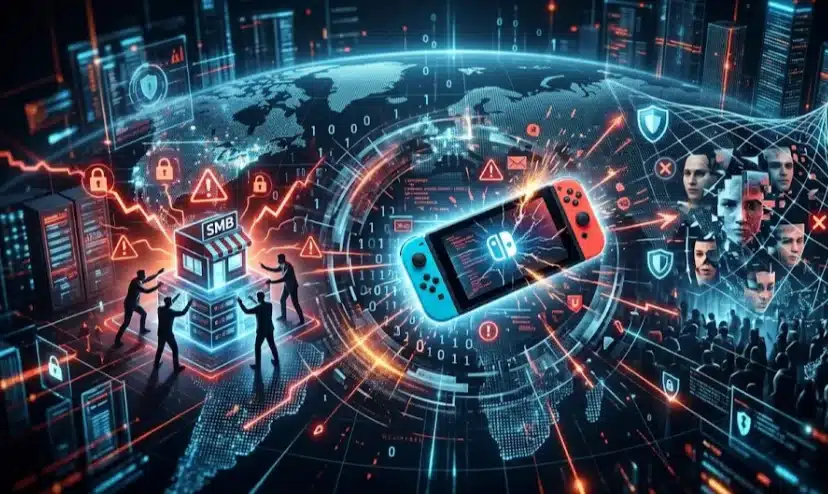
The Cyber Express Weekly Roundup: Hiscox’s SMB Warning, a Nintendo Switch Flaw, and a Record Deepfake Takedown

weekly roundup September 18 2026

This weekly roundup covers a stark small-business cyberattack report out of the UK, a hardware flaw exposing Nintendo Switch owners to nearby attackers, the largest known seizure of AI deepfake porn websites, a candid conversation on AI's role in offensive security, new US legislation targeting elder fraud, and a fresh national threat-intelligence partnership in the UAE.  From consumer hardware to national policy, this week's developments show that exposure isn't limited to large enterprises or nation-state targets — small businesses, individual console owners, and everyday victims of fraud and non-consensual imagery are all squarely in scope, even as governments and industry move to close the gaps. 

The Cyber Express Weekly Roundup 

UK Small Businesses Face Higher Cyberattack Rates Than Global Peers, Hiscox Report Finds 

UK small firms are being hit by cyberattacks at a rate well above the global average, according to Hiscox's 10th annual Cyber Readiness Report. The survey of nearly 7,000 smaller businesses worldwide, including 1,000 in the UK, found that 38% of UK firms suffered a successful attack in the past year, compared with a 29% global average — the highest rate among all markets surveyed. Read more… 

Cyble Signs MOU with UAE Cyber Security Council to Boost National Threat Intelligence 

Cyble, an AI-native cybersecurity firm, has signed a Memorandum of Understanding with the UAE's Cyber Security Council to strengthen the country's national threat intelligence capabilities. Announced in Abu Dhabi in September 2026, the agreement centers on delivering advanced threat intelligence, early warning capabilities, and insights into emerging cyber risks facing government and critical infrastructure entities across the UAE. Read more… 

Nintendo Switch Flaw Let Nearby Attackers Run Code, Steal Data 

Nintendo has patched a flaw in the original Switch that let nearby attackers hijack its QR-code-based "Send to Smartphone" feature to run unauthorized code or steal data, including account information stored on the console. Tracked as CVE-2026-82079, the bug affected consoles on firmware older than version 23.0.0; the Switch 2 is unaffected. Read more… 

Manhattan D.A. Seizes 12 Deepfake Porn Websites in Largest Known Takedown of Its Kind 

The Manhattan District Attorney's Office has seized 12 websites allegedly used to create, sell, and distribute AI-generated deepfake pornography targeting roughly 1,200 real people without their consent. Announced by D.A. Alvin L. Bragg Jr., it's described as the largest known seizure of AI-generated celebrity deepfake websites to date, and the investigation is ongoing. Read more… 

Rahul Singh Choudhary on AI's Growing Role in Cryptanalysis and Offensive Security 

In the latest episode of Security Pill Season 2.0, The Cyber Express interviewed cybersecurity analyst Rahul Singh Choudhary about how AI is reshaping cryptanalysis, vulnerability research, and penetration testing. The conversation opens with a key question: has AI moved from merely assisting security research to actively participating in it — particularly around the cryptographic assumptions underpinning wallets, exchanges, and smart contracts? Read more… 

US House Passes GUARD Act to Boost Law Enforcement Fight Against Elder Fraud, Crypto Scams 

The U.S. House of Representatives has passed the bipartisan GUARD Act (H.R. 2978) on September 15, 2026, aimed at strengthening law enforcement's ability to combat elder financial fraud and cryptocurrency scams. Co-led by Representatives Josh Gottheimer, Zachary Nunn, and Scott Fitzgerald, the bill now heads to the Senate. Read more… 

Weekly Cybersecurity Takeaway 

This week's developments span the full spectrum of cyber risk — from small UK businesses absorbing a disproportionate share of attacks, to a hardware-level flaw putting console owners at physical-proximity risk, to AI tools being weaponized for non-consensual imagery at unprecedented scale.   Meanwhile, policy responses are accelerating on multiple fronts: US lawmakers are moving to arm local investigators against crypto-enabled elder fraud, and the UAE is deepening its national threat-intelligence posture through public-private partnership.  Taken together, the stories point to a widening gap between the speed of exploitation — whether by scammers, deepfake operators, or nearby attackers exploiting hardware — and the pace of institutional response, even as that response visibly picks up. 

💾

AI is already reshaping how crypto and blockchain systems get attacked — and defended. In this episode of Security Pill Season 2.0, we speak with Rahul Singh...

AI Won’t Replace Cybersecurity Jobs, It’ll Replace the Toil – Harsha Reddy Explains What’s Next

AI, Cybersecurity, Harsha Reddy

As enterprises race to bolt AI onto every business process, security leaders are being forced to answer a harder question than "should we adopt it" — it's "who's accountable when it goes wrong." To unpack this, The Cyber Express sat down with Harsha Reddy, Head of Information Security at Veterinary Emergency Group (VEG).

With nearly two decades in security leadership — including senior roles at Lixil and American Standard before joining VEG — Harsha brings a practitioner's view of where AI is genuinely changing the CISO's job, and where it's mostly just hype and shadow adoption.

Watch the Full Interview:

Harsha Reddy Explains Why AI Will Replace Tasks, Not Defenders

Harsha pushes back on the narrative that AI will hollow out security teams, pointing to Gartner research showing that while most fields are projected to lose jobs to AI, cybersecurity is expected to gain them. In his view, the technology is mainly absorbing the "toil" — log review, alert triage, evidence gathering — that keeps analysts from actually defending.

Also listen to S1 Episode: Awareness and Education at Young Age is the Answer to Cybersecurity Skill Gap

“It's the analyst who refuses to use AI that will get replaced by an analyst who uses it,” he says.

On adoption, Reddy points to a 2024 Microsoft-LinkedIn survey in which most executives called AI critical to their business, yet a majority had no formal plan and most had employees already bringing in their own tools. That gap, he argues, is why so many organizations are now dealing with AI-related data leaks. "Many organizations started onboarding AI like software when they should be onboarding it like staff." His fix isn't more restrictions — blocking AI just pushes it into the shadows — but guardrails, an internal AI enablement committee, and measuring actual business value instead of token consumption.

The conversation also digs into deepfake-driven fraud, why training employees to spot deepfakes is “a losing bet” at machine speed, and how he decides when to greenlight a new AI tool versus telling a business unit “not yet.”

The conversation closes with our newly introduced rapid-fire round "Express Shots" — Claude vs. ChatGPT, passkeys vs. passwords, and Reddy's prediction for the biggest cybersecurity threat of 2030.

💾

Read the latest updates Firewall Daily news and insights on The Cyber Expres, your trusted source for cybersecurity and information technology updates."

Are successful deepfake scams more common than we realize?

Many times a day worldwide, a boss asks one of their team members to perform a task during a video call. But is the person assigning tasks actually who they say they are? Or is it a deepfake? Instead of blindly following orders, employees must now ask themselves if they are becoming a victims of fraud.

Earlier this year, a finance worker found themselves talking on a video meeting with someone who looked and sounded just like their CFO. After the meeting was over, they then dutifully followed their boss’s instructions to send $200 million Hong Kong dollars, which equals $25 million.

But it wasn’t actually their boss — just an AI video representation called a deepfake. Later that day, the employee realized their terrible mistake after checking with the corporate offices of their multinational firm. They had been a victim of a deepfake scheme that defrauded the organization out of $25 million.

Businesses are often deepfake targets

The term deepfake refers to AI-created content — video, image, audio or text — that contains false or altered information, such as Taylor Swift promoting cookware and the infamous fake Tom Cruise. Even the recent hurricanes hitting the U.S. led to multiple deepfake images, including fake flooded Disney World photos and heartbreaking AI-generated pictures of people with their pets in floodwaters.

While deepfakes, also referred to as synthetic media, targeted at individuals typically serve to manipulate people, cyber criminals targeting businesses are looking for monetary gain. According to the CISA Contextualizing Deepfake Threats to Organizations information sheet, threats targeting businesses tend to fall into one of three categories: executive impersonation for brand manipulation, impersonation for financial gain or impersonation to gain access.

But the recent incident in Hong Kong wasn’t just one employee making a mistake. Deepfake schemes are becoming increasingly common for businesses. A recent Medus survey found that the majority (53%) of finance professionals have been targeted by attempted deepfake schemes. Even more concerning is the fact that more than 43% admitted to ultimately falling victim to the attack.

Watch Unmask the Deepfake

Are deepfake attacks underreported?

The key word from the Medus research is “admitted.”  And it raises a big question. Do people fail to report being a victim of a deepfake attack because they are embarrassed? The answer is probably.  After the fact, it seems obvious it was a fake to other people. And it’s tough to admit that you fell for an AI-generated image.  But the underreporting only adds to the shame and makes it easier for cyber criminals to get away with it.

Most people assume that they could spot a deepfake. But that’s not the case. The Center for Humans and Machines and CREED found a wide gap between people’s confidence in identifying a deepfake and their actual performance. Because many people overestimate their ability to identify a deepfake, it adds to the shame when someone falls victim, which likely leads to underreporting.

Why people fall for deepfake schemes

The employee who was tricked by the deepfake of the CFO to the tune of $25 million later admitted that when they first got the email supposedly from his CFO, the mention of a secret transaction made them wonder if the email was actually a phishing email. But once he got on the video, they recognized other members of his department in the video and decided it was authentic. However, the employee later learned that the video images of his department members were also deepfakes.

Many people who are victims overlook their concerns, questions and doubts. But what makes people, even those educated on deepfakes, push their concerns to the side and choose to believe an image is real? That’s the $1 million — or $25 million — question that we need to answer to prevent costly and damaging deepfake schemes in the future.

Sage Journals asked the question about who was more likely to fall for deepfakes and didn’t find any pattern around age or gender. However, older individuals may be more vulnerable to the scheme and have a hard time detecting it. Additionally, the researchers found that while awareness is a good starting point, it appears to have limited effectiveness in preventing people from falling for deepfakes.

However, computational neuroscientist Tijl Grootswagers of Western Sydney University likely hit the nail on the head as to the challenge of spotting a deepfake: it’s a brand new skill for each of us. We’ve learned to be skeptical of news stories and bias, but questioning the authenticity of an image we can see goes against our thought processes. Grootswagers told Science Magazine “In our lives, we never have to think about who is a real or a fake person. It’s not a task we’ve been trained on.”

Interestingly, Grootswagers discovered that our brains are better at detection without our intervention. He discovered that when people looked at a picture of a deepfake, the image resulted in a different electrical signal to the brain’s visual cortex than a legitimate image or video. When asked why, he wasn’t quite sure — maybe the signal never reached our consciousness due to interference from other brain regions, or maybe humans don’t recognize the signals that an image is fake because it’s a new task.

This means that each of us must begin to train our brain to consider that any image or video that we view could possibly be a deepfake. By asking this question each and every time we begin to act on content, we may be able to begin detecting our brain signals that are spotting the fakes before we can. And most importantly, if we do fall victim to a deepfake, especially at work, it’s key that each of us reports all instances. Only then can experts and authorities begin to curb the creation and proliferation.

The post Are successful deepfake scams more common than we realize? appeared first on Security Intelligence.

2024 trends: Were they accurate?

The new year always kicks off with a flood of prediction articles; then, 12 months later, our newsfeed is filled with wrap-up articles. But we are often left to wonder if experts got it right in January about how the year would unfold. As we close out 2024, let’s take a moment to go back and see if the crystal balls were working about how the year would play out in cybersecurity.

Here are five trends that were often predicted for 2024.

1. The use of artificial intelligence in cybersecurity will increase

As the year began, there was no doubt that artificial intelligence (AI) would be a main character in the year’s events — and that was right on the money. Many organizations began to use or continue using AI in their cybersecurity operations in a wide range of ways. For example, Microsoft’s internal response teams use a large language model to manage requests and tickets based on how they were handled previously, saving 20 hours per person each week.

As the world turned its attention over the summer to the Paris Olympics, the team responsible for keeping the Paris Olympics data, apps, systems and even physical buildings protected turned to AI. While 140 cyberattacks were linked to the Olympics, the teams’ efforts resulted in no disruption of the competitions.

Throughout the entire life cycle of the games, from before the opening ceremony to after the torch left Paris, cybersecurity teams used AI to secure critical information systems, protect sensitive data and raise awareness within the games’ ecosystem. Additionally, algorithmic video surveillance based in AI scanned video to detect abandoned bags, the presence of weapons, unusual crowd movements and fires.

2. Organizations will see more AI-based threats and attacks

Unfortunately, experts were right about cyber criminals also turning to AI technology to more effectively conduct attacks. Threat actors are using AI in a wide range of ways for data breaches and cyberattacks, including improved reconnaissance, better target profiling and lowering expertise required for conducting an attack. Because AI can automate many processes required for an attack, such as vulnerability scanning, exploitation and data exfiltration processes, more cyber criminals now have the skills for even more damaging attacks.

“Since the release of gen AI, attackers are increasingly employing tools along with large language models to carry out large-scale social engineering attacks, and Gartner predicts that by 2027, 17% of total cyberattacks/data leaks will involve generative AI,” wrote Gartner in an August 2024 press release.

IBM distinguished engineer Jeff Crume has no doubt that the trend of cyber criminals using AI for attacks will continue in 2025. He says that cyber professionals do a better job of authentication because attackers are finding it easier to log in than to hack in. While looking for bad grammar and spelling errors now works to spot phishing attacks, he expects that this will no longer work as AI-based phishing attacks hit mass distribution.

Explore cybersecurity services

3. An increase in deepfakes and deceptions

While experts correctly predicted that deepfakes would become more of a threat in 2024, it’s likely no one expected the scale of arguably the most shocking deepfake story of the year. At the beginning of 2024, attackers created a deepfake video call that led to an employee giving the cyber criminals $25 million, which showed the power and damage that deepfakes can cause. But the World Economic Forum expects that the trend will only increase, even declaring that over the next two years, AI-fueled disinformation will be the number one threat in the world.

Throughout the year, other deepfake incidents made headlines. Quantum AI, an AI company, was suspected by the Securities and Exchange Commission of using AI to generate deepfakes on social media to deceive the public that Elon Musk developed the company’s technology. Even the well-received Paris Olympics were not immune to deepfakes, with Russian Group Storm-1679 suspected of creating AI content to discredit the International Olympic Committee. As the year closed out, German citizens saw an increase in AI-based propaganda regarding the upcoming German elections in 2025, including text, images and video.

4. A growing impact of quantum computing on cybersecurity

Ray Harishankar, IBM Fellow, IBM Quantum Safe, predicted that in 2024, “harvest now, decrypt later” attacks would become more common. As the year moved forward, quantum computing became an increasingly top concern, especially the harvest-now attacks. In July, the Office of Management and Budget released the Report on Post-Quantum Cryptography, which urged organizations to prepare their systems and processes for advancements in quantum computing.

During the fall of 2024, the predictions of the quantum’s impact became even more urgent, as symmetric cryptography would be unsafe by 2029, with even asymmetric cryptography fully breakable by quantum technology by 2034.

“That does not mean, however, that the risks are five years away. The prospect of harvest-now, decrypt-later attacks is already a concern, making the post-quantum cryptography transition an urgent priority,” wrote Gartner.

 5. Recession of ransomware attacks

John Dwyer, former Head of Research at IBM X-Force, predicted we might face a ransomware recession as more companies pledged not to pay the ransom. While we wish we could declare this came true, the jury is still out, and likely, we won’t know for sure until all the data is collected from 2024.

However, Wired declared in the summer of 2024 that “ransomware showed no signs of slowing down in 2024 — despite increasing police crackdowns.” In December, Heather Wishart-Smith wrote in her Forbes article The Persistent Ransomware Threat: 2024 Trends and High-Profile Attacks about the increasing dual extortion technique of cyber criminals as an increasing trend in 2024.

All in all, the experts were largely on target with their 2024 predictions. And in the next few weeks, we will start the prediction game all over again as we wonder what’s in the cards for cybersecurity in 2025.

The post 2024 trends: Were they accurate? appeared first on Security Intelligence.

❌