Entrar
From Infostealer Log to Marketplace Listing: A Technical Walkthrough of the Credential Theft Pipeline
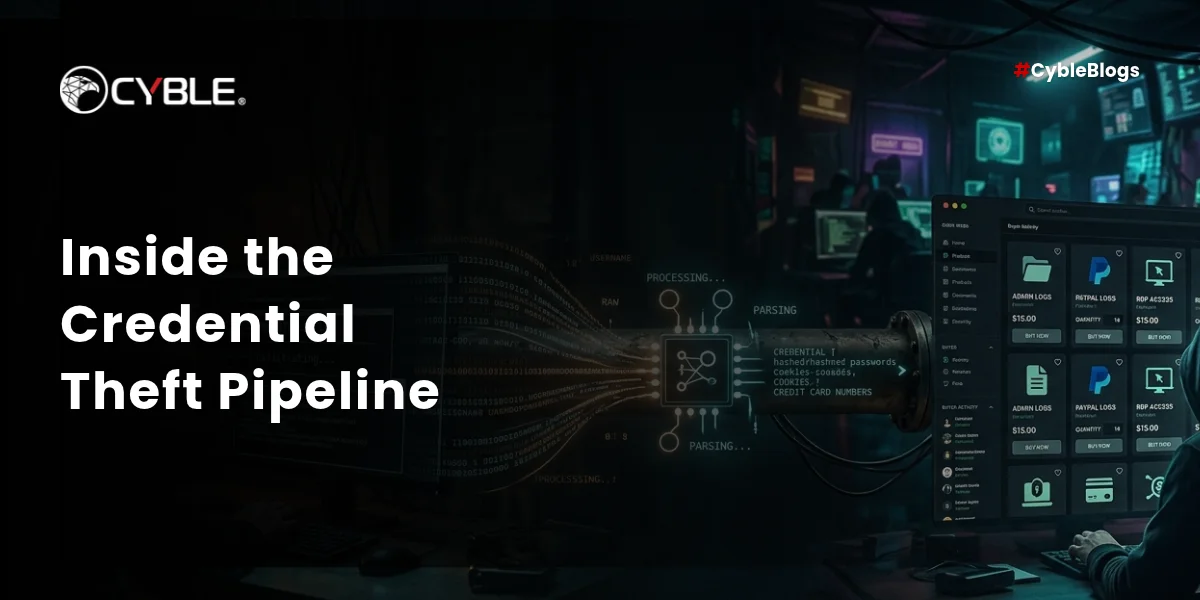
Infostealer malware is behind a large share of today's credential compromise — and it usually doesn't start with a breach at all. When a security team hears "data breach," the instinct is to look for the moment a database was exfiltrated or a network was penetrated. But more often, the real starting point is a single endpoint infection, often on a personal device, that has nothing to do with the organization's perimeter.
By the time stolen credentials show up in a breach notification or a dark web alert, they've already passed through several distinct, mechanical stages. Understanding that pipeline — rather than waiting for the final alert — is what separates reactive security teams from ones that catch exposure early.
How Infostealer Malware Powers the Credential Theft Pipeline?
What follows is a stage-by-stage breakdown of that journey — from the moment infostealer malware first executes on a device, through the log assembly and enrichment steps that add value along the way, to the final point where credentials are packaged and sold on the open market. Each section builds directly on the one before it, showing exactly how a single infection turns into an inventoried, priced, and marketable product.
Execution and Harvesting
The pipeline begins with infostealer malware — a lightweight piece of software designed to do one thing efficiently: grab whatever credentials, cookies, and session tokens are sitting in a browser or application on the infected machine. This is the core mechanism behind modern credential harvesting, and these tools typically arrive through cracked software installers, fake game cheats, malicious browser extensions, or phishing lures disguised as invoices or shipping notices.
Once executed, the stealer doesn't loiter. It targets browser credential stores, autofill data, saved payment details, cryptocurrency wallet files, FTP client configurations, and any session cookies that could allow an attacker to bypass login screens entirely. Many stealers also grab system fingerprinting data — IP address, hardware ID, installed software — which becomes useful later for building convincing sessions or bypassing device-based fraud checks.
The output of this stage is a "log": a structured folder of text files, often just a few kilobytes, containing everything the malware could pull from that one machine. These stealer logs are the raw currency of the entire pipeline that follows.
Aggregation and Log Assembly
A single log is not particularly valuable on its own. Its worth comes from volume. Threat actors operating stealer campaigns typically run panels — command-and-control dashboards — that collect incoming logs from hundreds or thousands of infected machines simultaneously. These logs get bundled into larger archives, sometimes labeled by infection date, campaign, or targeted region.
This is the point where individual credential theft becomes an inventory problem for the attacker. Logs get sorted, deduplicated, and screened for anything obviously valuable — corporate VPN logins, SaaS admin panels, banking portals — versus low-value consumer accounts.
Parsing and Enrichment
Raw logs are messy, so a parsing step usually follows before anything is sold or shared. Automated tools and, in some cases, manual review are used to extract structured fields: username, password, URL, and associated cookies, organized into searchable formats. This is also where enrichment happens — cross-referencing a log against previously leaked datasets to add context like a person's employer, job title, or other accounts tied to the same email address.
Enrichment matters because it changes the value proposition. A raw password paired with a login URL is interesting. That same credential paired with confirmation that it belongs to an IT administrator at a mid-sized company is something else entirely — and priced accordingly.
It's also at this stage that enriched credentials become prime material for credential stuffing campaigns, where attackers automate login attempts across dozens of unrelated services in the hope that a password was reused.
Marketplace Listing
The final stage is distribution. Parsed and enriched logs are listed for sale on dark web marketplaces and forums, sometimes as full archives ("bulk logs") and sometimes broken apart and sold as individual access credentials to specific platforms — a corporate email account, a cloud console login, a remote desktop session. Listings often include partial samples as proof of authenticity, along with metadata like infection date, geography, and browser type, to help buyers judge freshness and relevance.
This is usually the first point where an outside observer — including a security team — has a realistic chance of spotting exposure, provided they're actually looking at this layer of the ecosystem rather than waiting for a breach disclosure further downstream.
Why the Earlier Stages Matter More Than the Alert?
Most detection strategies are built around the last step: someone notices a listing or a breach compilation and issues an alert. But by then, the credential may have already changed hands, been tested against multiple services, or been bundled into a larger fraud operation. The earlier stages — infection, log assembly, and enrichment — are where exposure actually originates, and where it can be caught closer to the source.
For SOC teams and identity security leads, the practical takeaway is that credential exposure isn't a single event to monitor for — it's a pipeline to monitor across. Visibility into stealer logs, marketplace chatter, and enrichment activity gives a much earlier warning than waiting for a finished, packaged breach.
Your Credentials Are Probably Already for Sale. You Just Don't Know It Yet.
Somewhere right now, an infostealer log sits in a marketplace listing with your company's name attached to it — and nobody on your team has seen it. That's not a scare tactic. It's the default state for most organizations, because credential exposure happens quietly, on devices you don't control, long before it ever becomes "your" incident.
The only real question is whether you find out from a threat feed, or from a breach headline.
See what's already exposed — before someone else finds it first. Run a free check with Cyble and get a real answer, not a guess.
The post From Infostealer Log to Marketplace Listing: A Technical Walkthrough of the Credential Theft Pipeline appeared first on Cyble.