❌

Visualização de leitura

MLEP in KICS for Networks 5.0: how machine learning helps track network behavior of OT devices

In an industrial network, malicious activity can be hard to tell apart from normal data exchange between devices. Malicious actors routinely rely on legitimate tools and the Living-off-the-Land technique, so a single network connection may show no known signs of an attack: the device uses a familiar protocol and transmits ordinary data. An anomaly can hide in subtle details: the data source, the time of access, or the volume of transferred data may be atypical for a particular device. However, to detect this kind of anomaly, you need to understand the roles of the devices at both ends of the connection and know which network activity patterns are typical for them.

But an organization’s asset inventory data is often incomplete, which makes it harder to catch unauthorized connections in time. Suppose monitoring detects a host that regularly exchanges data with programmable logic controllers (PLCs). Its IP address is known, but the inventory does not specify what role it plays: is it an engineering workstation, a process data server, or a piece of contractor’s equipment? The host may also have been on the industrial network for a long time, with its record going out of date after a network upgrade.

In the joint OT asset inventory guidance released by CISA and its partners in 2025, inventorying devices and classifying them by role are treated as part of OT asset management. For organizations, this is one of the most important areas: according to the SANS 2025 ICS security survey, 50% of respondents had deployed or significantly expanded ICS inventory and visibility tools over the previous 12 months, and 54% named them as investment priorities for the next 12–24 months.

Device inventory in Kaspersky Industrial CyberSecurity for Networks

In Kaspersky Industrial CyberSecurity for Networks, the Asset Discovery technology is the foundation of asset visibility. Passive network traffic analysis detects devices and their interactions, while recognition rules help determine the device category and extract available information about it, such as the vendor, model, or software version. Exactly which attributes the system can obtain depends on the protocol and the traffic it observes. We covered this in more detail at the Kaspersky Industrial Cybersecurity Conference.
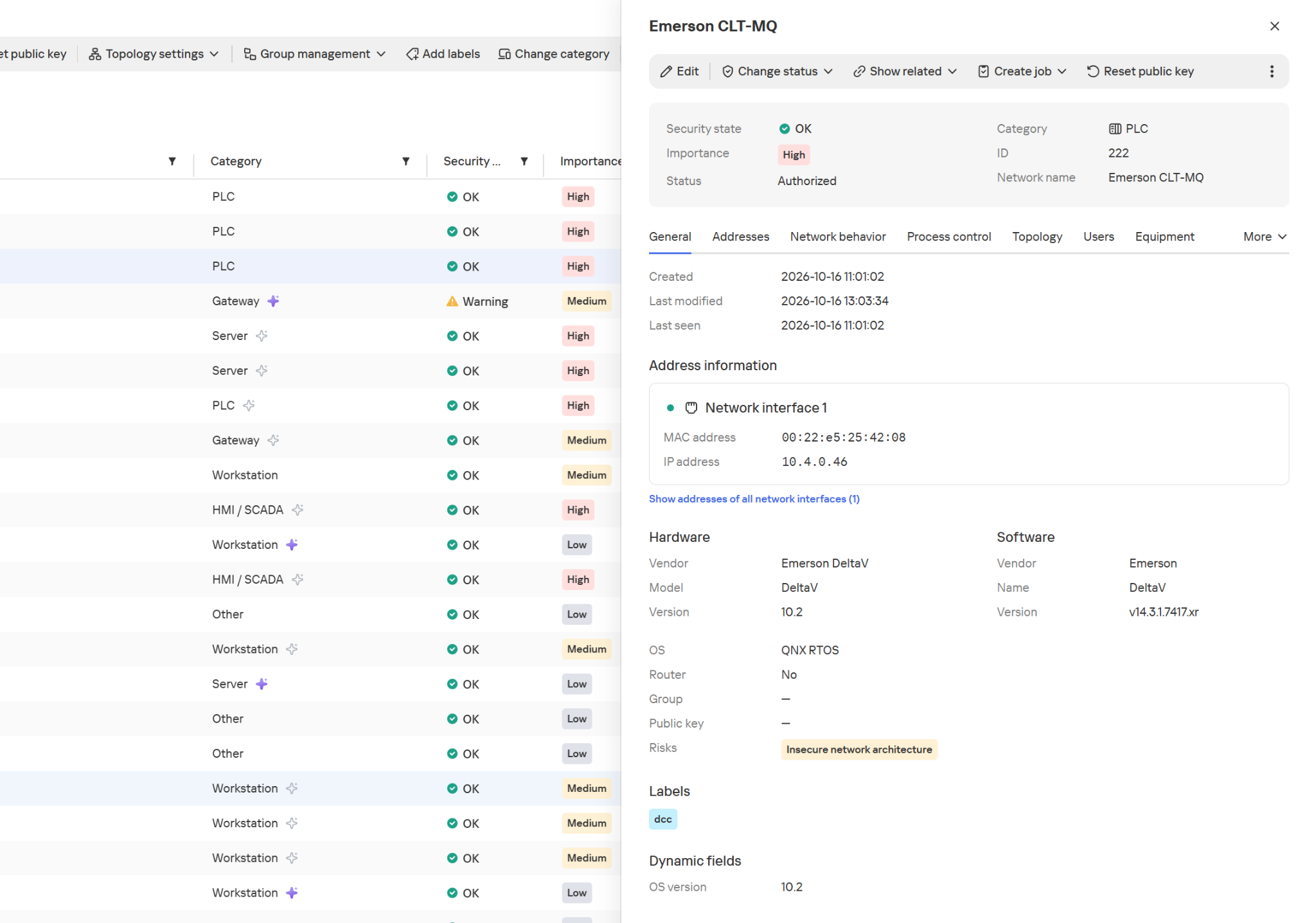
Hardware and software information in the device card

Hardware and software information in the device card

The product also supports active polling modules (APMs): where polling is allowed, they can request additional configuration and firmware version details from devices. This kind of inventory is far more detailed than a list of IP addresses.
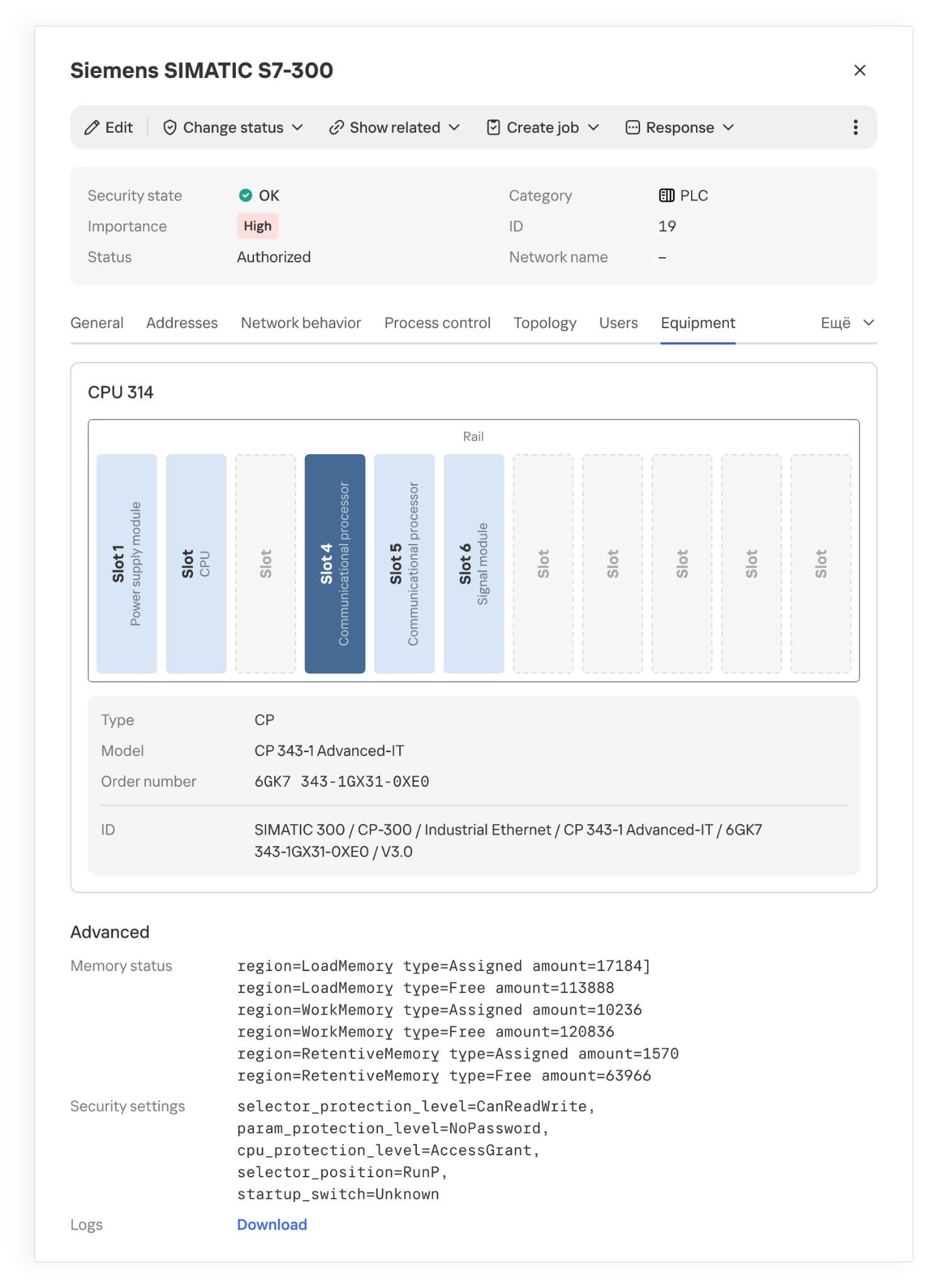
Installed modules and their placement in a PLC rack

Installed modules and their placement in a PLC rack

However, even accurate hardware information doesn’t always explain what function a host performs in a specific industrial facility. Gaps appear for various reasons. Some devices send identifying information only at startup or during configuration, while others rarely communicate. Proprietary protocols can’t always be parsed, and encryption may leave only connection metadata for analysis. If the monitoring system doesn’t receive traffic from every segment of the industrial network, some network activity goes unobserved. Active polling doesn’t suit every device or every operating condition.
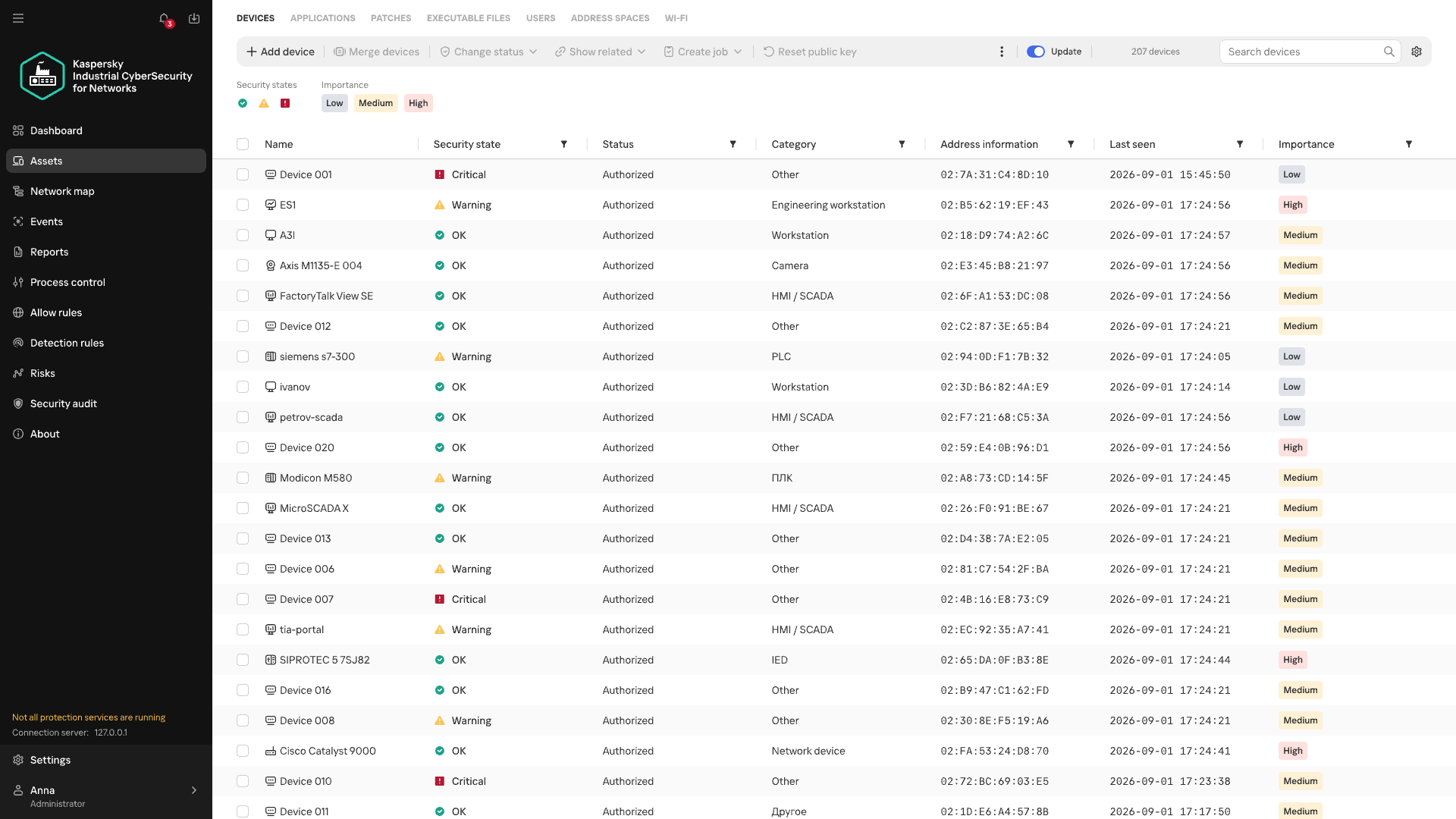
Devices of unknown category

Devices of unknown category

When there isn’t enough direct information about a device, its category can be refined by looking at the patterns of its recurring network interactions. Analyzing these interactions is the job of Machine Learning Event Processor (MLEP), a service included in Kaspersky Industrial CyberSecurity for Networks 5.0. This machine-learning-based event processor can both refine device categories and detect anomalies in their network behavior.

What data does MLEP analyze?

To compare device behavior, you don’t need to store every packet as a separate observation (a data object) in the ML model. MLEP represents network sessions as a sequence of short 15-second fragments. For each fragment, MLEP stores information about the endpoints (IP, MAC, and port), the direction of data exchange, the protocol, and the number and size of the packets transmitted. Together these make up an event, which then gets a timestamp. Traffic thus becomes a sequence of events showing which hosts a device communicated with, when, and how communication intensity changed.

Aggregating data into events also sets the method’s limits. An aggregated fragment can’t be used to reconstruct the exact order of individual packets or the content of commands. MLEP can draw conclusions about a new protocol only if another KICS technology has managed to recognize it. That said, comparing stable network connections and changes in exchange volume doesn’t require a detailed record of every packet. These observations form the basis of the device’s behavioral history.

From observations to MLEP results

Each object has its own behavioral history, and one object’s history can’t be applied to another. But the principles of behavior analysis, along with some common rules, work across different objects.

Let’s look at how this works in MLEP, which is built on a spiking neural semantic network (NSN).

Event identification

Neurosemantic networks structure information as a multilayer ordered graph, where the data in each consecutive layer builds on the data in the previous one. The nodes of this graph — that is, the units of information in each layer — act as neurons.The NSN creates dedicated channels to handle different event parameters (port, IP, and so on). Unique parameter values for each channel are stored as neurons in layer 0. The event itself, which consists of a set of parameter values, is stored as a neuron in layer 1 of the network. If an event occurs for the first time, neurogenesis creates a new neuron with input connections to the corresponding parameter neurons. This lets the network learn and operate on the event stream at the same time. If the event has occurred before, the network activates the same neuron that was created when the event first appeared. This way, the network identifies each event precisely. Each neuron that corresponds to an event also collects basic statistics: when it was last activated and how many times it has been activated.
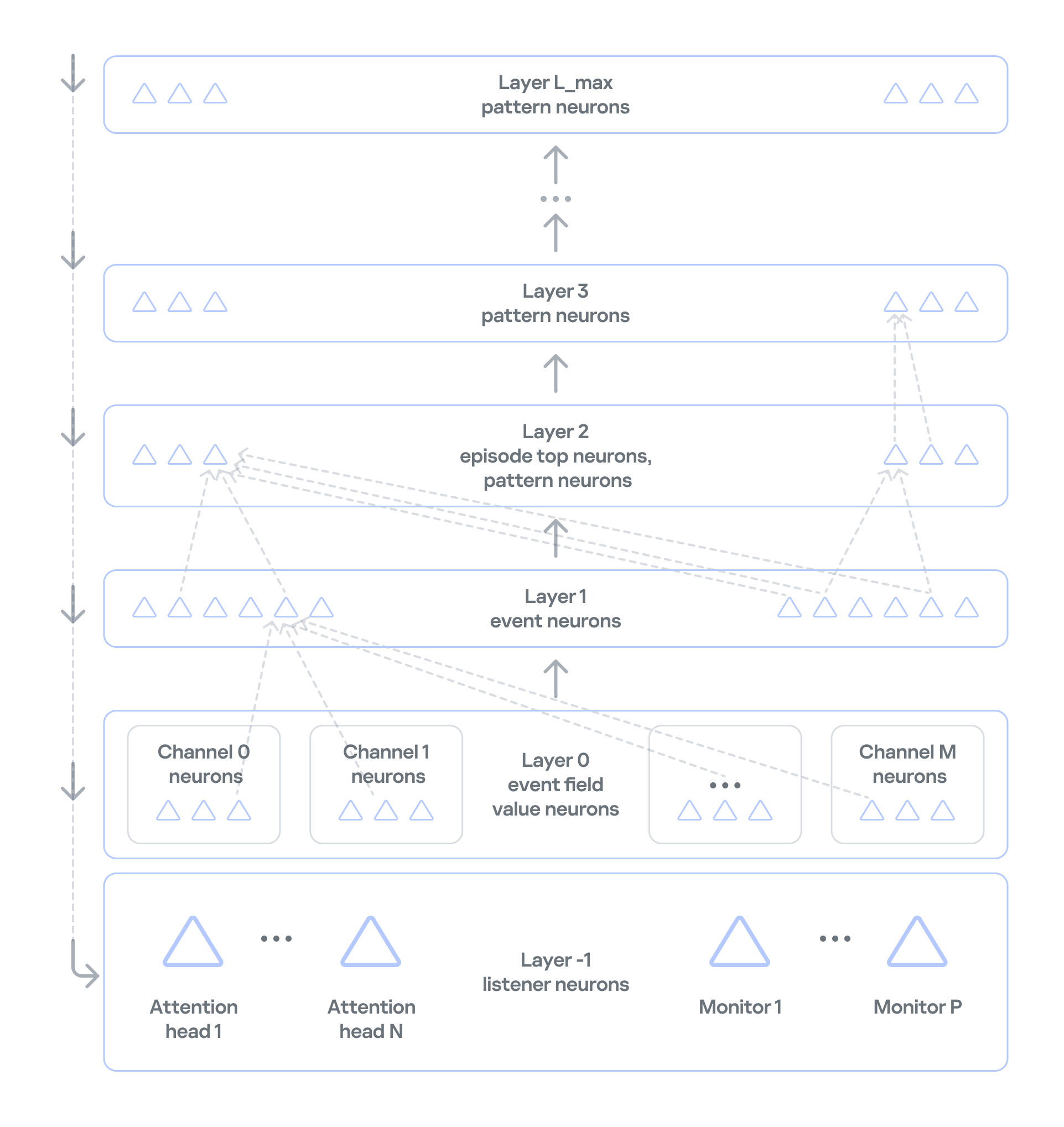
 

Event history

In NSN-based event processing, layer 2 and above store sequences of events over time: recurring patterns and the full history. However, categorization and statistical anomaly detection don’t require storing the full packet sequence or a detailed timeline of every network event. As we noted earlier, events are themselves aggregates, which means the order of network packets has already been averaged out. So MLEP keeps history only temporarily, within each episode (30,000 aggregated events by default), which saves computing resources.

Statistics processing in MLEP

MLEP processes statistics mainly through specialized listener neurons on layer −1 (minus one) of the network. Attention heads and monitors are built on these neurons.
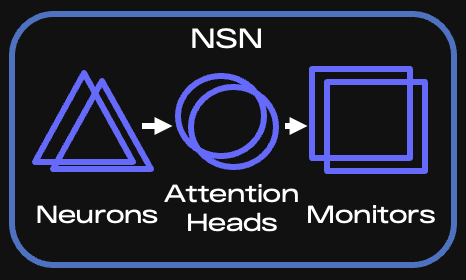
Key components of the NSN

Key components of the NSN

When an event arrives, the corresponding neuron is activated, and the network instantly knows whether that neuron is new or was created earlier. Each attention head subscribes to the events or event features it needs and takes in only the activations of the matching neurons. If an event occurs for the first time, all heads are notified and then decide whether to subscribe (grow a connection to the relevant neuron) and receive information about activations of such neurons from then on.

It is called a spiking network because activation information is a spike, not a number. This spike tells the head that something it’s interested in has happened.

An attention head is configured according to scenarios — the situations that MLEP should send alerts about. The core of a head’s configuration is a query, which filters incoming information and serves as the subscription criterion. Unlike regular database queries, this query runs on the stream, so it can react to an event instantly.

Attention heads work very much like the semantics of ordinary human language. A query has a subject of attention (one or more grammatical subjects) and conditions (the other parts of the sentence). In the infrastructure of an industrial enterprise, the subjects are devices on the network, and the conditions are various aspects of network communication, such as ports, protocol, and average packet size. If a head has many subjects (for example, if it’s interested in every device on an industrial network), it fans out: it creates a child head for each individual value of the subject of attention, that is, each device. The child head then watches a specific device and reports to the parent head.

Attention heads don’t accumulate or process statistics. They only filter event streams. When an attention head receives a relevant event, it activates and sends a spike to the monitor subscribed to that head.

Monitors, in turn, have stacks for accumulating and processing events. They can also have their own queries and post-filter information from the head. For example, they can select only new events from those filtered by the head.

There are several types of monitors:

  • Stat monitors track changes in the average count of specific events (for example, device activity) over time intervals typical for those events, or in the average values of numeric event parameters (for example, changes in device traffic volume).
  • Monitors work from the event alone: they fire when an event has occurred a certain number of times within a given interval, or has occurred for the first time.
  • Similar-behavior monitors work with heads that can generalize events, that is, extract just a few parameters whose combination is shared (generalized) across many events.

MLEP uses these monitor types to implement scenarios for categorizing devices and detecting their anomalous behavior:

  1. For categorization, MLEP uses attention heads and monitors that identify common behavior across different assets and group devices accordingly. MLEP then takes information from Asset Discovery about the known categories of some assets and extends those categories to other assets in the same group. Because a device can show different types of activity, it may land in several groups. MLEP then makes a weighted assessment across all relevant groups.
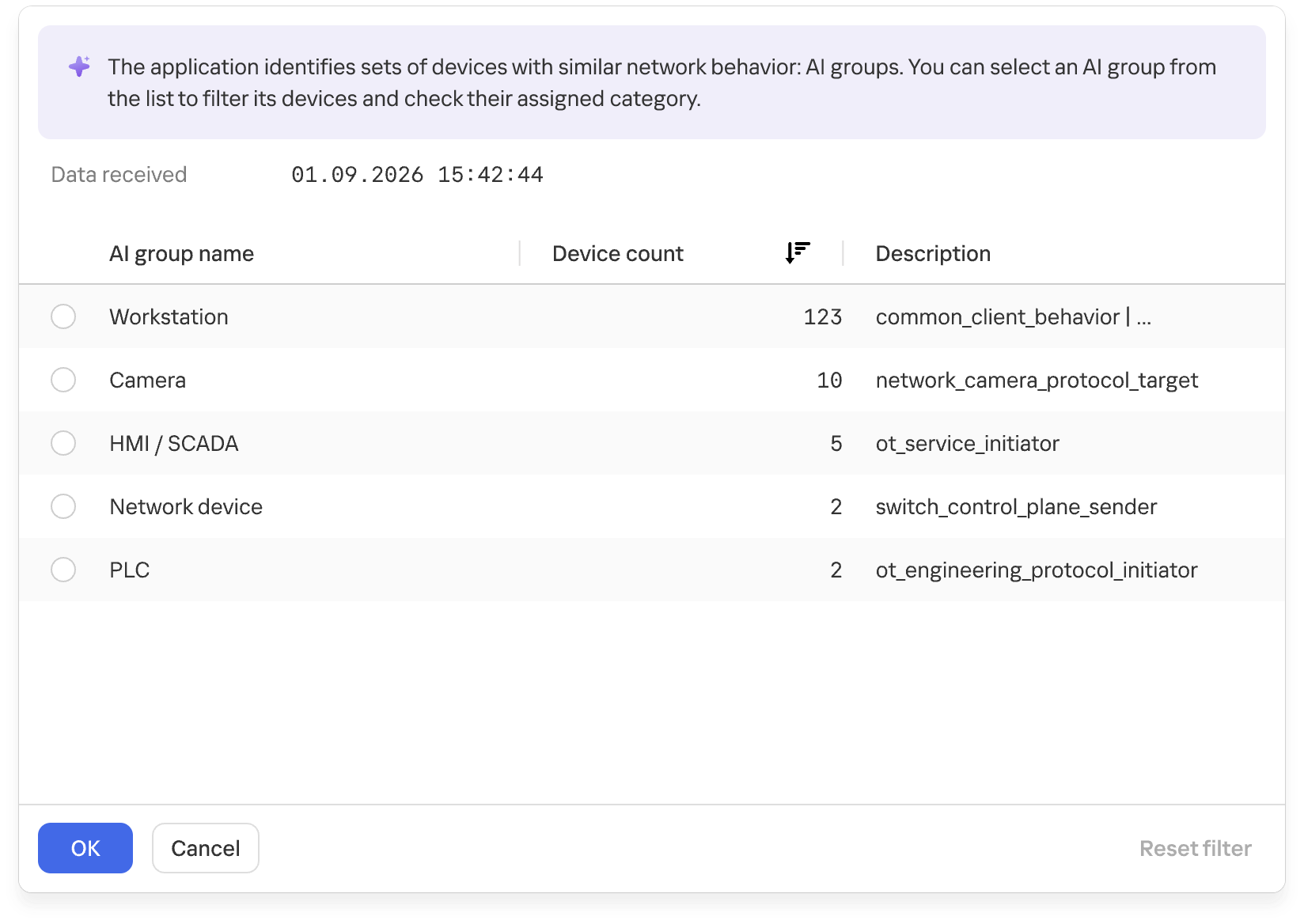
    Groups of devices with similar network behavior

    Groups of devices with similar network behavior

    At the final stage, the system verifies that assigning the category to the asset is permissible. This is again done by special rule monitors loaded into the NSN at system startup. The rules rely on asset metadata available from Asset Discovery and APMs.

  2. MLEP takes a similar approach to anomaly detection: an attention head and a monitor define an anomaly scenario, often loosely. When a monitor activates on such a scenario, MLEP generates an alert about unusual behavior.

The current version of MLEP ships with preconfigured heads and monitors.

The functional dynamic diagram below shows how events from devices on an industrial network are processed.
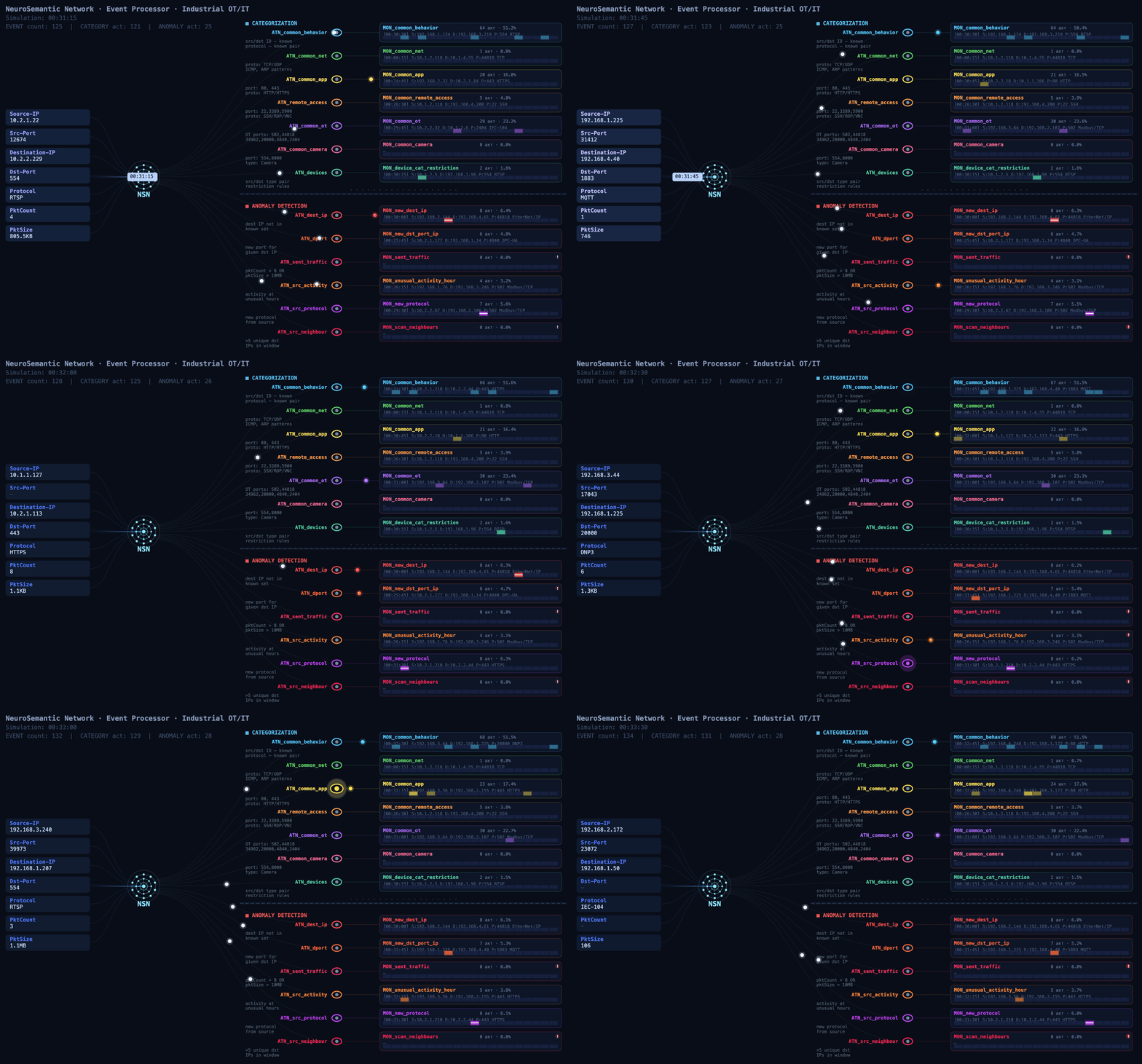
Event processing flow

Event processing flow (click to play)

MLEP in practice: how behavior helps complete the asset inventory

At a facility with several similar production lines, device information may be more complete on some lines than on others. On one line, devices are identified as PLCs, while on another, after an upgrade, some hosts show up only as addresses: the available traffic didn’t provide enough information to determine their category. Still, these devices communicate with the same types of HMIs and process data collection servers. Their communication directions, frequency, and volumes may be similar.

That’s where MLEP comes in. It takes the categories of already known assets and matches recurring features of their network behavior against those of uncategorized devices. When the observed interactions turn out to be similar, MLEP can add a category for that host to the inventory.
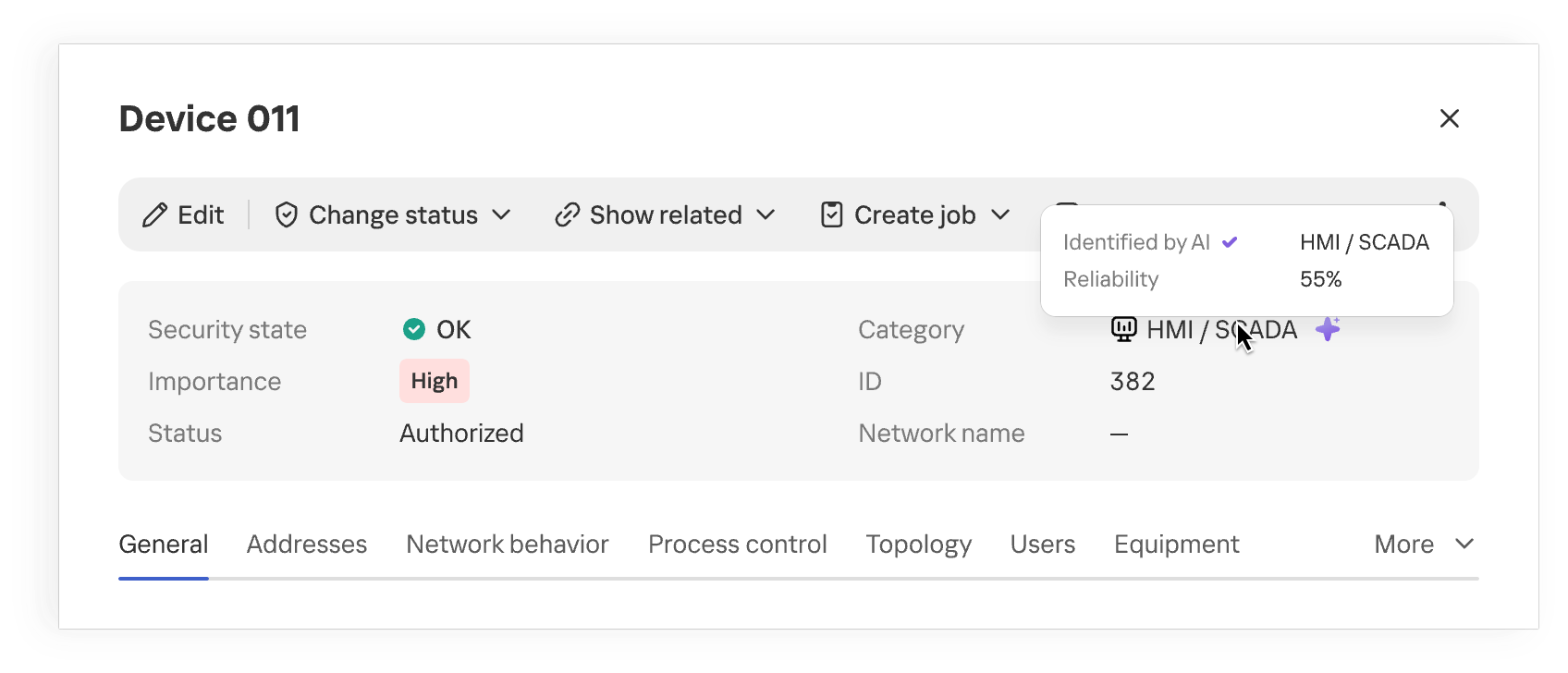
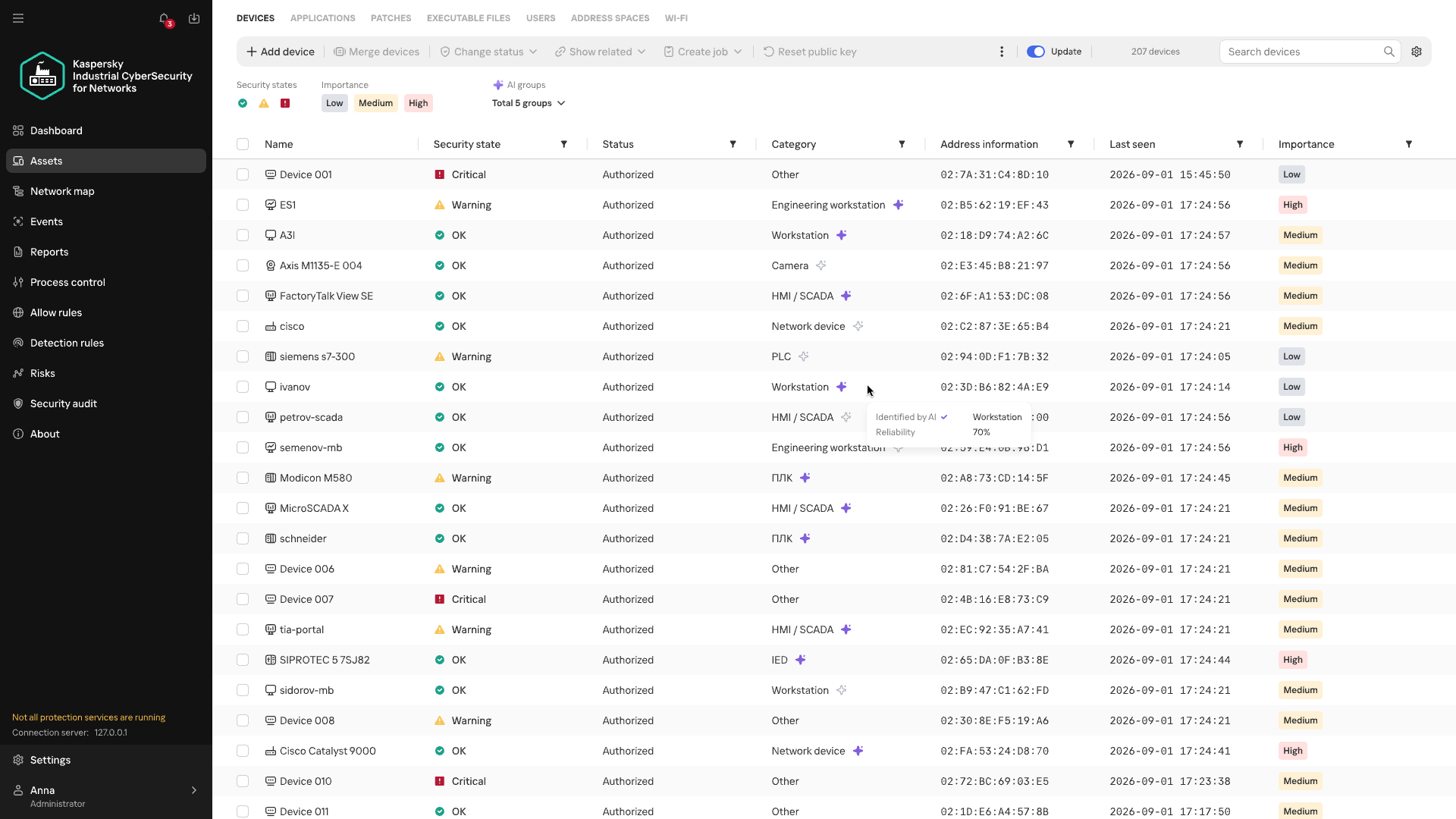
Device category suggested by MLEP

Device category suggested by MLEP

Once the category is refined, the industrial network map provides more context about the equipment on the network. When analyzing network activity, the analyst immediately sees the device’s suggested category and can skip looking up each IP address in the design diagrams. This approach is especially useful where equipment changes faster than the documentation is updated.

The suggested category is also checked against existing device information and defined constraints. This helps filter out some contradictory options, but prediction quality still depends on how much of the traffic is visible, especially if the device communicates only rarely.
Anomalous activity and streaming statistics

Investigations of real-world attacks show that attackers actively use both standard tools and permitted protocols. You don’t always need to know an attacker’s specific technique in advance to spot potentially malicious activity. Signature-based detection helps find known signs of an attack, but it doesn’t assess how typical an observed interaction is for a particular device. MLEP compares current activity with the device’s usual network profile: which hosts it communicates with, which protocols it uses, when and how much data it transmits, its average packet size, and so on. The changes it detects help guide the direction of the investigation. Correlating these changes with other events and the operational context helps determine whether malicious actions could be behind them. When investigating an incident that has already been detected, anomalies help reconstruct the sequence of actions.

The first version of MLEP comes with six preconfigured monitors, one for each type of deviation from the device’s usual network profile:

Anomaly How it helps with event analysis
New external host Flags a new external connection that wasn’t previously seen in the device’s observed behavior, even if the IP address isn’t listed among known IoCs. Helps check whether this connection appeared at the same time as other suspicious events.
New combination of destination address and port Shows that the device has begun using a service it hasn’t used before. Once an incident has been detected, this helps trace new connections after the more critical events have been analyzed.
Unusually large volume of data sent Highlights data transfers that are atypical for the device and helps correlate their timing and direction with other events.
Atypical activity time Shows that the device was active at a time that’s unusual for it. In an already detected incident, this helps reconstruct the timeline of actions around the main alert.
New protocol Helps spot a new method of communication, even when the device is communicating with familiar hosts.
Activity with signs of scanning Shows that the device has started contacting an unusually large number of neighboring hosts. This signal helps reveal possible reconnaissance ahead of attempts to access equipment.

During an investigation, anomalies help reconstruct the sequence of changes: when a specific host established new connections, switched protocols, increased its data transfer volume, or shifted its operating hours. Matching events by device and time shows an analyst how activity unfolded around an incident that has already been detected.

This is especially useful when some of the attacker’s actions fell outside the monitored scope or didn’t trigger other KICS technologies. Correlating these changes with the device’s role, protocol analysis data, and events from other technologies gives the analyst a more complete timeline. Behavioral anomalies show exactly where to look for the missing links and which network interactions need attention.
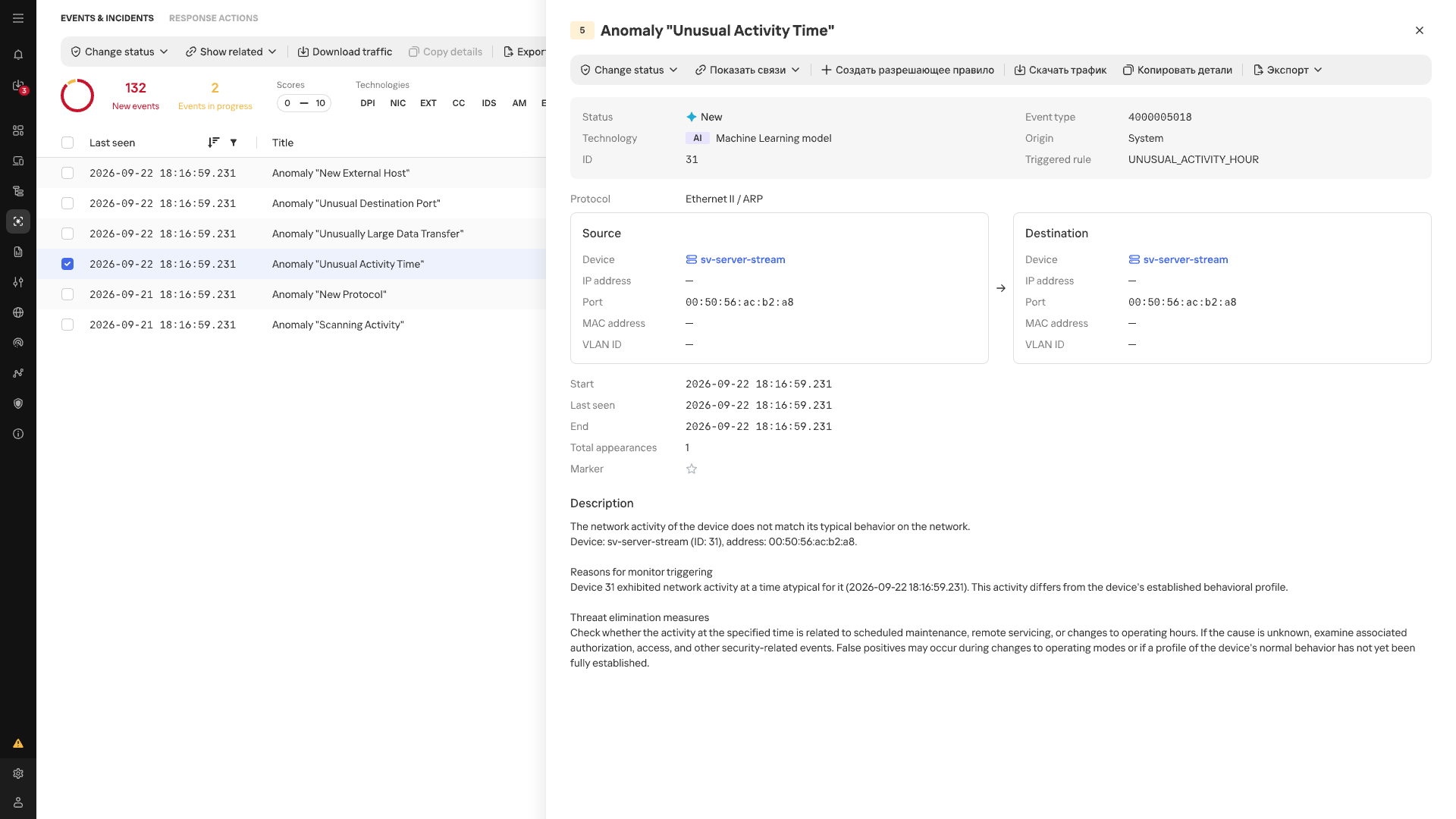
Atypical Activity Time anomaly card

Atypical Activity Time anomaly card

In the event list, anomalies detected by MLEP are marked with an AI label. Each event shows its name, source, destination, timestamp, and the ID of the triggered scenario.

Conclusion

In an industrial network, whether behavior is anomalous depends on the host where it occurs and that host’s place in the industrial process. The repetitive nature of many communications makes a change in normal data exchange easier to spot, while knowing a device’s function and criticality helps gauge the possible consequences. Taken together, these observations make network traffic more than a list of connections: it helps assess new events in the context of a specific facility, even without an attack scenario known in advance. Machine learning technologies are well suited to this kind of comprehensive analysis, as they can process and organize huge streams of heterogeneous data. Starting with version 5.0, Kaspersky Industrial CyberSecurity for Networks handles this function with MLEP, which works effectively alongside the product’s existing functionality.


Meta Faces $25 Billion Penalty Linked to Cambridge Analytica Scandal

A New Mexico judge ordered Meta to pay $25 billion for misleading users about privacy, setting a record penalty. Meta plans to appeal.

This week a New Mexico judge ordered Meta to pay the state $25 billion. The order follows a jury finding that the company deceived Facebook users about their privacy, and it’s the biggest fine ever imposed on Meta. State District Court Judge Francis J. Mathew wrote that Facebook’s deception was intentional and that executives consistently misled users about how the platform worked.

“Facebook promised users that they (the users) controlled their data. This was false,” he said, as reported by the Associated Press.

This is a case about promises, not about a breach. Jurors found in September that Meta committed over 43 million violations of New Mexico consumer protection laws by making misleading public statements about how it handled users’ personal data. The case grew out of the Cambridge Analytica scandal, in which a political consulting firm harvested Facebook data to build targeted political ads for the 2016 election.

New Mexico had asked the court to fine Meta between $35 billion and $40 billion, arguing that only a large penalty would push the company to change its behavior. Meta’s lawyers said the fine should not exceed $3.4 billion and argued that any higher amount would be unconstitutional. The jury found more than 43 million violations, including 2.1 million under specific claims. Each violation can carry a fine of up to $5,000.

New Mexico Attorney General Raúl Torrez said the ruling sends a clear warning to technology companies that they must follow the law. Under the state’s constitution, fines for consumer protection violations go toward education. However, the money may remain tied up while Meta appeals the decision.

Meta plans to appeal the $25 billion ruling. The company argues that the decision and the way New Mexico is enforcing consumer protection laws make it almost impossible to operate in the state. Meta’s chief legal officer, C.J. Mahoney, says the case is an attempt to restrict free speech and impose new rules on what people can say online. The company says it is confident it will win the appeal. Meta’s lawyers also argued that the state failed to prove that residents had actually seen the misleading statements or suffered harm as a result.

Meta is worth $1.8 trillion and brought in more than $200 billion in revenue last year, and its shares rose 2% after the announcement, with earnings due that day. A nonprofit director called $25 billion a drop in the bucket for Meta, though he said it shows people want accountability. Both can be true: the company says doing business in New Mexico is all but impossible, and Wall Street shrugged.

The history explains why the number is so large. Cambridge Analytica got data through a personality quiz app that around 300,000 people took, and the app also pulled data on their friends, building a dataset of 87 million profiles. Meta banned the app in 2015 and asked Cambridge Analytica to delete the data, and the firm shut down in May 2018. The company later agreed to pay $725 million in December 2022 to settle a class action over sharing with Cambridge Analytica, and the FTC fined it $5 billion in 2019, a fifth of today’s award.

New Mexico was not part of the $18 billion settlement Meta reached in August with almost all other US states and territories. The deal includes stronger child-safety measures and $459 million related to the Cambridge Analytica scandal. This is Meta’s second legal defeat in New Mexico in six months. In March, a jury ordered the company to pay $375 million for misleading users about children’s safety.

Meta’s appeal could reduce the $25 billion fine if a court lowers the number of violations. The case also sends a warning to companies: privacy promises have legal consequences. As the judge stated, Facebook told users they controlled their data, but this was not true.

Follow me on Twitter: @securityaffairs and Facebook and Mastodon

Pierluigi Paganini

(SecurityAffairs – hacking, Cambridge Analytica Scandal)

Meta wants to scrape your website to train its AI, and you can’t say no

Meta wants the right to scrape your website for AI training. If you have a business account, that includes you.

At the end of the month, Meta plans to change its commercial terms in a way that matters to every company advertising or selling through its platforms. The new language takes effect on October 30, 2026. It lets Meta collect content from websites associated with business customers and use it to train AI models or otherwise improve its products, according to The Register.

Meta defines “business customer” broadly. It includes anyone who uses ads or marketing messages, sells or lists products, develops apps, uses a product catalog, manages a Page, runs a Group for business purposes, or uses tools such as Ads Manager or Meta Business Suite. At least one million businesses already use Meta’s AI agents in WhatsApp and Messenger. Nieman Lab also points out that almost every news publisher has at least one Meta business account.

The contract clearly explains which tools Meta can use. By accepting the terms, you allow Meta, or anyone working on its behalf, to use automated tools such as web scrapers, bots, spiders and crawlers to access and index your websites, pages and URLs. These tools can also revisit your sites regularly to collect updates.

“You authorise us (or any entity acting on our behalf) to use automated software (such as web scrapers, bots, robots, spiders, crawlers and user agents) and create test credentials to access, index, cache, analyse, collect, retrieve or crawl the domains, web pages or URLs (and any content available through them) that are associated with your products or services, or that are made available through your or users’ use of Meta Company Products and services, and to periodically pull updates from such domains, web pages or URLs.” states Meta’s commercial terms. “Meta may use any content from such domains, web pages or URLs to provide, develop, improve, research, train and maintain the integrity of, the Meta Company Products, services and features provided under these Commercial Terms and any other applicable supplemental terms.”

Then comes the use clause. The company may use any content from those domains to provide, develop, improve, research, train and maintain the integrity of its products, services and features. The contract lists scrapers, bots, robots, spiders, crawlers and user agents, which is a lot of ways to say visitor you didn’t invite.

The News/Media Alliance says there’s no way out. Business accounts have no option to opt out of the terms, and the only alternative is to stop using Meta’s products.

““Meta’s new commercial terms of use are outrageous and probably illegal. The company’s decision to withhold access to its audience unless businesses allow Meta to scrape content from their websites is an appalling, bad-faith policy, and a clear abuse of the company’s market power. It cannot be allowed to be implemented on October 30.” states Media Alliance. “The text is so far reaching that any business with intellectual property online and a Meta business account could have their copyrighted material taken from them.”

Danielle Coffey, President and CEO of the News/Media Alliance also pushed the point beyond news sites. Her questions were whether Taylor Swift’s Meta business account would give Meta access to copyrighted media on her website, and whether Shutterstock’s would let Meta scrape its images. The Alliance’s argument is that any business with intellectual property online and a Meta account could be affected, not just publishers.

There is also a problem with robots.txt. News reports say the social network giant plans to let businesses control how its crawlers access their websites through robots.txt files, but the contract makes no such promise. The law does not always require companies to follow these instructions, so businesses must rely on Meta to respect their preferences.

The company didn’t respond to The Register’s request for comment.

If you run a Meta business account, someone should read the terms before October 30 and check what your own robots.txt actually says.

Follow me on Twitter: @securityaffairs and Facebook and Mastodon

Pierluigi Paganini

(SecurityAffairs – hacking, AI)

US Navy tells sailors and their families: scrub your social media, enemies are watching

The US Navy has told its entire workforce of 340,000 active-duty personnel, 58,000 reservists, and 210,000 civilian employees to clean up their social media profiles, because adversaries might be using them to determine who they are, where they live, and when they may not be at home. Read more in my article on the Hot for Security blog.

Russian Hackers Exploit Hotel Wi-Fi in New CaptiveCrunch Espionage Campaign

CaptiveCrunch

Microsoft Threat Intelligence has uncovered CaptiveCrunch, a cyber espionage campaign linked to Storm-2945, a subgroup of Midnight Blizzard, the Russian state-linked threat actor associated with Russia's Foreign Intelligence Service (SVR).   Active since early May 2026, the operation targets business travelers by exploiting hospitality Wi-Fi networks and captive portals in hotels, conference centers, and similar venues. The campaign combines adversary-in-the-middle attacks, phishing, malware deployment, and AI-assisted development to steal credentials and infiltrate enterprise environments. 

Storm-2945 Uses Hospitality Networks to Target Travelers 

According to Microsoft, Storm-2945 manipulates DNS and HTTP traffic on public Wi-Fi networks using captive portals. By intercepting users before they reach legitimate websites, attackers redirect victims to malicious infrastructure that hosts fake Microsoft sign-in pages or malware downloads. This approach allows the Midnight Blizzard campaign to compromise users without requiring them to intentionally visit suspicious websites. Microsoft believes the attackers may have gained access to shared captive portal infrastructure used across multiple hospitality providers, expanding the scale of the CaptiveCrunch operation beyond isolated venues.

Credential Theft and Malware Deployment 

A key objective of CaptiveCrunch is stealing Microsoft Entra ID credentials. Researchers observed Storm-2945 using counterfeit Microsoft login pages and device code phishing to gain unauthorized access to Microsoft 365 accounts. Once authentication succeeds, the attackers register compromised devices and collect cloud data, making corporate travelers especially attractive targets.  The campaign also distributes malware disguised as browser or operating system updates through convincing "ClickFix" prompts that encourage users to run scripts or install software. Similar tactics have targeted Android users by prompting them to download malicious APK files. The primary payload is CornFlake, a Windows remote access trojan written in Go that installs itself as a persistent "Cloud Sync Service." It maintains persistence through Windows services, registry keys, and scheduled tasks while enabling attackers to log keystrokes, capture screenshots, monitor clipboard activity, record webcam and microphone data, steal browser credentials, exfiltrate files, monitor USB devices, and execute remote commands through PowerShell or Windows Command Prompt. Communications with command-and-control servers are encrypted to evade analysis.

AI-Assisted Malware and Centralized Control

Supporting CornFlake is ChocoShell, a PowerShell-based infostealer that operates entirely in memory to avoid detection. It extracts browser passwords, Microsoft 365 Single Sign-On tokens, Azure Active Directory authentication tokens, Wi-Fi credentials, and session cookies while bypassing AMSI, User Account Control, and virtual analysis environments. Microsoft researchers noted that ChocoShell's source code contains detailed developer comments, suggesting significant AI-assisted development.  The attackers manage infected systems through FruitStone, a web-based command-and-control platform that allows operators to deploy malware, execute remote commands, collect stolen credentials, review screenshots and keystrokes, configure campaigns, and organize compromised devices by geography and operational status. 

Microsoft's Defensive Guidance

Microsoft assesses with high confidence that Storm-2945 operates as part of Midnight Blizzard because of overlaps in tooling, phishing techniques, victim selection, and cloud exploitation methods. The Russian state-linked threat actor has previously targeted governments, diplomatic organizations, NGOs, IT providers, and other strategic sectors.  To reduce exposure to CaptiveCrunch, Microsoft recommends treating public Wi-Fi as untrusted, enforcing phishing-resistant multi-factor authentication or passkeys, restricting OAuth permissions, monitoring device registrations, and applying Conditional Access policies.   Organizations should also educate employees about ClickFix-style social engineering and avoid installing software, certificates, or updates delivered through captive portals. Business travelers are encouraged to use trusted VPNs, mobile hotspots, or enterprise-managed travel routers whenever possible. 

Denmark Ordered to Pay $12M Over Huawei Equipment Removal

A Danish court ordered the state to compensate TDC NET after the removal of Huawei fiber-network equipment, raising questions about telecom security costs.

The post Denmark Ordered to Pay $12M Over Huawei Equipment Removal appeared first on TechRepublic.

Anti-DDoS Firm Heaped Attacks on Brazilian ISPs

A Brazilian tech firm that specializes in protecting networks from distributed denial-of-service (DDoS) attacks has been enabling a botnet responsible for an extended campaign of massive DDoS attacks against other network operators in Brazil, KrebsOnSecurity has learned. The firm’s chief executive says the malicious activity resulted from a security breach and was likely the work of a competitor trying to tarnish his company’s public image.

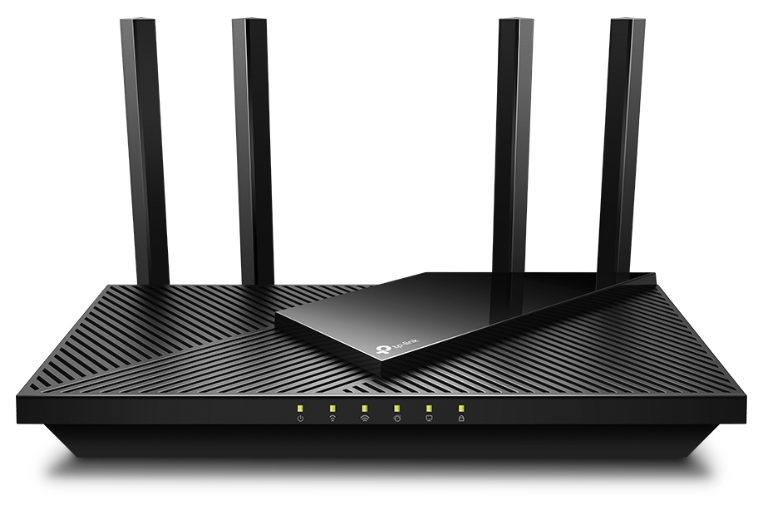
An Archer AX21 router from TP-Link. Image: tp-link.com.

For the past several years, security experts have tracked a series of massive DDoS attacks originating from Brazil and solely targeting Brazilian ISPs. Until recently, it was less than clear who or what was behind these digital sieges. That changed earlier this month when a trusted source who asked to remain anonymous shared a curious file archive that was exposed in an open directory online.

The exposed archive contained several Portuguese-language malicious programs written in Python. It also included the private SSH authentication keys belonging to the CEO of Huge Networks, a Brazilian ISP that primarily offers DDoS protection to other Brazilian network operators.

Founded in Miami, Fla. in 2014, Huge Networks’s operations are centered in Brazil. The company originated from protecting game servers against DDoS attacks and evolved into an ISP-focused DDoS mitigation provider. It does not appear in any public abuse complaints and is not associated with any known DDoS-for-hire services.

Nevertheless, the exposed archive shows that a Brazil-based threat actor maintained root access to Huge Networks infrastructure and built a powerful DDoS botnet by routinely mass-scanning the Internet for insecure Internet routers and unmanaged domain name system (DNS) servers on the Web that could be enlisted in attacks.

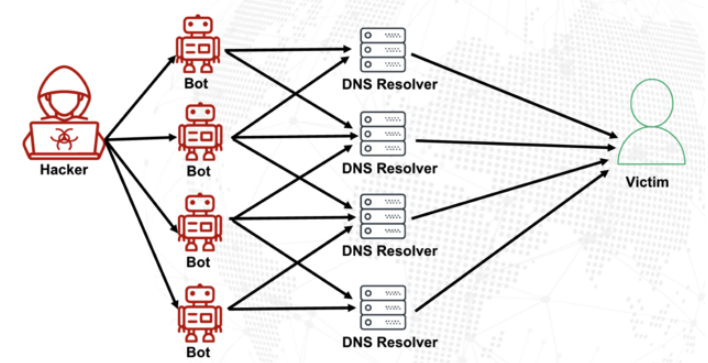
DNS is what allows Internet users to reach websites by typing familiar domain names instead of the associated IP addresses. Ideally, DNS servers only provide answers to machines within a trusted domain. But so-called “DNS reflection” attacks rely on DNS servers that are (mis)configured to accept queries from anywhere on the Web. Attackers can send spoofed DNS queries to these servers so that the request appears to come from the target’s network. That way, when the DNS servers respond, they reply to the spoofed (targeted) address.

By taking advantage of an extension to the DNS protocol that enables large DNS messages, botmasters can dramatically boost the size and impact of a reflection attack — crafting DNS queries so that the responses are much bigger than the requests. For example, an attacker could compose a DNS request of less than 100 bytes, prompting a response that is 60-70 times as large. This amplification effect is especially pronounced when the perpetrators can query many DNS servers with these spoofed requests from tens of thousands of compromised devices simultaneously.

A DNS amplification attack, illustrated. It shows an attacker on the left, sending malicious commands to a number of bots to the immediate right, which then make spoofed DNS queries with the source address as the target's IP address.

A DNS amplification and reflection attack, illustrated. Image: veracara.digicert.com.

The exposed file archive includes a command-line history showing exactly how this attacker built and maintained a powerful botnet by scouring the Internet for TP-Link Archer AX21 routers. Specifically, the botnet seeks out TP-Link devices that remain vulnerable to CVE-2023-1389, an unauthenticated command injection vulnerability that was patched back in April 2023.

Malicious domains in the exposed Python attack scripts included DNS lookups for hikylover[.]st, and c.loyaltyservices[.]lol, both domains that have been flagged in the past year as control servers for an Internet of Things (IoT) botnet powered by a Mirai malware variant.

The leaked archive shows the botmaster coordinated their scanning from a Digital Ocean server that has been flagged for abusive activity hundreds of times in the past year. The Python scripts invoke multiple Internet addresses assigned to Huge Networks that were used to identify targets and execute DDoS campaigns. The attacks were strictly limited to Brazilian IP address ranges, and the scripts show that each selected IP address prefix was attacked for 10-60 seconds with four parallel processes per host before the botnet moved on to the next target.

The archive also shows these malicious Python scripts relied on private SSH keys belonging to Huge Networks’s CEO, Erick Nascimento. Reached for comment about the files, Mr. Nascimento said he did not write the attack programs and that he didn’t realize the extent of the DDoS campaigns until contacted by KrebsOnSecurity.

“We received and notified many Tier 1 upstreams regarding very very large DDoS attacks against small ISPs,” Nascimento said. “We didn’t dig deep enough at the time, and what you sent makes that clear.”

Nascimento said the unauthorized activity is likely related to a digital intrusion first detected in January 2026 that compromised two of the company’s development servers, as well as his personal SSH keys. But he said there’s no evidence those keys were used after January.

“We notified the team in writing the same day, wiped the boxes, and rotated keys,” Nascimento said, sharing a screenshot of a January 11 notification from Digital Ocean. “All documented internally.”

Mr. Nascimento said Huge Networks has since engaged a third-party network forensics firm to investigate further.

“Our working assessment so far is that this all started with a single internal compromise — one pivot point that gave the attacker downstream access to some resources, including a legacy personal droplet of mine,” he wrote.

“The compromise happened through a bastion/jump server that several people had access to,” Nascimento continued. “Digital Ocean flagged the droplet on January 11 — compromised due to a leaked SSH key, in their wording — I was traveling at the time and addressed it on return. That droplet was deprecated and destroyed, and it was never part of Huge Networks infrastructure.”

The malicious software that powers the botnet of TP-Link devices used in the DDoS attacks on Brazilian ISPs is based on Mirai, a malware strain that made its public debut in September 2016 by launching a then record-smashing DDoS attack that kept this website offline for four days. In January 2017, KrebsOnSecurity identified the Mirai authors as the co-owners of a DDoS mitigation firm that was using the botnet to attack gaming servers and scare up new clients.

In May 2025, KrebsOnSecurity was hit by another Mirai-based DDoS that Google called the largest attack it had ever mitigated. That report implicated a 20-something Brazilian man who was running a DDoS mitigation company as well as several DDoS-for-hire services that have since been seized by the FBI.

Nascimento flatly denied being involved in DDoS attacks against Brazilian operators to generate business for his company’s services.

“We don’t run DDoS attacks against Brazilian operators to sell protection,” Nascimento wrote in response to questions. “Our sales model is mostly inbound and through channel integrator, distributors, partners — not active prospecting based on market incidents. The targets in the scripts you received are small regional providers, the vast majority of which are neither in our customer base nor in our commercial pipeline — a fact verifiable through public sources like QRator.”

Nascimento maintains he has “strong evidence stored on the blockchain” that this was all done by a competitor. As for who that competitor might be, the CEO wouldn’t say.

“I would love to share this with you, but it could not be published as it would lose the surprise factor against my dishonest competitor,” he explained. “Coincidentally or not, your contact happened a week before an important event – ​​one that this competitor has NEVER participated in (and it’s a traditional event in the sector). And this year, they will be participating. Strange, isn’t it?”

Strange indeed.

Researchers disclose vulnerabilities in IP KVMs from four manufacturers

Researchers are warning about the risks posed by a low-cost device that can give insiders and hackers unusually broad powers in compromising networks.

The devices, which typically sell for $30 to $100, are known as IP KVMs. Administrators often use them to remotely access machines on networks. The devices, not much bigger than a deck of cards, allow the machines to be accessed at the BIOS/UEFI level, the firmware that runs before the loading of the operating system.

This provides power and convenience to admins, but in the wrong hands, the capabilities can often torpedo what might otherwise be a secure network. Risks are posed when the devices—which are exposed to the Internet—are deployed with weak security configurations or surreptitiously connected to by insiders. Firmware vulnerabilities also leave them open to remote takeover.

Read full article

Comments

© Getty Images

Iran-Backed Hackers Claim Wiper Attack on Medtech Firm Stryker

A hacktivist group with links to Iran’s intelligence agencies is claiming responsibility for a data-wiping attack against Stryker, a global medical technology company based in Michigan. News reports out of Ireland, Stryker’s largest hub outside of the United States, said the company sent home more than 5,000 workers there today. Meanwhile, a voicemail message at Stryker’s main U.S. headquarters says the company is currently experiencing a building emergency.

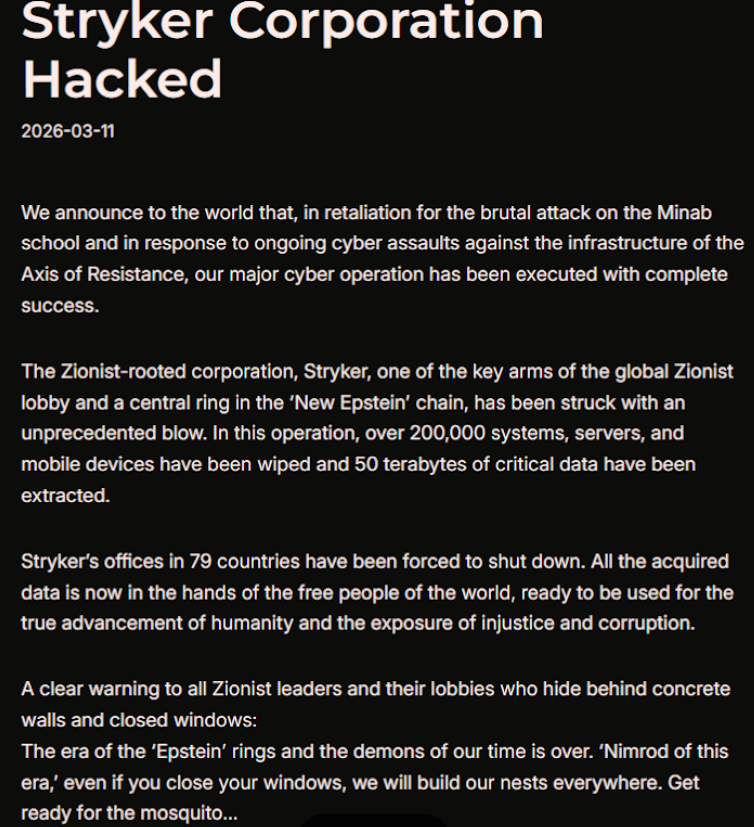
Based in Kalamazoo, Michigan, Stryker [NYSE:SYK] is a medical and surgical equipment maker that reported $25 billion in global sales last year. In a lengthy statement posted to Telegram, a hacktivist group known as Handala (a.k.a. Handala Hack Team) claimed that Stryker’s offices in 79 countries have been forced to shut down after the group erased data from more than 200,000 systems, servers and mobile devices.

A manifesto posted by the Iran-backed hacktivist group Handala, claiming a mass data-wiping attack against medical technology maker Stryker.

A manifesto posted by the Iran-backed hacktivist group Handala, claiming a mass data-wiping attack against medical technology maker Stryker.

“All the acquired data is now in the hands of the free people of the world, ready to be used for the true advancement of humanity and the exposure of injustice and corruption,” a portion of the Handala statement reads.

The group said the wiper attack was in retaliation for a Feb. 28 missile strike that hit an Iranian school and killed at least 175 people, most of them children. The New York Times reports today that an ongoing military investigation has determined the United States is responsible for the deadly Tomahawk missile strike.

Handala was one of several hacker groups recently profiled by Palo Alto Networks, which links it to Iran’s Ministry of Intelligence and Security (MOIS). Palo Alto says Handala surfaced in late 2023 and is assessed as one of several online personas maintained by Void Manticore, a MOIS-affiliated actor.

Stryker’s website says the company has 56,000 employees in 61 countries. A phone call placed Wednesday morning to the media line at Stryker’s Michigan headquarters sent this author to a voicemail message that stated, “We are currently experiencing a building emergency. Please try your call again later.”

A report Wednesday morning from the Irish Examiner said Stryker staff are now communicating via WhatsApp for any updates on when they can return to work. The story quoted an unnamed employee saying anything connected to the network is down, and that “anyone with Microsoft Outlook on their personal phones had their devices wiped.”

“Multiple sources have said that systems in the Cork headquarters have been ‘shut down’ and that Stryker devices held by employees have been wiped out,” the Examiner reported. “The login pages coming up on these devices have been defaced with the Handala logo.”

Wiper attacks usually involve malicious software designed to overwrite any existing data on infected devices. But a trusted source with knowledge of the attack who spoke on condition of anonymity told KrebsOnSecurity the perpetrators in this case appear to have used a Microsoft service called Microsoft Intune to issue a ‘remote wipe’ command against all connected devices.

Intune is a cloud-based solution built for IT teams to enforce security and data compliance policies, and it provides a single, web-based administrative console to monitor and control devices regardless of location. The Intune connection is supported by this Reddit discussion on the Stryker outage, where several users who claimed to be Stryker employees said they were told to uninstall Intune urgently.

Palo Alto says Handala’s hack-and-leak activity is primarily focused on Israel, with occasional targeting outside that scope when it serves a specific agenda. The security firm said Handala also has taken credit for recent attacks against fuel systems in Jordan and an Israeli energy exploration company.

“Recent observed activities are opportunistic and ‘quick and dirty,’ with a noticeable focus on supply-chain footholds (e.g., IT/service providers) to reach downstream victims, followed by ‘proof’ posts to amplify credibility and intimidate targets,” Palo Alto researchers wrote.

The Handala manifesto posted to Telegram referred to Stryker as a “Zionist-rooted corporation,” which may be a reference to the company’s 2019 acquisition of the Israeli company OrthoSpace.

Stryker is a major supplier of medical devices, and the ongoing attack is already affecting healthcare providers. One healthcare professional at a major university medical system in the United States told KrebsOnSecurity they are currently unable to order surgical supplies that they normally source through Stryker.

“This is a real-world supply chain attack,” the expert said, who asked to remain anonymous because they were not authorized to speak to the press. “Pretty much every hospital in the U.S. that performs surgeries uses their supplies.”

John Riggi, national advisor for the American Hospital Association (AHA), said the AHA is not aware of any supply-chain disruptions as of yet.

“We are aware of reports of the cyber attack against Stryker and are actively exchanging information with the hospital field and the federal government to understand the nature of the threat and assess any impact to hospital operations,” Riggi said in an email. “As of this time, we are not aware of any direct impacts or disruptions to U.S. hospitals as a result of this attack. That may change as hospitals evaluate services, technology and supply chain related to Stryker and if the duration of the attack extends.”

According to a March 11 memo from the state of Maryland’s Institute for Emergency Medical Services Systems, Stryker indicated that some of their computer systems have been impacted by a “global network disruption.” The memo indicates that in response to the attack, a number of hospitals have opted to disconnect from Stryker’s various online services, including LifeNet, which allows paramedics to transmit EKGs to emergency physicians so that heart attack patients can expedite their treatment when they arrive at the hospital.

“As a precaution, some hospitals have temporarily suspended their connection to Stryker systems, including LIFENET, while others have maintained the connection,” wrote Timothy Chizmar, the state’s EMS medical director. “The Maryland Medical Protocols for EMS requires ECG transmission for patients with acute coronary syndrome (or STEMI). However, if you are unable to transmit a 12 Lead ECG to a receiving hospital, you should initiate radio consultation and describe the findings on the ECG.”

This is a developing story. Updates will be noted with a timestamp.

Update, 2:54 p.m. ET: Added comment from Riggi and perspectives on this attack’s potential to turn into a supply-chain problem for the healthcare system.

Update, Mar. 12, 7:59 a.m. ET: Added information about the outage affecting Stryker’s online services.

Cibercriminosos adotam agentes de IA para lançar ataques autônomos e adaptáveis em 2025

De acordo com um estudo publicado pelo Observatório Latino-Americano de Ameaças Digitais (OLAD) em 2025, 411 ataques cibernéticos e ameaças digitais direcionados a empresas e instituições na América Latina foram documentados durante o ano passado, incluindo infraestruturas críticas como alvos, espionagem e ransomware.

À medida que os recursos de defesa de IA evoluem, o mesmo acontece com as estratégias e ferramentas de IA utilizadas pelos agentes de ameaças, criando um cenário de riscos em rápida transformação que superam os métodos tradicionais de detecção e respostas. Nesse contexto, a nova pesquisa da Unit 42, equipe de inteligência de ameaças da Palo Alto Networks, intitulada Agentic AI Attack Framework, revelou como os criminosos estão começando a usar os agentes, uma evolução da inteligência artificial que vai além da geração de conteúdo a qual, ao contrário da generativa, que se concentra na criação de texto, imagens ou código, depende somente de agentes autônomos capazes de tomar decisões, adaptar ao ambiente e executar várias fases de um ataque cibernético sem intervenção humana direta.

O relatório detalha como esses agentes podem ser programados para executar tarefas como inspeção do sistema, escrever e-mails de phishing personalizados, evitar controles de segurança, manipular conversas em tempo real e remover rastros digitais. O mais preocupante é que eles podem aprender com os erros, ajustar o próprio comportamento e colaborar entre si, o que os torna uma ameaça muito mais dinâmica e difícil de conter.

Durante os testes, a Unit 42 simulou um ataque de ransomware, desde o comprometimento inicial até a exfiltração de dados, em apenas 25 minutos, usando IA em cada estágio da cadeia de ataque. Isso representou um aumento de 100 vezes na velocidade, totalmente impulsionado por IA.

Em contraste com os ciberataques tradicionais, que normalmente seguem padrões previsíveis e exigem intervenção humana em cada estágio, os ataques agênticos podem operar de forma contínua e adaptável. Isso significa que um único agente pode iniciar uma campanha de invasão, avaliar seu progresso, modificar sua estratégia em tempo real e escalar o ataque sem a necessidade de supervisão direta. Essa capacidade de ser autônomo representa um desafio para as equipes de cibersegurança, que precisam lidar com ameaças que não são apenas mais rápidas, como também mais inteligentes e persistentes.

Esses ataques cibernéticos podem ter consequências graves para as organizações. Por exemplo, um agente mal-intencionado pode enviar e-mails falsos altamente convincentes aos funcionários para roubar senhas, se infiltrar em sistemas internos e circular pela rede sem ser detectado. Isso leva ao roubo de informações confidenciais, como dados de clientes ou planos estratégicos, ou até mesmo ao sequestro de sistemas importantes por ransomware, paralisando as operações por dias. Além do impacto econômico, esses incidentes prejudicam a reputação da empresa, geram uma perda de confiança e podem levar a sanções legais se informações pessoais ou financeiras forem comprometidas.

Preparando-se para o imprevisível: como fortalecer a segurança organizacional

Nesse cenário, as organizações precisam de uma infraestrutura de segurança avançada e adaptável. Não é mais suficiente reagir a incidentes, agora é essencial antecipá-los por meio de monitoramento contínuo, análise inteligente de dados e automação dos principais processos.

A tendência à plataformização permite que as empresas reduzam a fragmentação tecnológica, melhorem a visibilidade do próprio ambiente digital e respondam mais rapidamente a qualquer tentativa de invasão. A Palo Alto Networks, por exemplo, está fazendo algo exatamente nesse sentido, desenvolvendo uma plataforma unificada de segurança de dados que abrangerá desde o desenvolvimento de código até ambientes de nuvem e centros de operações de segurança (SOCs). Essa iniciativa busca oferecer uma visão holística da segurança e facilitar o gerenciamento centralizado de ameaças, o que é essencial diante de um cenário de ataques cibernéticos cada vez mais sofisticados.

Além disso, a adoção de arquiteturas como o SASE (Secure Access Service Edge) fortalece a postura de segurança ao estender a proteção para além do perímetro tradicional. Essas tecnologias permitem controles granulares baseados em identidade, contexto e comportamento, o que é fundamental em um ambiente em que usuários, dispositivos e aplicativos estão distribuídos. Para as organizações brasileiras, investir nesse tipo de recurso representa uma melhoria técnica, bem como uma estratégia fundamental para garantir a continuidade operacional e a proteção de ativos essenciais contra ameaças cada vez mais automatizadas e persistentes.

O Brasil, com a crescente digitalização em setores-chave, como saúde, educação e serviços públicos, se torna um alvo atraente para essa ameaça emergente. A necessidade de fortalecer as capacidades de segurança cibernética no país é urgente, especialmente em face da adoção acelerada de tecnologias digitais em todos os níveis do governo e das empresas.

Diante desse cenário, especialistas da Palo Alto Networks recomendam que as organizações brasileiras implementem soluções de segurança que integrem recursos de detecção baseados em IA, bem como programas de conscientização e resposta a incidentes que considerem esse novo tipo de ameaças automatizadas.

A evolução dos ataques cibernéticos para esquemas mais autônomos e adaptáveis exige uma resposta igualmente inovadora. Somente por meio de estratégias proativas e colaborativas será possível mitigar os riscos apresentados por essa nova era de ataques alimentados pelos agentes de IA.

Sobre a Unit 42

A Unit 42 da Palo Alto Networks reúne pesquisadores de ameaças de renome mundial, respondentes de incidentes de elite e consultores de segurança especializados para criar uma organização orientada por inteligência e pronta para responder, apaixonada por ajudar a gerenciar o risco cibernético proativamente. Juntos, nossa equipe atua como seu consultor de confiança para ajudar a avaliar e testar controles de segurança contra as ameaças certas, transformar estratégias de segurança com uma abordagem informada sobre ameaças e responder a incidentes em tempo recorde para que você possa voltar aos negócios mais rapidamente. Visite paloaltonetworks.com/unit42.

Sobre a Palo Alto Networks

Como líder global em segurança cibernética, a Palo Alto Networks (NASDAQ: PANW) tem o compromisso de proteger nosso modo de vida digital por meio de inovação contínua. Com a confiança de organizações em todo o mundo, fornecemos soluções de segurança de ponta a ponta baseadas em IA em redes, nuvem, operações de segurança e IA, capacitadas pela inteligência e experiência em ameaças da Unit 42. Nosso foco na plataformização permite que as empresas simplifiquem a segurança em escala, garantindo que a proteção impulsione a inovação. Saiba mais em www.paloaltonetworks.com.

CVEs Targeting Remote Access Technologies in 2025

The exploitation of vulnerabilities targeting remote access technologies to gain initial access is continuing relentlessly also during 2025, with initial access brokers, and in general opportunistic and targeted threat actors, quite active in leveraging software flaws to break into organizations.
❌